

Sample Category Title
How the Coming Fed Hiking Cycle Will Differ – and Why it Matters
With a Fed hiking cycle starting soon, we look at what previous hiking cycles looked like and how the current situation compares. In a coming paper we will look at how markets have fared during previous hiking cycles and what to expect in this cycle.
We see some key differences in the current situation compared to previous hiking cycles. Most importantly, the Fed looks to be a lot behind the curve, which calls for more front-loaded tightening than normal.
Another key difference important for not least bond markets is, that the yield curve is unusually flat in comparison with previous rate take-offs. We thus expect to see outright selling of bonds by the Fed ('active' QT) as part of the tightening in order to postpone an inversion.
This is unchartered territory for hiking cycles and in our view adds upside risk to long bond yields. It also supports the case for higher risk premia in risk markets.
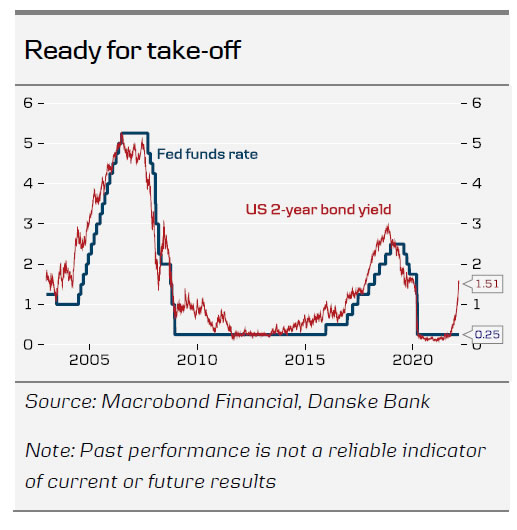
Stylized facts about hiking cycles
When looking at the previous hiking cycles, we choose to only include the past 30 years as for example inflation expectations were much less anchored before that (see chart). It provides us with four hiking cycles in total 1994-95, 1999-2000, 2004-06 and 2016-2018). The chart on page 2 shows the cycles with stats on length, hikes per year etc. Here is a summary of the key findings:
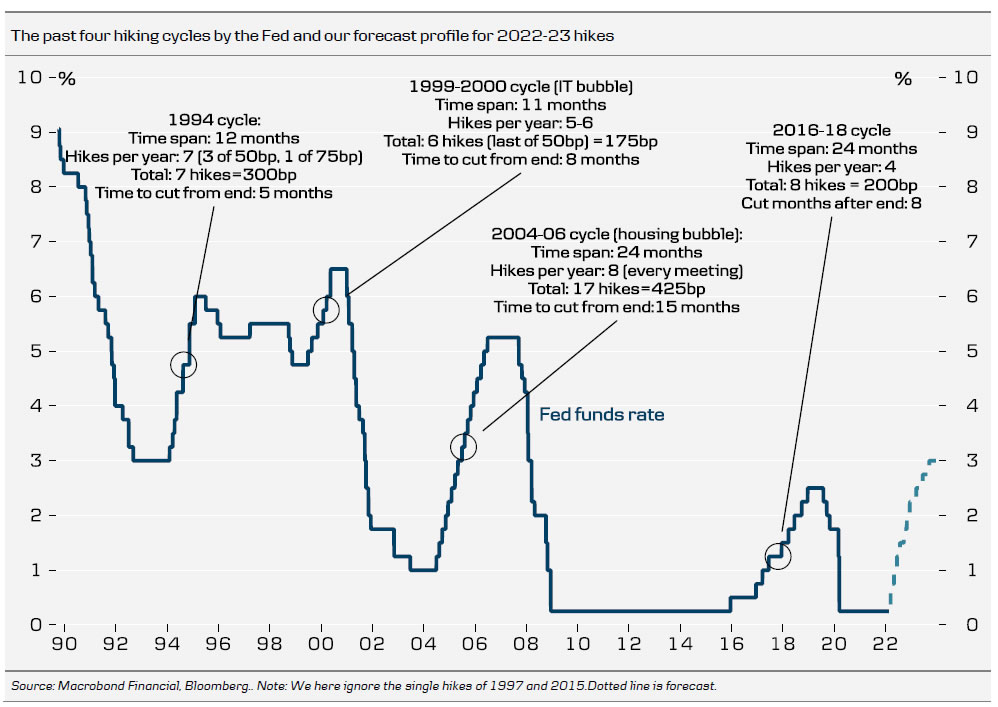
- Hiking cycles have lasted 1-2 years (longest was 24months, shortest 11 months)
- Policy rates were cut within 8 months from the last hike in three cases and 15 months after in one case (2004-06 cycle). In two of the four cycles, the US was in recession within a year from the last hike. In both cases, though, it followed asset bubbles (in 2001 the IT bubble and in 2007 the housing bubble).
- It is more than 20 years ago the Fed has hiked rates by 50bp (changes of 50bp are much more common in rate cut cycles).
- The Fed has not started a hiking cycle with 50bp since the 1980's.
- The most recent 2016-18 cycle was the 'softest' path. The Fed hiked four times per year and 25bp at each meeting (we here ignore the lonely hike in December 2015).
- The 2004-06 hiking cycle was the longest. It lasted 25 months and the Fed hiked 25bp at each meeting for 17 meetings in a row. They described it as 'measured pace'.
- The shortest cycle was the 1999-2000 cycle that lasted 7 months (total hikes of 175bp).
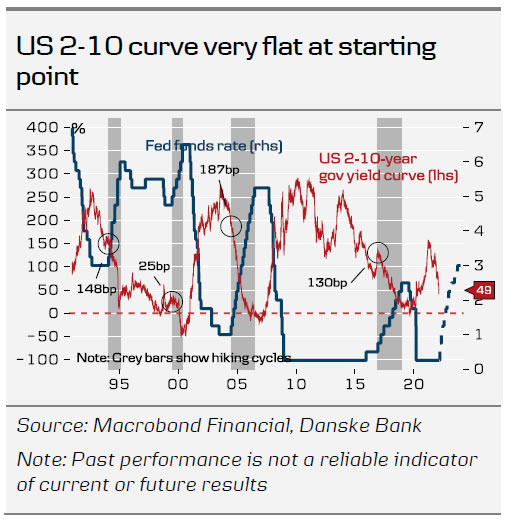
How the starting point of the current cycle differs from previous cycles
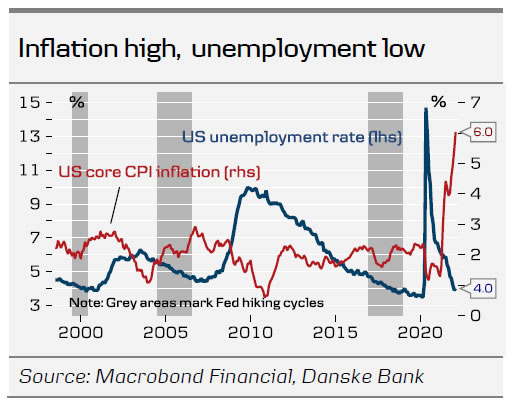
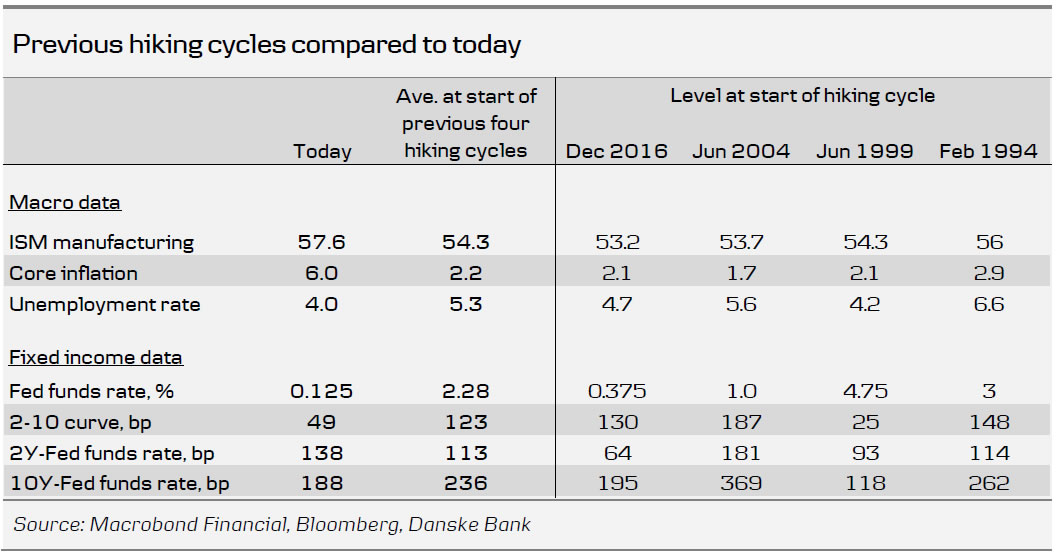
In the table on page 3, we compare the current situation with the starting point of previous hiking cycles in terms of the economy and fixed income markets. Some key differences sticks out:
First, it is clear that the Fed this time takes action much later than usual and surely looks to be behind curve (this was also highlighted in Fed Update – We expect a total of 200bp this year starting with 50bp in March, 14 February 2022). Compared to previous cycles, core inflation is much higher, unemployment is lower and ISM manufacturing is higher, see also Fed Update – Different economy, different hiking cycle – a comparison with December 2015, 3 February 2022. In the Fed's defence, the situation has been extraordinary due to the pandemic and inflationary pressures were underestimated by most forecasters, including ourselves. In addition, employment is still 2% below the level before the pandemic suggesting labour markets have not healed despite labour shortages. However, the Fed no longer has the luxury of being patient with inflation overshooting every month and unemployment now at very low levels. It also seems increasingly likely that permanent damage has been done to potential GDP with fewer workers returning to the labour force than expected.
Second, the Fed is starting from the lowest level ever as rates are close to zero. The Fed did hike from a similar level in December 2015 but it turned out to be a lonely hike and in hindsight looks like a policy error. We have not included it here as it never became an actual cycle.
Third, the 2-10 curve (around 46bp currently, is very flat compared to the start of previous cycles. During the past 30 years the curve was only more flat at the start of a hiking cycle in 1999 (25bp) but back then, the cycle also started with the Fed funds rate at 4.75%. In 2004 the 2-10 curve was at 187bp when the first hike was delivered and in 2016 it was at 130bp.
Implications of the different starting point
We believe these differences has some important implications for this hiking cycle:
- The hiking cycle should be more front-loaded in order for the Fed to catch up with what it is behind the curve. This is why we look for the Fed to begin the cycle with a 50bp hike (for the first time since the 1980's) and follow through with hikes at every meeting in 2022. It is around 50bp more hikes than what the market is currently pricing.
- 'Active quantitative tightening (QT)' will, in our view, be seen for the first time ever. That is, the Fed is likely to sell bonds outright to reduce the balance sheet, starting in May in our view. In the previous hiking cycle, the Fed only did what we call 'passive QT' and reduced the balance sheet by not reinvesting proceeds from bonds that expired. Without 'active QT' the Fed could very well see an inversion of the 2-10 curve very early in the hiking cycle, because the starting point is a very flat curve to begin with. An inversion has historically been a leading indicator of recession and we believe the Fed will aim to postpone an inversion as long as possible. Several FOMC members have already expressed concern over a possible inversion. They can work to avoid this by selling longer bonds.
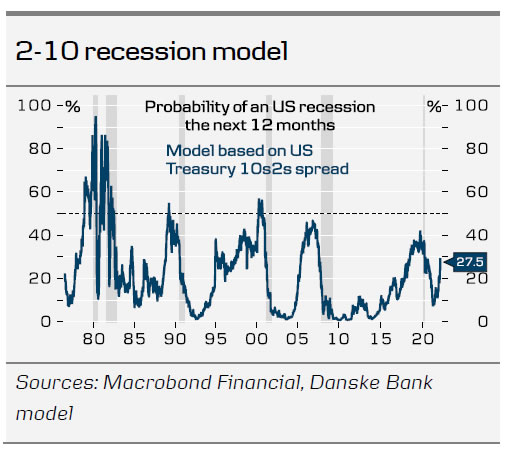
The above features highlights that we are indeed entering unchartered territory when it comes to Fed tightening cycles. We will follow up soon with a paper on what the financial implications are likely to be but all else equal, we see a case for more upward pressure on longer yields on the back of 'active QT' and for higher risk premia in risk assets because of the unchartered path the Fed is embarking on.
Businesses Investment Plans to Rise Despite Omicron Disruptions
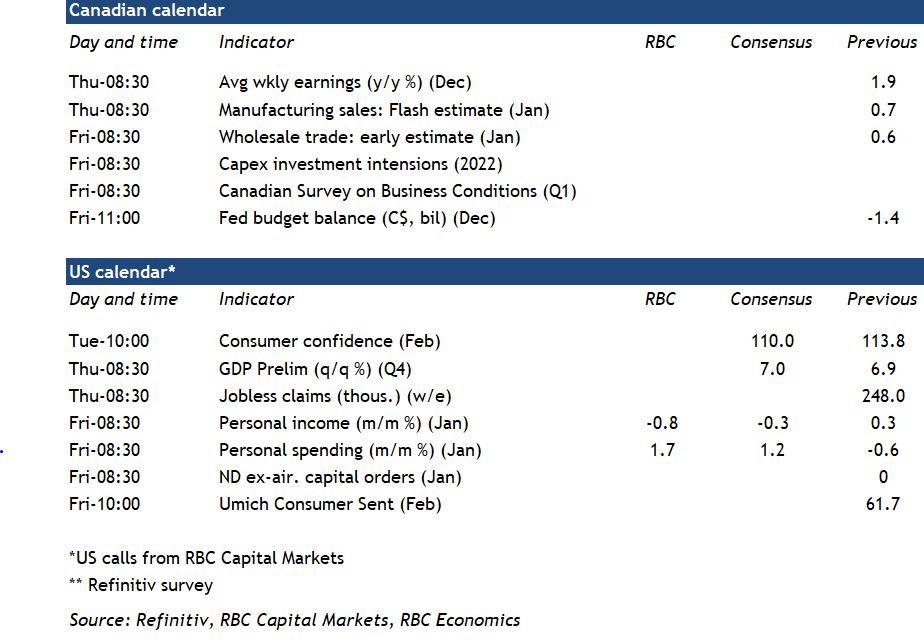
January manufacturing sales will likely look substantially weaker in Statistics Canada’s preliminary estimate for the month. The rapid spread of the Omicron variant kept many workers at home, either due to illness or self-isolation. Indeed, over 10% of manufacturing workers were absent from work due to illness in January and hours worked fell 3.3%. We expect this disruption to be temporary and look for a quick recovery starting in February as the rise in COVID cases slows. What’s more, early signs are that travel and hospitality spending are bouncing back as government restrictions ease. That sets the stage for a broader resumption in activity following an ugly-looking round of economic data last month.
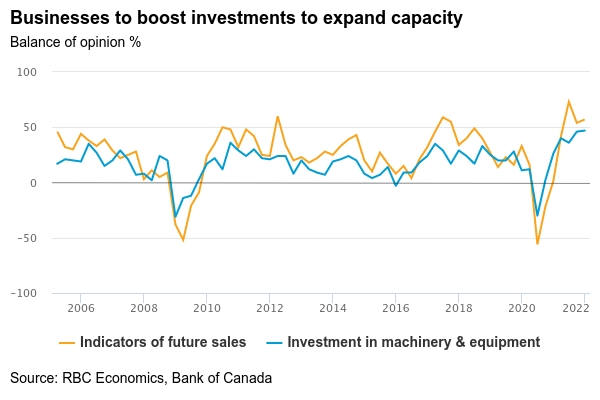
The latest Canadian Survey on Business Conditions (CSBC) will be released Friday. It was conducted from January 4 to February 7, when Omicron was spreading quickly through the population. Still, most firms are likely to have anticipated a rise in sales while acknowledging that capacity pressures and high input costs remain significant issues. In the Bank of Canada’s Business Outlook Survey (BOS), over 75% of firms reported they would have difficulty filling an unexpected increase in orders. Global supply chain pressures are making those challenges worse. And tight labour markets (with more job vacancies than can be filled with the available workforce) represent a production constraint that won’t end with the pandemic. That has pushed business investment intentions higher. We expect the annual Business CAPEX intentions survey to echo increased investment plans (particularly for machinery & equipment) in the BOS as firms rush to expand output.
Week ahead data watch:
- Canada’s alternative labour market SEPH and job vacancy survey will likely record elevated levels of unfilled jobs in December, particularly within the hospitality and retail sectors. Labour markets deteriorated in January, but are expected to bounce back in February.
- U.S. personal spending is expected to tick higher, supported by a 3.8% surge in retail sales that more-than-retraced a 2.5% drop in December.
Week Ahead: 21 February 2022
It has been yet another week dominated by events unfolding in Ukraine. While there have been some reports of de-escalation in tensions, nothing has changed fundamentally to prevent investors from remaining fearful about a possible Russian invasion. So, investors have been seeking protection in haven assets like gold, not only because of the situation in Ukraine and heightened stock market volatility but because of surging inflationary pressures around the world, too. The precious metal climbed to $1900 for the first time since June, while stocks markets slumped after a positive start to the week.
So, key questions remain unanswered on the Russia-Ukraine tensions. But beyond this, investor sentiment is likely to remain downbeat anyway given concerns about surging inflationary pressures around the world and policy tightening from the Fed. This should keep the pressure on the stock markets, with the S&P 500 having broken below its 200-day moving average. Meanwhile, the technology-heavy and interest-rate-sensitive Nasdaq 100 is bearing the brunt of the sell-off. Safe-haven flows into gold is on the rise, and this is something we expect to continue in the week ahead. Investors are seeking to protect their purchasing powers from being eroded by inflation damaging the values of fiat currencies.
Key economic highlights
As we look forward to a new week, the market is likely to remain pretty much headline-driven and investors will unlikely pay much attention to macro data. There will be a couple of exceptions. For example, on Wednesday when we have a rate decision from the RBNZ and Friday when the Fed’s favourite inflation measure is published: core PCI price index.
Monday
- Flash Services and Manufacturing PMIs from UK, Germany, France and Eurozone
- US bank holiday in observance of Presidents' Day
The first day of the new week will all be about those manufacturing and services PMIs, as they will provide us with the latest indication of economic health. In addition to information about the overall health of these sectors, we will get clues about new orders, employment and more to the point, prices for both goods and services. Investors are watching inflation data like hawks and any surprise readings here should move the markets. The PMI data often provides the most up-to-date and relevant insight into the companies’ view of the economy.
Tuesday
- German Ifo Business
- US Consumer Confidence (CB), Flash Services and Manufacturing PMIs and S&P/CS House Price Index
It will be a relatively quieter week for global macro pointers, but it is worth keeping a close eye on US housing data. With inflation surging in recent weeks, consumer’s disposable incomes have likely suffered. Meanwhile, the Fed is going to raise interest rates multiple times this year. This is already pushing up mortgage costs, albeit from historically low bases. Still, should rates rise further, delinquencies might become more common, hurting sales of homes.
Wednesday
- RBNZ
It is unusually very quiet in terms of major data on Tuesday and Wednesday, with the exception being the Reserve Bank of New Zealand policy decision. The RBNZ is expected to hike rates by 25 basis points to 1.00% from 0.75% currently.
Thursday
- US Preliminary GDP, unemployment claims and new home sales
- Central bank speeches: BOE Gov Bailey and Fed’s Mester
- New Zealand retail sales
- US Core PCE Price Index, personal income and spending
Without a doubt, Friday’s release of PCE Price Index measure of inflation will be the highlight of the week’s data releases. Analysts are expecting to see another 0.5% rise in the month-over-month figure to take the yearly rate to 4.8%, which, if correct, will actually be a tick lower than the previous reading of 4.9%. But as we have seen from the CPI and RPI data, inflation has had a tendency to surprise to the upside of late.
Chart to watch: Gold
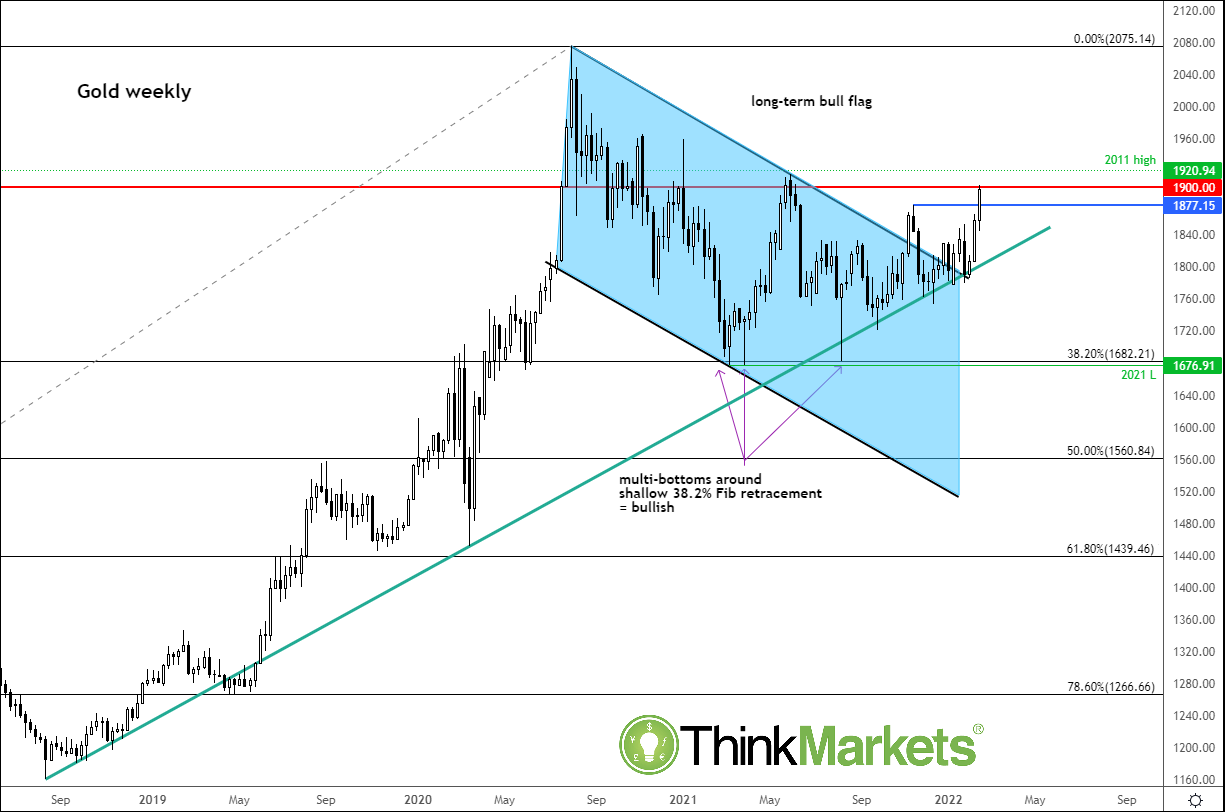
Source: ThinkMarkets and TradingView.com
As mentioned, gold has been shining brightly of late for the macro reasons listed above. Gold has also found buyers because of its technical breakout from the consolidation range it had been stuck inside for several months. The breakout has potentially cleared the way towards $2000, although the 2011 high at $1920 will be the first bullish target.
RBNZ Policy Decision: Selling the News or a Bullish Surprise?
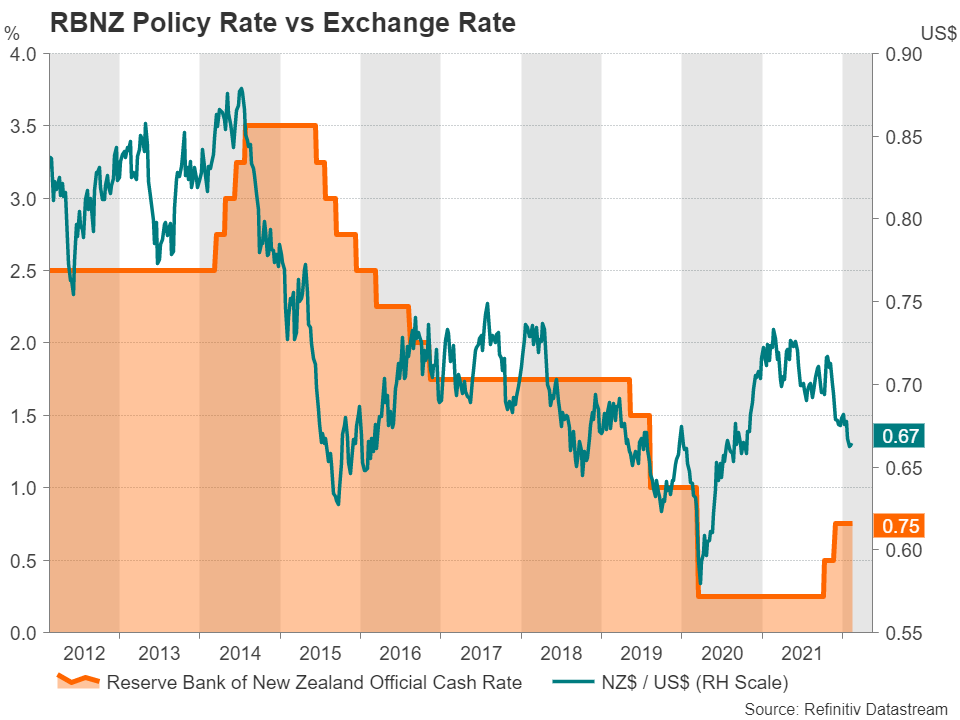
The Reserve Bank of New Zealand, the current king of the global tightening cycle, is expected to deliver its third rate hike in five months with full certainty when its policy meeting concludes on Wednesday at 01:00 GMT. Despite that, the kiwi remains a laggard in the FX space, losing more than 2.0% against the US dollar year-to-date, and if someone believes that the policy decision will change its fortunes this time, they’d better not hold their breath.
Interest rates to rise to pre-pandemic levels
Investors are certain the RBNZ will hike its interest rate up to 1% as inflation has gone through the roof to top at a three decade high of 5.9% y/y in the last quarter of 2021. The central bank aims to cool inflation back to the midpoint of its 1-3% range target, and it was the first among its major counterparts to set its plan into action, ending its quantitative easing program last July and raising interest rates twice by 25 bps each time in October and November to 0.75%.
More rate hikes to come
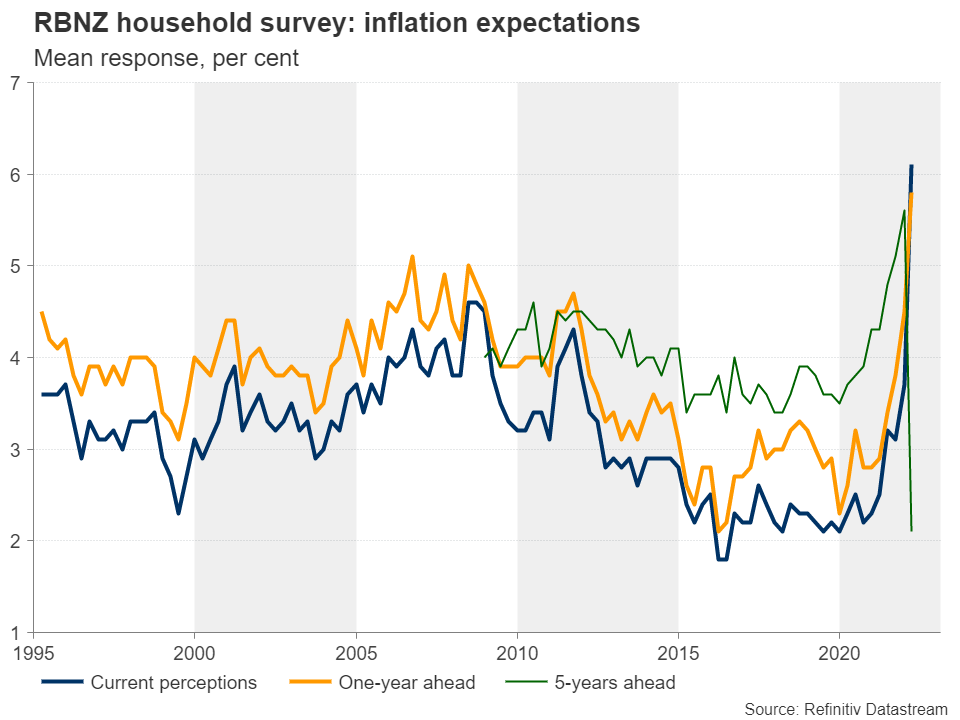
However, more is still needed to be done as the evidence from around the world suggests supply chain constraints continued to heat inflationary pressures at the start of the new year, while the latest survey conducted by the RBNZ showed one-year and two-year inflation expectations picking up steam above 3.0%. Perhaps the high mortgage rates brought some results in the hot housing market, making house prices and sales volumes decelerate in January according to the latest REINZ property report, though policymakers will probably require a more convincing slowdown and they will not hesitate to tighten their policy further until they get the job done.
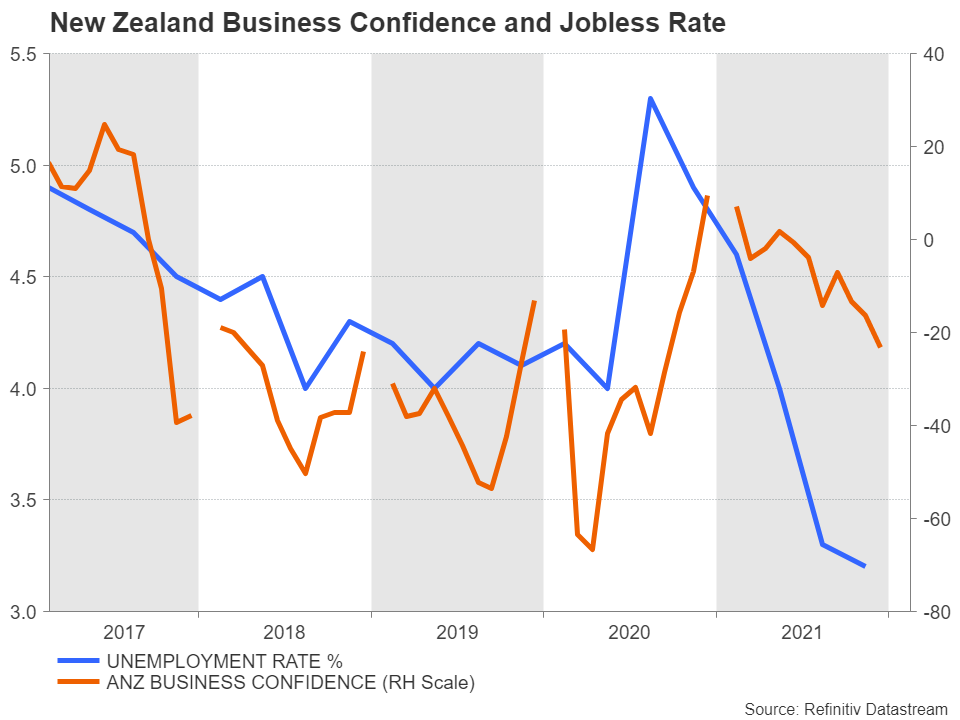
Futures markets are currently fully pricing in six more rate hikes by October, while they largely expect borrowing costs to rise to 2.5% by November 2022. Fundamentally, the economic picture is not too bright. Closing its borders to foreign investors, the government has limited the supply of imported labor, pressing the unemployment rate to a historic low of 3.2% during the December quarter, but that has consequently worsened labor shortages and created wage pressures.
GDP data mirrored a contracting economy during the third quarter, while indicators from the last three months of the year showed retail sales returning to the negative area and business confidence plunging. Adding to the latter, even if dairy prices jumped to record highs recently because of the pandemic disruptions and stricter environmental regulations, farmers used the extra cash for debt repayment instead of reinvesting the money in their businesses. Probably that could further weigh on production in the year ahead.
Communication will matter
Having its first policy meeting since November and scheduled to meet again in just under two months from now, the RBNZ’s outlook on the economy and its market communication could provide fresh direction to traders for the new year. However, given the growth uncertainty and fears of not panicking investors as geopolitical tensions across the Ukrainian border remain elevated, the central bank will probably stick to the steady pace of 25 bps rate increases to mitigate the inflation risk as other central banks have done so far, disappointing those who expect a larger 50 bps rate hike.
NZD/USD
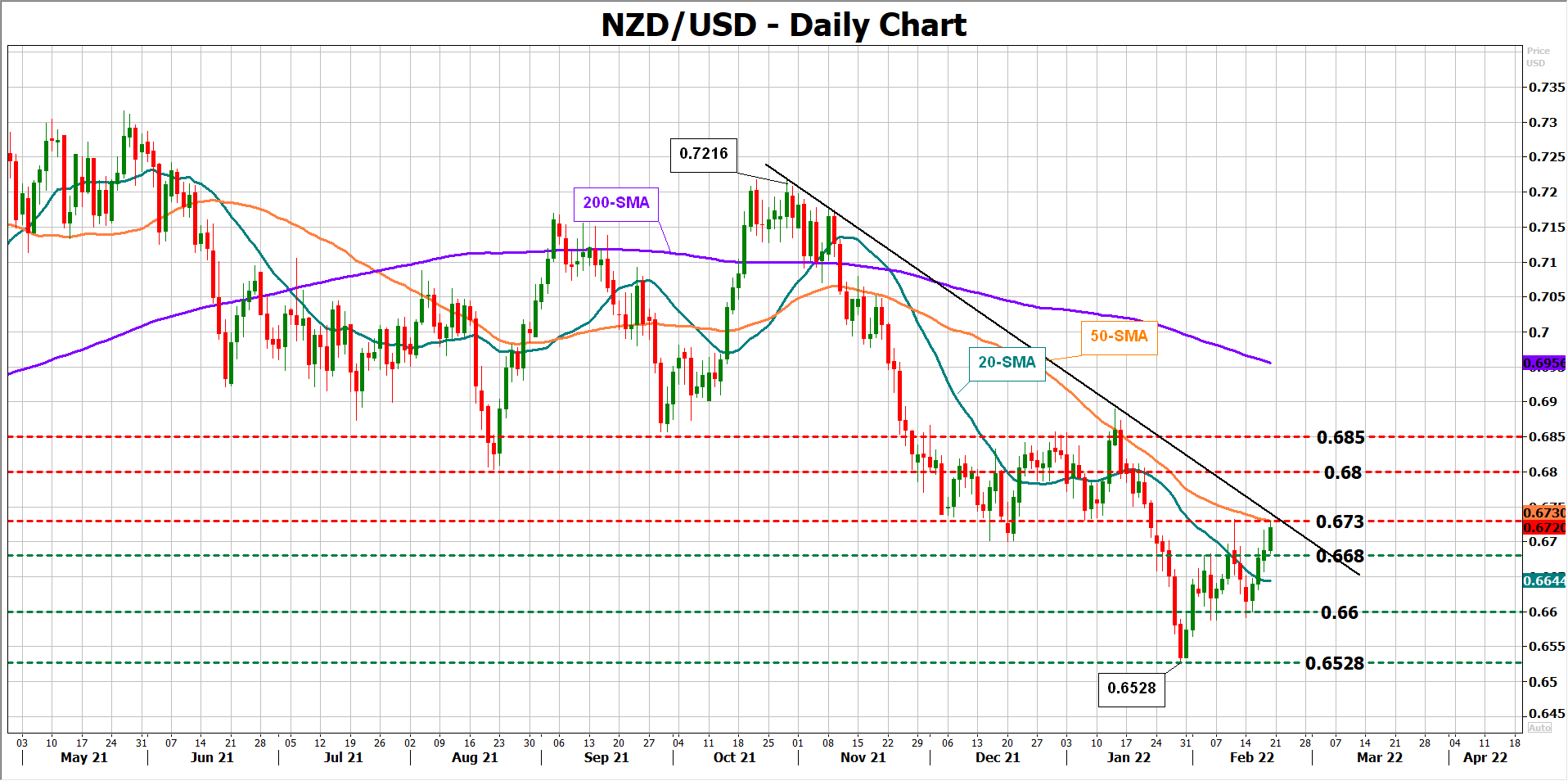
Hence, unless the RBNZ brightens the foreseeing future of the New Zealand economy or raises the stakes for a faster monetary tightening, the policy announcement itself may not be a big surprise to investors, and it could even be a classic case of selling the news. If this turns out to be the case, kiwi/dollar may miss a clear trendline breakout above 0.6730 and its 50-day simple moving average (SMA), flipping backwards to seek support near the familiar 0.6600 support band. A steeper downfall could even threaten an outlook deterioration below the 15-month low of 0.6528.
Should the central bank remain confident in the economy, signalling that it is ready to use all options to ease inflation to the target level, including a steeper pace of rate of increases, kiwi/dollar could violate the 0.6730 border and run up to the 0.6790 – 0.6800 resistance zone. Beyond the latter, the rally could head for a test within the 0.6870 – 0.6900 barrier.
Otherwise, the commodity-dependent New Zealand currency may remain exposed to the dollar volatility.
Eurozone PMIs Could Decide the ECB’s Next Move
The latest PMI business surveys from the euro area will be released early on Monday, starting with the French numbers at 08:15 GMT. Inflation has fired up and the jobs market is healing quickly, pushing the European Central Bank to signal that rate increases are coming. The timing remains uncertain though, so the upcoming data could be crucial in shaping market expectations and thus driving the euro.
Heating up
There’s a raging debate in market circles around the ECB’s next move. Even though there’s still a long way to go, the Eurozone economy has improved dramatically, with the unemployment rate reaching its lowest level since 2007 and inflation rising at the fastest pace since the euro came into effect.
And while economic growth hasn’t been impressive, the good news is that fiscal spending will continue to trickle in throughout the year, as the European recovery fund money is still being distributed to member states. This is in contrast to America, where all the government spending was frontloaded last year and the fiscal taps are now closing.
As such, the ECB has started to take baby steps towards higher interest rates. At its latest meeting, President Lagarde did not rule out raising rates this year and hinted that asset purchases could be reduced faster than previously signaled. Markets are currently pricing in two rate hikes by December and there’s speculation about ending asset purchases completely by the third quarter.
The missing ingredient for the ECB to turn even more confident is wage growth. A strong acceleration in wages would suggest that ‘organic’ inflationary pressures are starting to fire up, so inflation might persist even after supply chains correct. Hence, the upcoming PMI surveys will be watched closely - are businesses ‘complaining’ they have to pay higher salaries?
PMIs set to improve
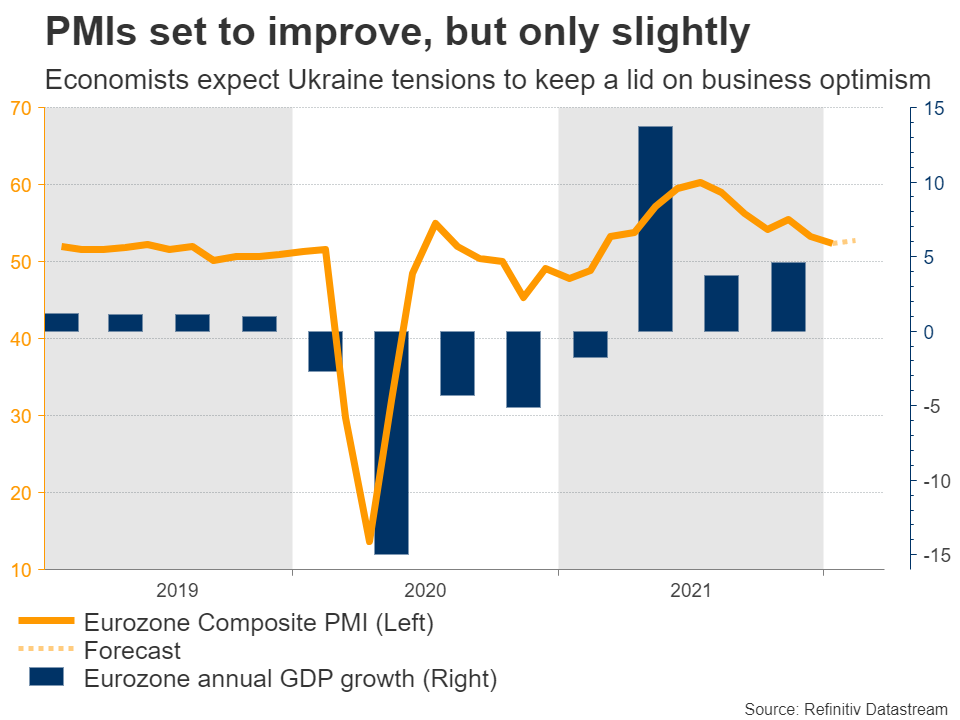
With the measures to fight the Omicron wave being lifted in most countries, the PMIs are expected to rise in February, albeit only slightly. The composite index for the entire Eurozone is projected at 52.7, up from 52.3 in January but nothing to write home about. Economists seem to expect the tensions in Ukraine to have kept a lid on business confidence.
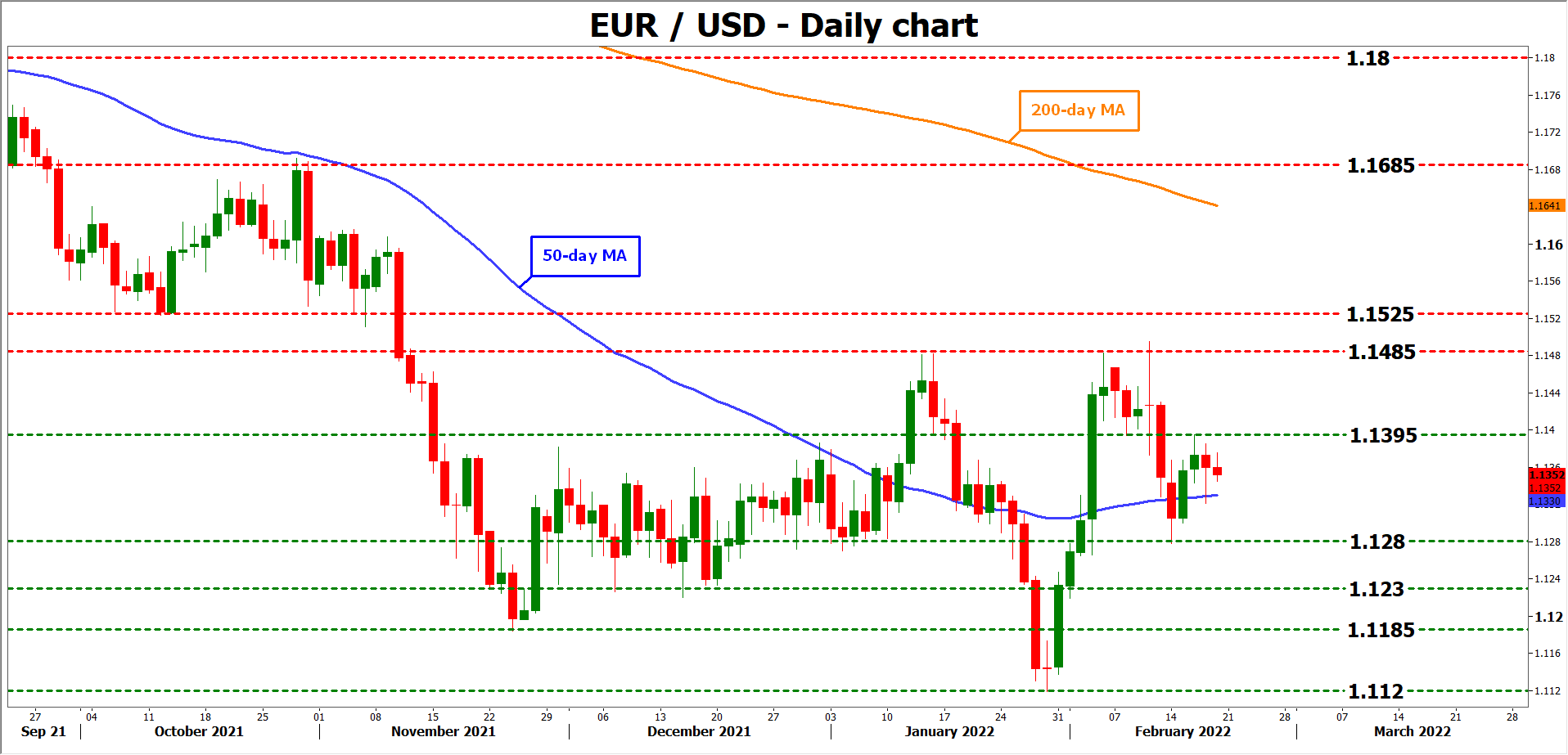
The initial reaction in the euro will depend on any surprises in these numbers. Taking a technical look at euro/dollar, a positive surprise could send the pair above the 1.1395 zone, turning the focus towards the 1.1485 region.
On the other hand, a disappointment might see the bears test the 1.1280 level, where a violation could open the door towards 1.1230.
Euro outlook
In the bigger picture, the euro has been entirely at the mercy of risk sentiment lately as markets grapple with the threat of war in Ukraine. This could have tremendous repercussions for the Eurozone as most nations would have to impose sanctions on Russia if it does invade, which could backfire by pushing energy prices higher.
There are other risks too, for example President Macron losing the upcoming presidential election in France to a Eurosceptic or the Italian bond market going berserk now that the ECB is taking away the ‘medicine’.
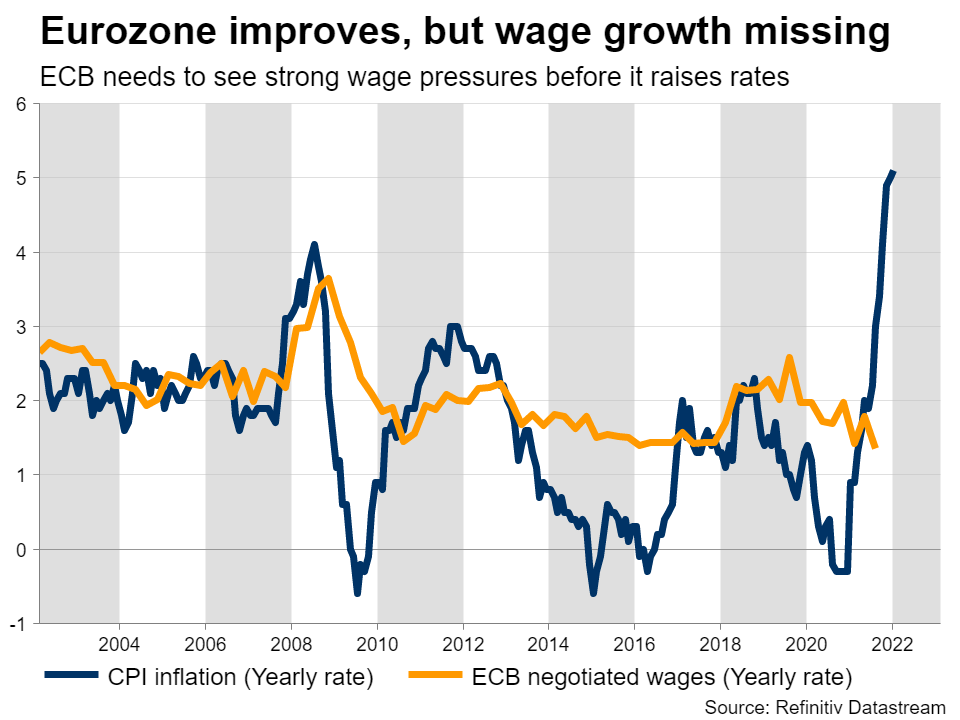
But the second half of the year could be a different story for the euro. If European wages start to show signs of life and political risks fade away, that could be a recipe for a relief rally, especially if that coincides with ‘peak inflation’ in America and traders dial back their aggressive Fed bets.
It might take a while to get there, but the longer term picture for the euro is starting to improve.
Week Ahead – PCE Inflation, Flash PMIs, RBNZ Meeting Lined Up as Ukraine Tensions Linger
The Reserve Bank of New Zealand is poised to raise interest rates for a third time next week. But will it pull the 50 basis points trigger this time, setting a precedent for other central banks? In a week where PCE inflation numbers will be in focus in the United States, the RBNZ’s actions could have rippling effects for Fed policy speculation. Elsewhere, the flash PMI readings for February will be the centre of attention as consumers face a growing spending squeeze from spiralling inflation just as Omicron restrictions are being lifted in many places.
Will the RBNZ get the 50bps ball rolling?
New Zealand’s central bank got an early start on rate hikes, raising the official cash rate consecutively at the October and November meetings. It’s widely anticipated to become three in-a-row when policymakers meet on Wednesday. However, what’s not a done deal is whether they will opt for 25 or 50 bps. Inflationary pressures are brewing in New Zealand amid red-hot hot property and labour markets on top of the global supply-chain related price spikes.
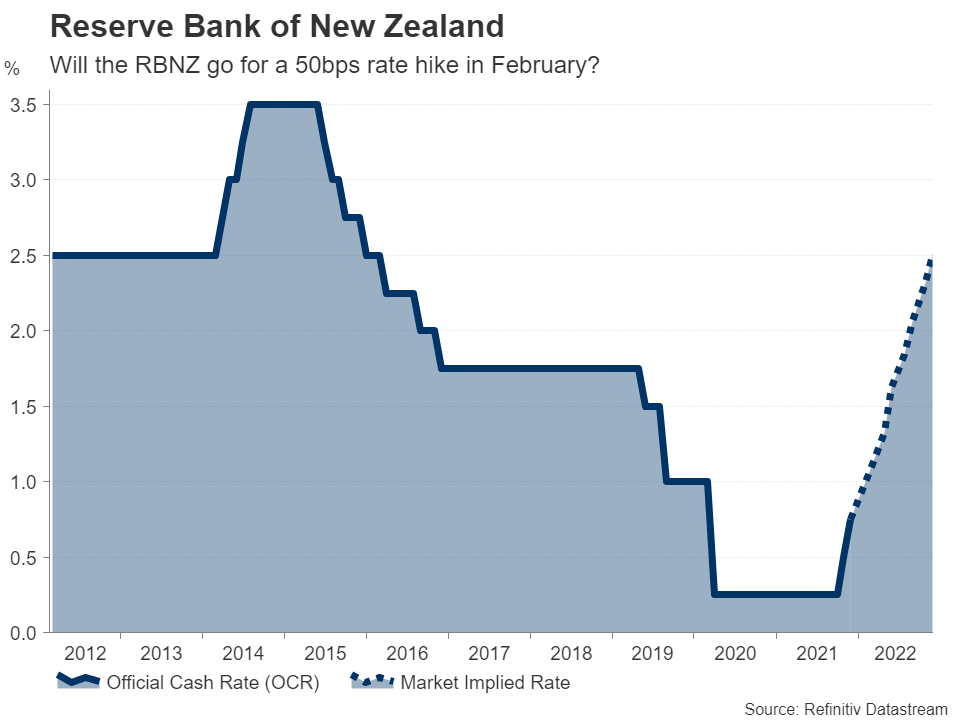
Money markets see only about a 30% probability of a 50-bps increase so should the RBNZ confound expectations and deliver a double hike, the New Zealand dollar would likely enjoy a mini rally, extending its current rebound against the US dollar.
On Thursday, quarterly figures on retail sales might attract some attention too.
Wage data eyed in Australia
Over in neighbouring Australia, the Reserve Bank of Australia is becoming increasingly open to the idea of a rate rise in 2022. One of the criteria that the RBA is looking for to bring forward its rate hike timeline is higher wages. Thus, the wage price index for Q4 that’s out on Wednesday could be a crucial piece in the jigsaw for policymakers when it comes to assessing the immediate risks from higher inflation.
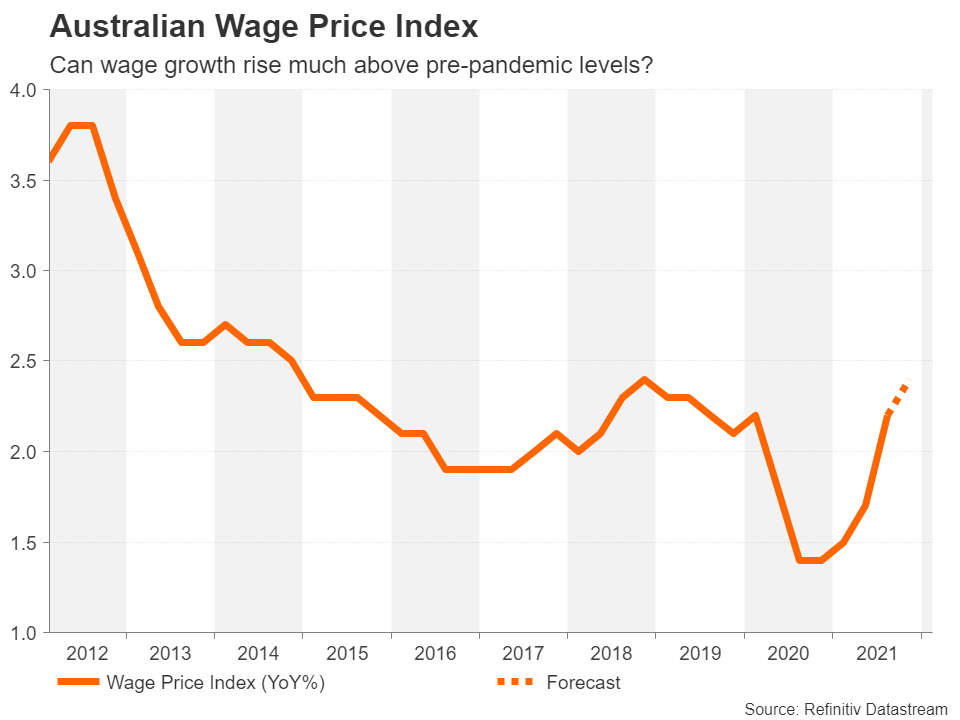
Ahead of the wage growth numbers, the flash manufacturing and services PMIs for February are due on Monday. The run of data will continue on Thursday with the capital expenditure estimate for the fourth quarter.
The Australian dollar has bounced back impressively from the 18-month lows it plumbed less than a month ago. If the wage figures underscore the subdued picture, the aussie will have a hard time maintaining its positive posture.
Eurozone PMIs likely improved in February
Another central bank that recently had to perform a U-turn on the possibility of a raising rates in 2022 is the European Central Bank. The final reading of euro area CPI due Wednesday is expected to confirm that inflation in the bloc hit 5.1% in January.
The ECB has so far been relaxed about the jump in the CPI prints, blaming it almost entirely on the surge in energy prices, being mindful of the fragile recovery in Eurozone economies. However, with Omicron-induced virus curbs being gradually ditched in more and more member states, the flash PMIs due on Monday are expected to point to an uptick in economic activity in February.
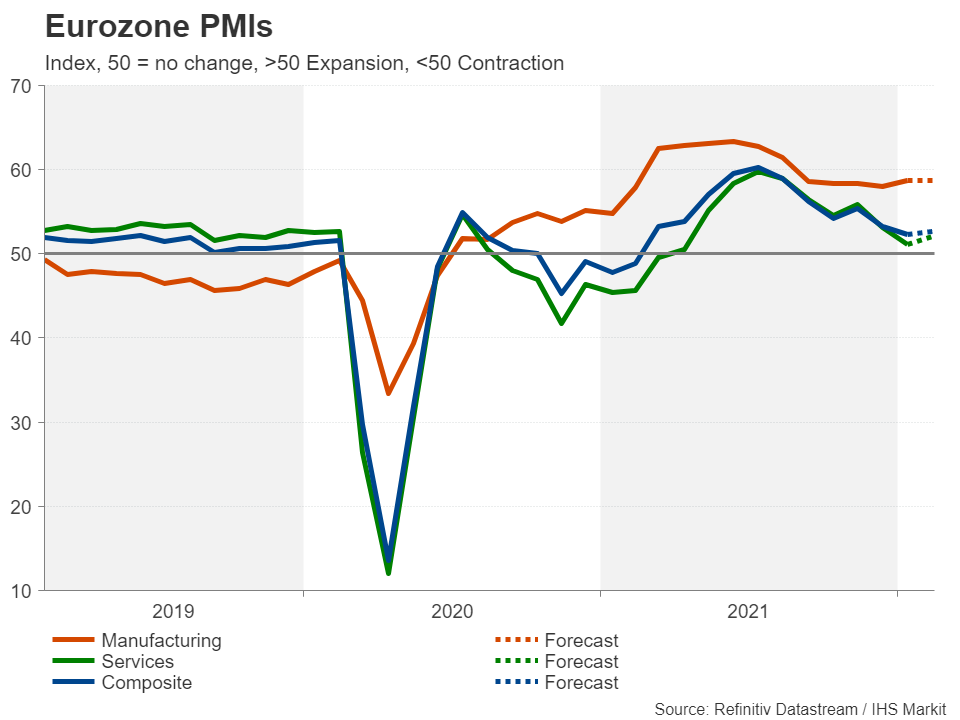
There is a danger, though, that the PMIs may be weighed by weakening household spending as soaring inflation squeezes disposable incomes, while business confidence is dented by the escalating frictions between Russia, Ukraine and the West. But these are low economic risks for the moment that could become a lot more prominent in the future.
If the PMI surveys fail to provide much clarity, investors will also be treated to the German Ifo Business Climate gauge on Tuesday and the Eurozone economic sentiment indicator on Friday.
The flash PMIs will be front and centre for sterling as well, as there’s no other major release out of the United Kingdom next week.
Euro shaken by Ukraine standoff
However, as geopolitical tensions come to a boil, the data might play second fiddle for the euro next week.
Diplomatic efforts by European leaders to diffuse the hostilities between Russia and Ukraine have so far failed and the threat of a war remains alarmingly high. The heightened tensions have been a boon for gold, as well as for safe haven currencies like the yen and Swiss franc, and to a lesser extent, the US dollar.
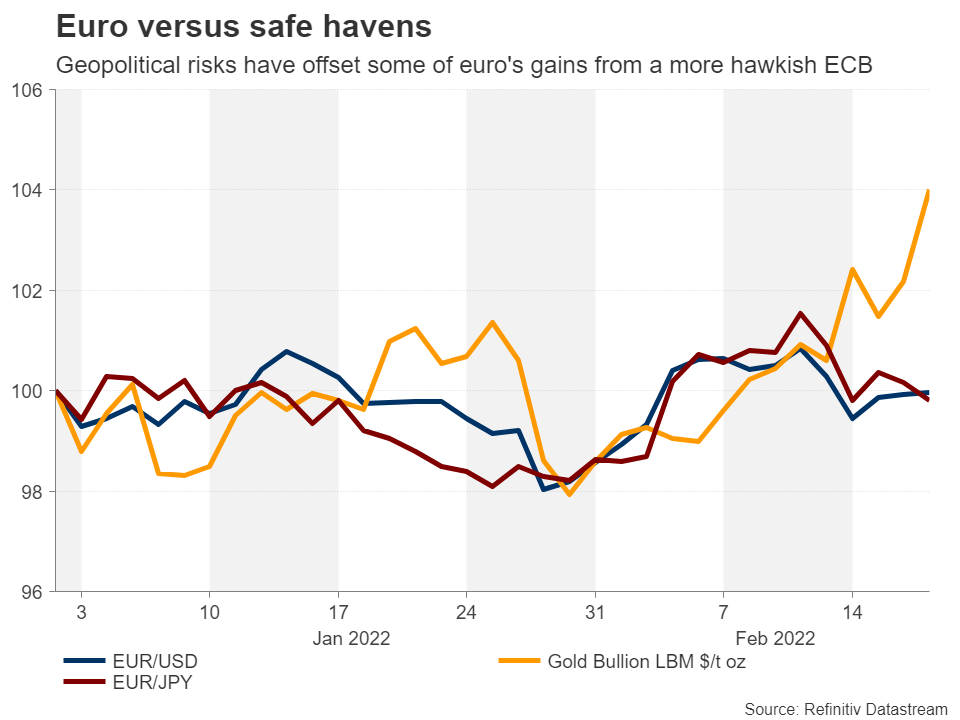
On the other hand, the euro’s rebound has faltered and further tumbles are possible if the tense standoff turns to a military confrontation. There can be no doubt that the United States would impose tough sanctions on Russia should President Putin go down the military route. A conflict and subsequent sanctions would not only come at a huge economic cost for Russia, but it could be damaging for the Eurozone economy too as the energy crisis would likely only worsen in such a scenario.
Although this would also mean the ECB would have to move quicker in normalizing policy, it would be doing so in a less favourable environment so the euro would probably not get the boost it would otherwise have gotten.
Can PCE inflation bolster the dollar?
In the US, however, there will be no shortage of data, though markets will be shut on Monday for Presidents’ Day. But the week will get into full gear on Tuesday with the flash PMIs and consumer confidence index for February. On Thursday, the second estimate of fourth quarter GDP is forecast to be revised a nudge higher to 7.0%.
New home sales are also out on Thursday, to be followed by pending home sales on Friday, as well as durable goods orders for January.
But the main highlight on Friday and for the week will be the PCE report, which should shed some light on how well consumption held up in January and whether the price pressures in the Fed’s preferred inflation metric remained as elevated as they did in the consumer price index.
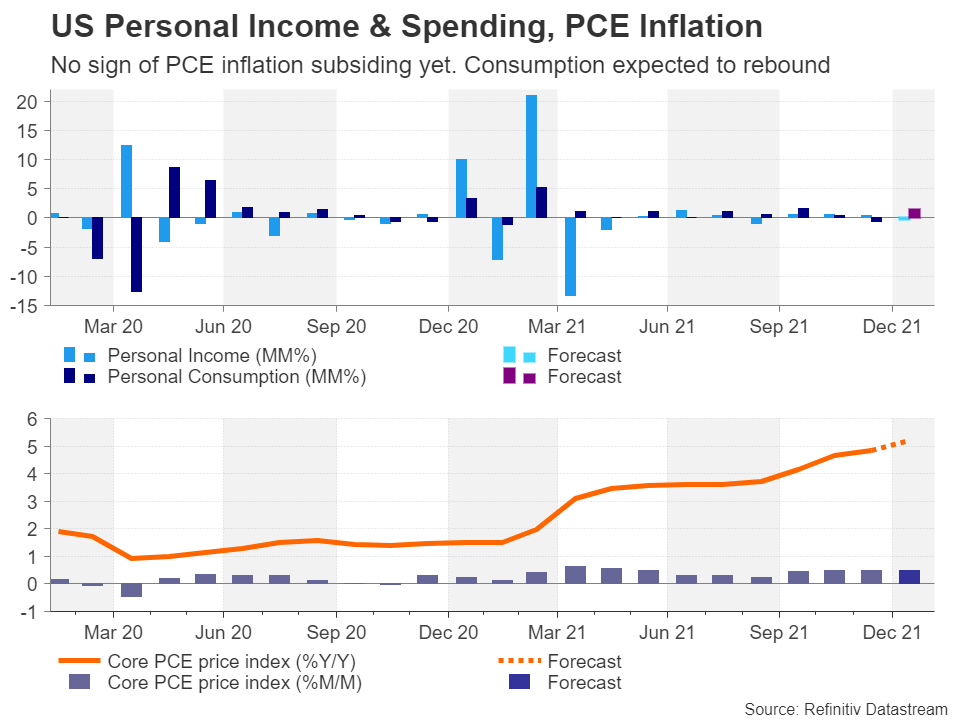
Following January’s much stronger-than-expected bounce back in retail sales, it’s not difficult to guess an equally upbeat consumption number. Personal consumption is forecast to have risen by 1.5% month-on-month in January, more than reversing the prior month’s slide. Personal income, however, is expected to have declined by 0.3% m/m.
More importantly from this report, the core PCE price index is projected to have edged up by another 0.5% m/m in January, showing no sign of easing in the monthly pace of increase and reinforcing the worrying trend seen in the CPI figures.
Any positive surprises in the upcoming raft of data could bolster the dollar, which has gained only modestly from the growing bets that the Fed will hike rates by 50 bps in March. Geopolitical worries haven’t provided a significant boost either, but an unexpectedly strong PCE inflation print might.
Weekly Focus – Uncertainty Remains High in Eastern Ukraine
The tensions in Eastern Ukraine remain elevated, although broader market reaction has so far remained moderate. Reports of shelling were heard from both sides on Thursday, and US has continued to accuse Russia of building more troops by the Ukrainian border, as well as staging a false-attack to justify an invasion. Russia was clearly not satisfied by the security proposals made by the west earlier, and continues to threaten with 'military-technical measures'. That being said, US's Blinken will meet Russia's Lavrov late next week, which has been interpreted as lower risk of near-term escalation. Overall, markets still seem very headline driven, with little concrete insight into the how the situation is evolving. Despite the volatility, rouble has appreciated moderately since Monday, and while Russian assets continue to trade with a risk premium, market does not seem to be in a panic mode. Oil prices, which rose last Friday on the back of rising sanctions fears, have also calmed down somewhat throughout the week.
Inflation remains a key theme for the markets, and this week markets have generally pulled back slightly on the central bank rate hike expectations. FOMC minutes did not provide strong signals for favouring either 25 or 50bp hike in the March meeting, market prices in around 30-35% risk of the latter. We updated our Fed call, and now look for a 50bp hike in March followed by a 25bp hike in every meeting of 2022. Despite market already pricing in several rate hikes for this year, US financial conditions remain expansionary relative to pre-covid levels, and we believe that stronger tightening will be needed to bring down the current inflationary pressures. We also think 'active QT' or outright selling of bonds to reduce the size of the balance sheet will be a key part of Fed's playbook. Read our in-depth take in Research US: How the coming Fed hiking cycle will differ - and why it matters, 18 February. For ECB, markets still price 40bp worth of hikes this year, and a total of 100bp by the end of next year, which we see too aggressive, as we expect ECB stop hiking at zero. Overall, we believe the tightening liquidity conditions will support broad USD and weigh on scandi currencies, as we wrote in our most recent FX Forecast Update - Central banks accelerate tightening prospects, 14 February.
China took a pause in its easing cycle, as PBOC refrained from cutting the Medium Lending Facility rates this week. We think the easing will likely continue with further rate cuts and reserve requirement reductions in coming months. Chinese January PPI continued to decelerate, providing some hope on easing global inflationary pressures. However, China's strict covid-policies continue to create risks of further supply chain issues, and the renewed policy easing is likely contributing to the recent rise in commodity prices.
Next week, markets continue to keep a close eye on the developments by the Ukrainian border. On the data calendar, Markit's February Flash PMIs for Euro Area, US and UK will be released on Monday and Tueday. Easing covid-restrictions could spark an uptick in the figures, but the key focus will be on how the supply chain issues and price pressures continue to develop. US PCE will be interesting following the strong retail sales released earlier. The Reserve Bank of New Zealand meets on Wednesday, and while another 25bp hike seems like the most likely option, risks are tilted to the hawkish side amid the global push for faster tightening.
AUD/USD Outlook: Aussie Rises to One-Week High on Positive Fundamentals
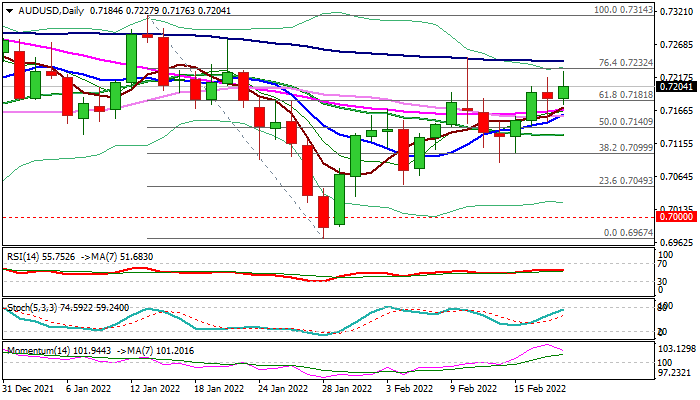
The Australian dollar remains bid and on track for the third straight weekly gains, underpinned by Australia’s reopening after long period of restrictive measures as the number of Covid cases dropped significantly.
News that US and Russia’s top officials, Blinken and Lavrov will meet next week revives optimism and supports risk-sensitive Aussie dollar.
Near-term action extended to one-week high (0.7227) on Friday and probing through thinning daily cloud which twists next week.
Break through upper pivots at 0.7232/42 (cloud top / 100DMA) would generate fresh bullish signal and open way for extension towards 2022 high (0.7314).
Bullish daily techs support the action which needs weekly close above broken Fibo resistance at 0.7181 (61.8% of 0.7314/0.6967) now reverted to support, to keep bullish bias.
Res: 0.7227; 0.7242; 0.7276; 0.7293.
Sup: 0.7181; 0.7168; 0.7150; 0.7140.
Sunset Market Commentary
Markets
ECB chief economist Lane’s speech yesterday not having a meaningful impact on markets didn’t make it less symbolic. The last staunch defender of the central bank’s extremely easy monetary policy threw in the towel, basically saying normalization (ending QE, negative rates) is on the horizon. Lane’s speech was one of the several this week, o.a. by Schnabel and Villeroy, which all had the same tone. It was followed by more central bank talk by ECB’s Kazimir (Slovakia) and Vasle. The former argues to end QE already in August as to retain some flexibility regarding interest rates. Slovenian council member Vasle said monetary policy should adjust quicker to try and shift the inflation trend in 2022H2. Both carry less weight compared to the others this week but it’s striking nonetheless how quickly consensus is forming. For the moment though, German – core in general – bond markets are more occupied with the geopolitical situation and that may remain the case for some time around. Risk sentiment was a story of ebb and flow all week, today included. This morning things looked somewhat brighter after the US’s and Russia’s foreign ministers agreed to hold talks next week. It rekindled hopes for a diplomatic way out of the conflict. But sentiment turned again after (US) reports of Russia having gathered some 190k of military personnel along the Ukrainian borders. Donbas separatists later said there’s an evacuation going on in the disputed region due to the conflict escalation. Equities dived into the red with losses up to 1% in Europe. US stocks open mixed/flat. Core bonds swapped early losses for gains with the Bund outperforming US Treasuries. The German curve bull steepens with changes ranging from -4.4 bps (2y) over -3.1 bps (10y) to -2.4 bps (30y). Germany’s 2y is nearing the levels before the ECB’s pivot on February 3. European swap yields lose <2 bps at the short end. US yields trade flat at the front (2y) and lose 2.4-2.6 bps (10y-30y) further down the curve.
The US dollar holds a slight advantage over the euro with the EUR/USD pair drifting towards 1.134 from an 1.1361 open. Trade-weighted DXY is near intraday highs of 95.93. The usual beneficiaries in case of deteriorating sentiment are letting down a bit. USD/JPY holds above 115 and the Swiss franc barely gains against the euro (EUR/CHF 1.044, down from 1.045). Britain’s economic update came to a conclusion with strong retail sales this morning rebounding from an Omicron-hit December. Together with a solid labour market report and above-consensus CPI figures, all is set for the Bank of England to continue its normalization cycle. EUR/GBP declines for a third day straight today but mainly on euro weakness and inspired by EUR/USD moves rather than sterling strength. The couple is filling bids in the 0.834 area.
News Headlines
Swedish inflation moderated less than forecast in January. Headline inflation (CPIF) fell by 0.5% M/M to 3.9% Y/Y (from 4.1% Y/Y). The main impact to the monthly figure came from lower electricity prices. Underlying inflation even increased by 0.1% M/M (vs -0.5% M/M forecast) to accelerate from 1.7% Y/Y to 2.5% Y/Y and matching the highest level since March 2002. Prices in January increased for fuel (especially diesel), motor cars, health services and food and non-alcoholic beverages. There were also increased prices for furnishings and household equipment, housing costs and fees for rented and housing co-operative dwellings. The Swedish krona spiked higher after the release but failed to really gather momentum. EUR/SEK currently changes hands around 10.59. The Swedish swap curve bear flattens with yields rising by 2.1 bps (30-yr) to 4.5 bps (2-yr).
Canadian retail sales declined by 1.8% M/M in December. Core sales recorded an even steeper 2.5% M/M decline. Lower sales at clothing and clothing accessories stores (-9.5% M/M) and furniture and home furnishings stores (-11.3% M/M) led the decline, which coincided with concerns over the spread of the COVID-19 Omicron variant in December. Retail sales were up 1.7% in the fourth quarter of 2021, marking its second consecutive quarterly increase. The loonie didn’t respond to the data with USD/CAD changing hands just above 1.27.
Markets Staying Quiet, Canada and UK Retail Sales Ignored
The financial markets are generally quiet today. Stocks are slightly down by losses are limited. Retail sales data from Canada and UK are largely ignored. Commodity currencies are the strongest ones for now. Yen, Dollar and Euro are the weaker ones. There news of shelling in Ukraine east by Russian-backed separatists and there is still no clarity on the overall situation and development. Traders are likely to continue to hold their bets for now.
In Europe, at the time of writing, FTSE is down -0.05%. DAX is down -1.01%. CAC is down -0.19%. Germany 10-year yield is down -0.020 at 0.210. Earlier in Asia, Nikkei dropped -0.41%. Hong Kong HSI dropped -1.88%. China Shanghai SSE rose 0.66%. Singapore Strait Times dropped -0.37%. Japan 10-year JGB yield dropped -0.0034 to 0.220.
Canada retail sales dropped -1.8% mom in Dec, to rebound by 2.4% in Jan
Canada retail sales dropped -1.8% mom to CAD 57.0B in December, better than expectation of -2.1%. Sales were down in 8 of 11 subsectors, representing 62.9% of retail trade. Excluding gasoline stations and motor vehicle and parts, sales dropped -2.4% mom.
For Q4, retail sales were up 1.7%, marking its second consecutive quarterly increase.
Advance estimate suggests sales rose 2.4% in January.
UK retail sales rose 1.9% mom in Jan, ex-fuel sales rose 1.7% mom
UK retail sales volume grew 1.9% mom in January, well above expectation of 1.0% mom. Ex-fuel sales rose 1.7% mom, above expectation of 1.2% mom. Comparing with the sale month a year earlier, retail sales rose 9.1% yoy while ex-fuel sales rose 7.2% yoy.
Comparing with prepandemic level in February 2020, retail sales was 3.6% above that level while ex-fuel sales was 4.4% above.
Japan CPI core slowed to 0.2% yoy in Jan, CPI core core dropped to -1.1% yoy
Japan all item CPI slowed from 0.8% yoy to 0.5% yoy in January, below expectation of 0.6% yoy. CPI core (all item less fresh food) dropped from 0.5% yoy to 0.2% yoy, below expectation of 0.3% yoy. CPI core-core (all item less fresh food and energy), dropped from -0.7% yoy to -1.1% yoy, below expectation of -0.7% yoy.
Finance Minister Shunichi Suzuki said recent prices rises were "driven mostly by increases in energy costs", though forex moves also has had some impact. He added, "if inflation rises before improvement in job market, wage hikes kick in, that could affect consumption."
EUR/USD Daily Outlook
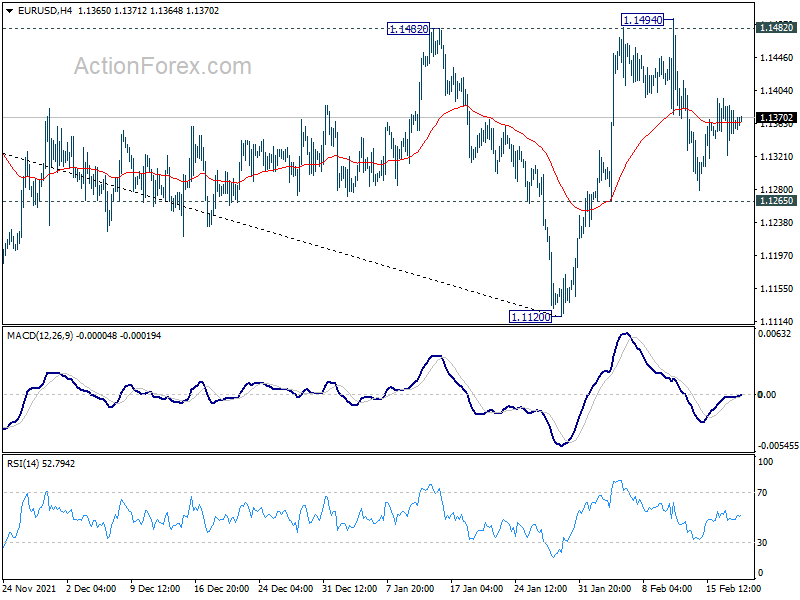
Daily Pivots: (S1) 1.1329; (P) 1.1357; (R1) 1.1391; More...
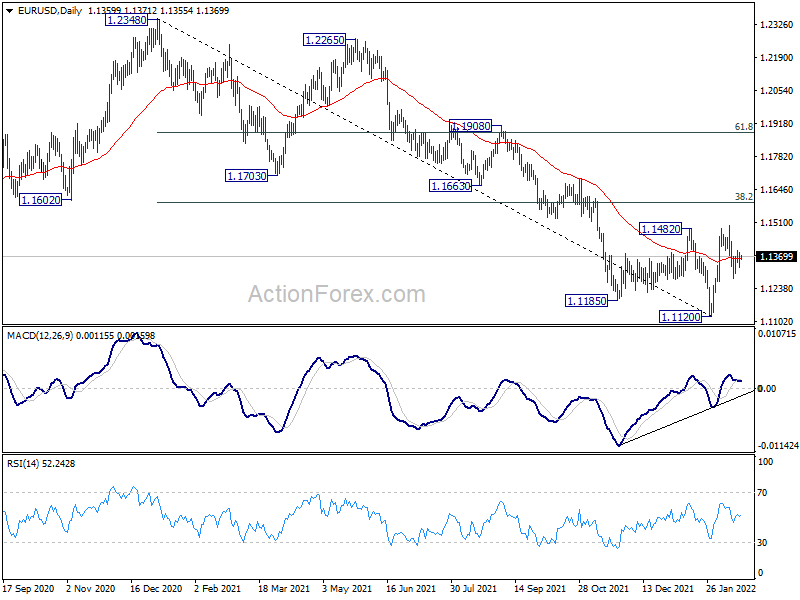
Range trading continues in EUR/USD and intraday bias remains neutral. With 1.1265 minor support intact, further rally will remain mildly in favor. On the upside break of 1.1482 will target 38.2% retracement of 1.2348 to 1.1120 at 1.1589 next. Sustained break there will argue that whole fall from 1.2348 has completed too and target 61.8% retracement at 1.1879. On the downside, however, break of 1.1265 support will dampen this bullish view and bring retest of 1.1120 low instead.
In the bigger picture, the decline from 1.2348 (2021 high) is seen as a leg inside the range pattern from 1.2555 (2018 high). Sustained trading above 55 week EMA (now at 1.1613) will argue that it has completed and stronger rise would be seen back towards top of the range between 1.2348 and 1.2555. However, firm break of 1.0635 (2020 low) will raise the chance of long term down trend resumption and target a retest on 1.0339 (2017 low) next.
Economic Indicators Update
| GMT | Ccy | Events | Actual | Forecast | Previous | Revised |
|---|---|---|---|---|---|---|
| 21:45 | NZD | PPI Input Q/Q Q4 | 1.10% | 1.60% | 1.60% | |
| 21:45 | NZD | PPI Output Q/Q Q4 | 1.40% | 2.30% | 1.80% | |
| 23:30 | JPY | National CPI Core Y/Y Jan | 0.20% | 0.30% | 0.50% | |
| 07:00 | GBP | Retail Sales M/M Jan | 1.90% | 1.00% | -3.70% | -4.00% |
| 07:00 | GBP | Retail Sales Y/Y Jan | 9.10% | 8.70% | -0.90% | -1.70% |
| 07:00 | GBP | Retail Sales ex-Fuel M/M Jan | 1.70% | 1.20% | -3.60% | -3.90% |
| 07:00 | GBP | Retail Sales ex-Fuel Y/Y Jan | 7.20% | 7.90% | -3.00% | -3.80% |
| 09:00 | EUR | Eurozone Current Account (EUR) Dec | 22.6B | 24.3B | 23.6B | |
| 13:30 | CAD | New Housing Price Index M/M Jan | 0.90% | 0.50% | 0.20% | |
| 13:30 | CAD | Retail Sales M/M Dec | -1.80% | -2.10% | 0.70% | |
| 13:30 | CAD | Retail Sales ex Autos M/M Dec | -2.50% | -2.10% | 1.10% | |
| 15:00 | USD | Existing Home Sales Jan | 6.12M | 6.18M | ||
| 15:00 | EUR | Eurozone Consumer Confidence Feb P | -8 | -9 |