Sample Category Title
Sunset Market Commentary
Markets
ECB chief economist Lane’s speech yesterday not having a meaningful impact on markets didn’t make it less symbolic. The last staunch defender of the central bank’s extremely easy monetary policy threw in the towel, basically saying normalization (ending QE, negative rates) is on the horizon. Lane’s speech was one of the several this week, o.a. by Schnabel and Villeroy, which all had the same tone. It was followed by more central bank talk by ECB’s Kazimir (Slovakia) and Vasle. The former argues to end QE already in August as to retain some flexibility regarding interest rates. Slovenian council member Vasle said monetary policy should adjust quicker to try and shift the inflation trend in 2022H2. Both carry less weight compared to the others this week but it’s striking nonetheless how quickly consensus is forming. For the moment though, German – core in general – bond markets are more occupied with the geopolitical situation and that may remain the case for some time around. Risk sentiment was a story of ebb and flow all week, today included. This morning things looked somewhat brighter after the US’s and Russia’s foreign ministers agreed to hold talks next week. It rekindled hopes for a diplomatic way out of the conflict. But sentiment turned again after (US) reports of Russia having gathered some 190k of military personnel along the Ukrainian borders. Donbas separatists later said there’s an evacuation going on in the disputed region due to the conflict escalation. Equities dived into the red with losses up to 1% in Europe. US stocks open mixed/flat. Core bonds swapped early losses for gains with the Bund outperforming US Treasuries. The German curve bull steepens with changes ranging from -4.4 bps (2y) over -3.1 bps (10y) to -2.4 bps (30y). Germany’s 2y is nearing the levels before the ECB’s pivot on February 3. European swap yields lose <2 bps at the short end. US yields trade flat at the front (2y) and lose 2.4-2.6 bps (10y-30y) further down the curve.
The US dollar holds a slight advantage over the euro with the EUR/USD pair drifting towards 1.134 from an 1.1361 open. Trade-weighted DXY is near intraday highs of 95.93. The usual beneficiaries in case of deteriorating sentiment are letting down a bit. USD/JPY holds above 115 and the Swiss franc barely gains against the euro (EUR/CHF 1.044, down from 1.045). Britain’s economic update came to a conclusion with strong retail sales this morning rebounding from an Omicron-hit December. Together with a solid labour market report and above-consensus CPI figures, all is set for the Bank of England to continue its normalization cycle. EUR/GBP declines for a third day straight today but mainly on euro weakness and inspired by EUR/USD moves rather than sterling strength. The couple is filling bids in the 0.834 area.
News Headlines
Swedish inflation moderated less than forecast in January. Headline inflation (CPIF) fell by 0.5% M/M to 3.9% Y/Y (from 4.1% Y/Y). The main impact to the monthly figure came from lower electricity prices. Underlying inflation even increased by 0.1% M/M (vs -0.5% M/M forecast) to accelerate from 1.7% Y/Y to 2.5% Y/Y and matching the highest level since March 2002. Prices in January increased for fuel (especially diesel), motor cars, health services and food and non-alcoholic beverages. There were also increased prices for furnishings and household equipment, housing costs and fees for rented and housing co-operative dwellings. The Swedish krona spiked higher after the release but failed to really gather momentum. EUR/SEK currently changes hands around 10.59. The Swedish swap curve bear flattens with yields rising by 2.1 bps (30-yr) to 4.5 bps (2-yr).
Canadian retail sales declined by 1.8% M/M in December. Core sales recorded an even steeper 2.5% M/M decline. Lower sales at clothing and clothing accessories stores (-9.5% M/M) and furniture and home furnishings stores (-11.3% M/M) led the decline, which coincided with concerns over the spread of the COVID-19 Omicron variant in December. Retail sales were up 1.7% in the fourth quarter of 2021, marking its second consecutive quarterly increase. The loonie didn’t respond to the data with USD/CAD changing hands just above 1.27.
Markets Staying Quiet, Canada and UK Retail Sales Ignored
The financial markets are generally quiet today. Stocks are slightly down by losses are limited. Retail sales data from Canada and UK are largely ignored. Commodity currencies are the strongest ones for now. Yen, Dollar and Euro are the weaker ones. There news of shelling in Ukraine east by Russian-backed separatists and there is still no clarity on the overall situation and development. Traders are likely to continue to hold their bets for now.
In Europe, at the time of writing, FTSE is down -0.05%. DAX is down -1.01%. CAC is down -0.19%. Germany 10-year yield is down -0.020 at 0.210. Earlier in Asia, Nikkei dropped -0.41%. Hong Kong HSI dropped -1.88%. China Shanghai SSE rose 0.66%. Singapore Strait Times dropped -0.37%. Japan 10-year JGB yield dropped -0.0034 to 0.220.
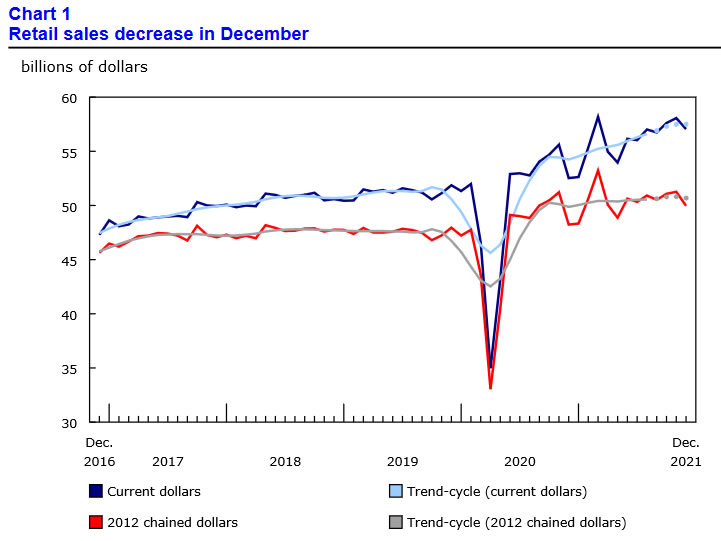
Canada retail sales dropped -1.8% mom in Dec, to rebound by 2.4% in Jan
Canada retail sales dropped -1.8% mom to CAD 57.0B in December, better than expectation of -2.1%. Sales were down in 8 of 11 subsectors, representing 62.9% of retail trade. Excluding gasoline stations and motor vehicle and parts, sales dropped -2.4% mom.
For Q4, retail sales were up 1.7%, marking its second consecutive quarterly increase.
Advance estimate suggests sales rose 2.4% in January.
UK retail sales rose 1.9% mom in Jan, ex-fuel sales rose 1.7% mom
UK retail sales volume grew 1.9% mom in January, well above expectation of 1.0% mom. Ex-fuel sales rose 1.7% mom, above expectation of 1.2% mom. Comparing with the sale month a year earlier, retail sales rose 9.1% yoy while ex-fuel sales rose 7.2% yoy.
Comparing with prepandemic level in February 2020, retail sales was 3.6% above that level while ex-fuel sales was 4.4% above.
Japan CPI core slowed to 0.2% yoy in Jan, CPI core core dropped to -1.1% yoy
Japan all item CPI slowed from 0.8% yoy to 0.5% yoy in January, below expectation of 0.6% yoy. CPI core (all item less fresh food) dropped from 0.5% yoy to 0.2% yoy, below expectation of 0.3% yoy. CPI core-core (all item less fresh food and energy), dropped from -0.7% yoy to -1.1% yoy, below expectation of -0.7% yoy.
Finance Minister Shunichi Suzuki said recent prices rises were "driven mostly by increases in energy costs", though forex moves also has had some impact. He added, "if inflation rises before improvement in job market, wage hikes kick in, that could affect consumption."
EUR/USD Daily Outlook
Daily Pivots: (S1) 1.1329; (P) 1.1357; (R1) 1.1391; More...
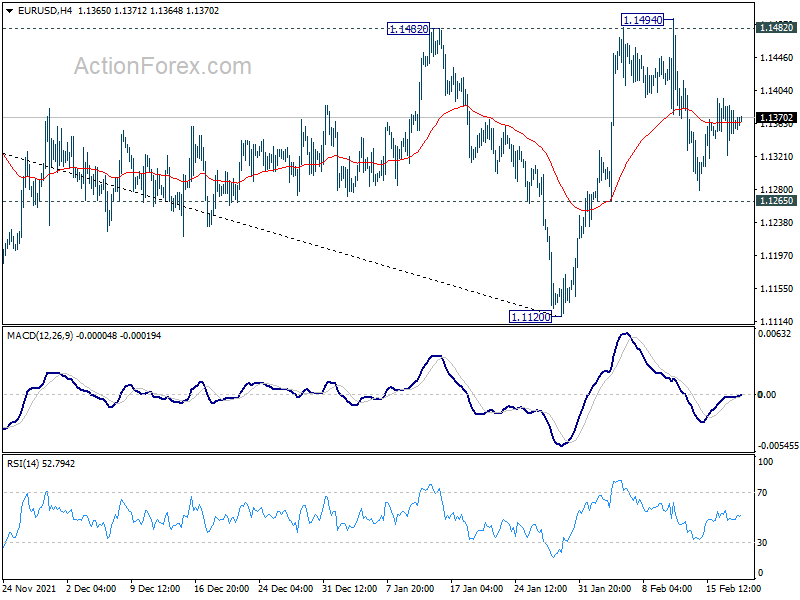
Range trading continues in EUR/USD and intraday bias remains neutral. With 1.1265 minor support intact, further rally will remain mildly in favor. On the upside break of 1.1482 will target 38.2% retracement of 1.2348 to 1.1120 at 1.1589 next. Sustained break there will argue that whole fall from 1.2348 has completed too and target 61.8% retracement at 1.1879. On the downside, however, break of 1.1265 support will dampen this bullish view and bring retest of 1.1120 low instead.
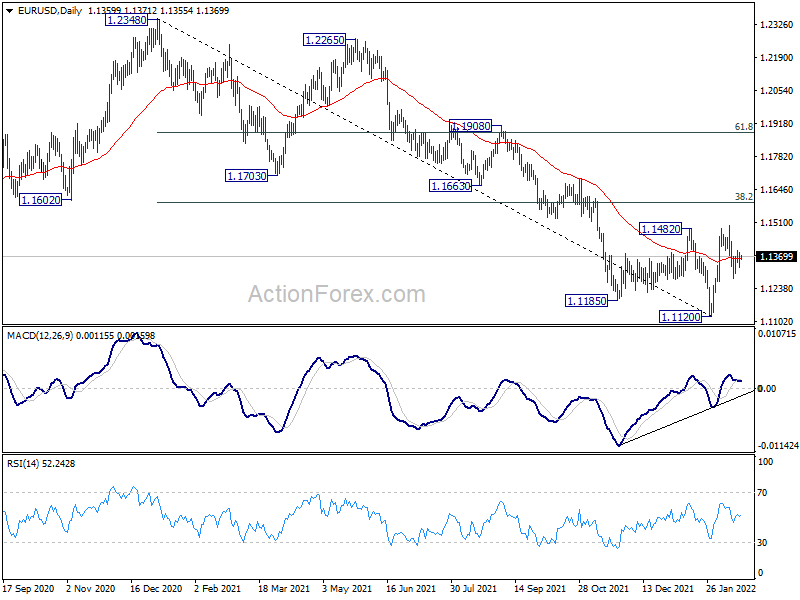
In the bigger picture, the decline from 1.2348 (2021 high) is seen as a leg inside the range pattern from 1.2555 (2018 high). Sustained trading above 55 week EMA (now at 1.1613) will argue that it has completed and stronger rise would be seen back towards top of the range between 1.2348 and 1.2555. However, firm break of 1.0635 (2020 low) will raise the chance of long term down trend resumption and target a retest on 1.0339 (2017 low) next.
Economic Indicators Update
| GMT | Ccy | Events | Actual | Forecast | Previous | Revised |
|---|---|---|---|---|---|---|
| 21:45 | NZD | PPI Input Q/Q Q4 | 1.10% | 1.60% | 1.60% | |
| 21:45 | NZD | PPI Output Q/Q Q4 | 1.40% | 2.30% | 1.80% | |
| 23:30 | JPY | National CPI Core Y/Y Jan | 0.20% | 0.30% | 0.50% | |
| 07:00 | GBP | Retail Sales M/M Jan | 1.90% | 1.00% | -3.70% | -4.00% |
| 07:00 | GBP | Retail Sales Y/Y Jan | 9.10% | 8.70% | -0.90% | -1.70% |
| 07:00 | GBP | Retail Sales ex-Fuel M/M Jan | 1.70% | 1.20% | -3.60% | -3.90% |
| 07:00 | GBP | Retail Sales ex-Fuel Y/Y Jan | 7.20% | 7.90% | -3.00% | -3.80% |
| 09:00 | EUR | Eurozone Current Account (EUR) Dec | 22.6B | 24.3B | 23.6B | |
| 13:30 | CAD | New Housing Price Index M/M Jan | 0.90% | 0.50% | 0.20% | |
| 13:30 | CAD | Retail Sales M/M Dec | -1.80% | -2.10% | 0.70% | |
| 13:30 | CAD | Retail Sales ex Autos M/M Dec | -2.50% | -2.10% | 1.10% | |
| 15:00 | USD | Existing Home Sales Jan | 6.12M | 6.18M | ||
| 15:00 | EUR | Eurozone Consumer Confidence Feb P | -8 | -9 |
Canada retail sales dropped -1.8% mom in Dec, to rebound by 2.4% in Jan
Canada retail sales dropped -1.8% mom to CAD 57.0B in December, better than expectation of -2.1%. Sales were down in 8 of 11 subsectors, representing 62.9% of retail trade. Excluding gasoline stations and motor vehicle and parts, sales dropped -2.4% mom.
For Q4, retail sales were up 1.7%, marking its second consecutive quarterly increase.
Advance estimate suggests sales rose 2.4% in January.
GBPUSD Tests Upper Boundary of Trading Range
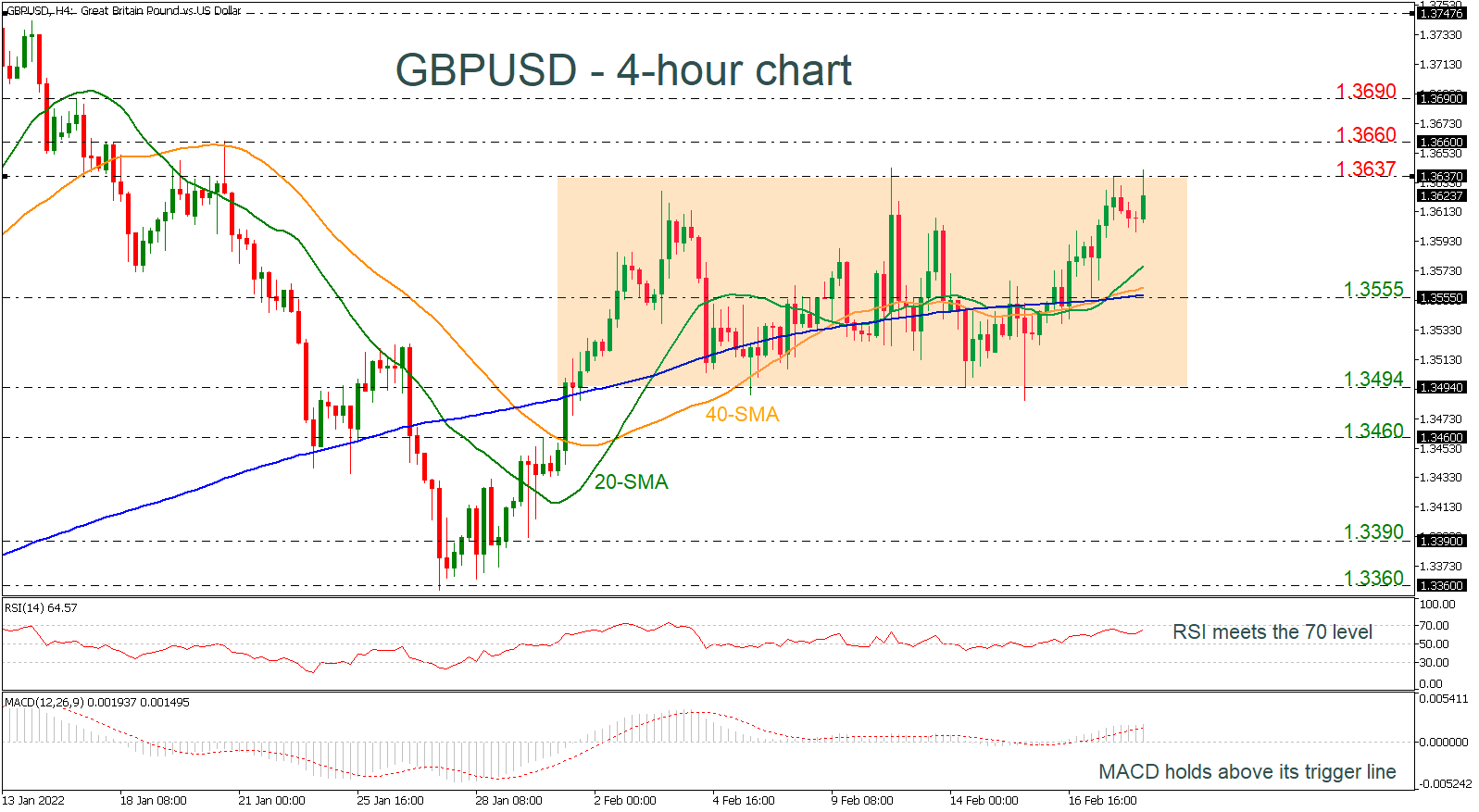
GBPUSD is moving higher over the last 4-hour session remaining well above the short-term simple moving averages (SMAs). The RSI indicator is pointing up near the 70 level, while the MACD oscillator is holding above its trigger line in the positive region.
If the market overcomes the 1.3637 resistance level, the next stop could come from the 1.3660 resistance level. Surpassing the aforementioned levels, the bulls may visit the 1.3690 hurdle ahead of the 1.3750 barrier, registered in January 13.
On the other hand, a drop lower could take the bears until the immediate 20-period SMA at 1.3576 before tumbling to the 40- and the 200-period SMAs near the 1.3555 support level. Underneath these obstacles the market could make a pause at the 1.3494 mark.
In conclusion, GBPUSD has been in neutral phase in the short-term with upper boundary the 1.3637 resistance and lower boundary the 1.3494 support. Only a move above or below these levels may change this outlook.
Gold May Slowdown for a Correction: Elliott Wave Analysis
Gold is coming sharply to the upside as a "safe haven" asset based on the latest US-Russia tensions. Higher inflation is also one of the reasons for higher metals.
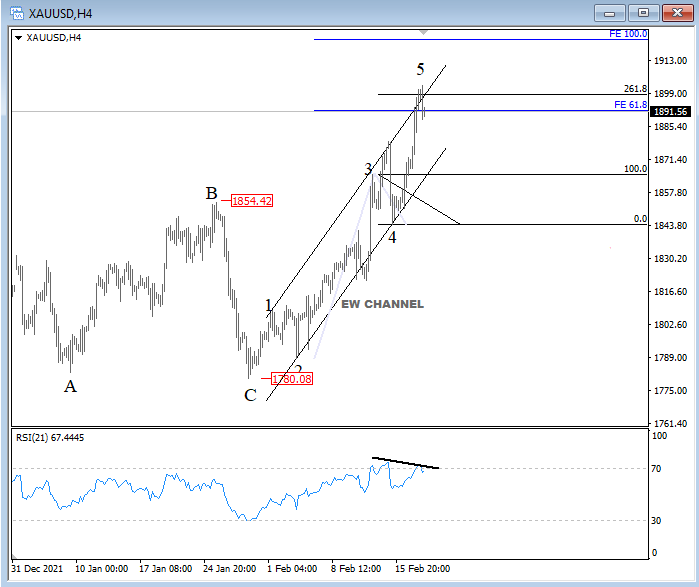
Technically we see prices are coming up from 1780 in an impulsive fashion after 1854 was broken, but we see gold in a fifth wave now at strong 1900 resistance where we also see some important Fib levels. And RSI divergence may also suggest that bulls may slow down for a correction Important upward resistance area is at 1900.
Gold 4h Elliott Wave analysis
Cautious End to the Week
It promises to be a fascinating end to the week as European equity markets steady and US futures pare losses amid planned talks between the US and Russia next week.
Risk aversion swept through the markets on Thursday as the perceived risk of a Russian invasion of Ukraine rose. Much like the weather here in London, Friday was shaping up to be rather treacherous in the markets, that is until US Secretary of State Antony Blinken accepted an invitation to meet Russian Foreign Minister Sergei Lavrov in Europe next week.
While we're still being warned that a Russian invasion is highly likely, the meeting does offer hope that nothing will happen before then which is bringing some stability in the markets. In the absence of the meeting, it could have been another turbulent day in the markets and we could still see some risk aversion creeping in as we near the close, given how quickly these situations can change.
Rebound in UK retail sales nothing to get excited about
UK retail sales bounced back strongly in January from the slump in December which turned out to be worse than first thought after revisions. It was always likely that we were going to see a strong rebound as December's figures were heavily impacted by early Christmas shopping and the onset of omicron, so I don't think anyone is getting too excited by the data.
Not least because the cost-of-living crisis is upon us and it's not going to get any easier as real incomes are squeezed thanks to a broad array of price increases. The energy price cap increase and higher national insurance contributions will hit household finances again in April. This doesn't bode well when consumer confidence is already slumping.
Oil slides as the US nears nuclear accord with Iran
Reports of the US and Iran nearing a new nuclear deal couldn't have come at a better time and oil prices are slipping at the prospect of more than a million barrels of crude re-entering the market. In the absence of a deal, we could already be talking about triple-figure oil prices.
Of course, the risk of a Russian invasion remains heightened so there's plenty of potential for oil prices to head higher once more if troops do cross the border but the combination of next week's Blinkin-Lavrov meeting and a nuclear deal are providing relief for crude markets.
Gold shines as panic sets in
Gold surged once again on Thursday in risk-averse trade and topped $1,900 for the first time in eight months. The yellow metal is paring gains today, off around four-tenths of one percent, but remains well supported given the level of uncertainty and anxiety that exists.
It has really benefited from its role as a safe haven and inflation hedge, blowing away any suggestion that gold no longer serves such a purpose or that it's been in any way replaced. If troops cross the border, we could see it surge once more and potentially eye levels not seen since late 2020.
Bitcoin battered but holds at key support
Bitcoin got hammered on Thursday alongside other risk assets but importantly saw strong support around $40,000 where it continues to trade above. It had held up well in recent weeks, even during periods of risk-aversion, but it was well and truly swept up in it yesterday. A break below here could see it come under some pressure in the near term, especially if combined with broad risk-aversion in the markets.
EUR/USD Outlook: Near-Term Action Remains Negatively Aligned Below Falling 10DMA
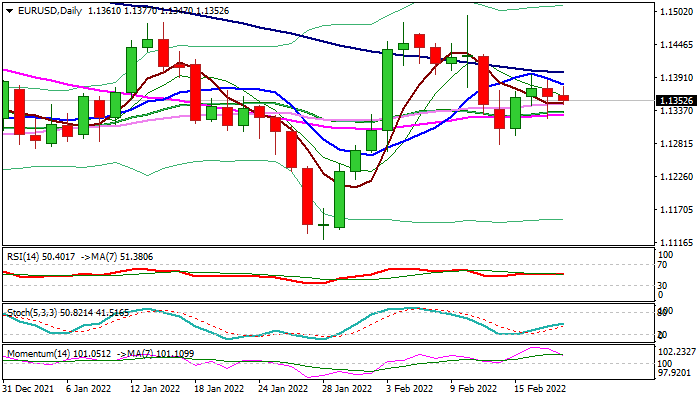
The Euro is trading in a choppy sideways mode in European session on Friday, with near-term action being weighed down by south-heading 10DMA which capped upticks in past two days and fading bullish momentum on daily chart.
Fresh weakness is probing below the base of thinning daily cloud and pressuring pivotal Fibo support at 1.1351 (38.2% of 1.1280/1.1395) upleg, violation of which would spark fresh acceleration lower for retest of Thursday’s low (1.1323, also Fibo 61.8% of 1.1280/1.1395) where bears were strongly rejected.
Caution on repeated failure to close below 1.1351 Fibo support that would signal extended sideways mode, however, near-term bias is expected to remain with bears as long action stays below descending 100DMA (1.1399).
Res: 1.1379; 1.1386; 1.1399; 1.1430.
Sup: 1.1337; 1.1323; 1.1294; 1.1280.
EURNZD Wave Analysis
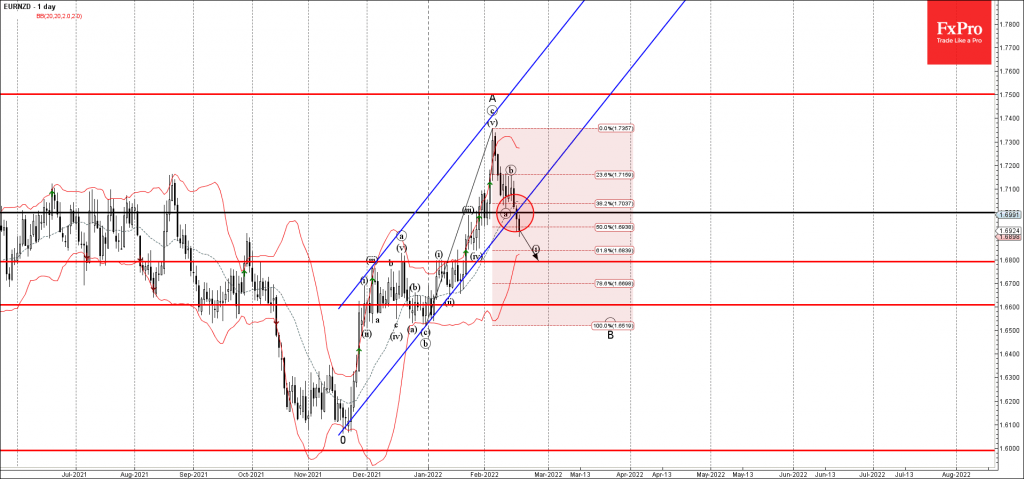
- EURNZD broke daily up channel
- Likely to fall to support level 1.6800
EURNZD currency pair recently broke the round support level 1.700, intersecting with the support trendline of the daily up channel from last November.
The breakout of the support level 1.700 accelerated the active minor impulse wave (i) – which belongs to the higher order downward wave B from the start of February.
EURNZD can be expected to fall further toward the next support level 1.6800 (former resistance from December and January, target for the completion of the active impulse wave (i)).
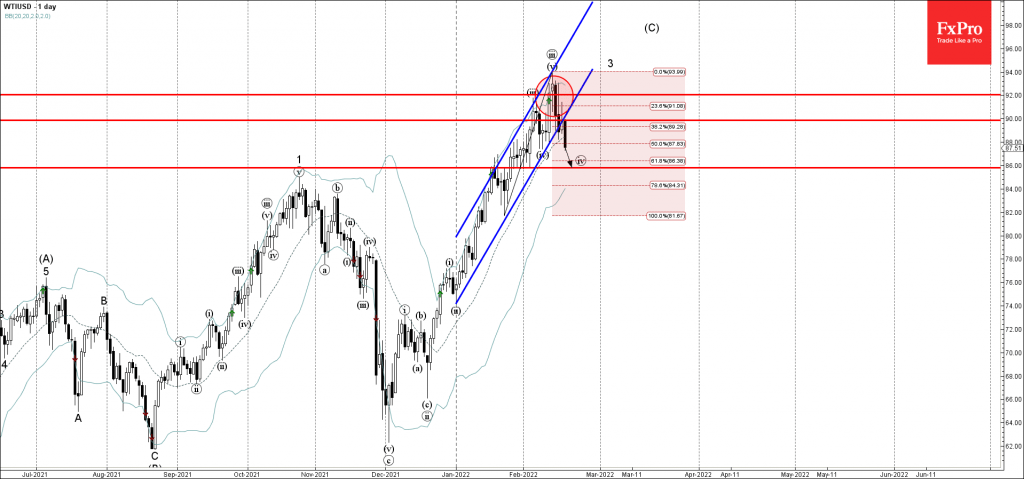
WTI Wave Analysis
- WTI broke round support level 90.00
- Likely to fall to support level 86.00
WTI crude oil recently broke the round support level 90.00, intersecting with the support trendline of the daily up channel from December and the 38.2% Fibonacci correction of the previous upward impulse from January.
The breakout of the support level 90.00 accelerated the active minor correction (iv) – which started earlier from the key resistance level 92.00.
WTI crude oil can be expected to fall further toward the next support level 86.00 (target for the completion of the active minor correction (iv)).
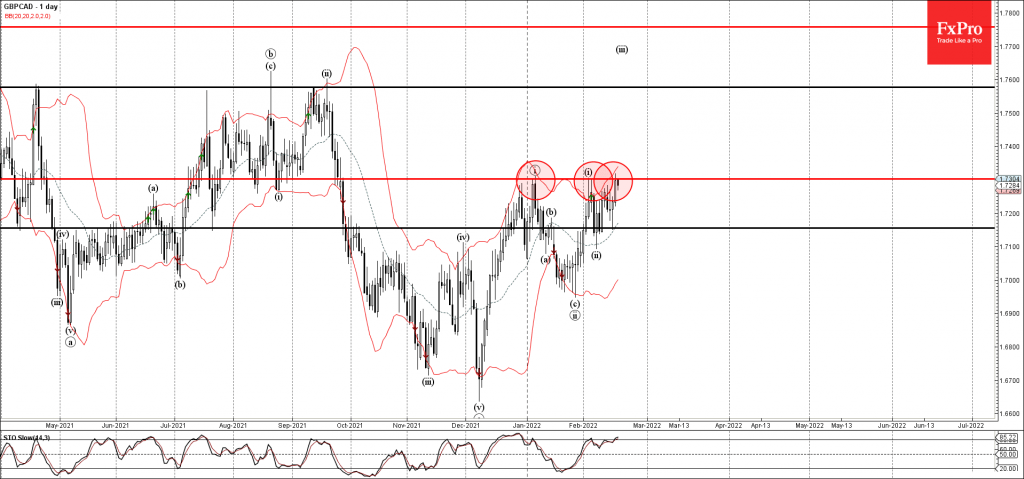
GBPCAD Wave Analysis
- GBPCAD reversed from resistance level 1.7300
- Likely to fall to support level 1.7155.
GBPCAD currency pair recently reversed down from the resistance level 1.7300 (which has been repeatedly reversing the price from the start of January).
The resistance zone near the resistance level 1.7300 was strengthened by the upper daily Bollinger Band.
Given the overbought daily Stochastic – GBPCAD currency pair can be expected to fall further toward the next key support level 1.7155.