Sample Category Title
WTI Futures Rallies to Fresh Highs again Near 95.00
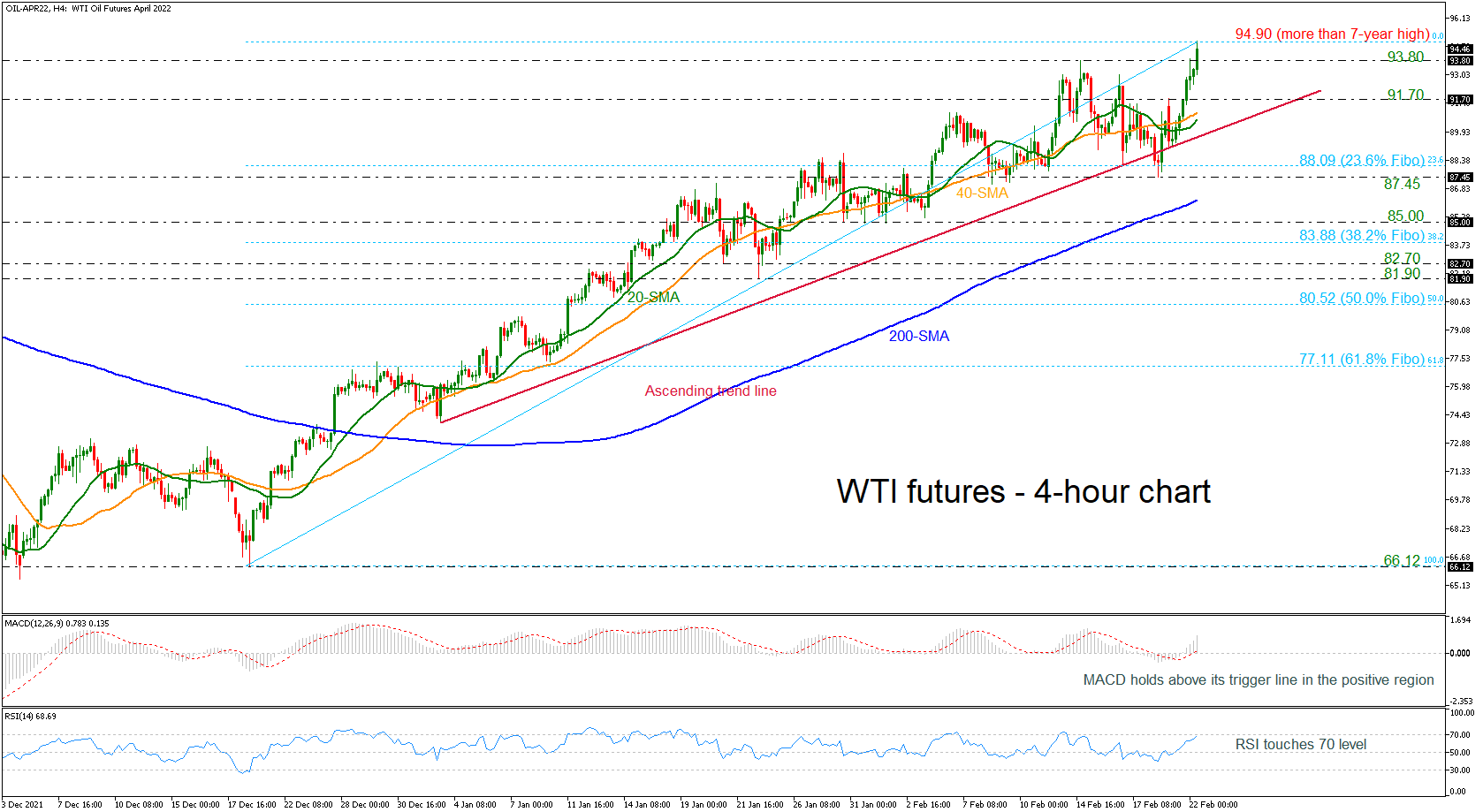
WTI crude oil futures are surging towards a more-than-seven-year high of 94.90, creating the eighth consecutive green four-hour session. The price rebounded off the short-term ascending trend line with the technical indicators mirroring the aggressive bullish structure. Specifically, the RSI is picking up speed around 70 and the MACD continues to distance itself above its red signal line.
Should the price decisively close above the multi-year high, bulls could extend the uptrend towards the next resistance at 98.74, taken from the inside swing low on May 2014. Further advances above this level, could then target the area around the 100.00 round figure.
On the other hand, a decline could meet the 93.80 and the 91.70 levels ahead of the 40- and 20-period simple moving averages (SMAs) at 91.00 and 90.63 correspondingly. Slightly lower, the price could retest the uptrend line near 89.90, which the market was unable to break in the previous couple of months. More bearish movements shift the focus to the 23.6% Fibonacci retracement level of the up leg from 66.12 to 94.90 at 88.09.
To summarize, oil prices have been in a strong positive tendency in the short- and medium-term timeframes and only a move beneath the 200-period SMA may change this outlook.
EURJPY Buyers Contest Decline and Break of MAs
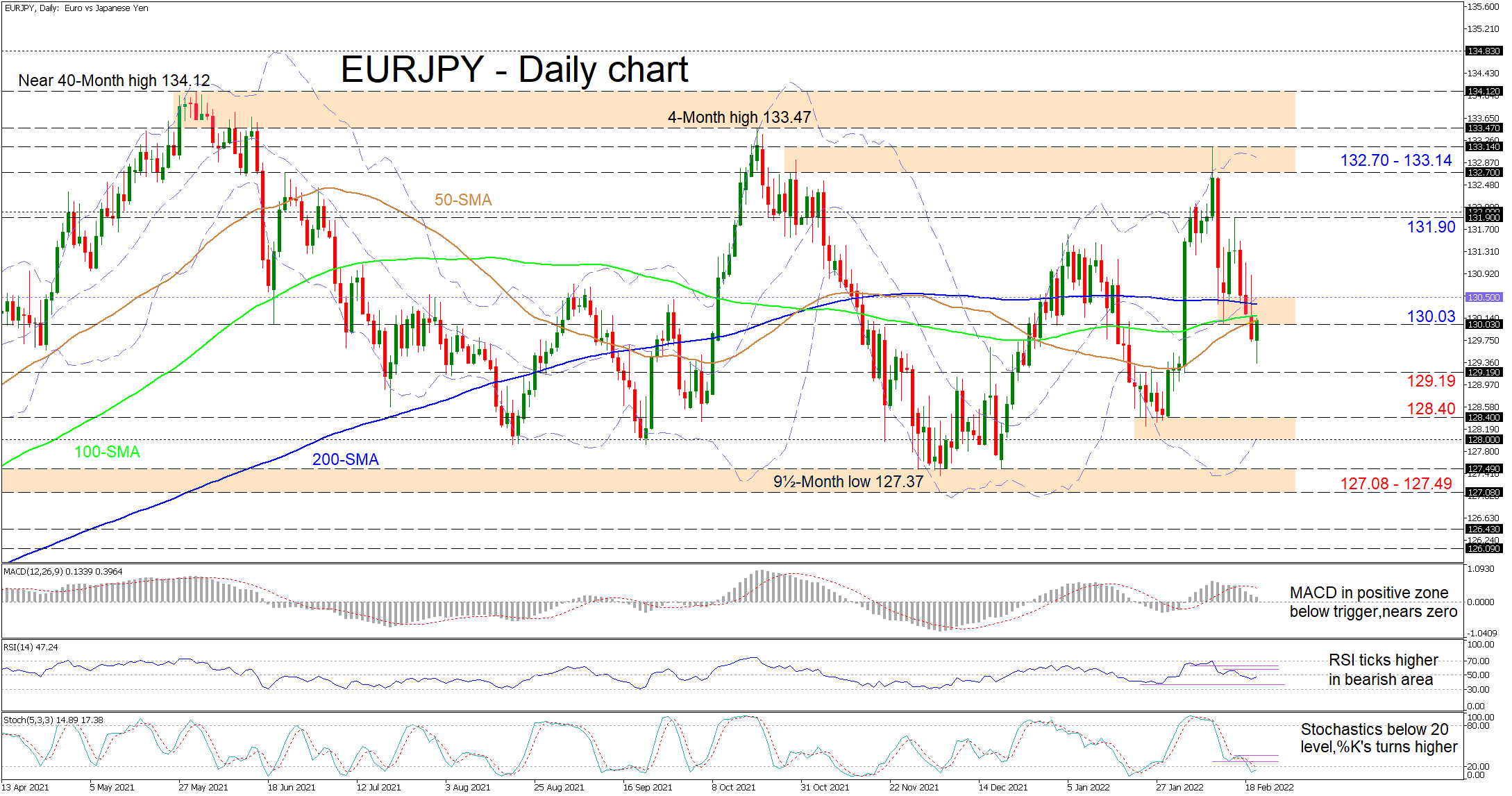
EURJPY bulls are pushing back after the converged simple moving averages (SMAs) failed to halt fresh plunges in the price. The SMAs are lacking any definitive trend suggestions but could now prove to be a tougher barrier for buyers to overstep.
The short-term oscillators are signalling that negative impetus in the pair has lost some might. The MACD’s decline below its red trigger line has softened slightly on its way to the zero threshold, while the RSI is improving in the bearish region. Furthermore, the stochastic %K line’s negative charge is waning in oversold territory.
As negative impetus continues to lose its might, the bulls may put pressure on the immediate resistance zone existing between the 130.03 inside swing low and the mid-Bollinger band at 130.50. Recapturing the region above this fortified barrier could boost upside momentum, propelling the price towards the 131.90 high and adjacent 132.00 handle. If bullish pressures endure, the 132.70-133.14 boundary could then come under attack, which encapsulates the upper Bollinger band as well.
Otherwise, if sellers retake control, initial downside friction could evolve at the 129.19 obstacle before the bears dive to test the support zone from the 128.40 level until the 128.00 hurdle, where the lower Bollinger band currently resides. Breaching this too, negative pressures may then attempt to deepen the down move in the pair with a break of the significant 127.08-127.49 base, which has defended the broader positive structure since February 2021.
Summarizing, EURJPY’s latest bearish bearing remains intact below the flattened SMAs and the 131.90 high, despite buyer’s emergence beneath the moving averages.
USDCAD is Found Within a Sideways Channel; Neutral Outlook
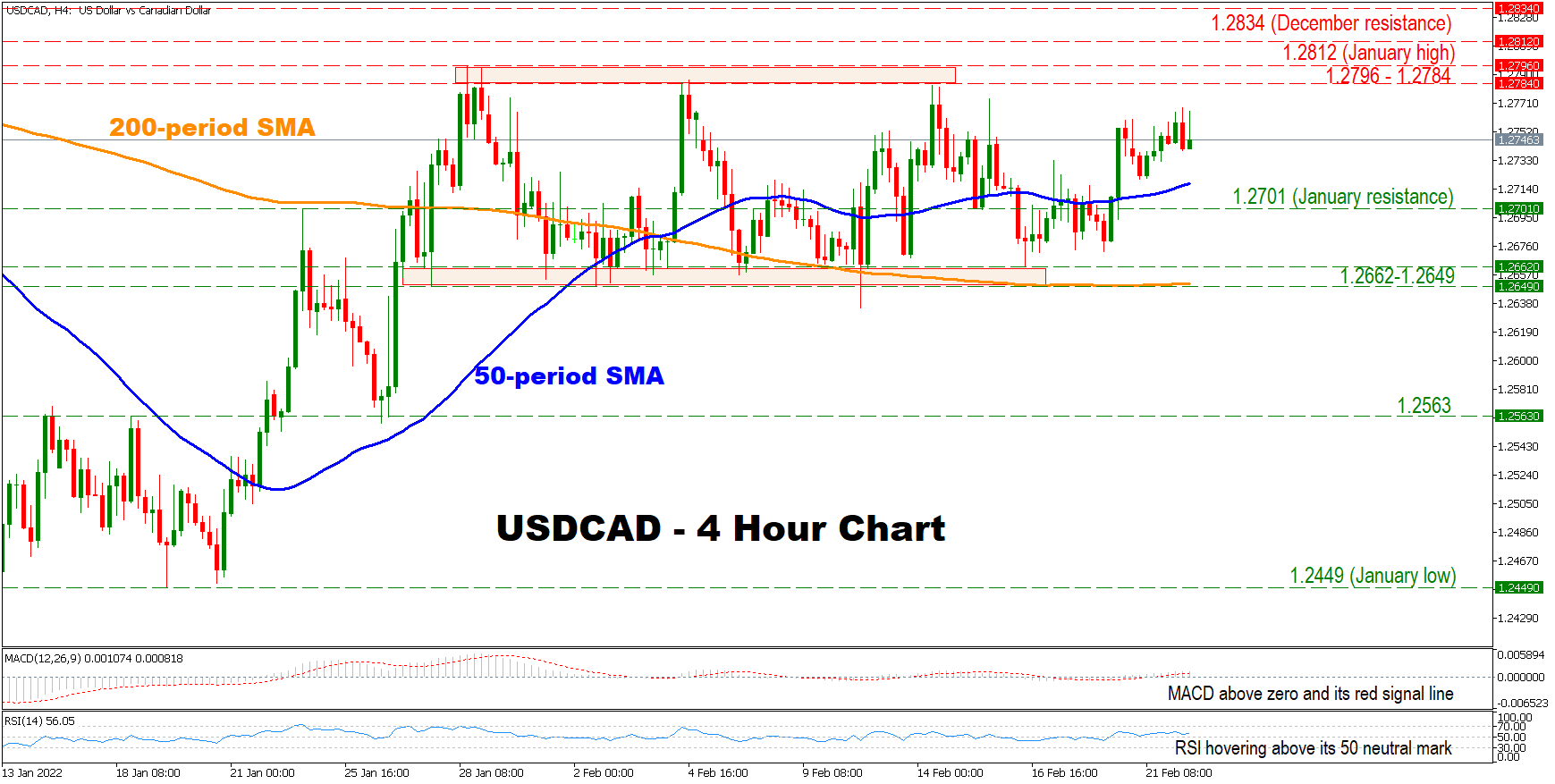
USDCAD has been trading sideways during the last month with an upper boundary the 1.2796 resistance and lower boundary the 1.2649 support. However, despite the neutral outlook there are some positive signs as the pair is trading above its 50- and 200-period simple moving averages (SMAs), with the former crossing recently above the latter, raising hopes that the outlook may soon turn bullish.
Short-term momentum indicators are reflecting a cautiously positive bias as the RSI is found slightly above its 50 neutral mark. In addition, the MACD is found marginally above zero and its red signal line, which might indicate that positive momentum is slowly building up.
Should the bulls manage to cross above the congested region which includes the 1.2784 and 1.2796 hurdles, the pair’s outlook could turn bullish, sending buyers to test the January high at 1.2812. Crossing above the latter might open the door towards the December resistance at 1.2834.
On the flip side, initial resistance might be found at the 50-period SMA currently at 1.2717, before sellers take aim at the 1.2701 barrier. Crossing below this point could send the price towards the congested region which includes the consecutive hurdles of 1.2662 and 1.2649, together with the 200-period SMA. A break below this area could turn the pair’s outlook to bearish, paving the way towards the 1.2563 obstacle.
In brief, the overall outlook for the pair is neutral. For sentiment to change, traders should break above or below last month’s trading range with upper boundary the 1.2796 resistance and lower boundary the 1.2649 support.
The Russia Ukraine Situation Update
Can we keep the status quo going?
The recent developments between Russia and Ukraine continue to be carefully scrutinized by market participants, political and investment analysts. Some initially thought the ongoing situation would reach a peak and then be eased, yet the opposite has manifested so far. The matter is becoming increasingly unsafe, especially as some areas in Ukraine were asked to evacuate during the closing of the previous week. In the current week we will be focusing on some important meetings between officials that are of crucial importance for the escalation or de-escalation of the subject.
Focusing first on the most recent updates, we turn our attention to the Russian troops increasing in numbers nearby the Ukrainian border. The US had accurately understood that a Russian force had been building up and increasing its power on various fronts nearby Ukraine, which prompted them even to make a prediction on the date that a possible invasion would be carried out. In our view, the Russians have achieved a number of important objectives with their latest actions that deserve a more analytical viewpoint. First the Russians have made the US look senseless with their announcement related to the 16th of February being the day Russia would attack Ukraine. This may have been a deliberate tactic from the Russian side to manipulate the US into false expectations, while proceeding with a very different plan in the end. So far Russia has undertaken a number of important and strategic positions increasing troops and moving military equipment around the Ukraine border. Russian military exercises in Belarus, a country bordering with Ukraine had taken the spotlight recently while Russian warships have also been seen making maneuvers in the Baltic and Black Sea. With the military exercises, Russia has managed to achieve two things. First it remains in an active state, with a considerable amount of troops being ready to go if the decision to attack was taken. Second, they are applying more pressure on Ukraine making them feel like sitting ducks while being surrounded from various perspectives. Finally, Russia’s pressure and military activities has forced European and US government officials to consider new talks and a potential meeting between Presidents Biden and Putin. Even though such a meeting has not been confirmed with specifics, it can be seen as a solid opportunity to remove a lot of uncertainty over the subject. However, on a more negative perspective two key areas in Ukraine including Donetsk and the Donbas have performed evacuations of civilians.
Another important finding that stands out from recent developments, can be the response from the US government but also the media. The US press seems to be aggressively opposing Russia’s stance so far and have openly criticized Vladimir Putin’s actions and possible scenarios of dealing with the subject. The European press may have been more cautious with its views on the matter, giving the notion that negativity may have intentionally been spread in the US. On the other hand, the US Government has mostly used verbal threats as a response but also stating clearly that sanctions will be enacted if an attack was carried out on Ukraine. Minor numbers of US troops have been sent to different countries in Europe and could possibly weather the storm and engage in battle if tensions would arise.
In the past three consecutive weeks Gold prices have risen pushing prices to a new 2022 high level as a result of geopolitical tensions. Market participants believe the situation between Ukraine and Russia has kept traders on the buying side, while some are unwilling to let go of their orders making it seem that Gold prices could appreciate even further. Gold is known as an asset positively correlated to geopolitical tensions, especially among countries that are of significant global importance. In this case, Russia’s contribution to the Oil and Natural Gas market is highlighted. Other analysts suggest that a worsening of the matter can lift inflationary pressures to even higher levels primarily due to an increase of energy prices but also grains. Inflation at the moment remains a great thorn for the global economy and further increases in prices can cause a destabilization of economic growth. Under these circumstances, traders can be possibly using Gold as a hedge instrument. However, the question remains are these tensions expected to calm as the issue’s root could take years to be resolved?
As we noted in one of our previous reports on the subject, the Russian Ukraine matter had started many years back, when the Soviet Union was in power. After so many years, Ukraine’s interest turning towards joining Europe is still not accepted by Russia. Russia’s inflexible handling of Ukraine is seen as a suppression among Europeans, but also the US. Russia has openly indicated the problem arises as Ukraine wants to become a member of the North Atlantic Treaty Organization (NATO). In Russia’s view this would bring NATO forces and military equipment nearby its boarder making it easier for them to monitor was it happening in the area. This can be used as a major military advantage for NATO, should Ukraine actually join the group that may be considered as a threat to Russia’s military superiority in the region. From the opposite perspective Ukraine may see NATO as a way out of Russia’s shadow. Ukraine is not a small country, yet compared to Russia may be far inferior and especially militarily. With a chance to join NATO, Ukraine may feel a lot safer to make its own decisions and write out its own future.
In the past week, Ukraine President Zelenskyy confirmed that the global security rules that were set up many years ago are obsolete and are no longer working. To make changes in the status quo a great challenge could be required, a one that we cannot afford to see using military actions. A more diplomatic approach however is still on the table and that’s what the market is counting on currently.
Dollar rises on Ukraine developments
Ukraine jitters raise risk apprehension
With US markets closed for a holiday overnight, volumes and volatility were muted in currency markets, sparing them the worst of the ravages seen elsewhere. Still, the US dollar did receive a modest haven bid, and the old adage of always buying US dollars in a war is as good today as it was all those decades ago when I started my trading career. Overnight the dollar index rose unwound all its early Monday losses to close at 96.16, where it remains in Asia. 95.70 and 96.50 are the near-term support/resistance levels.
Asia FX traders are clearly in wait-and-see mode today with volatility muted and the major currencies most around where they opened yesterday morning. EUR/USD is steady at 1.1305, USD/JPY at 114.65, GBP/USD at 1.3585, AUD/USD at 0.7195 and NZD/USD at 0.6705 with AUD and NZD giving back all of yesterday morning’s gains. With the Ukraine situation deteriorating from a market perspective, the risks have skewed towards a higher US dollar, and potentially yen, as investors look for havens. The euro is likely to be the most vulnerable major currency, due to its energy supply chain vulnerability to Russia and pure geography.
Asian currencies retreated overnight as well, perhaps more on rising oil prices than Ukrainian geopolitical nerves, although they are all an intertwined story. The fallout remains relatively modest for now, especially with USD/CNY remaining anchored near 6.3500. A rise through USD 100 by Brent crude, seemingly inevitable in my opinion, will change that dynamic with most of the region being major energy importers. Malaysia and Indonesia should fare better than most because of that.
Oil prices leap higher as Ukraine crisis worsens
If you’ve read the note this far, you know what comes next. Oil prices surged higher overnight on thinned US holiday liquidity after President Putin crushed the summit olive branch and commenced “security operations” in his breakaway satellite provinces of the Ukraine. Brent crude surged 3.60% higher to USD 97.00 a barrel, with WTI futures rallying 2.10% higher to USD 93.90 a barrel.
There is some divergent price action in Asia today with Brent crude unchanged at USD 97.00 a barrel, while WTI has fallen 1.05% to USD 92.90 a barrel. The White House has just announced that sanctions are coming, and I suspect that US oil supplies, rather more secure thanks to domestic production and benchmarked to WTI, has prompted some basis trading with Brent. Brent crude, being the international benchmark, should remain rock solid at these levels given developments in Eastern Europe. Also, given it has been a US holiday, I would take today’s WTI price action in Asia with a huge grain of salt.
Short of the US and Europe throwing the Ukraine under the political bus and appeasing Putin in totality, it seems inevitable that Brent crude will test USD 100 a barrel sooner rather than later. A full-scale Russian invasion likely will see it spike to USD 130 (at least) dragging WTI with it. It is hard to see Brent moving back below USD 90.00 a barrel anytime soon now, with OPEC+ capacity limited in its ability to pump more, and Iranian crude frozen out of the market.
Gold rallies on Ukraine developments
Gold prices rose overnight as the Eastern European situation deteriorated and investors went hunting for safe-havens. Gold rose 0.35% to USD 1904.00 an ounce with volumes muted by the US holiday. In Asia, gold has climbed once again, rising 0.25% to USD 1909.00 an ounce as the haven theme continued.
Stagflation or a Russian invasion of the Ukraine, gold should be a winner in the coming days and weeks. Initial support should hold at USD 1880.00, while gold looks set to test resistance at USD 1920.00 an ounce sooner, rather than later. That opens USD 1960.00 and then USD 2000.00 an ounce.
As a stagflation/inflation hedge, or as a hedge against uncertainty, gold appears poised to come into its own and a retest of the previous all-time highs near USD 2100.00 an ounce can not be ruled out.
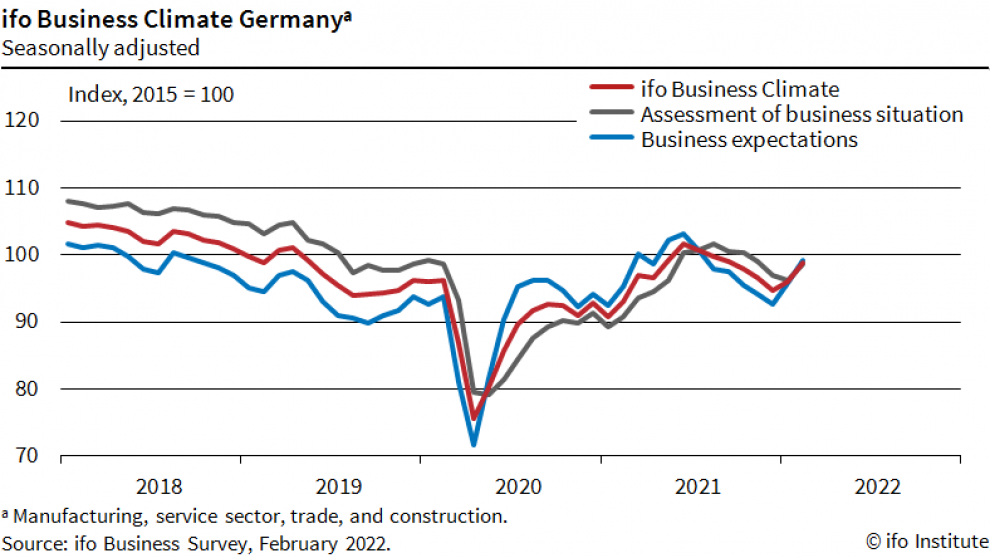
Germany Ifo business climate rose to 98.9, betting on an end to coronavirus crisis
Germany Ifo Business Climate rose from 96.0 to 98.9 in February, above expectation of 96.5. Current Assessment Index rose from 96.2 to 98.6, above expectation of 96.6. Expectations index rose from 95.8 to 99.2, above expectation of 96.5.
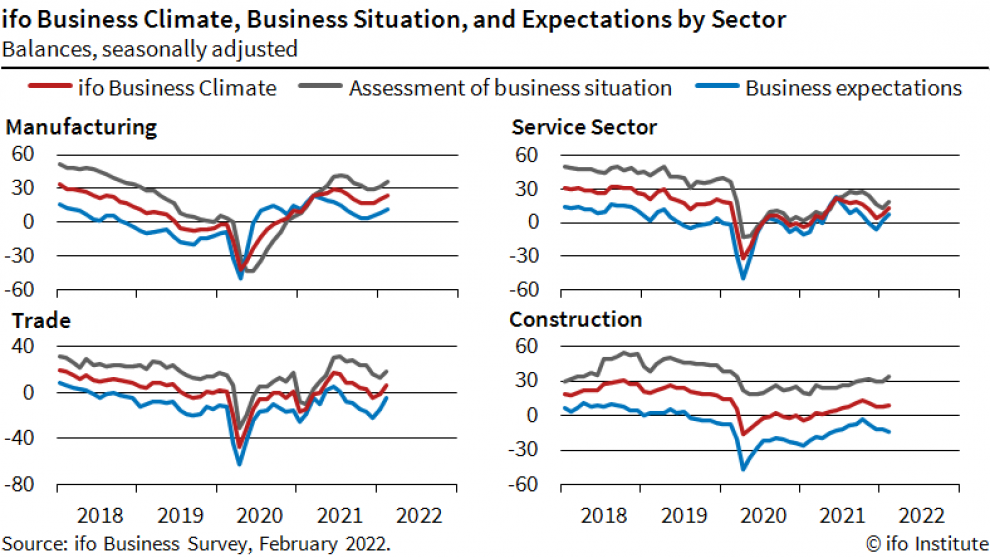
By industry, manufacturing rose from 20.0 to 23.5. Services rose from 7.7 to 13.5. trade rose from -1.3 to 6.6. Construction rose from 8.0 to 8.3.
Ifo said, "the German economy is betting on an end to the coronavirus crisis. However, the escalation of the crisis engulfing Ukraine remains a risk factor."
UK 100 Struggles for Support
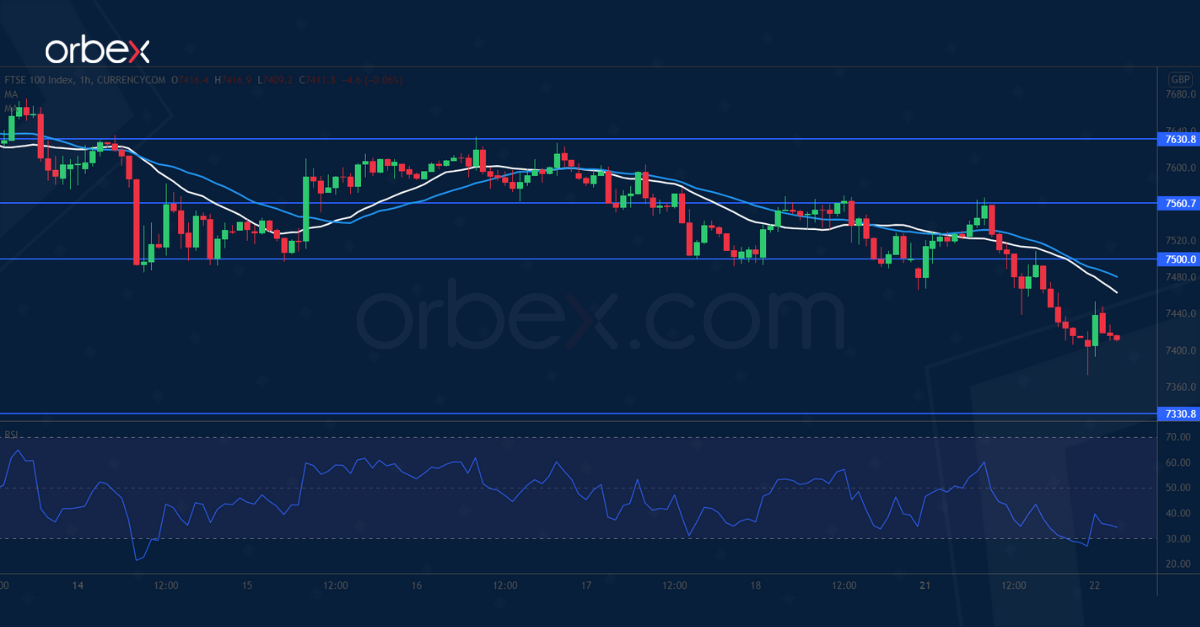
The FTSE 100 tumbles as risk appetite slip across the board. The bulls’ latest effort to push beyond 7630 turned out to be futile. A break below 7500 suggests a lack of commitment and weighs on short-term sentiment.
Intraday traders have switched sides and look to fade the next bounce towards the former support.
A dip below 7430 has opened the door to 7330 as the next target. Further down, the daily support at 7240 would be a major level to keep the uptrend intact in the medium term.
XAG/USD Bounces Higher
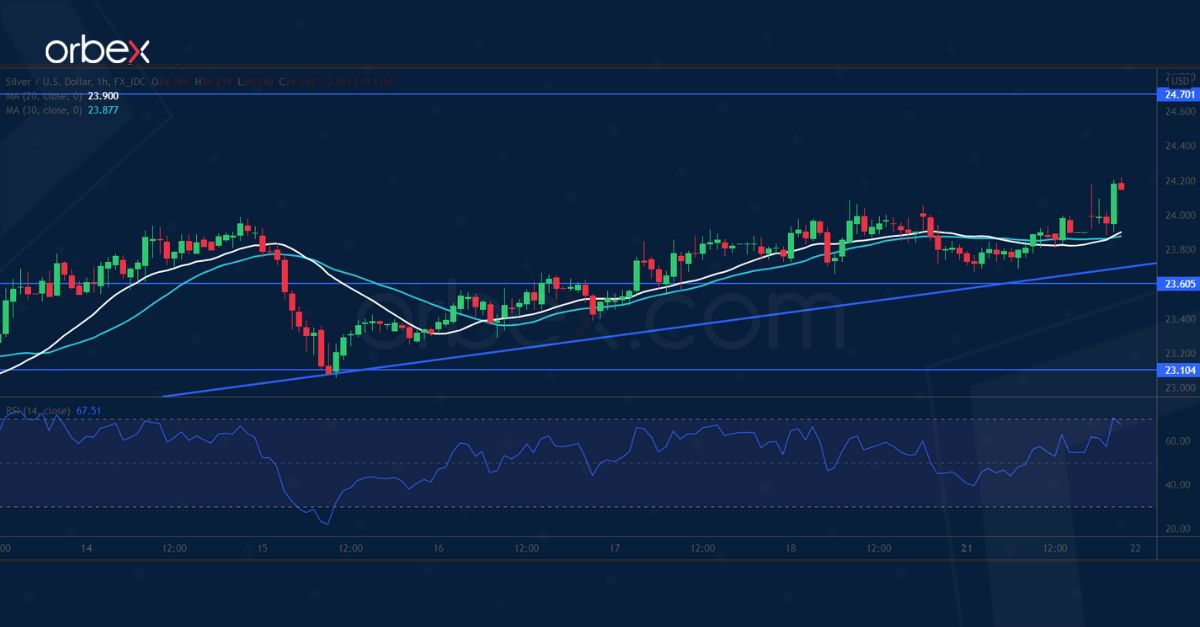
Bullion rallies over ongoing geopolitical tensions in Eastern Europe. Silver gained momentum after a break above the supply zone at 23.90.
A brief fallback found support over 23.10 which indicates solid buying interest. The price is grinding up along a rising trendline and sentiment remains upbeat as long as it stays above the congestion area near the trendline and 23.60.
January’s peak at 24.70 is the target when volatility picks up again. A bullish breakout could trigger a broader reversal in the weeks to come.
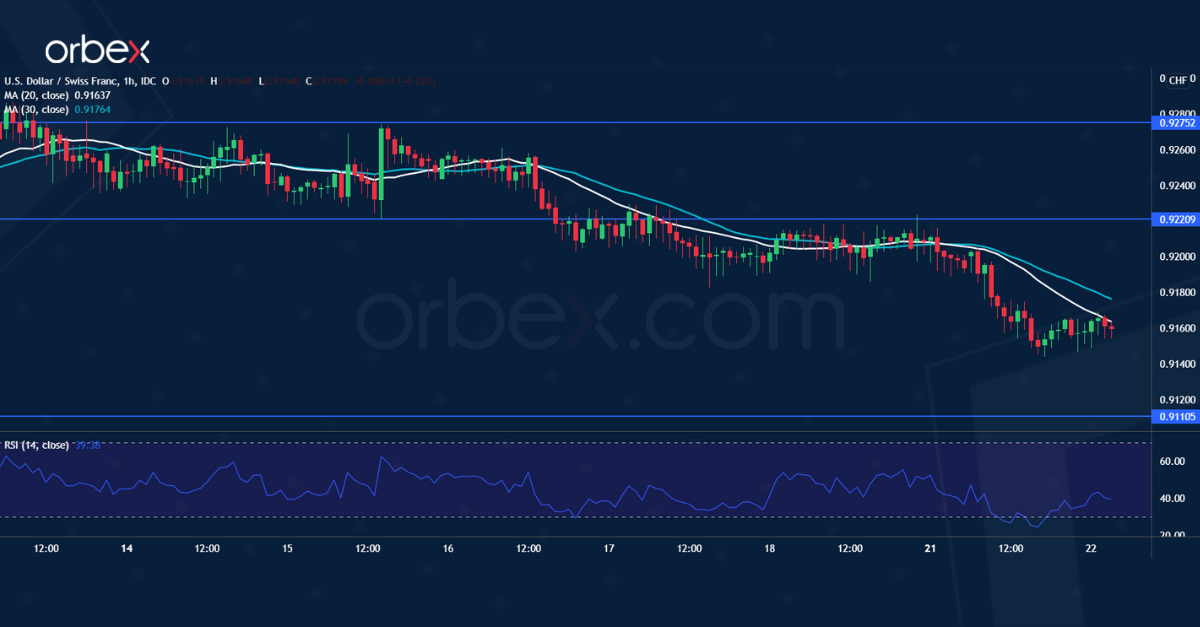
USD/CHF Tests Daily Support
The Swiss franc surges as the US-Russia stalemate boosts demand for safe-haven assets. Consecutive drops below 0.9220 and then 0.9180 suggest that sellers have taken control.
The greenback is heading towards January’s double bottom around 0.9110. A break below this key floor would trigger a deeper correction towards the psychological level of 0.9000.
The RSI’s oversold situation may cause a temporary rebound. The support-turned-resistance at 0.9220 is the level to break to give the bulls any hope of recovery.
GBPUSD Holds Within Sideways Channel above Short-term SMAs
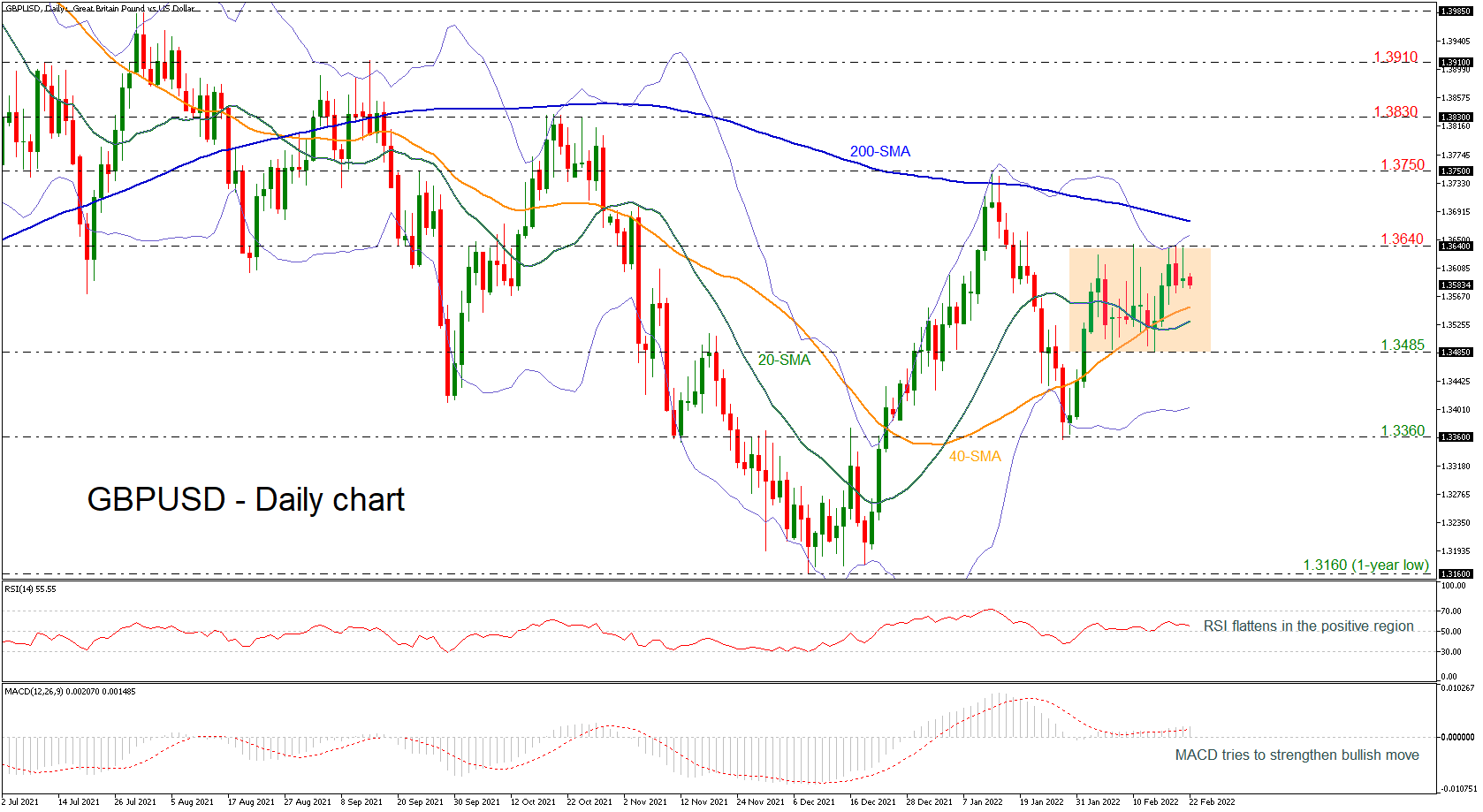
GBPUSD has been developing within a trading range with upper boundary the 1.3640 resistance and lower boundary the 1.3485 support level over the last three weeks.
The price tested the 1.3640 barrier several times as well as the upper Bollinger band with the technical indicators confirming a weak bias. The RSI indicator is moving sideways above the 50 level, while the MACD is trying to extend its positive move above its trigger and zero lines.
A move to the upside may meet resistance at 1.3640 ahead of the 200-day simple moving average (SMA) near 1.3675. The region around the 1.3750 barrier could act as an additional barrier in case of stronger bullish movement.
Immediate support to further declines may be taking place around the 1.3485 figure before breaking the range to the downside. If there are steeper losses, the lower Bollinger band at 1.3405 may halt the bearish actions before plunging to 1.3360.
The picture is looking predominantly neutral at the moment, with price action taking place above the short-term SMAs, though caution is warranted in the near-term as there are some technical signs of a positive market.