Sample Category Title
Digital Revolution: Will Cryptocurrencies Take Over the World? Part I
Part I: Are Cryptocurrencies Really "Money"?
Summary
The form that money takes has evolved over the centuries. Most recently, fiat money and bank deposits replaced gold and other precious metals as the predominant form of money. Will cryptocurrencies (a.k.a. digital currencies) supplant paper money and bank deposits?
- According to most economics textbooks, money has three main functions: it is a medium of exchange, a unit of account and a store of value.
- Digital currencies are already being used as a medium of exchange, but their use as a unit of account is more limited at present. That is, prices of most goods and services continue to be expressed in national currencies, not in terms of digital currencies per se.
- Cryptocurrencies can offer a store of value, at least in a long-run sense. However, the extreme price volatility of many digital currencies implies that individuals and businesses can experience meaningful short-term losses. Furthermore, there has been no issuance to date of crypto-denominated securities (i.e., stocks and bonds), to the best of our knowledge.
- There are a number of benefits of digital currencies. Payments can be made essentially instantaneously via cryptocurrencies, and these transactions can be made secretly. They can also be a good inflation hedge.
- But digital currencies also possess a number of notable drawbacks. Secrecy can enable illicit activities, and their limited supply could potentially lead to a deflationary situation.
- Stablecoins, which are digital currencies whose prices are essentially tied to another asset such as the U.S. dollar, may offer some of the benefits of cryptocurrencies without some of their notable drawbacks. We will discuss so-called "stablecoins" in Part II before turning our focus to central bank digital currencies in Part III. We will offer conclusions in the fourth and final report in this series.
NOT A DEPOSIT. NOT PROTECTED BY SIPC. NOT FDIC INSURED. NOT GUARANTEED. MAY LOSE VALUE. NOT INSURED BY ANY FEDERAL GOVERNMENTAL AGENCY
This commentary is provided for information purposes only and does not contain any recommendations or investment advice. The Firm makes no recommendation as to the suitability of investing in digital assets, including cryptocurrencies. Investments in digital assets carry significant risks, including the possible loss of the principal amount invested. It is only for individuals with a high risk tolerance who can withstand the volatility of the digital asset market. Investors should obtain advice from their own tax, financial, legal and other advisors, and only make investment decisions on the basis of the investor's own objectives, experience and resources.
Will National Currencies Go the Way of the Horse & Buggy?
Humans have been engaging in voluntary and welfare-enhancing exchange of goods and services for millennia. Initially, these exchanges were transacted via barter. For example, an individual in ancient Mesopotamia may have been willing to trade three lambs to another individual for two bushels of wheat. If the other individual agreed to those terms, the trade was made. But barter is an inefficient form of exchange, because the terms of each and every transaction need to be negotiated. Eventually, people invented "money," to serve as a medium of exchange. Instead of exchanging lambs for wheat directly, individuals could sell their lambs for money and then use money to subsequently buy wheat either at that time or sometime in the future. Gold and other precious metals were used as some early forms of money.
Gold and other precious metals have intrinsic value. That is, these metals can be used to make goods, such as jewelry, that individuals value. But a disadvantage of precious metals is their weight which limits their transportability. A gold bar could conceivably be used to buy goods and services, but a standard gold bar weighs 27 lbs. Gold coins weigh significantly less than an entire bar, but it is not always practical to carry around numerous coins. So fiat currencies (i.e., paper money that is issued by governments and central banks of sovereign nations) gradually came into use. During the Gold Standard era, paper money was "backed" by gold. Individuals and businesses could exchange the paper bills they possessed for an equivalent value of gold. But the U.S. government stopped gold convertibility in 1971. Today, paper money is not "backed" by anything that has intrinsic value.
Indeed, there is little intrinsic value to paper money; the paper itself is essentially worthless. But what gives paper money its value is the trust that people have that other individuals will accept it as a means of payment. And these recipients of paper money are willing accept it as payment for goods and services because they trust that other people will do so as well. In short, paper money is backed by trust: trust that other people will accept it in exchange for goods and services. But if this trust breaks down, then paper money becomes worthless.
Modern monetary systems have evolved further and include more than just paper money. There currently is more than $2 trillion of paper notes and coins that are denominated in U.S. dollars in circulation today. These physical forms of money can be considered as "public" money because they are liabilities of the U.S. government (coins) or the Federal Reserves (paper notes). But there is nearly $5 trillion in demand deposits (i.e., plain vanilla checking accounts) in U.S. financial institutions, and the value of other liquid deposits, which can easily be converted into cash or demand deposits, exceeds $13 trillion. These deposits can be considered as "private" money because they are liabilities of privately-owned financial institutions. However, the value of these deposits are guaranteed by the federal government, up to a limit, and they can be used to purchase goods and services.1
This brings us to 21st century and the advent of cryptocurrencies (a.k.a, digital currencies.). Bitcoin, which was introduced in 2009, was the first cryptocurrency. But the number of digital currencies has mushroomed in recent years. According to coinmarketcap.com there currently are more than 16,000 digital currencies, although many of these cryptocurrencies are little used at present. Just two cryptocurrencies (Bitcoin and Ether) together account for about 60% of the $2 trillion worth of digital currencies that are in circulation today. Although coins and paper bills, which have physical forms, comprise a part of most nations' money supplies, cryptocurrencies exist only in electronic form that has even less intrinsic value than paper.
As discussed above, the form that money takes has evolved over the centuries, and there are no properties inherent in paper money and bank deposits that necessarily make them the final step in the evolutionary chain of monetary systems. The explosive growth in the amount of outstanding digital currencies, from nonexistent a few short years ago to roughly $2 trillion today, raises an interesting question: will cryptocurrencies such as Bitcoin and Ether eventually replace national currencies such as the U.S. dollar and the euro? We will attempt to provide an answer to that question is a series of four reports.
This series is organized as follows: we focus on the benefits and drawbacks of digital currencies in this first report. In the second report, which we plan to publish shortly, we will focus on privately-issued "stablecoins." As their name implies, one of the benefits of stablecoins is the relative stability in their value. Are there any notable drawbacks to stablecoins? Although issuance of cryptocurrencies is largely confined to the private sector at present, the public sector is starting to get in on the act. We will focus on the future of central bank digital currencies in Part III, and we will offer conclusions in the fourth and final report.
What Functions Does Money Serve?
Let's start by asking if cryptocurrencies are in fact "money." According to most economics textbooks, money has three main functions: it is a unit of account, a medium of exchange, and a store of value.2 In terms of the first function, cryptocurrencies are not used much as a unit of account at present. Prices of most goods and services are largely expressed in terms of national currencies such as U.S. dollars and euros and not in terms of cryptocurrencies per se. In other words, national currencies continue to serve as the numéraire—the common benchmark in which the values of goods and services are measured—in their respective economies. Unless one of the thousands of digital currencies that currently exists becomes completely dominant, cryptocurrencies likely will not become units of account anytime soon.
Despite their limitations as units of account, digital currencies fulfill the function of mediums of exchange. That is, individuals can use cryptocurrencies to buy goods and services, provided the sellers agree to accept them as payment at the prevailing exchange rate between a specific digital currency and a specific national currency (e.g., the prevailing U.S. dollar/Bitcoin exchange rate). Bitcoin is presently used in roughly 250,000 or so transactions daily on a global basis, although this amount is just a fraction of the U.S. dollar-based transactions that occur every day.3 The reluctance to date of governments, except for El Salvador, to designate cryptocurrencies as legal tender clearly restrains their wider adoption as mediums of exchange.4 Furthermore, China's central bank announced in September 2021 that any transactions conducted in the country in privately-issued cryptocurrencies would henceforth be illegal. This move by the world's second largest economy also splashes some cold water on the wider adoption of digital currencies as mediums of exchange. That said, the number of crypto-based transactions could clearly increase further in coming years given that there are more than 16,000 cryptocurrencies that already exist.
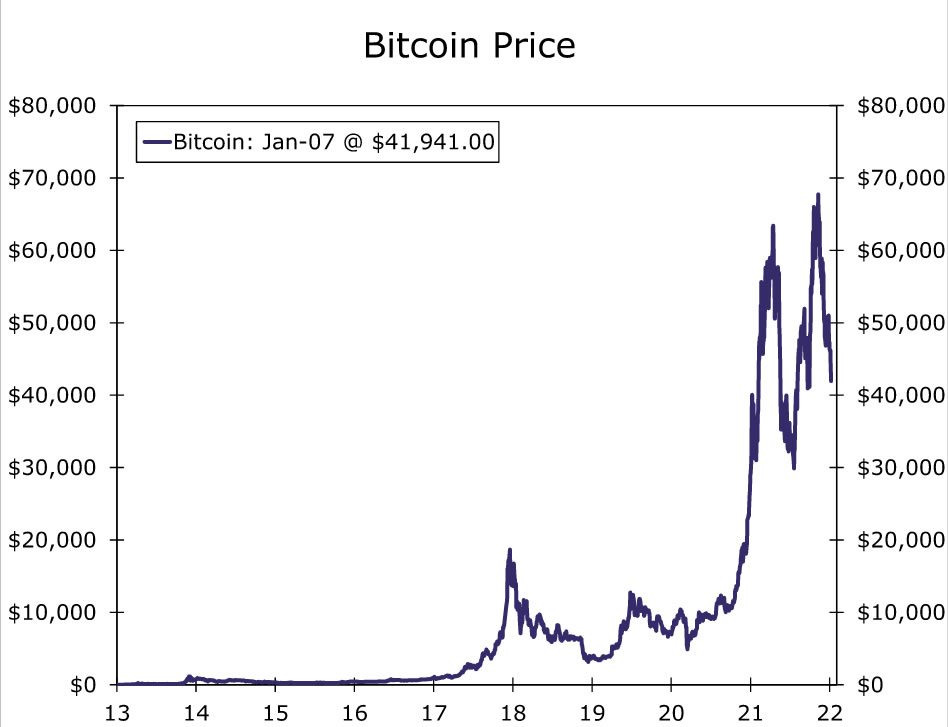
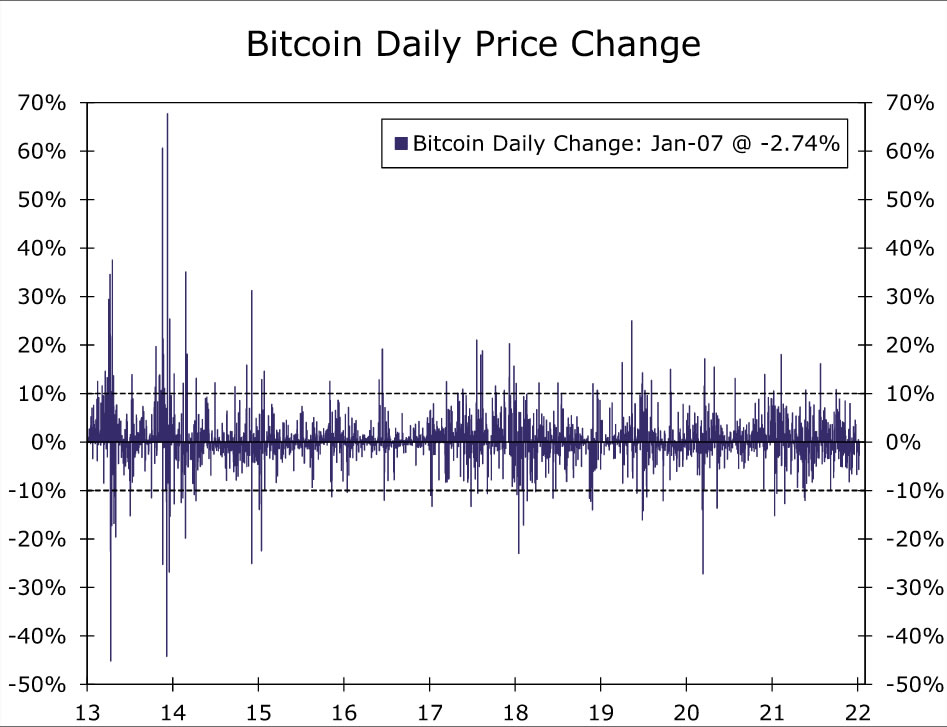
Are cryptocurrencies "stores of value"? Yes, at least in a long-run sense. The price of one bitcoin on December 30, 2011 was $4.25, and it ended 2021 at roughly $46,000. If an individual had remained in possession of that token over that ten-year period, then he or she would have realized an average return of more than 150% per annum (Figure 1). But this incredible rate of return over the past ten years has been associated with stomach-churning volatility. For example, the price of Bitcoin slumped more than 80% between December 2017 and December 2018. More recently, Bitcoin has dropped roughly 40% from its November 2021 peak of nearly $70,000. The average daily price fluctuation of Bitcoin since January 2012 has been 3%, with day-to-day swings in excess of 10% not uncommon (Figure 2). Clearly, Bitcoin has been an outstanding store of value since its inception, but individuals and businesses that may need to hold it for short periods of time to meet cash flow needs could have incurred significant losses. The same holds true for many other cryptocurrencies.
Individuals who own U.S. dollars can hold them in the simple form of coins, currency and bank deposits. There is no price volatility associated with these forms of money, although their purchasing power can erode over time due to inflation. But individuals can also invest those dollars in numerous fixed income and equity securities. The S&P 500 index has risen significantly less than Bitcoin—about 14% on an average per annum basis since 2012—but without the same degree of volatility. In that regard, the average daily price fluctuation of the S&P 500 has been only 0.7% since 2012, with just one daily price swing (daily close-to-daily close) in excess of 10%. The price volatility of investment grade debt securities tends to be even lower. These dollar-denominated securities tend to be good stores of value because they generally pay dividends (stocks) or coupons (bonds), and equities generally appreciate over time.
In contrast, the investment options of cryptocurrencies are more limited at present. Crypto saving accounts have been developed recently whereby owners of digital currencies can place their holdings into these accounts and the funds are then lent to borrowers. These saving accounts typically offer attractive rates of interest, but borrowers could potentially default and the value of the accounts are not government guaranteed.
Furthermore, to the best of our knowledge, no government or company has yet issued a crypto-denominated security. Bitcoin exchange-traded funds (ETFs) have recently been created, but the prices of these ETFs simply mirror the price of Bitcoin. Digital asset securities also have been created, whereby an individual can trade shares of stock digitally. The investor may be able to use a cryptocurrency to buy these securities, but the underlying assets (e.g., shares of Apple or Amazon) are denominated in national currencies such as U.S. dollars and not in cryptocurrencies per se. In sum, investors who want cryptocurrencies to be part of their portfolios but without the associated price volatility have few options currently.
Will crypto-denominated securities become part of the investment landscape anytime soon? In our view, corporate treasurers likely will remain hesitant to issue crypto-denominated securities, at least for the foreseeable future. Corporate revenues and assets are currently denominated in national currencies, but any company that issued a crypto-denominated security would have exposure to that digital currency on the liability side of its balance sheet. The company could quickly find itself in financial stress from an asset-liability mismatch if the price of the digital currency were to rocket higher.
This mismatch could be reduced if companies held crypto-denominated assets and/or they could hedge their crypto-denominated debt payments but, as noted previously, there are no crypto-denominated securities that corporate treasurers can buy at present. Some companies hold digital currencies as part of their cash balances, but the extreme price swings associated with cryptocurrencies likely make treasurers reluctant to make digital currencies a significant component of those cash balances at this time. Whereas a deep and liquid market exists where corporate treasurers can swap their U.S. dollar-denominated floating rate liabilities into fixed rate liabilities and vice versa (i.e., the swaps market), the ability to hedge crypto-denominated liabilities is currently quite limited. Bitcoin futures contracts have recently come into existence, but contracts that mature more than a month or two in the future are not actively traded at present.
In theory, issuance of crypto-denominated securities could potentially ramp up in coming years, which would enhance their ability to serve as a store of value. But until goods and services are more widely priced in terms of cryptocurrencies (i.e., cryptocurrencies become more widely used as units of account) and/or the extreme price volatility of many digital currencies subsides, we believe that many corporate treasurers will remain hesitant to issue crypto-denominated securities. In short, the ability of digital currencies to serve as stores of value without extreme price volatility likely will remain limited, at least for the foreseeable future.
The Pros and Cons of Cryptocurrencies
There are a number of benefits to cryptocurrencies. First, digital currencies exist only in electronic form, and payments between individuals and businesses can be made essentially instantaneously. In contrast, an individual or business can wait days to receive payment while a check "clears." Cryptocurrencies could also be used to make costless payments for "unbanked" individuals.5Because these individuals do not have access to checking accounts, they often must rely on costly alternatives such as money orders to make payments. Unbanked individuals would need just a mobile phone to make payments with digital currencies. Digital currencies are generally secure, in contrast to physical cash which can be misplaced or stolen. That said, there is some probability, albeit small, that digital wallets can be hacked.
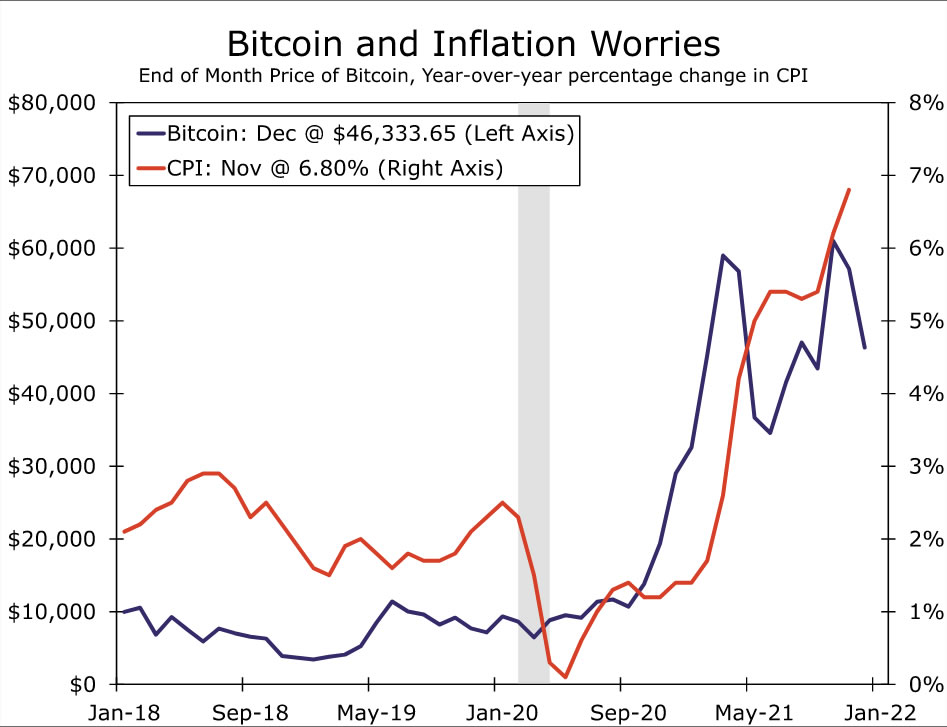
Additionally, cryptocurrencies are not issued by governments, and they largely exist outside the regulatory framework today. So transactions with digital currencies can be made largely in anonymity. And the supply of individual digital currencies are generally limited, so they can be a good inflation hedge. As shown in Figure 3, the recent rise in the rate of CPI inflation has been associated with a sharp increase in the price of Bitcoin.
But there are some notable drawbacks to digital currencies as well. First, the anonymity that some individuals treasure in crypto transactions can help facilitate illicit activities, although the absolute amount of illicit payments is generally small at present.6 Second, the limited supply of digital currencies, which give them properties as an inflation hedge, has some serious drawbacks. For starters, the generally inelastic supply of cryptocurrencies contributes to their price volatility. As the demand curve for digital currencies shifts back and forth along an inelastic supply curve, prices can fluctuate markedly.
Furthermore, the limited supply of digital currencies that causes their prices to explode when demand increases sharply can pose a potential economic risk. Nearly 19 million bitcoins have been "mined" since its inception in 2009, but Bitcoin has a maximum supply of only 21 million coins. It is only a matter of time before this limit is reached. There is not a maximum supply associated with Ether, the second most prevalent digital currency, but new "issuance" of this digital currency is limited to only 18 million coins per year. If the global supply of goods and services grows faster than the global supply of all cryptocurrencies in the years to come, then prices of goods and services will fall relative to the prices of cryptocurrencies. In other words, deflation will set in if privately-issued cryptocurrencies were to replace national currencies as the predominant units of account.
This dynamic occurred during the heyday of the Gold Standard in the late 19th century. Economic historians estimate that the general price level in the United States fell by more than 20% between 1873 and the turn of the 20th century.7 The deep and long-lasting economic contraction that started in 1873 had a role to play in depressing the price level, but prices continued to slide even after the economy had found its footing again in the 1880s. Because the global supply of gold was limited, prices of goods and services fell as their supply increased. Long periods of deflation can eventually lead to prolonged periods of high unemployment, and it was this period of deflation that led politicians of the period such as William Jennings Bryan to call for the use of silver as another component of the money supply.
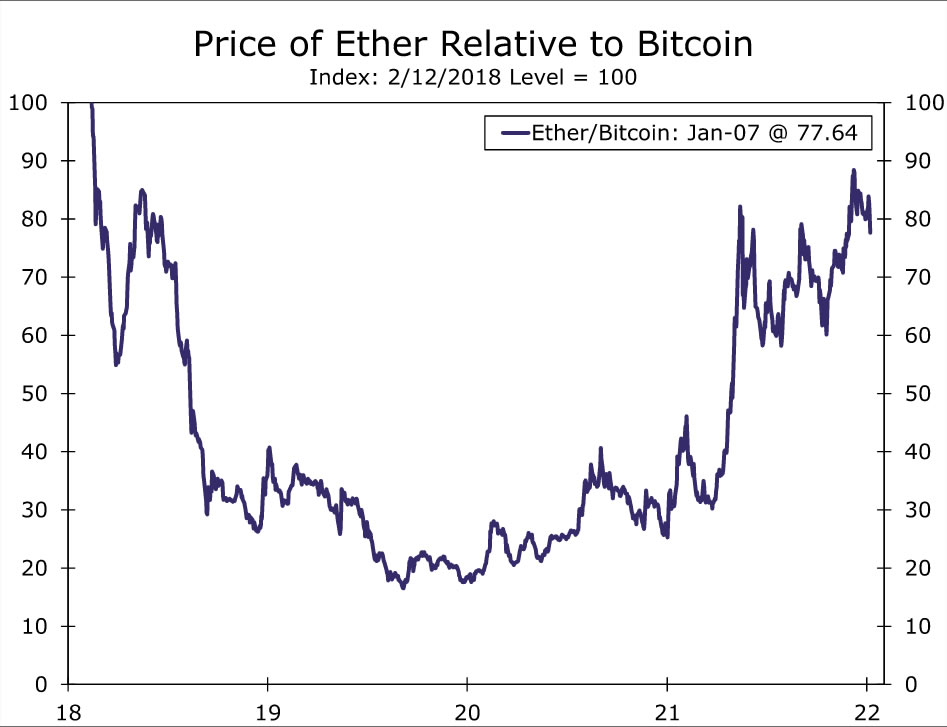
As noted previously, there are more than 16,000 cryptocurrencies in existence today, and many more likely will be introduced in years to come. So the overall supply of cryptocurrencies likely will continue to grow, which should limit prospects for a prolonged period of deflation. But individual cryptocurrencies are not perfect substitutes, and the value of one digital currency can fluctuate widely vis-á-vis another one. For example, Ether lost 80% of its value against Bitcoin between early 2018 and early 2020, although it subsequently has recouped much of those losses (Figure 4). This volatility may prevent individuals from shifting seamlessly from one cryptocurrency to another one, which would keep the use of individual digital currencies siloed.
What the world needs is an elastic supply of a digital currency(ies) that have less price volatility. Stablecoins, which are digital currencies whose prices are essentially tied to another asset such as the U.S. dollar, may offer some of the benefits of cryptocurrencies without some of their notable drawbacks. We will discuss stablecoins in more detail in the next report in this series.
Conclusion
The form that money takes has evolved over the centuries, and there is no reason to suspect that its current form—paper bills and bank deposits—necessarily has any permanence. In that regard, the use of cryptocurrencies has mushroomed in recent years, and they threaten to overtake paper bills and bank deposits in coming years as the predominant form of money in the world. The ability to make payments essentially instantaneously is an attractive feature of digital currencies as is their properties as an inflation hedge.
But there are also some serious drawbacks to cryptocurrencies, at least at present. Investors who want digital currencies to be part of their portfolios must be willing to tolerate high degrees of price volatility and the lack of crypto-denominated securities. In addition, the limited supply of digital currencies could potentially exert deflationary pressures on the global economy if they ever superseded national currencies. A prolonged period of deflation is a problem because debt is generally fixed in nominal terms. Therefore, a business' or individual's relative debt burden would grow as prices and wages fall, potentially leading to widespread bankruptcies and unemployment.
But there is a class of digital currencies, which are known as stablecoins, that do not have some of these drawbacks. The values of stablecoins are essentially tied to another asset such as the U.S. dollar, which keeps values more or less "stable." Additionally, supplies of stablecoins are not limited. Could stablecoins be the digital currencies that eventually supersede national currencies? We will discuss the outlook for stablecoins in Part II of this series.
Endnotes
1The Federal Deposit Insurance Corporation (FDIC) guarantees up to $250,000 in deposits per account owner. (Return)
2For example, Mishkin, Frederic, The Economics of Money, Banking, and Financial Markets 8th edition, Pearson, Boston, 2007. (Return)
3Data on Bitcoin-based transactions can be found on Statista. The Federal Reserve processed nearly 65 million transactions on an average day in 2020. (Return)
4Sellers are mandated by law to accept "legal tender" as payment for goods and services. Bitcoin became legal tender in El Salvador in September 2021. (Return)
5According to the FDIC, 5.4% of U.S. households (approximately 7.1 million) were "unbanked" in 2019, How America Banks: 2019 FDIC Survey.(Return)
6Chainanalysis estimates that digital currencies were used in $21.4 billion worth of illicit payments in 2019, which accounted for 2.1% of all crypto transaction volume that year. However, that amount fell to $10 billion in 2020 (only 0.34% of the total transaction volume in 2020). See The 2021 Crypto Crime Report, Chainanalysis, February 16, 2021. (Return)
7U.S. Census Bureau, "Price Indexes" 1949. (Return)
EEUR/USD Outlook: The Base of Thick Daily Cloud Continues to Cap and Keep Larger Bears Intact
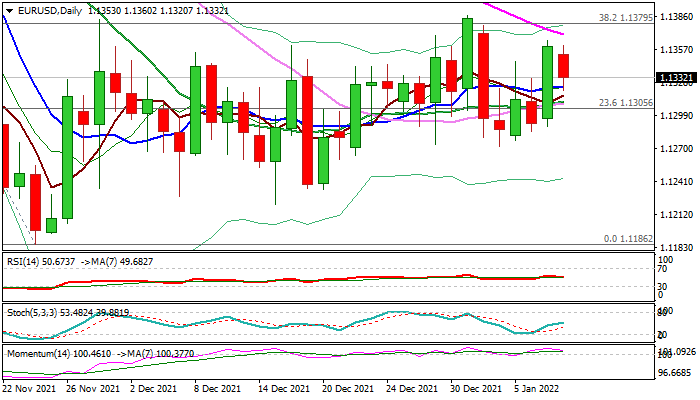
The Euro dips in European trading on Monday after last Friday’s post-NFP advance faced strong headwinds at the base of thick falling daily cloud (1.1361).
Extended consolidation of a larger downtrend from 2021 high (1.2349) was repeatedly capped by daily cloud base, suggesting that the upside is limited, while the action remains weighed by the cloud.
Although the daily techs still maintain bullish momentum, warning signals come from a weekly chart, as formation of 20/200DMA death-cross, negative momentum, and overbought stochastic, warn that the larger picture is bearish and a larger downtrend is likely to resume after consolidation.
Initial supports lay at 1.1272 (Jan 4 low) and 1.1221 (Dec 15 low), guarding pivot at 1.1186 (2021 low) loss of which signals bearish continuation and risk drop towards 1.10 zone.
Daily cloud base, falling 55DMA (1.1369) and Fibo 38.2% of 1.1692/1.1186 bear-leg (1.1379) offers strong barriers which should keep the upside limited and maintain an overall bearish structure.
Res: 1.1361; 1.1379; 1.1400; 1.1439.
Sup: 1.1324; 1.1272; 1.1221; 1.1186.
US Jobs Report Fuels Bets for Faster Fed Hikes
- Traders bet on faster Fed rate increases after solid jobs report
- Yields spike higher but the dollar cannot capitalize - euro flows?
- Stock markets take another hit as valuation rotation continues
Hot labor market
The US jobs market is approaching full employment conditions with impressive speed. Even though nonfarm payrolls fell short of expectations in December, with the economy adding 199k jobs instead of the anticipated 400k, the rest of the report was very encouraging.
The unemployment rate fell to a new post-pandemic low of 3.9%, while the labor force participation rate and the employment-to-population ratio improved. Most importantly, wage growth was far stronger than expected, adding credence to the narrative that companies are starting to compete for scarce workers.
All this paints a rosy picture of the labor market, despite the shortfall in nonfarm payrolls. Markets reacted by betting the Fed will be forced to expedite its normalization plans, to prevent strong wage growth from feeding inflation. The implied probability for a rate increase in March now stands at almost 90%.
In total, markets are now pricing in three Fed hikes for this year and equal chances for a fourth one.
Yields spike but dollar doesn’t obey
When rate traders bet on faster Fed rate increases, that typically benefits the dollar as yield differentials widen to its advantage. However, that’s not how it played out on Friday. While US yields did spike higher, the reserve currency didn’t follow the playbook and instead lost ground.
One explanation for this dichotomy is that short-term European yields also jumped, more than their US counterparts in fact. Inflation in the euro area hit a new record of 5% in December, fueling bets that the European Central Bank will also get the interest rate ball rolling soon. Money markets have pulled forward the first minor ECB rate increase to October of this year.
Admittedly, this speculation seems excessive. While European inflation has truly fired up, the labor market hasn’t recovered, so there is no fear of a wage-price inflationary spiral. The last thing the ECB wants is to raise rates too fast and put additional strain on highly indebted economies like Italy, risking to shock the bond market and undo years of hard work.
Hence, relative monetary policy still argues for a lower euro/dollar as there is scope for markets to fully price a fourth Fed hike this year, whereas the ECB is extremely unlikely to pull the rate trigger in October. The key risk to this view is ‘peak inflation’ in America, which sees traders dial back bets for aggressive Fed tightening.
Stocks under pressure
Stock markets have been under pressure since the year began, scrambling to price in the negative effects of higher interest rates. Most of the damage has been concentrated in the tech sector that’s the most sensitive to higher yields, hence why the Nasdaq lost another 1% on Friday to close the week 5.5% lower.
Valuation has been judge and executioner in equity markets lately. The spike in yields has seen the outrageous multiples of many companies compress to reflect reality, with the riskiest names suffering the most as investors prioritize steady profits over future promises.
Whether investors continue to position for a world of higher rates could depend on this week’s events, particularly on the latest US inflation report on Wednesday and the testimonies by Chairman Powell before Congress. The earnings season will also commence on Friday with big US banks.
AUD/USD Currently Correcting Higher from 0.7129 Low
The Aussie Dollar started a fresh decline from well above 0.7250 against the US Dollar. The AUD/USD pair traded below the 0.7220 support to move into a bearish zone.
The pair even traded below the 0.7160 level and the 50 hourly simple moving average. A low was formed near 0.7129 and is currently correcting higher. There was a break above a key bearish trend line with resistance near 0.7150 on the hourly chart.
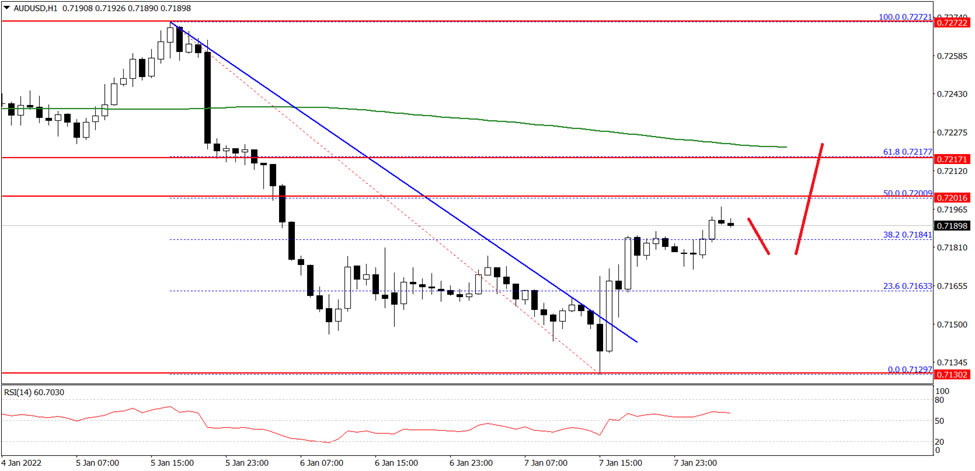
The next major resistance is near the 0.7200 level and the 50 hourly SMA, above which the pair could rise steadily towards the 0.7250 level in the near term.
An immediate support on the downside is near 0.7160 on FXOpen. The next key support is near the 0.7130 level. A clear break below the 0.7130 support could lead the pair towards the 0.7080 support.
EURGBP Continues its Descending Move; Bearish Forces Linger
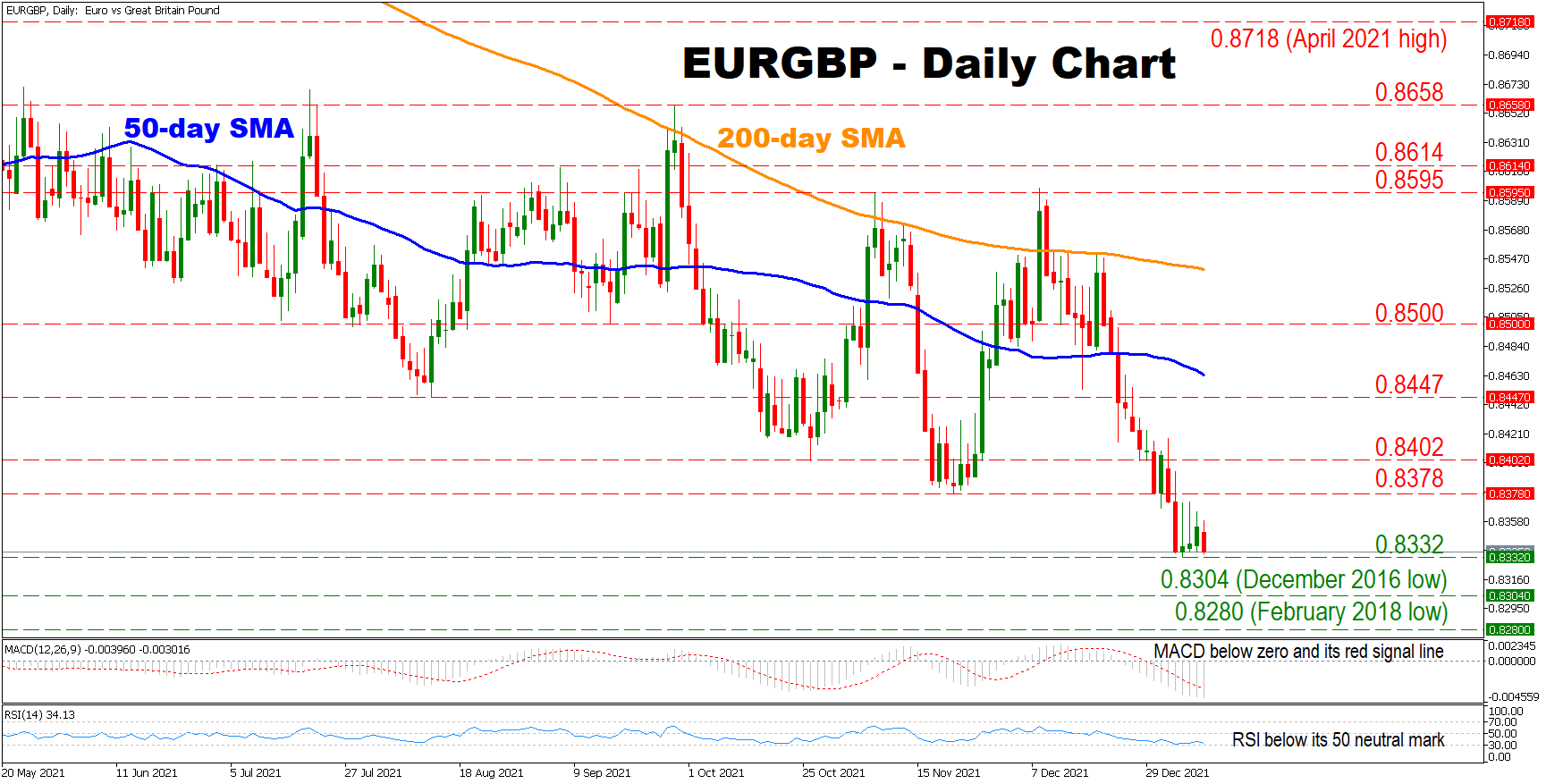
EURGBP came under pressure during December, crossing below its 50- and 200-day simple moving average (SMA). Moreover, the pair has marked yet more lower lows, reinforcing its overall bearish outlook.
Short-term momentum indicators are supporting a negative bias for the pair as the RSI is found below its 50 neutral mark, while the MACD is located below zero and its red signal line.
Should the bears maintain control, initial resistance might be found at the 0.8332 level. A break below that crucial point could intensify selling pressures, paving the way towards the December 2016 low of 0.8304. A decisive move below the latter could send the price to test the February 2018 low of 0.8280.
On the flip side, if the bulls regain control, initial support might be found at the 0.8378 level, before buyers eye the 0.8402 hurdle. A break above that point could open the door towards the 0.8447 obstacle, before testing the 50-day SMA currently at 0.8463. Surpassing the latter could strengthen the pair's positive momentum, sending the price towards the 0.8500 barrier.
In brief, the outlook for EURGBP is cautiously bearish as the price is trading well below its 50- and 200-day SMA. For sentiment to change, the bears would need to break above the 200-day SMA currently at 0.8539.
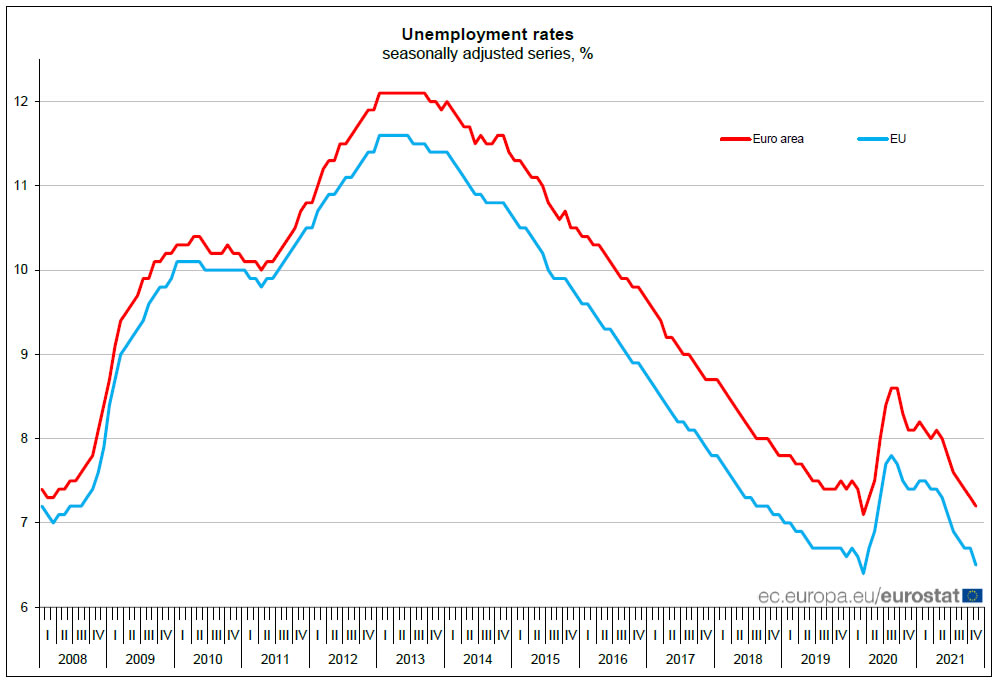
Eurozone unemployment rate dropped to 7.2% in Nov, EU down to 6.5%
Eurozone unemployment rate dropped from 7.3% to 7.2% in November, matched expectations. EU unemployment rate dropped from 6.7% to 6.5%.
Eurostat estimates that 13.984 million men and women in the EU, of whom 11.829 million in the euro area, were unemployed in November 2021. Compared with October 2021, the number of persons unemployed decreased by 247 000 in the EU and by 222 000 in the euro area. Compared with November 2020, unemployment decreased by 1.659 million in the EU and by 1.411 million in the euro area.
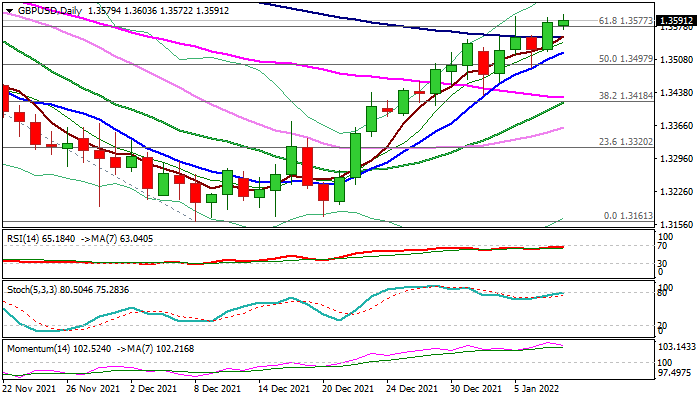
Cable Cracks 1.36 Barrier in Extension of Advance after Disappointing US NFP Data
Cable cracks 1.36 barrier in early Monday’s trading, maintaining positive stance following last Friday’s jump on well below expectations US non-farm payrolls data.
Bullish setup of daily MA’s underpins the action, along with positive signal generated on Friday’s close above pivotal double-Fibo barriers at 1.3575/77 (38.2% of 1.4249/1.3161 descend and 61.8% retracement of 1.3834/1.3161 downleg), which looks for confirmation on repeated daily close above these levels.
Sustained break above 1.36 zone (round-figure / Nov 9 high) would open way towards 1.3675 (Fibo 76.4% of 1.3834/1.3161) and possibly unmask 200DMA (1.3736).
Weaker bullish momentum and stochastic entering overbought territory on daily chart, warn that bulls might be losing steam and consolidation may precede fresh push higher.
Initial support lays at 1.3553 (5/100DMA bull-cross) with extended dips to remain above broken daily cloud top (1.3514) to keep bulls intact.
Res: 1.3607; 1.3675; 1.3700; 1.3736
Sup: 1.3575; 1.3553; 1.3514; 1.3490
Intraday Market Analysis: US Dollar Index Struggles for Support
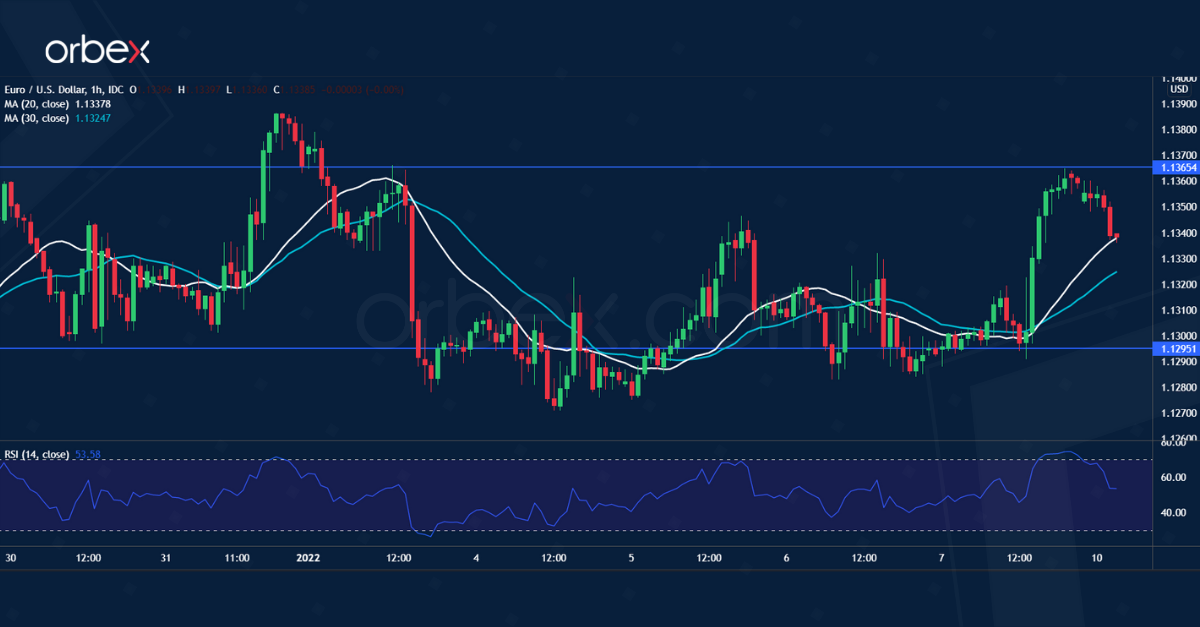
EUR/USD tests key resistance
The US dollar retreated after December’s Nonfarm Payrolls came in far below expectations. The pair has been in a narrowing range between 1.1270 and 1.1365.
The previous fall below 1.1280 added pressure on the buy side, though it turned out to be an opportunity for the bulls to accumulate at a bargain.
A break above the resistance could end the sideways action and trigger a runaway rally towards 1.1460. The RSI surged into the overbought area and may cause a brief pullback above 1.1295.
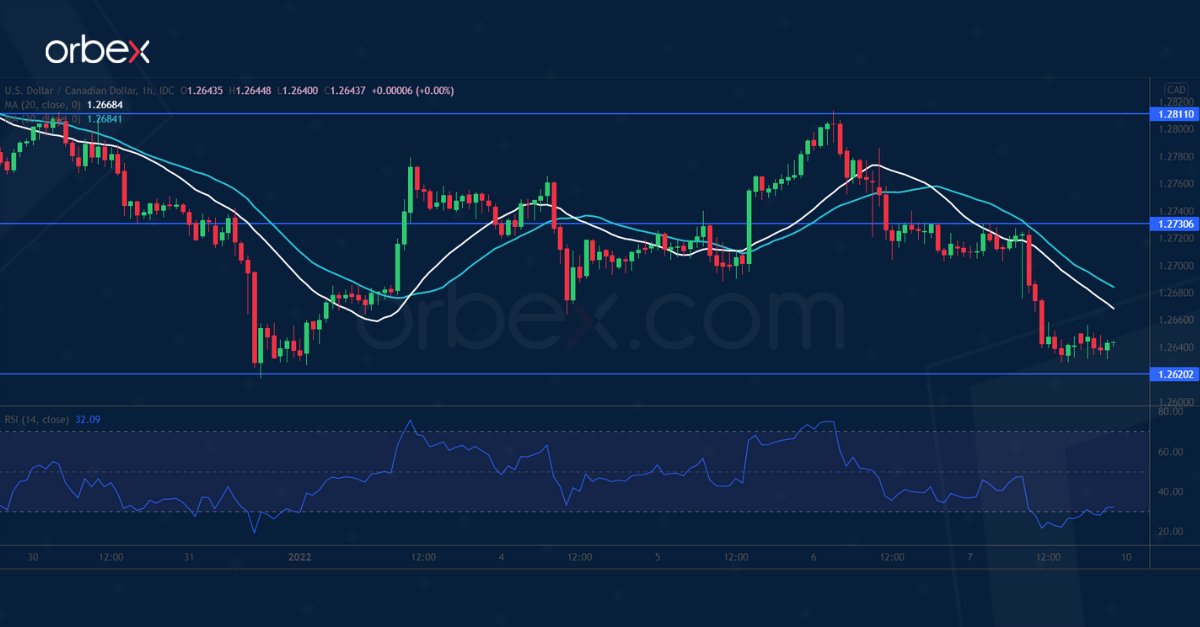
USD/CAD tests daily support
The loonie rallied after Canada added twice as many jobs as expected in December. The year-end sell-off met strong bids near the daily support at 1.2620.
But the rebound came to halt at the supply zone around 1.2810, which used to support from the previous consolidation. The RSI’s double top in the overbought zone has restrained the upward momentum.
1.2730 is a fresh resistance as price action is about to retest the critical level at 1.2620. A bearish breakout could trigger a plunge to 1.2540.
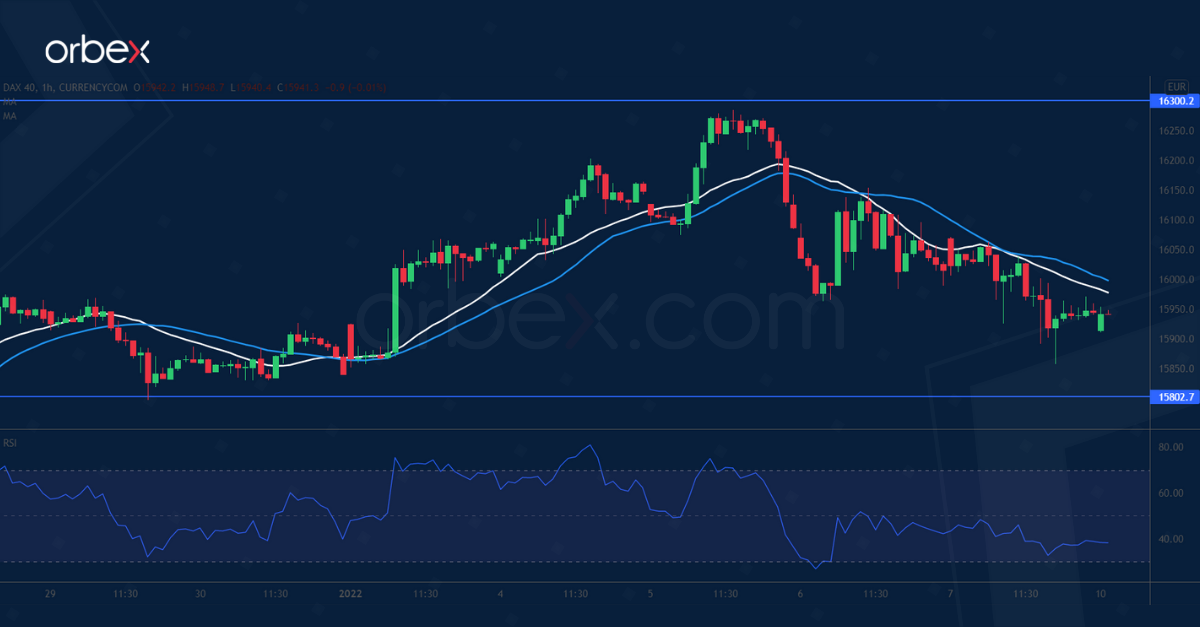
GER 40 seeks support
The Dax 40 edged lower as rising CPI in the eurozone argues in favor of tightening. The index saw stiff selling pressure right under the all-time high at 16300.
A bearish RSI divergence in this major supply area indicates a lack of commitment from the bulls as buying slows down. A combination of profit-taking and fresh selling has led to a drop below 16100, a warning sign for a steeper correction.
15800 is the next key support. A breakout could send the index to 15500 at the base of the latest rally.
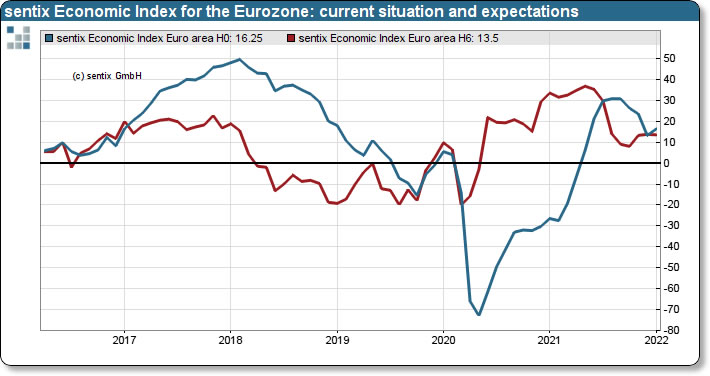
Eurozone Sentix rose to 14.9 in Jan, fundamentally constructive outlook with an Achilles’ heel
Eurozone Sentix Investor Confidence rose from 13.5 to 14.9 in January, above expectation of 12.0. Current Situation Index rose from 13.3 to 16.3. Expectations Index dropped slightly from 13.8 to 13.5.
Sentix said, "our fundamentally constructive outlook for the economy in 2022 (especially the first half of the year) has an Achilles' heel: The support of expansive central banks is threatening to run out faster than expected.
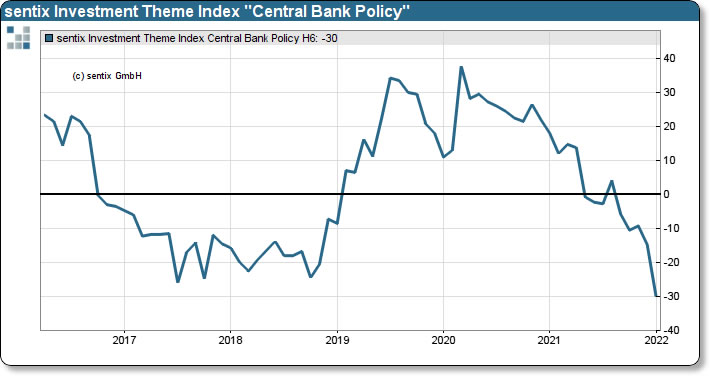
"The sentix topic barometer 'Central Bank Policy' indicates an increasing burden for the bond market and thus for the real economy. The burden on this is estimated to be greater than in 2018, when the monetary guardians also adopted a more restrictive course.
"Fiscal balancing impulses must therefore be put in place swiftly to cushion the weakening monetary impetus from the central banks."
Gold Slips Back Below 1,800 But Trendless Bias Holds
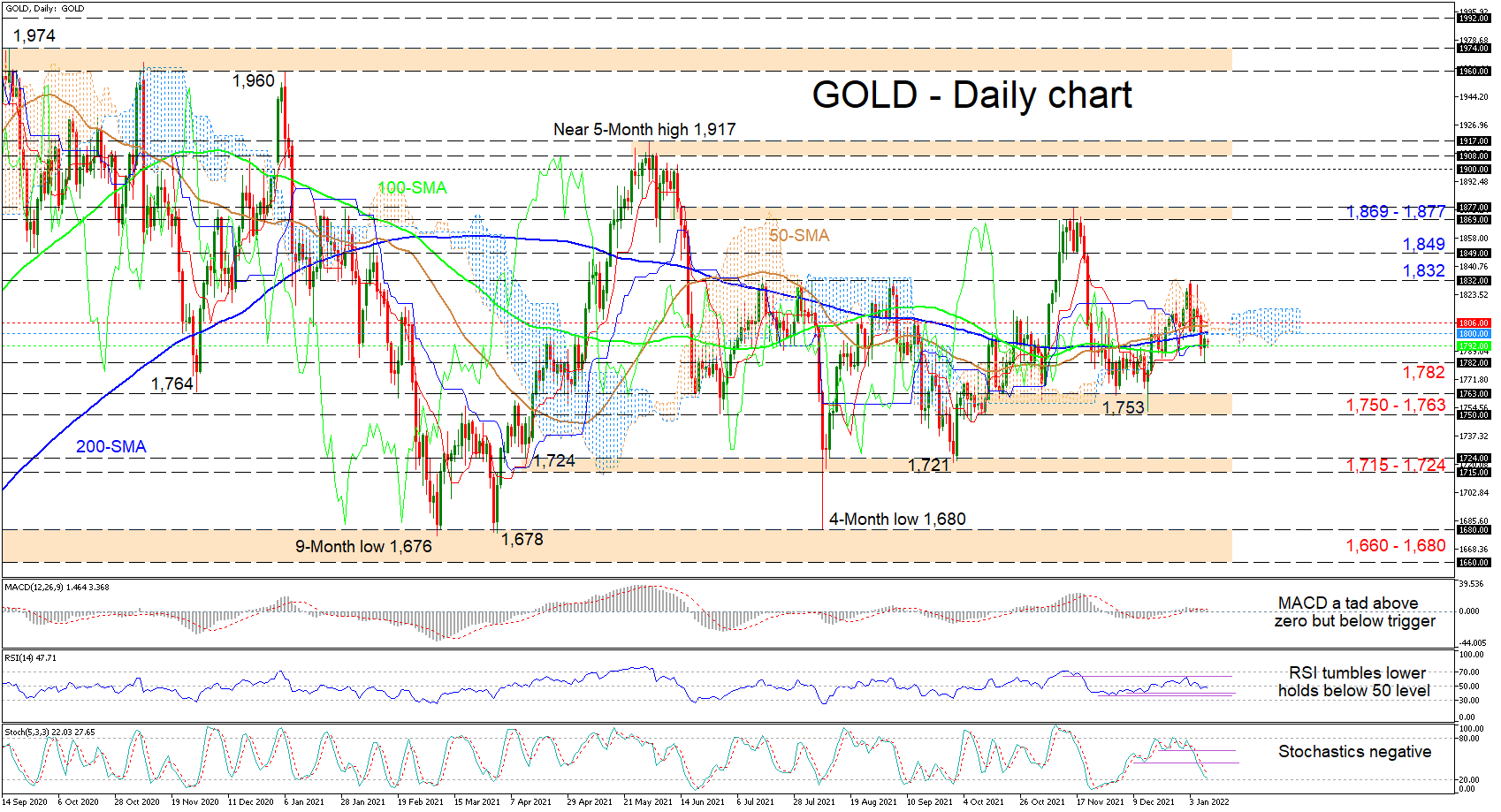
Gold’s downside forces have paused a tad beneath the 1,800 mark with the price resting on the 100-period simple moving average (SMA). A more neutral trajectory is being endorsed by the lack of trend in the SMAs.
The Ichimoku lines are not indicating a clear price direction especially after the price gains from the 1,753 trough, which have been relatively offset by the pullback in the commodity off the 1,832 recent high. The short-term oscillators are tilting a tad to the downside, but directional momentum remains weak. The MACD and the red trigger line have flatlined marginally above the zero threshold, while the RSI is pointing lower, slightly beneath the 50 level. The negatively charged stochastic oscillator is promoting further negative moves in the precious metal.
Maintaining the current price path, downward constraints could commence from the 100-day SMA at 1,792 ahead of the 1,782 nearby obstacle. Sliding lower, the bears may then confront the 1,750-1,763 support zone, which has taken shape from November 2021. If selling interest intensifies, the 1,715-1,724 support band could come under fire, while any further price impetus south may turn traders’ attention towards the key 1,660-1,680 barricade, which has defended the broader positive structure from June 2020.
On the other hand, an immediate fortified resistance section from the cloud’s lower band at 1,800 until the red Tenkan-sen line at 1,806 may impede buyers from reaching the 1,832 high. However, if the price successfully overcomes the 1,832 barrier, the bulls may jump towards the 1,849 obstacle before aiming for the 1,869-1,877 resistance border.
Summarizing, gold is oscillating around the 1,800 mark remaining confined between the 1,676 and 1,917 limits of a ten-month trading range.