

Sample Category Title
Omicron Becomes Omigone
Markets party despite Omicron
You would be hard pushed to find a reason not to be in a jubilant mood as an investor as financial markets dished out the happy new year’s overnight, the first trading day of the year. I spent it on a series of almost empty flights on the trek to managed isolation in New Zealand, but for the rest of the world, the New York session finished with plenty of New Year’s goodies. Stocks finished higher, oil moved higher, the US dollar moved higher, and US treasury yields moved higher. All signs that the US economy is starting the year in continuing recovery mode.
The chief reason behind the return of investor confidence is omicron, a trend really occurring since Christmas and the incessant “Jeff, will we get a Santa Claus rally?” As more data pours in, it seems that yes, the virus variant is much more contagious, but it is not leading to a proportionally larger number of hospital admissions, the opposite in fact. Quid pro quo, it won’t’ stop the global economic recovery, although China will remain locked up with Hong Kong and New Zealand, therefore “buy everything.”
Tesla jumped 13.0% overnight as it delivered more cars than forecast in Q4. The cost of replacing batteries remains its dirty little secret, and is highly ironic in some ways, as a four-wheeled tree hugger that has fewer moving parts than a normally aspirated petrol burner. Google “Finn,” “explosives’”, “battery,” and “Tesla” for one man’s adventure with an “ancient” 2013 Tesla. Apple also briefly touched a USD 3 trillion market cap yesterday, mostly because it’s Apple and its cool, but also because the street wanted to see a 3-handle.
One warning sign around equity exuberance though is the US bond market, with US 10-year yields climbing around 13 basis points to 1.635%, its highest, I believe, since late October. With a return of the post-Omicron buy everything trade, will come to the hard realisation that globally, inflation continues and yields globally, have likely seen the bottom. Monetary policy normalisation will be the name of the game for central banks, although it will look more normal in some countries than in others. The US, Russia, Latin America, and the Commonwealth countries will show normalisation to greater and larger extents. Japan and the Eurozone will change the names on the doors but keep monetising their government’s debt the same as ever behind it, while much of Asia, will tolerate stagflation to support growth making them mostly “bold and hold.”
Although the omicron relief trade could continue dominating investor sentiment for much of January, the new budget year always needs a “throw the kitchen sink at it” to get started, the US bond market is telling us not to get too carried away. Bitter experience also tells me that the first big direction trade of the year is usually wrong. Stock markets, in particular, will have to work much harder to make an honest dollar in 2022, as monetary policy settings get moved back from fantasy to reality.
Asian markets though are showing omicron resilience, with China and pan-Asian Manufacturing PMIs over the last couple of days, mostly outperforming for December. Today’s China Caixin Manufacturing PMI rose to 50.9, while Japan’s Jibun Bank PMI reading held steady at 54.3. Yesterday, Singapore GDP also proved resilient, with 2021 GDP finishing 7.20% for the year, completely reversing with interest, the 5.40% contraction of 2020. That, interestingly, is a trend that has been repeated all over the world, it just doesn’t feel like it in our everyday life.
Germany’s Unemployment and Retail Sales kick off Europe’s week, along with French Inflation. The US releases the JOLTS Job Openings and US ISM Manufacturing PMI. Omicron headlines will likely have a diminishing impact now that the new year has started and with the data seemingly clear about its virulence. If today’s data from Germany and the US show employment and job vacancies holding firm versus omicron, investors should the year in an ebullient mood as omicron becomes omigone.
Subdued Trading in FX Space Marks a Stark Contrast with Action on Bond Markets
Markets
Core bonds started the new year in an extremely weak fashion. US Treasuries underperformed German Bunds as trading volumes returned to early December levels. The US yield curve bear steepened with yields adding 3.6 bps (2-yr) to 12.2 bps (30-yr). The move was almost equally driven by higher real rates and rising inflation expectations. The leap higher in long-term bond yields comes after them being depressed ever since omicron set foot on US soil. Despite record national infection levels, yields finally continued their natural path higher. Is the "bad" news discounted? The European example shows that the economic impact of omicron so far remains less worse than initially feared. The monetary policy context continues to play a role as well. The Fed's December decision to accelerate the taper process could already result in a March rate hike with some governors even calling to shrink the balance sheet starting in Summer. This week's US eco data could strengthen this hypothesis. The December manufacturing ISM kickstarts the action today with consensus expecting another 60+ outcome. The non-manufacturing ISM prints on Thursday. December ADP employment change, weekly jobless claims and payrolls will - from Wednesday to Friday - be indicative for the tightness on the US labour market. Meantime, FOMC Minutes (Wednesday) will provide us with more insight on the decision making process within the US central bank. These eco/events are expected to weigh additionally on US Treasuries. The US 10-yr yield returned to the higher end of the 1.37%-1.7% trading range in place since Q4 2021 with the upper bound serving as next resistance ahead of the 2021 high (1.77%). The German yield curve bear steepened as well yesterday with yields adding 2.5 bps (2-yr) to 5.6 bps (30-yr). We must add that Bunds underperformed US Treasuries for most of the second half of December. The German 10-yr yield leapfrogged from -0.4% to nearly -0.1% currently with the 2021 high waiting for a test at -0.06%. The European 10y swap rate already passed that technical reference, closing at 0.34% yesterday, the highest level since May 2019! Market expectations about the pace of a future ECB tightening cycle (start late 2022/early 2023) turned more hawkish since the December Frankfurt gathering. This week's EMU eco calendar is less enticing than the US one, but we do get December inflation numbers on Friday. Subdued trading in FX space marks a stark contrast with action on bond markets. Yesterday's US Treasury underperformance abrupted a test of the upside of the narrow trading channel in EUR/USD between 1.1186 and 1.1383. Sterling's decent run since mid-December (BoE rate hike & positive risk sentiment) ran into EUR/GBP support just below 0.84.
News headlines
Key Turkish price indicators accelerated much faster than expected in December. Headline inflation jumped 13.58% M/M bringing prices 36.08% higher Y/Y, the fastest pace of price rises in more than 19 years. The core CPI index also jumped from 17.62% to 31.88%. PPI jumped at an even faster pace of 19.08% M/M and 79.89% Y/Y, suggesting inflationary pressures to stay. The jump in inflation comes as the unconventional policy approach of president Erdogan, forcing the CBRT to interest rate cuts, triggered a spiral of a free-fall of the lira reinforcing price pressures. With the CBRT last month cutting its policy rate to 14%, the real policy rate now reaches an extreme low of minus 22%. The Turkish government last month took some measures to shield TRY deposit holders from a weakening currency, but question is whether this will change the depreciation trend if the CBRT policy doesn't change in a profound way. After an initial post-data loss, the lira yesterday closed modestly stronger at EUR/TRY 14.82.
The China Caixin manufacturing PMI again returned to expansion territory, rising from 49.9 to 50.9. Markets expected an outcome near the 50 boom-or-bust level. According to the Caixin statement, firms reported the strongest increase in output for a year due to an up-tick in total sales. At the same time, they labelled foreign demand as lackluster with export orders broadly stagnant. Capacity constrains also remain an issue as insufficient availability of staff prevents firms to work through incomplete business. Average input costs rose at the weakest pace in 19 months in December as price for commodities eased.
CAD/JPY and AUD/JPY maintain bullish bias
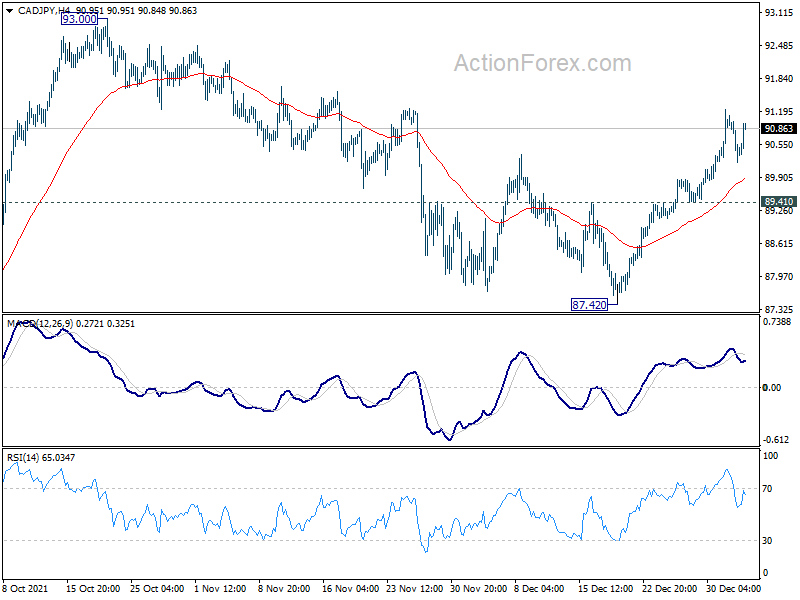
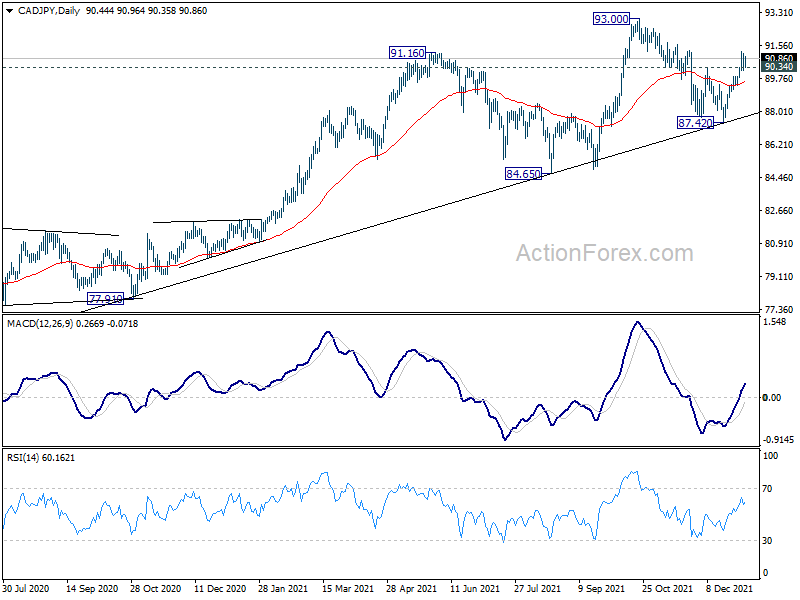
While Yen is being sold sharp sharply, commodity Yen crosses are generally struggling in range. Nevertheless, they's maintaining near term bullish bias. CAD/JPY's prior break of 90.34 resistance suggests that correction from 93.00 has completed at 87.42 has defended medium term trend line support. Further rise is expected as long as 89.41 support holds. CAD/JPY should target a test on 93.00 high next, with prospect of resuming whole up trend from 73.80 (2020 low).
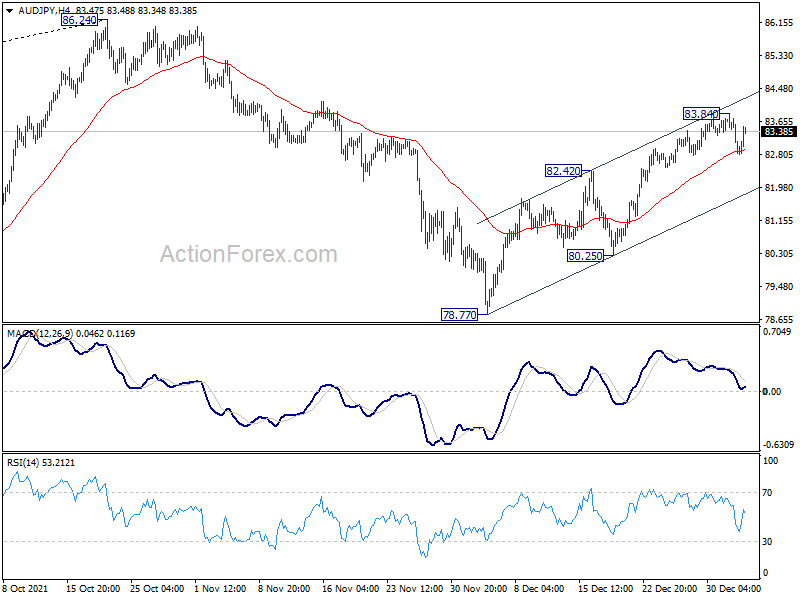
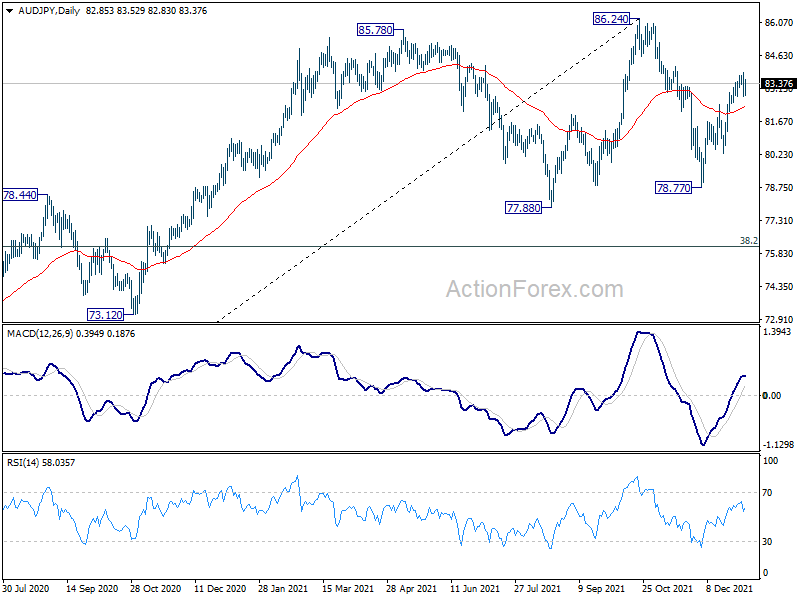
Similarly, AUD/JPY's correction from 86.24 should have completed at 78.77, ahead of 77.88 support. Further rally is expected as long as 82.42 resistance turned support holds. Break of 83.84 will resume the rebound from 78.77 to retest 86.24, also with prospect of resuming the up trend from 59.85 (2020 low).
New Year, New Record
New Year and a fresh record for the S&P500! The index kicked off the year with a first minute goal after recording 70 closing highs in 2021. Nasdaq rallied 1.20% at the first trading session of the year, as Apple finally hit the $3 trillion valuation and Tesla jumped 13.5% after reporting breath-taking car sales last quarter and last year.
Globally, there is a lot of news regarding the rising omicron cases, but there is also a lot of news that the omicron cases are not as deadly as the previous variants of Covid. And investors prefer focusing on a glass half full rather than a glass half empty at the start of the year.
So, it was a strong start to the year for the US equities, and Australian and Japanese markets followed up on the strong gains, especially Nikkei benefited well from the weakening yen, while Chinese equities remained under shadow of the growing property sector headache despite a better-than-expected manufacturing PMI printed by Caixin earlier in the session.
FTSE futures gained more than 1% on the back of a relatively cheaper yen, and firm oil and commodity prices, hinting that the FTSE100 is preparing to clear the 7400p resistance shortly.
In currencies, the US dollar remains in demand, the US dollar index is bid above the 50-dma, which is somewhere near 95.60, and the USDJPY surged to the highest levels since 2017. So the pair is now approaching the 116 level, although the positive USDJPY trade could run out of breath into the 117-118 region given that the historical data suggests that the Federal Reserve (Fed) hiking cycles tend to strengthen the yen against the US dollar rather than the contrary, due to a ‘buy the rumour, sell the fact’ type of an occurrence, according to Bloomberg, where the USDJPY spent last year factoring in a tighter Fed policy, and it is now time for traders to take profit and walk away.
In commodities, gold tanked from $1830 to below $1800 per ounce on the back of a strong risk appetite and a jump in the US 10-year yield.
US crude, on the other hand, is pushing higher above its 50-dma before today’s OPEC decision, where no surprise is expected. OPEC countries have rather a positive outlook for oil demand in the coming months as they focus on the recovery and reopening rather than on hundreds of flight cancellations and the restricted economic activity of the moment due to the omicron wave. OPEC is expected to maintain its regime of additional 400’000 barrels per day of extra supply in February, and a no change should keep oil bulls craving for further gains above the 50-dma, yet the $80 level should shelter a strong resistance, as even with the idea that better days are ahead of us and recovery should support better demand in oil, the IEA has been warning of a larger global glut in the first months of the year. And a vulnerable positive outlook should limit the oil bulls’ appetite nearing the psychological $80 mark.
GBP/JPY Daily Outlook
Daily Pivots: (S1) 154.94; (P) 155.44; (R1) 155.97; More...
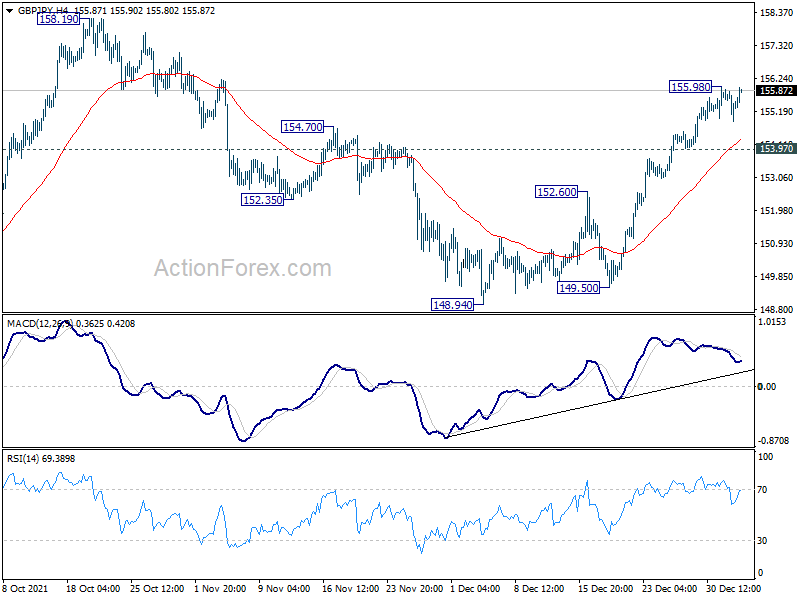
Intraday bias in GBP/JPY is turned neutral as it retreated after hitting 155.98. Some consolidations could be seen but further rally is expected as long as 153.97 support holds. As noted before, correction from 158.19 should have completed with three waves down to 148.94, after defending 148.93 key support. Break of 155.98 will resume the rise from 148.94 to retest 158.19 high next.
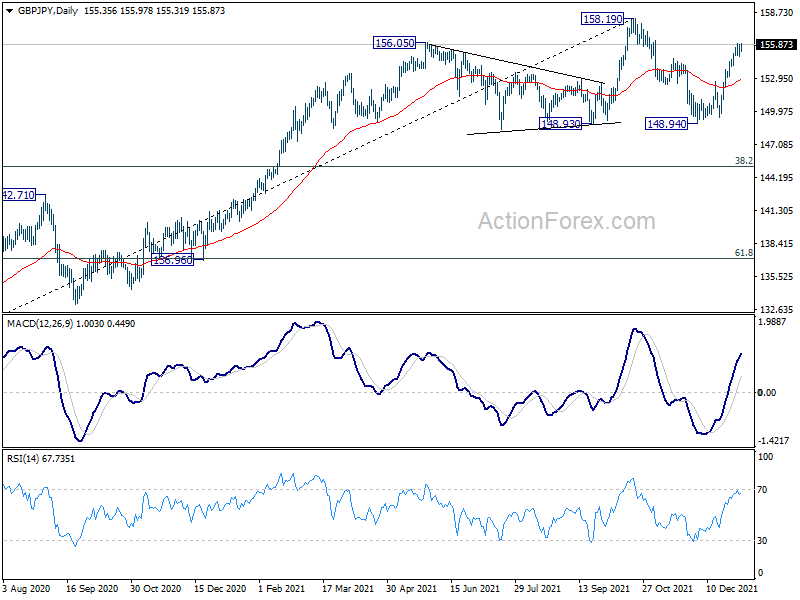
In the bigger picture, strong rebound from 148.93 key structural support will retain medium term bullishness. Firm break of 158.19 high will resume whole up trend from 123.94 (2020 low), to 61.8% retracement of 195.86 to 122.75 at 167.93. Nevertheless, firm break of 148.93 will bring deeper correction to 38.2% retracement of 123.94 to 158.19 at 145.10, and possibly further lower, as a correction to up trend from 123.94 at least
EUR/JPY Daily Outlook
Daily Pivots: (S1) 129.90; (P) 130.45; (R1) 130.87; More....
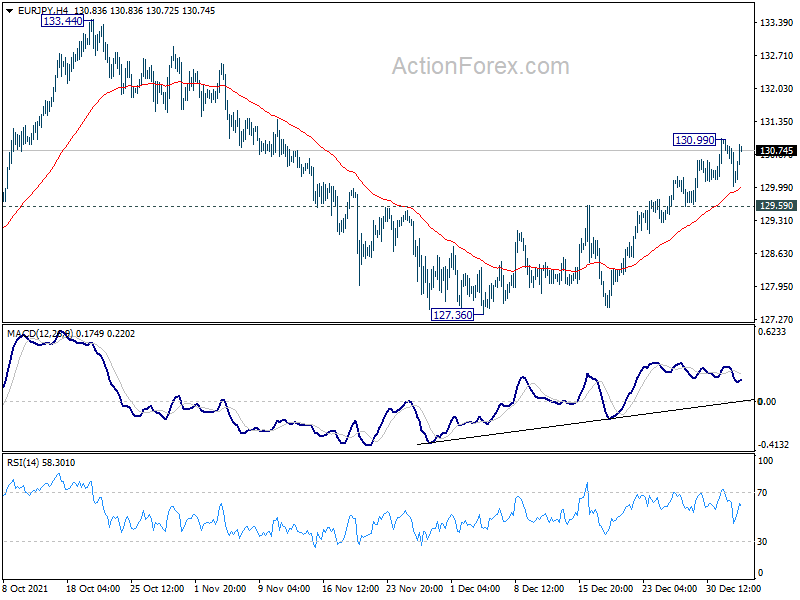
Intraday bias in EUR/JPY is turned neutral as it retreated after hitting 130.99. Some consolidations could be seen but further rally is expected as long as 129.59 minor support holds. As noted before, whole consolidation from 134.11 could have completed with three waves down to 127.36, ahead of 126.58 medium term fibonacci level. Above 130.99 will resume the rise from 127.26 to retest 133.44/134.11 resistance zone. On the downside, however, break of 129.59 will turn bias back to the downside for 127.36 support instead.
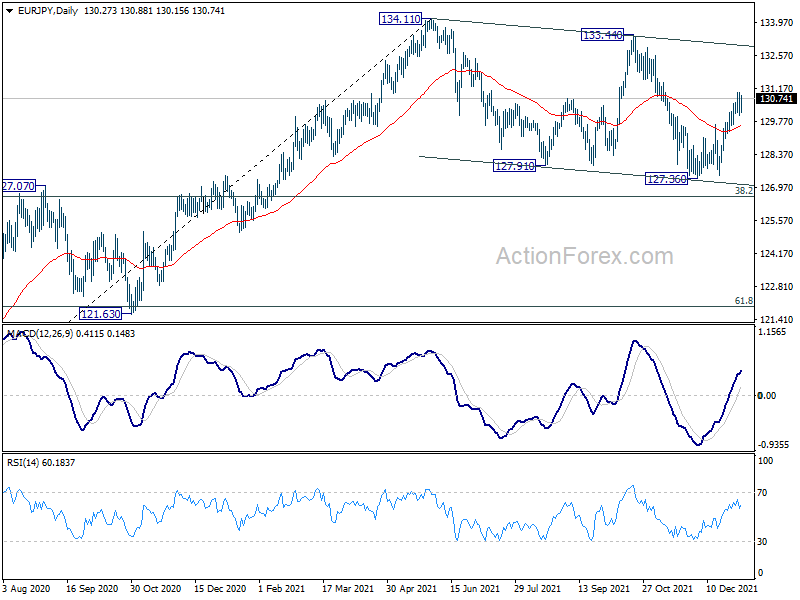
In the bigger picture, as long as 38.2% retracement of 114.42 (2020 low) to 134.11 at 126.58 holds, up trend from 114.42 is still in favor to continue. Break of 134.11 will target long term resistance at 137.49 (2018 high). However, sustained break of 126.58 will raise the chance of medium term bearish reversal. In this case, deeper decline would be seen to 61.8% retracement at 121.94, and possibly below.
EUR/AUD Daily Outlook
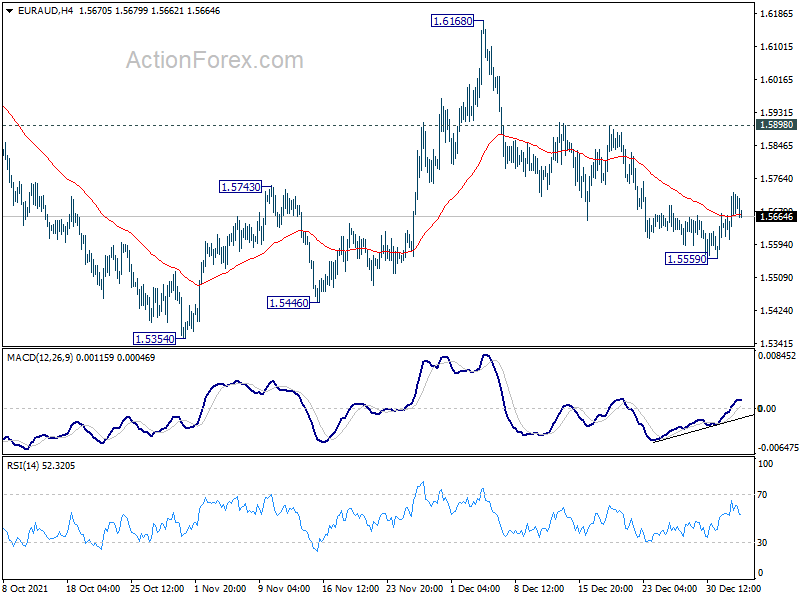
Daily Pivots: (S1) 1.5637; (P) 1.5683; (R1) 1.5758; More...
Intraday bias in EUR/AUD is turned neutral as it recovered after hitting 1.5559. Some sideway trading could be seen but further fall is expected as long as 1.5898 resistance holds. On the downside, break of 1.5559 will resume the fall from 1.6168 to retest 1.5354 low. However, break of 1.5898 will turn bias back to the upside for 1.6168 resistance instead.
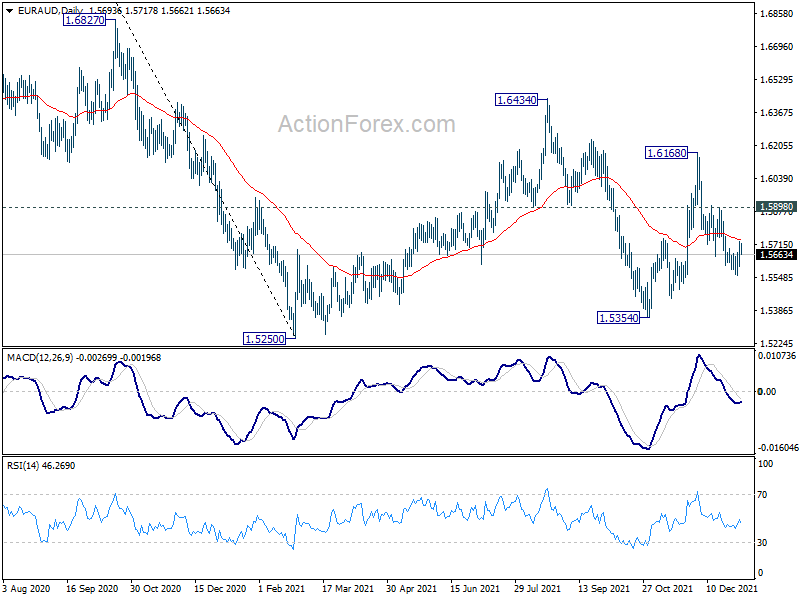
In the bigger picture, medium term outlook remains neutral for the moment. Rise from 1.5354 is seen as the third leg of the corrective pattern from 1.5250 low. Further rise cannot be ruled out, but even in that case, strong resistance should be seen at 38.2% retracement of 1.9799 to 1.5250 at 1.6988. Larger down trend from 1.9799 is in favor to extend through 1.5250 at a later stage.
EUR/GBP Daily Outlook
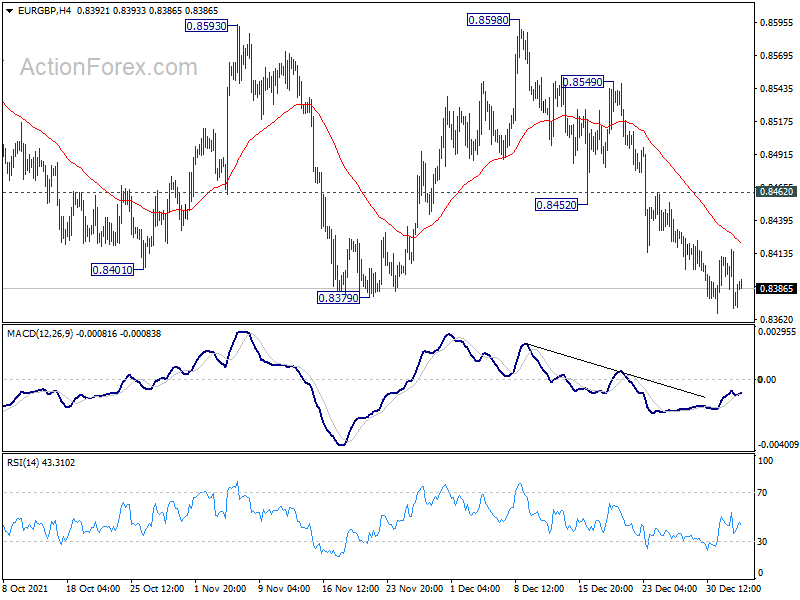
Daily Pivots: (S1) 0.8363; (P) 0.8391; (R1) 0.8410; More...
EUR/GBP's break of 0.8379 confirms resumption of larger down trend of 0.9499. Despite some loss of downside momentum as seen in 4 hour MACD, further decline is expected as long as 0.8462 resistance holds. Next target is 0.8276 key long term support. Nevertheless, break of 0.8462 will turn bias back to the upside for 0.8549 resistance instead.
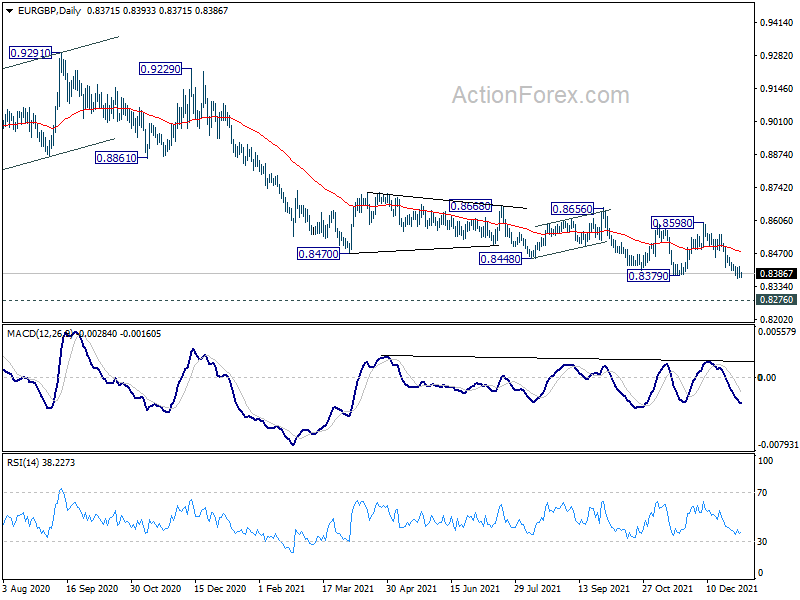
In the bigger picture, price actions from 0.9499 (2020 high) are still seen as developing into a corrective pattern. Deeper fall could be seen as long as 0.8598 resistance holds, towards long term support at 0.8276. We'd look for bottoming signal around there to bring reversal. Meanwhile, firm break of 0.8598 will now be an early sign of medium term bottoming and bring stronger rebound.
EUR/CHF Daily Outlook
Daily Pivots: (S1) 1.0357; (P) 1.0374; (R1) 1.0399; More....
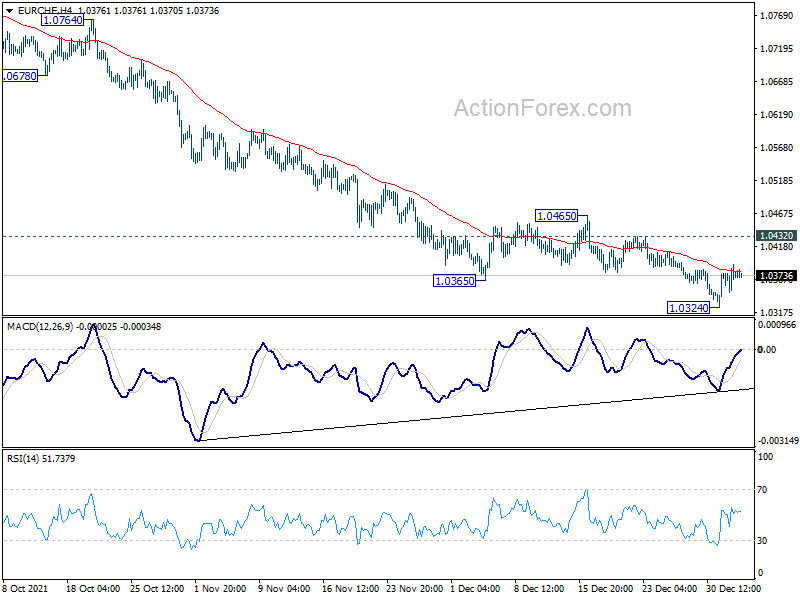
EUR/CHF recovered after dipping to 1.0324 and intraday bias is turned neural first. Outlook stays bearish as long as 1.0432 resistance holds. Break of 1.0324 will resume larger down trend from 1.1149 to 161.8% projection of 1.1149 to 1.0694 from 1.0936 at 1.0200 next. On the upside, however, break of 1.0432 minor resistance will indicate short term bottoming, and turn bias back to the upside for 1.0465 resistance and above.
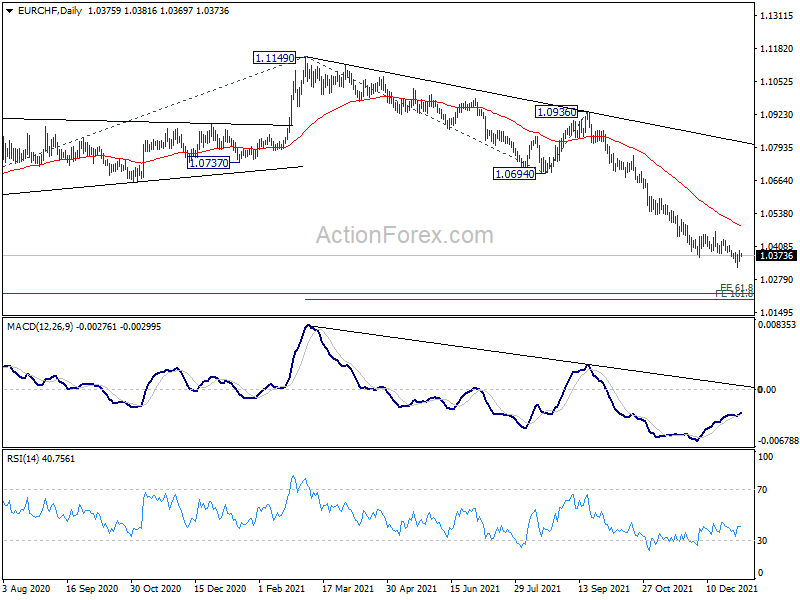
In the bigger picture, long term down trend from 1.2004 (2018 high) is now extending. Next target is 61.8% projection of 1.2004 to 1.0505 to 1.1149 at 1.0223. On the upside, break of 1.0505 support turned resistance is needed to be the first sign of medium term bottoming. Otherwise, outlook will remain bearish even in case of rebound.
The 60 Second Overview Yields Rise
Market movers today
Today is another quiet day in terms of data releases, in our view.
We will, however, keep an eye on Germany retail sales in November, preliminary French HICP inflation data for December and US ISM manufacturing (although we already received the equivalent US PMI manufacturing index).
Also look out for Danish FX reserves data, as EUR/DKK traded close to the 7.4360 FX intervention level from earlier last year through most of December.
The 60 second overview
Rising yields: The first trading day of the year started off slowly in the early European hours with UK still out for a bank holiday. However, upon US opening hours the risk positive market sentiment dominated, with a massive bond sell-off. US treasuries led the way with a 12bp sell-off in the 10y point, in a bear steepening move, for reasons including additional risk taking after year-end as well as omicron being milder leading to higher inflation speculation. The US sell-off drove European yields higher with Bunds touching -0.12% by rising 6bp. Intra-euro area spreads tightened. Today is rather light on data, but focus turns to euro area inflation prints and US labour market report.
Euro area PMIs: PMIs continued to suggest the pace of expansion is coming down across mainly services but also manufacturing. Although supply chain pressures remain widespread, euro area December PMIs also gave us some reasons to be a bit more optimistic towards the manufacturing sector outlook ahead: delivery times are coming down, production growth (notably in Germany) picked up, input and output cost pressures are easing and firms still remain optimistic with respect to the year-ahead outlook.
Equities: Equities made a flying start to 2022 as risk appetite soared on the first trading day of the year. Although equities were higher on both side of the Atlantic, the drivers were very different with much more defensive led gains in Europe while US was very cyclical-driven. Growth managed to outperform value despite the heavy lift to the long end of the US yield curve, partly driven by single stock news from Tesla and partly reflecting the still abundant level of liquidity.
In the US, Dow +0.7%, S&P 500 +0.6%, Nasdaq +1.2% and Russell 2000 +1.2%. Asian stocks mostly higher led by Japan (closed yesterday). China (Hang Seng) lagging as the bad news surrounding property developers are continuing this morning. Both European and US futures higher again this morning.
FI: The first trading day of the year started off slowly in the early European hours with UK still out for a bank holiday. However, upon US opening hours the risk positive market sentiment dominated, with a massive bond sell-off.
FX: EUR/USD dropped nearly a figure yesterday, trading below 1.13 at the time of writing. EUR/GBP also moved back below 0.84 in late trading yesterday. EUR/DKK bounced as high as 7.4383 yesterday, as carry on short EUR/DKK positions returned to negative carry after year-end.
Credit: With UK markets closed, activity in credit was limited yesterday and there was no trading in iTraxx indices. HY bonds tightened 3bp while IG widened 1bp.