Sample Category Title
GBP/JPY Mid-Day Outlook
Daily Pivots: (S1) 154.94; (P) 155.44; (R1) 155.97; More...
GBP/JPY's rise from 148.94 resumed after brief retreat and intraday bias is back on the upside. As noted before, correction from 158.19 should have completed with three waves down to 148.94, after defending 148.93 key support. Further rally should be seen back to retest 158.19. Firm break there will resume larger up trend to 167.93 long term fibonacci level. On the downside, below 154.86 minor support will turn intraday bias neutral and bring consolidations first.
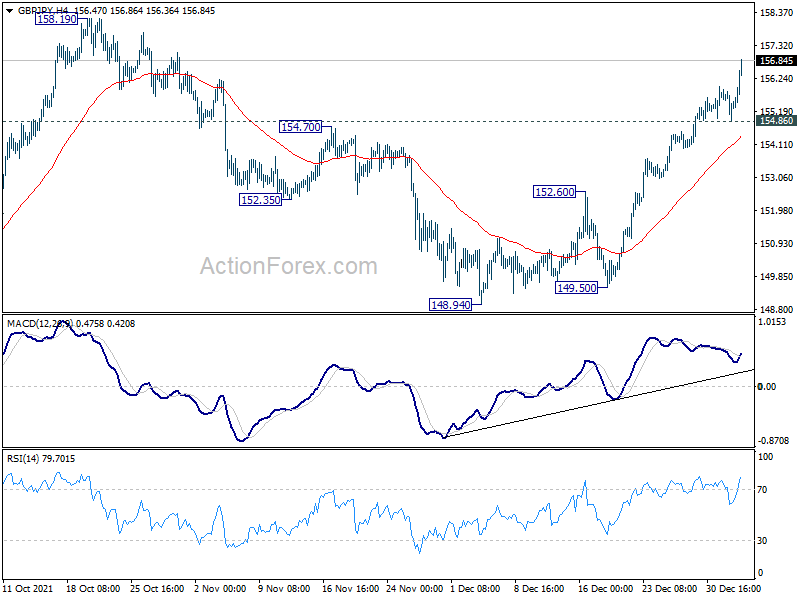
In the bigger picture, strong rebound from 148.93 key structural support will retain medium term bullishness. Firm break of 158.19 high will resume whole up trend from 123.94 (2020 low), to 61.8% retracement of 195.86 to 122.75 at 167.93. Nevertheless, firm break of 148.93 will bring deeper correction to 38.2% retracement of 123.94 to 158.19 at 145.10, and possibly further lower, as a correction to up trend from 123.94 at least
EUR/JPY Mid-Day Outlook
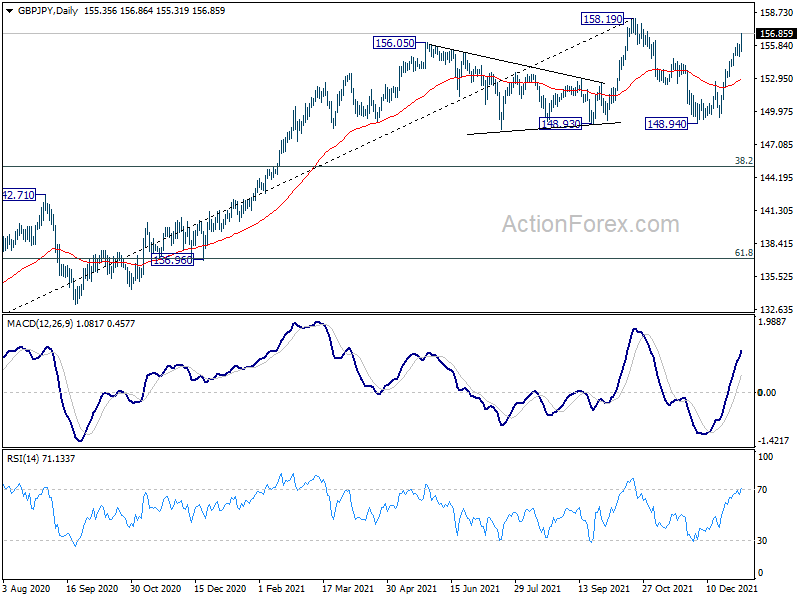
Daily Pivots: (S1) 129.90; (P) 130.45; (R1) 130.87; More....
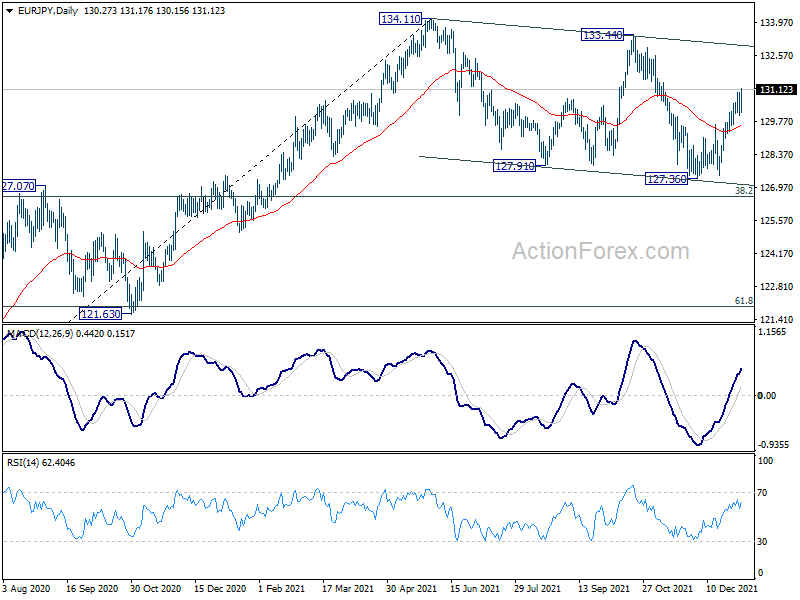
EUR/JPY's rally resumed after brief retreat and intraday bias is back on the upside. As noted before, whole consolidation from 134.11 could have completed with three waves down to 127.36, ahead of 126.58 medium term fibonacci level. Rise from 127.36 should target a test on 133.44/134.11 resistance zone. On the downside, break of 130.01 minor support will turn bias neutral for consolidations first.
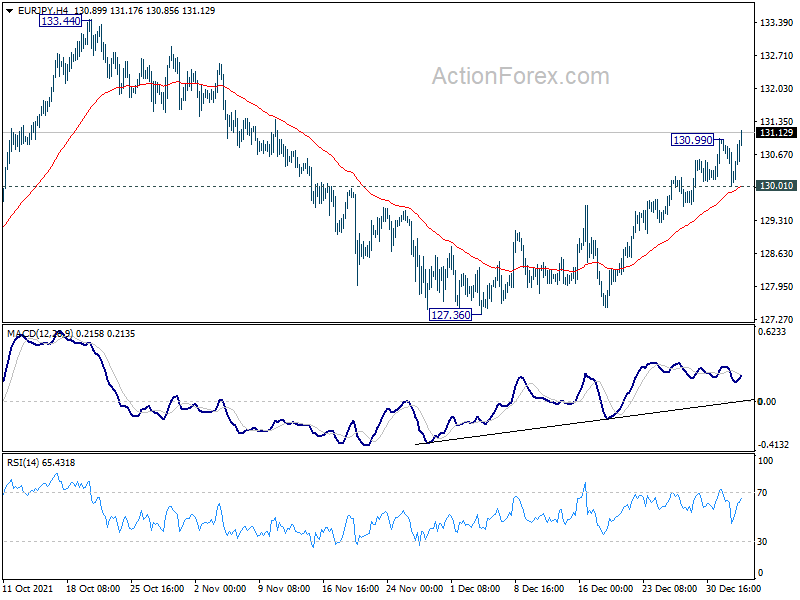
In the bigger picture, as long as 38.2% retracement of 114.42 (2020 low) to 134.11 at 126.58 holds, up trend from 114.42 is still in favor to continue. Break of 134.11 will target long term resistance at 137.49 (2018 high). However, sustained break of 126.58 will raise the chance of medium term bearish reversal. In this case, deeper decline would be seen to 61.8% retracement at 121.94, and possibly below.
USD/JPY Mid-Day Outlook
Daily Pivots: (S1) 115.08; (P) 115.22; (R1) 115.50; More...
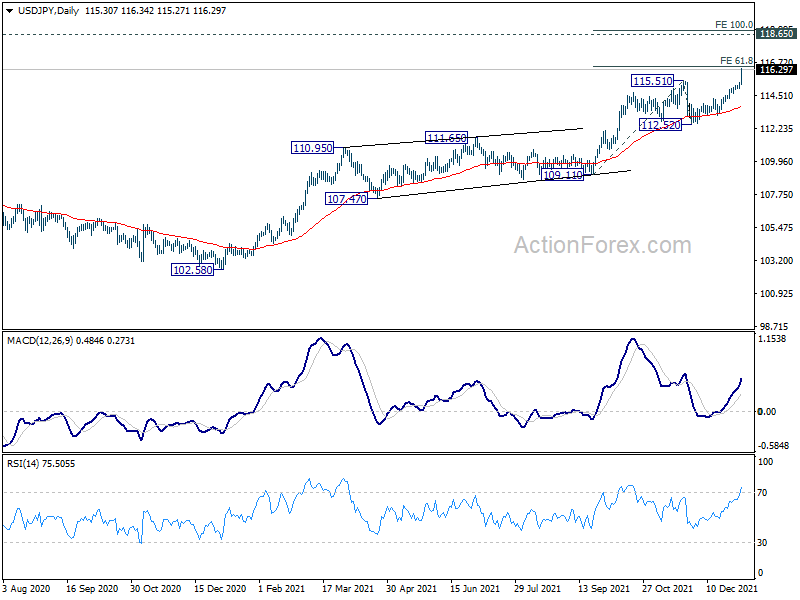
USD/JPY's rally is in acceleration and intraday bias stays on the upside for 61.8% projection of 109.11 to 115.51 from 112.52 at 116.47. Firm break there will extend the up trend from 102.58 to 100% projection at 118.90, which is close to 118.65 long term resistance. On the downside, below 115.64 minor support will turn intraday bias neutral and bring some consolidations, before staging another rally.
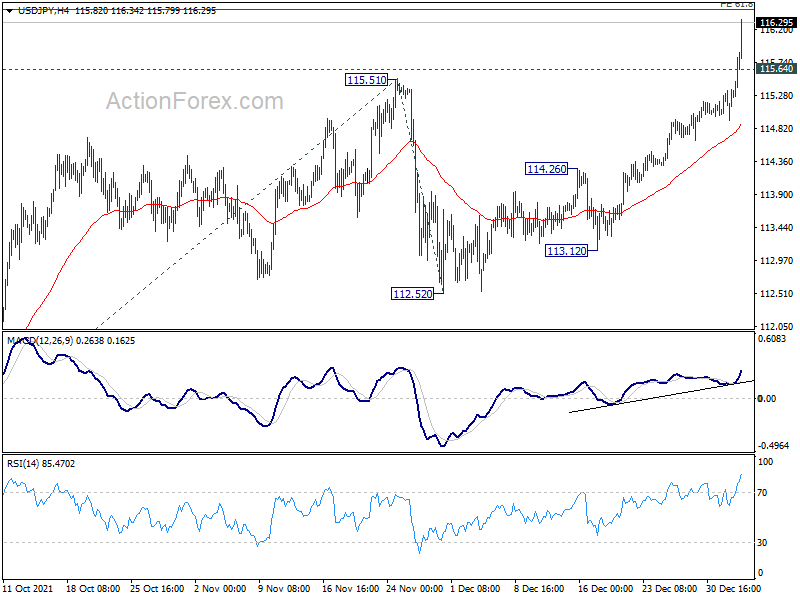
In the bigger picture, no change in the view that rise from 102.58 is the third leg of the up trend from 101.18 (2020 low). Such rally should target a test on 118.65 (2016 high). Sustained break there will pave the way to 120.85 (2015 high) and raise the chance of long term up trend resumption. For now, this will remain the favored case as long as 112.52 support holds, in case of deep pull back.
USD/CHF Mid-Day Outlook
Daily Pivots: (S1) 0.9135; (P) 0.9167; (R1) 0.9222; More....
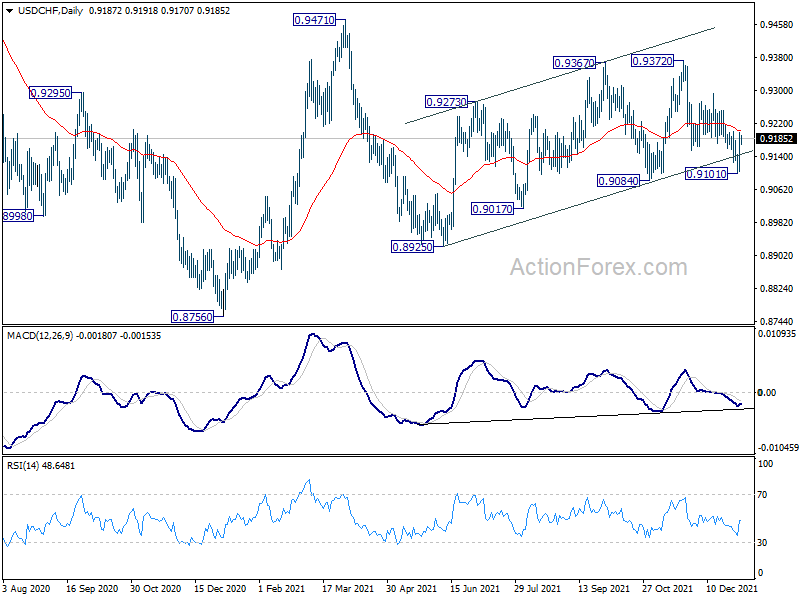
Intraday bias in USD/CHF remains neutral for the moment. On the upside, break of 0.9200 resistance will argue that fall from 0.9372 has completed with three waves down to 0.9101. Intraday bias will be back on the upside for 0.9372 resistance. On the downside, sustained break of 0.9084 support should confirm that choppy rise from 0.8925 has completed, and suggests that fall from 0.9471 is resuming. Deeper decline would be seen through 0.8925.
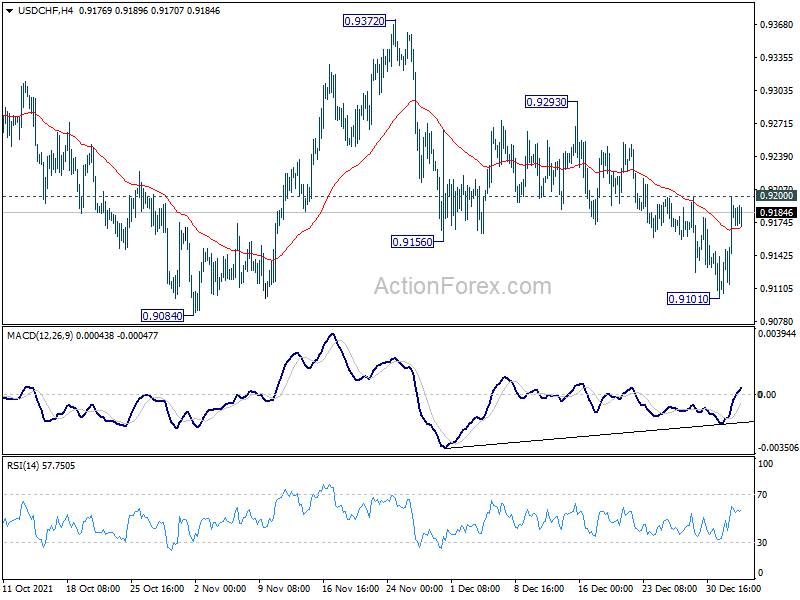
In the bigger picture, the corrective structure of the rebound from 0.8925 argues that fall from 0.9471 is not complete yet. It could either be the second leg of pattern from 0.8756 (2021 low), or resuming larger down trend from 1.0237 (2018 high). We'd pay attention to the downside momentum and assess the odds later. But for now, medium term outlook will be neutral at best as long as 0.9471 resistance holds.
GBP/USD Mid-Day Outlook
Daily Pivots: (S1) 1.3427; (P) 1.3483; (R1) 1.3534; More...
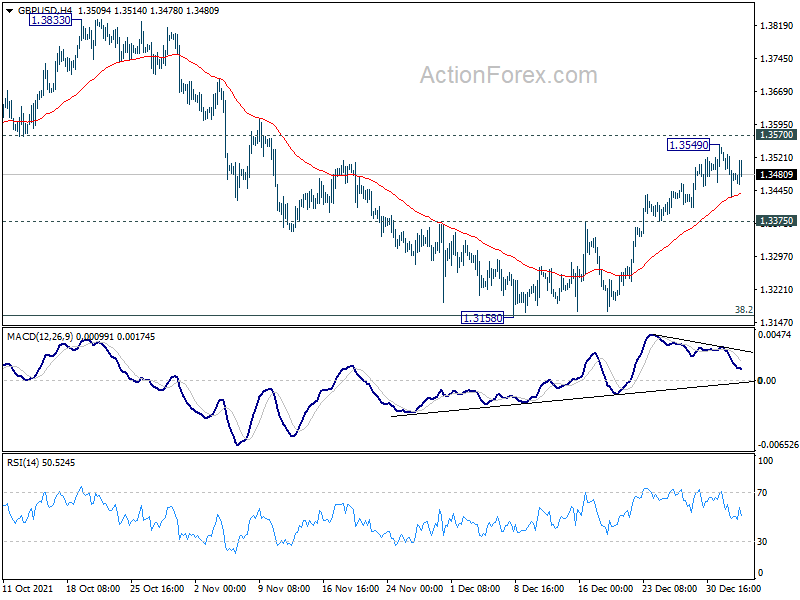
Intraday bias in GBP/USD remains neutral for the moment and some consolidations could be seen. But outlook is unchanged that we're seeing corrective fall from 1.4248 as complete with three waves down to 1.3158, after hitting 1.3164 medium term fibonacci level. Further rally is in favor as long as 1.3375 minor support holds. Sustained break of 1.3570 resistance will further affirm this bullish case and target 1.3833 resistance next. However, break of 1.3375 will turn bias back to the downside for 1.3158 low again.
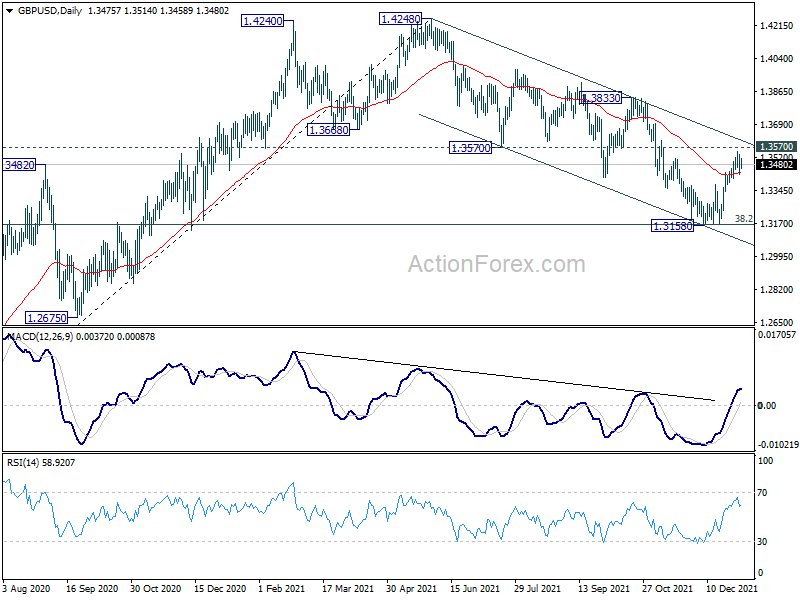
In the bigger picture, focus remains on 38.2% retracement of 1.1409 to 1.4248 at 1.3164. Sustained break there will argue that whole rise from 1.1409 has completed at 1.4248, after rejection by 1.4376 long term resistance. That will revive some medium term bearishness and and target 61.8% retracement at 1.2493. However, strong rebound from current level will revive argue that up trend from 1.1409 is still in progress, and probably ready to resume.
EUR/USD Mid-Day Outlook
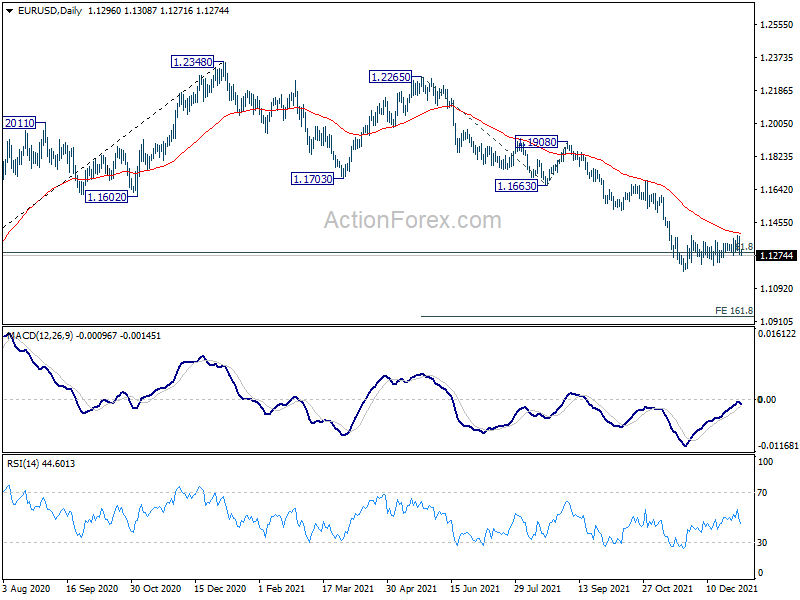
Daily Pivots: (S1) 1.1259; (P) 1.1319; (R1) 1.1358; More...
EUR/USD is still bounded in range trading and intraday bias remains neutral first. On the upside, firm break of 1.1385 resistance will resume the rebound from 1.1186. Sustained trading above 55 day EMA (now at 1.1392) will bring stronger rise back to 1.1663 support turned resistance. On the downside, break of 1.1185 will resume larger decline from 1.2348. Next target is 161.8% projection of 1.2265 to 1.1663 from 1.1908 at 1.0934.
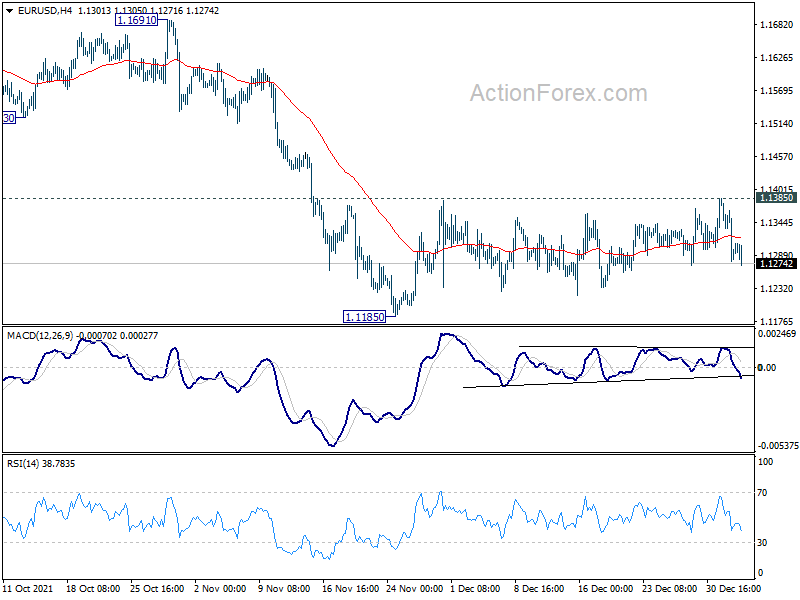
In the bigger picture, there are various ways of interpreting the fall from 1.2348 (2021 high). It could be a correction to rise from 1.0635 (2020 low), the fourth leg of a sideway pattern from 1.0339 (2017 low), or resuming long term down trend. In any case, outlook will now stay bearish as long as 1.1703 support turned resistance holds. Sustained break of 61.8% retracement of 1.0635 to 1.2348 at 1.1289 would pave the way back to 1.0635.
Yen Slips to 5-Year Low
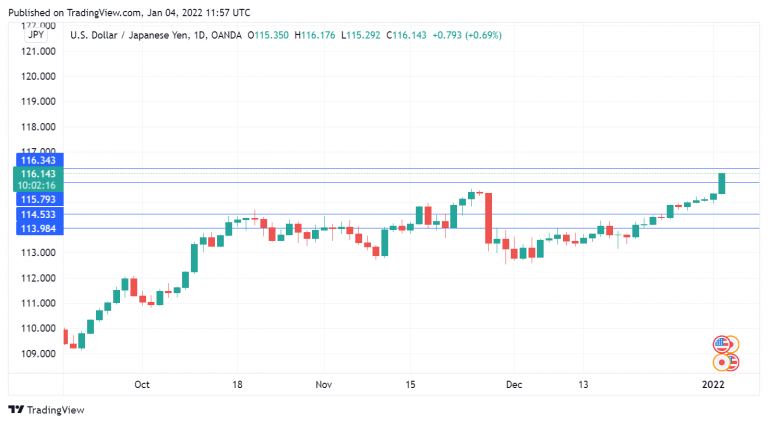
The Japanese yen continues its downswing early in the New Year. USD/JPY is trading at 115.95 in the European session, its highest level since January 2017.
US Treasury yields weigh on yen
The US dollar has brought in the New Year with a bang, rallying sharply against the major currencies. The dollar has looked impressive against the faltering yen, as USD/JPY hasn’t recorded a losing week since November.
The catalyst driving the greenback’s success early in 2022 has been the jump in US bond yields. The 10-year yield finished 2021 above the 1.50% level and has now pushed above 1.60%. The widening US/Japan rate differential has sent the yen sharply lower, as the currency is extremely sensitive to the rate differential. If US yields remain high, we could see the dollar rally as high as 118 over the coming weeks.
Inflation has become a hot topic for the Federal Reserve and the BoE, as policymakers must deal with inflation levels that are double or triple the banks’ inflation target of 2%. In Japan, inflation has been at low levels for years, with deflation a constant problem. However, Japan hasn’t been immune to surging energy costs and rising prices of raw materials, which have been exacerbated by pent-up demand as Covid-related restrictions have been eased.
Inflation in Japan is subdued compared to the US or the UK, but inflationary pressures are starting to squeeze consumers and businesses. Inflation expectations have risen, and the government’s policy of encouraging firms to pay higher wages should continue to push inflation upwards. This means that the Bank of Japan is expected to pay more attention to inflation, although a shift in the bank’s ultra-loose monetary policy is unlikely until inflation moves close to the bank’s target of around 2%.
USD/JPY Technical
- USD/JPY continues to put pressure on resistance at 114.83. Above, there is resistance at 115.26
- There is support at 112.90 and 112.47
US Dollar Rises Sharply on Higher Yields
US 10-year bond yield boosts greenback
The US dollar rallied sharply against the major currencies overnight as US 10-year bond yields surged back above 1.60%. The dollar index of major currencies rose sharply by 0.58% to 96.22 overnight, more than offsetting the previous day’s falls and leaving major technical support at 95.50 intact once again.
EUR/USD has fallen 0.70% to 1.1300 and has traced out a number of failures ahead of 1.1400 resistance. Failure of support at 1.1270 heralds a retest of 1.1200. GBP/USD has fallen 0.40% to 1.3470, with resistance at 1.3550, last week’s high and the 100-day moving average (DMA). Failure of support at 1.3400 signals the next leg lower. The widening US/Japan rate differential has pushed USD/JPY 40 points higher to 115.75 today, Asia’s biggest FX mover. Assuming that US yields remain elevated, there is nothing on the charts to stop a rally to 118.00 in the coming weeks.
The US dollar rally stopped the AUD, NZD and CAD rallies in their track, marking an abrupt end to their holiday season rallies. Although equities rallied on diminishing omicron fears, that same situation has allowed US yields to rise sharply, lifting the US dollar. The US dollar rally could peter out if sentiment remains strong, but the moves in equities and currencies highlight what a messy year could be ahead, without the unifying theme of the post-vaccine recovery central bank back-stop in play. In the meantime, AUD/USD has fallen to 0.7200 overnight and is in danger of retesting 0.7100. NZD/USD has fallen to 0.67800 and could revisit 0.6700 initially, and USD/CAD moving higher to 1.2800.
With USD/CNY anchored around 6.3700, and China content with monetary settings for now, including daily liquidity via the repo, Asian currencies have remained anchored as well. However, some cracks are starting to appear, with USD/KRW rising to 1194.50 today and USD/MYR jumping higher to 4.1800. If US yields continue to move higher this week, Asian FX weakness could become more widespread, with INR, PHP, and IDR the most vulnerable to widening yield differential perceptions.
Oil moves to the top of its range
Oil prices edged higher overnight, Brent crude rising 1.25% to USD 78.90, and WTI climbing 0.85% to USD 75.95 a barrel. Diminishing omicron concerns have supported oil through the holiday period and the spectre of OPEC+ now looms over energy markets. The OPEC+ monthly meeting has rolled around quickly this time, probably because they left the last one open in December as omicron hit, to support prices. The JMMC and full grouping meet this week with the OPEC+ still-open meeting oil floor having done its job without costing a cent. I do not expect any changes or surprises from OPEC+ this week, but its mere threat should keep a floor under prices this week.
Oil has risen again in Asia, helped along by Indonesia banning coal exports over the weekend, having exported so much this year that their own stocks in Java for power generation are now dangerously low. The ban will impact China the most initially, but given their inventory building, should not cause too much of a stir. In the meantime, it has been enough to life oil prices in Asia by around 0.50% to USD 79.35 for Brent, and USD 76.35 a barrel on WTI.
Brent crude has support at USD 77.60 and USD 77.50 barrel, its 100-day moving average (DMA), followed by USD 77.30. It has resistance at USD 80.00, and USD 82.00 a barrel. WTI has support at USD 75.00 and then USD 74.60, its 100-DMA. It has resistance at USD 77.50 a barrel, and then USD 79.30.
Gold’s Christmas rally ends abruptly
Gold showed, once again, how frail bullish sentiment is as recent long positions were stopped out overnight, gold falling 1.50%, or USD 28.50 an ounce, intraday to close at USD 1801.50 an ounce. Some short-covering has seen it creep up to USD 1804.00 an ounce in Asia.
Gold’s attempts to stage a meaningful recovery remain unconvincing, with traders cutting long positions at the very first sign of trouble intra-day. This time it was the US bond market, with yields rising sharply and sending gold into an equally vicious tail-spin, unwinding its entire Christmas rally. This is not the first time we have seen this sort of price action in the last month, with gold’s most consistent pricing factor being its ability to disappoint bullish investors.
Gold has resistance at USD 1830.00 and USD 1840.00 an ounce, although it would be a huge surprise if we saw those levels this week. Support lies at USD 1790.00, followed by USD 1780.00 an ounce. USD 1790.00 to USD 1820.00 is my call for the range this week.
Stocks March Higher, Yen Smashed as Traders Take on Risk
- Investors load up on riskier assets, dump safe havens as new year begins
- US stocks hit new records, dollar follows yields higher, yen gets blasted
- OPEC meeting and ISM manufacturing survey coming up today
Funds position for new year
A sense of optimism dominated on the first trading day of the year. Money managers loaded up their books with riskier assets such as equities and dumped defensive plays like bonds, positioning themselves for another stellar year in financial markets.
With the Fed scheduled to stop asset purchases this quarter and raise interest rates three times this year, there’s a clear risk that Treasury yields could storm higher. This would imply losses for bond holders that won’t hold until maturity, so fund managers have started front-running this move by unloading their bonds today.
There is also relief that Omicron won’t be quite as bad as previous variants despite the explosion in new cases, fueling the appetite for risk even further. Even though hospitalization rates in most countries have started to creep up, they remain well below previous peaks and the political willpower for lockdowns has been depleted.
The result was a sharp rally in yields that put the wind back into the dollar’s sails. Dollar/yen hit a new 5-year high in the aftermath as traders cut their exposure to haven assets and rate differentials widened against the yen, courtesy of the Bank of Japan’s strategy that keeps a ceiling on Japanese yields.
Stocks power to new records
It was a similar story in the stock market where the S&P 500 hit a new record high. The heavy lifting was done by Tesla, which gained a stunning 13.5% after reporting car deliveries that far exceeded expectations on Wall Street.
Of course, the real story for equities in recent years has been the overload of liquidity from central banks. Even though the Fed is slowly taking its foot off the accelerator, the financial system is still overflowing in excess liquidity and all that cash needs a home. If you can’t hold bonds because returns are horrible and higher yields could hurt your portfolio, the only other avenue is equities, especially for speculative funds.
Therefore, stocks are still the only game in town and a few cautious Fed rate hikes are unlikely to change that. Higher rates may allow for a regime of greater volatility but for monetary policy to truly hurt markets, it may require a shrinking of the Fed’s balance sheet through ‘quantitative tightening’ like in 2018, which is not on the table for now.
Gold gets hit, OPEC in focus
In the commodity sphere, the simultaneous rally in Treasury yields and the dollar dealt a severe blow to gold. Bullion is priced in dollars and offers no yield to hold, making it less attractive by comparison as yields move higher.
Overall, the outlook for the yellow metal seems precarious. Ever since the pandemic hit, ‘real yields’ have been what matters most for gold. Real yields hit record low after record low last year, and yet bullion was unable to capitalize. If gold couldn’t rally in such a favorable environment, it could take heavy fire if real yields move higher this year as monetary policy normalizes.
As for today, oil traders will keep a close eye on OPEC+, which is widely expected to stick to its planned production increases. If so, the market reaction could be minimal, with oil prices taking their cues from risk appetite instead. Finally, the latest ISM manufacturing print will shed some light on how the US economy closed the year.
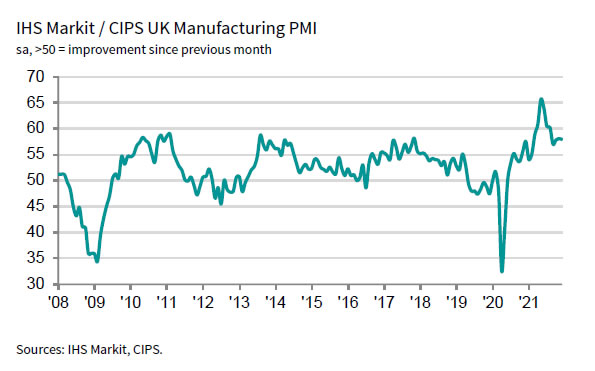
UK PMI manufacturing finalized at 57.9, upturn remains subdued
UK PMI Manufacturing was finalized at 57.9 in December, down slightly from November's 58.1. The index has now remained above neutral 50 mark for 19 straight months. Markit noted that output, new orders and employment all rose. New export orders fell for the fourth month running. Selling price inflation hit fresh record high.
Rob Dobson, Director at IHS Markit, said: "While the uptick in growth is a positive step, the upturn remains subdued compared to the middle of the year, as supply chain constraints and weak export performance constrained attempts to raise production further. Manufacturers indicated that logistic issues, Brexit difficulties and the possibility of further COVID restrictions (at home and overseas) had all hit export demand at the end of the year."