Sample Category Title
Stocks March Higher, Yen Smashed as Traders Take on Risk
- Investors load up on riskier assets, dump safe havens as new year begins
- US stocks hit new records, dollar follows yields higher, yen gets blasted
- OPEC meeting and ISM manufacturing survey coming up today
Funds position for new year
A sense of optimism dominated on the first trading day of the year. Money managers loaded up their books with riskier assets such as equities and dumped defensive plays like bonds, positioning themselves for another stellar year in financial markets.
With the Fed scheduled to stop asset purchases this quarter and raise interest rates three times this year, there’s a clear risk that Treasury yields could storm higher. This would imply losses for bond holders that won’t hold until maturity, so fund managers have started front-running this move by unloading their bonds today.
There is also relief that Omicron won’t be quite as bad as previous variants despite the explosion in new cases, fueling the appetite for risk even further. Even though hospitalization rates in most countries have started to creep up, they remain well below previous peaks and the political willpower for lockdowns has been depleted.
The result was a sharp rally in yields that put the wind back into the dollar’s sails. Dollar/yen hit a new 5-year high in the aftermath as traders cut their exposure to haven assets and rate differentials widened against the yen, courtesy of the Bank of Japan’s strategy that keeps a ceiling on Japanese yields.
Stocks power to new records
It was a similar story in the stock market where the S&P 500 hit a new record high. The heavy lifting was done by Tesla, which gained a stunning 13.5% after reporting car deliveries that far exceeded expectations on Wall Street.
Of course, the real story for equities in recent years has been the overload of liquidity from central banks. Even though the Fed is slowly taking its foot off the accelerator, the financial system is still overflowing in excess liquidity and all that cash needs a home. If you can’t hold bonds because returns are horrible and higher yields could hurt your portfolio, the only other avenue is equities, especially for speculative funds.
Therefore, stocks are still the only game in town and a few cautious Fed rate hikes are unlikely to change that. Higher rates may allow for a regime of greater volatility but for monetary policy to truly hurt markets, it may require a shrinking of the Fed’s balance sheet through ‘quantitative tightening’ like in 2018, which is not on the table for now.
Gold gets hit, OPEC in focus
In the commodity sphere, the simultaneous rally in Treasury yields and the dollar dealt a severe blow to gold. Bullion is priced in dollars and offers no yield to hold, making it less attractive by comparison as yields move higher.
Overall, the outlook for the yellow metal seems precarious. Ever since the pandemic hit, ‘real yields’ have been what matters most for gold. Real yields hit record low after record low last year, and yet bullion was unable to capitalize. If gold couldn’t rally in such a favorable environment, it could take heavy fire if real yields move higher this year as monetary policy normalizes.
As for today, oil traders will keep a close eye on OPEC+, which is widely expected to stick to its planned production increases. If so, the market reaction could be minimal, with oil prices taking their cues from risk appetite instead. Finally, the latest ISM manufacturing print will shed some light on how the US economy closed the year.
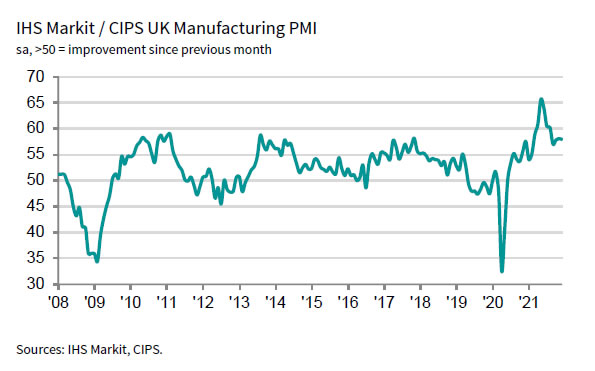
UK PMI manufacturing finalized at 57.9, upturn remains subdued
UK PMI Manufacturing was finalized at 57.9 in December, down slightly from November's 58.1. The index has now remained above neutral 50 mark for 19 straight months. Markit noted that output, new orders and employment all rose. New export orders fell for the fourth month running. Selling price inflation hit fresh record high.
Rob Dobson, Director at IHS Markit, said: "While the uptick in growth is a positive step, the upturn remains subdued compared to the middle of the year, as supply chain constraints and weak export performance constrained attempts to raise production further. Manufacturers indicated that logistic issues, Brexit difficulties and the possibility of further COVID restrictions (at home and overseas) had all hit export demand at the end of the year."
EURJPY Hovers Around 200-Day SMA in Short Term
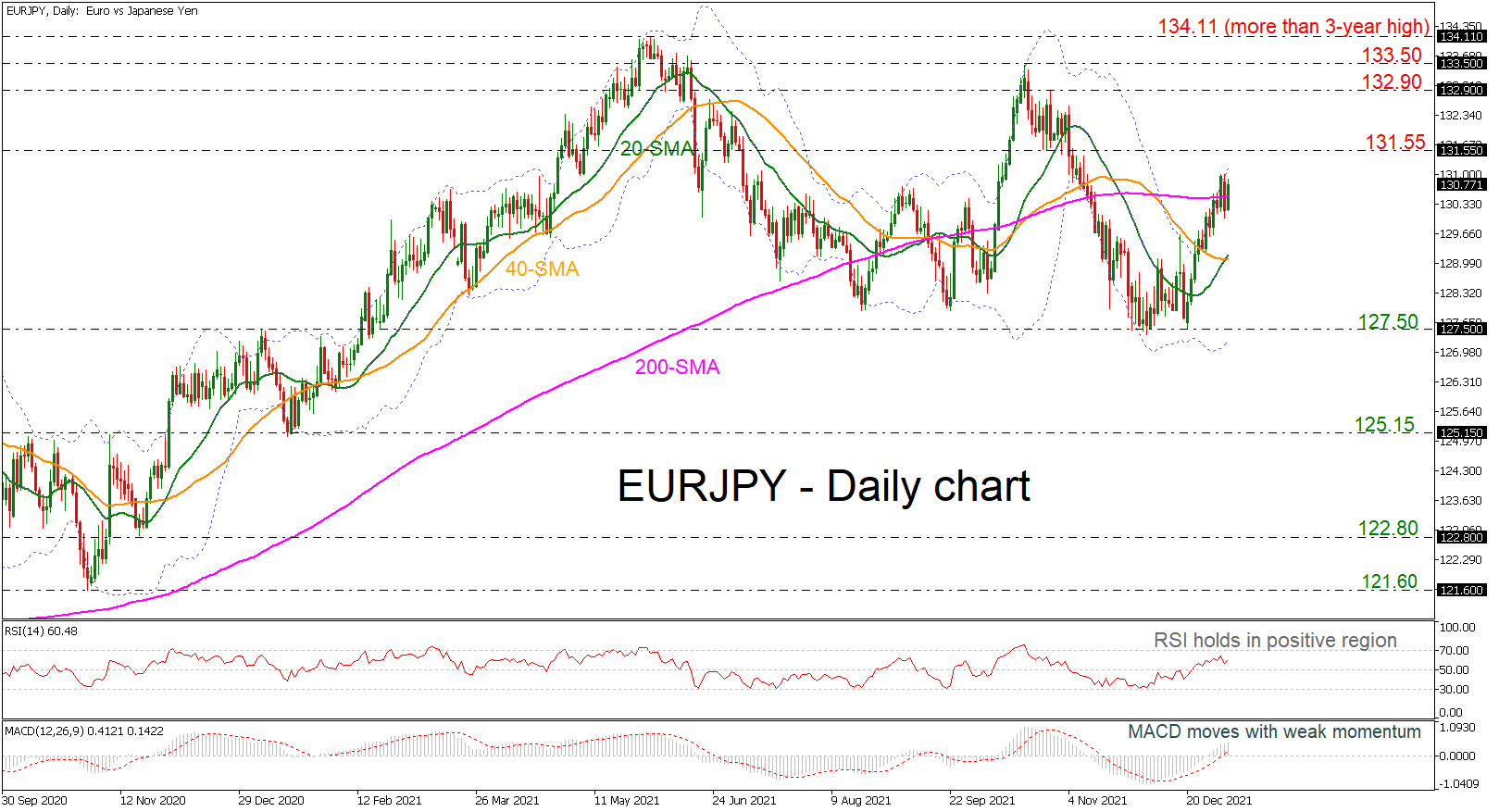
EURJPY has been in a back-and-forth movement around the 200-day simple moving average (SMA) after the bounce off the 127.50 support level around the lower Bollinger band. The price has overcome the 20- and 40-day simple moving averages (SMAs), which have just completed a bullish crossover, and the technical indicators are confirming the bullish bias. The RSI is pointing somewhat up in the positive region, while the MACD is strengthening its positive move above its trigger and zero lines.
Immediate resistance could come from the 131.55 barrier taken from the inside swing low at the end of October 2021. If the bulls take the upper hand and continue the recent move, the next target could be the 132.90 and 133.50 barriers.
On the other hand, a decline below the 200-day SMA may open the way for the bullish cross of the short-term SMAs at 129.20. More losses may see the 127.50 latest low ahead of the lower Bollinger band at 127.25. If the pair fails to hold above these levels, then the next target could be 125.15.
In brief, EURJPY has been in a slight descending move since June 1, but in the very short-term, the bias is distinctly bullish.
Currencies: Where are We Standing as the New Year Commences
USD – Rate hikes on the way
The greenback had displayed notable strengthening in 2021 and in December the currency managed to stabilize at higher grounds. According to the Dollar Index that follows the USD’s course against other major currencies, the stabilization at higher grounds may be proof that the economy has improved, despite the well-known difficulties that are still present. Looking at the Dollar Index we may notice some technical barriers especially to the way up, as the currency seems to have reached yearly highs in the previous months and corrected lower implying traders are keeping their positions but may be hesitant to increase them for now. Most of the market’s focus is currently placed on the Federal Reserve, as it has pointed out it plans to make significant changes to its monetary policy as soon as the coming months. Rate hikes are already considered yet we cannot guarantee when exactly they will be imposed while the percentage of the rate increase should also be kept in mind by traders. If the rate is increased by a wider margin than expected this scenario could send a different message to market participants and the global economy. Among the top indicators of the US economy we start with the housing market that continues to be on the rise with the Housing Starts Number and Existing Home Sales figures for November being on the rise. The New Home Sales-Units stabilized at previous months levels. Moving to the Job market that according to the Unemployment rate continuous to drop consecutively since June now reaching 4.2%. If the trend continues then we will soon be seeing the rate dropping to pre pandemic levels. Yet the recent difficulties with the new variant may postpone such an outcome. Inflation which continues to be a major concern of the market presently continues to be on the rise as the yearly rate reached 6.8% in November. This indicator is among the most crucial concerns of the Fed that may prompt it to take action the soonest. We see the US economy continuing to improve and inflation stabilizing and possibly returning lower as rate hikes come into play. Supply chain issues may also retreat at that time, as manufacturing in Asia continues to improve currently.
EUR – Supply bottlenecks and higher energy prices
The Euro has been in a downfall for most of the previous year losing ground most notably against the USD and the GBP. From our point of view the EUR as a currency continues to move within a familiar range that was used since previous years. This in our opinion seems to display some stability for the currency even though at times it seems that the uncertainty over the Eurozone’s economic performance overshadows this positivity. In November the Eurozone’s final yearly HICP rates which reflect Inflation levels within the group, showed stabilization at 4.9%. The Eurozone’s Preliminary Consumer Confidence rate for December moved further into the negative area which may imply that the expectations for the economic recovery remain gloomy for the near future. The Preliminary Markit PMI readings for the Eurozone, Germany and France where lower in December yet we will have to wait for the final readings to confirm the drop. At the moment the market’s expectations for the ECB to make drastic changes in the New Year remain rather low. The European central bank is not expected to reduce its bond buying program until 2023 according to the Financial Times. That is also the time when the bank is expected to start increasing its interest rate. This could be an indication that the ECB may be using a more patient approach rather than the more aggressive driven strategy most other major central banks are using around the world. On a more optimistic note, the pandemic-response scheme, a program designed to enhance recovery in the zone could be ending in March as per ECB president Christine Lagarde. Finally referring to the largest economic power in the Eurozone, Germany, which has recently appointed Olaf Scholz as Germany’s new chancellor may be in for noteworthy changes. Scholz is gunning for a greener economy and climate change measures. Overall we see Europe still finding challenges to deal with supply bottlenecks and higher energy prices in the first quarter of 2022. Thereafter, these problems could subside possibly adding support to the Eurozone block.
GBP – In a confident position despite challenges
The pound managed to hold its ground against the USD in 2021 but finished the year lower, while it dominated the scene against the EUR. The move in our view tends to be positive for the UK economy which even though is still facing trouble with the pandemic and the Brexit front, it seems to be able to stand on its own feet until this moment. In October the UK unemployment rate fell to 4.2%. The unemployment rate in the UK has been dropping successively since May 2021 landing currently at 4.2% and this tends to support improving economic circumstances. UK Retail Sales in November increased and surpassed both prior and anticipated readings which is another awesome sign for the economy which seems to be expanding. Also, December Preliminary Markit PMI data failed to impress as Services and Manufacturing seemingly dropped. Manufacturing had stalled in October thus the economy could be losing its step in this sector for the time being. Yet the UK GDP yearly rate for Q3 rose which again counterbalances negative impact on Manufacturing. Moreover, UK Nationwide house prices rose both yearly and monthly in December, indicating the house market remains solid in the UK. Thus we could say rightfully the Bank of England increased it interest rate to 0.25% in its most recent meeting in December. December was a rather difficult month for the UK economy with a broad turn towards cancelations over the holiday season which took place after the new variant. Chancellor of exchequers Rishi Sunak then announce an extra 1 billion pounds for the businesses impacted from these circumstances which gave a temporary boost to the GBP. Overall we see the UK being in a rather confident position despite still facing uncertainty and possible instability over Brexit and high energy prices.
AUD and NZD – Commodity currencies in focus
The AUD has lost ground against the USD, NZD and the GBP in the past year. According to Australia’s GDP rates for Q3 the economy continues to shrink yet at a slower pace than initially forecasted. On the bright side the Australian unemployment rate is currently at 4.6% compared to 6.4% where it started in 2021. The Reserve bank of Australia currently keeps its interest rate at 0.10%. Many media sources like Bloomberg see pressure mounting for RBA in 2022 as the banks stimulus program may be obsolete in the coming months. It is also important to note that RBA Governor Phillip Lowe has confessed that his banks decisions have been influence by other major central banks across the world in the past thus they could be waiting to see further action from them to act in the future. In general, Australia has been challenged by a number of lockdowns in some parts of the country. Furthermore, the muted economic activity in China may have also impacted Australia in the past year and may continue to do so. On the other hand, New Zealand seems to be making its own decisions based on its own views. Unemployment is currently down to 3.4% a rather low figure compared to other major economies. The Reserve Bank of New Zealand has increase its interest rate to 0.75% even as GDP rates for Q3 both yearly and monthly have dipped into negative territory. The NZD has been lower against the USD but has gained ground against both the GBP and the EUR in past 12 months. In our opinion the New Zealand economy remains stronger as it has also been able to handle the pandemic more efficiently and with stricter measures.
CNH and JPY – Industrial output and Manufacturing in the scope
In China economic activity may be in slowdown for the past several months as it has been facing important challenges on the energy crunch front. This issue has been very difficult to handle and its output may have been limited in this case. Chinese inflation rates for November have increased to 2.3% yet somewhat optimistically the country’s industrial output has increased to 3.8%. The Chinese NBS Manufacturing PMI for December improved slightly and paired with the pre mentioned Industrial Output can be a positive sign for the global economy as supply bottlenecks difficulties can be on track to subside if these readings continue to improve. The Chinese Renminbi continues to strengthen against the USD and the EUR in the past 12 months. On a different note the Japanese economy seems to be managing to keep the negative economic impact at low levels compared to major economies. In November the unemployment rate was at 2.8%, the lowest among major economies while its CPI rates increased but remained below 1%. Very impressively, the Japanese Preliminary Industrial Output rate increased in November. Yet the increase was substantial jumping from previous 1.8% to current 7.2%. In the past year the JPY has been evidently weaker than the USD and the EUR as the cheaper JPY tends to support the country’s efforts for higher value on exports.
TRY – Instability tantalizing the Lira
Turkey and the Turkish Lira have been in the epicenter of the markets focus for the past months. The ongoing weakening of the TRY combined with higher inflation data seem to create severe challenges for the Turkish economy. The Central Bank of the Republic of Turkey seems to keep its strategy of reducing its interest rate lower and lower yet media sources are calling for a mass opposition from Turkish citizens and investors. In December Turkish monthly CPI rates have jumped from previous 3.51% to 13.58% which is unheard of. Please note the yearly rate also jumped to 36.08%. The Turkish Lira has been continuously weakening against the USD, GBP and the EUR for the past year. Recently Turkish President Recep Tayyip Erdoğan announced that new measures to support the economy would be imposed that created a short-lived comeback for the TRY. In our opinion, the TRY will continue to be driven by Turkey’s ambiguous economic performance and internal political tensions.
Intraday Market Analysis – USD Recoups Losses
NZDUSD breaks support
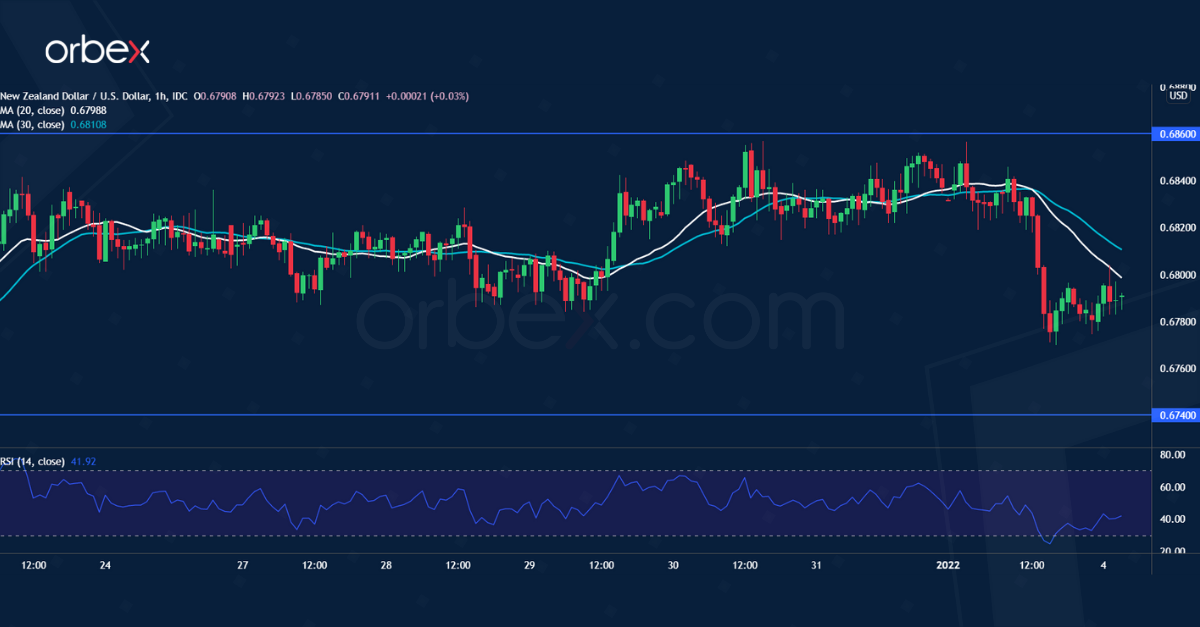
The New Zealand dollar tumbles against its US counterpart amid soaring Treasury yields.
The pair is looking to consolidate its recent gains after it rallied above the 30-day moving average (0.6820). The December high at 0.6860 is a major resistance. A bullish close may propel the kiwi to 0.6950.
In the meantime, the pullback below 0.6800 suggests a lack of further commitment from the buy-side as short-term traders took profit. 0.6740 is the next support and its breach may lead to a correction to 0.6700.
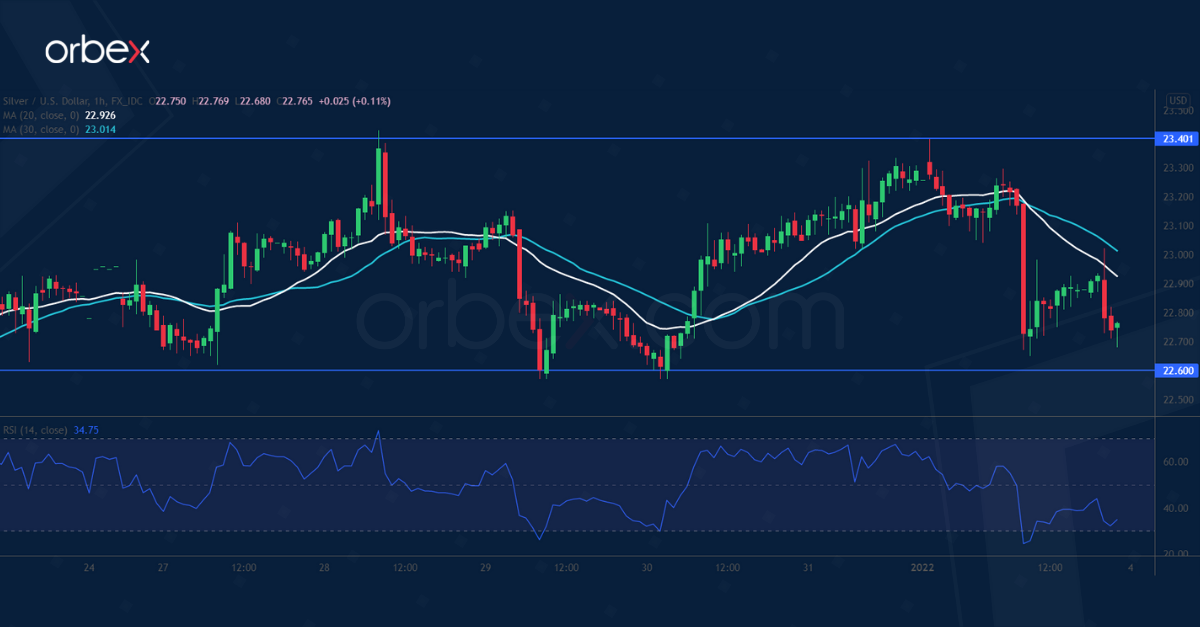
XAGUSD seeks support
Silver falls back as the US dollar strengthens across the board. Price action saw a strong recovery from the daily support at 21.50.
A rally above 23.15 indicates interest in keeping the rebound valid, following a brief end of the year sell-off. The double top at 23.40 is an important resistance on the way to 23.70. This point lies in a supply zone from the late November sell-off.
A break below the psychological level of 23.00 has prompted intraday buyers to bail out. 22.60 is the closest support and its breach could drive the metal to 21.80.
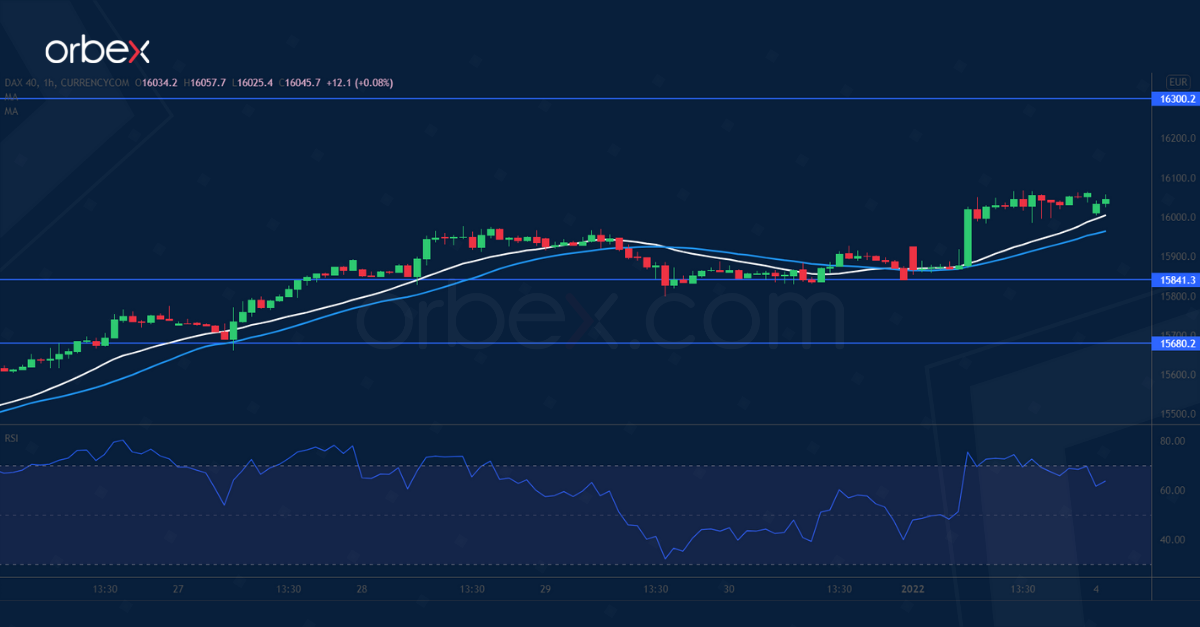
GER 40 rises towards an all-time high
The Dax 40 rallies in hopes that Omicron lockdowns can be avoided. A bullish MA cross on the daily charts indicates improved sentiment.
The rally accelerated after it cleared the supply area around 15750. The bulls are pushing towards the all-time high at 16300. A breakout could resume the uptrend, attracting trend followers in the process.
The RSI surged again into the overbought territory and may temper the bullish fever. 15840 is fresh support. 15680 from the previous resistance area would be a test for buyers’ resolve.
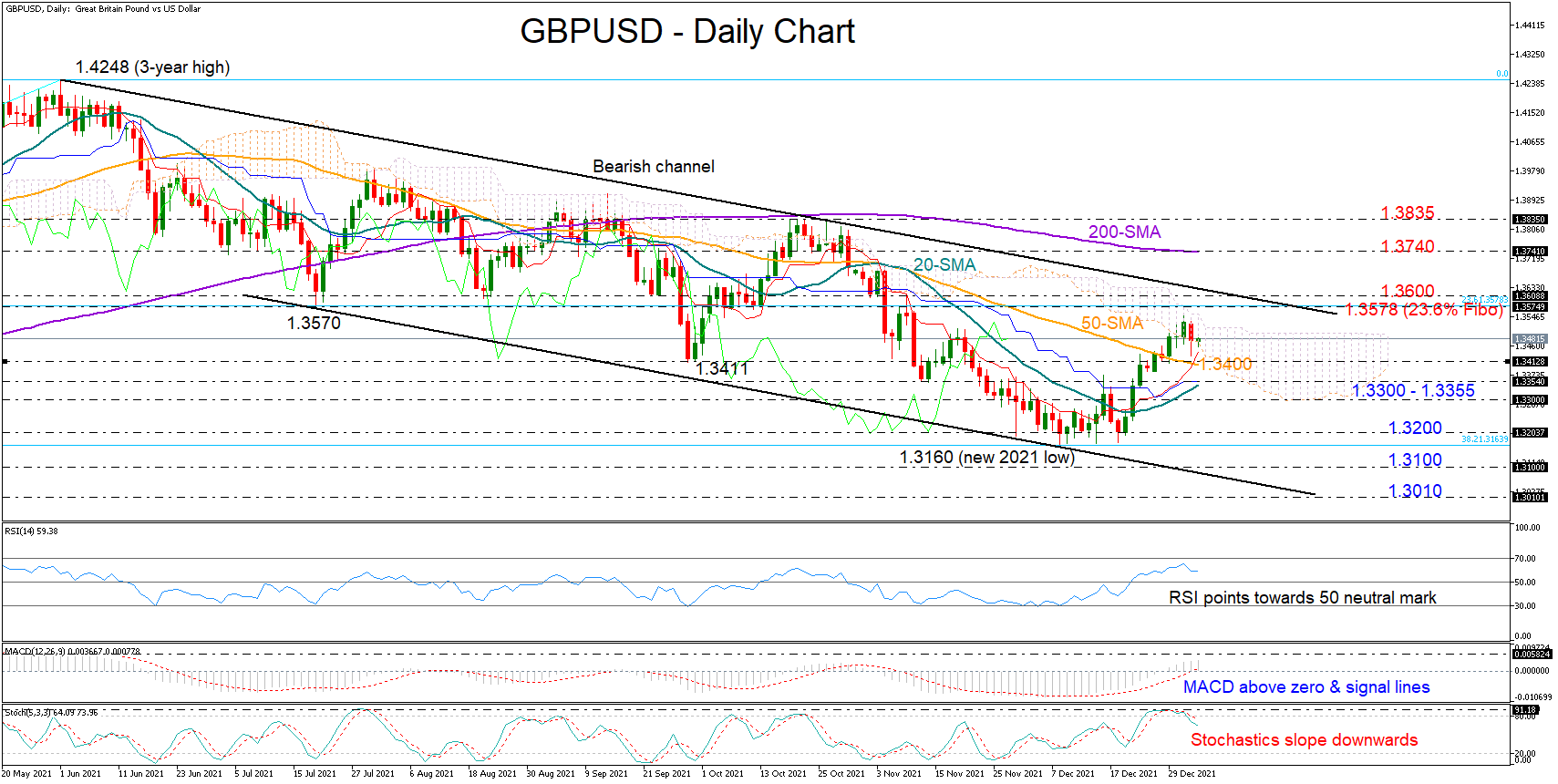
GBPUSD Maintains Some Foothold after Bearish Start to 2022
GBPUSD tiptoed to the downside after its two-week rally peaked at a seven-week high of 1.3549 on Friday, with the price falling as low as 1.3429 on the first trading day of 2022.
The pair is currently oscillating between gains and losses, creating doubts about whether it could stage a breakout above the upper boundary of the bearish channel, last tested back in October.
Both the RSI and the Stochastics are endorsing the negative momentum in the price as the indicators drift southwards. That said, the positive slope in the red Tenkan-sen line, and the fact that the MACD is some distance above its zero and signal lines keep feeding some optimism that selling pressures may not last for long.
If the bulls manage to set a foothold at the bottom of the Ichimoku cloud at 1.3465, which has been balancing bearish movements the past two days, they may attempt to crawl up to the 23.6% Fibonacci retracement of the long-term uptrend from 1.1409 to 1.4248 at 1.3578, and then touch the channel’s upper boundary seen around 1.3600. A significant move above this ceiling would put the seven-month-old downward pattern into question, likely bringing the 200-day simple moving average (SMA) at 1.3740 immediately into scope in the aftermath. Moving higher, a decisive close above October’s resistance of 1.3835 will be needed to officially dissolve the negative trend in the market.
In the event the bears keep the lead, the 50-day SMA at 1.3400 could block the way towards the 1.3300-1.3355 support area. Failure to hold above the latter could see an extension towards the crucial 1.3200 – 1.3160 zone, while a steeper decline is expected to rechallenge the channel’s bottom line around 1.3100.
Summarizing, despite the latest pullback, GBPUSD has yet to confirm a bearish bias. A rebound at 1.3465 could shift the focus back to the upside. Yet, for an outlook improvement in the broad picture, the bulls will need to rally above the downward-sloping channel.
Daily Technical Analysis
EUR/USD
Current level - 1.1298
The euro started the first trading day of the year with losses. The bulls continue to experience serious difficulties around the 1.1360 zone, and the pair was heavily sold out yesterday afternoon. After the false breach of the resistance at 1.1360, a probable scenario is for the bearish pressure to continue towards the lower band of the range at 1.1236. Market sentiment is still mixed and a confirmed breach of either zone would define the future direction of the market. The bulls can expect the first local support to be at around 1.1278. This week is shaping up to be quite a busy one, with the U.S. ISM manufacturing index being expected today at 15:00 GMT, the FOMC meeting minutes being scheduled for Wednesday at 19:00 GMT, and the non-farm payroll report for the U.S. being expected on Friday at 13:30 GMT.
USD/JPY
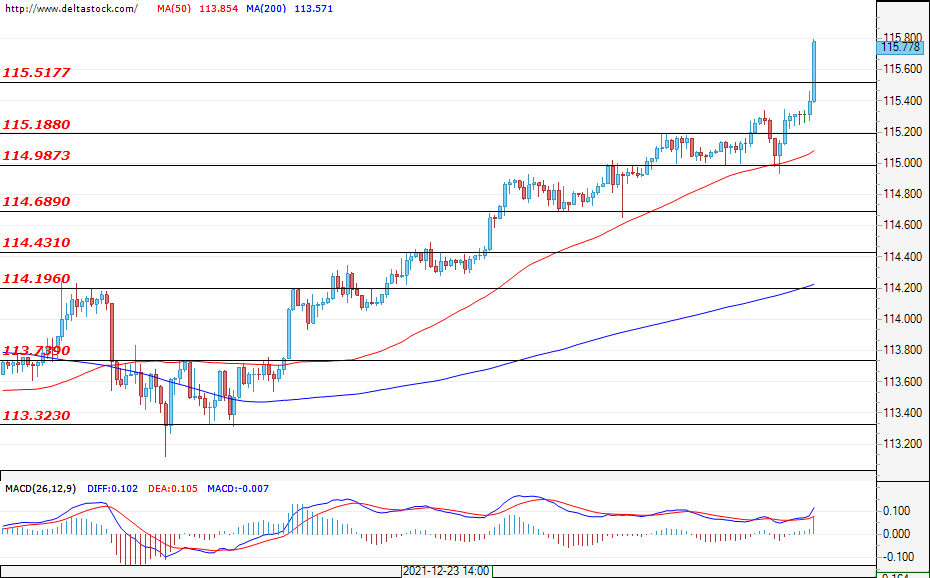
Current level - 115.77
The market is in a strong uptrend and, in the early hours of today’s trading, the pair managed to overcome the resistance at 115.51 that was coming from the higher time frames. While maintaining a strong start of the week, the Ninja is likely to test the area at around 116.00 and even at 117.00. The market seems stretched at the moment and so deep pullbacks are not yet ruled out. The first unconfirmed support for the bulls is 115.51 and a more significant area is the one at 114.98.
GBP/USD
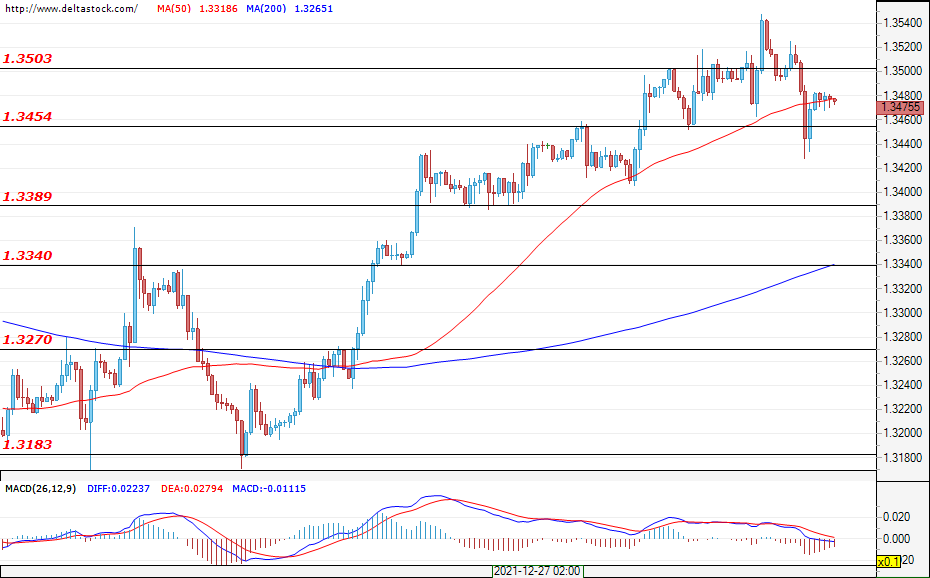
Current level - 1.3475
The bulls managed to reach the resistance at 1.3500, but failed to keep the pressure going. The market is entering a corrective phase and prices are likely to retest the supports at 1.3454 and at 1.3390. It is likely that any trading activity in the coming days will remain in the range between 1.3550 and 1.3390. An increase in activity can be expected today following the announcement of the manufacturing PMI for the UK at 9:30 GMT.
EURGERMANY40
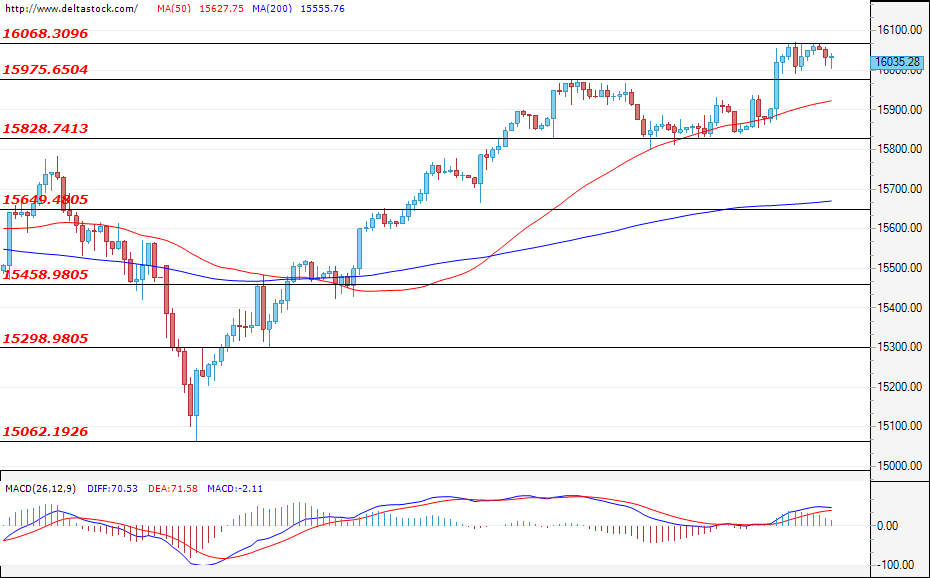
Current level - 16035
The German index started the new year with some good gains as the bulls tested the resistance at around 16070. The first support for them is the zone at 15975, followed by the more significant one at 15830. The uptrend seems strong and, so far, no deep corrections have been noted. If this optimism is maintained, then a breach above 16070 and a new rally towards 16260 is expected. Possible retracements should remain limited above 15830. Today at 8:55 GMT investors expect the unemployment change data for Germany and any positive news on this front could contribute towards a new upward impulse.
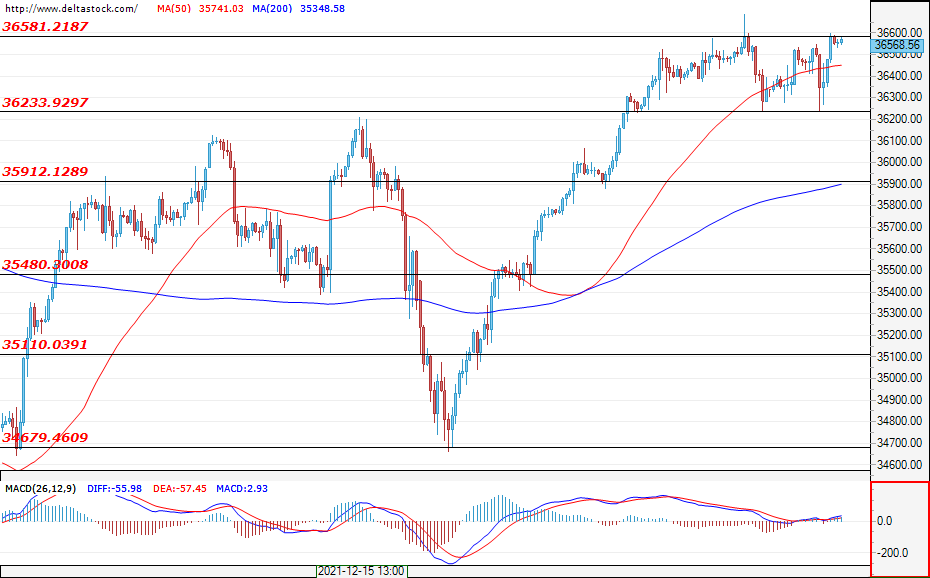
US30
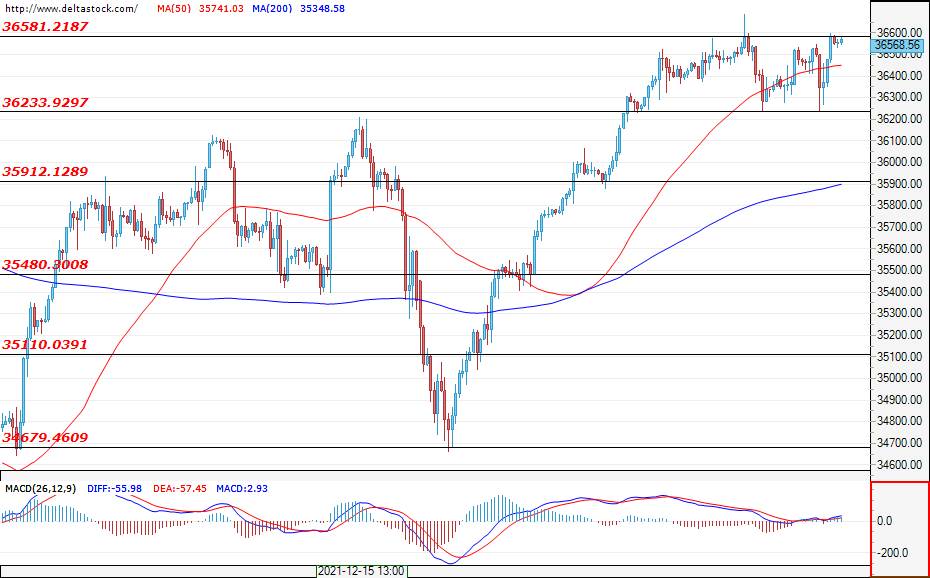
Current level - 36568
The first trading day for the year came with a bang for the U.S. blue-chip index, which closed at a new record high. The index managed to form solid support at around 36230 and, in the early hours of today, prices have gravitated around the resistance at 36580. Should market sentiment remain positive, a breach and a continuation of the rally towards 36900 could be expected. Given the overstreched and overbought levels of the market, deeper pullbacks are not excluded. If the support at 36230 is violated, then a test of the lower zone at 35900 could also be expected.
XAUUSD Retreats as US Dollar Index Bounces Back
US equities rose cautiously on the first trading day of the year as investors started returning back from their holidays. The Dow Jones rose by about 100 points while the S&P 500 and Nasdaq 100 indices rose by 0.25% and 0.75%, respectively. The CBOE VIX index also rose by about 0.80%. Despite concerns over rising Covid cases and a hawkish Fed, investors have history to fall back on. For one, stocks have recorded a positive year in all years in the past decade. The SP 500 index, which rose by 28% in 2021, has risen by more than 10% in the past three straight years. Tesla shares jumped by 9% after the company surpassed its fourth-quarter orders.
The US dollar index rose slightly in the American session as investors reflected on the latest manufacturing PMI numbers from key countries. On Monday, data by Markit showed that the American manufacturing PMI declined slightly to about 57.7 in December. Since the data has remained above 50 for months, it is a sign that the manufacturing sector is doing well. The Institute of Supply Management (ISM) will publish its data later today. The same strong growth was seen in Europe, where the PMI declined to 58.0 from the previous 58.4. The dollar rose as investors predicted that the Fed will be more hawkish this year.
The Australian dollar declined against the US dollar after the latest interest rate decision by the Reserve Bank of Australia (RBA). The bank decided to leave interest rates unchanged and hinted that they will remain in that range for a while. It also decided to continue with its asset purchases in a bid to support the economy as it faces significant Covid-related challenges. The currency also declined after better manufacturing PMI data from China. Other key data to watch today will be the German unemployment rate, mortgage lending and US JOLTs job openings.
EURUSD
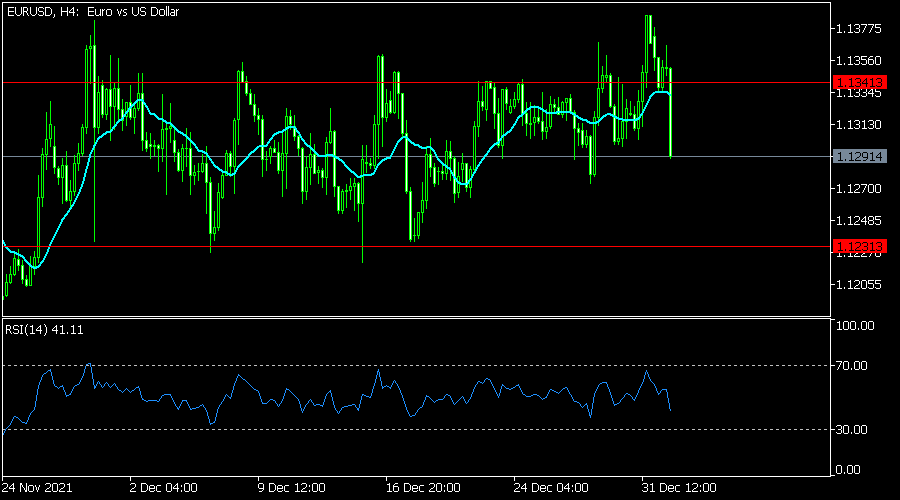
The EURUSD declined sharply in the overnight session. The pair is trading at 1.1290, which is the lowest level since December 29th. The pair managed to move below the important resistance at 1.1340. It has moved below the 25-day moving average and the 23.6% Fibonacci retracement level. Its Relative Strength Index (RSI) has moved below the neutral level of 50. Therefore, the pair will likely keep falling as bears target the lower side of the channel at 1.1231.
NZDUSD
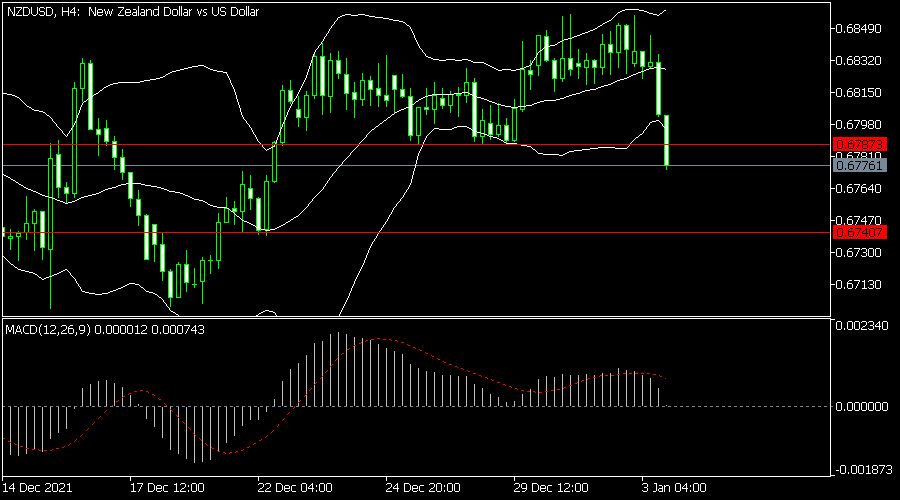
The NZDUSD pair declined sharply because of the strong US dollar. The pair declined to a low of 0.6775, which was the lowest level since December 22. It also moved below the lower line of the Bollinger Bands and the key support at 0.6787. It also declined below the 25-day and 50-day moving averages while oscillators have declined. The pair may continue falling as bears target the key support at 0.6740.
XAUUSD
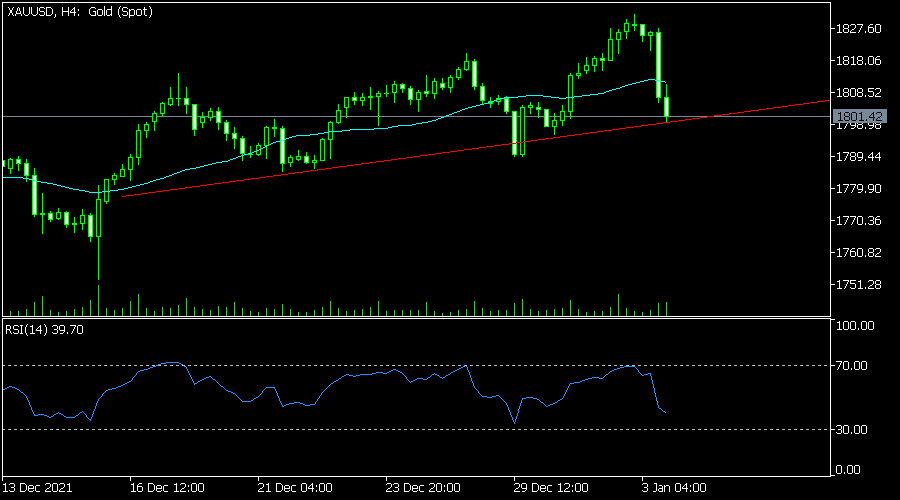
The XAUUSD pair declined to a low of 1,801, which is the lowest level since December 30. The pair moved below the lower line of the ascending trendline. It also moved slightly below the 25-day moving average while the Relative Strength Index has declined. Therefore, the pair will likely keep falling, with the next key target at 1,785.
Asia’s Cautious Equity Mood Continues
Mixed mood in Asian equity markets
With most of the region back at work today, Asian markets have refused to blindly piggyback New York’s overnight rally higher, even as the omicron relief rally gathers steam. The Indonesia coal export ban and the suspension of Evergrande shares yesterday left plenty of two-way risk on the table for Asia, especially where China is concerned. Overnight, Wall Street powered higher, led by Tesla and Apple. The S&P 500 rose by 0.53%, the Nasdaq rallied by 1.03%, and the Dow Jones climbed by 0.68%. Futures remain unchanged on all three indexes in Asian trading.
Wall Street’s performance has green-lighted gains in Japan today, but Asia is still displaying a mixed performance. The Nikkei 225 is 1.35%, higher even as the Kospi falls by 0.45%. Property and energy nerves are sweeping Chinese markets, as well as a partial virus shut-down of the city of Zhengzhou, booster requirements in Hong Kong and tighter information security requirements for companies wishing to IPO overseas. With that number of headwinds, it is not surprising that China is in the red. The Shanghai Composite is 0.65% lower, the CSI 300 is 1.20% lower and Hong Kong is down 0.25%.
Singapore has jumped 1.0% higher after impressive GDP data yesterday, with Taiwan also performing well, climbing 0.90%. Jakarta has risen by 0.65%, but Kuala Lumpur has fallen by -0.70%, with Manila down 1.10%, while Bangkok has climbed 1.10%, Australian markets have jumped on the Wall Street rally, helped by low hospitalisation rates as omicron sweeps the country. The All Ordinaries are 0.77% higher, with the ASX 200 rising by 0.87%.
With an underlying omicron is omigone theme pervading, today should see a positive start to European trading.
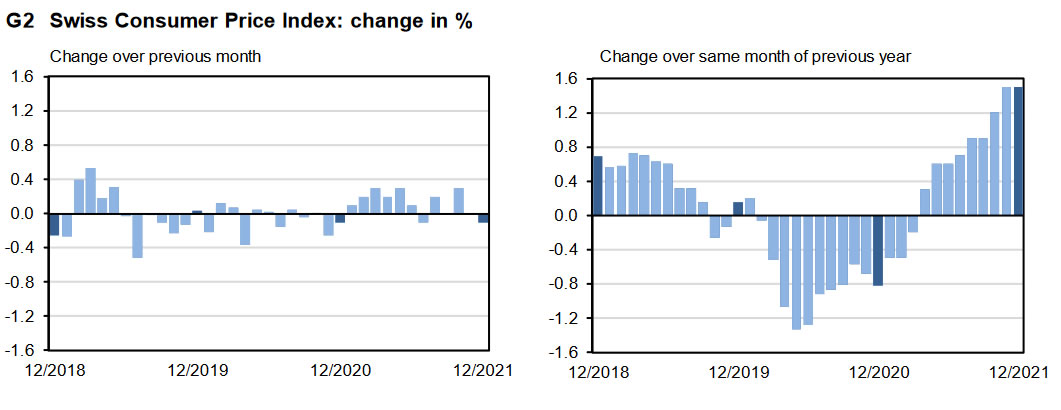
Swiss CPI at -0.1% mom, 1.5% yoy in Dec
Swiss CPI dropped -0.1% mom in December, matched expectations. the decline was due to several factors including falling prices for heating oil, fuel and air transport. For the 12-month period, CPI was unchanged at 1.5% yoy, below expectation of 1.6% yoy.
Average annual inflation in 2021 was at 0.6%. Prices for domestic products increased by 0.3% on average, those for imported products increased by 1.5%. Average annual inflation was –0.7% in 2020 and +0.4% in 2019.