

Sample Category Title
FTSE 100 index Wave Analysis
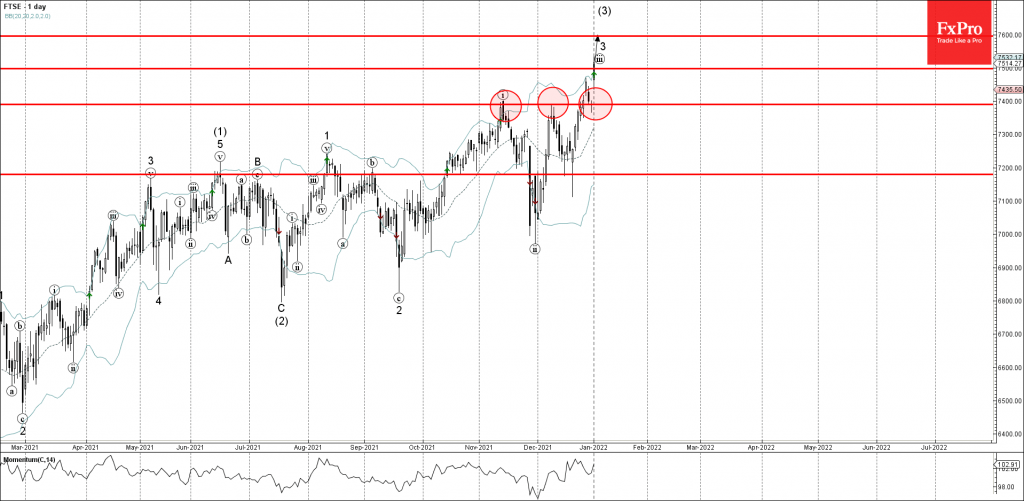
- FTSE 100 broke key resistance level 7500.00
- Likely to rise to resistance level 7600.00
FTSE 100 index recently broke above the key resistance level 7500.00 – which accelerated the active impulse waves 3 and (3).
The index earlier reversed up from the key support level 7400.00, former resistance level which has been repeatedly reversing the price from the middle of November.
Given the strong daily uptrend – FTSE 100 index can be expected to rise further toward the next resistance level 7600.00 (target price for the completion of the active impulse wave 3).
Eco Data 1/5/22
[php_everywhere instance="1"]
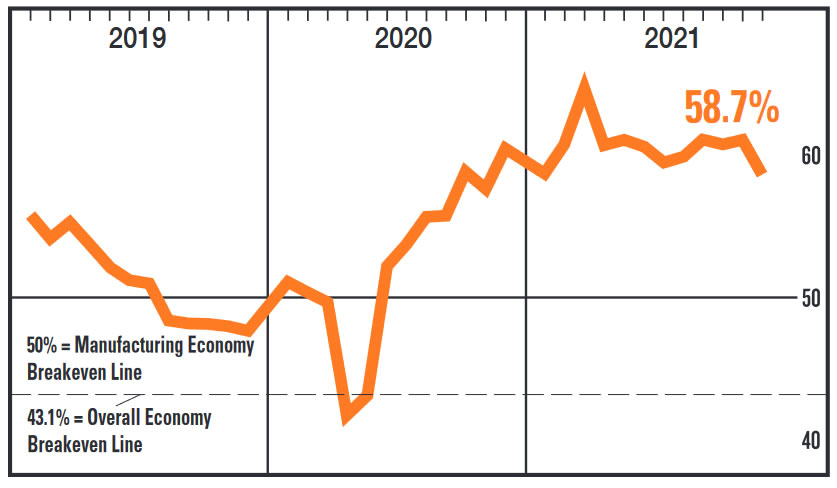
ISM Manufacturing Index Slows But Still Registers 19th Consecutive Month of Expansion
The December ISM manufacturing index fell to 58.7, missing market expectations for 60.0. This marked a 2.4 percentage point decrease from the November reading of 61.1.
New orders fell by 1.1 percentage points to 60.4, while new export orders decreased by 0.4 percentage points to 53.6.
The backlog of orders sub-index came in at 62.8, rising 0.9 percentage points from November's 61.9 print.
The production index pulled back to 59.2 (from 61.5 in November), while the employment index rose 0.9 points to 54.2.
The supplier deliveries sub-index fell to 64.9 points from 72.2 in November. The sub-index continues to reflect difficulties in meeting orders in a timely manner, but has managed two consecutive months of decline. The inventories sub-index registered 54.7 in December recording its fifth consecutive month of expansion.
Fifteen of 18 manufacturing industries reported growth in November. Growth was led by Apparel, Leather & Allied Products; Furniture & Related Products; Textile Mills; Plastics & Rubber Products; Machinery; Nonmetallic Mineral Products; Miscellaneous Manufacturing; and Chemical Products.
Key Implications
The manufacturing sector may have missed expectations, but December still registered another month of expansion. Despite persistent supply chain issues, healthy consumer demand has kept the sector buzzing with activity.
As the year rolls over, the start of 2022 could hold a setback for some of the improving supply conditions from late-2021. The explosive spread of the Omicron COVID variant threatens to further strain labor and input availability. Moreover, as consumers modify their behavior in response to the spreading virus, shifting spending away from services and back to goods, producers will have their hands full meeting demand. These factors could further delay the supply chain relief we have been anticipating and prolong the resultant inflationary impulse.
US Jobs Report, FOMC Minutes to Ring in Busy New Year for the Dollar
After the holiday lull, markets will be getting back into full swing this week as the Fed publishes the minutes of its December FOMC meeting on Wednesday (19:00 GMT) and the latest nonfarm payrolls report comes out on Friday (13:30 GMT). The ISM manufacturing and non-manufacturing PMIs are also due this week, on Tuesday and Thursday, respectively, both at 15:00 GMT. Will the data further ease Omicron fears or actually revive them, and just how hawkish was the Fed at its last meeting? Any surprises might just bolt the US dollar index out of its month-long sideways range.
A positive dollar outlook
The greenback just had its best year since 2015, and with the Fed expected to pull the rate hike trigger in 2022 on the back of a strong economy as well as surging inflation, the positive outlook should hold for at least the first few months of the year. Although the broader health of the economy is important for policymakers, the labour market is their top priority, and the past year couldn’t have been better proof of this as the Fed was willing to sacrifice runaway inflation for a full jobs recovery.
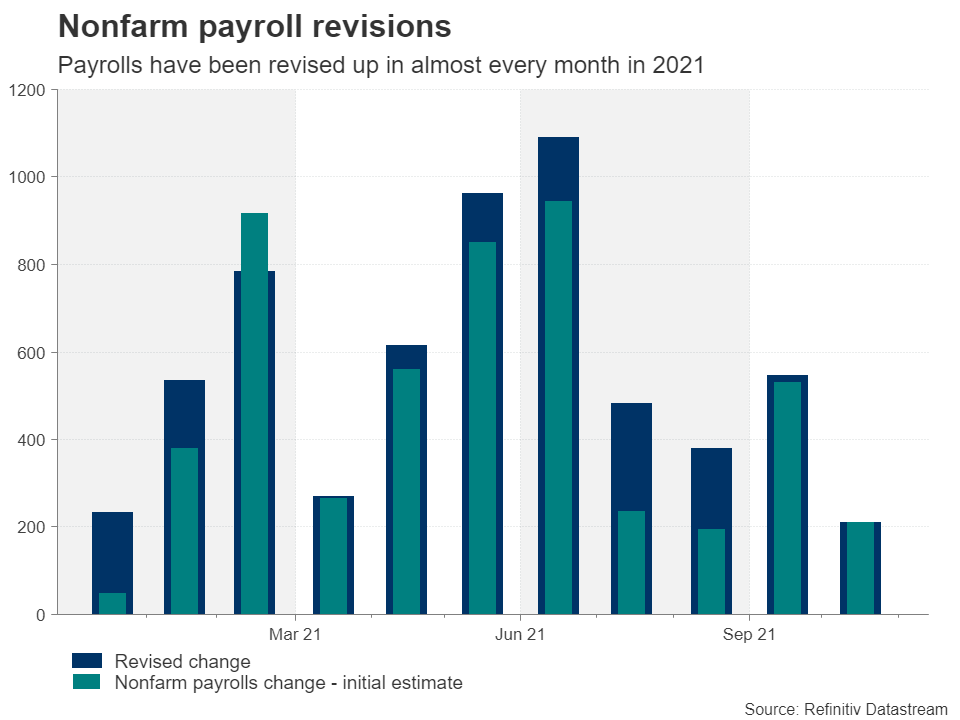
To be fair to the Fed, both the jobs and inflation data have been greatly distorted by the pandemic. For the labour market, in particular, there have been a lot of revisions to the initial payroll readings, while not even the Fed has a good explanation for the shrinking labour force. Excluding November and December, nonfarm payrolls have been revised up by almost one million, indicating jobs growth wasn’t as slow as first deemed.
Panic at the Fed?
But the bigger puzzle at the moment is whether the estimated remaining 3.5 million people who left the labour force during the pandemic and have yet to return will ever do so. Worker shortages are putting an upward strain on wage costs for businesses, adding to already burgeoning price pressures. Should the wage-price spiral get worse, inflation expectations could become unanchored and the Fed would then have no option but to press on the brakes much harder.
Investors already got a glimpse of this in December when Chair Powell made a dramatic hawkish pivot by announcing an accelerated pace of tapering, which paved the way for earlier rate hikes. The majority of FOMC members now predict three rate increases in 2022. Moreover, Powell hinted that liftoff could happen soon after tapering ends in March. Wednesday’s minutes will reveal how far those discussions went in the December meeting.
But the main risk from the minutes is the overall tone, which could come through as much more hawkish than Powell’s expertly handled press conference where he successfully appeased investor concerns. An overly hawkish Fed may yet pose a problem for the markets now that Omicron is sweeping across America, potentially dampening growth in the early parts of 2022. Hence, any sign that Omicron has started to have contractionary effects on the economy might weigh on sentiment.
Another solid month for US jobs
Looking at the consensus estimates for Friday’s data, nonfarm payrolls are expected to have risen by 400k in December versus November’s disappointing 210k increase, which may get revised. The unemployment rate is forecast to have hit another post-pandemic low, dropping 0.1 percentage points to 4.1%.
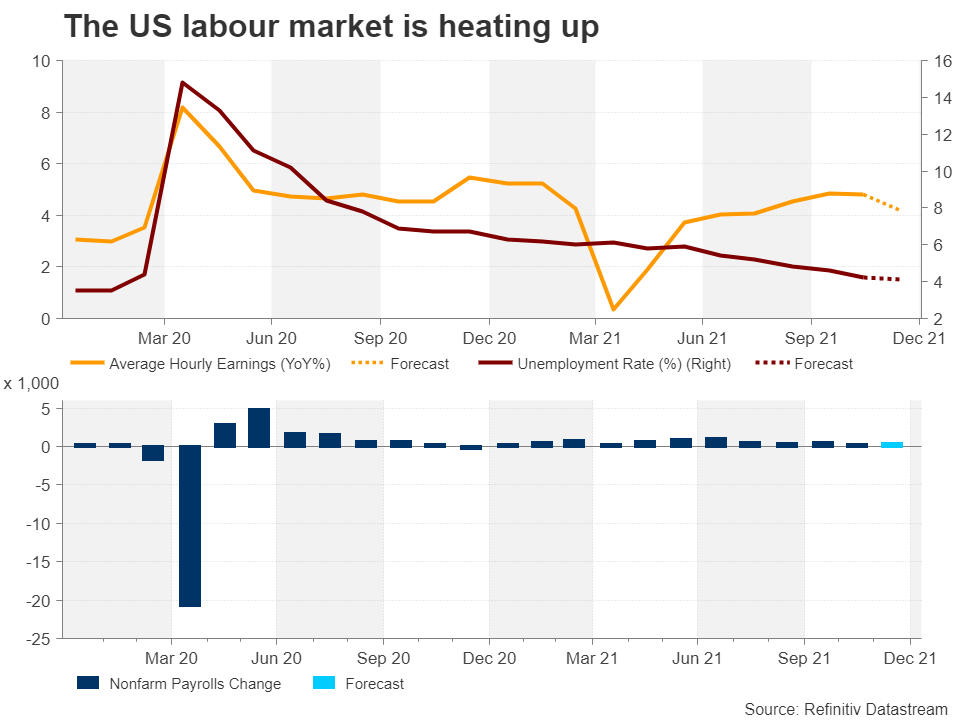
Average hourly earnings might be the more interesting release, however, as the month-on-month rate is expected to have quickened slightly to 0.4% but the yearly rate is anticipated to have moderated from 4.8% to 4.2% in December. A much stronger-than-projected pickup in the monthly pace would indicate that the hiring difficulties are getting worse, meaning wage growth has yet to peak.
A positive wage shock is probably the biggest potential upside from the NFP report for the US currency, while another disappointment in the headline jobs print could spark a frantic knee-jerk selloff, although given the recent strong weekly jobless claims numbers, a large miss is unlikely. The ISM surveys could exacerbate the moves if they deliver a double blow or boost to the dollar.
Uncertainties may keep the dollar in a range
Its index has been trading within a range for over a month, with the floor seen at the 38.2% Fibonacci retracement of the late October-late November upleg around 95.54 and the ceiling at November’s 16-month high of 96.94. That peak around 97 could be tested soon if the greenback keeps up its advances, but before then there is another resistance in the 96.60 zone. On the other hand, should the dollar index crack through the range floor and slip below the 50-day moving average, that would not bode well for the near-term outlook.
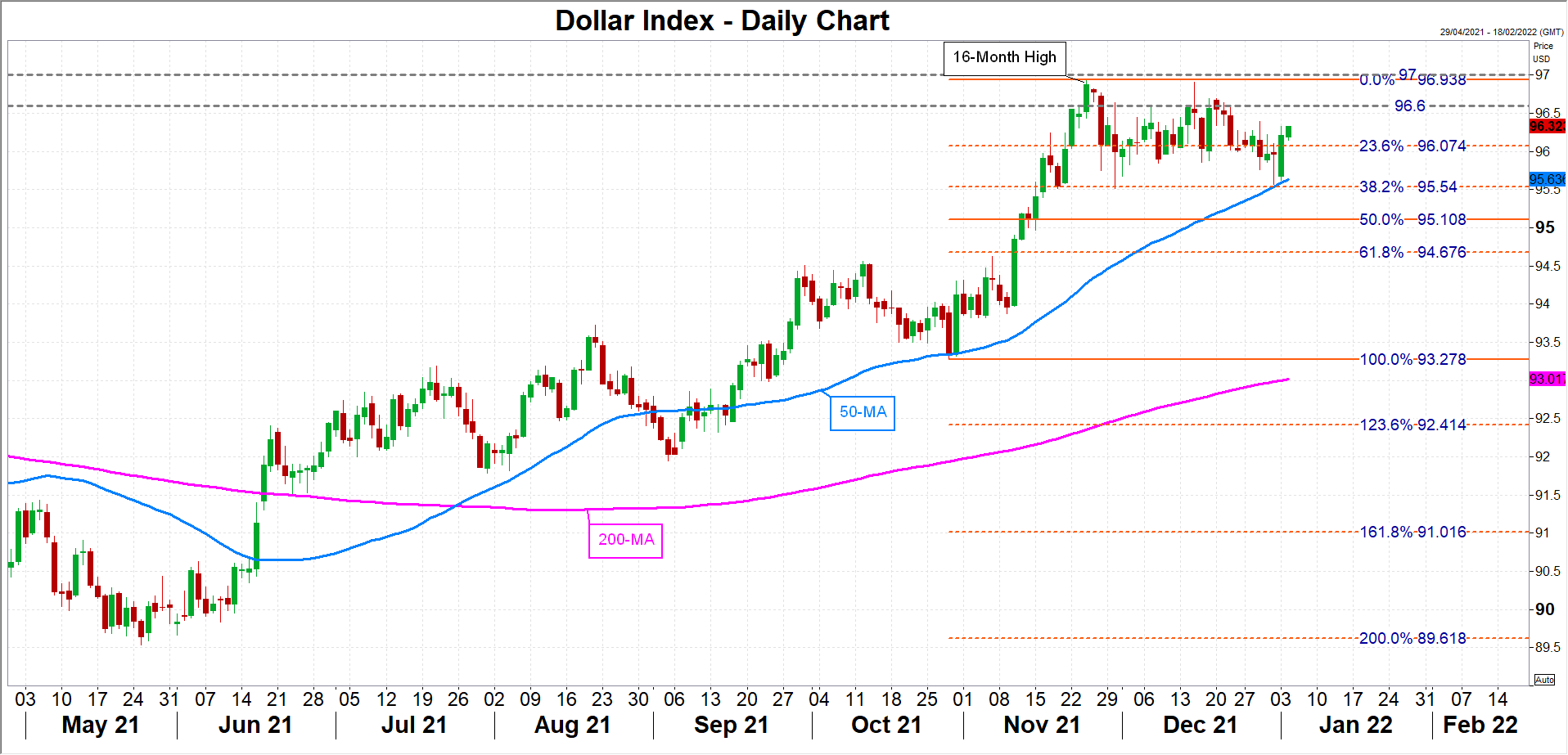
On the whole, though, it’s quite likely that the dollar will continue to consolidate until there is a clearer picture on how much of an impact Omicron will have on the global economy and on whether inflation is any closer to plateauing. The latter will undoubtedly determine how fast the Fed moves with rate hikes.
USDCAD Gives Up Rally Near Familiar Resistance
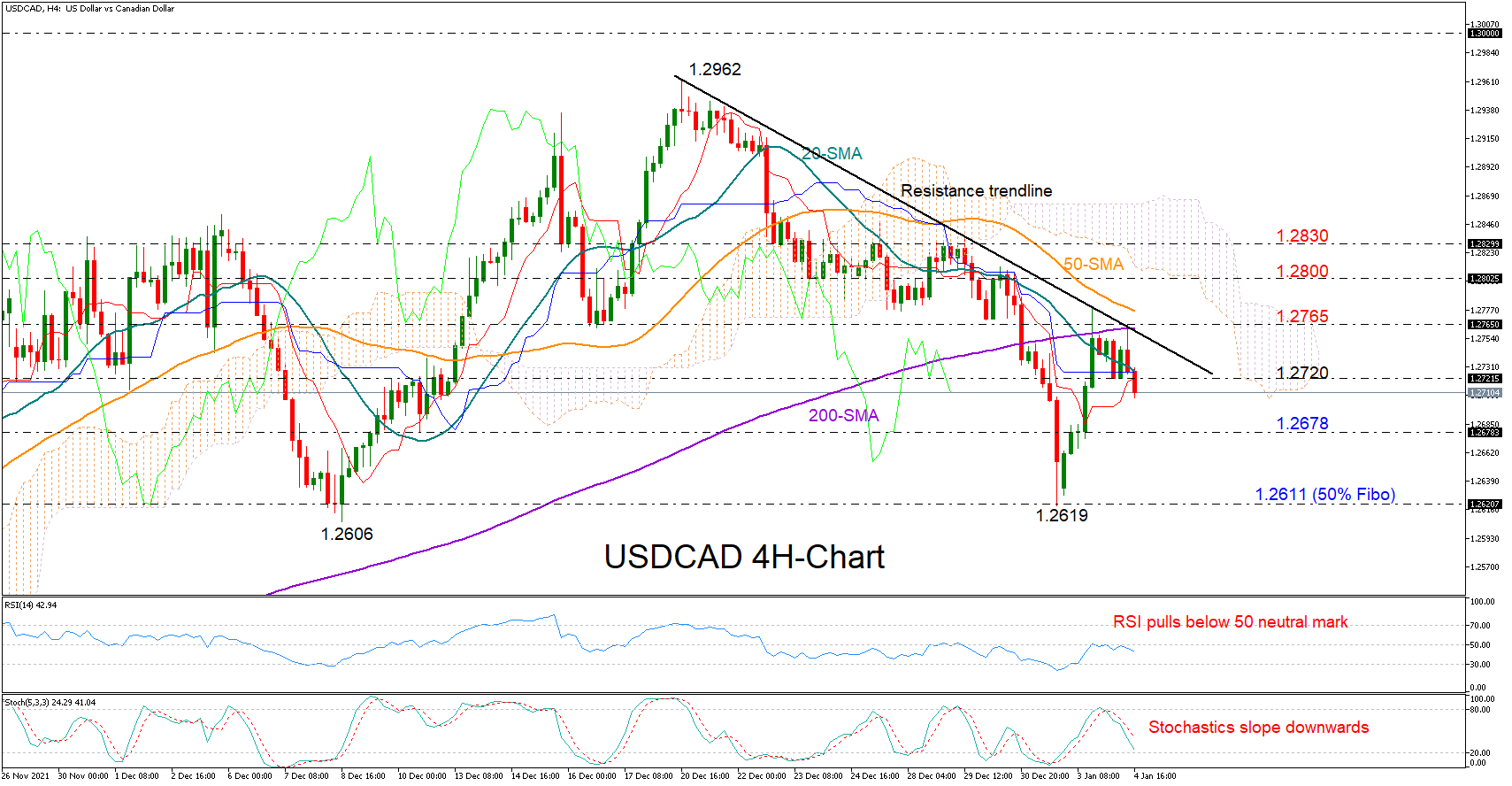
USDCAD swiftly bounced back to the 1.2700 territory after almost touching December’s low of 1.2606 last week, but the descending trendline drawn from the top of 1.2962 managed to put the brakes to the rally once again.
The area around 1.2720 has been balancing downside pressures over the past few hours in the four-hour chart. But currently it is giving up, letting the price slide to 1.2700. If the decline continues, the price could take a rest around 1.2678 before heading towards December’s floor of 1.2619 – 1.2606.
Alternatively, if the pair returns above 1.2720, it could fight for a close above the resistance trendline and the 200-period simple moving average (SMA) at 1.2765. The 50-period SMA is within a breathing distance at 1.2775. Therefore, traders may also wait for a move above it before targeting the 1.2800 level. A sharper increase is expected to face some limitations around the 1.2830 barrier.
From a technical perspective, downside risks seem to be greater at the moment given the RSI’s failure to pierce above its 50 neutral mark and the negative slope in the Stochastics.
Summarizing, the bears seem to be gaining ground in the USDCAD market, making a tumble towards 1.2678 highly likely.
Sunset Market Commentary
Markets
Core bonds parted ways today. While German Bunds recovered slightly from the past session’s beating, US treasuries ceded slightly ground in a positive risk environment. Main European indices gain up to 1.5%. The EuroStoxx50 is a whisker away from last year’s recovery high at 4415. Daily changes on the US yield curve currently range between +1.2 bp (2-yr) and +4.3 bp (30-yr). German yields lose 1.9 bps (2-yr) to 2.5 bps (10-yr) in a bull flattening move. 10-yr yield spread changes vs Germany are broadly unchanged with Ireland (+4 bps) underperforming. Italy (Sep2052) and Slovenia (2026&2062) are the first (EU) sovereigns to hit the market with new (syndicated) deals. Both are expected tomorrow. Today’s European eco calendar was empty, but the December US manufacturing ISM later today kickstarts an interesting data week, especially in the US. Apart from the non-manufacturing ISM and minutes of the December Fed meeting, we get the monthly labour update with ADP employment change and payrolls. The EMU agenda centers around monthly CPI numbers on Friday.
The dollar tried to build on yesterday’s momentum, but moves don’t drag that far. EUR/USD earlier failed to break through the upside of the sideways trading range in place since Q4 2021 (1.1186-1.1383) with relative yield dynamics helping the greenback out. EUR/USD currently changes hands at 1.1285 from an 1.1297 open. USD/JPY is propelled higher in the positive risk environment with the pair trading north of 116 for the first time since January 2017. Sterling outperforms all other majors as UK yields make a catch-up move with EU/US yield developments after yesterday’s Bank Holiday. UK yields add 6.8 bps to 9.5 bps with the belly of the curve underperforming the wings. The UK 2-yr yield tests last year’s high at 0.75% as the probability of a follow-up rate hike in February increases. EUR/GBP gives away support at 0.8381 to drop to 0.8344 currently, the lowest level since March 2020. Next support stands at 0.8282. CE currencies enjoy the risk-on boost. EUR/CZK falls below the March 2020 low (24.77) to 24.70, the strongest CZK level since 2012. The hawkish reaction function of the national bank (eg 100 bps rate hike in December) also grants CZK the relative real rate advantage. EUR/PLN declines to 4.56, the lowest since October in anticipation of a hawkish hike by the NBP later today. Finally, sentiment is even improving for the forint after an extensive test of the EUR/HUF 370 resistance area. The pair dropped below 365. An easing of tensions on the FX market will especially be welcomed by the central bank as it would allow time for pause in the weekly hiking cycle of the 1-week deposit rate (de facto key rate instrument). It currently stands at 4% and risks bumping into the 4.4% marginal lending rate ahead of the next MNB decision (Jan 25). At the end of last year, the central bank needed to widen the interest rate corridor at an intermediate ad hoc meeting to side-step the problem. News Headlines
Dutch gas futures soar another 15%+ today after jumping a similar amount yesterday. The strong two-day move follows a sharp 60% decline during the final part of 2021, when unusually mild weather curbed demand and flurry of US LNG cargoes supported supply. The reignited gas rally comes as supply from top seller Russia plunged this week amid heightened geopolitical tensions with the EU over Ukraine. To make matters worse, some nuclear capacity in countries including France was brought offline for repairs and maintenance ahead of the coldest months of the year.
OPEC+ stuck to the script of restoring previous output cuts and agreed to bring an additional 400 000 b/d to the market in February. The decision comes even as OPEC still expects a supply surplus for the first three months of the year. However, it will probably be less than expected earlier. In addition, much of the fuel inventories in developed countries are currently at low levels, a delegate said, and they may thus choose to replenish. It should also be noted that overcompliance with OPEC’s production cuts were estimated at 117% for November (last data) as some countries struggle to ramp up supply. Some of the agreed output increases thus don’t make it to the market.
US ISM manufacturing dropped to 58.7, prices dropped sharply to 68.2
US ISM Manufacturing dropped from 61.1 to 58.7 in December, below expectation of 60.2. Looking at some details, new orders dropped -1.1 to 60.4. Production dropped -2.3 to 59.2. Employment rose 0.9 to 54.2. Prices dropped sharply by -14.2 to 68.2.
ISM said: "The past relationship between the Manufacturing PMI® and the overall economy indicates that the Manufacturing PMI® for December (58.7 percent) corresponds to a 4.4-percent increase in real gross domestic product (GDP) on an annualized basis."
Euro Dips Below 1.13 as Treasury Yields Rise
The euro has started the New Year on the left foot, as EUR/USD has fallen close to 1% already this week. The dollar is showing broad strength, boosted by the jump in US bond yields. The 10-year yield broke above 1.60% on Monday, its highest level since November. The yield has crept up to 1.67% on Tuesday. The 30-year yield broke above the 2% level on Monday and is currently trading at 2.05%. If US yields remain at high levels, the dollar could continue its New Year rally.
Treasury bills appear to be the flavor of the week, as investors continue to sell Treasury bills on improved sentiment that the latest wave of Covid cases, driven by the Omicron variant, is less severe than originally feared. In the US, Omicron cases are exploding, with the average number of new cases breaking above 400 thousand, a 200% increase in the past 14 days. However, hospitalisation rates have not jumped higher and Covid-related deaths have actually declined slightly during this period. With no indications that Omicron will have a devastating effect on the global economy, Wall Street remains in an optimistic mood.
The US is back in action with some tier-1 events later today. The ISM Manufacturing PMI and JOLTS Job Openings are expected to show strong readings (60.0 and 11.06 million, respectively), so we could see some stronger movement from EUR/USD in the North American session.
German Retail Sales for November were stronger than expected, but this failed to push the euro higher. Retail Sales rose 0.9% m/m, beating the estimate of -0.5%. On an annualized basis, Retail Sales fell -2.9%, but this was better than the consensus of -4.9%.
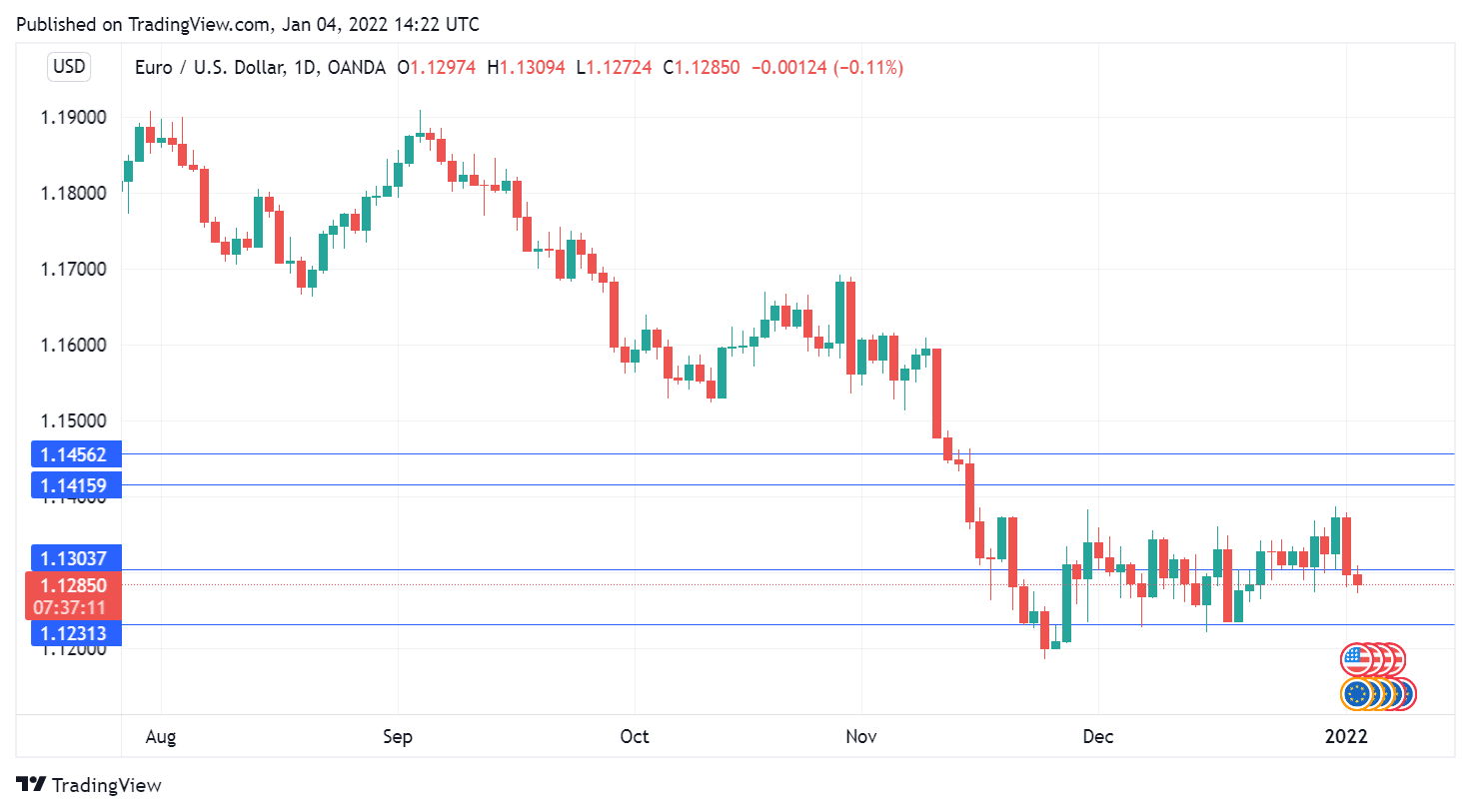
EUR/USD Technical
- EUR/USD has support at 1.1303. Below, there is support at 1.1232
- There is resistance at 1.1456 and 1.1415
Dollar Hits Five-Year High Against Yen; OPEC Next on the Radar
Omicron virus does not affect economic recovery
Despite concerns about the extremely contagious omicron virus subtype, investors are focusing on the economic recovery from the pandemic and central bank's plans for stimulus reduction at this time.
In the FX market, the focus today is on dollar/yen, which surged to a new five-year high of 116.33 as risk-on sentiment pressed safe-haven currencies such as the yen. It may be difficult for sellers to reverse the trend. The BOJ will stay the most dovish, so the weak yen may dive further this year.
The euro is still trading lower, and if it breaks below $1.1230, it could meet the 16-month low of $1.1185. Euro/pound is hovering near an almost two-year low of 0.8354 as the ECB is lagging behind the BoE, which has surprisingly hiked its interest rates last month.
In stock markets, US futures are suggesting another soft positive open for Wall Street today.
FOMC minutes and NFP on cards this week
Markets will probably be back in full gear later this week as investors are eagerly waiting for the minutes of the December FOMC released on Wednesday and the latest nonfarm payrolls report due on Friday, the markets. Nonfarm payrolls are expected to have increased by 400k in December, compared to 210k in November, which may be amended. The unemployment rate is expected to fall by 0.1% to 4.1%. The ISM manufacturing and non-manufacturing PMIs are also coming out.
In central bank news, there are now some people who might be suitable candidates for the Fed Board of Governors to keep in mind. A lot of people say that President Biden is going to nominate Philip Jefferson, who served the Fed twice before, to fill one of the empty seats on the Board of Directors.
OPEC+ meeting is expected
So far, OPEC+ is expected to keep up with its planned production increases today. Oil traders will be very interested in this. If that's the case, the market reaction could be very limited, with oil prices moving around $76.46/per barrel.
Gold is trading around $1,800/per ounce after a sharp negative day on Monday. Aussie/dollar is battling with the 0.7180 support level and the 20- and 40-day simple moving averages (SMAs), while kiwi/dollar is falling near 0.6765.
Dollar/loonie is continuing the upside move with weak momentum as Ontario is facing record high infection cases. All schools will move to online learning, and indoor dining, gyms, and movie theatres will be closed, as well.
Full Risk-On Markets Continues, Yen Continues Downside Acceleration
Global financial markets are in full risk-on mode today. Major European indexes are trading higher while US futures indicates that record run is continuing. In the currency markets, Yen's steep selloff continues and looks unstoppable. Dollar is performing well as supported by rally in treasury yields. Euro, on the other hand, is rather weak, in particular against Sterling and Swiss Franc. Commodity currencies are lacking a clear direction.
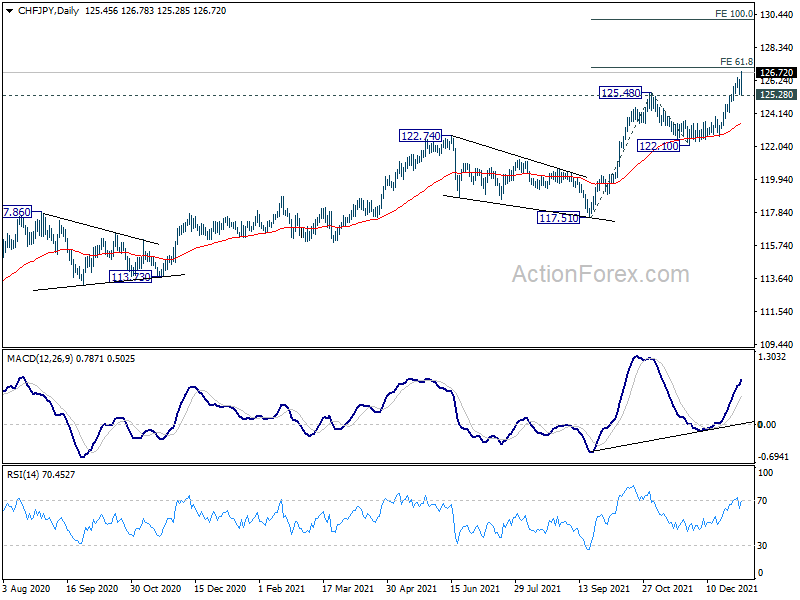
Technically, even CHF/JPY has also resumed its up trend and hit as high as 126.78 so far. A key focus is now on 61.8% projection of 117.51 to 125.48 from 122.10 at 127.02. Sustained break there could be an indication that Yen's decline is further accelerating, and would set the stage for 100% projection at 130.07.
In Europe, at the time of writing, FTSE is up 1.46%. DAX is up 0.94%. CAC is up 1.43%. Germany 10-year yield is down -0.0188 at -0.139. Earlier in Asia, Nikkei rose 1.77%. Hong Kong HSI rose 0.06%. China Shanghai SSE dropped -0.20%. Singapore Strait Times rose 1.50%. Japan 10-year JGB yield rose 0.0168 to 0.089.
UK PMI manufacturing finalized at 57.9, upturn remains subdued
UK PMI Manufacturing was finalized at 57.9 in December, down slightly from November's 58.1. The index has now remained above neutral 50 mark for 19 straight months. Markit noted that output, new orders and employment all rose. New export orders fell for the fourth month running. Selling price inflation hit fresh record high.
Rob Dobson, Director at IHS Markit, said: "While the uptick in growth is a positive step, the upturn remains subdued compared to the middle of the year, as supply chain constraints and weak export performance constrained attempts to raise production further. Manufacturers indicated that logistic issues, Brexit difficulties and the possibility of further COVID restrictions (at home and overseas) had all hit export demand at the end of the year."
Also from UK, M4 money supply rose 0.7% mom in November versus expectation of 0.5% mom.
Swiss CPI at -0.1% mom, 1.5% yoy in Dec
Swiss CPI dropped -0.1% mom in December, matched expectations. the decline was due to several factors including falling prices for heating oil, fuel and air transport. For the 12-month period, CPI was unchanged at 1.5% yoy, below expectation of 1.6% yoy.
Average annual inflation in 2021 was at 0.6%. Prices for domestic products increased by 0.3% on average, those for imported products increased by 1.5%. Average annual inflation was –0.7% in 2020 and +0.4% in 2019.
From Germany, retail sales rose 0.6% mom in November versus expectation of -0.5% mom. Unemployment dropped -23k in December versus expectation of -15k.
China Caixin PMI manufacturing rose to 50.9, improving demand and supply
China Caixin PMI Manufacturing rose to 50.9 in December, up from November's 49.9, above expectation of 50.0. The data signaled a renewed improvement in the sector with best reading since June. Caixin said rise in output was stronger amid renewed upturn in sales. Input cost inflation eased to 19-month low. Business confidence weakened amid pandemic and supply chain worries.
Wang Zhe, Senior Economist at Caixin Insight Group said: "To sum up, manufacturing demand and supply improved in December with easing inflationary pressure. But the job market was still under pressure and businesses were less optimistic, indicating unstable economic recovery. The repeated Covid-19 flare-ups and sluggish overseas demand were factors of instability."
Japan PMI manufacturing finalized at 54.3 in Dec, confidence dipped
Japan PMI Manufacturing was finalized at 54.3 in December, slightly lower than November's 54.5. But that was well above 2021's average of 52.7. Markit said output and new orders increased at slower rates. Employment level rose at fastest pace in nearly four years. Business optimism eased to four-month low.
Usamah Bhatti, Economist at IHS Markit, said: "Domestic markets were buoyed by a gradual recovery from the COVID-19 pandemic however a sharp rise in cases, particularly in South Korea hindered international demand and continued to disrupt supply chains across the sector... Delivery delays and material shortages remained a dampener on production and sales... Average lead times across the final quarter of 2021 deteriorated further... Though still optimistic, Japanese goods producers were wary of the continued impact of the pandemic and supply chain disruption, which resulted in confidence dipping to the softest since August."
GBP/JPY Mid-Day Outlook
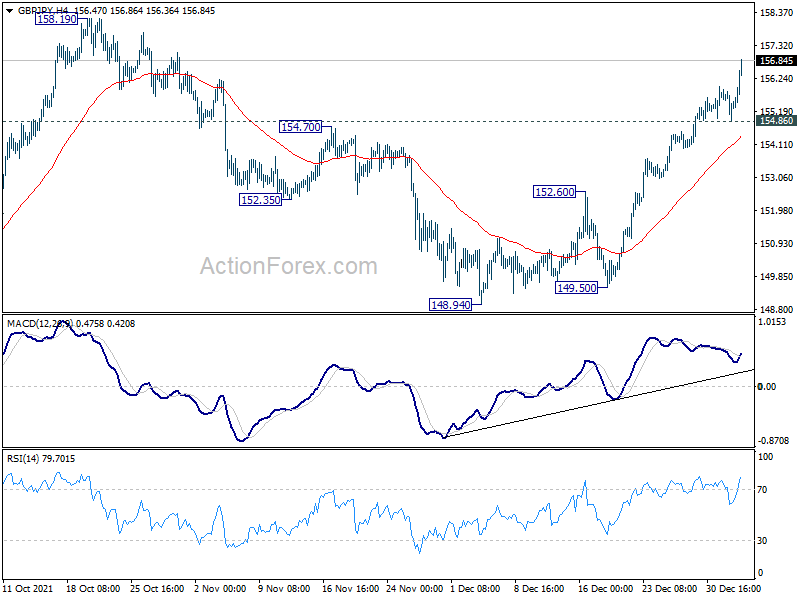
Daily Pivots: (S1) 154.94; (P) 155.44; (R1) 155.97; More...
GBP/JPY's rise from 148.94 resumed after brief retreat and intraday bias is back on the upside. As noted before, correction from 158.19 should have completed with three waves down to 148.94, after defending 148.93 key support. Further rally should be seen back to retest 158.19. Firm break there will resume larger up trend to 167.93 long term fibonacci level. On the downside, below 154.86 minor support will turn intraday bias neutral and bring consolidations first.
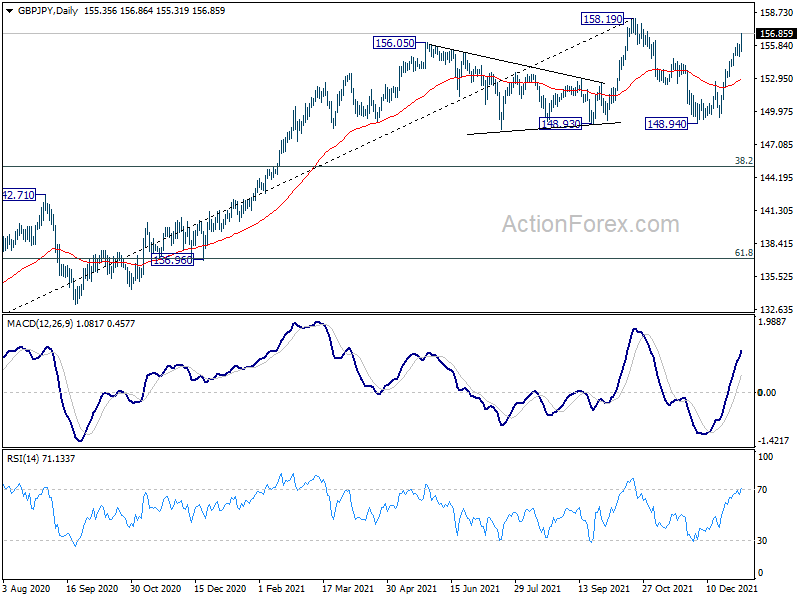
In the bigger picture, strong rebound from 148.93 key structural support will retain medium term bullishness. Firm break of 158.19 high will resume whole up trend from 123.94 (2020 low), to 61.8% retracement of 195.86 to 122.75 at 167.93. Nevertheless, firm break of 148.93 will bring deeper correction to 38.2% retracement of 123.94 to 158.19 at 145.10, and possibly further lower, as a correction to up trend from 123.94 at least
Economic Indicators Update
| GMT | Ccy | Events | Actual | Forecast | Previous | Revised |
|---|---|---|---|---|---|---|
| 00:01 | GBP | BRC Shop Price Index Y/Y Nov | 0.80% | 0.30% | ||
| 00:30 | JPY | Manufacturing PMI Dec F | 54.3 | 54.2 | 54.2 | |
| 01:45 | CNY | Caixin Manufacturing PMI Dec | 50.9 | 50.5 | 49.9 | |
| 07:00 | EUR | Germany Retail Sales M/M Nov | 0.60% | -0.50% | -0.30% | |
| 07:30 | CHF | CPI M/M Dec | -0.10% | -0.10% | 0.00% | |
| 07:30 | CHF | CPI Y/Y Dec | 1.50% | 1.60% | 1.50% | |
| 08:55 | EUR | Germany Unemployment Change Dec | -23K | -15K | -34K | |
| 09:30 | GBP | Mortgage Approvals Nov | 67K | 66K | 67K | |
| 09:30 | GBP | M4 Money Supply M/M Nov | 0.70% | 0.50% | 0.60% | |
| 09:30 | GBP | Manufacturing PMI Dec F | 57.9 | 57.6 | 57.6 | |
| 13:30 | CAD | Industrial Product Price M/M Nov | 0.80% | 0.90% | 1.30% | |
| 13:30 | CAD | Raw Material Price Index Nov | -1.00% | 0.00% | 4.80% | |
| 14:30 | CAD | Manufacturing PMI Dec | 57.2 | |||
| 15:00 | USD | ISM Manufacturing PMI Dec | 60.2 | 61.1 | ||
| 15:00 | USD | ISM Manufacturing Prices Paid Dec | 79.5 | 82.4 | ||
| 15:00 | USD | ISM Manufacturing Employment Dec | 53.3 |