Sample Category Title
Japan: Expect Stronger Economy But Softer Currency
Summary
- Japan's GDP contracted in Q3, not an unexpected result considering a state of emergency remained in effect for Tokyo and the surrounding areas through until the end of September. Weakness was evident in both consumer spending and business investment.
- The outlook for the economy is brightening for the quarters ahead however. With the lifting of restrictions, we expect a rebound in activity during Q4, while the prospect of additional fiscal stimulus being passed before the end of this year should also be supportive of growth in 2022.
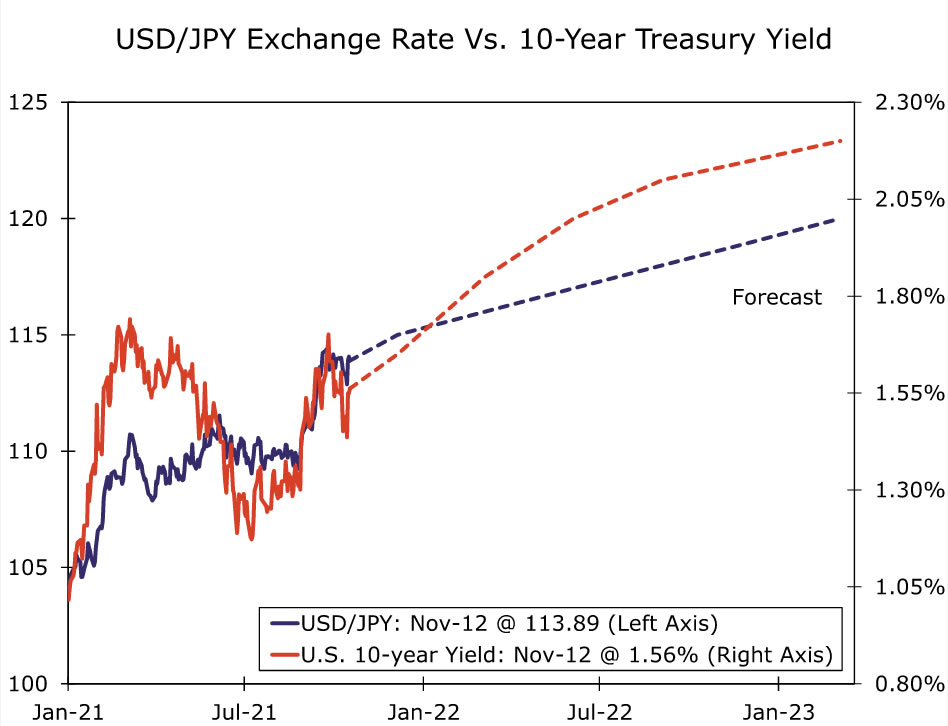
- However, improving growth prospects do not necessarily correspond to improving Japanese currency prospects. With inflation still absent, we expect the Bank of Japan to maintain accommodative monetary policy for the foreseeable future. In an environment of rising global bond yields, that should translate to a softer yen over the medium-term, and we forecast a USD/JPY exchange rate of JPY120.00 by early 2023.
Another Challenging Quarter for Japan's Economy
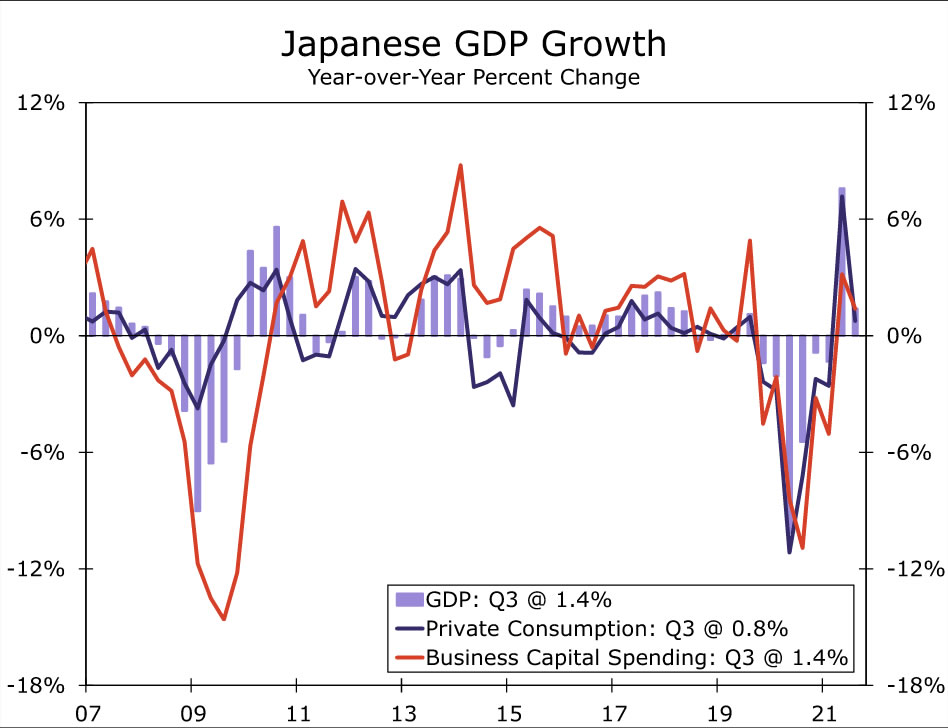
Japan's third quarter GDP figures confirmed another challenging quarter for the country's economy, as ongoing COVID-related restrictions in Tokyo and the surrounding areas restrained consumer and investment spending. Overall GDP fell 0.8% quarter-over-quarter (not annualized), more than reversing the unexpected 0.4% gain seen in Q2. The softness in third quarter GDP was relatively broad-based, as private consumption fell 1.1% and business capital spending fell a larger 3.8%. While not fully complete, the income details from the report were however mildly encouraging, as (nominal) employee compensation rose 0.5% quarter-over-quarter and 1.8% year-over-year.
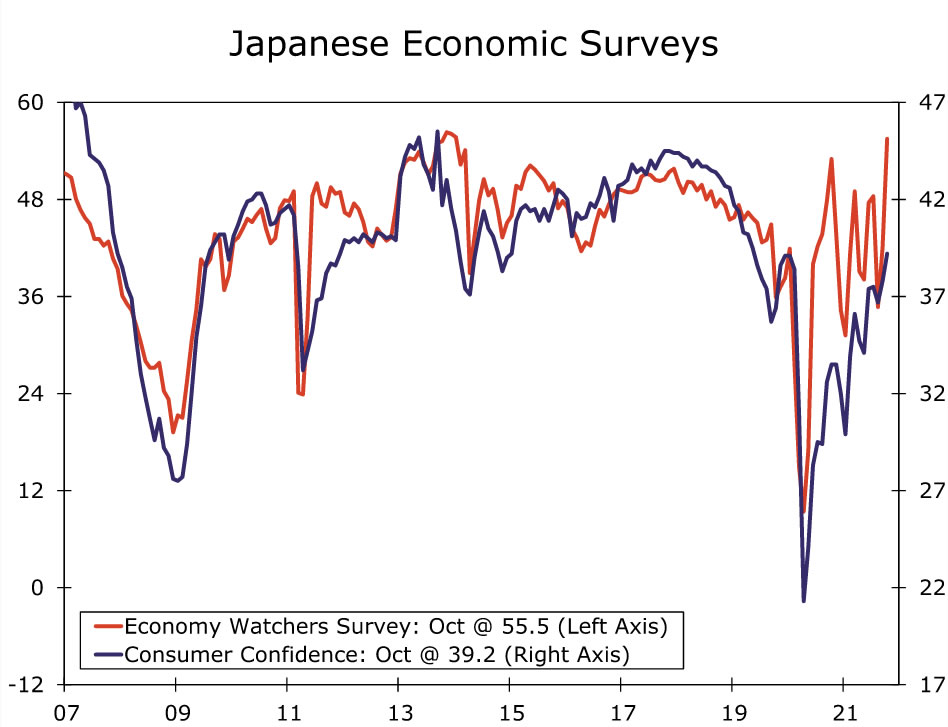
The more encouraging news with respect to Japan's economic outlook stems from recent political and policy developments. Significantly, the Japanese government lifted the state of emergency and all associated restrictions at the end of September, paving the way for an increase in consumer and service sector activity during Q4. While this is not yet evident in the 'hard' activity data, there has been a perceptible improvement in confidence surveys so far during the fourth quarter. The October economy watchers survey rose to 55.5, the strongest reading since early 2014, while October consumer confidence also rose to 39.2.
Other recent political and policy developments have also, in our view, led to some brightening in prospects for Japan's economy. In recent months, Fumio Kishida was installed as Japan's new Prime Minister, and his Liberal Democratic Party (LDP) subsequently won lower-house elections held at the end of October, securing 261 seats in the 465 seat lower house. Following the election, Kishida repeated his previously signaled plans for a new stimulus package, which among other things could include cash handouts and vouchers. Kishida has said the package will be put together in November, with the intention of passing by the end of the year. While the size of any additional stimulus has yet to be determined, a recent survey of economists suggested measures in the region of ¥30 trillion, which would be equivalent to more than 5% of Japan's GDP. Even if actual new spending is less than the size of the headline package, which is usually the case, the proposed fiscal stimulus could still offer significant support to the economy in 2022 in particular. It is against this backdrop that we have in recent months moderately raised our GDP growth forecast for Japan, and we now look for 2.3% growth for 2021 and 2.8% growth for 2022. The risks around that growth outlook are potentially to the downside for 2021, but to the upside for 2022.
Constructive Economic Outlook Might Not Mean Constructive Currency Prospects
Although the prospects for Japan's economy have improved moderately, our view remains for Japanese currency underperformance over time, and we expect the yen to weaken versus the greenback over the medium-term. Unlike many other economies, inflation pressures remain notably absent in Japan. For both 2022 and 2023, we forecast CPI inflation of just 0.6%, and expect the Bank of Japan to persist with its accommodative monetary policy stance for an extended period, including maintaining its 10-year Japanese government bond yield target at zero percent.
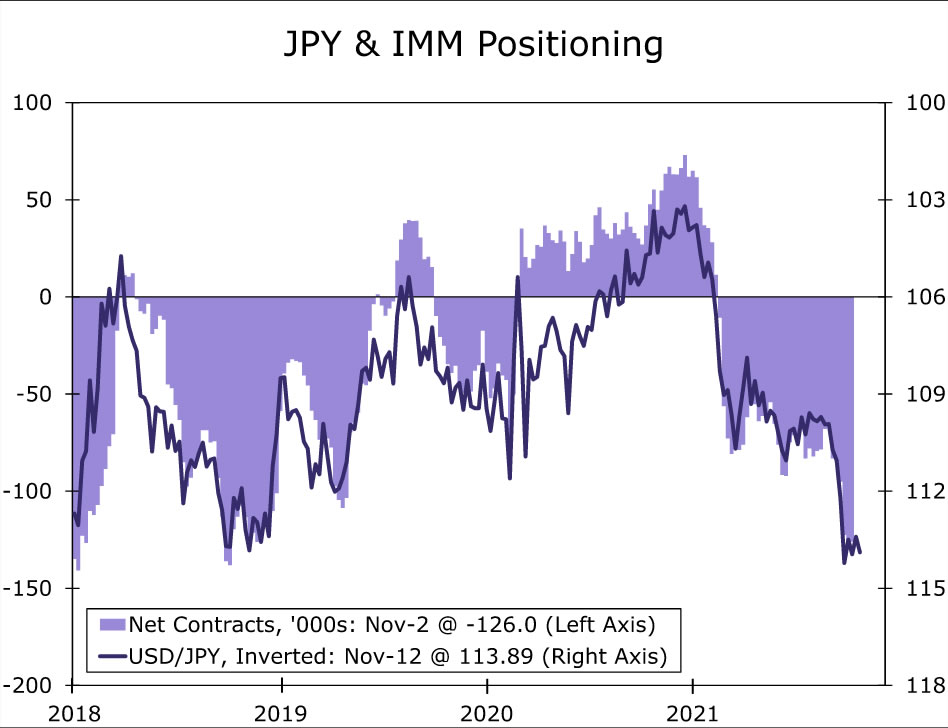
For the time being, a brief period of yen stability is possible, given some recent declines in global bond yields and existing FX positions. IMM currency futures, for example, show speculative yen short positions near their largest levels since 2019, potentially limiting yen softness for now. However, we do expect global bond yields to show a renewed rise in the months and quarters ahead as inflation pressures persist. U.S. price pressures in particular remain quite robust, with the U.S. October CPI rising 6.2% year-over-year. As U.S. inflation remains quite elevated by historical standards and the Federal Reserve winds down its quantitative easing program by mid-2022 and starts its rate hike cycle before then end of next year, we see U.S. 10-year Treasury yields rising to 2.20% by early 2023. With Japanese yields unlikely to follow U.S. yields perceptibly higher, we expect that will translate into a weaker yen versus the U.S. dollar, and target and USD/JPY exchange rate of JPY120.00 by early 2023.
Will UK Inflation Data Rekindle BoE Rate Hike Talk, Jump-Start the Pound?
It’s a packed week for UK economic indicators, starting with the labour market report on Tuesday, CPI figures on Wednesday and retail sales data on Friday, all due at 07:00 GMT. The pound is still licking its wounds from the Bank of England flip flopping on its rate hike decision, with the surge in the US dollar adding to the pain. But potentially upbeat numbers in this week’s trio of releases might turn out to be the reminder that investors needed that a rate hike is still on the agenda at the BoE.
A tight labour market
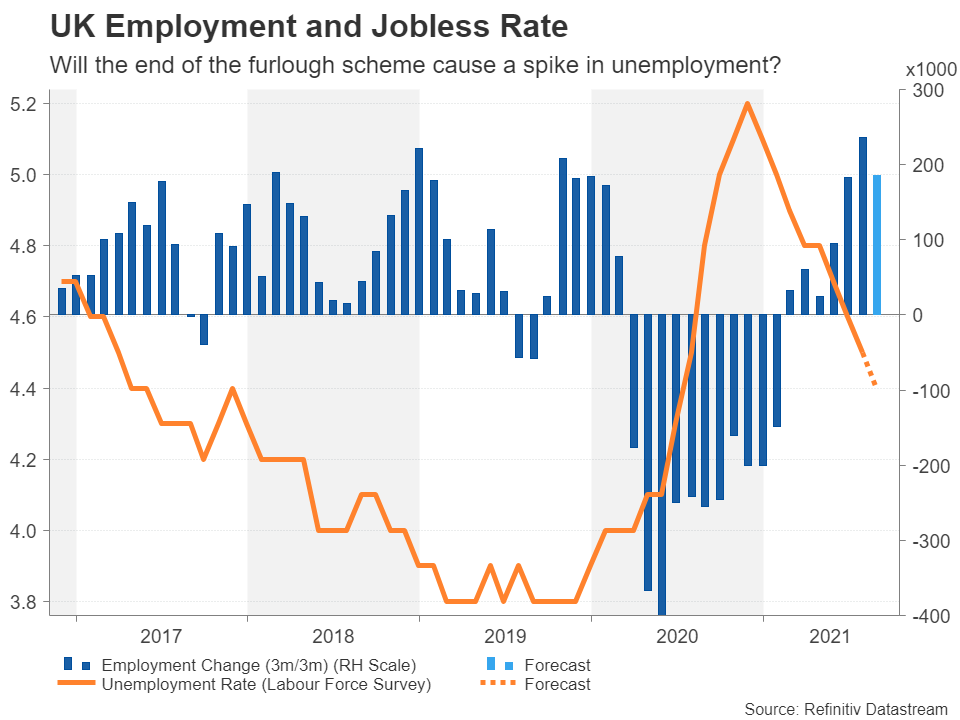
Despite the UK economy taking a bigger hit from the Covid shutdowns than most other advanced economies, the pandemic has barely left a mark on the labour market. Locked down workers have the government to thank for being able to hold on to their jobs as Chancellor Rishi Sunak’s furlough scheme was one of the most generous in the world. However, that lifeline for millions of Brits ended in September and Tuesday’s data will be the first indication as to whether businesses held on to those workers who were being subsidized by the government.
The three-month employment change is expected to see a rise of 185k in September, slowing somewhat from the 235k gain of the prior month. That should lower the unemployment rate down a tick to 4.4% to a new post-pandemic low. However, what investors will really be looking at is the October data for the change in the number of people claiming unemployment benefits as a spike in this figure would suggest there were big job losses from the furlough scheme coming to an end.
Is inflation about to skyrocket?
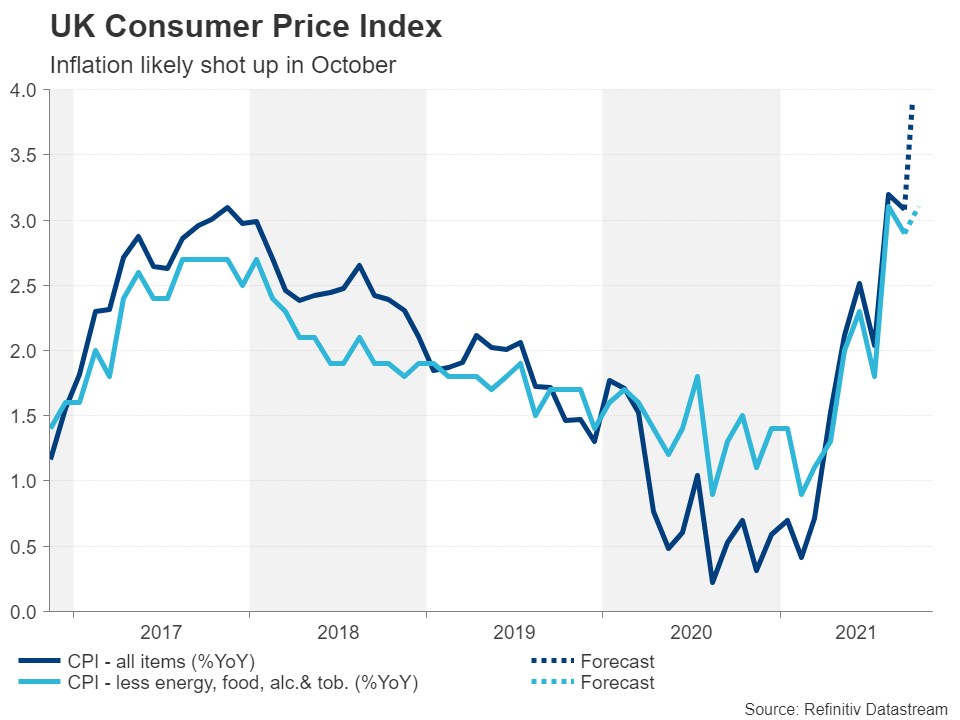
Average weekly earnings growth will also be eyed on Tuesday for possible signs that wage pressures are hotting up, though forecasts suggest they moderated in September. The big reveal on inflationary pressures will come from the latest CPI readings on Wednesday.
Britain’s consumer price index is expected to have jumped from 3.1% to 3.9% year-on-year in October. The core rate is projected to have climbed from 2.9% to 3.1% y/y. The Bank of England’s inflation target allows for the CPI rate to fluctuate within a one percentage point band above or below 2% so a number in the 4% vicinity would alarm the hawks at the BoE.
A strong recovery that could have been stronger
One of the concerns that investors have had ever since inflation started running wild and the BoE started to get edgy about it is whether the UK economy can withstand higher interest rates. Although, GDP has recovered strongly this year from the depths of the pandemic slump, the reopening effect wasn’t as powerful as many had hoped. More recently, fears that both business and household spending will be curtailed by the global supply-chain bottlenecks and the surge in energy prices have been weighing on the pound, offsetting some of the boost from rising rate hike speculation.
But consumption in the retail sector likely bounced back in October after several months of declines. Retail sales are forecast to have grown by 0.5% month-on-month, although the 12-month figure is expected to have stayed negative at -2.0%.
Battered pound hoping for data lift
Nevertheless, a positive trend in all three datasets could be enough to aid sterling’s rebound from 11-month lows against the US dollar as rate hike bets for December and February would be ramped up. The pair is currently trading below the immediate resistance of the 50% Fibonacci retracement of the September 2020-June 2021 uptrend at $1.3460. A break above this barrier could open the way for the 38.2% Fibonacci of $1.3646 just below the 50-day moving average (MA). However, reaching the 50-day MA would still leave cable some way off the descending trend line, which needs to be overcome if the bearish picture is to turn positive.
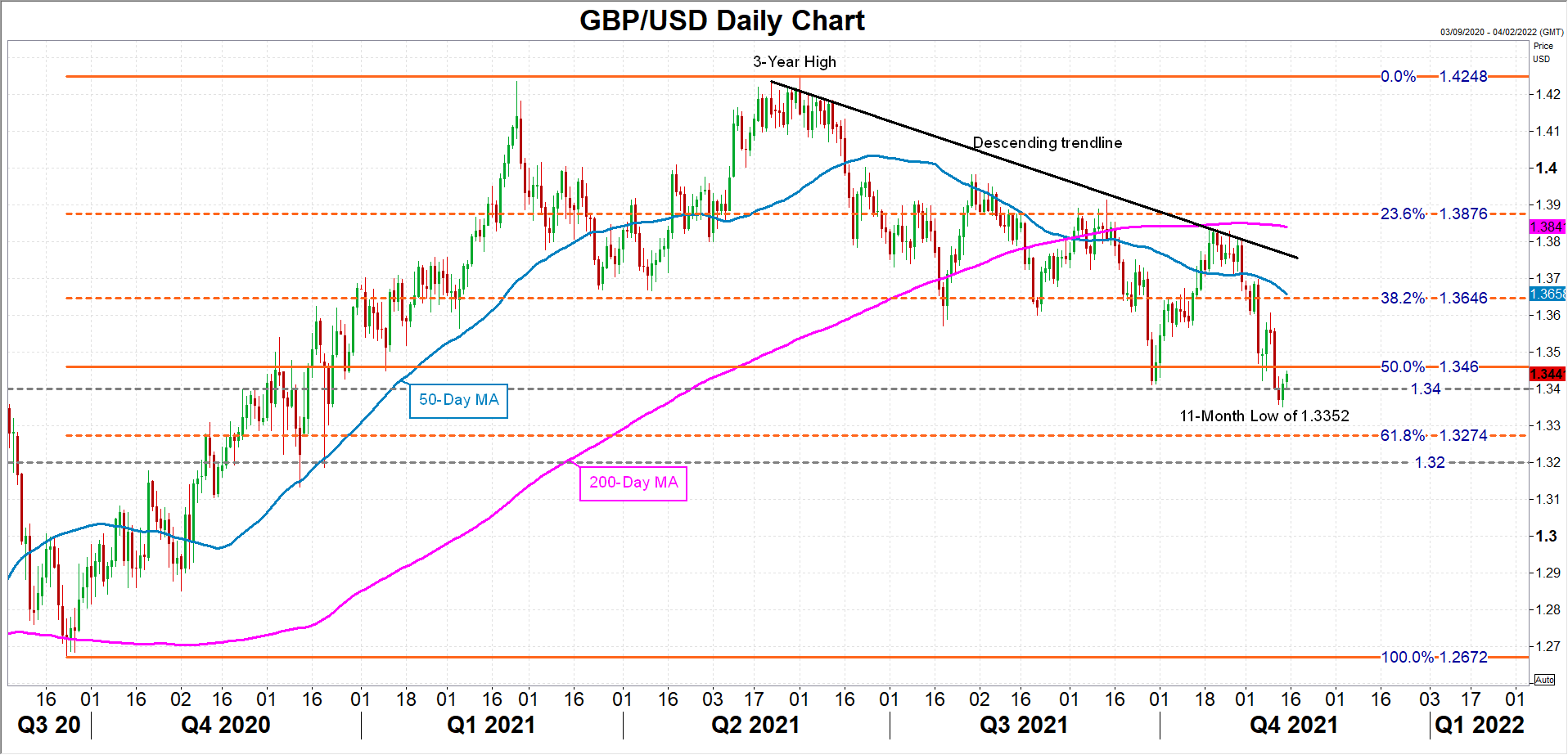
In the event that the data barrage disappoints and investors price in a reduced likelihood of an early move on rates by the Bank of England, sterling could plunge to fresh lows. If the recent trough of $1.3352 is breached, the 61.8% Fibonacci of $1.3274 would be the next major support, followed by the $1.32 level.
Canada’s Manufacturing Sales Tumble in September
Canada's manufacturing sales fell 3% (month/month) in September – a slightly smaller decline than Statistics Canada's flash estimate (-3.2%). The picture was more disappointing after accounting for price effects, with manufacturing shipment volumes down 4.2% on the month.
The decline in nominal sales spanned 12 of the 21 industries. However, it was once again, predominantly an auto sector story. Motor vehicle sales fell a whopping 35.6%. Sales were also weak in the primary metals (-6.3%), plastics and rubber (-3.6%), and chemicals (-1.8%) industries. Strong sales in the petroleum and coal products industry (+3%) provided some offset.
Inventories rose 1.3% on the month, lifting the inventory-to-sales ratio to 1.67 (from 1.60 in August). Forward looking indicators were mixed, with new orders down 3% and unfilled orders up 0.6%.
Key Implications
The ebb and flow of Canada's manufacturing sales continues to be dictated by lingering supply disruptions in the auto sector. September's sales plunge was particularly pronounced, leaving sales levels in the motor vehicles industry 60% below pre-pandemic levels and at their lowest since May of last year. The broad-based weakness across other industries in September's manufacturing report rubbed salt to the wound.
The near-term outlook for the manufacturing sector remains clouded. On the one hand, sentiment remains notably strong in Canada and the U.S., as evidenced by recent PMI releases. This optimism should be further corroborated by continued resilience in labour markets and consumer demand. Still, supply constraints are leaving their mark on the industry. These disruptions can take time to dissipate, and survey responses have suggested that they may last well into 2022.
Greenback Slips as Fed Tapering Starts
Fed tapering begins
According to the FOMC meeting of November 2-3, tapering will begin this week as planned. The New York Fed announced its modified bond-purchase schedule last week, confirming that tapering will start this month. Until June, the Federal Reserve intends to keep reducing its purchases by $15 billion each month. There is a possibility of a change in tapering speed, but the Fed has indicated that it will only do so if it is necessary. Futures for the Fed Funds rate are still pricing in a Q2 liftoff of roughly two-thirds, while Q3 is priced in completely. If economic indicators and inflation remain strong, the dollar's recent surge is expected to continue.
President Joe Biden and President Xi Jinping will hold their first virtual meeting tonight, amid heightened tensions between the superpowers on matters like the origins of Covid-19, human rights in Hong Kong and Xinjiang, and the future of Taiwan.
Lagarde’s rate hike commentary
President Lagarde indicated today that a rate hike in 2022 is "extremely doubtful" but added "I do not think I will venture into 2023.". She went on to say that over the medium run, inflation will fall below the 2% target level. While she plainly wants to keep all options open, Lagarde finds herself in a delicate balancing act as several other central banks have already begun to tighten monetary policy.
FX and commodities markets
The US dollar index is falling from the recent high of 95.42 and dollar/yen is diving below the 114.00 psychological number. The British pound hit a new low on Friday at $1.3352, while the euro is struggling to jump strongly higher from the 16-month low of $1.1461. US stock futures are returning to gains, suggesting a positive open again.
Commodity currencies are gaining some ground. The aussie is finding strong support at the $0.7300 level and the kiwi is approaching the $0.7100 number. Dollar/loonie is losing momentum after the climb at 1.2600.
WTI oil prices have dipped below $80/per barrel as traders awaited President Joe Biden's response to rising fuel prices. In the gold market, the price is flattening around today’s high of $1,867/per ounce.
Coronavirus updates
Unvaccinated persons in Austria will be put under mandatory quarantine starting today, the most extreme Western European response to the recent coronavirus pandemic. Last week, Europe had over 2 million cases, the largest in a single week since the pandemic began. After a record number of cases, the Netherlands and Latvia have both implemented new restrictions, while Germany is exploring new measures as a result of the unprecedented increase in infections.
CAD Rebounds, Investors Eye CPI
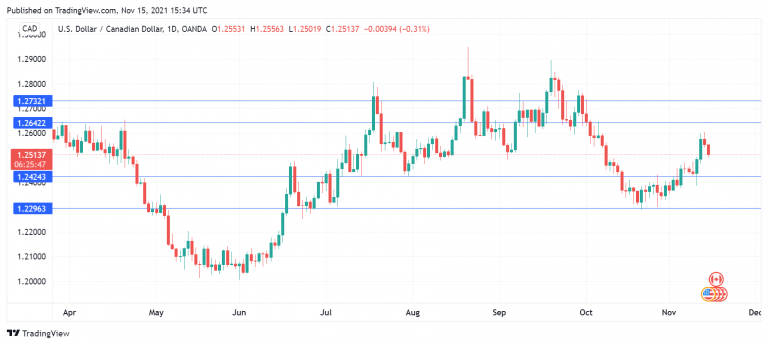
The Canadian dollar has started the new trading week in positive territory, extending the gains we saw on Friday. Currently, USD/CAD is trading at 1.2502, down 0.40% on the day.
In the US, inflation is surging, and the Fed’s message that inflation is transitory is looking more out of sync with the inflation data. October inflation numbers were red hot, with headline CPI rising to 6.2% y/y and CPI climbing to 4.6%, as both reads were the fastest pace seen since the early 1990s. A key question is how long can the Fed continue to ignore the inflation data and not take action.
The job numbers point to many unfilled openings as the demand for workers continues to outstrip supply. JOLT job openings remained high in September at 10.44 million, lower than the August read of 10.62 million but above the consensus of 10.30 million.
In addition to high inflation, inflation expectations have hit multi-year levels, climbing to 4.9% in October. Inflation expectations can translate into actual inflation and is another indication that inflation is not showing signs of cooling off anytime soon.
In Canada, Manufacturing Sales for September declined by 3.0%. Most of the decline was due to a decrease in sales of motor vehicles due to the shortage of semiconductor chips. This hampered production in Canadian auto assembly plants and the supply chain disruption will likely continue into 2022.
Canada will release CPI reports on Wednesday. As is the case in the US, inflation is soaring and has become a headache for the Bank of Canada. In September, headline inflation hit 4.4% y/y, its highest level since 2003. The BoC has signalled that it may raise rates around mid-2022, but the markets have priced in a hike for March of next year. If the CPI release beats expectations, the BoC will be under pressure to bring forward its timeline for a hike, which would give a boost to the Canadian dollar.
USD/CAD Technical
- There is support at 1.2423. Below, there is support at 1.2296
- There is resistance at 1.2641, followed by 1.2732
Sunset Market Commentary
Markets
Inflation remains ‘talk of the town’ after US prices last week were reported rising at the fastest pace in more than 30 years. Even if, as a central banker, you are convinced that most of this rise is temporary, this feels uncomfortable. A precautionary approach suggests that it would be safe to remove some of current extreme policy accommodation. That was exactly what markets concluded with higher US short-term rates and a flattening of the curve. At the same time, Friday’s consumer confidence showed inflation becoming the major obstacle for growth. Question is whether those consumers will be happy with (sharply) higher rates to address the erosion of their spending power. The dilemma for centrale bankers probably can’t be bigger. This week, the focus, at least in the US, will turn from inflation to growth. October US retail sales (tomorrow) are an interesting pointer. Today, the Empire manufacturing survey provided some comfort. The headline sentiment index jumped from 19.8 to 30.9. Price indices continue accelerating, but for now this hasn’t much further negative implications for output or employment. Still firms are becoming less optimistic on the expectations six months ahead. Yields rebounded modestly after the report. US yields hover between little changed (2-y) and +3.5 bps. Short-term yields (2-y at 0.51%) stay within reach of recent post-corona peak. Low real yields (10-y at -1.18 %) illustrates persistent uncertainty on growth and hamper sustained upside for LT yields. In Europe, yields initially declined modestly. In a hearing before the European Parliament, ECB’s Lagarde still didn’t see the need for any precautionary action on inflation and repeated that worn-out narrative that inflation will drop back below 2.0% as supply bottlenecks unwind. According to the ECB president any tightening ‘would begin having an impact at a time when inflation is actually returning to lower levels’. However, a Lagarde-driven decline in yields (if any) was reversed during the US session. European/German yields currently rise between 2.5 bps (2-5-y) and little changed (30 -y). Intra-EMU spreads tightening marginally (-2 bps Greece).
Changes in the major FX cross rates are limited, but investors see no reason to fight the protracted, by default accent of the USD. The DXY index is holding north of 95.00. EUR/USD is drifting further south in the 1.14 big figure (1.144) after breaking 1.1495 last week. USD/JPY is trading little changed near 114. Sterling shows a mixed picture. Cable (1.3425) trades slightly off last week’s low, but EUR/GBP (0.8525) eases back lower in the 0.85 big figure on broader euro softness. At the time of writing, BoE’s Bailey, Pill, Saunders and Mann are explaining monetary policy before the UK Parliament. Bailey repeats that labour market conditions are key.
News Headlines
Swedish inflation in October rose a faster-than-expected 0.2% m/m or 2.8% y/y. Headline inflation with a fixed interest rate (CPIF) sprinted higher as well to 3.1% y/y (3% expected), surpassing 3% for the first time since 2008. Core CPIF – the Riksbank’s preferred gauge – came in at 1.8%, beating a 1.6% consensus. Rising inflationary pressures mark a stark contrast with the Riksbank’s pledge of zero-policy rates until 2024 at least, arguing that the current price surge is largely transitory. The Riksbank holds a policy meeting on November 25. The inflationary pressures recently propelled short-term SEK interest rates as markets’ conviction of ever-low policy rates wanes. The 2y inches a few bps higher The krone gains marginally. EUR/SEK 10.00 is being tested.
According to officials familiar with the matter, the ECB is conducting PEPP with an operational ceiling of just under 50% of each country’s debt. It was already obvious that the central bank bought considerably more outstanding debt than the 33% maximum that applies for the ECB’s longer-standing APP but it was never disclosed what the actual cap is. The ceiling for supranational debt (eg. bonds issued by the EC) stands at 60% vs 50% in APP. The officials added that the info featured in a recent Governing Council presentation that examined how much buying space the ECB still has. This in turn was part of the buildup of important discussions the ECB will have in December on the future of its bond purchases when PEPP ends in March 2022.
EUR/AUD Mid-Day Outlook
Daily Pivots: (S1) 1.5569; (P) 1.5644; (R1) 1.5687; More...
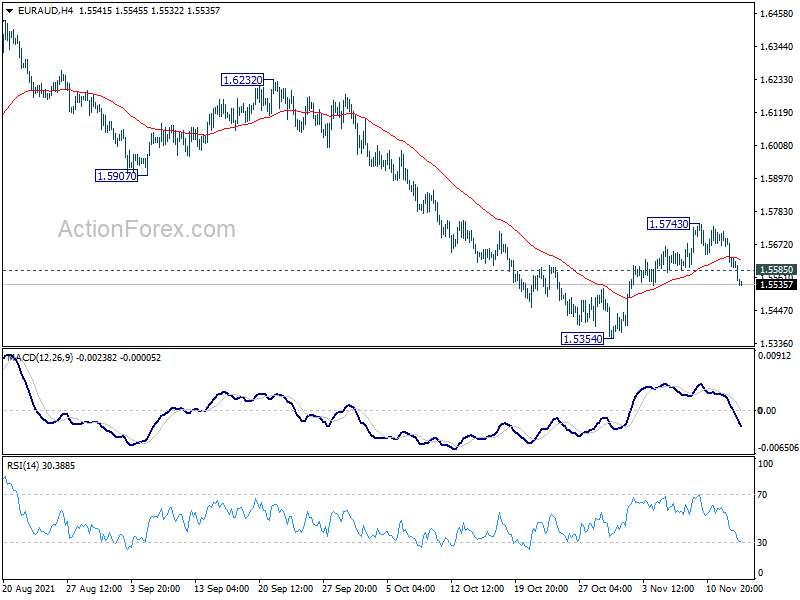
EUR/AUD's break of 1.5585 minor resistance suggests that recovery from 1.5354 is complete at 1.5743. Rejection by 55 day EMA also keeps near term outlook bearish. Intraday bias is back on the downside to extend the fall from 1.6434 through 1.5354 to 1.5250 low next. For now, near term outlook will remain bearish as long as 1.5743 resistance holds, in case of recovery.
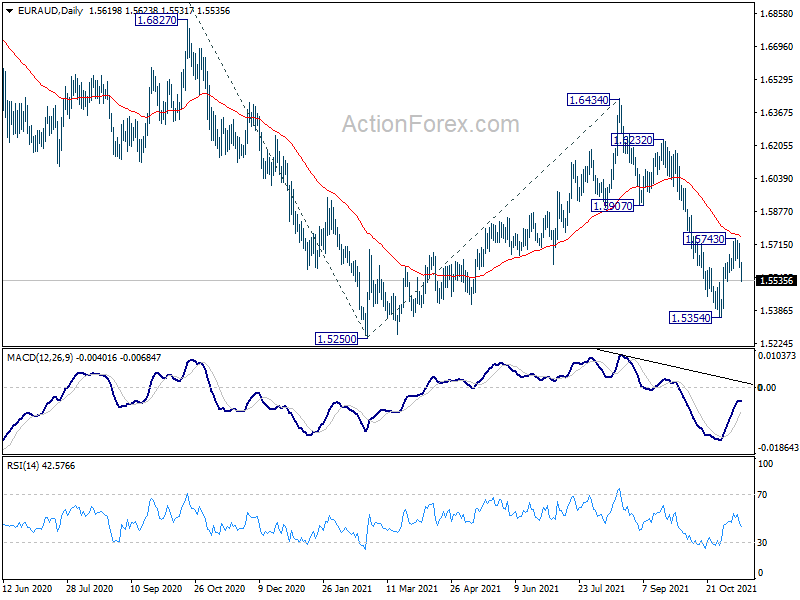
In the bigger picture, the down trend from 1.9799 (2020 high) is in progress. Firm break of 1.5250 low will confirm resumption and target 61.8% retracement of 1.1602 (2012 low) to 1.9799 at 1.4733. Sustained break there could bring more downside acceleration to 61.8% projection of 1.9799 to 1.5250 from 1.6434 at 1.3623. In any case, break of 1.6434 resistance is needed to signal medium term bottoming, or outlook will stay bearish.
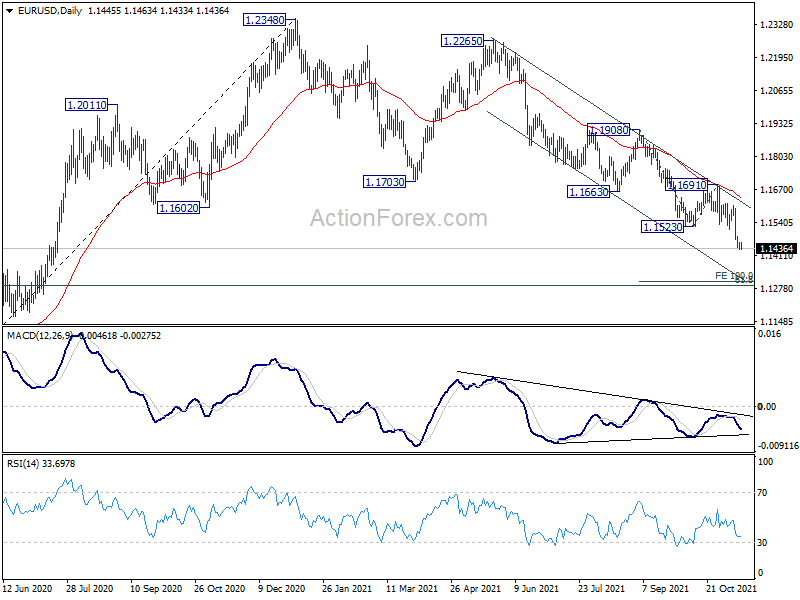
EUR/USD Mid-Day Outlook
Daily Pivots: (S1) 1.1431; (P) 1.1446; (R1) 1.1460; More...
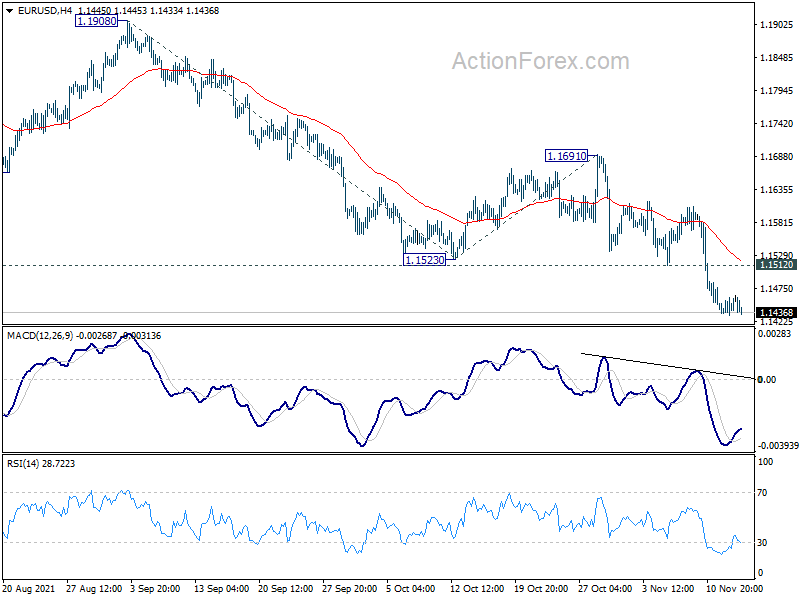
EUR/USD's decline is still in progress despite some loss of downside momentum. Intraday bias stays on the downside. Next target is 100% projection 1.1908 to 1.1523 from 1.1691 at 1.1306, which is close to long term fibonacci level at 1.1289. We'd pay attention to bottoming signal there. On the upside, above 1.1512 minor resistance will turn intraday bias neutral first. But overall near term outlook will stay bearish as long as 1.1691 resistance holds, even in case of strong rebound.
In the bigger picture, there are various ways of interpreting the fall from 1.2348 (2021 high). It could be a correction to rise from 1.0635 (2020 low), the fourth leg of a sideway pattern from 1.0339 (2017 low), or resuming long term down trend. In any case, outlook will now stay bearish as long as 1.1703 support turned resistance holds. Sustained break of 61.8% retracement of 1.0635 to 1.2348 at 1.1289 could pave the way back to 1.0635.
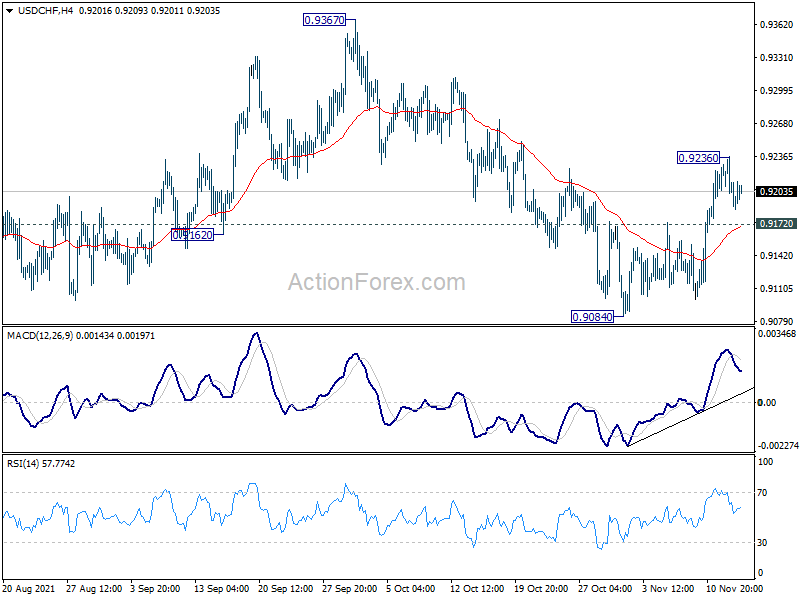
USD/CHF Mid-Day Outlook
Daily Pivots: (S1) 0.9197; (P) 0.9217; (R1) 0.9233; More....
Intraday bias in USD/CHF stays neutral for consolidation below 0.9236 temporary top. On the upside, break of 0.9236 will resume the rise from 0.9084 to 0.9367 resistance. On the downside, below 0.9172 minor support will turn intraday bias back to the downside for 0.9084 instead.
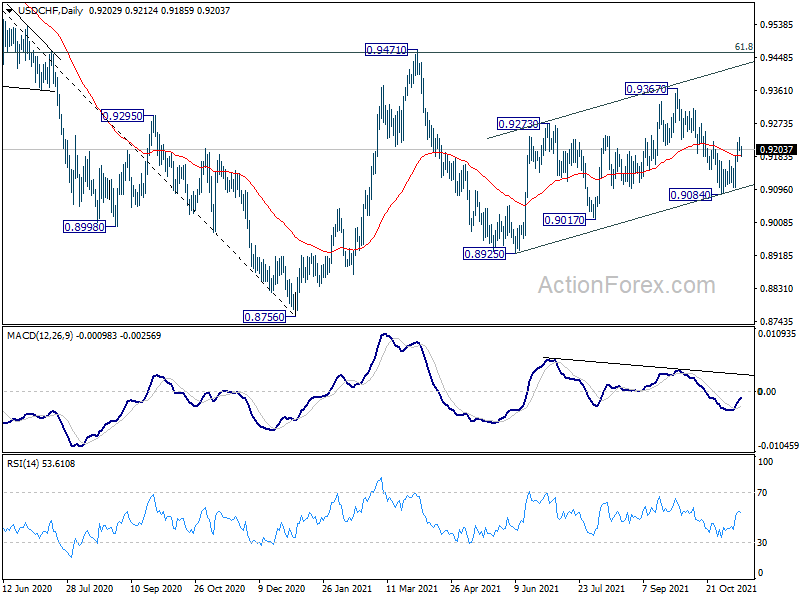
In the bigger picture, the corrective structure of the rebound from 0.8925 argues that fall from 0.9471 is not complete yet. It could either be the second leg of pattern from 0.8756 (2021 low), or resuming larger down trend from 1.0237 (2018 high). We'd pay attention to the downside momentum and assess the odds later. But for now, medium term outlook will be neutral at best as long as 0.9471 resistance holds.
USD/JPY Mid-Day Outlook
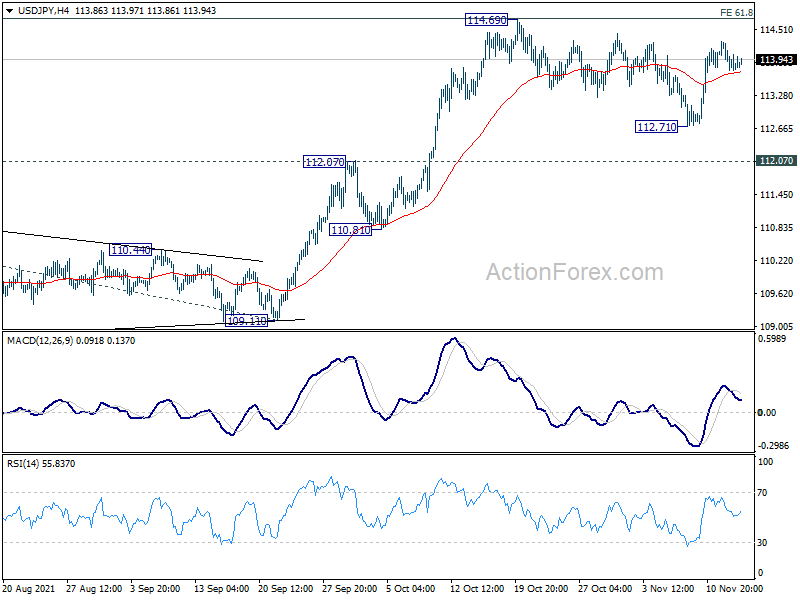
Daily Pivots: (S1) 113.69; (P) 114.00; (R1) 114.23; More...
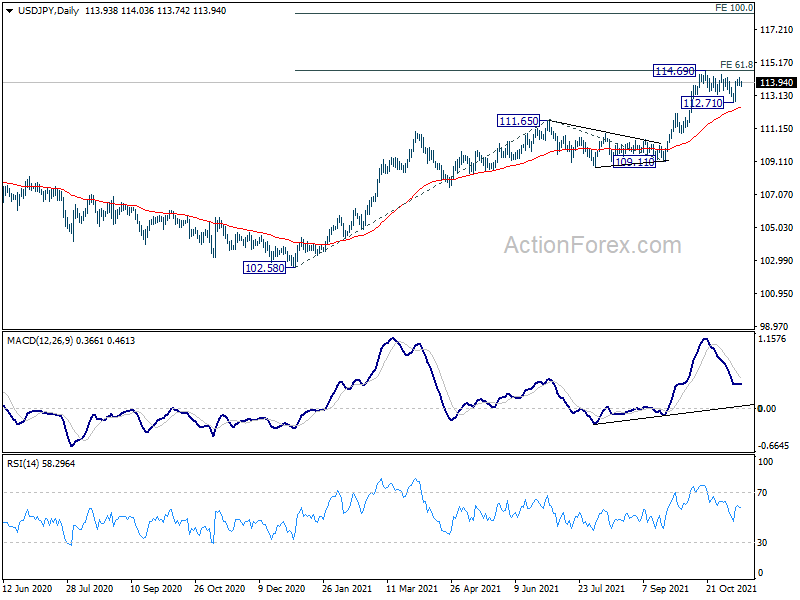
Intraday bias in USD/JPY remains neutral for the moment. On the upside, sustained break of 114.69 will resume larger up trend for 100% projection of 102.58 to 111.65 from 109.11 at 118.18 next. In case the consolidation pattern from 114.69 extends with another fall, we'd continue to expect downside to be contained above 112.07 resistance turned support to bring rebound.
In the bigger picture, corrective decline from 118.65 (2016 high) should have completed at 101.18 already. Rise from the 102.58 is seen as the third leg of the up trend from 101.18. Next target is 114.54 resistance and then 118.65 high. This will now be the preferred case as long as 109.11 support hold, even in case of deep pull back.