Sample Category Title
GBP/USD Reaches Above Resistance Zone
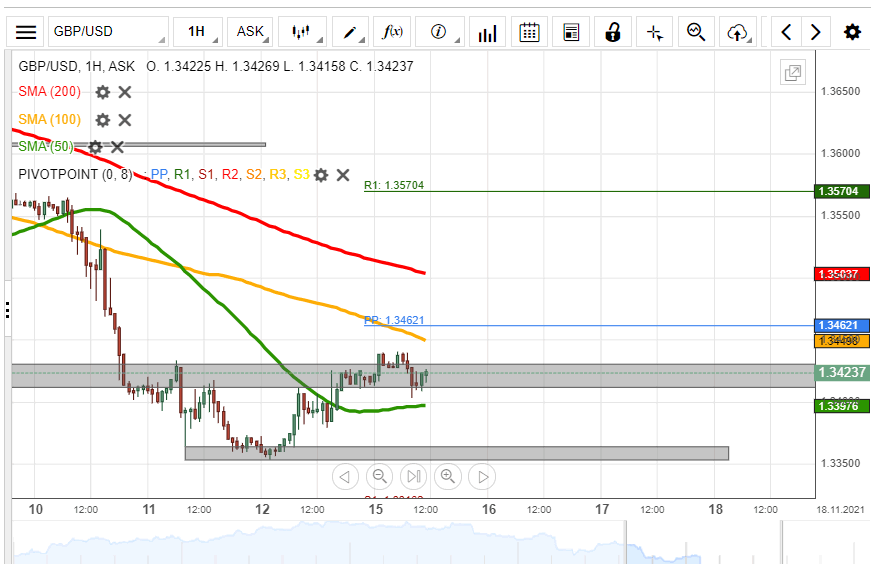
On Monday morning, the GBP/USD passed above the resistance of the 1.3410/1.3430 zone. However, a follow up surge did not occur. Instead, the pair started to trade in the zone. Meanwhile, support was being provided by the 50-hour SMA and the 1.3400 level. Resistance was provided by the 100-hour SMA at 1.3450 and the weekly simple pivot point at 1.3462.
If the GBP/USD passes below the support of the 50-hour SMA and the 1.3400 mark, a potential decline would look for support in the last week's low level zone at 1.3354/1.3365. Below the zone, note the weekly S1 simple pivot point at 1.3316.
However, a surge of the pair might test the levels at 1.3450/1.3462. Above this zone, the 200-hour SMA at 1.3504 and the 1.3500 mark would most likely provide resistance.
EUR/USD Trades Sideways
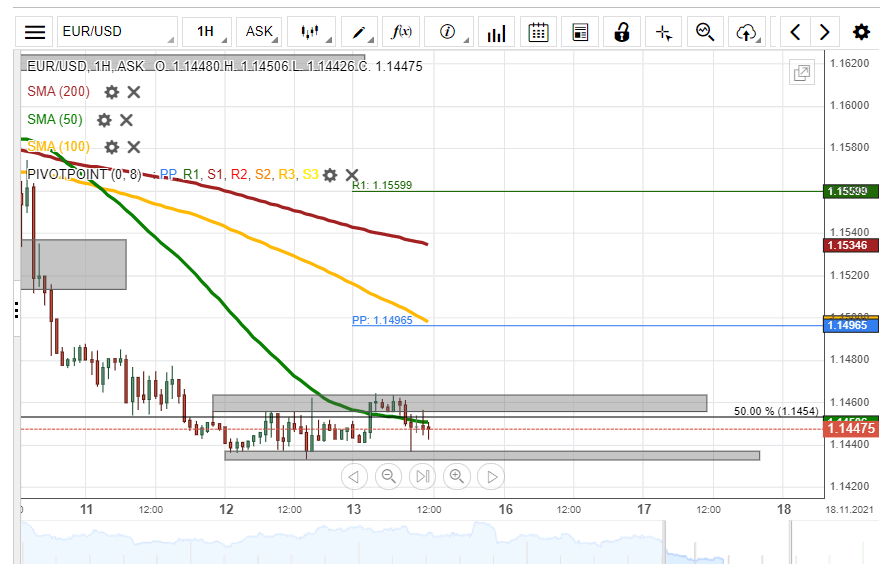
Since Friday, the EUR/USD has traded sideways. On Monday, the borders of the sideways trading range were marked on the chart. The rate keeps finding support at 1.1433/1.1437. Meanwhile, resistance is being provided by the 1.1456/1.1464 zone.
If the pair resumes its decline and passes the support of the 1.1433/1.1437 zone, the EUR/USD might look for support in the 1.1400 level. Below the 1.1400 mark, the weekly S1 simple pivot point at 1.1384 might stop a decline.
On the other hand, a passing of the resistance zone at 1.1456/1.1464 might result in the rate testing the resistance of the weekly simple pivot point at 1.1497, the 100-hour SMA at 1.1498 and the 1.1500 mark.
China’s Economic Outlook Remains Dismal Despite Some Recovery in October
The latest of data for October revealed fragility of China's economic recovery. Although growth of both industrial production and retail sales beat consensus, the momentum appears weak. Property developments would continued to be hampered by government's erratic change in policy and debt problems in the sector, hurting overall fixed asset investment in the months ahead.
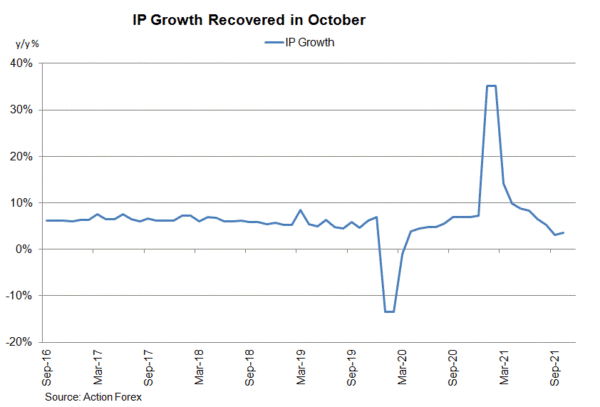
Industrial production grew +3.5% in October, accelerating from +3.1% a month ago. This also beat consensus of +3%. Improvement was seen in industries such as computers, utilities and food manufacturing while growth of pharmaceuticals production slowed.
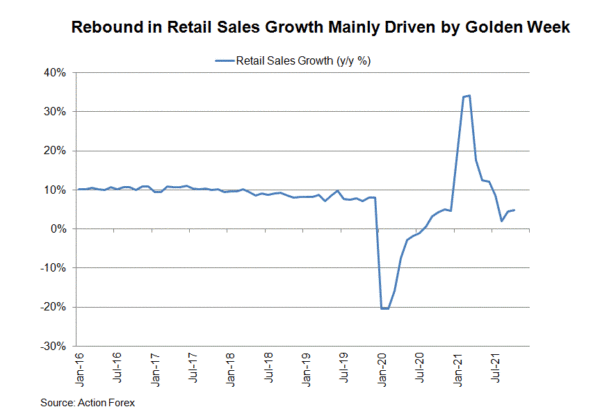
Retail sales expanded +4.9% y/y, beating consensus of +3.8% and September’s +4.4%. Stronger sales were driven by Golden Week holiday in the first week of the month. Resurgence in the pandemic, however, continued to hurt catering sales of which growth weakened further to +2% y/y , from +3.1% in September. Automobile sales among medium/large dealers declined -11.5% y/y in October, following a -11.8% contraction a month ago. Benefiting from restrictive measures, online sales growth accelerated to +10.3% y/y in October, up slightly from +10.1% in September.
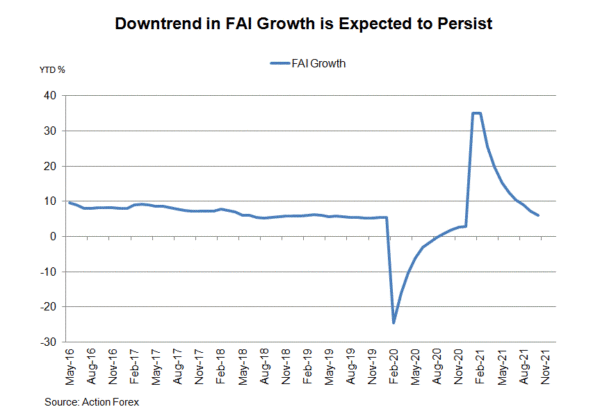
 Fixed asset investment grew +6.1% in the first 10 months of the year, slowing markedly from 7.3% in the first 3 quarters. The market had anticipated that growth eased to +6.2%. Breaking down into different categories, growth in manufacturing investment was 10.1% y/y in October, compared with +10.2 in September. Property investments, however, declined -5.6% y/y in October, worsening from -3.5% in the prior month. Infrastructure investments also contracted -2.4% y/y in October, after September’s -3.0% fall.
Economic Outlook
For the month ahead, the impact of the “double-11” festival on retail sales should be closely-watched. While consumption during the period has over the past years triggered a spike in November’s retail sales, this year might be different amidst government’s crackdown on the tech companies. Alibaba’s sales data shows that total gross merchandise volume (GMV) rose +8.5% y/y to US$ 84.5B in the first 11 days of the month. The growth nonetheless fell below the low end of consensus forecast of US$ 86B.
The headwind of fixed asset investment growth remains. Debt problems of China’s property sector appear to have spread from Evergrande to smaller players. Developers such as Sinic and Kaisa Group Holdings have recently announced they might default the interest payments. As the situation worsens, negative chain effects would haunt market confidence, property sales and property developments.
GBP/USD: Order Block Retest Pattern For Short Trade Continuation Towards M L5
GBP/USD technical analysis
- Bears are still in control.
- Order block retest underway.
- Ideally the rice should stay below 1.3453.
- The failure to hold resistance will retrace the price higher.
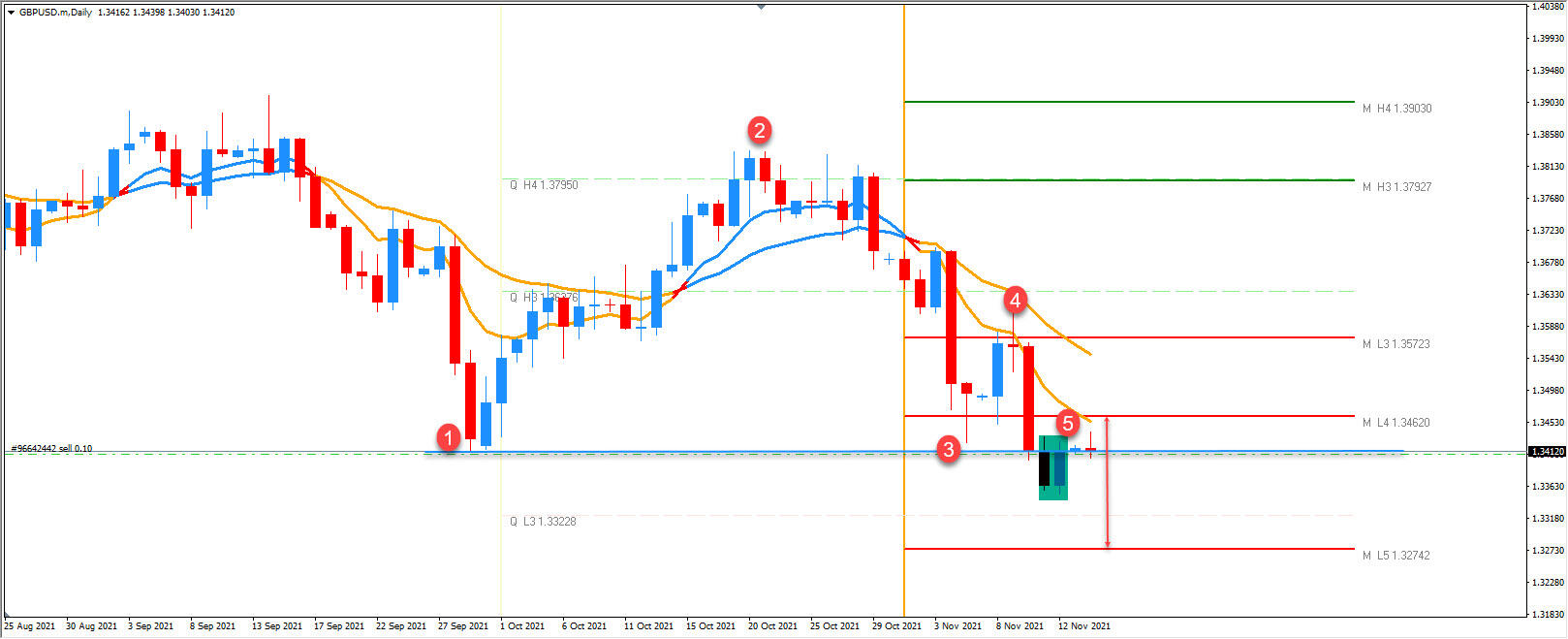
- Order block support.
- Double top.
- Swing low.
- Bearish rejection.
- Order block retest.
After a strong drop to the 1.3350 zone, Gold has found a consolidation area around the 1.3410 zone. The price is still bearish and bears are still in charge. However, for bearish momentum to persist, the price would ideally stay above 1.3453 which is the resistance zone close to M L4 camarilla pivot. At this point we can see that the price is trying to reject from the zone and the break and the daily close below 1.3400 will cue for more bearish momentum. Watch for continuation lower towards 1.3350 retest then 1.3322 and 1.3274.
ECB Lagarde Reiterates Stance That Conditions For A Rate Hike In 2022 Is Unlikely
Notes/Observations
- Focus on Biden-Xi virtual summit later on Monday.
- Emerging EU and Nordic inflation data continued its upward trajectory.
Asia
- China Oct Retail Sales beat expectations (YoY: 4.9% v 3.7%e).
- China Oct Industrial Production data beat expectations (YoY3.5% v 3.0%e).
- Japan Preliminary Q3 GDP missed expectations (Q/Q: -0.8% v -0.2%e; GDP Annualized QoQ: -3.0% v -0.7%e).
- China National Bureau of Stats (NBS) stated that more effort was needed to maintain economic stability, periodic structural problems still existed in the economy, consumer inflation to remain mild. Stagflation signs in Economy caused by short term factors.
- China PBcC conducted ¥1.0T in maturing 1-year Medium-Term Lending Facility (MLF).
- Japan Econ Min Yamagiwa reiterated its overall assessment that the domestic economy was continuing to pick up, but pace was weakening and needed policy support, economic stimulus would include measures to address.
Coronavirus
- Austria govt ordered a nationwide lockdown for unvaccinated people from Monday, Nov 15th.
Ameicas
- Treasury Sec Yellen reiterated that US inflation will not normalize until late 2022. Expected spikes in the prices of goods to abate by the second half of next year, if the pandemic is brought under control.
- Fed's Kashkari (dove, non-voter) stated that the Fed had taken appropriate steps in face of inflation. Saw higher inflation continuing over next few months and important not to overreact to temporary factors.
Energy
- Russian gas flows towards Germany via the Yamal Europe pipeline said to have risen over the weekend.
- Sen Maj Leader Schumer (D-NY) stated that President Biden must call to release oil reserves from SPR to lower gasoline prices.
Speakers/Fixed income/FX/Commodities/Erratum
Equities
- Indices [Stoxx600 +0.02% at 486.86, FTSE -0.02% at 7,346.48, DAX +0.10% at 16,110.15, CAC-40 +0.25% at 7,109.17, IBEX-35 -0.04% at 9,077.27, FTSE MIB +0.15% at 27,774.00, SMI -0.03% at 12,512.57, S&P 500 Futures +0.16%].
- Market Focal Points/Key Themes: European indices open with a slight generalized downward bias but later moved to trade generally mixed; sectors that are performing better include consumer discretionary and materials; financials industrials ;BBVA launches offer to take remaining stake in Garanti Bank; paragon sells it stake in Votabox; Heineken acquires Distell and Namibia Breweries; Raiffeisen sells its Bulgarian unit to KBC; Shell to simplify it’s share structure; Ahold Delhaize studying spin-off of Bol.com unit; corporate events expected in the upcoming US session include earngings from Warner Music and Ahold Delhaze’s investor day.
Equities
- Consumer discretionary: Cineworld Group [CINE.UK] +12% (trading update), Heineken [HEIA.NL] +1.5% (acquisitions).
- Financials: BBVA [BBVA.ES] -4% (bid for Turkish bank), KBC Group [KBC.BE] -2% (acquisition).
- Industrials: Airbus [AIR.FR] +3% (orders for jets).
Speakers
- ECB chief Lagarde testimony in EU Parliament reiterated view that expected inflation to moderate in 2022 but would will take longer to decline than originally expected; Saw medium-term inflation remaining below 2% target. Reiterated that conditions for a rate hike in 2022 in unlikely. Saw 2022 wage growth potentially rising above current year level but no signs of 2nd round effects. Growth momentum had moderated due to supply bottlenecks.
- BOE’s Haskel stated that Brexit added uncertainty to the UK and held back investments.
- Poland Central Bank (NBP) Gov Glapinski stated that a rate hike was more likely for now if incoming sets of data confirmed our current assessment. MPC to do all that’s necessary to keep stable prices in mid-term.
- Russia Central Bank (CBR) Gov Nabiullina testified that she was not sure if current inflationary pressures were temporary as supply chain disruptions were more serious than expected. Domestic economy had returned to pre-pandemic growth levels.
- Russia govt spokesperson Peskov stated that returning inflation to target was priority for Putin. Reiterated that Russia would not use the Nord Stream 2 to redirect flows from Belarus despite Belarus President Lukashenko threat to cut off gas transit to Europe.
- China Foreign Min spokesperson Zhao Lijian stated that the upcoming talks between Xi-Biden to involve candid exchange of views and explore ways for the two nations to get along.
- Japan govt draft on stimulus said to promote establishment of production bases for semiconductors, vaccines and medicine. To urge the govt and BOJ to share a strong sense of urgency while maintaining an appropriate mix of monetary and fiscal policies.
- Saudi Oil Min Abdulaziz stated that was not part of his job to be concerned over any US SPR release. OPEC+ was fulfilling its duties to the oil market. Oil market was not responsible for energy shortages and noted that oil inventories would build from December.
- UAE Energy Min Al Mazrouei stated that oil market to be more balanced in 2022.
- US President Biden said to plan to tell China President Xi at the virtual summit that China must play by the rules of the road; Talks expected to last several hours.
Currencies/Fixed Income
- USD drifted from 16-month highs in a quiet EU session on Monday. Recent greenback strength was aided by US inflation data which fueled speculation that the Fed might have to move faster and more aggressively on rates.
- EUR/USD steady at 1.1450 with focus on ECB’s Lagarde upcoming testimony in EU Parliament. She was likely to further resist the market's rate hike pricing in her testimony. Dealers note that the pair can test 1.10 on technical factors in the coming months with bets the Fed would be ahead of other major central banks on tightening.
Economic data
- (FI) Finland Oct CPI M/M: 0.8% v 0.3% prior; Y/Y: 3.2% v 2.5% prior.
- (FI) Finland Sept Final Retail Sales Volume Y/Y: 2.7% v 0.6% prelim.
- (IN) India Oct Wholesale Prices (WPI) Y/Y: 12.5% v 11.1%e.
- (DK) Denmark Oct PPI M/M: 1.6% v 5.1% prior; Y/Y: 22.4% v 19.0% prior.
- (DK) Denmark Q3 GDP Indicator Q/Q: 2.0% v 2.2% prior.
- (NO) Norway Oct Trade Balance (NOK): 84.5B v 52.6B prior (record high surplus).
- (ES) Spain Sept House transactions Y/Y: 40.6% v 57.9% prior.
- (TR) Turkey Oct Central Gov't Budget Balance (TRY): -17.4B v -23.6B prior.
- (SE) Sweden Oct CPI M/M: 0.2% v 0.0%e; Y/Y: 2.8% v 2.7%e (3rd month with annual pace above target); CPI Level: 346.44 v 345.84e.
- (SE) Sweden Oct CPIF M/M: 0.2% v 0.0%e; Y/Y: 3.1% v 3.0%e.
- (SE) Sweden Oct CPIF (ex-energy) M/M: 0.4% v 0.2%e; Y/Y: 1.8% v 1.6%e.
- (CH) Swiss weekly Total Sight Deposits (CHF): 719.2B v 719.4B prior; Domestic Sight Deposits: 644.1B v 643.7B prior.
- (CZ) Czech Sept Current Account (CZK): -10.0B v -22.7Be.
- (PL) Poland Oct Final CPI M/M: 1.1% v 1.0% prelim; Y/Y: 6.8% v 6.8% prelim (confirmed 7th month above target and highest since 2001).
- (IT) Italy Sept General Government Debt: €2.706T v €2.734T prior (moves off record highs).
- (EU) Euro Zone Sept Trade Balance (seasonally adj): €6.1B v €11.5Be; Trade Balance NSA (unadj): €7.3B v €4.8B prior.
Fixed income Issuance
- None seen.
Looking Ahead
- (NG) Nigeria Oct CPI Y/Y: 16.2%e v 16.6% prior.
- (PE) Peru Sept Economic Activity Index (Monthly GDP) Y/Y: No est v 11.8% prior.
- (SK) Slovakia Debt Agency (Adral) to sell 2024, 2030 and 2036 bonds.
- 05:25 (EU) Daily ECB Liquidity Stats.
- 05:30 (DE) Germany to sell combined €6.0B in 6-month and 12-month BuBills.
- 05:30 (NL) Netherlands Debt Agency (DSTA) to sell €2.0-4.0B in 3-month and 6-month bills.
- 06:00 (IE) Ireland Sept Trade Balance: No est v €5.7B prior.
- 06:00 (IE) Ireland Sept Property Prices M/M: No est v 2.2% prior; Y/Y: No est v 10.9% prior.
- 06:00 (IL) Israel Oct Unemployment Rate: No est v 5.2% prior; Unemployment Rate (including Covid Effect): No est v 7.9% prior.
- 06:00 (RO) Romania to sell 3.5% Nov 2025 Bonds.
- 06:00 (IL) Israel to sell bonds.
- 06:30 (IN) India Oct Trade Balance: -$19.9Be v -$22.6B prior; Exports Y/Y: No est v 22.6% prior; Imports Y/Y: No est v 84.8% prior.
- 06:30 (IS) Iceland to sell 3-month and 6-month Bills.
- 06:45 (US) Daily Libor Fixing.
- 07:00 (IN) India announces details of upcoming bond sale (held on Fridays).
- 08:00 (PL) Poland Sept Current Account Balance: -€1.3Be v -€1.7B prior; Trade Balance: -€0.5Be v -€1.4B prior; Exports: €24.4Be v €21.8B prior; Imports: €25.0Be v €23.2B prior.
- 08:00 (UK) Daily Baltic Dry Bulk Index.
- 08:00 (ES) Spain Debt Agency (Tesoro) announces size of upcoming auctions.
- 08:30 (US) Nov Empire Manufacturing: 22.0e v 19.8 prior.
- 08:30 (CA) Sept Manufacturing Sales M/M: -3.1%e v 0.5% prior; Wholesale Trade Sales M/M: 1.1%e v 0.3% prior.
- 08:30 (UR) Ukraine Q3 Preliminary GDP Q/Q: No est v -0.7% prior; Y/Y: 3.6%e v 5.7% prior.
- 09:00 (FR) France Debt Agency (AFT) to sell €5.0-6.2B in 3-month, 6-month and 12-month bills.
- 09:00 (CA) Canada Oct Existing Home Sales M/M: No est v 0.9% prior.
- 09:45 (UK) BOE to buy £1.47B in APF Gilt purchase operation (3-7 years).
- 11:30 (IL) Israel Oct CPI M/M: 0.4%e v 0.2% prior; Y/Y: 2.6%e v 2.5% prior.
- 11:30 (US) Treasury to sell 13-Week and 26-Week Bills.
- 17:30 (AU) Australia ANZ Roy Morgan Weekly Consumer Confidence Index: No est v 109.0 prior.
- 19:30 (AU) RBA Nov Minutes.
- 21:30 (AU) RBA Gov Lowe speech at ABE Webinar.
- 22:00 (TH) Thailand Central bank to sell THB50B in 3-month bills.
- 22:30 (HK) Hong Kong to sell 3-month and 6-month Bills.
- 22:35 (JP) Japan to sell 5-year JGB bonds.
- 23:30 (JP) Japan Sept Tertiary Industry Index M/M: +0.8%e v -1.7% prior.
ECB Lagarde: Conditions for rate hike very unlikely to be satisfied next year
In a European Parliament committee hearing, ECB President Christine Lagarde said, "growth momentum is moderating to some extent owing to supply bottlenecks and the rise in energy prices." Consumer spending is "solid", but shortages of materials, equipment and labour are "weighing on manufacturing production, weakening the near-term outlook." "Although the duration of supply constraints is uncertain, they are likely to persist for several months and gradually ease only during 2022," she added.
Lagarde also reiterated that the upswing in inflation is driven by three primary forces, energy prices, demand outpacing constrained supply, and reversal effect of German VAT cut. "The latter factor will fall out of the inflation calculation from January 2022 but the other two may last longer." "As a result, we still see inflation moderating in the next year, but it will take longer to decline than originally expected," she said.
On monetary policy, she said the conditions for rate hike are "very unlikely to be satisfied next year". Intentions on further calibration of bond purchases will be announced in December. But "even after the expected end of the pandemic emergency, it will still be important that monetary policy – including the appropriate calibration of asset purchases – supports the recovery throughout the euro area and the sustainable return of inflation to our target of two per cent."
US Retail Sales Could Refuel The Dollar’s Rally
The dollar sliced through its rivals last week as inflation fired up, raising bets that the Fed will be forced to normalize at a faster clip. Markets are now split on whether the central bank will raise rates twice or three times next year, so the upcoming retail sales at 13:30 GMT Tuesday could be crucial. A solid report could tip the scales towards three hikes and give the dollar more fuel.
Inflation soars, dollar roars
With US inflation reaching its fastest pace in three decades, investors are betting that Fed officials will have to hit the normalization button sooner. The transitory narrative is slowly melting away, with even the Fed admitting this episode will probably last longer than expected.
Of course, price pressures are likely to cool next year as the supply disruptions start easing and more energy production comes online. The real question is, will inflation decline towards the Fed's 2% goal, or will the American consumer and powerful government spending prevent that from happening?
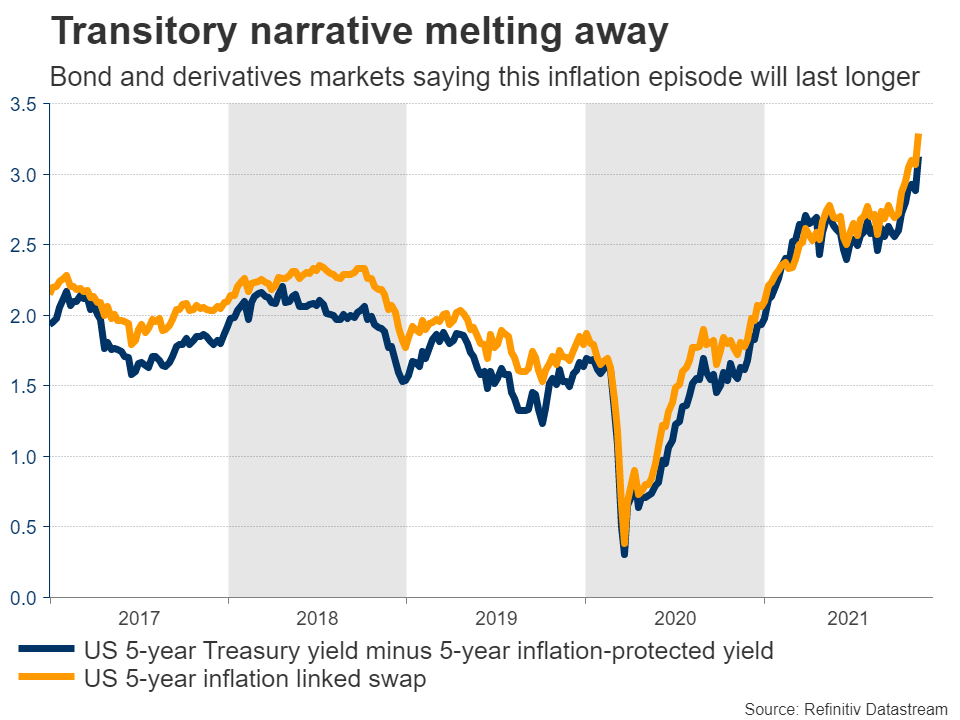
An inflation rate of 3% would be a massive slowdown from current levels, but still far higher than the central bank is comfortable with. If that's the case, the Fed may have to step on the brakes with force, raising interest rates faster. Markets are currently pricing in two rate hikes for next year and equal odds for a third one.
Early shopping?
There is a strong expectation in market circles that consumers will start their holiday shopping earlier this year, with supply disruptions and delivery delays everywhere. This could pull forward some demand from the November/December period towards October, artificially boosting the upcoming numbers.
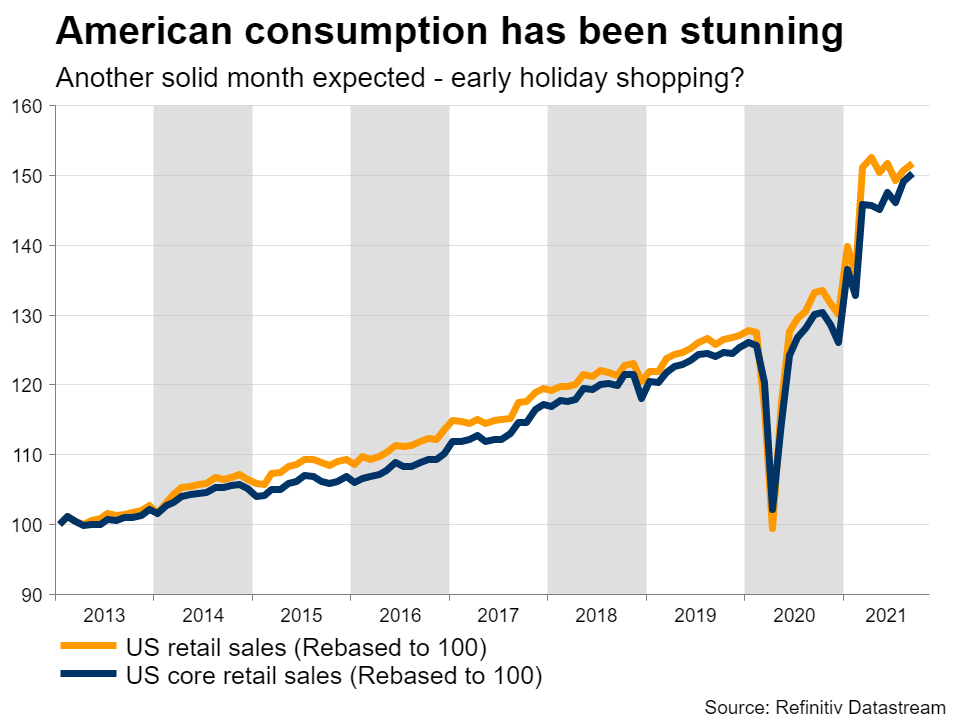
Forecasts suggest US retail sales rose by 1.1% in October, faster than the 0.7% increase in September. Expectations are similar for the retail control group, which excludes several volatile items and is used in GDP calculations. Credit card spending data from JPMorgan Chase also point to a solid month for consumption.
Dollar reigns supreme
Overall, the outlook for the dollar remains quite bright. The American economy is just stronger than most of its competitors. Consumption is booming, lost jobs are coming back quickly, inflation is scorching hot, wage growth is firing up, and business surveys point to a strong spell of growth ahead. Best of all, Congress is bringing even more spending online. 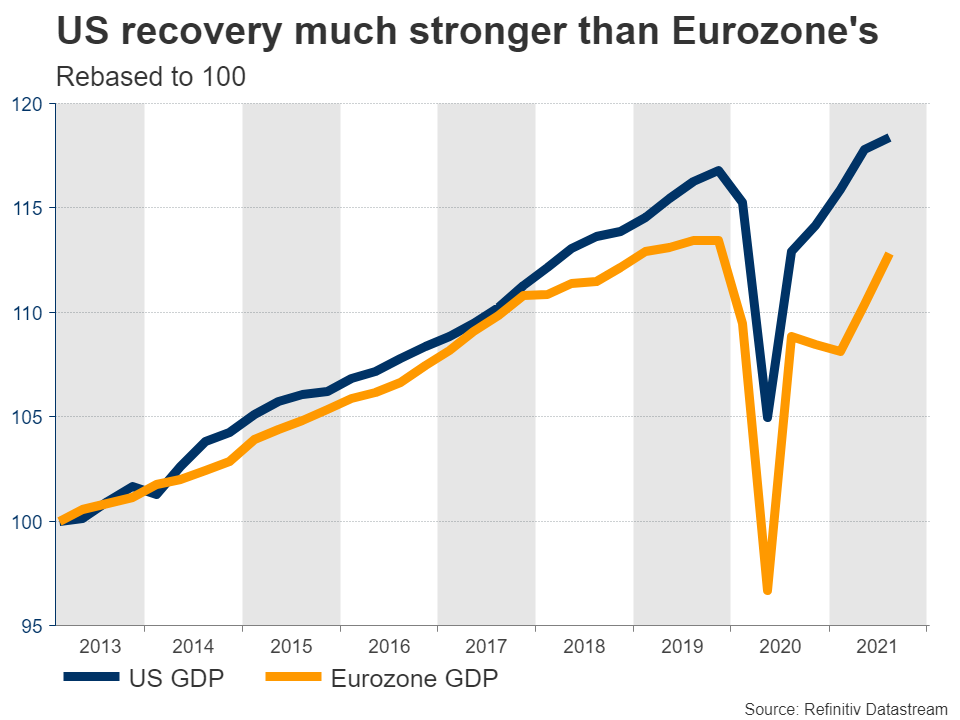
The other side of this coin is the euro, which is still grappling with several risks that threaten growth. Covid cases have skyrocketed again, resulting in the Netherlands imposing a partial lockdown last week. Austria and Germany could follow soon. Then there's the spiral in energy prices squeezing consumers, and China's slowdown spelling bad news for European exports.
Taken together, these imply that the European Central Bank could disappoint market expectations for a minor rate increase next year, while there is still scope for a third Fed rate hike to be priced in. Therefore, the risks surrounding euro/dollar seem tilted to the downside.
Taking a technical look at the pair, a strong retail sales report could see the bears pierce below the recent low of 1.1430 and potentially target the 1.1370 zone next.
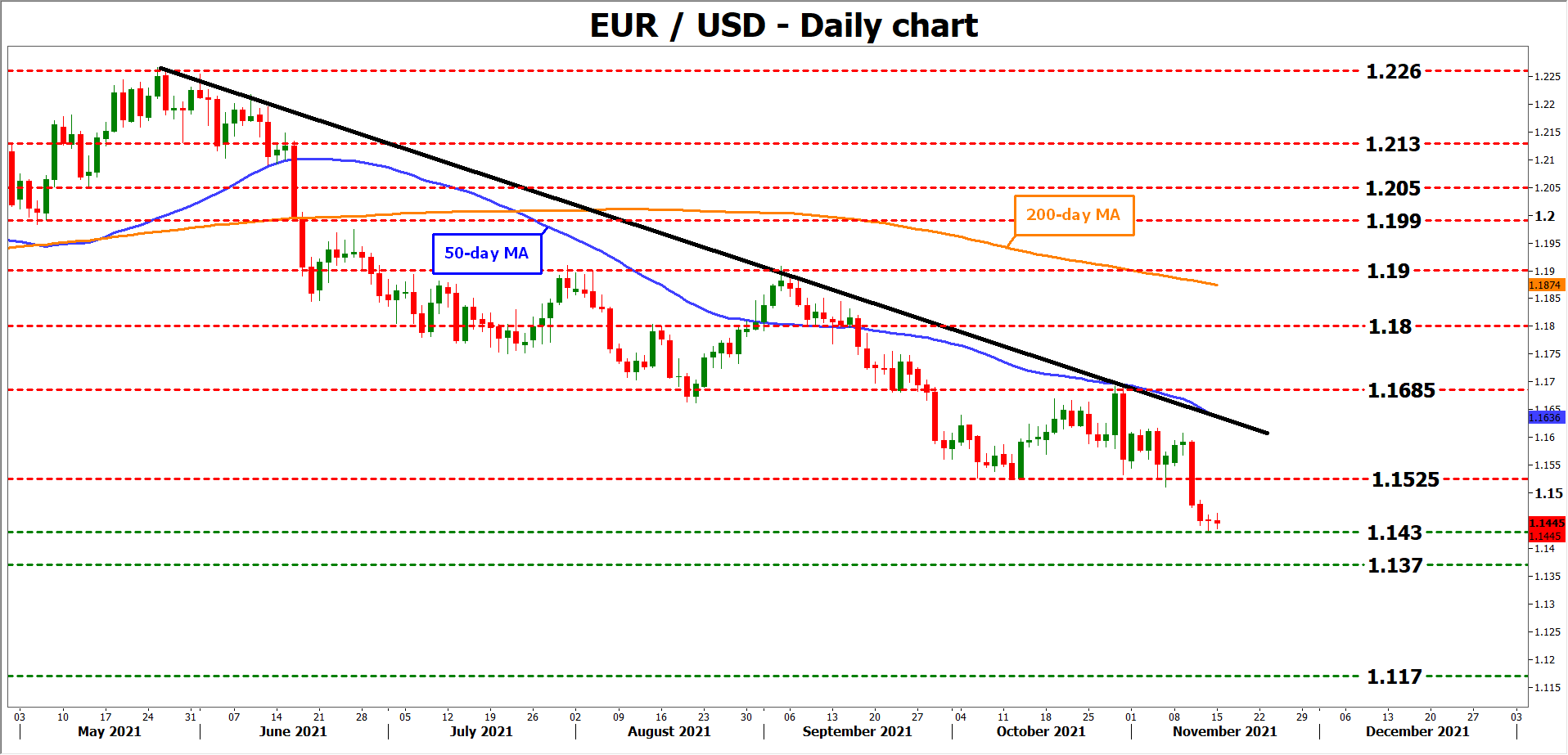
On the flipside, a disappointment in the upcoming data might spark a relief rally. In this case, the 1.1525 region could provide initial resistance, ahead of the 50-day moving average currently at 1.1636 and the downtrend line.
Beyond macroeconomics factors, let's not forget that the dollar also offers protection against drawdowns in stock markets, which may prove useful in this environment.
USD/CAD Declines Below Support Levels
The USD/CAD currency exchange rate ended its sideways trading on Friday noon. By the middle of Monday's trading, the pair had passed below the support zone at 1.2570/1.2575 and the 50-hour simple moving average near 1.2555. Next target for the decline was the weekly simple pivot point at the 1.2512 level.
In the case that the rate finds enough support in the weekly simple pivot point at 1.2512, a recovery would occur. A potential recovery would aim at the resistance of the 1.2570/1.2575 zone and the 50-hour simple moving average, which was located near the zone. Further above, the 1.2600 mark might keep the USD/CAD down.
A move below the pivot point would most likely almost immediately find support in the 1.2500 level and the zone that surrounds it. Below the 1.2500 mark, the rate could find support in the 200-hour simple moving average near 1.2475.
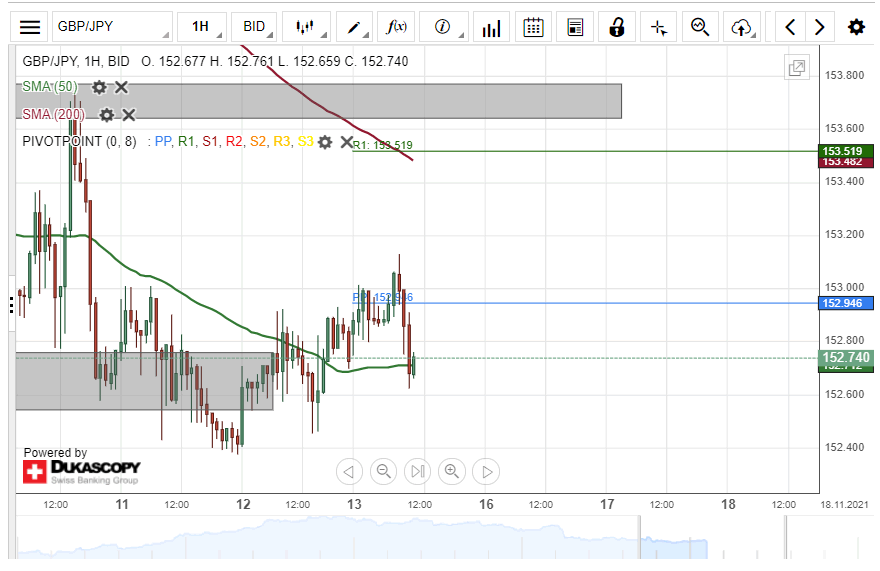
GBP/JPY Reaches Above 153.00
On Monday morning, the GBP/JPY currency exchange rate reached above the 153.00 level. The 153.00 mark provided resistance on Thursday and reversed the rate's recovery by causing a drop to the 152.40 level. Meanwhile, the pair was finding support in the 50-hour simple moving average at 152.70.
If the pair surges, it would reach for the 153.50 mark. Note that the 153.50 level's resistance is being strengthened by the 200-hour simple moving average at 153.50 and the weekly R1 simple pivot point at 153.52.
On the other hand, a decline below the 50-hour simple moving average could reach the 152.40 level, which provided support on Thursday. Below the 152.40 level, there is a support zone at 152.05/152.18. In addition, the support of the weekly S1 simple pivot point was located at 152.16.
AUD/USD Breaks Pattern
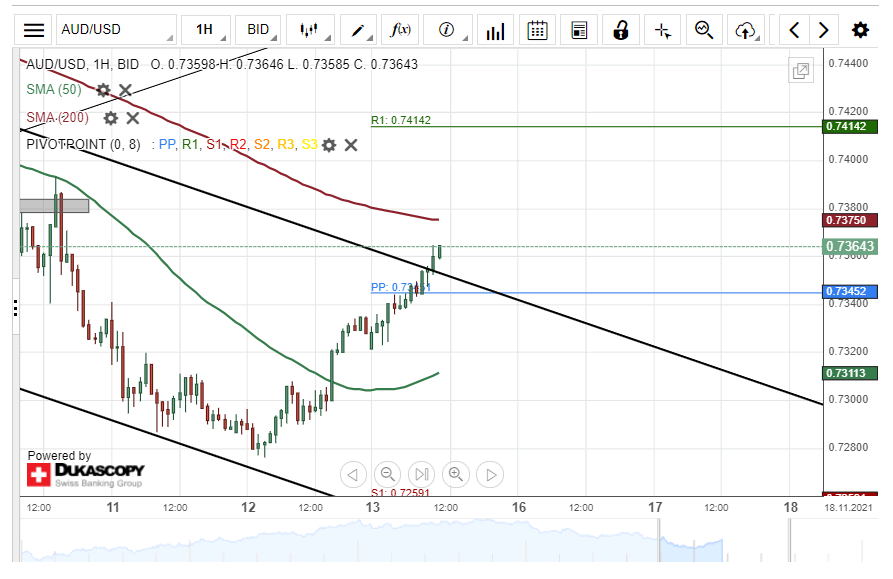
On Monday morning, the AUD/USD currency exchange rate broke the resistance line of the channel down pattern, which had guided the rate since the start of November. A potential target for the following morning surge was the 200-hour simple moving average at 0.7375.
A passing above the resistance of the 200-hour simple moving average at 0.7375 could result in a move to the 0.7400 mark. Above the 0.7400 level, the weekly R1 simple pivot point at 0.7414 might provide resistance.
On the other hand, if the 200-hour SMA pushes the rate down, the AUD/USD might look for support in the weekly simple pivot point at 0.7345. Below the pivot point, note the 50-hour SMA at 0.7310.