Sample Category Title
GBP/USD Mid-Day Outlook
Daily Pivots: (S1) 1.3370; (P) 1.3398; (R1) 1.3442; More...
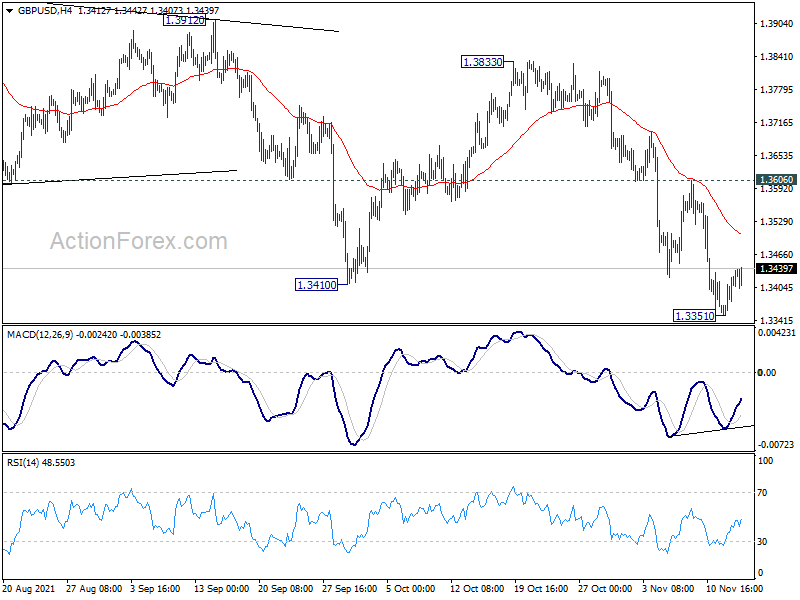
GBP/USD is staying in consolidation from 1.3351 temporary low and intraday bias remains neutral first. We'd continue to expect upside of recovery to be limited below 1.3606 resistance, to bring down trend resumption. On the downside, break of 1.3351 will extend the decline from 1.4248 to 1.3164 fibonacci level next.
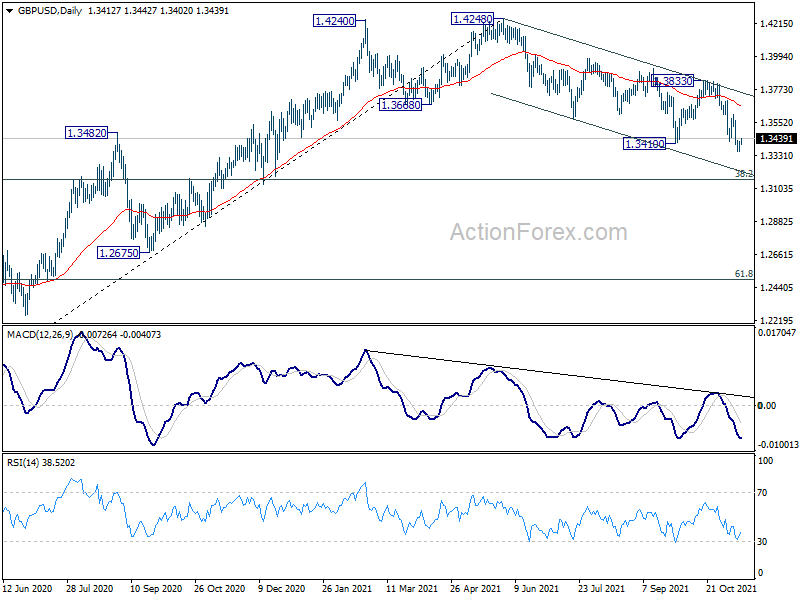
In the bigger picture, the structure of the fall from 1.4248 suggests that it's a correction to the up trend from 1.1409 (2020 low) only. While deeper fall cannot be ruled out yet, downside should be contained by 38.2% retracement of 1.1409 to 1.4248 at 1.3164, at least on first attempt, to bring rebound. On the upside, firm break of 1.4376 key resistance (2018 high) will add to the case of long term bullish reversal. However, sustained trading below 1.3164 will revive some medium term bearishness and target 61.8% retracement at 1.2493.
Aussie Jumps With Risk Appetite, Dollar Continues to Retreat
Australian Dollar leads other commodity currencies higher today, as supported by solid risk appetite. US futures indicate a much higher open and extended rally could push major indices to new record highs later this week. Dollar and Euro are currently the weakest ones for the day, followed by Yen. Sterling and Swiss Franc are mixed. In other markets, gold is trying to extend near term rally but upside momentum is weak. WTI crude oil is still defending 80 handle.
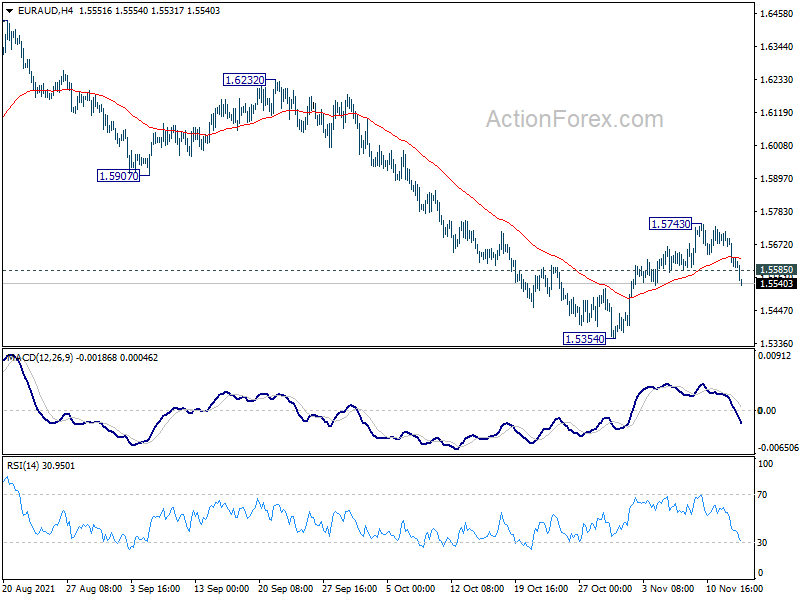
Technically, EUR/AUD's break of 1.5585 minor support suggests that rebound from 1.5354 is complete at 1.5743. Deeper fall would be seen back to 1.5354 low. When that happens, we'll see if it's accompanied by break of 0.7431 minor resistance in AUD/USD, or deeper down trend extension in EUR/USD. The latter case is favored.
In Europe, at the time of writing, FTSE is down -0.04%. DAX is up 0.31%. CAC is up 0.31%. Germany 10-year yield is up 0.0070 at -0.250. Earlier in Asia, Nikkei rose 0.56%. Hong Kong HSI rose 0.25%. China Shanghai SSE dropped -0.16%. Singapore Strait Times rose 0.38%. Japan 10-year JGB yield dropped -0.0078 to 0.068.
US Empire State manufacturing rose to 30.9, employees and price paid surged
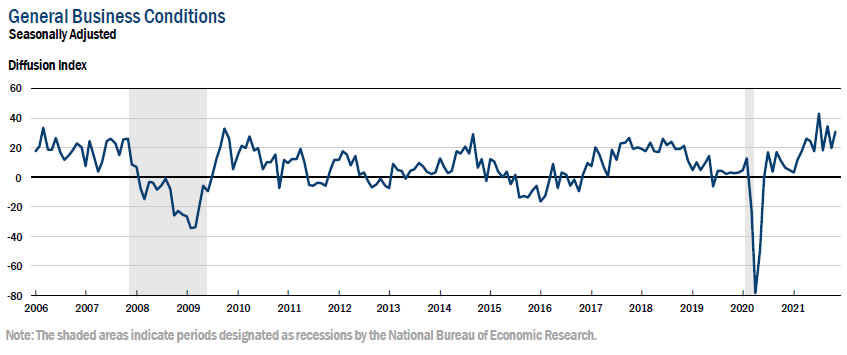
US Empire State Manufacturing Survey general business conditions jumped to 30.9 in November, up from 19.8, above expectation of 20.2. 43% of respondents reported improved conditions while 12% reported worsened conditions.
New orders rose 5 pts to 28.8. Shipment jumped 19 pts to 28.2. Delivery times dropped -5.8 to 38.0. Number of employees jumped 9 pts to 26.0, a record high. Average workweek also jumped 8 pts to 23.1. Price paid rose 4 pts to 83.0. Price paid rose 7 pts to 50.8, a record high.
From Canada, manufacturing sales dropped -3.0% mom in September, matched expectations. Wholesale sales rose 1.0% mom, below expectation of 1.1% mom.
ECB Lagarde: Conditions for rate hike very unlikely to be satisfied next year
In a European Parliament committee hearing, ECB President Christine Lagarde said, "growth momentum is moderating to some extent owing to supply bottlenecks and the rise in energy prices." Consumer spending is "solid", but shortages of materials, equipment and labour are "weighing on manufacturing production, weakening the near-term outlook." "Although the duration of supply constraints is uncertain, they are likely to persist for several months and gradually ease only during 2022," she added.
Lagarde also reiterated that the upswing in inflation is driven by three primary forces, energy prices, demand outpacing constrained supply, and reversal effect of German VAT cut. "The latter factor will fall out of the inflation calculation from January 2022 but the other two may last longer." "As a result, we still see inflation moderating in the next year, but it will take longer to decline than originally expected," she said.
On monetary policy, she said the conditions for rate hike are "very unlikely to be satisfied next year". Intentions on further calibration of bond purchases will be announced in December. But "even after the expected end of the pandemic emergency, it will still be important that monetary policy – including the appropriate calibration of asset purchases – supports the recovery throughout the euro area and the sustainable return of inflation to our target of two per cent."
Eurozone exports rose 10.0% yoy in Sep, imports rose 21.6% yoy
Eurozone exports of goods to the rest of the world rose 10.0% yoy to EUR 209.3B in September. Imports rose 21.6% yoy to EUR 202.0B. As a result, Eurozone recorded a EUR 7.3B surplus. Intra-Eurozone trade rose 16.4% yoy to EUR 191.5B.
In seasonally adjusted term, Eurozone exports dropped -0.4% mom to EUR 201.4B. Imports rose 1.5% mom to EUR 195.3%. Trade surplus narrowed to EUR 6.1B. Intra-Eurozone trade rose EUR 0.8B to EUR 182.9B.
Japan GDP contracted -0.8% qoq, -3.0% annualized in Q3
Japan GDP contracted -0.8% qoq in Q3, much worse than expectation of -0.2% qoq. In annualized term, GDP dropped -3.0% qoq, much worse than expectation of -0.8%.
Capital expenditure dropped -0.8% qoq, versus expectation of -0.6% qoq. External demand rose 0.1% qoq, versus expectation of 0.0% qoq. Private consumption dropped -1.1% qoq, versus expectation of -0.5% qoq. GDP price index dropped -1.1%, slightly better than expectation of -1.2%.
Economy minister Daishiro Yamagiwa said pace of pickup in the economy is weakening and policy support is needed. He also warned of downside risks from the global supply constraints. Prime Minister Fumio Kishida is expected to reveal a stimulus package "worth several tens of trillion yen" later this week on November 19.
BoJ Kuroda: Recovery mechanism maintained, inflation to hit 1% mid 2022
In a speech with business leaders, BoJ Governor Haruhiko Kuroda said that CPI is likely to "increase moderately in positive territory for the time being", reflecting rise in energy prices. Thereafter, "it is projected to increase gradually to about 1 percent as the output gap turns positive around the middle of next year."
He noted that economic recovery in Japan has been "somewhat slower than initially expected". Nevertheless "the mechanism for economic recovery has been maintained."
Real GDP is expected to recovery to pre-pandemic level in the first half of 2022. Thereafter, "as the resumption of economic activity progresses while public health is being protected, Japan's economy is expected to follow a growth path that outpaces its potential growth rate, supported by relatively high growth in overseas economies and accommodative financial conditions."
China industrial production rose 3.5% yoy in Oct, retail sales up 4.9% yoy
China industrial production rose 3.5% yoy in October, above expectation of 3.0% yoy. Retail sales rose 4.9% yoy, versus expectation of 3.8% yoy. Fixed asset investment rose 6.1% ytd yoy, versus expectation of 6.2%.
"The national economy was generally stable and maintained the trend of recovery," the NBS said in a statement. "However, we must be aware that the international environment is still complicated and severe with many unstable and uncertain factors."
GBP/USD Mid-Day Outlook
Daily Pivots: (S1) 1.3370; (P) 1.3398; (R1) 1.3442; More...
GBP/USD is staying in consolidation from 1.3351 temporary low and intraday bias remains neutral first. We'd continue to expect upside of recovery to be limited below 1.3606 resistance, to bring down trend resumption. On the downside, break of 1.3351 will extend the decline from 1.4248 to 1.3164 fibonacci level next.
In the bigger picture, the structure of the fall from 1.4248 suggests that it's a correction to the up trend from 1.1409 (2020 low) only. While deeper fall cannot be ruled out yet, downside should be contained by 38.2% retracement of 1.1409 to 1.4248 at 1.3164, at least on first attempt, to bring rebound. On the upside, firm break of 1.4376 key resistance (2018 high) will add to the case of long term bullish reversal. However, sustained trading below 1.3164 will revive some medium term bearishness and target 61.8% retracement at 1.2493.
Economic Indicators Update
| GMT | Ccy | Events | Actual | Forecast | Previous | Revised |
|---|---|---|---|---|---|---|
| 23:50 | JPY | GDP Q/Q Q3 P | -0.80% | -0.20% | 0.50% | |
| 23:50 | JPY | GDP Price Index Q3 P | -1.10% | -1.20% | -1.10% | |
| 00:01 | GBP | Rightmove House Price Index M/M Nov | -0.60% | 1.80% | ||
| 02:00 | CNY | Retail Sales Y/Y Oct | 4.90% | 3.80% | 4.40% | |
| 02:00 | CNY | Industrial Production Y/Y Oct | 3.50% | 3.00% | 3.10% | |
| 02:00 | CNY | Fixed Asset Investment YTD Y/Y Oct | 6.10% | 6.20% | 7.30% | |
| 04:30 | JPY | Industrial Production M/M Sep F | -5.40% | -5.40% | -5.40% | |
| 10:00 | EUR | Eurozone Trade Balance (EUR) Sep | 6.1B | 12.5B | 11.1B | |
| 13:30 | CAD | Manufacturing Sales M/M Sep | -3.00% | -3.00% | 0.50% | |
| 13:30 | CAD | Wholesale Sales M/M Sep | 1.00% | 1.10% | 0.30% | |
| 13:30 | USD | Empire State Manufacturing Index Nov | 30.9 | 20.2 | 19.8 |
US Empire State manufacturing rose to 30.9, employees and price paid surged
US Empire State Manufacturing Survey general business conditions jumped to 30.9 in November, up from 19.8, above expectation of 20.2. 43% of respondents reported improved conditions while 12% reported worsened conditions.
New orders rose 5 pts to 28.8. Shipment jumped 19 pts to 28.2. Delivery times dropped -5.8 to 38.0. Number of employees jumped 9 pts to 26.0, a record high. Average workweek also jumped 8 pts to 23.1. Price paid rose 4 pts to 83.0. Price paid rose 7 pts to 50.8, a record high.
Brent Looks Weaker Than Usual
Oil is starting a new November weak with a decline. Brent is trading at $81.60 and looking rather weak so far.
The latest statistics from Baker Hughes showed that the Oil Rig Count added 4 units over the week and now equals 454. It’s a pretty bearish signal – the drilling activity in the US is accelerating, which may result in higher output, hence an excessive supply.
The latest report from the United States Department of Energy says that the oil extraction in the fourth quarter of 2021 will add 0.3 million bpdб while the total daily output will reach 11.6 million bpd. If everything goes as planned, the DoE will adjust its forecast once again in December.
This week, the International Energy Agency is scheduled to publish its forecasts on the supply and demand – oil investors are ready to respond.
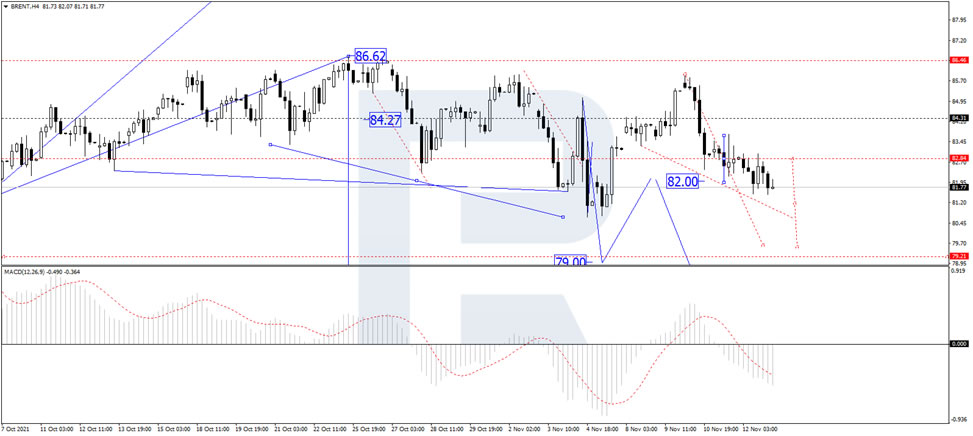
In the H4 chart, after rebounding from 85.85, Brent is still falling towards 79.00 and may later start a new correction to test 82.85 from below. After that, the asset may form a new descending structure to reach 77.55 and then start another growth with the target at 90.00. From the technical point of view, this scenario is confirmed by MACD Oscillator: its signal line is moving below 0 within the histogram area, which implies a descending wave on the price chart. After this wave is over, the line is expected to grow towards 0.
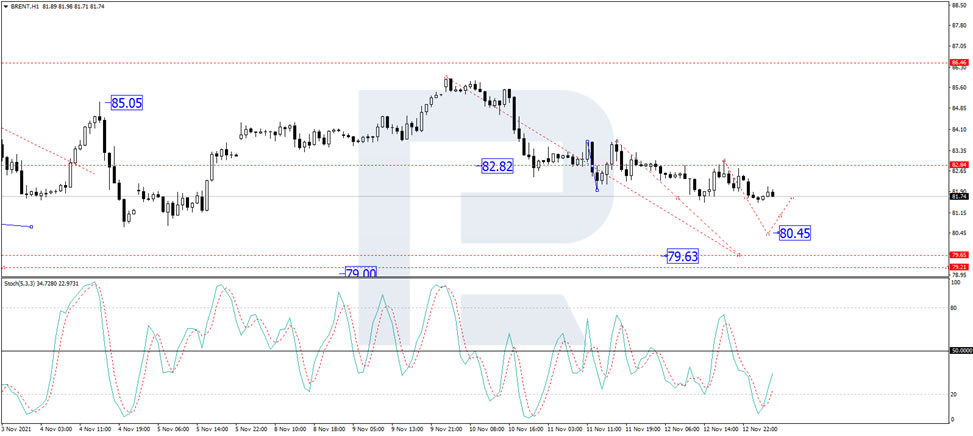
As we can see in the H1 chart, after forming a new consolidation range around 82.82, Brent has expanded it to the downside. In fact, this range should be considered as a downside continuation pattern. Possibly, the asset may reach 79.63 and then start a new correction to return to 82.82. Later, the market may resume trading downwards with the short-term target at 79.00. From the technical point of view, this idea is confirmed by the Stochastic Oscillator: its signal line is moving below 20, which implies a further downtrend on the price chart. After the price reaches the above-mentioned short-term target, the line may resume growing towards 50.
Oil Prices Dip, Gold Rally Pauses
Oil pullback losing momentum
Oil prices are falling again on Monday, although the pullback does appear to be losing momentum as it approaches the lows from a couple of weeks ago. The correction has been partially attributed to the prospect of US President Joe Biden releasing oil from the SPR. While I’m sure Biden will be happy with this result, I’m not convinced it’s a threat he wants to follow through on. Not at these levels. It’s win-win in that sense. For now, at least.
Ultimately prices remain well supported as there’s little chance of OPEC+ raising output faster, especially if – as UAE energy minister Suhail al-Mazrouei claimed today – the group expects the market to return to surplus in the first quarter of 2022. With US shale not the force it was prior to the pandemic as focus shifted to debt and shareholder repayments this year, we may have to get used to prices at these elevated levels.
Is gold’s winning streak coming to an end?
Gold prices are pulling back a little at the start of the week, threatening to bring an end to the seven-day winning streak for the yellow metal. It’s been quite a run for gold, which has soared as inflation indicators have continued to rise and become more widespread. This, in turn, has forced traders to price in more rate hikes even as central banks push back against it.
Gold has become popular despite higher yields and a stronger dollar, as inflation-adjusted yields remain at their lows. It’s also been seeing some love for its role as an inflation hedge, as we saw in the aftermath of the US CPI data last week. If policymakers continue to stick to the transitory line, gold could continue to see support. Of course, the dot plot next month may be a big giveaway on that front.
Another Flat Session
The week is off to a relatively flat start, in keeping with the mood last week in equity markets as investors weigh up a strong earnings season against inflation and interest rate risks.
The market recovery has well and truly stalled in Europe while Asia is still struggling to get much uplift and the US is failing to build on record highs. In many ways, I’m encouraged by the resilience we’re seeing in the markets which are again factoring in higher inflation and earlier rate hikes. But then I wonder what will be the catalyst for the rally to continue.
There’s a long list of reasons to be concerned right now but with earnings season basically in the rearview mirror, the bullish list is looking a little light. Of course, Covid restrictions this winter could be relatively light touch as vaccinations keep hospitalisations and fatalities low which would be a big plus for companies and economies, and support equity markets. But that will only become clear over time.
This may just lead to a lot more two-way price action, deeper pullbacks but highs remaining in sight as investors look to capitalise in anticipation of a strong 2022. Ultimately, it all comes down to the inflation and interest rate risks and it will be months until we have a clearer picture of this.
Investors are seemingly comfortable with modest rate hikes in order to deal with inflation risks but that may change if central banks roll the dice on inflation being transitory and are forced into more aggressive rate hikes next year. It’s a fine balancing act but as we saw recently, central bank inaction when inflation indicators are flashing makes investors very anxious.
Mixed data response from Asia
The week is off to a bumper start on the economic calendar in Asia, although it seems to have received a bit of flat reaction. Retail sales and industrial production in China both exceeded market expectations which should give investors some cause for optimism. On the flips side, fixed asset investment was only 6.1% dragged down by a decline in real estate investment as property sector woes continues to dampen sentiment.
The property sector, which accounts for around a quarter of Chinese GDP, is one major risk for the economy as new home prices continue to fall. But others continue to weigh including strict Covid lockdowns, supply disruptions, higher inflation, electricity outages etc.
In Japan, the recent restrictions weighed heavily on growth in the third quarter which undershot already gloomy forecasts. The country contracted by 3% on an annualised basis but should bounce back quickly as restrictions have been lifted and a large new fiscal package is due to be announced. There wasn’t much of a negative reaction in the markets, although investors have been quite forgiving of restriction-driven impacts, especially if more stimulus is on the cards.
Bitcoin edges higher after Taproot upgrade
Bitcoin is a little higher on Monday, not long after the Taproot upgrade was launched which initially had little impact on price. The upgrade, while big for bitcoin, has been a long time coming so was probably heavily priced in. We are seeing some bullish action today but that may have little, if anything, to do with it. We may also just be seeing a rally that’s suffering from a little exhaustion, as we’ve seen on numerous occasions recently.
XAUUSD Is Possibly Bullish
Technical analysis
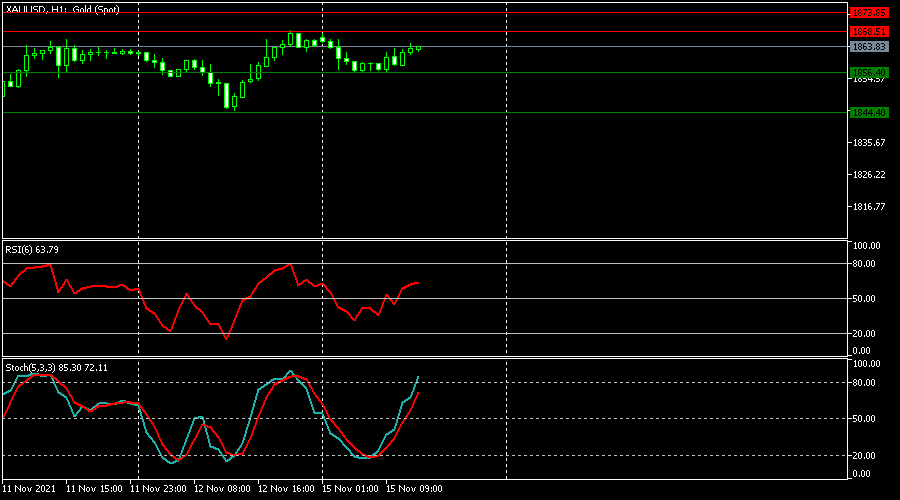
The RSI is above level 50.
The Stochastics is at the overbought zone.
Most likely scenario – BUY
Target prices: 1,868.51 1,873.85
Alternative scenario – SELL
Target prices: 1,856.40 1,844.40
Key levels
Support 1,856.40 1,844.40
Resistance 1,868.51 1,873.85
AUD Rises, RBA Minutes Next
The Australian dollar has started the week in positive territory, extending the gains seen on Friday. AUD/USD is currently trading at 0.7364, up 0.47% on the day.
Markets await RBA minutes
It’s a light calendar in Australia this week, with no major economic releases. The highlight from Down Under will be the RBA minutes from the November meeting, which will be released on Tuesday. The RBA didn’t adjust the cash rate or its bond-purchase programme at the meeting, but did abandon its yield curve, which was an important component of its monetary policy. The central bank retreated after trying unsuccessfully to defend a 0.10% target on 3-year Australian bonds, and the Australian dollar fell sharply in response.
Given this latest drama with the RBA, the minutes could prove to be a market-mover. With core CPI rising to the bank’s target band and inflation expectations above 4%, the RBA’s message that inflation is transitory is becoming a tough sell to sceptical markets. Governor Phillip Lowe has not veered from this stance that the bank will not raise rates before 2024, but I would not be surprised if the minutes show that some bank members are in favour of an earlier date.
We continue to see a disconnect between RBA guidance and market expectations, which is certainly not an optimal situation, as it puts the RBA’s credibility at risk. The markets are much more hawkish than the RBA and have priced in several rate hikes for 2022, with the cash rate projected to approach 1.0% by the end of next year. Will the RBA stick to its guns, or will it become more hawkish? Investors will be hoping for some clarity, or at least some clues from bank policy makers in the minutes as well as at the December policy meeting.
AUD/USD Technical
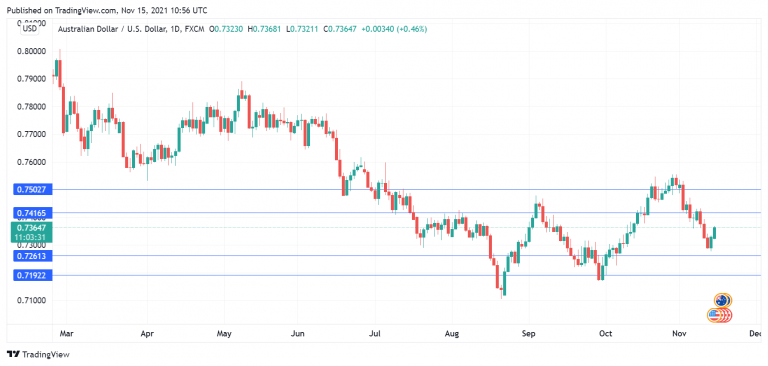
- There is resistance at 0.7416. 0.7502 is next
- There are support lines at 0.7261 and 0.7192
GOLD Tests 1,870.00 Level
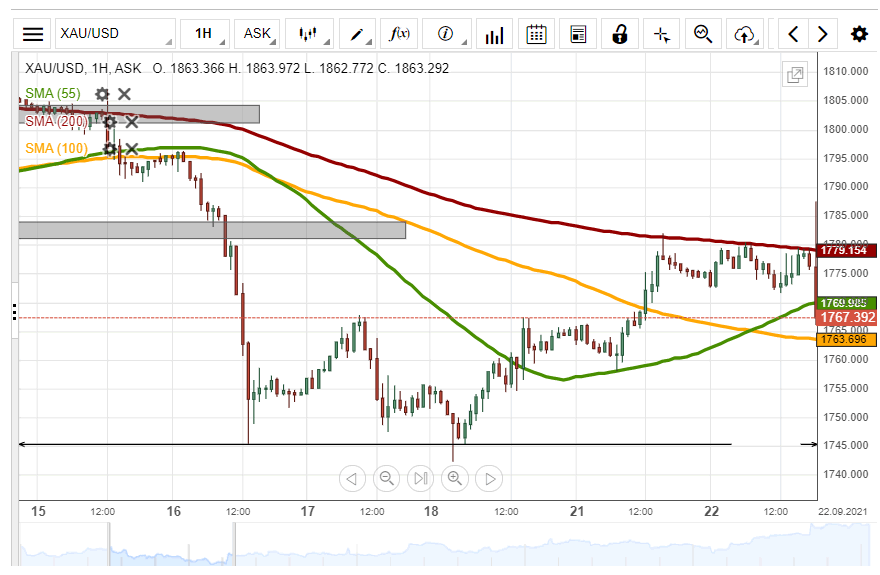
During Monday's Asian trading hours, the price for gold reached above the November 10 high level, as the price touched the 1,870.00 level's resistance. However, afterwards, the price retraced back down, before appearing to start another attempt to pass the resistance of the 1,870.00 level.
In the case that the price passes above the 1,870.00 level, the yellow metal could eventually approach the 1,900.00 mark. Although, note that round price levels might provide resistance.
On the other hand, a decline of the price might find support in the 100-hour SMA near 1,850.00, before reaching the support zone at 1,841.70/,1,845.60.
USD/JPY Finds Resistance In 50-Hour SMA
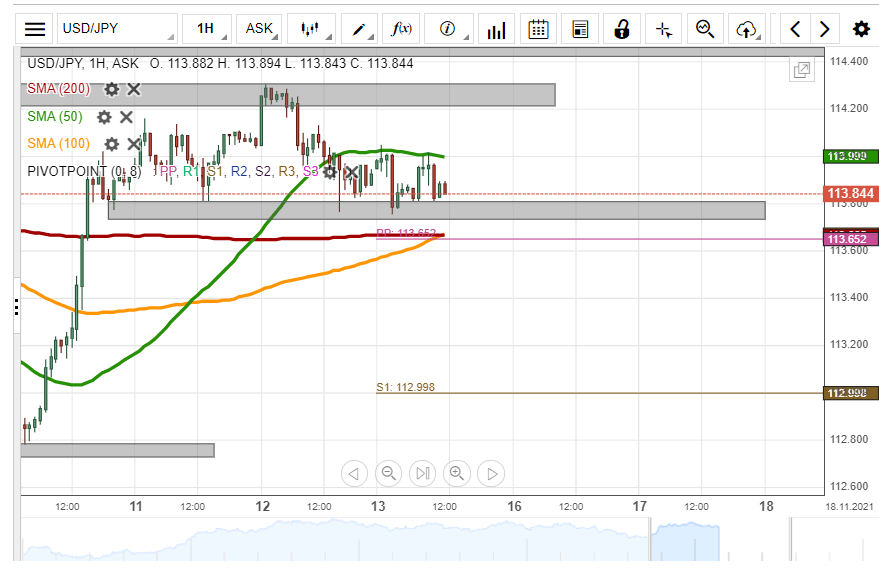
Since the middle of Friday's trading hours, the USD/JPY has traded between the support of the 113.74/113.81 zone and the resistance of the 50-hour simple moving average at 114.00. However, note that the round exchange rate level of 114.00 could be acting also acting as resistance. Namely, it is the combination of the round exchange rate and the simple moving average.
If the USD/JPY declines below the support zone, it would immediately encounter a strong support zone. Namely, at 113.65 the 100 and 200-hour simple moving averages were strengthening the weekly simple pivot point. Below these technical levels, there is no support as low as 113.00, where the weekly S1 simple pivot point was located at.
Meanwhile, a surge above the 114.00 mark and the 50-hour SMA would most likely result in a test of the resistance zone at 114.22/114.32.