

Sample Category Title
EUR/USD Daily Outlook
Daily Pivots: (S1) 1.1329; (P) 1.1396; (R1) 1.1437; More...
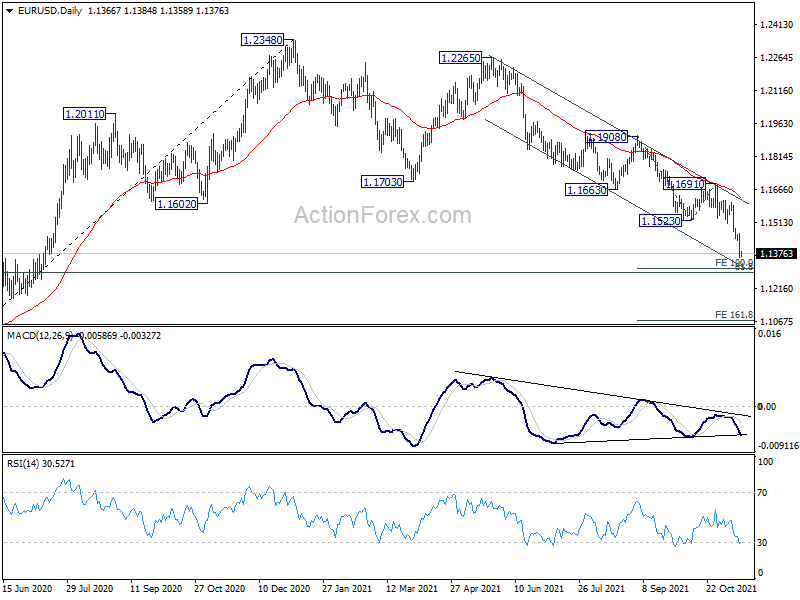
EUR/USD's decline reaccelerates to as low as 1.1355 so far today. Intraday bias remains on the downside for 100% projection 1.1908 to 1.1523 from 1.1691 at 1.1306, which is close to long term fibonacci level at 1.1289. We'd pay attention to bottoming signal there. Break of 1.1463 minor resistance should now suggest short term bottoming and bring rebound back to 1.1523/1691 resistance zone first. However, decisive break there will pave the way to 161.8% projection at 1.1068 next.
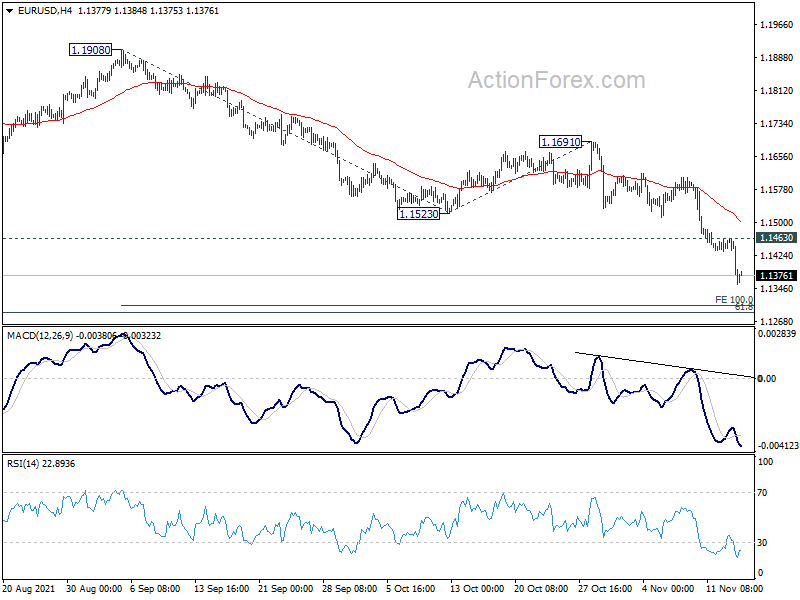
In the bigger picture, there are various ways of interpreting the fall from 1.2348 (2021 high). It could be a correction to rise from 1.0635 (2020 low), the fourth leg of a sideway pattern from 1.0339 (2017 low), or resuming long term down trend. In any case, outlook will now stay bearish as long as 1.1703 support turned resistance holds. Sustained break of 61.8% retracement of 1.0635 to 1.2348 at 1.1289 could pave the way back to 1.0635.
USD Weaker Ahead Of US Retail Sales, RBA Gov Lowe Comments On Inflation
General trend
- Nikkei has traded generally flat amid similar US equity session.
- S&P ASX 200 lagged amid RBA comments, Resources index underperformed.
- Shanghai Composite ended morning trading slightly higher (+0.3%) after the lower open.
- Hang Seng has outperformed and extended gains ahead of the conclusion of the Biden/Xi virtual meeting, TECH index rises [Online gaming firms rise amid speculation that China could soon resume approvals]; Property index also advances.
- RBA Lowe indicates still a ways away from a rate move, but would be prepared to respond to very, very sharp rise in inflation pressures.
- Companies due to report earnings during the NY morning include Aramark, Youdao, DouYu, Home Depot, NetEase, Sea Limited, TransDigm, Walmart.
Headlines/Economic data
Australia/New Zealand
- ASX 200 opened 0.0%.
- (AU) Reserve Bank of Australia (RBA) Gov Lowe: Have yet to see broad based pick up in wages; Wages need to grow 3.0% of more to hit CPI midpoint, still possible cash rate won’t rise before 2024, data doesn’t warrant a rise in 2022.
- (AU) RBA Gov Lowe Q&A: Would be prepared to respond to very, very sharp rise in inflation pressures, Decision on QE won't be made until Feb.
- (AU) RESERVE BANK OF AUSTRALIA (RBA) OCT MINUTES: Further pick up in inflation was expected, remain committed to maintaining highly supportive monetary conditions to achieve a return to full employment in Australia and inflation consistent with the target.
- (AU) Australia APRA Chair Byres: Considering additional measures to rein in housing lending if the need arises - AFR.
Japan
- Nikkei 225 opened -0.1%.
- (JP) Japan Fin Min Suzuki: Expects economy to pick up during Q4; Stimulus to have real impact in 2022.
- (JP) Bank of Japan (BOJ) Reviewing regional bank support program, the central bank said to be seeking to avoid excessive payouts to banks - Nikkei.
- (JP) Japan MoF sells ¥2.5T v ¥2.5T indicated in 0.005% 5-year JGBs; Avg Yield: -0.077% v -0.790% prior, bid-to-cover 4.54x v 3.86x prior.
- (JP) Japan Industry Min: Economic stumulus package will include plan to strengthen chip industry as national policy (yesterday after the close).
Korea
- Kospi opened -0.1%.
- (KR) 'Serious' COVID cases in South Korea have hit a new high; Cases >2.0K for 7th straight day – Yonhap.
China/Hong Kong
- Hang Seng opened +0.2%; Shanghai Composite opened -0.1%.
- (CN) Comments from US President Biden and China President Xi meeting: President Xi: China stands ready to move US China relations forward in a "positive direction".
- (CN) China State Television: China President Xi and US President Biden had full and deep communication on development and bilateral issues.
- (CN) China PBOC sets Yuan reference rate: 6.3924 v 6.3896 prior.
- (CN) China PBOC Open Market Operation (OMO): Injects CNY50B in 7-day reverse repos v CNY10B prior; Net drain CNY50B v Net drain CNY90B prior.
- 728.HK Has requested US Appeals court to block FCC decision to revoke US authorization - press.
- (CN) China said to potentially restart approvals of online gaming soon - Chinese press.
North America
- (US) Fed's Kashkari (dove, non-voter): Fed will never allow price expectations to become unanchored.
- (US) Fed's Barkin (FOMC voter, hawk): Do not think the infrastructure bill will provide any near term stimulus - media interview.
- (US) House Rep Smith (D-WA) said to be open to including a China provision to the Defense Bill - press.
- (US) President Biden: Discussed complex nature of bilateral relations, US remains committed to "One China" policy, but opposed to efforts to change status of Taiwan - White House read out of meeting with China President Xi.
Europe
- (EU) European Union Parliament and Council have reached a provisional deal for the 2022 Budget.
Levels as of 00:15ET
- Hang Seng +1.2%; Shanghai Composite +0.2%; Kospi -0.2%; Nikkei225 +0.1%; ASX 200 -0.7%.
- Equity Futures: S&P500 +0.0%; Nasdaq100 +0.1%, Dax +0.1%; FTSE100 +0.1%.
- EUR 1.1386-1.1359; JPY 114.32-114.11; AUD 0.7369-0.7342; NZD 0.7064-0.7038.
- Commodity Futures: Gold +0.1% at $1,868/oz; Crude Oil +0.7% at $80.27/brl; Copper +0.4% at $4.43/lb.
Euro Selloff Intensified on Dovish Lagarde, Could EUR/USD Defend 1.13?
Euro tumbled broadly overnight, riding on dovish comments from ECB President Christine Lagarde. In short, Lagarde continued to talk down the need of early stimulus withdrawal and warned of the hurt to recovery for doing so. Swiss Franc is currently the second weakest, followed by Yen. On the other hand, commodity currencies are the stronger one as led by Aussie, even though stock rally attempt faltered overnight.
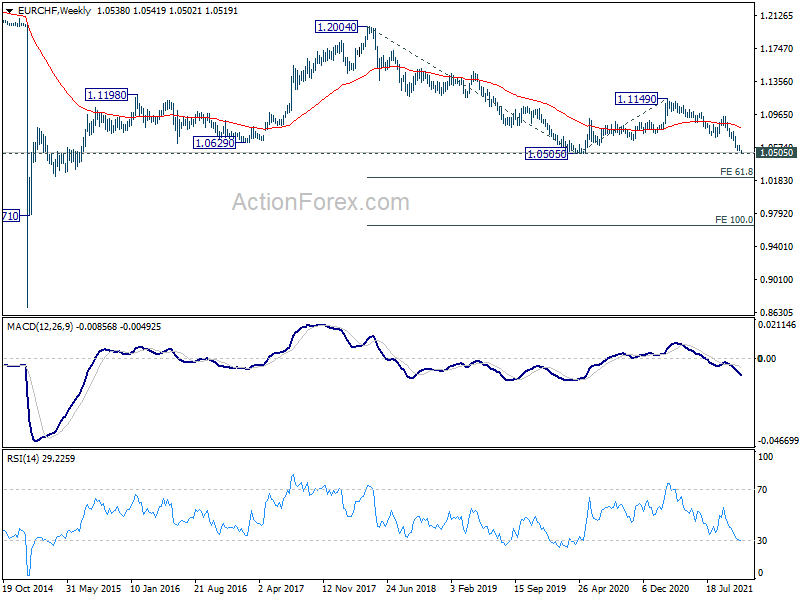
Technically, EUR/USD is now approaching a key target and support level at around 1.13 handle. EUR/CHF is also pressing 1.0505 key support level of 2020 low. We'd pay attention to bottoming signals around these two levels, at least on first attempt. However, sustained break of the levels in both pairs will carry large bearish implication and could prompt even steeper, broad based, selloff for the medium term.
In Asia, at the time of writing, Nikkei is trading up 0.06%. Hong Kong HSI is up 0.94%. China Shanghai SSE is down -0.18%. Singapore Strait Times is down -0.01%. Japan 10-year JGB yield is up 0.0114 at 0.079. Overnight, DOW dropped -0.04%. S&P 500 dropped -0.00%. NASDAQ dropped -0.04%. 10-year yield rose 0.041 to 1.623.
EUR/CAD downside breakout on broad Euro weakness
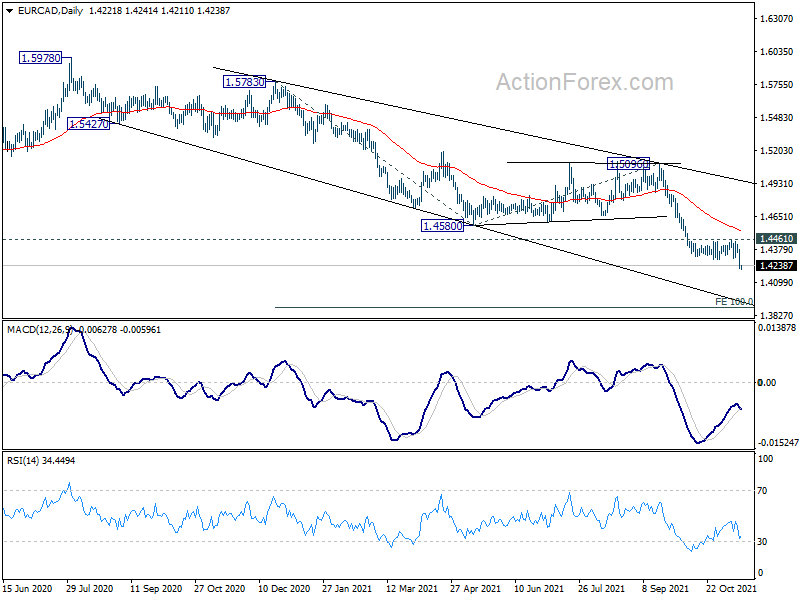
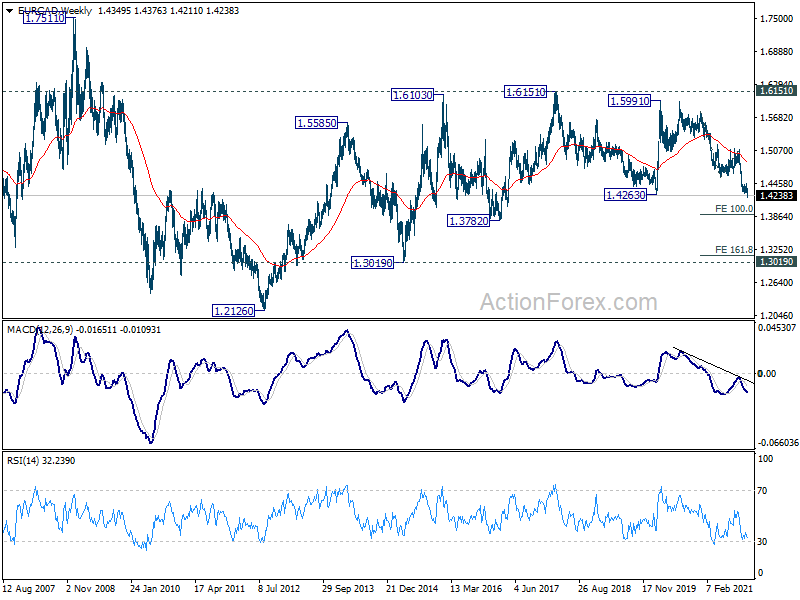
EUR/CAD's down trend finally resumed this week, following broad based selloff in Euro, and hit as low as 1.4211 so far. Current fall is part of the down trend from 1.5991. Next target is 100% projection of 1.5783 to 1.4580 from 1.5096 at 1.3893. For now, outlook will stay bearish as long as 1.4661 resistance holds, even in case of recovery.
Also, it should be noted that 1.4263 key support (2020 low) is now taken out by the cross. Fall from 1.5991 would extend through 1.3782 support before bottoming. Yet, we're not seeing a strong bearish scenarios for pushing through 1.3019 yet. We'll see how the downside momentum develops in the medium term.
Fed Barkin: It's helpful to have a few months to evaluate
Richmond Fed President Tom Barkin said yesterday that it's helpful to have "a few more months" to evaluate to see "where reality is in this economy, and if the need to act is there". He added that "we're not going to hesitate" to accelerate tapering to get ahead of inflation is needed".
But, "I personally think it's very helpful for us to have a few more months to evaluate, is inflation going to come back to more normal levels? Is the labor market going to open up as people spend through some of this savings?"
RBA Lowe: Still plausible that rate won't be raised before 2024
In a speech, RBA Governor Philip Lowe reiterated, "the latest data and forecasts do not warrant an increase in the cash rate in 2022." Also, it's "still plausible that the first increase in the cash rate will not be before 2024" even if underlying inflation hits 2.5%.
He said, the central scenario is that underlying inflation will reach "middle of the target by the end of 2023". That would be the first time in nearly seven years that inflation is at the mid-point. And, "this, by itself, does not warrant an increase in the cash rate."
For rate hike, RBA would like to see inflation "well within the 2–3 per cent range", and, " have a reasonable degree of confidence that it will not fall back again". The "trajectory" is important, "with a slow drift up in underlying inflation having different policy implications to a sharp rise."
Another important consideration will be developments in the labor market. wages growth is used as one of the "guideposts" and "it is likely that wages will need to be growing at 3 point something per cent to sustain inflation around the middle of the target band."
Looking ahead
UK employment data will be a major focus in European session. Eurozone will also release GDP and employment change. Later in the day, US retail sales will take center stage, with import price, industrial production, business inventories and NAHB housing index featured too. Canada will release housing starts.
EUR/USD Daily Outlook
Daily Pivots: (S1) 1.1329; (P) 1.1396; (R1) 1.1437; More...
EUR/USD's decline reaccelerates to as low as 1.1355 so far today. Intraday bias remains on the downside for 100% projection 1.1908 to 1.1523 from 1.1691 at 1.1453 at 1.1306, which is close to long term fibonacci level at 1.1289. We'd pay attention to bottoming signal there. Break of 1.1463 minor resistance should now suggest short term bottoming and bring rebound back to 1.1523/1691 resistance zone first. However, decisive break there will pave the way to 161.8% projection at 1.1068 next.
In the bigger picture, there are various ways of interpreting the fall from 1.2348 (2021 high). It could be a correction to rise from 1.0635 (2020 low), the fourth leg of a sideway pattern from 1.0339 (2017 low), or resuming long term down trend. In any case, outlook will now stay bearish as long as 1.1703 support turned resistance holds. Sustained break of 61.8% retracement of 1.0635 to 1.2348 at 1.1289 could pave the way back to 1.0635.
Economic Indicators Update
| GMT | Ccy | Events | Actual | Forecast | Previous | Revised |
|---|---|---|---|---|---|---|
| 00:30 | AUD | RBA Minutes | ||||
| 02:30 | AUD | RBA's Governor Lowe speech | ||||
| 04:30 | JPY | Tertiary Industry Index M/M Sep | 0.5% | 0.90% | -1.70% | -1.1% |
| 07:00 | GBP | Claimant Count Change Oct | -51.1K | |||
| 07:00 | GBP | ILO Unemployment Rate (3M) Sep | 4.50% | 4.50% | ||
| 07:00 | GBP | Average Earnings Excluding Bonus 3M/Y Sep | 6.00% | 6.00% | ||
| 07:00 | GBP | Average Earnings Including Bonus 3M/Y Sep | 7.00% | 7.20% | ||
| 10:00 | EUR | Eurozone GDP Q/Q Q3 P | 2.20% | 2.20% | ||
| 10:00 | EUR | Eurozone Employment Change Q/Q Q3 P | 0.60% | 0.70% | ||
| 13:15 | CAD | Housing Starts Y/Y Oct | 265K | 251K | ||
| 13:30 | USD | Retail Sales M/M Oct | 1.20% | 0.70% | ||
| 13:30 | USD | Retail Sales ex Autos M/M Oct | 1.00% | 0.80% | ||
| 13:30 | USD | Import Price Index M/M Oct | 1.00% | 0.40% | ||
| 14:15 | USD | Industrial Production M/M Oct | 0.90% | -1.30% | ||
| 14:15 | USD | Capacity Utilization Oct | 75.90% | 75.20% | ||
| 15:00 | USD | Business Inventories Sep | 0.50% | 0.60% | ||
| 15:00 | USD | NAHB Housing Market Index Nov | 80 | 80 |
Market Morning Briefing: Euro Has Fallen Sharply Breaking Below 1.14
STOCKS
Dow can dip to 35000 while below 36250 while Dax could be headed towards 16400 while above 16100.Nikkei and Shanghai can rise towards 30000/31000 and 3600 respectively if they continue to rise from current levels. Nifty and Sensex need to see if they can break and sustain above 18200 and 61000 to turn further bullish for the medium term.
Dow (36087.45, -12.86, -0.036%) has come down today. While below 36250, a fall towards 35000 is possible.
DAX (16148.64, +54.57, +0.34%) has broken the range of 15900-16100 on the upside. The view is now bullish to see a rise towards 16400 while the rise above 16100 sustains.
Nikkei (29841.26, +64.46, +0.22%) has risen further today. The view remains bullish to see a test a 30000/31000 before we see a corrective fall.
Shanghai (3542.94, +9.64, +0.28%) has risen again today and is trading just shy of 3550. A break above 3550 can trigger a rise towards 3600.
Nifty (18109.45, 6.70, +0.037%) opened higher initially before coming down to close at 18109.45 yesterday. The next couple of days are crucial to see if Nifty can rise past 18200 or a break below 18000 is seen.
Sensex (60718.71, +32.02, +0.053%) tested 61036.56 yesterady before closing below 610000. While above 60000, a test of 61000/62000 again is possible.
COMMODITIES
Commodity prices have almost risen globally except that of crude which is in a sideways range after rising sharply over the past few months. Gold, Copper and Silver now show some rally while Crude prices remain stable. Gold can test 1880-1900 while above 185, copper can trade within 4.45/50-4.30/25 while Silver is bullish while above 24.5. Brent and WTI have important resistances near 85 and 82/83 respectively which are likely to hold in the near term.
Brent (82.81) fell almost towards 80 before bouncing back from there. Resistance is seen near 84/85 on the upside which needs to hold to produce a sharp fall towards 79/78 on the downside. While below 85, view remains sideways to bearish for Brent.
WTI (81.47) has bounced from immediate support near 79 and while that holds, a bounce to 82-83 is possible before again resuming a fall that could break below 79 to fall lower towards 75.
Gold (1870.20) has moved up well. Immediate support is seen at 1850/60 and while that holds, Gold can rise towards 1880-1900 slowly. A broad sideways range of 1850-1880 can also be possible in the next few sessions before a further rise is seen. For now trade above 1850 looks likely.
Silver (25.27) has dipped from 25.50 and is trading slightly lower. While above immediate support at 24.50, there is scope for a rise to 26 or higher eventually. Important supports are seen at 24.50 and 24 below current levels.
Copper (4.4360) trades near the lower end of the 4.45/50-4.35 region and a break on the downside if seen can take it towards 4.30/25 before bouncing back towards 4.45/50 again in the medium term. Watch price action near current levels.
FOREX
Dollar Index may see a pull back to 94.50/25 on the downside before heading towards 95 while Euro has broken below 1.14 and while above immediate support at 1.1350, we may expect a possible rise to 1.1425 that may extend to 1.15 too. Overall downtrend is intact with a possible target of 1.12 in the medium term. Aussie looks bullish while Pound has scope to fall further in the near term. Crucial fall in USDCNY breaking below support at 6.3750. It can open up chances of a further fall to 6.36/35 if an immediate bounce back is not seen. Stronger Chinese Yuan may possibly keep USDINR low today.
Dollar Index (95.407) tested 95.60 yesterday, breaking above the immediate resistance near 95.27 mentioned yesterday. But before testing 96 a pull back seems to be on its way as the index has dipped from yesterday’s highs. A fall towards 94.50-94.25 can be possible before again resuming its uptrend.
Euro (1.1383) has fallen sharply breaking below 1.14. This is a crucial break but we may expect 1.13-1.1350 to hold for now and produce a bounce back to 1.1450-1.15 before falling further towards 1.12 in the medium term. Note that while Euro sustains below 1.13, chances of testing 1.12 cannot be negated in the longer run.
EURJPY (130.02) has been falling well too but can possibly see a corrective upmove from 129.50 towards 130.50-130.75 before resuming the fall.
Aussie (0.7362) has been rising from 0.7276 over the past 3-sessions and looks bullish for a further rise towards 0.7450-0.75 slowly. Immediate view is bullish with possible small interim corrections.
Pound (1.3434) has immediate resistance near 1.3450 which if holds can produce a fall towards 1.3350-1.330 in the near term.
Dollar-Yen (114.19) seems to be holding well below 114.70/50 for now. While the upside target of 115.50 is open, while below 114.75/50, we may expect a short corrective dip towards 113.25-113.00 before again moving up from there.
USDCNY (6.3706) has fallen sharply today breaking below our mentioned support near 6.3750. This opens up a further fall to 6.36/35 in the medium term.
USDINR (74.4875) traded within 74.30-74.50 region yesterday. Resistance at 74.60 seems to be holding well for now and while that holds, a fall to 74.28/25/20 looks possible on the downside. Below 74.30, support is seen at 74. View remains overall bearish towards 74 while below 74.60.
INTEREST RATES
The US Treasury yields have surged especially at the far-end and are coming closer to their key resistance. It is now important to see if the yields are reversing lower thereafter or not in line with our expectation. The German yields have also risen well and are coming closer to their key resistances. The corrective rise that is in place could be coming to an end soon and the broader downtrend is likely to resume. The 10Yr and 5Yr GoI have reversed lower without seeing an extended rise that was expected. They can now move down towards the lower end of their current range from here. Broadly, the bias is bearish to see a downside break of their ranges.
The US 2Yr (0.51%), 5Yr (1.24%), 10Yr (1.61%) and the 30Yr (2%) have surged especially at the far-end. The 10Yr and 30Yr are heading up towards 1.65% and the 30Yr has touched 2% and can extend the upside to 2.1% in line with our expectation. While we expect a reversal thereafter, the price action around 1.65% (10Yr) and 2.1% (30Yr) will need a close watch to see if the yields are turning down or not.
The German 2Yr (-0.70%), 5Yr (-0.53%), 10Yr (-0.23%) and 30Yr (0.08%) yields have risen across tenors. The 10Yr is coming closer to -0.2% and need to see if it can extend the rise to -0.1%. The 30Yr on the other hand is just below 0.1%. It has to be seen if the expected reversal is happening from here itself or after an extended rise to 0.2%.
The resistance at 6.38% on the India 10Yr GoI (6.3430%) has held well and the yield has reversed lower. A further dip to 6.3% can be seen in the coming sessions. The broader 6.3%-6.45% range remains intact, and our bias is bearish to see a downside breakout of this range eventually.
The 5Yr GoI (5.6895%) has dipped below 5.7% contrary to our expectation to see a rise to 5.75%-5.76% and then reverse lower. The fall to 5.66% can now happen from here itself. A break below 5.66% will pave way for a deeper fall to 5.62%-5.60%.
EUR/CAD downside breakout on broad Euro weakness
EUR/CAD's down trend finally resumed this week, following broad based selloff in Euro, and hit as low as 1.4211 so far. Current fall is part of the down trend from 1.5991. Next target is 100% projection of 1.5783 to 1.4580 from 1.5096 at 1.3893. For now, outlook will stay bearish as long as 1.4661 resistance holds, even in case of recovery.
Also, it should be noted that 1.4263 key support (2020 low) is now taken out by the cross. Fall from 1.5991 would extend through 1.3782 support before bottoming. Yet, we're not seeing a strong bearish scenarios for pushing through 1.3019 yet. We'll see how the downside momentum develops in the medium term.
RBA Lowe: Still plausible that rate won’t be raised before 2024
In a speech, RBA Governor Philip Lowe reiterated, "the latest data and forecasts do not warrant an increase in the cash rate in 2022." Also, it's "still plausible that the first increase in the cash rate will not be before 2024" even if underlying inflation hits 2.5%.
He said, the central scenario is that underlying inflation will reach "middle of the target by the end of 2023". That would be the first time in nearly seven years that inflation is at the mid-point. And, "this, by itself, does not warrant an increase in the cash rate."
For rate hike, RBA would like to see inflation "well within the 2–3 per cent range", and, " have a reasonable degree of confidence that it will not fall back again". The "trajectory" is important, "with a slow drift up in underlying inflation having different policy implications to a sharp rise."
Another important consideration will be developments in the labor market. wages growth is used as one of the "guideposts" and "it is likely that wages will need to be growing at 3 point something per cent to sustain inflation around the middle of the target band."
(RBA) Minutes of the Monetary Policy Meeting of the Reserve Bank Board
Hybrid – 2 November 2021
Members present
Philip Lowe (Governor and Chair), Guy Debelle (Deputy Governor), Mark Barnaba AM, Wendy Craik AM, Ian Harper AO, Carolyn Hewson AO, Steven Kennedy PSM, Carol Schwartz AO, Alison Watkins
Others participating
Luci Ellis (Assistant Governor, Economic), Christopher Kent (Assistant Governor, Financial Markets), Tony Richards (Head, Payments Policy Department)
Anthony Dickman (Secretary), Penelope Smith (Deputy Secretary)
Michele Bullock (Assistant Governor, Financial System), Alexandra Heath (Head, International Department), Bradley Jones (Head, Economic Analysis Department), Marion Kohler (Head, Domestic Markets Department)
International economic developments
Members commenced their discussion of international economic developments by noting that the global economy had continued to recover and that conditions were in place for a sustained expansion. The global outlook was supported by rising vaccination coverage alongside expansionary fiscal and monetary policy settings. Output in most advanced economies was expected to return to pre-pandemic paths in 2022. Output had already recovered to its pre-pandemic trajectory in China, although activity had recently slowed and developments in the property sector had introduced more uncertainty to the outlook. A number of emerging market economies were falling short of pre-pandemic expectations for output; in some countries, this was a result of ongoing health concerns and a more challenging environment for fiscal and monetary policy.
Members noted that capacity constraints in global goods markets had been more persistent than initially envisaged, and price pressures had broadened. The ongoing strength in global goods demand was straining supply chains to a degree not evident in the earlier stages of the pandemic. The supply of semiconductors, household goods and building materials had struggled to keep pace with the growth in demand; disruptions in globally interconnected supply chains and bottlenecks in transportation networks had exacerbated the situation. Disruptions in energy markets in the euro area, the United Kingdom and China had also adversely affected production in some industries, particularly energy-intensive products, including some base metals. Prices for a range of energy and non-energy commodities were at or around multi-year highs. Producer prices had also picked up strongly in a number of countries in recent months. Iron ore prices remained volatile after a large increase and subsequent decline earlier in the year.
Members noted that headline measures of inflation had increased in a number of economies to well above central banks' inflation targets. Higher energy prices, alongside the strong recovery in global demand and ongoing capacity constraints in the goods sector, had contributed to this development. Underlying inflation had also picked up, although not to the same extent as headline measures. Central banks and other forecasters generally expected most of the factors that had boosted inflation in prior months to be temporary and for inflation to moderate over the year ahead. Members noted that, while a range of outcomes for global inflation in 2022 were possible, risks to inflation forecasts were tilted to the upside.
Members noted that wages growth would be key to determining whether the upswing in global inflation persisted. Labour markets were tightening, with job vacancies high and unemployment rates recovering to be generally around or only a little above pre-pandemic levels. However, employment and participation rates remained some way below pre-pandemic levels in a number of countries. Labour shortages were being reported in some industries, including in customer-facing roles, where health concerns among workers and uncertainty over the hours available for work appeared to be lingering. These concerns, alongside vaccine mandates for certain industries and, in some cases, reduced availability of foreign labour and domestic labour due to early retirements, meant it was uncertain how rapidly labour supply would expand in the period ahead. Wages growth had increased more in countries where labour shortages were pronounced, such as the United States, the United Kingdom and New Zealand. But a consistent pattern in wages growth across advanced economies was not evident. As in Australia, wages growth had been more subdued in Canada and the euro area, despite strong labour market recoveries in these economies.
Domestic economic developments
Turning to the domestic economy, members noted that activity in Australia had contracted sharply in the September quarter as a result of the outbreaks of the Delta variant of COVID-19 and associated lockdowns in New South Wales, Victoria and the Australian Capital Territory. This setback had delayed, but not derailed, the economic recovery that had been under way in the first half of the year. A bounce-back in domestic demand was forecast for the December and March quarters as restrictions are eased further. Timely data on mobility, spending and labour demand pointed to a strong rebound in parts of the country that had been most affected by the Delta outbreak. High rates of vaccination coverage and expansionary policy settings underpinned the outlook. By mid 2022, activity was expected to be broadly in line with the pre-Delta recovery path. Nevertheless, members agreed that the effects of the pandemic would continue to result in an uneven recovery across industries and parts of the country. Under the central scenario, GDP was forecast to grow by around 3 per cent over 2021, 5½ per cent over 2022 and 2½ per cent over 2023.
Members noted that household consumption had declined sharply in the September quarter in response to tighter restrictions in some states, but was expected to underpin output growth in subsequent quarters as restrictions are eased. Consumption of services was expected to lead the recovery, following a period in 2020 during which goods consumption had been very strong. Higher household wealth, steady growth in household disposable income and a decline in uncertainty related to health and economic outcomes were expected to support household spending over the forecast period. The household saving ratio had increased sharply in the September quarter, reflecting fewer consumption opportunities and higher income support payments, but was expected to decline to around its average level of prior years. In addition to the uncertainties around health outcomes, members agreed that key uncertainties for the consumption outlook related to the evolution of asset prices and whether households viewed the savings accumulated during the pandemic as income or wealth, which would determine the rate at which they were run down.
Investment activity, particularly construction, had been adversely affected by lockdowns in the September quarter after a strong first half of the year. However, non-mining business and dwelling investment were expected to have regained positive momentum as restrictions were eased in states affected by the Delta outbreak. Information from the Bank's liaison program and recent business surveys indicated that firms remained positive about the outlook and had generally not scaled back their capital expenditure plans during the lockdowns. Government support payments had assisted some firms during the lockdowns and ongoing tax incentives had supported investment by smaller firms.
A large pipeline of work was expected to sustain a high level of residential and non-residential construction activity over the forecast period. Recently, building approvals for detached dwellings as well as alterations and additions had declined, but from very high levels. A large pipeline of public capital works, including road and rail infrastructure, was also expected to support investment activity over the coming year or so. Members noted that capacity constraints in some parts of the construction sector were being reported, with shortages of materials and labour extending construction times and increasing building costs. The outlook for mining investment was little changed, as firms had not adjusted capital expenditure plans despite large movements in commodity prices over the recent period. Much of the planned mining investment was aimed at sustaining the level of production rather than expanding capacity.
Australia's terms of trade had remained high, as the effect of the recent fall in iron ore prices had been broadly offset by increases in the prices of coal and liquefied natural gas. However, the terms of trade were expected to decline over the forecast period.
Members noted the rapid growth in housing prices over prior months. Price growth had been strongest for detached dwellings and in regional areas over the preceding year. Restrictions introduced in response to the Delta outbreak, including on open inspections, had temporarily weighed on housing market activity, particularly in Melbourne. But new listings and auction market activity had rebounded following the easing of restrictions. Rental market conditions remained mixed. Advertised rents had increased strongly, including in regional areas, where changes in the pattern of internal migration during the pandemic had contributed to demand and supply could not easily respond. It was possible that low listings were also supporting advertised rents elsewhere in the country. However, the low rate of population growth owing to the closure of the international border had reduced rental demand for units in large capital cities. While advertised rents for units had picked up more recently, they remained below their pre-pandemic level in Melbourne and were around their pre-pandemic level in Sydney.
Members noted that lockdowns since June had disrupted what had been a strong recovery in labour market conditions. A significant number of workers had experienced reduced hours or been stood down, with total hours worked declining by 3 per cent in the September quarter and employment falling by 2 per cent (around 280,000 people). The unemployment rate had declined; however, this was primarily because stood-down workers and those who had lost their jobs did not tend to look for alternative employment during lockdowns, so they were recorded as having left the labour force. Alternative measures of spare capacity that included these workers had peaked above 11 per cent.
Nevertheless, the labour market had proven to be more resilient than during the national lockdowns in 2020, and a swift recovery in labour market conditions appeared likely. This was partly because many workers had maintained attachment to their employers while on reduced or zero hours in states affected by lockdowns. Hiring intentions in New South Wales and Victoria had picked up ahead of the easing of lockdown restrictions. Liaison suggested that firms affected by lockdowns were reluctant to lay off staff given reported labour shortages and strong labour demand prior to the Delta outbreak. In line with the expected recovery in activity, the unemployment rate was forecast to be a little below 5 per cent at the end of 2021, before declining to around 4¼ per cent by the end of 2022 and 4 per cent by the end of 2023. Employment was expected to rebound strongly in the near term before growing at a more moderate pace later in the forecast period as output growth settled around its longer-run trend.
Wages growth was expected to pick up as remaining wage freezes and cuts implemented in 2020 were unwound and the labour market tightened. Forecast growth in the Wage Price Index had been revised up a little to around 3 per cent by the end of 2023. Broader measures of labour costs, which included increases in the superannuation guarantee rate and non-wage benefits, were expected to grow at a slightly faster pace. Inertia in wage-setting practices was likely to moderate the increase in wages growth. Moreover, wages growth was starting from a low base – disaggregated data and information from the Bank's liaison program suggested only a small share of workers were receiving increases in wages of more than 3 per cent. However, members acknowledged there was uncertainty around how wages growth would respond to the unemployment rate being near 4 per cent for an extended period, as there was little historical experience to draw on. The effect on overall labour market conditions of the reopening of the international border, including the effects on labour supply across different regions and occupations, was also uncertain.
Inflation in the September quarter had been about ¼ percentage point higher than expected three months earlier, in both headline and underlying terms. Around two-thirds of the quarterly increase in headline CPI was accounted for by increases in fuel prices and home-building costs. Growth in construction costs had picked up noticeably in the quarter, reflecting rising global materials prices and strong demand for housing construction induced by domestic subsidies. Although prices of some consumer durable goods had picked up as import price pressures persisted and demand remained strong, inflation had been fairly subdued in other expenditure components. CPI rent inflation remained low; while advertised rents had been rising at a faster pace, rents for newly leased dwellings made up only a small share of total rents.
Members noted that, in the central scenario, underlying inflation was expected to pick up gradually towards the end of the forecast period. The inflation outlook allowed for the effect of higher housing costs and imported goods inflation in coming quarters, and a subsequent steady pick-up in wages growth. Underlying inflation was expected to be around 2¼ per cent by the end of 2022 and around 2½ per cent by the end of 2023. Headline inflation was expected to run above underlying inflation in the near term, largely owing to the sharp increase in fuel prices.
While the forecast for inflation was higher than previously, members noted that the outlook for inflation in Australia differed from that for many other advanced economies. Unlike a few major economies, the labour market participation rate in Australia had bounced back quickly. This flexibility in labour supply implied there would be less upward pressure on wages in Australia. In addition, the effect of global supply disruptions on inflation had been less pronounced in Australia than in other parts of the world, including in energy markets. And the starting points for inflation and wages growth were lower in Australia than in many other advanced economies.
Members agreed that the distribution of possible outcomes for inflation had widened. If price pressures in global goods markets persisted for longer than expected, the extent of the pass-through to domestic prices could be stronger than in the central scenario. Workers might also demand higher wages as compensation for higher inflation outcomes. If employers passed these increased wage costs on to consumers, this would feed into higher inflation outcomes. However, it was also possible that global goods demand would ease over the coming year or so, around the same time that more goods supply came on line. This could see price pressures in global goods markets dissipate and lead to lower inflation outcomes in Australia.
Members concluded their discussion of the domestic economy by considering two alternative scenarios in light of the considerable ongoing uncertainty around health outcomes and household consumption.
A stronger economic trajectory than the central scenario was possible if households increased spending by more than expected. This could be the result of positive news on the health front and high rates of vaccination leading to reduced uncertainty about the outlook and a boost in households' desire to consume out of their rising wealth. These conditions would also support stronger private investment. In this upside scenario, the unemployment rate would decline more rapidly than in the central scenario, to be around 3¼ per cent by the end of 2023, and the stronger labour market would see underlying inflation increase to a little above 3 per cent over the same period.
Alternatively, a weaker trajectory could eventuate as a result of lingering uncertainty about the outlook, which would result in near-term precautionary saving, alongside possible adverse health outcomes, such as the emergence of a new variant of COVID-19 or waning efficacy of vaccines in the first half of 2022. The weaker economic environment would depress confidence, resulting in lower consumption and higher saving by households, and a slower recovery in private investment. International travel would also resume more slowly, delaying the recovery in trade in services. In this downside scenario, subdued activity would push the unemployment rate to above pre-pandemic levels and weigh on wages growth. This would keep underlying inflation below 2 per cent over most of the forecast period.
International financial markets
Members commenced their discussion of international financial markets by noting that yields on government bonds had been volatile and had increased noticeably in advanced economies over the preceding month, reaching or surpassing levels seen earlier in the year. These developments had followed release of data that had led to upward revisions to the inflation outlook by market participants, particularly for the coming few years. This, in turn, had led to rising expectations that central banks would tighten policy earlier than had previously been thought likely, as well as an increase in risk premia, reflecting an increase in uncertainty about the outlook for inflation and monetary policy.
A few central banks, including the Bank of Korea, Norges Bank and the Reserve Bank of New Zealand, had already increased their policy rates. Market pricing suggested that a number of other central banks were expected to start increasing their policy rates in the subsequent few quarters. Some central banks had remained focused on reducing the pace of asset purchases. The Bank of Canada had announced an end to the quantitative easing phase of its bond purchase program at its most recent policy meeting and indicated that it would purchase bonds only at the rate required to offset maturities, thereby keeping its bond holdings somewhat stable. The Bank of Canada had suggested that it would continue to do this until at least the time of the first increase in its policy rate, which it anticipated would be around the middle of 2022, a little ahead of the previous projection. The US Federal Reserve was widely expected to announce a reduction in its rate of asset purchases at its policy meeting later in November.
Members noted that, despite the increase in yields and the recent volatility, financial conditions overall had remained accommodative in advanced economies. Interest rates and credit spreads for corporate borrowers had remained historically low. Equity prices in most major markets, including in Australia, had remained around record highs, supported by well-received earnings reports.
In China, highly leveraged property developers had remained under pressure, although broader risk sentiment had improved and overall financial conditions remained stable. The property developer Evergrande had averted default by making overdue coupon payments on offshore bonds, but it still had several overdue coupon payments outstanding. Further, Chinese authorities had clarified that banks could roll over funding to other highly indebted developers. Meanwhile, central banks in other emerging Asian economies had kept policy rates unchanged, while a number of others – particularly in Latin American countries and in Russia – had tightened policy further in response to rising inflation.
Domestic financial markets
In Australia, yields on longer-term government bonds had increased markedly alongside the global movements in yields, although domestic developments had also played an important role. In particular, the recent improvement in the domestic economic outlook and the stronger-than-expected CPI outcome for the September quarter had led to an increase in market participants' expectations for inflation over the period ahead. An increase in uncertainty about the outlook for inflation, and the associated path for monetary policy, had also contributed to the increase in Australian bond yields in the form of higher risk premia. Members noted that lower liquidity in Australian bond markets compared with the major markets could lead to additional volatility and some overshooting during a period when markets are adjusting to significant news. Consequently, the differential between yields on Australian Government bonds and US Treasuries had widened sharply in the period leading up to the meeting.
In this environment, the yield on the April 2024 target bond had also increased, although it had remained well below swap rates for the same maturity. In mid October, the Bank had purchased $1 billion of the April 2024 bond after yields on this bond had risen towards 20 basis points over a few days. Although the yield on the April 2024 bond had declined following that auction, it had risen further following the CPI release, as markets had revised upwards their expectations for inflation and, therefore, had attached a higher probability to the Board discontinuing the yield target. The decision by the Bank not to conduct target bond purchases during the period between the CPI release and the Board meeting had added to this market dynamic. Implied expectations of the future cash rate had also increased notably over the preceding month to the highest levels seen this year, with several increases in the cash rate priced in by the end of 2022.
Reflecting the higher yield differential, the Australian dollar had appreciated from its recent lows, but remained lower than earlier in the year. Members noted that movements in the Australian dollar and other major currencies had not been particularly volatile.
Members noted that banks' funding costs had remained around historical lows and outstanding lending rates had continued to edge lower in September. Members also observed that the increase of a few basis points in bank bill swap rates in the days leading up to the meeting would, if sustained, be expected to lead to a small increase in bank funding costs. Total credit growth had picked up further in six-month-ended terms, with strong growth in both the business and housing components. Commitments for housing loans had declined slightly, but had remained at high levels, with lower commitments for owner-occupiers partly offset by a rise in commitments for investors.
In early October, in response to risks associated with high and rising household indebtedness, the Australian Prudential Regulation Authority increased the serviceability assessment rate that it expects banks to use to assess prospective borrowers' loan applications.
The future of payments
Members discussed a paper on the potential use of new digital assets in payments. They noted the rapid innovation occurring at present and that some innovations, such as distributed-ledger technology and self-executing (or smart) contracts, could significantly change the financial sector. Members discussed the likelihood that the payment instruments used in applications of the new decentralised finance (or DeFi) would be new tokenised versions of fiat currencies (either stablecoins or central bank digital currencies (CBDCs)) rather than cryptocurrencies, which had numerous shortcomings as stores of value or means of payment. Members observed that, if stablecoins were to be used widely, they should be subject to regulation that ensured they were safe for users and promoted financial stability. They also noted the considerable risks associated with cryptocurrencies and the prospect that the recent boom, which was most obvious in the 'meme coins', contained a significant speculative component. Securities regulators in many jurisdictions had warned that investors in cryptocurrencies could experience large losses.
Members expressed their support for the work being done by the Bank in relation to CBDCs. This included development of a limited proof-of-concept of a wholesale CBDC in 2019 and the recently completed Project Atom, which had involved four external parties and incorporated tokenised financial assets, with a report to be published shortly. Bank staff are also working with the Bank for International Settlements' Innovation Hub and three other central banks to develop prototype shared platforms for cross-border transactions using CBDCs of different jurisdictions. Additionally, the staff are engaging with the new Digital Finance Cooperative Research Centre on possible CBDC projects.
Members observed that there had also been significant innovation in the more traditional payments system. The New Payments Platform was highlighted for its capability to deliver more than 19 million COVID-19 support payments in recent months, providing immediate value and mostly on weekends.
Considerations for monetary policy
In considering the policy decision, members observed that the Australian economy was recovering after the interruption to growth caused by the Delta outbreak and was expected to bounce back quickly as restrictions are eased further. A strong recovery in hours worked was already under way and forward-looking indicators of labour demand were consistent with strong employment over the coming months. The unemployment rate was expected to trend lower over the subsequent couple of years, to reach 4 per cent by the end of 2023.
Inflation had increased, but remained low in underlying terms. Headline inflation was being affected by higher prices for petrol and newly constructed homes, as well as strains in global supply chains. A further pick-up in underlying inflation was expected, but it would be only gradual. The Bank's central forecast was for underlying inflation to reach the mid-point of the target range by the end of 2023. Wages growth remained subdued, but was expected to increase gradually as the labour market tightens.
Members acknowledged that the risks to the inflation forecast had changed, with the distribution of possible outcomes shifting upwards. The main uncertainties related to the persistence of the current disruptions to global supply chains and to the behaviour of wages at the lowest unemployment rate in decades.
Housing prices had continued to rise in most markets and housing credit growth had picked up, reflecting stronger demand for credit from both owner-occupiers and investors. Members continued to emphasise the importance of maintaining lending standards at a time of historically low interest rates.
Members noted that financial conditions in Australia were still highly accommodative, with most lending rates at record lows. Bond yields had increased recently, alongside increased uncertainty about the outlook for inflation. Bond market volatility had also risen significantly. The exchange rate had appreciated a little, but remained within the range of the preceding year.
Turning to the current monetary policy settings, members discussed the implications of revisions to the inflation outlook for the Bank's yield target for the April 2024 bond in particular. The yield target had been introduced during the exceptional circumstances of March 2020 and the onset of the pandemic. It was part of a package of monetary policy measures designed to limit the damage to the Australian economy and to support its recovery. Members agreed that the policy package had been effective in delivering a substantial easing in financial conditions and had contributed to the Australian economy being well placed to recover from the pandemic.
The introduction of the yield target had two motivations. The first was to keep funding costs low across the economy by directly anchoring the short end of the yield curve. The second was to reinforce the Board's forward guidance that the cash rate was very unlikely to be increased for three years, which, at the time, ran until March 2023. Members agreed that the yield target had been effective in achieving these objectives. However, its effectiveness as a monetary policy tool had declined as expectations about inflation and future interest rates had begun to shift in light of progress towards the Bank's goals. This reduced effectiveness was evident in the markedly higher level of swap rates of similar maturities that had flowed through to yields on bank and corporate bonds, which are typically priced off these swap rates.
The Board discussed three options for the yield target: to continue with the target of 10 basis points for the April 2024 bond; to adjust the target by raising the target yield or shortening its tenor, say, to a bond maturing in 2023; or to discontinue the yield target altogether.
Members noted that the main argument for retaining the yield target was that it remained consistent with the central forecast for the economy, which accorded with the cash rate remaining at its current level until 2024. However, as the risks to the inflation forecast had shifted higher, it had become possible that an earlier increase in the cash rate would be appropriate. The shift in the distribution of possible outcomes was being reflected in other term interest rates in Australia. Members noted that retaining the target in these circumstances could result in the Bank purchasing all the freely tradable bonds in the April 2024 bond line, so that trading in that bond would cease. This would further diminish the usefulness of the target as an effective anchor for other interest rates.
On the second option, the Board agreed that market participants could question the longevity of the yield target it if were raised or its tenor shortened. In addition, changes of this nature were not consistent with the Board's view that the yield target was an appropriate tool during an exceptional period, but not one to be used on an ongoing basis.
Given these considerations and in light of the faster-than-expected progress towards the Bank's goals and the revised outlook for inflation, the Board agreed on the third option – namely, to discontinue the yield target altogether. In making this decision, members highlighted the importance of continuing to communicate clearly that future decisions about the cash rate would be based on the state of the economy and not particular dates on the calendar. Given the latest data and forecasts, the central scenario for the economy continued to be consistent with the cash rate remaining at its current level until 2024.
Members discussed the Bank's decision to stand out of the market in the days between the CPI release and the meeting. This had resulted in uncertainty about the Bank's policy intentions and had affected market pricing and liquidity for a period. Members acknowledged that the Bank had faced the difficult choice of entering a thin market in an effort to defend a target that was losing credibility or standing out of the market until the Board had an opportunity to consider the implications for monetary policy of the most recent data and the updated forecasts. Members acknowledged the Governor's authority to exercise discretion in implementing the Board's policy decisions. In that regard, the Board supported the Governor's decision to exercise discretion in these circumstances.
Members saw merit in reviewing the operation of the yield target and its effectiveness as part of the broader package of monetary policy measures introduced in March 2020. This would be done in 2022 and in light of additional information on the effect of the overall policy package on the Bank's goals.
Members then discussed the bond purchase program. The Board reaffirmed its previous decision to continue with the program at the current rate of purchases until mid February 2022, when the program will be reviewed again. Members agreed that continuation of the program was appropriate to support the financial conditions that underpinned the central forecast scenario for inflation and unemployment. The Board's review of the program in February 2022 will be based on the same three considerations as the previous reviews – namely, the actions of other central banks, how the domestic bond market is functioning, and the actual and expected progress towards the Bank's goals for inflation and unemployment.
The Board remained committed to maintaining highly supportive monetary conditions to achieve a return to full employment in Australia and inflation consistent with the target. For inflation to be between 2 and 3 per cent on a sustainable basis, the labour market will need to be tight enough to generate materially higher wages growth than at the time of the meeting. The Board will not raise the cash rate until these criteria are met, and is prepared to be patient.
In view of the significance of the decision to discontinue the yield target, members supported the Governor's intention to conduct a webinar later that afternoon, which would include a question and answer session, to explain the Board's decision and provide an update on the economic outlook.
The decision
The Board decided upon the following policy settings:
- maintain the cash rate target at 10 basis points and the interest rate on Exchange Settlement balances at zero per cent
- continue to purchase government securities at the rate of $4 billion a week until at least mid February 2022
- discontinue the target of 10 basis points for the April 2024 Australian Government bond.
Fed Barkin: It’s helpful to have a few months to evaluate
Richmond Fed President Tom Barkin said yesterday that it's helpful to have "a few more months" to evaluate to see "where reality is in this economy, and if the need to act is there". He added that "we're not going to hesitate" to accelerate tapering to get ahead of inflation is needed".
But, "I personally think it's very helpful for us to have a few more months to evaluate, is inflation going to come back to more normal levels? Is the labor market going to open up as people spend through some of this savings?"
GBP/USD Could Recover If It Clears 1.3480
Key Highlights
- GBP/USD extended decline below 1.3500 and 1.3450.
- A key bearish trend line is forming with resistance near 1.3460 on the 4-hours chart.
- EUR/USD failed to recover and declined further below 1.1400.
- The UK ILO Unemployment Rate could drop from 4.5% to 4.4% in Sep 2021 (3M).
GBP/USD Technical Analysis
The British Pound failed to stay above 1.3500 and extended decline against the US Dollar. GBP/USD traded below the 1.3450 support and even tested 1.3350.
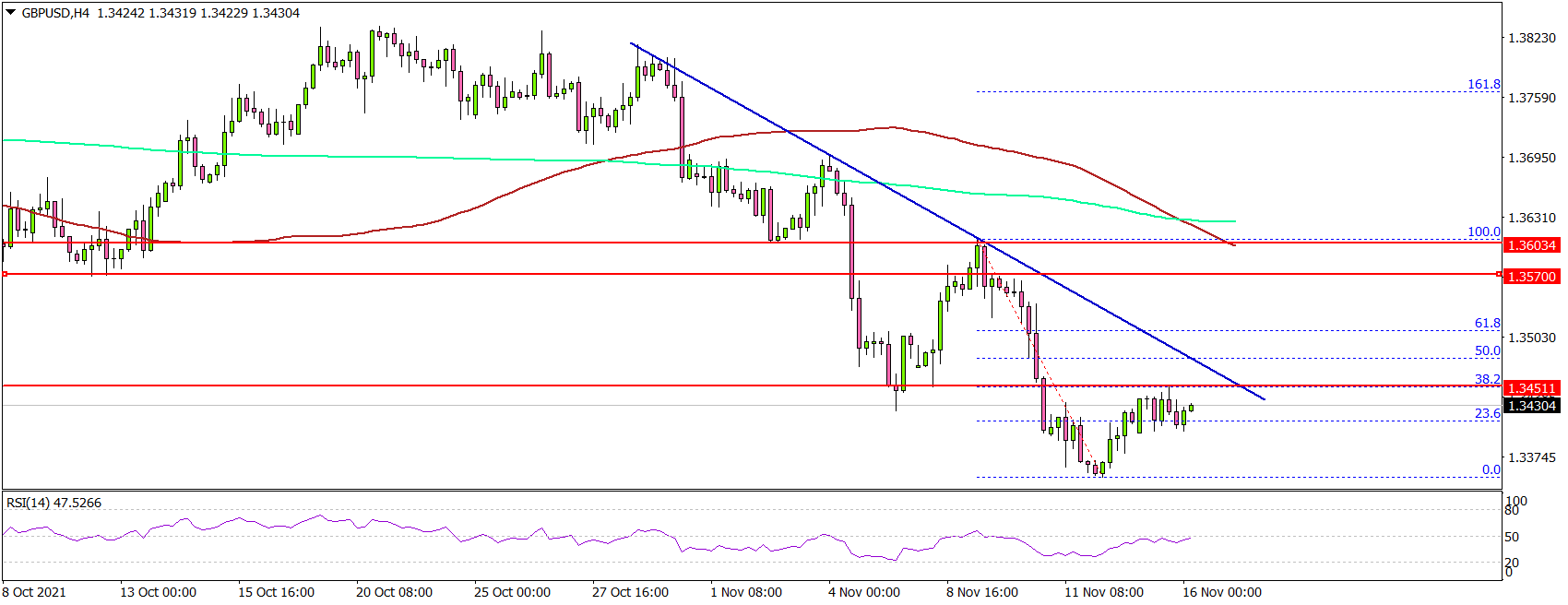
Looking at the 4-hours chart, the pair traded as low as 1.3353. It settled well below the 1.3500 level, the 200 simple moving average (green, 4-hours), and the 100 simple moving average (red, 4-hours).
It is now correcting losses and trading above 1.3400. There was a break above the 23.6% Fib retracement level of the recent decline from the 1.3608 swing high to 1.3353 low.
An immediate resistance is near the 1.3440 level. The next major resistance is near the 1.3450 level. There is also a key bearish trend line forming with resistance near 1.3460 on the same chart.
The main resistance is forming near 1.3480. It is close to the 50% Fib retracement level of the recent decline from the 1.3608 swing high to 1.3353 low. A clear break above the 1.3450 and 1.3480 resistance levels could open the doors for a steady increase. The next key resistance could be 1.3550.
An immediate support is near the 1.3420 level. The main breakdown support is near the 1.3400 level, below which there is a risk of more losses. The next major support is near the 1.3350 level.
Looking at EUR/USD, the pair failed to start a decent recovery wave and extended decline below the key 1.1400 support zone.
Economic Releases
- UK Claimant Count Change for Oct 2021 – Forecast -30.0K, versus -51.1K previous.
- UK ILO Unemployment Rate for Sep 2021 (3M) – Forecast 4.4%, versus 4.5% previous.
- Euro Zone Gross Domestic Product for Q3 2021 (Prelim) (QoQ) - Forecast 2.2%, versus 2.2% previous.
- US Retail Sales for Oct 2021 (MoM) – Forecast +0.7%, versus +0.7% previous.
Eco Data 11/16/21
[php_everywhere instance="1"]