Sample Category Title
Summary 11/15 – 11/19
Monday, Nov 15, 2021
[php_everywhere instance="1"]
Tuesday, Nov 16, 2021
[php_everywhere instance="2"]
Wednesday, Nov 17, 2021
[php_everywhere instance="3"]
Thursday, Nov 18, 2021
[php_everywhere instance="4"]
Friday, Nov 19, 2021
[php_everywhere instance="5"]
Weekly Economic & Financial Commentary: Inflation Shows No Signs of Backing Down in October
Summary
United States: Inflation Shows No Signs of Backing Down in October
- The inflation bells were ringing this week as the consumer price index climbed a hefty 0.9% in October, pushing the year-over-year rate over 6%, the highest in 30 years. Amid this uptick, inflation fears weighed on consumers' minds as sentiment dipped five points and near-term inflation expectations increased to 4.9%. Job openings came in at 10.4M in September as a fresh quits rate record and evidence of job switching may mean further delays to the labor force recovery.
- Next week: Retail Sales (Tues.), Industrial Production (Tues.), Housing Starts (Wed.)
International: U.K. Economic Growth Slows Sharply in the Third Quarter
- U.K. GDP growth slowed sharply in Q3 to 1.3% quarter over quarter, with a respectable increase in consumer spending while business investment edged only slightly higher. The quarter ended on a solid enough note as September GDP rose 0.6% month-over-month. The mixed figures mean the Bank of England's December monetary policy meeting remains a close call, although we lean toward a 15-bp rate hike at that announcement.
- Next week: Japan GDP (Mon.), China Retail Sales & Industrial Output (Mon.), U.K. CPI (Wed.)
Interest Rate Watch: Fed Likely Will Start Tightening in 2022
- We now look for the overall rate of CPI inflation to average 5.2% in 2022, up from 4.7% this year. In our view, this elevated inflation rate will prompt the FOMC to raise rates next year. We now look for the Committee to increase its target range for the federal funds rate by 25 bps in Q3-2022 with another 25-bp hike in the Q4-2022.
Credit Market Insights: Broad-Based Extensions of Credit Bring Household Debt to $15.2 Trillion
- Total household debt rose $286 billion (+1.9%) from the second quarter to cross the $15T mark for the first time ever.
Topic of the Week: Veterans in the Labor Market
- In honor of America's 19 million veterans, we have recently written a report on the labor market outcomes of veterans and their families. We believe that military service and subsequent educational opportunities make veterans an asset across employment sectors and roles.
The Weekly Bottom Line: Inflation Hits 30-Year High
U.S. Highlights
- The Consumer Price Index data stole the show this week, with inflation hitting 30-year highs in October.
- Transportation prices have brought the drama in the run up in core inflation to above 4% in 2021, but widespread price pressures in a variety of core inflation categories have played a key supporting role.
- Markets are also waiting for the President’s decision on whether Chair Powell will be reappointed for a second term. Odds are he will be, but there are three other spots on the Board of Governors up for grabs. The new members will have their work cut out for them balancing inflation pressures with maximum employment.
Canadian Highlights
- Following this week’s frothy U.S. inflation data, Canada will get its own CPI report for October next week. Canadian inflation should clock in at 4.6% y/y - trailing the U.S. by a healthy margin.
- Inflation hasn’t run as hot in Canada as it has stateside, with Americans seeing faster price growth for several items, including food and energy products.
- Wage inflation is also much tamer in Canada, lowering the risk of a wage-price spiral, but also pointing to negative real wage growth. This could weigh on the recovery moving forward.
U.S. - Inflation Hits 30-Year High
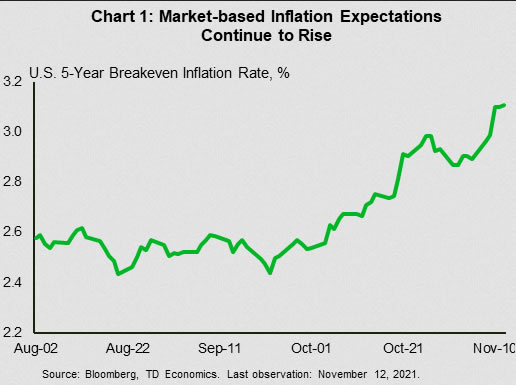
The Consumer Price Index data stole the show this week, with both headline and core inflation (excluding food and energy) at 30-year highs in October. Increased market concern about inflation dampened sentiment in equity markets, and bond yields rose. Market-based measures of inflation expectations have also been on the rise (Chart 1), and market pricing on the first Fed hike was brought forward from September 2022 to July. Last week, we updated our own timing on the first Fed hike to next summer (see Dollars & Sense).
Headline inflation was 6.2% in October on a year-on-year basis, and core inflation wasn’t too far behind at 4.6%. Price pressures were broad based in October, and it was hard to find a category where price pressures were cooling. Energy prices were a big part of the story with a 4.8% month-on-month gain and up 30% versus a year ago. Food prices have also been climbing steadily, and were 5.3% higher than a year ago, the fastest pace since early 2009.
Chart 1 is a bar graph showing month over month gains in U.S. non-farm payroll employment for the month of October 2021. There were gains in monthly employment for all sectors except Government where employment declined by 73 thousand.
Transportation costs have brought the drama when it comes to the 30-year high in core inflation readings (Chart 2). Comparing the drivers of core inflation to two years ago, transportation has contributed over 70% of the acceleration. They were a key factor in the run up in inflation back in the spring as the economy re-opened. They had taken a breather through the summer but were back in action in October. Both new (+1.4% m/m) and used (+2.5% m/m) car prices were on the rise again, which had knock-on effects on rental car prices, which rose rising 3.1% on the month. Price pressures for vehicles are due to the semiconductor shortages hampering availability of new vehicles, driving consumers to the used market. This also affected rental car companies that had to ramp up for the surge in demand for travel.
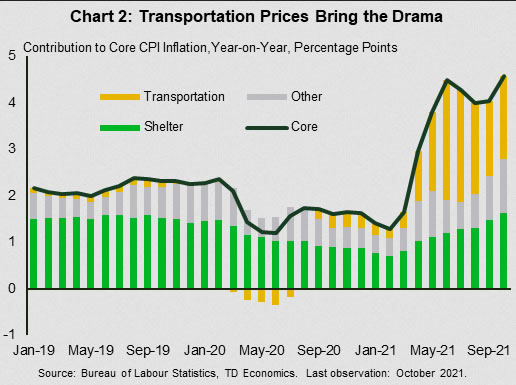
Much of these transportation related price pressures are likely to ebb next year. But, as Chart 2 shows, there has been a gradual swell of inflation pressures both in the heavily weighted shelter component and widespread pressures across a variety of other categories. This is seen in the pace of core inflation excluding transportation, which has picked up to a 2.8% year-on-year pace – quite a bit hotter than 2.2% in October 2019. These underlying price pressures are likely to remain strong enough to support rate hikes by the middle of next year.
At this critical juncture in post-pandemic monetary policy, the make-up of the Fed’s Board of Governors is set to undergo a material shift – starting with a possible change in the Fed Chair. The President is set to announce his decision on whether to re-appoint Chair Powell for a second term in the next two weeks. The betting odds are that Powell will be re-appointed, although Governor Brainard is also likely in the mix.
Whether there is a new Chair or not, there are likely to be at least three new faces on the influential seven-member Board of Governors. Governor Quarles announced his retirement this week, there was already a vacancy on the board, and Vice Chair Clarida’s term expires in January. Any new members are going to have to hit the ground running, as they weigh the balance between fostering continued healing in the labor market, and vigilance on inflation.
Canada - It's Not as Hot Up in Canada
Hot on the heels of a frothy U.S. inflation report, Canada gets its own peek at October consumer prices next week. Inflation is highly correlated in both countries and based on past relationships, the U.S. report would imply a heated month for Canada too. Our own take is that inflation advanced 0.6% m/m – a steamy gain indeed, but softer than the U.S. print. Similarly, Canadian inflation should clock in at 4.6% on a year-on-year basis, well below the 6.2% pace recorded in the U.S.
October is not unique in that Canadian inflation has consistently trailed the U.S. since the middle of last year, with the gap between the two at one point growing to its highest level in nearly 15 years in June. That's not all, as when we attempt to control for impacts of the pandemic in 2020 by measuring inflation in 2-year annualized rates, Canada also trails its neighbour to the south. However, shorter-term trends imply that the gap is narrowing.
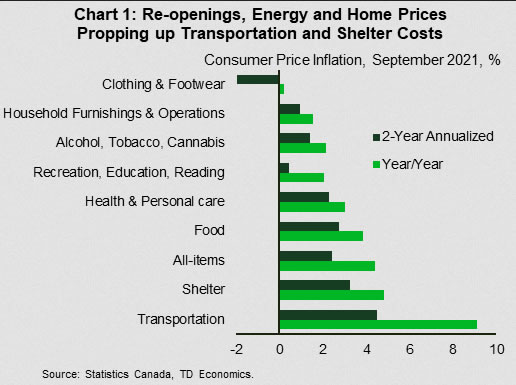
Canadian inflation rates are running cooler than their U.S. counterparts in several major categories. Measured on a 2-year annualized basis, both food and energy prices are experiencing softer inflation in Canada. Meanwhile, price growth for recreational services in the U.S. has been stronger - likely a function of states lifting public health restrictions sooner than provinces. In addition, the U.S. has seen firmer prices for household furnishing items, alcoholic beverages and even apparel. All told, Canada's inflation issue is less severe than it is stateside. However, that's of cold comfort to Canadians who have seen surging prices for items such as gasoline, natural gas and meat products as well as healthcare services (Chart 1).
A key reason for cooler inflation in Canada is tamer wage growth amid greater labour force participation. Indeed, average hourly earnings in both the Canadian LFS and SEPH employment reports are growing at around 2%. Meanwhile, the latter's fixed weighted index of average hourly earnings (which controls for factors that can skew figures reported on an average basis), is only mildly stronger at 2.8%. Compare this to average hourly earnings in the U.S., which are running at a near 5% pace. Many U.S. businesses are passing on higher labour costs to consumers.
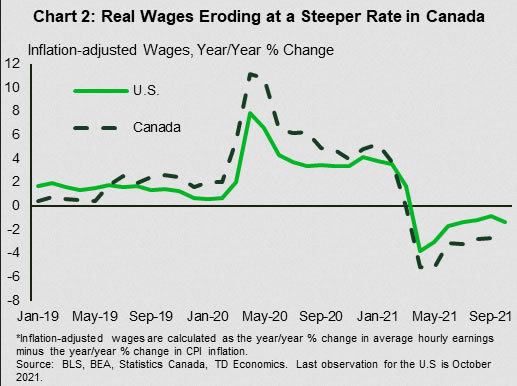
The absence of significant wage inflation in Canada is a bit of a double-edged sword. On the one hand, less inflation in the labour market can prevent a wage-price spiral that turns consumer price inflation from "transitory, but not short-lived" to something even more entrenched. On the other hand, wages for Canadian workers are falling in real terms, and at a faster rate than for workers in the U.S. (Chart 2). This has negative implications for household spending. Fortunately for the outlook, Canadian households have become wealthier during the pandemic, and have a significant amount of savings to draw upon to finance spending and support the recovery.
Week Ahead – The Great Inflation Debate
Central banks have a massive dilemma on their hands
There’s a clear and unintentional theme to this weeks preview, something that’s increasingly come to dominate the conversation, drive markets around the globe and across asset class, and that we haven’t had to think about or deal with for a long time; inflation.
Central banks have backed themselves into a corner and for different reasons. Whether that’s through sticking to the “inflation is transitory” line for too long, promising rate hikes and not delivering or cutting rates while inflation is rising at an extraordinary rate. Credibility is the lowest its been in years.
The last week was dominated by the US inflation story as CPI hit a 31-year high. This week will be more broad-based, as more countries release inflation data or hold central bank meetings. The US may be front and centre for obvious reasons, but inflation is a global problem and that’s becoming increasingly clear.
US
The focus on Wall Street is all about inflation and whether the Fed is making a policy mistake. The latest retail sales report will show us how strong the US consumer is despite the recent broad-based pricing pressures. The October retail sales report is expected to show a resilient consumer is beginning holiday shopping. Sales at retail stores, restaurants, and online sellers are expected to increase by 1.1%, an improvement over the 0.7% seen in September.
Given Wall Street’s new stance over pricing pressures, investors will closely listen to a wrath of Fed speakers to find out if some policymakers are abandoning the “inflation is transitory” stance. On Tuesday, Fed’s Barkin and Daly speak. Wednesday will have speeches from Fed’s Bowman, Mester, Daly, Waller, Evans, and Bostic. On Thursday, Fed’s Bostic, Daly, and Waller Speak. Friday contains appearances by Fed’s Waller and Clarida.
EU
Perhaps not the most eventful week ahead, in theory, but as we’ve seen in recent days in the US, these are very sensitive times. The primary takeaway from the ECB meeting a couple of weeks ago was that the markets weren’t buying what Lagarde was selling. Her dovish message fell on deaf ears.
The final CPI number shouldn’t see much of an upward revision if any, but if it does, it will only add to the inflation narrative which could further spook investors.
UK
If there’s one major central bank that’s hoping to catch a break on inflation, the Bank of England is surely it. It’s backed itself into a corner in recent weeks, warning of an impending hike, before bottling the decision last Thursday. Either an increase is nailed on for December or policymakers will be begging for reprieve when the inflation data is released next week.
Retail sales and labour market figures will also add some context, especially as they’ll account for the end of the furlough scheme at the end of September which the central bank was apparently keenly waiting for.
Russia
Next week has little on offer from Russia, with PPI data the only release of note.
This week, it was announced that the country will have a prototype of the digital rouble platform early next year and tests will be run before any decision is made. Not market moving at the moment but a potentially important step as central banks further explore the cryptocurrency space.
South Africa
The SARB will make its interest rate announcement on Thursday. The central bank could raise rates but market expectations are pointing to no change this month. Rates will rise over the next couple of years though, with the neutral rate well above the current level. A 25 basis point hike wouldn’t be a total shock.
Turkey
Inflation is close to 20%, USDTRY is within a whisker of 10 for the first time ever and the CBRT is likely to cut interest rates by another 100 basis points next week. Unconventional to put it mildly but with the central bank’s credibility in tatters, there’s little reason to expect its approach to suddenly change now. The situation has deteriorated greatly and the worst is probably yet to come.
China
The week kicks off with a selection of Chinese data releases including retail sales, industrial production and fixed-asset investment. The readings are expected to show some stabilisation after falling sharply over the course of this year. Power outages, Covid outbreaks, property woes, crackdowns and more have dragged on activity this year and while stabilisation is encouraging, many challenges still lie ahead.
Evergrande avoided default by the skin of its teeth again this week which keeps the party going a little longer. Other developers have been dragged into the firing line in recent weeks, including Kaisa Group which also has offshore payments due in the short-term, and may not have the same luck. It’s still not clear how this mess will be cleared up and how bad it will get for the sector or the broader credit markets. But every last minute payment buys time which investors are hoping leads to a relatively pain-free resolution.
India
A very light data week for India, with WPI inflation on Monday the only standout release. Stagflation is a word repeatedly thrown out when discussing India’s outlook at the moment and Monday’s data could further fuel it.
Australia
RBA minutes and a speech from Governor Lowe will be front and centre for Australia next week as investors try to make sense of the inflation situation and what central banks are actually going to do. The RBA isn’t alone in this but it certainly contributed to it when it abandoned its yield targeting days before its last meeting. With markets seemingly going it alone on rate expectations when it comes to some central banks, it’s critical that policymakers rebuild bridges and regain trust quickly.
New Zealand
For New Zealand, inflation expectations looks like the standout release on Thursday, although the house price index on Wednesday may also attract some interest.
Japan
A plethora of economic data coming out of Japan next week and it’s hard to know where to start. The economy is likely to have contracted in the third quarter due to the state of emergency but it should rebound in the current quarter as Covid measures were lifted. Fiscal stimulus is also on the way which should help the economy bounce back.
Japan is one country where inflation metrics are not making for ugly reading. Yes, low to no inflation is far from ideal. But at least it’s not putting the BoJ under enormous pressure to raise rates when the economy isn’t ready for it. Other releases this week include industrial production and capacity utilization on Monday, and trade balance and machine orders on Tuesday.
Key Economic Events
Saturday, Nov. 13
COP26 ends
Economic Data/Events
- China medium-term lending
Sunday, Nov. 14
- Hungary PM Orban holds its annual congress
Monday, Nov. 15
- Energy ministers, policymakers and leading industry executives attend the Abu Dhabi International Petroleum Exhibition and Conference (ADIPEC)
- US Secretary of Commerce Raimondo makes her first official visit to Asia, where she will meet with government officials and business leaders in Japan, Singapore and Malaysia.
- India will allow foreign visitors into the country for the first time in 18 months due to the pandemic.
- US Trade Representative Tai travels to Asia for meetings with officials in Tokyo, Seoul and New Delhi.
- In a joint EU session, foreign affairs and defence ministers review the first draft of the bloc’s Strategic Compass.
- UK PM Johnson delivers the annual Lord Mayor’s Banquet speech.
- BOE Haskel speaks at the Resolution Foundation.
Economic Data/Events
- US Nov Empire Manufacturing: 20.1 v 19.8 prior
- Japan GDP
- Thailand GDP
- Poland CPI
- Canada existing home sales
- China property prices, retail sales, industrial production, surveyed jobless
- New Zealand performance services index, net migration
- Indonesia trade
- India trade, wholesale prices
- Turkey home sales, budget balance
- Japan industrial production, tertiary index, capacity utilization
- UK Rightmove house prices, Bloomberg economic survey
Tuesday, Nov. 16
- Fed Presidents Barkin, George and Bostic take part in a discussion about racism and the economy with a focus on financial services, hosted by the Minneapolis Fed.
- Fed’s Harker speaks at Philadelphia Fed Annual Fintech Conference
- Reserve Bank of Australia Governor Lowe speaks to the Australian Business Economists Webinar.
Economic Data/Events
- US business inventories, cross-border investment, retail sales, industrial production
- Eurozone GDP
- Hungary GDP
- Poland CPI
- Canada housing starts
- Australia ANZ Roy Morgan consumer confidence, RBA minutes of policy meeting
- Hong Kong jobless rate
- Japan tertiary industry index
- UK jobless claims, unemployment
- Turkey house price index
Wednesday, Nov. 17
- SEC Chair Gensler and the presidents of the Fed in New York and San Francisco speak at the US Treasury Market Annual Conference.
- European Central Bank Financial Stability Review.
- Bank of Russia Governor Nabiullina speaks at an industry forum.
- UK PM Johnson speaks to the Liaison Committee
Economic Data/Events
- US housing starts
- Eurozone CPI
- UK CPI
- Canada CPI
- South Africa CPI
- Russia GDP, CPI
- Italy trade
- Japan machinery orders, trade
- New Zealand PPI
- Australia Westpac leading index, wage price index, Bloomberg economic survey
- Singapore electronic exports, non-oil domestic exports
- Mexico international reserves
- South Africa retail sales
- EIA Crude Oil Inventory Report
Thursday, Nov. 18
- IMF Managing Director Georgieva speaks at the fund’s Statistical Forum – ‘Measuring Climate Change: The Economic and Financial Dimensions’.
Economic Data/Events
- US Conference Board leading index, initial jobless claims
- Singapore GDP
- South Africa (SARB) Rate decision: Expected to keep Interest Rate at 3.50%
- Turkey (CBRT) Rate decision: Expected to cut One-Week Repo Rate 100 bps to 15.00%
- Eurozone new car registrations
- Australia RBA FX transactions
- China Swift global payments CNY
- New Zealand two-year inflation expectations
- Thailand car sales
- South Korea short-term external debt
- Russia gold and forex reserves
Friday, Nov. 19
- BOE Chief Economist Huw Pill speaks in Bristol.
- Fed’s Richard Clarida and Mary Daly speak at Asia Economic Policy Conference.
- EU Justice Commissioner Didier Reynders visits Warsaw amid the escalating judicial row between Poland and the bloc.
Economic Data/Events
- Norway GDP
- Japan CPI
- Canada retail sales
- France unemployment
- UK GfK consumer confidence, retail sales, public sector net borrowing
- New Zealand credit-card spending
- Thailand foreign reserves, forward contracts
- China FX net settlement
Sovereign Rating Updates:
- Switzerland (Fitch)
- South Africa (S&P)
- Greece (Moody’s)
- South Africa (Moody’s)
- Denmark (DBRS)
Forward Guidance: Inflation Data in Focus as Supply Chain Disruptions Drag on
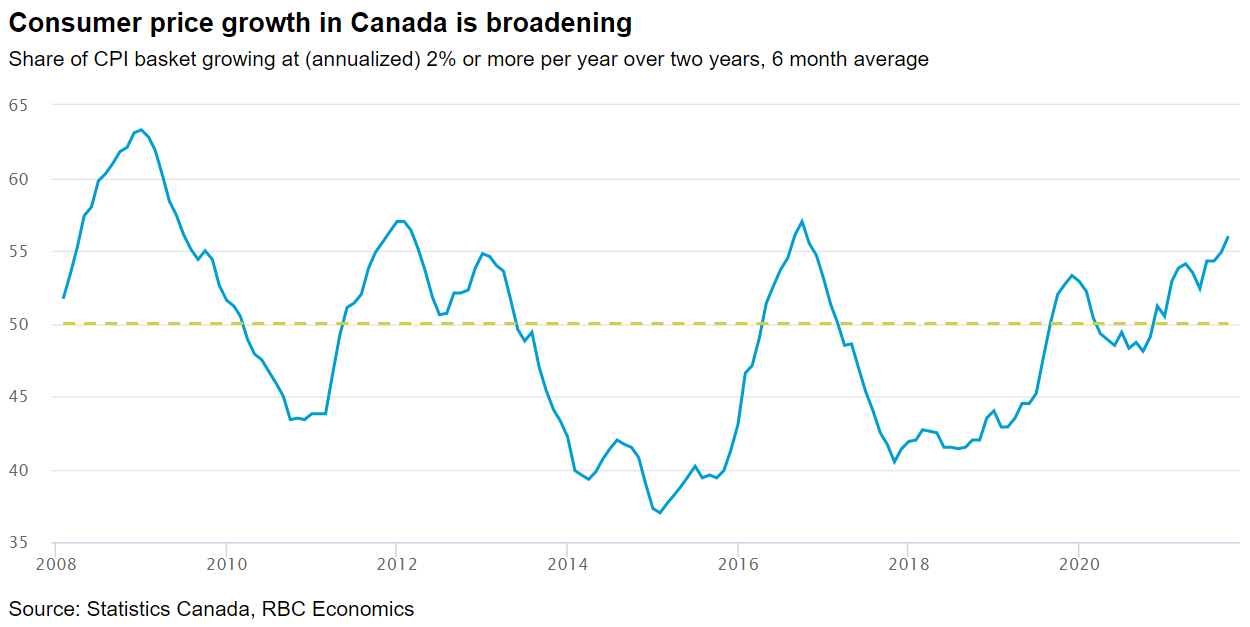
A busier calendar of economic data will be headlined by October inflation numbers. We expect the inflation rate ticked up to 4.5% reflecting higher food, gasoline, and home purchase/ownership costs. Annual CPI growth is still being biased higher by weak year-ago comparables when the economic impact of the pandemic was more severe. Price growth has been broadening versus pre-pandemic (2019) levels as well, and that is expected to continue in October. Retail food prices, particularly for meat, have increased substantially in recent months following an earlier jump in agricultural commodity prices. Prices at the pump rose 5.1% from September to October, building on already elevated levels. Shelter costs, particularly owner’s replacement costs and other owned accommodation costs (realtor/broker fees) have been key drivers of price growth above pre-pandemic trends and that likely continued in October given a reacceleration in home resale prices. Auto related components including new vehicle and car rental and leasing costs are expected to show another increase as supply continues to be curtailed by the continuation of the global semi-conductor shortage.
The impact of the chip shortage will also be evident in next week’s retail and manufacturing reports. Advance estimates have already suggested weaker sales in October, with retail and manufacturing falling 1.9% and 3.2% month over month, the latter mostly reflecting weaker transport equipment sales. Spending on services however has continued to improve through September into October, particularly for travel related items as indicated by RBC’s consumer spending tracker. That said, spending on travel continues to run well-below pre-pandemic levels, suggesting more room for recovery in coming months with border restrictions further eased for travel between Canada and the US.
Week ahead data watch:
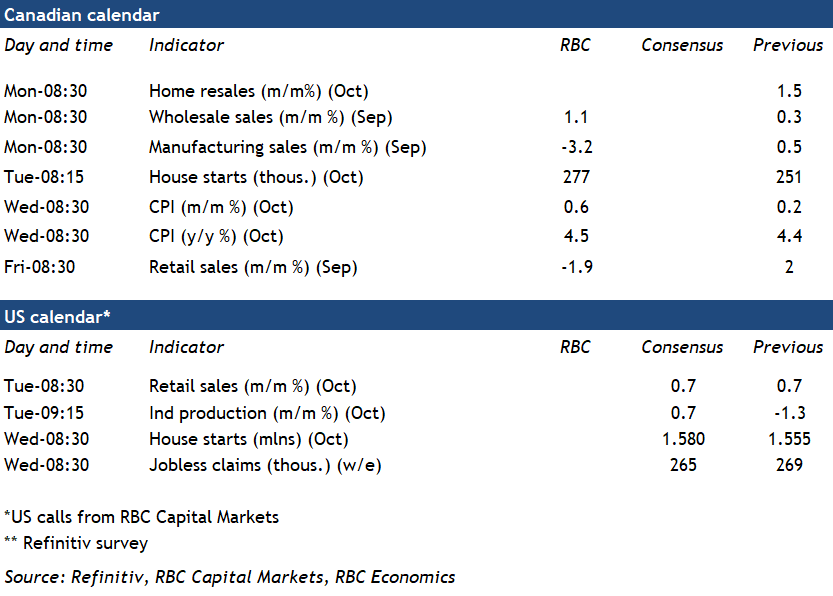
The official preliminary estimate of Canadian September retail sales showed a 1.9% decline. We expect little change to the preliminary estimate although spending on some services (particularly travel-related) have continued to recover according to our own consumer tracker.
We see little reason to deviate from StatCan’s preliminary estimates that manufacturing sales fell 3.2% in September, with most of the weakness coming from transportation-related items. Manufacturing hours worked were little changed in September, but motor vehicle exports dropped 18% with the global semiconductor shortage disrupting production. Wholesale sales, though, ticked up by about a percentage point in the official Statcan early estimate.
Housing starts in Canada are expected to tick up to an annualized 277k in October, after stronger permit issuance reported for the prior months.
Week Ahead – More CPI Data Incoming; Is the Inflation Storm about to Get Bigger?
As inflation in the United States hits a three-decade high, there could be further nasty surprises on the way as more countries publish their monthly CPI prints. The focus will also be on the economic recovery, as there is a host of other data coming up, including from the United Kingdom, Japan, China and Canada. Will global bonds join the selloff in US Treasuries if inflation surges elsewhere too, or will the dollar continue to ascend?
US retail sales might add fuel to dollar’s rally
The transitory narrative is starting to crumble after America’s consumer price index jumped to a 31-year high of 6.2% year-on-year in October. Although the shock beat is unlikely to impact near-term policy by the Fed, especially as tapering has only just kicked off, it does raise some serious questions about how long the US central bank will be able to stay ‘patient’. Up until now, the patchy nature of the recovery was one of the reasons why policymakers were erring on the side of caution. But with the US economy having now more than recouped the lost output from the pandemic slump and both the labour market and consumption appearing to be on a steadier footing after some recent wobbles, the Fed could be losing the argument for maintaining policy so accommodative.
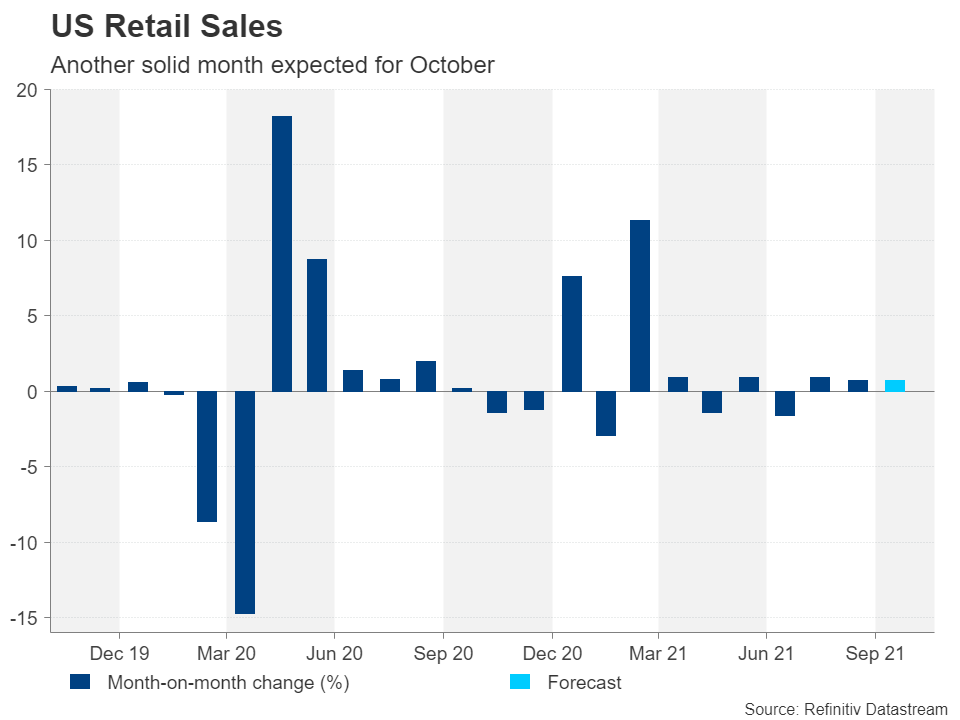
After the CPI report, all eyes next week will be on the retail sales numbers for October due Tuesday. Retail sales are expected to have risen by 0.7% over the month, the same pace as in September, which would suggest the final quarter of the year got off to a solid start.
Various manufacturing indicators will shed further light on how strong the growth momentum is in the world’s largest economy. The Empire State manufacturing index is released on Monday, along with industrial output figures, while the Philly Fed manufacturing index comes out on Thursday. Other key data include housing starts and building permits due Wednesday.
If the upcoming numbers underscore the bullish picture, Treasury yields could extend their gains, propelling the US dollar to fresh multi-month highs. The dollar index has hit 16-month peaks, breaking above the 95 level, mainly at the expense of sterling.
Can the pound find solace in upcoming flurry of data?
It’s been a dreadful couple of weeks for the British currency. Investors were left scrambling after the Bank of England confounded market expectations of a rate hike at its November meeting, instead keeping them on hold and pummelling the pound. But just as the pound was starting to get back on its feet, then came another blow from the US inflation shock.
However, there will be plenty of opportunities next week for sterling to regain some lost ground as it’s going to be a packed release schedule. The labour market report will launch things on Tuesday. If there is another big gain in employment in September, this would ease concerns at the Bank of England about the impact of the government furlough scheme coming to an end.
October inflation data on Wednesday could further fuel bets that the BoE will hike rates at one of its upcoming meetings if CPI rises by more than expected. Forecasts are for annual CPI to hit 3.9%, well above the BoE's upper limit of 3%.
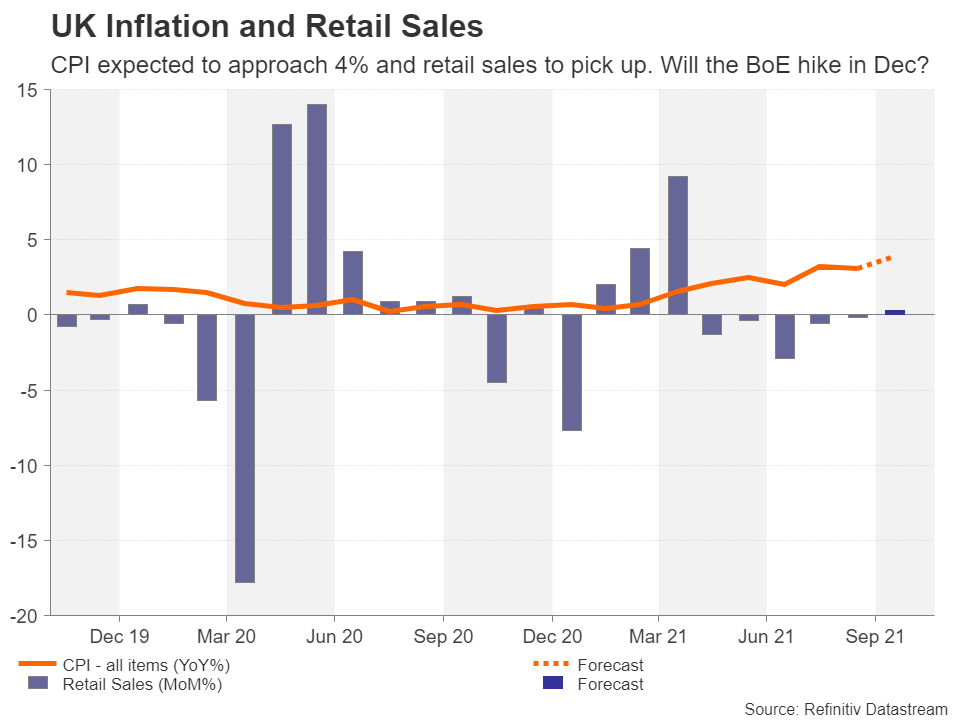
Finally, retail sales figures will be crucial on Friday as UK consumer spending has been quite sluggish since May. Another negative print in October would undermine any boost from hot inflation readings.
Loonie hoping for strong CPI to stem losses
CPI and retail sales numbers will also be doing the rounds in Canada. Annual inflation had surged to 4.4% in September, which was an 18-year high. Although the Bank of Canada has brought forward slightly the expected timing of its first post-pandemic rate hike to Q2/Q3, investors are strongly pricing in a move in March.
If the data on Wednesday shows that inflation continued to march higher in October, it would bolster the case for an even earlier hike, lifting the Canadian dollar, which got pushed to one-month lows versus the mighty greenback this week.
Also to watch out of Canada are retail sales figures on Friday.
Rate hike speculation to dominate for aussie and kiwi
Staying with commodity-linked currencies, China’s monthly data dump might set the mood for global markets and risk-sensitive FX pairs on Monday as industrial output, retail sales and fixed-asset investment readings for October are published. For the aussie, quarterly wage growth data out of Australia will be important too on Wednesday. The Reserve Bank of Australia wants to see wage growth hit 3% in a sustained fashion before contemplating raising rates so progress towards that goal in Q3 would be positive for the battered Australian dollar.
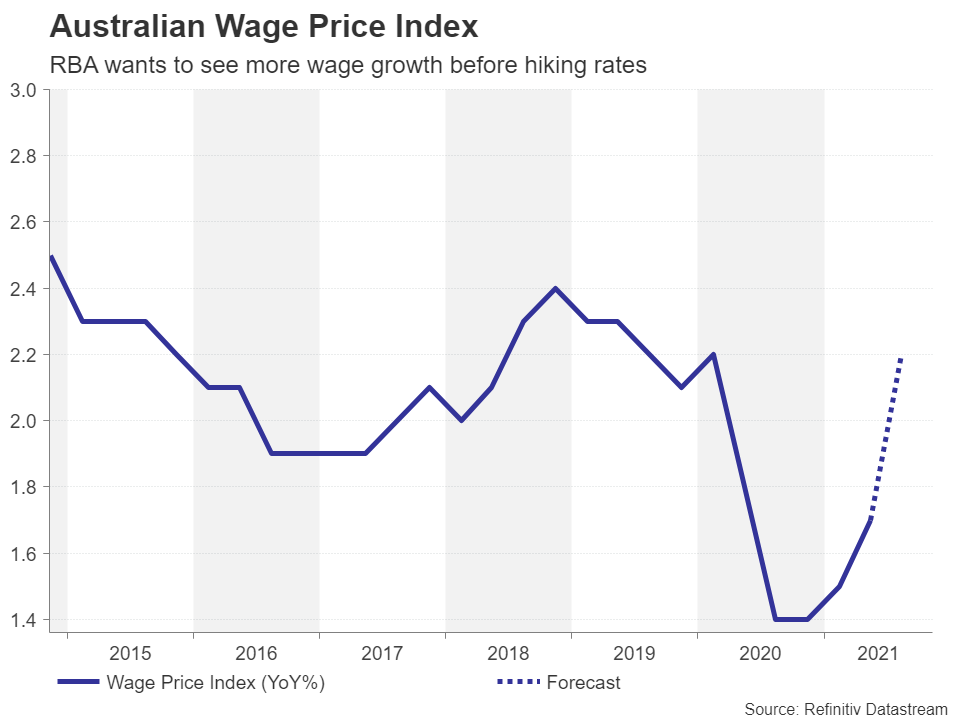
Meanwhile, the RBA will be publishing its November meeting minutes on Tuesday, which could reveal more about the discussions around the rate hike timeline following the decision to drop the three-year yield target.
The Reserve Bank of New Zealand will not be able to escape investors’ attention either as its quarterly business survey is out on Thursday. Aside from gauging business sentiment, the survey also asks business managers about their forecasts for inflation. If the report points to inflation expectations still trending higher (one- and two-year expectations have already shot past 3% and 2%, respectively), it would strengthen the odds of a 50-bps rate increase by the RBNZ when it meets later this month. This could provide some much-needed upside for the New Zealand dollar, which, like its aussie and loonie counterparts, has been unable to overcome the greenback’s advances.
Japan’s inflation problem – or lack of
In Japan, it will likely be somewhat of a grimmer picture for the yen as Q3 GDP numbers due on Monday will probably show the economy contracted by 0.2% quarter-on-quarter. Machinery orders and trade numbers for September will follow on Wednesday.
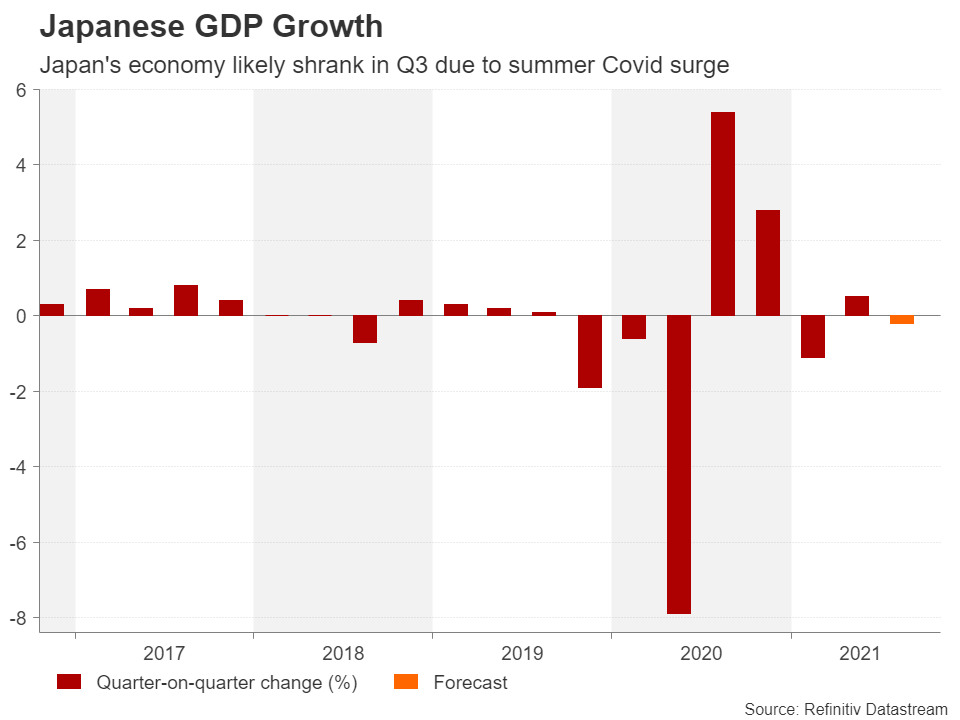
With Japan’s fifth and worst virus wave finally abating, the GDP estimates may be considered to be somewhat out-of-date, although there are concerns about how quickly the economy can rebound amid the supply constraints and soaring energy prices that are causing pain for manufacturers.
However, when it comes to the yen, it’s all about yield differentials and the Bank of Japan is not about to step away from its yield-bashing policies anytime soon. Prices may be spiralling higher in most parts of the world, but in Japan, they remain muted. The core CPI rate out on Friday is expected to have held steady at 0.1% y/y in October. Without any danger of inflation overshooting the BoJ’s 2% target over the coming months, there is no prospect of the yen ending its post-pandemic slide against its major peers anytime soon.
Weekly Focus – Will US Consumers be Daunted by Higher Inflation?
After the flurry of central bank meetings and strong US jobs report last week (see US Labour Market Monitor - Stronger jobs report but participation remains subdued), markets calmed down somewhat at the start of this week. However, another strong upside surprise in US October CPI inflation (printing at 6.2%, highest since 1990) turned the tables, highlighting the risk that inflation will be more persistent than expected by the Federal Reserve and thus raising the probability of a faster tightening of monetary policy (see Global Inflation Watch - Highest US wage growth in more than 10 years). The market response was clear with a jump in global bond yields and equities selling off. Markets have now priced in three 25bp Fed hikes in 2022, which pushed EUR/USD below the 1.15 level amid broad USD strengthening. Spill-overs were also seen in European fixed income markets, with higher yields and spread widening between EU-Core and periphery government bonds. US Brent oil moved back above USD85 per barrel after the US administration signalled it will refrain from releasing strategic reserves to the market.
A string of Chinese data released during the weak, continued to paint a mixed picture. On the back of booming (US) goods demand, exports beat expectations in October. Producer price inflation jumped more than expected to a 26-year high, but CPI inflation at 1.5% also remained comfortably below the PBOC's 3% inflation target. The credit impulse has turned higher, but strains in Chinese property markets linger, with stress spreading to investment grade bonds and the Chinese off-shore USD high-yield index reaching a new record high. Media reported that the government is mulling steps to ease bond issuance rules for developers and preparing capital injections from banks and institutional investors. German ZEW economic expectations surprised on the upside in November, rising for the first time since May, while inflation expectations continued to ease. It will be interesting to see whether November PMI figures show a similar pattern, after clouds have darkened over to the euro area macro outlook of late (see Euro Area Macro Monitor - Darkening clouds on the horizon).
Next week's key release will be the US retail sales which have continued to surprise on the upside in recent months. Elevated US goods consumption remains an important driver behind the global supply chain pressures and Tuesday's figures will reveal whether goods spending has started to weaken in October on the back of high inflation. A range of Fed speakers will also be keenly watched by the market for monetary policy hints. In the euro area, final HICP figures will reveal more details about the trend in underlying inflation pressures, after core inflation surged to the highest level since 2002 in October. In China, we expect Monday's retail sales and industrial production figures for October to be on the soft side, given disruptions from power shortages and another Covid-19 wave. Given the Bank of England's renewed focus on labour market outcomes to determine the hiking cycle, the UK jobs report on Tuesday (as well as the CPI figures on Wednesday) will also be of interest. US President Joe Biden and Chinese President Xi Jinping are scheduled to hold a virtual summit next week. In Japan, new PM Kishida will reveal a new stimulus package to kick-start the recovery. In Australia the central bank will keep a close eye on Q3 wage inflation data, a key indicator for Reserve Bank of Australia's transitory inflation view, and a low print could push back on market's aggressive rate hike pricing.
Dollar Turns Down after Printing New Highs
Eyes on JOLTS job openings ahead of inflation expectations
There is a scarcity of fresh information today. The JOLTS job openings for September and the preliminary November consumer mood index from the University of Michigan will be released later in the day. The results of the JOLTS survey should demonstrate that supply of workets continues to be the most pressing issue in the labor market. These are generally second-tier economic data from the United States, but they may garner more attention this time around because the spotlight is currently on inflation forecasts and the job quit rate. Traders will look on inflation forecasts for the next year in the Michigan survey, which are expected to rise to 4.9%. The Fed's Williams will have a speech today.
The US dollar index is retreating somewhat after the jump towards a fresh high of 95.24 earlier today. Dollar/yen is moving below the 114.00 psychological mark, after two consecutive green days.
Several dangers to growth remain on the table for the euro. Consumers are being squeezed by rising energy prices, China's economic slowdown is disappointing news for Europe's main export market, and rising covid cases in the Netherlands forced the country to enact a temporary lockdown. As the number of cases has risen recently, Germany could follow suit. The euro is tumbling to a fresh 16-month low of $1.1442.
Brexit comes back on the radar
Brexit tensions are still attracting a lot of interest. As part of the ongoing negotiations, the two parties will meet in London today. According to the most recent sources, the EU is prepared to improve its offer to reduce customs procedures in Northern Ireland, but it is nearing the end of its patience. According to reports, EC Vice President Sefcovic will tell the UK today that an agreement will not be feasible until the country lifts its "unachievable" demands that the European Court of Justice be removed from its supervision function. Frost, the United Kingdom's chief Brexit negotiator, has called for a thorough rewrite of the agreement and has warned of unilateral amendments if the EU does not make sufficient concessions. Currently, the pound is trading at $1.3410, well under the 11-month low of 1.3352.
Commodities
In other markets, gold prices are posting a negative session after six consecutive green days but remain comfortably above $1,800/per ounce. Also, oil prices are heading south, dropping beneath $80.00/per barrel.
USD/JPY Mid-Day Outlook
Daily Pivots: (S1) 113.87; (P) 114.01; (R1) 114.21; More...
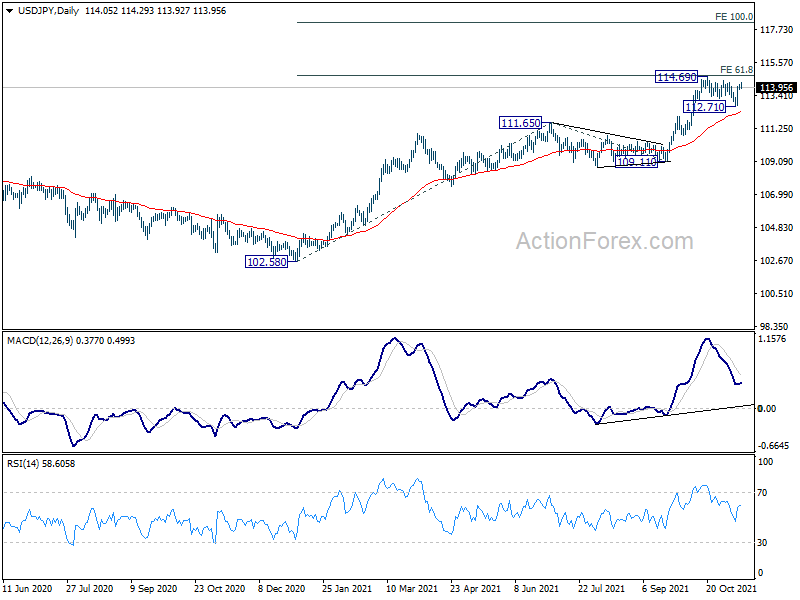
Intraday bias in USD/JPY remains mildly on the upside for retesting 114.69 high. Sustained break there will resume larger up trend for 100% projection of 102.58 to 111.65 from 109.11 at 118.18 next. On the downside, in case of another fall, we'd continue to expect downside to be contained above 112.07 resistance turned support to bring rebound.
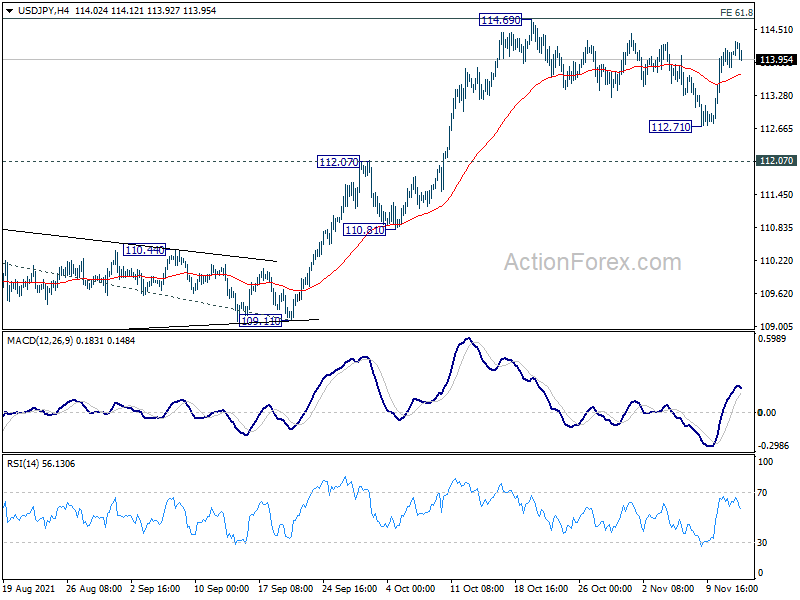
In the bigger picture, corrective decline from 118.65 (2016 high) should have completed at 101.18 already. Rise from the 102.58 is seen as the third leg of the up trend from 101.18. Next target is 114.54 resistance and then 118.65 high. This will now be the preferred case as long as 109.11 support hold, even in case of deep pull back.
USD/CHF Mid-Day Outlook
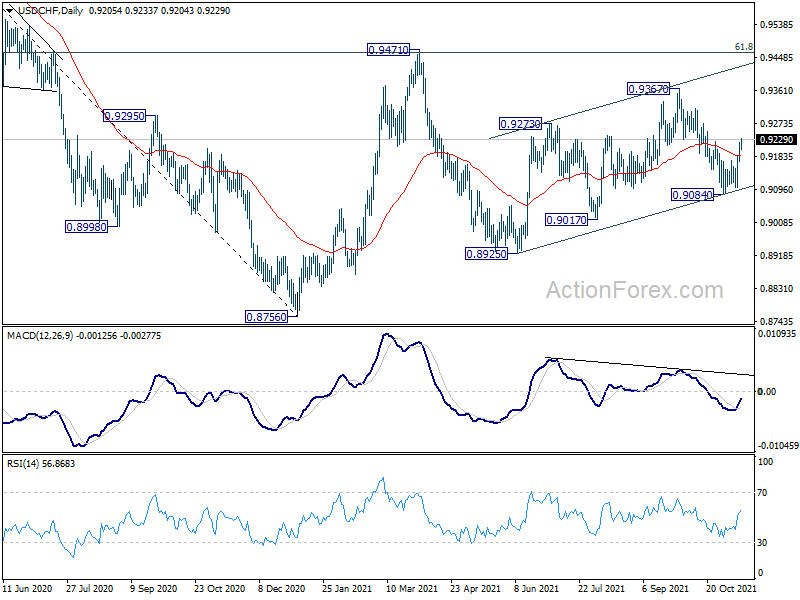
Daily Pivots: (S1) 0.9183; (P) 0.9204; (R1) 0.9231; More....
Intraday bias in USD/CHF stays on the upside at this point. Rebound from 0.9084 short term bottom would target a test on 0.9367 resistance. On the downside, below 0.9172 minor support will turn intraday bias back to the downside for 0.9084 instead.
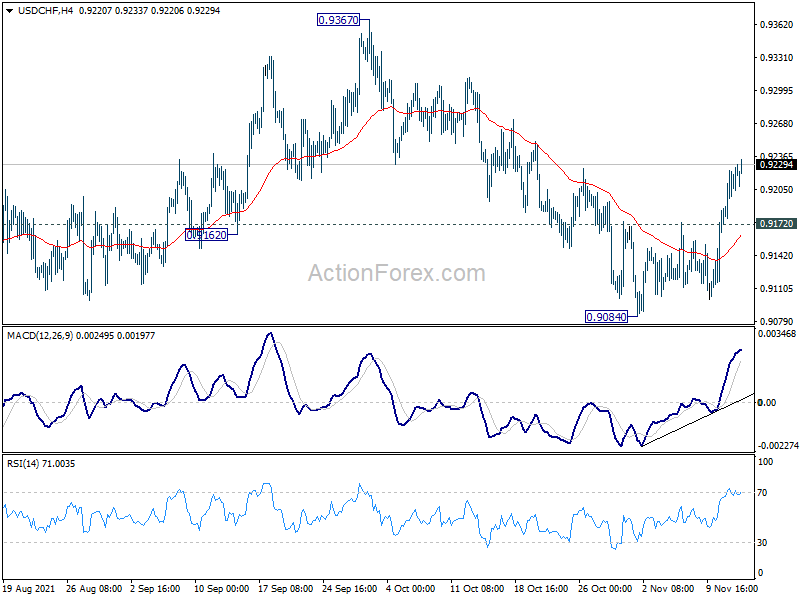
In the bigger picture, the corrective structure of the rebound from 0.8925 argues that fall from 0.9471 is not complete yet. It could either be the second leg of pattern from 0.8756 (2021 low), or resuming larger down trend from 1.0237 (2018 high). We'd pay attention to the downside momentum and assess the odds later. But for now, medium term outlook will be neutral at best as long as 0.9471 resistance holds.