Sample Category Title
Oil Slips On OPEC+, Gold Drifting
Oil falls on OPEC+
Oil prices fell overnight as OPEC+ took less than 30 minutes to go ahead with adding scheduled 400,000 bpd of production to global markets. Additionally, the group revised their consumption forecasts to swing to a production surplus of 2.5 million bpd in 2022. Oil prices fell initially but were salvaged later in the session after official US Crude Inventory data recorded a surprise 7.0 million-barrel fall.
Brent crude finished the overnight session 0.55% lower at USD 71.30, and WTI closed 0.40% lower at USD 68.25 a barrel, having spiked lower to near USD 67.00 intraday. The noise of the overnight session has not been repeated in Asia, where both contracts have recorded a modest 0.15% recovery. Brent crude is trading at USD 71.40 and WTI at USD 68.35 a barrel.
Both contracts are flirting with support at their 100-DMAs, with WTI closing below it. The inability to maintain support at USD 72.00 and USD 68.00, respectively, suggests that the downside remains the path of least resistance now. It is also notable that the giant falls in US crude inventories and the production closures from Hurricane Ida have had no meaningful, supportive impacts on oil prices. Therefore, Brent crude could test USD 70.00 and WTI USD 67.00 a barrel ahead of tomorrow’s US jobs data.
Gold is unchanged once again
Gold finished another session unchanged for the 3rd day in a row, closing at USD 1814.00 an ounce overnight. It continues to trade aimlessly in a narrow range in Asia, easing 0.15% to USD 1811.60 an ounce.
For now, gold appears to be off investors’ radars, but my concerns that upward momentum is stalling are increasing. After the V-shaped recovery last week, gold has been unable to break out of the confines of its 100 and 200-DMAs, today at USD 1814.50 and USD 1809.40 an ounce, respectively. Notably, it has failed to find any upward momentum from the US dollar retreat this week, which is a significant warning sign of a loss of upward momentum.
Gold is vulnerable to a potentially sharp fall through USD 1800.00 an ounce ahead of the US data tomorrow, which could flush out fast-money longs, potentially extending losses to USD 1780.00 an ounce. Gold has resistance at USD 1820.00 and then a formidable resistance zone between USD 1830.00 and USD 1835.00 an ounce.
The US Dollar Retreat Continues
Dollar dips as tapering concerns ease
The US dollar fell once again overnight as hawkish inflation rhetoric from Europe lifted the euro, and US ADP and ISM PMI data reinforced expectations of a softer jobs print from the US tomorrow, adding credence to Jerome Powell’s apparently dovish Fed tapering outlook. The dollar index fell by 0.15% to 92.50, where it remains in Asia today. That hawkish euro-inflation lifted EUR/USD by 0.25% to 1.1840, and a rally through 1.1860 targets 1.1900. GBP/USD was dragged higher to 1.3775, but it once again failed at 1.3800. GBP/USD needs to overcome the 50 and 200-day moving averages (DMAs) at 1.3810 to swing the technical picture decisively bullish.
With US tapering fears receding, risk sentiment bell weathers, the Australian and New Zealand dollars outperformed. AUD/USD rose 0.70% to 0.7365 as of this morning and remains on track to test 0.7400 ahead of the US data. NZD/USD has risen by 0.30% to 0.7065 but must overcome the 100 and 200-DMAs at 0.7085 and 0.7115 to maintain upward momentum. A soft US Non-Farm Payrolls print tomorrow night should greenlight 200 point-plus rallies by both next week.
With USD/CNY holding steady once again at 6.4620, regional Asian currencies have been left to their own devices today. USD/THB and USD/KRW are 0.40% higher, with the rest of USD/Asia slightly higher for the session. After rallying powerfully for the last week or so, it looks like investors are trimming Asia FX long positioning into the US data. A softer Non-Farm print tomorrow (<750K) should allow Asian FX to resume its upward trajectory. With the US ADP and PMI data overnight signalling, employment remains subdued. Although not for employers not trying hard enough to hire workers, the market has decisively shifted towards the US Non-Farms coming in on the soft side of 750,000 jobs. That reinforces the market's preferred narrative of a later and slower taper, thus keeping the buy-everything rally's momentum going. Therefore, a surprise print above 900k is likely to have a greater impact. We could see a squeeze of short US dollar positions across both the DM and EM space in that scenario.
Asian Markets Mixed As NFP Looms
Asian equities mixed ahead of US data tomorrow
Asian markets are having a mixed day, with a bias to the downside, as regional investors digest the latest Chinese government clampdown of the day and look to reduce exposure into tomorrow’s US Non-Farm Payroll release. Overnight, there was also a sense of positioning for safety as US technology outperformed in what was otherwise a slightly negative session after the US ADP and ISM PMI data.
The S&P 500 finished just 0.03% higher, while the Nasdaq rose by 0.33%, with the Dow Jones edging 0.13% lower. Futures on all three are slightly negative in directionless Asian trading.
In Asia, the Nikkei 225 has risen 0.30% after BoJ Board member Kataoka said the Japan recovery was not fast enough and the BoJ could ease further. In South Korea, the Kospi has fallen by 1.05% after higher than expected inflation data raised the spectre of further central bank tightening.
China’s summoning of 11 ride-hailing firms for a meeting has not impacted the main Shanghai Composite index, which is 0.50% higher, but has seen the CSI 300 fall by 0.33% with Hong Kong treading water, up by just 0.15% today. Singapore’s Straits Times has edged 0.17% lower, with Taipei down 0.55%, Kuala Lumpur easing by 0.14%, and Bangkok unchanged.
Australian markets have taken fright at warnings by the Australian medical establishment that they are not ready for a deluge of Covid-19 cases once the economy reopens. Fears that today Q2 Balance of Trade will be a high-water market for the economy, much of it in lockdown in Q3, also seem to be weighing heavily. The ASX 200 has fallen by 0.80%, with the All Ordinaries lower by 0.60%.
Equity markets appear to be reacting to a combination of local headlines and pre-US-data positioning adjustments on a slow news day. Assuming the same pattern of behaviours, I expect European markets to open on the heavier side, especially as inflation-fighting rhetoric is getting louder from the ivory towers of central bank intelligentsia.
Tapering Fears Recede
Investors cautious after soft US data
Tapering nerves receded further overnight after a very soft ADP Employment number and the ISM Manufacturing PMI employment sub-index contracted. That has taken the heat out of expectations for this Friday’s US Non-Farm Payroll data and further reinforced Fed Chairman Powell’s cautious approach in the markets’ minds.
Equities traded sideways, with tech outperforming in an old-school flight to quality. Although US yields remained mostly unmoved, the reduction in tapering fears impacted the US dollar, which fell sharply versus the major currencies overnight. That was helped along by more hawkish rhetoric emerging from Europe after higher recent Eurozone and German inflation numbers.
OPEC+ took only 30 minutes at their JMMC meeting to approve a further 400,000 bpd of production this morning, in line with their previously announced schedule. That sent oil prices lower, but a 7 million barrel drop in official US Crude Inventories saved the day for black gold.
Asian markets are trading cautiously today as the street moves into a pre-Non-Farms holding pattern. An early rally in China equities looks in danger of being snuffed out by, you guessed it, the Chinese government. Reuters is reporting that 11 ride-hailing firms have been summoned by regulators and the Transport Ministry to a “meeting.” Another day, another clampdown. Dip-buyers in China equities will keep dipping their toes. However, I believe we are a long way still from repricing China equities to a level that balances the government’s “enthusiasm” for common prosperity.
Economic releases in Asia today have been mostly positive. South Korean final Q2 GDP improved slightly to 0.80% MoM and 6.0% YoY. That positive note has been offset, to some extent, by August Inflation coming in higher than expected at 0.60% MoM and 2.60% YoY. The Korean won has barely reacted, circling in a Non-Farm holding pattern, but the prospects of further Bank of Korea rate increases loom, and that is weighing on local equity markets.
Australia’s Balance of trade for July outperformed, rising to AUD 12.117 billion, while Home Loans only contracted by -0.40%. Both exports and imports increased, and despite the Covid-19 lockdowns, the economy is proving remarkably resilient. Improving risk appetite saw the Australian dollar rally powerfully overnight. Still, equities received no solace from the data today, focusing on warnings from the medical establishment about the health system’s ability to weather a full reopening once vaccination targets have been met.
The data calendar is a wasteland across Asia and Europe for the rest of the day. US Initial Jobless Claims will receive more than usual attention after the ADP data and ahead of the US Non-Farms. But most eyes are likely to be focused on US Factory Orders for July. In the bigger picture, though, it looks like we are in for a headline-driven 24 hours in financial markets until tomorrow’s main event in New York. Currency expectations are for a 750,000 jobs Non-Farm Payroll print. With the taper doves in control at the moment, a much higher number is likely to have the greatest surprise factor. That said, the street now looks locked and loaded for a good old-fashioned FOMO-buy-everything-sell-US dollars move if the data is soft.
WTI Oil Outlook: Stronger Than Expected Drop In Crude Inventories Inflated Oil Prices
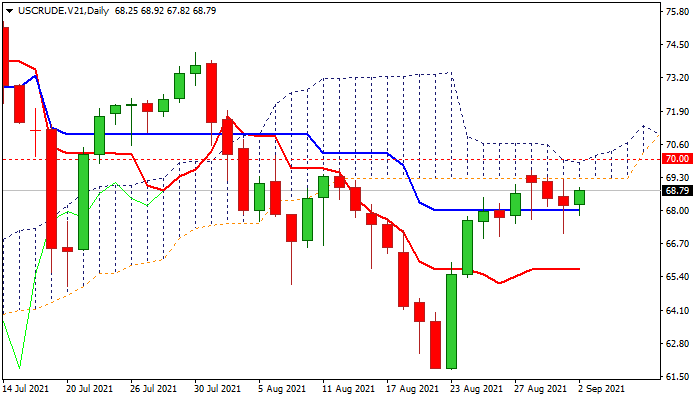
The WTI regained traction and edged higher on Thursday after three-day drop was contained by converged 10/20DMA’s which formed bull-cross.
Oil prices dropped on Wednesday after the OPEC+ group agreed to keep its policy of gradually phasing out record output reductions by adding by adding 400,000 barrels per day each month, but raised its demand forecast or 2022 that partially offset negative impact.
On the other side, US crude inventories fell by 7.2 million barrels and petroleum product supplies rose to a record despite the rise in new coronavirus cases that offered additional support to oil prices.
Bulls are on course for renewed attack at daily cloud base ($69.25) which capped the recent strong rally, with narrowing cloud which is going to twist next week, expected to be magnetic.
Sustained break of psychological $70 barrier (slightly above 50% retracement of $76.95/$61.82 pullback) would boost bulls and add to signals that corrective phase from new three-year high ($76.95) is over.
Caution on repeated rejections under $70 pivot, with return below 20DMA ($67.26) to sideline bulls.
Res: 64.00, 64.78, 65.12, 66.00.
Sup: 67.60, 67.26, 67.10, 66.62.
GBP/USD Outlook: Bulls Continue To Struggle At Key 1.3800 Resistance Zone
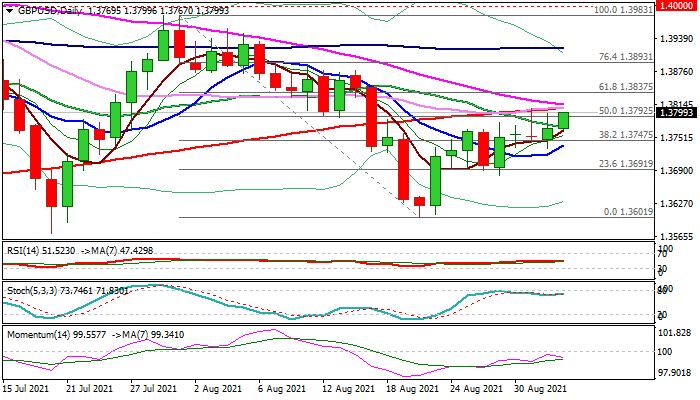
Cable remains constructive in early European trading on Thursday and holding within thick daily cloud, but long upper shadows on candles of past two days warn of headwinds bulls face.
Also, repeated rejection above 50% retracement of 1.3983/1.3601 (1.3792) downleg signal of formation of bull-trap, that additionally weighs on bulls.
Strong resistances at 1.3800 zone are reinforced by converged 55/30/200DMA’s and repeated failures to clearly break these barriers would add to signals of stall.
Daily MA’s are in mixed setup, momentum is in the negative territory and RSI is neutral, lacking clear direction signal.
Sustained breakthrough 1.3800 zone would generate initial signal of bullish continuation and expose targets at 1.3837/93 (Fibo 61.8% / 76.4% of 1.3983/1.3601).
Conversely, break and close below 10DMA (1.3736) would sideline bulls.
Res: 1.3815, 1.3837, 1.3878, 1.3893.
Sup: 1.3763, 1.3747, 1.3736, 1.3707.
EURGBP Backs Off Near Six-Week High
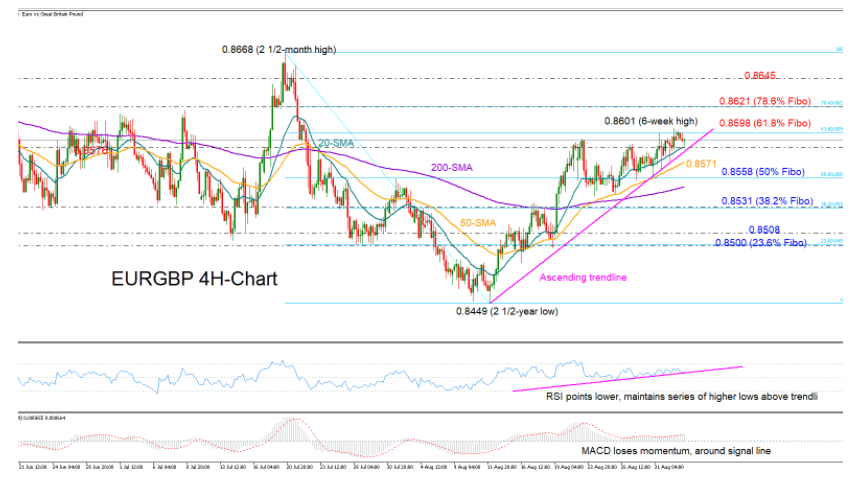
EURGBP faltered after barely surpassing the 0.8600 level on Wednesday in the four-hour chart. The 61.8% Fibonacci retracement of the 0.8668 - 0.8449 down leg is also in the neighborhood, cementing that ceiling and making any violation at this point important to watch.
The soft slowdown in the RSI and the MACD is reflecting a weakening bullish bias. Yet, as long as the former maintains its higher lows above the short-term ascending trendline and the latter remains around its red signal line and within the positive territory, any downside correction in the price could raise little worry.
Instead, a slide below the supportive trendline drawn from the 2 ½ -year low of 0.8449 could create some anxiety, especially if the 50-period simple moving average (SMA) at 0.8571 proves fragile this time, letting selling forces to spiral towards the 50% Fibonacci of 0.8558. Moving lower from here, the 200-period SMA may attempt to prevent any declines towards the 38.2% Fibonacci of 0.8531.
On the upside, a solid move above the 61.8% Fibonacci of 0.8598 could see a continuation towards the 78.6% Fibonacci of 0.8621. Beyond that, the bulls will push harder to close above the 0.8645 barrier with scope to upgrade the broad outlook above the 0.8668 top.
Summarizing, EURGBP is holding a positive-to-neutral bias in the short-term picture. A break above 0.8598 may spark another bullish round, whereas a clear break below the trendline could enhance the current selling pressures.
Dollar Bleeds After Hints Of NFP Disappointment
- Soft US jobs indicators cool expectations for tomorrow’s NFP
- Dollar extends retreat, stocks hang on to record highs
- Oil prices ease as OPEC sticks to the plan, gold trades quietly
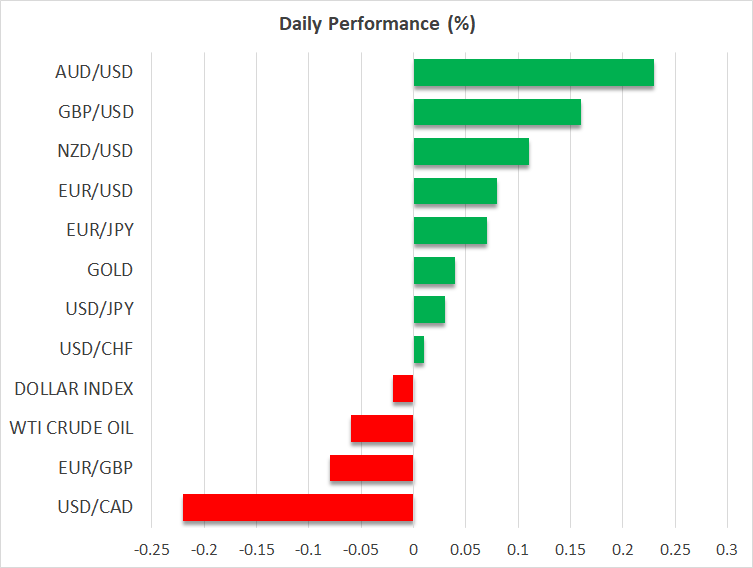 Investors on alert for NFP disappointment
With markets buzzing about when the Fed will finally get the taper process rolling, the spotlight is squarely on tomorrow’s US employment report to determine whether the next FOMC meeting is ‘live’ or not. The tea leaves now point to a disappointment, as a series of labor market indicators have been underwhelming lately.
The ADP report fell short of expectations with only 374k jobs added in August, missing the forecast of 613k. This indicator is seen as unreliable because of its poor predictive power over nonfarm payrolls lately, but a similar weakness was also reflected in the ISM manufacturing and Markit composite PMI surveys, adding credence to the concerns.
As such, the dollar took some fire to hit a one-month low against the euro yesterday, as traders positioned themselves for a potential NFP miss that keeps the Fed from touching the taper button this month. That said, even an abysmal jobs report wouldn’t derail the tapering process - it would only delay it.
America is clearly on a path to a strong labor market. There are now more open jobs than people unemployed, which implies that millions of workers are waiting for the right opportunities. With federal unemployment benefits rolling off, the next few months could bring a hiring bonanza. Indeed, there is a universe where the US returns to full employment by year-end, considering that around 2.5 million people who retired early after the pandemic aren’t coming back.
Stocks waiting for the NFP storm
Over on Wall Street, things were awfully quiet. Stock markets kicked off the new month with a neutral tone, as concerns over economic momentum losing steam were overshadowed by hopes the Fed will keep the financial system overflowing in liquidity for a while longer.
With the earnings season fading into the rear view mirror, the most crucial element for equities will be the evolution of monetary and fiscal programs. In this sense, the picture seems promising. The Fed will avoid shocking markets at all costs during its normalization campaign and Democrats in Congress are trying to unleash trillions more in spending to juice up growth in the coming years.
The biggest issues facing this market are the exorbitant valuations in some sectors and the fact that options flow is now the name of the game, with some unreal gamma squeezes serving as jet fuel for the overall rally. The problem is that gamma squeezes can work in reverse too, on the way down, especially if valuations are so stretched.
Antipodeans, OPEC, and gold
The antipodean currencies came back swinging this week, capitalizing on the softness in the US dollar. Markets have once again priced in a rate increase by the RBNZ next month. However, the rebound in the aussie will be tested if the RBA backpedals on its tapering plans next week.
In the energy arena, OPEC+ agreed to stick to its plans to steadily raise output. Oil prices fell initially after the Russian minister hinted that bigger supply increases may be on the cards, but managed to claw back most of those losses.
Finally, gold couldn’t take advantage of the pullback in the dollar this week, showing no signs of life. A potential NFP disappointment tomorrow could reawaken bullion and hurl it towards the $1835 region, but the longer-term outlook is turning darker with the Fed about to close the liquidity taps.
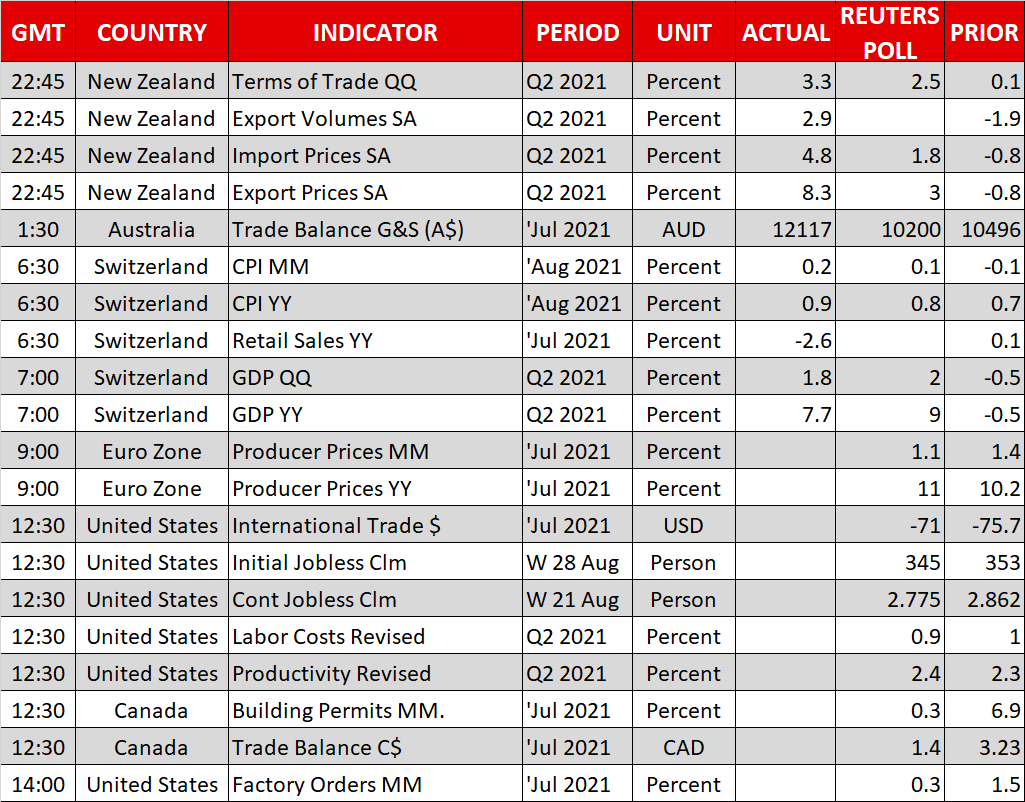
Eurozone PPI at 2.3% mom, 12.1% yoy in Jul; EU up 2.2% mom, 12.2% yoy
Eurozone PPI came in at 2.3% mom, 12.1% yoy in July, well above expectation of 1.2% mom, 10.9% yoy. For the month, industrial producer prices increased by 5.7% in the energy sector, by 1.9% for intermediate goods, by 0.7% for durable consumer goods, by 0.5% for capital goods and by 0.1% for non-durable consumer goods. Prices in total industry excluding energy increased by 1.0%.
EU PPI came in at 2.2% mom, 12.2% yoy. For the month, industrial producer prices increased in all Member States except Malta, where they remained stable. The highest increases were recorded in Ireland (+20.6%), Estonia (+6.4%) and Belgium (+4.2%).
The Analytical Overview Of The Main Currency Pairs
The EUR/USD currency pair
Technical indicators of the currency pair:
Prev Open: 1.1809
Prev Close: 1.1839
% chg. over the last day: +0.25%
The unemployment rate in Europe decreased to 7.6% (previous - 7.8%). But economists believe that the fall in unemployment in the eurozone was caused by a drop in the labor force as a whole rather than an increase in employment. Against the background of the decline in the dollar index, as well as investors' concerns about the fact that the ECB may start to take actions to suppress inflation, the European currency rate increased. The ECB is planning to hold a monetary policy meeting on September 9.
Trading recommendations
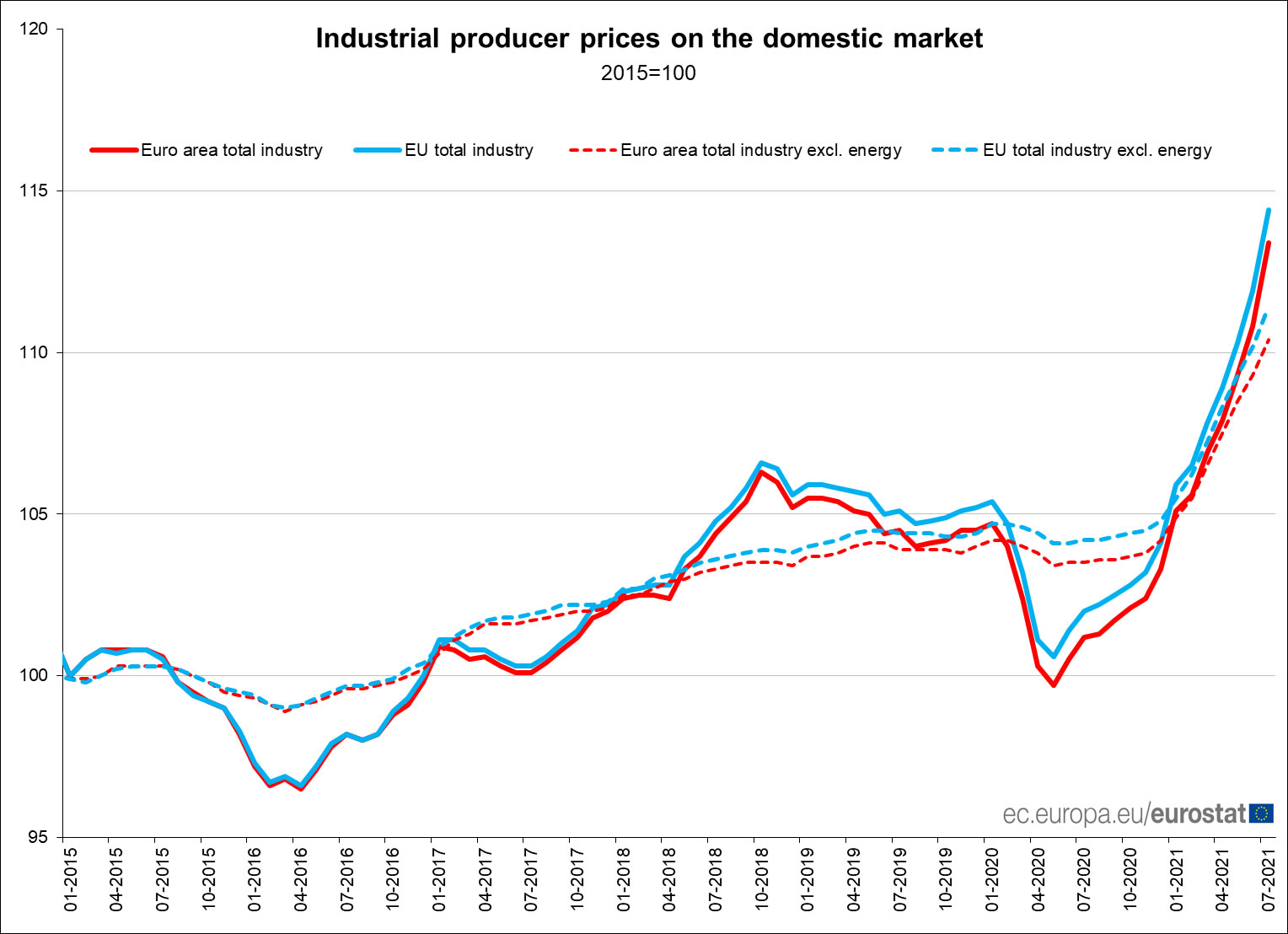
Support levels: 1.1816, 1.1799, 1.1759, 1.1704, 1.1620
Resistance levels: 1.1854, 1.1894, 1.1934, 1.1969
From a technical point of view, the general trend of the EUR/USD currency pair has changed to bullish. The price broke through the priority change level and consolidated above. But the MACD indicator is still signaling a divergence in the opposite direction. The price has deviated from the moving average; given the divergence, the probability of a corrective downward move is increasing. Under such market conditions, it is best to look for sell trades from the resistance levels, where sellers show initiative. Buy trades can be considered only after a pullback to the support levels near the moving average.
Alternative scenario: if the price breaks through the 1.1704 support level and fixes below, the mid-term uptrend will likely be broken.
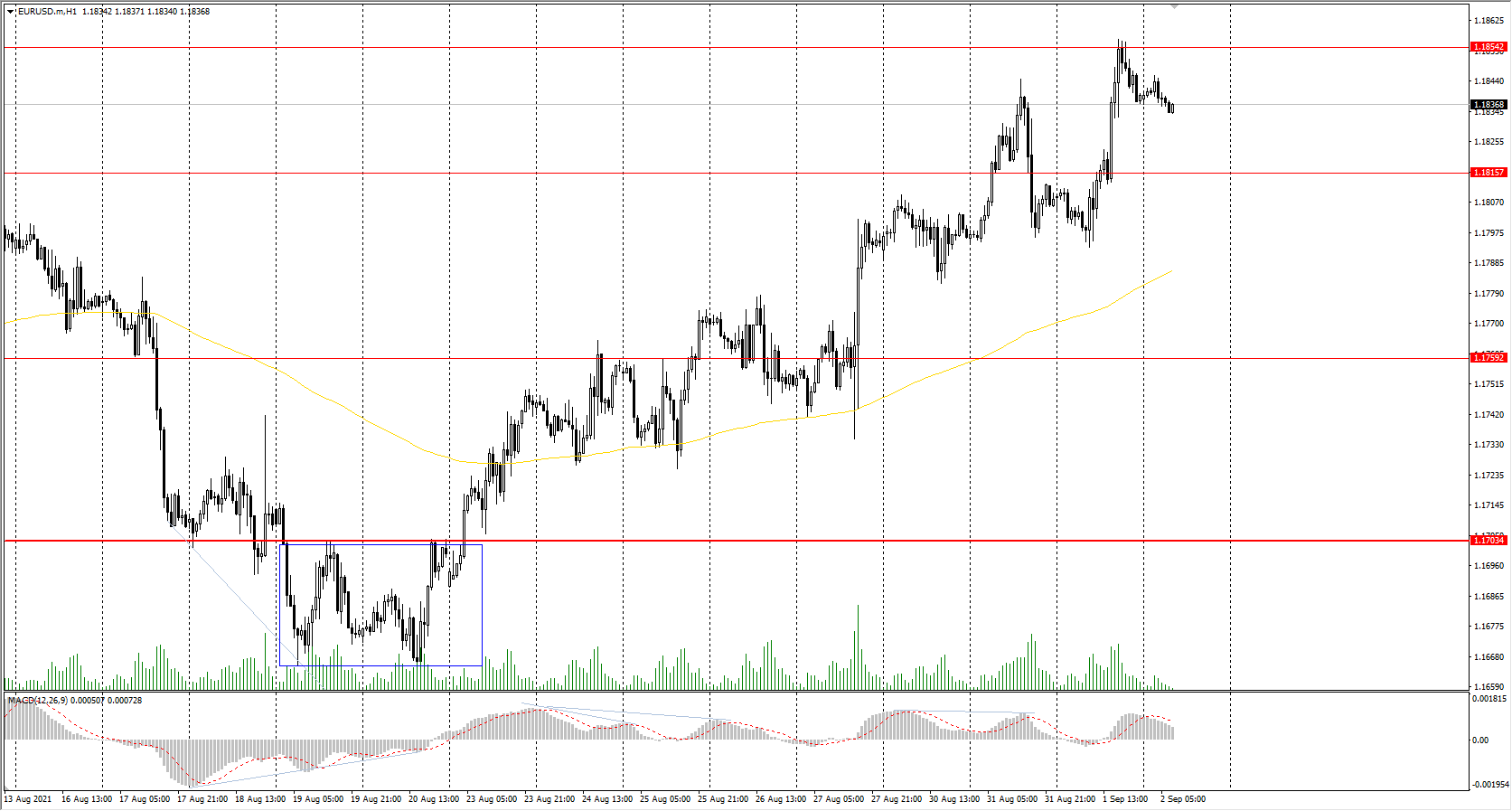
News feed for 2021.09.02:
- US Initial Jobless Claims at 15:30 (GMT+3).
The GBP/USD currency pair
Technical indicators of the currency pair:
Prev Open: 1.3748
Prev Close: 1.3768
% chg. over the last day: +0.15%
The UK Manufacturing PMI increased to 60.3 in August, which is higher than experts forecasts. This is a good sign as the UK manufacturing growth has slowed sharply in recent weeks.
Trading recommendations
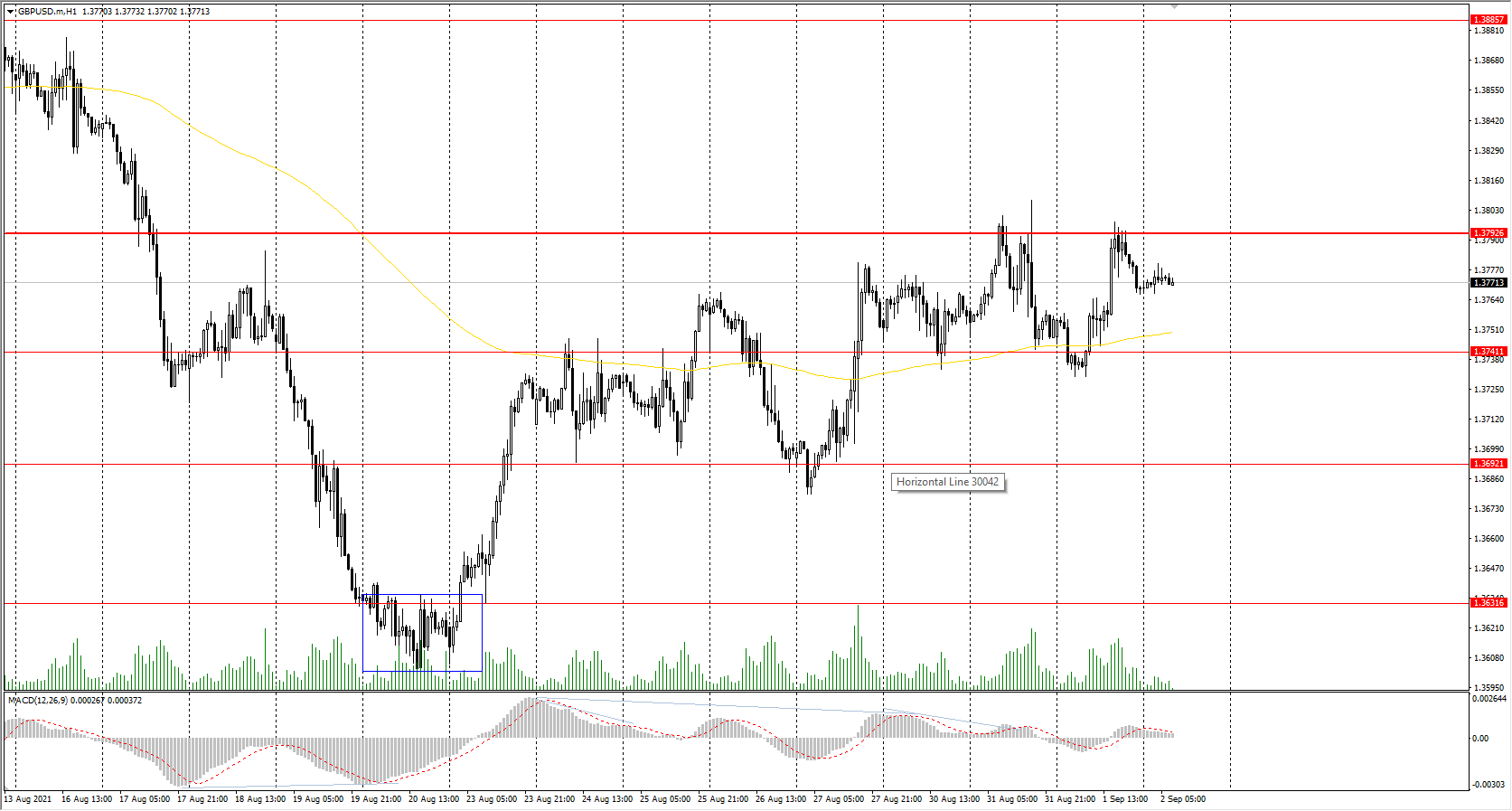
Support levels: 1.3741, 1.3692, 1.3632, 1.3614, 1.3525
Resistance levels: 1.3793, 1.3772, 1.3886, 1.3935, 1.4002
On the hourly time frame, the GBP/USD trend is bearish. But the local trend is upward, and the price is trading near the priority change level. Against the background of the dollar index decline, this level can be easily broken. The MACD indicator has become inactive. Under such market conditions, it is better to look for sell trades from the resistance level, where sellers show initiative. Buy positions can be considered only with short targets throughout the day.
Alternative scenario: if the price breaks through the 1.3793 resistance level and consolidates above, the bullish scenario will likely resume.
The USD/JPY currency pair
Technical indicators of the currency pair:
Prev Open: 109.98
Prev Close: 110.02
% chg. over the last day: +0.04%
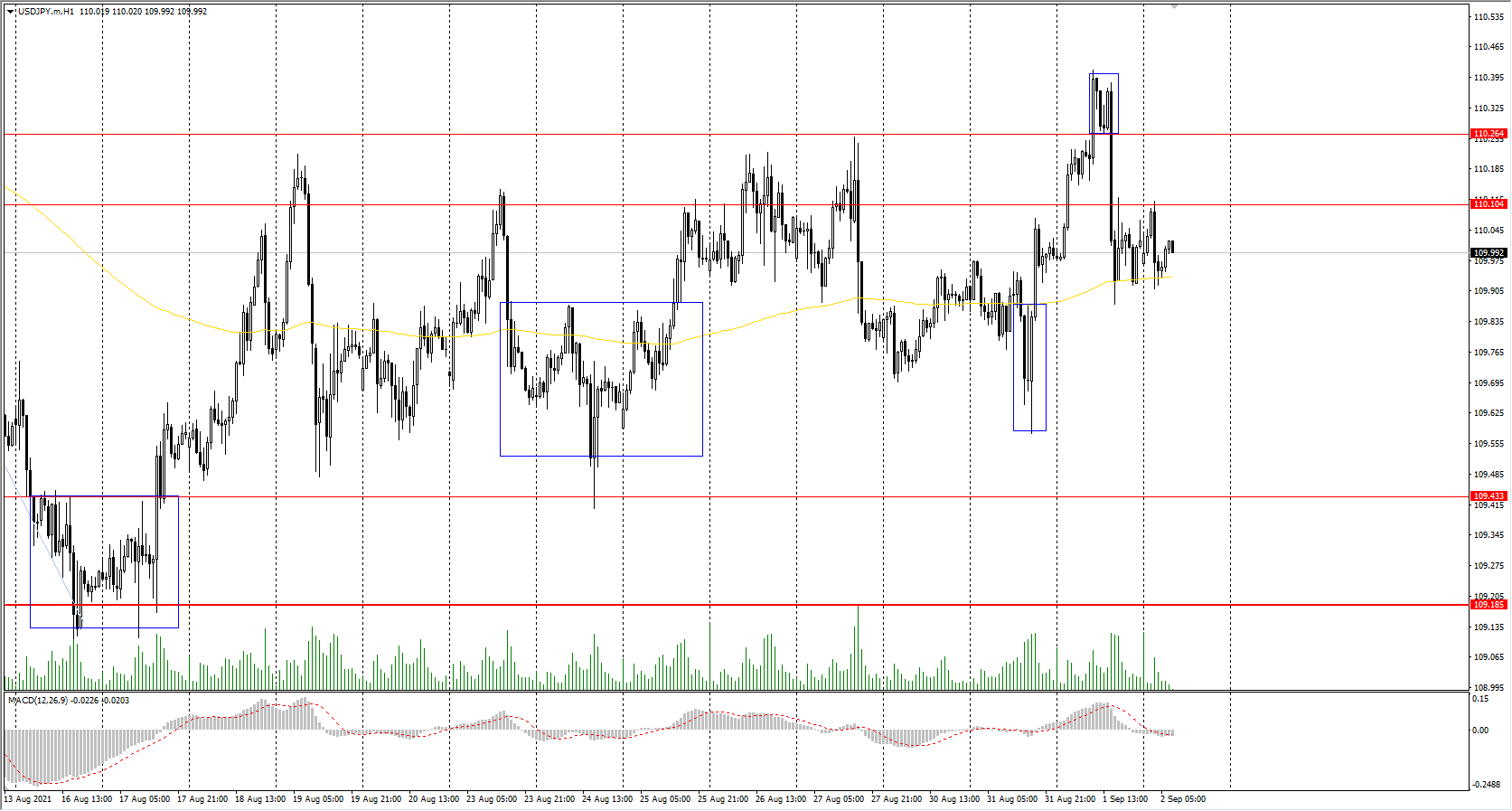
The USD/JPY currency pair is highly dependent on the dynamics of the dollar index now. During the American session, the dollar index fell, which led to a decrease in the USD/JPY quotes. As a result, the price returned to the wide corridor, forming a false-break zone above.
Trading recommendations
Support levels: 109.43, 109.19, 108.65
Resistance levels: 110.11, 110.34, 110.66, 110.95, 111.48
The main trend of the USD/JPY currency pair is bullish. Due to the dollar index decline, the price returned to the wide corridor yesterday. The MACD indicator has become inactive again. Under such market conditions, traders should look for buy trades from the support level, where the buyers show initiative. Sell positions should be considered only on the lower time frames from the false breakdown zone.
Alternative scenario: if the price falls below 109.43, the uptrend is likely to be broken.
The USD/CAD currency pair
Technical indicators of the currency pair:
Prev Open: 1.2610
Prev Close: 1.2619
% chg. over the last day: +0.07%
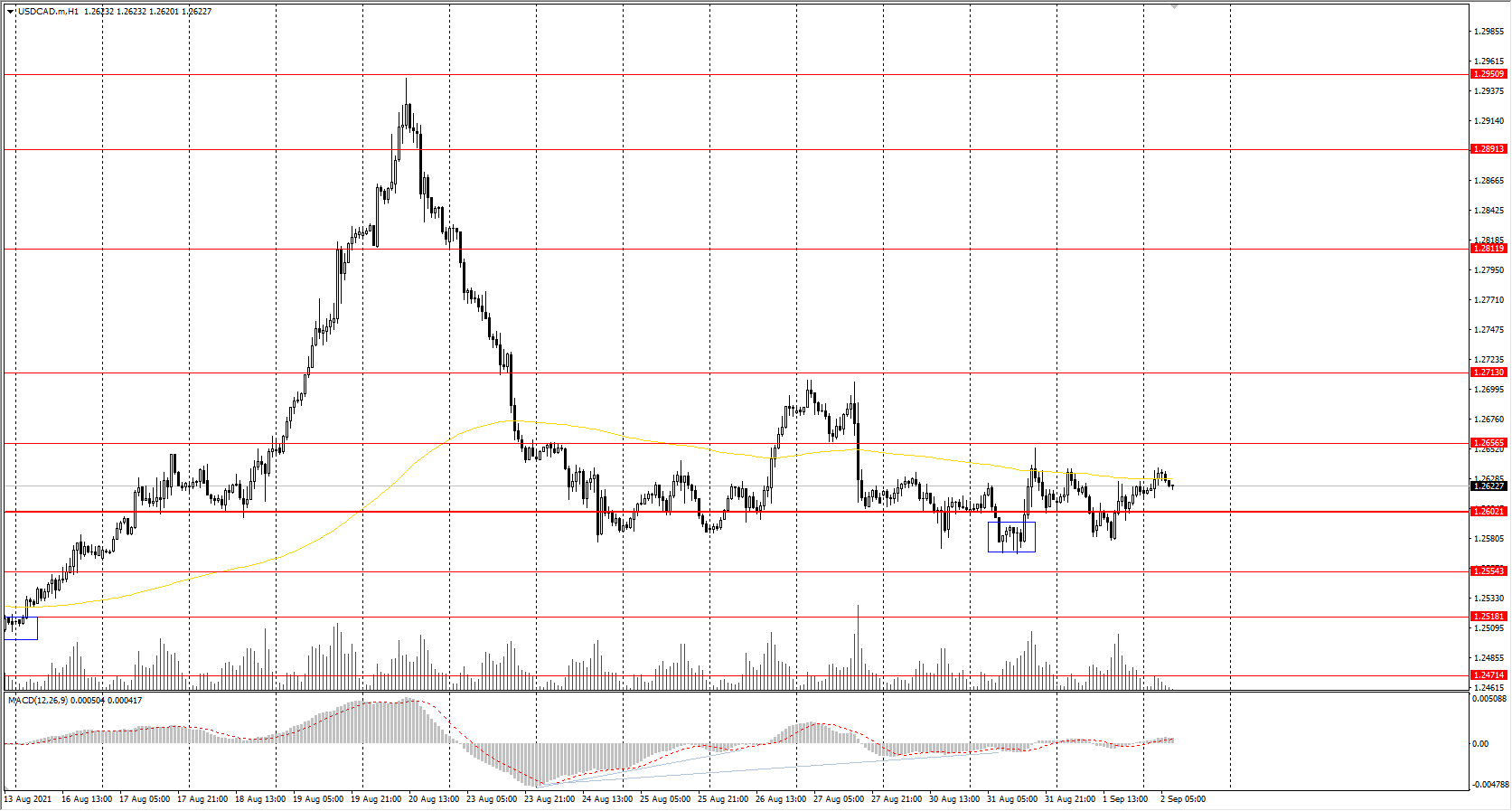
The Canadian dollar is a commodity currency, so the USD/CAD currency pair is highly dependent on the dynamics of the dollar index and oil prices. Yesterday, both the dollar index and oil prices decreased. As a result, the USD/CAD currency pair is trading in the corridor without any dynamics.
Trading recommendations
Support levels: 1.2583, 1.2554
Resistance levels: 1.2656, 1.2713, 1.2812, 1.2891, 1.2951
In terms of technical analysis, the USD/CAD trend is still bullish. The price was testing the priority change level yesterday but it couldn't break through the level. It is better to look for buy positions from the priority change level where buyers show initiative. Sell positions can be considered from the resistance levels, or after the breakthrough of the 1.2583 support level.
Alternative scenario: if the price breaks through the 1.2583 support level and fixes below, the uptrend will likely be broken.