

Sample Category Title
Eco Data 8/24/21
[php_everywhere instance="1"]
Gold – Back in Favour?
Facing major resistance
Gold has come a long way over the last couple of weeks when it suffered a flash crash at the start of the week.
Since then, not only has it rebounded strongly, it’s crossed back above the support level that was the catalyst for the plunge and headed back towards recent highs.
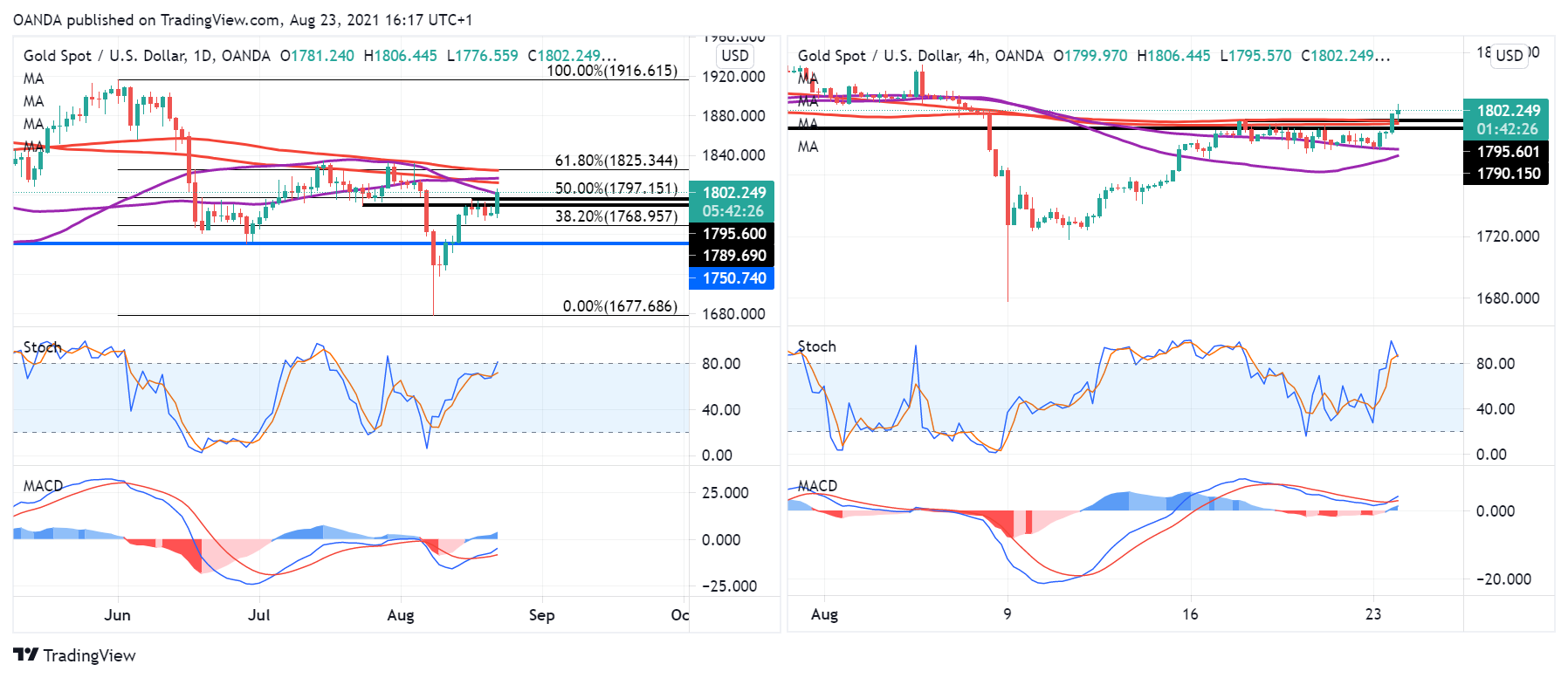
It’s broken through major resistance levels along the way, the latest being $1,800 which sees it overcome the 50% retracement level from the June highs to August lows.
The bigger test is still to come though. The 61.8% retracement level falls around those July and August highs around $1,833.
The cluster of moving averages may provide further resistance to the yellow metals ascent. But a break above here would be very bullish indeed. The question is what it will take.
The Fed looked destined to announce tapering in September but recent data along with rising Covid cases may derail their plans. That could be enough to see gold come back into favour, something that appeared highly unlikely a few weeks ago after the release of the July jobs report.
Pound Rebounds on Strong Manufacturing PMI
The British pound has started the new trading week in positive territory. GBP/USD is trading at 1.3672, up 0.37% on the day.
Manufacturing stellar but services slip
The UK Flash PMI reports for August were mixed. Manufacturing PMI was down slightly, to 60.1 (July final: 60.4). Although a 5-month low, this read indicates strong expansion as it is well above the neutral 50-level. Consumer demand remains strong, but manufacturers are having trouble keeping up due to shortages of raw materials.
The news was not as good from the services sectors, which slipped to 55.3, a 6-month low (July final: 59.6). The sharp slowdown was a reflection of supply chain problems and staff shortages. As with manufacturing, businesses were unable to keep up with customer demand, resulting in backlogs. Still, even with this slowdown, business activity remains well into expansionary territory. Meanwhile, the CBI survey of manufacturers’ economic expectations, which was mired in negative territory for some 24 months, posted its fourth straight month of expansion. This is another indication of a robust manufacturing sector.
The British pound started the week on the right foot, as the PMIs continued to point to expansion. As well, the markets are in risk-on mode, which has curbed the dollar’s upswing which we saw last week.
The Federal Reserve will remain in the spotlight this week, with Jerome Powell delivering a much-anticipated speech on Friday at the Jackson Hole Symposium. With the delta variant of Covid continuing to grab the headlines and make investors jittery, Powell may opt to deliver a dovish message with regard to tapering. Investors are responding by purchasing Treasuries and technology stocks. If Powell’s speech is dovish, Jackson Hole could end up being a negative market-mover for the US dollar.
GBP/USD Technical Analysis
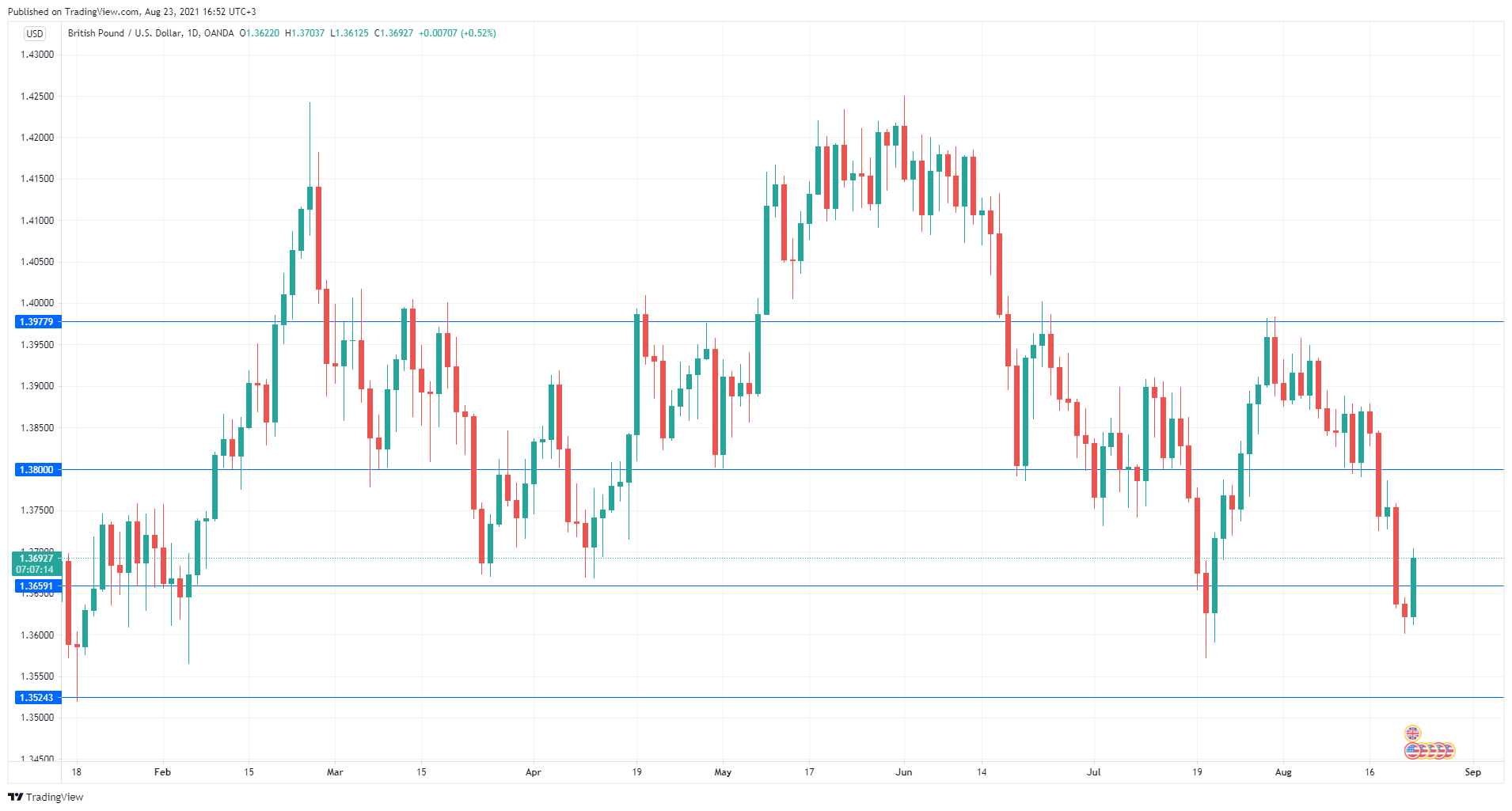
- GBP/USD is facing resistance at 1.3800. Above, there is resistance at 1.3977
- On the downside, 1.3659 is the first line of support. This is followed by support at 1.3524
Sunset Market Commentary
Markets
End last week, the risk-off correction halted. Indications on slower growth in China lost their grip on global trading. Investors were (and still are) pondering the potential impact of the corona variants on future growth and on the CB’s reaction function, especially on Fed bond-buying tapering. This topic will be closely watched at the Jackson Hole symposium starting on Thursday evening. With respect to the growth story, today’s PMI’s could bring some clarity. The preliminary EMU PMI’s confirmed a solid recovery. The composite output index printed at a strong 59.5, only slightly lower from last month’s 60,2 which marked a 15-y high. According to Markit, growth in the services sector overtook manufacturing as COVID-19 containment measures are eased further. Inflow of orders slowed slightly but remains among the highest in the past two decades. Persistent optimism and strong orderbooks caused employment growth matching the highest level in 21 year. At the same time, Markit mentions: “Supply chain delays continue to wreak havoc, however, leaving companies frequently unable to meet demand and pushing firms’ costs higher”. Markit also sees an upward movement on wage growth which, along with other supply disruptions, could lead to higher inflation. It’s very long call from a monthly PMI report to ECB policy, but progress should also be visible in the ECB forecasts to be released at the September 9 policy meeting. As is often the case, the reaction to EMU data was modest, but at least the PMI’s had some impact. European yields were already supported by a better global sentiment. The German 10-y yield at some point gained more than 3.5bp, but momentum eased going into the US dealings. Yields changes currently vary between unchanged (2-y) and +2.5 bp (30-y). US Treasuries outperform with 2 & 5-y yields little changed and the long end rising only slightly (+1.0 bp for 30-y). Other risky, cyclical assets including the likes of oil (brent $67.3 p/b) or copper are rebounding off last week’s correction lows. European and US equities are gaining about 0.5%. Evidently this is more due to global sentiment rather than a reaction the EMU PMI’s. By the way, the US Markit composite PMI released as we are concluding this report unexpectedly dropped from 59.9 to mainly driven by a setback in services (55.2 from 59.9).
On the FX market, EUR/USD tries to build on Friday’s tentative bottoming, trying to leave the 1.17 area behind. An important part of this move already occurred before the publication of the EMU PMI’s. A constructive risk sentiment and a limited rise in US yields eased the USD-bid. EUR/USD is trading in the 1.1740 area. The DXY trade-weighted dollar dropped back below previous resistance at 93.43 (currently 93.15). Last week, the sterling faced headwinds from a series of disappointing/less convincing data. Today’s UK services PMI (55.5 from 59.6) extended this series and also pushed the overall composite index to 55.3 from 59.2. Manufacturing (60.1) showed stronger resilience. At least today, the weaker UK growth momentum didn’t cause any further damage for the UK currency. EUR/GBP hovers in the 0.8575 area. Cable (1.370) rebounds off the 1.3572/1.3602 support area. Commodity related currencies including the loonie (USD/CAD 1.2725), the aussie (AUD/USD 0.7185) and kiwi dollar (USD/NZD 0.6970) are trying to fight back after last week’s battering.
News Headlines
The German Bundesbank in its monthly report warned the “delta variant and a slowing vaccination dynamic could lead to stricter protection measures”, resulting in a recovery this year that’s less strong than previously expected. After activity in the first half of the year disappointed, total growth in 2021 could turn out to be a bit lower than the 3.7% projected in June, it said. The manufacturing sector in particular is undergoing consequences of raw material shortages and supply-chain bottlenecks. Growth should still reach pre-pandemic levels in the summer or the autumn. Inflation is another source of uncertainty, the BuBa added. Rising prices have been passed on to consumers to a larger degree than expected.
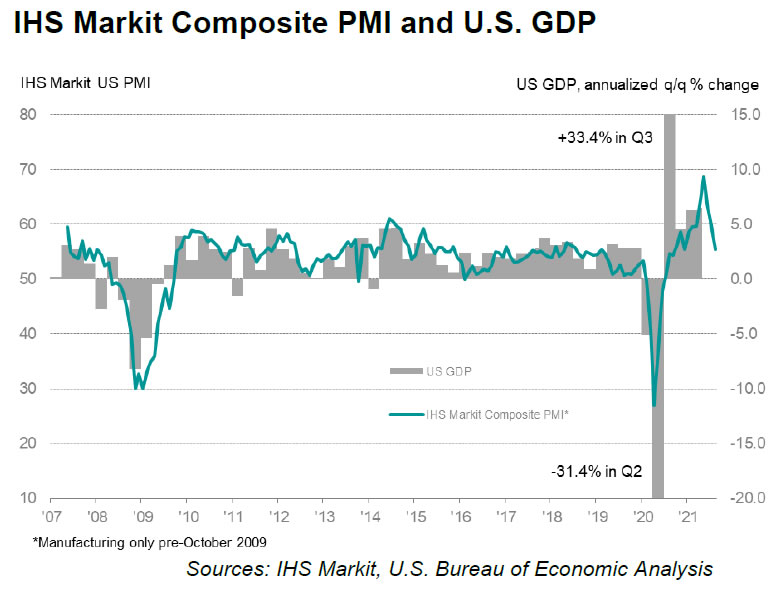
US PMI manufacturing dropped to 61.2, services down to 55.2
US PMI Manufacturing dropped from 63.4 to 61.2 in August, below expectation of 63.0. PMI Services dropped from 59.9 to 55.2, below expectation of 59.9. PMI Composite dropped from 59.9 to 55.4.
Chris Williamson, Chief Business Economist at IHS Markit, said:
"The expansion slowed sharply again in August as the spread of the Delta variant led to a weakening of demand growth, especially for consumer-facing services, and further frustrated firms' efforts to meet existing sales.
"Not only have supply chain delays hit a new survey record high, but the August survey saw increasing frustrations in relation to hiring. Jobs growth waned to the lowest since July of last year as companies either failed to find suitable staff or existing workers switched jobs.
"Prices charged for goods and services grew at an increased rate as demand once again ran ahead of supply, most notably in the manufacturing sector.
"Prices look set to continue to rise sharply due to the persistent upward pressure on costs arising from shortages of materials and labor, though if demand continues to cool due to rising case numbers this should alleviate some of the inflationary pressures."
USD/JPY Mid-Day Outlook
Daily Pivots: (S1) 109.61; (P) 109.75; (R1) 109.92; More...
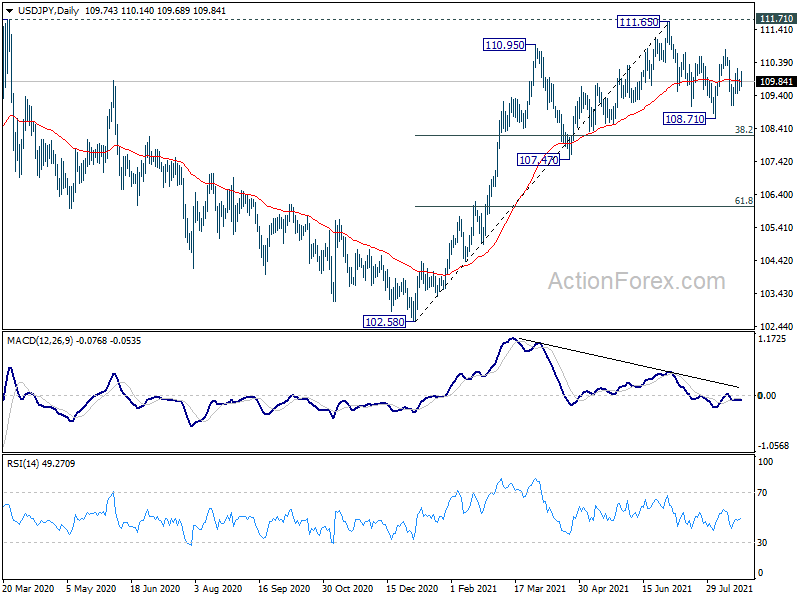
Intraday bias in USD/JPY remains neutral as range trading continues. On the upside, break of 110.79 will resume the rebound from 108.71 to retest 111.65 high. On the downside, break of 109.10 will target 108.71 support first. Firm break there will resume the decline from 111.65 and target 38.2% retracement of 102.58 to 111.65 at 108.18 next.
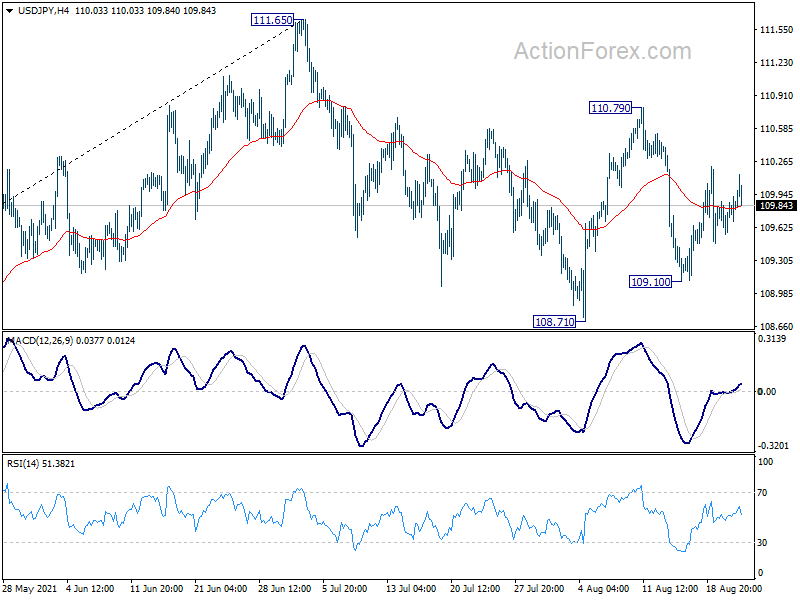
In the bigger picture, medium term outlook is staying neutral with 111.71 resistance intact. The pattern from 101.18 could still extend with another falling leg. Sustained trading below 55 day EMA will bring deeper fall to 107.47 support and below. Nevertheless, strong break of 111.71 resistance will confirm completion of the corrective decline from 118.65 (2016 high). Further rise should then be seen to 114.54 and then 118.65 resistance.
USD/CHF Mid-Day Outlook
Daily Pivots: (S1) 0.9156; (P) 0.9173; (R1) 0.9187; More....
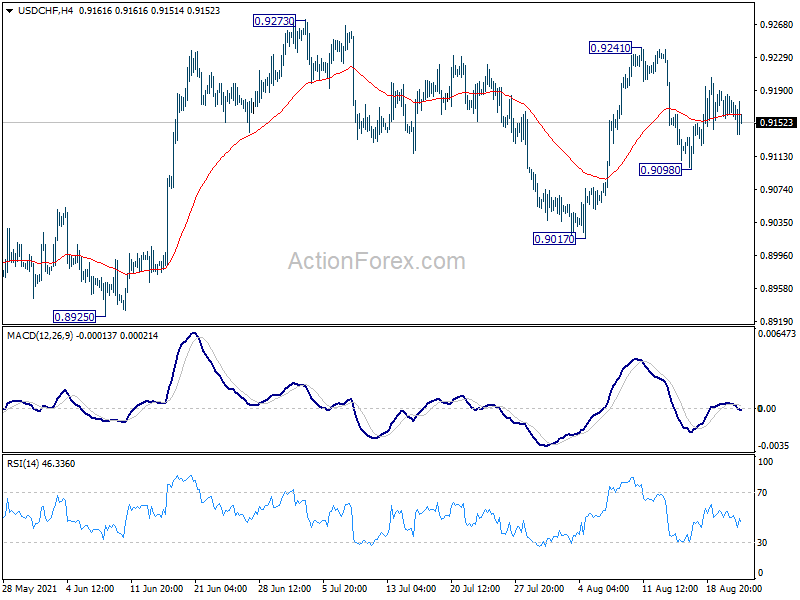
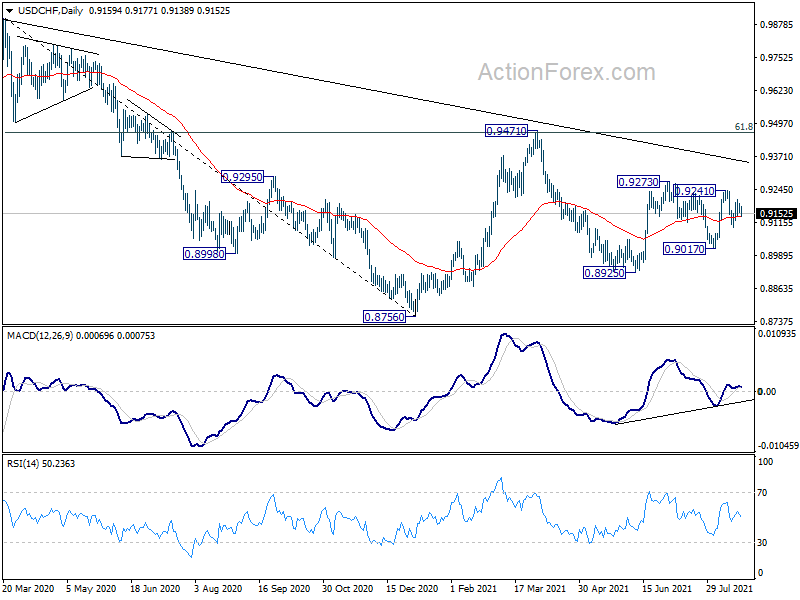
Intraday bias in USD/CHF remains neutral as range trading continues. On the upside, break of 0.9241 resistance should resume the rise from 0.8925 through 0.9273. On the downside, break of 0.9098 will target 0.9017 support first. Further break there will likely resume the decline from 0.9471 through 0.8925 low.
In the bigger picture, the failure to sustain above 55 week EMA (now at 0.9180) retains medium term bearishness in USD/CHF. Break of 0.8925 support should resume the whole decline form 1.0342 (2016 high) through 0.8756 low. However, break of 0.9273 resistance and sustained trading above 55 week EMA will be an early sign of bullish trend reversal. Focus will then turn to 0.9471 resistance for confirmation.
GBP/USD Mid-Day Outlook
Daily Pivots: (S1) 1.3602; (P) 1.3623; (R1) 1.3643; More...
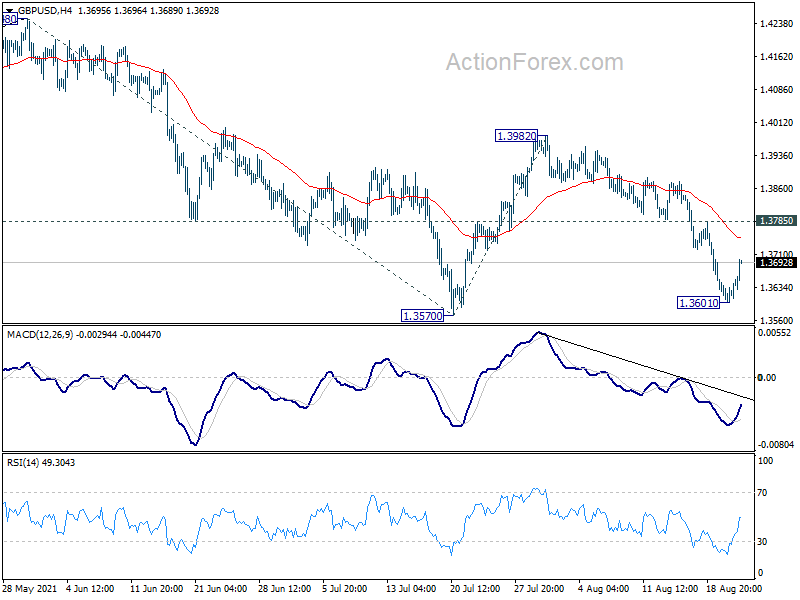
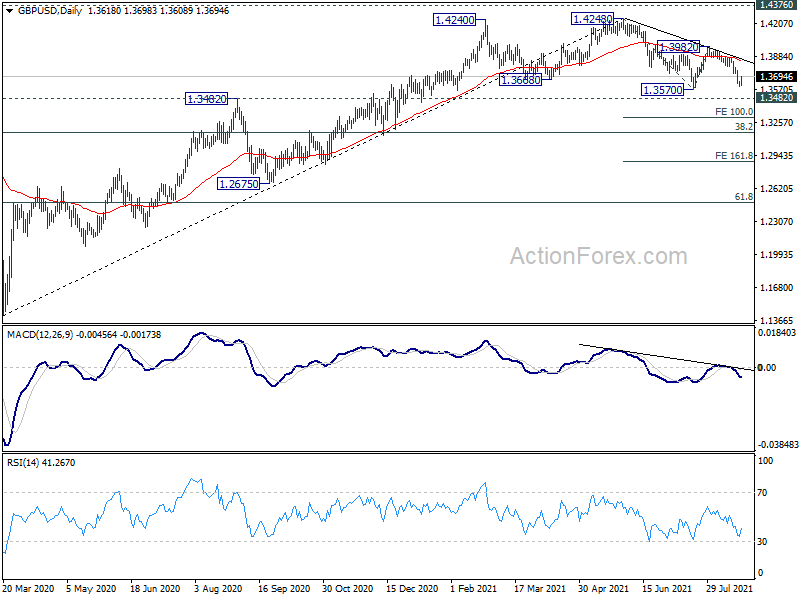
Intraday bias in GBP/USD stays neutral first and further decline is in favor with 1.3785 minor resistance intact. On the downside, firm break of 1.3570 will resume larger fall from 1.4248 to 1.3482 resistance turned support next. Break there will target 100% projection of 1.4248 to 1.3570 from 1.3982 at 1.3304. However, break of 1.3785 will turn bias back to the upside for 1.3982 resistance intact.
In the bigger picture, current development argues that rise from 1.1409 (2020 low) has completed at 1.4248, after failing 1.4376 resistance. Fall from there could either be correcting the rise form 1.1409, or starting another falling leg inside long term sideway pattern. In either case, sustained break of 1.3482 resistance turned support will target 38.2% retracement of 1.1409 to 1.4248 at 1.3164 first. Break there will pave the way to 61.8% retracement at 1.2493.
EUR/USD Mid-Day Outlook
Daily Pivots: (S1) 1.1674; (P) 1.1690; (R1) 1.1715; More...
EUR/USD's recovery from 1.1663 continues but stays below 1.1804 resistance. Intraday bias remains neutral first. In case of another fall, we'd continue to look for strong support from 1.1602/1703 key support zone to bring rebound. On the upside, above 1.1804 resistance will turn bias back to the upside for 1.1907 resistance first. However, sustained break of 1.1602/1703 will carry larger bearish implication and pave the way to 1.1289 fibonacci support.
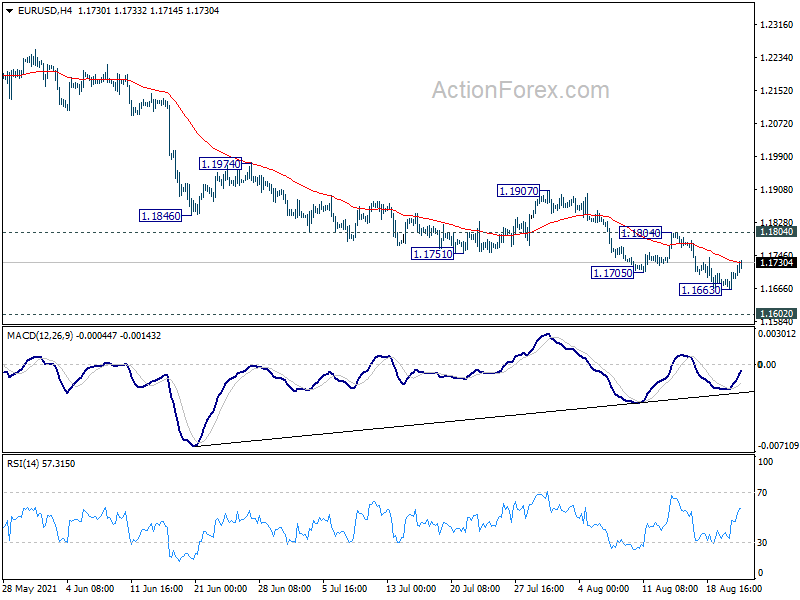
In the bigger picture, rise from 1.0635 is seen as the third leg of the pattern from 1.0339 (2017 low). Further rally remains in favors long as 1.1602 support holds, to cluster resistance at 1.2555 next, (38.2% retracement of 1.6039 to 1.0339 at 1.2516). However sustained break of 1.1602 will argue that the rise from 1.0635 is over, and turn medium term outlook bearish again. Deeper fall would be seen to 61.8% retracement of 1.0635 to 1.2348 at 1.1289 and below.
Dollar Extending Pull Back, Gold Upside Breakout
Markets continue to reverse some of last week's move, as seen in the rebound in European and Asian equities. Dollar, Yen and Swiss Franc all turned weaker while commodity currencies strengthened. PMIs from Eurozone and UK are all solid, despite mild pull back. Yet, both are outshone by commodity currencies. Sterling is currently having a slight upper hand against Euro.
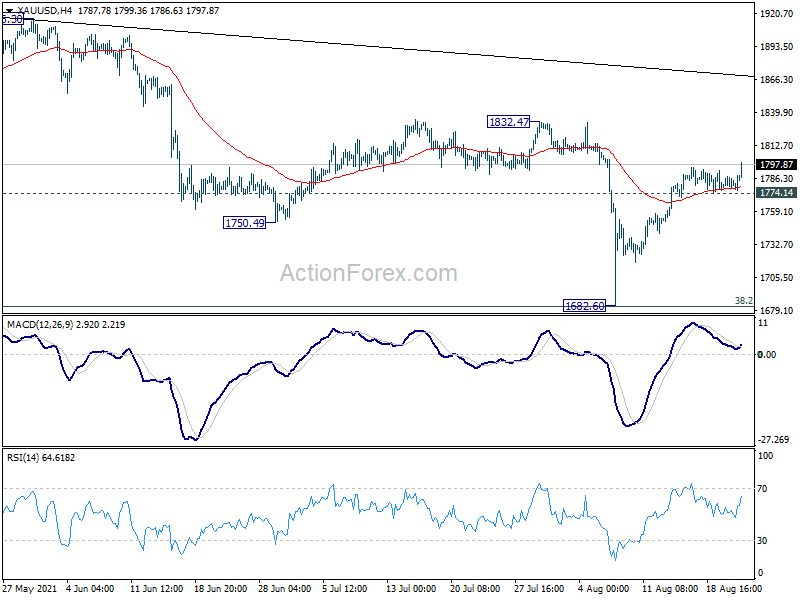
Technically, however, there is no clear sign of reversal for Dollar, Yen and Franc yet. Though, Gold's break of 1795.42 resistance now suggests resumption of rebound from 1682.60. Reaction to 1800 handle will be watched, and sustained trading above would pave the way to retest 1832.47 resistance that. We'd see if EUR/USD would follow and break through 1.1084 resistance too.
In Europe, at the time of writing, FTSE is up 0.36%. DAX is up 0.23%. CAC is up 0.89%. Germany 10-year yield is up 0.021 at -0.473. Earlier in Asia, Nikkei rose 1.78%. Hong Kong HSI rose 1.05%. China Shanghai SSE rose 1.45%. Singapore Strait Times dropped -0.49%. Japan 10-year JGB yield rose 0.0070 to 0.019.
UK PMI manufacturing dropped to 60.1, services tumbled to 55.5
UK PMI Manufacturing dropped from 60.4 to 60.1 in August, above expectation of 59.5. PMI Services dropped notably from 59.6 to 55.5, below expectation of 59.0. PMI Composite dropped from 59.2 to 55.3.
Chris Williamson, Chief Business Economist at IHS Markit, said: "Although the PMI indicates that the economy continues to expand at a pace slightly above the pre-pandemic average, there are clear signs of the recovery losing momentum in the third quarter after a buoyant second quarter... rising virus case numbers are deterring many forms of spending... Supplier delays have risen to a degree exceeded only once before... Prices have risen sharply again, albeit with the rate of inflation moving below July's record high.
"More positively, business expectations for the year ahead perked up in August, encouraging a record jump in employment as furloughed workers were brought back to the workplace. However, demand and supply availability need to improve further for this rise in employment to be sustained in coming months".
Bundesbank: Output to rise sharply in summer
In the monthly report, Bundesbank said German economic output is "likely to rise sharply in summer 2021", more strongly than in Spring. Industry was unable to take advantage of the growth in Q2 due to increased delivery bottlenecks. But there are initial signs that these delivery bottlenecks are "at least not worsening". It remains to be seen if GDP could reach pre-crisis level in Summer or not until Autumn.
Inflation is expected to continue to rise in Germany, but then "decrease noticeably again at the beginning of 2022", as the base effect will then no longer apply. Though, inflation could still be over 2% until mid-2022.
Eurozone PMI composite ticked down to 59.5, recovery retained impressive momentum
Eurozone PMI Manufacturing dropped from 62.8 to 61.5 in August, below expectation of 62.0. PMI Services dropped from 59.8 to 59.7, below expectation of 59.8. PMI Composite dropped from 60.2 to 59.5.
Chris Williamson, Chief Business Economist at IHS Markit said: "The eurozone's economic recovery retained impressive momentum in August, with the PMI dipping only slightly from July's recent high to put its average in the third quarter so far at the highest for 21 years... Firms benefited from virus containment measures easing to the lowest since the pandemic began...
"Supply chain delays continue to wreak havoc... combined with surging demand, led to another near-record increase in average selling prices for goods and services, though there are some welcome signs that these inflationary pressures may have peaked for now. Encouragement comes from a second month of job creation at the strongest for 21 years... some upward movement on wage growth... which could feed through to higher inflation".
Germany PMI composite dropped to 60.0, still firmly inside growth territory
Germany PMI Manufacturing dropped from 65.9 to 52.7 in August, below expectation of 65.0. PMI Services dropped from 61.8 to 61.5, above expectation of 61.0. PMI Composite dropped from 62.4 to 60.6.
Phil Smith, Associate Director at IHS Markit said: "With August's flash PMI still firmly inside growth territory, the recovery of the German private sector looks to be continuing at a healthy pace. Although growth has slowed down since July, the data are still pointing to a stronger economic expansion in the third quarter than the provisional 1.5% increase in GDP seen in the three months to June."
France PMI composite dropped to 55.9, another strong month of growth
France PMI Manufacturing dropped from 58.0 to 57.3 in July, matched expectations. PMI Services dropped from 56.8 to 56.4, below expectation of 57.0. PMI Composite dropped form 56.6 to 55.9.
Joe Hayes, Senior Economist at IHS Markit said: "Another strong month of growth across France was signalled by the flash PMI figure for August. Despite some of the challenges businesses are facing on the supply side, it's encouraging to see PMI data consistently signalling robust expansion. Furthermore, given we're now midway through the third quarter, the survey data up to this point suggest we could see another decent out turn in the corresponding GDP figure."
Japan PMI composite dropped to 45.9 in Aug, weaker demand and sustained supply chain pressures
Japan PMI Manufacturing dropped from 53.0 to 52.4 in August, below expectation of 53.4. PMI services dropped sharply from 47.4 to 43.5, worst in 15 months. PMI Composite dropped from 48.8 to 45.9, worst since August 2020.
Usamah Bhatti, Economist at IHS Markit, said: "The Japanese private sector economy saw business conditions deteriorate further midway through the third quarter of the year, with flash PMI data signalling a quicker decline in business activity in August. The latest contraction was the quickest recorded since August 2020, while incoming business was reduced at the sharpest pace for seven months. Survey respondents commonly attributed weaker demand to ongoing COVID-19 restrictions, coupled with sustained supply chain pressures."
Australia PMI composite dropped to 15-month low, heavily impacted by restrictions
Australia PMI Manufacturing dropped from 56.9 to 51.7 in August, hitting a 14-month low. PMI Services dropped from 44.2 to 43.3, a 15-month low. PMI Composite dropped from 45.2 to 43.5, also a 15-month low.
Jingyi Pan, Economics Associate Director at IHS Markit, said: "Australia's private sector remained stuck in decline in August... as activity remained heavily impacted by current mobility restrictions brought about by the spread of the COVID-19 Delta variant. Not only were demand and business activity hit, employment conditions also deteriorated, with private sector staffing levels falling for the first time since October 2020... The one bright spot had been an improvement in the outlook amongst Australian private sector firms in August, with hopes of an improvement in the COVID-19 situation expected to spark an eventual rebound for the Australian economy."
EUR/USD Mid-Day Outlook
Daily Pivots: (S1) 1.1674; (P) 1.1690; (R1) 1.1715; More...
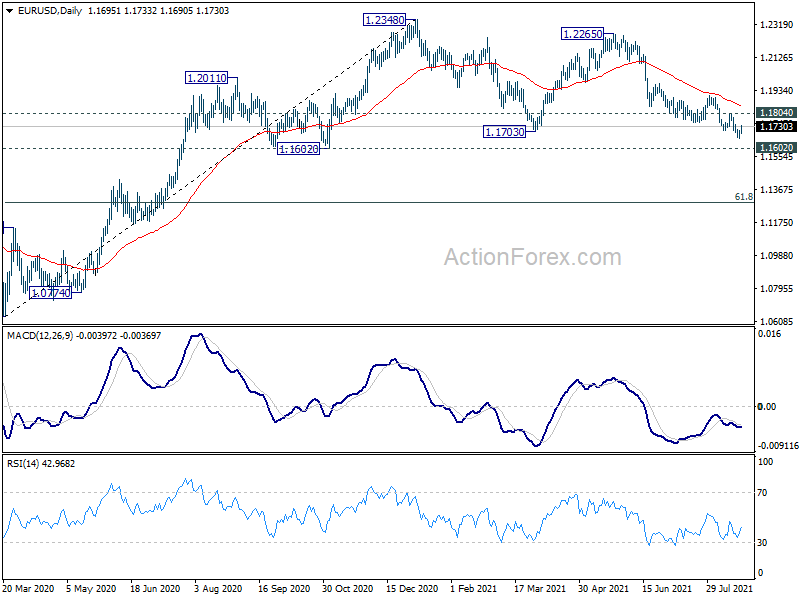
EUR/USD's recovery from 1.1663 continues but stays below 1.1804 resistance. Intraday bias remains neutral first. In case of another fall, we'd continue to look for strong support from 1.1602/1703 key support zone to bring rebound. On the upside, above 1.1804 resistance will turn bias back to the upside for 1.1907 resistance first. However, sustained break of 1.1602/1703 will carry larger bearish implication and pave the way to 1.1289 fibonacci support.
In the bigger picture, rise from 1.0635 is seen as the third leg of the pattern from 1.0339 (2017 low). Further rally remains in favors long as 1.1602 support holds, to cluster resistance at 1.2555 next, (38.2% retracement of 1.6039 to 1.0339 at 1.2516). However sustained break of 1.1602 will argue that the rise from 1.0635 is over, and turn medium term outlook bearish again. Deeper fall would be seen to 61.8% retracement of 1.0635 to 1.2348 at 1.1289 and below.
Economic Indicators Update
| GMT | Ccy | Events | Actual | Forecast | Previous | Revised |
|---|---|---|---|---|---|---|
| 23:00 | AUD | Manufacturing PMI Aug P | 51.7 | 56.9 | ||
| 23:00 | AUD | Services PMI Aug P | 43.3 | 44.2 | ||
| 0:30 | JPY | Manufacturing PMI Aug P | 52.4 | 53.4 | 53 | |
| 7:15 | EUR | France Manufacturing PMI Aug P | 57.3 | 57.3 | 58 | |
| 7:15 | EUR | France Services PMI Aug P | 56.4 | 57 | 56.8 | |
| 7:30 | EUR | Germany Manufacturing PMI Aug P | 62.7 | 65 | 65.9 | |
| 7:30 | EUR | Germany Services PMI Aug P | 61.5 | 61 | 61.8 | |
| 8:00 | EUR | Eurozone Manufacturing PMI Aug P | 61.5 | 62 | 62.8 | |
| 8:00 | EUR | Eurozone Services PMI Aug P | 59.7 | 59.8 | 59.8 | |
| 8:30 | GBP | Manufacturing PMI Aug P | 60.1 | 59.5 | 60.4 | |
| 8:30 | GBP | Services PMI Aug P | 55.5 | 59 | 59.6 | |
| 13:45 | USD | Manufacturing PMI Aug P | 63 | 63.4 | ||
| 13:45 | USD | Services PMI Aug P | 59.9 | 59.9 | ||
| 14:00 | USD | Existing Home Sales Jul | 5.83M | 5.86M | ||
| 14:00 | EUR | Eurozone Consumer Confidence Aug P | -5 | -4 |