

Sample Category Title
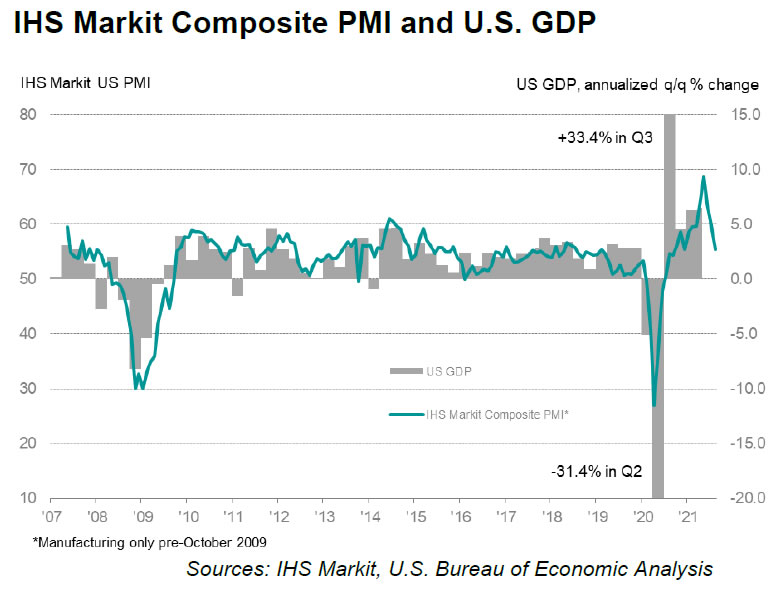
US PMI manufacturing dropped to 61.2, services down to 55.2
US PMI Manufacturing dropped from 63.4 to 61.2 in August, below expectation of 63.0. PMI Services dropped from 59.9 to 55.2, below expectation of 59.9. PMI Composite dropped from 59.9 to 55.4.
Chris Williamson, Chief Business Economist at IHS Markit, said:
"The expansion slowed sharply again in August as the spread of the Delta variant led to a weakening of demand growth, especially for consumer-facing services, and further frustrated firms' efforts to meet existing sales.
"Not only have supply chain delays hit a new survey record high, but the August survey saw increasing frustrations in relation to hiring. Jobs growth waned to the lowest since July of last year as companies either failed to find suitable staff or existing workers switched jobs.
"Prices charged for goods and services grew at an increased rate as demand once again ran ahead of supply, most notably in the manufacturing sector.
"Prices look set to continue to rise sharply due to the persistent upward pressure on costs arising from shortages of materials and labor, though if demand continues to cool due to rising case numbers this should alleviate some of the inflationary pressures."
USD/JPY Mid-Day Outlook
Daily Pivots: (S1) 109.61; (P) 109.75; (R1) 109.92; More...
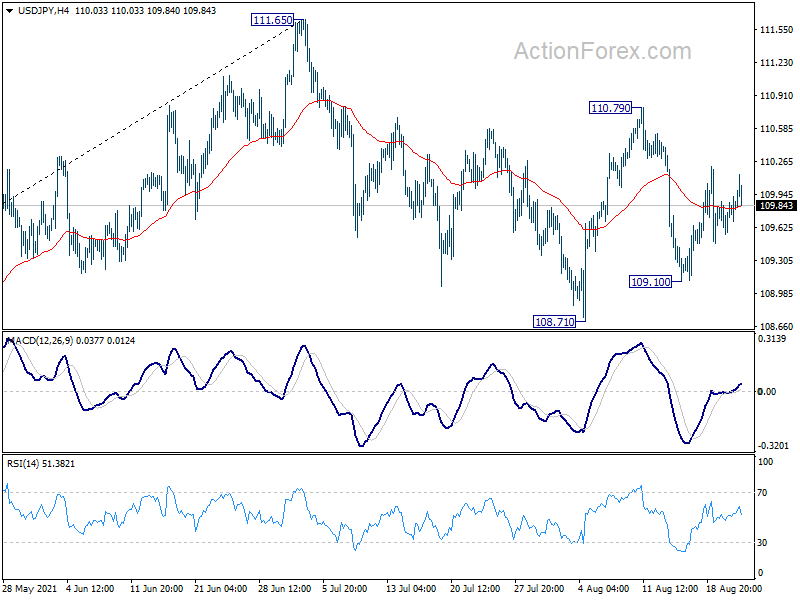
Intraday bias in USD/JPY remains neutral as range trading continues. On the upside, break of 110.79 will resume the rebound from 108.71 to retest 111.65 high. On the downside, break of 109.10 will target 108.71 support first. Firm break there will resume the decline from 111.65 and target 38.2% retracement of 102.58 to 111.65 at 108.18 next.
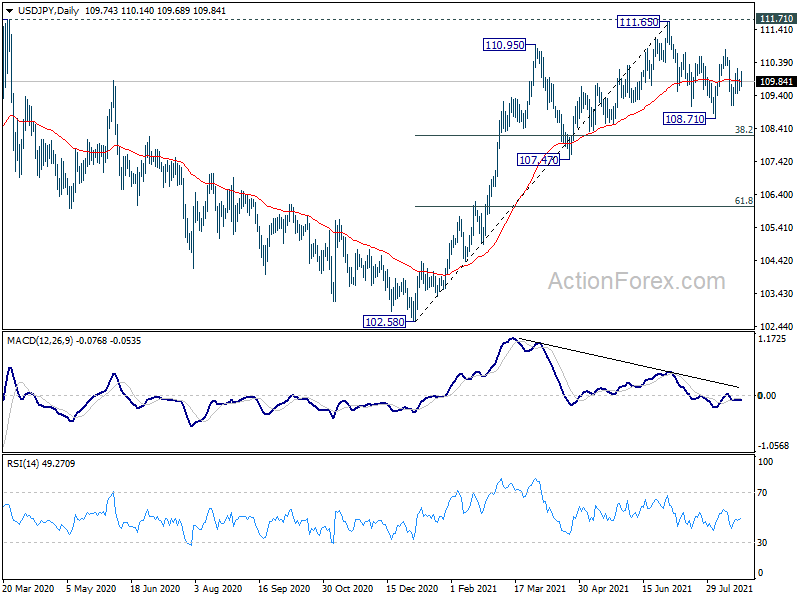
In the bigger picture, medium term outlook is staying neutral with 111.71 resistance intact. The pattern from 101.18 could still extend with another falling leg. Sustained trading below 55 day EMA will bring deeper fall to 107.47 support and below. Nevertheless, strong break of 111.71 resistance will confirm completion of the corrective decline from 118.65 (2016 high). Further rise should then be seen to 114.54 and then 118.65 resistance.
USD/CHF Mid-Day Outlook
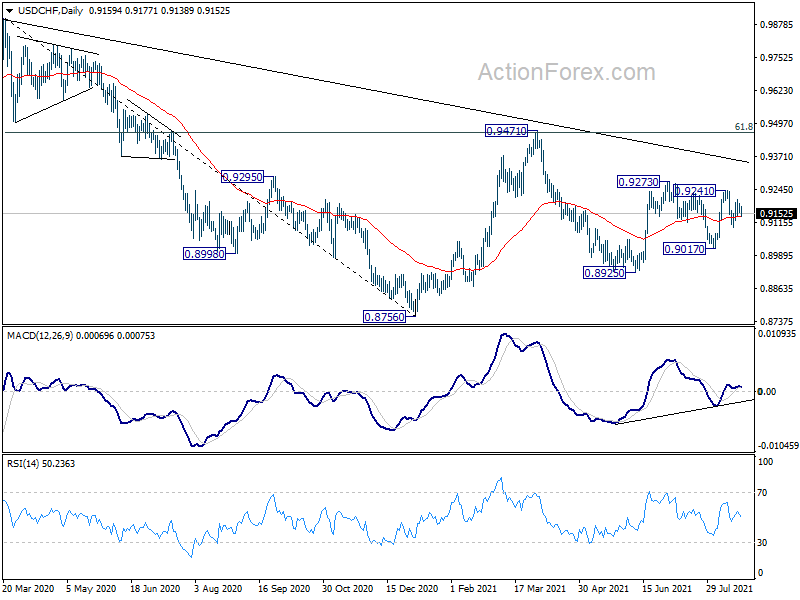
Daily Pivots: (S1) 0.9156; (P) 0.9173; (R1) 0.9187; More....
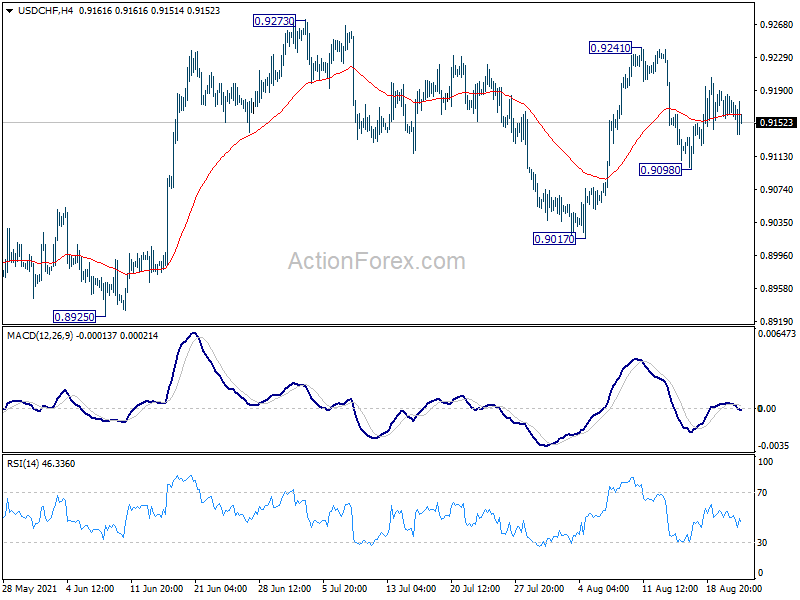
Intraday bias in USD/CHF remains neutral as range trading continues. On the upside, break of 0.9241 resistance should resume the rise from 0.8925 through 0.9273. On the downside, break of 0.9098 will target 0.9017 support first. Further break there will likely resume the decline from 0.9471 through 0.8925 low.
In the bigger picture, the failure to sustain above 55 week EMA (now at 0.9180) retains medium term bearishness in USD/CHF. Break of 0.8925 support should resume the whole decline form 1.0342 (2016 high) through 0.8756 low. However, break of 0.9273 resistance and sustained trading above 55 week EMA will be an early sign of bullish trend reversal. Focus will then turn to 0.9471 resistance for confirmation.
GBP/USD Mid-Day Outlook
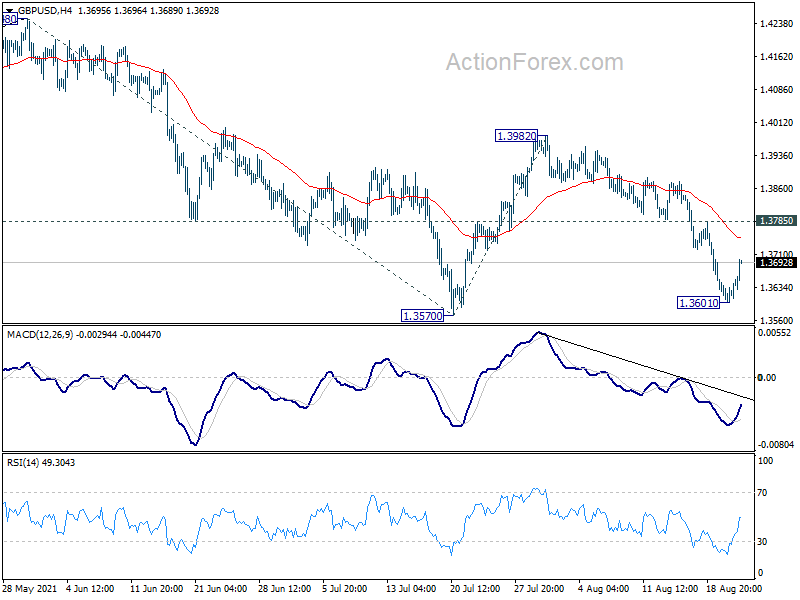
Daily Pivots: (S1) 1.3602; (P) 1.3623; (R1) 1.3643; More...
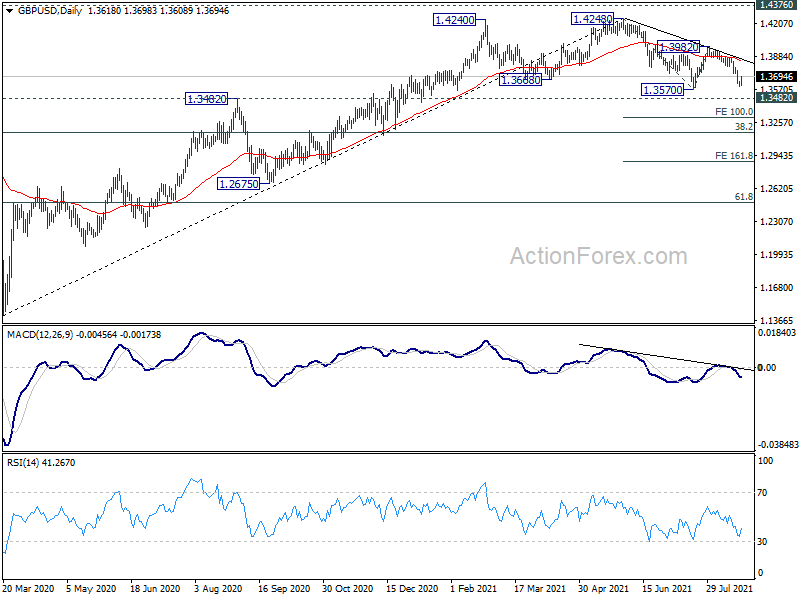
Intraday bias in GBP/USD stays neutral first and further decline is in favor with 1.3785 minor resistance intact. On the downside, firm break of 1.3570 will resume larger fall from 1.4248 to 1.3482 resistance turned support next. Break there will target 100% projection of 1.4248 to 1.3570 from 1.3982 at 1.3304. However, break of 1.3785 will turn bias back to the upside for 1.3982 resistance intact.
In the bigger picture, current development argues that rise from 1.1409 (2020 low) has completed at 1.4248, after failing 1.4376 resistance. Fall from there could either be correcting the rise form 1.1409, or starting another falling leg inside long term sideway pattern. In either case, sustained break of 1.3482 resistance turned support will target 38.2% retracement of 1.1409 to 1.4248 at 1.3164 first. Break there will pave the way to 61.8% retracement at 1.2493.
EUR/USD Mid-Day Outlook
Daily Pivots: (S1) 1.1674; (P) 1.1690; (R1) 1.1715; More...
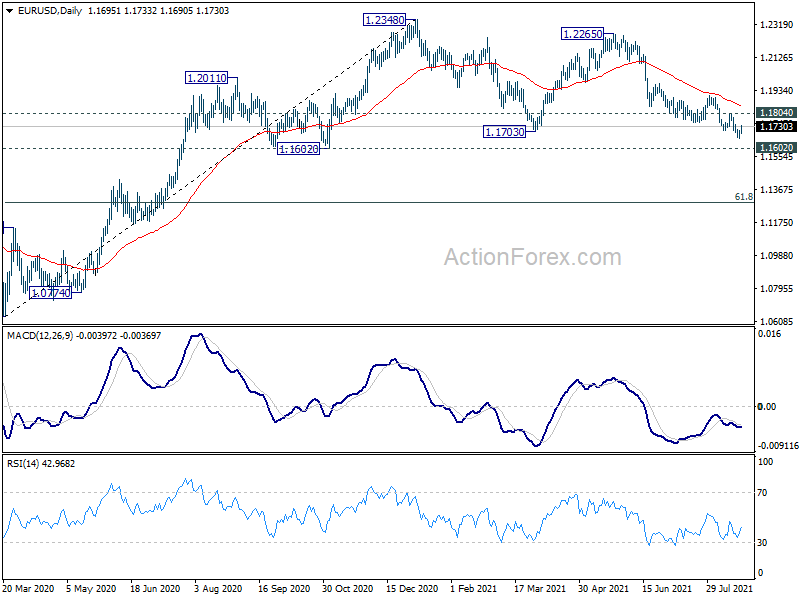
EUR/USD's recovery from 1.1663 continues but stays below 1.1804 resistance. Intraday bias remains neutral first. In case of another fall, we'd continue to look for strong support from 1.1602/1703 key support zone to bring rebound. On the upside, above 1.1804 resistance will turn bias back to the upside for 1.1907 resistance first. However, sustained break of 1.1602/1703 will carry larger bearish implication and pave the way to 1.1289 fibonacci support.
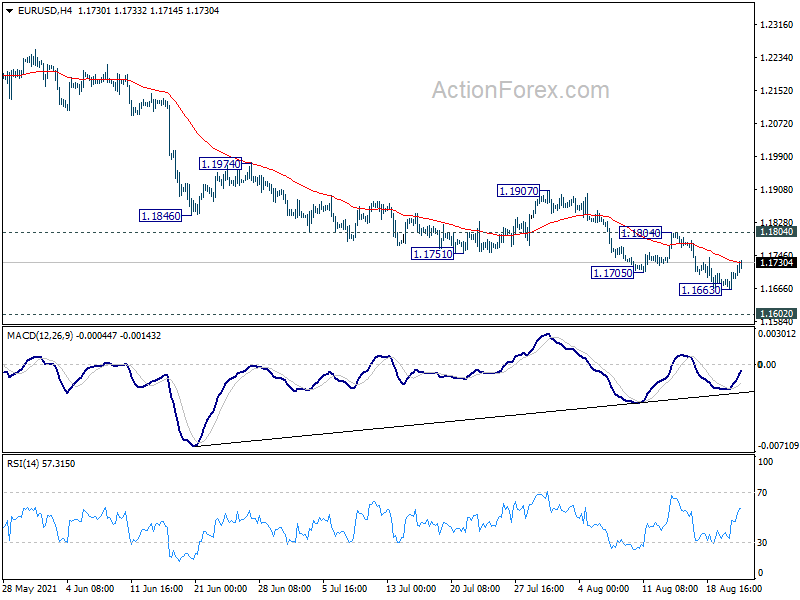
In the bigger picture, rise from 1.0635 is seen as the third leg of the pattern from 1.0339 (2017 low). Further rally remains in favors long as 1.1602 support holds, to cluster resistance at 1.2555 next, (38.2% retracement of 1.6039 to 1.0339 at 1.2516). However sustained break of 1.1602 will argue that the rise from 1.0635 is over, and turn medium term outlook bearish again. Deeper fall would be seen to 61.8% retracement of 1.0635 to 1.2348 at 1.1289 and below.
Dollar Extending Pull Back, Gold Upside Breakout
Markets continue to reverse some of last week's move, as seen in the rebound in European and Asian equities. Dollar, Yen and Swiss Franc all turned weaker while commodity currencies strengthened. PMIs from Eurozone and UK are all solid, despite mild pull back. Yet, both are outshone by commodity currencies. Sterling is currently having a slight upper hand against Euro.
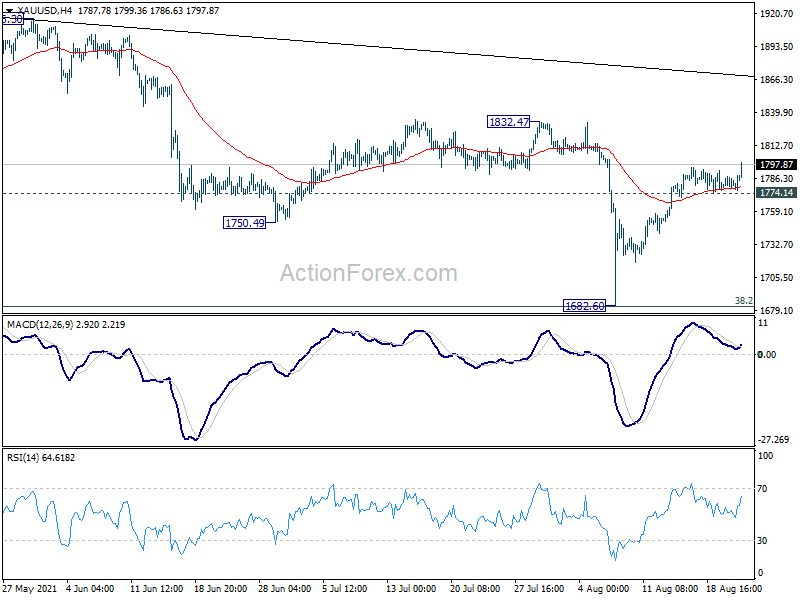
Technically, however, there is no clear sign of reversal for Dollar, Yen and Franc yet. Though, Gold's break of 1795.42 resistance now suggests resumption of rebound from 1682.60. Reaction to 1800 handle will be watched, and sustained trading above would pave the way to retest 1832.47 resistance that. We'd see if EUR/USD would follow and break through 1.1084 resistance too.
In Europe, at the time of writing, FTSE is up 0.36%. DAX is up 0.23%. CAC is up 0.89%. Germany 10-year yield is up 0.021 at -0.473. Earlier in Asia, Nikkei rose 1.78%. Hong Kong HSI rose 1.05%. China Shanghai SSE rose 1.45%. Singapore Strait Times dropped -0.49%. Japan 10-year JGB yield rose 0.0070 to 0.019.
UK PMI manufacturing dropped to 60.1, services tumbled to 55.5
UK PMI Manufacturing dropped from 60.4 to 60.1 in August, above expectation of 59.5. PMI Services dropped notably from 59.6 to 55.5, below expectation of 59.0. PMI Composite dropped from 59.2 to 55.3.
Chris Williamson, Chief Business Economist at IHS Markit, said: "Although the PMI indicates that the economy continues to expand at a pace slightly above the pre-pandemic average, there are clear signs of the recovery losing momentum in the third quarter after a buoyant second quarter... rising virus case numbers are deterring many forms of spending... Supplier delays have risen to a degree exceeded only once before... Prices have risen sharply again, albeit with the rate of inflation moving below July's record high.
"More positively, business expectations for the year ahead perked up in August, encouraging a record jump in employment as furloughed workers were brought back to the workplace. However, demand and supply availability need to improve further for this rise in employment to be sustained in coming months".
Bundesbank: Output to rise sharply in summer
In the monthly report, Bundesbank said German economic output is "likely to rise sharply in summer 2021", more strongly than in Spring. Industry was unable to take advantage of the growth in Q2 due to increased delivery bottlenecks. But there are initial signs that these delivery bottlenecks are "at least not worsening". It remains to be seen if GDP could reach pre-crisis level in Summer or not until Autumn.
Inflation is expected to continue to rise in Germany, but then "decrease noticeably again at the beginning of 2022", as the base effect will then no longer apply. Though, inflation could still be over 2% until mid-2022.
Eurozone PMI composite ticked down to 59.5, recovery retained impressive momentum
Eurozone PMI Manufacturing dropped from 62.8 to 61.5 in August, below expectation of 62.0. PMI Services dropped from 59.8 to 59.7, below expectation of 59.8. PMI Composite dropped from 60.2 to 59.5.
Chris Williamson, Chief Business Economist at IHS Markit said: "The eurozone's economic recovery retained impressive momentum in August, with the PMI dipping only slightly from July's recent high to put its average in the third quarter so far at the highest for 21 years... Firms benefited from virus containment measures easing to the lowest since the pandemic began...
"Supply chain delays continue to wreak havoc... combined with surging demand, led to another near-record increase in average selling prices for goods and services, though there are some welcome signs that these inflationary pressures may have peaked for now. Encouragement comes from a second month of job creation at the strongest for 21 years... some upward movement on wage growth... which could feed through to higher inflation".
Germany PMI composite dropped to 60.0, still firmly inside growth territory
Germany PMI Manufacturing dropped from 65.9 to 52.7 in August, below expectation of 65.0. PMI Services dropped from 61.8 to 61.5, above expectation of 61.0. PMI Composite dropped from 62.4 to 60.6.
Phil Smith, Associate Director at IHS Markit said: "With August's flash PMI still firmly inside growth territory, the recovery of the German private sector looks to be continuing at a healthy pace. Although growth has slowed down since July, the data are still pointing to a stronger economic expansion in the third quarter than the provisional 1.5% increase in GDP seen in the three months to June."
France PMI composite dropped to 55.9, another strong month of growth
France PMI Manufacturing dropped from 58.0 to 57.3 in July, matched expectations. PMI Services dropped from 56.8 to 56.4, below expectation of 57.0. PMI Composite dropped form 56.6 to 55.9.
Joe Hayes, Senior Economist at IHS Markit said: "Another strong month of growth across France was signalled by the flash PMI figure for August. Despite some of the challenges businesses are facing on the supply side, it's encouraging to see PMI data consistently signalling robust expansion. Furthermore, given we're now midway through the third quarter, the survey data up to this point suggest we could see another decent out turn in the corresponding GDP figure."
Japan PMI composite dropped to 45.9 in Aug, weaker demand and sustained supply chain pressures
Japan PMI Manufacturing dropped from 53.0 to 52.4 in August, below expectation of 53.4. PMI services dropped sharply from 47.4 to 43.5, worst in 15 months. PMI Composite dropped from 48.8 to 45.9, worst since August 2020.
Usamah Bhatti, Economist at IHS Markit, said: "The Japanese private sector economy saw business conditions deteriorate further midway through the third quarter of the year, with flash PMI data signalling a quicker decline in business activity in August. The latest contraction was the quickest recorded since August 2020, while incoming business was reduced at the sharpest pace for seven months. Survey respondents commonly attributed weaker demand to ongoing COVID-19 restrictions, coupled with sustained supply chain pressures."
Australia PMI composite dropped to 15-month low, heavily impacted by restrictions
Australia PMI Manufacturing dropped from 56.9 to 51.7 in August, hitting a 14-month low. PMI Services dropped from 44.2 to 43.3, a 15-month low. PMI Composite dropped from 45.2 to 43.5, also a 15-month low.
Jingyi Pan, Economics Associate Director at IHS Markit, said: "Australia's private sector remained stuck in decline in August... as activity remained heavily impacted by current mobility restrictions brought about by the spread of the COVID-19 Delta variant. Not only were demand and business activity hit, employment conditions also deteriorated, with private sector staffing levels falling for the first time since October 2020... The one bright spot had been an improvement in the outlook amongst Australian private sector firms in August, with hopes of an improvement in the COVID-19 situation expected to spark an eventual rebound for the Australian economy."
EUR/USD Mid-Day Outlook
Daily Pivots: (S1) 1.1674; (P) 1.1690; (R1) 1.1715; More...
EUR/USD's recovery from 1.1663 continues but stays below 1.1804 resistance. Intraday bias remains neutral first. In case of another fall, we'd continue to look for strong support from 1.1602/1703 key support zone to bring rebound. On the upside, above 1.1804 resistance will turn bias back to the upside for 1.1907 resistance first. However, sustained break of 1.1602/1703 will carry larger bearish implication and pave the way to 1.1289 fibonacci support.
In the bigger picture, rise from 1.0635 is seen as the third leg of the pattern from 1.0339 (2017 low). Further rally remains in favors long as 1.1602 support holds, to cluster resistance at 1.2555 next, (38.2% retracement of 1.6039 to 1.0339 at 1.2516). However sustained break of 1.1602 will argue that the rise from 1.0635 is over, and turn medium term outlook bearish again. Deeper fall would be seen to 61.8% retracement of 1.0635 to 1.2348 at 1.1289 and below.
Economic Indicators Update
| GMT | Ccy | Events | Actual | Forecast | Previous | Revised |
|---|---|---|---|---|---|---|
| 23:00 | AUD | Manufacturing PMI Aug P | 51.7 | 56.9 | ||
| 23:00 | AUD | Services PMI Aug P | 43.3 | 44.2 | ||
| 0:30 | JPY | Manufacturing PMI Aug P | 52.4 | 53.4 | 53 | |
| 7:15 | EUR | France Manufacturing PMI Aug P | 57.3 | 57.3 | 58 | |
| 7:15 | EUR | France Services PMI Aug P | 56.4 | 57 | 56.8 | |
| 7:30 | EUR | Germany Manufacturing PMI Aug P | 62.7 | 65 | 65.9 | |
| 7:30 | EUR | Germany Services PMI Aug P | 61.5 | 61 | 61.8 | |
| 8:00 | EUR | Eurozone Manufacturing PMI Aug P | 61.5 | 62 | 62.8 | |
| 8:00 | EUR | Eurozone Services PMI Aug P | 59.7 | 59.8 | 59.8 | |
| 8:30 | GBP | Manufacturing PMI Aug P | 60.1 | 59.5 | 60.4 | |
| 8:30 | GBP | Services PMI Aug P | 55.5 | 59 | 59.6 | |
| 13:45 | USD | Manufacturing PMI Aug P | 63 | 63.4 | ||
| 13:45 | USD | Services PMI Aug P | 59.9 | 59.9 | ||
| 14:00 | USD | Existing Home Sales Jul | 5.83M | 5.86M | ||
| 14:00 | EUR | Eurozone Consumer Confidence Aug P | -5 | -4 |
Crude Oil Correcting Cheerfully
The Brent price is starting another week of August with a growth. The asset is trading at $66.65; the market is trying to compensate for previous losses.
This is the major trigger right now – market players are buying the assets that plunged significantly. A secondary catalyst is a piece of news about an explosion and fire on the platform in the Gulf of Mexico – investors believe that it may cause oil supply problems.
In general, the commodity market may establish conditions for a long-awaited rebound after a stressed period of emotional sales.
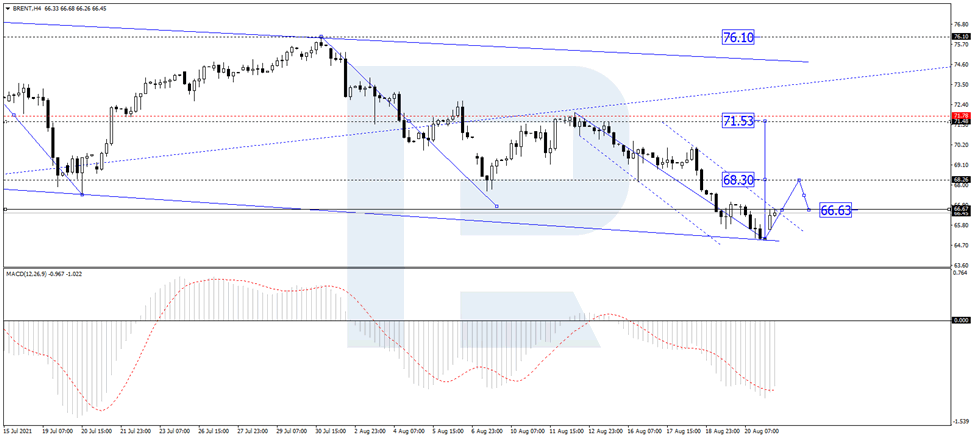
In the H4 chart, after reaching the predicted downside target at 67.00, Bret is consolidating below this level; it has already reached the downside border of the range at 65.05. Possibly, today the asset may form a new rising impulse towards 68.27 and then fall to reach 66.66, thus forming another consolidation range near the lows. Later, the market may break the range to the upside and form one more ascending wave with the target at 71.50. From the technical point of view, this scenario is confirmed by MACD Oscillator: its signal line is trading below 0 outside the histogram area and may move upwards. In the future, the line is expected to break 0, thus boosting the asset to grow towards new highs on the price chart.
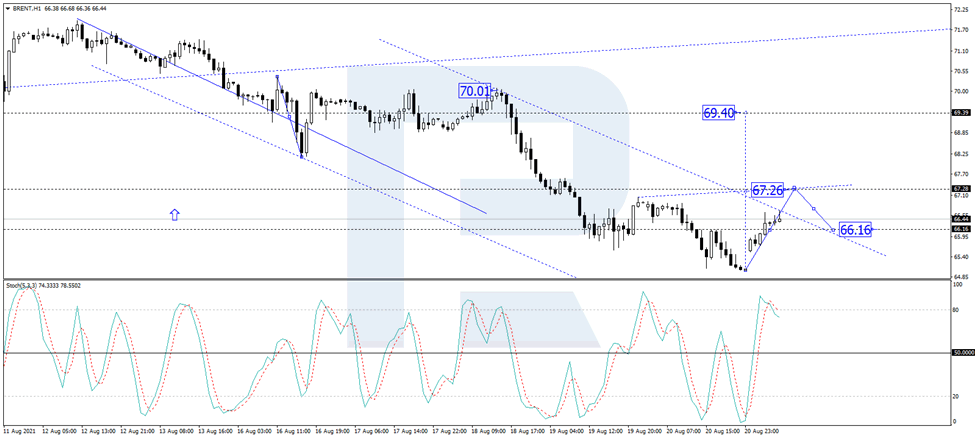
 As we can see in the H1 chart, after completing the ascending structure at 66.16 and forming a new consolidation range around this level, Brent is expected to break it to the upside and continue moving upwards with the first target at 67.26. After that, the instrument may correct to test 66.16 from above and then form one more ascending structure with the short-term target at 69.40. From the technical point of view, this idea is confirmed by the Stochastic Oscillator: after breaking 50 and reaching 80, its signal line is expected to fall and return to 50. Later, the line may rebound and resume moving upwards to reach 80
Appetite For Risk Improves Ahead Of Jackson Hole
Risk sentiment has turned positive at the start of the new week with stocks and US index futures rising slightly, crude oil rebounding 3.5% and copper rallying. In FX, the dollar gained against the safe-haven Japanese yen but fell against risk-sensitive commodity dollars. Meanwhile cryptocurrencies gained further ground with Bitcoin topping 50K. It remains to be seen whether the appetite for risk will remain positive as we head deeper into the week.
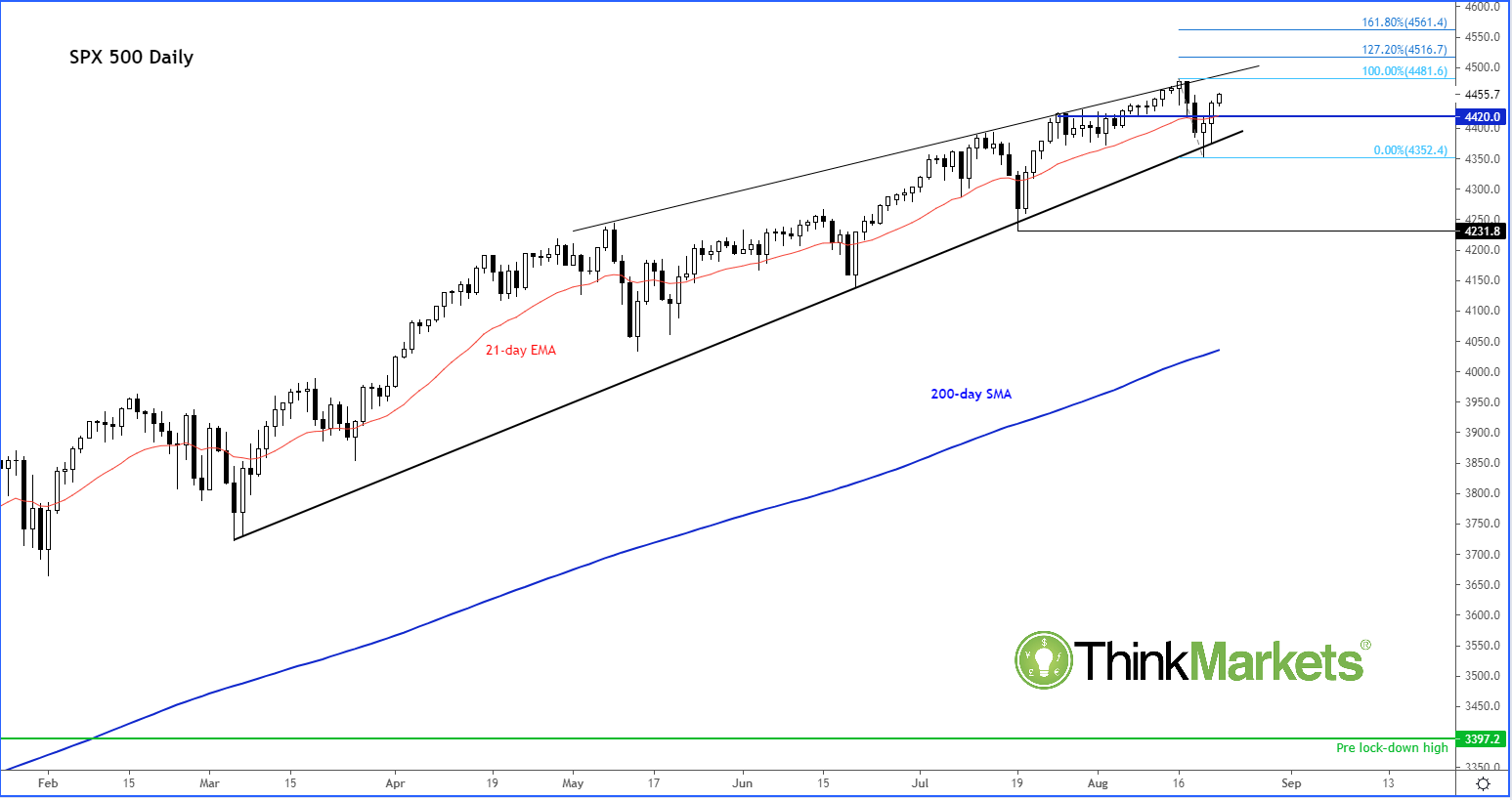
Last week, sentiment had turned a bit sour with the big falls in commodity prices. Investors were concerned that demand for crude oil and copper will be weaker than expected this year, owing to a resurgent coronavirus, with the delta variant proving to be more infectious and resilient than expected. The virus is spreading fast across the US, with hospitalisation and deaths climbing. On top of this, the dollar rallied on speculation the Federal Reserve was getting closer to taper its asset purchases. And to make the situation even worse, the latest macro data from China wasn’t great either as we found out at the start of the week, raising concerns that the world’s largest consumer of copper and many other commodities, is struggling to sustain its recovery. The soft US retail sales report we saw last week underscores the impact of the Delta variant, while Friday’s unexpected drop in UK July sales (-2.5%) could be a sign that the recovery is slowing down here, too. But as mentioned, all those concerns were put aside at the start of this week with risk assets rebounding. The key question is whether the recovery will last.
All eyes and ears on Jackson Hole Symposium (Friday)
One of the most eagerly-anticipated events – the Jackson Hole conference – is taking place on Thursday. But instead of a three-day-in-person meeting, it is now going to be a virtual event, which probably means the Fed is unlikely to kick off any major pivot in the tapering narrative in light of the recent upsurge in Delta cases and hospitalisations. Previously, analysts had expected Powell and co to spill the beans on tapering timeline.
If Powell signals the Fed will maintain status quo in the upcoming policy meetings, then the stock market bears may decide to stay largely on the side lines. The greenback may fall, and this could support gold. For most other commodities, which are sensitive to concerns about demand or supply dynamics, will likely remain subdued – unless Delta cases fall back sharply. Otherwise, as there is always the risk we may see more restrictions, or the current restrictions being extended, Monday’s recovery may not last very long for crude oil and copper. So, the impact of the Fed on commodities that are sensitive to the economy will be limited.
Still, judging by the latest communication from the Fed, it looks the US central bank is planning to pull back the pace of its monthly bond purchases before the end of the year, although “some” members – according to the minutes of the FOMC’s July meeting – prefer to wait until early in 2022 to start tapering. With inflation surging in recent months, the economy has already reached and surpassed its goal on inflation, and the Fed is “close to being satisfied” with the progress of jobs growth.
So, it is still possible Fed Chair Jay Powell may provide us with a rough timeline of its tapering process this week, although this would now come as surprise. Otherwise, the focus will quickly turn to the September meeting, when we will also have the updated economic and interest rate projections from the Fed. Either way, we are very close to finding out what the Fed’s next plans are.
But with the dollar already rising in anticipation of tapering, the greenback may not rise too much if the Fed does indeed inform us of its plans in the coming weeks. Indeed, policymakers at the Fed have been very clear about one thing: that tapering of QE purchases does not necessarily mean an imminent rate hike. For that to happen, the Fed will want to see “substantial further progress” in employment, something which the Fed does not feel has been achieved yet. Indeed, officials want to complete tapering of asset purchases first, before starting a hiking cycle.
European manufacturing and services PMIs mostly in line
Looking ahead to the other macro events for this week, they will all play second fiddle to the Jackson Hole event. We have already had the latest European manufacturing and services PMIs this morning, but they failed to ignite much volatility. Eurozone services PMI edged lower to 59.7 from 59.8, more or less in line with expectations. UK services PMI unexpectedly dropped to 55.5 from 59.6, yet this was also shrugged off in terms of initial reaction as the nation’s manufacturing PMI beat expectations. US PMIs are due later along with Existing Home Sales.
US Preliminary GDP and Jobless Claims (Wednesday)
Looking ahead, we will have more data from the US. Sentiment will be shaky after the recent sell-off in some key commodity prices such as crude oil and copper that was triggered, at least in part, by anxiety about the economic impact of the coronavirus spread and global supply chains. Last week, the number of Americans filing for initial jobless claims fell to 348K, the lowest level since the pandemic began, reflecting the steady progress in employment and economic recovery in general. Further improvement in the labour market could hasten the Fed’s policy normalisation processes and support the dollar. On Thursday, we will find out how the economy performed for in the second quarter. GDP will be the second estimate, after the “advance” estimate revealed the world’s largest economy had grown by 6.4%. Unless we see a sizeable revision, the market won’t be paying too much attention to what is backward-looking data. Instead, the focus will be on what’s to come the next – Jackson Hole (see above).
US data dump (Friday)
Finally, the last day of the week will see the release of US Core PCE Price Index; Personal Income and Spending, and UoM’s revised Consumer Sentiment and Inflation Expectations surveys. Among these, the PCE Price Index is going to be the most important given it is the Fed’s favourite measure of inflation. Now how much of a reaction we will get from Friday’s data releases will be dependent on what Fed Chairman Powell will have said at the Jackson Hole symposium regarding tapering on Wednesday. For example, if he chooses not to provide the timeline for tapering and says the Fed is waiting for the release of more data, then it will be logical to expect more of a reaction from the data releases.
Major Euro Area PMI Readings Showing Solid Expansion
Notes/Observations
- Jackson Hole symposium later in the week. Powell might offer further clarity on taper timing.
- High number of Delta variant cases in some countries raises concerns about the global growth outlook.
- Major European PMI data mixed but decelerating from recent cycle highs (Beats: France, UK; Misses: Germany, Euro Zone); expansion in region cooling only slightly despite widespread supply chain delays.
Asia
- New Zealand PM Ardern confirmed another extension of 3 days to the national lockdown extended until Aug 27th with Auckland lockdown extended until Aug 31st.
- Japan Aug Preliminary PMI Manufacturing registered its 7th month of expansion (52.4 v 53.0 prior.
- Australia Aug Preliminary PMI Manufacturing registered its 15th consecutive month of expansion but lowest since June 202 ( 51.7 v 56.9 prior.
- China Ministry of Commerce (MOFCOM) reiterated view that faced severe foreign trade situation in H2 2021 and early 2022. Added that foreign trade might face more complicated situation in 2022.
- Opposition-backed candidate Takeharu Yamanaka won the Yokohama mayoral elections.
Europe
- ECB's Schnabel (Germany) reiterated stance that expected inflation to keep rising until the end of 2021 especially in Germany, but then seeing CPI falling "significantly" in 2022.
- German chancellor Merkel says Ukraine should remain a gas transit state after 2024 and construction of Nord Stream 2. Would impose new sanctions on Moscow if necessary, in reference to potential use of Nord Stream 2 as a "weapon".
- UK PM Johnson to convene special G-7 meeting on Tuesday (Aug 24th) regarding Afghanistan was expected to ask US President Biden to delay withdrawal of US forces.
- Sweden PM Lofven to step down in November and to also step down as leader of the Social Democrats.
Americas
- Treasury Sec Yellen said to have told senior White House officials she was in favor of reappointing Fed Chair Powell for a 2nd term.
Speakers/Fixed income/FX/Commodities/Erratum
Equities
- Indices [Stoxx600 +0.30% at 470.20, FTSE +0.36% at 7,113.25, DAX +0.08% at 15,820.10, CAC-40 +0.70% at 6,672.37, IBEX-35 +0.16% at 8,930.00, FTSE MIB +0.26% at 25,985.50, SMI +0.31% at 12,453.82, S&P 500 Futures +0.24%].
- Market Focal Points/Key Themes: European indices open higher across the board but moderated their gains as the session wore on; improved risk sentiment supports cyclicals; better performing sectors include consumer discretionary and financials; industrials and materials sectors among the laggards; oil and gas subsector supported by higher crude; reportedly private equity firms looking to acquire Sainsbury’s; also private equity firms are reported interested in Babcock; Cembra Money Bank terminates agreement with Migros; Vonovia formally launches takeover of Deutsche Wohenen; reportedly Fincatieri interested in acquiring Leonardos’ OTO Melara unit; earnings expected during the upcoming US session include JD.com and Madison Square Garden Entertainment.
Equities
- Consumer discretionary: J Sainsbury [SBRY.UK] +9% (PE interest speculation), B&S Group [BSGR.NL] -3% (earnings), Zoo Digital [ZOO.UK] -4% (trading update).
- Financials: Cembra Money Bank [CMBN.CH] -27% (terminates credit card partnership).
- Healthcare: Valneva [VLA.FR] +3% (vaccine rolling submission).
- Industrials: Babcock International Group [BAB.UK] +5% (PE interest speculation), Renold [RNO.UK] +18% (trading update).
- Technology: Prosus [PRX.NL] +1.5% (buyback).
Speakers
- SNB President Jordan said to have preventive medical procedure. In good condition and to return to work after a recovery period.
- South Korea Fin Min Hong stated that financial market stabilization remained important as high uncertainties persist. Reiterated stance to closely monitor markets and take pre-emptive steps if needed.
Currencies/ Fixed income
- USD retraced from its recent strength. Dealers awaiting policy clues from central bankers at the Jackson Hole symposium on Thursday amid a recent surge in coronavirus cases that threatens to dent the global recovery. Some speculation Fed might delay the start of tapering.
- EUR/USD was trading at 1.1725 area by mid-session. Major European PMI data released during the session was mixed. Dealers noted that although readings were decelerating from recent cycle highs but added the expansion in region was cooling only slightly despite widespread supply chain delays. Yields in Europe reflected this sentiment and rose by approx. 3bps in both the core and peripheral areas.
Economic data
- (NL) Netherlands Aug Consumer Confidence Index: -6 v -4 prior.
- (DK) Denmark Aug Consumer Confidence Indicator: 4.4 v 2.6 prior.
- (CH) Swiss July M3 Money Supply Y/Y: 3.4% v 3.7% prior.
- (TR) Turkey Aug Consumer Confidence: 78.2 v 79.5 prior.
- (FR) France Aug Preliminary Manufacturing PMI: 57.3 v 57.2e (9th month of expansion); Services PMI: 56.4 v 56.3e; Composite PMI: 55.9 v 56.1e.
- Germany Aug Preliminary Manufacturing PMI: 62.7 v 65.0e (14th month of expansion); Services PMI: 61.5 v 61.0e; Composite PMI: 60.6 v 62.5e.
- (EU) Euro Zone Aug Preliminary Manufacturing PMI: 61.5 v 62.0e (14th month of expansion); Services PMI: 59.7 v 59.5e; Composite PMI: 59.5 v 59.6e.
- (CH) Swiss weekly Total Sight Deposits (CHF): 715.0B v 714.6B prior; Domestic Sight Deposits: 639.8B v 639.3B prior.
- (TR) Turkey July Foreign Tourist Arrivals Y/Y: 367.0% v 853.4% prior.
- (TW) Taiwan July Industrial Production Y/Y: 13.9% v 17.6%e.
- (TW) Taiwan July Unemployment Rate:4.4 % v 4.7%e.
- (UK) Aug Preliminary Manufacturing PMI: 60.1 v 59.5e (15th straight expansion); Services PMI: 55.5 v 59.1e; Composite PMI: 55.3 v 58.7e.
- (IS) Iceland July Wage Index M/M: -0.1% v +0.4% prior; Y/Y: 7.8% v 7.7% prior.
Fixed income issuance
- (NO) Norway sold NOK2.0B vs. NOK2.0B indicated in 6-month bills; Avg Yield: 0.21 v 0.12% prior; Bid-to-cover: 3.01x v 2.13x prior.
Looking ahead
- (PE) Peru Q2 GDP Y/Y: 41.5%e v 3.8% prior.
- 05:25 (EU) Daily ECB Liquidity Stats.
- 05:30 ((DE) Germany to sell €4.0B in 12-month BuBills.
- 06:00 (UK) Aug CBI Industrial Trends Total Orders: 16e v 17 prior; Selling Prices: 40e v 42 prior.
- 06:00 (IL) Israel July Unemployment Rate: No est v 5.2% prior; Unemployment Rate (including Covid): No est v 9.0% prior.
- 06:00 (IL) Israel Jun Manufacturing Production M/M: No est v -1.7% prior.
- 06:00 (RO) Romania to sell RON200M in 4.25% 2036 Bonds.
- 06:00 (IL) Israel to sell bonds.
- 06:45 (US) Daily Libor Fixing.
- 07:00 (MX) Mexico Jun Retail Sales M/M: 0.1%e v 0.6% prior; Y/Y: 20.4%e v 29.7% prior.
- 07:25 (BR) Brazil Central Bank Weekly Economists Survey.
- 08:00 (PL) Poland July M3 Money Supply M/M: 0.5%e v 0.2% prior; Y/Y: 8.2%e v 7.4% prior.
- 08:00 (UK) Daily Baltic Dry Bulk Index.
- 08:00 (IN) India announces details of upcoming bond sale (held on Fridays).
- 08:30 (US) July Chicago Fed National Activity Index: 0.11e v 0.09 prior.
- 09:00 (IL) Israel Central Bank (BOI) Interest Rate Decision: Expected to leave Base Rate unchanged at 0.10%.
- 09:00 (FR) France Debt Agency (AFT) to sell €4.3-5.5B in 3-month, 6-month and 12-month bills.
- 09:45 (US) Aug Preliminary Markit Manufacturing PMI: 62.3e v 63.4 prior; Services PMI: 59.2e v 59.9 prior; Composite PMI: No est v 59.9 prior.
- 09:45 (EU) ECB weekly QE bond buying update.
- 09:45 (UK) BOE to buy £1.147B in APF Gilt purchase operation (3-7 years).
- 10:00 (US) July Existing Home Sales: 5.83Me v 5.86M prior.
- 10:00 (EU) Euro Zone Aug Advance Consumer Confidence Index: -4.9e v -4.4 prior.
- 11:30 (US) Treasury to sell 13-Week and 26-Week Bills.
- 16:00 (US) Weekly Crop Progress Report.
- 17:00 (KR) South Korea Aug Consumer Confidence: No est v 103.2 prior.
- 18:45 (NZ) New Zealand Q2 Retail Sales (ex-inflation) Q/Q: 2.0%e v 2.5% prior.
- 19:30 (AU) Australia ANZ Roy Morgan Weekly Consumer Confidence Index: No est v 101.1 prior.
- 20:00 (AU) RBA's Richards.
- 21:30 (KR) South Korea to sell KRW250B in 20-Year Bonds.
- 22:30 (KR) South Korea to sell KRW300B in 20-Year Bonds.
- 23:00 (KR) South Korea Q2 Household Credit (KRW): No est v 1.765T prior.
- 23:00 (TH) Thailand Central Bank to sell combined THB 60B in bills.
- 23:30 (HK) Hong Kong to sell 3-month and 6-month Bills.
- 22:30 (JP) Japan to sell 6-Month Bills.
- 23:35 (JP) Japan to sell 5-Year JGB Bonds.
Bundesbank: Output to rise sharply in summer
In the monthly report, Bundesbank said German economic output is "likely to rise sharply in summer 2021", more strongly than in Spring. Industry was unable to take advantage of the growth in Q2 due to increased delivery bottlenecks. But there are initial signs that these delivery bottlenecks are "at least not worsening". It remains to be seen if GDP could reach pre-crisis level in Summer or not until Autumn.
Inflation is expected to continue to rise in Germany, but then "decrease noticeably again at the beginning of 2022", as the base effect will then no longer apply. Though, inflation could still be over 2% until mid-2022.