

Sample Category Title
GBP/JPY Weekly Outlook
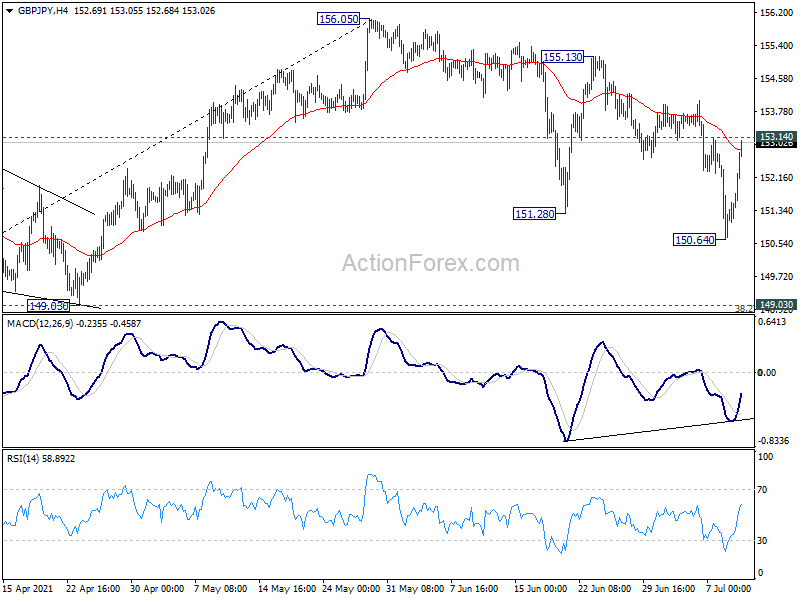
GBP/JPY's corrective fall from 156.05 resumed to 150.64 last week, but rebounded strongly since then. Initial bias is neutral this week first. In case of another fall, through 150.64 support, downside should be contained by 38.2% retracement of 136.96 to 156.05 at 148.75 to bring rebound. On the upside, firm break of 153.14 minor resistance will argue that the corrective fall has completed, on bullish convergence condition in 4 hour MACD. Stronger rise would then be seen back to 155.13/156.05 resistance zone.
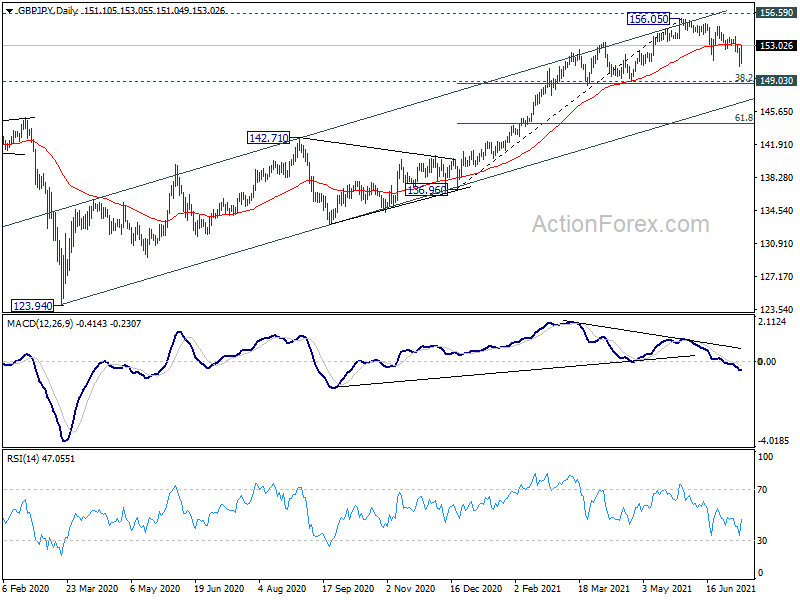
In the bigger picture, rise from 123.94 is seen as the third leg of the pattern from 122.75 (2016 low). Focus remains on 156.59 resistance (2018 high). Sustained break there should confirm long term bullish trend reversal. Next target is 61.8% retracement of 195.86 (2015 high) to 122.75 at 167.93. On the downside, break of 149.03 support is needed to be the first sign of completion of the rise from 123.94. Otherwise, outlook will remain bullish even in case of deep pull back.
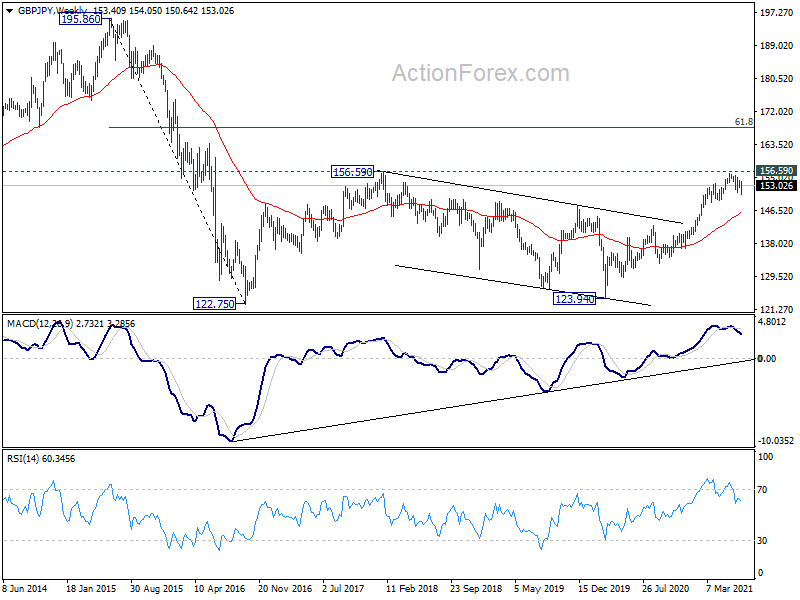
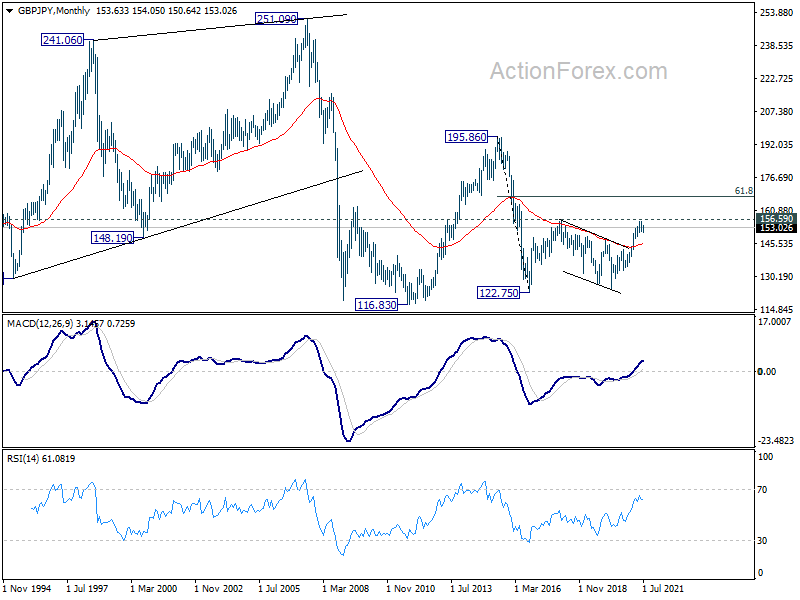
In the longer term picture, the strong break of 55 months EMA was an early sign of long term bullish reversal. Firm break of 156.69 resistance should now confirm the start of an up trend for 195.86 (2015 high).
EUR/JPY Weekly Outlook
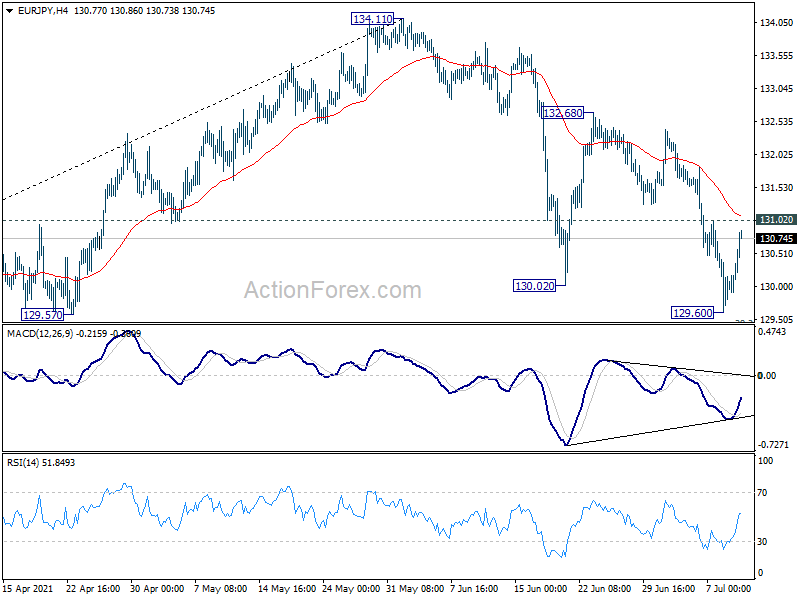
EUR/JPY's corrective decline from 134.11 resumed to as low as 129.60 last week but rebounded strongly since then. Initial bias is neutral this week first. In case of another fall, we'd expect strong support from 38.2% retracement of 121.63 to 134.11 at 129.34 to bring rebound. On the upside, break of 131.02 resistance will indicate short term bottoming, on bullish convergence condition in 4 hour MACD. Strong rise should be seen to 132.68 resistance and above.
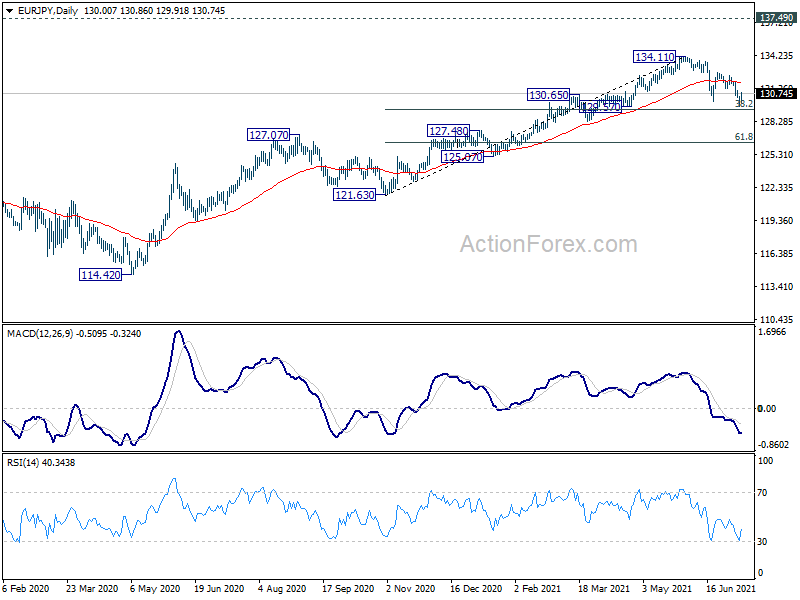
In the bigger picture, rise from 114.42 is seen as a medium term rising leg inside a long term sideway pattern. Next target is 137.49 (2018 high). Decisive break there will open up the possibility that it's indeed resuming the up trend from 94.11 (2012 low). For now, outlook will stay bullish as long as 127.07 resistance turned support holds, in case of pull back.
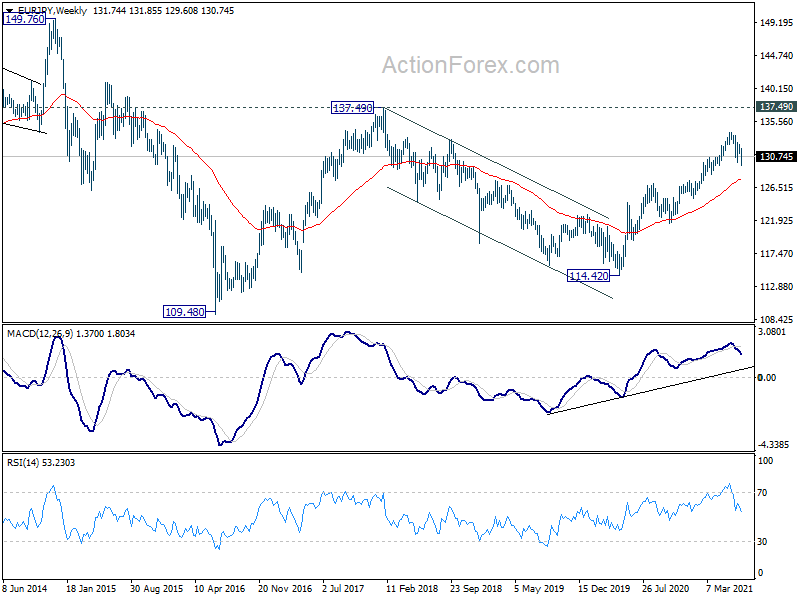
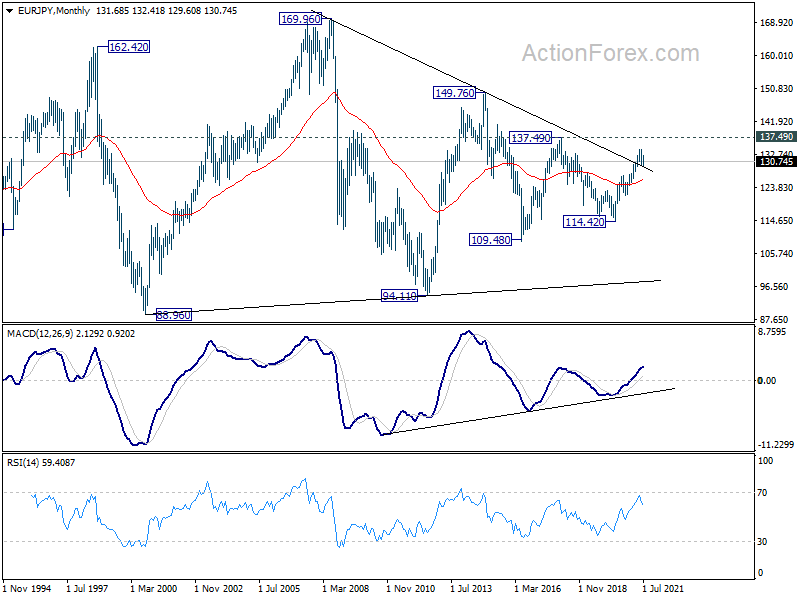
In the long term picture, EUR/JPY is staying in long term sideway pattern, established since 2000. Another rising leg in progress for 137.49 resistance and above.
EUR/GBP Weekly Outlook
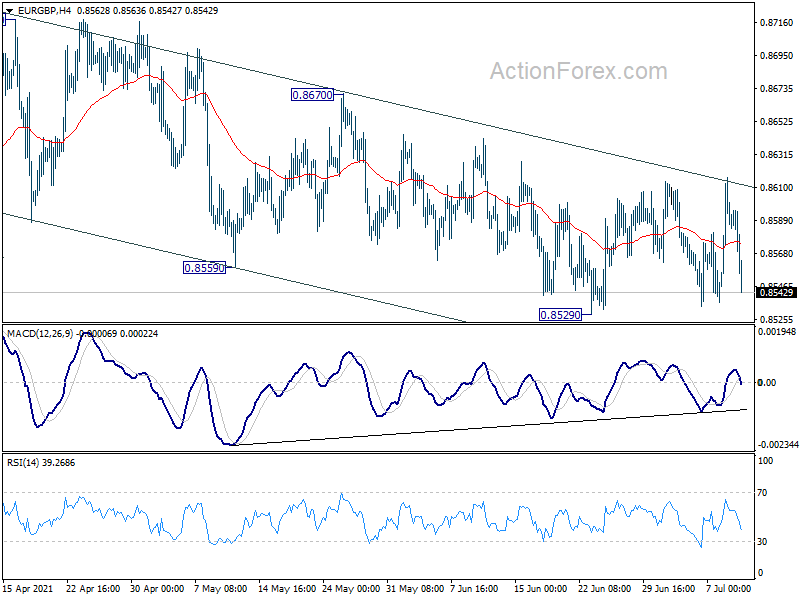
EUR/GBP stayed in range above 0.8529 last week, as well ass near term falling channel. Outlook is unchanged and initial bias is neutral this week first. On the downside, break of 0.8529 will resume the choppy decline towards retesting 0.8470 low. On the upside, decisive break of 0.8670 will confirm that corrective fall from 0.8718 has completed. Further rise would be seen to resume the rebound from 0.8470.
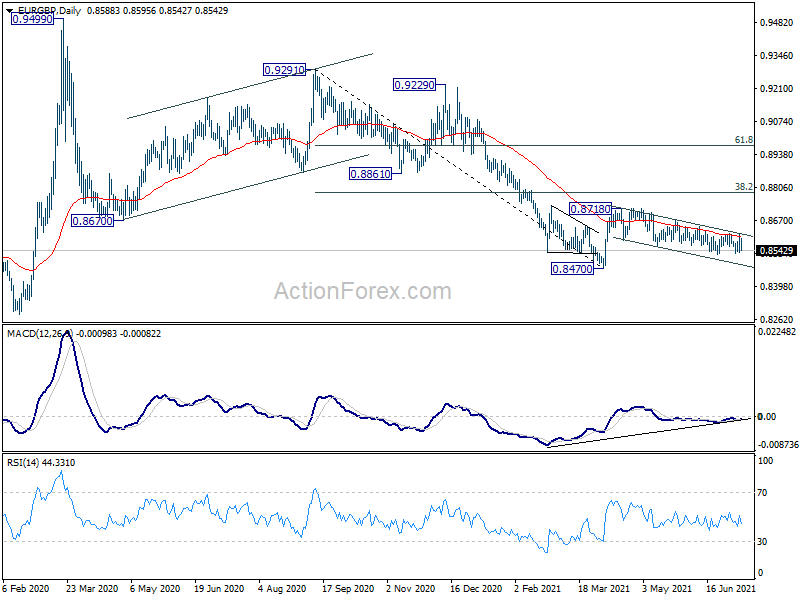
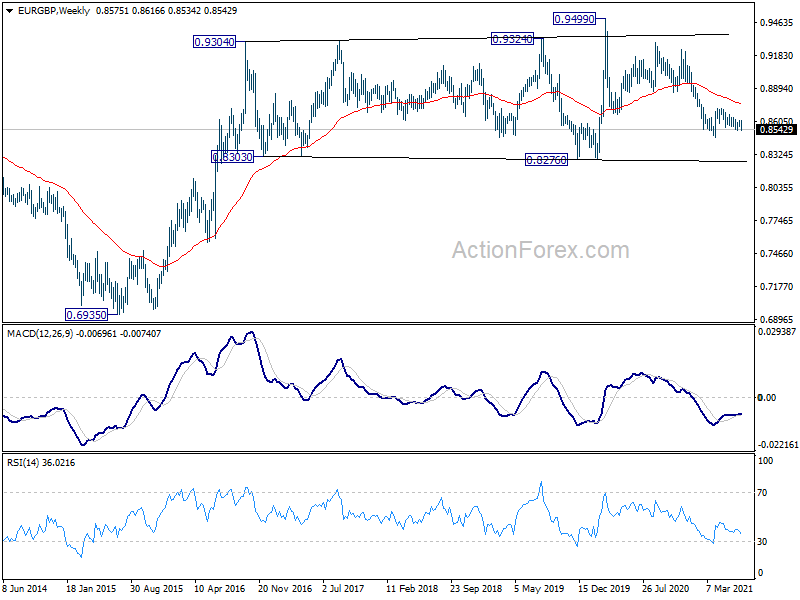
In the bigger picture, price actions from 0.9499 are still seen as developing into a corrective pattern. That is, up trend from 0.6935 (2015 low) would resume at a later stage. This will remain the favored case as long as 0.8276 support holds. However, firm break of 0.8276 support will suggest that rise from 0.6935 has completed and turn medium term outlook bearish.
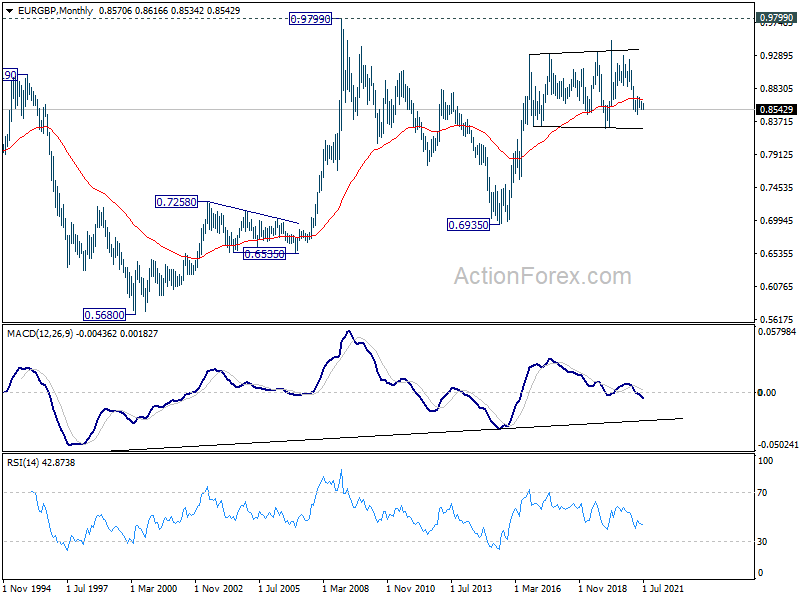
In the long term picture, rise from 0.6935 (2015 low) is still in progress. It could be resuming long term up trend from 0.5680 (2000 low). Break of 0.9799 (2008 high) is expected down the road, as long as 0.8276 support holds.
EUR/AUD Weekly Outlook
EUR/AUD's choppy rise from 1.5250 resumed to 1.5976 last week after drawing support from 55 day EMA. But a temporary top was formed there and initial bias is turned neutral this week first. On the upside, break of 1.5976 will target 1.6033 key support turned resistance next. Sustained break there will argue that longer term trend has reversed, and target 1.6827 resistance for confirmation.
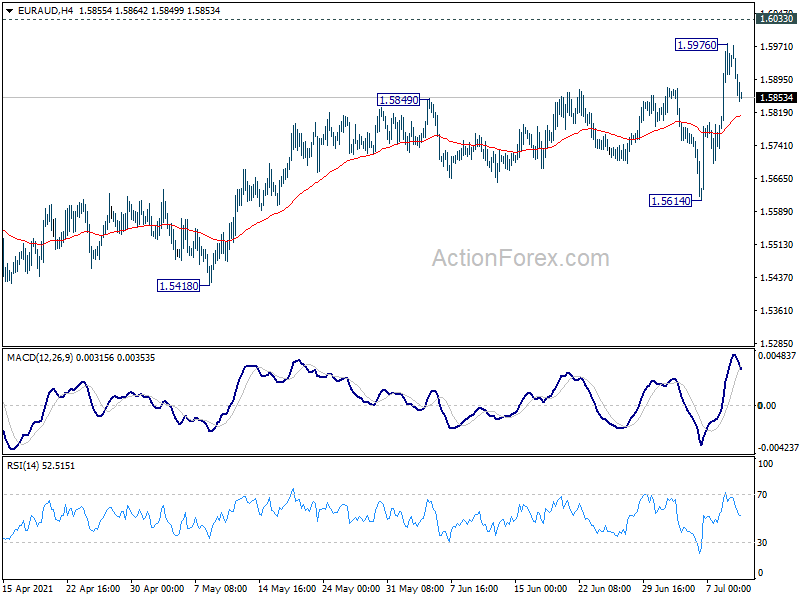
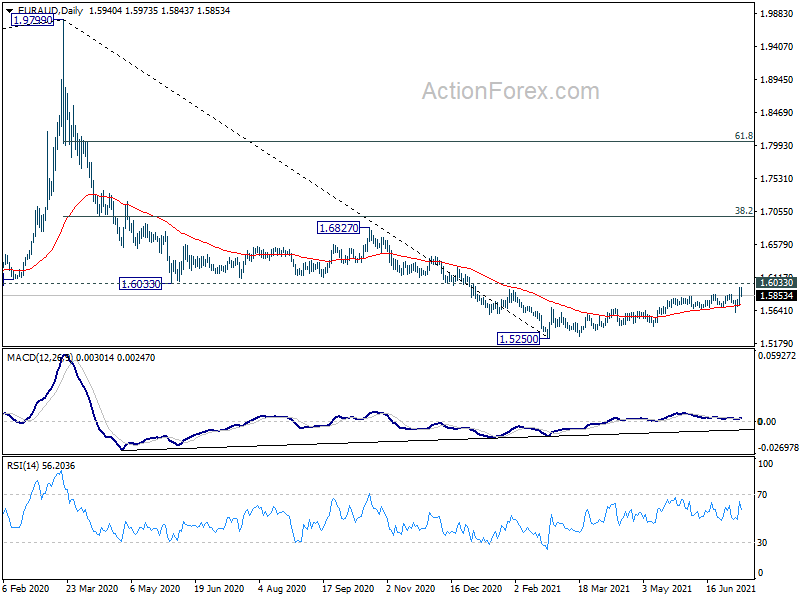
In the bigger picture, outlook stays bearish with 1.6033 support turned resistance intact for now. Fall from 1.9799, as a correction to to long term up trend from 1.1602 (2012 low) is still in favor to resume through 1.5250 later. However, However, firm break of 1.6033 will argue that such decline has completed. Stronger rebound would then be seen 38.2% retracement of 1.9799 to 1.5250 at 1.6988.
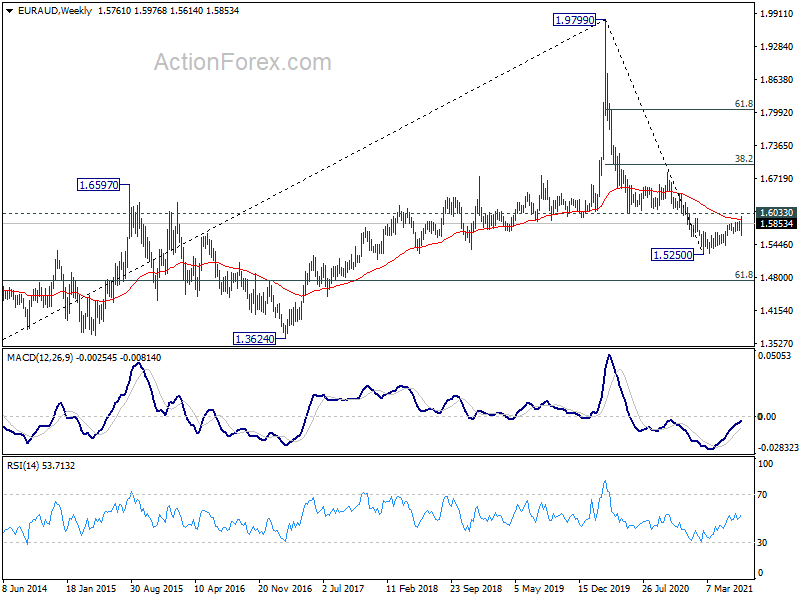
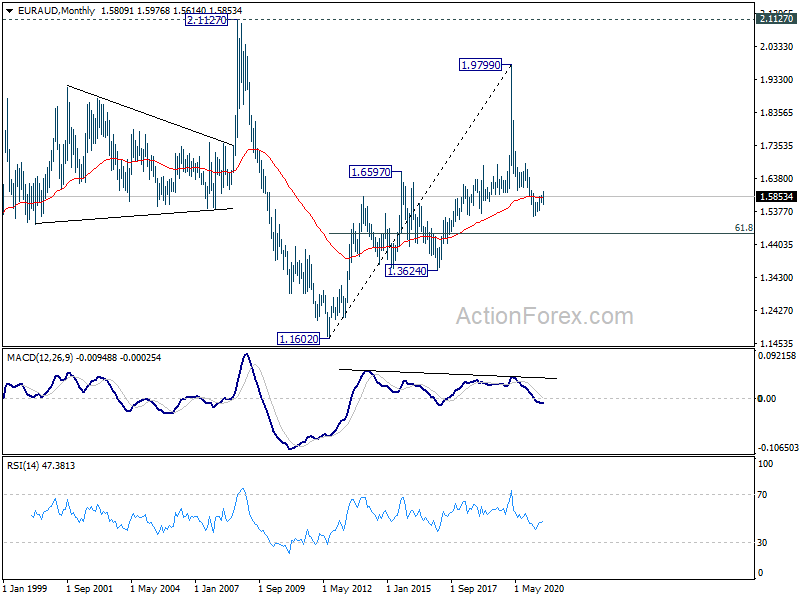
In the longer term picture, rise from 1.1602 (2012 low) should have already completed with three waves up to 1.9799 (2020 high). Fall from there is seen as a medium term to long term down leg as a long term down trend, or a sideway pattern. We'll assess the odds again at a later stage.
EUR/CHF Weekly Outlook
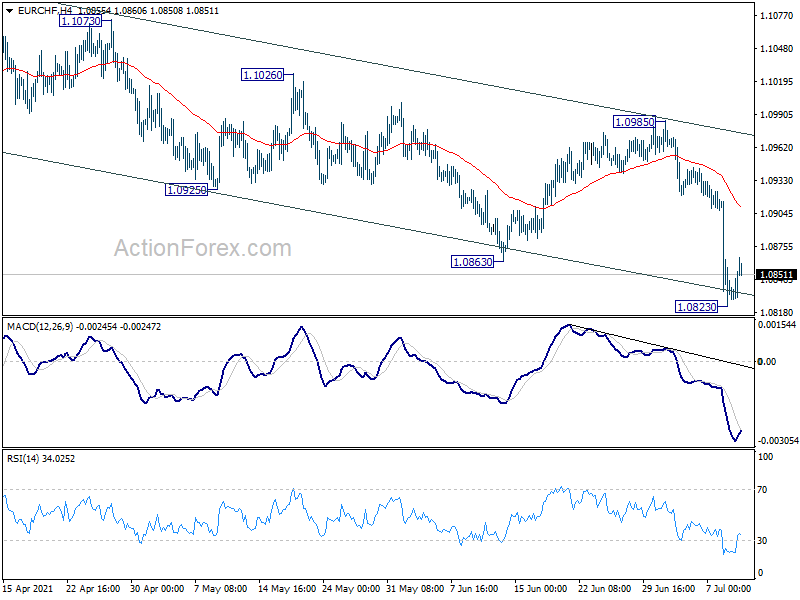
EUR/CHF's decline from 1.1149 resumed last week and hit as low as 1.0823. A temporary low was formed there with subsequent recovery. Initial bias is turned neutral this week first. Some consolidations could be seen. But overall outlook will stay bearish as long as 1.0985 resistance holds. Break of 1.0823 will resume the decline to 1.0737 cluster support next.
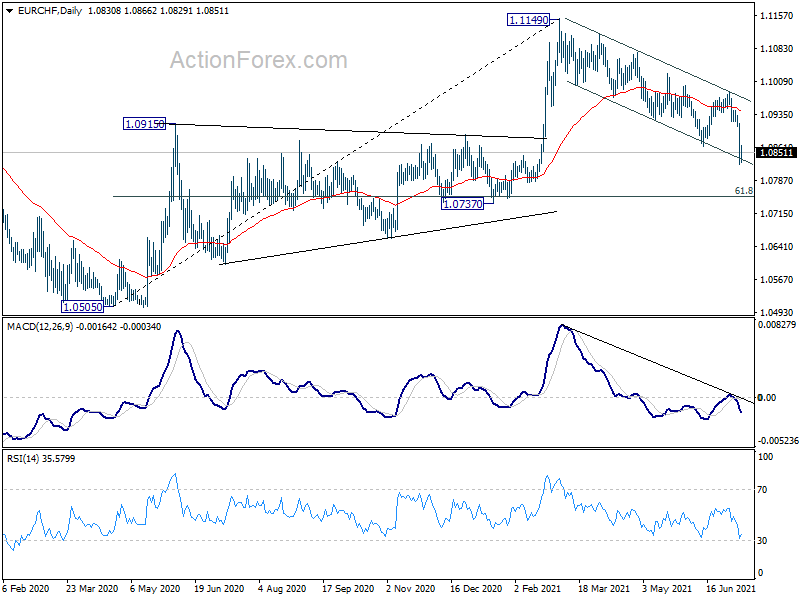
In the bigger picture, current development argues that rebound from 1.0505 (2020 low) might be completed with three waves up to 1.1149 already. Sustained trading below 55 week EMA (now at 1.0885) will affirm this bearish case. Further break of 1.0737 cluster support (61.8% retracement of 1.0505 to 1.1149 at 1.0751) will bring retest of 1.0505 low.
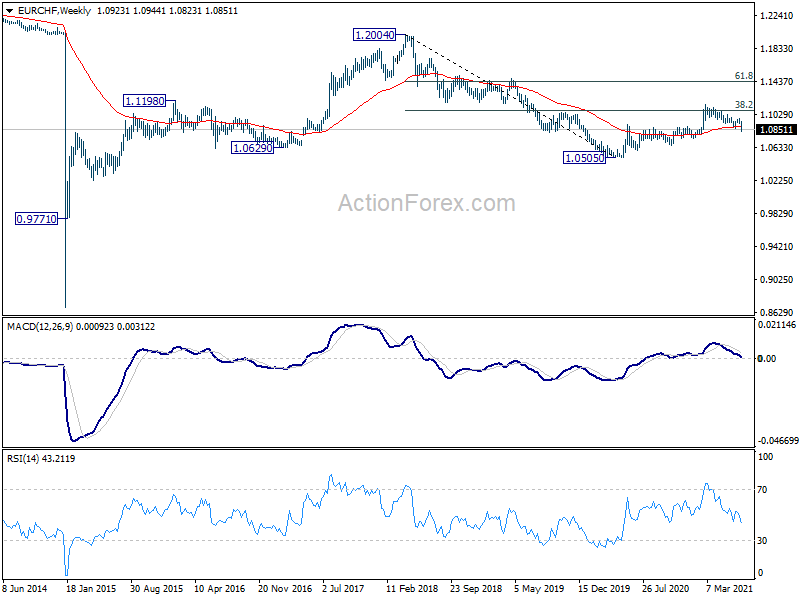
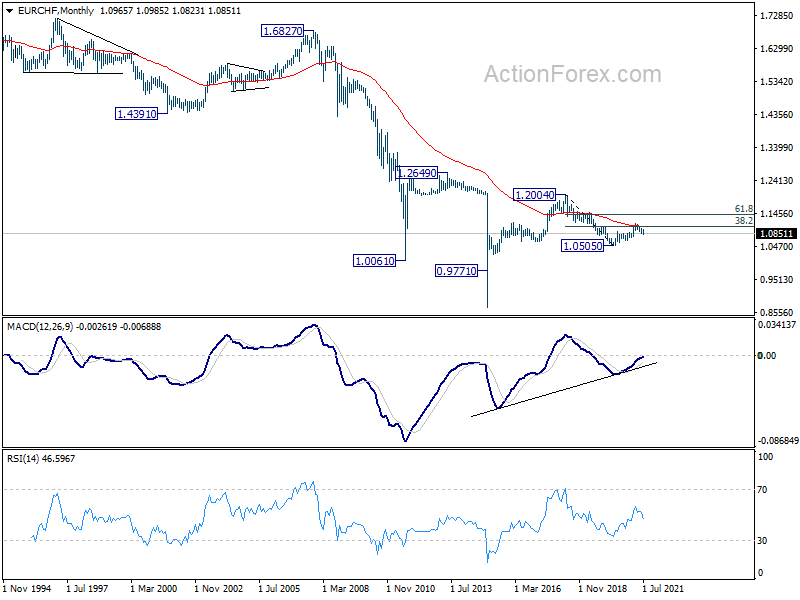
In the long term picture, price actions from 1.0505 are currently seen as a correction to down trend from 1.2004 (2018 high). only. The failure to sustain above 38.2% retracement of 1.2004 to 1.0505 at 1.1078 retains long term bearishness. This is also affirmed by rejection by 55 month EMA. Another fall through 1.0505 is mildly in favor for now.
Dollar and Yen Could Turn Weaker Again as Risk Bulls Didn’t Give Up
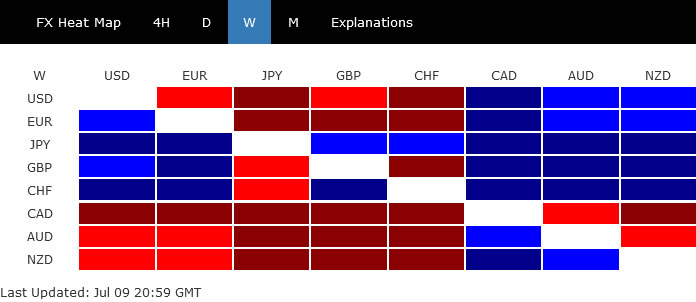
Market bears had multiple chances to probe a bearish reversal last week, riding on talks like Fed's tapering, spread of Delta variants, and China's crackdown on its own technology stocks, as well as foreign IPOs. Yet, the optimists just refused to give up and pushed US indexes to new record closes, after all the volatility. The tug of war should end that easily. But for now, it seems that the bulls are having a solid upper hand.
That brings us to note that while Yen and Swiss Franc ended as the strongest, late selloff argues that the near term moves are already reversing. Some Yen crosses, as noted below, could have completed their corrections near to medium term fibonacci support levels. Dollar also ended mixed after losing momentum and paring back much gains. There is prospect of more downside in Dollar for the near term. The question is whether commodity currencies, after ending the week as worst performers, could strike a come back. Or, it's now time for Euro and Sterling to shine.
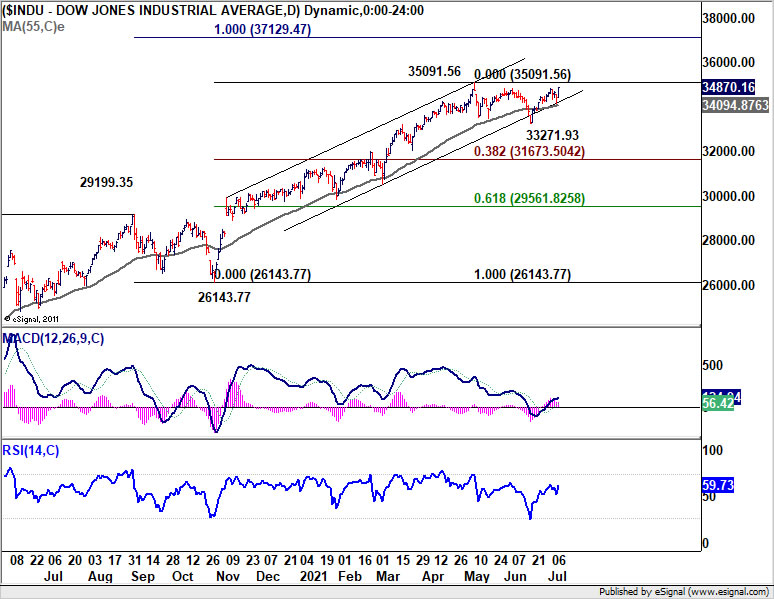
DOW ended at record close after volatile week
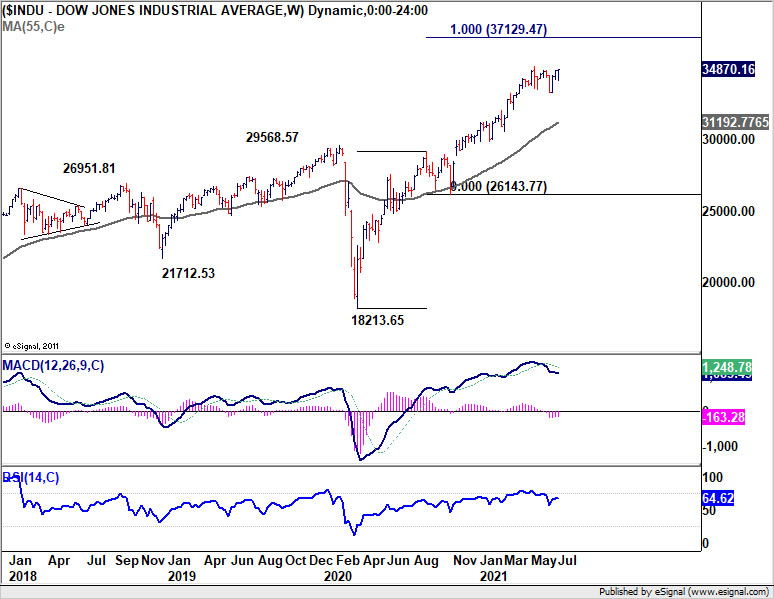
The intra-week selloff in stocks proved to be just a temporary blip. NASDAQ and S&P 500 eventually extended recent up trend to new record high. Even DOW ended the week at record close at 34870.16, even though it's short of intraday record of 35091.56. More importantly, it also managed to hold above 55 day EMA (now at 34095.87) and stayed inside medium term channel. Thus, there is no change in the up trend despite all the shocks. Focus is back on 35091.56 in the coming days. Firm break there will resume larger up trend from 18213.65, towards 100% projection of 18213.65 to 29199.35 from 26143.77 at 37129.47.
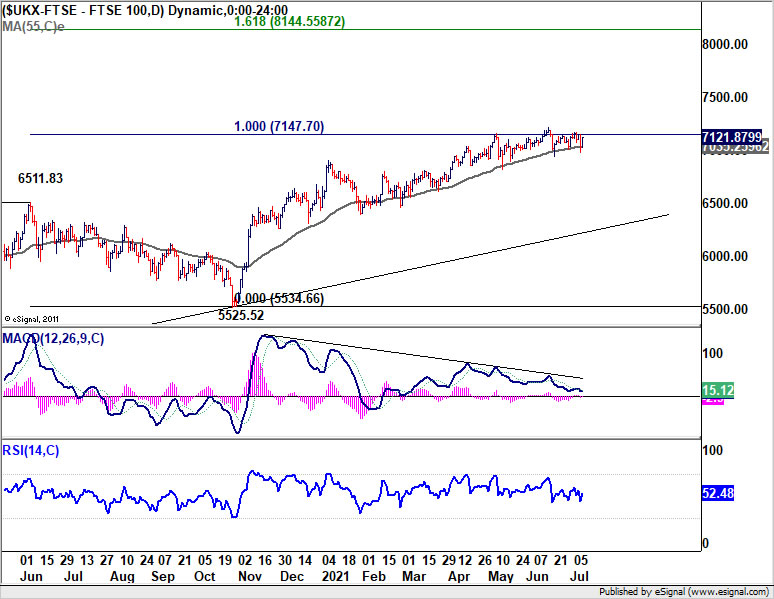
FTSE and DAX range bound, Nikkei holding on to fibonacci support
Development in major European indexes were also not back. FTSE was just range bound, and repeated drew support from rising 55 day EMA. Similarly, DAX also just engaged in sideway consolidation, holding on to rising 55 day EMA. Both indexes are staying in healthy medium term up trend for upside breakout any time.
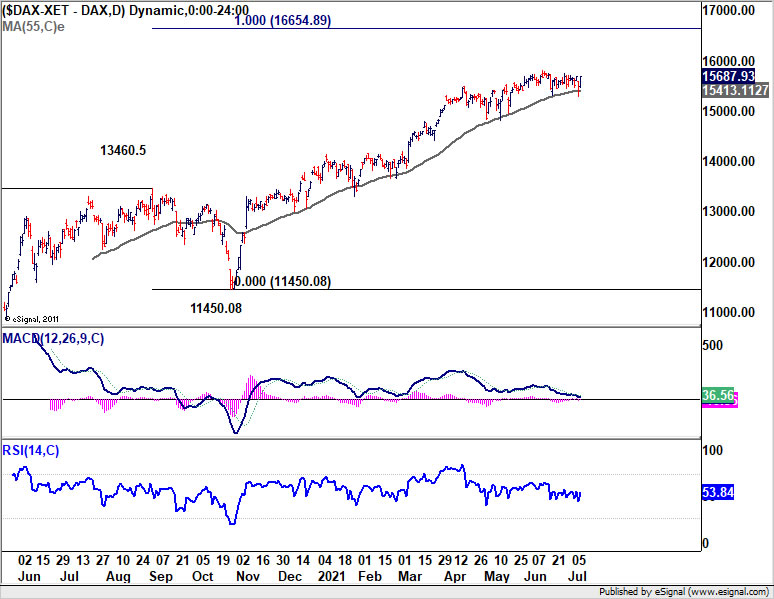
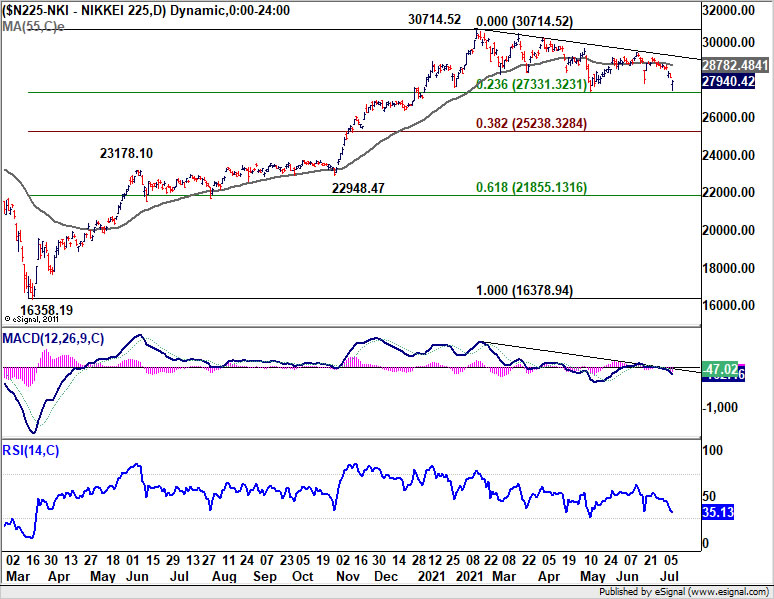
Nikkei's development was a little bit more shaky, as dragged down China's crackdown on its own technology sector. Yet, it's holding on to 23.6% retracement of 16378.94 to 30714.52 at 27331.32. The risk of deeper, medium-term scale, correction is there, but not overwhelmingly high yet.
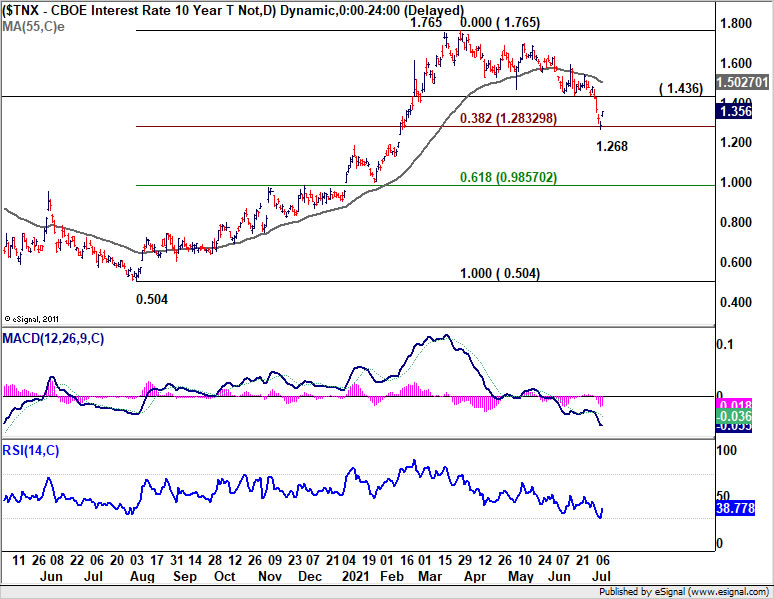
10-year yield rebounded after diving to 1.268
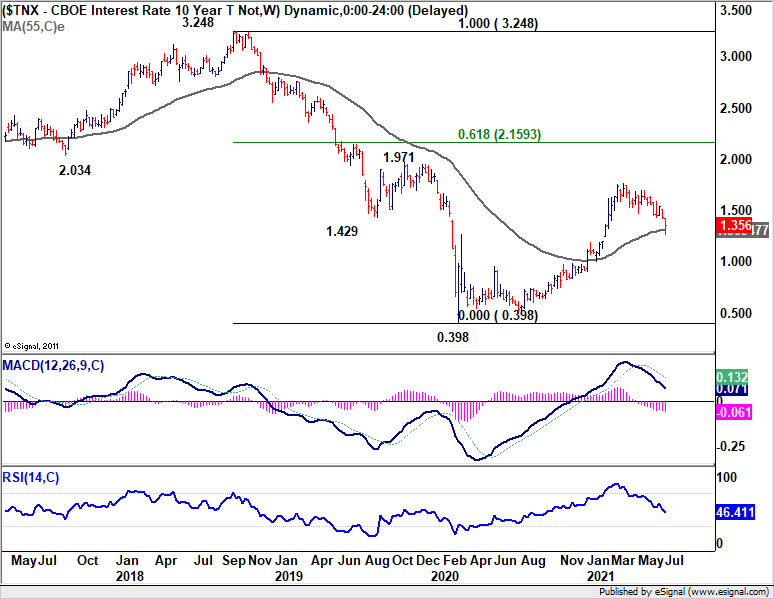
Back to the US markets, 10-year yield dived sharply to as low as 1.268 last week but recovered notably from there to close at 1.356. Some support was seen from 38.2% retracement of 0.504 to 1.765 at 1.283. Such level is also close to 55 week EMA (now at 1.309). The conditions are there to complete the correction from 1.765. If TNX could quickly rise back above 1.436 resistance the support later in the month, overall market sentiment would be seen as normalized.
Dollar index continued to lose upside momentum
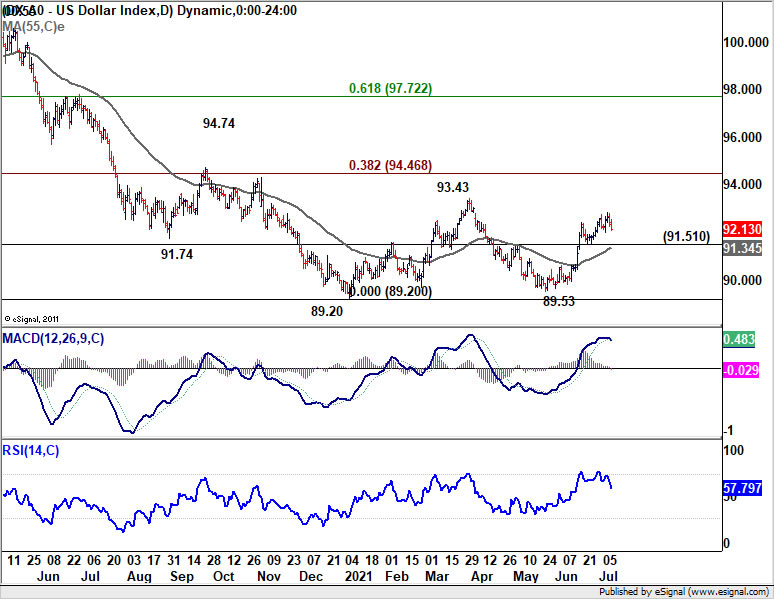
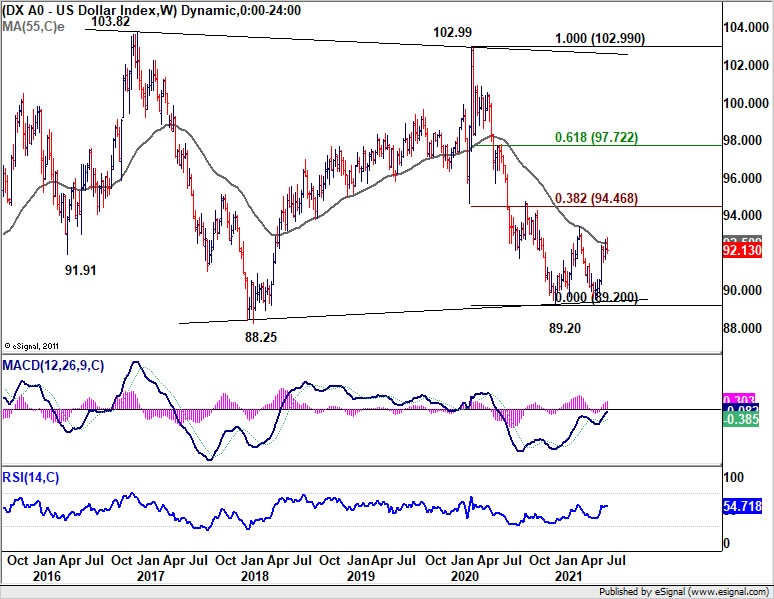
As for the Dollar index, it continued to lose upside momentum as seen in Daily MACD. 55 week EMA (now at 92.50) is too much for DXY to break through decisively. Risk of a near term reversal is increasing. Break of 91.51 support would bring deeper fall through 55 day EMA (now at 91.34), back to retest 89.20/53 support zone. Also, even in case of another rise, as we're seeing it as in sideway consolidation pattern from 89.20, there is little upside potential above 93.43 resistance
Yen crosses might have finished correction with last week's falls
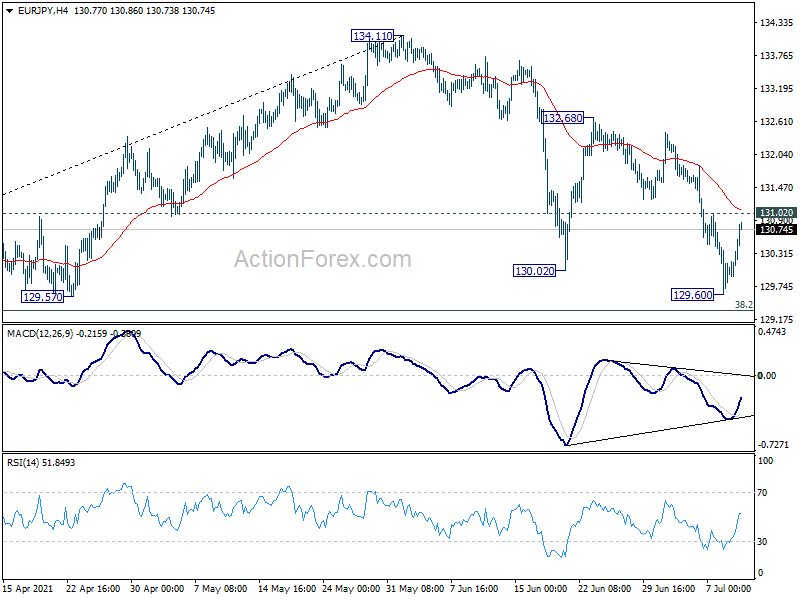
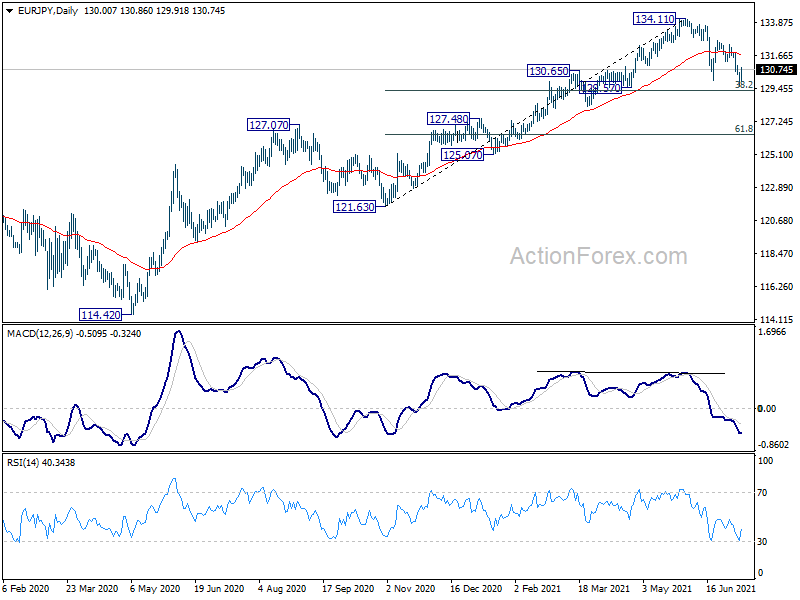
Yen crosses are worth some attention in the coming days. Near term correction could have completed after last week's deep decline and late rebound. EUR/JPY's focus will be on 131.02 minor resistance this week. Firm break there will argue that correction from 134.11 has completed with three waves down to 129.60, on bullish convergence condition in 4 hour MACD. That came just ahead of 38.2% retracement of 121.63 to 134.11 at 129.34. Stronger rebound would then be seen to 132.68 resistance to confirm.
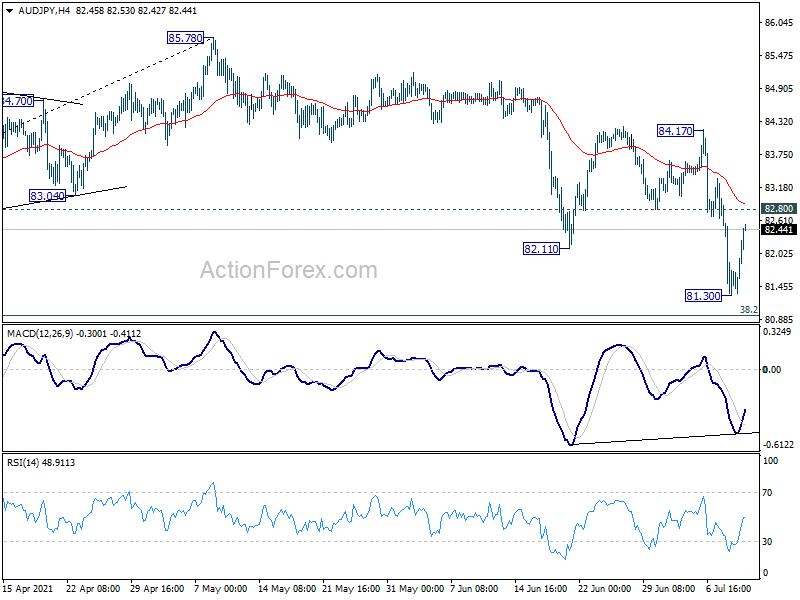
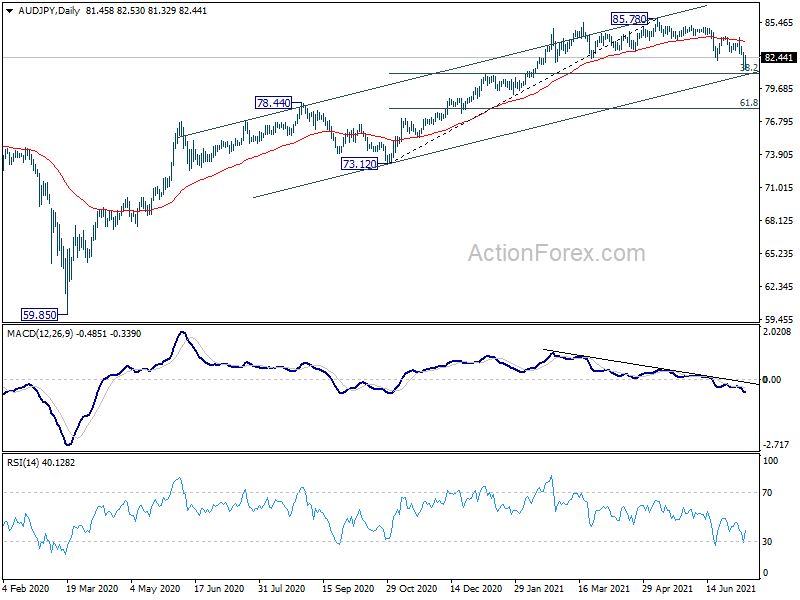
Similarly, AUD/JPY's focus will be on 82.80 support turned resistance this week. Firm break there will argue that correction from 85.78 has completed at 81.30, on bullish convergence condition in 4 hour MACD. That came just above 38.2% retracement of 73.12 to 85.78 at 80.94. Further rise should then be seen to 84.17 resistance to confirm.
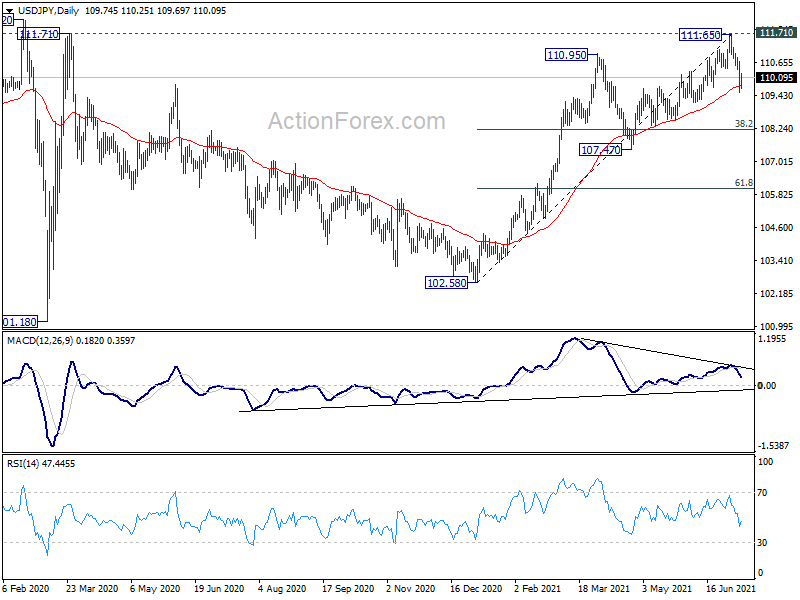
Development of USD/JPY would be less clear, depending on the relative reactions if risk appetite continues strongly. Bearish divergence condition in Daily MACD gives a warning that it was rejected firmly by 111.71 key resistance already. Yet, it's not giving up on 55 day EMA yet. Risk will be mildly on the downside, but the pair has to break through last week's low at 109.52 to confirm that selling is back first.
EUR/USD Weekly Outlook
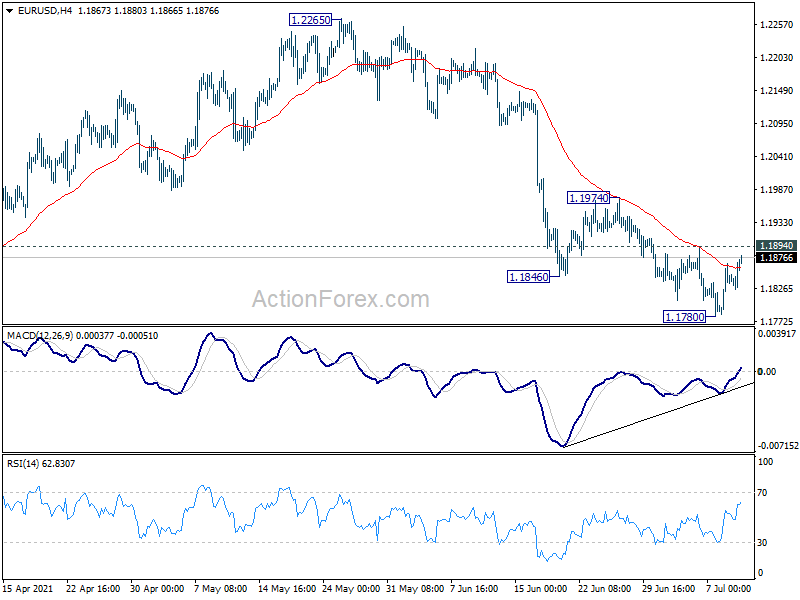
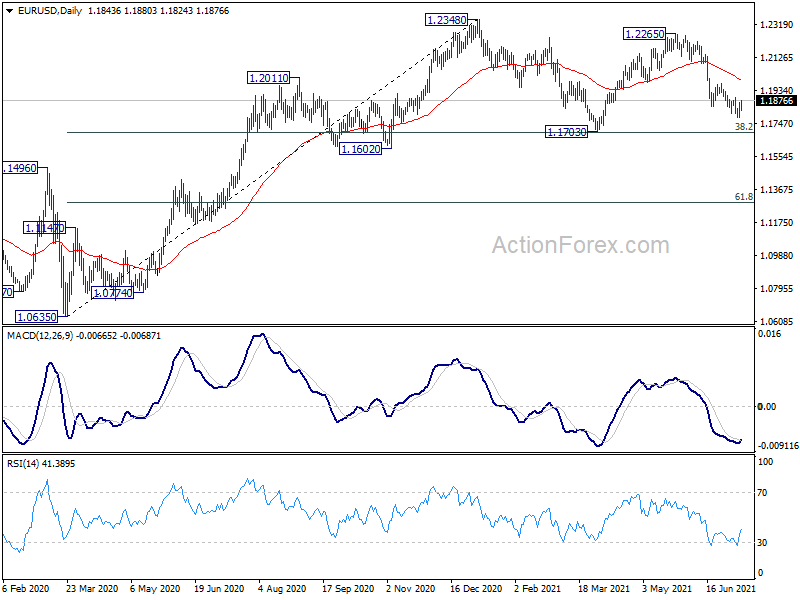
EUR/USD's decline from 1.2265 extended to as low as 1.1780 last week but recovered again. Initial bias remains neutral this week first. Break of 1.1780 will bring another decline, to extend the corrective pattern from 1.2348, to retest 1.1703 support. However, considering bullish convergence condition in 4 hour MACD. Break of 1.1894 minor resistance will indicate short term bottoming. Intraday bias will be turned back to the upside for 1.1974 resistance first. Sustained break there will pave the way back to 1.2265/2348 resistance zone.
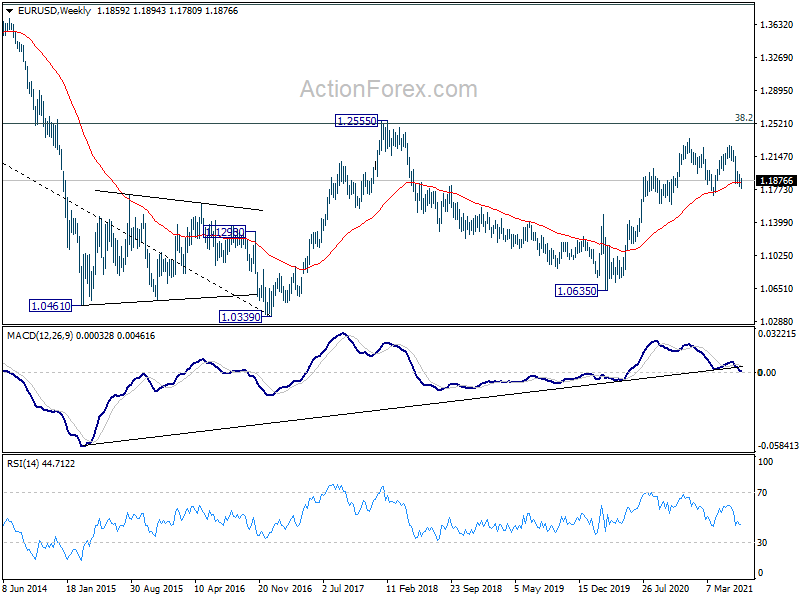
In the bigger picture, rise from 1.0635 is seen as the third leg of the pattern from 1.0339 (2017 low). Further rally could be seen to cluster resistance at 1.2555 next, (38.2% retracement of 1.6039 to 1.0339 at 1.2516). This will remain the favored case as long as 1.1602 support holds. Reaction from 1.2555 should reveal underlying long term momentum in the pair. However sustained break of 1.1602 will argue that the rise from 1.0635 is over, and turn medium term outlook bearish again.
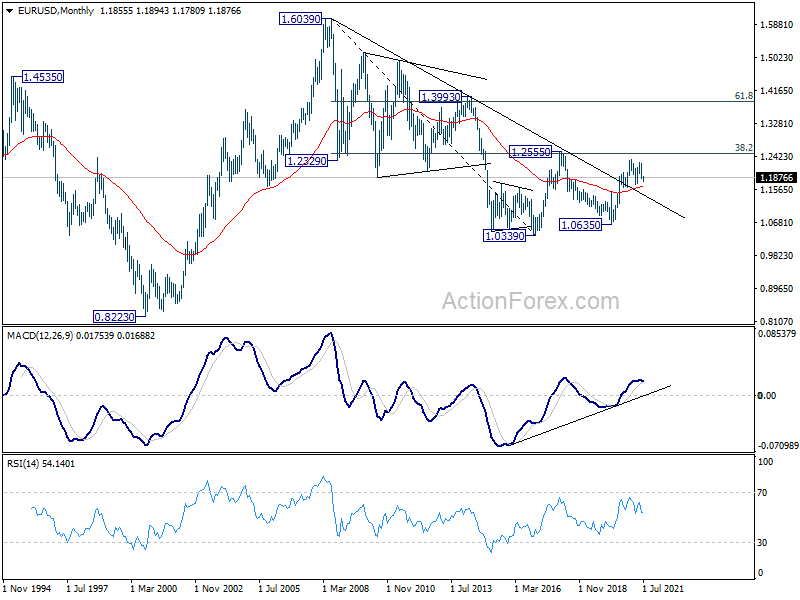
In the long term picture, focus remains on 1.2555 cluster resistance (38.2% retracement of 1.6039 to 1.0339 at 1.2516). Sustained break there should confirm long term bullish reversal and target 61.8% retracement at 1.3862 and above. However, rejection by 1.2555 will keep medium term outlook neutral first, and raise the prospect of down trend resumption at a later stage.
Summary 7/12 – 7/16
Monday, Jul 12, 2021
[php_everywhere instance="1"]
Tuesday, Jul 13, 2021
[php_everywhere instance="2"]
Wednesday, Jul 14, 2021
[php_everywhere instance="3"]
Thursday, Jul 15, 2021
[php_everywhere instance="4"]
Friday, Jul 16, 2021
[php_everywhere instance="5"]
Weekly Economic & Financial Commentary: June FOMC Minutes Raise as Many Questions as Answers
Summary
United States: Growth Concerns Rattle Markets During Relatively Quiet Week for Economic Data
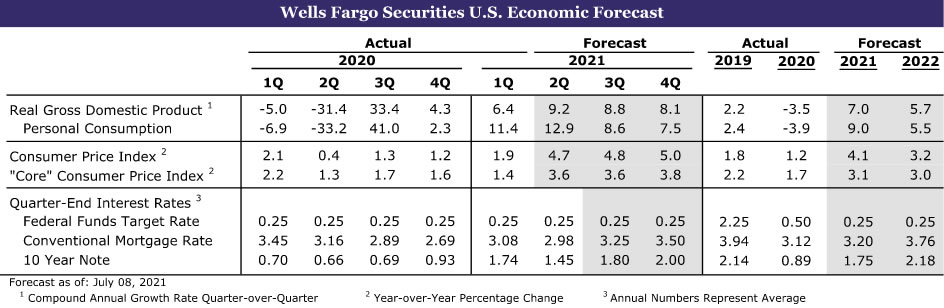
- Financial markets were jittery this week as uncertainty mounted around the new COVID variant hampering global activity and the growing idea that a lack of supply may prevent economic growth. We continue to believe that the drivers of economic recovery remain intact and project a robust above-consensus pace of growth into next year as supply problems ease.
- Next week: Consumer Price Index (Tuesday), Industrial Production (Thursday), Retail Sales (Friday)
International: U.K. Calms Down but Still Carries On
- U.K. May GDP figures pointed to an ongoing recovery, albeit at a slower pace, as the economy grew 0.8% month-over-month, with slower growth reported in both services and industrial activity. Meanwhile in Canada, after COVID restrictions crimped activity in recent months, June saw a rebound as employment jumped by 230,700.
- Next week: Bank of Canada policy announcement (Wednesday), China GDP (Thursday), Australian employment (Thursday)
Interest Rate Watch: June FOMC Minutes Raise as Many Questions as Answers
- Anyone looking for a higher degree of clarity on the path and timing for the Fed to remove its extraordinary policy accommodation was likely disappointed by this week's release of the June FOMC meeting minutes.
Credit Market Insights: What Happens When Forbearance Ends?
- Since the beginning of the year, an average of 1.3 million adults have reported being at risk of foreclosure; meanwhile, federal forbearance protections are set to expire at the end of September.
Topic of the Week: Oil Prices in the Spotlight Amid OPEC+ Impasse
- Talks last week among OPEC+ broke down as Saudi Arabia and the United Arab Emirates (UAE) failed to come to terms on how new production quotas should be calculated.
U.S. Review
Growth Concerns Rattle Markets During Relatively Quiet Week for Economic Data
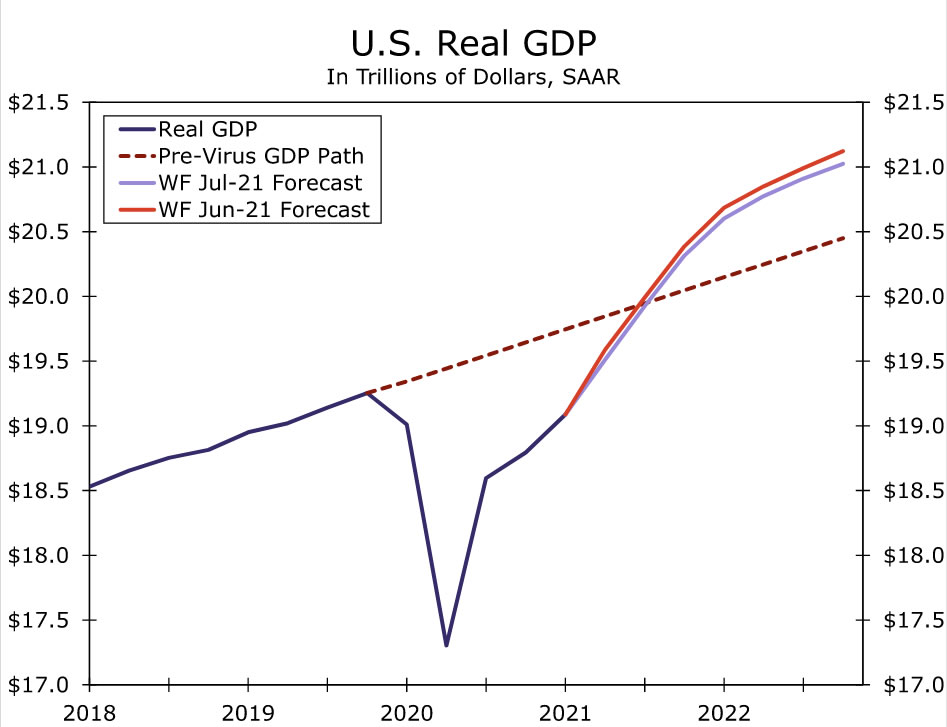
There was little fresh economic data released during this holiday-shortened week, but financial markets were jittery. Equity markets slid by the most in three weeks on Thursday and Treasury yields sank, reflecting a risk-off move as uncertainty mounted around the new COVID variant hampering global activity and the growing idea that a lack of supply may prevent economic growth. While we've acknowledged parts of the U.S. economy could be growing even faster if it were not for severe bottlenecks, we continue to believe the drivers of economic recovery remain intact and project a robust above-consensus pace of growth into next year as supply problems ease.
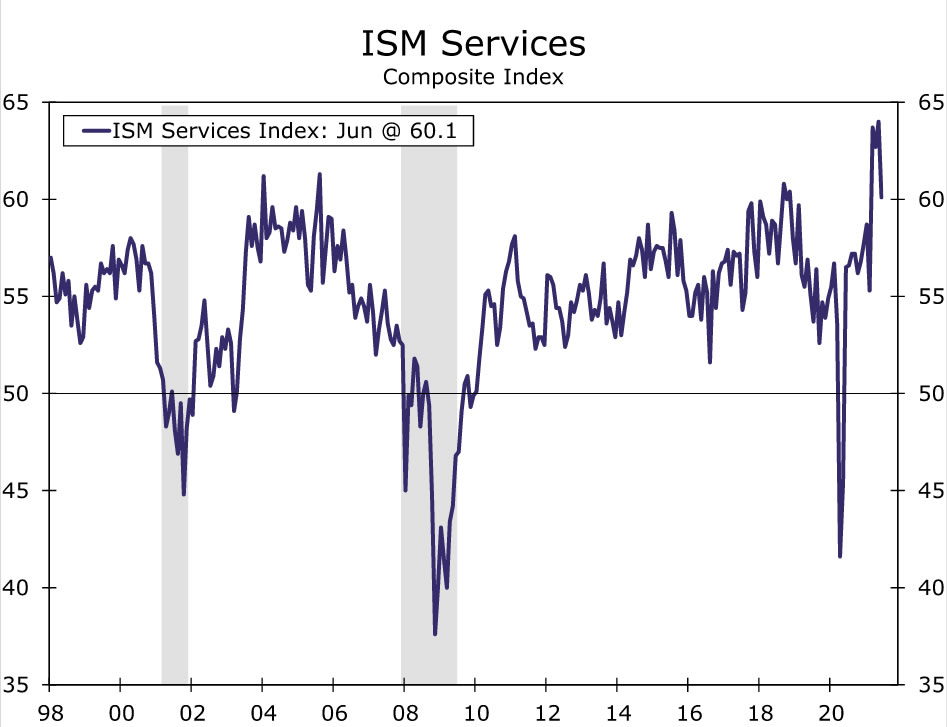
Households are flush with cash, which should continue to support service sector activity. Although the ISM services index pulled back to 60.1 in June from a record high the prior month, the index remains consistent with activity remaining hot this summer (see chart). A normalization of spending from goods back to services over the remainder of the year should help ease some ongoing issues with the supply of physical inputs.
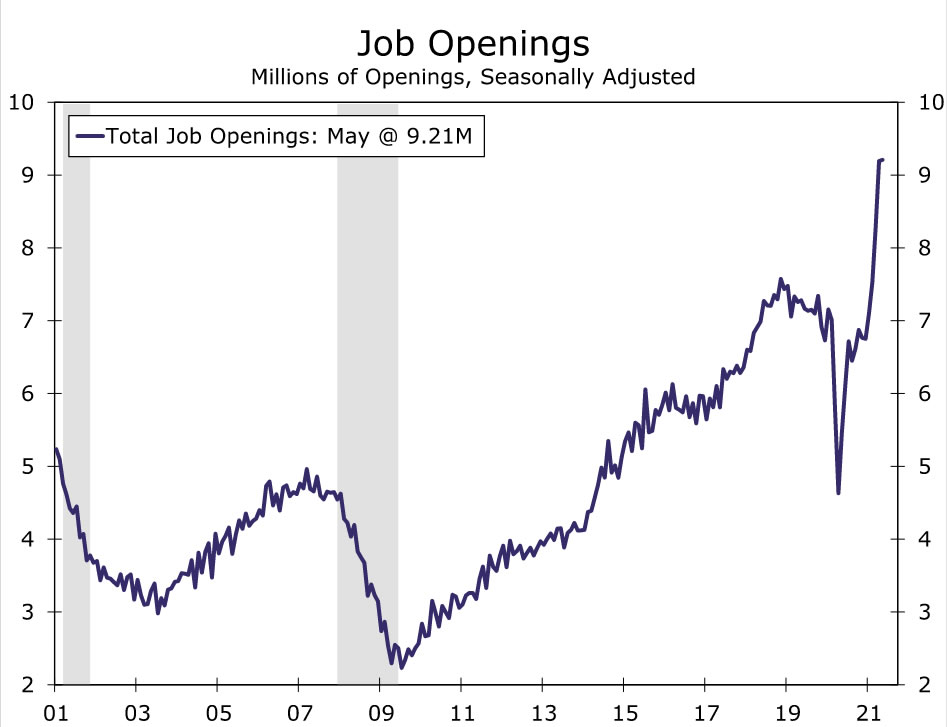
In terms of labor, we expect frictions to remain for some months as employers struggle to find all the help they need. Job openings notched another record high of 9.2 million in May (see chart), but the monthly gain (+16,000) was the smallest since the start of the year. Encouragingly, the smaller gain in openings and the recent pickup in hiring over the past two months suggest reopening frictions are not meaningfully getting worse. Restaffing will take some time, and we expect a return to in-person schooling in the fall; the expiration of enhanced unemployment benefits as well as the easing of COVID concerns should bring more workers back into the labor force over the remainder of the year.
In the meantime, the strong pace of demand amid strapped supply is bidding up costs and pushing earnings and non-wage incentives higher as firms are having to pony up to attract workers. Earnings are rising fastest among lower-paying sectors hardest hit from the pandemic. For example, average hourly earnings in the transportation & warehousing sector were up 17.7% at an annualized rate over the past three months through June, the most of any sector. Anecdotal evidence suggests a more competitive wage environment will keep price pressures elevated, and a respondent from the transportation & warehousing industry in the latest ISM services report noted, “wages have risen at an unprecedented rate... We are expecting a long-term effect on pricing of services.” The prices paid component of the ISM came in north of 70 for the fifth consecutive month in June as all but one industry (agriculture) reported higher costs during the month. These developments further support our view that inflation pressures will remain elevated.
Considering the current labor situation, we suspect the modest pickup in initial jobless claims to 373,000 last week was more noise than a signal. The trend in initial claims is falling and with labor scarce and more expensive for those looking to hire, businesses are likely increasingly reluctant to lay off workers. The pickup in wages does, however, bode well for workers weighing their options and suggests continued churn in the labor market. The quit rate remains above pre-pandemic levels, and higher earnings amid consumer perceptions that jobs are “plentiful” may continue to encourage job switching. A silver lining is that a higher wage environment may also serve as an additional incentive to draw workers back into the labor force.
U.S. Outlook
Consumer Price Index • Tuesday
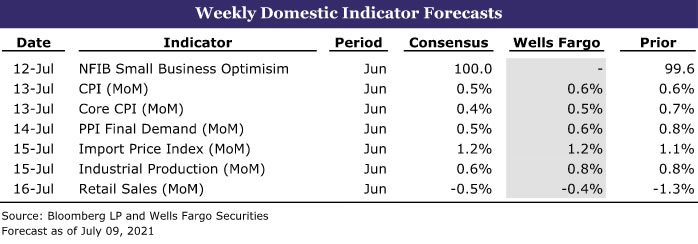
The Consumer Price Index (CPI) report for May had a little bit for both sides of the inflation debate. Again, the major drivers behind May's 0.6% month-over-month increase were categories related to temporary phenomena, such as the reopening of the service sector and supply-chain woes. Vehicles and other goods accounted for more than half of May's increase, while travel services accounted for another 11%. That said, housing inflation, which had been relatively benign despite the rapid increase in home prices, started to pick up in May. Shelter inflation, which makes up roughly a third of the CPI basket, could provide a more durable boost to overall inflation as the run-up in home prices filters into the CPI and demand for apartments starts to normalize.
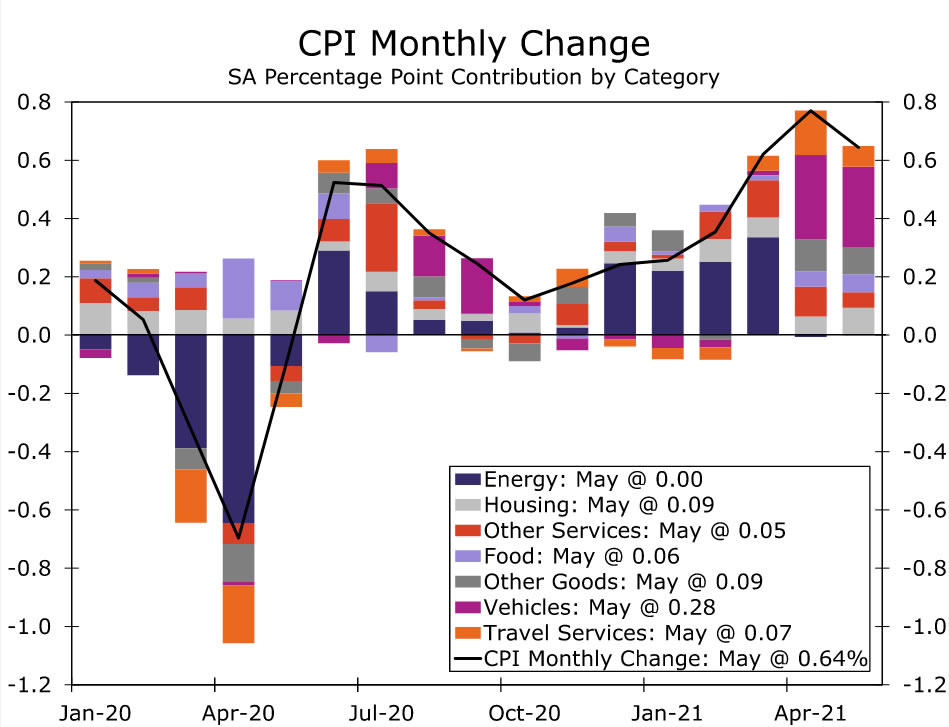
Looking to May, used car prices have showed some signs of topping out. The Manheim Used Car Index fell in June for the first time in 2021. While this may not show up in the June CPI report, given the lag between wholesale and retail car prices, it could signal a shift for one of the more inflationary categories. While core goods inflation could continue to moderate from its April high, the goods sector continues to face a host of rising input costs, which it may pass on to consumers. Companies in manufacturing as well as transportation & warehousing have had to bid up wages to attract workers, while transportation and material costs remain elevated. Altogether, we look for the headline CPI to increase 0.6% in June, bringing the year-over-year rate to 5.0%. Excluding food and energy, we expect core CPI to rise 0.5% in June to 4.0% above its year-ago level.
Industrial Production • Thursday
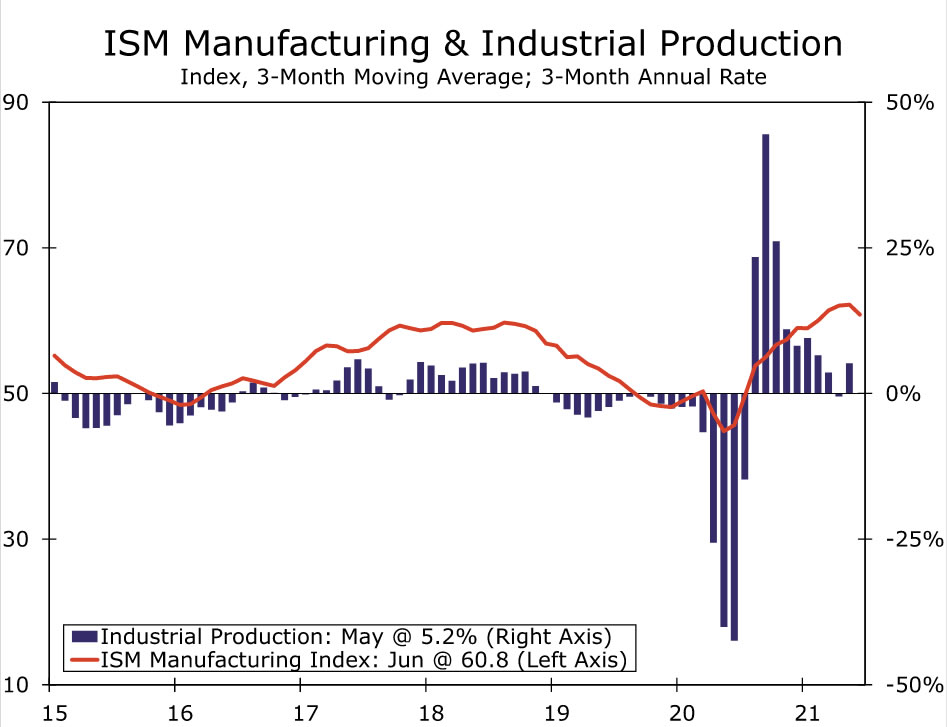
Industrial production increased 0.8% in May, beating expectations. While some of this was due to downward revisions to April data, the outrun was an impressive feat given the plethora of obstacles facing the industrial sector. Rising input costs, lagging supplier deliveries and a lack of skilled labor has been bedeviling producers for months and showed little sign of abating in June. In the June ISM survey, purchasing managers in the manufacturing sector highlighted their inability to keep up with new orders due to a lack of materials, and one added the "lack of labor is killing us." Despite these headaches, which weighed on the headline index, the production sub-component rose 2.3 points to 60.8.
While the problems facing production are unlikely to abate soon, the demand outlook remains robust. Businesses have ramped up investment to ease current capacity constraints and will likely need to keep spending through the end of this year as they rebuild their depleted inventories. Outside the factory sector, utilities could see some boost in June, following the heat wave that blanketed parts of the West at the end of last month. Overall, we look for industrial production to rise 0.8% in June.
Retail Sales • Friday
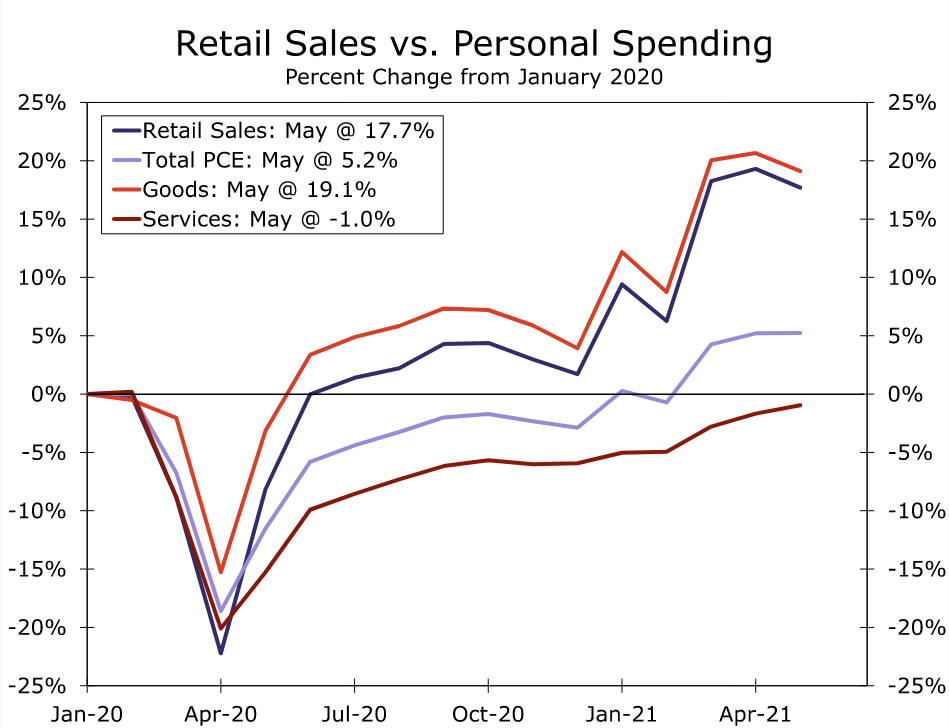
Retail sales fell 1.3% in May, driven by slower vehicle and parts sales as well as slower sales at general merchandise stores. While we had expected goods spending to slow as consumers shifted their spending toward the reopening services sector, low inventories and higher prices have brought sales down faster than we initially anticipated. That said, we remain optimistic that overall spending will be strong this summer. As can be seen in the chart, retail sales largely reflect good spending. Outside last year, however, the bulk of consumer spending is on services.
Looking to next week's report, we suspect retail sales remained soft. Vehicle sales fell again in June and will likely weigh on the headline index. Excluding autos, we suspect retail sales increased 0.5% in June. We will also be closely watching spending at restaurants & bars for insights into the ongoing service recovery. Despite the deep hole the industry fell into last year, real spending at restaurants has been closing in on its pre-pandemic level and likely made further progress in June.
International Review
U.K. Calms Down but Still Carries On; Canada Moves from Soft Spring to Solid Summer
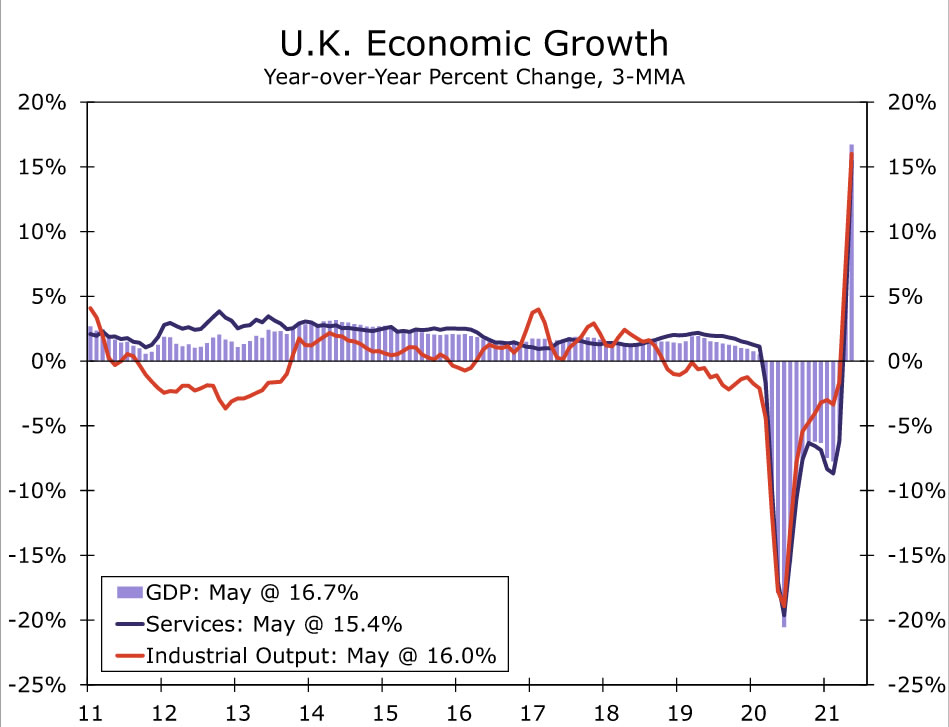
The latest U.K. GDP figures indicated the country's economic expansion continued, albeit at a somewhat slower pace in May. U.K. GDP rose 0.8% month-over-month in May, less than expected, following sizable gains in both March and April. That said, with the May increase, the level of GDP for the first two months of Q2 is now 4.3% above its Q1 average. May services activity showed a steady gain of 0.9% month-over-month as the U.K. continued along the reopening path, while May industrial output rose a similar 0.8%. The release did show clear evidence of the reopening, as accommodation and food service activities rose 37.1%. Given overall encouraging economic signals, even with the brief delay in the final phase of the U.K. reopening, we remain constructive on the prospects for U.K. growth. Indeed, in our forecast update published earlier this week, we lifted our U.K. GDP growth outlook for 2021 to 7.5%, from 7.0% previously.
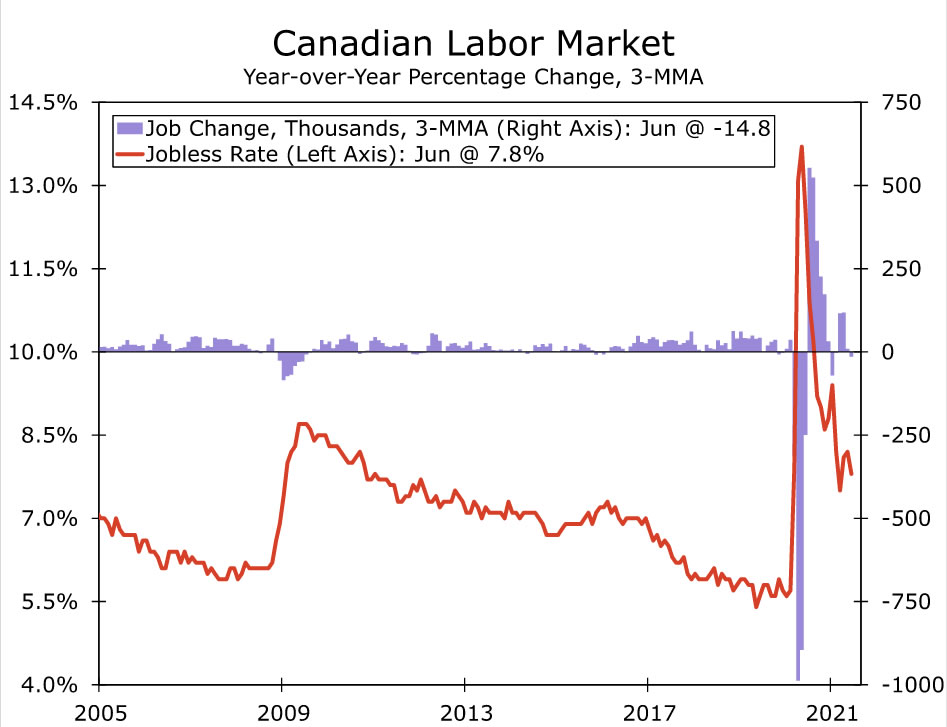
Also moving in a positive direction are activity data and confidence surveys from Canada. A renewed spread of COVID cases and associated restrictions earlier this year led Canadian employment to decline noticeably in both April and May. However, Canada's June labor market report saw the start of a rebound as employment rose by 230,700. The composition of that job growth was less impressive, as a fall in full-time jobs of 33,200 was more than offset by a gain of 263,900 part-time jobs. Meanwhile, the unemployment rate declined to 7.8%. The labor market report wasn't the only good news from Canada this week, as the June manufacturing PMI jumped to 71.9. With Canada's economy showing solid overall trends, we expect the Bank of Canada to slow its bond purchases further at its July monetary policy announcement.
Speaking of tapering bond purchases, the Reserve Bank of Australia (RBA) announced an initial foray into slowing the pace of its bond purchases. At its monetary policy announcement this week, the RBA kept its policy interest rate at 0.10% and its target for three-year government bond yields also at 0.10%. With respect to its quantitative easing plans, the RBA said it would complete its A$200 billion of bond purchases, as previously indicated, while also noting the recent pace of purchases has typically been around A$5 billion per week. Beyond September, the RBA said it would continue its bond purchases, but at a modestly reduced pace of A$4 billion per week, until at least mid-November, at which time it said it would conduct a further review.
International Outlook
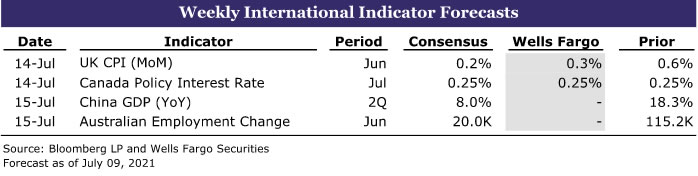
Bank of Canada Policy Announcement • Wednesday
The Bank of Canada announces its latest monetary policy decision next week, and despite some economic softness during the spring given a renewed spread of COVID cases and associated restrictions, we expect another step toward less accommodative monetary policy.
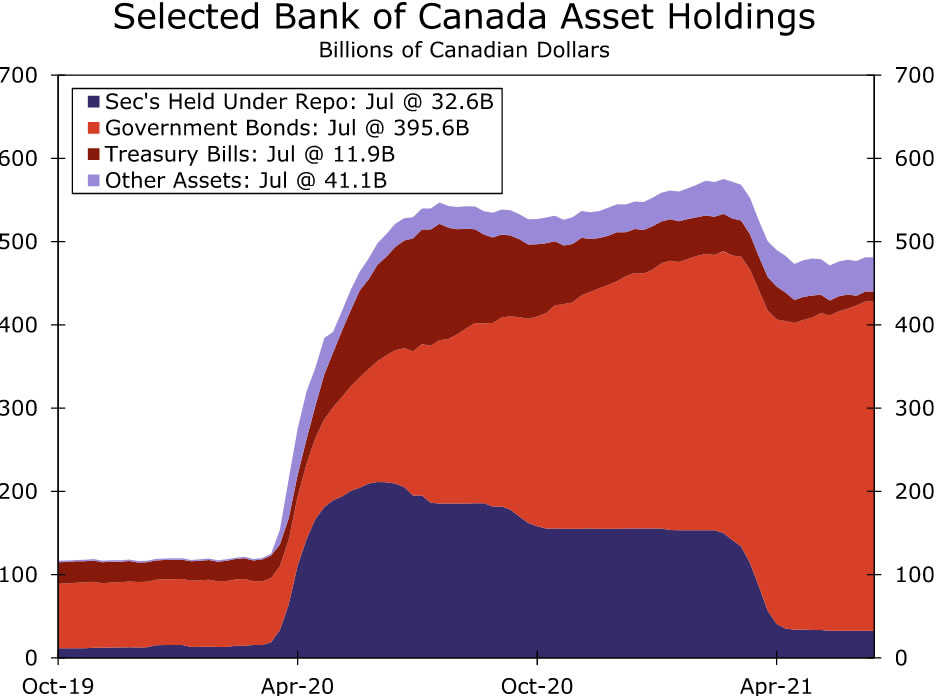
There are indications Canada's economy is shaking off the latest COVID scare as new cases recede, and given elevated oil prices and a rebound in both June employment and the June manufacturing PMI. We do not expect those more hopeful signals to prompt any change in the central bank's policy interest rate, which we expect to stay at 0.25%. We do, however, expect the Bank of Canada to slow its government bond purchases further, from the current pace of at least C$3 billion per week to a reduced pace of at least C$2 billion per week. Next week's announcement will also be accompanied by a Monetary Policy Report, which will detail the central bank's latest economic projections. A particularly strong upgrade to the central bank's GDP growth or CPI inflation outlook could hasten the point at which market participants expect the Bank of Canada to begin raising interest rates.
China GDP • Thursday
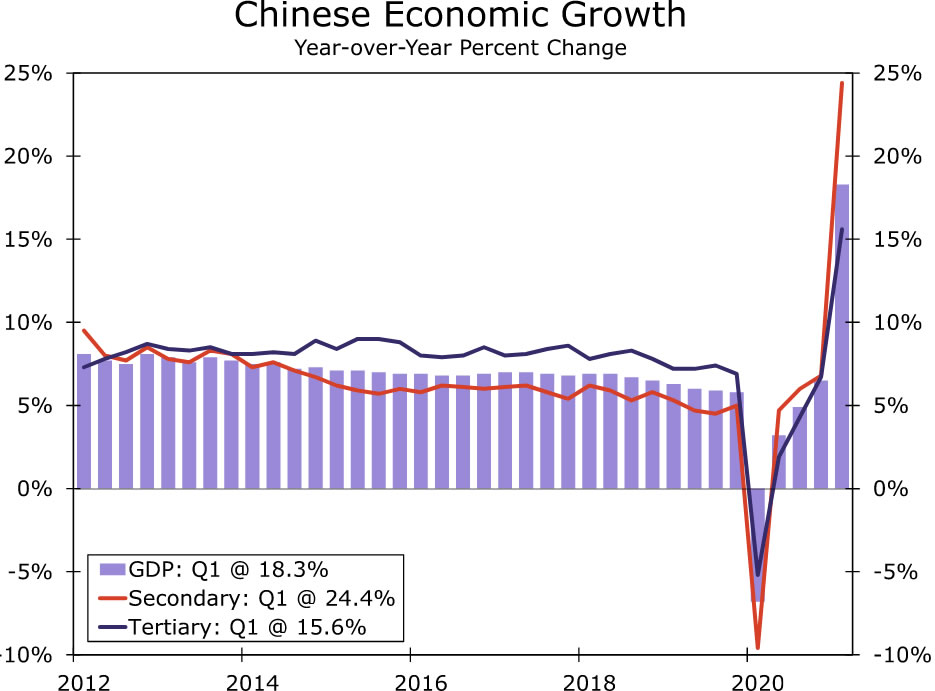
China's Q2 GDP figures due next week should confirm an overall and ongoing slowdown in the economy. On a sequential basis, the consensus forecast is for Q2 GDP to rise 1.0% quarter-over-quarter. That would be better than the 0.6% increase seen in Q1, but still slower than the trend rate of growth typically seen prior to the COVID crisis. Meanwhile, on an annual basis GDP is forecast to slow markedly to 8.0% year-over-year, with both manufacturing and service sector growth expected to decelerate.
Indeed, recent monthly activity data confirm that there has been a broad-based slowdown, a trend that is expected to continue with the release of June figures. The consensus forecast is for June retail sales to slow to 10.9% year-over-year, while growth in June industrial output is forecast to slow to 8.0%.
Australian Employment • Thursday
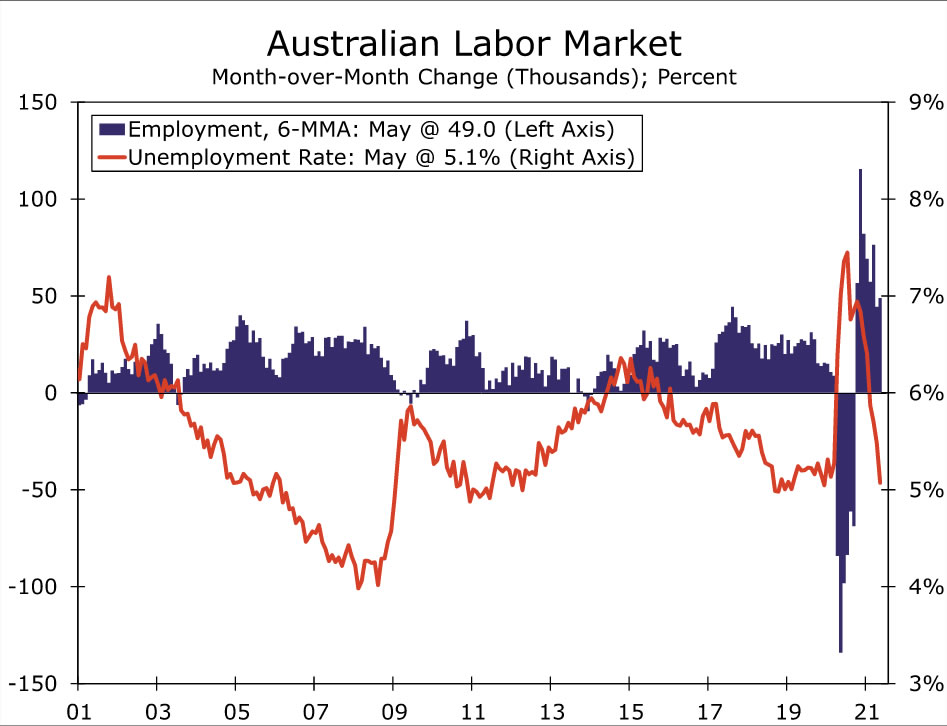
Next week, Australia's June labor market report is expected to show another—albeit smaller—job gain for June. Except for a brief dip in April following the end of government income support measures, Australian employment has otherwise gained in the past eight months. For June, the consensus forecast is for an employment increase of 20,000 and for the unemployment rate to dip to 5.0%.
The Reserve Bank of Australia (RBA) recently said the country's economic recovery has been stronger than expected so far, but also acknowledged the renewed outbreak of COVID cases and associated restrictions as a possible risk to activity in the near term. Moreover, despite the solid recovery, there have so far been few signs of wage or price inflation. Thus even in the event of another rise in jobs, we would not expect any further adjustment in policy settings or guidance, especially given the modest tweaks in policy approach already announced at the July RBA monetary policy meeting.
Interest Rate Watch
June FOMC Minutes Raise as Many Questions as Answers
Anyone looking for a higher degree of clarity on the path and timing for the Fed to remove its extraordinary policy accommodation was likely disappointed by this week's release of the June FOMC meeting minutes. Given that the Fed raised its estimate for 2021 inflation, as measured by the PCE deflator, by a full percentage point to 3.4%, there was quite a bit of discussion about inflation. While a few members clearly appear to be more alarmed about the rapid and widespread acceleration in price increases, the majority of FOMC members still are clinging to the notion that the bulk of the acceleration in inflation will prove transitory. Supply-chain bottlenecks are clearly proving more pernicious and likely to persist longer than earlier thought, but the recent decline in lumber prices has bolstered confidence of those who still believe relief from higher inflation is just around the corner.
Views on the path for economic growth were also divided beyond the burst provided by the avalanche of fiscal stimulus early this spring. The FOMC cited the recent slowing in payroll growth (prior to the June report) as reason for patience in accelerating the winding down of QE. And the committee was also divided whether its purchases of mortgage-backed securities were contributing to the rapid run-up in home prices. In short, the minutes suggest the Fed has only slightly pulled forward its expectations for when it would be appropriate to begin winding down their bond purchases, with the most likely timing of an announcement coming late this fall with implementation beginning early next year. That puts the timing of the first interest rate hike sometime in early 2023, consistent with the movement in the Fed's dot plot, which shows 11 of the 18 FOMC participants believe that at least two quarter-point hikes in the federal funds rate would be appropriate by the end 2023 and two others believe that one hike would be needed. Seven FOMC members feel the Fed should begin hiking rates in 2022, with five members believing one rate hike would be appropriate and two stating the appropriate federal rate at the end of 2022 would be half a percentage point higher than it is today.
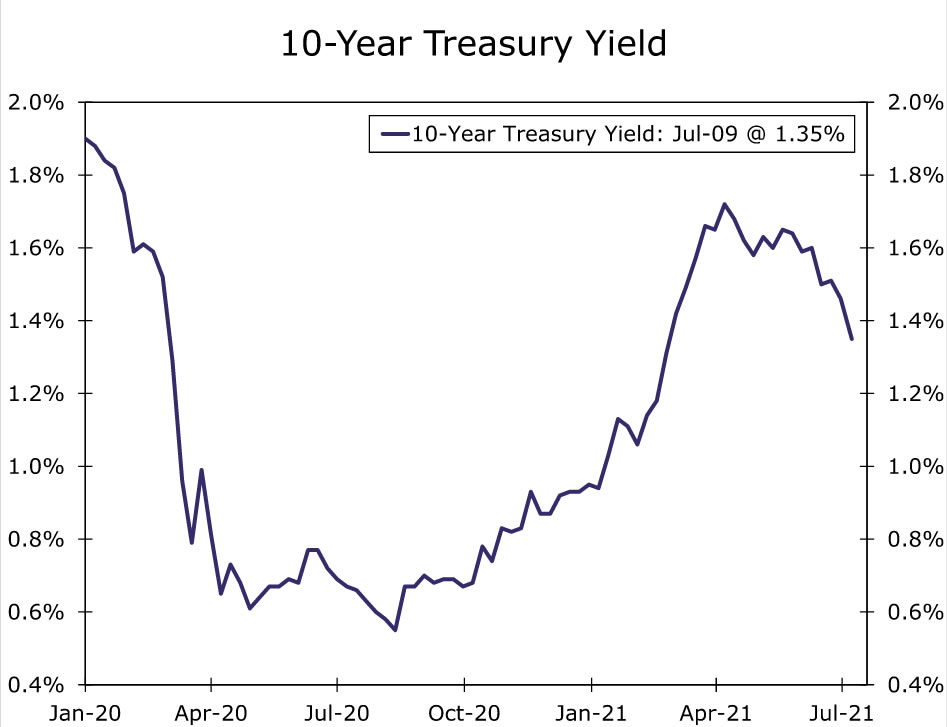
Long-term bond yields declined sharply this week, with the yield on the 10-year Treasury note briefly falling to 1.25% on Thursday morning. Yields have recovered somewhat but remain well below where they were a week ago. The drop in yield follows growing concern about the pace of economic growth. Forecasts for second quarter GDP have been scaled, with our own estimate reduced from 10.9% a month ago to 9.2% currently. Moreover, many forecasters have pointed out that the second quarter will mark peak growth for this business cycle and that waning stimulus and growing calls for increased regulation and higher taxes will slow growth in coming quarters. News that China would make it more difficult for Chinese firms to list on U.S. stock exchanges and would clamp down on the growth of its tech giants in general also sent a chill throughout the financial markets.
Expectations for global economic growth were also dented by growing concerns about the Delta variant. Japan announced the Olympics, set to start in two weeks, would not allow spectators due to the rise in COVID infections. Several other countries have also reported a disturbing rise in new COVID cases and infections have risen sharply in parts of the U.S., particularly rural portions of Missouri and Arkansas. Despite these concerns, some sense of order appears to have returned to the markets at week's end. Both the Pfizer and Moderna vaccines appear to provide a high degree of protection from the Delta variant. For those infections that do slip through to vaccinated individuals, the overwhelming majority have proved to be asymptomatic or resulted in cases with very mild symptoms. The variant is more contagious, however, and could potentially slow the reopening of schools this fall, which is a key cog in the reopening process that is widely expected to boost job growth this fall.
Credit Market Insights
What Happens When Forbearance Ends?
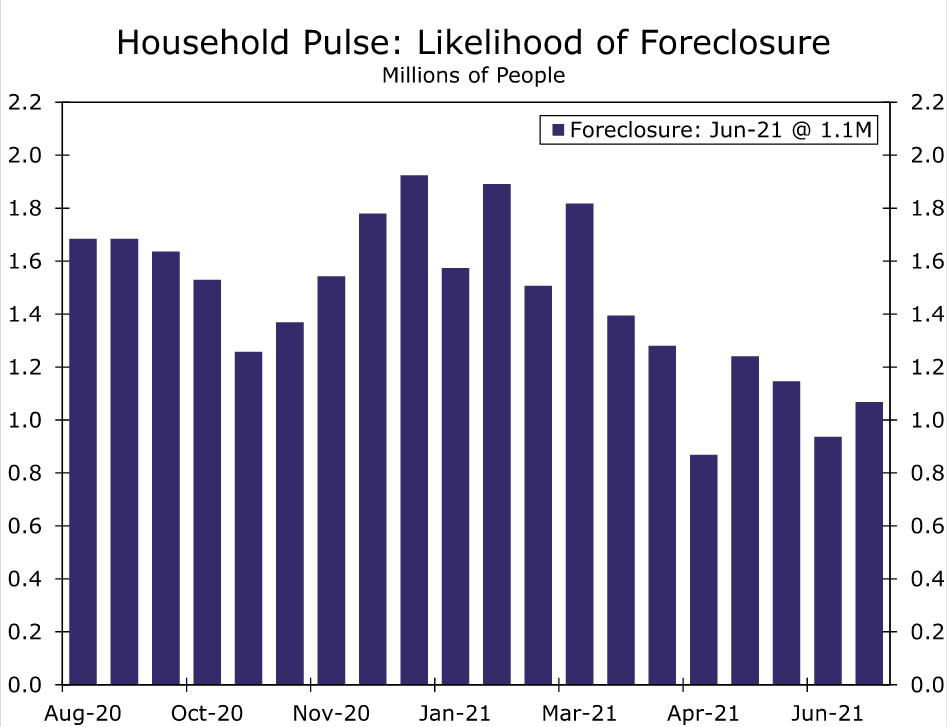
Since the beginning of the year, an average of 1.3 million adults have reported being at risk of foreclosure in the Census Bureau’s weekly Household Pulse Survey. That equates to roughly 1.6% of total owner-occupied homes across the country. To support struggling homeowners, the foreclosure moratorium for federally-guaranteed mortgages was extended for the final time to July 31. Federal forbearance protections were also extended to September 30, with borrowers given the ability to request or extend forbearance enrollment by up to three or six months. Black Knight, Inc.’s and the Mortgage Bankers Association’s (MBA) estimates show the number of homeowners currently in forbearance is around 2 million. Looking ahead, Black Knight projects that most of the active forbearance plans will expire in September and October. So, what will happen when forbearance ends?
In our view, we doubt that we will see a material surge in foreclosures once the forbearance programs end. When forbearance agreements expire, loan servicers typically work with borrowers to find a repayment option to avoid foreclosure. Over the course of the pandemic, forbearance plans have been remarkably successful. According to MBA, 28% of forbearance exits over the past year have resulted in a loan deferral, while another 24% of borrowers exited because they were able to continue making their monthly payments during the forbearance period. While the pace of forbearance exits has slowed in recent weeks, it is likely to improve in the coming months alongside stronger job growth. Furthermore, more fiscal support is on its way to homeowners. The American Rescue Plan, passed in March, appropriated $9.96 billion for homeowner assistance.
Topic of the Week
Oil Prices in the Spotlight Amid OPEC+ Impasse
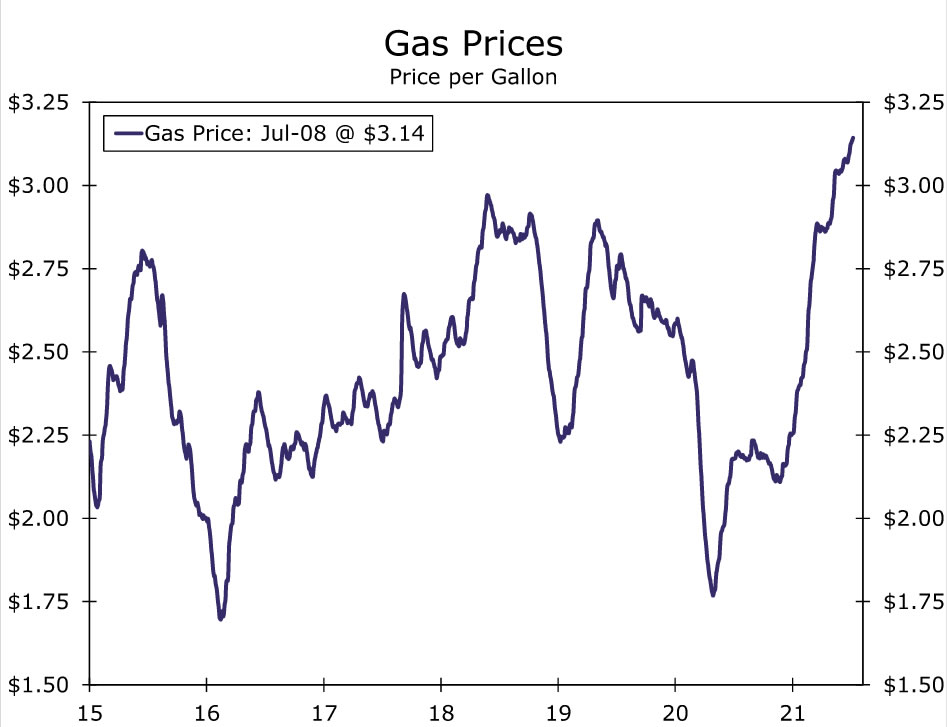
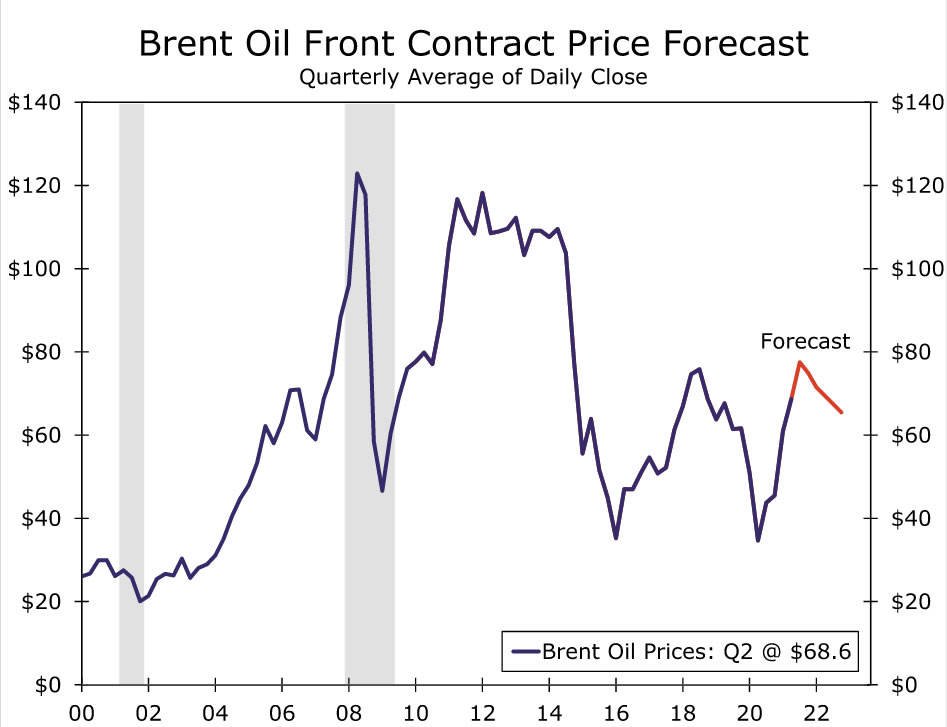
Oil prices are trending higher. As of this writing, Brent front month contract prices, which are a commonly used global benchmark for oil prices, were $73.90 per barrel, almost 75% higher than the $42.35 per barrel prices seen in early July of last year. The rise in oil prices has occurred alongside a resurgence in global energy demand. While COVID is still a threat, more progress is being made on vaccinations, and many economies are unwinding pandemic-related restrictions. This has been especially true in the United States, where over 67% of the population has received at least one vaccination and consumers are venturing back out in the economy, hitting the road and hopping on airplanes. According to the Energy Information Administration, fuel demand jumped to 10 million barrels a day during the week leading up to the July 4th holiday. This comes as no surprise, considering 2.19 million people passed through TSA checkpoints in airports on July 2 (a post-pandemic high) and an estimated 44 million people traveled by car over the Independence Day weekend. With more people out and about, gas prices have risen to $3.14 a gallon, the highest since the onset of the pandemic.
The ascension of oil prices also comes as energy supplies struggle to keep up with demand. The Organization of the Petroleum Exporting Countries and its partners (OPEC+) broached this issue at a meeting last week. Last year, as global energy demand collapsed alongside lockdowns and other pandemic-related restrictions, OPEC+ agreed to cut production by 10 million barrels a day, which was the largest production cut on record. Now, with COVID risks receding, many economies are reopening and oil demand is bouncing back. With the pendulum swinging the other way, OPEC+ has gradually lifted production and the early July meeting was meant to decide the next phase of its production policy. However, talks among the group of 23 crude oil producing nations, which controls over 50% of global oil supplies and 90% of proven reserves, broke down as Saudi Arabia and the United Arab Emirates (UAE) failed to come to terms on how new production quotas should be calculated. Expectations for the OPEC+ meeting were for a modest increase in production, but the stalemate has introduced a new source of uncertainty regarding the timing and magnitude of future production increases to oil markets. The OPEC+ impasse was followed by a rally in oil futures, which hit a six-year high of nearly $77 a barrel on July 6. Oil prices have since retreated a bit, as prospects for a complete recovery in global energy demand have been dimmed by ongoing COVID outbreaks in Southeast Asia and Japan.
Source: Bloomberg LP and Wells Fargo Securities
Source: IHS Markit and Wells Fargo Securities
Considering the ongoing supply and demand imbalance in energy markets and recent OPEC+ stalemate, we look for the Brent front contract price to end the year at $75 per barrel. That said, energy markets should begin to balance out as demand moderates over the next few years. If the outcome of the recent meeting is any indication, less OPEC+ cohesion is to be expected moving forward, with price concerns superseded by a focus on gaining market share. Thus, we expect a gradual decline in Brent prices over the course of next year and for prices to be at $65.50 per barrel by the end of 2022. Still, the OPEC+ impasse has raised concerns that oil prices might be higher than many are expecting in coming years, which could generate added inflationary pressures and slow down overall economic growth.
Those fears are not unfounded. We utilized Oxford Economics' Global Economic Model to quantify the impact of a modest oil price shock in which Brent prices remain at $75 per barrel over the next seven quarters. Under this scenario, the Oxford model projects that the level of real GDP would be over 0.2% lower at the end of 2022 compared to its baseline forecast. Slightly slower GDP growth under these conditions is mostly explained by the more moderate pace of consumer spending that would theoretically occur as households budget for higher gas prices and heating bills. Not surprising, higher oil prices would also produce a faster rise in the headline Consumer Price Index (CPI), which directly measures increases in energy prices. The core CPI, which excludes energy and food prices, would also increase at a slightly faster rate than Oxford's baseline forecast. Materials used in a long list of consumer products, such as plastics, tires, clothing and roofing shingles (to name just a few), are byproducts of oil refining, meaning that any increase in oil prices could potentially flow through to the core CPI.
The Weekly Bottom Line: Bond Market Inflation Fears Ease
U.S. Highlights
- Economic news was relatively light in a holiday-shortened week. The move down in Treasury yields garnered headlines, as bond markets ratchet down inflation expectations.
- The FOMC Minutes were released this week and confirmed increased confidence among members that the economy is on the road to recovery.
- The Job Openings and Labor Turnover Survey also made news, showing demand for workers remains strong. Job openings were at an historic high in May. Challenges clearly remain in matching workers with opportunities. Hiring did not follow job openings up and the ratio of hires to openings fell to an historic low in the month.
Canadian Highlights
- Data from metropolitan real estate boards provided an early indication that Canada’s home sales likely continued to come back down to earth in June, as home sales edged lower in Toronto, Vancouver and Calgary.
- Employment bounced back strongly in June, with the economy adding 231k new jobs, and leaving the level of employment just 340k below its pre-pandemic level. Details were on the soft-side, with all gains and then some in part-time jobs.
- The Bank of Canada Business Outlook Survey and Survey of Consumer Expectations were positive, showing that businesses and consumers were feeling optimistic ahead of reopening.
U.S. - Bond Market Inflation Fears Ease
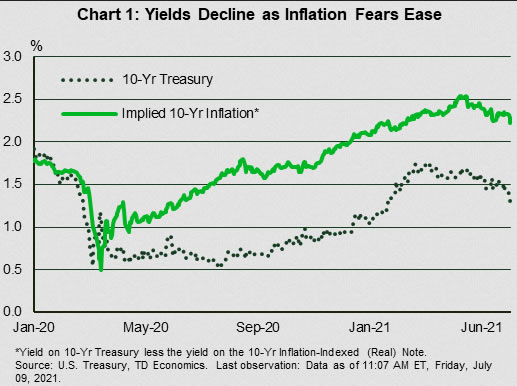
Economic news was relatively light in a holiday-shortened week. The move down in Treasury yields garnered headlines. U.S. yields have dropped notably and are now about 40 basis points below their March highs.
Nominal Treasury yields had surged earlier this year in the wake of the Democrats winning control of the Senate, as markets priced in more expansive fiscal policy and higher inflation. As is often the case with market swings, these expectations were likely a little over-done, and expectations for both inflation over the long-term, and fiscal stimulus appear to be recalibrating.
These moves seem a bit in contrast with the minutes from the mid-June Fed meeting, which confirm increased confidence among FOMC members that the economy is on the road to recovery. The minutes provided more color on why the “dots” – Fed members’ expectations for rate hikes – shifted earlier at that meeting. We expect the Fed to move from talking about talking about tapering to action in the coming meetings.
However, the recent decline in bond yields is less about shifts in market rate hike expectations. Rather, it is largely due to declining inflation expectations, as shown in a narrowing spread between nominal and inflation-indexed bond yields (Chart 1).
One economic release that has gained prominence recently – the Job Openings and Labor Turnover Survey – continued to paint a picture of a high degree of labor disruption and churn due to the pandemic. The level of job openings remained historically high in May, confirming demand for labor is strong in many sectors. However, the rate of hiring is only modestly above historical rates, suggesting either that businesses are finding it harder to find workers to fill openings, or that they are constrained in how quickly they can on-board new hires.
Quit rates are also high relative to history, although they fell from April to May. This points to increased churn in the labor market as workers move to jobs with higher wages or better working conditions. The pandemic has been a massive disruption to most sectors, leading to big swings in employment flows. Demand for workers has increased in many sectors (Chart 2), but the biggest increases are in those that were hardest hit by pandemic-related closures. At the same time there remains a high number of people on the sidelines. In May, there were 9.2 million job openings, compared to 9.5 million officially unemployed in June. That number doesn’t include the 1.6 million people who weren’t able to look for work due to Covid.
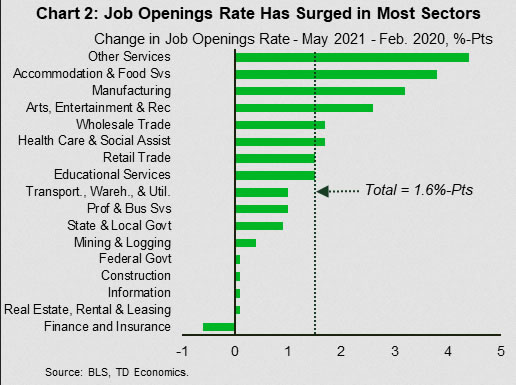
The bottom line is that demand for workers in many sectors is much stronger than prior to the pandemic, but 42% of people who are unemployed have been so for more than six months, and many will find it difficult to return to work until pandemic-related constraints have fully eased. Even with strong demand, the process of matching workers with jobs will take time..
Canada - June Brings Jobs (and Jabs)
It was a volatile week in financial markets. Equities sold off earlier in the week as investors turned less optimistic about the global economic recovery amid uneven access to vaccines and surging cases of the delta variant in many parts of the world. However, optimism rebounded Friday morning and, as of writing, the TSX is roughly flat relative to its level a week ago.
Meanwhile, worries about inflation have receded somewhat, reigniting demand for bonds and leading bond yields lower. Crude prices swung wildly due to an impasse within OPEC+, which left the outlook for near-term oil production uncertain.
Despite turbulence in financial markets, this week's economic data was broadly encouraging. Data from metropolitan real estate boards provided early indication that Canada's home sales likely continued to come back down to earth in June after rising to stratospheric levels in the spring. Home sales edged lower in Toronto, Vancouver and Calgary, and price pressures appear to have moderated.
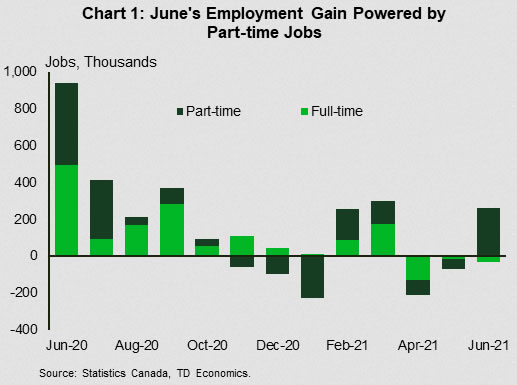
However, today's jobs report was this week's marquee release. As COVID-19 cases subsided and restrictions eased, employment bounced back strongly in June, adding 231k new jobs, and leaving the level of employment just 340k below its pre-pandemic level. The unemployment rate also fell to 7.8% from 8.2% even as more people rejoined the labour force. Details of the report dimmed the excitement somewhat. All of June's gains and then some were in part-time positions (Chart 1). Gains were also not broad-based across industries: accommodation & food and wholesale & retail trade accounted for three quarter of new jobs as shops and restaurants re-opened.
Still, ongoing progress in the job market, together with this week's survey data will provide reassurance to the Bank of Canada on the state of the economic recovery ahead of next week's interest rate decision. The Bank's Business Outlook Survey showed that businesses sentiment and hiring intentions both reached record-breaking levels in May, as sales expectations improved. Separately, the Survey of Consumer Expectations showed that consumer spending intentions remained resilient as Canada emerged from the third wave of the virus. Households expected to boost their spending by 4.1% over the next 12 months – near the survey high and nearly double expected income growth of 2.1% (Chart 2). Lastly, both surveys indicated that businesses and consumers viewed recent inflationary pressures as transitory.
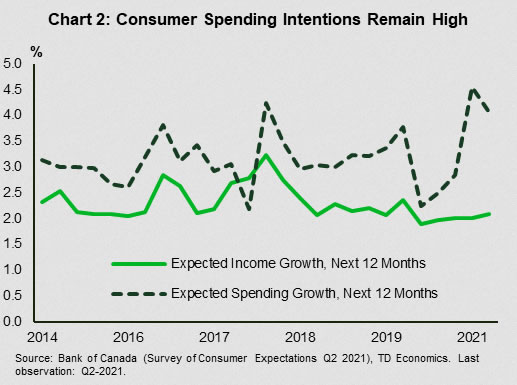
This positive tone is likely to be reflected in the Bank of Canada's statement and Monetary Policy Report next week, however the Bank is also likely to acknowledge that the recovery is still not complete. With Q2 GDP growth tracking close to the Bank's April projection, we expect it will not drastically change its forward guidance, maintaining the time horizon with respect to interest rate normalization (pegged to the second half of 2022). Still, progress to date will likely be sufficient for the Bank to announce a further reduction in asset purchases as a successful vaccination campaign clears the way for stronger economic growth.
Week Ahead – Market Volatility to Remain Elevated
Global stocks are all over the place as some indexes fall into correction as others continue to extend higher into record territory. The bond market volatility surprised many investors as the growth outlook took a massive hit as the spread of the Delta coronavirus variant showed many countries are still struggling to return to normal.
Asian stocks should have a strong open following the PBOC’s RRR cut. This is quite the pivot by the central bank and it should support the notion that crackdown over tech companies will probably ease. The yuan could be vulnerable following the RRR cut and that should be great news for exports.
The upcoming week is filled with many potential market moving events. A wrath of rate decisions (BOJ, BOC, RBNZ, and CBRT) will continue to show the unbalanced global economic recovery has some banks tapering, others poised for further cuts, and some stuck in wait-and-see mode. Traders will also closely watch three big economic releases: US CPI, China’s Q2 GDP, and US retail sales, which could show some weakness persisting across the world’s two largest economies. The banks will also kickoff earnings season and that should come with a better understanding of how strong is the US consumer. Fed Chair Powell will give his semi-annual Monetary Policy Report to Congress. Since Powell’s testimony will happen after the latest inflation report and fresh concerns about the pace of the global economic recovery, it could have a dovish outcome.
Country
US
Next week is a jammed pack week with CPI data, key testimony from Fed Chair Powell, and the beginning of earnings season. It will be a busy week of Fed speak as Quarles, Kashkari, Evans and Williams will all be making the rounds.
Tuesday will be a busy morning with the June inflation report expected to show inflationary pressures ease. The June month over month reading is expected to tick lower to 0.5%, while the year over year headline eases from 5.0% to 4.9%. Earnings season officially begins with early reports from Pepsico, JPMorgan, Fastenal and Goldman Sachs. Wall Street will closely listen to what the banks have to say about the US consumer.
On Thursday, Fed Chair Powell will deliver his semi-annual testimony to the Senate Banking Panel. This could be big because Powell may start to see some easing of pricing pressures and further reasons to become slightly pessimistic to the short-term global growth outlook. If Powell confirms his conservative, somewhat noncommittal approach to tapering, we could see Treasury yields remain heavy.
The June retail sales reading will draw a lot of attention on Friday given the big miss last month. Investors will look to see if this trend continues.
EU
Europe’s battle with Covid is, unfortunately, far from over. The World Health Organization has warned that a new wave of Covid in Europe is inevitable, with cases of the Delta variant on the rise.
The resurgence of Covid could have a devastating effect on the summer tourist season. France has warned its citizens against vacationing in Spain in Portugal, and other countries could follow suit with advisories against travelling to certain European countries.
The International Conference on Climate will take place in Venice on Sunday, July 11. ECB President and the Fed’s Quarles will be among the key speakers.
On Monday, eurozone finance minister will meet in Brussels to discuss economic and financial issues affecting the eurozone. US Treasury Secretary Janet Yellen will be in attendance.
The EU Foreign Affairs Council will also meet in Brussels. The agenda will include geopolitical hotspots, including Afghanistan, South Caucasus, Lebanon, Ethiopia, as well as digital technologies. The Council will also hold a working lunch with Israeli foreign minister Lapid.
German Chancellor Merkel will host Ukrainian President Zelenskiy in Berlin. The two leaders will discuss the Nord Stream 2 gas pipeline, which runs between Russia and Germany, as well as the conflict in Ukraine’s Donbas region.
On Tuesday, Germany releases the June CPI report.
On Wednesday, European Commission President Ursula von der Leyen and Commissioner for Budget Johannes Hahn host a press conference in Brussels. European Commission Vice President will discuss an EU digital tax, which the US opposes.
The European Commission will recommend new measures under its Green Deal plan, including expanding the EU’s carbon market. These proposals follow the endorsement of EU’s new Climate Law, which increases the bloc’s 2030 emissions reductions target.
France celebrates Bastille Day, with financial markets to remain open.
The eurozone releases Industrial Production for May.
On Thursday, Germany Chancellor Angela Merkel visits the White House and will meet with President Joe Biden. The agenda will include tensions over the Nord Stream 2 pipeline, which carries natural gas from Russia to Germany.
The eurozone releases CPI YoY readings on Friday, which could slip from 2.0% to 1.9%. The Core CPI YoY reading is expected to remain unchanged at 0.9%.
Sweden
On Tuesday, Sweden Riksbank Governor Stefan Ingves will join in a panel discussion at a virtual conference in Jerusalem, entitled “Inflation: Dynamics, Expectations, and Targeting.
UK
On Sunday, July 14, Prime Minister Boris Johnson is expected to confirm the decision to end most health restrictions in England, commencing on July 19. The UK has been hit with a surge in cases of the Covid delta variant, but Johnson is keen to reopen the economy.
On Wednesday, the UK releases June CPI YoY. The consensus is 2.3%, vs 2.1% in the May report. The monthly reading is expected to ease from 0.6% to 0.1%. BOE Deputy Governor David Ramsden speaks at the Strand Group, in an event co-sponsored by King’s Business School.
On Thursday, the UK publishes the and the Unemployment Rate for May and Unemployment Claims for June. Also, BOE member Michael Saunders delivers a speech on the U.K. inflation outlook.
Emerging Markets
Poland
Poland will release the June CPI report on Thursday. The June CPI Core YoY reading is expected to decline from 4.0% to 3.7%.
South Africa
On Tuesday, South Africa will release gold, platinum and mining production for May.
Turkey
On Tuesday, Turkey releases Industrial Production for May.
Turkey’s central bank will hold a policy meeting on Wednesday, with analysts unanimously expecting the 1-week repo rate to remain steady at 19.00%. The central bank governor has promised to maintain interest rates above inflation until there is a permanent drop in price growth. Last week, the bank reiterated its projection that inflation will ease considerably in Q3 of 2021 and into Q4. The bank noted that the vaccine rollout is going well and has boosted economic activity.
ASIA Pacific
China
The Hang Seng Index tumbled into bear market territory as China’s technology crackdown continues to weigh on sentiment. Given some economic data softness, the economy was clearly in need of some support and the PBOC delivered a well telegraphed RRR cut that will help boost lending.
The aftermath of the RRR cut could provide some support for the dollar against the yuan.
Investors will closely watch Tuesday’s release of trade data that could show exports and imports significantly pullback from elevated levels. The main economic data release of next week will be China’s second quarter GDP reading. The world’s second largest economy is expected to see a significant slowdown in the second quarter as GDP declines from 18.3% to around 8.0%.
India
India’s COVID-19 cases were appearing to be on the right track but a recent increase in cases have many worried that a third wave could be coming. Until COVID cases start trending lower, the Indian rupee still remains vulnerable to the dollar. A pullback with oil prices has provided some modest support for the rupee.
On Monday, India will release both Industrial production and CPI data. Pricing pressures continue to climb higher further above the RBI’s target range. The June CPI YoY reading is expected to rise from 6.3% to 6.6%. Base effects have distorted industrial production and the May reading will come back down to earth, dropping from 134.4% to 32.0%.
Australia & New Zealand
The AUD/USD and NZD/USD have performed poorly again for another week as global risk sentiment took a turn for the worse. In Australia, traders will closely monitor Wednesday’s jobs data that should see the unemployment rate tick lower to 5.0%, with a gain of around 20,000 jobs.
A key event for the week will be the upcoming RBNZ rate decision. The middle of the week policy meeting is widely expected to see the bank maintain the official cash rate at 0.25%, but they could possibly signal earlier tightening.
Both the Aussie dollar and kiwi will still closely observe what happens with the broader market risk appetite tone, which could take a lead following the release of China’s second quarter GDP reading on Thursday.
Japan
Risk appetite for Japanese assets took a big hit after news that fans will be banned at the Summer Olympics. Japan is clearly still in the middle of its fight against COVID and the decision to declare a state of emergency through August 22nd will dramatically force investors to downgrade their growth forecasts.
The Nikkei 225 has weakened over 10% from the February peak and investors will closely watch to see how strongly the dip is bought. The Japanese yen is tentatively finding support from the 50-day SMA, but if risk aversion reigns supreme early next week, price action could support a decline towards 109.20.
Markets
Oil
Following the worst week in a few months, crude prices may remain vulnerable if more countries continue to eye semi-lockdowns. With international travel not coming back anytime soon and the US slowly passing peak driving season, the demand side does not provide such a rosy picture anymore.
Much of the energy market is awaiting to see what happens with Iran’s crude output. Nothing is officially scheduled, but the seventh round of indirect US-Iran talks could resume and that could impact the next major move for oil prices.
Gold
The bond market rally has been gold’s best friend. Much of Wall Street was behind the reflation trade and eagerly anticipated a steeper Treasury curve. Yields are poised to bounce back some and that should be a slight headwind for gold prices.
Gold was already starting to see central bank demand improve and if ETF demand turns positive again, bullion bulls could become more aggressive with their bets. The line in the sand for gold is the $1,800 level and if prices can remain elevated post the latest US CPI report, that could be the greenlight needed for many traders.
Bitcoin
Bitcoin remains trapped between the $30,000.00 and $40,000.00 trading range but extended weakness could persist if the market keeps getting unnerved following continued headlines over the crackdown from Beijing and persistent worries about its massive carbon footprint problem. Despite all the uncertainty over transitioning mining activity away from China, questions on whether miners are using optimal renewable energy, and nervousness over regulatory concerns from the US, cryptocurrencies continue to make progress in payment adoption and attract new investors. If Bitcoin can maintain this consolidation pattern, longer-term bullish bets may start to return.
Key Economic Events
Saturday, July 10
- The Group of 20 finance ministers and central bank chiefs finish a two-day summit in Venice, Italy.
Sunday, July 11
- ECB President Lagarde and Fed Vice Chair for Supervision Quarles to speak at the Venice International Conference on Climate.
Monday, July 12
- Eurozone finance ministers, the Eurogroup, and US Treasury Secretary Yellen meet in Brussels
- UK PM Johnson to confirm a final decision on ending most restrictions in England for July 19th.
- Ukrainian President Zelenskiy to meet with German Chancellor Merkel to talk about the Nord Stream 2 gas pipeline and the conflict in Donbas.
Economic Data/Events:
- India industrial production, CPI
- Mexico Industrial production
- Japan core machine orders, PPI
- Russia Trade Balance
- South Africa manufacturing production
- Denmark CPI
- Turkey Unemployment
- Sweden Unemployment
Tuesday, July 13
- Fed presidents Kashkari (Minneapolis,) Bostic (Atlanta,) and Rosengren (Boston.) speak on racism and the economy with a focus on criminal justice.
- Sweden Riksbank Governor Ingves speaks at the conference “Inflation: Dynamics, Expectations, and Targeting.”
Economic Data/Events:
- US Earnings Season begins with JPMorgan and Goldman Sachs reporting before the opening bell
- US June CPI M/M: 0.5%e v 0.6% prior; Y/Y: 4.9%e v 5.0% prior
- Germany CPI
- Czech Republic CPI
- Australia NAB business confidence
- China Trade, medium-term lending facility rate
- New Zealand food prices
- Turkey Industrial production
- South Africa gold, platinum, and mining production
Wednesday, July 14
- European Commission President von der Leyen and Commissioner for Budget Hahn speak in in Brussels.
- BOE Deputy Governor Ramsden speaks at the Strand Group, in conjunction with King’s Business School.
- Minneapolis Fed President Kashkari speaks
- US House Financial Services committee holds a hearing on monetary policy and the state of economy.
- France celebrates Bastille Day.
Economic Data/Events:
- US PPI, Fed Beige Book
- Earnings Season Reports from Bank of America, Citigroup, Wells Fargo
- Australia Westpac consumer confidence
- Canada BOC Rate decision: To deliver another round of bond tapering
- Turkey (CBRT) Rate Decision: To keep rates steady, prospects of rate cuts likely to be later in the year
- New Zealand (RBNZ) Rate Decision: To keep rates steady and possibly show willingness to tighten near year end
- UK CPI
- Sweden CPI
- Russia CPI
- Eurozone Industrial production
- Japan Industrial production
- India wholesale prices
- Singapore GDP
- South Africa retail sales
- Canada manufacturing sales
- Poland Current account
- EIA crude oil inventory report
Thursday, July 15
- Fed Chair Powell to deliver the semi-annual Monetary Policy Report to Congress
- Germany Chancellor Merkel meets President Joe Biden in the White House
- RBI Governor Das, finance ministry officials and company executives will attend the two-day, online Economic Times Financial Inclusion summit.
- BOE policy maker Michael Saunders speaks on the U.K. inflation outlook.
- Chicago Fed President Charles Evans discusses the U.S. economy at the annual Rocky Mountain Economic Summit.
Economic Data/Events:
- US initial jobless claims, Empire manufacturing, industrial production
- China Q2 GDP Q/Q: 1.2%e v 0.6% prior; Y/Y: 8.0%e v 18.3% prior
- UK jobless claims, unemployment
- Poland CPI
- Italy CPI
- Canada existing home sales
- China new home prices, retail sales, surveyed jobless rate, industrial production
- Australia unemployment, RBA FX transactions
- India Trade
- Japan tertiary industry index
- Russia gold and forex reserves
- OPEC Monthly Oil report
Friday, July 16
- New York Fed President Williams and First Vice President Hassan speak at an event hosted by the New York Fed about culture in a post-pandemic workplace.
Economic Data/Events:
- US Jun retail sales: -0.5%e v -1.3% prior, Tic Flow data, July Prelim Univ. of Michigan consumer sentiment: 86.5e v 85.5 prior
- Bank of Japan (BOJ) Interest Rate Decision: No change to monetary policy, could downgrade growth forecasts
- BOJ Gov Kuroda rate decision press conference
- Eurozone CPI
- Poland CPI
- New Zealand CPI
- Canada housing starts, wholesale trade sales
- Eurozone new car registrations
- Eurozone Trade
- New Zealand manufacturing PMI
- Singapore electronic exports
- Thailand foreign reserves, forward contracts
- Russia PPI
- Turkey budget balance, house prices
Sovereign Rating Update:
- Greece (Fitch)
- EFSF (Fitch)
- ESM (Fitch)
- Russia(S&P)
- Finland (Moody’s)
- Ireland (DBRS)
- Netherlands (DBRS)