Sample Category Title
Forward Guidance: Bank of Canada Poised to Taper Stimulus as Recovery Progresses
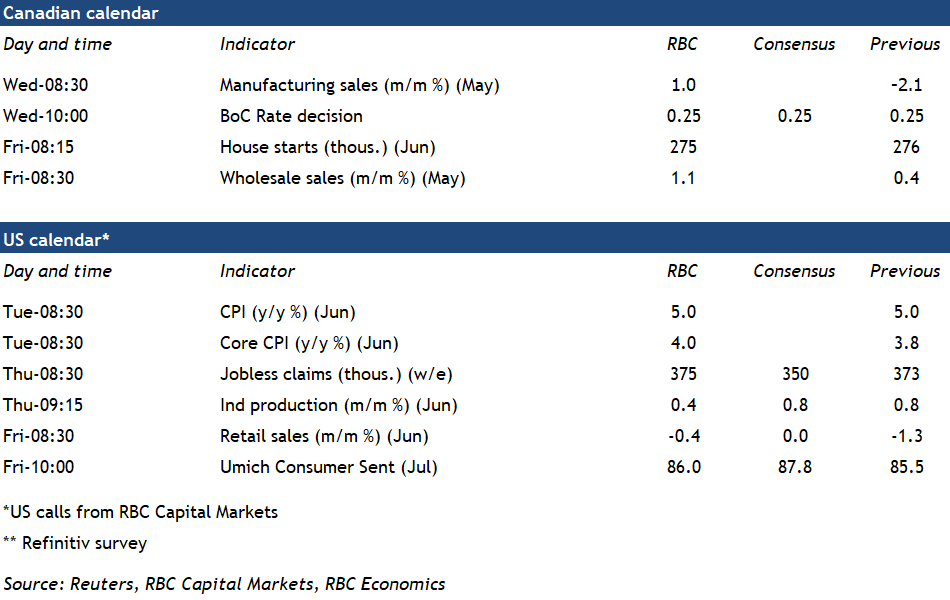
We expect no major forecast changes in next week’s Bank of Canada rate decision and Monetary Policy Report. Indeed, the Canadian economic recovery is progressing largely in line with the central bank’s expectations, suggesting April GDP growth forecasts should be left mostly intact. We are tracking a 3.5% rise in Q2 GDP despite the spring virus wave—a projection in line with the BoC’s last published forecast. Vaccine distribution has accelerated as expected and early indicators are that household spending on hard hit travel and hospitality sectors showed signs of life in June as restrictions eased. With the economy performing largely as expected, we look for the BoC to lower the pace of asset purchases this month.
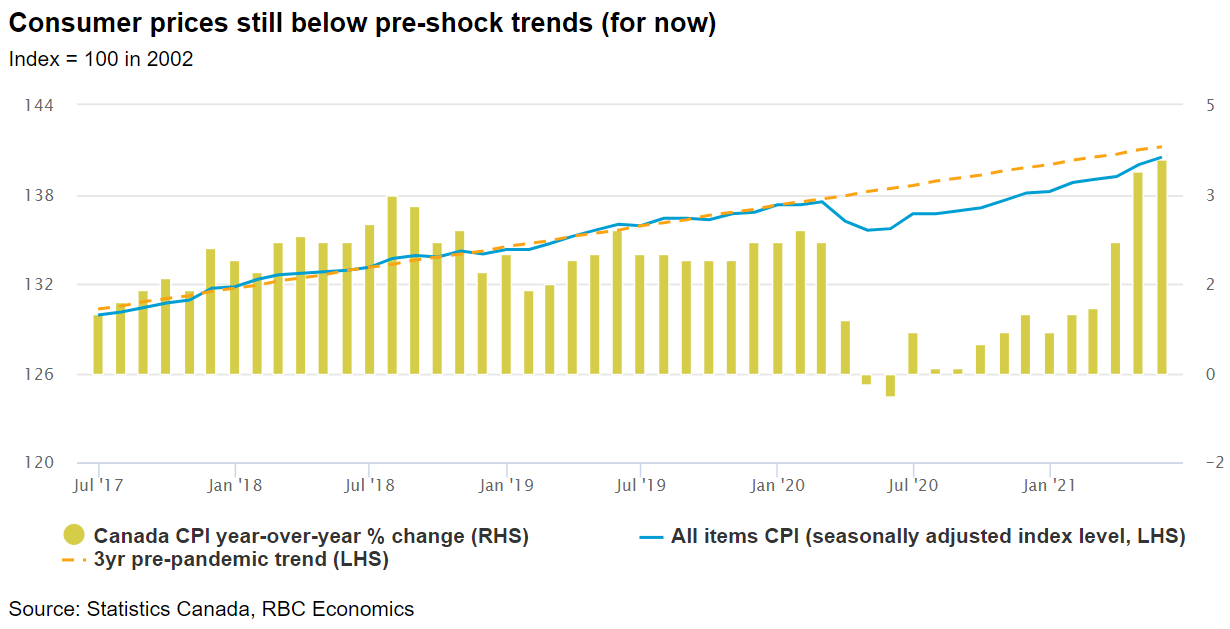
With a near-term bounce back in the economy looking increasingly assured, a more pressing concern is whether a consumer-led surge in demand over the second half of 2021 will stoke inflation pressures. Surging housing costs, and a retracing of price declines earlier in the pandemic (particularly for energy prices) already pushed headline CPI growth to 3.5% from year-ago levels in April and May. We expect the Q3 average to remain above the top-end of the central bank’s 1% to 3% target range. Although those readings have been higher than expected, BoC policymakers will likely continue to see the recent price surge as transitory. Up to this point, the increases have mainly pushed price levels back toward pre-pandemic trends. We expect no change to the policy rate or forward guidance timeline with the Bank expected to maintain exceptionally low policy rates until the second half of 2022.
Week ahead data watch:
- Preliminary estimates for Canadian manufacturing and wholesale sales in May have already been released. Both indicators showed increases of ~1% despite the weak economic backdrop that was in place when many regions were under lockdowns.
- We expect Canadian June housing starts to have held at elevated levels—broadly in line with the strong permits issued in recent months.
- We expect US Inflation to jump 5.0% above year ago levels driven by pandemic base effects alongside firming price pressures. Central bankers will look past reopening bottlenecks for evidence of broad-based underlying price firming.
- US Retail Sales will likely show another decline in June as auto production disruptions limited new car sales.
- With over 50M vaccines in hand, Canada’s vaccination campaigain continues to thrive. Still, concerns about variants (delta) spread cannot be ignored. And the share of the eligible (12+) population receiving at least one dose has plateaued at still just short of 80%.
What Does Central Bank Divergence Mean for FX?
There’s been a massive shift within the central bank world lately. Some have taken baby steps towards exiting cheap money and ultimately raising interest rates, but others have not. We seem to be entering a period where the economies that will be raising rates might see their currencies appreciate against those that won’t. The dollar, pound, kiwi, and loonie could shine, whereas the yen, franc, and euro may fall behind.
Fuel on the fire
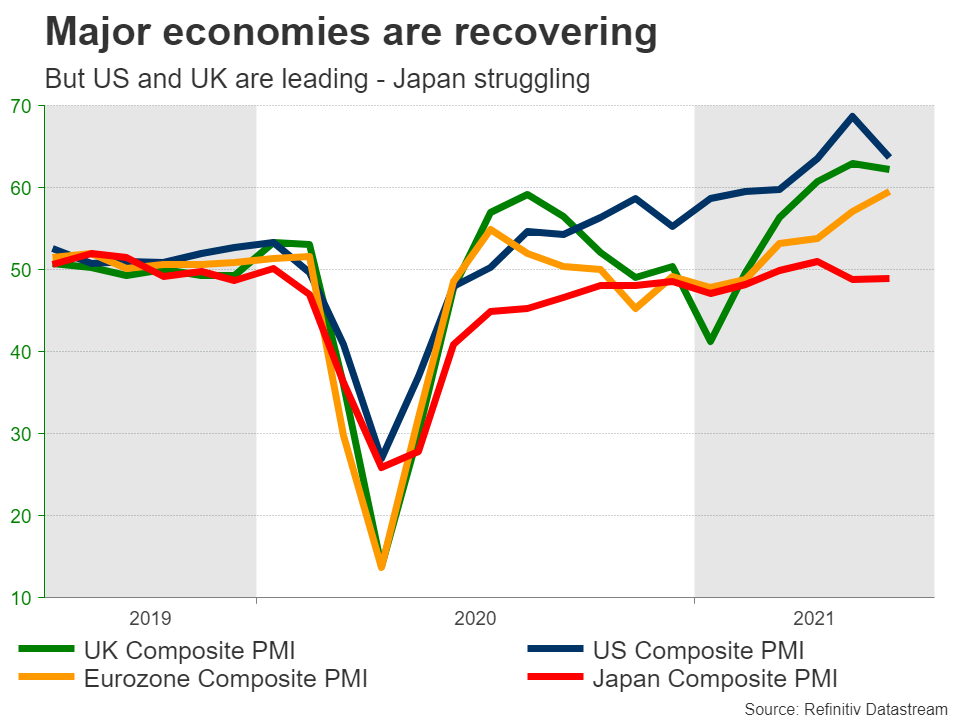
One year after the world economy almost collapsed, things are looking much better in many countries, so much so that some central banks are ready to take their foot off the accelerator. Tremendous government spending and infinite liquidity for the financial system seem to have worked wonders in preventing any lasting damage from the crisis.
It is now clear that the pandemic was mainly a supply shock, which was handled like a demand crisis. When an economy is facing production problems but the government keeps spending with force, the supply side can’t cope. The result is a booming economy, but at the cost of rising inflation.
It’s like pouring fuel on the fire. It risks overheating the economy. As such, some central banks are now trying to slowly exit their crisis-era programs to keep inflation under control. It’s better to step on the brakes gently now, than having to pull the handbrake later on.
But it’s not all central banks. Some are faced with economies that are still struggling, so they won’t be exiting cheap money anytime soon. This sets the stage for some powerful FX trends moving forward.
Carry trade
Higher interest rates are naturally beneficial for a currency. Investors can borrow in a low-yielding currency and then invest that money in higher-yielding assets abroad, earning a return on the difference and boosting demand for the high-yielding currency. This is called a carry trade.
When investors sense that a central bank will be raising rates down the road, they usually try to front-run this trade by buying that currency, expecting it will appreciate later on.
So who is raising rates?
In a nutshell, of particular interest for FX traders is that the central banks of America, Canada, the UK, and New Zealand have all taken the first steps towards normalizing rates. The markets think the Reserve Bank of New Zealand will act first, currently pricing in an 80% chance for a rate increase in November this year, with another one to follow by spring 2022.
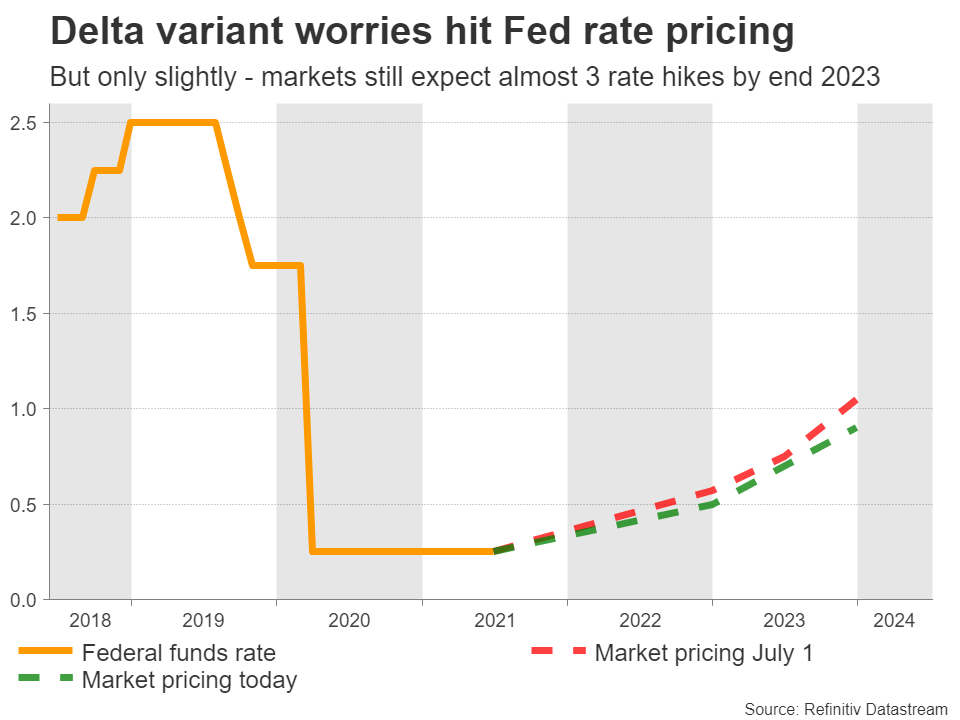
In America, the Fed is widely expected to announce that it will scale back its enormous asset purchase program in the coming months, which would be the first step towards higher rates. The first rate increase is priced in for December 2022, with almost another two in 2023. This pricing took a hit lately due to worries around the Delta variant, but not dramatically.
The Bank of England is a similar story, along with the Bank of Canada.
Who isn’t normalizing?
The Eurozone, Japan, and Switzerland won’t be raising rates anytime soon. Japan and Switzerland are still trapped in a low inflation regime and economic growth is far from impressive.
Europe is doing better so the European Central Bank might ultimately dial back its asset purchases, but it won’t raise rates for several years. The economy is just not that strong. In fact, the ECB recently raised its inflation target, essentially committing to negative interest rates for a longer period of time.
Winners and losers
Adding everything together, the currencies of nations that will enjoy higher interest rates are likely to outperform those that won’t be raising rates over the coming years.
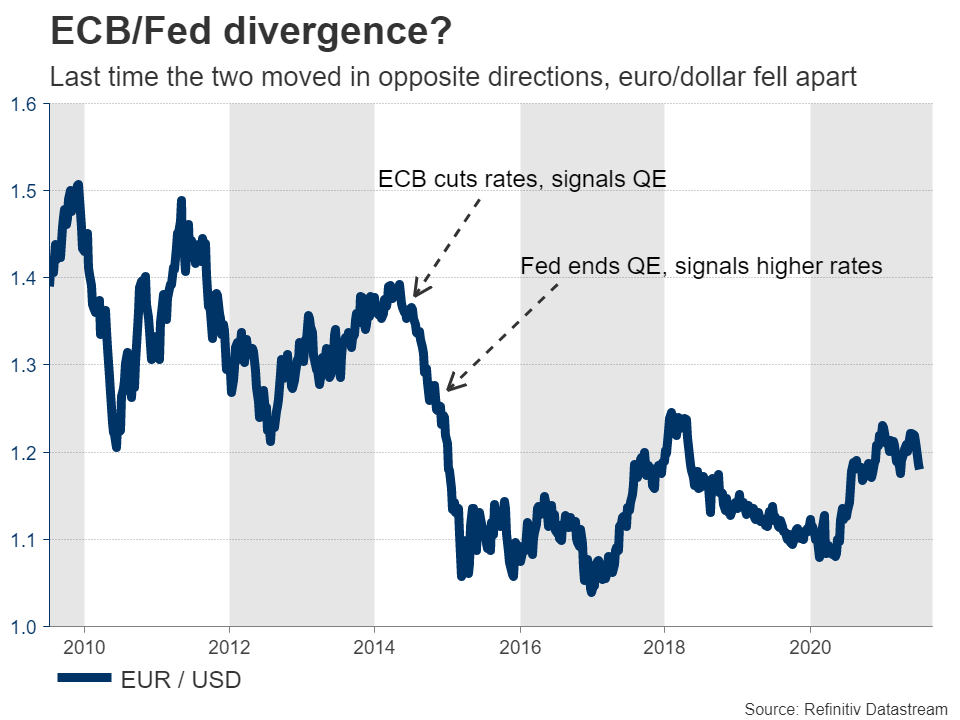
Specifically, this implies that the US dollar, British pound, Canadian dollar, and New Zealand dollar might shine against the Japanese yen, Swiss franc, and to a lesser extent the euro. Pairs like dollar/yen or pound/franc could head higher over time as this theme crystallizes.
What’s the risk?
The main risk to this view would be some shock that hits global markets. For example, a new covid mutation that the vaccines are not effective against, which sees lockdowns return. That could slow down the pace of normalization in many countries, and also boost both the yen and the franc through safe-haven demand.
In fact, we have already seen this play out this week. Concerns around the Delta covid variant have seen rates decline as investors started pricing in a slower normalization path by the major central banks, boosting the yen and the franc in the process.
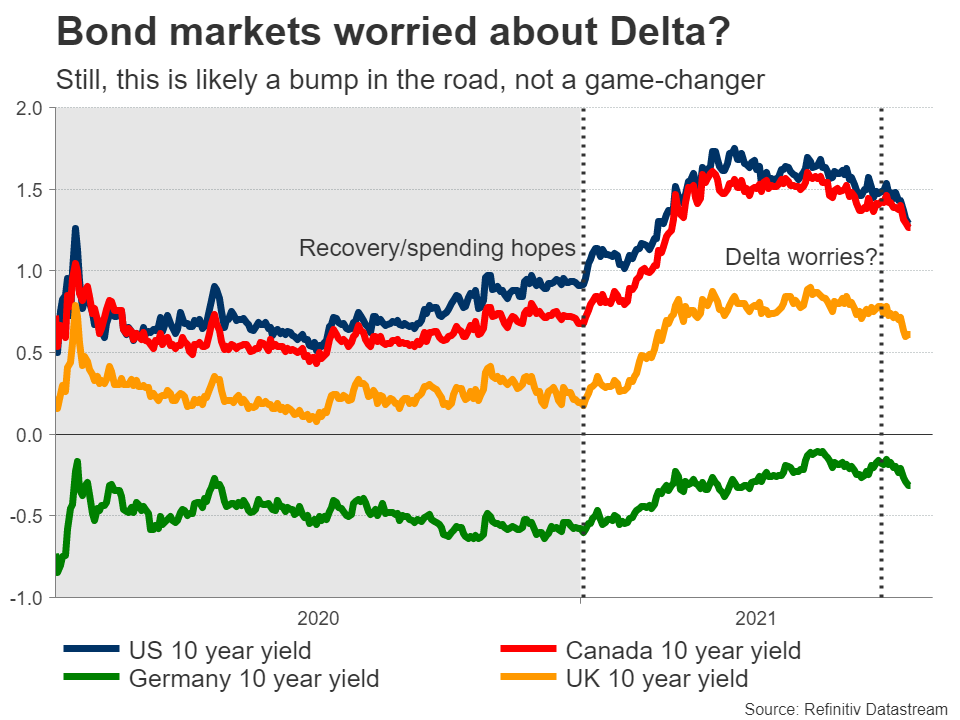
But ultimately, this is unlikely to last long. The Delta variant might slow down this trend, but it won’t derail it. It is mainly an issue for emerging markets, not the advanced economies that are mostly vaccinated already. It will take something much bigger to demolish the narrative of monetary policy normalization.
Week Ahead – RBNZ and BoC to Stay on Taper Path but Delta Strain May Cause Angst for BoJ
It will be a busy week as the Bank of Canada, Bank of Japan and the Reserve Bank of New Zealand all meet, while inflation will take centre stage on the data front. With increasing concerns that the new Delta Covid variant could scupper reopening plans around the world, Japanese policymakers are the most likely to strike a more cautious tone, but the BoC and RBNZ will probably maintain their optimism for now. After the Federal Reserve signalled that a taper decision was not imminent, markets might take a more relaxed view on the latest CPI readings in the United States. Meanwhile, Q2 GDP numbers will be watched in China for signs that the recovery in the world’s second largest economy may be plateauing.
Will RBNZ add fuel to November rate hike calls?
There’s been a sudden shift in RBNZ rate hike expectations over the past week after a closely watched business confidence gauge jumped to the highest in four years in Q2. The survey was the latest to point to improving sentiment across New Zealand as the country appears to be coming out of the pandemic hole much quicker than other advanced economies. Subsequently, market participants have brought forward the timing of how soon the RBNZ will hike rates, pricing in a near two-thirds possibility of higher rates by November 2021 compared to earlier predictions of August 2022.
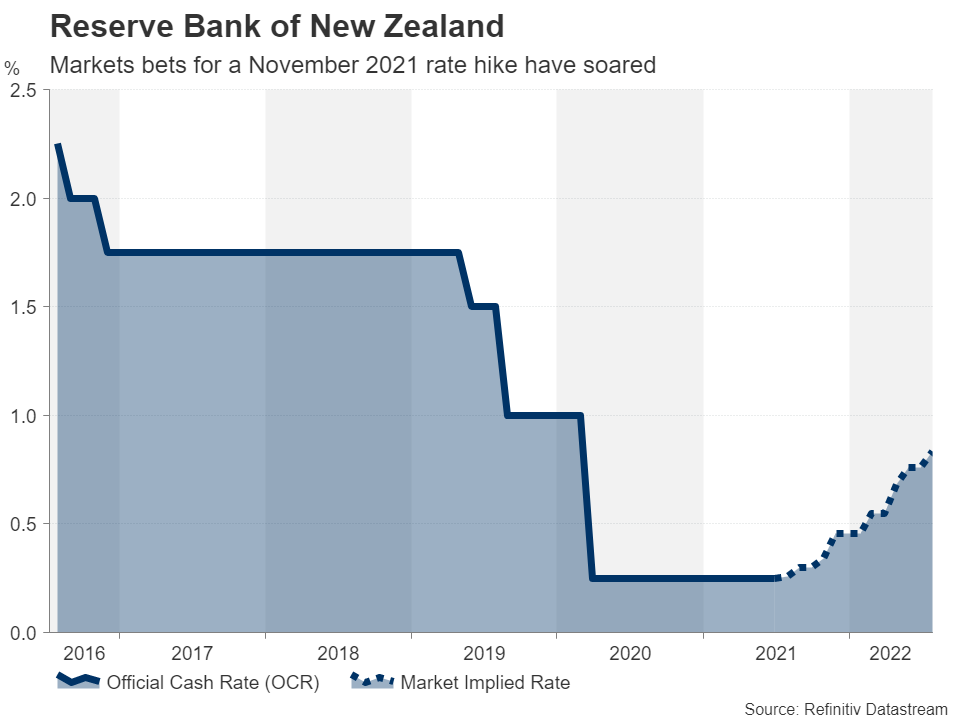
For the July meeting, however, the RBNZ is almost certain to keep its policy settings on hold when it meets on Wednesday. Nevertheless, investors will be scrutinizing the language in the statement as upbeat remarks about the economy would reinforce expectations that a rate hike is likely to come sooner rather than later. Although it can’t be ruled out that policymakers might emphasize that the outlook has become less certain following the spike in infections in the region, the likelihood is very slim given that New Zealand has so far avoided a major outbreak of the Delta variant.
The New Zealand dollar could receive a short-term boost against its US counterpart if the RBNZ does not say anything that puts into question the revised timeline for rate hikes. However, the fact that even after such a dramatic move in rate hike bets, the kiwi was unable to reclaim the front foot against the greenback, global risk sentiment and Fed taper speculation seem to be bigger priorities for investors right now.
Ahead of the RBNZ decision, electronic card retail sales for June might attract some attention on Monday and the consumer price index for the second quarter will be important too on Friday.
China’s recovery may be cooling
China will report GDP numbers for the second quarter on Thursday and the data may add to the current jitters about a weakening growth outlook if they are worse than what is being anticipated. The Chinese economy grew by a staggering 18.3% year-on-year in the first three months of the year. However, the figure was inflated due to the low base effect of the prior year when GDP had slumped during the Q1 2020 lockdown. Moreover, recent PMI prints have been somewhat on the soft side. The forecast for Q2 is GDP growth of 8% y/y.
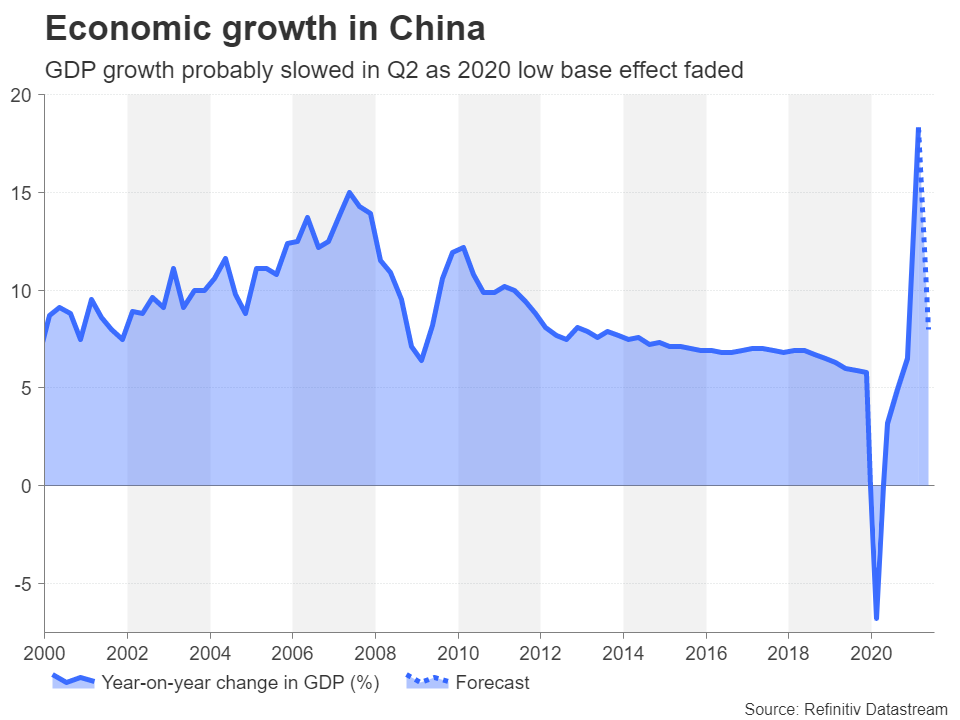
The monthly readings for industrial production and retail sales are also due on Thursday, which will be preceded by June trade figures on Tuesday. Should the barrage of data not do much in terms of shoring up confidence about the growth picture, especially as the rampant spread of the Delta variant is forcing fresh shutdowns in many parts of the world, market sentiment might take a hit. This could weigh on risk assets such as stocks, as well as hurt the China-sensitive Australian dollar.
Thursday could turn out to be a volatile session for the aussie as Australian employment numbers are on the agenda too. The recent lockdowns announced in Australia probably came too late to have a strong impact on the June jobs data, so the 30k rise in employment that is being forecasted for the month might be of some comfort for the local dollar.
BoC unlikely to be deterred by virus fears
The Bank of Canada will announce its policy decision hours after the RBNZ on Wednesday. A further reduction in QE is expected, with policymakers slowing the pace of bond purchases from C$3 billion to C$2 billion a week. The Bank will also publish updated economic projections and could reveal whether it is still pencilling in a rate increase for the second half of 2022.
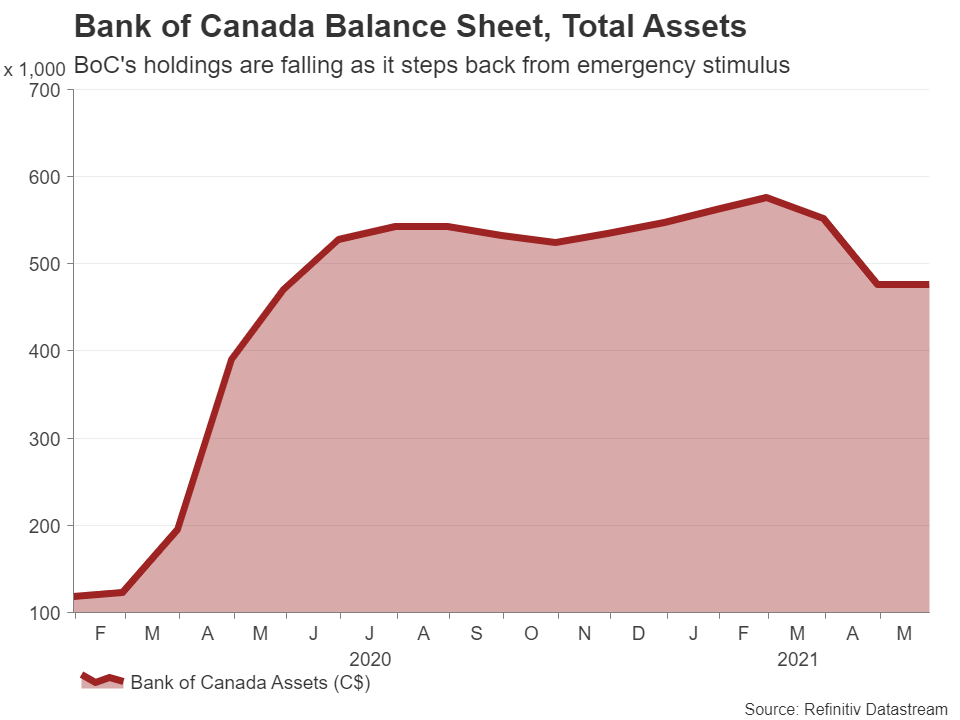
Back in April, policymakers formally set an exit course out of the pandemic stimulus and although since then, a new threat has emerged in the form of the Delta variant, daily infections in Canada remain very low so there’s not much chance of the Bank turning more cautious. If anything, policymakers could reaffirm their optimism following the BoC’s rosy business outlook survey released just this week.
Even so, the Canadian dollar could continue to struggle versus the mighty US dollar amid the ongoing concerns about the strength of the global recovery, which have boosted demand for safe havens.
BoJ gloom to reflect Japan’s Olympic and virus woes
The Bank of Japan will not have as much to cheer about when it concludes its two-day policy meeting on Friday. The BoJ looks set to lower its growth projections for the current fiscal year when it releases its quarterly outlook report alongside its policy decision, which is expected to remain unchanged. Many regions in Japan are only now coming out of weeks of state of emergencies that were imposed to fight the country’s fourth virus wave. However, the capital Tokyo has been placed back under restrictions to prevent another surge when the Olympic Games start later in July. Thus, after an initial strong rebound, Japan’s road to recovery has unexpectedly become very bumpy.
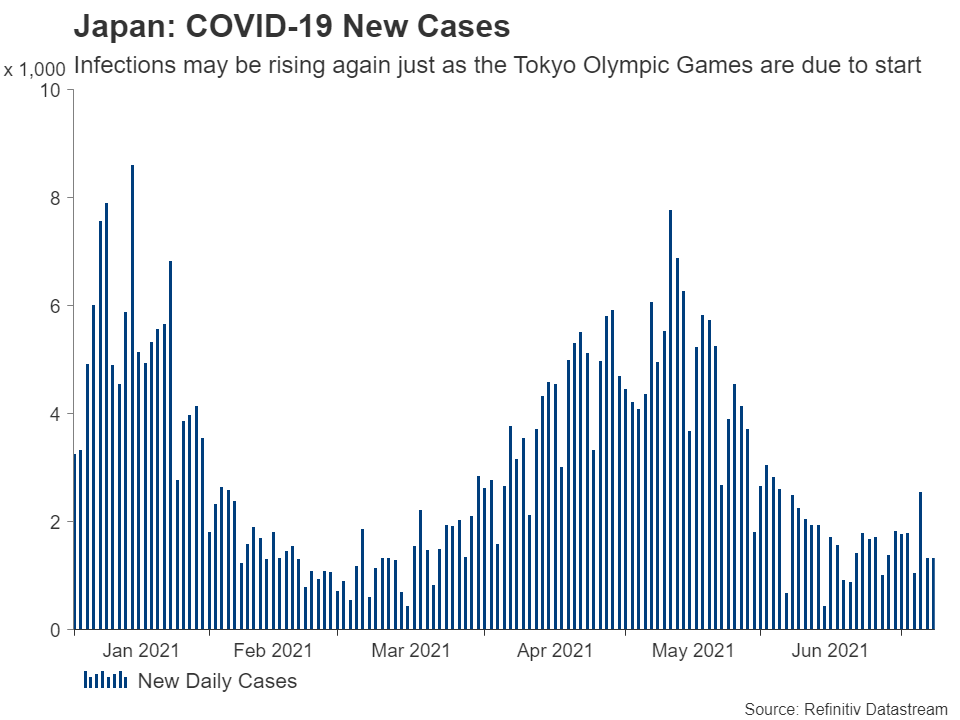
What this all means for monetary policy is that the Bank of Japan is nowhere near normalizing policy, and it’s left little doubt that the BoJ will be engaged in QE long after other central banks have exited theirs.
But will a gloomier BoJ matter much for FX markets? That will all depend on whether risk appetite has bounced back by then. At the moment, the yen is enjoying a mini revival on the back of the worries about the Delta variant and broader doubts about economic growth. Should those jitters subside, the yen could come under renewed pressure. Though, until global bond yields end their slump, the Japanese currency could stay substantially elevated from its 2021 lows.
US CPI may not set markets alight but retail sales might
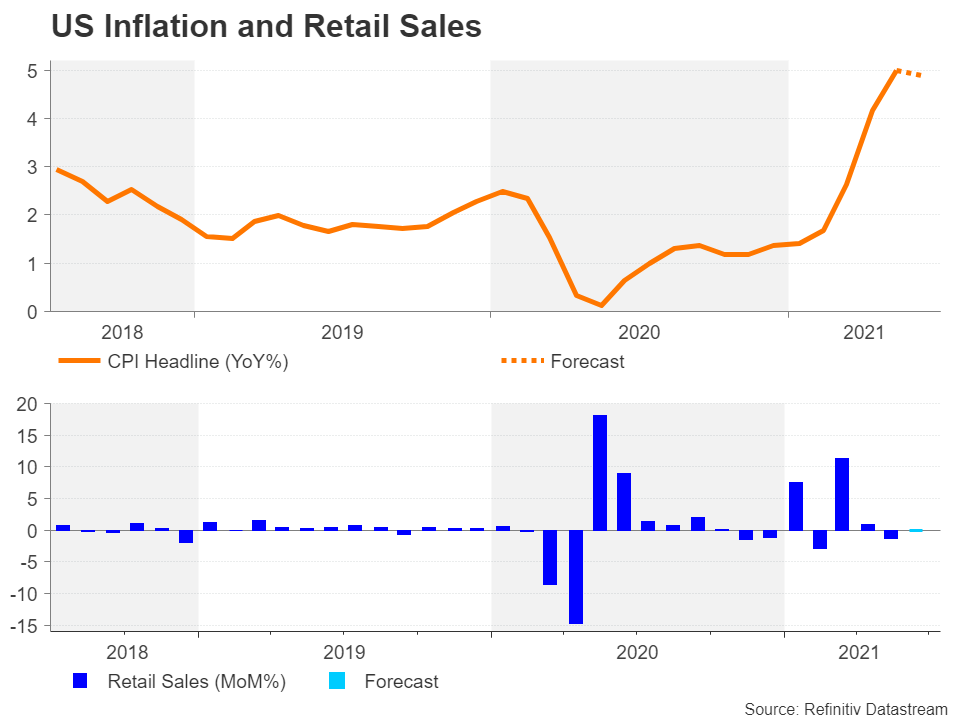
Over in the US, the main highlights will be the CPI report for June on Tuesday and retail sales figures on Friday. The month-on-month CPI rate could ease further in June, with forecasts pointing to a 0.4% increase, which would be down from the prior month’s rate of 0.6% and 0.8% in April. The annual rate is also forecast to moderate to 4.9% compared to May’s 13-year high of 5.0%.
However, with the surge in inflation having so far failed to alarm the Fed enough to press the brakes on stimulus, the June readings probably won’t either, especially after the minutes of the June FOMC meeting indicated policymakers have yet to see sufficient progress towards their goals that would warrant bringing forward a decision on tapering. What could, though, shift Fed expectations slightly are June’s retail sales prints.
Retail sales dipped 1.3% m/m in May as the boosts from the stimulus payments and reopening of the economy waned somewhat. Analysts are not anticipating a rebound for June and another disappointing month would support the case for FOMC members to be “patient” before announcing changes to the pace of asset purchases. However, a stronger-than-expected number could sway the odds in favour of earlier tapering, potentially giving the bullish dollar another leg up.
In other US releases, the producer price index will follow on Wednesday and traders will additionally be able to sift through manufacturing surveys (Empire State on Thursday and Philly Fed on Friday), industrial production data (Thursday) and the University of Michigan’s preliminary consumer sentiment gauge.
Finally, inflation figures are also due in the United Kingdom on Wednesday, to be followed by the latest jobless figures on Thursday. In the Eurozone, the final estimates of June inflation are out on Friday. Both the euro and pound are likely to continue taking their cues from the dollar over the coming days, with investors keeping an eye on infection rates in the UK and on the continent to see whether vaccines alone will be able to keep hospitalizations low as virus restrictions are loosened.
GBP/USD Outlook: Bulls Regain Traction But More Evidence Needed to Signal Reversal
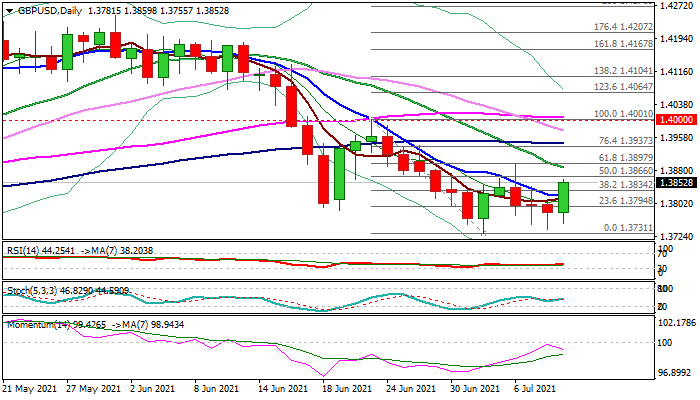
Cable regained traction on Friday after negative tone prevailed during this week, with three-day drop ending with a hammer candle that generated initial bullish signal.
Fresh advance nearly fully reversed losses of this week but needs lift above pivotal barriers at 1.3887/97 (falling 20DMA / Fibo 61.8% of 1.4001/1.3731 bear-leg) to confirm reversal signal and open way for stronger recovery.
Formation of bullish engulfing today would add to positive tone, but stall of 19-d momentum rally on approach to centreline and subsequent descend, warn that recovery may run out of steam.
Caution on return and close below 10DMA (1.3819) which would weaken near-term structure and keep the downside at risk.
Res: 1.3866; 1.3887; 1.3897; 1.3937.
Sup: 1.3834; 1.3819; 1.3794; 1.3741.
Sunset Market Commentary
Markets
Core bonds finally stopped rallying today. Both the German Bund and US Treasuries already looked exhausted yesterday with the former underperforming by paring most or all of the intraday gains. The resulting hammer candlestick (in yields) met with follow-through price action at the final day of a remarkable trading week. US Treasuries underperform this time, with yields sprinting 4 bps (5y) to 4.5 bps (10y) higher, carried by both a bottoming out in real yields and inflation expectations. German yields rise more modest with the long end adding 1.9 bps (10y) to 2.3 bps (30y). Bund outperformance might be rooted in a flurry of ECB speeches in the wake of the policy review, each with different nuances. Bundesbank governor Weidmann for example stressed the ECB will allow but won’t deliberately seek inflation overshoots. France’s Villeroy said the new 2% target is not a ceiling. The ECB minutes also weighed on European yields. They showed how the central bank is very much on edge when it comes to rising (sovereign) yields, whatever the reason (eg. better economic prospects). One official advocated an increase of the PEPP buying pace. Yields rose even as the Chinese central bank heeded the State Council’s call yesterday to further cut the reserve requirement to support credit and economic growth. That embodied investor worries about cooling growth and prompted a sharp risk sell-off and a flight to safe havens on Thursday. The atmosphere completely turned today though with nice gains for European stocks of >1%. EuroStoxx50 currently fights resistance around 4040. Cyclicals on Wall Street outperform (DJI +0.9%). Other risky assets also perform better with both corporate and European peripheral government bond (-1 to -2 bps) spreads tightening. On FX markets, the classic safe havens bite the dust. The yen is the top loser, followed by the dollar and the Swiss Franc. EUR/USD erased early weakness to extend yesterday’s gain into the high 1.18(7) zone. EUR/JPY rebounds from 130 to 130.6 but USD/JPY struggles to regain 110. DXY is venturing towards the lower bound of the upward trend channel (92.21). Cyclical currencies profit with the likes of the NOK, AUD and CAD (also due to solid payrolls, cf. infra) topping the G10 scoreboard as commodities catch a better bid (Brent oil for example flirting with $75 again). Sterling has a better run today too as the sky cleared a bit. EUR/GBP retraces more than half of yesterday’s gain to trade around 0.856. Dynamics in the currency pair these last few weeks are worse than the Echternach procession: it’s three steps forward and three steps back.
News Headlines
Canadian June labour data indicated a solid improvement as the economy recovers from the lockdowns. The economy added 230.7k jobs vs. 175k expected. The economy lost a combined 275k jobs in May and April. The unemployment rate declined from 8.2% to 7.8%. The participation rate jumped from 64.6 to 65.2%. All employment gains was registered in part-time employment though. Full employment even declined 33.2k. The Bank of Canada will hold a regular policy meeting next week (July 14). Markets expect the BoC to further scale back the amount of weekly asset purchases by C$1 bln to C$2 bln. USD/CAD today declined slightly after being propelled by the risk-off (and a modest decline in some commodities) recently. USD/CAD is drifting below the 1.25 big figure.
Headline June inflation in Norway rose 0.3% M/M and 2.9% Y/Y, from 2.7% in May. However, core inflation (excluding energy and tax changes) was slightly softer than expected at 0.4% M/M and 1.4% Y/Y (from 1.5%). Amongst others, the rebound of the krone helps to ease underlying price pressures. The Norges bank at the June policy meeting indicated that it will soon be appropriate to raise the policy rate from the current level. Rising capacity utilization is limiting the risk of inflation becoming too low. High house prices are a factor too. Today’s inflation report probably won’t change the assessment of the Norges Bank. The Norwegian krone today showed a solid rebound after the risk-off losses incurred of late with EUR/NOK declining from 10.41 at the open to currently 10.34.
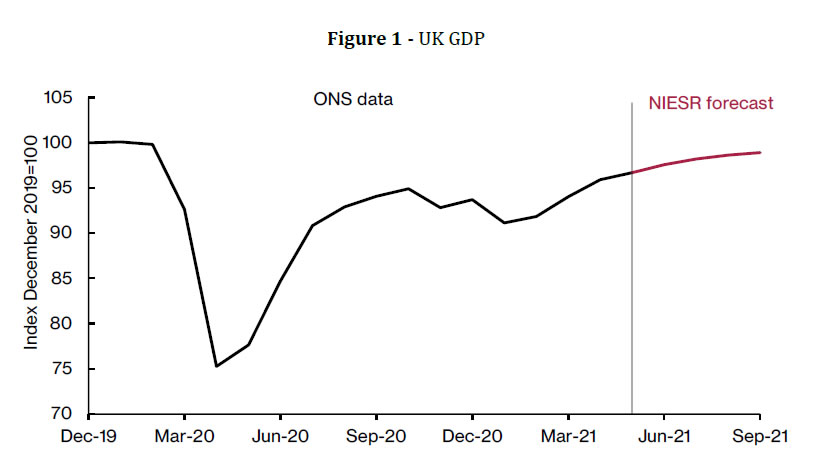
NIESR expects 0.9% UK GDP growth in June, 1.9% in Q3
NIESR said UK's 0.8% GDP growth in May "disappointed". It expected GDP growth of 0.9% in June, and 4.8% in Q2 overall. Nevertheless, "with catch-up potential still evident in hospitality, transport, business support and the arts, we forecast growth of 1.9 per cent in the third quarter, still notably above historical trend growth rates." But, "much will depend on the roll-out and efficacy of the vaccines in the context of the Delta variant."
"Like April, May's GDP growth was faster than usual but almost entirely driven by the lifting of Covid-19 restrictions, with the hospitality sector accounting for 0.7 percentage points of May's 0.8 per cent growth. Underlying growth is moderate outside the sectors being unlocked, with supply constraints contributing to the continuing recent stagnation in manufacturing. It remains to be seen whether the lifting of further restrictions in July contributes to a continuation of strong growth in the third quarter or – if cases of Covid-19 continue to rise – increased caution among consumers and even another national lockdown."
Rory Macqueen Principal Economist - Macroeconomic Modelling and Forecasting
Canadian Employment Bounced Back in June as Restrictions Eased
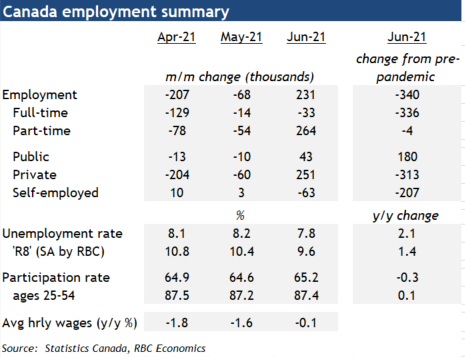
- Employment rose 231k overall, the unemployment rate fell to 7.8%
- Job gains all in part-time work, and largely in industries hardest hit by spring lockdowns, and concentrated among younger workers
- Further job market recovery expected over the summer with virus containment measures continuing to ease.
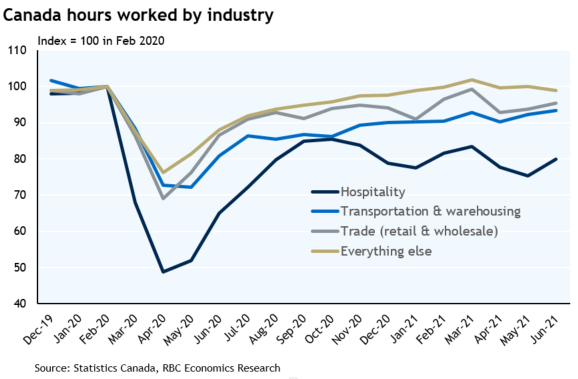
The 231k increase in employment in June was broadly in line with expectations - but retraced more than 80% of the 275k drop over April and May. The details of the increase were less impressive than the headline, with all of the gain coming from part-time work. Total hours worked actually edged slightly lower (-0.2%). But with virus containment measures continuing to ease, more sizeable labour market improvements are expected in months to come.
The June jobs increase was heavily concentrated in the high-contact service sectors which rebounded after being once again disproportionately hit by spring virus containment measures - and it was concentrated in youth aged 15-24. But those hard-hit service industries also still account for the bulk of the remaining (and still large) 340k shortfall in employment versus pre-shock (February 2020) levels - over three-quarters from the accommodation & food services sector alone, even after a 101k increase in June.
Outside of those high-contact service-sector industries, supply chain disruptions and labour shortages have become a more pressing concern than a lack of orders. Manufacturing employment edged down another 12k in June to build on a 36k May drop. Vaccine distribution has ramped up significantly and provided virus spread remains in check, there are still a lot of jobs to recoup over the second half of the year in high-contact service sectors. Beyond that, production and labour-supply capacity limits will make further gains next year harder to come by.
USD/JPY Mid-Day Outlook
Daily Pivots: (S1) 109.30; (P) 110.00; (R1) 110.45; More...
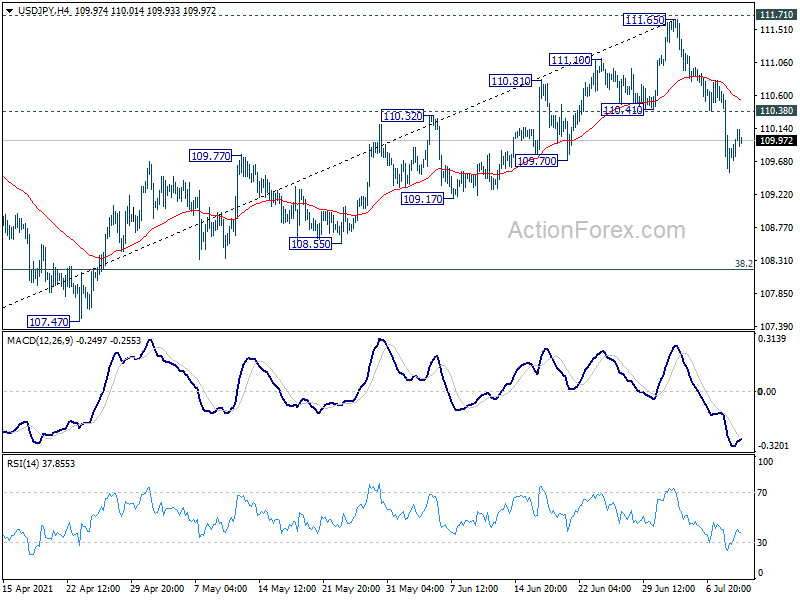
No change in USD/JPY's outlook. Sustained trading below 55 day EMA (now at 109.78) will suggest that it's at least correcting the whole rise from 102.58. Deeper fall would be seen to 38.2% retracement of 102.58 to 111.65 at 108.18. On the upside, above 110.38 minor resistance will turn intraday bias neutral first. But risk will remain mildly on the downside as long as 111.65 resistance holds, in case of recovery.
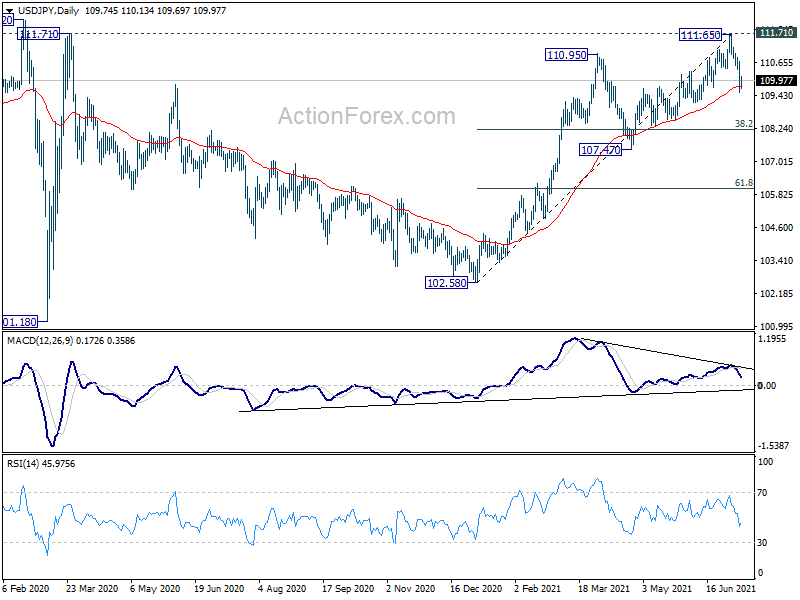
In the bigger picture, medium term outlook is staying neutral with 111.71 resistance intact. Though, as notable support was seen from 55 day EMA, rise from 102.58 is mildly in favor to extend higher. Decisive break of 111.71/112.22 resistance will suggest long term bullish reversal. Rise from 101.18 could then target 118.65 resistance (Dec 2016) and above. However, sustained break of 55 day EMA would revive some medium term bearishness, and open up deep fall back towards 102.58 support.
USD/CHF Mid-Day Outlook
Daily Pivots: (S1) 0.9101; (P) 0.9181; (R1) 0.9228; More....
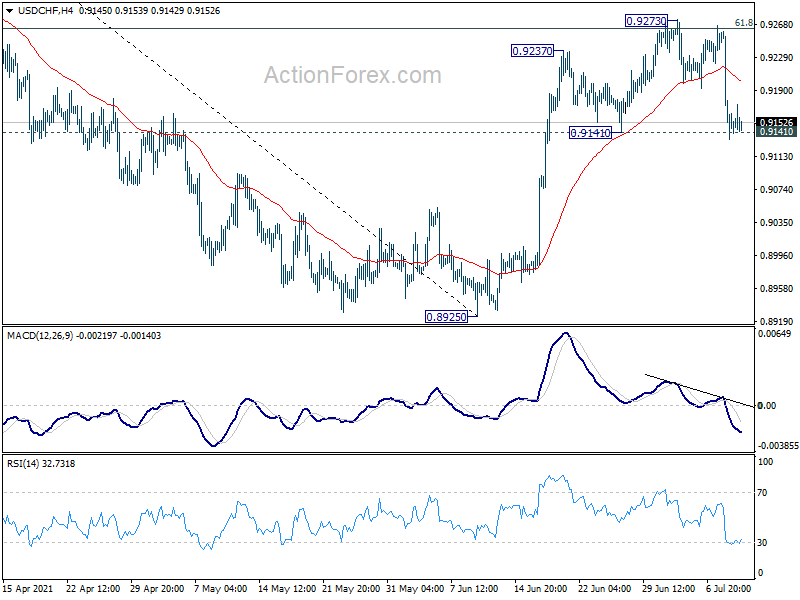
No change in USD/CHF's outlook. Intraday bias stays neutral with focus on 0.9141 support. Firm break there will argue that whole rebound from 0.8925 has completed. Intraday bias will be turned to the downside for 55 day EMA (now at 0.9121). Sustained break there will pave the way back to retest 0.8925 low. On the upside, though, break of 0.9273 will resume the rally to 0.9471 key resistance instead.
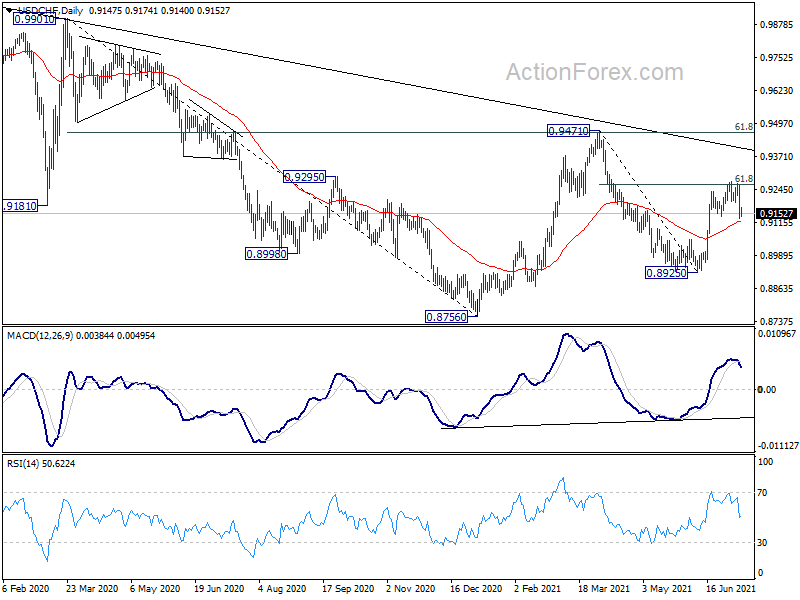
In the bigger picture, medium term outlook is currently neutral with focus on 0.9471 resistance. Sustained break there will indicate completion of whole decline from 1.0342 (2016 high). Medium term outlook will be turned bullish for a test on 1.0342 high. But, rejection by 0.9471 again will revive bearishness for another fall through 0.8756 low.
GBP/USD Mid-Day Outlook
Daily Pivots: (S1) 1.3753; (P) 1.3779; (R1) 1.3817; More....
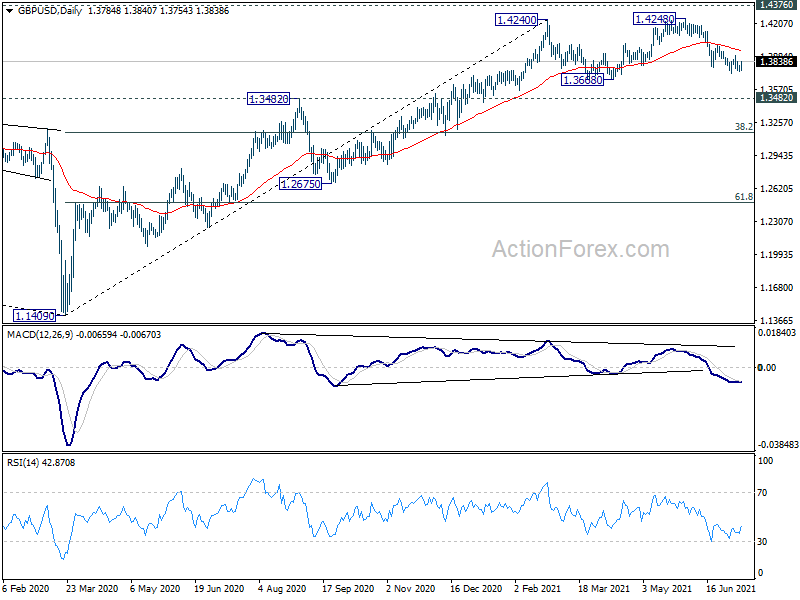
Intraday bias in GBP/USD stays neutral at this point. On the downside, break of 1.3730 support will resume the fall from 1.4248, as the third leg of the consolidation pattern from 1.4240. Deeper decline would be seen to 1.3668 support and possibly below. On the upside, break of 1.4000 resistance will argue that fall from 1.4248 has completed. Intraday bias will be turned back to the upside for retesting 1.4240/8 resistance zone.
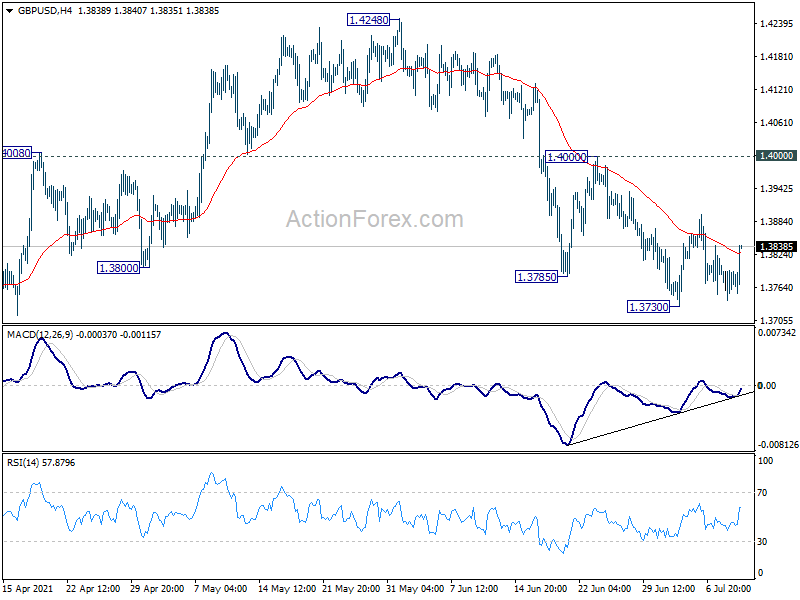
In the bigger picture, as long as 1.3482 resistance turned support holds, up trend from 1.1409 should still continue. Decisive break of 1.4376 resistance will carry larger bullish implications and target 38.2% retracement of 2.1161 (2007 high) to 1.1409 (2020 low) at 1.5134. However, firm break of 1.3482 support will argue that the rise from 1.1409 has completed and bring deeper fall to 1.2675 support and below.