

Sample Category Title
S&P 500, DOW JONES Retreat As Earnings Season Kicks Off
The Japanese yen was little changed against the US dollar after relatively positive Japanese economic data. According to the Ministry of Finance, the country’s producer price index rose to 5.0% in June, better than the median estimate of 4.7%. It rose by 0.6% on a month-on-month basis. Further data showed that core machinery orders rose by 7.8% on a MoM basis and by 12.2% on a YoY basis. These numbers provide some evidence that the Japanese economy is doing relatively well as local and international demand rises.
US futures declined today as traders started looking ahead to the upcoming earning season. Dow Jones, S&P 500, and Nasdaq 1000 futures dropped by less than 0.10%. The earning season will start this week as big banks like JP Morgan, Wells Fargo, and Bank of America release their results. Other top companies that will publish their results are Delta, Blackrock, and UnitedHealth Group. Analysts will be focusing on growth at a time when valuations are stretched. The S&P 500 has even recorded 38 record closes this year. According to FactSet, analysts expect that S&P 500 companies revenue rose by 64% in Q2 from a year earlier.
The New Zealand dollar declined slightly after the latest electronic sales from the country. According to the statistics agency, retail sales declined from 1.7% in May to 0.9% in June. This decline led to a year-on-year increase of 4.0%. This decline is part of the normalisation as the country stages a relatively stronger recovery. Further data showed that business confidence rose sharply, leading more analysts to forecast a hawkish Reserve Bank of New Zealand. Many companies said that they expect business conditions to improve as the local and international market reopens.
NZDUSD
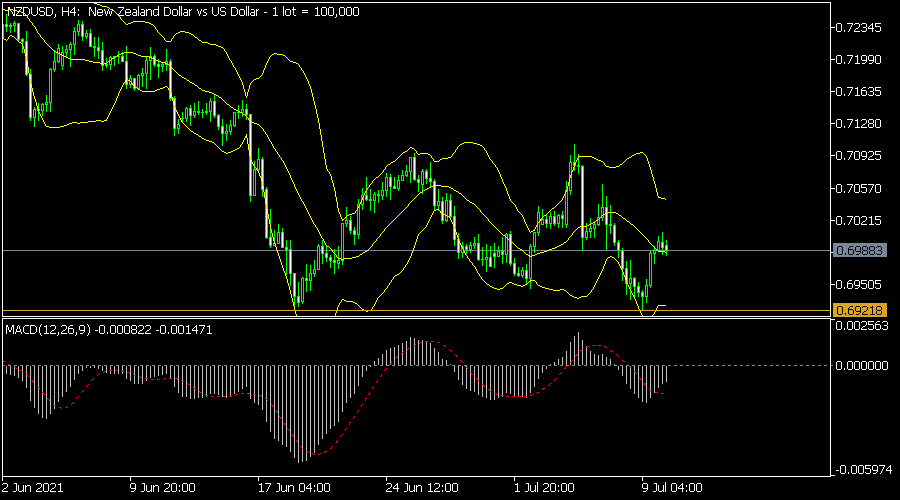
The NZDUSD pair declined to 0.6988 after the latest New Zealand electronic sales data. On the four-hour chart, the pair has moved to the middle line of the Bollinger Bands. It is also slightly above the neckline of the double-top pattern at 0.6945. It also formed a double-bottom pattern at 0.6921. Therefore, the pair will likely remain within this range today with the key support and resistance levels being at 0.6950 and 0.7050.
EURUSD
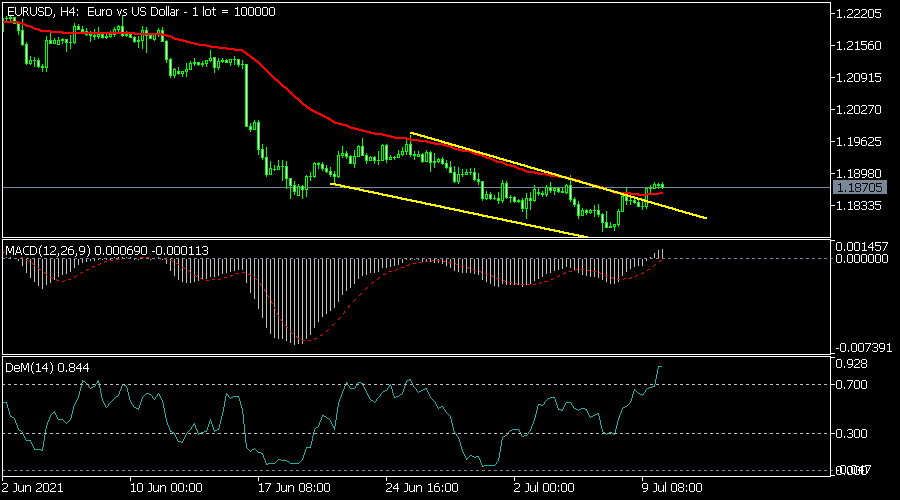
The EURUSD pair rose to 1.1870 in the Asian session. On the four-hour chart, the pair moved above the upper side of the descending channel. It also rose above the 25-day exponential moving average while the DeMarker has moved to the overbought level. The signal and histogram of the MACD have risen above the neutral level. The pair will likely resume the downward trend as bears attempt to move back to the descending channel.
USDJPY
The USDJPY pair was little changed after the latest Japanese machinery and PPI data. It moved to 110.10, which was above last week’s low at 109.50. On the four-hour chart, the pair is slightly below the 25-day moving average while the moving average of oscillator has moved above the neutral level. The MACD has also made a bullish divergence pattern. Still, the pair may resume the downward trend as bears attempt to test last week’s low at 109.50.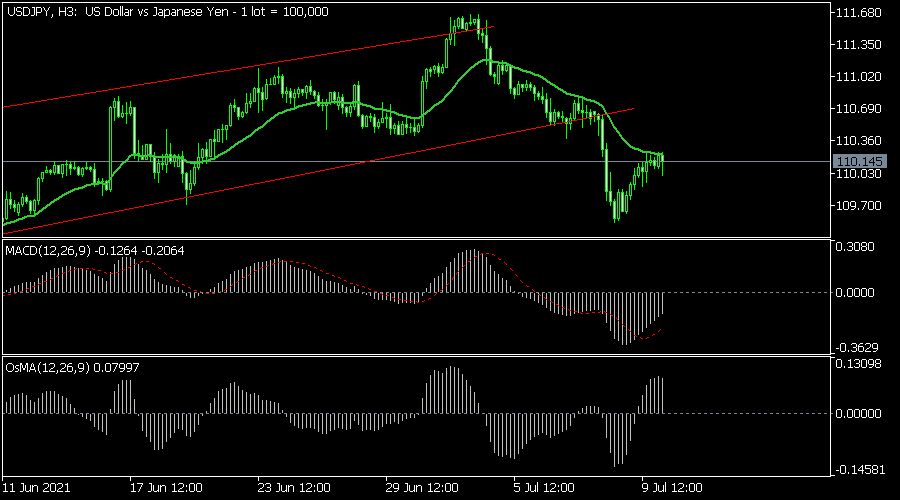
ECB Lagarde Indicated Additional Clarity On The Post-PEPP Period
Markets
An interview by ECB President Lagarde with Bloomberg TV grabs most headlines this morning. Her main message is that the next policy meeting (July 22) will be an important one including some interesting variations and changes. The sudden hyping of a normally dull summer meeting comes after the ECB last week completed its strategic review sooner than expected. They swapped the close to, but below 2% inflation target for a hard 2% one while allowing for temporary deviations. Lagarde added that this new inflation target might take a little longer to reach and stressed the acceptance and tolerance of temporary higher inflation. The new inflation target calls for new wordings around forward guidance on both interest rates and asset purchases, something the ECB will update next week. Apart from the semantics, ECB Lagarde indicated additional clarity on the post-PEPP period. The ECB’s current €1.85tn Pandemic Emergency Purchase Programme runs at least until March 2022. Since March, the weekly pace stands at €15/20bn. We argued before that around that timing, the ECB could temporary raise asset purchases under the regular APP (currently €20bn/month) in order to smoothen the eventual exit process. Lagarde hinted in that direction by talking about a “transition into a new format”. By tackling the asset purchases issue already in July, the ECB avoids an unwarranted build-up in tapering expectations: “We need to be very flexible and not start creating the anticipation that the exit is in the next few weeks, months”. Besides clearing the air on future policy (= removing uncertainty), the central bank will simultaneously extend the time frame for which ultra-easy monetary policy conditions will remain in place. By doing so, she breaks ranks with the current views inside the Fed (tapering discussion ongoing) and BoE (net asset buying to end by the end of the year).
Today’s eco calendar isn’t really enticing though the US Treasury starts its mid-month refinancing operation with 3-yr and 10-yr Note auctions. The empty calendar and last week’s setback in US yields suggests that Friday correction higher could be extended in a daily perspective. US yields added 1.9 bps (2-yr) to 6.7 bps (10-yr), but remain significantly lower on a weekly basis. ECB’s Lagarde interview could still be interpreted as dovish, though we’ve already had a setback in (EU) real yields as well last week. The single currency or core bonds don’t react in tomorrow’s Asian dealings. Asian equity markets follow the end of last week’s bounce in Europe and in the US. Other items to watch this week are US CPI inflation numbers (tomorrow) and retail sales (Friday), the start of Q2 earnings season, the US 30-yr bond auction, Fed Powell’s semi-annual testimony in US Congress and UK inflation/employment figures.
News headlines
Bulgarian parliamentary elections delivered another inconclusive outcome. Former PM Borissov’s Gerb party won about 24% with almost 90% of the votes counted, followed by 23.5% for the anti-establishment group ITN. The Socialists secured 13.7% of the votes. It was the second ballot in just a few months’ time after a better-than-expected result for ITN prevented Borissov from a fourth term in April as all other parties refused to work with him. Bulgarian president Radev will give the winner of the election a first chance to forge a coalition before passing the baton to the runner-up. If that fails too, a third candidate is chosen by the president for a final try before new elections are called.
In the wake of the G7 early June, the G20 over the weekend agreed to set a minimum tax of 15% for corporates with a revenue of more than $890 million. They also decided to redirect some of the taxes in a way that multinationals with a turnover of more than $23.8 bn pay to countries where the (often digital) products and services are effectively sold. The new system is expected to take effect in 2023 and has been agreed to by 132 countries. Because of the tax deal and under intense pressure from the US, the EU is backing down on its own proposals for a digital levy. The bloc was due unveil proposals this week but has pushed that date back to July 20.
Equities Optimistic Despite Rising COVID-19 Restrictions In The Region
General trend
- Markets rebound snapping last week’s declines with most of the major markets in the region trading higher. Q2 earnings season kicks off, markets process China’s RRR cut From Friday and ECB’s Lagarde notes policy review for July meeting.
- US futures opened higher before pulling back mid-session.
- A$ weaker as COVID lockdown in Sydney expected to be extended beyond Friday as cases continue to rise. Offshore yuan stronger after RRR cut Friday.
- China cut RRR 50bps Friday after the close to support what is increasingly expected to be a weaker H2. Early analysis suggests this move will be a positive for brokers but mixed effect on banks. The cut will release around $154B in liquidity, but a PBOC adviser noted liquidity conditions would remain basically stable despite the cut.
- RBNZ Shadow board points to a tightening within a year.
- G20 Fin Ministers met over the weekend in Italy, worried that lack of vaccine will derail an economic recovery and for the first time mentioned carbon pricing.
- Thailand warns may revises outlooks due to recent COVID resurgence, Vietnam implements new movement restrictions. Tokyo enters state of emergency for COVID other areas are expected to follow soon. Seoul enters is strongest restrictions for 12-25th of July.
- Reminder on Tuesday (July 12th) China to release June trade figures.
Headlines/Economic data
Australia/New Zealand
ASX 200 opened 0.0%.
- (NZ) RBNZ Shadow Board (NZIER): Calling for RBNZ to tighten policy given the pick up in inflation pressures in New Zealand (as soon as July meeting).
- API.AU Received unsolicited, non-binding proposal from Wesfarmers at A$1.38/shr cash; board to review.
- (NZ) Reserve Bank of New Zealand (RBNZ) buys NZ$90M in government bonds in QE auction v NZ$100M sought.
- (SG) Singapore, Australia travel bubble start, again delayed to end of 2021 due to recent spike in cases in Sydney.
Japan
- Nikkei 225 opened +1.7%.
- 6758.JP Expect that robots will takeover manufacturing of TVs, cameras and smartphones, unmanned production lines expected to cut costs by 70% at main TV factory in Malaysia by 2023 v 2018 – FT.
- (JP) Japan Jun PPI (CGPI) M/M: 0.6% v 0.5%e; Y/Y: 5.0% v 6.3%e.
- (JP) JAPAN MAY CORE MACHINE ORDERS M/M: 7.8% V 2.4%E (largest increase since Oct 2020); Y/Y: +12.2% V 6.3%E.
- 4568.JP Planning large scale non-inferiority COVID vaccine trial this year.
- (JP) Recent review of Japan TSE first section companies finds that 30% will not qualify for prime market when overhaul takes place in April 2022 - press.
Korea
- Kospi opened +0.3%.
- (KR) South Korea will enforce its strictest social distancing measures starting Monday for 2 weeks, aiming to rein in the resurgence of the new COVID cases in the greater Seoul area – Yonhap.
- (KR) Foreign investors net sold KRW500B in Korean equities in June (2nd consecutive month of net selling); Net sold bonds KRW499B – FSS.
- (KR) office of the South Korea President reiterated that the attendance of President Moon to opening ceremony of Olympics in Tokyo, depends on whether the visit would guarantee a fruitful summit meeting between the two countries' leaders.
- 000660.KR Started mass production of of 8GB LPDDR4 mobile DRAM based on 1a-nm EUV process this month; Expect 1a-nm DRAM to alleviate supply and demand conditions.
- (KR) South Korea Fin Min Hong: It's not easy for the govt to increase the size of an extra budget (currently under review at parliament) as politicians made the request amid the 4th wave of the pandemic; should sell more bonds but cannot – Yonhap.
China/Hong Kong
- Hang Seng opened +1.2%; Shanghai Composite opened +0.6%.
- (CN) China Sec Journal: GDP may slow in H2; Govt may increase policy support for economy.
- (CN) CHINA PBOC CUTS RESERVE REQUIREMENT RATIO (RRR) BY 50BP; effective Thurs, July 15th (Friday after the close).
- 700.HK SAMR confirms blocking of Tencent, Huya, Douyu merger; merger should not go through despite Tencent's offer of restrictive conditions.
- (CN) Cyberspace Administration of China orders all companies that have information on more than 1.0M users, to apply for approval when seeking to IPO in other countries – press.
- (CN) China Commerce Ministry calls US blacklist of Chinese companies "unreasonable suppression".
- (CN) China PBOC Open Market Operation (OMO): Injects CNY10B in 7-day reverse repos v CNY10B in 7-day reverse repos prior; Net CNY0B v Net CNY0B prior.
- (CN) China PBOC sets Yuan reference rate: 6.4785 v 6.4755 prior.
Other
- (G20) G20 Fin Mins agree on minimum corporate tax of at least 15%, carbon pricing mechanisms can be part of the policy mix used to address climate change (1st mention of carbon pricing).
North America
- (US) Treasury Sec Yellen: Expect to finalize tax changes for large firms in 2022, needs to be faster distribution of COVID vaccines globally or economic recovery will be impacted - speaking from G20.
- (US) Fed's Quarles (hawk, voter): Financial stability board taking critical role in coordinating global approach to climate related financial risks (no comments on monetary policy or economic outlook).
- WEBER.IPO Grill maker, Weber, planning to IPO; Weber is backed by BDT - press.
Europe
- (DE) ECB's Schnabel (Germany): do not expect to see 'excessively high' inflation; current higher inflation is temporary - press interview.
- (EU) ECB chief Lagarde: ECB policy forward guidance to be reviewed during July 22nd meeting, possible measures for 2022; PEPP may be followed by transition into new format; Must not create anticipation emergency tools near end.
- (IT) Italy beats UK to win European Championship (football/soccer).
Levels as of 01:15ET.
- Hang Seng +0.7%; Shanghai Composite +0.9%; Kospi +0.9%; Nikkei225 +2.2%; ASX 200 +0.8%.
- Equity Futures: S&P500 -0.2%; Nasdaq100 -0.1%, Dax -0.2%; FTSE100 -0.2%.
- EUR 1.1880-1.1865; JPY 110.25-110.02; AUD 0.7493-0.7468; NZD 0.7009-0.6977.
- Commodity Futures: Gold -0.4% at $1,802/oz; Crude Oil -0.1% at $74.46/brl; Copper -0.4% at $4.32/lb
GBP/JPY Daily Outlook
Daily Pivots: (S1) 151.79; (P) 152.43; (R1) 153.69; More...
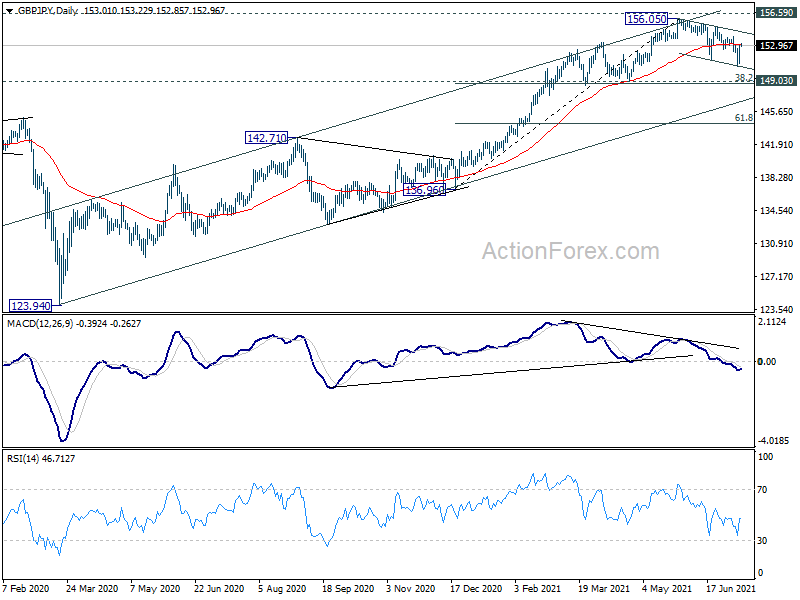
Intraday bias in GBP/JPY remains neutral first with focus on 153.14 minor resistance. Firm break there will argue that corrective fall from 156.05 has completed with three waves down to 150.64, on bullish convergence condition in 4 hour MACD. Intraday bias will be turned back to the upside for 155.13/156.05 resistance zone. On the downside, break of 150.64 will resume the correction. But downside should be contained by 38.2% retracement of 136.96 to 156.05 at 148.75 to bring rebound.
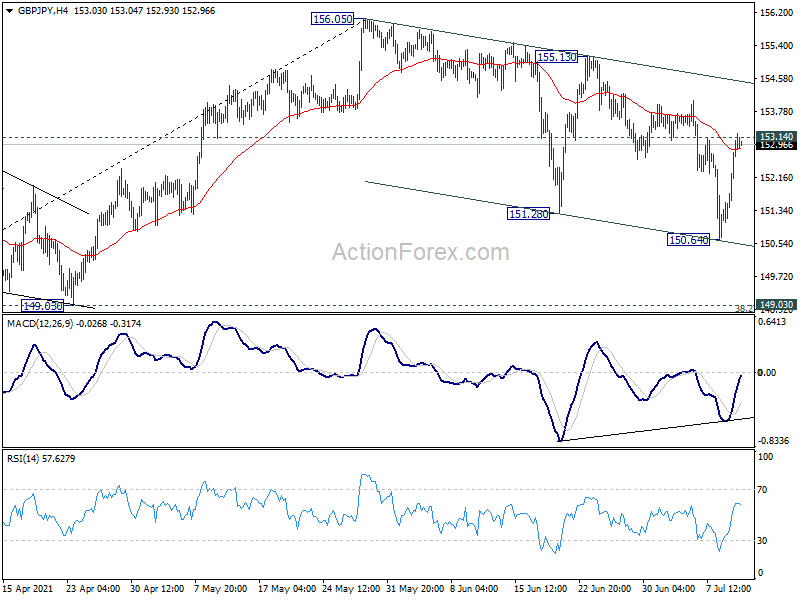
In the bigger picture, rise from 123.94 is seen as the third leg of the pattern from 122.75 (2016 low). Focus remains on 156.59 resistance (2018 high). Sustained break there should confirm long term bullish trend reversal. Next target is 61.8% retracement of 195.86 (2015 high) to 122.75 at 167.93. On the downside, break of 149.03 support is needed to be the first sign of completion of the rise from 123.94. Otherwise, outlook will remain bullish even in case of deep pull back.
Dollar and Yen Soft in Subdued Asian Trading, Three Central Banks to Meet This Week
Dollar and Yen remain generally soft in quiet Asian session today. Nikkei staged a strong 2.2% rebound but there is little reaction in the currency markets. Major pairs and crosses are generally stuck inside Friday's range. Trading could remain subdued today with an ultra light economic calendar, without any significant release ahead. Yet volatility is certain with three central banks featured this week, with lots of data to be featured.
Technically, main focus will be on whether movements in Dollar and Yen would confirm near term bearish reversal. Levels to watch include 1.1894 resistance in EUR/USD, 0.9151 support in USD/CHF, 131.02 resistance in EUR/JPY and 153.14 resistance in GBP/JPY. Break of these levels will likely have some spillover effects to pressure Dollar and Yen elsewhere.
In Asia, Nikkei closed up 2.25%. Hong Kong HSI is up 0.54%. China Shanghai SSE is up 0.62%. Singapore Strait Times is up 0.21%. Japan 10-year JGB yield is up 0.0006 at 0.031.
ECB Lagarde expects some interesting variations and changes in Jul meeting
ECB President Christine Lagarde told Bloomberg that there will at "some interesting variations and changes" in the upcoming July 22 meeting. "It's going to be an important meeting," she added. "Given the persistence that we need to demonstrate to deliver on our commitment, forward guidance will certainly be revisited."
The immediate task for the Governing Council to align the statement and forward guidance with the result of the strategic review. "We're going to look at the circumstances, we're going to look at what forward guidance we need to revisit, we're going to look at the calibration of all the tools we are using to make sure that it is aligned with our new strategy," she said.
Regarding the PEPP program, she expected it to continue until "at least" March 2022, then followed by a "transition into a new format", without elaboration. She emphasized, "we need to be very flexible and not start creating the anticipation that the exit is in the next few weeks, months."
ECB Villeroy: There is no point in putting predetermined threshold or duration on inflation overshoot
ECB Governing Council member Francois Villeroy de Galhau said the new 2% symmetric inflation target is a "significant change". But, "there is no point putting in rules with such-and-such predetermined threshold or duration" on inflation overshoot.
"In the hypothesis that we stop net purchases under the pandemic emergency purchases program next March, our monetary policy will remain very accommodative for as long as necessary, thanks to our quartet of unconventional tools. There is no doubt about that," Villeroy added.
Yannis Stournaras said that the new strategy will leave ECB better prepared for further crisis. Ignazio Visco noted ECB is not adopting average inflation target like that Fed, which suggests a period of catch-up in inflation.
RBNZ, BoC and BoJ to meet, and lots of data to watch
Three central banks will meet this week, including RBNZ, BoC and BoJ. RBNZ will particular be a focus as market speculations on a November rate hike heated up last week. The question is whether RBNZ would try to talk down such expectations. BoC is expected to further taper bond purchases, from CAD 3B to CAD 2B a week. More importantly, the updated economic projections could reveal whether it's still expecting a rate hike for the second half of 2022, or earlier. BoJ might downgrade the outlook in the new economic projections. But other than that, it's likely to tell us anything new. Meanwhile, Fed will also release Beige Book economic report.
The calendar is also busy on the economic data front. US CPI and PPI, regional Fed surveys and retail sales would catch most attention. Also, UK will release CPI and PPI, and employment. Australia will release NAB business confidence and employment. China will release GDP, trade balance and a string of other data. Here are some highlights for the week:
- Monday: Japan machine orders, PPI.
- Tuesday: Australia NAB business confidence; China trade balance; Germany CPI final; Swiss PPI; US CPI.
- Wednesday: RBNZ rate decision; UK CPI, PPI; Eurozone industrial production; Canada Manufacturing sales, BoC rate decision; US PPI, Fed's Beige Book report.
- Thursday: Australia employment; China GDP, fixed asset investment, industrial production, retail sales; Japan tertiary industry index; UK employment; US Empire state manufacturing, Philly Fed survey, jobless claims, import prices, industrial production.
- Friday: New Zealand BusinessNZ manufacturing, CPI; BoJ rate decision; Eurozone trade balance, CPI final; Canada housing starts, foreign securities purchases, wholesale sales; US retail sales, business inventories, U of Michigan consumer sentiment.
GBP/JPY Daily Outlook
Daily Pivots: (S1) 151.79; (P) 152.43; (R1) 153.69; More...
Intraday bias in GBP/JPY remains neutral first with focus on 153.14 minor resistance. Firm break there will argue that corrective fall from 156.05 has completed with three waves down to 150.64, on bullish convergence condition in 4 hour MACD. Intraday bias will be turned back to the upside for 155.13/156.05 resistance zone. On the downside, break of 150.64 will resume the correction. But downside should be contained by 38.2% retracement of 136.96 to 156.05 at 148.75 to bring rebound.
In the bigger picture, rise from 123.94 is seen as the third leg of the pattern from 122.75 (2016 low). Focus remains on 156.59 resistance (2018 high). Sustained break there should confirm long term bullish trend reversal. Next target is 61.8% retracement of 195.86 (2015 high) to 122.75 at 167.93. On the downside, break of 149.03 support is needed to be the first sign of completion of the rise from 123.94. Otherwise, outlook will remain bullish even in case of deep pull back.
Economic Indicators Update
| GMT | Ccy | Events | Actual | Forecast | Previous | Revised |
|---|---|---|---|---|---|---|
| 23:50 | JPY | PPI Y/Y Jun | 5.00% | 4.70% | 4.90% | |
| 23:50 | JPY | Machinery Orders M/M May | 7.80% | 2.60% | 0.60% | |
| 6:00 | JPY | Machine Tool Orders Y/Y Jun | 96.60% | 140.70% | 141.90% |
ECB Villeroy: There is no point in putting predetermined threshold or duration on inflation overshoot
ECB Governing Council member Francois Villeroy de Galhau said the new 2% symmetric inflation target is a "significant change". But, "there is no point putting in rules with such-and-such predetermined threshold or duration" on inflation overshoot.
"In the hypothesis that we stop net purchases under the pandemic emergency purchases program next March, our monetary policy will remain very accommodative for as long as necessary, thanks to our quartet of unconventional tools. There is no doubt about that," Villeroy added.
Yannis Stournaras said that the new strategy will leave ECB better prepared for further crisis. Ignazio Visco noted ECB is not adopting average inflation target like that Fed, which suggests a period of catch-up in inflation.
ECB Lagarde expects some interesting variations and changes in Jul meeting
ECB President Christine Lagarde told Bloomberg that there will at "some interesting variations and changes" in the upcoming July 22 meeting. "It's going to be an important meeting," she added. "Given the persistence that we need to demonstrate to deliver on our commitment, forward guidance will certainly be revisited."
The immediate task for the Governing Council to align the statement and forward guidance with the result of the strategic review. "We're going to look at the circumstances, we're going to look at what forward guidance we need to revisit, we're going to look at the calibration of all the tools we are using to make sure that it is aligned with our new strategy," she said.
Regarding the PEPP program, she expected it to continue until "at least" March 2022, then followed by a "transition into a new format", without elaboration. She emphasized, "we need to be very flexible and not start creating the anticipation that the exit is in the next few weeks, months."
July ECB Could Bring Some Interesting Changes
Market movers today
- Riksbank meeting minutes out today will be scrutinized for signals on the policy rate outlook.
- After G20 finance minister endorsed the global corporate tax deal over the weekend, Eurozone finance ministers will today discuss economic and financial policies. They will be joined by US Treasury Secretary Yellen, who will likely make another push for Brussels to drop its digital tax proposal.
- Later this week the June US CPI release will be in focus. The European Commission will also unveil proposals for a legislative framework to support its climate ambition to reach net zero by 2050.
The 60 second overview
ECB: After ECB last week revamped its monetary strategy (see Flash: ECB Research - Strategic Review: Striving for symmetry, 8 July), minutes from the June meeting released on Friday confirmed that the decision to extend the higher PEPP purchase pace into Q3 was taken form a risk-management perspective. Governing Council (GC) members were concerned that a reduction in the purchase pace could cause a disorderly rise in yields and weigh on financing conditions. On the other hand, voices in the GC about the side effects of asset purchases are also growing louder and we expect discussions on the future of the PEPP programme to gather pace over the summer, with a decision likely coming at the September meeting. In an interview over the weekend, President Lagarde also said markets should prepare for new monetary stimulus guidance at the meeting next week and signalled additional measures may be brought in next year to support the economy after the PEPP program ends.
Covid-19 & Delta: Continued spreading of the delta variant has weighed on risk sentiment last week. However, an increasing number of studies shows that while vaccines are slightly less effective at preventing symptomatic illness for the delta variant, they still have an extremely high efficacy against severe illness. This implies that rising delta cases should be manageable in most advanced economies as a result of the relatively good vaccination coverage. However, the situation remains more difficult in developing economies, were new restrictions to stem the spreading could weigh on economic activity.
Markets: Asian shares are in the green this morning after their US peers ended last week on new record highs as investors continued to bet that global growth remains on track despite new Covid-19 variants. Chinese stocks also found support after the central bank cut the reserve requirement for banks to support growth. US and European equity futures contracts are little changed, but investors will turn their focus this week to the Q2 earnings season. After jumping on Friday, 10Y US Treasury yields stabilized around 1.35% and Tuesday's US CPI data and Fed Chair Powell's semi-annual appearance before Congress will be key in setting the direction for US yields this week. Brent oil was steady at USD/bbl 75.5.
FI: Friday's EGB move was a minor reversal of the rally observed since the beginning of the week. With summer lull taking its toll on markets, ECB policy messages ahead of next week's meeting (which also takes into account the new policy strategy formulation) will have the risk of larger than usual market moves. As ECB is still in easing mode, attempting to reduce volatility over the summer, further downside risk to rates is noteworthy as well as spread tightening driven by carry trades. Fed is still being closely monitored for a change in policy stance. We identify the two key risks being 1) markets anticipating an ECB September tapering discussion (May repeat) and 2) US repricing spilling over to the EGB market after US labour market and CPI data surprises but also add a third - next week's ECB meeting.
FX: Friday's session saw a partial reversal of the sharp moves seen Thursday: reflation sensitive currencies gained while duration sensitive currencies and safe havens lost terrain. The broad USD weakened and EUR/USD is back above 1.1850. EUR/NOK has been through a rollercoaster ride and from having traded as high as 10.4350 on Thursday is now back towards 10.30. EUR/SEK remains within the 10.10-10.20 range and is currently trading in the upper parts close to 10.20. In terms of the Scandies global sentiment and the USD remain the most important drivers. Meanwhile for SEK this week we have some potential domestic market movers, such as today's Riksbank minutes and Wednesday's inflation print. As recent Riksbank communication hints at inflation making its way back to the top of the Riksbank's agenda, the inflation-SEK-link is bound to be reinstated soon enough. It remains to be seen, however, if it is already now or whether the summer lull keeps a lid on Wednesday's figures.
EUR/USD Recovers, But Key Resistance Intact
Key Highlights
- EUR/USD traded as low as 1.1781 before starting an upside correction.
- It traded above a major bearish trend line with resistance near 1.1840 on the 4-hours chart.
- GBP/USD climbed higher nicely above 1.3850, but it could struggle near 1.3950.
- Crude oil price started a fresh increase after a short-term correction to $71.00.
EUR/USD Technical Analysis
The Euro extended its decline below the 1.1820 support against the US Dollar. EUR/USD traded as low as 1.1781 before starting an upside correction.
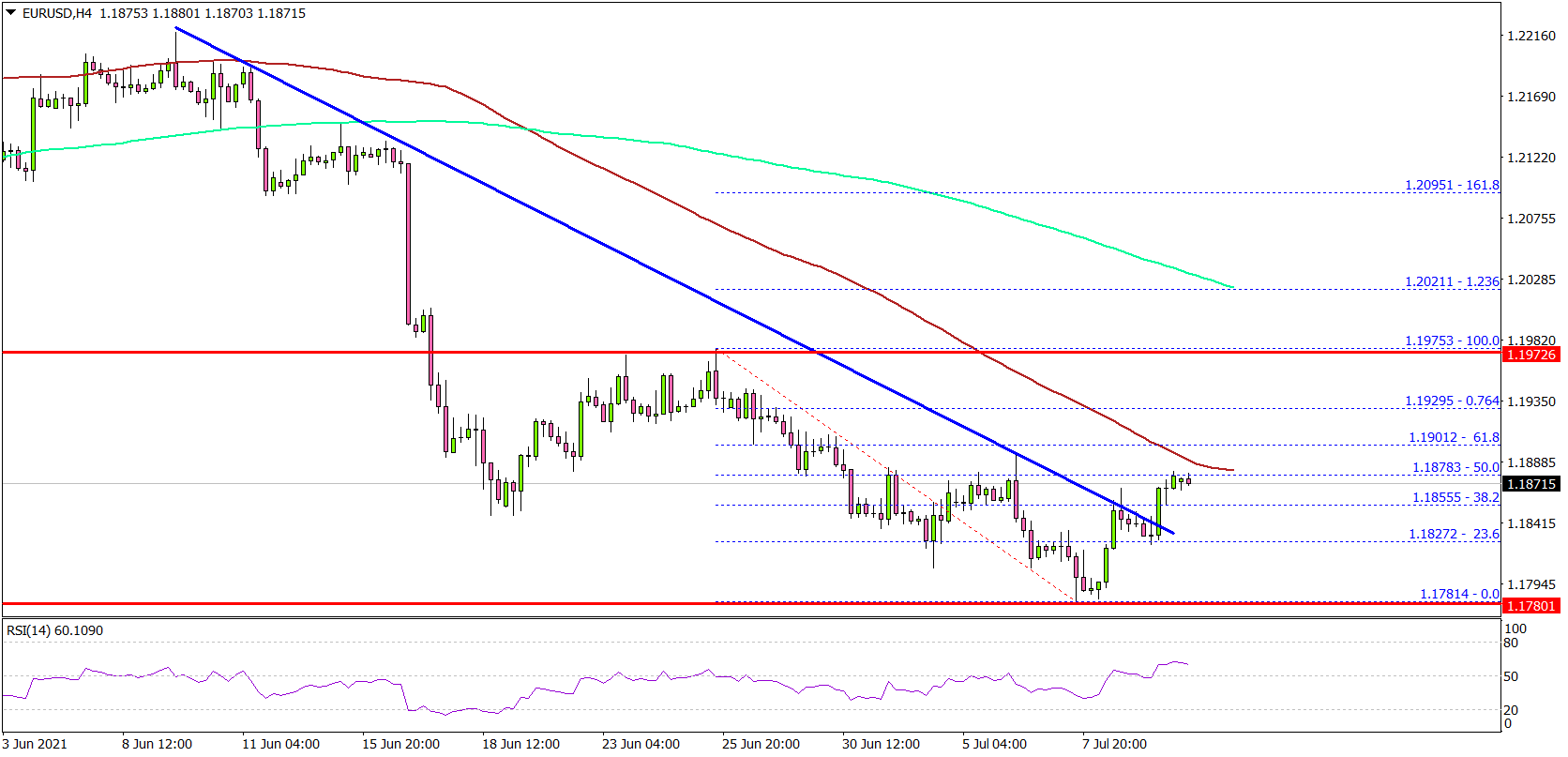 Looking at the 4-hours chart, the pair was able to recover above the 1.1820 resistance level. There was a break above a major bearish trend line with resistance near 1.1840.
The pair even traded above the 50% Fib retracement level of the key decline from the 1.1975 swing high to 1.1781 low. It is now facing resistance near the 1.1900 zone and the 100 simple moving average (red, 4-hours).
The next major resistance is near the 1.1930 level. It is near the 76.4% Fib retracement level of the key decline from the 1.1975 swing high to 1.1781 low. Any more gains could lead the pair towards the 1.1975 and 1.2000 resistance levels.
If not, EUR/USD could start a fresh decline below the 1.1850 level. The first key support is near 1.1820, below which there is a risk of more losses below the 1.1781 low.
Looking at GB/USD, there was a strong recovery wave above the 1.3850 resistance, but the pair is still trading well below the main 1.4000 resistance.
Economic Releases
German Wholesale Price Index for June 2021 (MoM) – Forecast +1.1%, versus +1.7% previous.
Market Morning Briefing: Aussie Rose To Test 0.75
STOCKS
Strong bounce in US equities on Friday and in the Asians early morning today. The Dow has risen above 34500 and needs to see if it can rise past 35100 from here which is needed to become strongly bullish. DAX has risen within its 15300-15800 range. Nikkei has bounced sharply above 28000 thereby easing the danger of seeing a fall to 27000-26000. Shanghai has risen back into its 3500-3625 range and can retain this range for some more time. Sensex and Nifty can also rise within its 52000-53000 and 15600-15900 range respectively.
Dow (34870.16, +448.23, +1.30%) had risen back sharply above 34500 again on Friday. The danger of seeing 34000-33500 on the downside that was mentioned on Friday has eased. 35000-35100 will be a crucial resistance zone which will have to be broken to move up further towards 36000. Inability to breach 35100 can drag it back to 34500 and can keep the chances alive of seeing 34000-33500 on the downside.
DAX (15687.93, +267.29, +1.73%) has risen back above 15600. We can expect a range of 15300-15800 (changed from 15400-15800 mentioned so far). A breakout on either side of this range will give a clear cue on whether DAX can move up to 16000-16200 or fall to 15000-14800 going forward.
Nikkei (28583.89, +643.47, +2.30%) has risen back well above 28000 again. It will have to be seen if it can sustain above 28000 which is needed to negate the danger of seeing 27000-26000 on the downside mentioned on Friday. While above 28000, a further rise to 29000-29500 in the near-term.
Shanghai (3557.06, +32.98, +0.94%) failed to sustain the break below 3500 on Friday and has risen back into the 3500-3625 range. While above 3500, the sideways range can continue for some more time and the fall to 3450-3400 stands reduced now.
Sensex (52386.19, −182.75, -0.35%) and Nifty (15689.80, −38.10, -0.24%) remained stable above the lower end of their 52000-53000 and 15600-15900 range respectively. We expect this range to hold and see a bounce within it this week.
COMMODITIES
Commodities have risen today.Brent and WTI have risen and have room to test the level of $77/78 and $75/77 before we see a fall from there. Gold has also risen above 1800 and near term view is bullish towards1820 and eventually 1840 on the upside . silver is bullish towards 26.50-27. Copper trades near the upper end of the range of 4.40-4.20 .We can see a pull back from the levels of 4.40 towards 4.20 again.
Brent(75.46) and WTI(74. 50) have risen slightly after falling sharply last week from respective resistances. Brent can now bounce back towards $77/78 which if breaks higher could extend a rally towards $80 followed by a dip towards $73-72 in the medium term. WTI can also test the level of $75/77 before we see a fall towards the level of $70.
Gold(1806.30) has risen above 1800 and could now rise towards 1820. Thereafter the price needs to sustain above 1820 to more up further in the medium term towards 1840/60. Immediate view is bullish.
Silver(26.25) has risen significantly and could rise towards 27 on a break above 26.50. The contract can range within 25.80-26.50-27.00 before we see an eventual break on either side.
Copper (4.3320) has risen within the previously mentioned range of 4.20-4.40.The contract can now face rejection near 4.40 and fall towards the lower end of the range. We may expect consolidation between 4.20-4.40 for some time before we see a break on either side.
FOREX
Dollar trades weak while Euro is headed towards 1.19 in the near term. Pound and Aussie have risen sharply and look bullish while EURJPY may test immediate resistance near 131 from where it can fall. USDCNY can dip towards 6.44. The strength in Chinese Yuan and Euro against the Dollar indicates some Rupee strength today towards 74.40/20 with upside capped at 74.80/60.
Dollar Index (92.166) has dipped well but may again attempt to bounce from 92. A break below 92 is needed for the index to set a medium term bearish sentiment. Else 92-93 could be the trade range for the near term.
Euro (1.1871) has risen well and could test 1.19 in the near term. A sustained break above 1.19 would be needed in the longer run for Euro to rally towards 1.1950 or even higher.
EURJPY (130.80) has risen well from 12962 seen least week. Immediate trend resistance is seen at 131 which if holds could push the pair down towards 129.60-129.00 again in the longer run. Watch price action near 131.
Dollar-Yen (110.16) has risen well from 109.53 seen last week. This has been in line with our expected support at 109.50 that we have been mentioning for quite sometime. While above 109.50, immediate view is bullish to see a rise towards 110 eventually.
Aussie (0.7476) rose to test 0.75 but has again dipped from there. While below 0.75, there is scope to see some ranged moves within 0.75-0.74 for a few sessions before a break on either side is seen.
Pound (1.3894) has bounced well too. While above 1.37, we may expect a test of 1.40 on the upside before another dip is seen. Overall broad range of 1.37-1.40 may hold for the next few weeks. Only a break below 1.37, if seen would turn it bearish.
USDCNY (6.4724) looks bearish and can fall below 6.46 in the near term towards 6.45/44 before bouncing to higher levels.
USDINR (74.6425) can test 74.40 today and a break below 74.40, if seen would negate a possible test of 75 and instead take the pair down towards 74.20. Upside could be capped at 74.80 in the near term.
INTEREST RATES
The crucial supports on the US Treasury yields have held very well as expected and the corrective bounce is happening in line with our expectation. There is room for the yields to move up further from here before a reversal is seen again. The German yields have bounced at the far-end on Friday but may not sustain. The view is bearish to see further fall in the coming days. The 10Yr GOI may remain volatile with the expected 6.1%-6.2% range for some more time. A breakout of this range is needed to get clarity on the direction.
The US 2Yr (0.21%), 5Yr (0.79%), 10Yr (1.36%) and 30Yr (1.99%) Treasury yields have risen back sharply on Friday. The 1.25% on the 10Yr and 1.9% on the 30Yr has held very well as expected and the corrective bounce has happened in line with our expectation. The 10Yr can rise to 1.4%-1.5% and the 30Yr has room to test 2.1%-2.2% on the upside while this bounce sustains.
The German 2Yr (-0.69%) and 5Yr (-0.60%) yields remain stable while the 10Yr (-0.29%), 30Yr (0.20%) have bounced slightly. The view is bearish. The 30Yr can fall to 0.10%-0.8% and the 10Yr has room to test -0.45% and -0.50% on the downside in the coming days.
The 10Yr GoI (6.1726%)had risen back sharply on Friday. The yield seems to remain volatile within our expected 6.1%-6.2% range. As mentioned on Friday, we will have to wait for a breakout on either side of this range to get clarity on whether the 10Yr GoI can move up to 6.3% or fall to 6% going forward.