Sample Category Title
Risk Off Sentiment Supports Safe Haven Currencies
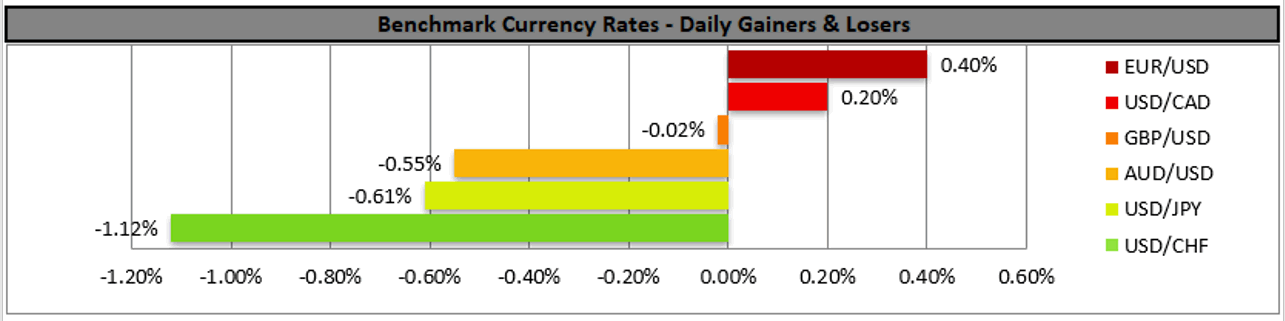
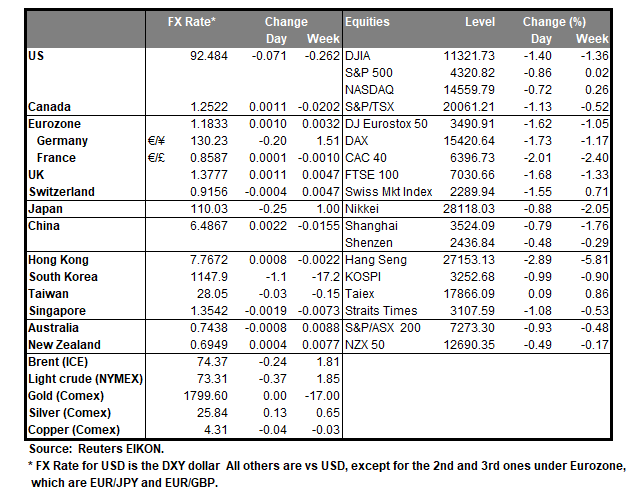
Safe-havens such as JPY and CHF gained yesterday, while riskier assets which include currencies such as the Aussie and the Kiwi suffered remaining near multi-month lows as the market worries for the economic recovery on a global level tended to increase. On the flip side US stockmarkets tended to retreat as Dow Jones, S&P 500 and Nasdaq dropped, displaying the risk aversion of the market. As was expected bonds rallied and equities world-wide dropped as the fast-spreading Delta variant of COVID-19 endangers the economic recovery highlighting weaknesses with various soft spots being on display. It’s characteristic that the initial Jobless claims figure for last week rose instead of dropping as expected, reaching 373k last week, increasing worries about the tightening of the US employment market. We expect fundamentals to be the key drivers for the greenback today as high impact financial releases seem to be absent from the US.
USD/CHF dropped considerably yesterday, breaking the 0.9215 (R1) support line now turned to resistance, yet seemed to stabilise just above the 0.9130 (S1) support line. We tend to maintain a bearish outlook for the pair given its drop and that the pair’s RSI reading below our 4-hour chart, has reached the reading of 30, confirming the presence of the bears, yet at the same time it may imply that the pair has reached oversold levels and a correction higher is possible. Please note that the pair’s price action has reached the lower Bollinger band, which may also mention that it’s time for some stabilisation and/or a correction higher. Should the bears continue to dominate the pair’s direction, we may see it breaking the 0.9130 (S1) support line and aim for the 0.9035 (S2) support level. Should the bulls take over, we may see the pair reversing course and aiming if not breaking the 0.9215 (R1) resistance line.
The Aussie hits a 7-month low against USD
The Aussie and the Kiwi were in full retreat yesterday as risk aversion was more than evident in the global markets, and worries grew as Sydney tightened its lockdown measures as an outbreak of the Delta variant could get out of control. Traders tended also to worry about the adverse effects of the path of the pandemic on Australia’s economic outlook but also on a global level as Australia is an exporter of raw materials and implied that traders were more worried about slowing growth rather than an accelerating inflation. At the same time RBA’s persistence to hike rates in 2024 rather than at an earlier date tended to weigh on the Aussie highlighting the interest rate differential outlook of the Australian central bank with others, not excluding the Fed. Overall, should the current risk off sentiment continue to characterize the markets we may see AUD weakening further.
AUD/USD also dropped breaking the 0.7465 (R1) support line, now turned to resistance and is currently aiming for the 0.7400 (S1) support level. We tend to maintain a bearish outlook for the pair as long as it remains below the downward trendline formed since the 6th of July. It should be noted that the RSI indicator below our 4-hour chart has reached the reading of 30 as result of the intense selling interest of the market, yet at the same time may imply that he pair is oversold and a correction higher is possible. Should the selling interest of the market be extended we may see the pair breaking the 0.7400 (S1) support line and aim for the 0.7335 (S2) support level. Should buyers take charge of the pair’s direction, we may see AUD/USD breaking the prementioned downward trendline and aim, if not break the 0.7465 (R1) resistance line.
Other economic highlights today and the following Asian session:
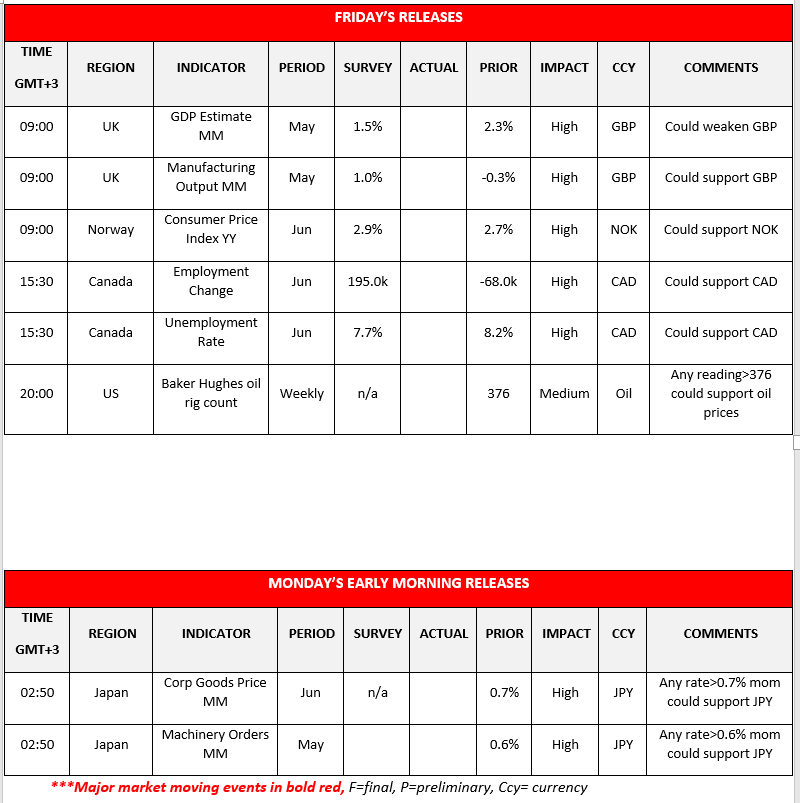
Today we highlight the release of UK’s GDP rates and manufacturing output growth rate for May as well as Canada’s employment data for June, as both releases could create substantial volatility and affect the direction of their respective currencies.
USD/CHF H4 Chart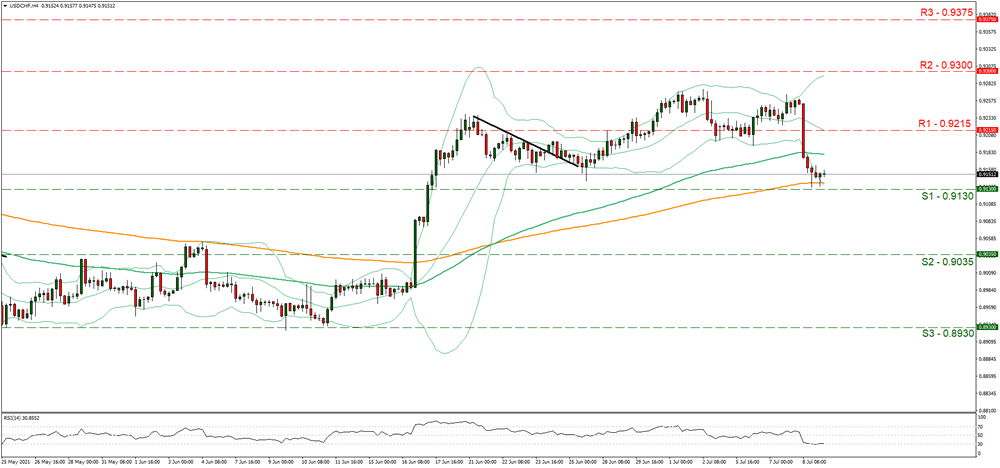
Support: 0.9130 (S1), 0.9035 (S2), 0.8930 (S3)
Resistance: 0.9215 (R1), 0.9300 (R2), 0.9375 (R3)
AUD/USD H4 Chart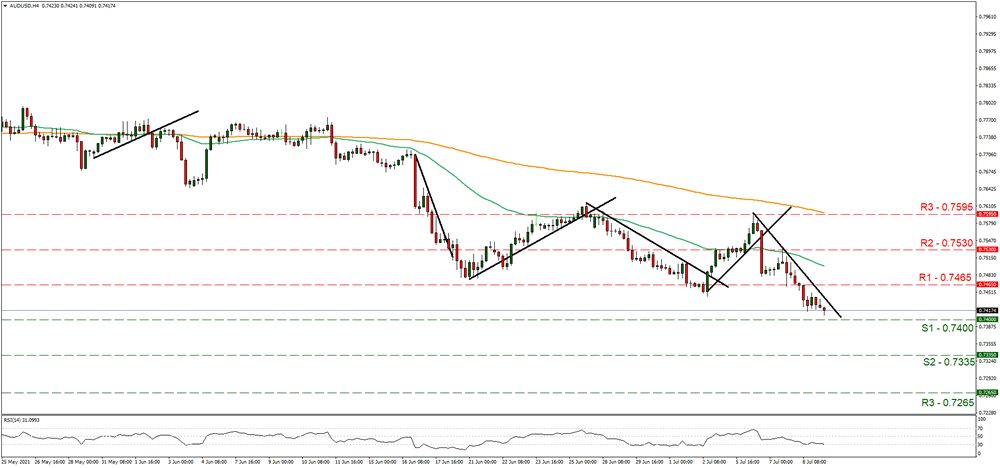
Support: 0.7400 (S1), 0.7335 (S2), 0.7265 (S3)
Resistance: 0.7465 (R1), 0.7530 (R2), 0.7595 (R3)
Will Canada’s Job Data Lift Loonie?
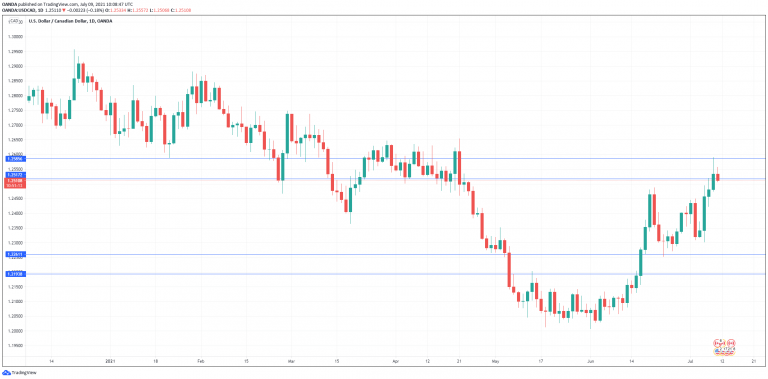
The Canadian dollar is trading quietly in the European session. Currently, USD/CAD is trading at 1.2518, down 0.09%.
Canada releases key employment data later in the day (12:30 GMT). Canadian dollar bulls are hoping for a strong outing from Employment Change. It has been a rough week for the Canadian dollar, with USD/CAD climbing 1.57%. On Thursday, the pair climbed to 1.2590, its highest level since April 21. The Canadian dollar, which is sensitive to commodity prices, has been hurt by the drop in oil prices this week. With the OPEC+ group failing to reach an agreement, there are concerns that producers will sharply increase production come April of next year, when the current deal expires.
Canada job data expected to improve
Canada's labour market is expected to have rebounded in June, after shedding 68 thousand jobs in May. The consensus for June is a strong gain of 195 thousand. If the actual reading is within expectations, we could see investors give a thumbs-up and send the Canadian dollar upwards. The unemployment rate is projected to fall to 7.7% in June, down sharply from the previous read of 8.2%.
Investors are still scratching their heads after the FOMC minutes were released on Wednesday. There was speculation that the Fed might sound hawkish, after surprising the markets in June when it said it anticipated raising rates twice in 2023. However, the minutes did not provide any clues as to the timeline for a taper in the Fed's bond-buying programme. Some members argued in favor of a taper, citing the strong recovery and the jump in inflation. Still, the prevailing view was that it was premature to make any shift in policy, and the market appears to agree with the Fed that inflation levels will ease.
USD/CAD Technical
- USD/CAD is testing resistance at 1.2517. Above, there is resistance at 1.2585 which was tested on Thursday
- On the downside, there is support at 1.2261. Below, there is support at 1.2193
Global Economic Growth May Slow Down Due To The Rapid Spread Of Delta Strain. Investors Are Concerned
The Federal Reserve will scrap its quantitative easing (QE) program on January 1, 2022. But the US labor market situation is raising concerns among investors again. The number of Americans filing for unemployment benefits unexpectedly increased by 2,000 to 373,000, indicating that the labor market recovery from the pandemic remains unstable. These numbers also raise concerns that new outbreaks continue to be one of the biggest downsides for the ongoing sustained economic recovery. Amid this news, the US stock indices closed the day in the red zone. The Dow Jones index decreased by 0.75%, the S&P 500 index fell by 0.86%, and the NASDAQ lost 0.72%. However, the analysts are confident that the growth of the indices will continue until the Fed moves from words to actions.
The European Central Bank adjusted its monetary policy. The ECB raised its inflation target to 2%. The figure is symmetric, meaning that negative and positive deviations from the target are equally undesirable. This means that monetary policy will not regulate short-term fluctuations in inflation. Eurozone inflation is expected to fall in June as labor shortage and delays rate in raw material supplies are declining. The rate of asset purchases on the ECB balance sheet decreased and that supported the euro. But the European stock indices also fell at the end of the day, due to the concerns about the prospects for economic recovery. The British indicator FTSE 100 lost 1.68%, German DAX decreased by 1.73% and French CAC 40 fell by 2.01%. But the overall fundamental picture in Europe remains positive.
Oil is rising in price again. The US oil inventories decreased by 6.87 million barrels to 445.48 million barrels last week. This is the lowest value since February 2020 and it has been declining for the seventh week in a row. Fuel prices will continue to rise due to the supply deficit in the market.
Gold corrected slightly yesterday. This drop was caused by a short-period rise in government bond yields. In general, the fundamental picture on precious metals remains unchanged. Analysts expect the gold and silver prices to grow.
China's consumer price index, one of the main indicators of inflation, increased by 1.1% on a year-on-year basis in June. The figure is lower than the 1.3% increase in the previous month. Japan declared a state of emergency in the suburbs of Tokyo, just before the Summer Olympics. It also became known that the Tokyo Olympics will take place without spectators. The three-week lockdown in Sydney may be extended. Hundreds of additional police officers are patrolling areas of Sydney to ensure the fulfillment of city shutdown orders imposed to eradicate an outbreak of the highly contagious Delta strain. South Korea has reported 1,316 new cases of COVID-19 infection - a new record. Severe restrictions (up to the maximum) have been imposed in Seoul and the suburbs since Monday.
Main market quotes:
- S&P 500 (F) 4,320.82 -37.31 (-0.86%)
- Dow Jones 34,421.93 -259.86 (-0.75%)
- DAX 15,420.61 -272.07 (-1.73%)
- FTSE 100 7,030.66 -120.36 (-1.68%)
- USD Index 92.37 -0.27 (-0.29%)
Important events:
- China Consumer Price Index (m/m) at 04:30 (GMT+3);
- UK GDP (m/m, q/q) at 09:00 (GMT+3);
- UK BoE Gov Andrew Bailey’s Speech at 13:00 (GMT+3);
- ECB President Christine Lagarde’s Speech at 13:00 (GMT+3);
- Canada Employment Change (m/m) at 15:30 (GMT+3);
- Canada Unemployment Rate (m/m) at 15:30 (GMT+3);
- G20 meeting (First day).
Bundesbank Weidmann: ECB not striving for either lower or higher inflation
Bundesbank President Jens Weidmann said ECB is ""not striving for either lower or higher rates" of inflation with the new symmetric target. He added, the 2% medium term inflation goal is a "clear and easily understandable objective," and that "temporary deviations from the target in either direction can occur."
Separately, Governing Council member Olli Rehn said the "new inflation goal is unambiguous." Clearly, the "medium-term core inflation forecast of 1.4% below new aim."
Another Governing Council member Francois Villeroy de Galhau said ECB will still need to analyze the meaning of a "temporary" overshoot of inflation. "We didn't discuss any duration, we didn't discuss any numbers. It's all about the context," he said. "In monetary policy, you have to combine the direction with judgment. We set the direction very clearly."
Stocks And Dollar Stabilize As Bond Chaos Cools
- Stock markets and FX pairs cool down after seismic moves
- Everything revolves around the bond market - is the squeeze over?
- Gold recovery stalls, ECB minutes and Canadian jobs coming up
Is the bond market short squeeze done?
After a week of mayhem across global markets, calmer tones are finally prevailing. The source of all the stress was the bond market, where yields started to break down. Such a move usually signals worries about weaker economic growth, which would ultimately translate into slower rate increases by central banks.
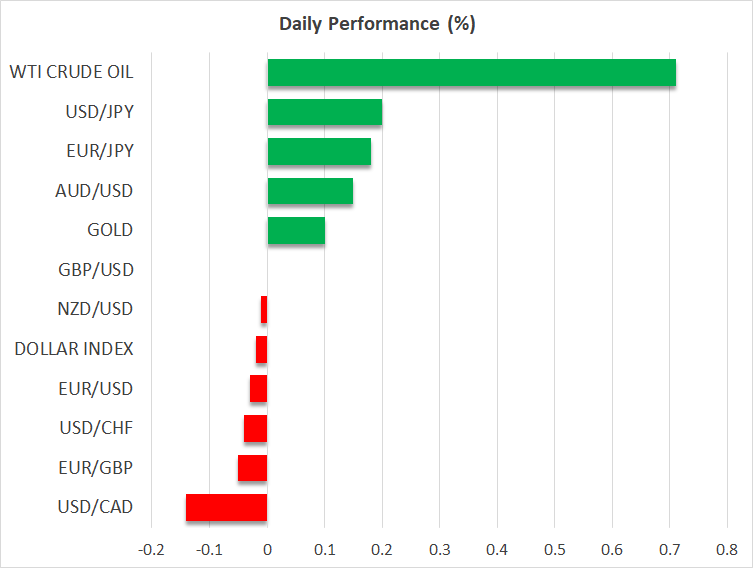
When the bond market says something might be wrong, other asset classes pay attention. Stock markets came under fire yesterday and commodity currencies got hammered, while safe havens like the yen and Swiss franc shined bright. It was a classic risk-off move, with concerns around the rampaging Delta variant being blamed as the catalyst.
However, that may be only half the story. The other part may be more technical in nature. Positioning in the bond market was stretched-short before this debacle, which means everyone was betting on higher yields by shorting the actual bonds. Fears around the Delta variant might have sparked the initial move, but it was likely amplified by a ferocious short squeeze in Treasuries.
What does it all mean? In a nutshell, this pandemonium could fade soon as the short squeeze runs its course. We are already seeing signs of that today, with Treasury yields rebounding and Wall Street stabilizing. If that is the case, the latest gains in the yen and franc could evaporate soon.
Dollar claws its way back, gold struggles
The US dollar declined yesterday but is on track to close the week higher overall. That is quite impressive considering that falling Treasury yields are usually the dollar’s kryptonite, and is a testament to the reserve currency’s safe-haven appeal.
If the world economy - and especially emerging markets - are going to take a hit as the Delta variant spreads, then the dollar is probably the place to hide. The US is among the leaders in the global vaccination race and its economy will likely suffer the least thanks to the gargantuan spending programs.
The dollar is essentially an all-weather currency. It can shine both when markets are fearful and when optimism is riding high, amid expectations of US economic exceptionalism.
Over in commodities, gold could not advance yesterday even despite a softer dollar and falling real yields, which is a bad look. On the bright side, the precious metal is set to close the week with decent gains. Still, the big picture remains gloomy. It will be tough for bullion to regain its former glory if the havoc in bonds was truly a short squeeze that will fade out, and with inflation fears subsiding.
ECB minutes, Canadian jobs, and earnings
As for today, the spotlight will fall on the minutes of the latest ECB meeting and jobs numbers out of Canada. We already heard from the ECB yesterday when it raised its inflation target, so the minutes are unlikely to move the needle for the euro.
The Canadian data could bring some relief to the loonie, which has been demolished by the pullback in oil prices this week. Even so, vaccination rates are high and the outlook for the economy remains bright with US spending spilling over. The Bank of Canada could be among the first central banks to raise rates this cycle.
Finally, Wall Street is headed for a higher open today as the stabilization in the bond market has given investors the green light to buy another dip. The recovery’s mettle will be tested next week when US banks get the earnings season rolling.
GBP/JPY Daily Outlook
Daily Pivots: (S1) 150.43; (P) 151.60; (R1) 152.53; More...
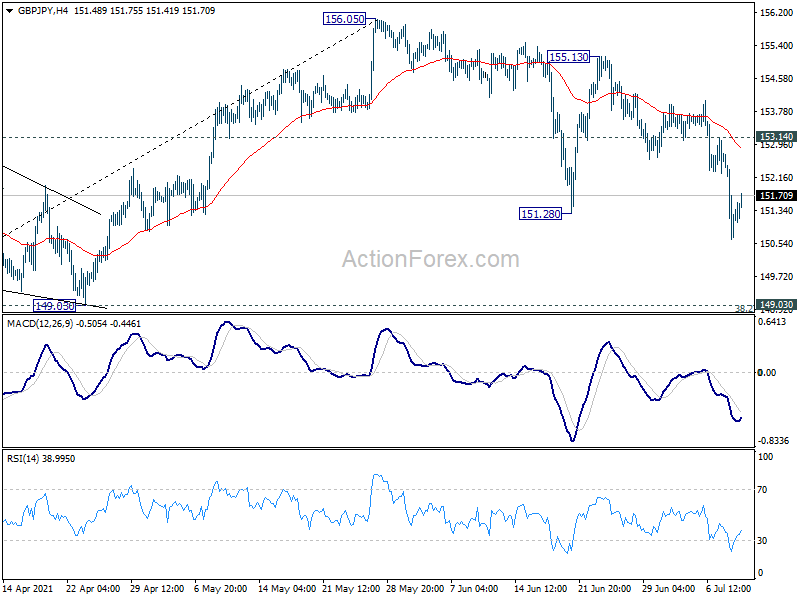
Intraday bias in GBP/JPY remains on the downside at this point. Corrective decline from 156.05 would target for 149.03 support. We'd expect strong support from 38.2% retracement of 136.96 to 156.05 at 148.75 to bring rebound. On the upside, above 153.14 minor resistance will turn bias back to the upside for 155.13 resistance.
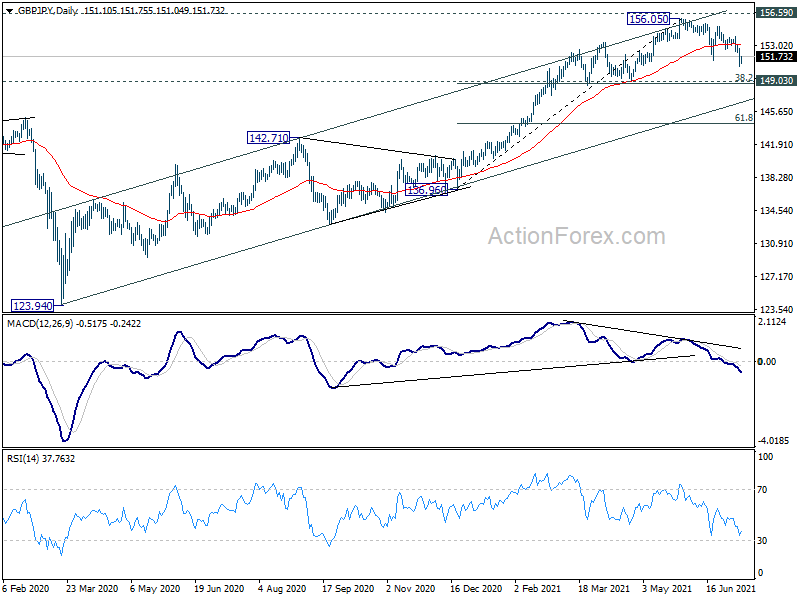
In the bigger picture, rise from 123.94 is seen as the third leg of the pattern from 122.75 (2016 low). Focus is now on 156.59 resistance (2018 high). Sustained break there should confirm long term bullish trend reversal. Next target is 61.8% retracement of 195.86 (2015 high) to 122.75 at 167.93. On the downside, break of 149.03 support is needed to be the first sign of completion of the rise from 123.94. Otherwise, outlook will remain bullish even in case of deep pull back.
EUR/JPY Daily Outlook
Daily Pivots: (S1) 129.58; (P) 130.07; (R1) 130.50; More....
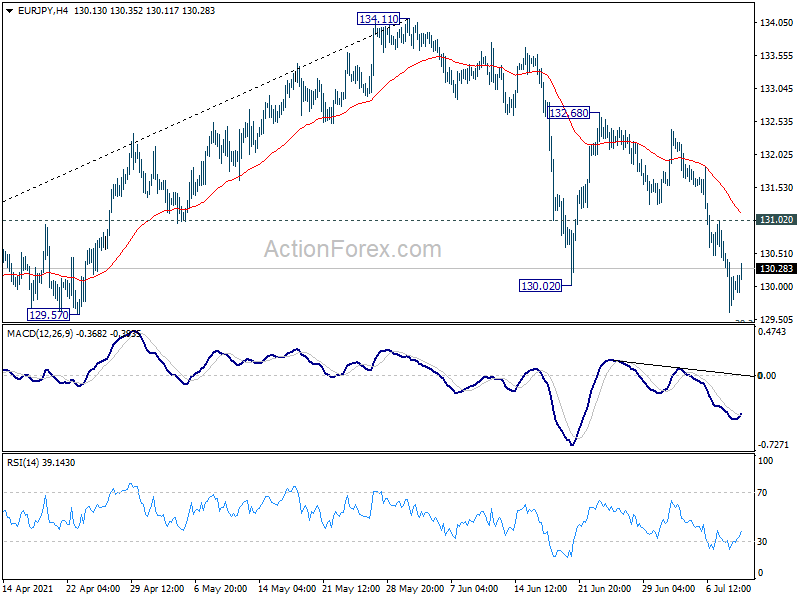
Intraday bias in EUR/JPY remains mildly on the downside for the moment. Corrective pattern from 134.11 would target 38.2% retracement of 121.63 to 134.11 at 129.34. We'd look for strong support from there to bring rebound. On the upside, above 131.02 minor resistance will turn bias back to the upside for 132.68 resistance first.
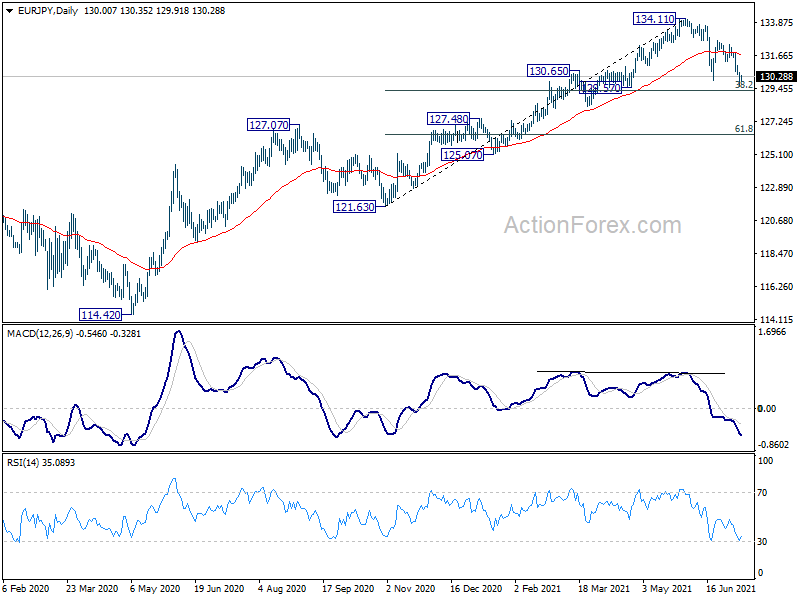
In the bigger picture, rise from 114.42 is seen as a medium term rising leg inside a long term sideway pattern. Next target is 137.49 (2018 high). Decisive break there will open up the possibility that it's indeed resuming the up trend from 94.11 (2012 low). For now, outlook will stay bullish as long as 127.07 resistance turned support holds, in case of pull back.
EUR/GBP Daily Outlook
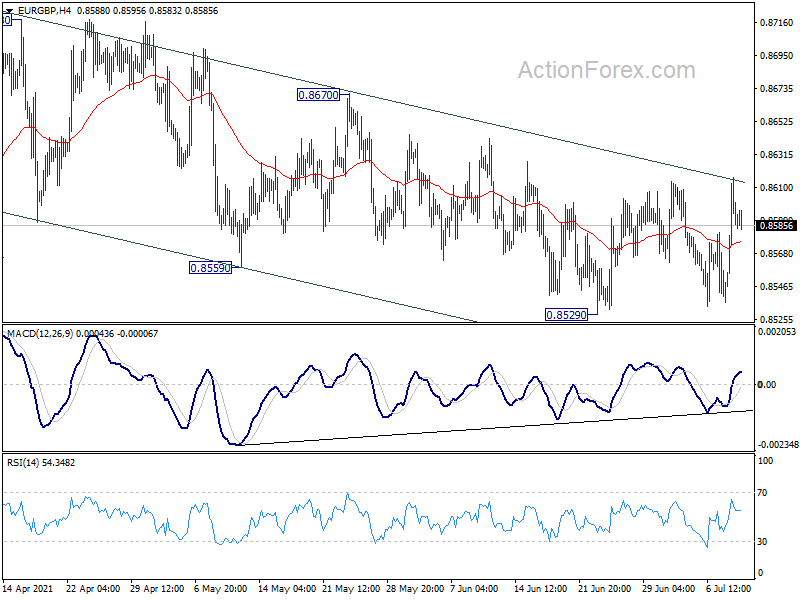
Daily Pivots: (S1) 0.8549; (P) 0.8584; (R1) 0.8623; More...
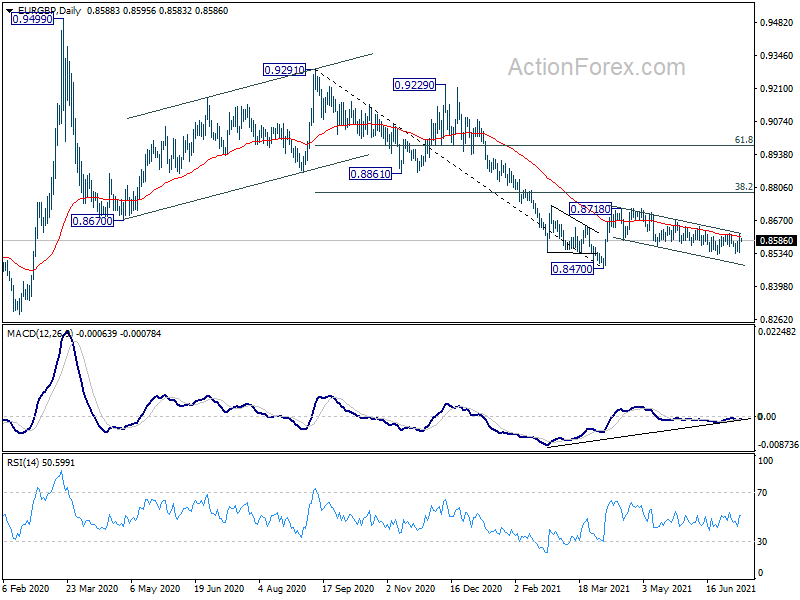
Intraday bias in EUR/GBP remains neutral as it's staying in range above 0.8529. On the downside, break of of 0.8529 will resume the choppy decline towards retesting 0.8470 low. On the upside, decisive break of 0.8670 will confirm that corrective fall from 0.8718 has completed. Further rise would be seen to resume the rebound from 0.8470.
In the bigger picture, price actions from 0.9499 are still seen as developing into a corrective pattern. That is, up trend from 0.6935 (2015 low) would resume at a later stage. This will remain the favored case as long as 0.8276 support holds. However, firm break of 0.8276 support will suggest that rise from 0.6935 has completed and turn medium term outlook bearish.
EUR/AUD Daily Outlook
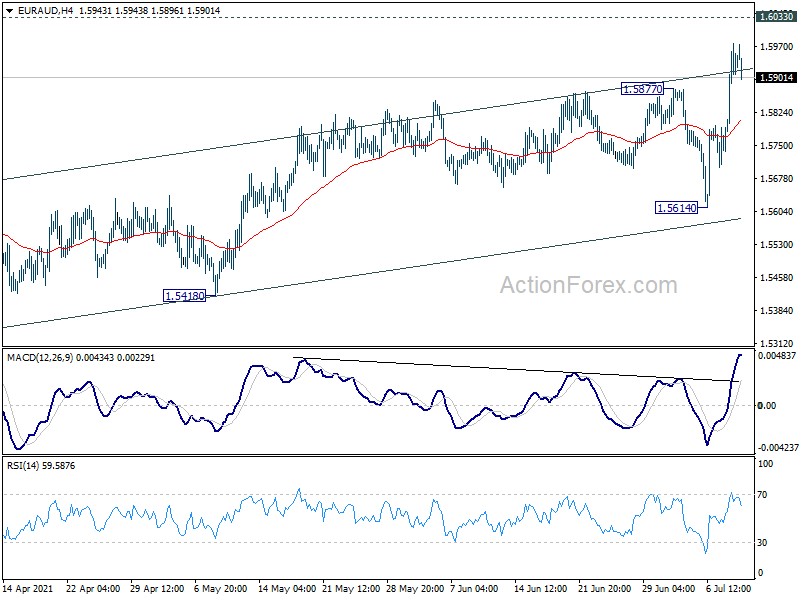
Daily Pivots: (S1) 1.5796; (P) 1.5888; (R1) 1.6031; More...
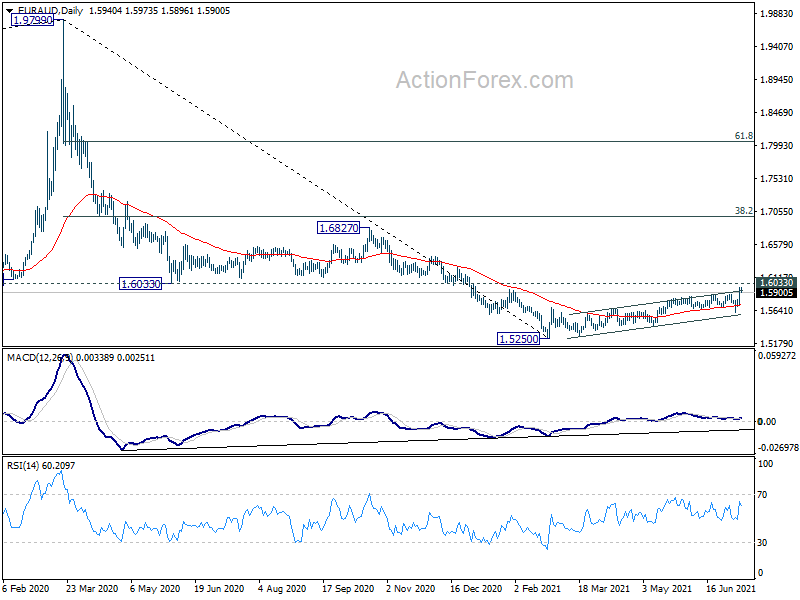
Intraday bias in EUR/AUD remains on the upside at this point. Further rise would be seen to 1.6033 key support turned resistance next. Sustained break there will argue that longer term trend has reversed, and target 1.6827 resistance for confirmation. On the downside, break of 1.5614 resistance support is needed to indicate short term topping. Otherwise, further rise will remain in favor in case of retreat.
In the bigger picture, price actions from 1.9799 are developing into a deep correction, to long term up trend from 1.1602 (2012 low). Deeper fall would be seen to 61.8% retracement of 1.1602 to 1.9799 at 1.4733. Medium term outlook will remain bearish as long as 1.6033 support turned resistance holds, even in case of strong rebound. However, firm break of 1.6033 will argue that such decline has completed. Stronger rebound would then be seen 38.2% retracement of 1.9799 to 1.5250 at 1.6988.
EUR/CHF Daily Outlook
Daily Pivots: (S1) 1.0800; (P) 1.0862; (R1) 1.0899; More....
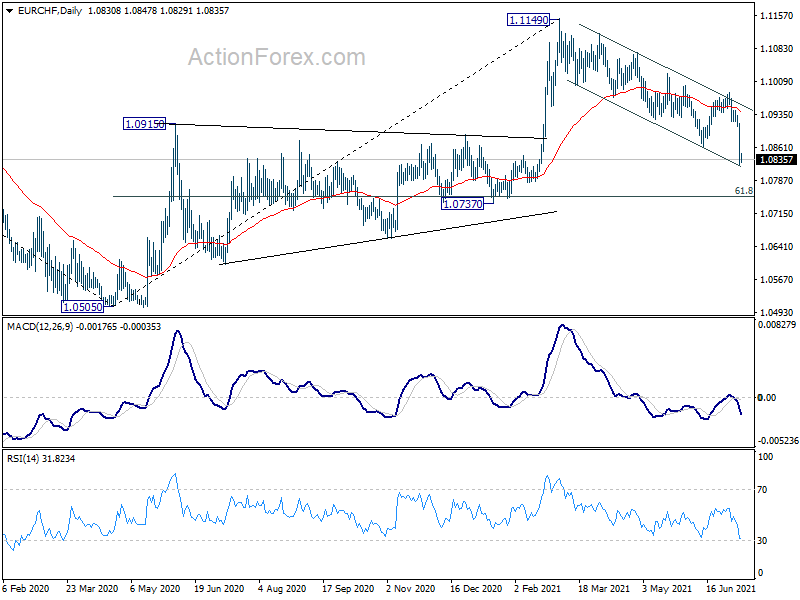
Intraday bias in EUR/CHF remains on the downside at this point. Current choppy decline from 1.1149 has just resumed and should target 1.0737 cluster support zone. On the upside, break of 1.0864 minor resistance will turn intraday bias neutral first. But outlook will stay bearish as long as 1.0985 resistance holds.
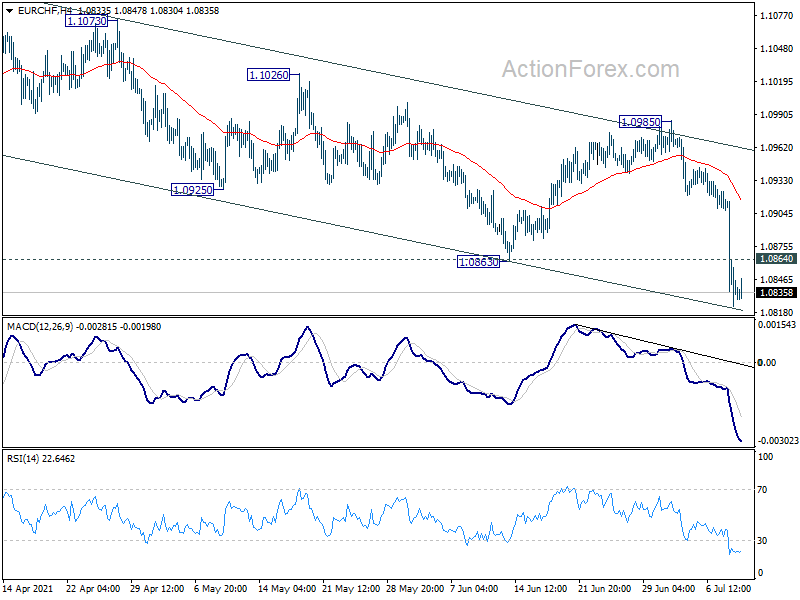
In the bigger picture, current development argues that rebound from 1.0505 (2020 low) might be completed at 1.1149 already. Rejection by 55 month EMA (now at 1.1074) at least keeps medium term bearishness open. Sustained break of 1.0737 cluster support (61.8% retracement of 1.0505 to 1.1149 at 1.0751) will argue that the down trend from 2004 (2018 high) is ready to resume through 1.0505 low. Sustained trading below 55 week EMA (now at 1.0885) will affirm this bearish case. Nevertheless, strong support from 55 week EMA will revive the case for resuming the rise from 1.0505 at a later stage.