

Sample Category Title
EUR/USD Mid-Day Outlook
Daily Pivots: (S1) 1.1797; (P) 1.1833; (R1) 1.1881; More...
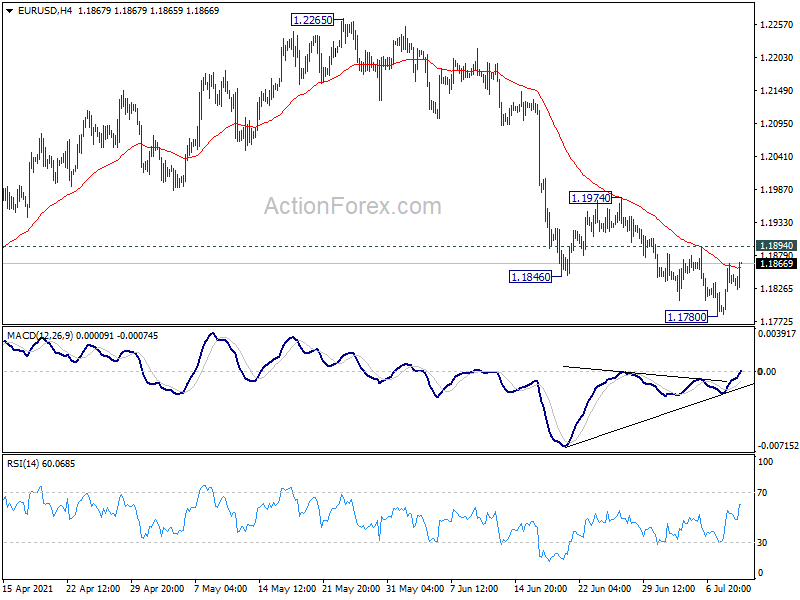
Intraday bias in EUR/USD remains neutral first. With 1.1894 minor resistance intact, another fall could still be seen. Below 1.1780 will extend the fall from 1.2265, as the third leg of the consolidation pattern from 1.2348, to 1.1703 key support next. On the upside, firm break of 1.1894 resistance will suggest short term bottoming, on bullish convergence condition in 4 hour MACD. Stronger rebound should then be seen to 1.1974 resistance and above.
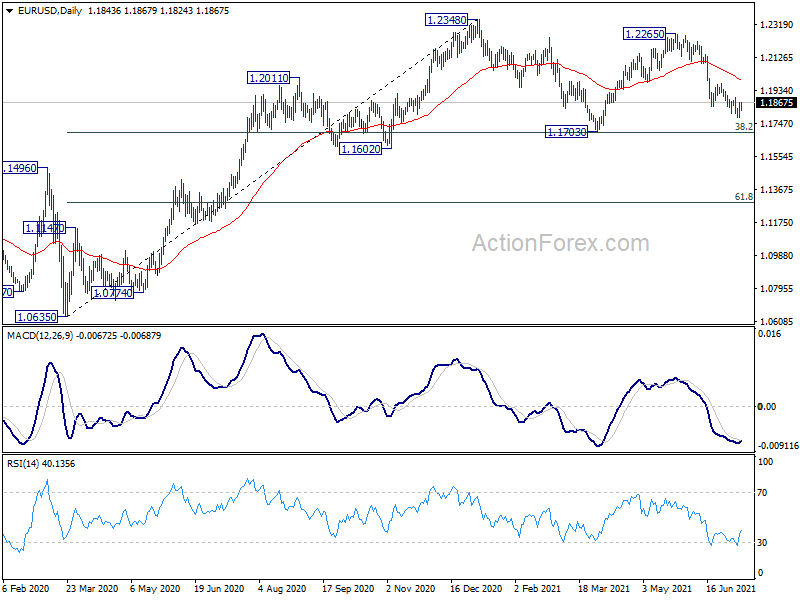
In the bigger picture, rise from 1.0635 is seen as the third leg of the pattern from 1.0339 (2017 low). Further rally could be seen to cluster resistance at 1.2555 next, (38.2% retracement of 1.6039 to 1.0339 at 1.2516). This will remain the favored case as long as 1.1602 support holds. Reaction from 1.2555 should reveal underlying long term momentum in the pair. However sustained break of 1.1602 will argue that the rise from 1.0635 is over, and turn medium term outlook bearish again.
Market Reversing Prior Moves, Canadian Dollar Supported by Job Data
The markets are now reversing prior moves in the week, with Dollar, Yen and Swiss Franc trading generally lower. Canadian Dollar is supported by strong job data, while Aussie and Kiwi also recover. Major European indexes are trading slightly up as DOW futures is also up over 260 pts. US 10-year yield is back above 1.3 handle, while Germany 10-year yield is above -0.3. now, we'd see how much of the last moves of the week could reverse the prior ones.
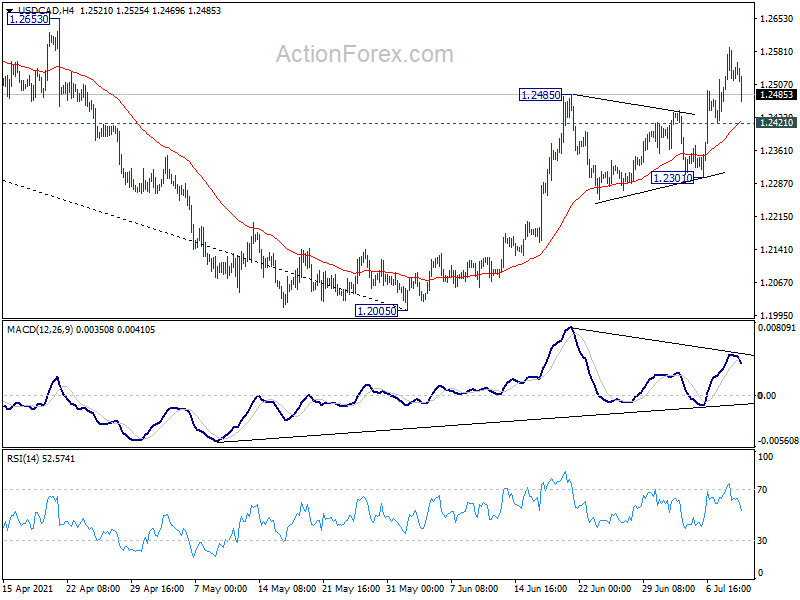
Technically, 1.1894 minor resistance in EUR/USD will be a focus before the weekend. Break there would indicate short term bottoming at 1.1780 and bring stronger rebound. At the same time, break of 1.241 minor support in USD/CAD could turn focus back to 1.2301 support. Bearish divergence on 4 hour MACD in USD/CAD would then raise the chance of short term topping.
In Europe, at the time of writing, FTSE is up 0.71%. DAX is up 0.91%. CAC is up 1.68%. Germany 10-year yield is up 0.013 at -0.292. Earlier in Asia, Nikkei dropped -0.63%. Hong Kong HSI rose 0.70%. China Shanghai SSE dropped -0.04%. Singapore Strait Times rose 0.77%. Japan 10-year JGB yield rose 0.0028 to 0.031.
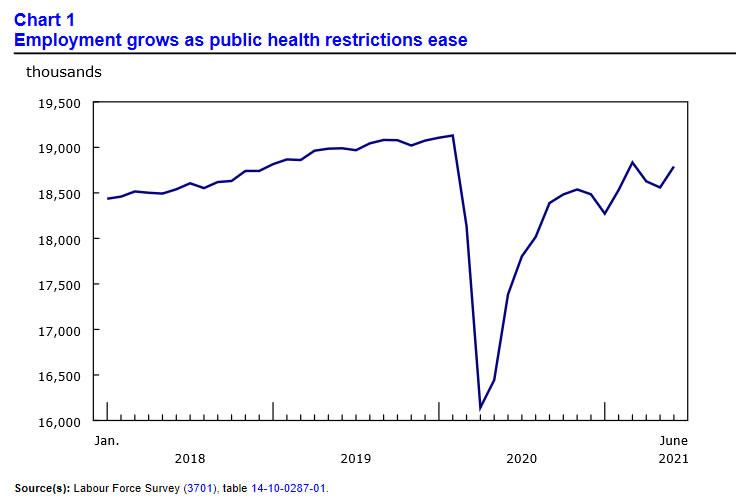
Canada employment rose 230.7k in June, unemployment rate dropped to 7.8%
Canada employment grew 230.7k in June, above expectation of 172.5k. Statistics Canada noted, "employment growth in June was entirely in part-time work and concentrated among youth aged 15 to 24, primarily young women."
Unemployment rate dropped to 7.8%, down from 8.2%, matched expectations. Labor force participation rate also rose 0.6% to 65.2%. The figure remained above post-pandemic low of 7.5% recorded in April this year, but was considerably lower than recent peak at 9.4% in January, and the record high of 13.7% in May 2020.
Bundesbank Weidmann: ECB not striving for either lower or higher inflation
Bundesbank President Jens Weidmann said ECB is "not striving for either lower or higher rates" of inflation with the new symmetric target. He added, the 2% medium term inflation goal is a "clear and easily understandable objective," and that "temporary deviations from the target in either direction can occur."
Separately, Governing Council member Olli Rehn said the "new inflation goal is unambiguous." Clearly, the "medium-term core inflation forecast of 1.4% below new aim."
Another Governing Council member Francois Villeroy de Galhau said ECB will still need to analyze the meaning of a "temporary" overshoot of inflation. "We didn't discuss any duration, we didn't discuss any numbers. It's all about the context," he said. "In monetary policy, you have to combine the direction with judgment. We set the direction very clearly."
ECB accounts: PEPP to continue with significantly higher pace
In the accounts of June 9-10 meeting, ECB said, "it was stressed that the recovery was at an early stage and lacked robustness, as it depended heavily on policy support". The projected path for the economy was " was subject to significant uncertainties and risks". An " undue tightening of financing conditions at the current juncture could jeopardise the ongoing economic recovery and the outlook for inflation."
Hence, "a noticeable slowing of the pace of purchases for the next quarter was therefore seen as inappropriate at the current juncture". A remark was even made that, "in view of the persistent inflation shortfall projected in the June staff projections, even an increase in asset purchases as the main monetary policy instrument could be justified at present."
Nevertheless, "in view of the better outlook for growth and inflation and the associated upside risks, it was, however, also argued that, to provide the same degree of accommodation, asset purchases should be scaled back somewhat." Concerns were also expressed about potential side effects "if the highly accommodative monetary policy stance was maintained much longer."
Overall, most members consent that net PEPP purchases should continue at a significantly higher pace in Q3. But the "reaction function" on purchases would "continue to rely on a joint assessment of financing conditions and the outlook for inflation over the medium term".
UK GDP grew 0.8% mom in May, still -3.1% below pre-pandemic level
UK GDP grew 0.8% mom in May, well below expectation of 1.9% mom. That's still the fourth consecutive month of growth. Service sector grew 0.9% mom. Production grew 0.8% mom, returned to growth. Manufacturing contracted -0.1% mom. Construction contracted for a second consecutive month, by -0.8% mom.
Overall GDP was still -3.1% below pre-pandemic level seen in February 2020. Services was -3.4% low, production -2.6% lower, while manufacturing was -3.0% lower. But construction was 0.3% above the pre-pandemic level.
EUR/USD Mid-Day Outlook
Daily Pivots: (S1) 1.1797; (P) 1.1833; (R1) 1.1881; More...
Intraday bias in EUR/USD remains neutral first. With 1.1894 minor resistance intact, another fall could still be seen. Below 1.1780 will extend the fall from 1.2265, as the third leg of the consolidation pattern from 1.2348, to 1.1703 key support next. On the upside, firm break of 1.1894 resistance will suggest short term bottoming, on bullish convergence condition in 4 hour MACD. Stronger rebound should then be seen to 1.1974 resistance and above.
In the bigger picture, rise from 1.0635 is seen as the third leg of the pattern from 1.0339 (2017 low). Further rally could be seen to cluster resistance at 1.2555 next, (38.2% retracement of 1.6039 to 1.0339 at 1.2516). This will remain the favored case as long as 1.1602 support holds. Reaction from 1.2555 should reveal underlying long term momentum in the pair. However sustained break of 1.1602 will argue that the rise from 1.0635 is over, and turn medium term outlook bearish again.
Economic Indicators Update
| GMT | Ccy | Events | Actual | Forecast | Previous | Revised |
|---|---|---|---|---|---|---|
| 23:50 | JPY | Money Supply M2+CD Y/Y Jun | 5.90% | 7.10% | 7.90% | |
| 01:30 | CNY | PPI Y/Y Jun | 8.80% | 8.80% | 9.00% | |
| 01:30 | CNY | CPI M/M Jun | -0.40% | 0.00% | -0.20% | |
| 01:30 | CNY | CPI Y/Y Jun | 1.10% | 1.40% | 1.30% | |
| 06:00 | GBP | GDP M/M May | 0.80% | 1.90% | 2.30% | 2.00% |
| 06:00 | GBP | Manufacturing Production M/M May | -0.10% | 1.00% | -0.30% | 0.00% |
| 06:00 | GBP | Manufacturing Production Y/Y May | 27.70% | 29.50% | 39.70% | 39.10% |
| 06:00 | GBP | Industrial Production M/M May | 0.80% | 1.50% | -1.30% | -1.00% |
| 06:00 | GBP | Industrial Production Y/Y May | 20.60% | 21.60% | 27.50% | 27.20% |
| 06:00 | GBP | Index of Services 3M/3M May | 3.90% | 4.30% | 1.40% | |
| 11:00 | GBP | Goods Trade Balance (GBP) May | -8.5B | -10.8B | -11.0B | -10.9B |
| 12:30 | CAD | Net Change in Employment Jun | 230.7K | 172.5K | -68K | |
| 12:30 | CAD | Unemployment Rate Jun | 7.80% | 7.80% | 8.20% | |
| 13:00 | GBP | NIESR GDP Estimate Jun | 3.80% | |||
| 14:00 | USD | Wholesale Inventories May | 1.10% | 1.10% |
Canada employment rose 230.7k in June, unemployment rate dropped to 7.8%
Canada employment grew 230.7k in June, above expectation of 172.5k. Statistics Canada noted, "employment growth in June was entirely in part-time work and concentrated among youth aged 15 to 24, primarily young women."
Unemployment rate dropped to 7.8%, down from 8.2%, matched expectations. Labor force participation rate also rose 0.6% to 65.2%. The figure remained above post-pandemic low of 7.5% recorded in April this year, but was considerably lower than recent peak at 9.4% in January, and the record high of 13.7% in May 2020.
GBPJPY Dips Below 151 but 23.6% Fibo Keeps Things Positive
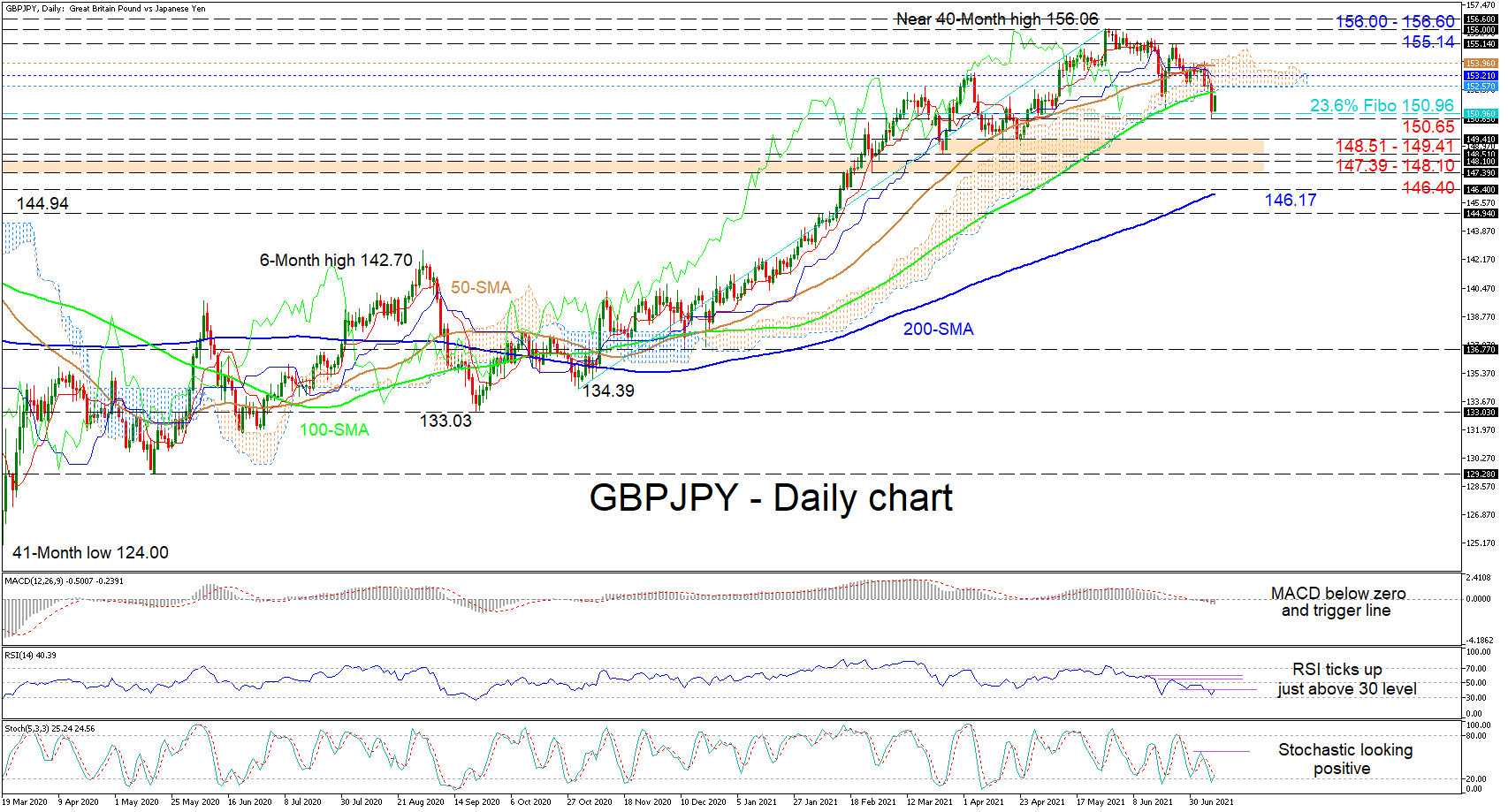
GBPJPY is not out of the woods just yet, in spite of finding some footing around the 150.96 level, that being the 23.6% Fibonacci retracement of the up leg from 134.39 until 156.06. Although downside forces have abated at 150.65, the Ichimoku lines have thus far kept their diving demeanour. The simple moving averages (SMAs) are sustaining a bullish bearing but the 50-day SMA’s incline has softened a tad with the fading in the pair. However, it has yet to convey that the bears are decisively shifting the near-term sentiment to the downside.
The short-term oscillators are indicating that positive momentum is growing from the 23.6% Fibo level. The MACD is flattening slightly beneath its red trigger and zero lines, while the RSI, marginally above the 30 level, is pointing north. Furthermore, the stochastic oscillator’s %K line is pushing above the 20 mark, endorsing bullish price behaviour.
If the price maintains its upward thrust, sturdy constraints to advances could develop from the 100-day SMA, attached to the Ichimoku cloud’s lower surface at 152.57, until the 50-day SMA at 153.96. Triumphing over these congested obstacles, the pair may then meet the June 23 high of 155.14. Any efforts in the pair to improve further could result in the bulls challenging the resistance belt, moulded between the multi-year high of 156.06 and the peak of the February 2018 rally at 156.60.
If selling orders increase, initial support could be revived at the 23.6% Fibo of 150.96 and the 150.65 low. However, a deeper retracement may direct the pair towards a test of the support base of 148.51-149.41. If this foundation proves temporary, lingering beneath is the border of 147.39-148.10. Should sellers accelerate the downward pace, testing the 146.40 low and 200-day SMA at 146.17, this could throw into question the sustainability of the positive structure.
Summarizing, GBPJPY is exhibiting a sluggish positive tone in the short-term above the 148.51-149.41 support base. A push above the cloud could reinstate a stronger bullish mood.
ECB accounts: PEPP to continue with significantly higher pace
In the accounts of June 9-10 meeting, ECB said, "it was stressed that the recovery was at an early stage and lacked robustness, as it depended heavily on policy support". The projected path for the economy was " was subject to significant uncertainties and risks". An " undue tightening of financing conditions at the current juncture could jeopardise the ongoing economic recovery and the outlook for inflation."
Hence, "a noticeable slowing of the pace of purchases for the next quarter was therefore seen as inappropriate at the current juncture". A remark was even made that, "in view of the persistent inflation shortfall projected in the June staff projections, even an increase in asset purchases as the main monetary policy instrument could be justified at present."
Nevertheless, "in view of the better outlook for growth and inflation and the associated upside risks, it was, however, also argued that, to provide the same degree of accommodation, asset purchases should be scaled back somewhat." Concerns were also expressed about potential side effects "if the highly accommodative monetary policy stance was maintained much longer."
Overall, most members consent that net PEPP purchases should continue at a significantly higher pace in Q3. But the "reaction function" on purchases would "continue to rely on a joint assessment of financing conditions and the outlook for inflation over the medium term".
(ECB) Account of the monetary policy meeting 9-10 June 2021
Account of the monetary policy meeting of the Governing Council of the European Central Bank held in Frankfurt am Main on Wednesday and Thursday, 9-10 June 2021
1. Review of financial, economic and monetary developments and policy options
Financial market developments
Ms Schnabel reviewed the financial market developments since the Governing Council's previous monetary policy meeting on 21-22 April 2021.
The nominal euro area ten-year GDP-weighted sovereign bond yield had increased by around 5 basis points, while short to medium-term yields had remained broadly unchanged. Taking into account also broader developments since the Governing Council's 10-11 March meeting, a mild steepening of the yield curve could be observed – a typical phenomenon of an economy on the verge of recovery. Long-term US Treasury yields, meanwhile, had remained largely unchanged over the same period.
Market intelligence pointed to two key drivers behind the diverging yield developments in the euro area and the United States. The first factor related to the pace of vaccination, which had been accelerating in all major euro area countries. As a result, the euro area was now expected to close most of the vaccination gap with the United States by the start of the summer. A high proportion of vaccinations had also strengthened investor confidence in the resilience of the euro area recovery.
The second, and related, factor concerned the dynamics of the reopening, which had been considerably faster and economically stronger than most analysts had expected. The data for the euro area in recent weeks had persistently surprised market analysts to the upside. Model-based evidence confirmed that positive macroeconomic shocks had been a key factor driving euro area risk-free yields since the Governing Council's 10-11 March meeting. This stood in sharp contrast to the period before the March meeting, when spillovers from outside the euro area had been the main driving force.
Firming expectations about a strong euro area recovery had led investors to materially upgrade their required inflation compensation across the entire maturity spectrum. Markets now expected annual inflation in two years' time – once adjusted for the still negative inflation risk premium – to be at almost 1.7%, well above the level seen before the pandemic. Option prices suggested that markets were pricing almost a one-in-four chance that euro area inflation over the next five years would average more than 2%. Consequently, changes in inflation compensation had remained the sole driver of developments in nominal risk-free rates in recent weeks. Real long-term overnight index swap (OIS) rates, by contrast, had remained below the levels that prevailed when, in December 2020, the Governing Council had pledged to preserve favourable financing conditions.
At the same time, there had been a notable and persistent increase in the spread of the ten-year GDP-weighted sovereign bond yield over the risk-free OIS rate. What distinguished the recent widening of the spread from many previous episodes was the fact that it had occurred across all euro area sovereigns, including the safest ones. Corporate bond spreads, by contrast, had remained resilient. It was likely that significant liquidity buffers, an improving growth and credit outlook, as well as expectations of continued fiscal policy support had jointly contributed to keeping spreads stable at, or close to, pre-pandemic levels.
Recent developments had been accompanied by a marginal upward shift in the euro overnight index average (EONIA) forward OIS curve, which now indicated a slightly earlier time for policy rate lift-off. However, both the limited size of the shift and survey evidence suggested that genuine lift-off expectations had not changed significantly in recent months. The nominal effective exchange rate of the euro had also remained broadly unchanged in recent months, masking diverging bilateral exchange rate developments that mirrored, by and large, the different pace with which the recovery from the crisis was proceeding around the globe.
Finally, recent stock market developments suggested that the renewed rise in long-term rates continued to be seen by investors as a harbinger of a robust and resilient expansion. The EURO STOXX 50 Index had risen by 8% since the Governing Council's meeting on 10-11 March. Upward revisions to long-term earnings expectations had pushed equity valuations in the euro area higher. Countries that were expected to benefit more from the reopening of the economy and a faster pace of vaccination had recently outperformed others. At the sectoral level, euro area banking had been the best-performing sector for the year to date, benefiting from an improving domestic economy, rising bond yields and cheap funding costs through the targeted longer-term refinancing operations (TLTROs). However, despite improved market sentiment, euro area bank valuations remained depressed in historical and international comparison.
The global environment and economic and monetary developments in the euro area
Mr Lane reviewed the global environment and the recent economic and monetary developments in the euro area.
As regards the external environment, progress in overcoming the pandemic, especially in advanced economies, was reflected in developments in Purchasing Managers' Indices (PMIs) as leading indicators of economic activity. Manufacturing PMIs had recovered quickly but had also stabilised more recently, partly on account of bottlenecks in production. At the same time, there had been a very significant and sharp increase in the global services output PMI. The recovery in global trade had so far been very strong, which reflected a close link between trade and manufacturing.
Oil prices had risen since the Governing Council's April monetary policy meeting (+7.7%) and also relative to the assumptions embedded in the June Eurosystem staff macroeconomic projections for the euro area at the cut-off date (+3.9%). In US dollar terms, oil prices were now broadly back at their pre-pandemic levels. Also since the April meeting, the euro had appreciated slightly against the US dollar but was broadly unchanged in nominal effective terms – although it was quite elevated when compared with its spring 2020 level.
Turning to the euro area, in the first quarter of 2021 the economy had experienced a consumption-led drop in GDP growth. Looser restrictions were expected to enable a rebound in activity as of the second quarter. At the sectoral level, manufacturing had been held back by supply-side constraints related to semiconductors and shipping, which in turn had weighed on first quarter output. In addition, the services sector had continued to be adversely affected by distancing measures and by a lack of demand. The hardest hit high-contact services, such as travel, accommodation and food, were still lagging, though clearly improving. The improving pandemic situation was reflected in strongly rising levels of confidence, as seen, for instance, in the Economic Sentiment Indicator and PMI data to May.
Regarding the components of GDP, consumer spending had decreased by 2.3% quarter on quarter in real terms in the first quarter of 2021. With households having gradually become more optimistic, consumption was expected to increase strongly in the second and third quarters of the year before levelling off. While the saving ratio was expected to fall, it was important to keep in mind that growth in household disposable income had been sustained by substantial public income support over recent quarters. As the economy recovered, labour income should again contribute more to growth in household income.
Investment had continued to support the economic recovery. Housing investment in the first quarter of the year had continued to grow, by 0.5% quarter on quarter, while firms had also flagged significant shortages of labour and materials, as well as a near-record lengthening of supplier delivery times. For business investment, recent data indicated a rebound also in the second quarter of 2021, after a 0.4% quarter-on-quarter contraction in the first quarter.
Turning to euro area trade, order-based indicators signalled strong momentum, while the recovery in extra-euro area goods exports had slowed during the first months of the year. Euro area manufacturers had struggled to source semiconductors as a consequence of input shortages and were affected by disruptions in shipping.
Assessing labour market developments, hard indicators had continued to show weakness while soft indicators were signalling improvements. Employment was still about 2.2% below pre-pandemic levels and the latest employment figure for the first quarter of 2021 was -0.3% (quarter on quarter), on account of the contraction in real GDP in the fourth quarter of 2020 and the first quarter of 2021. While the unemployment rate reflected a slight improvement, broader measures of labour underutilisation had remained high. In line with the recovery in the economy, forward-looking employment indicators had turned positive.
The June staff projections included upward revisions to the level of economic activity. Real GDP was projected to grow by 4.6% in 2021 and 4.7% in 2022 (revised up by 0.6 percentage points for both years), and by 2.1% in 2023 (unchanged). Overall, the faster pace of the recovery was broad-based across demand components. To address the continued uncertainty surrounding the pandemic and its influence on economic developments, alternative mild and severe scenarios had been prepared once again, as part of the June projection exercise.
Turning to nominal developments, inflation in the Harmonised Index of Consumer Prices (HICP) had increased from 1.3% in March to 1.6% in April and 2.0% in May 2021, according to Eurostat's flash release. Positive energy-related base effects – linked to the strong fall in energy inflation in 2020 – had been dominating developments in headline inflation since February 2021. Meanwhile, the role of some temporary factors, such as seasonal sales or changes in HICP weights, had been waning in recent months.
HICP inflation excluding energy and food had broadly moved sideways between March and May 2021, at 0.9%, which was still somewhat below the level observed before the pandemic. Negotiated wage growth had decreased substantially to 1.4% in the first quarter of 2021, well below the 1.8% recorded, on average, in 2020. Compensation per employee and compensation per hour had continued to be strongly affected by job retention schemes. At the same time, the GDP deflator had increased from 1.3% in the fourth quarter of 2020 to 1.5% in the first quarter of 2021.
Pronounced rises in input costs (linked to surging commodity price inflation, substantial increases in shipping costs and supply shortages of some raw materials) had led to upward pressures at the early stages of the pricing chain. However, so far, higher pipeline pressures for intermediate goods had fed through to later stages of the pricing chain only to a very limited extent. Euro area producer price inflation for non-food consumer goods – a key measure of pipeline pressures for non-energy industrial goods – had stood at 1.0% in April, up from 0.9% in March and 0.6% in February.
In the June staff projections, headline inflation was projected to average 1.9% in 2021 and to decline to 1.5% and 1.4% in 2022 and 2023 respectively. Compared with the March staff projections, the projection for HICP inflation had been revised up for 2021 and 2022 and was unchanged for 2023. HICP inflation excluding energy and food was projected to increase from 1.1% in 2021 to 1.3% in 2022 and 1.4% in 2023, revised up throughout the projection horizon due to upward effects from rising global inflationary pressures and more positive developments in slack.
Turning to market-based measures of inflation compensation, inflation-linked swap (ILS) rates had continued to recover, especially in shorter maturities. The one-year forward ILS rate one year ahead had increased by 23 basis points to 1.27% since the Governing Council's April monetary policy meeting, while the five-year forward ILS rate five years ahead had risen by 7 basis points to stand at 1.60%.
As regards financial conditions in the euro area, asset prices across financial markets had mirrored improvements in the economic outlook. Equity and corporate bond markets were reflecting an improving outlook for growth and near-term credit risk. Long-term risk-free rates and GDP-weighted sovereign bond yields had increased somewhat further since the March Governing Council monetary policy meeting and stood above their pre-pandemic levels.
Turning to monetary developments, annual M3 growth had declined to 9.2% in April from 10% in March. While the first four months of 2021 had seen a moderation in broad money growth, it had been driven by special factors. M3 growth had continued to be driven by Eurosystem purchases and, up to March, resilient lending to the private sector, which had supported the liquidity buffers of firms and the deposits of households. Bank lending to firms had seen net redemptions in April after the large positive inflow in March, which reflected the decision by some banks to frontload their lending to March to meet the lending benchmark for the TLTRO. The outflow in April might have also reflected decreased liquidity needs, as the sectors most affected by the pandemic showed signs of recovery. Bank lending rates to firms had increased in April, more than offsetting the decline observed in March.
Fiscal support had been scaled up further, especially for 2021, with a substantial additional stimulus since the March staff projections. A higher stimulus funded by the Next Generation EU (NGEU) programme was projected to provide significant growth support over the forecast horizon. According to the June fiscal projection, after the massive fiscal response to the pandemic crisis in 2020, the euro area budget deficit was projected to remain around 7% in 2021 and to decline to levels around 3% as of 2022.
Monetary policy considerations and policy options
Summing up, Mr Lane remarked that, while output had declined in the first quarter of 2021, forward-looking survey data indicated the start of a significant rebound in the second quarter. In particular, the services sector had started to reopen. The manufacturing sector remained strong, even if supply constraints and the uncertain prospects for some large emerging market economies were likely to pose headwinds. The pick-up in economic activity should accelerate in the third quarter, as a result of further progress in containing the pandemic and the associated easing of social distancing restrictions. Overall, based on the June staff projections, real GDP was expected to exceed its pre-pandemic level in the first quarter of 2022, one quarter earlier than envisaged in the March staff projections.
Risks surrounding the growth outlook were balanced. An even stronger recovery could be predicated on better developments in the epidemiological situation, a more vigorous rebound in consumption and a stronger than projected rebound in foreign demand. In contrast, downside risks still mainly related to a renewed deterioration in the pandemic, for instance due to the spread of more infectious coronavirus (COVID-19) variants, as well as to financial disruptions that could result from a surge in corporate insolvencies.
The increase in headline inflation, from 1.3% in March to 1.6% in April and 2.0% in May, was predominantly due to sizeable base effects in energy inflation. To a lesser extent, non-energy industrial goods inflation had also played a role. Pipeline pressures at the earlier stages of the pricing chain were intensifying, although there was no evidence so far that these were seeping through to inflation developments. Underlying inflationary pressures remained muted, especially as wage inflation was still weak. Owing to the reversal of last year's temporary VAT reduction in Germany, headline inflation was projected to pick up after the summer and to peak towards the end of the year, averaging 1.9% in 2021, before returning to more moderate rates of 1.5% in 2022 and 1.4% in 2023. The projected increase in core inflation, from 1.1% in 2021 to 1.3% in 2022 and 1.4% in 2023, reflected an upgrade on the March staff projections.
Long-term benchmark market interest rates had continued to increase, exerting some upward pressure on euro area sovereign bond yields. "Downstream" financing indicators, which capture the credit conditions facing households and firms, remained accommodative. Nonetheless, these could tighten in the months to come should the upward movement in long-term risk-free rates and sovereign bond yields prove sustained.
The risk of tighter financing conditions needed to be seen against the still subdued outlook for inflation beyond the near term. At its meeting on 10-11 March, when confronted with a similar tightening in market interest rates against a backdrop of limited progress in the inflation outlook, the Governing Council had decided to significantly step up purchases under the pandemic emergency purchase programme (PEPP). The macroeconomic situation at the time of this meeting was more benign: economic prospects were brightening, risks were receding and the projected pick-up in core inflation improved the robustness of the medium-term inflation outlook. At the same time, the negative pandemic shock to the projected inflation path had not been fully reversed. Also, if sustained, the rise in market rates could dampen the ongoing recovery and delay further progress in boosting inflation dynamics.
Against this background, Mr Lane proposed that the Governing Council should continue to conduct net asset purchases under the PEPP over the coming quarter at a significantly higher pace than during the first months of the year. A significantly higher pace of purchases under the PEPP remained necessary to help preserve the favourable financing conditions that were needed to offset the negative impact of the pandemic on inflation. This meant that asset purchases under the PEPP remained a proportionate monetary policy response to the risks to the ECB's inflation aim.
2. Governing Council's discussion and monetary policy decisions
Economic and monetary analyses
With regard to the economic analysis, members generally agreed with the assessment of the current economic situation in the euro area and of the risks to activity provided by Mr Lane in his introduction. After the contraction in the first quarter of 2021, the latest data signalled a bounce-back in services activity and ongoing dynamism in manufacturing production. Economic activity was expected to accelerate in the second half of the year as further containment measures were lifted. At the same time, uncertainties remained, as the near-term economic outlook continued to depend on the course of the pandemic and on how the economy responded after reopening. Inflation had picked up over recent months, largely on account of base effects in energy inflation and other transitory factors. It was expected to rise further in the second half of the year, before declining as temporary factors faded out.
As regards the external environment, members largely shared the assessment provided by Mr Lane in his introduction that the global economic outlook was broadly unchanged. This concealed an upgrade to the outlook for advanced economies relative to that for emerging market economies, given the more rapid progress with vaccination programmes in the former and some new concerns about the pandemic in the latter. The stronger trade relationships between the euro area and other advanced economies implied that an unchanged global growth outlook was consistent with stronger euro area foreign demand. It was observed that, compared with progress in other major economies around the world, the economic recovery in the euro area was as yet lacking in robustness. At the same time, it was suggested that the inflationary pressures being experienced in some of these cyclically more advanced economies, notably the United States, could be a harbinger of developments in the euro area further down the road.
Turning to euro area developments, in the first quarter of the year euro area real GDP had declined further, by 0.3%, to stand 5.1% below its pre-pandemic level of the fourth quarter of 2019. Business and consumer surveys and high-frequency indicators pointed to a sizeable improvement in activity as of the second quarter. Over the medium term, the recovery in the euro area economy was expected to be buoyed by stronger global and domestic demand, with continued support from both monetary policy and fiscal policy.
Members generally agreed with both the baseline view for economic growth in the June staff projections and the upward revision as compared with the March staff projections. It was widely acknowledged that incoming information and data had been favourable and bolstered confidence in the expected economic recovery. It was underlined that there had been a string of positive surprises in the euro area since the March monetary policy meeting. Significant progress had been made on vaccination and the containment of the pandemic, with many restrictions in euro area countries being lifted. The point was made that the upward revisions to growth in the June staff projections looked modest compared with the recent improvements in some indicators. Moreover, activity in the first quarter of this year had turned out less negative than anticipated in the June projections. It was argued that this would still need to be factored into the outlook and would imply a faster closing of the output gap. However, it was remarked that projection errors for the first quarter were very heterogeneous across countries and that the outcome had been better than expected only in parts of the euro area.
At the same time, there were a number of reasons for caution. The recovery was still fragile and remained heavily dependent on the evolution of the pandemic and the assumption that the health crisis would be over after the summer. Reference was made to the uncertainty surrounding the emergence of new COVID-19 variants and the containment measures that these might necessitate. Moreover, it was suggested that positive surprises in incoming information had related more to soft data than to hard data, and it was noted that the June staff projections for growth in the second and third quarters of the year were above those of mechanical short-term forecasting tools. It was also stressed that the recovery remained heavily dependent on the support of fiscal policy measures and the very accommodative monetary policy stance.
In assessing the risks to growth, it was underlined that there had been a number of consecutive upward revisions to the growth outlook across recent projection rounds, despite the earlier assessment of downside risks. It was observed that the June baseline staff projections had turned out somewhere between the baseline and mild scenarios of the March staff projections. Also, it was noted that the GDP projections had been moving successively closer to the pre-pandemic trajectory and it was argued that, from that perspective, scarring effects seemed to be turning out less pronounced than had been initially feared. At the same time it was cautioned that, if the pandemic continued and restrictions remained in place, the outlook might be just as prone to downward revisions as it had previously been to upward revisions. Moreover, in the June staff projections a number of previous upside risk factors were fully incorporated into the baseline, notably the impact associated with the US fiscal plans.
The behaviour of consumers in response to an easing of lockdown measures continued to be surrounded by uncertainty. On the one hand, it was argued that the assumption included in the June staff projections concerning the unwinding of accumulated forced savings might be too conservative. Even small additional releases of these savings could have large effects on consumption because of the amounts involved. Regarding possible additional upward risks to consumption, a question was raised on the role of wealth effects associated with the recent increases in house prices and equity prices. On the other hand, it was observed that, while the staff projections assumed only a small proportion of excess savings would be unwound by the end of the projection horizon, the projections were still predicated on the assumption of a very rapid normalisation of the saving ratio in the short term. It was recalled that excess savings had been accumulated mainly in richer households with lower propensities to consume and that there was large heterogeneity in such excess savings across euro area countries. A general question remained on the scale of pent-up demand and the extent to which excess savings could also be used for consumption rather than housing or other purposes, such as repaying debt.
It was observed that there had been no change to the staff projection for real GDP growth in 2023 and that the upward revision for 2022 was essentially due to carry-over effects from 2021, both of which suggested further upside risks beyond the short term. The point was also made that downside risks from financial amplification mechanisms, owing to corporate bankruptcies and associated pressures on banks, had diminished. However, it was noted that the economic recovery remained uneven across sectors and that an increase in insolvencies might yet come, especially among small and medium-sized enterprises (SMEs) and in the services sectors. It was suggested that uncertainties and risks remained in the final stretch of the recovery, related to the necessary resource reallocation typically associated with very deep recessions.
Overall, the risks surrounding the euro area growth outlook were seen as broadly balanced. On the one hand, an even stronger recovery could ensue if global demand picked up faster and household savings were reduced more quickly, once social and travel restrictions were lifted. On the other hand, the ongoing pandemic, including the spread of virus mutations, and its implications for economic and financial conditions continued to be sources of downside risk.
Regarding fiscal policies, an ambitious and coordinated fiscal stance was considered to remain crucial, as a premature withdrawal of fiscal support would risk weakening the recovery and amplifying longer-term scarring effects. National fiscal policies should thus continue to provide critical and timely support to the firms and households most exposed to the ongoing pandemic and the associated containment measures. At the same time, governments should ensure fiscal measures remained temporary and countercyclical, as well as sufficiently targeted in nature, to address vulnerabilities effectively and to support a swift recovery in the euro area economy. The key role of the NGEU package was reiterated, with Member States called upon to deploy the funds productively and accompany these by productivity-enhancing structural policies. This would allow the NGEU programme to contribute to a faster, stronger and more uniform recovery and would increase economic resilience as well as the growth potential of Member States' economies. Such structural policies were particularly important in improving economic structures and institutions and in accelerating the green and digital transitions.
Members noted that the June staff projections contained substantial further fiscal loosening compared with the March staff projections. As a result, at present the fiscal stance in 2021 was expected to be similar to that in 2020, and the risk of "cliff-edge effects" was seen to be receding. While the continued importance of fiscal measures in supporting the economic recovery and tackling economic fragmentation was reiterated, concerns were expressed that fiscal consolidation might come too late rather than too early and that there was a risk of a substantial structural deterioration in fiscal deficits. Caution needed to be exercised in the interpretation of fiscal balances in the period ahead, as the crisis measures had been statistically recorded as structural spending. For the time being, it was generally considered that heterogeneity across countries in the timing and speed of economic recovery implied differentiated needs for targeted and temporary fiscal support. This suggested that calls for fiscal consolidation would need to be country-specific.
Turning to price developments, there was broad agreement with the assessment presented by Mr Lane in his introduction. According to Eurostat's flash release, euro area annual inflation had increased from 1.3% in March to 1.6% in April and 2.0% in May 2021. Headline inflation was likely to increase further towards the autumn, reflecting mainly the base effects of the reversal of the temporary VAT reduction in Germany. Inflation was expected to decline again at the start of next year as temporary factors faded out. Underlying price pressures were expected to increase somewhat this year owing to temporary supply constraints and the recovery in domestic demand. Nevertheless, price pressures were likely to remain subdued overall. This in part reflected low wage pressures, in the context of still significant economic slack, and the appreciation of the euro. Once the impact of the pandemic had begun to fade, the reduction in slack, supported by accommodative monetary and fiscal policies, would contribute to a gradual increase in underlying inflation over the medium term.
Members widely agreed on the importance of looking through the temporary increase in inflation in 2021. It was underlined that the increase in inflation to 2.0% in May had been larger than expected, but also that this had followed a long period of subdued price increases, and that this development had to be assessed from a medium-term perspective. The question was raised as to the extent to which the recent rise in input costs and the temporary supply constraints, such as for semiconductors, could be expected to feed through to consumer prices over time. Pipeline pressures emerging at the intermediate goods stage typically showed only a limited and sluggish pass-through to producer prices for final consumer goods and from there to retail prices. At the same time, it was suggested that the current situation could be different from the past since companies had less scope for absorbing pipeline pressures in their margins, after a long period of subdued profits, while the marked pick-up in demand might offer an opportunity to adjust prices. A greater than usual pass-through to the final consumer stages might also be possible if households were prepared to pay higher prices in the light of ample savings accumulated involuntarily during the pandemic. Against this background, it was argued that there could be upside risks not only over the shorter term but also over the medium term.
It was suggested that a perception among the public that prices could rise more persistently could have an impact on the behaviour of households and companies in the period ahead. It had to be acknowledged that household purchasing power would suffer more than anticipated this year, and it was difficult to say how that would interact with wage negotiations. If second-round effects from higher oil prices and headline inflation fed into higher wages, it would help convergence with the Governing Council's inflation aim. However, it was argued that currently there was little evidence of mounting wage pressures. There was evidence of a labour scarcity in some sectors and the situation differed from country to country, but there was, overall, still a significant degree of slack in the labour market, and a large number of employees in job retention schemes still needed to be brought back into work. Moreover, it was recalled that, following labour market reforms, wage indexation had become much less prevalent than some years before.
In their discussion of the June staff projections, members noted that the projection of 1.4% for headline inflation in 2023 implied a medium-term figure that remained well below the Governing Council's inflation aim. The same held even for the mild scenario in the staff projections and for forecasts of other institutions. It was observed that the inflation forecasts of other institutions were broadly similar to those of the June projections, although their forecasts for economic growth were lower. It was pointed out that the inflation outlook would have been even lower without the substantial fiscal and monetary support in place. It was also mentioned that, in the June projections, the upward revision of underlying inflation to a rate above its longer-term average had been offset by a lower rate of change in energy prices. The staff projections, like several other forecasts and projections, were based on the assumption that oil prices would evolve along the path of their futures prices, implying a mechanical downward impact on energy price dynamics over the projection horizon, which in the context of the current projections implied a questionable decline in headline inflation between 2022 and 2023. It was also argued that, in a situation where governments were striving to meet climate change targets, it was likely that new measures would be required that might bring additional upside risks to price developments over a medium to longer-term horizon. For these reasons, projected inflation of only 1.4% in 2023 was widely seen as subject to upward risks.
With regard to recent developments in inflation expectations, members noted that survey-based measures of longer-term inflation expectations remained at subdued levels, while comparable market-based indicators of inflation compensation had continued to increase and now stood above pre-pandemic levels. The increase in inflation expectations was seen as a welcome development. It was argued that inflation expectations on the part of firms and households tended to be closely linked to the latest actual inflation readings, and this was helping boost inflation expectations given that realised inflation was likely to exceed 2% for some months. However, it was also pointed out that the higher levels of market-based indicators of inflation compensation mainly reflected an increase in risk premia rather than an upward shift in the anticipated path of inflation. Nonetheless, a reduction in hitherto negative risk premia was a first step towards normalisation, with economic agents starting to hedge against inflation risks rather than deflation risks.
With respect to the monetary analysis, members concurred with the assessment provided by Mr Lane in his introduction. The annual rate of growth in broad money (M3) had declined in March and April, partly owing to strong negative base effects and weaker developments in deposits that reflected reduced liquidity needs as the pandemic situation improved. At the same time, the Eurosystem's ongoing asset purchases remained the largest source of money creation. The annual growth rate of bank loans to the private sector had fallen in April, with volatility in loans to non-financial corporations reflecting some frontloading in loan creation in March relative to April, and loans to households recording solid monthly flows.
On aggregate, credit conditions were judged to have remained supportive. The risk of a premature tightening of bank lending conditions was seen as being mitigated by a continued sizeable degree of policy support. Bank profitability was improving, allowing banks to prepare for credit defaults and to use their balance sheet capacity in terms of capital and liquidity buffers for new lending. It was noted that some tightening in bank lending rates, as included in the baseline projection, was to be expected when support measures were phased out, and credit risk was likely to increase. An increase in bankruptcies in the corporate sector could be expected later this year, and cliff-edge effects could not be ruled out, notably for SMEs. However, it was underlined that an increase in insolvencies would come from artificially subdued levels. A view was expressed that, overall, risks of financial amplification effects or credit supply constraints affecting firms and banks were diminishing. At the same time, credit demand could slow as firms and households ran down precautionary liquidity buffers that they had built up during the pandemic, which might moderate a tightening of bank lending rates.
Monetary policy stance and policy considerations
Turning to the assessment of euro area financing and financial conditions, members generally agreed that, despite the increase in nominal risk-free rates, euro area financing conditions had remained accommodative and continued to support the recovery. The recent rise in nominal yields was seen as having been partly driven by the improving economic outlook, which was accompanied by an increase in inflation compensation, whereas real rates, which were considered to matter most for financing conditions, had fallen to new record lows or remained at very favourable levels. Downstream indicators of nominal financing conditions were assessed as favourable, too, with bank lending rates still near historical lows despite a recent rebound. Attention was drawn to the role of global factors in driving yield increases, with yields having stabilised in the United States since the Governing Council's April monetary policy meeting. The concern was voiced that a sustained rise in market rates could translate into a tightening of broader financing conditions that were relevant for the wider economy, thereby reinforcing vulnerabilities in the sectors most affected by the crisis. At the same time, it was noted that stock and residential property prices had become even more buoyant than in December 2020, when the PEPP was last expanded substantially. It was reiterated that preserving favourable financing conditions over the pandemic period remained essential to reduce uncertainty and bolster confidence, thereby underpinning economic activity and safeguarding medium-term price stability.
Members expressed broad agreement with Mr Lane's proposal to reconfirm the very accommodative monetary policy stance and to leave the ECB's monetary policy configuration unchanged, including the proposal to continue net purchases under the PEPP over the next quarter at a significantly higher pace than during the first months of the year. Although the medium-term outlook had improved, the June staff projections still saw inflation falling short of the pre-pandemic projected path at the policy-relevant horizon and did not show a robust convergence towards a level below, but close to, 2%. In this environment, monetary policy had to look through temporary short-term developments in inflation and focus on the medium-term outlook.
While it seemed appropriate that the improved outlook should be reflected in the Governing Council's policy stance, financing conditions were assessed as too fragile to allow a meaningful reduction in the pace of purchases without risking a disorderly rise in yields. It was stressed that the recovery was at an early stage and lacked robustness, as it depended heavily on policy support. Moreover, the projected path for the economy was subject to significant uncertainties and risks. An undue tightening of financing conditions at the current juncture could jeopardise the ongoing economic recovery and the outlook for inflation. A noticeable slowing of the pace of purchases for the next quarter was therefore seen as inappropriate at the current juncture. Concern was expressed that any change in net purchases not based on a clear improvement in the medium-term inflation outlook would lead to an unwarranted tightening of financing and financial conditions and cast doubt on the Governing Council's resolve to bring inflation back to its aim. In this context, a remark was made that, in view of the persistent inflation shortfall projected in the June staff projections, even an increase in asset purchases as the main monetary policy instrument could be justified at present. It had also to be considered that the lower bound on interest rates was still constraining the available monetary policy space, which meant caution was required in relation to a tightening of the policy stance. A steady course was therefore warranted to maintain the monetary accommodation needed to underpin the economic recovery and to contribute to the sustained convergence of inflation towards the Governing Council's aim in the medium term.
In view of the better outlook for growth and inflation and the associated upside risks, it was, however, also argued that, to provide the same degree of accommodation, asset purchases should be scaled back somewhat. It was stressed that, as a matter of symmetry and consistency in decision-making, the improved outlook should be reflected in the pace of purchases. Financing conditions in the euro area were seen to be more favourable in June than they had been in March or December, implying an increasing degree of accommodation if the current purchase pace was maintained. Moreover, the improved outlook would also raise the natural interest rate, thereby effectively providing further accommodation. Reference was made to the Governing Council's established communication that, if economic developments were better than expected and favourable financing conditions could be maintained with asset purchase flows that did not exhaust the envelope over the net purchase horizon of the PEPP, the envelope need not be used in full. In this context, it was recalled that the PEPP was an emergency programme with a limited time span. Concerns were also expressed about potential side effects if the highly accommodative monetary policy stance was maintained much longer because it might hinder structural change in the corporate sector and resource reallocation in the labour market. In addition, property price dynamics were accelerating.
Overall, most members expressed their readiness to join a broad consensus behind the proposal by Mr Lane. Hence, the Governing Council confirmed that it expected net asset purchases under the PEPP over the next quarter to continue to be conducted at a significantly higher pace than during the first months of the year. The Governing Council's commitment to preserve favourable financing conditions over the pandemic period and to prevent a tightening that was inconsistent with countering the downward impact of the pandemic on the projected inflation path was reiterated. Moreover, it was deemed essential that the Governing Council reaffirm its commitment to achieve its stated inflation aim.
It was underlined that the Governing Council's "reaction function" with respect to purchases under the PEPP would continue to rely on a joint assessment of financing conditions and the outlook for inflation over the medium term. It was reiterated that flexibility in the conduct of purchases was a cornerstone of the PEPP's purchase strategy. The broad parameters for PEPP purchases would continue to be decided by the Governing Council on the basis of a quarterly joint assessment of financing conditions and the inflation outlook. They would then be implemented by the Executive Board in a flexible manner according to market conditions, including seasonality, with a view to preventing a tightening of financing conditions that was inconsistent with countering the downward impact of the pandemic on the projected path of inflation.
Monetary policy decisions and communication
Taking into account the foregoing discussion among the members, upon a proposal by the President, the Governing Council decided to confirm its very accommodative monetary policy stance:
The interest rate on the main refinancing operations and the interest rates on the marginal lending facility and the deposit facility would remain unchanged at 0.00%, 0.25% and -0.50% respectively. The Governing Council expected the key ECB interest rates to remain at their present or lower levels until it had seen the inflation outlook robustly converge to a level sufficiently close to, but below, 2% within its projection horizon, and such convergence had been consistently reflected in underlying inflation dynamics.
The Governing Council would continue to conduct net asset purchases under the PEPP with a total envelope of €1,850 billion until at least the end of March 2022 and, in any case, until it judged that the coronavirus crisis phase was over. Based on a joint assessment of financing conditions and the inflation outlook, the Governing Council expected net purchases under the PEPP over the next quarter to continue to be conducted at a significantly higher pace than during the first months of the year.
The Governing Council would purchase flexibly according to market conditions and with a view to preventing a tightening of financing conditions that was inconsistent with countering the downward impact of the pandemic on the projected path of inflation. In addition, the flexibility of purchases over time, across asset classes and among jurisdictions would continue to support the smooth transmission of monetary policy. If favourable financing conditions could be maintained with asset purchase flows that did not exhaust the envelope over the net purchase horizon of the PEPP, the envelope need not be used in full. Equally, the envelope could be recalibrated if required to maintain favourable financing conditions to help counter the negative pandemic shock to the path of inflation.
The Governing Council would continue to reinvest the principal payments from maturing securities purchased under the PEPP until at least the end of 2023. In any case, the future roll-off of the PEPP portfolio would be managed to avoid interference with the appropriate monetary policy stance.
Net purchases under the APP would continue at a monthly pace of €20 billion. The Governing Council continued to expect monthly net asset purchases under the APP to run for as long as necessary to reinforce the accommodative impact of its policy rates, and to end shortly before it started raising the key ECB interest rates.
The Governing Council also intended to continue reinvesting, in full, the principal payments from maturing securities purchased under the APP for an extended period of time past the date when it started raising the key ECB interest rates, and in any case for as long as necessary to maintain favourable liquidity conditions and an ample degree of monetary accommodation.
Finally, the Governing Council would continue to provide ample liquidity through its refinancing operations. The funding obtained through the third series of targeted longer-term refinancing operations (TLTRO III) played a crucial role in supporting bank lending to firms and households.
The Governing Council stood ready to adjust all of its instruments, as appropriate, to ensure that inflation moved towards its aim in a sustained manner, in line with its commitment to symmetry.
The members of the Governing Council subsequently finalised the introductory statement, which the President and the Vice-President would, as usual, deliver at the press conference following the end of the current Governing Council meeting.
EUR/USD Started A Fresh Increase From 1.1780
The Euro found support near the 1.1780 zone after a steady decline against the US Dollar. The EUR/USD pair formed a base above 1.1780 and it started a fresh increase.
It surpassed the 1.1800 resistance level and the 50 hourly simple moving average. There was a break above a key bearish trend line with resistance near 1.1808 on the hourly chart. It traded as high as 1.1867 and it is now correcting gains.
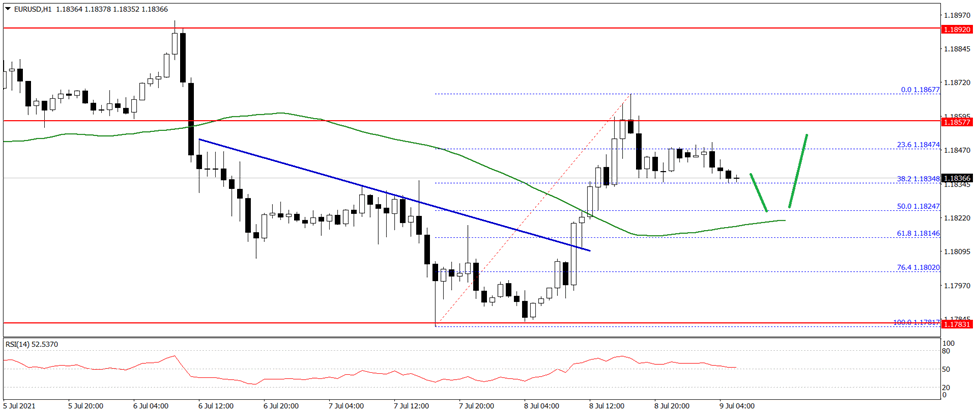
An initial support is near the 1.1830 level. The first major support is near the 1.1820 level and the 50 hourly SMA, below which the pair could dive towards the 1.1780 level.
On the upside, an initial resistance is near 1.1850 on FXOpen. The first key resistance is near the 1.1865 level, above which the bulls are likely to aim a test of the 1.1900 resistance zone.
Oil Recovers, Gold Drifting
Oil extends gains as inventories are drained
Oil prices appear to have found a floor, pushing higher for a second straight session on Friday following inventory data. However, the rise was insufficient to make up for lost ground earlier in the week and oil is set to book its first weekly loss in six weeks.
Crude oil inventories declined by a larger-than-forecast 6.9 million barrels during the week ending 2 July, taking inventory levels to the lowest since before the pandemic in February 2020. Expectations had been for a four million barrel draw.
The larger-than-forecast draw supports the view that demand is rising amid the economic reopening and as the summer driving season ramps up. However, gains in oil prices are likely to remain capped amid the ongoing OPEC+ spat. While Saudi Arabia and the UAE are still at odds over raising output, oil prices are unlikely to retake recent multi-year highs.
Growing concerns over rising Delta cases could also act as a brake on oil prices.
Baker Hughes rig count data will be in focus later, as investors look to see whether the 10% rally in oil prices in June has prompted more US producers to ramp up output. So far, that hasn’t been the case, but with oil prices well above break-even for these producers, they could soon return to the field.
Gold lacks direction heading into the weekend
Gold enjoyed a good bout of volatility in the previous session, pushing to a three-week high of USD1818 before retreating to close approximately flat just above the key USD1800.
Concerns over slowing global economic growth, coupled with fears over Covid flareups, particularly in Europe and Asia, boosted safe-haven flows into the precious metal. However, these weren’t sufficient for gold to maintain the recent high.
Today gold is directionless, ranging around the USD1800 level, although it’s set for its third straight week of gains. Looking ahead, the Fed Monetary Policy Report could offer some direction for the precious metal later in the session.
European Bourses Rebound, USD Lacks Direction
European stocks are rebounding after steep losses in the previous session. Concerns over slowing global economic growth, rising Delta cases and the Fed moving towards tightening monetary policy proved too much for the markets to swallow. Stock indices, which were trading around all-time highs, came off. Key technical levels were tested but not meaningfully breached. As a result, dip buyers are back in today, picking up bargains.
The French CAC is leading the charge in Europe, trading up more than 2%. Meanwhile, the Italian FTSE Mib is outperforming the FTSE. Here’s hoping this isn’t an ominous sign for Sunday’s final!
The UK index is charging higher despite disappointing GDP data. The British economy grew a less-than-expected 0.8% MoM in May, well below the 1.5% forecast. April’s GDP reading was also downwardly revised to 2%. The data shows the economic rebound started to ease in May, even as the reopening was still in full swing. The UK economy could do with a leg up. Maybe football euphoria could translate into an economic boost, but we will have to wait until July for that.
Weakness in the pound is doing the heavy lifting in the FTSE, an index dominated by foreign earning multinationals. Travel stocks are flying higher after the British government eased travel restrictions on double-jabbed British tourists flying back from amber-list countries.
Looking ahead, US indices are pointing to a stronger start on the open, suggesting that yesterday’s sell-off could have been simply a healthy technical correction rather than anything more ominous.
Big tech could be under the spotlight as finance ministers and central bankers from the 20 largest economies meet in Vienna. Corporate tax reform will be at the top of the agenda, as the group looks to build on the momentum created at the G7 meeting.
FX – USD holds steady after heavy losses
The US dollar is consolidating after steep falls in the previous session. The greenback traced US treasury yields lower on Thursday as traders showed less concern over elevated inflation and interest rate rises than the Fed in its slightly more hawkish FOMC minutes.
Expectations that the US economy has passed peak growth dragged on demand for the US dollar. Evidence of a stalling recovery in the American labour market came from US initial jobless claims unexpectedly rising last week.
Interestingly the US dollar failed to pick up safe-haven bids, even as the stock markets slumped across the board.
UK Growth Slows In Month Of May, G20 Meets In Venice
Notes/Observations
- UK May GDP rose for the 4th straight month but missed expectations (M/M: 0.8% v 1.5%e); Concerns that reopening boost was fading fast.
- Various ECB members comment after the Strategy Review that it remained in a situation that justified an easy monetary policy.
- Global government bond yields trade higher, reversing Thursday's mild drop.
- Spread of the Delta coronavirus variant continues to fuel concerns about the pace of global economic recovery.
Asia
- China Jun CPI data missed expectations (M/M: -0.4% v 0.0%e; YoY: 1.1% v 1.3%e).
- China Ministry of Commerce (MOFCOM) stated that it expected retail sales during its 5-year plan to increase ~5.0% per year and Trade and goods ~2.0%/year.
Europe
- UK Treasury said to have insisted that Brexit settlement has remained within the previous range of £35-39B.
Americas
- Fed's Daily (non-voter, dove): Delta Variant is a threat to global economic recovery; One threat is that officials prematurely declare victory on coronavirus.
- US said to set to add additional China companies to Blacklist due to human rights issues in Xinjiang and use of surveillance. An announcement could be made as soon as July 9th (Fri). At least 10 additional companies could be added to the list [no specific cos. were mentioned.
Speakers/Fixed income/FX/Commodities/Erratum
Equities
- Indices [Stoxx600 +1.5% at 4,049, FTSE +0.8% at 7,084, DAX +1.0% at 15,569, CAC-40 +1.8% at 6,512, IBEX-35 +0.9% at 8,727, FTSE MIB +1.2% at 24,938, SMI +0.6% at 11,999, S&P 500 Futures +0.4%].
- Market Focal Points/Key Themes: European indices open higher across the board and advance into the green as the session progressed (a notable exception being Portugal’s PSI, weighed by EDP); better-performing sectors include industrials and consumer discretionary; underperformers include energy and telecom; Philip Morris makes an offer for Vectura; D’ieteren takes stake in TVH Parts; focus on results of G-20 meeting over the weekend; earnings expected in the upcoming US session include Greenbrier.
Equities
- Consumer discretionary: Alma Media ALMA.FR +7.7% (raises outlook), Beter Bed BBED.NL +5.1% (divestment).
- Energy: Ilika IKA.UK -26.0% (placing), Petroleum Geo-Services PGS.NO +9.7% (trading update).
- Financials: Deutsche Bank DBK.DE +2.0% (analyst action).
- Healthcare: Lysogene LYS.FR +14.8% (FDA fast track designation for LYS-GM101), Synlab SYAB.DE +4.2% (raises outlook).
- Industrials: Daimler DAI.DE +1.5% (diesel settlement), HeidelbergCement HEI.DE +1.1% (analyst action), Vallourec VK.FR +6.1% (analyst action).
- Technology: Ricardo RCDO.UK +1.8% (analyst action).
Speakers
- ECB's Rehn (Finland) stated that it must prepare for recovery to slow due to the delta variant of the coronavirus. The new ECB inflation target was unambiguous. Goal allowed aims like full employment to be emphasized. The medium-term core inflation outlook of 1.4% was below the new target and justified continued monetary support.
- ECB's Weidmann (Germany) on Strategy review stated that temporary deviations from 2% symmetrical target could occur. Did not make our monetary policy contingent on targets not met in the past and would not deliberately seek inflation overshoots.
- ECB's Villeroy (France) reiterated Council's stance that ECB's new 2% symmetrical target was not a ceiling. The reiterated stance that remain in a situation that justifies an easy monetary policy.
- EU Economic Commissioner Gentiloni (Italy) stated that he was optimistic about a global tax agreement. Believed that an EU digital tax would not undermine the global deal.
- France Fin Min Le Maire believed could have a groundbreaking agreement on international taxation at G20. Wanted more than 15% as the global minimum corporate tax.
- US Treasury Sec Yellen stated that US was considering a range of policies that could implicit prices on carbon emissions. De-carbonizing economies by mid-century would require significant public investment and difficult economic decisions.
- China Foreign Ministry spokesperson Wang Wenbin stated that govt opposed US acts that limited Chinese companies’ access to indexes.
Currencies/Fixed Income
- USD steady against most major pairs in quiet trading.
- EUR/USD at 1.1840 area in the aftermath of ECB's Strategic Review that placed asymmetrical 2% inflation target. Dealers did not the target gave the central bank leeway to stick to their ultra-expensive monetary policy for some time to come.
- GBP/USD was initially softer after UK MAY GDP missed expectations (M/M: 0.8% v 1.5%e); Concerns that reopening boost was fading fast. Pair did manage to recoup its data-related losses.
Economic data
- (NL) Netherlands May Manufacturing Production M/M: 1.4% v 0.5% prior; Y/Y: 16.5% v 13.1% prior; Industrial Sales Y/Y: 20.0% v 18.7% prior.
- (FI) Finland May Industrial Production M/M: 2.2% v 1.3% prior; Y/Y: 8.0% v 2.1% prior.
- (UK) May GDP M/M: 0.8% v 1.5%e; GDP 3M/3M: 3.6% v 3.9%e.
- (UK) May Industrial Production M/M: 0.8% v 1.4%e v -1.3% prior; Y/Y: 20.6% v 21.6%e.
- (UK) May Manufacturing Production M/M: -0.1% v +1.0%e; Y/Y: 27.7% v 29.5%e.
- (UK) May Construction Output M/M: -0.8% v +1.0%e; Y/Y: 56.5% v 58.2%e.
- (UK) May Index of Services M/M: 0.9% v 1.6%e; 3M/3M: 3.9% v 4.1%e.
- (NO) Norway Jun CPI M/M: 0.3% v 0.4%e; Y/Y: 2.9% v 2.9%e(6th straight month above target).
- (NO) Norway Jun CPI Underlying M/M: 0.4% v 0.5%e; Y/Y: 1.4% v 1.5%e.
- (NO) Norway Jun PPI (including oil) M/M: 4.6% v 2.8% prior; Y/Y: 37.1% v 29.4% prior.
- (NO) Norway Jun Trade Balance (NOK): 25.0B v 14.4B prior.
- (NO) Norway Q2 House Price Index Q/Q: 2.7% v 3.4% prior.
- (DK) Denmark May Current Account Balance (DKK): 14.6B v 13.7B prior; Trade Balance: 6.0B v 4.8B prior.
- (HU) Hungary May Preliminary Trade Balance: €0.1B v €0.4B prior.
- (TR) Turkey July TCMB Survey of Expectations: Next 12-month Outlook: 12.6% v 12.1% prior.
- (TR) Turkey May Current Account Balance: -$3.1B v -$3.0Be.
- (AT) Austria May Industrial Production M/M: 0.0% v 0.3% prior; Y/Y: 23.4% v 33.8% prior.
- (TH) Thailand end-Jun Foreign Reserves.
- (CN) Weekly Shanghai copper inventories (SHFE): 129.5K v 142.5K tons prior.
- (CZ) Czech Jun Unemployment Rate: 3.7% v 3.9% prior.
- (IT) Italy May Industrial Production M/M: -1.5% v +0.3%e; Y/Y: 21.1% v 24.8%e; Industrial Production NSA (unadj) Y/Y: 24.9% v 80.4% prior.
- (RU) Russia Narrow Money Supply w/e July 2nd (RUB): 14.04T v 14.05T prior.
- (CZ) Czech Jun International Reserves: $165.9B v $169.6B prior.
- (GR) Greece Jun CPI Y/Y: 1.0% v 0.1% prior; CPI EU Harmonized Y/Y: +0.6% v -1.2% prior.
- (GR) Greece May Industrial Production Y/Y: 14.0% v 22.7% prior.
- (IT) Italy Stats Agency (Istat) Monthly Economic Note.
- (HU) Hungary Jun YTD Budget Balance (HUF): -1.705T v -1.313T prior.
Fixed income Issuance
- (IT) Italy Debt Agency (Tesoro) sold €7.5B vs. €7.5B indicated in 12-month Bills; Avg Yield: -0.450% v -0.490% prior; Bid-to-cover: 1.26x v 1.37x prior.
Looking Ahead
- (MX) Mexico Jun Nominal Wages: No est v 4.4% prior.
- 05:25 (EU) Daily ECB Liquidity Stats.
- 05:30 (IN) India to sell combined INR260B in 2023, 2031, and 2061 bonds.
- 05:30 (ZA) South Africa to sell combined ZAR1.2B in I/L 2029, 2038, and 2046 Bonds.
- 06:00 (PT) Portugal May Trade Balance: No est v -€1.3B prior.
- 06:00 (G7) BOE Gov Bailey with ECB chief Lagarde on a panel on digitalization.
- 06:00 (UK) DMO to sell £B in 1-month, 3-month and 6-month bills (£B, £B, and £B respectively).
- 06:45 (US) Daily Libor Fixing.
- 07:00 (UK) May Visible Trade Balance: -£11.1Be v -£11.0B prior; Overall Trade Balance: -£1.3Be v -£0.9B prior; Trade Balance Non-EU: No est v -£5.6B prior.
- 07:30 (IS) Iceland to sell Apr 2024 RIKB Bonds.
- 07:30 (EU) ECB account of Jun 10th Meeting (Minutes).
- 07:30 (IN) India Weekly Forex Reserve w/e July 2nd: No est v $609.0B prior.
- 08:00 (UR) Ukraine Jun CPI M/M: 0.35e v 1.3% prior; Y/Y: 9.5%e v 9.5% prior.
- 08:00 (IS) Iceland Jun Unemployment Rate: No est v 10.0% prior.
- 08:00 (PL) Poland Central Bank (NBP) Jun Minutes (two decisions ago).
- 08:00 (UK) Daily Baltic Dry Bulk Index.
- 08:00 (IN) India announces upcoming bill issuance (held on Wed).
- 08:00 (ES) Spain Debt Agency (Tesoro) announces upcoming bond issuance.
- 08:30 (CA) Canada Jun Net Change in Employment: +175.0Ke v -68.0K prior; Unemployment Rate: 7.8%e v 8.2% prior; Full Time Employment Change: No est v -13.8K prior; Part Time Employment Change: No est v -54.2K prior; Participation Rate: No est v 64.6% prior; Hourly Wage Rate Y/Y: 0.0%e v -1.4% prior.
- 08:30 (CL) Chile Central Bank Traders Survey (bi-monthly).
- 08:30 (US) Weekly USDA Net Export Sales.
- 09:00 (RU) Russia Q2 Preliminary Current Account Balance: $19.5Be v $23.3B prior.
- 10:00 (US) May Final Wholesale Inventories M/M: 1.1%e v 1.1% prelim; Wholesale Trade Sales M/M: No est v 0.8% prior.
- 11:00 (EU) Potential sovereign ratings after European close (Fitch on Lithuania, Russia sovereign ratings).
- 13:00 (US) Weekly Baker Hughes Rig Count.