Sample Category Title
UK CPI steady at 3.8% in August, goods prices firm, services ease
Inflation in the UK held steady in August, with CPI unchanged at 3.8% yoy, matching consensus. On the month, prices rose 0.3%. Core CPI, which strips out food, energy, alcohol, and tobacco, eased from 3.8% yoy to 3.6% yoy, a notch below expectations of 3.7% yoy and another sign that underlying pressures are easing gradually.
Goods prices provided an offset, rising from 2.7% yoy to 2.8% yoy, their highest since October 2023. By contrast, services inflation slowed from 5.0% to 4.7%, pointing to softer domestic price dynamics. While still elevated, the services pullback is significant given its importance in shaping medium-term inflation risks.
The BoE meets tomorrow and is expected to hold rates steady, but the August CPI figures will feed into the debate over November’s decision. Softer core and services readings suggest disinflationary progress is intact, leaving policymakers room to consider another rate cut if incoming data on growth and jobs reinforce the trend.
USD/CHF Daily Outlook
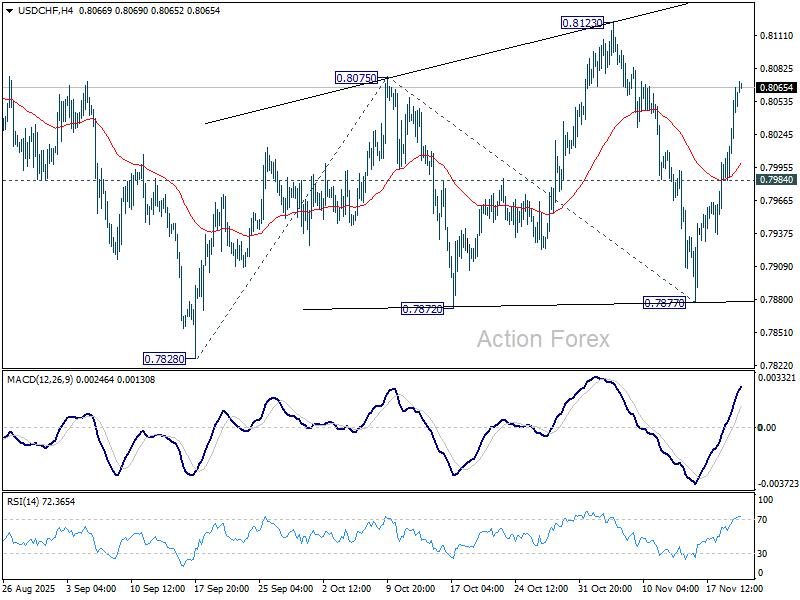
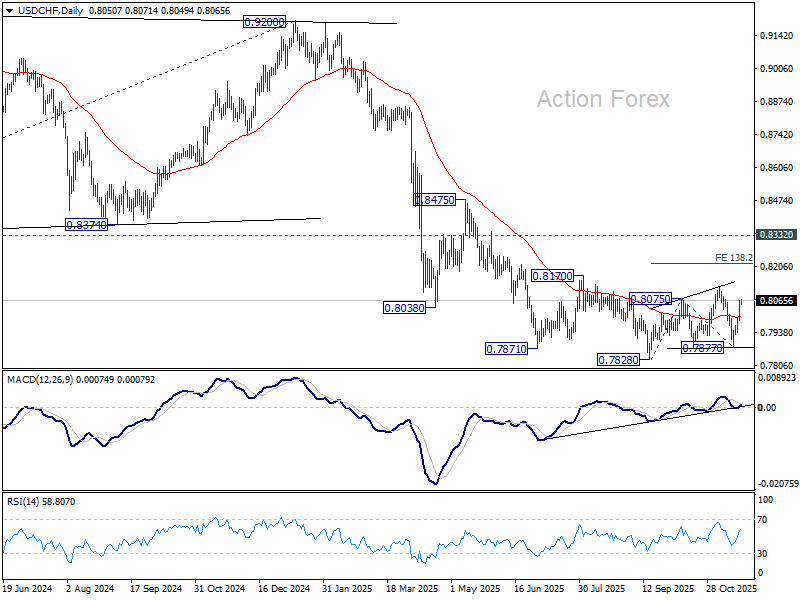
Daily Pivots: (S1) 0.7827; (P) 0.7888; (R1) 0.7920; More….
USD/CHF's break of 0.7871 low confirms down trend resumption. Intraday bias stays on the downside for 61.8% projection of 0.8475 to 0.7871 from 0.8170 at 0.7797. Firm break there will pave the way to 100% projection at 0.7566. On the upside, 0.7914 support turned resistance will turn intraday bias neutral for consolidations But recovery should be limited below 0.8006 resistance to bring another fall.
In the bigger picture, long term down trend from 1.0342 (2017 high) is still in progress. Next target is 100% projection of 1.0146 (2022 high) to 0.8332 from 0.9200 at 0.7382. In any case, outlook will stay bearish as long as 0.8332 support turned resistance holds.
Calm Before the Fed: Dollar Soft, Markets Brace for Guidance
Markets traded with a subdued tone today as investors awaited the Fed’s highly anticipated policy decision. The Fed is expected to cut rates by 25bps, but the real market mover will be the details: how divided the vote is, what the updated projections show, and the signals Chair Jerome Powell delivers in his press conference. These elements will define expectations for how far and how fast easing progresses from here.
The stakes are high. U.S. equities and Gold are already at record highs, with scope to extend gains if Powell confirms a dovish tilt. Bond traders are focused on whether the 10-year yield can slip below the 4% mark, a level that could trigger broader repricing across global fixed income. Meanwhile, Dollar — this week’s laggard — risks an accelerated selloff if the Fed opens the door to back-to-back cuts.
The BoC decision also lands today, with a 25bps cut to 2.50% widely expected. Markets will be looking for any signal that more easing is in the pipeline, particularly now that uncertainty around tariffs has eased. Recent soft growth and employment data have built the case for further accommodation, and the Loonie’s resilience could hinge on whether Governor Tiff Macklem leaves that door open.
In Europe, the spotlight is on UK inflation figures. With the BoE expected to hold policy tomorrow, the real question is whether the data tilt the odds for another cut in November. Headline and services inflation will be critical, with a stronger print weakening the case for further easing.
Overall, Dollar remains pinned to the bottom of the currency performance ladder, followed by Kiwi and Aussie. Swiss Franc has emerged as the strongest, followed by Euro and Yen, while Sterling and Loonie are stuck in the middle of the pack.
On the trade front, U.S. Treasury Secretary Scott Bessent struck an optimistic tone, saying he believes a deal with China is “near.” With reciprocal tariffs due to take effect in November, Bessent said further talks are expected before then, noting that each round of discussions has become “more and more productive.” He added that Chinese negotiators now “sense that a trade deal is possible,” offering a rare dose of optimism in a tense environment.
In Asia, at the time of writing, Nikkei is down -0.34%. Hong Kong HSI is up 1.59%. China Shanghai SSE is up 0.21%. Singapore Strait Times is down -0.39%. Japan 10-year JGB yield is down -0.003 at 1.601. Overnight, DOW fell -0.27%. S&P 500 fell -0.13%. NASDAQ fell -0.07%. 10-year yield fell -0.008 to 4.026.
Japan August exports near flat, -13.8% US plunge balanced by other markets
Japan’s trade deficit narrowed in August to JPY -242.5B, smaller than expectations for JPY -513.6B, as exports outperformed forecasts. Overall exports dipped just 0.1% yoy to JPY 8425B, beating projections for a 1.9% yoy decline. Imports, however, fell -5.2% yoy to JPY 8668B, a steeper drop than the -4.2% yoy contraction expected.
The details highlighted stark divergences. Exports to the U.S. tumbled -13.8% yoy, the sharpest fall since February 2021, led by a -28.3% yoy plunge in autos and a -38.9% yoy drop in chipmaking equipment. By contrast, shipments to Asia rose 1.7% yoy, while exports to Western Europe jumped 7.7% yoy. Exports to mainland China slipped 0.5% yoy, though shipments to Hong Kong surged 14.4% yoy.
Australia leading index turns below trend, but RBA to wait until November to cut again
Australia’s Westpac Leading Index growth rate slipped into negative territory in August, falling from 0.11% to -0.16%. It marks the first below-trend reading since September 2024 and a sharp moderation from February’s peak of 0.86%.
Westpac noted the weakness is “not overly concerning” but highlights a “clear softening” from earlier in the year, consistent with the economy slowing after a relatively strong June quarter. It expects growth of 1.9% in 2025, better than the 1.3% expansion in 2024 but still below trend, with a return to trend pace only in 2026.
The RBA meets on September 29–30, where policymakers are almost certain to hold the cash rate steady at 3.6%. Westpac argues that incoming data should eventually validate benign inflation and soft demand, paving the way for a 25bp cut in November, followed by two further cuts in 2026. For now, the RBA will proceed cautiously, watching for confirmation of underlying trends before easing again.
BoC and Fed double-header as USD/CAD flirts with head-and-shoulders reversal
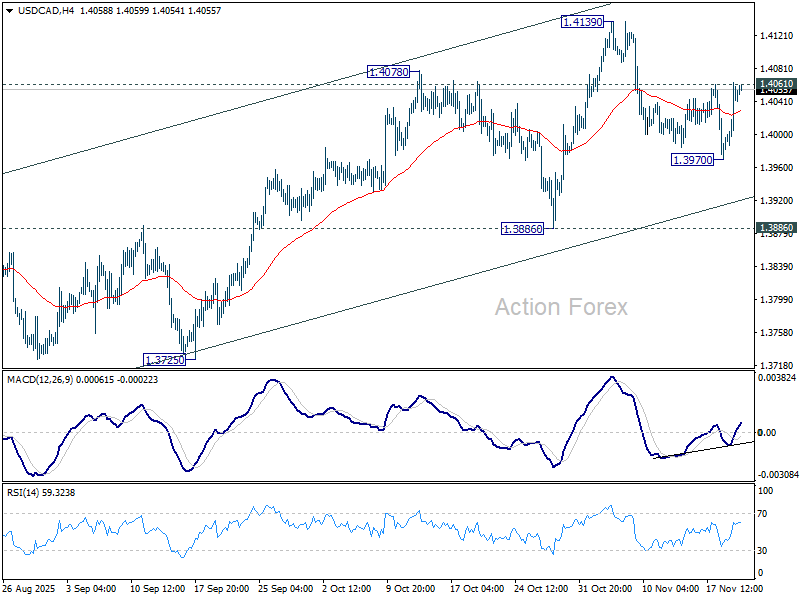
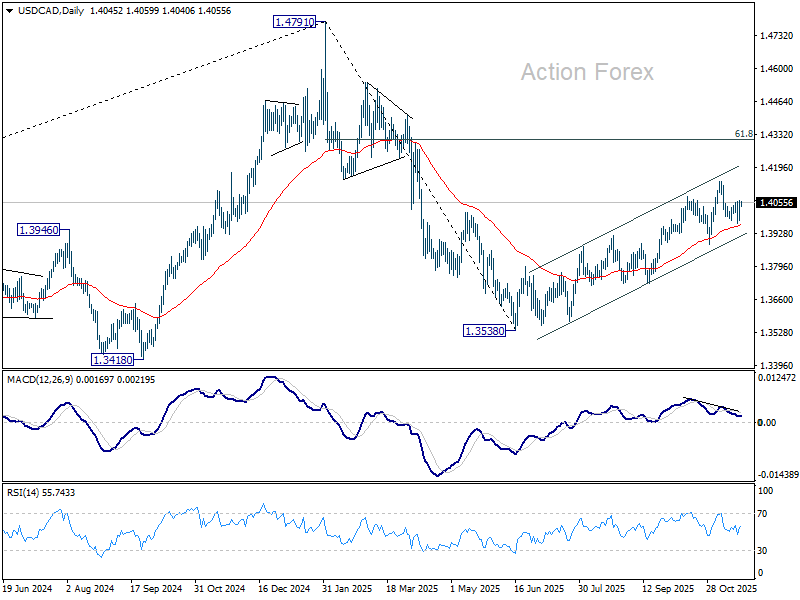
Global markets are bracing for a double dose of central bank action today, with both the BoC and the Fed expected to deliver interest rate cuts. While the decisions themselves are largely anticipated, the bigger question is what kind of guidance policymakers provide for the months ahead. With USD/CAD now sitting just above the neckline of a head and shoulder top pattern, today’s policy decisions could be the make or break for the currency pair.
The BoC is almost certain to trim its policy rate by 25bps to 2.50%. The case for cutting was reinforced by August CPI, which rose 1.9% yoy — weaker than forecast. While core inflation remains sticky at elevated levels, the fact that it has stayed steady for three months gives policymakers confidence that underlying pressures are contained.
Beyond inflation, the growth backdrop has deteriorated noticeably. Canada’s economy contracted by -0.4% qoq in Q2, undershooting the BoC’s own forecasts. August data revealed a second consecutive month of job losses and a higher unemployment rate. These signals of slackening demand strengthen the case for pre-emptive easing. Markets now want to know whether Governor Tiff Macklem will acknowledge the need for more cuts before year-end.
According to a Reuters poll, over 70% of economists see at least one more 25bps reduction in 2025, with some forecasting two additional cuts to take the policy rate down to 2.00%. Whether the BoC leans toward validating that view, or opts to remain data-dependent, could set the tone for Canadian Dollar.
For the Fed, a 25bps cut to 4.00–4.25% is virtually locked in, with futures assigning only a 4% chance to a larger 50bps move. Consensus has hardened around the idea of “back-to-back-to-back” cuts in September, October, and December, which would lower the target range to 3.50–3.75% by year-end. The policy statement, dot plot, and Chair Jerome Powell’s press conference will be dissected for confirmation of this trajectory.
Beyond the near term, attention will turn to the pace of easing in 2026 and beyond. June projections showed rates drifting to 3.6% in 2026 and 3.4% in 2027, with the longer-run neutral rate anchored near 3.0%. The critical question is whether the Fed signals that the 3.00–3.25% zone could be reached as early as 2026, suggesting a faster normalization path than previously expected — with significant implications for bonds, equities, and Dollar.
Technically, USD/CAD is now on a knife edge. Decisive break below 1.3725 would complete a head-and-shoulders top (ls: 1.3878; h: 1.3923; rs: 1.3889), confirming that the corrective rebound from the 1.3538 low has ended. That would put the larger downtrend back in play, with an retest of 1.3538 first. Firm break there would open the way toward 61.8% projection of 1.4791 to 1.3538 from 1.3923 at 1.3149.
USD/CHF Daily Outlook
Daily Pivots: (S1) 0.7827; (P) 0.7888; (R1) 0.7920; More….
USD/CHF's break of 0.7871 low confirms down trend resumption. Intraday bias stays on the downside for 61.8% projection of 0.8475 to 0.7871 from 0.8170 at 0.7797. Firm break there will pave the way to 100% projection at 0.7566. On the upside, 0.7914 support turned resistance will turn intraday bias neutral for consolidations But recovery should be limited below 0.8006 resistance to bring another fall.
In the bigger picture, long term down trend from 1.0342 (2017 high) is still in progress. Next target is 100% projection of 1.0146 (2022 high) to 0.8332 from 0.9200 at 0.7382. In any case, outlook will stay bearish as long as 0.8332 support turned resistance holds.
Gold Breaks Record High – All Eyes on Fed’s Next Move
Key Highlights
- Gold extended its rally and traded to a new record high near $3,700.
- A key bullish trend line is forming with support at $3,665 on the 4-hour chart.
- WTI Crude Oil prices could recover if there is a close above $65.50.
- EUR/USD rallied above the 1.1760 and 1.1800 resistance levels.
Gold Price Technical Analysis
Gold prices formed a base above $3,500 and started a fresh increase against the US Dollar. It cleared many hurdles near $3,550 and $3,650.
The 4-hour chart of XAU/USD indicates that the price settled above the $3,650 level, the 100 Simple Moving Average (red, 4 hours), and the 200 Simple Moving Average (green, 4 hours). The upward move was such that the price spiked to $3,700.
Gold traded to a new record high near $3,701 and might continue to rise. On the upside, immediate resistance is near the $3,700 level. The next major resistance sits near the $3,715 level.
A clear move above $3,715 could open the doors for more upside. In the stated case, the bulls could aim for a move toward $3,750, above which the price could rally toward the milestone level of $3,765.
On the downside, initial support is near the $3,675 level. The first key support is $3,665. There is also a key bullish trend line forming with support at $3,665 on the same chart. The next major support is near the $3,620 level.
A downside break below $3,620 might call for more downsides. The next key zone to watch could be $3,550 and the 100 Simple Moving Average (red, 4 hours).
Looking at WTI Crude Oil, the price shows signs of recovery, but the bulls need to push it above $65.50 in the near term.
Economic Releases to Watch Today
- Fed Interest Rate Decision - Forecast 4.25%, versus 4.5% previous.
- Fed Monetary Policy Statement.
- FOMC Economic Projections.
BoC and Fed double-header as USD/CAD flirts with head-and-shoulders reversal
Global markets are bracing for a double dose of central bank action today, with both the BoC and the Fed expected to deliver interest rate cuts. While the decisions themselves are largely anticipated, the bigger question is what kind of guidance policymakers provide for the months ahead. With USD/CAD now sitting just above the neckline of a head and shoulder top pattern, today’s policy decisions could be the make or break for the currency pair.
The BoC is almost certain to trim its policy rate by 25bps to 2.50%. The case for cutting was reinforced by August CPI, which rose 1.9% yoy — weaker than forecast. While core inflation remains sticky at elevated levels, the fact that it has stayed steady for three months gives policymakers confidence that underlying pressures are contained.
Beyond inflation, the growth backdrop has deteriorated noticeably. Canada’s economy contracted by -0.4% qoq in Q2, undershooting the BoC’s own forecasts. August data revealed a second consecutive month of job losses and a higher unemployment rate. These signals of slackening demand strengthen the case for pre-emptive easing. Markets now want to know whether Governor Tiff Macklem will acknowledge the need for more cuts before year-end.
According to a Reuters poll, over 70% of economists see at least one more 25bps reduction in 2025, with some forecasting two additional cuts to take the policy rate down to 2.00%. Whether the BoC leans toward validating that view, or opts to remain data-dependent, could set the tone for Canadian Dollar.
For the Fed, a 25bps cut to 4.00–4.25% is virtually locked in, with futures assigning only a 4% chance to a larger 50bps move. Consensus has hardened around the idea of “back-to-back-to-back” cuts in September, October, and December, which would lower the target range to 3.50–3.75% by year-end. The policy statement, dot plot, and Chair Jerome Powell’s press conference will be dissected for confirmation of this trajectory.
Beyond the near term, attention will turn to the pace of easing in 2026 and beyond. June projections showed rates drifting to 3.6% in 2026 and 3.4% in 2027, with the longer-run neutral rate anchored near 3.0%. The critical question is whether the Fed signals that the 3.00–3.25% zone could be reached as early as 2026, suggesting a faster normalization path than previously expected — with significant implications for bonds, equities, and Dollar.
Technically, USD/CAD is now on a knife edge. Decisive break below 1.3725 would complete a head-and-shoulders top (ls: 1.3878; h: 1.3923; rs: 1.3889), confirming that the corrective rebound from the 1.3538 low has ended. That would put the larger downtrend back in play, with an retest of 1.3538 first. Firm break there would open the way toward 61.8% projection of 1.4791 to 1.3538 from 1.3923 at 1.3149.
Japan August exports near flat, -13.8% US plunge balanced by other markets
Japan’s trade deficit narrowed in August to JPY -242.5B, smaller than expectations for JPY -513.6B, as exports outperformed forecasts. Overall exports dipped just 0.1% yoy to JPY 8425B, beating projections for a 1.9% yoy decline. Imports, however, fell -5.2% yoy to JPY 8668B, a steeper drop than the -4.2% yoy contraction expected.
The details highlighted stark divergences. Exports to the U.S. tumbled -13.8% yoy, the sharpest fall since February 2021, led by a -28.3% yoy plunge in autos and a -38.9% yoy drop in chipmaking equipment. By contrast, shipments to Asia rose 1.7% yoy, while exports to Western Europe jumped 7.7% yoy. Exports to mainland China slipped 0.5% yoy, though shipments to Hong Kong surged 14.4% yoy.
Australia leading index turns below trend, but RBA to wait until November to cut again
Australia’s Westpac Leading Index growth rate slipped into negative territory in August, falling from 0.11% to -0.16%. It marks the first below-trend reading since September 2024 and a sharp moderation from February’s peak of 0.86%.
Westpac noted the weakness is “not overly concerning” but highlights a “clear softening” from earlier in the year, consistent with the economy slowing after a relatively strong June quarter. It expects growth of 1.9% in 2025, better than the 1.3% expansion in 2024 but still below trend, with a return to trend pace only in 2026.
The RBA meets on September 29–30, where policymakers are almost certain to hold the cash rate steady at 3.6%. Westpac argues that incoming data should eventually validate benign inflation and soft demand, paving the way for a 25bp cut in November, followed by two further cuts in 2026. For now, the RBA will proceed cautiously, watching for confirmation of underlying trends before easing again.
Fed (FOMC) Meeting Preview: 25 bps Cut Appears Baked In, Forward Guidance Is Key. Implications for DXY, Dow Jones...
The Federal Reserve's upcoming meeting is a big deal for the US economy and financial markets as a whole.
The latest economic data suggests the Fed should start lowering interest rates. However, the market already expects a rate cut and based on market moves it appears that it has largely been priced in.
Because of this, the Fed's announcement about their future plans will likely be more important than their actual decision at this meeting. That is likely to be what will really stoke volatility barring a surprise decision by the Fed.
Source: CME FedWatch Tool
The Macroeconomic Case for a Rate Cut
The main concern is the weakening job market. While the economy grew by 3.3% in the second quarter, this was mostly due to a big change in trade, which hid the fact that consumer spending was weak. People were spending less because they were worried about tariffs, a cooling job market, and unstable wealth.
This was confirmed by the Federal Reserve's Beige Book, which showed little to no economic activity and declining consumer spending across the country. It also reported that most districts were not hiring and that the job market was slowing. Last Friday's jobs report also showed a small increase in jobs, and unemployment went up. Revisions to job numbers from the past year showed the economy created less than half the jobs that were previously reported.
Even though inflation is still above the target, the risk to the job market now seems more urgent to the Fed. They'll likely start to move toward a less restrictive policy.
Three factors that drove inflation up in 2022—oil prices, housing rents, and wages—are now gone, and are even helping to lower inflation. A cooling economy with rising unemployment will also help bring inflation back down to 2% by the end of 2026.
The Fed will probably lower its forecasts for economic growth and inflation while raising its unemployment projections. We expect the Fed to cut interest rates by 0.25% at their September 17 meeting, with more cuts to follow in October, December, January, and March. It's possible the Fed could start with a larger cut of 0.50%, but a 0.25% cut is more likely because most members are still cautious about the impact of tariffs on inflation.
The Fed's Challenge: Reining in Dovish Expectations
The Federal Reserve is in a tough spot. Even with evidence pointing to a need for lower interest rates, the market has already bet on a lot of rapid rate cuts. This creates a significant communication challenge for the Fed. They have to manage market expectations very carefully.
The "Dovish" Surprise
One possibility is that the Fed tries to meet or even beat the market's high expectations. Traders are already anticipating a lot of cuts by the end of 2026. For the Fed's announcement to truly be a positive surprise for the market, they would need to signal an even faster pace of rate cuts than what is already expected. If they simply use their normal cautious language, even when announcing a cut, the market might see it as a disappointment. The real risk here isn't a wrong policy decision, but a gap between what the Fed says and what the market wants to hear.
The "Powell Pushback"
A different view is that Fed Chair Powell will intentionally try to lower market expectations. This perspective suggests that he will push back against the idea of quick rate cuts in October and December. Instead, he would likely emphasize that the Fed will continue to be guided by incoming economic data, keeping their options open.
This cautious approach is about protecting the Fed's credibility. Having been criticized for underestimating inflation in the past, they don't want to cut rates too soon only to have to reverse course if inflation spikes again. By remaining patient and focusing on data, Powell would be protecting the Fed's reputation and ensuring they can react to the economy as it unfolds, rather than being forced into a schedule set by the market
Probable Scenarios and Forward Outlook
Source: Google Gemini
Impact Analysis on US Indices and Broader Markets
The market's reaction to the FOMC meeting will translate the two primary scenarios into tangible consequences for US indices and other asset classes.
The reaction to a dovish signal would likely be a boon for equities. The S&P 500 would likely rally, driven by the anticipation of lower borrowing costs and a broader "risk-on" sentiment. The Nasdaq 100, composed of technology and growth stocks, would likely outperform due to its higher sensitivity to changes in interest rates.
Conversely, a hawkish signal would be a source of disappointment for "doves," potentially triggering a pullback in US indices as traders unwind their aggressive rate-cut bets. Tech and growth stocks would be particularly vulnerable. The following table summarizes the potential impact on key US indices and the U.S. Dollar Index (DXY) under the two scenarios.
Source: Google Gemini
Since the market is already highly dovish, the disappointment of a cautious Fed is significant. A potential sell-off might be sharp, but it could also be short-lived if the underlying macroeconomic data remains fundamentally sound. A cautious hold today might simply be a delay of an inevitable cut tomorrow. This understanding is critical for long-term investors aiming to distinguish between temporary market volatility and a fundamental shift in economic trajectory.
Tomorrow's meeting promises fireworks regardless of the decision. Volatility will definitely rear its head and the decision could have wider implications for global markets and risk sentiment.
Examining US Bonds and Yield Curve Before FOMC Decision
In case you haven't seen our introduction to bond yields and an explanation on their recent moves, I formally invite you to read it over which may help you to understand some of tomorrow's moves.
Recent movements in Bonds: Why are government bond yields rising so much as of late?
What is the Fed Funds rate and why is the FOMC meeting so big?
Tomorrow, and as-usual for every FOMC meeting, the Federal Reserve will decide whether or not to change its Main policy rate, the Fed Funds, currently locked between 4.25% to 4.50% (Effective Fed Funds is at 4.33%, but that's a technicity).
You will usually see the higher bound of that range represented, which is why you usually hear the "4.50%" rate from US President Trump and media – We will use this rate for the article.
The FOMC is closely watched due to all banks (Central Banks and all others), traders, investors using this rate as the main US Dollar financing rate.
As the Reserve currency, the US Dollar and its supply will have a great influence on global yields, demand and prices.
The current US Treasury Yield Curve
Current vs 2-year ago Yield Curve – Source: TradingView
Small explanation on the yield curve
The current curve (blue) is inverted –compared to a Flattening yield curve in purple– which means that the market expects that the yield on short-term obligations will be lower than on long-term ones.
This is due to lower inflation expectations and a lower time compensation in the short run, compared to higher inflation expectations and higher risk to outstanding debt in the long run.
The 2-Year yield is the closest to expiry and is the best view of where the market expects the Fed Funds rate to be within the next two years.
The same is true for 5-year and longer-term yields, but these also include a time-risk premium (and of course, reflect demand).
This is why, for example, 30-year yields will be tied to longer-run mortgages for consumers, as they tend to reflect longer-term risks for banks to lend.
Also, one of the keys to understanding yields is that the higher the demand (or price), the lower the yield.
Conversely, if fewer people want bonds, they will sell them, causing the yield to go up to attract more demand.
One of the talks and curve pricing since Donald Trump's investiture is how wider deficits steepens the curve even more (pressure for lower short-term rates puts pressure towards higher rates in the long-run).
A jumbo cut tomorrow would hence boost economic activity and markets would hence price higher future inflation.
Current US Yields and change in today's sessions
US Yields from the 2Y to 30Y and daily performance – September 16, 2025 – Source: TradingView
As you can see, these yields are showing another form of the blue curve observed just before.
With the current huge selling in the US Dollar, market participants are hedging for an eventual 50 bps which is leading to big steepening in the curve.
When the 2Y Yield decreases more than the 30Y, this is considered Bull steepening: Bond traders bought more the front (short-term bonds) than the back (long-term bonds).
Let's now look at different Bond charts and spot key levels for them.
2 Year US Treasury Bond
US 2Y Bond, September 16, 2025 – Source: TradingView
10 Year Treasury Bond
US 10Y Bond, September 16, 2025 – Source: TradingView
This bond is traditionally seen as the benchmark for the safest and most liquid financial product.
Watch a break of the most recent highs (113.86) for further continuation towards the September 2024 highs. You may also check the equivalent Yields on the charts.
Any downside below the Key 112.50 pivot (Yield = 4.25% to 4.30%) should lead to further increase in the yield.
It is extremely difficult to anticipate what will be said in such a key FOMC but all eyes will be on the statement (14:00 ET) and Powell's speech (14:30 ET).
Watch for any clues on potential dovishness from Powell which may add more rates towards the end of 2025 (25 bps for each meeting, 3 meetings left is the current pricing).
Any unexpected hawkishness could have different effects: Either take out rate cuts in 2025 (flattening the curve) or take out 2026 cuts (steepening the curve even more).
Tomorrow will be essential for all assets, currencies and flows for the coming period.
Of course, do not forget the Bank of Canada rate decisions at 9:30 tomorrow morning and the Bank of England rate decision at 7:00 on Thursday 18th.
Safe trades and a successful FOMC session!
FTSE 100 Wave Analysis
FTSE 100: ⬇️ Sell
- FTSE 100 reversed from resistance zone
- Likely to fall to support level 9090.00
FTSE 100 index recently reversed down from the resistance zone between the key resistance level 9330,00 (which stopped the previous wave (3) in the middle of August, as can be seen below) and the upper daily Bollinger Band.
The downward reversal from this resistance zone started the active short-term correction 2.
FTSE 100 index can be expected to fall to the next support level 9090.00, the target for the completion of the wave 2 (low of the previous correction (4)).