




RBNZ survey shows moderating short-term inflation expectations

    According to RBNZ Business Expectations Survey for Q2, respondents have lowered their expectations for CPI inflation in both the short-term and medium-term, while their long-term CPI inflation expectations have remained stable.

    Specifically, one-year-ahead annual inflation expectations have notably decreased by 49 bps, moving from 3.22% to 2.73%. Two-year-ahead inflation expectations also saw a decline from 2.50% to 2.33%. Five-year-ahead inflation expectations are holding steady at 2.25%. Ten-year-ahead expectations edged up slightly by 3bps, from 2.16% to 2.19%.

    Regarding the Official Cash Rate, survey respondents anticipate that it to 5.46% by the end Q2, similar to current rate at 5.50%. Looking further ahead, they forecast a reduction in OCR to 4.79% by the end of Q1 2025, marking a slight increase from last quarter’s prediction of 4.74%. These expectations align with anticipation of approximately three rate cuts by the end of Q1 next year.

    Full RBNZ business expectations survey here.

    Australia’s NAB business confidence steady at 1, conditions normalize with slowing cost growth

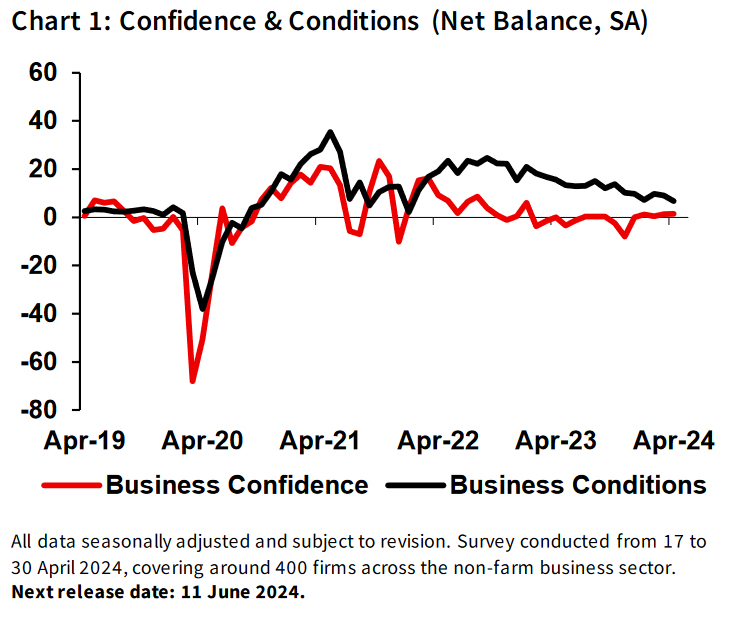
      Australia’s NAB Business Confidence held steady at 1 in April. Business Conditions index fell from from 9 to 7. Notably, trading conditions declined from 15 to 12, while profitability was unchanged at 6. A significant reduction was observed in employment conditions, which dropped from 6 to 2.

      NAB Chief Economist Alan Oster reflected on these figures: “All three components of business conditions were back at their long-run averages in April.” He described this as a milestone, marking a normalization after the unusually high levels of 2022, “reflecting slowing economic growth.”

      Labour cost growth decreased to 1.5% from 1.7%, and purchase cost growth slowed to 1.2% from 1.5%. Meanwhile, product price growth rose slightly to 0.9% from 0.7%. Retail price growth moderated significantly to 0.9% from 1.4%.

      Oster noted, “There was some further improvement in the pace of cost growth in April, and a step down in the pace of retail price growth.” He suggested these changes could indicate easing in inflation in the second quarter, though further observation is needed to confirm this trend.
      Full Australia NAB business confidence release here.

      NZ BNZ services dips to 47.1, lowest since early 2022

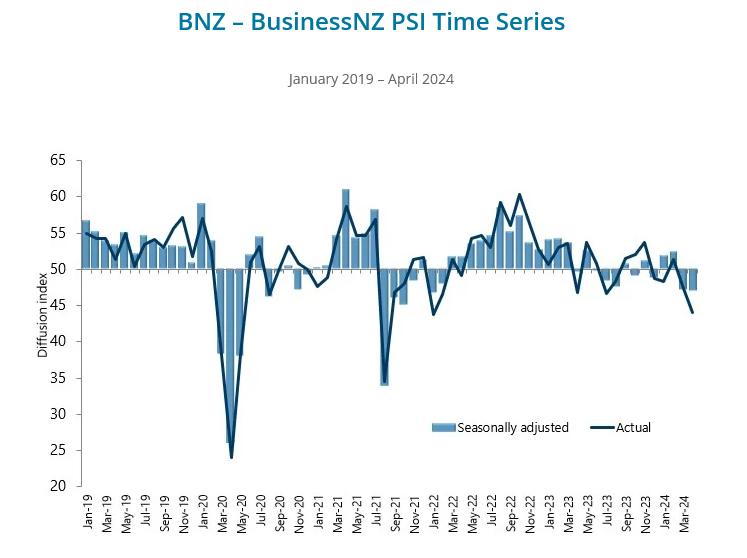
        New Zealand’s BusinessNZ Performance of Services Index ticked down from 47.2 to 47.1 in April, marking the lowest level since January 2022.

        Breaking down the components of the index reveals mixed signals: Activity and sales saw a modest improvement, rising from 44.8 to 46.5. However, employment took a downturn, dropping from 49.9 to 47.1, recording its lowest level since February 2022. New orders and business also declined slightly to 47.1, from 47.9. Stocks and inventories remained unchanged at 46.6, while supplier deliveries worsened, falling from 48.6 to 47.6—the lowest since November 2022.

        The feedback from businesses has increasingly skewed negative, with 66.3% of comments in April being pessimistic, up from 63.0% in March and 57.3% in February. Many respondents highlighted the difficult economic environment and persistent inflationary pressures as significant concerns.

        Doug Steel, a senior economist at BNZ, commented on the broader implications of these figures, stating, “combining today’s weak PSI with last week’s PMI yields a composite reading that would be consistent with GDP tracking below year earlier levels into the middle of this year.” He further noted that the combined index suggests there could be “some downside risk” to their current economic forecasts.

        Full NZ BNZ PSI release here.

        Canada’s employment rises 90.4k in Apr, unemployment rate unchanged at 6.1%

          Canada’s employment grew strongly by 90.4k in April, well above expectation of 17.5k.

          Unemployment rate was unchanged at 6.1%, below expectation of 6.2%. Employment rate was unchanged at 61.4%. Total hours worked rose 0.8% mom.

          Average hourly wages rose 4.7% yoy, slowed from March’s 5.1% yoy.

          Full Canada employment release here.

          BoE’s Pill cautions against overemphasis on June rate cut

            BoE Chief Economist Huw Pill today advised against fixating on the possibility of an interest rate cut in the upcoming June meeting, describing such expectations as “probably a little bit ill-advised.”

            Pill clarified that a rate reduction next month is not a “fait accompli,” tempering expectations that have been building around BoE’s short-term monetary policy trajectory.

            Pill elaborated that the MPC has indeed signaled that the bank rate could be reduced, but only upon receiving sufficient evidence that the persistent components of inflation are on a clear downward path.


            June rate cut plausible, ECB accounts indicate

              In the accounts from their April monetary policy meeting, ECB confirmed that it is “plausible” to be in a position to start cutting interest rates as early as June, contingent upon incoming evidence supporting the medium-term inflation forecasts established in March.

              ECB members collectively noted that recent data largely upheld the projections made by staff in March, bolstering their “confidence that the disinflationary process was continuing”.

              Looking forward, ECB highlighted the importance of upcoming data releases and new staff projections, which are expected before the June meeting. These forthcoming insights will provide a more “comprehensive” basis for decision-making, enabling a fuller assessment of the economic environment and potentially justifying a shift in policy.

              Full ECB accounts here.

              UK GDP grows 0.4% mom in Mar, 0.6% qoq in Apr, above expectations

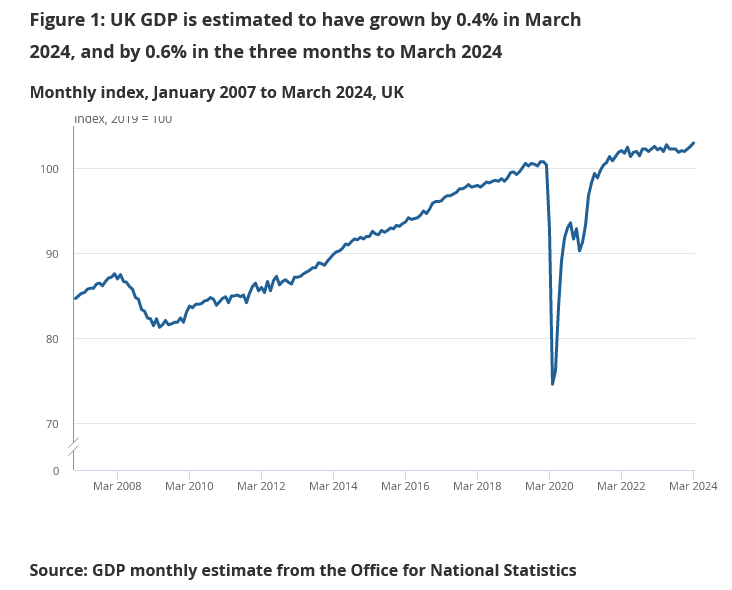
                UK GDP grew 0.4% mom in March, well above expectation of 0.1% mom. Services output rose 0.5% mom. Production output rose 0.2% mom while construction output fell -0.4% mom.

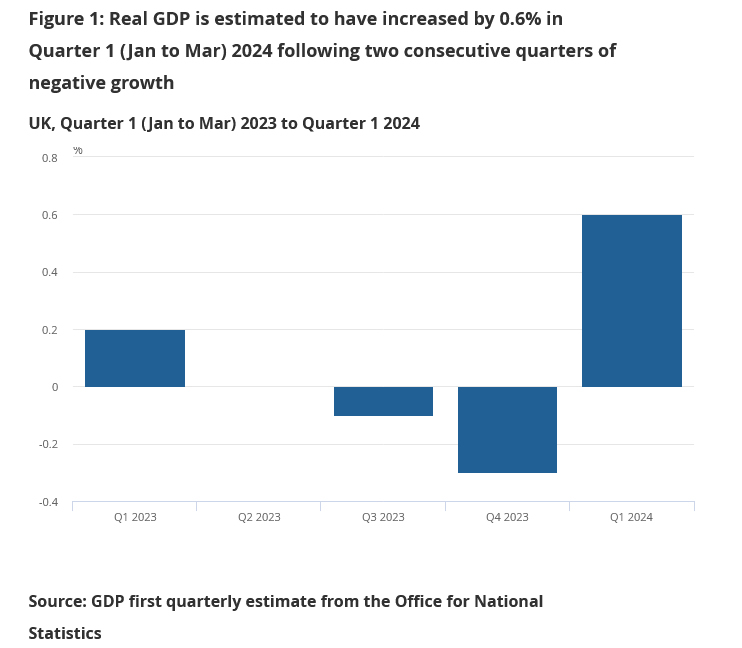
                For Q1, GDP grew 0.6% qoq, above expectation of 0.4% qoq. Compared with the same quarter a year ago, GDP is estimated to have increased by 0.2% yoy. In output terms, services grew by 0.7% on the quarter with widespread growth across the sector; elsewhere the production sector grew by 0.8% while the construction sector fell by -0.9%.

                Full UK monthly and quarterly GDP releases.

                NZ BNZ manufacturing rises to 48.9, signs of life despite prolonged contraction

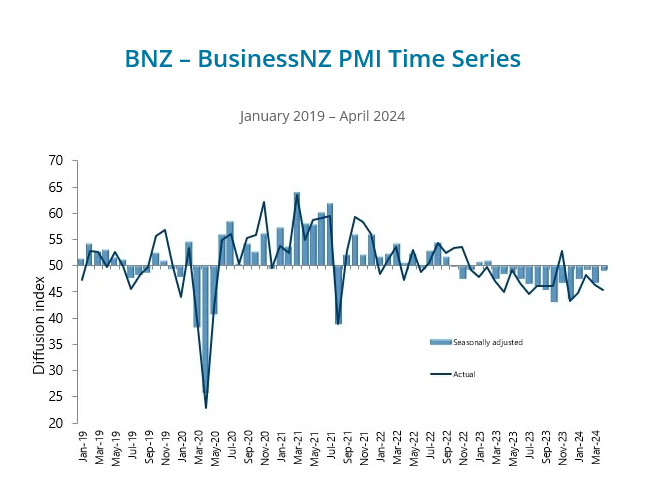
                  New Zealand BusinessNZ Performance of Manufacturing Index rose from 46.8 to 48.9 in April. Despite this improvement, the sector remains in contraction for the 14th consecutive month.

                  Breaking down the components of the index, there were some positive developments in April. Production notably increased to 50.8 from 46.0, and employment also rose to 50.8 from 46.8, both crossing into expansion territory. However, new orders still lagged behind, albeit with a slight improvement to 45.3 from 44.6, indicating that demand continues to be tepid. Additionally, finished stocks and deliveries edged closer to a neutral stance, registering at 50.4 and 48.4, respectively.

                  Catherine Beard, BusinessNZ’s Director of Advocacy, , noted slight improvement in April but also increase in negative sentiment among businesses. She highlighted that “the proportion of negative comments again increased to 69%, compared with 65% in March and 62% in February,” with lack of sales and orders being a recurrent concern alongside the broader struggles of the economy.

                  BNZ Senior Economist Doug Steel provided further insights, stating that “the PMI this year to date is consistent with manufacturing GDP trailing year earlier levels.” He also noted that the details for April were “a bit more mixed,” and they presented a less uniformly weak picture than in recent months.

                  Full NZ BNZ PMI release here.

                  Fed’s Daly discusses dual scenarios for interest rate amid inflation uncertainty

                    San Francisco Fed President Mary Daly articulated the challenges surrounding US inflation, describing it as likely to be a “bumpy ride” going forward. In her comments yesterday, Daly highlighted there is “uncertainly about what the next few months of inflation will look like”.

                    Daly presented two potential scenarios that could influence Fed’s interest rate decisions. In the first scenario, if inflation continues on its recent downward trend alongside a cooling job market, Daly noted that lowering interest rates would be appropriate.

                    Conversely, Daly outlined a second scenario where inflation does not decline as expected but instead remains stagnant, as observed in the first quarter of this year. In such a situation, Daly stated that it would not be appropriate to cut interest rates, unless there is a concurrent weakening in the job market.


                    BoE’s Pill signals rate cut discussions in upcoming meetings

                      BoE Chief Economist Huw Pill expressed growing confidence in the possibility of lowering interest rates and stated that the committee would start discussing it “over the next few meetings”.

                      “We’re growing more and more confident that we can begin to reduce the restriction that monetary policy is putting in the economy and start to cut interest rate,” Pill said at a Q&A session organized by the central bank yesterday.

                      Pill emphasized that the Bank is not quite ready to make these adjustments, stating, “We’re not quite there yet, and we need more evidence.”

                      Yet, he also mentioned, “In the absence of big new disturbances in the economy, we’re going to be thinking about moving interest rates over the next few meetings.”

                      This commentary came after the Bank’s decision to maintain the interest rate at 5.25%, a decision supported by an 8-2 vote. Deputy Governor Dave Ramsden joined Swati Dhingra, the usual dove, in voting for a rate cut, signaling a slight shift towards a more dovish stance within policy-setting committee.

                      US initial jobless claims rises to 231k, vs exp 210k

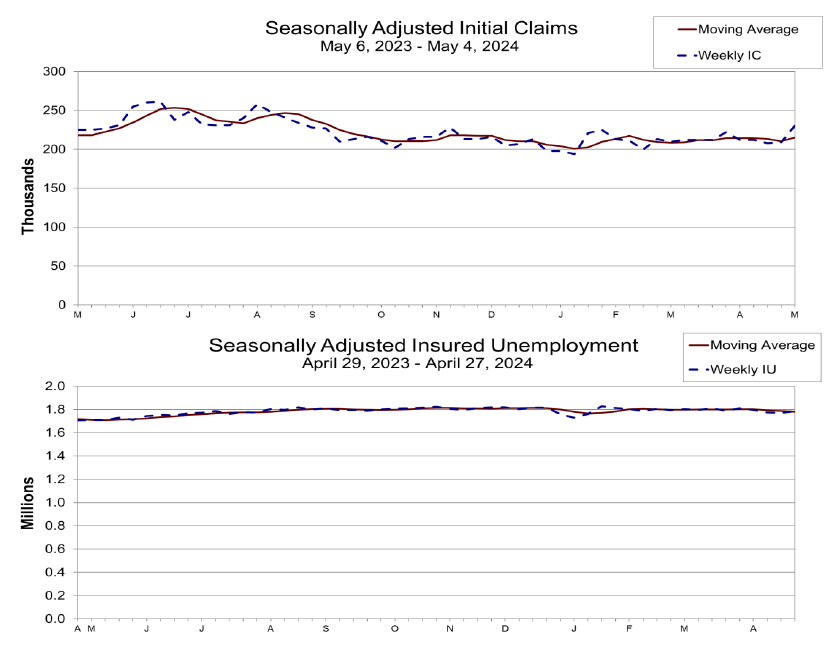
                        US initial jobless claims rose 22k to 231k in the week ending May 4, above expectation of 210k. That’s also the highest level since late August 2023. Four-week moving average on initial claims rose 4.75k to 215k.

                        Continuing claims rose 17k to 1785k in the week ending April 27. Four-week moving average of continuing claims fell -6.25k to 1781k.

                        Full US jobless claims release here.

                        BoE holds rate at 5.25%, Ramsden joins dove camp

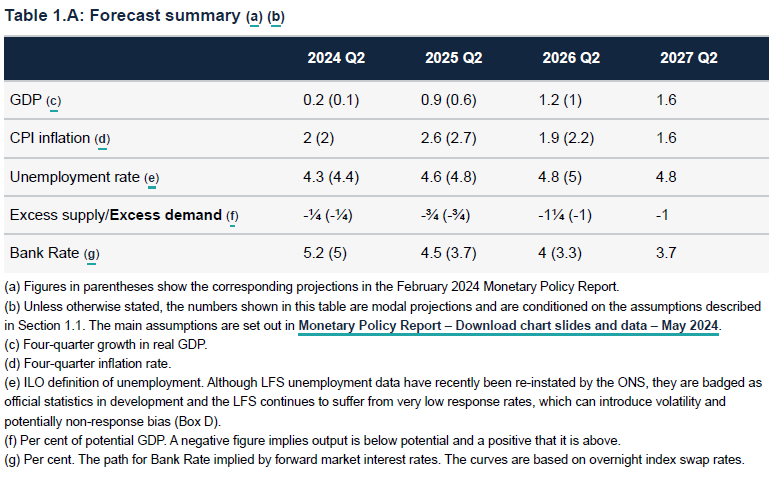
                          BoE maintained Bank Rate at 5.25%, as widely expected. The announcement revealed a subtle dovish shift as evidenced by the voting and adjustments in the accompanying statement. Although these changes are not strong enough to warrant an immediate rate cut in June, they suggest that the central bank is inching closer to easing monetary policy.

                          The meeting concluded with a 7-2 voting split, with Deputy Governor Dave Ramsden joining the typically dovish Swati Dhingra in advocating for a rate cut. Additionally, BoE has explicitly stated its intent to monitor incoming data to assess whether risks from “inflation persistence are receding”, to determine the duration for which current Bank Rate is maintained.

                          Furthermore, in its updated economic forecasts, BoE revised GDP growth projections upwards across the board and lowered CPI expectations for the coming years.

                          Four-quarter GDP growth is projected to be at 0.2% in Q2 2024 (revised up from 0.1%), 0.9% in Q2 2025 (up from 0.6%), 1.2% in Q2 2026 (up from 1%) , and then 1.6% in Q2 2027.

                          CPI inflation is projected to be at 2% in Q2 2024 (unchanged), 2.6% in Q2 2025 (down from 2.7%), 1.9% in Q2 2026 (down from 2.2%, and then 1.6) in Q2 2027.

                          Full BoE statement and Monetary Policy Report.

                          Record high for FTSE as markets eye BoE for rate cut clues

                            As BoE meets today, expectations are set for interest rate to remain unchanged at 5.25%. The focal point for investors, however, is any signal from regarding rate cuts. Financial markets have already fully priced in a first 25bps by August, with a 40% probability assigned to such a move occurring as soon as June. Additional reductions are expected later in November or December, lowering the Bank Rate to 4.75% by year-end, with further cuts anticipated in 2025.

                            The likelihood of BoE providing clear indication today about the timing of these rate cuts remains low. Any hints will be subtly embedded within the voting outcomes and the newly updated economic forecasts. Market predictions suggest an 8-1 voting split, with Swati Dhingra expected to maintain her stance for a rate cut. Meanwhile, hawks like Catherine Mann and Jonathan Haskel are not predicted to shift their positions drastically and return to vote for hike. A significant variable in this equation is whether Deputy Governor Dave Ramsden will align with Dhingra, adding weight to the dovish side.

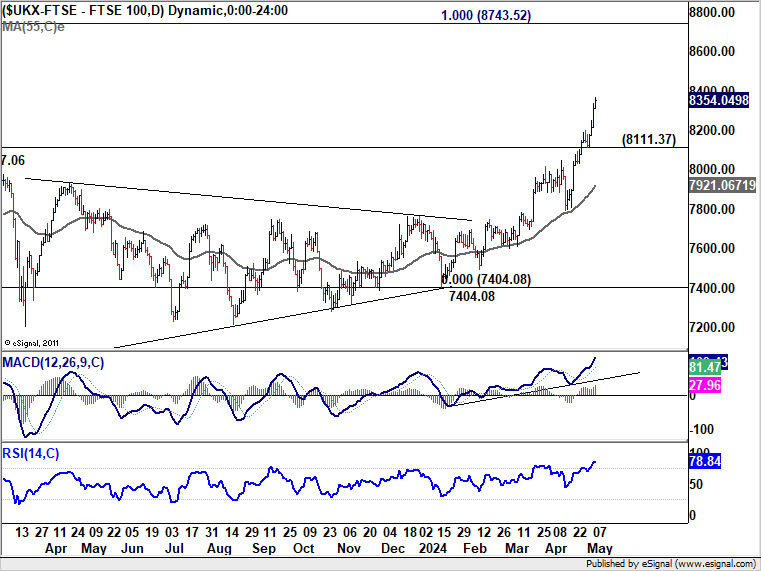
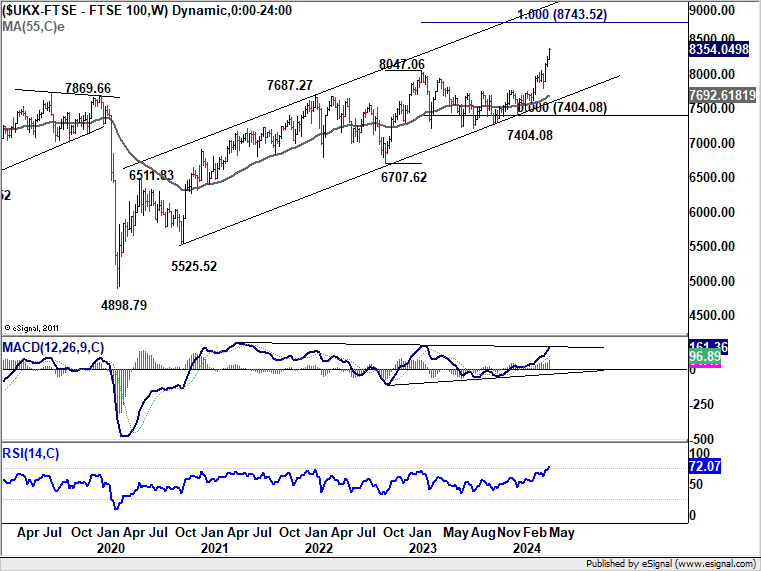
                            FTSE surged to new record high yesterday, partly supported by a weaker Pound, and more importantly as the UK economy is clear out of last year’s shallow recession, with strong momentum in the services sector. Technically, near term outlook in FTSE will stay bullish as long as 8111.37 support holds. Next target is 100% projection of 6707.62 to 8047.06 from 7404.08 at 8743.52.

                            China’s exports rises 1.5% yoy in Apr, imports surges 8.% yoy

                              China’s trade figures for April showcased significant recovery, with exports increasing by 1.5% yoy to USD 292.5 B, exceeding the expected 1.0% yoy growth. This rebound is particularly noteworthy given the -7.5% yoy decline observed in March.

                              On the import side, there was a notable surge of 8.4% yoy to USD 210.1B, substantially higher than the forecasted 5.4% yoy. This rise marks a recovery from the -1.9% decline in March. The significant increase in imports, driven partly by a weaker comparison base from the previous year, also reflects an uptick in economic activity as domestic conditions improve.

                              Trade surplus for April stood at USD 72.4B, smaller than the expected USD 81.4B but still an improvement from USD 58.6B recorded in March.

                              BoJ meeting summary indicates hawkish shift

                                Summary of Opinions from BoJ’s April meeting revealed a notable hawkish tilt among its board members, with significant dialogue concerning further rate hikes. This development reflects a growing concern over inflationary pressures and the impact of a weaker yen, which could hasten monetary policy normalization.

                                One board member highlighted that if the economic activity and price forecasts from April are realized, future policy interest rates might be “higher than the path that is factored in by the market.”

                                Further discussions emphasized the necessity of managing transitions carefully to mitigate shocks from sudden and substantial policy changes once price stability target is achieved. One approach proposed involves “moderate policy interest rate hikes”.

                                Another critical point raised was the impact of a weakening yen on inflation. A board member warned that if underlying inflation continues to rise above the baseline scenario due to the currency’s depreciation, “it is quite possible that the pace of monetary policy normalization will increase”.

                                Full BoJ Summary of Opinions here.

                                Japan’s real wages fall -2.5% yoy, declining for 24th consecutive month

                                  In Japan, real wages fell notably by -2.5% yoy in March, marking a worsening trend from the previous month’s -1.8% yoy. It also extended the streak of declines to 24 consecutive months—the longest since such data was first recorded in 1991.

                                  Nominal wages, which include total cash earnings, grew modestly by 0.6% yoy in March, a deceleration from February’s 1.4% yoy increase. Although regular pay saw a rise of 1.7% yoy , this was offset by -1.5% yoy decline in overtime pay, which has fallen for four consecutive months. Furthermore, special payments, which encompass bonuses and other benefits, saw a sharp decrease of -9.4% yoy.

                                  The persistence of wage declines occurs despite a seemingly favorable outcome from Japan’s annual labor-management wage talks this spring, which were described as the most beneficial for workers at major companies in three decades.

                                  However, a labor ministry official noted that the results of the “shunto” wage negotiations were not reflected in the March data. With these results expected to influence the figures from April onwards, there is a focus on whether real wages will show an improvement and turn positive for the first time in two years.

                                  Fed’s Collins: Bringing down inflation will require more time

                                    Boston Fed President Susan Collins described current monetary policy as “well positioned” to adapt based on new economic data and the evolving economic outlook. She is “optimistic” that Fed can achieve 2% inflation target in a “reasonable amount of time” while maintaining a robust labor market. However, she now anticipates that reaching this goal will “take more time than previously thought.”

                                    Collins highlighted “recent upward surprises to activity and inflation”. This has led her to suggest that maintaining the current policy level might be necessary for a longer period than initially expected. She emphasized the importance of ensuring that inflation moves “sustainably toward 2%” before considering any policy adjustments.

                                    ECB’s Holzmann decisively against quick and strong interest rate cuts

                                      In an interview published today, ECB Governing Council member Robert Holzmann indicated that while he is open to rate cut in June, “I see absolutely no reason for us to cut key interest rates too quickly, too strongly,” he said.

                                      Holzmann also acknowledged the significant influence of Fed on ECB decision-making. He described the Fed as “the gorilla in the room,” emphasizing how ECB policies are, to some extent, shaped by actions taken by the US central bank, particularly due to the dollar’s pivotal role in the global economy.

                                      ECB’s Wunsch sees path to start rate cut, but not preset course of action

                                        Speaking in Frankfurt, ECB Governing Council member Pierre Wunsch indicated the even though the outlook remains “foggy”, he saw a “path for initiating rate cuts this year.” He added that the upcoming June meeting would provide clearer insights into wage and service sector dynamics for making the decision.

                                        Wunsch further explained that there is “no sign of de-anchoring” regarding longer-term inflation expectations, which supports the argument the costs of remaining “tight for too long” seem to outweigh those of a “premature loosening”.

                                        However, Wunsch also noted “significant risks” related to the path of wage growth and inflation in sectors with high labor costs. Therefore “now is not the time to commit to a preset course of action” he added.

                                        WTI crude trends downward amid revised EIA supply and demand forecasts

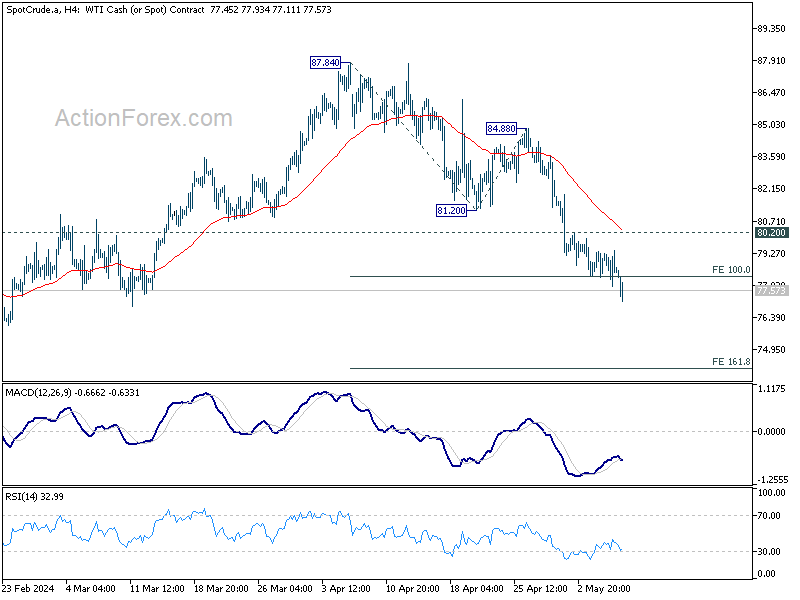
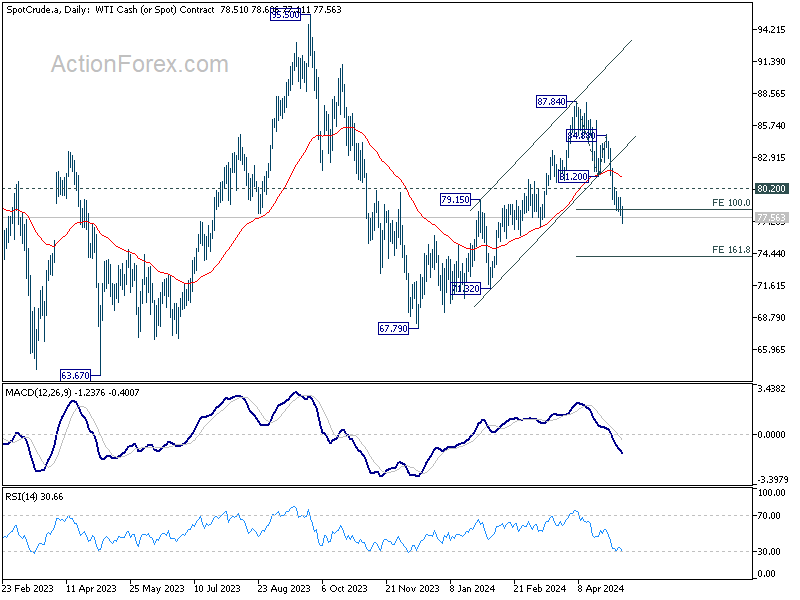
                                          WTI crude oil is extending its near term decline today on expectation of higher production and lower demand ahead. If WTI cannot reclaim 80 mark in short term, there is prospect of downside acceleration through 70 next.

                                          In its latest report, the US Energy Information Administration revised its expectations for this year’s global oil and liquid fuels output upwards while reducing its demand forecasts.

                                          Notably, it now anticipates that global oil and liquid fuels consumption will increase by 920k bpd to 102.84m bpd, a slight reduction from the previously forecasted growth of 950k bpd.

                                          On the production side, total world crude oil and liquid fuels production is expected to rise by 970k bpd to 102.76m bpd, up from the earlier estimate of 850k bpd increase.

                                          Technically, the break of 100% projection of 87.84 to 81.20 from 84.88 at 78.24 suggests WTI is probably ready for downside acceleration. Near term outlook will stay bearish as long as 80.20 resistance holds. Next target is 161.8% projection at 74.13.

                                          More importantly, the fall from 87.84 is seen as the third leg of the pattern from 95.50. There is prospects of deeper decline through 67.79 towards 63.67 (2023 low) in the medium term.