




ECB’s Nagel uncertain if rate plateau is reached

    ECB Governing Council, Joachim Nagel, Bundesbank head, posed a crucial question in his speech in Frankfurt, “Have we reached the plateau” on interest rates? He answered by stating that it “cannot yet be clearly predicted”. He continued, elaborating that “the forecasts still only show a slow decline toward the target level of 2%.”

    Nagel’s comments hinted at the continuous monitoring of economic indicators, suggesting that while borrowing costs are expected to “remain at a sufficiently high level for a sufficiently long time,” the exact interpretation hinges on the incoming data.

    Addressing concerns about Germany’s economic health, he remarked that characterizing Germany as the ‘sick man’ “seems exaggerated.” He attributed the present sluggish growth to specific influences such as the global economic deceleration, Russia’s conflict with Ukraine, and reduced public expenditure. Offering a silver lining, Nagel projected, “Once we get past the worst of these special factors, the weak growth should also ease. We expect the economy to grow again in 2024.”

    On the other hand, Latvia’s central bank chief, Martins Kazaks, highlighted the structural nature of recent oil price hikes. He pointed out, “The recent oil price increase in my view is not a temporary or transitory, it’s very much a structural issue.” Such dynamics, according to Kazaks, present heightened inflation risks. Regarding the anticipated rate cuts, he expressed skepticism about their timing, asserting, “I think expecting rate cuts mid next year is somewhat too early.”

    SNB bucks expectations and keeps interest rate steady

      In an unexpected move that diverged from the market’s anticipations, SNB held its policy rate steady at 1.75%, side-stepping the anticipated hike to 2.00%. The conditional inflation projections have undergone downward revision. While inflation could surge above 2% target in upcoming quarters, it’s projected to retract back to 1.9% in 2025 based on current interest rate, without further tightening.

      Despite this, SNB did not completely distance itself from a hawkish tone, and maintained the further tightening “may become necessary”. It also reiterated the willingness to intervene in the market with focus on “selling foreign currency

      Delving into the specifics of the conditional inflation projections, based on steady 1.75% policy rate, inflation is forecasted to ascend to 2.0% by the end of this year. It will scale up to its apex at 2.2% in the second quarter of 2024, before experiencing a slight dip to 1.9% at the onset of 2025, maintaining that level thereafter.

      On the economic growth front, SNB’s projections lean towards the cautious side, forecasting tepid growth for the remainder of the year. The annual growth is projected to hover around a modest 1%.
      BoE and SNB looms as GBP/CHF awaits Clarity

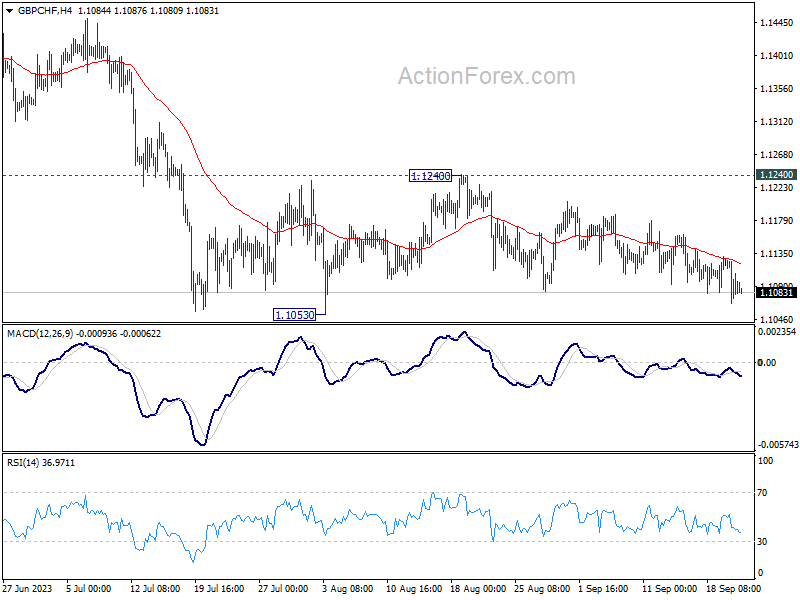
        Today, all eyes are firmly fixed on BoE and SNB rate decisions, which are poised to offer directional cues for the GBP/CHF, hopefully. The pair has been bounded in a constrained range for some time, hungry for a catalyst to redefine its movement.

        On one hand, BoE is grappling with the aftermath of lackluster UK inflation data, leaving its imminent rate decision hanging in a delicate balance. The central bank faces two potential paths: embracing a hawkish hold akin to Fed, hence deferring a rate hike while keeping it in the future playbook, or mirroring ECB’s strategy with a dovish hike, signaling a peak in the tightening cycle. This undetermined stance has metamorphosed the rate decision into somewhat of a coin toss.

        Meanwhile, the consensus among analysts is leaning towards a 25bps hike by SNB, setting the interest rate at a neat 2.00%, thereby drawing the current cycle to a close. This perspective, held by a substantial majority of economists surveyed by Bloomberg, finds reinforcement in the upward revision of the 2024 inflation forecasts tabled by SECO yesterday.

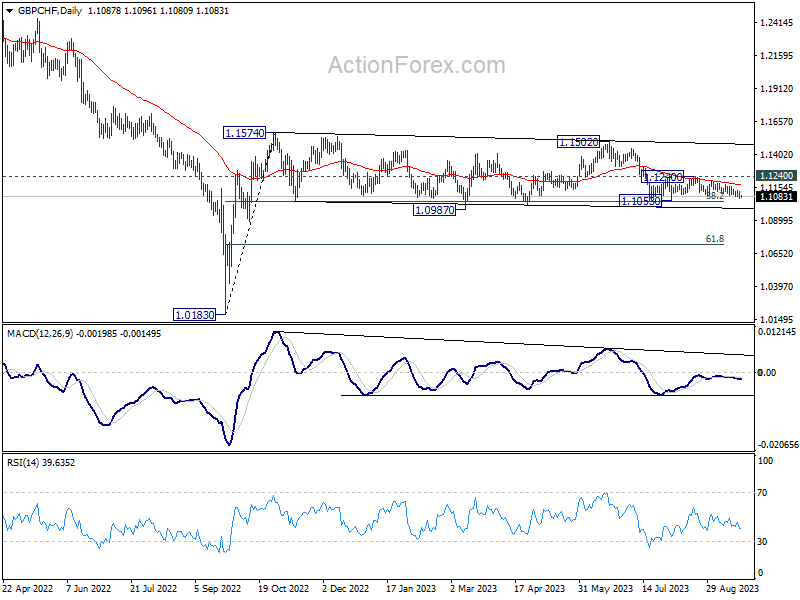
        Casting an eye on GBP/CHF, it is currently oscillating within a short-term range between 1.1053 and 1.1240. Presently, its trajectory is hard to pin down. The bearish sentiment is palpable with the pair capped below by 55 D EMA at 1.1709. However, this is offset by the steadfast support at 38.2% retracement of 1.0183 to 1.1574 at 1.1043.

        For a clear bearish momentum to materialize, the cross would need to break the 1.1053 support, and then ensuring it sustainably trades below 1.1043 – a weekly close below this fibonacci level would solidify this stance. Yet, a spike lower, followed a substantial rebound could indicate a bullish reversal, hinting at a potential rise past 1.1240 resistance later, to extend the medium term range trading from 1.1574.

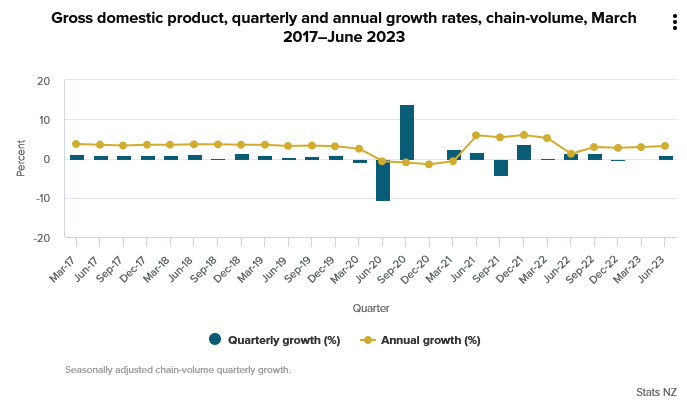
        New Zealand’s Q2 GDP outperforms expectations with 0.9% qoq growth

          New Zealand’s GDP surged by 0.90% qoq in Q2, doubling the expected growth rate of 0.4%. This notable growth is significantly attributed to substantial boost in the business services sector, specifically within the realm of computer system design.

          Despite a setback in the primary industries, which contracted by 1.9%, goods-producing industries and service sectors pulled their weight, recording a growth of 0.7% and 1.0% respectively. The service sector emerged as a strong pillar of economic advancement.

          The quarter also saw manufacturing sector shake off its lethargy, reversing a trend of decline sustained over five consecutive quarters to contribute positively to the economic pie.

          Full NZ GDP release here.

          S&P 500 dips on Fed’s definitive hawkish stance

            US equities ended their trading session in the red, following a definitive hawkish stance from Fed, even though interest rate was kept unchanged as expected. Fed sent a clear signal that another rate hike is still on the cards this year, and interest rate is going to stay higher for longer. Fed Chair Jerome Powell confirmed in the post meeting press conference, “We’re in a position to proceed carefully in determining the extent of additional policy firming.”

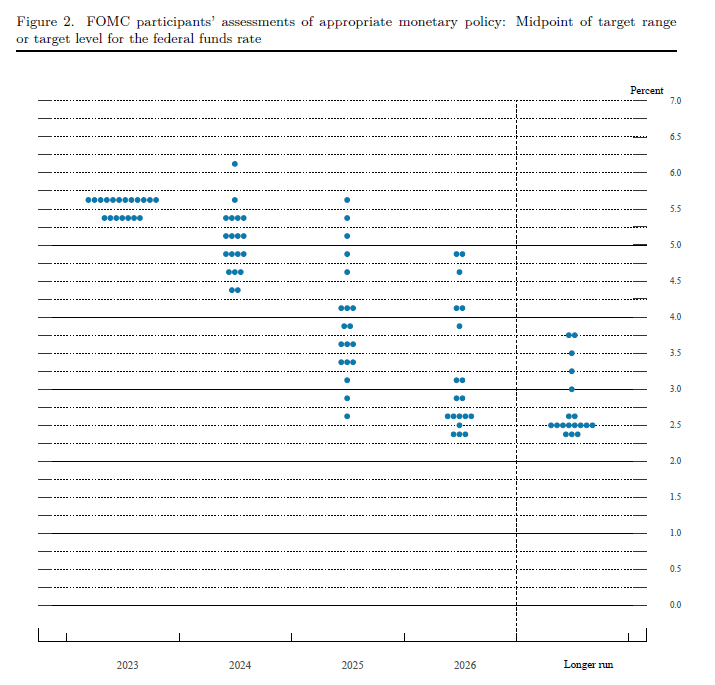
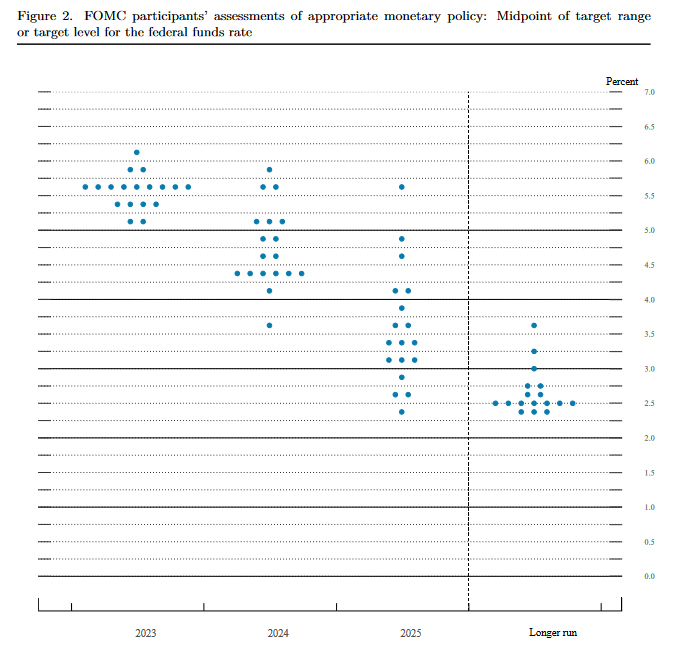
            The new batch of economic projections divulged a prevailing sentiment among 12 of 19 Fed officials in favor of one more rate hike within this year. Investors were taken by surprise not by the rate hike anticipation but by the foreseeing of lesser rate cuts in 2024, a strategic shift attributed largely to the resilient labor market.

            Furthermore, the projections hinted at a steeper path for interest rates in the years ahead. Median outlook for federal funds rate was adjusted upwards, settling at 5.1% for 2024, from a prior 4.6%, and 3.9% for 2025, up from 3.4%. This suggests that monetary policy will lean on the tighter side stretching into 2026. A 2.9% funds rate is projected for 2026, marking a divergence from the long-run neutral rate, which remains pegged at 2.5%.

            More on Fed:

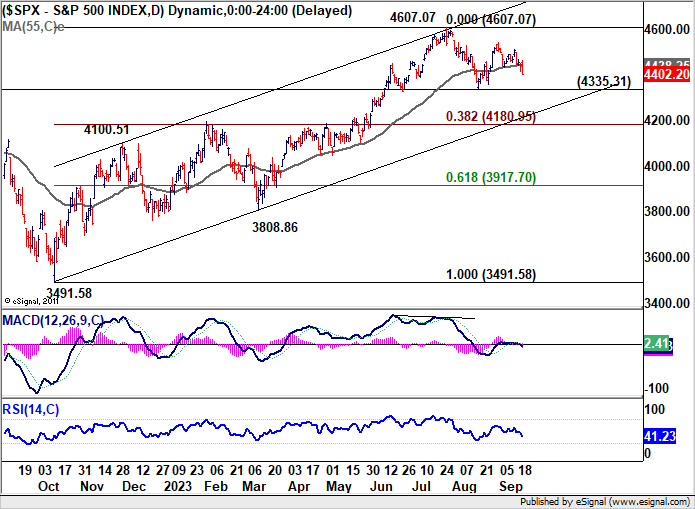
            Reflecting these developments, S&P 500 took a dip, shedding -0.94% or -41.75 points to conclude at 4402.20. In a technical context, S&P 500’s movements stemming from 4607.07 are perceived a correction pattern. D deeper slide is on the cards to 4335.31 or even lower.

            However, robust support levels are anticipated around the 38.2% retracement of 3491.58 to 4607.07 at 4180.95. This is expected to limit further losses, at least at first attempt. Meanwhile, a close above 55 D EMA (now at 4438.25) will neutralize the bearish outlook.

            Fed stands pat, 12 members see one more hike

              Fed keeps federal funds rate unchanged at 5.25-5.50% as widely expected, by unanimous vote. Tightening bias is maintained as “The Committee would be prepared to adjust the stance of monetary policy as appropriate if risks emerge that could impede the attainment of the Committee’s goals”.

              In the new dot plot, 12 of 19 policymakers penciled in one more 25bps rate hike this year to 5.50-5.75%. By

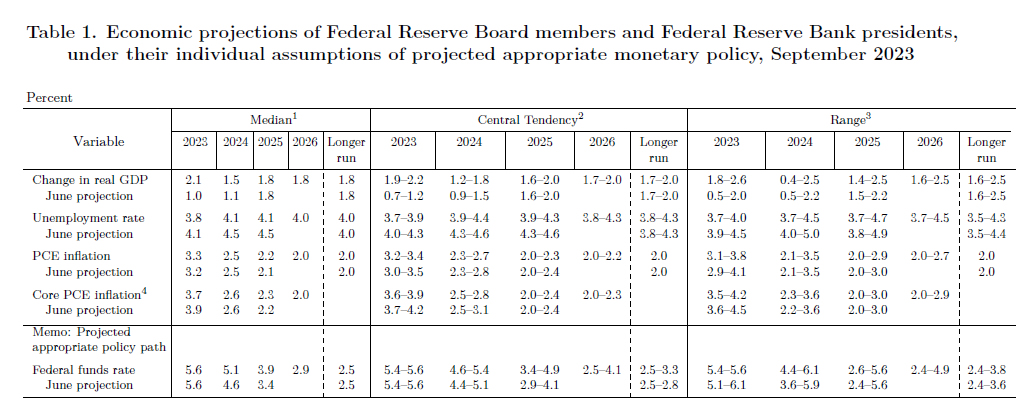
              In the new median projections,

              • 2023 GDP growth is revised up to 2.1% (from 1.0%).
              • 2024 GDP growth is revised up to 1.5% (from 1.1%).
              • 2025 GDP growth is unchanged at 1.8%.
              • 2023 unemployment rate is revised down to 3.8% (from 4.1%).
              • 2024 unemployment rate is revised down to 4.1% (from 4.4%).
              • 2025 unemployment rate is revised down to 4.1% (from 4.5%).
              • 2023 PCE inflation is revised up to 2.2% (from 3.2%).
              • 2024 PCE inflation is unchanged at 2.5%.
              • 2025 PCE inflation is revised up to 2.2% (from 2.1%).
              • 2023 core PCE is revised down to 3.7% (from 3.9%).
              • 2024 core PCE is unchanged at 2.6%.
              • 2025 PCE is revised up to 2.3% (from 2.2%).
              • 2023 federal funds rate unchanged at 5.6%.
              • 2024 federal funds rate raised to 5.1% (from 4.6%).
              • 2025 federal funds rate raised to 3.9% (from 3.4%).


              Full FOMC statement here.

              Full Summary of Economic Projections here.


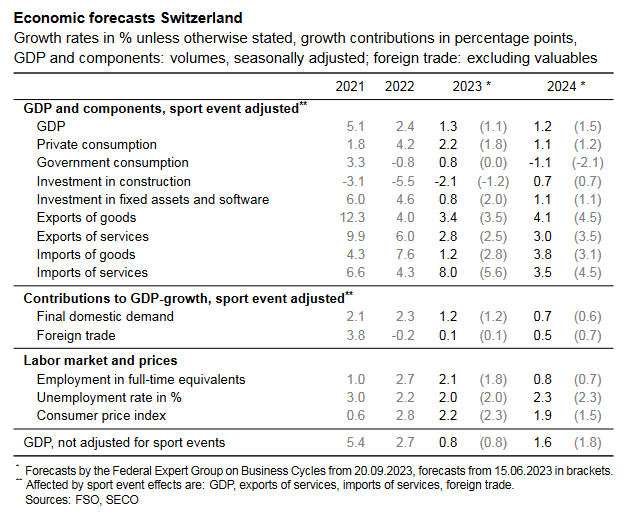
              Swiss SECO downgrades 2024 growth forecast, raises inflation

                In the update to Swiss State Secretariat for Economic Affairs economic forecasts, a marginal upgrade has been bestowed upon Switzerland’s 2023 GDP outlook, leveraging the robust performance in the first quarter. The forecast, adjusted for sporting events, now stands at 1.3%, a slight increase from the 1.1% predicted in June.

                Despite this adjustment, outlook for 2024 has experienced a cut, settling at 1.2% as opposed to the earlier estimation of 1.5%. This renders the prospects for economic growth considerably below-average for both 2023 and 2024.

                Shifting focus to CPI forecasts, the estimation for 2023 have been marginally trimmed down to 2.2%, a -0.1% decrease from June forecast. Conversely, 2024 projection experiences a hike, ascending from 1.5% to 1.9%.

                SECO points towards substantial economic risks looming on the horizon. A pressing concern is the international persistence of inflation. The panorama of economic challenges also encompasses escalating risks tied to the global debt scenario fluctuations in property and financial markets. Monetary policy transmission could also be stronger than assumed.

                Furthermore, the evolving situations in Germany and China emerge as potent risk factors, not just for the global economy but significantly impacting Swiss foreign trade.

                Full SECO release here.

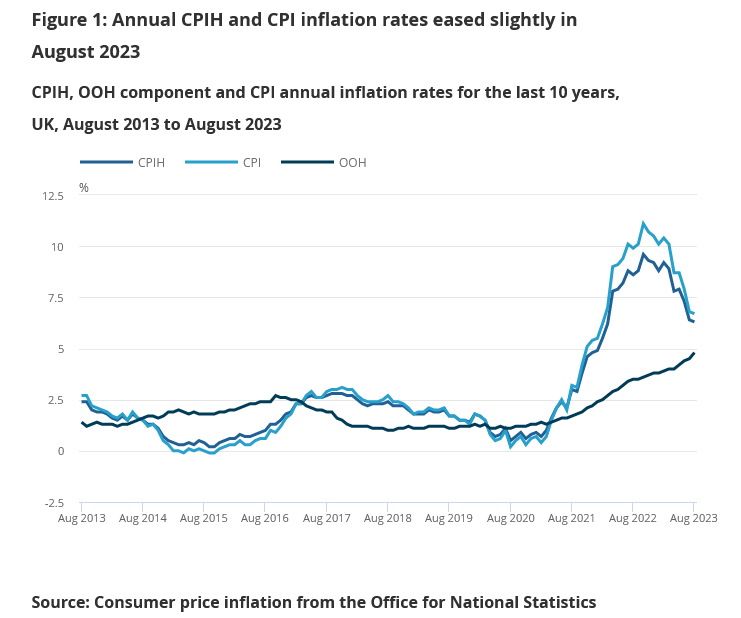
                UK CPI slowed to 6.7%, BoE’s hike tomorrow could be the last

                  Sterling is facing headwinds after release of UK’s CPI inflation data, which came in lower than market forecasts. This development strengthens the speculation that BoE might be drawing curtains on its tightening cycle, with the one more hike expected tomorrow potentially being the concluding move.

                  The reported data illustrated deceleration in CPI from of 6.8% yoy to 6.7% yoy in August, a result that fell short of the projected escalation to 7.1% yoy. This is the lowest rate witnessed since February 2022.

                  A deeper dive into the components reveals that this softening of annual CPI into August 2023 emerged from six out of the 12 sectors. Notably, restaurants and hotels, along with food and non-alcoholic beverages, played a pivotal role in pulling down the numbers. However, the motor fuels category within the transport sector exerted upward pressure, somewhat counterbalancing the decline.

                  Furthermore, core CPI, which is calculated by excluding variables such as energy, food, alcohol, and tobacco, followed suit, decelerating from 6.9% yoy to 6.2% yoy. This stands significantly below anticipated rate of 6.8% yoy.

                  Breaking it down further, while CPI goods noted a slight acceleration from 6.1% yoy to 6.3% yoy, CPI services delineated a slowdown from 7.4% yoy to 6.8% yoy.

                  For the month. CPI rose 0.3% mom in August, below expectation of 0.7% mom.

                  Full UK CPI release here.


                  US treasury yields hit 16-Year peaks as markets await Fed’s insights

                    As anticipation builds around Fed impending monetary policy decision today, US 5- and 10-year Treasury yields surged to levels not seen in 16 years. With market expectations firming around a hold in the range of 5.25-5.50% – a forecast that has been in place for over a month – the possibility of any shock moves by the Fed is remote.

                    Nevertheless, investors will keenly dissect any subtle hints from Fed that might suggest another rate hike this year, or provide clues about the timing and speed of monetary easing in 2024. The forthcoming “dot plot” will be of particular significance.

                    To recall, in their June meeting, 12 out of 18 policymakers envisioned at least one more rate hike in the calendar year. 10 anticipated interest rates to fall back to 4.50-4.75% by the close of 2024. The evolving position of these dots is bound to sculpt market sentiments for the forthcoming months.

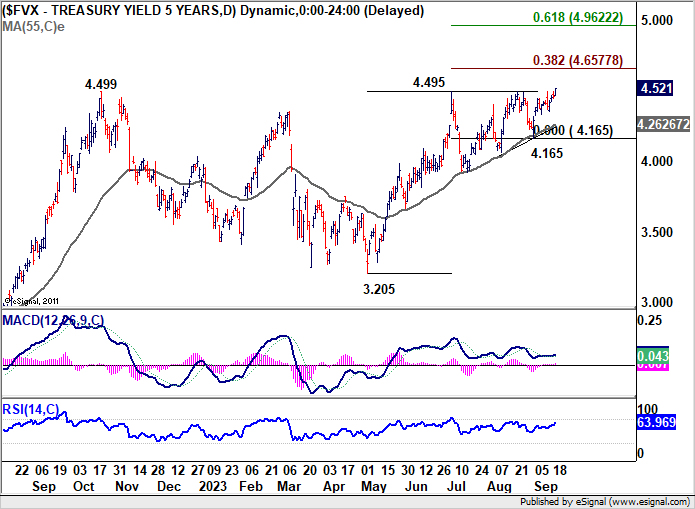
                    Five-year yield exhibited a strong close overnight, at an unmatched zenith since 2007, recording a 4.521. This surge found an ally in the WTI crude oil, which leaped, touching the 93-mark.

                    On the technical front, FVX looks ready to resume is long term up trend to finally get rid of resistance zone at around 4.5. The next hurdle is 38.2% projection of 3.205 to 4.495 from 4.165 at 4.657.

                    Any upside surprises in today’s Fed inflation projections could potentially steer FVX towards the 4.657 projection level. Yet, surpassing this level might necessitate a sustained WTI oil rally, breaking the 95 mark and advancing towards 100.


                    Australia Westpac leading index edged up to -0.5%, growth struggles despite population boom

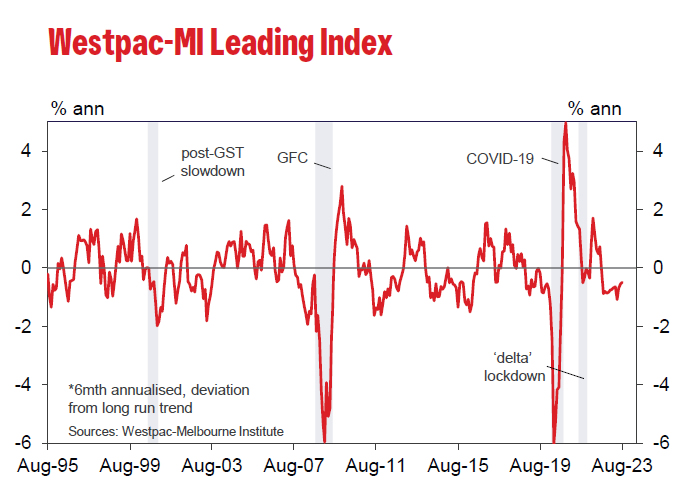
                      Westpac Leading Index for Australia indicates that the nation’s growth outlook remains subdued. The index inched up marginally from -0.56% to -0.50% in August, marking a year since it began registering negative readings. These figures suggest that the prospect of per capita GDP advancing in the coming 3–9 months appears bleak.

                      Westpac’s forecasts for the next year resonate with the index’s gloomy narrative, anticipating an economic growth of less than 1% for the year leading up to June 2024. Interestingly, there’s a potential silver lining: with predictions pointing to population growth surpassing 2% in 2023, this could introduce some upside risks to the otherwise somber economic projections.

                      However, despite this population surge, the economy is projected to trail behind, as evident from the March and June quarter results. Both quarters witnessed a contraction of -0.3% in GDP per capita, a pattern that’s predicted to persist in the forthcoming year.

                      Regarding next RBA rate decision on October 3, Westpac said it’s “almost certain to hold rates steady for another month”. The crucial data for the next move would be September quarter inflation report, which will not be available until the November RBA meeting.

                      Full Australia Westpac Leading Index release here.

                      Japan’s exports to China tumble further, trade with US flourishes

                        Japan’s economic data shows a dwindling momentum in the country’s export sector, registering a decline of -0.8% yoy to JPY 7994B in August, with a particularly notable decrease in its trading activities with China.

                        The continued dip in exports is largely attributed to diminishing overseas demand and the trade restrictions imposed by China, which have significantly impacted Japan’s trade balance.

                        A striking example is seen in the sharp -11.0% yoy decline in exports to China, to a total of JPY 1.44T. This downturn marks the third consecutive month of double-digit drops in export activities to China, severely affected by the -41.2% yoy plunge in food exports due to China’s ban on Japanese seafood.

                        However, a beacon of positivity trading rapport with US, which saw a growth spurt of 5.1% yoy, aggregating to a record JPY 1.62T for the month of August. This surge has been primarily fueled by a heightened demand for Japanese cars, mining, and construction machinery.

                        On the import front, Japan noted a considerable -17.8% yoy reduction to JPY 8925B, with imports from China dipping -12.1% to JPY 1.93T, and those from US falling -9.5% yoy to JPY 967.39B. The nation’s trade balance has consequently been reported at a deficit of JPY -930.5B.

                        When analyzed in seasonally adjusted terms, both exports and imports showcase a month-on-month decrease, registering -1.7% mom to JPY 8267.8B and -2.1% mom to JPY 8823.6B, respectively. Thankfully, there is a silver lining as the trade deficit has slightly narrowed compared to the previous month, standing at JPY -555.7B.

                        Full Japan trade release here.

                        BoC Kozicki speaks on recent swings in inflation

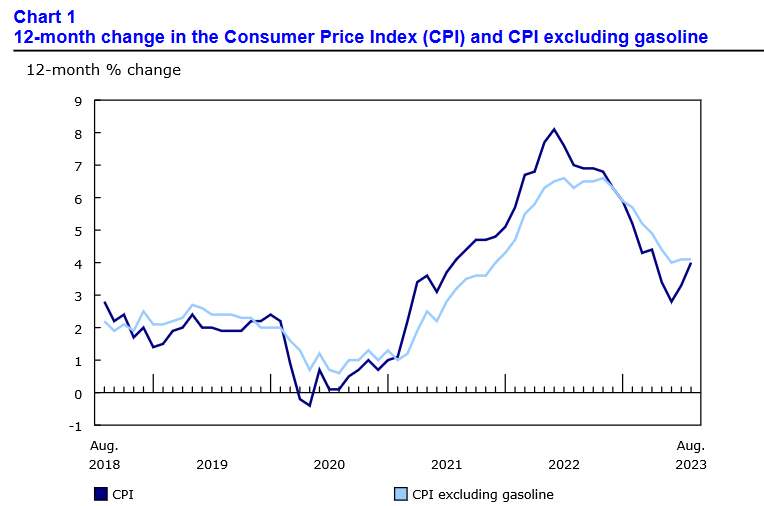
                          BoC Deputy Governor Sharon Kozicki acknowledged in a speech that CPI inflation has seen “ups and downs of the size we’ve seen in the past couple of months,” highlighting a decrease from a high of 8.1% in June 2022 to 2.8% in June this year. However, this decrease was followed by a surge to 3.3% in July and 4.0% in August (as released yesterday). Despite this decrease and subsequent rise, she affirmed that such fluctuations are “not that unusual.”

                          She emphasized the Bank’s approach to monitoring inflation, which includes a focus on measures of core inflation that exclude more volatile price movement components to get a true sense of underlying inflation.

                          “Measures of core inflation have eased,” she noted, yet underlined that “inflationary pressures are still broad-based.” She continued to express concern over the number of CPI components with price increases exceeding 5%, which, despite being lower than before, remains “much higher than it usually is when inflation is stable and close to 2%.”

                          Acknowledging that “underlying inflation is still well above the level that would be consistent with achieving our target of 2% CPI inflation,” Kozicki emphasized the Bank’s commitment to continuous evaluation of several factors such as “the evolution of excess demand, inflation expectations, wage growth and corporate price-setting behaviour” to ensure alignment with the 2% inflation target.

                          To maintain economic stability amidst the dynamic inflationary environment, Kozicki emphasized that the Bank is “prepared to raise the policy interest rate further if needed.”

                          Full speech of BoC Kozicki here.

                          Canada CPI jumps to 4% yoy on gasoline, above expectation of 3.8% yoy

                            Canada CPI accelerated to 4.0% yoy in August, up from July’s 3.3% yoy, above expectation of 3.8% yoy. The in CPI was largely the result of higher year-over-year prices for gasoline in August (+0.8%) compared with July (-12.9%). Excluding gasoline, CPI was unchanged at 4.1% yoy.

                            CPI median rose from 3.7% yoy to 4.1% yoy, above expectation of 3.7% yoy. CPI trimmed rose from 3.6% yoy to 3.9% yoy, above expectation of 3.5% yoy. CPI common was unchanged at 4.8% yoy, matched expectations.

                            On a monthly basis, CPI rose 0.4% mom in August, double expectation of 0.2% mom.

                            Full Canada CPI release here.

                            OECD downgrades 2024 global growth, interest rate close to current levels into 2024

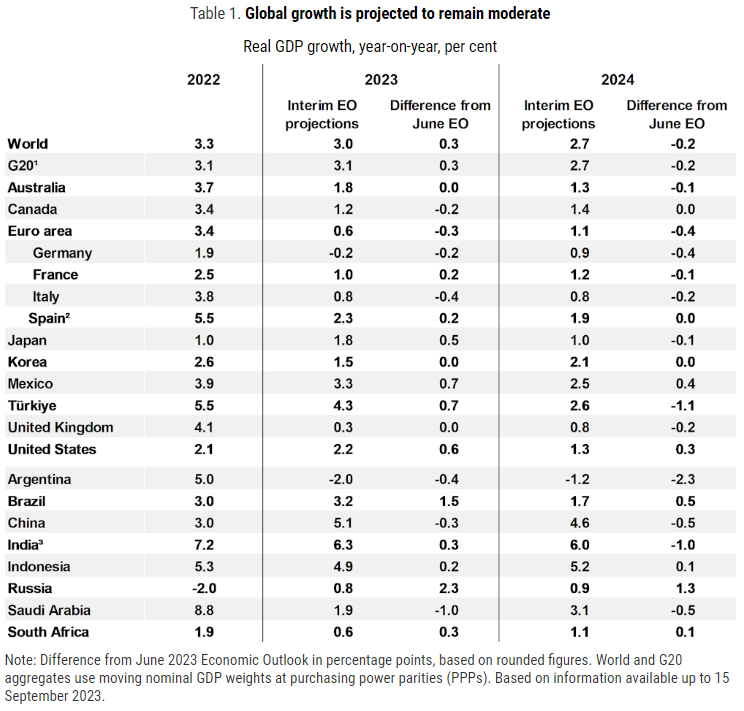
                              The latest OECD Interim Economic Outlook has revealed revised global growth forecasts, with an incremental uptick for 2023 followed by a slight dip in 2024. The updated predictions reflect a blend of uplifted expectations for some economies and dampened hopes for others, amidst a backdrop of inflation concerns and the repercussions of a more sluggish recovery in China.

                              For 2023, the global economic growth forecast now stands at 3.0%, marking a 0.3% increase from previous predictions. Conversely, projections for 2024 have seen a decrease of -0.2%, bringing the anticipated growth down to 2.7%.

                              Dissecting the outlook on a regional basis unveils a mixed bag of prospects:

                              • US: A positive revision with growth estimates standing at 2.2% for 2023, up by 0.6%, and a 1.3% prediction for 2024, reflecting a 0.3% increase.
                              • Eurozone: Here the expectations have been trimmed down with 2023 forecasts reduced by -0.3% to a mere 0.5%, and a 2024 estimate of 1.1%, down by -0.4%.
                              • Japan: The outlook for 2023 appears brighter with a 0.5% increase to 1.8%, although the 2024 forecast has been slightly reduced by -0.1%, standing at 1.0%.
                              • China: Forecasts have been negatively revised to 4.1% in 2023, a drop of -0.3%, and 4.6% in 2024, reflecting a decrease of -0.5%.

                              The OECD outlook points out considerable downside risks, emphasizing potential persistency in inflation accompanied by potential disruptions in the food and energy markets. Slowdown in China’s economy stands as a prominent concern, with ripple effects expected to diminish growth in global trading partners and possibly undercut business confidence universally.

                              Projections for headline inflation in G20 nations indicate a gradual decrease through 2023, moving from 7.8% in 2022 to 6.0% in 2023, and further dwindling to 4.8% in 2024. However, core inflation, primarily fueled by the services sector and relatively taut labour markets, is predicted to linger, necessitating a sustained restrictive posture in monetary policy across several countries.

                              As economies globally grapple with these changing dynamics, the emphasis remains on steering a cautious course, with a keen eye on inflation patterns as a decisive factor in shaping future policy directions. The evolving economic narrative dictates a necessity for many countries to maintain interest rates close to their present markers, extending well into 2024.


                              Full OECD Interim Economic Outlook release here.

                              Eurozone CPI finalized at 5.2% in Aug, core CPI at 5.3%

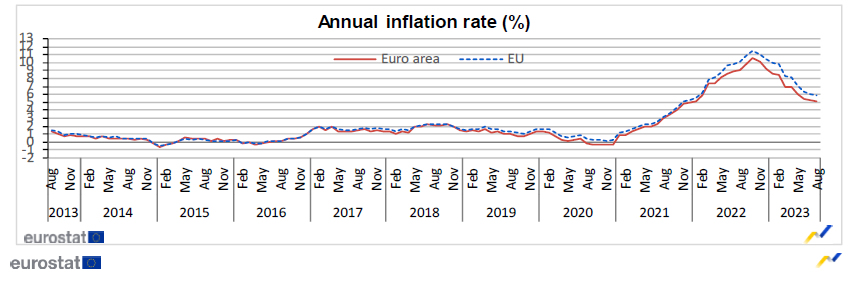
                                Eurozone CPI was finalized at 5.2% yoy in August, down from 5.3% yoy in July. CPI core (all-items ex-energy, food, alcohol & tobacco) was finalized at 5.3% yoy, down from 5.5% yoy in July. Services prices slowed from 5.6% yoy to 5.5% yoy. Energy prices rose from -6.1% yoy to -3.3% yoy.

                                EU CPI was finalized at 5.9% yoy, down from 6.1% yoy in July. The lowest annual rates were registered in Denmark (2.3%), Spain and Belgium (both 2.4%). The highest annual rates were recorded in Hungary (14.2%), Czechia (10.1%) and Slovakia (9.6%). Compared with July, annual inflation fell in fifteen Member States, remained stable in one and rose in eleven.

                                Full Eurozone CPI release here.

                                ECB’s Villeroy advocates for sustained 4% deposit rate to counter inflation

                                  In an interview with BFM television, ECB Governing Council member Francois Villeroy de Galhau emphasized the pivotal role of interest rates in curbing inflation, which he starkly referred to as a “disease.” Drawing a clear line of action against inflationary pressures, he advocated for maintaining a firm grip on the existing measures.

                                  Villeroy underscored the effectiveness of the current strategy by stating, “Inflation is a disease and rates are the medicine. The medicine is starting to work.” T

                                  Diving into specifics, he highlighted the appropriateness of the 4% deposit rate level, voicing his opinion that this rate should be upheld for a “sufficiently long time” to ensure that it effectively counters inflationary trends.

                                  Looking to the future, Villeroy elucidated that once the inflation rate cools down to hover around 2% target, it would then be feasible to consider a reduction in ECB rate.

                                  Canada’s CPI looms, can CAD/JPY sustain bullish momentum?

                                    Today, eyes are on Canada’s CPI data, with projections pointing towards an uptick. Expectations peg the headline inflation at 3.8% yoy, an increase from July’s 3.3% yoy. Should this materialize, it would represent a consecutive monthly acceleration, with inflation rate soaring to its pinnacle since April, and significantly surpassing BoC’s 2% target. Nevertheless, monthly CPI growth is projected at 0.2% mom, decelerating from the previous 0.6% mom noted in July.

                                    The inflation surge in August is attributed to an interplay of base effects paired with escalating energy prices. Yet, the most pronounced upside risks are to stem from an array of service prices. The spotlight will undeniably be on the core inflation metrics. Also, a surge in three-month inflation will naturally amplify the likelihood of another rate hikes by BoC, potentially as proximate as October.

                                    BoC’s Governor, Tiff Macklem, elucidated the bank’s stance in a September 7 speech, stating that while “monetary policy may be sufficiently restrictive”, the bank aspires to witness “less-generalized price increases” alongside a dip in the average price rise. Failing to observe such a trend might compel the bank to contemplate elevating the policy rate again, particularly if inflationary tendencies persist.

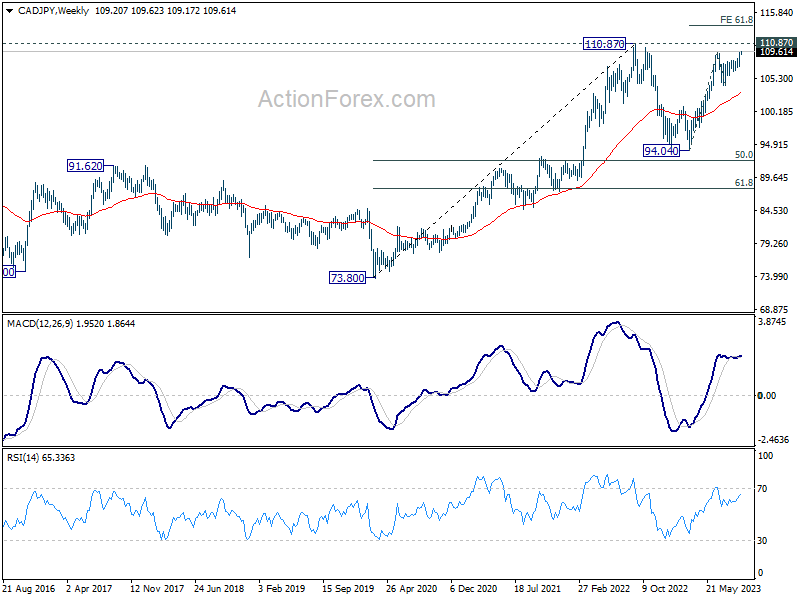
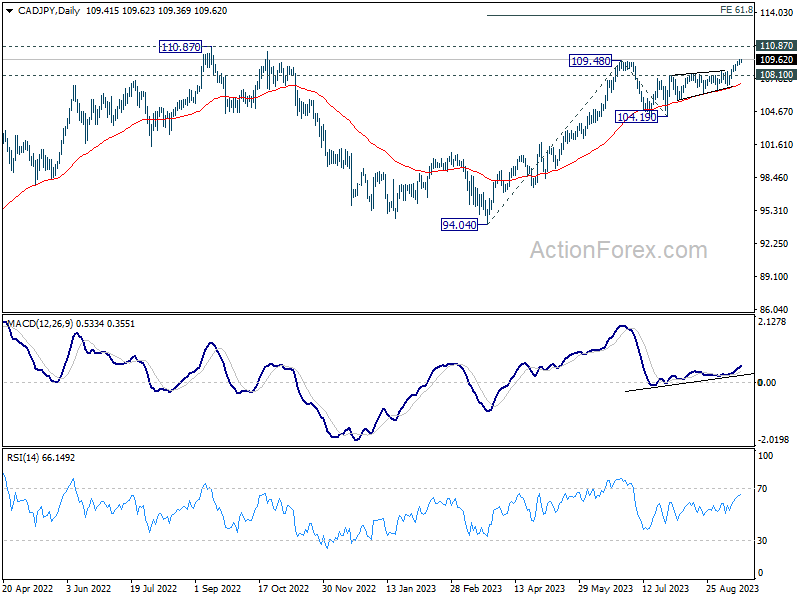
                                    On the currency front, the Canadian Dollar has showcased commendable strength this month, propelled by a spike in oil prices. CAD/JPY’s break of 109.46 resistance this week argues that rise from 94.04 is resuming for a test on 110.87 key resistance (2022 high). Firm break there will confirm larger up trend resumption. Next target will be 61.8% projection of 94.04 to 109.48 from 104.19 at 113.73. In any case, near term outlook will stay bullish as long as 108.10 resistance turned support holds.

                                    RBA minutes flag risks on growth, consumption and China

                                      RBA’s meeting held on September 5, the minutes revealed that officials weighed two courses for monetary policy: increasing cash rate target by 25 bps or standing pat.

                                      After a thorough consideration of the prevailing economic circumstances, members resolved that maintaining the current cash rate was the more compelling choice, highlighting the necessity to allot more time to gauge the comprehensive impacts of monetary policy tightening enacted since May 2022. This consensus is grounded in an understanding of the substantial delays that characterize transmission of policy repercussions through the economy.

                                      Amid these considerations, members also highlighted potential risks. Specifically, there were concerns regarding the possibility that “the economy could slow more sharply than forecast.” Factors like potentially weaker consumption and mounting downside risks to the Chinese economy were flagged.

                                      However, the minutes reflected a cautiously optimistic tone, with members deducing that “recent developments had not materially altered the outlook.” The general consensus remained that the economy still seems to be on a balanced path where inflation is poised to return to the target range, and employment growth is anticipated to sustain its momentum.

                                      Full RBA minutes here.

                                      ECB’s Kazimir: Cannot rule out further hike, premature to bet on cut

                                        ECB Governing Council member and head of Slovakia’s central bank, Peter Kazimir, indicated in an opinion piece that the possibility of further rate hikes remains on the table. Also, it’s premature to bet on the timing of the first rate cut.

                                        Kazimir emphasized that the forthcoming March forecast will be a decisive factor in ascertaining whether the inflation target is within reachable limits, stating, “Only the March forecast can confirm that we are heading unequivocally and steadily towards our inflation goal.”

                                        “That is why I cannot rule out the possibility of further rate increases today,: he added.

                                        Elaborating on the current stance of the policy rates, Kazimir metaphorically commented, “Assume we’re at the top. If so, we may have to stay camping here for quite some time and spend the winter, spring, and summer here.”

                                        Hence, it would be “premature to place market bets on when the first interest rate cuts will occur.”

                                        Meanwhile, he did leave the door open for potential adjustments in the bank’s quantitative tightening measures, contingent on economic data. He noted, “As soon as incoming economic data and analyses confirm that further tightening is unnecessary, I see room for a debate about adjusting the pace of our quantitative tightening.”


                                        NZ economic growth to remain subdued according to NZIER forecasts

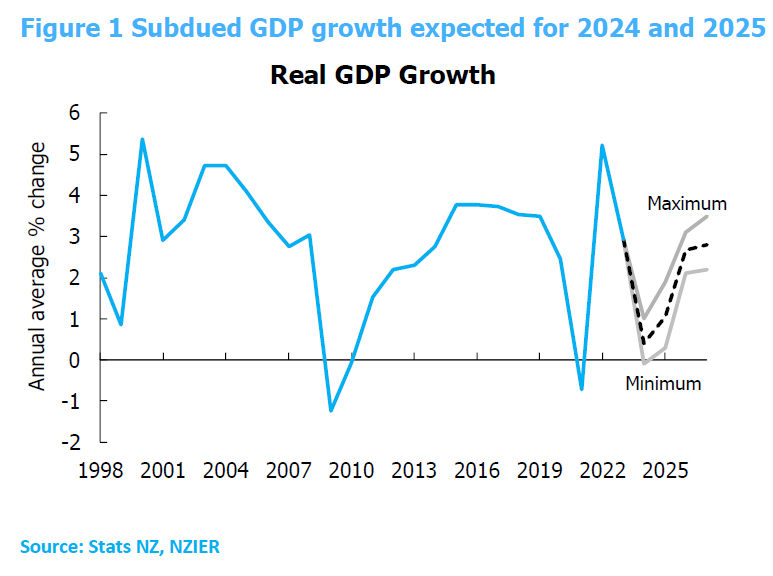
                                          Latest forecasts from New Zealand Institute of Economic Research anticipate a period of subdued economic growth over the next few years. The annual average GDP growth is expected to decline to 0.4% in the fiscal year ending March 2024, followed by modest growth of 1.1% in 2025.

                                          This sluggish pace is partly attributable to the ripple effect of consecutive hikes in RBNZ’s OCR, currently standing at 5.50%, which have started to curb demand in the broader economy. Moreover, diminishing demand for exports, spurred mainly by China’s weaker growth outlook, poses downside risk to the nation’s economic vitality.

                                          Shifting focus to inflation sphere, there has been a notable upward revision for the projections as of March 2024, with annual CPI inflation predicted to retreat to 4.3% in 2024, and further dip to 2.4% in the subsequent year.

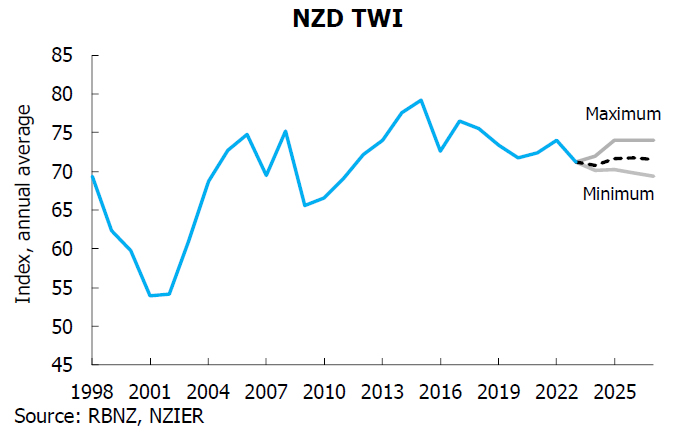
                                          As for currency outlook, NZD Trade Weighted Index forecasts have undergone revisions, showing a downturn for the approaching year but portraying an uplift in 2025.

                                          NZD has not encountered significant fluctuations against other currencies in recent times in terms of yield attractiveness. This steadiness, however, is anticipated to meet challenges due to reduced export demand from China.

                                          The forecast encapsulates expectation of NZD TWI oscillating between 70.8 and 71.6 in the period spanning 2024 to 2027.

                                          Full NZIER consensus forecasts here.