SNB Zurbruegg: Important to keep rate differential to avoid excessive Franc appreciation

    SNB Vice Chairman Fritz Zurbruegg said in a l’agefi interview, “Switzerland has always had lower rates than others since the financial crisis. It is very important for us to keep this differential to avoid an excessive appreciation of the Swiss franc.”

    “As soon as the situation requires it, we’ll raise our interest rate,” he said. But, “we’ll keep this ability to intervene in foreign exchange markets if needed to ensure price stability.”

    “Experience has shown that having some leeway within the range we associate with price stability has worked well in the past in Switzerland,” he added. “We are a small, open economy with capital flows linked to our safe-haven status. We cannot always achieve a precise target and inflation can fluctuate in the short term because we aim for the medium term.”

    Fed Mester: Russia invasion adding upside risk to inflation, downside risk to growth

      Cleveland Fed President Loretta Mester said yesterday that Russia’s invasion of Ukraine could push inflation up higher. “The unfolding event has implications for the economic outlook, adding upside risk to inflation even as it puts downside risks to the growth forecast,” she said.

      “The challenge facing Fed policymakers is how to recalibrate monetary policy, reducing the accommodation from the emergency levels needed earlier in the pandemic in order now to get inflation under control and at the same time sustain the expansion and maintain healthy labor markets,” Mester added.

      BoE Mann: Embedded inflation becomes a domestic problem

        BoE MPC member Catherine Mann said yesterday, “we already have very rapid increase in oil prices… In the U.K., that it becomes embedded by virtue of the institution mechanism of the price cap” on domestic energy bills.

        “That embeddedness becomes a domestic inflationary problem that we have to deal with on the monetary policy stage,” she said.

        “You only get inflation if businesses raise their prices. That’s where it comes from. It doesn’t come from wage settlements. It comes from businesses’ capacity to raise their prices in a systematic way and sustain demand,” she said.

        BoE Saunders prefers to move rates quite quickly towards neutral

          BoE MPC member Michael Saunders said yesterday, “the economy is in significant excess demand, and inflation expectations are not as well anchored as I would like.”

          “My preference is to move quite quickly towards a more neutral stance in order to prevent the recent trend of higher inflation expectations and rising pay growth from becoming more firmly embedded,” he said.

          However, he emphasized that his vote for 50bps hike in February “does not necessarily imply that I would vote for a 50 basis-point hike in the event that further tightening is required.”

          “All else equal, the case for policy to move in a larger step probably is greater when Bank Rate is clearly further away from the approximate level that, if maintained, would return inflation to target and keep it there,” he added.

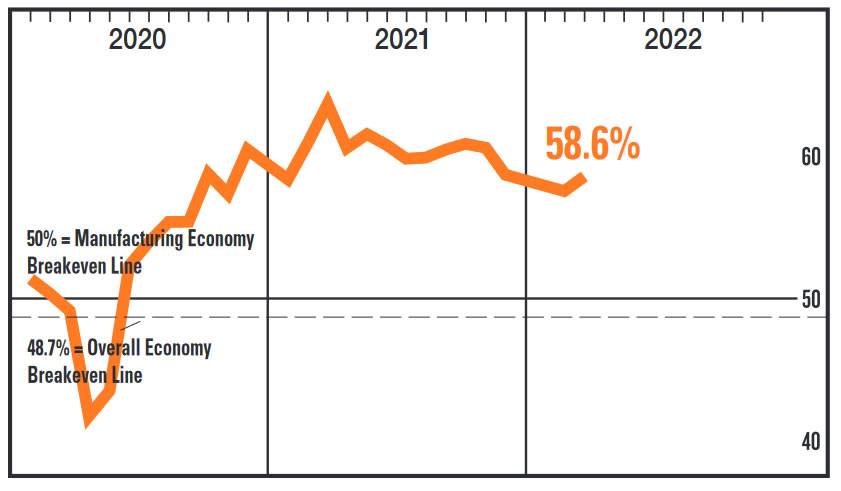
          US ISM manufacturing rose to 58.6, corresponds to 3.5% annualized GDP growth

            US ISM Manufacturing index rose from 57.6 to 58.6 in February, above expectation of 57.9. Looking at some details, production rose from 57.8 to 58.5. New orders rose from 57.9 to 61.7. Employment dropped from 54.5 to 52.9. Prices dropped from 76.1 to 75.6.

            ISM said: “The past relationship between the Manufacturing PMI and the overall economy indicates that the Manufacturing PMI for February (58.6 percent) corresponds to a 3.5-percent increase in real gross domestic product (GDP) on an annualized basis.”

            Full release here.

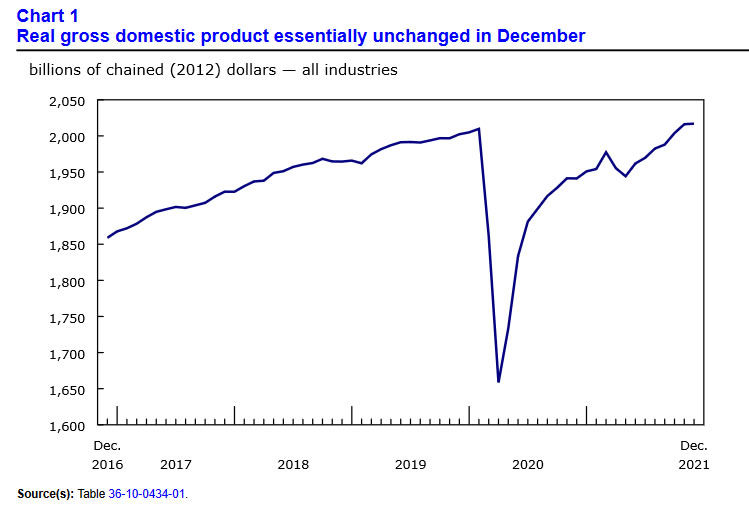
            Canada GDP flat in Dec, grew 0.2% in Jan

              Canada GDP was flat in December, matched expectation of 0.0% mom. The 0.1% mom growth in services-producing industry was offset by the -0.1% mom decline in goods-producing industries. 14 of 20 industrial sectors grew.

              Advance information indicates a 0.2% mom growth in real GDP in January, led by retail, construction, finance and insurance as well as the professional, scientific and technical services sector.

              Full release here.

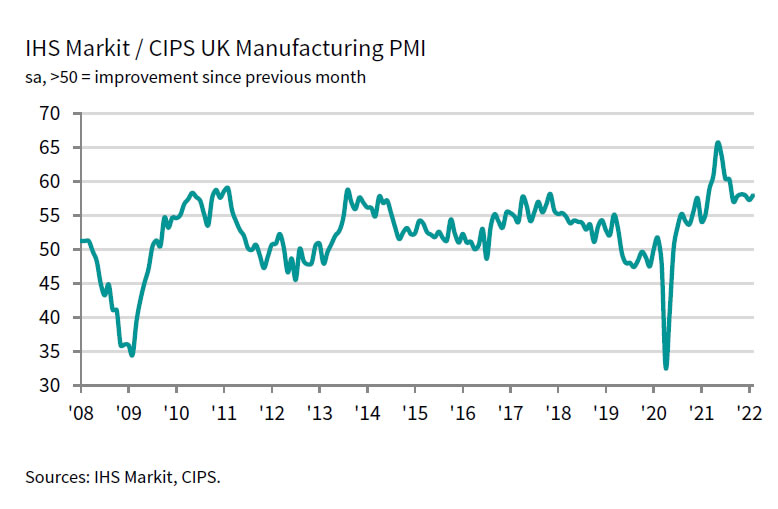
              UK PMI manufacturing finalized at 58 in Feb, production and new orders both accelerate

                UK PMI Manufacturing was finalized at three-month high of 58.0 in February, up from 57.3 in January. Markit said output and new orders expanded at quicker rates. New export orders decreased. Input price inflation remained elevated.

                Rob Dobson, Director at IHS Markit, said:

                “February saw rates of expansion in UK manufacturing production and new orders both accelerate. Growth was boosted by stronger domestic demand and by firms catching up on delayed work as material shortages and supply chain disruptions started to dissipate. Consumer goods output in particular also benefitted from increased sales due to a further easing of COVID restrictions. However, the trend in new export orders is less positive, slipping back into contraction after January’s short-lived uptick. While companies maintain a positive outlook for the year ahead, rising headwinds, especially the intensifying geopolitical backdrop, are ratcheting up near-term risks to demand and confidence.

                “Inflationary pressure also remained elevated across the manufacturing sector in February. Companies were hit hard by rising transportation, energy and commodity prices, leading to further increases in selling prices. That said, rates of inflation for input costs and output charges eased further. Although this easing may have provided some temporary respite, signs that energy and oil prices may stay high is a further cause for concern.”

                Full release here.

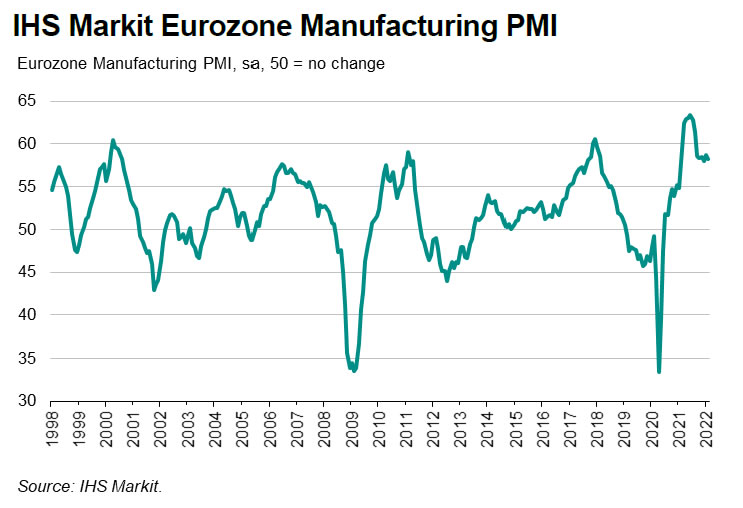
                Eurozone PMI manufacturing finalized at 58.2 in Feb, a largely positive month

                  Eurozone PMI Manufacturing was finalized at 58.2 in February, down slightly from January’s 58.7. Markit said demand for Eurozone goods rose at fastest rate since last August. Supplier delivery times lengthened to weakest extent for over a year, but inflation remained steep.

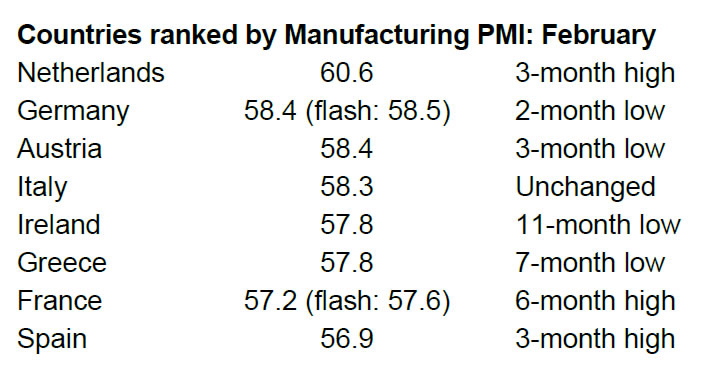
                  Looking at some member states, the Netherlands rose to 3-month high at 60.6. Germany dropped to 58.4 while Austria dropped to 58.4. Italy was unchanged at 58.3. Ireland dropped to 11-month low at 57.8. Greece dropped to 7-month low at 57.8. France rose to 6-month high at 57.2. Spain rose to 3-month high at 56.9.

                  Joe Hayes, Senior Economist at IHS Markit said: “Don’t let the drop in the headline PMI distract from what should be viewed as a largely positive month for the euro area manufacturing sector in February. Demand for goods is trending higher, with the rate of expansion accelerating to a six-month high. Underlying sales conditions are clearly strengthening as Europe overcomes the Omicron wave of COVID-19 and businesses step up their recovery efforts.”

                  Full release here.

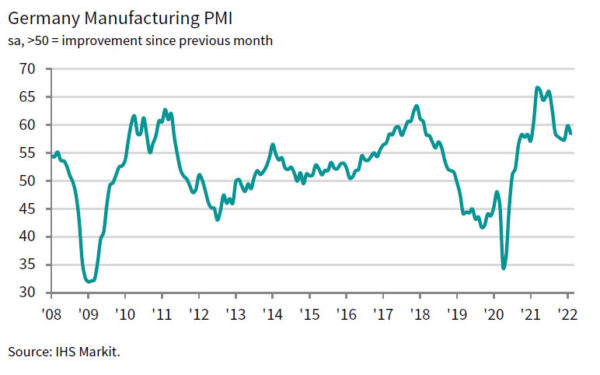
                  Germany PMI manufacturing finalized at 58.4 in Feb, underlying demand strong

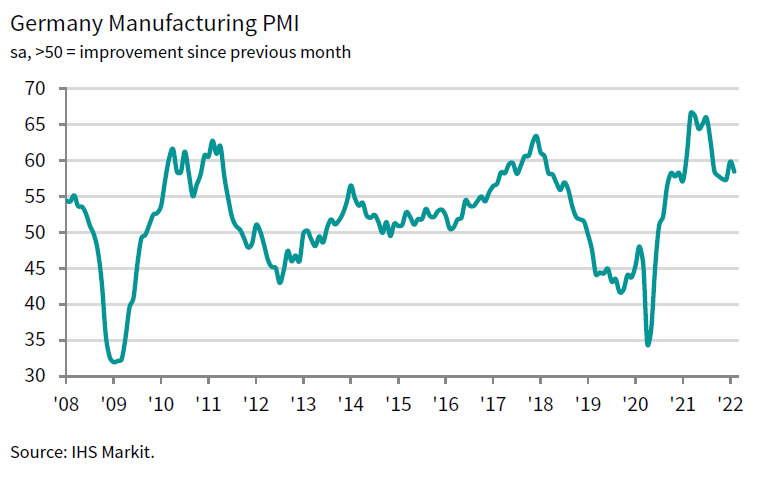
                    Germany PMI Manufacturing was finalized at 58.4 in February, down from January’s 59.8. Markit said there were sharp rise in backlogs as growth in the new orders outstripped output. Factory cost inflation slipped further from recent highs. Incidence of supply delays was lowest since November 2020.

                    Phil Smith, Associate Economics Director at IHS Markit, said:

                    “Underlying demand for German manufactured goods was strong in February, with new order growth accelerating and the survey showing rising sales both domestically and internationally.

                    “Production continued to rise, but staff absences linked to the Omicron wave of the pandemic were a constraint on output and added to already stretched capacity, thereby contributing to a sharp rise in backlogs of work. However, with COVID cases in the country looking like they might have already peaked, this particular headwind will hopefully be only temporary. Furthermore, the pace of factory job creation remained rapid as manufacturers looked to address capacity shortfalls.

                    “Supply constraints showed further tentative signs of easing in February, and one of the positives from this was a fall in the rate of input cost inflation to an 11-month low. “When the survey was conducted, firms were hopeful of further progress in the supply situation and were highly optimistic about the outlook. With the escalation of the situation in Ukraine since February’s survey, and the surge in oil and gas prices that’s come with it, downside risks to the sector’s performance in 2022 have increased.”
                    Full release here.

                    France PMI manufacturing finalized at 57.2, six-month high

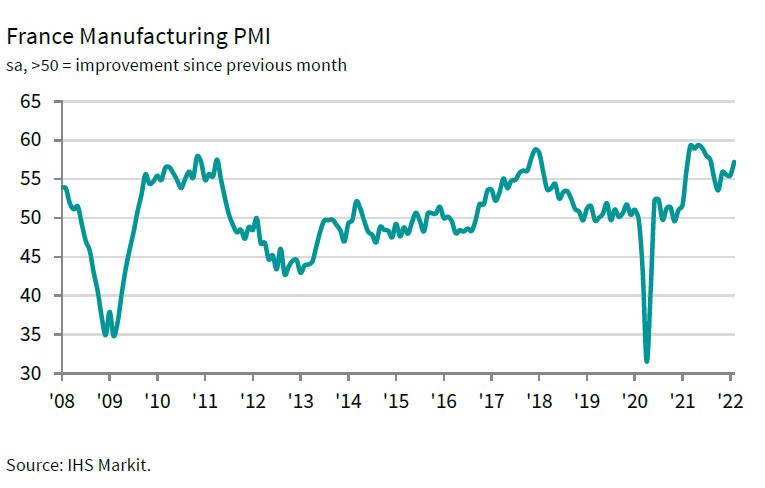
                      France PMI Manufacturing was finalized at six-month high of 57.2 in February, up from January’s 55.5. Markit said manufacturing output increased at fastest rate since last July. Demand for goods improved despite steep output price inflation. Capacity pressures intensified as supply issues persisted.

                      Joe Hayes, Senior Economist at IHS Markit, said:

                      “Against the immense supply chain struggles that manufacturers have had to contend with over the last few months, the latest survey data show some promising signs of resilience as goods production increased at the fastest rate since last July. What is also encouraging to read is the anecdotes from our survey members which suggest that the trend in demand for goods is gaining momentum and many expect this trend to continue. Additional workers were recruited in February (some on a short-term basis to cover staff isolating with COVID-19), and business confidence strengthened.

                      “There were also some cautious signs of optimism in supply chain data, with input lead times lengthening to the weakest extent for almost a year. According to panel members, the availability for certain raw materials had improved. It’s important not to get too carried away though as there still needs to be a considerable catch-up here.

                      “Less positive remains the inflation story and the persistence of rising costs and output prices. Suppliers continue to raise their fees as demand for inputs remains strong, but it appears that many businesses are simply paying these prices and passing the burden onto their clients. Given the causes of inflation seem sticky, policymaker intervention may well be required to bring inflation under control.”

                      Full release here.
                      China Caixin PMI manufacturing rose to 49.1 in Feb, returned to growth

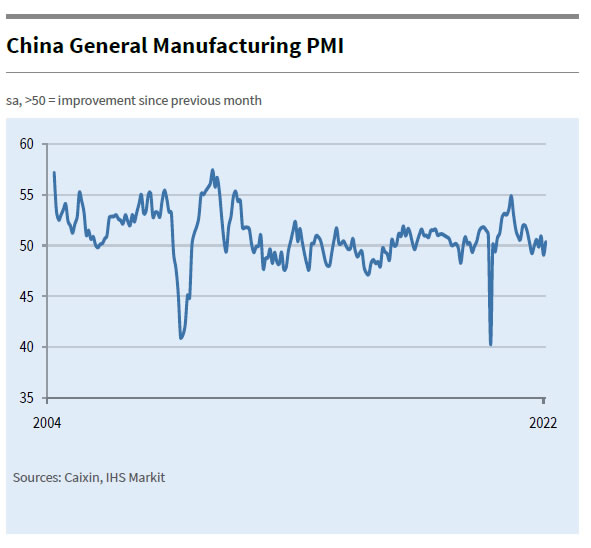
                        China Caixin PMI Manufacturing rose from 49.1 to 50.4 in February, above expectation of 49.5. Caixin said output returned to growth amid quickest rate in new work for eight months. Pandemic continued to weigh on export sales. Business confidence picked up to the highest since last June.

                        Wang Zhe, Senior Economist at Caixin Insight Group said: “Overall, manufacturing activity expanded in February. Supply recovered, while demand more clearly improved. The level of optimism about the future business outlook increased further. However, the job market remained under high pressure. And we still need to keep an eye on inflationary pressure.

                        Full release here.

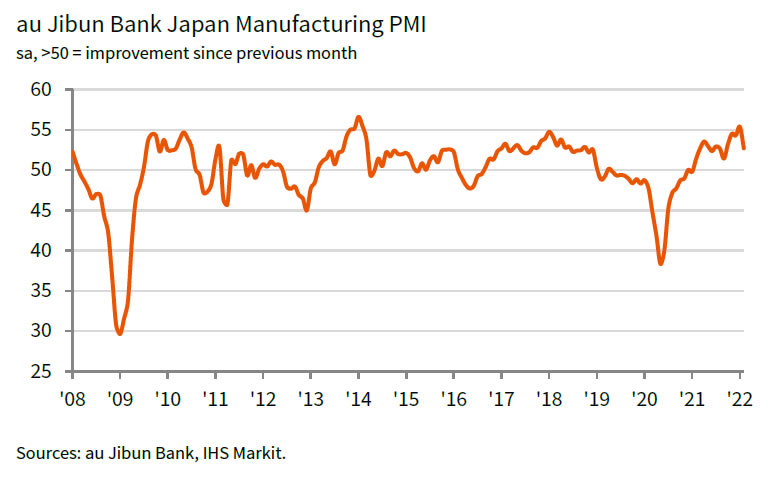
                        Japan PMI manufacturing finalized at 52.7, new orders stagnates and input prices rose

                          Japan PMI Manufacturing was finalized at 52.7 in February, down from January’s 55.4. Markit said there was renewed fall in output amid near-stagnation in new orders. Input prices rose at sharpest pace since August 2008. Stocks of purchases had survey-record increase amid delays and shortages.

                          Usamah Bhatti, Economist at IHS Markit, said: “February PMI data pointed to a softer expansion in the Japanese manufacturing sector. The rate of growth eased to a five-month low, however, amid a renewed reduction in production levels and a broad stagnation in new orders… input price pressures intensified further, with average cost burdens rising at the sharpest pace in thirteen-and-a-half years… manufacturers commented that the degree of optimism regarding the 12-month outlook for output eased to a six-month low in February… This is broadly in line with the IHS Markit prediction for industrial production to grow 5.9% in 2022.”

                          Full release here.
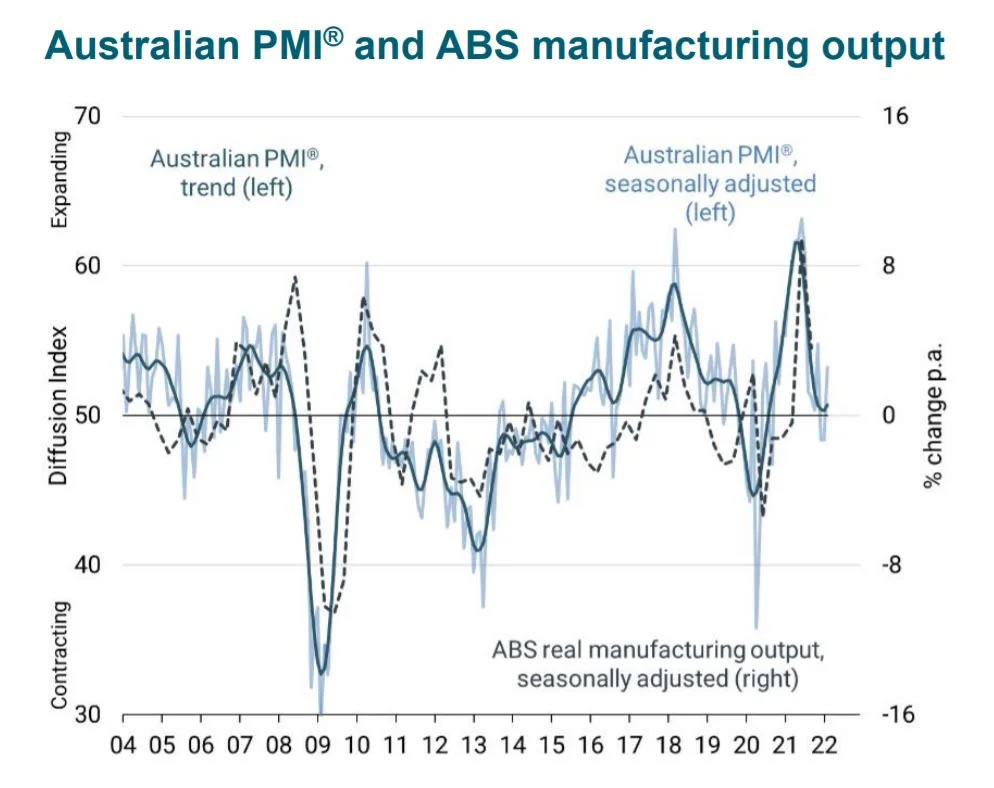
                          Australia AiG manufacturing rose to 53.2, edged back into expansion

                            Australia AiG Performance of Manufacturing Index rose 4.8 pts to 53.2 in February. Production rose 2.7 to 54.6. Employment dropped -1.9 to 43.5. Average wages rose 1.4 to 64.9. Input prices dropped -6.7 to 75.6. But selling prices rose 1.4 to 64.9.

                            Innes Willox, Chief Executive of Ai Group said: “Australia’s manufacturing sector edged back into expansion during February following the sharp labour and supply chain disruptions of the December-January period. Price and wage pressures continued in February with some easing in the pace of increase in input prices. At the same time, selling prices accelerated suggesting further recovery of earlier cost increases.”

                            Full release here.

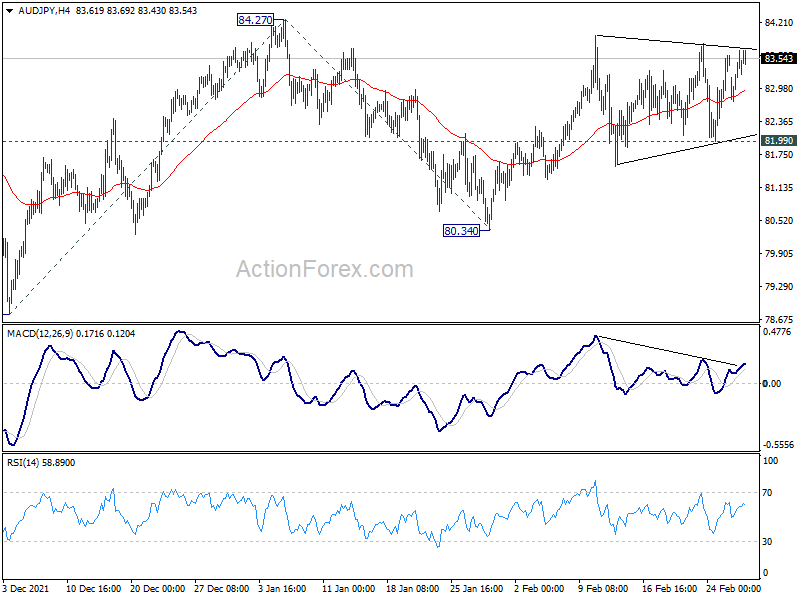
                            RBA stands pat and be patient, AUD/JPY range-bound

                              RBA left cash rate target unchanged at 0.10% as widely expected. The board maintained that it “will not increase the cash rate until actual inflation is sustainably within the 2 to 3 per cent target range.”. For now, it is “too early to conclude that it is sustainably within the target range”, and RBA is “prepared to be patient”.

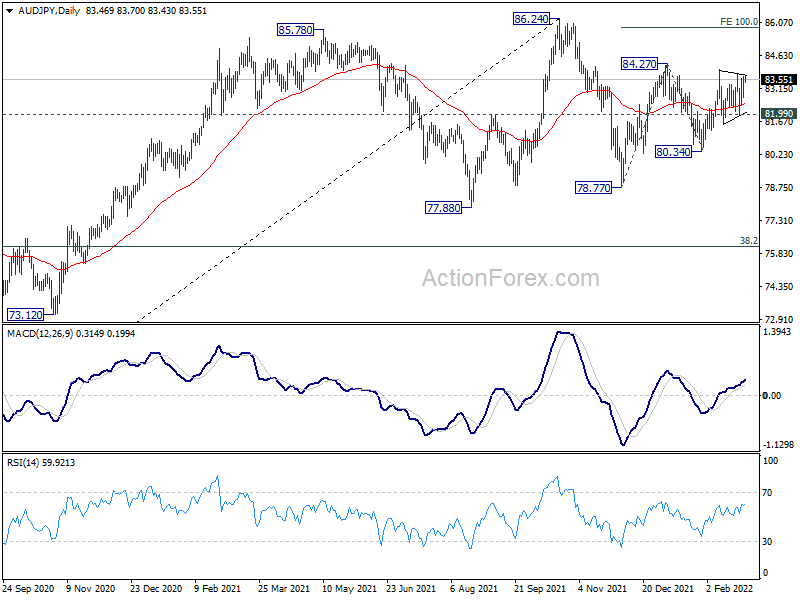
                              AUD/JPY is staying established after the release. Price action from 86.24 high are seen as developing into a sideway corrective pattern, with rise fro 78.77 as the second leg. That is, further rally is in favor as long as 81.99 support holds. Break of 84.27 will target 100% projection of 78.77 to 84.27 from 80.34 at 85.84. However, even in this case, upside should be limited by 86.24 high to bring another falling leg to complete the three-wave corrective pattern.

                              Meanwhile, break of 81.99 support will argue that it’s developing into a deeper correction, instead of a sideway pattern. Deeper fall should then be seen through 80.34 to 78.77 and below.

                              US goods trade deficit widened to USD 107.6B in Jan

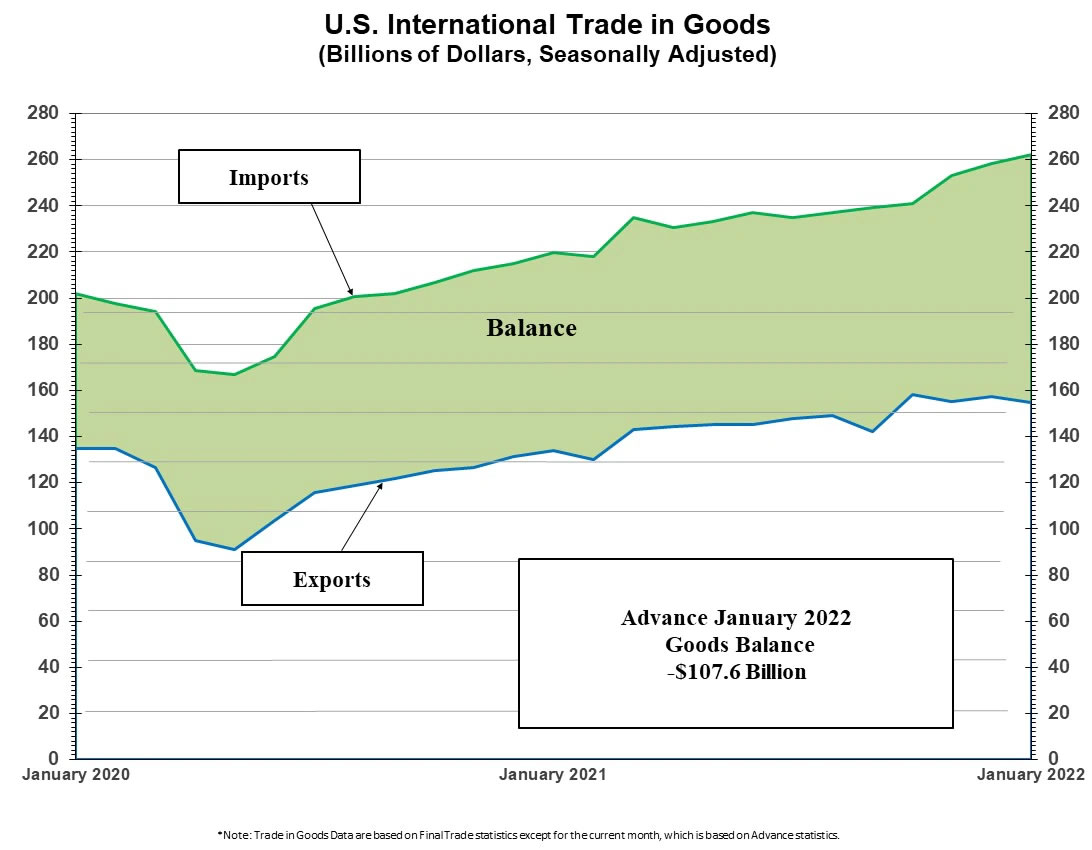
                                US goods exports dropped USD -2.8B to USD 154.8B in January. Goods imports rose USD 4.4B to USD 262.5B. Trade deficit widened by USD -7.2B to USD -107.6B, larger than expectation of USD -98.5B.

                                Wholesale inventories rose 0.8% mom to USD 798.2B. Retail inventories rose 1.9% mom to USD 658.1B.

                                Full release here.
                                ECB Panetta: The world becomes darker, our steps should be smaller

                                  ECB Executive Board member Fabio Panetta said, “we should adjust policy carefully and recalibrate it as we see the effects of our decisions, so as to avoid suffocating the recovery,” he said.

                                  Talking about Russia invasion, he said, “this terrible event has made the need for prudence even greater. The world has become darker, and our steps should be smaller still.”

                                  “The most important thing right now is for us to be ready and available to preserve financial stability,” he added.

                                  ECB Centeno: Stagflation risks increased with Russia invasion of Ukraine

                                    ECB Governing Council member Mario Centeno “I am convinced that the traction of growth that the economy was following will prevail.” But, “a scenario close to stagflation is not out of the possibilities that we can face. So we need to adjust our policies to that.”

                                    He added that policymakers had already considered the threat of stagflation before. “After the invasion these risks have only increased,” he said. Russian’s invasion of Ukraine has the possibility of “a positive impact on inflation, a few decimal points, and a negative impact on growth.”

                                    Swiss KOF dropped to 105 in Feb, primarily on manufacturing

                                      Swiss KOF Economic Barometer dropped from 107.2 to 105 in February, below expectation of 108.5. KOF said, “the indicators from the manufacturing sector are primarily responsible for the decline, followed by those from the financial sector. The signals for the Swiss exporters are somewhat more favourable than before. ”

                                      Full release here.
                                      New Zealand ANZ business confidence dropped to -51.8, a challenging year in 2022

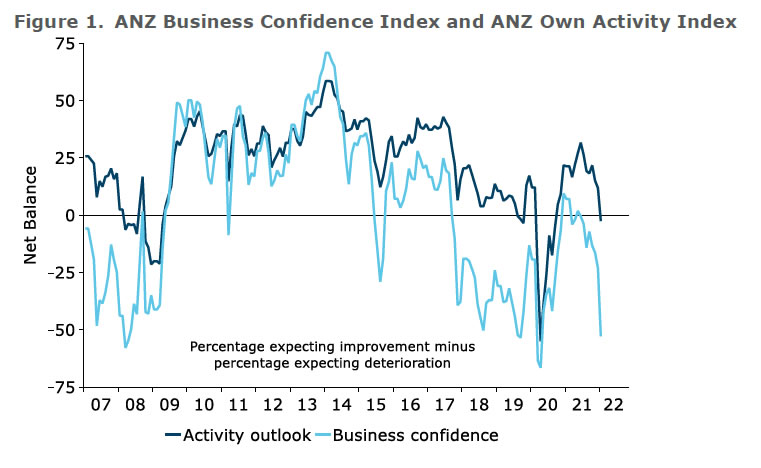
                                        New Zealand ANZ business confidence dropped to -51.8 in February, down from December’s -23.2. Own activity outlook dropped from 11.8 to -2.2. Export intentions dropped from 8.8 to 0.9. Investment intentions dropped from 11.4 to 4.5. Employment intentions dropped from 10.5 to 2.3. Cost expectations rose from 88.2 to 92.0. Profit expectations dropped from -13.1 to -32.7. Pricing intentions rose from 63.6 to 74.1. Inflation expectations rose from 4.42 to 5.29.

                                        ANZ said, “All up, 2022 is shaping up to be a challenging year economically, and getting on top of super-charged inflation without an outright recession is looking increasingly difficult. But with CPI inflation heading well over 6% the RBNZ has no choice but keep right on hiking. And now global geopolitical developments threaten yet more imported inflation via energy markets. Buckle up.”

                                        Full release here.

                                        Australia retail sales rose 1.8% mom in Jan, above expectation

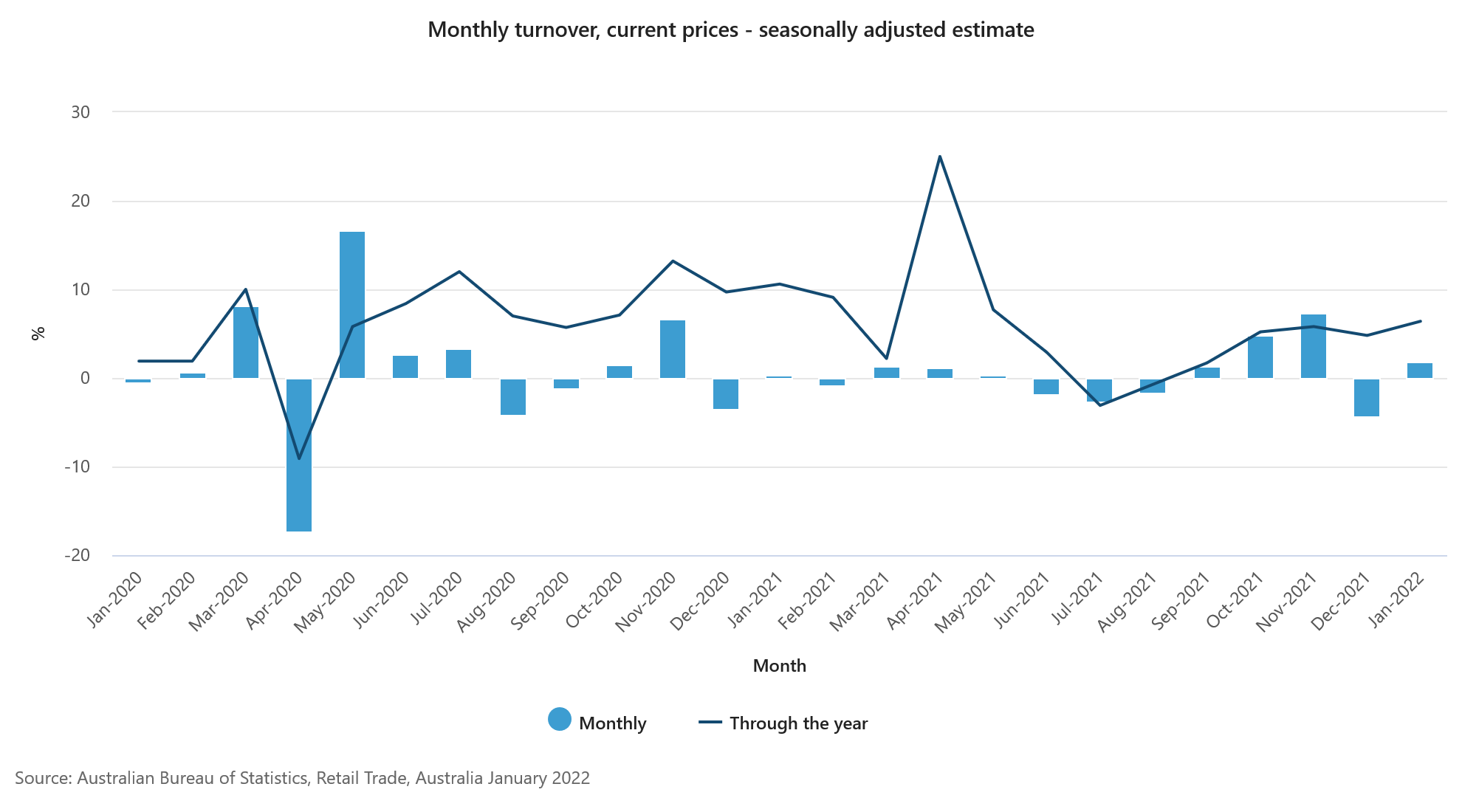
                                          Australia retail sales rose 1.8% mom in January, above expectation of 0.4% mom.

                                          Director of Quarterly Economy Wide Statistics, Ben James said: “The emergence of the Omicron variant and rising COVID-19 case numbers, combined with an absence of mandated lockdowns has resulted in a range of different consumer behaviours. We have seen the type of spending previously associated with lockdowns occurring simultaneously with those associated with the easing of lockdown conditions.”

                                          “This had led to variations across the industries with Food retailing recording a rise in sales consistent with previous COVID-19 outbreaks as consumers exercise caution amidst surging case numbers. However, the absence of lockdowns meant that other discretionary industries which would usually see a fall during the pandemic have recorded mixed results.”

                                          Full release here.