

Sample Category Title
GBP/USD Vulnerable as Trendline Break Sets Up Potential 600 Pip Drop
GBPUSD has continued its recent struggles today with the pair on a 8-day losing streak. This comes after cable posted 5 consecutive months of gains, to rise from a 2025 low of 1.2099 to a high of 1.3788, last seen in October 2021.
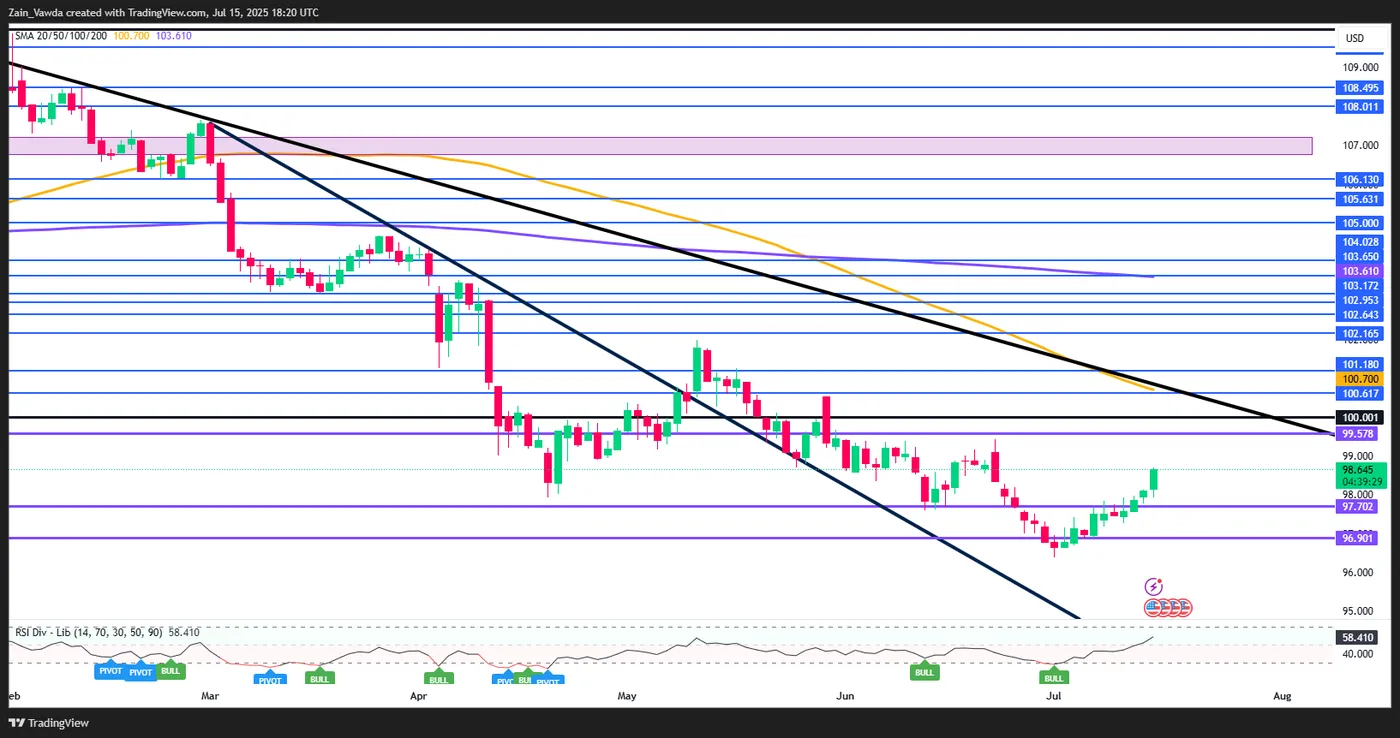
The rally in GBPUSD was largely facilitated by USD weakness following Donald Trump's inauguration and announcement of global tariffs. The move which saw the US Dollar lose its safe haven status and the US Dollar Index (DXY) drop below the psychological 100.00 mark for the first time since a brief foray in July 2023.
However as tariffs have drawn near the US Dollar has shown signs of life. The DXY is now on four-day win streak and is approaching the 99.00 handle. This comes at a time when the UK is facing macro challenges which have begun to weigh on the GBP.
US Dollar Index (DXY) Daily Chart, July 15 2025
Source: TradingView
UK CPI Ahead as Macro Factors Weigh on the Pound
The recent drop in the pound isn’t due to fiscal issues, as the 10-year Gilt-Bund spread has tightened to 187 bps, its lowest since April. Instead, it’s driven by narrowing short-term interest rate spreads. This reflects doubts about whether the Bank of England will ease policy faster than expected.
Tonight, Governor Andrew Bailey will speak, likely signaling that quicker rate cuts are possible if the labor market weakens following an uptick in UK unemployment.
Key data releases lie ahead with June CPI tomorrow and UK labor market figures on Thursday. If May’s payroll drop of -109k isn’t revised and June shows further declines, UK rates and the pound could fall further. All of this may play into the current setup developing for GBPUSD.
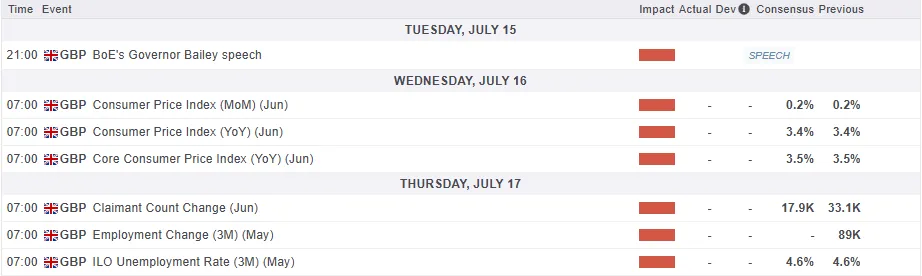
For all market-moving economic releases and events, see the MarketPulse Economic Calendar.
Technical Analysis - GBP/USD
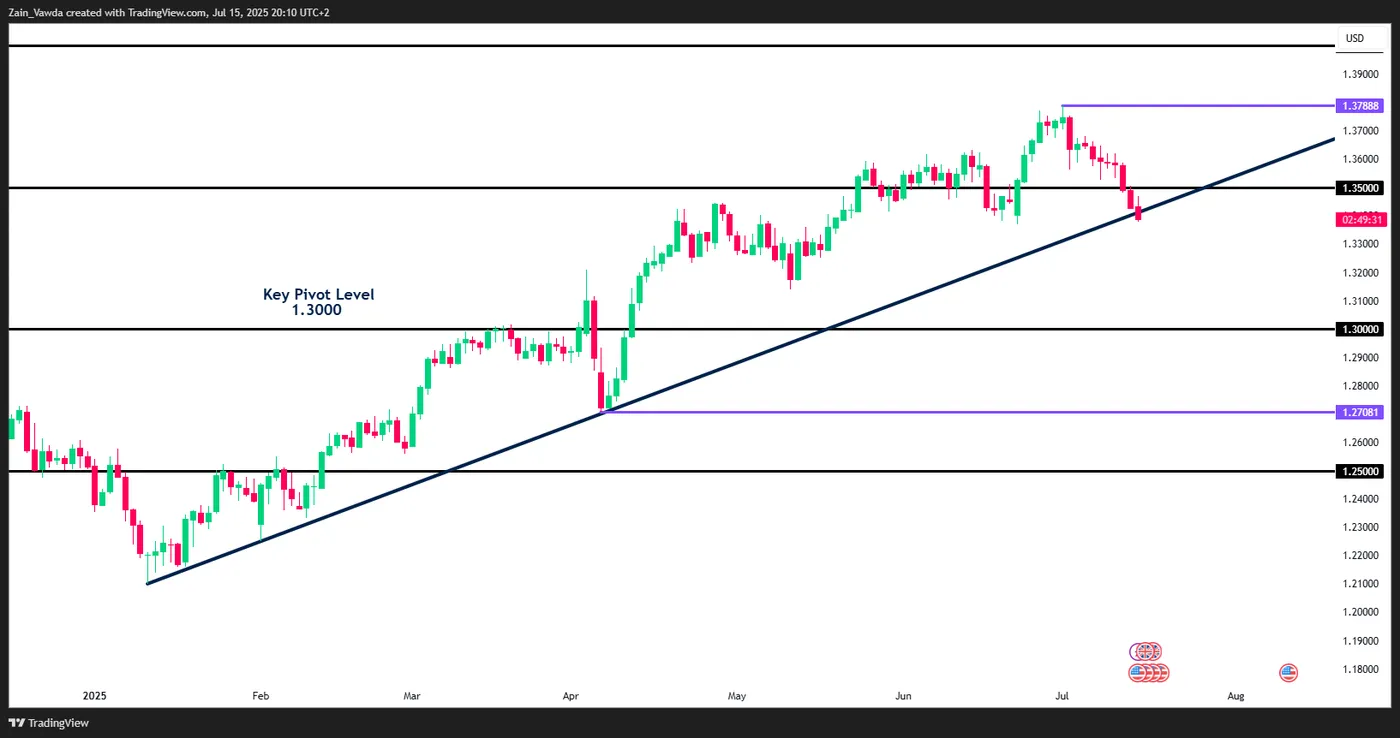
GBP/USD is on course for a daily candle close below the long term ascending trendline which traces back to January 13 lows of 1.2099.
GBPUSD is on a 8 day losing streak which may warrant caution that a short-term pullback may materialize.
Further supporting this narrative is the RSI period 14 which is approaching the 30 handle, which is considered an oversold zone. However, as we know this is no guarantee that a bullish move will occur, as the RSI has a tendency to continue lower even when it is below the 30 handle if the bearish trend is strong.
There is support around a 100 pips below current price, around the 1.3266 handle which is where the 100-day SMA rests. Just below that, we have the 1.3250 handle which is also a multi-year key level which has served as support/resistance over the past few years.
A break of this support level brings the key pivot level of 1.3000 into focus. A break here could lead to a drop toward the first potential trendline break target which rests at 1.2708, some 600 pips from current prices.
Indeed should such a move play out this is one that may present further opportunities for entry along the way, but it is definitely worth watching.
GBP/USD Daily Chart, July 15, 2025
Source: TradingView.com
Support
- 1.3266
- 1.3000
- 1.2708
Resistance
- 1.3500
- 1.3788
- 1.4000
Client Sentiment Data - GBP/USD
Looking at OANDA client sentiment data and market participants are rather neutral on GBP/USD with 52% of traders net-short. I prefer to take a contrarian view toward crowd sentiment, however the fact that traders are relatively neutral does not help provide any significant insights. All it shows is that market participants are cautious and rightly so as the fundamentals and technicals hint at further downside but after 8 consecutive bearish days market participants are clearly cautious.
Bitcoin Retracts, Altcoins Shine in Unusual Reactions to US CPI
This morning's price action is a tricky one: The US CPI report has surprised positively, with a lack of initial reaction still turning into a positive reactions at the Market Open.
Equities rallied and Bitcoi,n which retracted from its all-time highs overnight, saw a bounce but that rally was underwhelming and got followed by some reversals – The moves in markets are centered around the major Rally that happened in the US Dollar since 9:30.
The Dow Jones was the index to follow as a failed bounced got followed by a general reversal from markets and Majors which are currently struggling against the Greenback – Only the Nasdaq is still up on the session, consolidating around the 22,950 Level.
In spite of all the mixed signals given by Markets in the morning session, BTC is still trading $6,000 above its record highs and Cryptocurrencies aficionados are using this relative strength in Tech as a signal to pump altcoins.
Let's take a look at Risk-Assets with an emphasis on Crypto to spot what Markets are cooking.
An uncommon Price action in US Equities
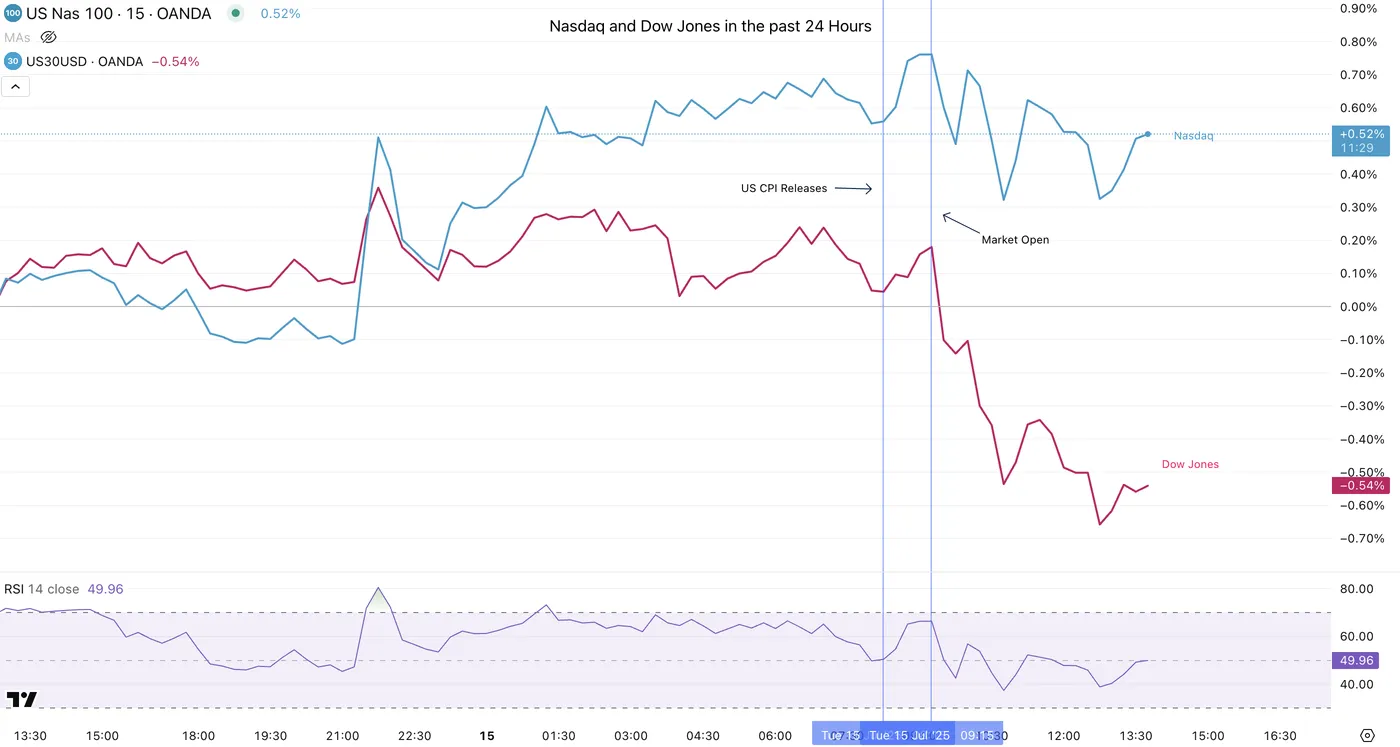
Nasdaq and Dow Jones performance in the past 24 Hours
The Immediate reaction to the data was positive but not by a strong margin, with the Dow taking a concrete turn to the downside which may weigh on overall Equity sentiment, with the S&P 500 actually turning negative in the past hour.
The earnings season has just begun, therefore expect some confusion in Indices as Markets tend to see major rebalancing around these periods
So, what about Cryptos?
Screenshot 2025-07-15 at 1.57.10 PM
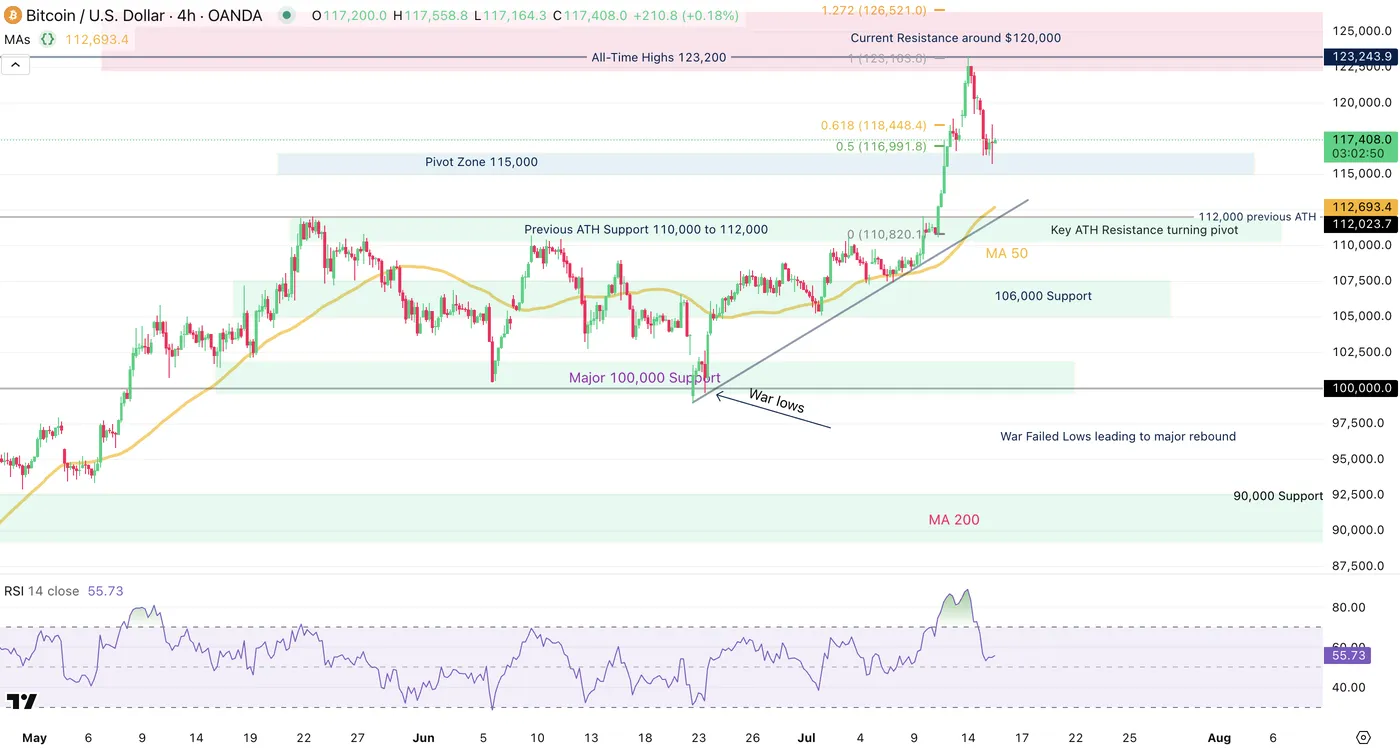
Bitcoin 4H Chart, July 15, 2025 – Source: TradingView
Bitcoin is trading just below the 50% retracement of the impulsive Move that took the crypto to its all-time highs (~$123,200).
As long as BTC holds above its $115,000 Pivot Zone (light blue), expect the Crypto Markets to maintain a positive tone.
Usually, when Bitcoin stays put after having retraced slightly from all-time highs, like today, Altcoins tend to rally consequently.
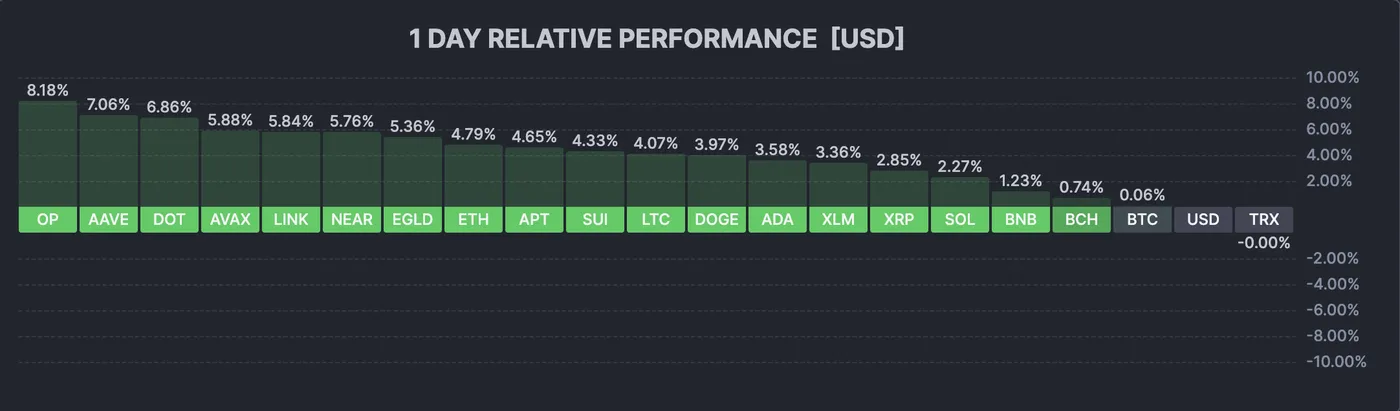
Cryptocurrencies Performance Board – Source: Finviz
As can be seen, the picture is very green for cryptos – The all-around positive sentiment in Tech, the only sector positive on the day is dragging up majorly altcoins, with OP (Optimism, an ETH-Ecosystem altcoin), AAVE and Polkadot are leading on the day.
For major cryptos, Ethereum is up close to 3% compared to an down small/unchanged Bitcoin – another bull sign for altcoins.
Monitor this trend for the upcoming period as this is a move that Crypto buyers have been awaiting in the 9-month Bitcoin-Only rally.
Edit: Total Market Cap hit new all-time highs
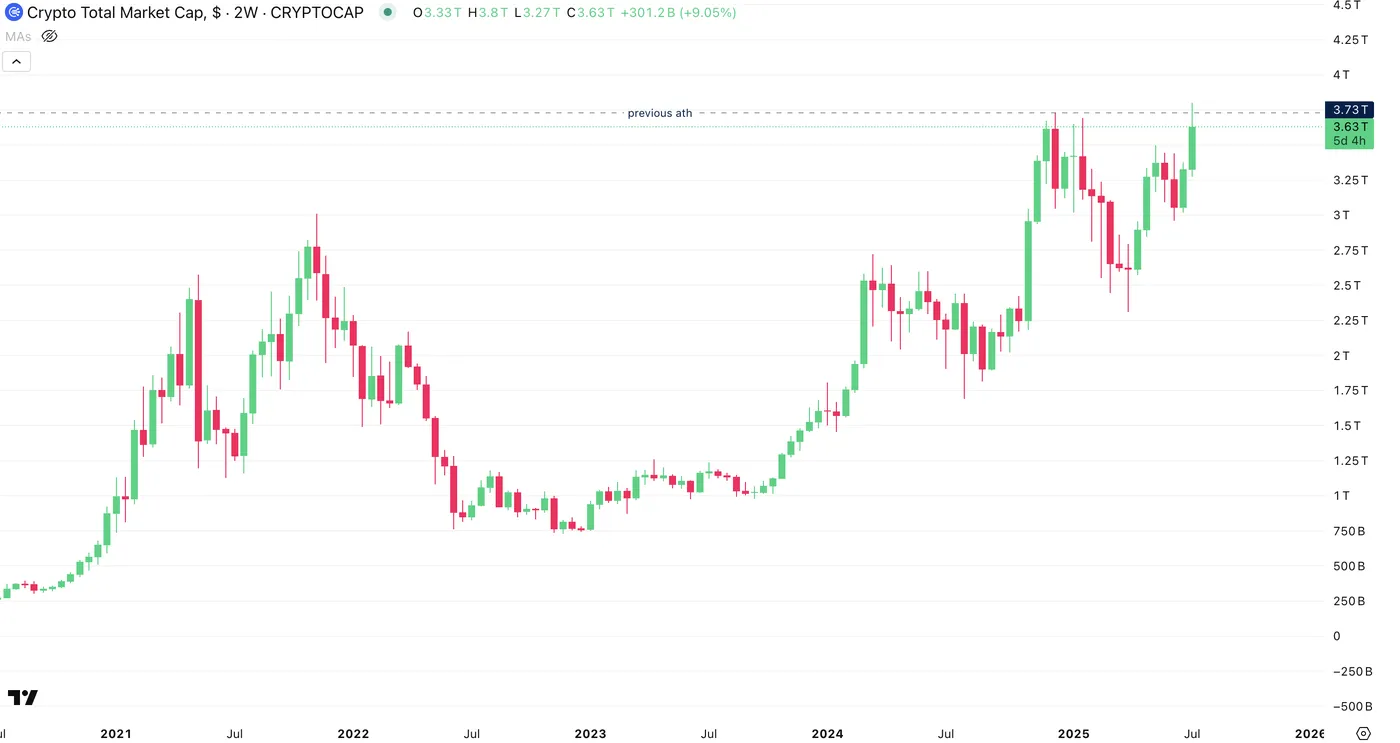
Crypto Total Market Cap, July 15, 2025 – Source: TradingView
When writing the article, I had not observed that the Total market cap had made new highs ($3.8T), a very strong sign for the overall Crypto market.
However, despite a strong day for altcoins, the Market Cap has retracted today but is still staying in the 98th percentile of historic performance – This is something to track if risk-assets were to see outflows.
ETH/BTC Update
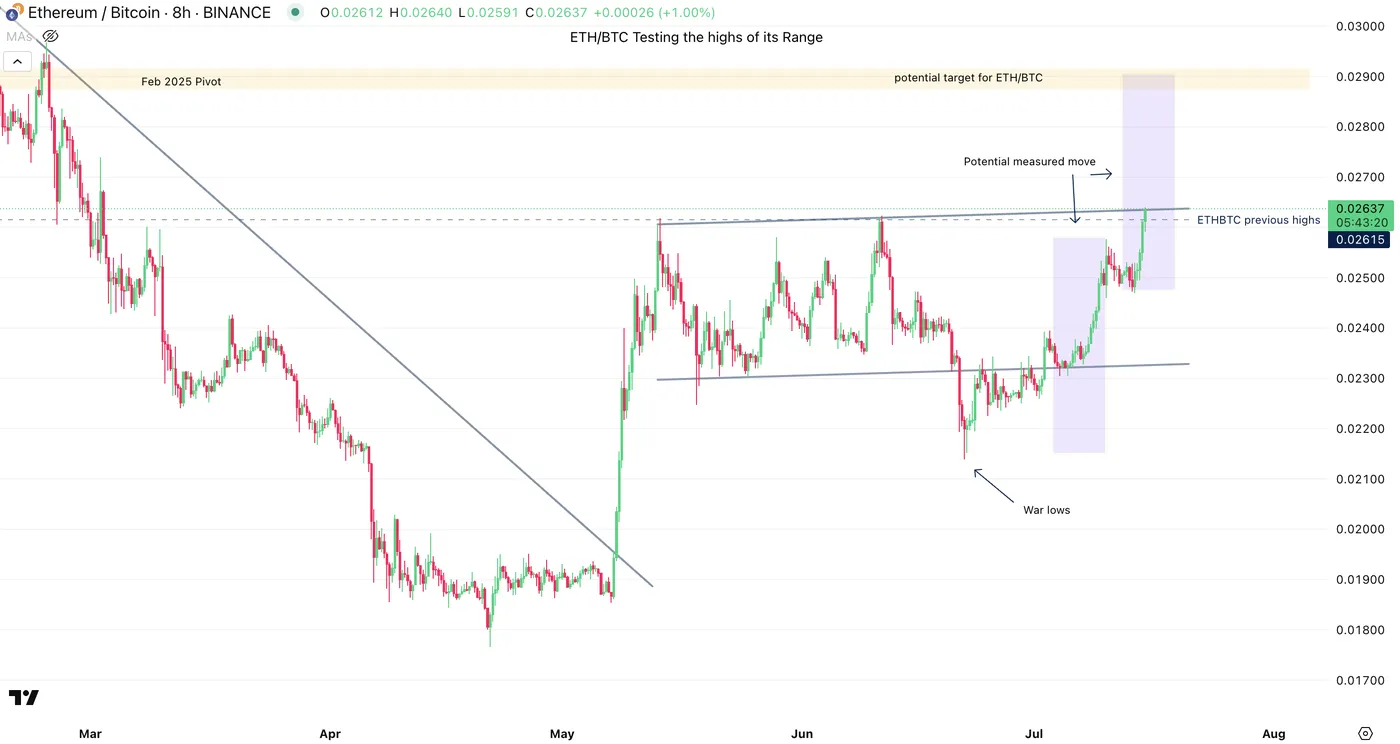
ETH/BTC Since February 2025 – Source: TradingView
ETH/BTC has been rallying consequently since the June 21st War Lows and this has helped altcoins to take back some share of the crypto market – Most of the crypto inflows have been directed to Bitcoin and Altcoins had previously been correcting, awaiting for such a move.
It is still early to assume a breakout, but the strength of the ongoing ETH/BTC rally may lead to significant upside in Ethereum and hence other altcoins.
Potential targets for the potential breakout could be between 2.90% to 3% of BTC's price on a measured move count – Difficult to predict if sentiment will hold but the probabilities of this scenario are high on a Technical Analysis perspective.
A story that warrants close follow-up, particularly as the ongoing market-environment is giving some signs of change.
Safe Trades!
Silver Trades Around 14 Years High in a Breakout
Silver has been working a catch up in terms of performance compared to the more-shining Gold that really took off against other traded metals in the first half of the year.
Our past analysis of Silver observed the addition of elements that could lead to a breakout, with that outcome actually taking place in the past 4 sessions.
Prices went from a $36.5 consolidation zone to highs of $39.13, a 7.5% rise to levels not seen since September 2011 spikes.
Let's take a look at where prices currently stand as metals have been retracting slowly off of Friday highs – The Dollar Index broke out after the 9:30 Market Open and this usually doesn't help with Precious Metal Performance.
Silver Intraday Update
Silver 4H Chart
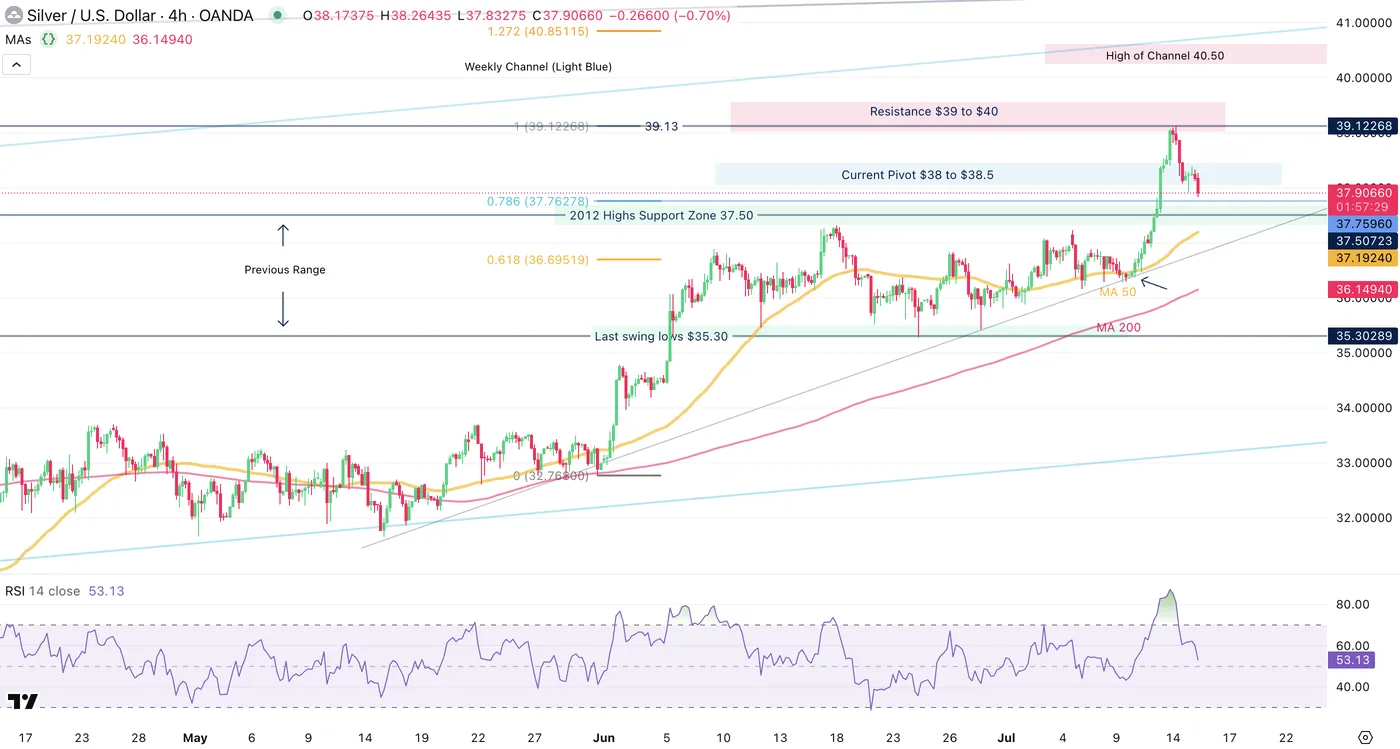
Silver 4H Chart, July 15, 2025 – Source: TradingView
Last week's consolidation at its middle of the range with the 4H MA 50 coming in as support gave some great technical conditions pointing towards the eventual breakout that took the metal to its Friday 39.13 highs on a tight bull channel.
Overbought conditions have led to some reversals in anticipation of today's CPI Release.
One thing to spot on the current corrective sequence is the playing of the immediate support zone around the 2012 highs (37.50 +/- $0.15). Holding this Zone would consolidate further the breakout towards a new trend.
Any rebound from here would also need to test the upper bound of the channel as the most recent highs stalled about $1 from that area, however time consolidation could lead to even higher prices that is, as long as prices hold the support zone mentioned just before.
Silver 1H Chart
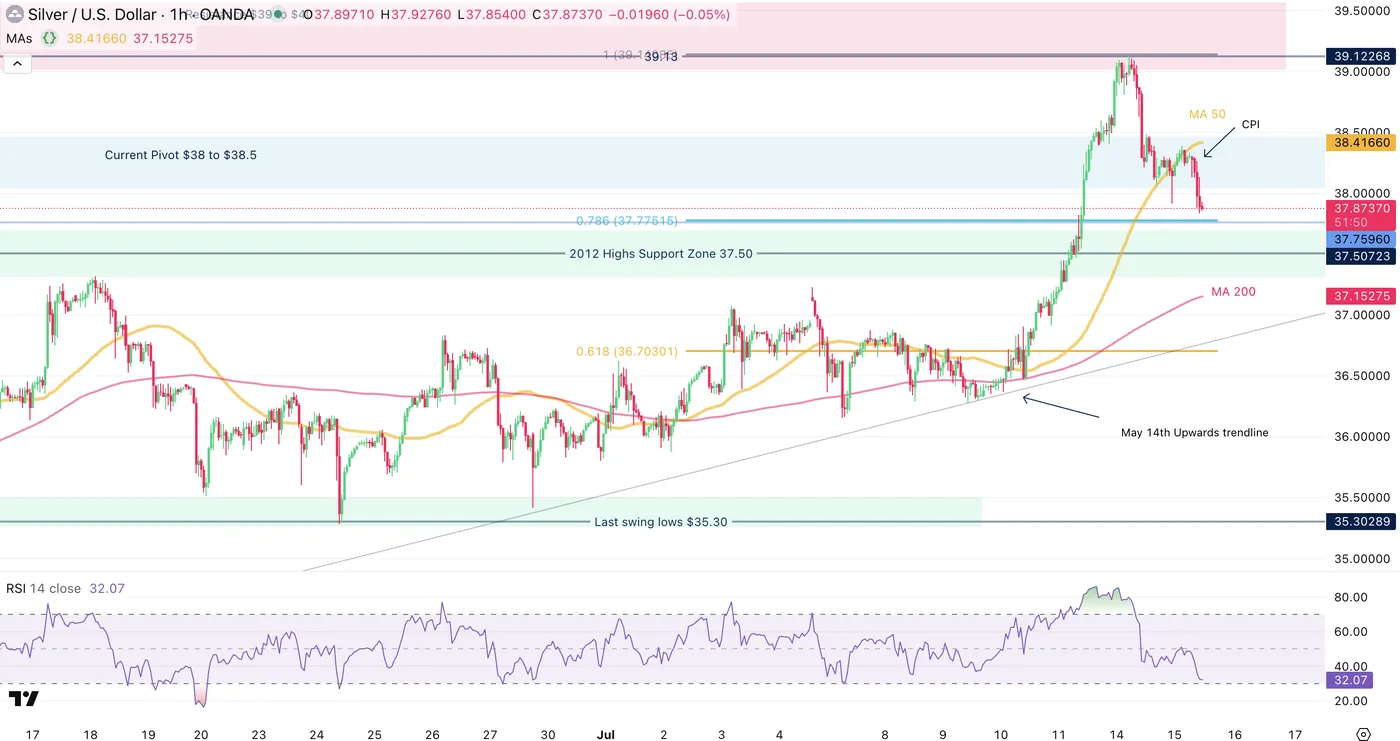
Silver 1H Chart, July 15, 2025 – Source: TradingView
Placing a Fibonacci tool from the last swing lows to the current highs points at potential stalling within the correction around the 78.6% level at $37.75, within the Support Zone.
1H Momentum is write at oversold after the CPI led to some further correction in prices – About the CPI, the report came in just below expectations, something that should have seen a small rebound in the precious metal however subsequent USD Buying led to the current outcome.
This is a story to watch as markets may start to fade such data points and this tends to form longer trends. We will watch upcoming reactions to data releases in that aspect.
Silver 30m Chart
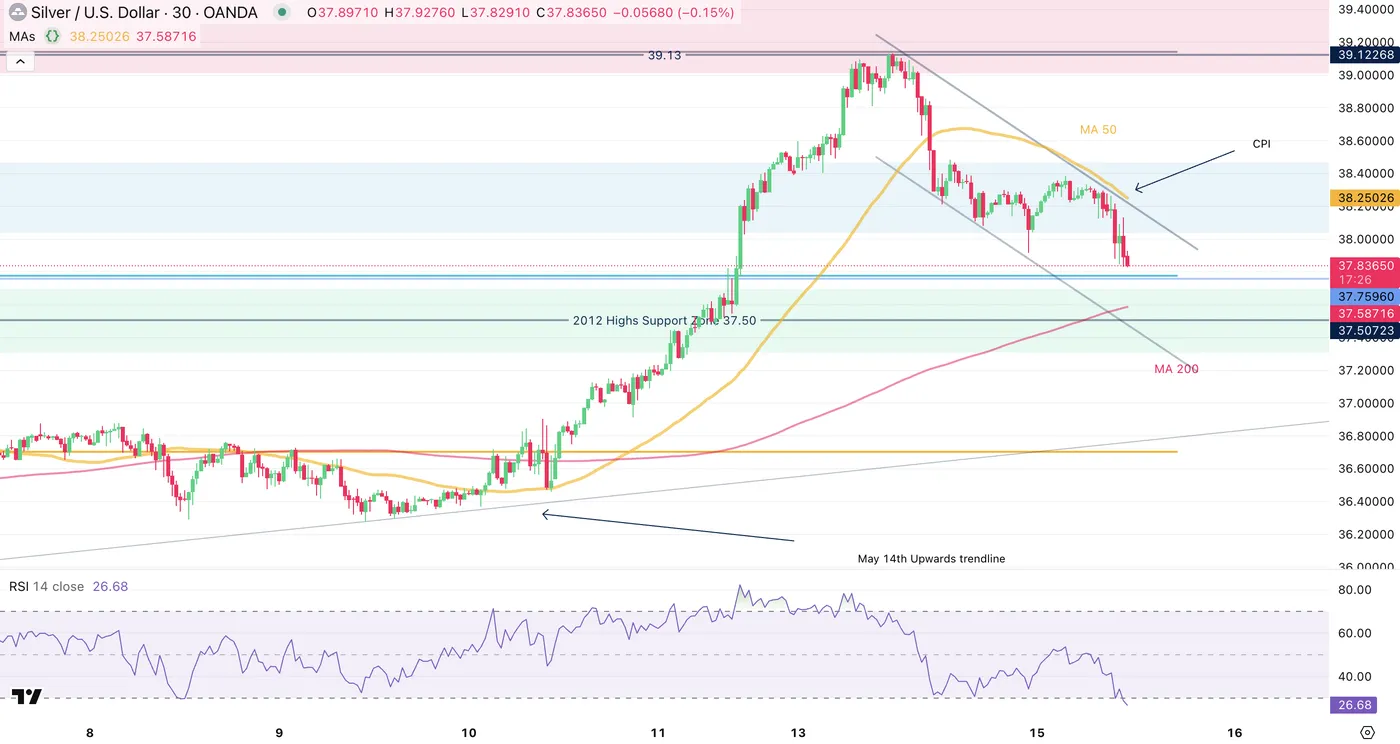
Silver 30m Chart, July 15, 2025 – Source: TradingView
The 30m and 1H 50-period Moving average are now acting as resistance and will be key barometers for either continuation (use the MA as selling point) or recovering of strength (breaking out of both the upper bound of the descending 30m channel + the 50 period MA – $38.25)
In any case, prices are now contained between the 50 and 200 30m MA which may point to the consolidation scenario around the $37.75 Fib, as prices are currently entering the 2012 High Support.
Safe Trades!
USDJPY Wave Analysis
USDJPY: ⬆️ Buy
- USDJPY broke the resistance area
- Likely to rise to resistance level 151.30
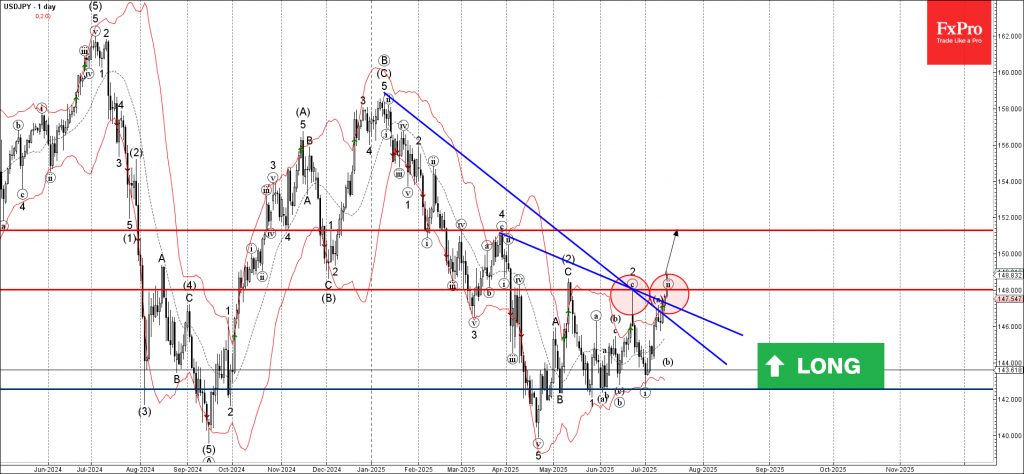
USDJPY currency pair recently broke the resistance area located at the intersection of the resistance level 148.00 and the two resistance trendlines from January and March.
The breakout of this resistance area should strengthen the bullish pressure on his currency pair.
Given the continuation of the widespread yen sales seen recently across FX markets, USDJPY currency pair index can be expected to rise to the next resistance level 151.30 (monthly high from March).
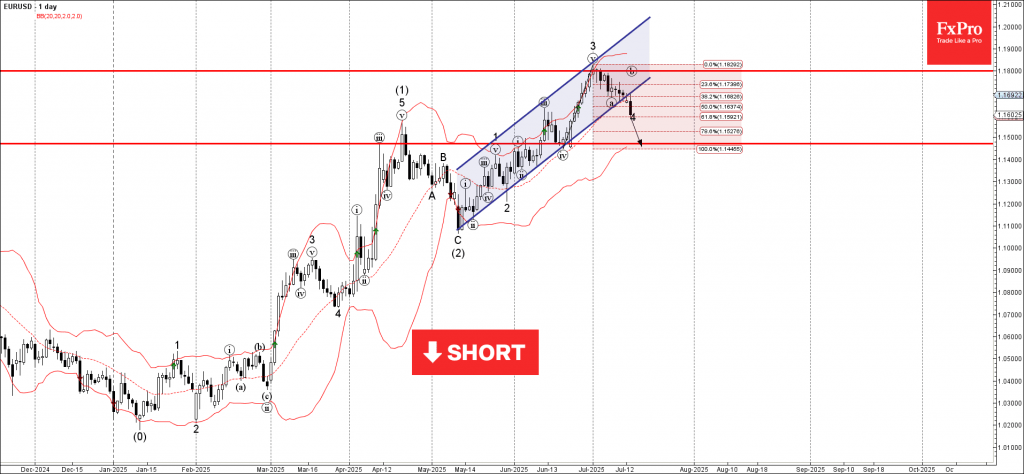
EURUSD Wave Analysis
EURUSD: ⬇️ Sell
- EURUSD broke daily up channel
- Likely to fall to support level 1.1470
EURUSD currency pair recently broke the support area located at the intersection of the support trendline of the daily up channel from May and the 38.2% Fibonacci correction of the upward impulse from June.
The breakout of this support area accelerated the active short-term ABC correction 4.
Given the strongly bullish US dollar sentiment coupled with significant euro pessimism seen today, EURUSD currency pair can be expected to fall further to the next support level 1.1470 (low of former wave iv).
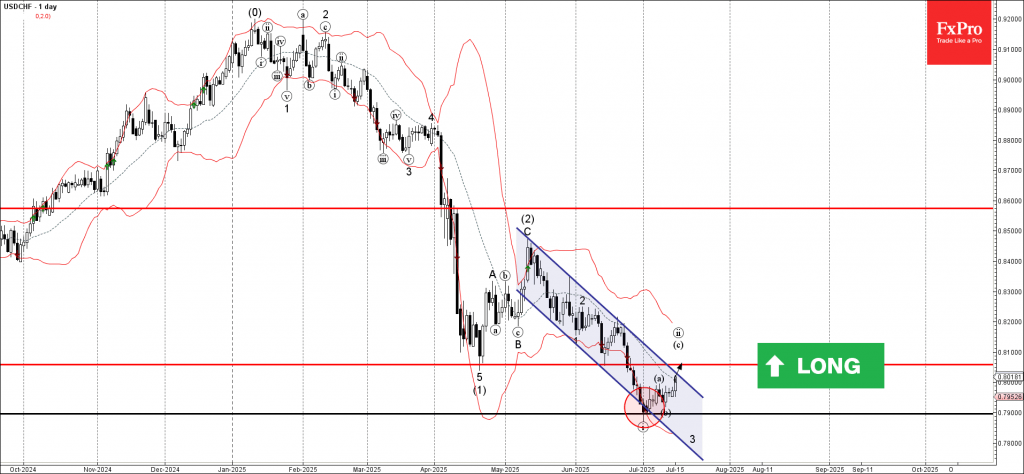
USDCHF Wave Analysis
USDCHF: ⬆️ Buy
- USDCHF reversed from support zone
- Likely to rise to resistance level 0.8055
USDCHF currency pair recently reversed from the support zone lying at the intersection of the support level 0.7900, lower daily Bollinger Band and the support trendline of the daily down channel from May.
The upward reversal from support zone started the active short-term ABC correction ii.
Given the strongly bullish US dollar sentiment seen today, USDCHF currency pair can be expected to rise to the next resistance level 0.8055 (former strong support from April and June).
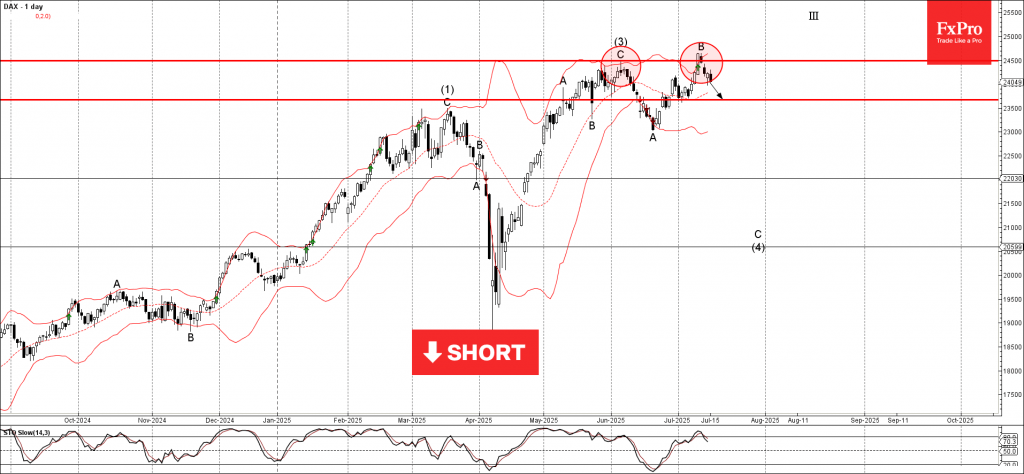
DAX Wave Analysis
DAX: ⬇️ Sell
- DAX reversed from the resistance area
- Likely to fall to support level 23675.00.
DAX index recently reversed down the resistance area between the pivotal resistance level 24500.00 (former top of wave 3 from June) and the upper daily Bollinger Band.
The downward reversal from this resistance zone stopped the earlier short-term ABC correction B.
Given the strength of the resistance level 24500.00, DAX index can be expected to fall further to the next support level 23675.00.
BoE’s Mann stresses inflation still a challenge, backs policy patience
BoE policymaker Catherine Mann emphasized the importance of keeping monetary policy restrictive in the face of lingering inflation pressures.
Speaking in an interview with Business in Wales Mann said, "wage rates come down” and "inflation come down quite a bit". But inflation is "still a challenge", as it's well above the 2% target.
Mann, who has voted to keep rates on hold at the last two meetings—including one where most colleagues backed a cut—framed inflation as a broad economic burden. “Inflation is a tax on everybody,” she said, adding that it’s crucial to maintain policy discipline until inflation is fully under control.
Sunset Market Commentary
Markets
This morning, it initially looked that risk premia at the ultra-long end of the yield curve could remain the focus for markets. The Japanese 10-y yield tested the cycle /YTD top levels near 1.6%. The 30-y yield even touched an all-time top near 3.21%. However, this time were no spillovers to markets outside Japan. Markets shifted into wait-and-see modus ahead of the US CPI data. German ZEW economic confidence improved more than expected, both for the measure on the current situation (-59.5 from -72.0) and the expectations series (52.7 from 47.5). The indicator had little impact on trading. Even so, equity resilience suggests a similar attitude (slight gains for Eurostoxx 50 and US equities) with investors staying hopeful on a reasonable outcome of the trade negotiations.
The eagerly awaited June US CPI report wasn’t able to given any clear directional guidance. At 0.3% M/M and 2.7% Y/Y and 0.2%/2.9% Y/Y for core inflation (ex food and energy) the report was very close to expectations. A rise in prices of apparel (0.4%) and some household furnishings and equipment might be indication of some pass-through of higher costs, but its too early to draw any firm conclusions. Vehicle prices declined again. Services prices ex energy rose 0.3%. Shelter price inflation was a modest 0.2%. If anything, the conclusion might be that it takes time for tariffs to move the overall picture on inflation, also as those items only have a rather limited weight in the inflation basket compared to e.g. services. US short-term yields briefly dipped after the release but most of this move was quickly undone. US yields are trading +2.5 bps (2-y) and -1.0 bps lower (30-y). Already this morning, German/EMU curves bull flattened and this move was maintained after the US CPI release. The German 2-y yields trades little changed (2-y). The 30-y declines 5.5 bps. Both the price action in the US and even more in the German yield curve suggest this a correction on recent steepening as LT yields were closing in on high profile levels, rather than a reaction to CPI. Hardly any USD reaction to the CPI data. The DXY trade-weighted (98.1) index lost marginal ground after the CPI release, but the move didn’t continue. EUR/USD drifts lower to 1.165. The yen still underperforms with USD/JPY at 148.5 and EUR/JPY 172.8, touching the highest level since July last year. EUR/GBP this morning just didn’t touch the 0.87 barrier, currently trading near 0.8675. Tomorrow, the UK June CPI data will be published with the labour market data to be released on Thursday. This evening markets also will keep a close at the Mansion House speech of Bailey. Markets look out whether the BoE governor will again shift the focus to sub-trend growth and easing of labour market conditions, suggesting more room for the BoE to cut rates later this year.
News & Views
Canadian inflation slowed to 0.1% m/m in June from 0.6% in May. That was nevertheless enough to lift the 1.7% y/y reading to 1.9%. The core measures watched closely by the Bank of Canada (trimmed, mean) ranged between 3% and 3.1% y/y while the common core gauge (CPI ex food and energy) came in at 2.6%. These latter gauges have been going nowhere for the last three months (since April) now. That’s unlikely to sooth the central bank let alone to convince it to cut rates further from the current 2.75% (in place since March). The BoC in its latest policy meeting (June 4) and referring back then to April data, specifically mentioned the uptick in core inflation and added that households continue to expect tariffs will raise prices while businesses plan to pass on those costs. US President Trump threatened Canada with a 35% in one of his tariff letters last week. The Canadian Loonie strengthens slightly against an overall weaker USD today. USD/CAD drops to 1.367. Canadian government bond yields trade little changed across the curve.
OPEC in its monthly report said that the global economy may perform better than expected in the latter half of the year despite the rumbling trade conflicts. Shorter term and going over the summer months, refineries’ crude intake would remain elevated, helping support the demand outlook. The robust outlook meant the oil cartel made no changes to its global oil demand growth for 2025 and 2026 after reductions in April. The OPEC analysis came after the IEA trimmed its demand forecast last week but later said that the market may be tighter than it appears. Brent oil prices trade little changed today around $69.3/b.