Mon, Apr 20, 2026 07:30 GMT
More

    Sample Category Title

    EUR/USD Extends Its March Beyond 1.14

    KBC Bank

    Markets

    US President Trump unexpectedly dropped a bomb on Friday by recommending a 50% tariff on EU goods effective immediate June 1st as he believed that the bloc wasn’t negotiating in good faith. Treasury Secretary Bessent added that he hoped it would light a fire under the EU. Apparently it did. A phone call between Commission President von der Leyen and US President Trump resulted in the latter pushing the negotiation deadline back to July 9 (in line with the previous end date of the 90-day pause), but the consequence of a “no-deal” remains the 50% tariff rather than the 20% reciprocal tariff charted in Washington’s Rose Garden on Liberation Day. Von der Leyen said that Europe is ready to advance talks swiftly and decisively with Trump cherishing the very nice call.

    Trump’s rant on social media covered an otherwise quite trading session by risk aversion on Friday. European stock markets lost 2% by the closing bell while US benchmarks suffered a setback of up to 1%. German Bunds rallied with yields sliding 6 to 7 bps across the curve as investors reverted to upping ECB rate cut bets. If any, the episode highlights what Lagarde labelled “unpredictable uncertainty”, making it very hard to assess economic and inflationary consequences. US Treasuries initially spiked higher, but failed to stick with gains. Daily US yield changes varied between -1.8 bps and +0.2 bps with the belly of the curve outperforming the wings. The US dollar sold off with the trade-weighted greenback closing at 99.11 from a start at 99.89. A test of the April low (97.92) is in the making. Friday’s reaction function shows that Trump’s bullying tactics trigger “sell America” vibes with investors. EUR/USD’s rise on Friday is testament to that: 1.1362 from 1.1281.

    Risk sentiment improves this morning with the July 9 deadline back in place. Stakes are now higher though. German Bund and European equity futures undo most of Friday’s moves. EUR/USD extends its march beyond 1.14. It’s probably too early to draw firm conclusions as the absence of UK (Spring Bank Holiday) and US (Memorial Day) investors squeezes market volumes today. We warn to get over-enthused and stick with a negative bias against the dollar. The EMU eco calendar is empty. ECB president Lagarde speaks on Europe’s role in a Fragmented World and it’s unclear whether she’ll touch on monetary policy during sideline interviews.

    News & Views

    Moody's raised the outlook on Italy’s Baa3 rating to positive from stable, reflecting the improved fiscal outlook against the backdrop of a better-than-expected fiscal performance in 2024 and the stable domestic political environment. Last year’s budget deficit came in at 3.4% compared to the 3.8% projected. Moody’s expects a further decline to 3% by 2026 as widening primary surpluses offset rising interest payments. The debt ratio should rise through 2027 (138.4% from 135.3% in 2024) before moving to a gradual declining trend from 2028. The positive outlook is also supported by a robust labour market, sound household and corporate balance sheets and a healthy banking sector. Together with further expected improvements in Italy’s external position they support economic resilience and reduce Italy's susceptibility to event risk. Its Baa3-rating takes into account Italy's large, wealthy economy and effective institutions and governance relative to rating peers. Moody’s adds, however, that the high debt burden remains a constraint on its credit profile.

    European officials familiar with the matter said they’re increasingly confidence that Bulgaria will soon meet all requirements for adopting the euro. With a history of narrow deficits, a low debt ratio and currency stability, above-target inflation was one of the final sticking points after the Russian invasion triggered a spike in prices. The European Commission together with the ECB is concluding the convergence report. Its release is due for early June. A positive assessment followed by EU leaders’ blessing at the end of June summit may pave the way for Bulgaria’s euro adoption from the beginning of 2026.

    Markets Swing on Rapidly Changing Trade Headlines

    Trade headlines are accelerating again—and that's not necessarily a good thing. Markets ended last week on a sour note after President Donald Trump threatened to impose a 50% tariff on European imports by June 1st, prompting a sharp selloff in major US and European indices. He also warned that Apple could face a 25% tariff unless it relocates its production to the US. The tech giant dropped 3% on fears that moving production could make it nearly impossible to sell iPhones for less than $3,000 apiece.

    Yet, sentiment has shifted sharply this morning. The Nikkei 225 rose more than 1.7%, buoyed by hopes that the US and Japan are progressing toward a trade deal. The news of partnership between US Steel Corp and Nippon Steel - long-standing saga since the Biden administration— also fuel optimism. Shares of Nippon Steel initially surged in Tokyo, though most gains were pared by the time of this report.

    In Europe, EuroStoxx futures are up by 1.6%, and S&P 500 futures have gained about 1% at the time of writing, helped by reports that the 50% EU tariff threat will be postponed to June 9th, giving European officials a bit more breathing room to negotiate. Still, the short extension comes as an unwelcome surprise for Europeans hoping for a calm, shortened week due to Thursday's Ascension Day holiday, and the US markets are closed today.

    Quick reminder: The EU, taken as a bloc, is the US' largest trading partner. And rising tensions between the US and EU could easily spark a broader selloff in risk assets, drive the dollar and US Treasuries lower, and send the euro, European bonds, and gold higher this week.

    In this context, selling pressure on the US dollar continues, driven by renewed trade frictions and swelling concerns over US debt. The dollar index is nearing its April lows, while the EURUSD has opened the week on strong footing—partly in relief over the delayed EU tariff deadline, though it's worth noting the euro was already rising on Friday when the tariff threat emerged. The euro appears to be acting as both a safe haven and a risk-on asset amid trade headlines.

    Cable surged past 1.35 for the first time in over three years, while the USDJPY looks poised to test the 142 level to the downside, with the 140 psychological mark in sight. The yen is supported by ongoing US dollar softness and mounting expectations of hawkish policy from the Bank of Japan (BoJ), bolstered by stronger-than-expected April CPI data.

    Elsewhere, gold continues to hold above $3,300 per ounce, supported by trade and debt uncertainties and Bitcoin is catching a bid amid capital outflows from the dollar and growing adoption by institutional players.
    Busy week ahead

    This week brings several key catalysts for both equity and currency markets. Major European economies will release May flash inflation figures, and consensus expects a slowdown after April’s surprise uptick. A stronger euro may have offset the rebound in oil prices. Should inflation slow meaningfully, the EURUSD could rally past the 1.15 handle.

    Investors will also monitor fresh Japanese inflation data, the Reserve Bank of New Zealand (RBNZ) is widely expected to cut interest rates by 25 basis points on Wednesday. In the US, Q1 GDP and core PCE data will provide critical insight into the health of the economy. A soft GDP print isn’t necessarily negative for investor sentiment —unless it’s accompanied by sticky inflation, which is likely given the potential tariff shock. That combination could spell trouble for Federal Reserve (Fed) policy expectations and equity valuations.

    Finally, all eyes turn to Nvidia, set to report fiscal Q1 2026 earnings after the bell on Wednesday. Last quarter, the company delivered strong results, although revenue just missed the $40 billion mark and margins remained under pressure due to Blackwell chip manufacturing challenges.

    For Q1, sales are expected to surpass $43 billion, despite heated trade war and rising Chinese competition. Margins may still face pressure, but fundamentals remain robust. Big spenders pledge to spend big, TSMC posted strong results—partly due to pre-tariff demand—and Nvidia recently secured major AI infrastructure deals in the Middle East, which should appear in forward guidance.

    The company is also prepping a cheaper version of its Blackwell chips for the Chinese market—though it still needs to be able to sell them. Options markets imply that Nvidia shares could move more than 7% in either direction following the report.

    Trump’s Tariff Twists Stir Up Markets

    In focus today

    Monday kicks off quietly, with no significant key data releases scheduled.

    In general, the week will be light on the data front, with the main releases including US consumer confidence on Tuesday, FOMC minutes and euro area inflation expectations Wednesday, and May inflation data for Germany, Spain and Italy as well as US personal spending/PCE figures on Friday. Weighing heavily on markets, we will continue to keep an eye out for any news on trade talks. Note that the Danske Morning Mail will not be published on Thursday and Friday this week due to the Ascension Day holiday.

    Economic and market news

    What happened since Friday

    Trade talks were in the limelight again, as Trump threatened Apple with 25% tariffs and the EU with 50% tariffs starting 1 June. Trump laid out the playing field, stating that he "is not looking for a deal" with the EU, as discussions are reportedly "going nowhere". However, yesterday it was announced that Trump backed away from this threat, agreeing to extend the deadline until 9 July (as was the initial deadline) between the US and the EU. The U-turn comes on the back of a conversation between Trump and EC President von der Leyen, with both parties opting for a swift and constructive agreement. Accordingly, this largely confirms that Trump's tariff plans can be regarded as a negotiation tool.

    In the euro area, wage growth declined to 2.4% y/y in Q1 2025 relative to 4.1% y/y in Q4 2024, according to the ECB's negotiated wage indicator. The large drop in Q1 mainly reflects one-off inflation compensation paid to workers in Q1 last year. While this decline overstates the underlying momentum in wage growth, excluding these one-offs shows a clear downward trend. This is visible in the ECB's wage tracker, which points to lower wage growth for 2025 and in company survey data indicating total wage growth around 3% y/y - consistent with inflation returning to 2%. Together, these wage indicators support further ECB rate cuts this year, as they imply lower services inflation. Importantly, negotiated wages do not capture the full picture, as they exclude overtime, salary increases to new or promoted staff, bonuses, and individual compensation not linked to collective bargaining. As such, the full overview of wage growth in Q1 2025 will come with the third estimate of the national account data on 6 June in the compensation per employee measure - the ECB's preferred wage measure.

    In Germany, Q1 2025 GDP growth was revised up to 0.4% q/q (flash: 0.2%), due to new export data for March released since the flash estimate showing a large increase in exports, likely due to front-loading to the US. This could result in weaker exports in either Q2 or Q3. Yet, besides front-loading of exports, private consumption rose 0.5% q/q, which is strong compared to the weak consumer confidence and a more positive sign for the economy.

    In Sweden, employment was flat over the month - markedly better than expected after the large increase in March. Thus, the labour market data points to a resilient Swedish economy, which reinforces our view that the Riksbank will stay on hold in June.

    Equities: Friday was one of those days with equities, bonds and dollar selling off at the same time. For every time the correlation flips, the bigger the risk of structural changes to the US equity exposure for pension funds and others. Though the flip in correlations is worrying, the overall equity moves were not. Equities recovered most of the losses into the session, as investors are clearly getting used to Trump's negotiation tactics. At least that is the market interpretation of it all, with close to zero discounting of the risk of 50% tariffs actually being implemented. Just take the Mag 7 companies, down a meagre -1.5% on the news. These companies generate between 25-40% of revenues in Europe. If 50% tariffs on Europe really were to happen, we would likely see EU going hard at them. Given the small reaction to Mag 7 on Friday, it is obvious that investors do not price in any meaningful escalation.

    Equities and bonds recovered about half of their intra-day losses on Friday and futures suggest that European rebound will continue today. Stoxx 600 closed -0.9% after dropping north of -2% intra-day. Similarly, S&P 500 shaved off only -0.7%. Despite the impressive intra-day rebound in equities, defensives still outperformed and did so overall last week, for the first time in four weeks. Apple one of the underperformers on Friday, down -3% on new tariff threats from Trump. Again, market impact is not very alarming: We will likely see Tim Cook promising US made iPhones by 2030, but taking no concrete action to do so, and both the president and shareholders will be happy. US and UK are closed for holiday today.

    FI and FX: The USD sold off on Friday, when US President Donald Trump called for a 50% tariff on imports from the EU thereby escalating the trade war again. EUR/USD rose to the highest since early May on the news. However, the market did not sell US Treasuries this time around with the 10Y yield holding steady around 4.50%. Both SEK and NOK gained vis-à-vis the EUR. The latter continues to trend stronger, while the former rose to the strongest level in about two weeks.

    USD/CAD Daily Outlook

    Daily Pivots: (S1) 1.3673; (P) 1.3771; (R1) 1.3832; More...

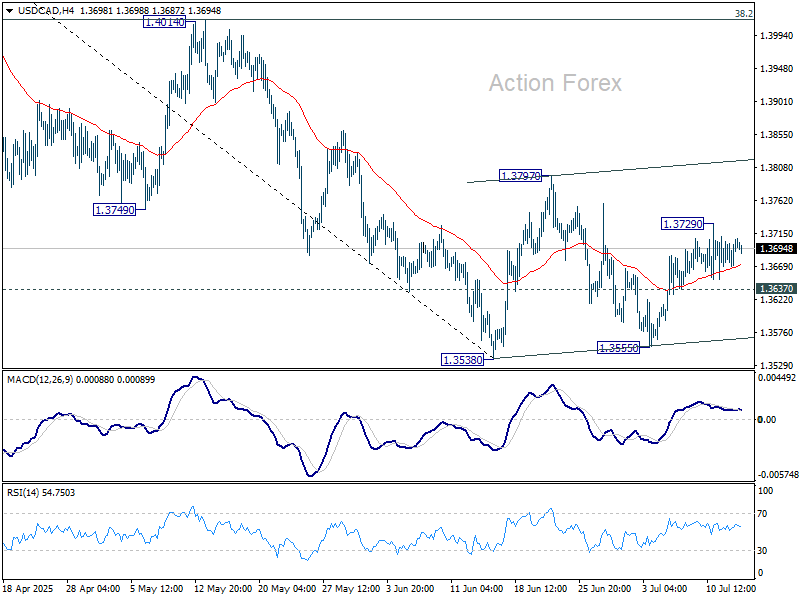
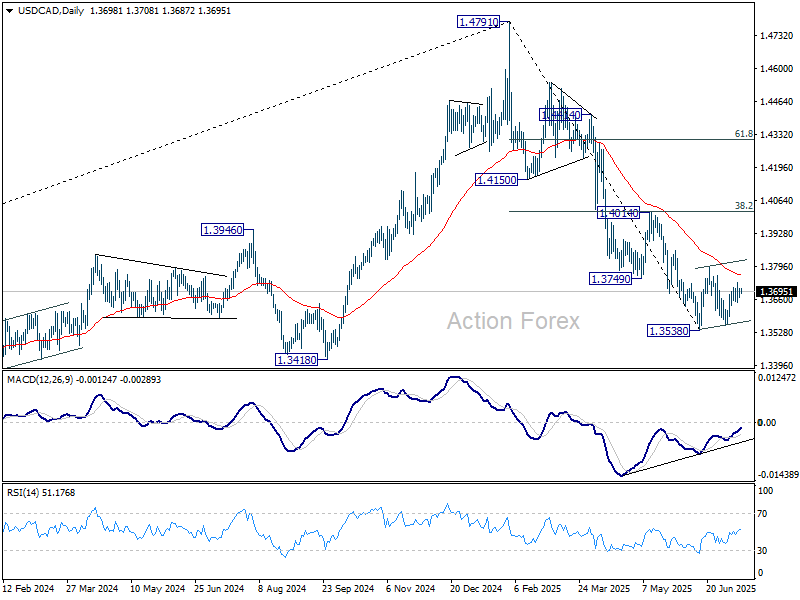
    Intraday bias in USD/CAD stays on the downside at this point. Current fall from 1.4791 is in progress for 61.8% projection of 1.4414 to 1.3749 from 1.4014 at 1.3603. On the upside, above 1.3812 minor resistance will turn intraday bias neutral again first. But outlook will remain bearish as long as 1.4014 resistance holds, in case of recovery.

    In the bigger picture, price actions from 1.4791 medium term top could either be a correction to rise from 1.2005 (2021 low), or trend reversal. In either case, further decline is expected as long as 1.4014 resistance holds. Next target is 61.8% retracement of 1.2005 (2021 low) to 1.4791 at 1.3069.

    AUD/USD Daily Report

    Daily Pivots: (S1) 0.6437; (P) 0.6468; (R1) 0.6527; More...

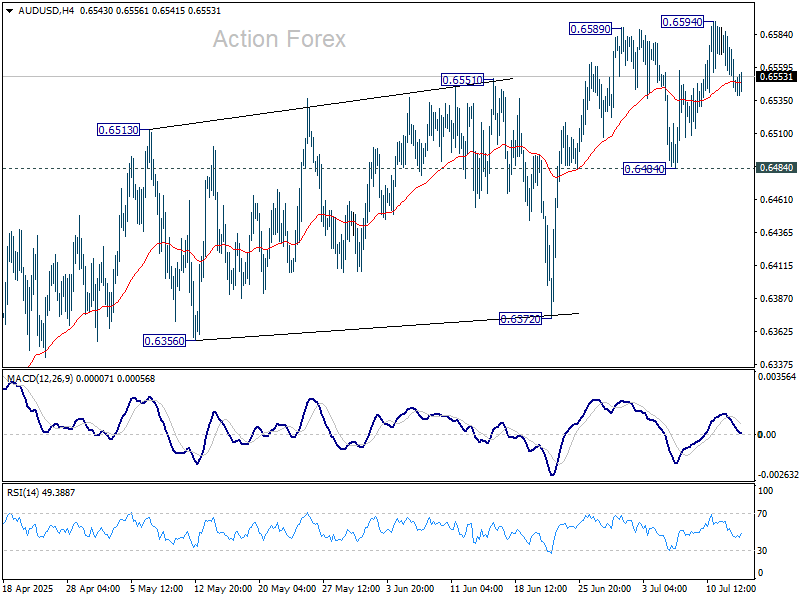
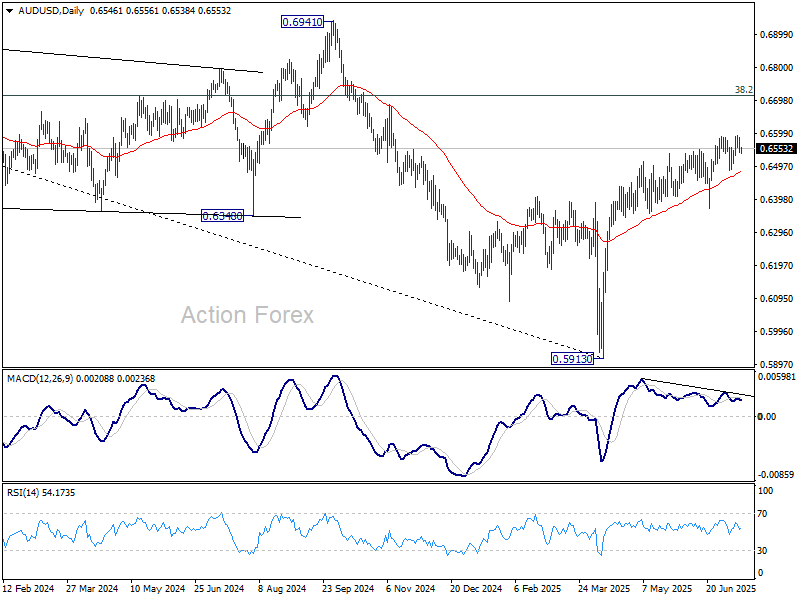
    AUD/USD's rise from 0.5913 resumed by breaking through 0.6513 resistance today. Intraday bias is back on the upside for 38.2% projection of 0.5913 to 0.6513 from 0.6406 at 0.6635. For now, outlook will stay bullish as long as 0.6406 support holds, in case of retreat.

    In the bigger picture, 55 W EMA (now at 0.6439) is considered taken out. A medium term bottom should already be in place at 0.5913. Rise from there could either be a corrective move, or reversing whole down trend from 0.8006 (2021 high). In either case, further rise is now expected as long as 55 D EMA (now at 0.6372) holds. Next target is 38.2% retracement of 0.8006 to 0.5913 at 0.6713.

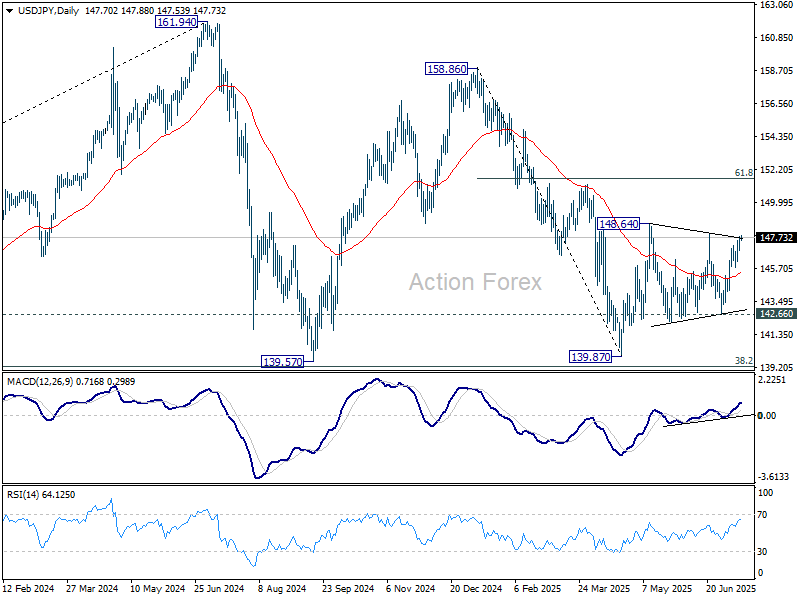
    USD/JPY Daily Outlook

    Daily Pivots: (S1) 141.93; (P) 143.07; (R1) 143.72; More...

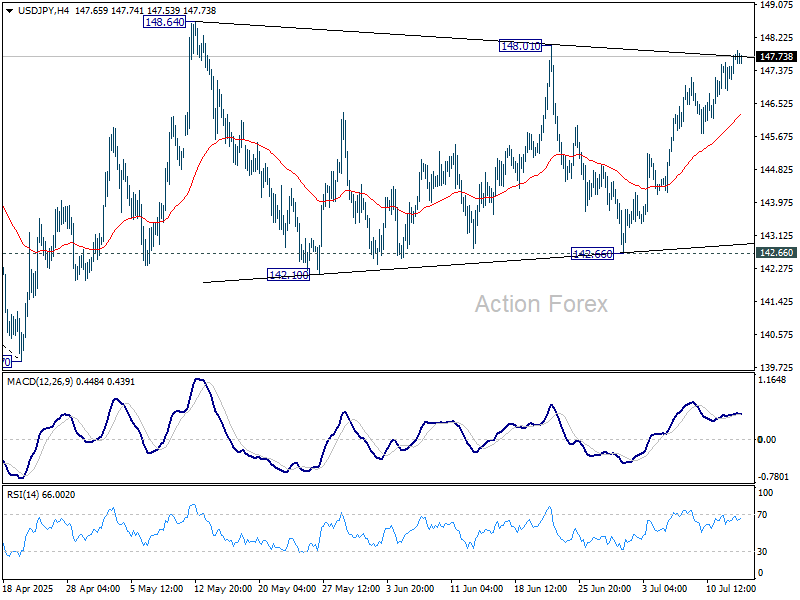
    Intraday bias in USD/JPY remains on the downside as fall from 148.64 is in progress for retesting 139.87. On the upside, above 144.31 minor resistance will turn intraday bias neutral again and bring consolidations first, before staging another decline.

    In the bigger picture, price actions from 161.94 are seen as a corrective pattern to rise from 102.58 (2021 low), with fall from 158.86 as the third leg. Strong support should be seen from 38.2% retracement of 102.58 to 161.94 at 139.26 to bring rebound. However, sustained break of 139.26 would open up deeper medium term decline to 61.8% retracement at 125.25.
    USD/CHF Daily Outlook

    Daily Pivots: (S1) 0.8179; (P) 0.8238; (R1) 0.8273; More….

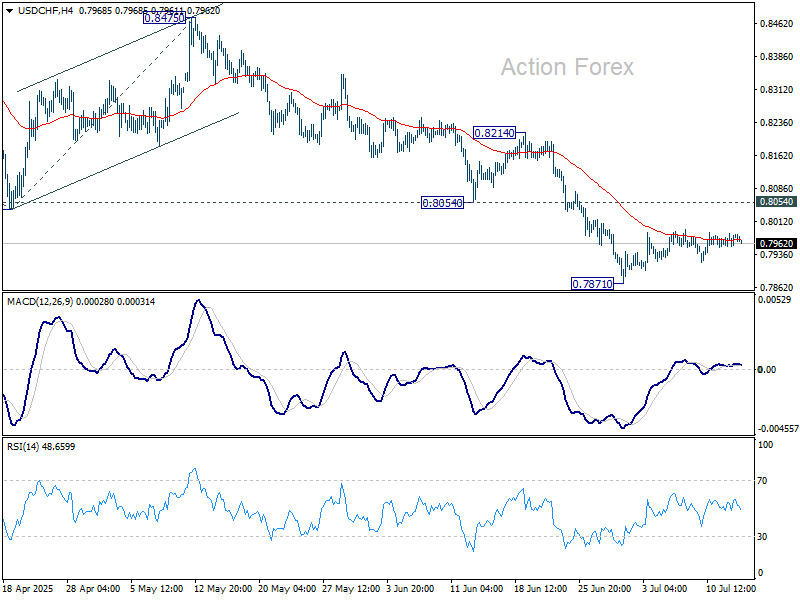
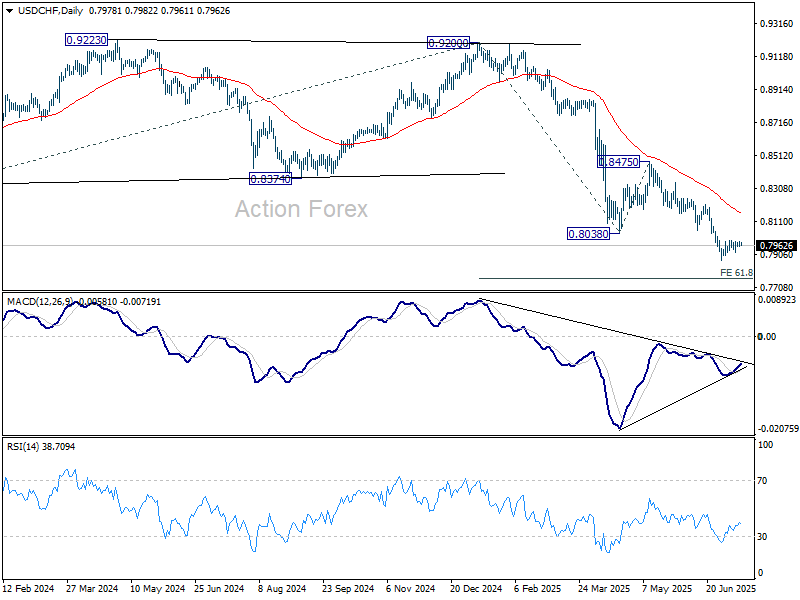
    Intraday bias in USD/CHF remains on the downside as fall from 0.8475 is in progress for retesting 0.8038 low. Firm break there will resume larger down trend to 61.8% projection of 0.9200 to 0.8038 from 0.8475 at 0.7757 next. On the upside, above 0.8305 minor resistance will turn intraday bias neutral again.

    In the bigger picture, long term down trend from 1.0342 (2017 high) is still in progress and met 61.8% projection of 1.0146 (2022 high) to 0.8332 from 0.9200 at 0.8079 already. In any case, outlook will stay bearish as long as 55 W EMA (now at 0.8713) holds. Sustained break of 0.8079 will target 100% projection at 0.7382.

    EUR/USD Daily Outlook

    Daily Pivots: (S1) 1.1303; (P) 1.1339; (R1) 1.1402; More...

    Intraday bias in EUR/USD remains on the upside as rise from 1.1064 is in progress for retesting 1.1572. Decisive break there will resume larger up trend to 61.8% projection of 1.0176 to 1.1572 from 1.1064 at 1.1927. On the downside, below 1.1255 minor support will turn intraday bias neutral again first.

    In the bigger picture, rise from 0.9534 long term bottom could be correcting the multi-decade downtrend or the start of a long term up trend. In either case, further rise should be seen to 100% projection of 0.9534 to 1.1274 from 1.0176 at 1.1916. This will now remain the favored case as long as 55 W EMA (now at 1.0858) holds.

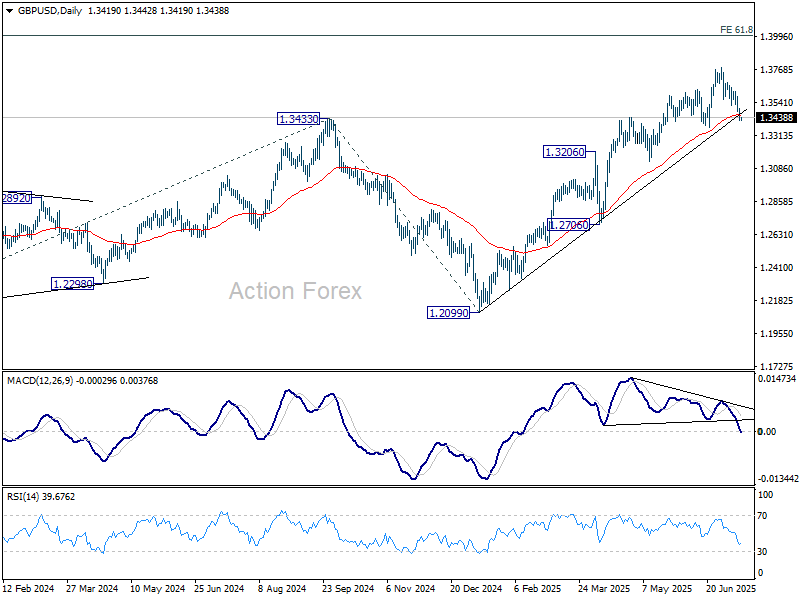
    GBP/USD Daily Outlook

    Daily Pivots: (S1) 1.3451; (P) 1.3496; (R1) 1.3587; More...

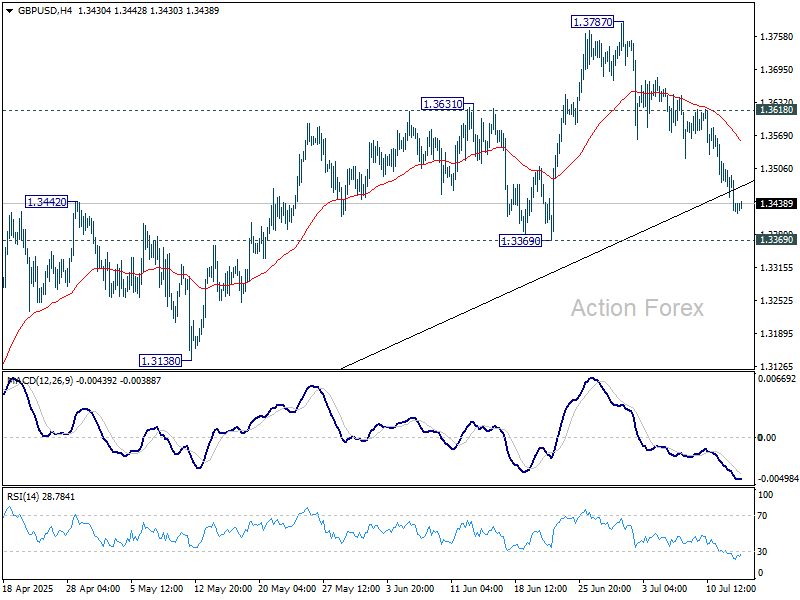
    Intraday bias in GBP/USD stays on the upside at this point. Firm break of 61.8% projection of 1.2706 to 1.3442 from 1.3138 at 1.3593 will target 100% projection at 1.3874. On the downside, below 1.3468 minor support will turn intraday bias neutral first. But retreat should be contained well above 1.3138 support to bring another rally.

    In the bigger picture, up trend from 1.3051 (2022 low) is in progress. Next medium term target is 61.8% projection of 1.0351 to 1.3433 from 1.2099 at 1.4004. Outlook will now stay bullish as long as 55 W EMA (now at 1.2870) holds, even in case of deep pullback.
    Dollar Drops as Tariff Confusion Reignites and Trade Talks Drag On

    Dollar extended its slide as the new week opened in Asia, with investors once again thrown off balance by US President Donald Trump’s unpredictable tariff messaging. The latest development sees Trump agreeing to delay the planned 50% tariff hike on the European Union to July 9, following a direct request from European Commission President Ursula von der Leyen. While that initially offered a sense of relief, markets remain unsettled by Trump’s abrupt shifts in tone, having only days ago vowed there would be “no deal” before June and called for an immediate 50% levy.

    Von der Leyen’s message on social media highlighted the EU’s readiness to move the discussions forward “swiftly and decisively”, But with Trump’s prior threats still fresh in investors’ minds, confidence in any stable outcome remains low. The tariff truce extension does little to erase concerns over the longer-term outlook for transatlantic trade, especially with the US’s broader reciprocal tariff regime still in place at a baseline of 10%.

    At the same time, Japan is pushing ahead with its own talks with Washington. Prime Minister Shigeru Ishiba indicated on Sunday that Tokyo aims to reach a deal by the G7 summit next month. There appears to be some traction in the bilateral dialogue, including discussions on non-tariff measures and shipbuilding cooperation. Notably, the US has expressed interest in using Japanese shipyards to repair warships, while Japan has floated the potential for collaboration on Arctic icebreakers, an area where it claims a technological edge.

    However, Japan’s chief negotiator Ryosei Akazawa struck a cautious tone upon returning from his third round of discussions in Washington. He reiterated that any agreement would be contingent on all elements falling into place as a package, and that “nothing is agreed until everything is agreed.” The scheduling of the next round, including a meeting with US Treasury Secretary Scott Bessent, is still being finalized.

    With US and UK markets closed for holiday and an empty data calendar to start the week, focus is squarely on trade developments and sentiment-driven flows. Later in the week, attention will turn to RBNZ, which is widely expected to cut interest rates by 25bps. FOMC minutes, US durable goods, consumer confidence, and PCE inflation data will offer critical insight too. In addition, key releases from Australia (monthly CPI and retail sales), Canada (Q1 GDP), and Japan (Tokyo CPI) will round out the week. But given the pace of political developments on trade, economic figures may take a back seat unless they show sharp surprises.

    In the currency markets, Dollar is at the bottom of the board, followed by Yen and Swiss Franc. Kiwi is leading gains, followed by Aussie and Euro. Sterling and Loonie are more mixed, hovering around the middle.

    Technically, with today's rally, immediate focus is now on 0.6028 resistance in NZD/USD. Decisive break there will resume the rise from 0.5484 and target 61.8% projection of 0.5484 to 0.6028 from 0.5845 at 0.6181. Nevertheless, the real test for NZD/USD's medium term outlook is on 38.2% retracement of 0.7463 (2021 high) to 0.5484 at 0.6240.

    In Asia, at the time of writing, Nikkei is up 0.83%. Hong Kong HSI is down -0.98%. China Shanghai SSE is down -0.18%. Singapore Strait Times is down -0.43%. Japan 10-year JGB yield is down -0.007 at 1.542.

    Fed Kashkari: Uncertainty to delay policy at least until September

    Minneapolis Fed President Neel Kashkari warned today that major shifts in US trade policies are clouding the outlook for monetary policy, making it difficult for the Fed to move on interest rates before September.

    While “anything is possible,” Kashkari said in an interview with Bloomberg TV, he’s unsure whether the picture will be “clear enough” by then. Much hinges, he added, on whether trade negotiations between the US and its partners yield concrete deals in the coming months, which could “provide a lot of the clarity we are looking for.”

    The uncertainty, Kashkari explained, is weighing on economic activity. He emphasized the stagflationary nature of the tariff shock, noting that its impact will depend on both the scale and duration of the levies.

    On financial markets, Kashkari acknowledged that rising US Treasury yields might reflect a broader reassessment by global investors about the risks of holding American assets. He suggested that the current bond market reaction could signal a new global paradigm.

    RBNZ set to ease again, FOMC minutes and PCE inflation watched

    RBNZ is widely expected to lower the Official Cash Rate by 25bps to 3.25% this week, continuing its cautious policy easing cycle. Q1 CPI in New Zealand surprised to the upside and may warrant a slight upward revision in near-term inflation forecasts. Nevertheless, the outlook for growth has become increasingly clouded by external trade risks. As such, the RBNZ would probably adopt a data-dependent easing bias beyond this meeting, weighing the need for further cuts against incoming global and domestic developments.

    Markets will be particularly attentive to any forward guidance on July from RBNZ. A hawkish tilt, such as hinting at an openness to pause depending on how trade and inflation evolve—could dampen expectations for a follow-up cut. Nonetheless, the baseline remains tilted toward continued easing unless global risks recede or domestic data markedly improve.

    In the US, the release of the FOMC minutes from the May meeting will draw scrutiny, though Fed is unlikely to deviate from its current stance. Policymakers have made clear they are in no rush to resume easing, preferring to wait for clearer signs from inflation and trade.

    With the 90-day trade truce now at the halfway mark and tensions reemerging—especially with Trump's threats toward the EU, uncertainty still dominates the outlook. More clarity may arrive with Fed’s next meeting on June 17–18, when updated economic projections will be published.

    Investors will also focus on key US data including durable goods orders, consumer confidence, and the core PCE price index.

    Elsewhere, Australia's monthly CPI and retail sales will shed light on the pace of disinflation and consumption ahead of the RBA's July decision. Canada’s GDP, Japan’s Tokyo CPI, retail sales, and industrial output will also be important inputs for their respective central banks.

    Here are some highlights for the week:

    • Tuesday: Japan corporate service price; Swiss trade balance; Germany Gfk consumer sentiment; US durable goods orders, consumer confidence.
    • Wednesday: Australia CPI; RBNZ rate decision; Germany import prices, unemployment; France consumer spending; Swiss UBS economic expectations; FOMC minutes.
    • Thursday: New Zealand ANZ business confidence; US GDP revision, pending home sales.
    • Friday: New Zealand building permits; Japan Tokyo CPI, industrial production, retail sales; Australia retail sales; Germany retail sales, CPI flash; Swiss KOF economic barometer; Eurozone M3 money supply; Canada GDP; US trade balance, personal income and spending, PCE inflation, Chicago PMI.

    GBP/USD Daily Outlook

    Daily Pivots: (S1) 1.3451; (P) 1.3496; (R1) 1.3587; More...

    Intraday bias in GBP/USD stays on the upside at this point. Firm break of 61.8% projection of 1.2706 to 1.3442 from 1.3138 at 1.3593 will target 100% projection at 1.3874. On the downside, below 1.3468 minor support will turn intraday bias neutral first. But retreat should be contained well above 1.3138 support to bring another rally.

    In the bigger picture, up trend from 1.3051 (2022 low) is in progress. Next medium term target is 61.8% projection of 1.0351 to 1.3433 from 1.2099 at 1.4004. Outlook will now stay bullish as long as 55 W EMA (now at 1.2870) holds, even in case of deep pullback.

    Economic Indicators Update

    GMT CCY EVENTS ACT F/C PP REV
    05:00 JPY Leading Economic Index Mar F 108.1 107.7 107.7
    06:30 CHF Employment Level Q1 5.534M