Sample Category Title
EUR/USD On The Edge — Is Another Slide Just Getting Started?
Key Highlights
- EUR/USD started a fresh decline from the 1.1260 resistance.
- A key bearish trend line is forming with resistance at 1.1225 on the 4-hour chart.
- GBP/USD is consolidating below the 1.3350 resistance zone.
- Gold prices dipped further and traded below $3,180.
EUR/USD Technical Analysis
The Euro attempted to recover above 1.1220 against the US Dollar. However, EUR/USD struggled near 1.1265 and reacted to the downside.
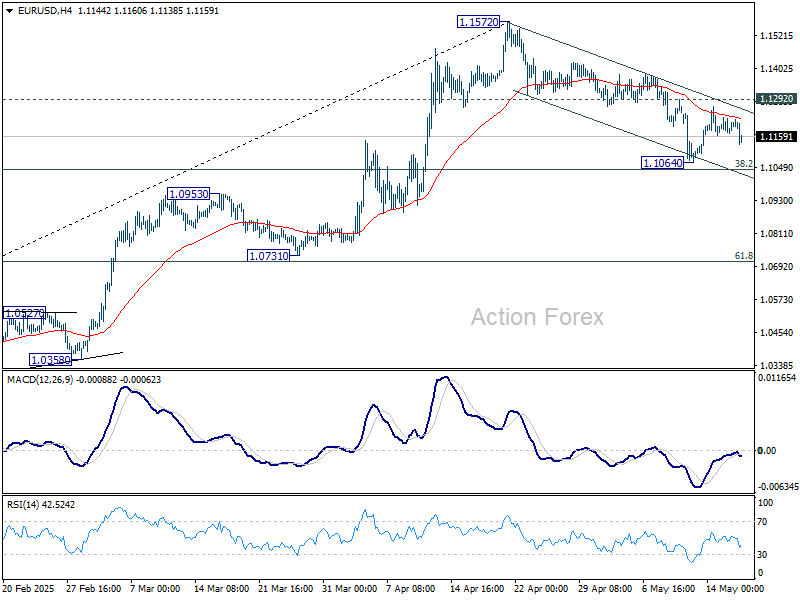
Looking at the 4-hour chart, the pair failed to clear the 61.8% Fib retracement level of the downward move from the 1.1380 swing high to the 1.1065 low. It settled below the 1.1250 level, the 100 simple moving average (red, 4-hour), and the 200 simple moving average (green, 4-hour).
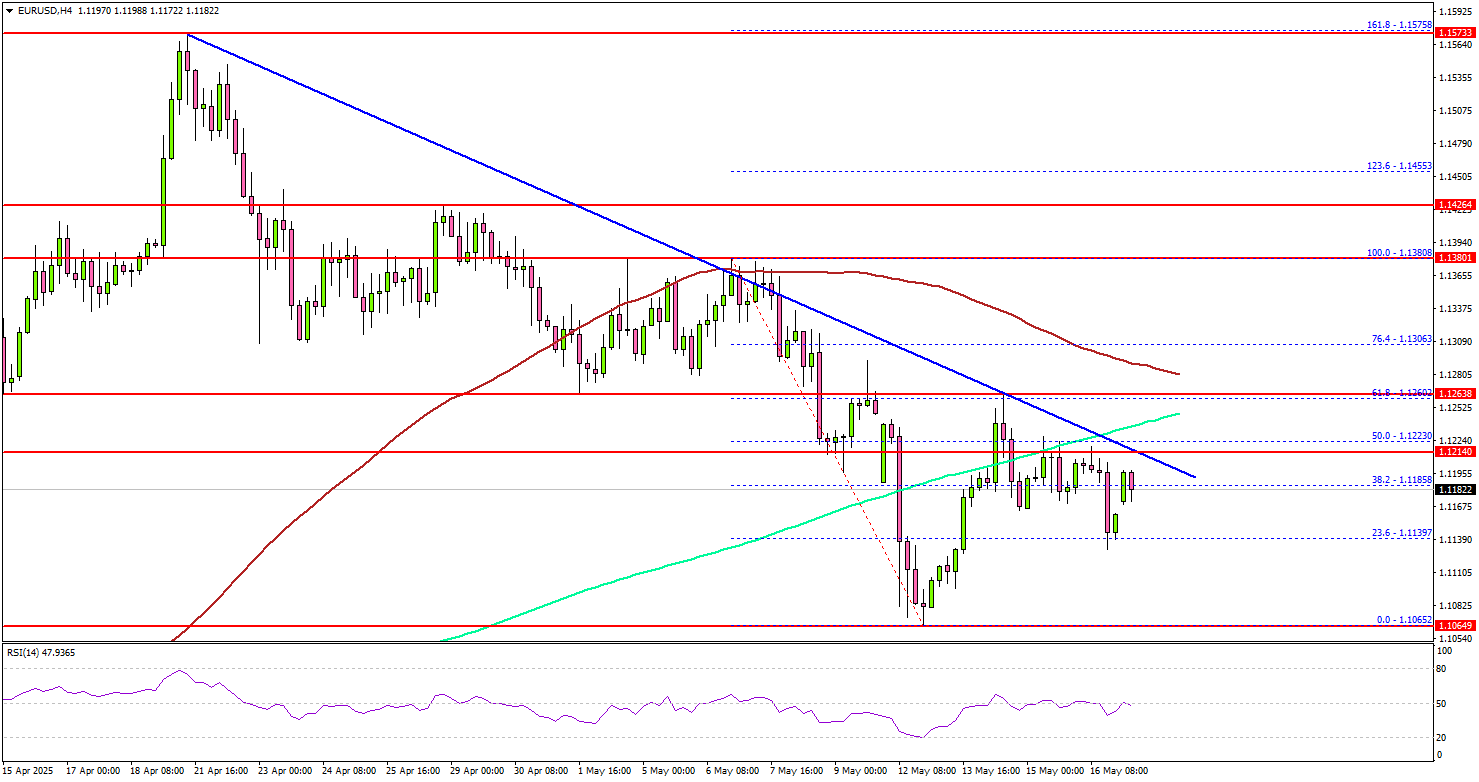
On the downside, immediate support sits near the 1.1120 level. The next key support sits near 1.1065. Any more losses could send the pair toward the 1.1020 level.
On the upside, the pair could face resistance near the 1.1225 level. There is also a key bearish trend line forming with resistance at 1.1225 on the same chart. The next key resistance sits near the 1.1300 level. The first major resistance sits at 1.1320.
A close above the 1.1320 level could set the pace for another increase. In the stated case, the pair could even clear the 1.1380 resistance. The next major stop for the bulls could be near the 1.1450 resistance.
Looking at GBP/USD, the pair started a consolidation phase and faces hurdles near the 1.3350 and 1.3380 levels.
Upcoming Economic Events:
- Fed's Bostic speech.
- Fed's Jefferson speech.
- Fed's Williams speech.
USDJPY Pulls Back, But Buyers Step In at Key Levels
Key Highlights
- USD/JPY started a downside correction and traded below 147.20.
- A connecting bullish trend line is forming with support at 144.50 on the 4-hour chart.
- EUR/USD could aim for a recovery if it clears the 1.1280 resistance.
- Gold prices dipped further and traded below $3,200.
USD/JPY Technical Analysis
The US Dollar failed to continue higher above 148.65 and corrected gains against the Japanese Yen. USD/JPY traded below the 148.00 and 147.50 levels.
Looking at the 4-hour chart, the pair traded below 147.20 support and tested the 50% Fib retracement level of the upward move from the 142.34 swing low to the 148.65 high. However, the pair remains well above the 100 simple moving average (red, 4-hour) and the 200 simple moving average (green, 4-hour).
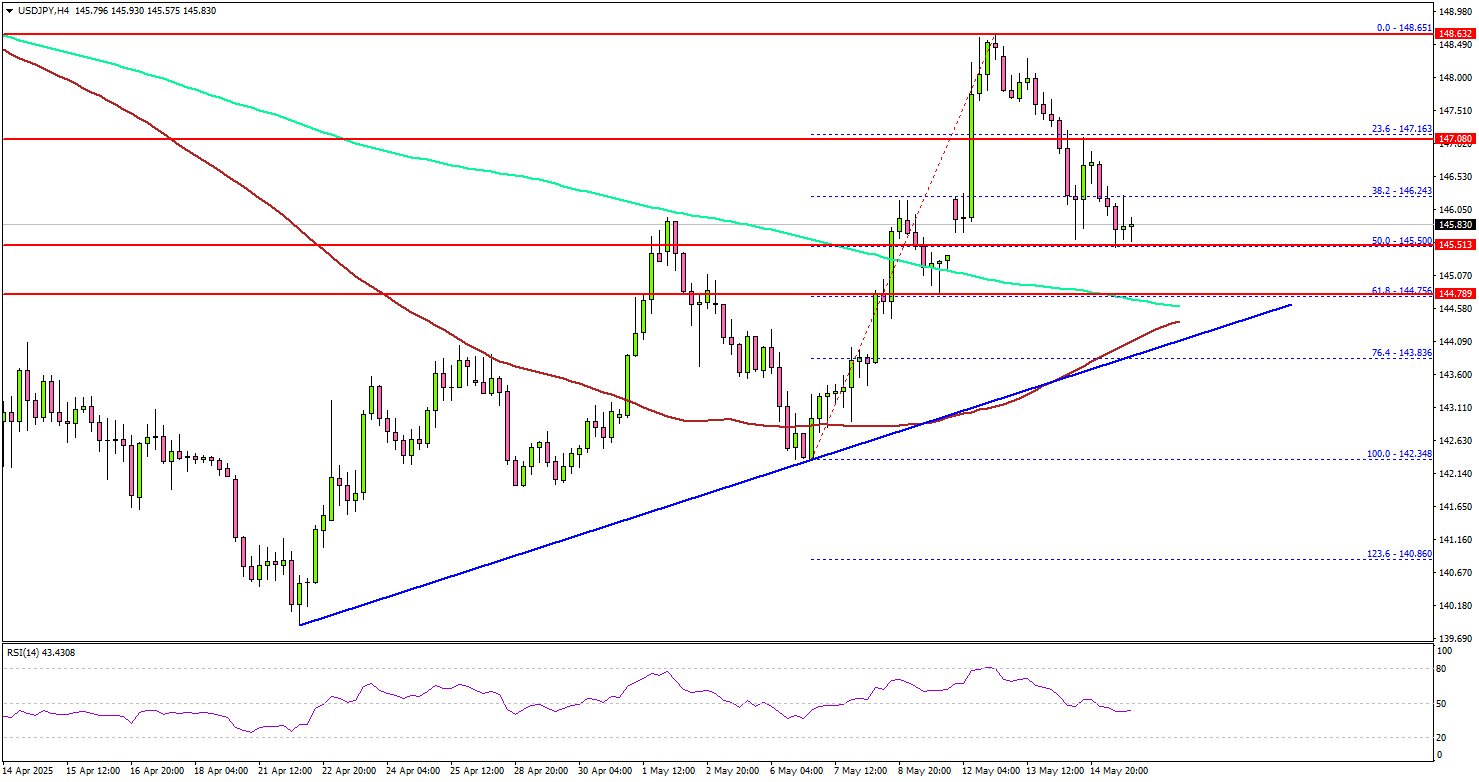
On the downside, immediate support sits near the 144.75 level and the 200 simple moving average (green, 4-hour). The next key support sits near 144.50. There is also a connecting bullish trend line forming with support at 144.50 on the same chart.
Any more losses could send the pair toward the 143.20 level. On the upside, the pair could face resistance near the 147.00 level. The next key resistance sits near the 147.50 level.
The first major resistance sits at 148.00. A close above the 148.00 level could set the tone for another increase. In the stated case, the pair could even clear the 148.65 resistance. The next major stop for the bulls could be near the 150.00 resistance.
Looking at EUR/USD, the pair started a consolidation phase and faces hurdles near the 1.1280 and 1.1320 levels.
Upcoming Economic Events:
- US Housing Starts for April 2025 (MoM) – Forecast 1.370M, versus 1.324M previous.
- US Building Permits for April 2025 (MoM) – Forecast 1.450M, versus 1.467M previous.
- Michigan Consumer Sentiment Index for May 2025 (Prelim) – Forecast 53.4, versus 52.2 previous.
S&P 500 Wave Analysis
S&P 500: ⬆️ Buy
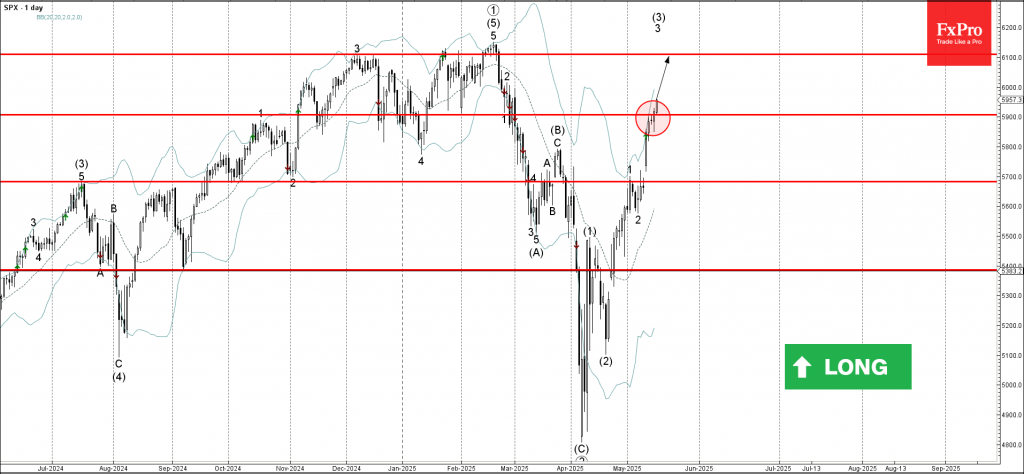
- S&P 500 broke the resistance level 5900.00
- Likely to rise to resistance level 6100.00
S&P 500 index recently broke the resistance level 5900.00, the former support from January and February.
The breakout of the resistance level 5900.00 should accelerate the active short-term impulse wave 3, which belongs to the intermediate impulse wave (3) from the end of April.
S&P 500 index can be expected to rise to the next resistance level 6100.00, which reversed the price multiple times from December to March, as can be seen below.
FTSE 100 Wave Analysis
FTSE 100: ⬆️ Buy
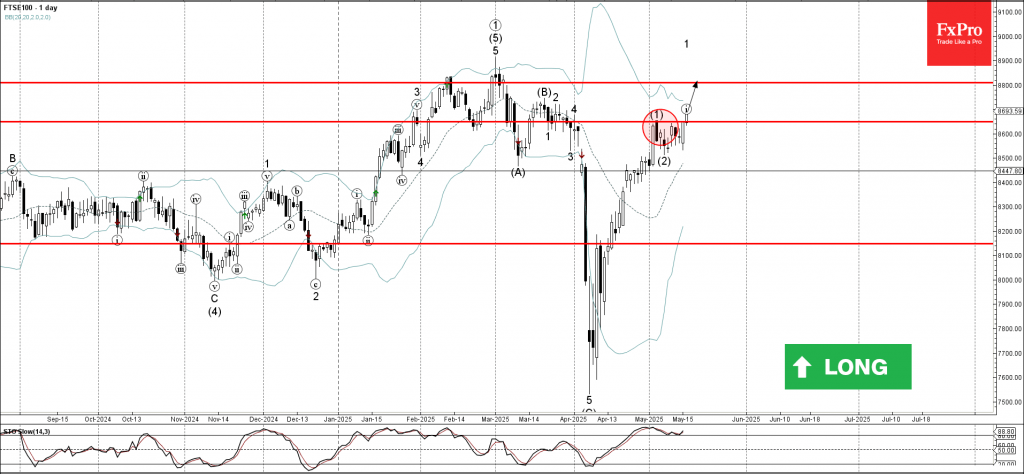
- FTSE 100 broke the resistance level 8650.00
- Likely to rise to resistance level 8800.00
The FTSE 100 index recently broke the resistance level 8650.00, which stopped the previous medium-term impulse wave (1) at the start of this month.
The breakout of the resistance level 8650.00 should accelerate the active medium-term impulse wave (3) from the start of May.
Given the improved sentiment across the global equity markets, the FTSE 100 index can be expected to rise to the next resistance level 8800.00, which has been reversing the price from the start of February.
Moody’s Downgrade Disrupts Calm from Tariff Truce, Dollar Faces New Test
Just as markets were finding their footing following a series of positive trade developments, Moody’s delivered a late-week shock by downgrading the US sovereign credit rating from Aaa to Aa1. The move overshadowed the optimism sparked by the US-China tariff truce and the broader de-escalation of trade tensions.
The trade outlook appears less volatile in the near term, with more agreements possibly in the pipeline. Markets may enjoy a reprieve from tariff headlines until early July for non-China partners, and until mid-August for China.
However, that stability could be abruptly shaken by Moody’s downgrade. The timing of the downgrade coincides with fragile improvements in sentiment, raises the risk of renewed selling in both Treasuries and Dollar.
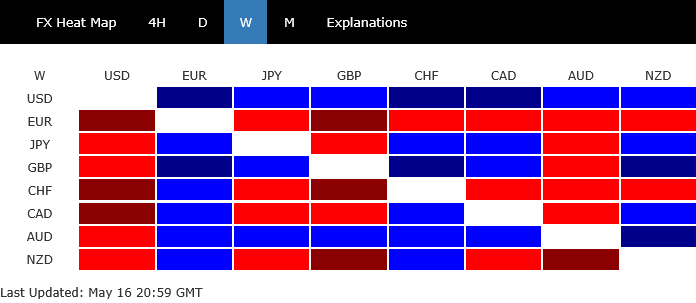
In the currency markets, performance was mixed last week, a hallmark of broader consolidation. Dollar finished as the strongest currency but notably failed to build on its early-week strength. Aussie followed as the second-best performer, buoyed by strong domestic job data and risk appetite, while Sterling also held firm with support from strong UK GDP. However, gains were limited overall. On the weaker side, Euro posted the poorest performance, followed by Swiss Franc and Kiwi. Yen and Loonie ended the week in the middle.
Wall Street Surges on Trade Truce, Even Though Soaring Inflation Expectations Reinforce Fed Patience
US equity markets wrapped up the week with strong gains, driven by renewed optimism over global trade and investor resilience, despite worrying economic signals. S&P 500 surged 5.3%, DOW added 3.4%, and NASDAQ Composite outperformed with a 7.2% jump. The rally was initially sparked by the surprising outcome of the US-China trade meeting. Both sides agreed to a 90-day truce and rolled back a significant portion of the tariffs, though not fully returning to pre-conflict levels.
Investors looked past several downside risks and pushed stock prices higher, even as economic data pointed to potential trouble ahead. Markets absorbed weak consumer sentiment and sharply rising inflation expectations without flinching. This reflects a broader hope that trade normalization will continue to offset macro headwinds, at least in the short term.
The University of Michigan's preliminary consumer sentiment report for May, released Friday, highlighted growing public anxiety. The headline index dropped to 50.8, its second-lowest reading on record. Year-ahead inflation expectations surged from 6.5% to 7.3%, the highest since 1981.
Importantly, the survey was conducted between April 22 and May 13. That timeframe includes the period after US President Donald Trump announced that reciprocal tariffs on all trading partners other than China would be scaled back to a 10% baseline. It also includes responses collected a day after the US-China truce was declared.
In that context, the persistent collapse in sentiment and worsening inflation outlook suggest that consumers remain highly skeptical about the economic direction. Even the rollback of some tariffs was not enough to lift the mood or tame concerns about rising prices. Attention will now be on the final May release due May 30, to see if sentiment and expectations shift more positively as the trade truce sinks in.
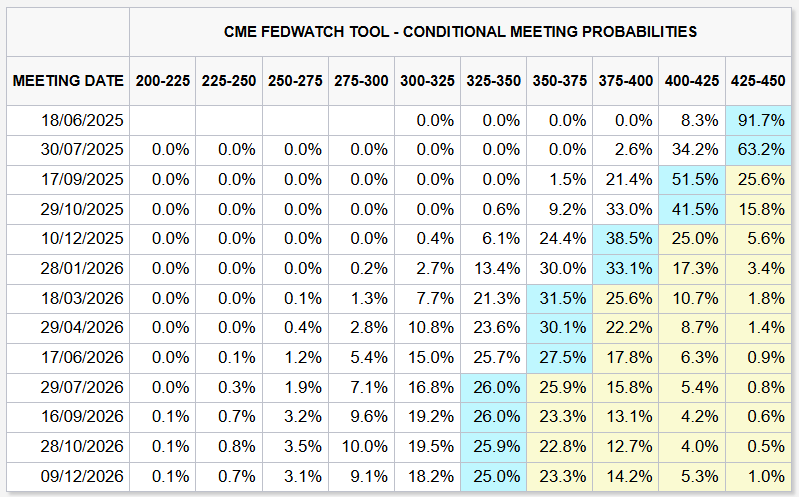
For Fed, the data likely reinforce a cautious stance, for holding back from another rate cut for longer. Fed funds futures now reflect just a 36% chance of a 25bps rate cut in July. Expectations rise to 75% for a September cut, followed by around 70% odds of another in December. That suggests markets believe only two rate cuts are likely this year, if any.
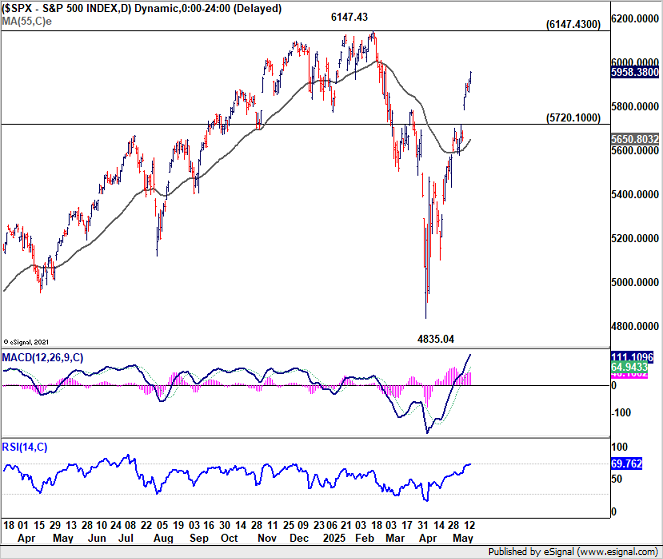
Technically, S&P 500 gapped higher at the start of the week and extended its rally from 4835.04 low. The current rise is still viewed as the second leg in the medium-term corrective pattern from the 6147.43 high. Momentum should start to fade above 6000 psychological level. A break below 5720.10 gap support would indicate short-term topping. Sustained trading below 55 Day EMA (now at 5650.80) would suggest that the third leg of the correction has already begun.
Moody’s Downgrade Casts Shadow Over Dollar and Treasuries
Despite a strong weekly finish for Wall Street and Dollar, sentiment faces a fresh challenge after Moody’s downgraded the US sovereign credit rating on Friday. The move, announced after markets closed, cut the rating by one notch to Aa1 from Aaa—marking a rare loss of top-tier status. While the immediate market reaction was muted due to timing, the downgrade could cast a shadow over financial markets in the coming week, with pressure potentially building on both Dollar and US Treasuries.
Notably, Dollar ended as the top-performing major currency last week, but it did so without conviction. After Monday’s initial surge, momentum faded quickly. By midweek, the greenback began to stall, showing little follow-through despite stronger inflation expectations. That suggests underlying demand may be fragile.
Moody’s cited deteriorating fiscal outlook as the key reason for the downgrade, pointing to “successive US administrations and Congress” that have failed to reverse the trend of widening deficits and rising debt servicing costs. The agency also expressed skepticism that meaningful fiscal reforms are on the horizon, making clear that the downgrade reflects more than just short-term political risks. The downgrade reflects not only mounting fiscal stress, but also the political impasse that continues to hinder structural reforms.
This backdrop is especially important given how markets reacted in early April, when sweeping reciprocal tariffs imposed by the US triggered a rally in Treasury yields and broad weakening of Dollar. That episode suggested investors may be reassessing traditional assumptions about the US’s role as the ultimate safe asset provider. A similar dynamic could resurface if the Moody’s downgrade gains traction with bondholders or sparks broader credit rating scrutiny.
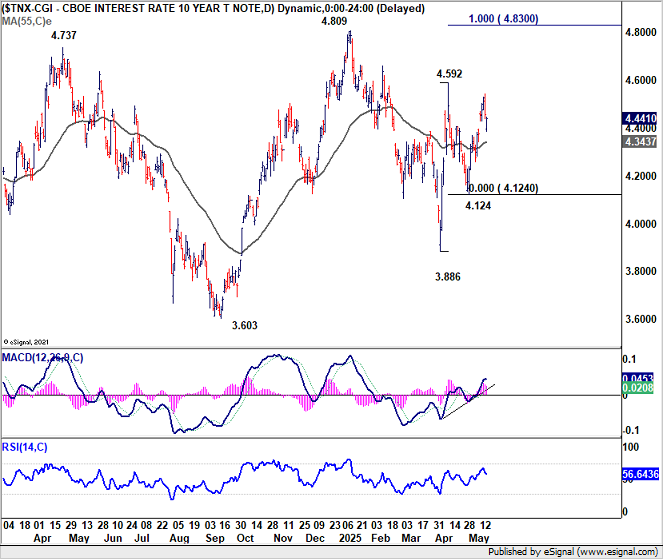
Technically, 10-year yield's strong rise last week suggests that near term correction from 1.4592 has already completed at 4.124. Rise from 3.886 might be ready to resume. Further rally is now in favor as long as 55 D EMA (now at 4.3437) holds. Firm break of 4.592 would target 100% projection of 3.886 to 4.592 from 4.124 at 4.830 next.
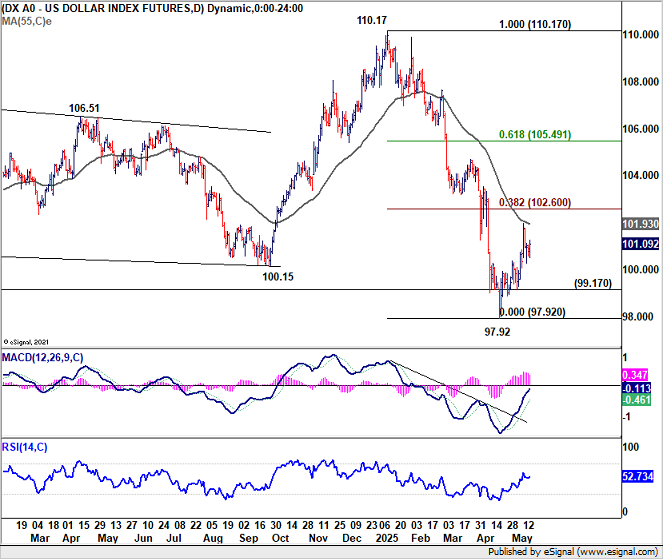
Dollar Index's corrective recovery from 97.92 continued last week, but started to struggle ahead of 55 D EMA (now at 101.93). While another rise cannot be ruled out, upside should be limited by 38.2% retracement of 110.17 to 97.92 at 102.60. On the downside, break of 99.17 support will argue that larger down trend is ready to resume through 97.92 low.
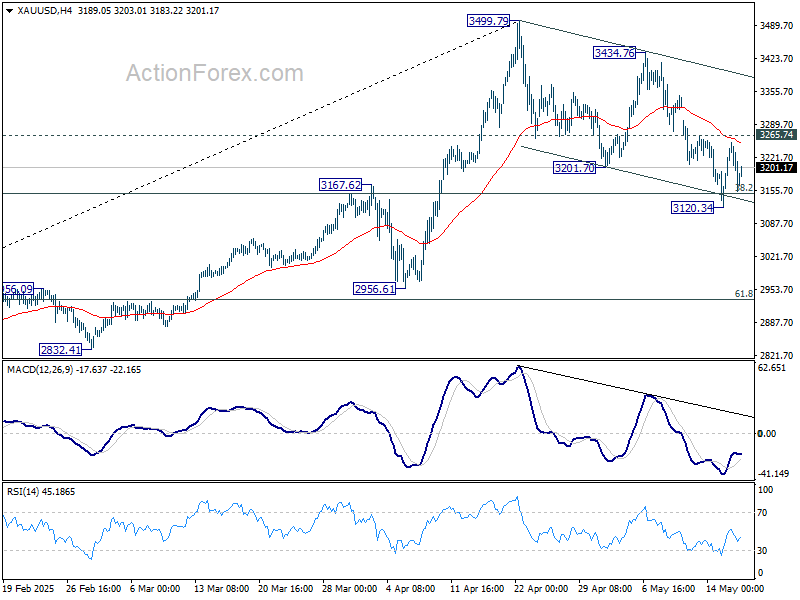
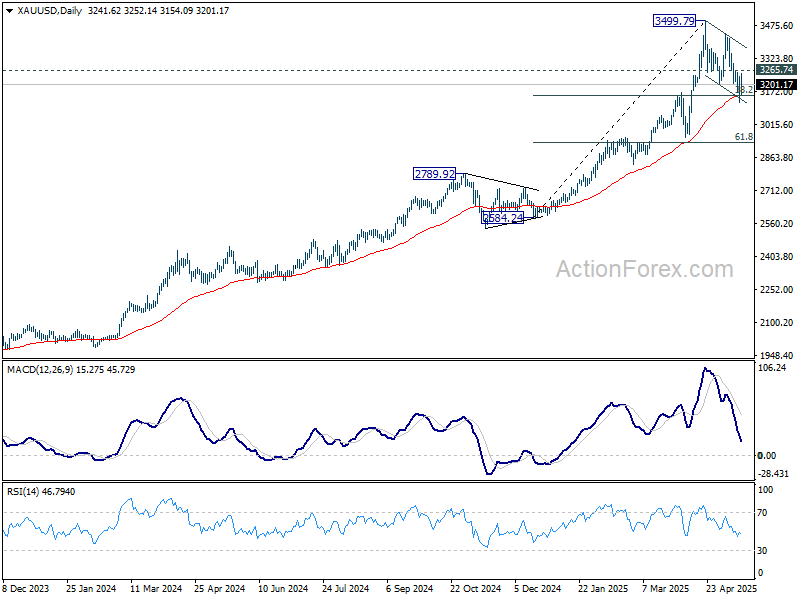
One asset that could benefit from renewed stress on the Dollar and Treasuries is Gold. Technically, Gold is now at an ideal level to complete the corrective pullback from 3499.79 high. Current levels include 55 D EMA (now at 3152.88) and 38.2% retracement of 2584.24 to 3499.79 at 3150.04. On the upside, firm break of 3262.74 resistance should bring stronger rally back to 3434.76/3499.79 resistance zone.
EUR/USD Weekly Outlook
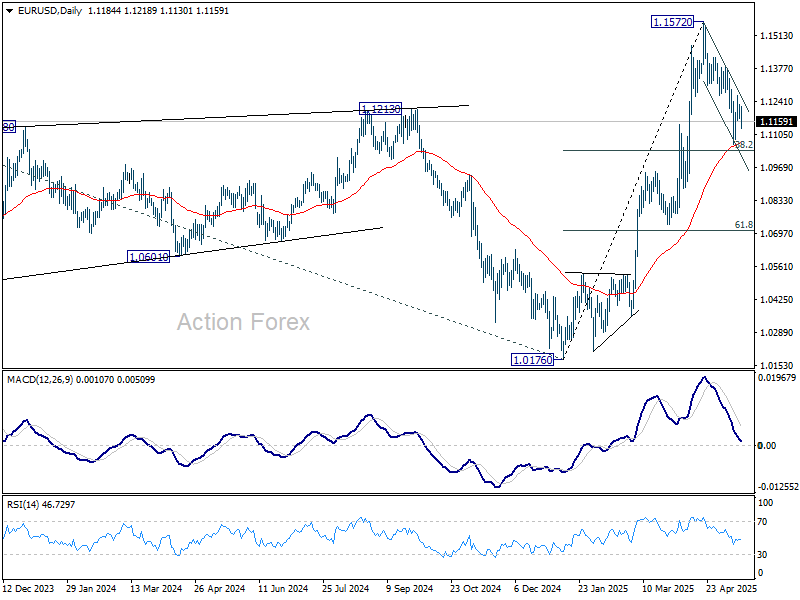
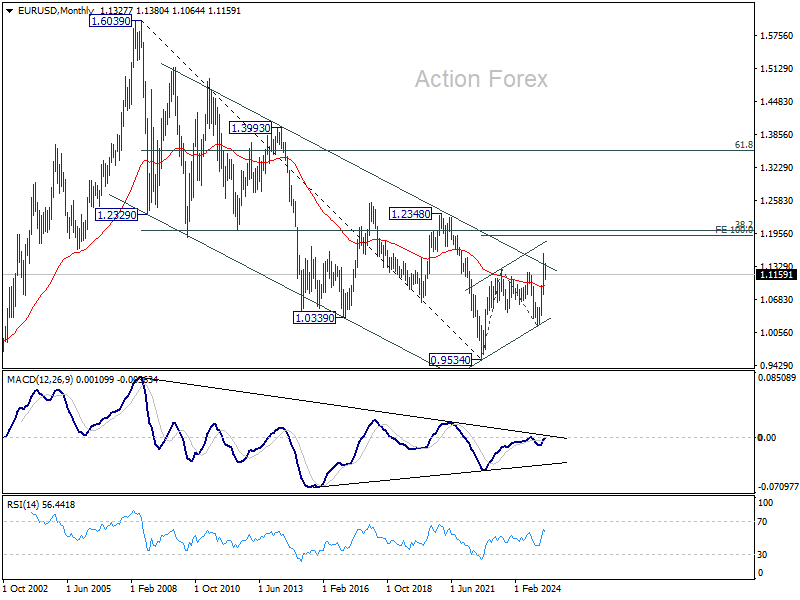
EUR/USD dived further to 1.1064 last week but recovered ahead of 38.2% retracement of 1.0176 to 1.1572 at 1.1039. Initial bias remains neutral this week first. Strong support is still expected from 1.1039 to complete the correction from 1.1572. On the upside, above 1.1292 will bring stronger rise back to retest 1.1572. However, sustained break of 1.1039 will dampen this view and target 61.8% retracement at 1.0709 next.
In the bigger picture, rise from 0.9534 long term bottom could be correcting the multi-decade downtrend or the start of a long term up trend. In either case, further rise should be seen to 100% projection of 0.9534 to 1.1274 from 1.0176 at 1.1916. This will now remain the favored case as long as 55 W EMA (now at 1.0818) holds.
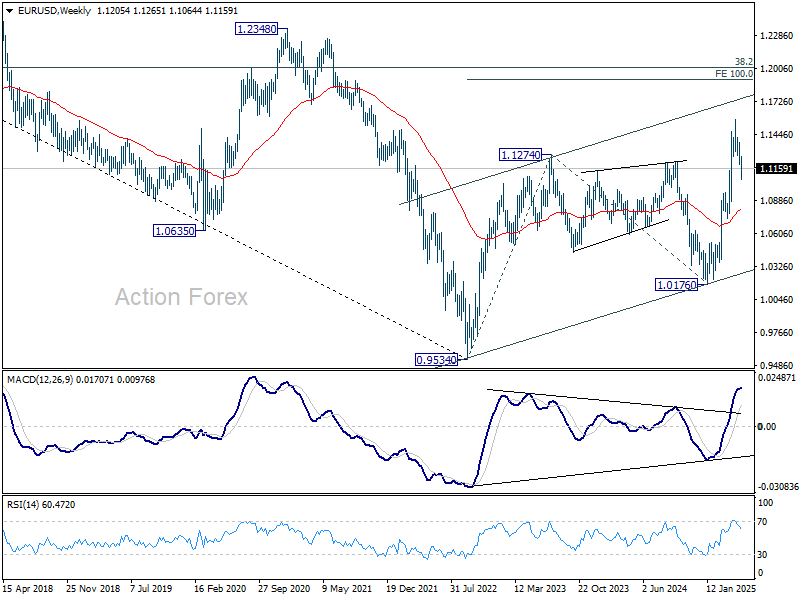
In the long term picture, the case of long term bullish reversal is building up. Sustained break of falling channel resistance (now at around 1.1300) will argue that the down trend from 1.6039 (2008 high) has completed at 0.9534. A medium term up trend should then follow even as a corrective move. Next target is 38.2% retracement of 1.6039 to 0.9534 at 1.2019.
EUR/USD Weekly Outlook
EUR/USD dived further to 1.1064 last week but recovered ahead of 38.2% retracement of 1.0176 to 1.1572 at 1.1039. Initial bias remains neutral this week first. Strong support is still expected from 1.1039 to complete the correction from 1.1572. On the upside, above 1.1292 will bring stronger rise back to retest 1.1572. However, sustained break of 1.1039 will dampen this view and target 61.8% retracement at 1.0709 next.
In the bigger picture, rise from 0.9534 long term bottom could be correcting the multi-decade downtrend or the start of a long term up trend. In either case, further rise should be seen to 100% projection of 0.9534 to 1.1274 from 1.0176 at 1.1916. This will now remain the favored case as long as 55 W EMA (now at 1.0818) holds.
In the long term picture, the case of long term bullish reversal is building up. Sustained break of falling channel resistance (now at around 1.1300) will argue that the down trend from 1.6039 (2008 high) has completed at 0.9534. A medium term up trend should then follow even as a corrective move. Next target is 38.2% retracement of 1.6039 to 0.9534 at 1.2019.
USD/JPY Weekly Outlook
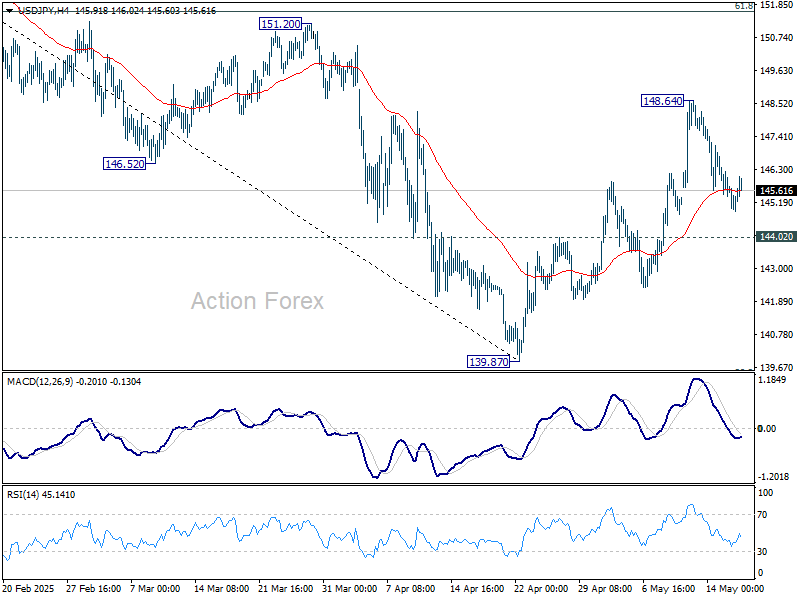
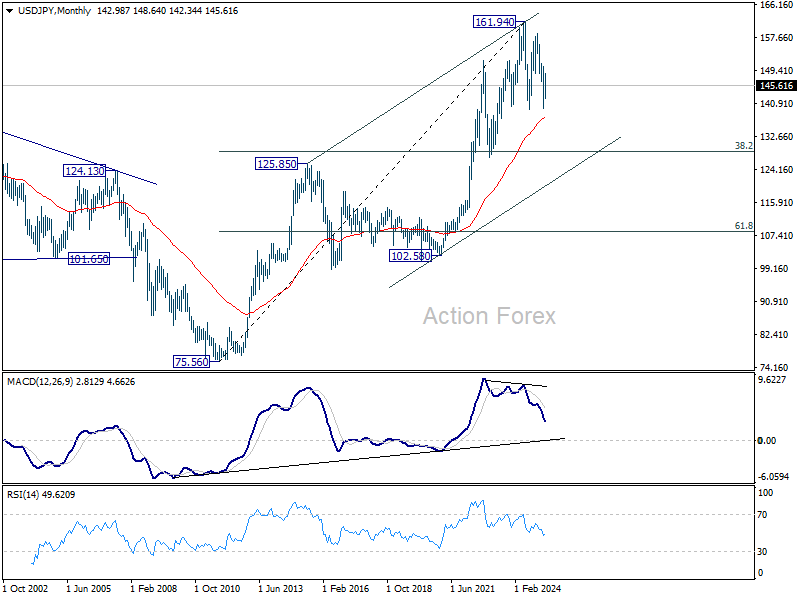
USD/JPY jumped to 148.64 last week but retreated deeply since then. Initial bias remains neutral this week first. Fall from 158.86 might have completed at 139.87 already. Further rise is in favor as long as 144.02 support holds. Above 148.64 will target 61.8% retracement of 158.86 to 139.87 at 151.60 next. However, firm break of 144.02 will bring retest of 139.87 low instead.
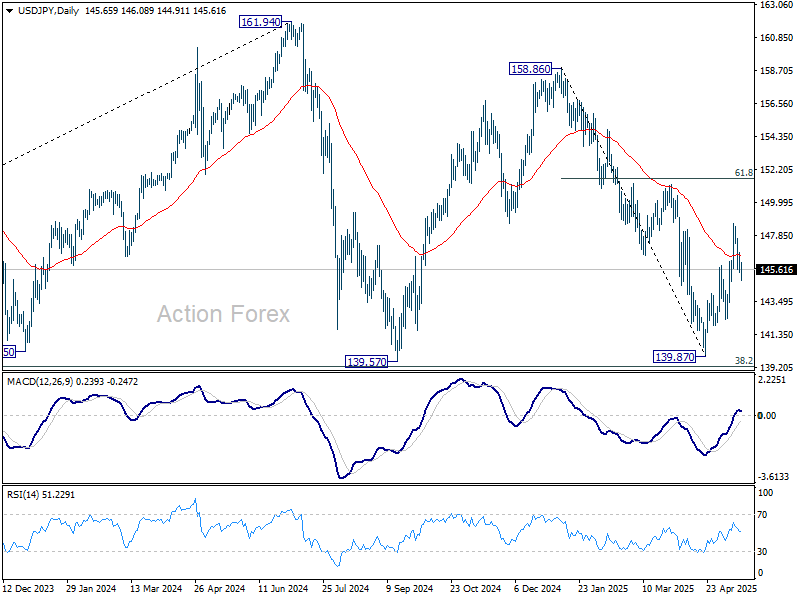
In the bigger picture, price actions from 161.94 are seen as a corrective pattern to rise from 102.58 (2021 low), with fall from 158.86 as the third leg. Strong support should be seen from 38.2% retracement of 102.58 to 161.94 at 139.26 to bring rebound. However, sustained break of 139.26 would open up deeper medium term decline to 61.8% retracement at 125.25.
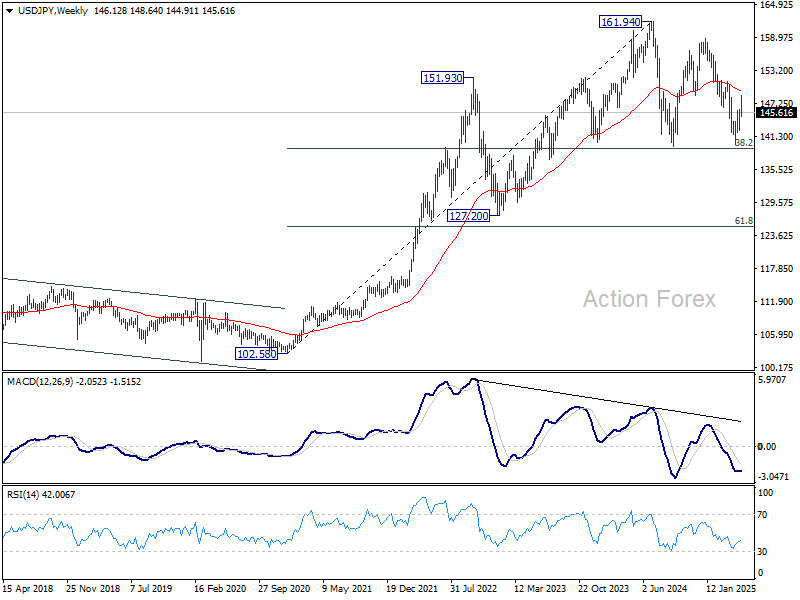
In the long term picture, it's still early to conclude that up trend from 75.56 (2011 low) has completed. A medium term corrective phase should have commenced, with risk of deep correction towards 55 M EMA (now at 137.17) and even below.
GBP/USD Weekly Outlook
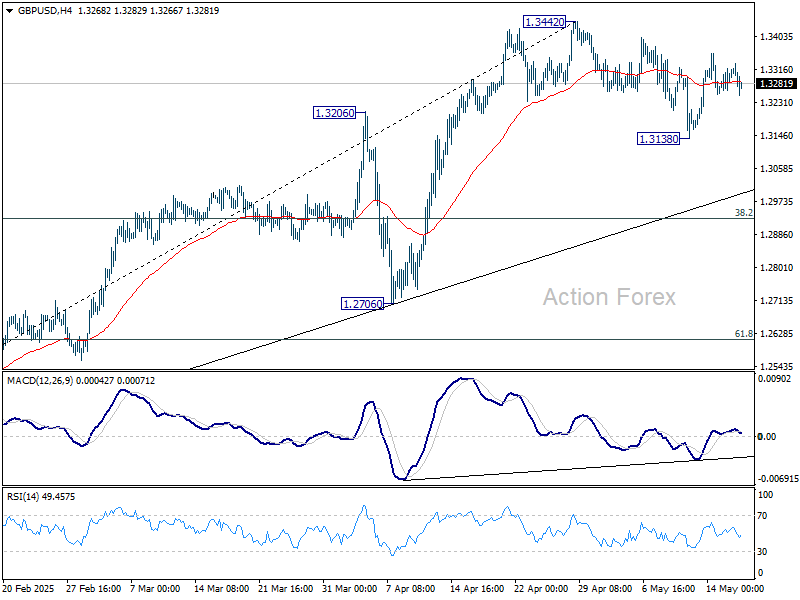
GBP/USD dipped further to 1.3138 last week but recovered quickly again. Initial bias stays neutral this week first. On the upside, decisive break of 1.3433/42 key resistance zone will confirm larger up trend resumption. Nevertheless, below 1.3138 will resume the correction from 1.3442. But downside should be contained by 38.2% retracement of 1.2099 to 1.3442 at 1.2929 to bring rebound.
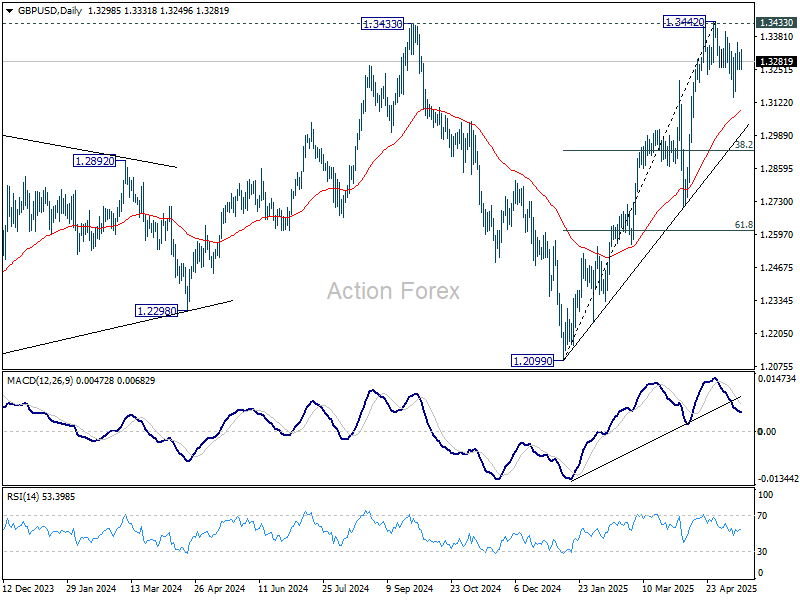
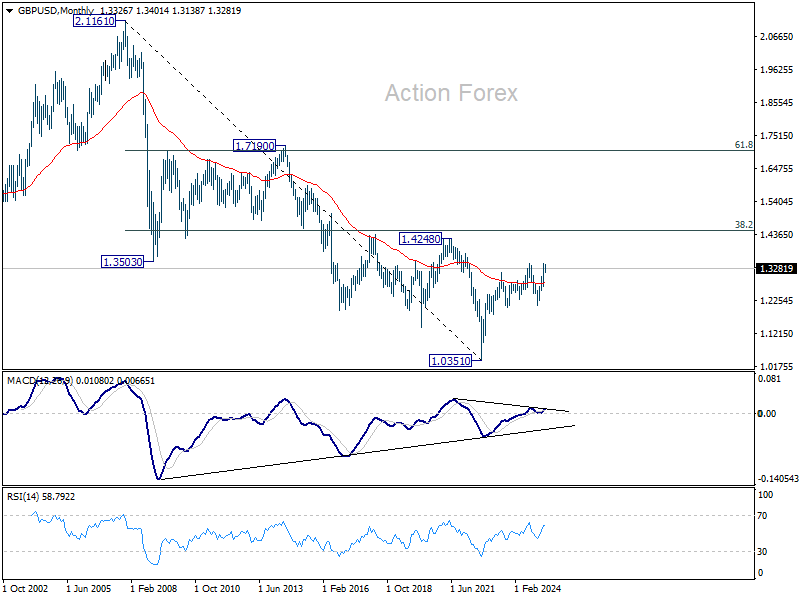
In the bigger picture, price actions from 1.3433 are seen as a corrective pattern to the up trend from 1.3051 (2022 low). Rise from 1.2099 could either be resuming the up trend, or the second leg of a consolidation pattern. Overall, GBP/USD should target 1.4248 key resistance (2021 high) on decisive break of 1.3433 at a later stage.
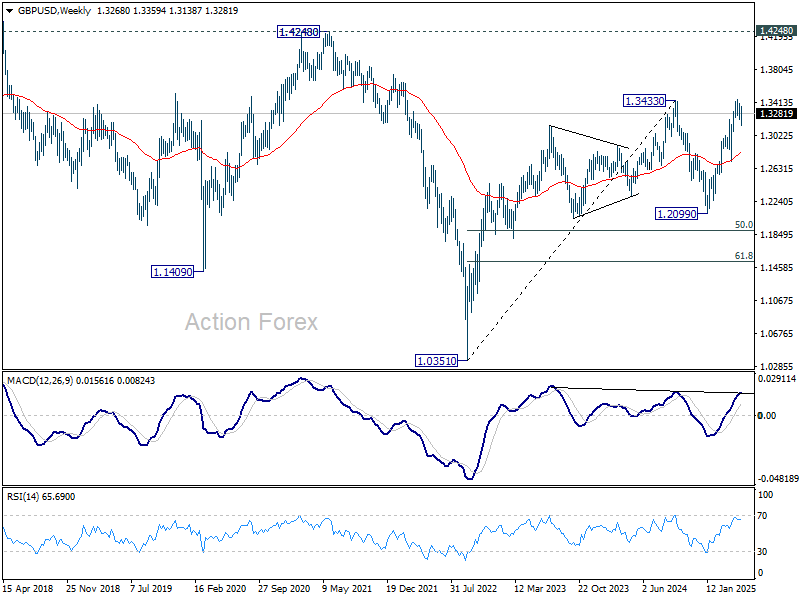
In the long term picture, price actions from 1.0351 (2022 low) are seen as a corrective pattern to the long term down trend from 2.1161 (2007 high) only. Outlook will be neutral at best as long as 1.4248 structural resistance holds, even in case of strong rebound.
USD/CHF Weekly Outlook
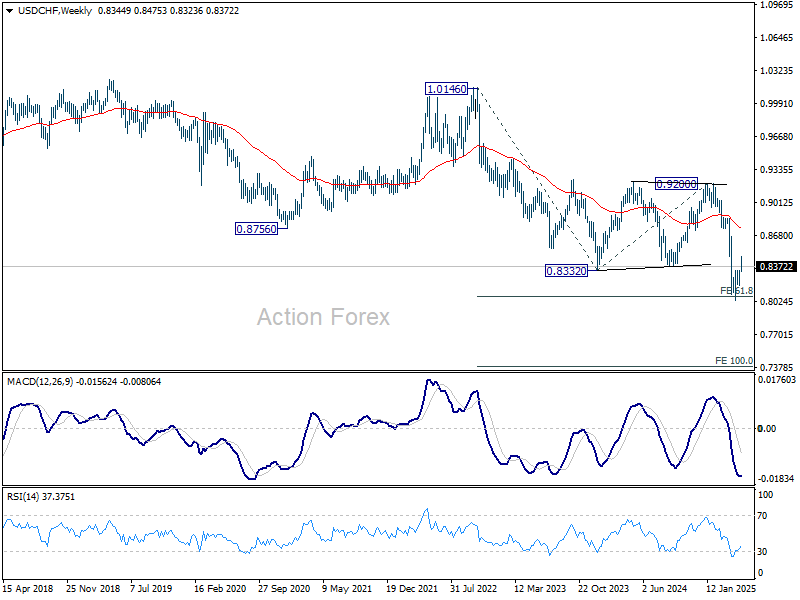
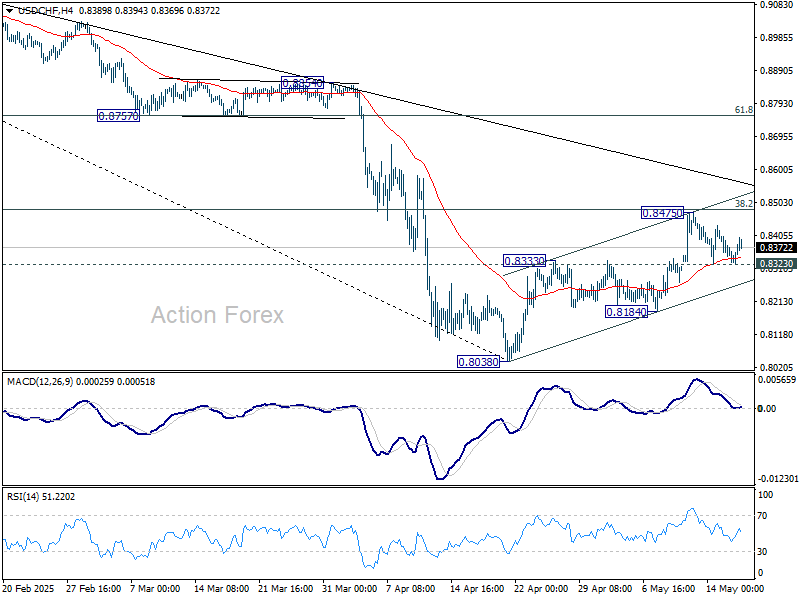
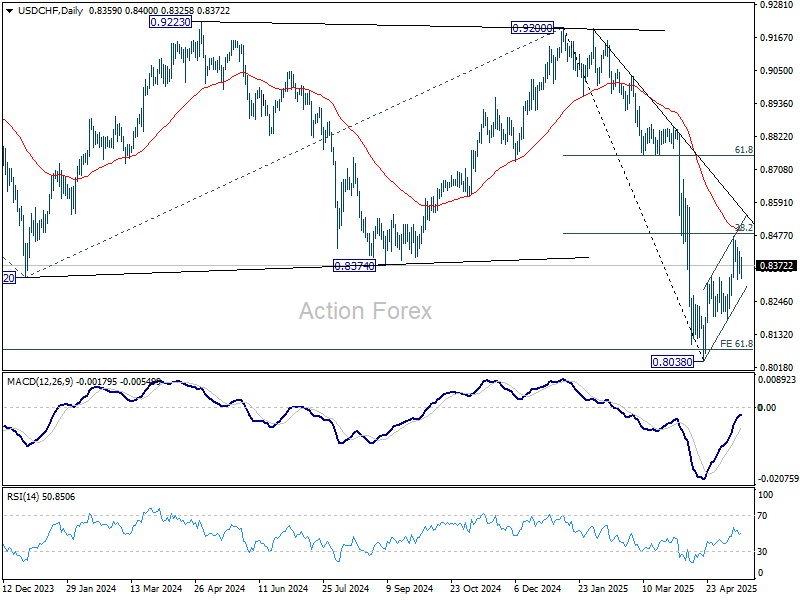
USD/CHF jumped to 0.8475 last week but turned sideway since then. Initial bias stays neutral this week first. On the downside, firm break of 0.8323 support will argue that corrective rebound from 0.8038 has completed at 0.8475, after rejection by 38.2% retracement of 0.9200 to 0.8038 at 0.8482. Intraday bias will be back on the downside for 0.8184, and then retest of 0.8038 low. However, sustained trading above 0.8482 will dampen this bearish view and target 61.8% retracement at 0.8756 next.
In the bigger picture, long term down trend from 1.0342 (2017 high) is still in progress and met 61.8% projection of 1.0146 (2022 high) to 0.8332 from 0.9200 at 0.8079 already. In any case, outlook will stay bearish as long as 55 W EMA (now at 0.8765) holds. Sustained break of 0.8079 will target 100% projection at 0.7382.
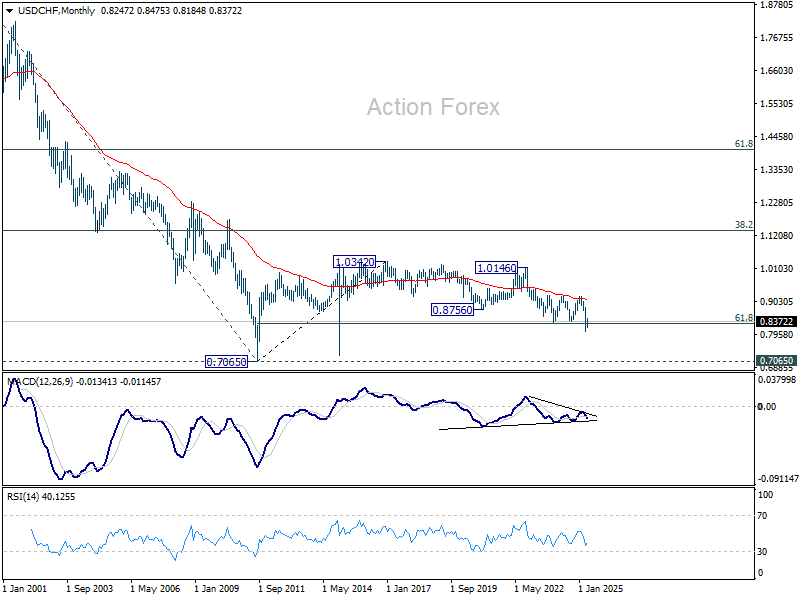
In the long term picture, price action from 0.7065 (2011 low ) are seen as a corrective pattern to the multi-decade down trend from 1.8305 (2000 high). It's uncertain if the fall from 1.0342 is the second leg of the pattern, or resumption of the down trend. But in either case, sustained trading below 61.8% retracement of 0.7065 to 1.0342 at 0.8317 will pave the way back to 0.7065.