Fri, Apr 10, 2026 23:42 GMT
More

    Sample Category Title

    AUD/USD Daily Report

    ActionForex

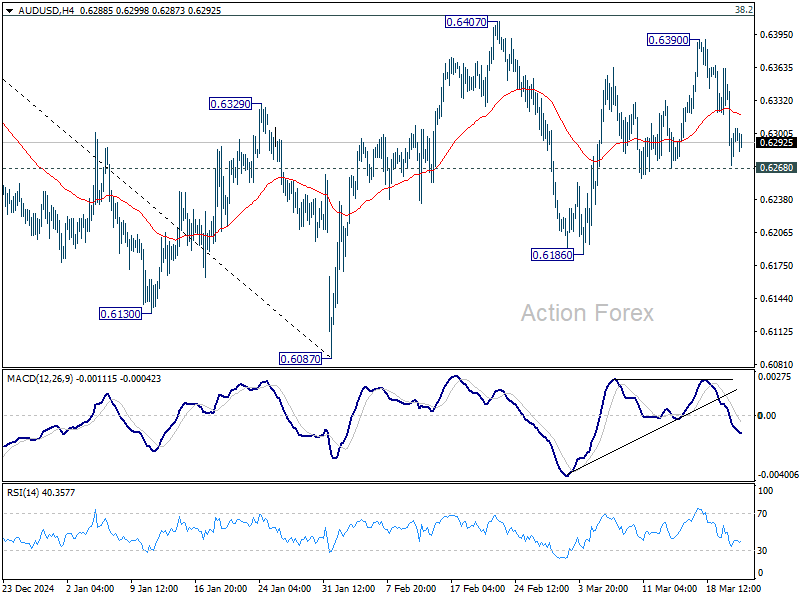
    Daily Pivots: (S1) 0.6208; (P) 0.6234; (R1) 0.6257; More...

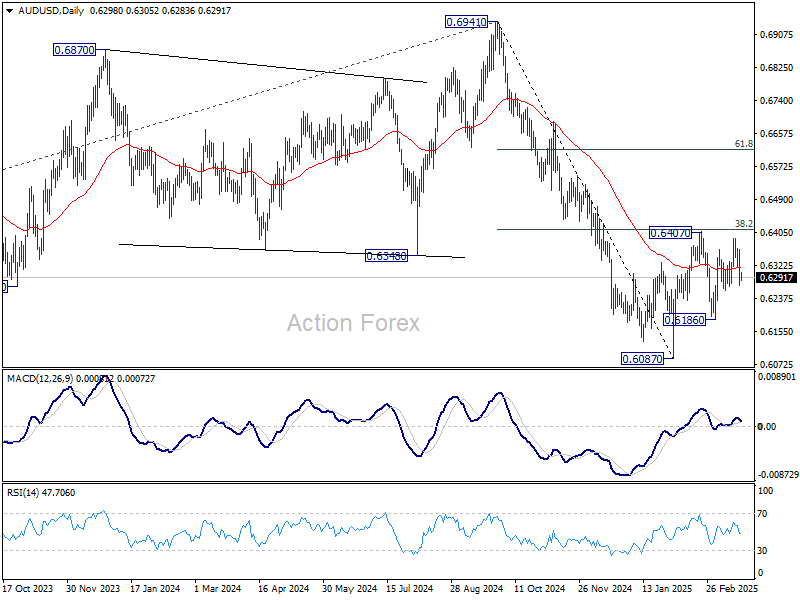
    No change in AUD/USD's outlook for now, and intraday bias stays mildly on the downside. Corrective rebound from 0.6130 could have completed at 0.6329. Deeper fall would be seen to retest 0.6130 low. On the upside, above 0.6329 will resume the rebound. But still, strong resistance is expected from 38.2% retracement of 0.6941 to 0.6130 at 0.6440 to limit upside to complete this corrective rebound.

    In the bigger picture, fall from 0.6941 (2024 high) is seen as part of the down trend from 0.8006 (2021 high). Next medium term target is 61.8% projection of 0.8006 to 0.6169 from 0.6941 at 0.5806. In any case, outlook will stay bearish as long as 55 W EMA (now at 0.6545) holds.

    USD/CAD Chart Analysis Following Bank of Canada’s Rate Cut

    Unlike the Federal Reserve, which opted to leave its monetary policy unchanged, the Bank of Canada cut its interest rate yesterday. According to Forex Factory, as expected by analysts, the Overnight Rate was lowered by 25 basis points from 3.25% to 3.00%.

    According to Reuters:

    → The Bank of Canada reduced interest rates to support the economy ahead of anticipated US trade tariffs.

    → This weakened the Canadian dollar, as the gap between Canadian and US bond yields widened.

    → Market participants estimate a 41% probability that the Bank of Canada will cut rates again in March.

    → The depreciation of the Canadian dollar is also influenced by oil prices (one of Canada’s key export commodities), which have fallen by over 8% since their mid-January peak.

    Technical analysis of the USD/CAD chart indicates that the Canadian dollar’s exchange rate against the US dollar is forming a “Megaphone” pattern, with price action demonstrating the presence of selling pressure. On 21 January, sellers sharply pushed the price down from the psychological level of 1.4500, and yesterday, the price made a bearish reversal from 1.4450.

    There is a possibility that seller activity could drive USD/CAD lower towards a key trendline (marked in grey) that has been forming since the second half of 2024.

    Trade over 50 forex markets 24 hours a day with FXOpen. Take advantage of low commissions, deep liquidity, and spreads from 0.0 pips. Open your FXOpen account now or learn more about trading forex with FXOpen.

    This article represents the opinion of the Companies operating under the FXOpen brand only. It is not to be construed as an offer, solicitation, or recommendation with respect to products and services provided by the Companies operating under the FXOpen brand, nor is it to be considered financial advice.

    Eurozone GDP stagnates in Q4, Germany and France weigh on growth

    Eurozone economy stalled in Q4, posting 0.0% qoq growth, falling short of modest expectations for a 0.1% expansion. Meanwhile, EU-wide GDP grew by 0.1% qoq, indicating marginal economic activity across the bloc.

    Among individual member states, Portugal led growth with a robust 1.5% increase, followed by Lithuania (+0.9%) and Spain (+0.8%).

    However, the overall performance was dragged down by contractions in key economies. Ireland recorded the steepest decline at -1.3%, while Germany and France also posted negative growth of -0.2% and -0.1%, respectively.

    On a year-over-year basis, GDP growth was positive for nine Eurozone countries, while three recorded annual declines.

    Full Eurozone GDP release here.

    USD/CAD Daily Outlook

    Daily Pivots: (S1) 1.4383; (P) 1.4427; (R1) 1.4465; More...

    USD/CAD is still bounded in range trading below 1.4516 and intraday bias stays neutral. More consolidations would be seen, but further rally is expected as long as 1.4260 support holds. On the upside, firm break of 1.4516 will resume larger up trend to 1.4667/89 key resistance zone. Nevertheless, firm break of 1.4260 will turn bias to the downside for deeper pullback through 55 D EMA (now at 1.4241).

    In the bigger picture, up trend from 1.2005 (2021) is in progress for retesting 1.4667/89 key resistance zone (2020/2015 highs). Decisive break there will confirm long term up trend resumption. Next target is 100% projection of 1.2401 to 1.3976 from 1.3418 at 1.4993. Medium term outlook will remain bullish as long as 1.3976 resistance turned holds (2022 high), even in case of deep pullback.

    ECB Rate Cut Takes Center Stage, as FOMC Hold Triggers Minimal Reaction

    FOMC rate decision and press conference yesterday proved to be a non-event. Dollar remained firm following the decision to keep interest rates unchanged at 4.25–4.50%. Fed Chair Jerome Powell reinforced a patient approach to policy adjustments, stating, "we do not need to be in a hurry to adjust our policy stance." He also emphasized the risks of premature easing, warning that "reducing policy restraint too fast or too much could hinder progress on inflation." His remarks reaffirmed expectations that Fed is unlikely to cut rates in the near term, with market pricing now assigning an 82% probability of another hold in March, up from 73% last week.

    Meanwhile, US President Donald Trump renewed his criticism of Fed, accusing it of failing to manage inflation and misjudging bank regulations. Trump demanded last week that "interest rates drop immediately". However, markets largely ignored his remarks, as Powell’s measured tone continues to shape expectations for a prolonged hold on interest rates.

    Attention now turns to ECB as it concludes this week’s round of major central bank meetings. ECB is widely expected to continue its "regular, gradual" easing path by cutting the deposit rate by 25bps to 2.75%, moving closer to the estimated neutral range of 1.75–2.25%.

    Market pricing suggests a terminal rate of around 2.00% by late spring or early summer, but ECB President Christine Lagarde is unlikely to provide a clear roadmap just yet. With uncertainty surrounding US trade policy and potential tariff escalations, Lagarde is expected to maintain a data-dependent stance rather than commit to a specific easing path.

    Technically, while EUR/CHF's choppy rebound from 0.9204 extended last week, momentum continue to be unconvincing. It's still more likely that not that this rebound is merely a corrective move. Firm break of 0.9242 support will be an early sign that this correction bounce has completed, and bring deeper fall to channel support (now at 0.9398) for more evidence.

    Overall for the week so far, Yen is still the strongest, followed by Dollar, and then Swiss Franc. Aussie is staying at the bottom, followed by Kiwi, and then Loonie. Euro and Sterling are stuck in the middle.

    Swiss KOF rises to 101.6, led by manufacturing and services

    Switzerland’s KOF Economic Barometer climbed to 101.6 in January, up from 99.6 and surpassing market expectations of 100.5. This data suggests modest pickup in economic momentum, particularly in production-side sectors.

    According to KOF, "the majority of the production-side indicator bundles included in the KOF Economic Barometer show positive developments."

    The strongest contributions came from manufacturing, financial and insurance services, hospitality, and other service industries, signaling resilience in key sectors of the Swiss economy.

    However, the outlook remains uneven. While production indicators strengthened, demand-side indicators showed signs of weakness. KOF noted that both "the indicator bundles for foreign demand as well as for private consumption indicate a downward tendency," highlighting subdued consumer activity and external trade concerns.

    BoJ’s Himino reiterates further hike possible if economic forecasts hold

    BoJ Deputy Governor Ryozo Himino reinforced expectations that the central bank could raise interest rates further if its economic and price projections are met.

    Speaking today, Himino stated, "If our economic and price forecasts are achieved, we will raise our policy rate accordingly and adjust the degree of monetary support."

    Himino also highlighted concerns about Japan’s prolonged period of negative real interest rates, describing the situation as "not normal."

    He explained that an ideal economic scenario for Japan would involve rising wages and corporate profits, fueling stronger consumption and investment, which would then support moderate and stable inflation. In such a case, Japan could see real interest rates turn positive.

    USD/CAD Daily Outlook

    Daily Pivots: (S1) 1.4383; (P) 1.4427; (R1) 1.4465; More...

    USD/CAD is still bounded in range trading below 1.4516 and intraday bias stays neutral. More consolidations would be seen, but further rally is expected as long as 1.4260 support holds. On the upside, firm break of 1.4516 will resume larger up trend to 1.4667/89 key resistance zone. Nevertheless, firm break of 1.4260 will turn bias to the downside for deeper pullback through 55 D EMA (now at 1.4241).

    In the bigger picture, up trend from 1.2005 (2021) is in progress for retesting 1.4667/89 key resistance zone (2020/2015 highs). Decisive break there will confirm long term up trend resumption. Next target is 100% projection of 1.2401 to 1.3976 from 1.3418 at 1.4993. Medium term outlook will remain bullish as long as 1.3976 resistance turned holds (2022 high), even in case of deep pullback.

    Economic Indicators Update

    GMT CCY EVENTS ACT F/C PP REV
    21:45 NZD Trade Balance (NZD) Dec 219M -1363M -437M -435M
    00:00 NZD ANZ Business Confidence Jan 54.4 62.3
    00:30 AUD Import Price Index Q/Q Q4 0.20% 1.50% -1.40%
    06:30 EUR France Consumer Spending M/M Dec 0.70% 0.10% 0.30% 0.20%
    06:30 EUR France GDP Q/Q Q4 P -0.10% 0.00% 0.40%
    07:00 CHF Trade Balance (CHF) Dec 3.49B 4.50B 5.42B 6.11B
    08:00 CHF KOF Economic Barometer Jan 101.6 100.5 99.5 99.6
    09:00 EUR Germany GDP Q/Q Q4 P -0.20% -0.10% 0.10%
    09:30 GBP Mortgage Approvals Dec 65K 66K
    09:30 GBP M4 Money Supply M/M Dec 0.20% 0.00%
    10:00 EUR EurozoneGDP Q/Q Q4 P 0.10% 0.40%
    10:00 EUR Eurozone Unemployment Rate Dec 6.30% 6.30%
    10:00 EUR Eurozone Economic Sentiment Indicator Jan 93.3 93.7
    10:00 EUR Eurozone Industrial Confidence Jan -14.1
    10:00 EUR Eurozone Services Sentiment Jan 5.9
    10:00 EUR Eurozone Consumer Confidence Jan F -14.2 -14.2
    13:15 EUR ECB Deposit Rate 2.75% 3.00%
    13:15 EUR ECB Main Refinancing Rate 2.90% 3.15%
    13:30 USD Initial Jobless Claims (Jan 24) 225K 223K
    13:30 USD GDP Annualized Q4 P 2.60% 3.10%
    13:30 USD GDP Price Index Q4 P 2.50% 1.90%
    13:45 EUR ECB Press Conference
    15:00 USD Pending Home Sales M/M Dec -0.90% 2.20%
    15:30 USD Natural Gas Storage -223B


    US Dollar Index (DXY) Analysis: Hawkish FOMC Pause, Trump’s Fed Criticism, and Technical Outlook

    • The Federal Reserve held interest rates steady and signaled a “wait and see” approach as uncertainties remain.
    • US Commerce Secretary Nominee Lutnick expressed support for sweeping tariffs, claiming they don’t impact inflation.
    • President Trump blamed the Fed for inflation, escalating tension between him and the central bank.
    • The US Dollar Index (DXY) experienced volatility following the FOMC, but struggles at key resistance level.

    The FOMC meeting has officially passed and let me start by saying that there were no real surprises. Looking at Fed Chair Powell’s press conference, the Fed Chair delivered a very balanced statement, keeping all market participants interested in the Central Bank’s next moves.

    Fed Chair Powell said that there would be no rush to cut rates again until inflation and jobs data made it more appropriate. No surprises here, as I have been saying in many articles of late there are too many uncertainties around the US economy moving forward. Most of this comes down to how markets will react to the implementation of tariffs as well as their potential effect.

    Yesterday we heard some interesting comments from US Commerce Secretary Nominee Lutnick who is the frontrunner for the position. Lutnick stated that is in favor of sweeping tariffs saying it does not impact inflation. Lutnick was also hawkish on China which does not bode well for markets moving forward.

    All of these uncertainties are the main reasons the Fed needed to adopt a more balanced and an almost ‘wait and see’ approach moving forward.

    Currency Strength Chart: Strongest JPY, EUR, CHF, GBP, CAD, USD, AUD, NZD – Weakest

    Source: FinancialJuice (click to enlarge)

    President Trump and Fed on a Collision Course?

    President Trump has never been the biggest fan of the Federal Reserve and has not directly called for lower rates yet as he promised but did blame inflation on the Fed. Yesterday the President said that If the Fed had spent less time on DEI, gender ideology, “green” energy, and fake climate change, inflation would never have been a problem.

    Whether or not you agree with President Trump, there does appear to be some friction which may come to a head in the coming months. When asked yesterday about President Trump, Federal Reserve Chair Jerome Powell did not comment but said he had not been in touch with the President.

    This will come to a head at some stage and is worth keeping an eye on as well over the coming weeks and months.

    Key Comments from Chair Powell

    A quick summary of some of the key comments from Fed Chair Powell yesterday.

    • Economy has made “significant progress toward goals”
    • Inflation has moved much closer to goal remains somewhat elevated
    • Labor market is not a source of inflationary pressures
    • Fed does “not need to be in a hurry to adjust policy”
    • Fed to continue meeting-by-meeting approach
    • Fed’s 2% long-term inflation goal will not change

    The inflation conundrum is also something the Fed needs to consider given the recent uptick has come ahead of any proposed tariffs being implemented.

    Source: LSEG (click to enlarge)

    The Fed will now get a peak at their preferred inflation gauge, the PCE data due for release tomorrow. Markets are expecting consumer spending MoM to have ticked up to 0.5% from a previous 0.4% with the YoY print forecast to rise to 2.6% from a previous 2.4%.

    Technical Analysis and DXY Reaction

    US Dollar Index (DXY)

    The US Dollar index rose briefly after the Powell presser yesterday but struggled to push on.

    The US Dollar has been on a rollercoaster of late, with tariff chatter either supporting the US Dollar or dragging it lower.

    This is likely to continue over the coming days until more clarity on the tariff picture is given. President Trump remains on course to implement 25% tariffs on Mexico and Canada on February 1, such a move could aid the US Dollar and provide support. However, any retaliatory tariffs may then see the Dollar face some weakness.

    Looking at the DXY chart below and as you can see, the 108.00 handle has stood firm over the past two days, with yesterdays wick to the upside a sign of selling pressure. The daily candle closed as an inverted hammer which usually hints at further upside. However, the fact that the inverted hammer was printed at a resistance level means that further upside may not materialize.

    Immediate resistance rests at 108.00 before the 108.49 comes into focus.

    Support rests at 107.00 before the 106.13 and 105.63 handles come into focus.

    US Dollar Index (DXY) Daily Chart, January 30, 2025

    Source: TradingView.com (click to enlarge)

    Support

    • 107.00
    • 106.13
    • 105.63

    Resistance

    • 108.49
    • 109.52
    • 110.00

    Nasdaq 100 Hovering Near Weekly Highs in a Volatile Week

    As shown on the 4-hour chart of the Nasdaq 100 (US Tech 100 mini on FXOpen), the index stood around the 21,600 level this morning, near the weekly high that formed at Monday’s open.

    This suggests that the tech-stock index has almost fully recovered from the decline triggered by the launch of AI from the Chinese startup DeepSeek. According to media reports:

    → Experts have pointed to signs that the Chinese startup used a technique known as “distillation” – in simple terms, this means that DeepSeek’s model extracted knowledge from more advanced models such as ChatGPT. In other words, this is not about innovation but rather an unfair practice.

    → Nassim Taleb believes that the sharp drop in NVDA shares is only the beginning of a potential market downturn inflated by AI-driven expectations. Further declines could be more significant than what we witnessed on Monday.

    Apart from news surrounding DeepSeek, traders were also focused on earnings reports from major corporations (which we will cover in detail in separate articles):

    → Tesla (TSLA) is holding above $400 in pre-market trading today, despite earnings per share falling short of expectations. Meanwhile, company executives believe that Trump’s policies could negatively impact Tesla’s operations.

    → Microsoft (MSFT) shares fell by more than 4%, Meta Platforms (META) surpassed $700 per share in post-market trading for the first time, and IBM surged by approximately 9%.

    Additionally, the fundamental backdrop became even more eventful following yesterday’s Fed updates, which, however, contained no surprises:

    → As expected, interest rates remained unchanged.

    → According to The Wall Street Journal, the Fed has entered a “Wait-and-See” phase, showing less confidence that inflation will continue to decline.

    The Nasdaq 100 (US Tech 100 mini on FXOpen) chart reveals that the price:

    → Tested a key support line (marked in blue) at the weekly low.

    → Remains within the red descending channel.

    From a bullish perspective, the red channel can be seen as a large-scale correction within the broader uptrend on higher timeframes.

    From a bearish perspective, the bearish gap that formed at Monday’s open may act as resistance. Whether bulls will be able to overcome this barrier in the near term will depend, among other factors, on the next batch of earnings reports from major tech companies.

    Trade global index CFDs with zero commission and tight spreads. Open your FXOpen account now or learn more about trading index CFDs with FXOpen.

    This article represents the opinion of the Companies operating under the FXOpen brand only. It is not to be construed as an offer, solicitation, or recommendation with respect to products and services provided by the Companies operating under the FXOpen brand, nor is it to be considered financial advice.

    Dollar Slightly Strengthened after the Fed Meeting

    Yesterday’s Fed meeting proceeded in line with expert forecasts. The base interest rate remained at 4.50%. Jerome Powell, who spoke after the Fed’s decision was announced, did not clarify the future direction of monetary policy. The head of the US regulator, in particular, noted that the Fed would not rush to cut rates and that, in order to change the course of monetary policy, real progress in reducing inflation needed to be seen.

    GBP/USD

    The GBP/USD currency pair tested key support at 1.2400 yesterday. At the moment, the price is holding above this level, and if positive news for the pound emerges, the pair could rise towards recent highs at 1.2530–1.2500.

    If GBP/USD buyers manage to consolidate the price above 1.2570 in the coming trading sessions, the pair may continue to rise towards 1.2660–1.2610. A break below the 1.2400 support level could trigger a renewed decline towards 1.2320–1.2260.

    Key events that could influence GBP/USD movements:

    • Today at 12:30 (GMT+2): Bank of England consumer credit data
    • Today at 16:30 (GMT+2): US GDP
    • Today at 16:30 (GMT+2): US initial jobless claims
    • Tomorrow at 16:30 (GMT+2): US core personal consumption expenditure price index

    EUR/USD

    The EUR/USD currency pair fell below 1.0400 yesterday following the Fed’s rate decision. However, euro buyers managed to push the price back up to 1.0440. Today is another important day for EUR/USD in terms of fundamentals. Analysts predict that the ECB may lower the base interest rate from 3.15% to 2.90%. Comments from Christine Lagarde on the regulator’s future monetary policy will also be significant.

    If incoming data is perceived as positive for EUR/USD, the price could once again test key resistance at 1.0540–1.0500. A break below yesterday’s low could trigger a renewed decline towards 1.0300–1.0240.

    Key events that could influence EUR/USD pricing:

    • Today at 12:00 (GMT+2): Germany GDP
    • Today at 16:15 (GMT+2): ECB interest rate decision
    • Today at 16:45 (GMT+2): ECB press conference
    • Tomorrow at 16:00 (GMT+2): Germany consumer price index (CPI)

    Trade over 50 forex markets 24 hours a day with FXOpen. Take advantage of low commissions, deep liquidity, and spreads from 0.0 pips. Open your FXOpen account now or learn more about trading forex with FXOpen.

    This article represents the opinion of the Companies operating under the FXOpen brand only. It is not to be construed as an offer, solicitation, or recommendation with respect to products and services provided by the Companies operating under the FXOpen brand, nor is it to be considered financial advice.

    Swiss KOF rises to 101.6, led by manufacturing and services

    Switzerland’s KOF Economic Barometer climbed to 101.6 in January, up from 99.6 and surpassing market expectations of 100.5. This data suggests modest pickup in economic momentum, particularly in production-side sectors.

    According to KOF, "the majority of the production-side indicator bundles included in the KOF Economic Barometer show positive developments."

    The strongest contributions came from manufacturing, financial and insurance services, hospitality, and other service industries, signaling resilience in key sectors of the Swiss economy.

    However, the outlook remains uneven. While production indicators strengthened, demand-side indicators showed signs of weakness. KOF noted that both "the indicator bundles for foreign demand as well as for private consumption indicate a downward tendency," highlighting subdued consumer activity and external trade concerns.

    Full Swiss KOF release here.

    BoJ’s Himino reiterates further hike possible if economic forecasts hold

    BoJ Deputy Governor Ryozo Himino reinforced expectations that the central bank could raise interest rates further if its economic and price projections are met.

    Speaking today, Himino stated, "If our economic and price forecasts are achieved, we will raise our policy rate accordingly and adjust the degree of monetary support."

    Himino also highlighted concerns about Japan’s prolonged period of negative real interest rates, describing the situation as "not normal."

    He explained that an ideal economic scenario for Japan would involve rising wages and corporate profits, fueling stronger consumption and investment, which would then support moderate and stable inflation. In such a case, Japan could see real interest rates turn positive.