Sample Category Title
Can USD/CHF Capitalize And Trade Above 0.9450?
Key Highlights
- After a major decline, the US Dollar found support near 0.9250 against the Swiss Franc.
- There was a break above two bearish trend lines with resistance at 0.9290 and 0.9380 on the 4-hours chart of USD/CHF.
- The pair needs to move above the 0.9450 resistance to gain upside momentum.
- The Swiss Consumer Price Index in Jan 2018 increased 0.7%, less than the forecast of 0.8% (YoY).
USDCHF Technical Analysis
There was a substantial decline in the US Dollar from the 0.9660 swing high against the Swiss Franc. The USD/CHF pair found support near 0.9250 and it later started an upside correction.
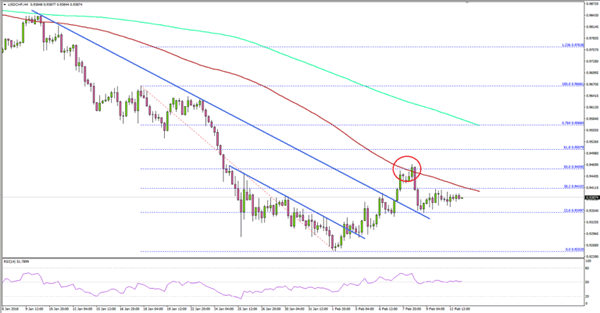
Looking at the 4-hours chart, it seems like the pair was well bid around the 0.9250 level. It traded above the 23.6% Fib retracement level of the last decline from the 0.9666 high to 0.9252 low.
During the upside move, the pair broke two bearish trend lines with resistance at 0.9290 and 0.9380. It cleared the path for more gains and the pair moved above 0.9400.
However, the upside move faced a strong resistance near 0.9450. The stated 0.9450 level is near the 50% Fib retracement level of the last decline from the 0.9666 high to 0.9252 low. Moreover, the 100 simple moving average (red, 4-hours) also prevented upsides above 0.9450.
The pair is currently consolidating above the 0.9320 level. It has to move above the 0.9450 resistance and settle above the 100 simple moving average (red, 4-hours) to rise further.
On the flip side, if the pair fails to move higher, the 0.9320 support could act as a decent buy zone. Below 0.9320, the pair may retest the last swing low of 0.9252.
Swiss CPI
Recently in Switzerland, the Consumer Price Index for Jan 2018 was issued by the Swiss Federal Statistical Office. The market was looking for an increase of 0.8% in the CPI in Jan 2018 compared with the same month a year ago.
The actual result was lower as the CPI increased 0.7%. The monthly change was -0.1%, which was similar to the forecast. The report added:
The decrease of 0.1% compared with the previous month is due in particular to the decrease in prices for outpatient hospital medical services. Prices for air transport also declined, along with prices for clothing and footwear, in particular because of sales. In contrast, prices for overnight stays in hotels, heating oil and electricity increased.
Overall, the market sentiment is neutral at the moment, and pairs such as EUR/USD and USD/JPY may consolidate for some time before the next leg.
AUD/USD Daily Outlook
Daily Pivots: (S1) 0.7826; (P) 0.7844; (R1) 0.7880; More...
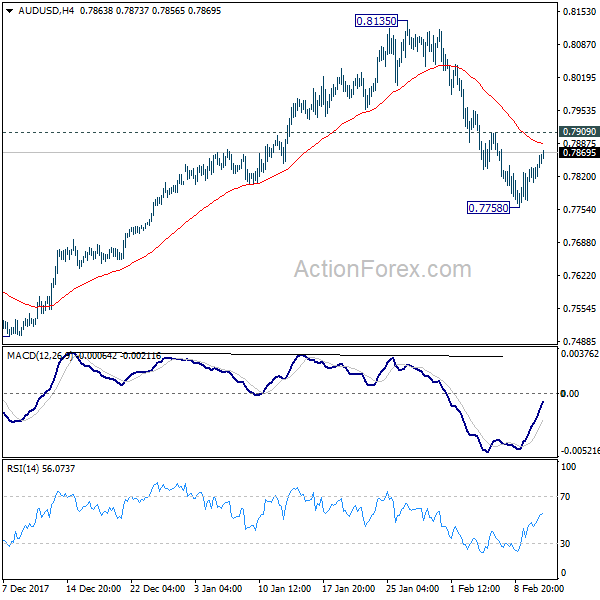
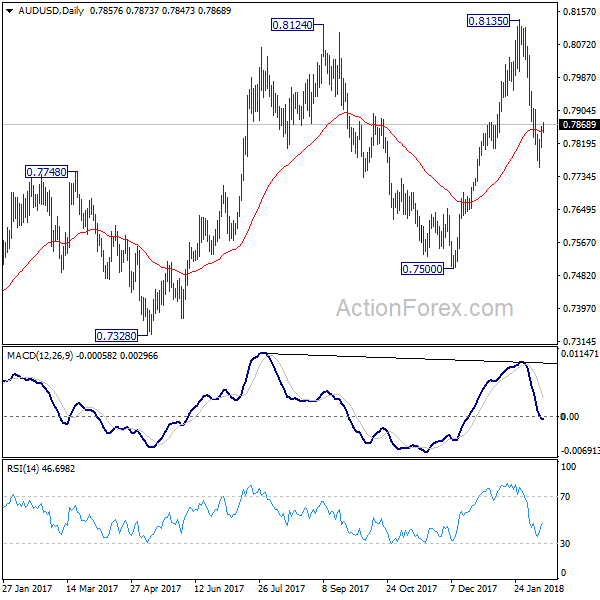
AUD/USD's recovery from 0.7758 extends higher today but it's staying below 0.7909 minor resistance. Intraday bias stays neutral and deeper decline remain in favor. Break of 0.7758 will extend the fall from 0.8135 to 0.7500 key support. At this point, there is no clearly sign of larger trend reversal yet. Hence, we'd look for strong support from 0.7500 to contain downside and bring rebound. On the upside, above 0.7909 minor resistance will turn bias back to the upside for retesting 0.8135 high.
In the bigger picture, medium term rebound from 0.6826 is seen as a corrective move. It might still extend higher but we'd expect strong resistance from 38.2% retracement of 1.1079 to 0.6826 at 0.8451 to limit upside to bring long term down trend resumption. On the downside, break of 0.7500 support will now be an important signal that such corrective rebound is completed.
Aussie Lifted Mildly by Business Confidence, Risk Sentiments Steady
Australian Dollar is lifted mildly today by business condition and confidence data and is trading broadly higher. Nonetheless, the forex markets are generally stuck in consolidation mode. Risk markets further stabilized overnight with DOW closed up 410 pts, or 1.7%, at 24601, responded positively to US President Donald Trump's infrastructure plan. Japan Nikkei follow is s trading up 0.8% at the time of writing. The economic calendar remains rather light today. UK inflation data, in particular CPI, will be the focus.
Australia business confidence hit 9 month high
Australia NAB business confidence rose 2 points to 12 in January, hitting a 9-month high. Business condition index rose 6 points to 19. NAB chief economist Alan Oster noted in the release that "while forward orders have eased a little, they remain above average and capacity utilisation has been trending up which is a good sign for both future investment and employment."
RBA Ellis: Wage growth to be gradual
RBA Assistant Governor Luci Ellis said that wages are forecast to "pick up from here", but "not immediately and then only gradually". She added that "firms are increasingly using other creative ways to attract and keep staff without paying across-the-board wage rises." And, "they are especially reluctant to grant wage rises, because this would increase one of their most important costs." Meanwhile, Australia is still "a bit further behind" some other advanced economies and "it might take a bit longer for the turnaround in inflation to happen here than elsewhere."
Japan PM Abe no decision on Kuroda yet
It was reported over the weekend that BoJ Governor Haruhiko Kuroda will be given a rare second term and the nomination will be sent to the parliament later this month. However, Prime Minister Shinzo Abe told the parliament today that he hasn't made the decision yet. Finance Minister, who's now the longest serving one in the post, said that "speaking fluent English is one very important condition for the job," of BoJ Governor. Meanwhile, Kuroda repeated his stance today, saying that "powerful" monetary easing is still needed to support the economy. And Kuroda pledged to "continue to closely watch domestic and overseas market moves, as they could affect Japan's economy and prices."
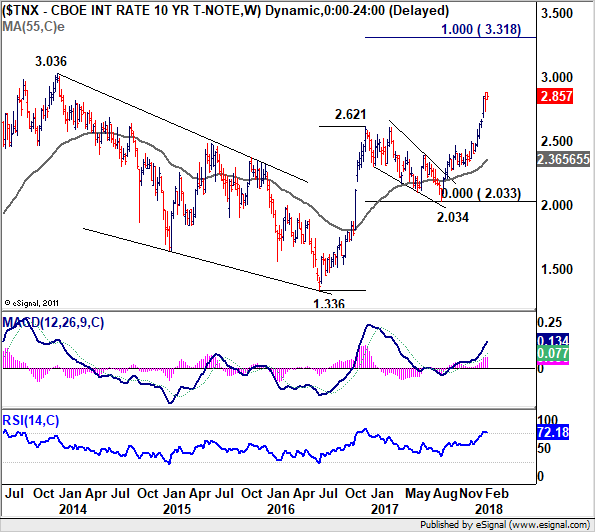
TNX could hit 3.5%
US 10 year yield closed higher by 0.028 at 2.857 yesterday but is limited below last week's high at 2.884. Technically, TNX is still on track for 3.036 key resistance level, which is seen as a key junction for the long term trend. Fundamentally, there are increasing expectation of rising yields in the US. According to Philip Moffitt, Asia-Pacific head of fixed income in Goldman Sachs Asset Management, Fed could hike four times this year. In the background, as Fed shrinks its balance sheet, there will be a surge in supply in bonds. And together, Moffitt expects TNX hitting 3.5% is "not a very brave forecast".
AUD/USD Daily Outlook
Daily Pivots: (S1) 0.7826; (P) 0.7844; (R1) 0.7880; More...
AUD/USD's recovery from 0.7758 extends higher today but it's staying below 0.7909 minor resistance. Intraday bias stays neutral and deeper decline remain in favor. Break of 0.7758 will extend the fall from 0.8135 to 0.7500 key support. At this point, there is no clearly sign of larger trend reversal yet. Hence, we'd look for strong support from 0.7500 to contain downside and bring rebound. On the upside, above 0.7909 minor resistance will turn bias back to the upside for retesting 0.8135 high.
In the bigger picture, medium term rebound from 0.6826 is seen as a corrective move. It might still extend higher but we'd expect strong resistance from 38.2% retracement of 1.1079 to 0.6826 at 0.8451 to limit upside to bring long term down trend resumption. On the downside, break of 0.7500 support will now be an important signal that such corrective rebound is completed.
Economic Indicators Update
| GMT | Ccy | Events | Actual | Forecast | Previous | Revised |
|---|---|---|---|---|---|---|
| 23:50 | JPY | Domestic CGPI Y/Y Jan | 2.70% | 2.70% | 3.10% | 3.00% |
| 0:30 | AUD | NAB Business Conditions Jan | 19 | 12 | 13 | |
| 0:30 | AUD | NAB Business Confidence Jan | 12 | 10 | 11 | 10 |
| 6:00 | JPY | Machine Tool Orders Y/Y Jan P | 48.30% | |||
| 8:15 | CHF | PPI M/M Jan | 0.20% | 0.20% | ||
| 8:15 | CHF | PPI Y/Y Jan | 0.90% | 1.80% | ||
| 9:30 | GBP | CPI M/M Jan | -0.60% | 0.40% | ||
| 9:30 | GBP | CPI Y/Y Jan | 2.90% | 3.00% | ||
| 9:30 | GBP | Core CPI Y/Y Jan | 2.60% | 2.50% | ||
| 9:30 | GBP | RPI M/M Jan | -0.70% | 0.80% | ||
| 9:30 | GBP | RPI Y/Y Jan | 4.10% | 4.10% | ||
| 9:30 | GBP | PPI Input M/M Jan | 0.60% | 0.10% | ||
| 9:30 | GBP | PPI Input Y/Y Jan | 4.10% | 4.90% | ||
| 9:30 | GBP | PPI Output M/M Jan | 0.20% | 0.40% | ||
| 9:30 | GBP | PPI Output Y/Y Jan | 3.00% | 3.30% | ||
| 9:30 | GBP | PPI Output Core M/M Jan | 0.20% | 0.30% | ||
| 9:30 | GBP | PPI Output Core Y/Y Jan | 2.30% | 2.50% | ||
| 9:30 | GBP | House Price Index Y/Y Dec | 4.90% | 5.10% |
A Day Of Calm
Equity markets have begun the week on a somewhat positive not picking up from Friday rebound as bargain hunters have returned on the first sign of stability. I guess if you owned a stock for fundamental reasons seven days ago and its 5 % lower this week, why not add to the portfolio? So the story goes.
While the Vix has pulled back to the 25 zone, it’s very trying to view this weeks stock market bounce anything other than technical correction after critical Global benchmarks had one of the there worst performances in years. However, the market is trying to find a positive equilibrium, and if we can get through this week’s critical US CPI relatively unscathed, then it would most certainly look as if last week was little more than a corrective episode rather then the commencement of a bear market.
None the less, government bond yields have found some stability after yields moved higher, albeit in very thinly traded Bond markets.
But certainly adding to the semblance of calm which has started the week. But concerns abound that the Bond Markets have only begun to factor in both the global reflation trade and burdening supply which could drive US bond yields considerably higher.
Oil Markets
Ignoring US supply-side concerns, OIl markets attempted to make a half-hearted recovery overnight on little more than an equity market correlated bounce and indeed the weaker USD added to the momentum.
Despite the Oil market exhibiting all the hallmarks of technical trading, toppling from massively overbought conditions to retracing on an equity correlated bounce. But technical momentum or not, with the EIA data around the corner, it’s hard not to overlook their expectations that U.S. crude output may rise to 11 million bpd by the end of the year.
However, global demand remains firm, and despite the shale oil boom the supply tightening narrative remains prevalent with OIL towing the line.
Battle lines are forming in an around the WTI 60.00 bpd level which should make for an exciting market this week.
Gold Markets
Gold prices were supported by a weaker dollar and physical demand ahead of Chinese lunar new year. The equity market carnage has abated, and the waves of cross assets selling to replenish equity margins have temporarily decreased providing a calmer market to re-establish Gold longs. But prices should remain within a range ahead of this week US inflation data as the US CPI will be a monster print for the markets inflation views and could provide a catalyst for Gold to bounce higher.
Currency Markets
The US dollar traded lower as currency traders are analysing the rebounding global equity markets. Lots of noise but little momentum as traders are keying on this week’s US CPI with volumes and liquidity density much lower to start the week.
Japanese Yen
The markets continue to digest the potential FX trading leverage cap for individuals in Japan. Mrs Watanabe was a considerable player in the market( especially for Retail brokers), so we’re keeping a close eye on the developments
As for the Yen, we seem to be at a crossroads in all Asian markets with currency markets barely budging looking for some inflation clarity in Wednesday CPI. The fear is that a higher print will send bond yields sky high and equity markets will tumble once again.
Australian Dollar
A rebound in risk sentiment has seen USD haven hedged unwind and buoyed commodity markets.As such, the Aussie dollar has found some solid footing this morning
Malaysian Ringgit
We’re at a bit of a crossroads this week as the markets are grappling with inflation versus the global growth narrative.
An uptick in inflation will lead to higher yields and will present the most significant headwind for the Ringgit. While the market has priced in 3 US rate hikes for 2018, a sudden uptick in US inflation could quicken the pace of the FED interest rate normalisation and could weigh negatively on regional sentiment.
We expect the market to trade in a tight range ahead of this domestic GDP and US CPI. Both monster data points for the Ringgits near-term fate
Gold Moves Higher Ahead Of CPI
Gold prices have moved higher to start the week. In Monday’s North American trade, the spot price for an ounce of gold is $1324.83, up 0.63% on the day. It’s a quiet start to the week, with only one event. The US federal budget is expected to rebound and show a large surplus of $50.2 billion. The last time the federal government posted a surplus was in September.
Gold lost ground last week, as the US dollar received a boost from a tumultuous week on global stock markets. Is the correction over? It’s too early too tell, since much of the sell-off is related to investor concerns over possible interest rate hikes by major central banks. The Bank of England has said it could accelerate its pace of hikes, and the Federal Reserve could follow suit if inflation moves higher. Gold prices are closely linked to interest rate moves, and a change in the Fed’s projection of interest rate moves could have a sharp effect on gold. Currently, the Fed is projecting three rate hikes this year, but if inflation moves higher and the robust US economy continues its current expansion, the Fed may opt for four or even five rate hikes, and this would push gold to lower levels.
It’s a quiet start to the week in the US, and the US dollar has been generally subdued. That will likely change on Wednesday, with the release of inflation and retail sales reports. The markets will be glued to the inflation indicators, as last week’s stock market slide was triggered by concern that higher inflation would lead to additional rate hikes from the Federal Reserve and other central banks. If inflation numbers are higher than expected, we could see some volatility in gold prices and further sell-offs in the stock markets.
Pound Ticks Lower, Investors Eye British CPI
The British pound has posted small losses in the Monday session. In North American trade, GBP/USD is trading at 1.3809, down 0.14% on the day. On the release front, there are no British data releases on the schedule. The US federal budget is expected to rebound and show a large surplus of $50.2 billion. The last time the federal government posted a surplus was in September. On Tuesday, the UK releases a host of inflation indicators, led by CPI.
It was the Bank of England’s turn to be in the spotlight on Thursday. The BoE made no changes to interest rates or quantitative easing, and both moves were unanimous (9-0). There was some surprise however, at the hawkish tone of policymakers, who said that interest rates could rise “earlier” and by a “somewhat greater extent” than they predicted at their previous meeting in November. Bottom line? We could see an interest rate in the first half of 2018, with analysts circling May as the most likely date. At the same time, the effect that Brexit is having on the economy is difficult to predict, and if the economic conditions worsen, the BoE could delay a rate hike. The hawkish message from the BoE pushed the British pound above the 1.40 level, but the upward swing didn’t last, as the pound had to settle for small gains on Thursday.
It’s a quiet start to the week in the US, and the US dollar has been generally subdued. That will likely change on Wednesday, with the release of inflation and retail sales reports. The markets will be glued to the inflation indicators, as last week’s stock market slide was triggered by concern that higher inflation would lead to additional rate hikes from the Federal Reserve and other central banks. If inflation numbers are higher than expected, we could see some volatility from the US dollar as well as the stock markets.
Yen Gains Ground, Japanese GDP Next
The Japanese yen has posted slight losses in the Monday session. In North American trade, USD/JPY is trading at 108.48, down 0.30% on the day. On the release front, there are no major indicators on the schedule. The US federal budget is expected to rebound and show a large surplus of $50.2 billion. This would mark the first surplus since September. In Japan, the Producer Price Index is expected to slow to 2.7%. On Tuesday, Japanese Preliminary GDP is expected to slow to 0.2% in the fourth quarter.
Turbulence in global stock markets last week triggered strong relativity in the currency markets. Most currencies lost ground against the US dollar, but the safe-haven Japanese yen bucked the trend. USD/JPY dropped 1.2%, and touched a low of 108.04, its lowest level since early September. A key reason for the sell-off was investor concern over possible interest rate hikes by major central banks. The Bank of England has said it could accelerate its pace of hikes, and the Federal Reserve could follow suit if inflation moves higher.
It’s a quiet start to the week in the US, and the US dollar has been generally subdued. That will likely change on Wednesday, with the release of inflation and retail sales reports. The markets will be glued to the inflation indicators, as last week’s stock market slide was triggered by concern that higher inflation would lead to additional rate hikes from the Federal Reserve and other central banks. If inflation numbers are higher than expected, we could see some volatility from the US dollar as well as the stock markets.
Can Equities Do it?
A tentative turn to the upside late on Friday will be tested in the days ahead but even if sentiment stabilizes, a big challenge awaits. Gold, silver and the Aussie are the best performers as yields push higher alongside risk appetite. Ashraf is watching 2676 on the SPX and 24706 on the Dow for today's close. Tune in for today's webinar on volatility. CFTC positioning was remarkably steady despite the turmoil. And here is a chart below that very few have mentioned.
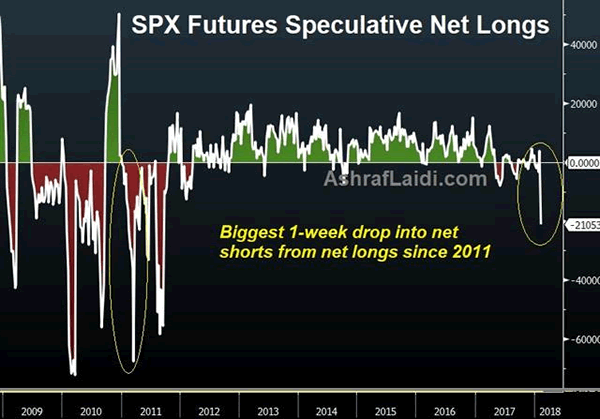
The S&P 500 gained nearly 40 points on Friday and traded 100 points off the lows in a small positive sign at the end of the worst week for global equities in years. Ultimately, the backdrop hasn't changed and the global economy is in fine shape. That was reflected in the general indifference of the FX and bond market. Looking to the week ahead and beyond, it will be bonds that steal the spotlight. The key event is Wednesday's release of US CPI and retail sales.
Despite all the turmoil, US 10-year yields finished the week at 2.85% -- the highest since the end of 2013. Aside from risk aversion, the climb took place despite tumbling commodity prices. A rise to 3% is likely and it's sure to create jitters in the junk bond space and broader markets. Is it a threshold for fear? Probably not but 3.5% might be a spot where negative feedback kicks in.
CFTC Commitments of Traders
Speculative net futures trader positions as of the close on Tuesday. Net short denoted by - long by +.
- EUR +141K vs +149K prior
- GBP +28K vs +32K prior
- JPY -113K vs -114K prior
- CAD +40K vs +33K prior
- CHF -20K vs -20K prior
- AUD +14K vs +13K prior
- NZD +3K vs +3K prior
The above numbers only reflect the close through Tuesday but underscore the lack of real concern in FX despite the turmoil in stock markets.
Sunset Market Commentary
Markets
Today, core bonds traded with a slightly negative bias. However, the Bund and the 10-year Note future held tight ranges. There were no important eco data. Global equities regained some further ground after last week's sell-off but the jury is still out whether this will mark the start of a sustained bottoming out process. US yields are up to 2.2 bp higher with the belly of the curve slightly underperforming and the 30-year outperforming (-1.5 bp) The US 10-year yield touched a minor new correction top intraday. The German yield curve rises about 1 bp, with the 2-year outperforming (unch). 10-y yield spreads versus Germany narrowed slightly in line with a more constructive risk sentiment globally. Portugal (-5 bp) outperformed. Greece (+19 bp) still underperforms.
The dollar lost slightly ground in Asia as global risk sentiment improved after the WS rebound on Friday. There were not eco data in EMU or in the US. European equities and US equity futures tried to build on Friday's improved risk sentiment, but the rebound was not strong enough to establish clear directional trends on other markets, including in the major dollar cross rates. Core yields hovered near recent peaks with interest rate differentials slightly widening in favour of the dollar. Whatever the reason, the overnight USD decline slowed soon. The topside in EUR/USD was capped just below 1.23 (currently 1.2250 area). USD/JPY held a very tight sideways range, close to mostly just north of 108.50. Markets are looking forward to the new budget proposal of the Trump administration and even more to Wednesday's US CPI release.
There were also no UK data. BoE' MPC member Gertjan Vlieghe supported last week's BoE policy assessment as he indicated that three more interest rate increases over the next few years probably leave the UK economy with some excess demand. He also confirmed that the BoE is on a rate hike trajectory and that the November rate hike was not intended to be just a one off. At the same time, there were plenty of headlines on UK PM May's 'Road to Brexit' initiative as she tries to hammer out a workable strategy for the UK to leave the EU in a constructive way. At least for now the (FX) market isn't convinced that this will lead to a break-through anytime soon. EUR/GBP hovers in the upper half of the 0.88 big figure. Cable is drifting sideways in the 1.38 big figure.
European equities show gains of about 1.25%, reversing part of last week's steep losses, but trading of the intraday peak. US indices opened about 1 % higher as investors try to find out whether a bottoming out process might start after last week's sell-off.
News Headlines
The Swedish unemployment rate as published by the Public Employment Service declined in January to an seasonally adjust 4.0% from 4.1% December. On Wednesday, the Swedish Riksbank will announce its policy decision.
Italian banks' NPL-reduction is gaining pace as the industry "nears the pre-crisis situation" also thanks to government measures, Finance Minister Pier Carlo Padoan said at an event in Rome.
China's banks extended a record 2.9 trillion yuan ($458.3 billion) in new yuan loans in January, blowing past expectations and nearly five times the previous month as policymakers aim to sustain solid economic growth while reining in debt risks.Net new loans surpassed the previous record of 2.51 trillion yuan in January 2016.
OPEC expects oil demand to grow faster than expected in 2018 due to a healthy world economy as the organization tries to remove a supply glut by cutting output. However OPEC expects the global oil market will return to balance only towards the end of 2018 as higher prices encourage the US and other non-member producers to pump more. OPEC expects world oil demand to rise 1.59 mln bpd this year, an increase of 60,000 bpd from the previous forecast.
Gold is Heading Lower; Looking Bearish in Short-Term
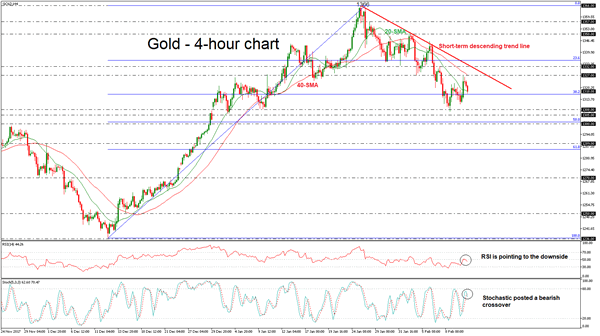
Gold is trading lower following the strong pullback on the 1366 resistance level on January 25. Having a look at the short-term timeframe the price almost hit the 38.2% Fibonacci retracement near 1316 level of the last up-leg with the low of 1236 and the high of 1366. The bearish correction is confirmed by the near-term technical indicators.
In the 4-hour chart, the RSI indicator is sloping to the downside below the 50 level, while the stochastic oscillator posted a bearish crossover within its moving averages, signaling further downside bias.
Currently, the price is extending the bearish tendency. If the precious metal drops below the 38.2% Fibonacci mark, it could hit the 1308 support level. Falling below this area could see prices re-test the 50.0% Fibonacci level, which holds near the 1300 significant psychological level.
Conversely, upside moves are likely to find resistance at 1327, which coincides with the 40-simple moving average in the 4-hour chart at the time of writing.