Sample Category Title
AUDCAD Posts Bullish Movement; Next Resistance above 0.9900
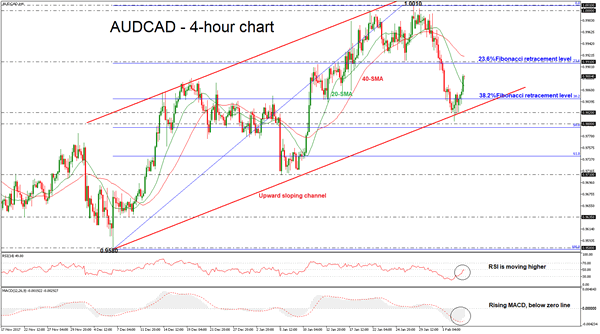
AUDCAD is rising aggressively over the last hourly session and is ready to attempt the 0.9900 psychological level. The price is heading for a re-test of the 0.9910 barrier and if it jumps above it, it would confirm the recent scenario for further gains. When looking in the short-term timeframe, the pair has been developing within an upward sloping channel since December 2017.
From the technical point of view, in the near-term, the RSI indicator is approaching the 50 level with sharp upside momentum, while the MACD oscillator posted a bullish crossover with its trigger line in the previous sessions.
If traders boost the price further up, they could drive it until the 0.9910 resistance level, which coincides with the 23.6% Fibonacci retracement level from 0.9580 to 1.0010. Furthermore, if price penetrates 0.9910, this could open the door for the strong psychological level of 1.0000.
Conversely, a dip back below the 38.2% Fibonacci level of 0.9845 and the rising trend line of the upward sloping channel the immediate support levels to watch are the 0.9820 barrier and the 0.9800 handle.
Gold Surpasses 23.6% Fibonacci Mark, Extending Gains
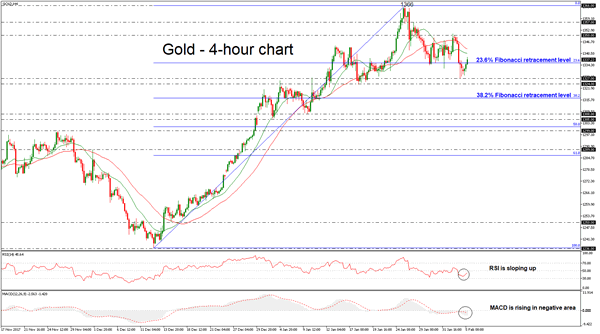
Gold is trading higher in the last few hours, following the strong rebound on the 1327 support level and successfully surpassed the 23.6% Fibonacci retracement level at 1335 of the last big upward movement with the low of 1236 and the high of 1366. In the 4-hour chart, the technical indicators seem to be turning positive.
The short-term technical indicators seem to be turning positive and point to more strength in the market. The RSI indicator is pointing sharply to the upside, below the 50 level, while the MACD oscillator is slightly rising in the negative territory. Technical indicators are signaling further gains in the near-term.
Currently, the price is extending the bullish tendency and is headed towards the 1350 resistance level. However, the precious metal needs to go through the 20 and 40 simple moving averages in the 4-hour chart.
Conversely, downside moves are likely to find resistance at 1327 and if the price breaks the aforementioned obstacle, it could open the door for the 38.2% Fibonacci mark at 1317.
Sunset Market Commentary
Markets:
Global core bonds corrected higher today following last week's sell-off. The move occurred amid a rather thin EMU eco calendar. Both the German Bund and US Note future were well into oversold territory. US politics might be at play with Democrats warning for a constitutional crisis over a top-secret memo which President Trump could use to fire his deputy attorney-general. German yields decline by 1.5 bps (2-yr) to 4.1 bps (5-yr) at the time of writing. The technical chart of the German 10-yr yield could show an engulfing pattern if we close today below Friday's intraday low (0.726%). That would suggest a slowdown in the Bund sell-off with even some additional correction higher. The US yield curve steepens with yield changes ranging between -1.5 bps (2-yr) +1.4 bps (30-yr). On intra-EMU bond markets, 10-yr yield spread changes versus Germany are limited with Portugal (+4 bps) and Greece (+11 bps) underperforming.
The dollar remains a place of relative calm given the nervous developments on other markets. EUR/USD held a relatively tight sideways range in the 1.24 big figure. EMU PMI's were very strong, but had only a very limited, temporary impact on EUR/USD. LT interest rate differentials widened slightly in favour of the dollar as Bunds outperformed Treasuries. However this was only a secondary factor for EUR/USD trading, at best. EUR/USD came under some modest pressure at the start of the US trading session (currently 1.2415 area). Still, the risk-off correction has only a modest impact on EUR/USD trading. Sentiment in USD/JPY is changing slightly. The yen ignored the equity sell-off at the end of last week as higher core yields and an ongoing soft approach from the BoJ weighed on the yen. Today's risk-off sentiment helped the yen to rebound off the post-payrolls' correction low. USD/JPY is drifting back below 110 (currently 109.80). EUR/JPY also eased after last week's spike and returned to mid-136 area. That said, the yen is still far away from playing the save haven role as it did in the past.
The sterling correction accelerated today. EUR/GBP held north of 0.88 at the start of trading. The UK currency continued to suffer from negative Brexit headlines (UK government wants to stay out of custom union after Brexit) and from a further deterioration in global risk sentiment. Mid-morning, sterling faced an additional headwind as the UK services PMI declined unexpectedly to 53 to 54.2, indicating a material slowdown in UK activity at the start of 2018. The data ease pressure on the BoE to considered a next rate in the near future. EUR/GBP rallied to fill offers in the 0.8870 area. 0.8928 intermediate resistance is coming on the horizon. Cable trades in the 1.4020 area as the dollar decline slowed, too.
News Headlines:
The US Non-manufacturing beat expectations, rising from 56 to 59.9, the highest level since 2005.
Britain's economy slowed sharply in January. The slowdown was driven mostly by Britain's services sector. The services PMI fell to a 16-month low of 53.0 from54.2 in December. The composite index eased from 54.9 to 53.5.
Contrary to the UK data, the EMU PMI's continued to signal a strong momentum in the EMU economy at the start of the year. The January services PMI was upwardly revised from 57.6 to 58.0. The composite measure rose to 58.8. The PMI's point to a Q1 GDP growth of 1.0% according to IHS Markit.
Negotiators for Chancellor Merkel's conservatives and the centre-left Social Democrats (SPD) reconvened to hammer out compromises on healthcare and labour policy, the stumbling blocks in the way of another "grand coalition". Both sides cited progress and said the remaining differences did not appear insurmountable.
USDCAD Extended Rally Pressures 1.25 Barrier, Twisting Daily Cloud Could Attract for Further Advance
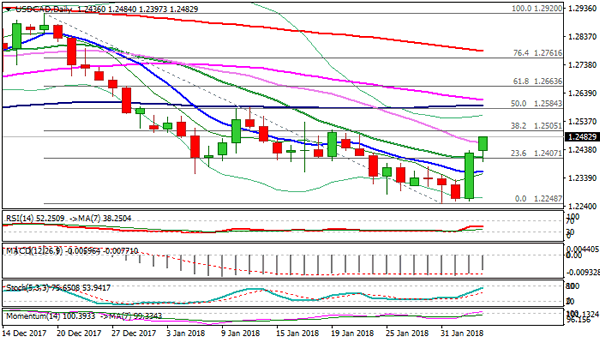
The USDCAD pair extends rally on Monday and broke through strong barrier at 1.2460 (Fibo 61.8% of 1.2590/1.2248 downleg).
Uncertainty over NAFTA talks keeps the greenback bid for extension of Friday's 1.3% rally, which was accelerated by strong US labor sector data.
Close above 10/20 SMA's on Friday was bullish signal for extension through 1.2460 barrier and attack at next pivot at 1.2505 (Fibo 38.2% of 1.2920/1.2248 descend).
Daily studies are regaining bullish momentum and indicators are heading north, with daily cloud twisting on Thursday (1.2699) and expected to attract near-term bulls.
Sustained lift above 1.2505 would open next targets at 1.2600 zone (11 Jan lower top and converging 55/100SMA's), with stronger acceleration capable of travelling to 1.2563 (Fibo 61.8% of 1.2920/1.2248 fall.
Broken 20SMA (1.2413) offers solid support which holds today's action and the downside being reinforced by thick 4-hr cloud (1.2395/1.2346).
Res: 1.2505; 1.2536; 1.2590; 1.2613
Sup: 1.2413; 1.2395; 1.2346; 1.2362
A Paradigm Shift?
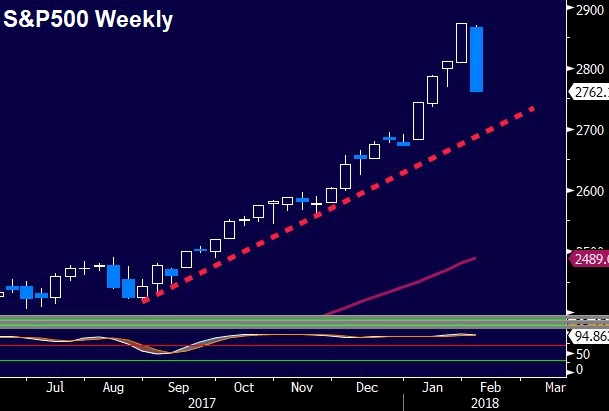
Ashraf's warnings about elevated volatility proved true with a rout in stock markets to close out the week. The Dow Jones Industrials Average opened 350 pts down today, following a sea of red in Asia and Europe. DOW30 is down 0.7% but S&P500 is down 2.0%. Fears of rising yields continue to be the main catalyst. Markets turn to the services ISM.
Non-farm payrolls had plenty of good news for the US economy and USD. The dollar jumped after 200K jobs were added compared to 180K and, more importantly, wage growth jumped to 2.9% compared to 2.6% expected. One big caveat was that wage growth was heavily concentrated in supervisory jobs but it's still a reason for a more-hawkish tilt at the Fed.
What was disappointing for dollar bulls was the inability to extend the dollar gains after the initial knee-jerk. The euro nearly recovered all the losses and USD/JPY climbed 60 pips only to give half of it back. There were stronger signs against the commodity currencies but that was also fueled by risk aversion.
So what set off the fears? There are worries about the Trump-Russia story again but as markets open for the week, neither Rosenstein nor Mueller have been fired, so that should dissipate. The larger worry is in bonds as US 10-year yields rose 6 bps on Friday to 2.84% despite the 2% fall in stocks.
It's been more than a decade since bonds and stocks were capable of selling off together and the takeaway is that inflation and rate hike worries are suddenly very real.
CFTC Commitments of Traders
Speculative net futures trader positions as of the close on Tuesday. Net short denoted by - long by +.
- EUR +149K vs +145K prior
- GBP +32K vs +33K prior
- JPY -114K vs -123K prior
- CAD +33K vs +23K prior
- CHF -20K vs -22K prior
- AUD +13K vs +17K prior
- NZD +3K vs -1K prior
Friday was a great test for the euro bulls. It could have easily turned into a rush to the exits; instead, the euro bulls regrouped in an impressive showing.
GBPUSD: Follows Through Lower On Weakness
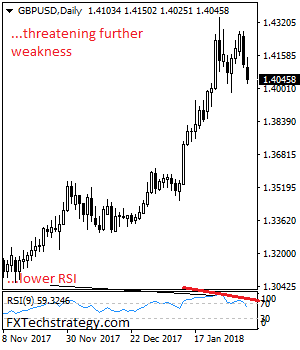
GBPUSD: The pair extended its weakness during Monday trading today. Support lies at the 1.4000 level where a break will turn attention to the 1.3950 level. Further down, support lies at the 1.3900 level. Below here will set the stage for more weakness towards the 1.3850 level. Conversely, resistance stands at the 1.4100 levels with a turn above here allowing more strength to build up towards the 1.4150 level. Further out, resistance resides at the 1.4200 level followed by the 1.4350 level. On the whole, GBPUSD looks to move further lower on pullbacks.
Canadian Dollar Slips after Strong US Job Numbers
The Canadian dollar is steady in the Monday session, after considerable losses on Friday. Currently, the pair is trading at 1.2435, up 0.06% on the day. On the release front, there are no Canadian releases on the schedule. In the US, the sole event on the calendar is ISM Non-Manufacturing PMI. The indicator is expected to rise to 56.5 points. On Tuesday, Canada releases the trade balance and Ivey PMI. The US will publish JOLTS Jobs Openings.
There was a changing of the guard at the Federal Reserve on the weekend, as Jerome Powell took over as chair, replacing Janet Yellen. On Friday, Yellen waxed optimistic about the economy, saying that strong growth, a red-hot labor market and increased wage growth would require the Fed to gradually raise interest rates. Powell is expected to continue to Yellen's policies, so the markets are not expecting any dramatic shifts. However, the massive US tax cut will have a strong impact on the US economy, and the markets will be looking to the Fed for guidance. If the Fed sounds optimistic about the tax reform package, the US dollar could move higher.
Strong US employment numbers on Friday spelled bad news for the Canadian dollar, as USD/CAD jumped 1.3%. In the US, nonfarm payrolls jumped to 200 thousand, beating the estimate of 181 thousand. Wage growth remained steady at 0.3%, edging above the estimate of 0.2%. Will the strong numbers lead to additional interest rate hikes? Minneapolis Fed President Neel Kaskkari said on Friday that the Fed might need to be more aggressive if wages continued to move higher. The Fed is planning to raise rates three times in 2018, but some economists are forecasting four hikes.
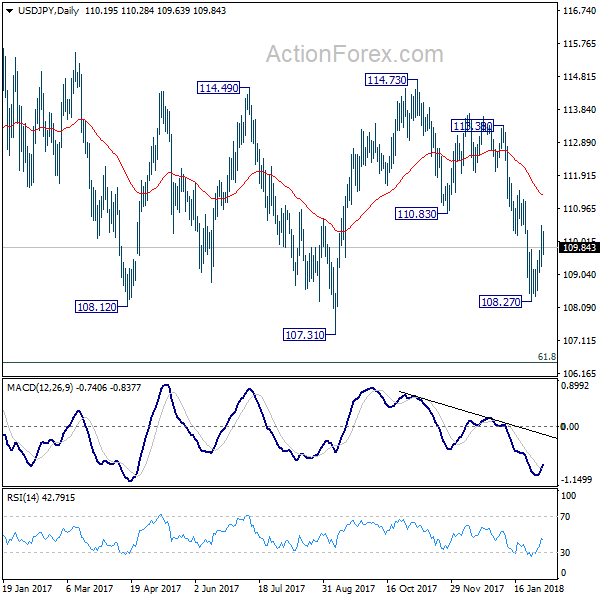
USD/JPY Mid-Day Outlook
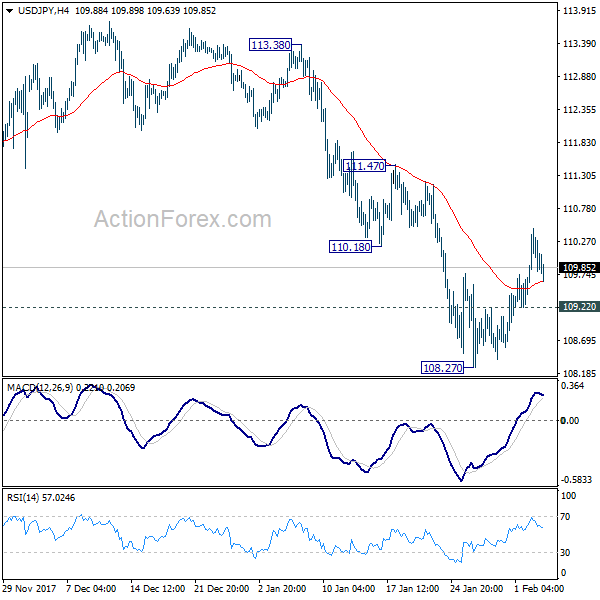
Daily Pivots: (S1) 109.45; (P) 109.97; (R1) 110.65; More...
No change in USD/JPY's outlook. With 109.22 minor support intact, intraday bias stays on the upside for 111.47 resistance first. As noted before, a short term bottom was also in place at 108.27. Sustained break of 111.47 will also have 55 day EMA (now at 111.33) firmly taken out. In such case, further rise would be seen back to 113.38/114.73 resistance zone. On the downside, however, below 109.22 minor support will turn focus back to 108.27 instead.
In the bigger picture, current development argues that the corrective pattern from 118.65 is extending. There is risk of dropping further to 61.8% retracement of 98.97 to 118.65 at 106.48. But this level should provide strong support to contain downside and bring resumption of rise from 98.97. However, sustained break of 106.48 will now likely send USD/JPY through 98.97 to resume the corrective fall from 125.85 (2015 high).
USD/CHF Mid-Day Outlook
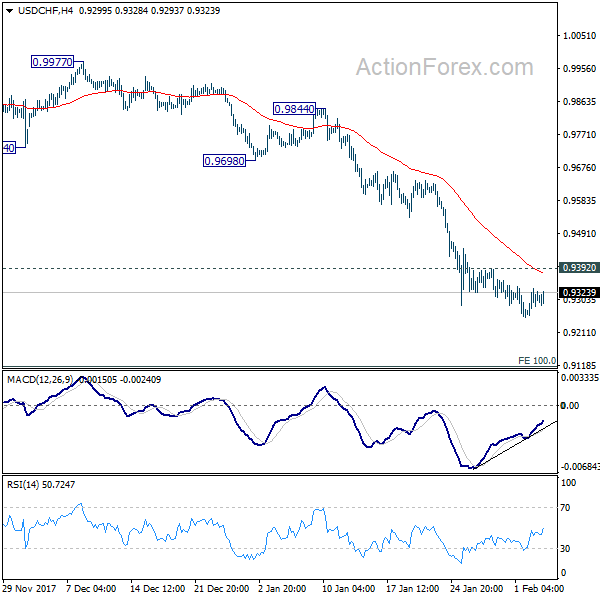
Daily Pivots: (S1) 0.9259; (P) 0.9298; (R1) 0.9345; More...
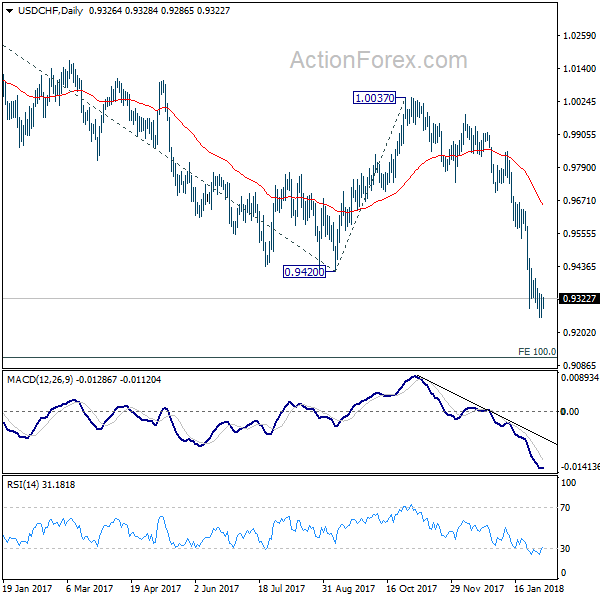
No change in USD/CHF's outlook. Deeper decline is expected with 0.9392 minor resistance intact. Current fall from 1.0037 would target next fibonacci projection level at 0.9115. On the upside, break of 0.9392 minor resistance, however, will indicate short term bottoming and bring stronger rebound.
In the bigger picture, the strong break of 0.9420 support suggests that fall from 1.0342 is developing into a medium term down trend. Deeper fall should be seen to 100% projection of 1.0342 to 0.9420 from 1.0037 at 0.9115. Break will target 161.8% projection at 0.8545. In any case, break of 0.9640 resistance is needed to be the first sign of medium term bottoming. Otherwise, outlook will stay bearish even in case of strong rebound.
EUR/USD Mid-Day Outlook
Daily Pivots: (S1) 1.2402; (P) 1.2459 (R1) 1.2511; More....
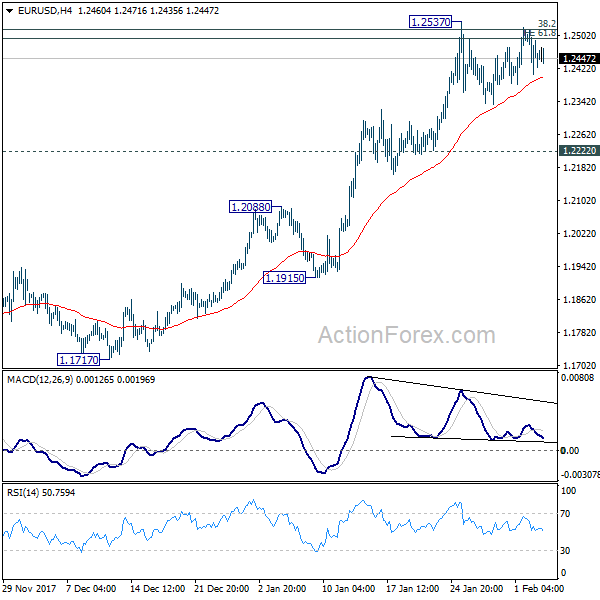
Intraday bias in EUR/USD remains neutral as range trading continues below 1.2537. As long as 1.2222 support holds, further rise is in favor. Sustained break of 1.2494/2516 will target 100% projection of 1.0569 to 1.2091 from 1.1553 at 1.3075 next. However, break of 1.2222 will indicate rejection from 1.2494/2516, on bearish divergence condition in 4 hour MACD, and turn near term outlook bearish for 1.1915 support first.
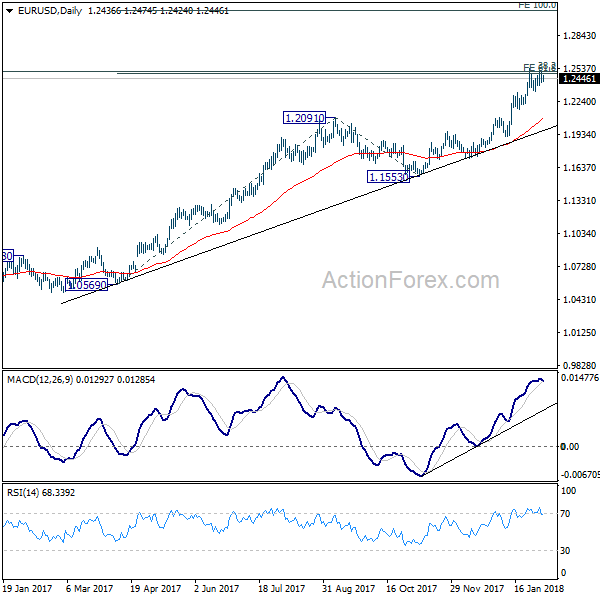
In the bigger picture, rise from 1.0339 medium term bottom is still seen as a corrective move for the moment. But key fibonacci level at 38.2% retracement of 1.6039 (2008 high) to 1.0339 (2017 low) at 1.2516 is looking vulnerable. Sustained break of 1.2516 will carry larger bullish implication and target 61.8% retracement of 1.6039 to 1.0339 at 1.3862. Nonetheless, rejection from 1.2516 will maintain long term bearish outlook and keep the case for retesting 1.0039 alive.