Sample Category Title
Trade Idea Wrap-up: USD/JPY – Stand aside
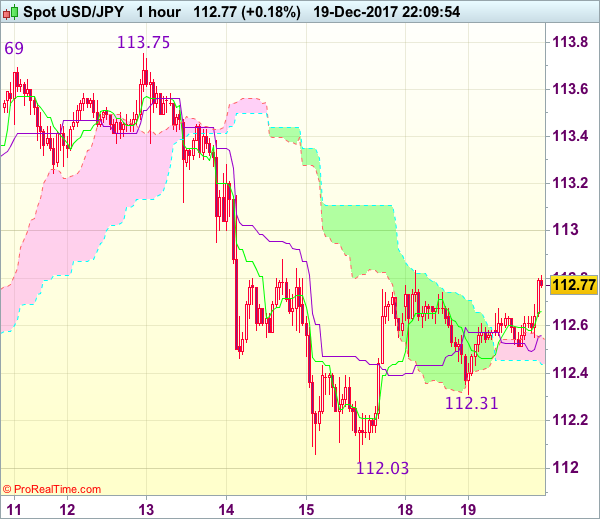
USD/JPY - 112.80
Most recent candlesticks pattern : N/A
Trend : Near term down
Tenkan-Sen level : 112.66
Kijun-Sen level : 112.56
Ichimoku cloud top : 112.55
Ichimoku cloud bottom : 112.44
New strategy :
Stand aside
Position : -
Target : -
Stop : -
As the greenback found good support at 112.03 late last week and rebounded, retaining our view that further consolidation above previous support at 111.99 would be seen and gain to resistance at 112.88 cannot be ruled out, however, reckon upside would be limited to 113.12 (previous support) and price should falter below 113.45-50, bring another decline later.
On the downside, expect pullback to be limited to 112.30 and bring another rebound later. A drop below 112.15-20 would bring another test of said support at 111.99-03 but break there is needed to retain bearishness and signal the rebound from 110.84 low has ended at 113.75, then the fall from there may extend weakness to 111.65-70 but reckon previous support at 111.41 would hold from here. As near term outlook is still mixed, would be prudent to stand aside for now.
US: Homebuilding Continues its Ascent in November
Homebuilding accelerated in November, extending the prior month's gains as rebuilding following hurricanes Harvey and Irma continued. Housing starts increased by 41k to 1,297k, surpassing consensus expectations for a moderation in activity to 1,250k. Building permits also surprised to the upside, clocking in at 1,298k, following a +19k revision to October's reading.
Single-family starts accounted for the entirety of the increase in activity, rising by 47k to 930k, on top of an upwardly revised (+6k) October reading. The more volatile multi-family segment saw building fall by 6k to 367k, and this was compounded by a downward revision (-40k) to October's reading.
Adding to the good news, single-family permits rose (+12k) from an upward revised October reading (+11k), to register at 862k. Multi-family permits fell (-30k) to 436k.
Activity in the South continued to rebound (+69k) as hurricane-related rebuilding progresses. Single-family starts in the South registered the fastest pace of building since 2007 at 515k. Activity in the West also picked up (+55k), while the Northeast (-57k) and the Midwest (-26k) saw a slowdown in building.
Key Implications
Today's report largely reflects sustained momentum from hurricane rebuilding, which got underway in October and is slated to continue into 2018. The strong pick-up in the single-family market is encouraging given the inventory constraints that have led to fast price growth in this segment. Furthermore, the increase in permits for single-family homes indicates that building will continue to be brisk, with the effects of the hurricanes gradually fading over 2018. Importantly, the gain was not entirely a result of hurricane rebuilding, with strong fundamentals in the West leading to the fastest pace of single-family starts there since 2007.
Fundamentals in the national housing market also remain strong, with persistent wage gains and still-low mortgage rates continuing to support demand. While potential changes to the tax code, including a downsized mortgage interest deduction and a cap on the property tax deduction, could impact prices in a select few high-priced markets, including New York, California and D.C., we expect strong demographics and labor market conditions to support demand. Builders echoed this optimistic sentiment in December, as hurricane-related uncertainty evaporated, leading the NAHB's index to reach an 18-year high.
Although builders will continue to face challenges related to labor scarcity in the coming months, due to increased demand for construction workers in the hurricane-affected South, we expect homebuilding to continue to grind higher over the medium-term. That should result in residential investment being a positive contributor to growth in the coming quarters.
Trade Idea Wrap-up: USD/CHF – Buy at 0.9850
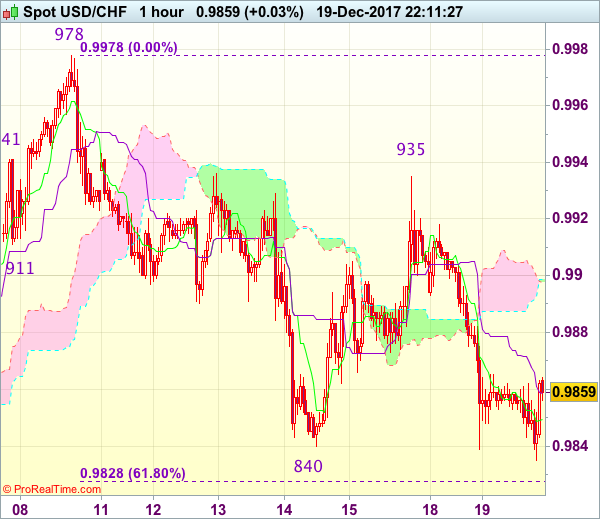
USD/CHF - 0.9860
Most recent candlesticks pattern : N/A
Trend : Near term down
Tenkan-Sen level : 0.9850
Kijun-Sen level : 0.9859
Ichimoku cloud top : 0.9899
Ichimoku cloud bottom : 0.9898
New strategy :
Buy at 0.9850, Target: 0.9950, Stop: 0.9820
Position : -
Target : -
Stop : -
Although the greenback fell marginally to 0.9835, lack of follow through selling and current rebound from 0.9835 suggest consolidation with mild upside bias is seen for gain to 0.9880, then 0.9900, however, break of resistance at 0.9935-36 is needed to signal low is formed, bring a stronger rebound to 0.9950-55 but price should falter well below resistance at 0.9978, bring retreat later.
In view of this, we are looking to buy dollar on dips. Below 0.9825-30 (61.8% Fibonacci retracement of 0.9735-0.9978) would signal the fall from 0.9978 top is still in progress and may extend further fall to 0.9795-00 and possibly towards 0.9775-80.
GBPUSD Further Bearish Below 1.3360
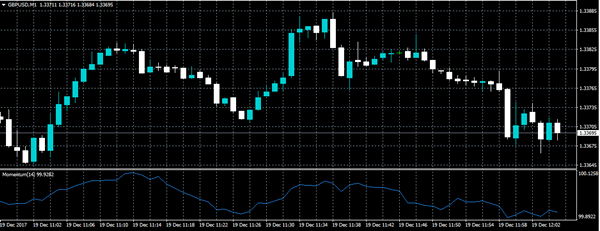
The British pound continues to soften against the U.S dollar, with the pair again swiftly rejected from the 1.3400 level during the European trading session. The GBPUSD is currently testing the 1.3360 support level, with pound sellers looking to take further control of the pair below this key support area. With a lack of UK and U.S macro-economic data, traders will look to the U.S congress, as the House Senate votes on the U.S tax bill during the U.S trading session. The passing of tax reform bill should be U.S dollar index supportive, although it is not clear if market participants have fully priced this into the greenback yet.
The GBPUSD pair will turn further bearish below the 1.3360 level, with sellers looking then looking to test towards the 1.3330 and 1.3300 support levels.
Should price action fail to break below the 1.3360 level, GBPUSD buyers will likely start to target towards the 1.3400 and 1.3418 resistance areas.
EURUSD Now Bullish Above 1.1787
The euro is trading above the 1.1800 level against the U.S dollar, as dip buyers continue to support the single currency on pullbacks. The EURUSD fell sharply from 1.1835 level on Monday, only to find support overnight at the pairs weekly pivot point, located at the 1.1777 level. Price-action currently trades close to the weekly price-highs, with the euro underpinned by a strong German IFO reading earlier. Investors now await the U.S Senate to pass the Trump administrations tax reform plan, which is expected during the mid U.S trading session.
The EURUSD remains intraday bullish while trading above the 1.1790 level, buyers may now target towards the 1.1840 and 1.1865 resistance regions.
Should the EURUSD pair start to decline below the 1.1790 level, sellers may target towards the weekly pivot at 1.1770 and the key 1.1750 support level.
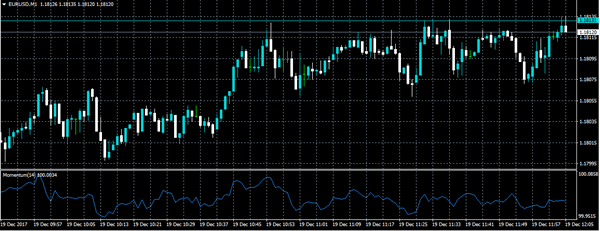
Trade Idea: EUR/GBP – Hold long entered at 0.8810
EUR/GBP - 0.8860
Original strategy :
Bought at 0.8810, Target: 0.8910, Stop: 0.8770
Position : - Long at 0.8810
Target : - 0.8910
Stop : - 0.8770
New strategy :
Hold long entered at 0.8810, Target: 0.8910, Stop: 0.8770
Position : - Long at 0.8810
Target : - 0.8910
Stop : - 0.8810
As the single currency did find renewed buying interest at 0.8792 and has risen again, retaining our bullish view that the rise from 0.8690 low is still in progress and upside bias remains for this move to bring test of resistance at 0.8868, break there would add credence to our view that the decline from 0.9015 has ended, bring further gain to 0.8890-00 and later towards 0.8930.
In view of this, we are holding on to our long position entered at 0.8810. Only below said support at 0.8792 would abort and signal top is formed instead, bring test of indicated support at 0.8760 but below there is needed to indicate the rebound fro 0.8690 has ended, then further all to 0.8720-25 would follow.
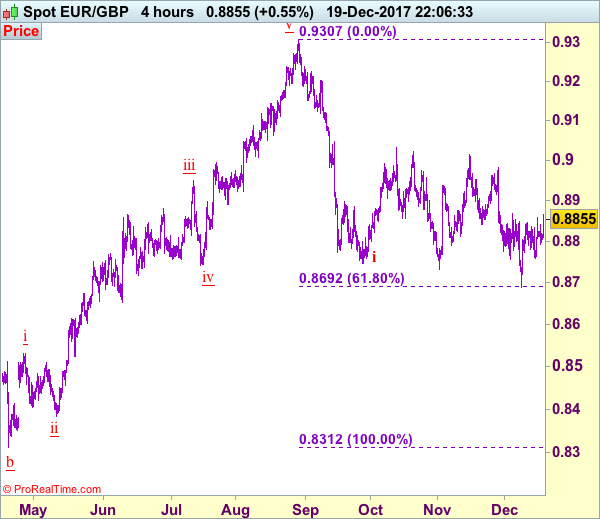
Our preferred count is that, after forming a major top at 0.9805 (wave V), (A)-(B)-(C) correction is unfolding with (A) leg ended at 0.8400 (A: 0.8637, B: 0.9491 and 5-waver C ended at 0.8400. Wave (B) has ended at 0.9413 and impulsive wave (C) has either ended at 0.8067 or may extend one more fall to 0.8000 before prospect of another rally. Current breach of indicated resistance at 0.9043 confirms our view that the (C) leg has ended and bring stronger rebound towards 0.9150/54, then towards 0.9240/50.
Dollar Continues to Stay Indifferent to Tax Bill
Dollar continues to trade generally soft, except versus Yen and Sterling. While tax bill optimism boosted stocks to record high, the greenback's reaction remains indifferent. The House will vote on the tax bill today and will very likely pass it. Senate is expected to follow shortly after scheduled debate. Released from US, housing starts rose 3.3% mom to 1.297m annualized rate in November. Building permits also rose 1.4% mom to 1.298m annualized rate. Both came in above market expectation. Current account deficit narrowed to USD -101b in Q3.
Fed Kashkari: Flattening yield curve signal recession risks
Minneapolis Fed President Neel Kashkari, who dissented all of the three Fed hikes this year, warned of recession risks in the US. He said in the statement that "in response to our rate hikes, the yield curve has flattened significantly, potentially signaling an increasing risk of a recession." And, hiking in low inflation environment "is likely holding down the long end of the curve by depressing inflation expectations." His view was differed by outgoing Fed chair Janet Yellen's. Yellen said in the post FOMC press conference that the current slope is well within its historical range" and "there are good reasons to think that the relationship between the slope of the yield curve and the business cycle may have changed."
German Ifo dropped but stayed strong
German Ifo business climate dropped slightly to 117.2 in December, down from 117.5, below expectation of 117.6. Current assessment gauge rose to 125.4, up from 124.5 and beat expectation of 124.7. But expectations gauge dropped to 109.5, down from 111.0, missing consensus of 110.8. Ifo noted in the release that "sentiment among German businesses is excellent ahead of Christmas, but no longer quite as euphoric as last month. This was due to less optimistic business expectations. Assessments of the current business situation, by contrast, were more positive this month." Ifo economist Klaus Wohlrabe also suggested not to over-interpret the decline in the index. He noted that "if the situation is already very good it is even more difficult to expect better business."
ECB Hansson: Communications should change
ECB Governing Council member Ardo Hansson said the central bank should start considering to change its communications. He said that "the fact that the growth is so strong gives us a lot confidence that (price) pressure will build up over time." Therefore, "moving to a communication which draws attention to the multi-faceted elements of monetary policy including interest rates is probably something that we should consider over the coming months."
SECO expects better 2018 growth
In Switzerland, the State Secretariat for Economic Affairs (SECO) updated both 2017 and 2018 growth forecasts. The economy is now projected to grow 1% in 2017, accelerate to 2.3% in 2018 then slow to 1.9% in 2019. SECO expected the "Swiss economy to make a speedy recovery over the next few quarters". Also, "the euro area has developed and is expected to grow even more dynamically than we expected three months ago, and domestically we are seeing the effects of the currency shock have really levelled off. It looks like nearly all sectors that have been hit by the currency shock are growing quickly."
RBA minutes showed upbeat outlook
RBA minutes for the December meeting revealed that policymakers were more upbeat on the global and domestic economic outlook. While maintaining a natural monetary policy stance, the minutes contained some hawkish ingredients, suggesting that recent data on employment and inflation have made the members more confident. The key concerns remained subdued wage growth and household consumption. More in RBA Added Some Hawkish References In December Minutes.
USD/CAD Mid-Day Outlook
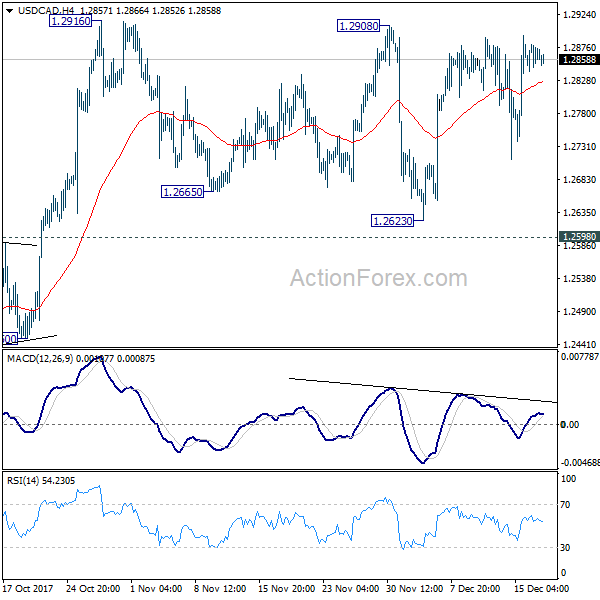
Daily Pivots: (S1) 1.2843; (P) 1.2862; (R1) 1.2882; More....
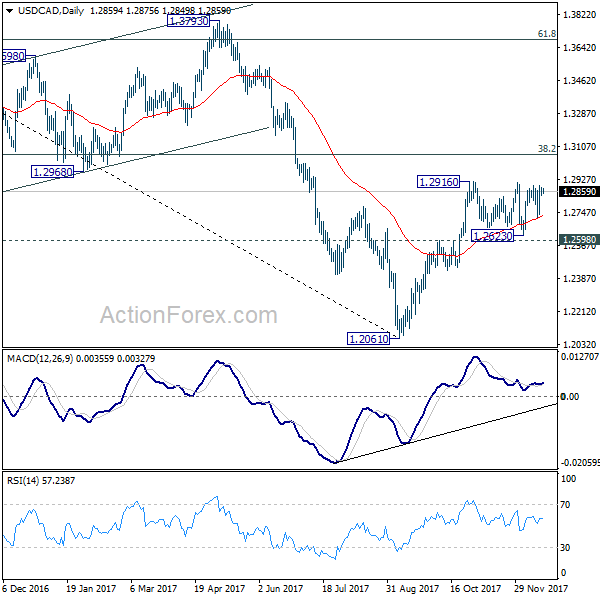
USD/CAD continues to stay in range of 1.2623/2916 and intraday bias remains neutral. Consolidation from 1.2916 might still extend. But, as long as 1.2598 resistance turned support holds, near term outlook remains bullish. On the upside, break of 1.2916 will resume the rise from 1.2061 and target 1.3065 medium term fibonacci level next. However, sustained break of 1.2598 will argue that rebound from 1.2061 has completed after hitting 55 week EMA (now at 1.2885). Near term outlook will be turned bearish in this case.
In the bigger picture, USD/CAD should have defended 50% retracement of 0.9406 (2011 low) to 1.4689 (2016 high) at 1.2048. And with 1.2048 intact, we'd favor the case that fall from 1.4689 is a correction. Rise from 1.2061 medium term bottom should now target 38.2% retracement of 1.4689 to 1.2061 at 1.3065. Firm break there will target 1.3793 key resistance next (61.8% retracement at 1.3685). We'll now hold on to this bullish view as long as 1.2450 support holds.
Economic Indicators Update
| GMT | Ccy | Events | Actual | Forecast | Previous | Revised |
|---|---|---|---|---|---|---|
| 21:00 | NZD | Westpac Consumer Confidence Q4 | 107.4 | 112.4 | ||
| 00:00 | NZD | ANZ Business Confidence Dec | -37.8 | -39.3 | ||
| 00:30 | AUD | RBA Minutes Dec | ||||
| 06:45 | CHF | SECO Economic Forecasts | ||||
| 09:00 | EUR | German IFO Business Climate Dec | 117.2 | 117.6 | 117.5 | |
| 09:00 | EUR | German IFO Current Assessment Dec | 125.4 | 124.7 | 124.4 | 124.5 |
| 09:00 | EUR | German IFO Expectations Dec | 109.5 | 110.8 | 111 | |
| 13:30 | USD | Housing Starts Nov | 1.30M | 1.25M | 1.29M | 1.26M |
| 13:30 | USD | Building Permits Nov | 1.30M | 1.28M | 1.32M | 1.32M |
| 13:30 | USD | Current Account Balance Q3 | -101B | -117B | -123B | -124B |
Tax Reform Spurs Santa Rally
US Seen Higher as Congress Prepares to Vote on Tax Reform Bill
US equity markets are on course to open higher again on Friday, once again pushing for new record highs as tax reform edges ever closer.
Tax reform was one of the key initiatives that contributed to Donald Trump's election victory last year as he vowed to revitalise a sluggish US economy. While it may have taken longer to deliver than he expected, it would appear that Republicans determination to give Americans an early Christmas present has paid off, although there has been numerous debates about who actually stands to benefit most from the bill.
Markets have clearly benefited from the prospect of tax reform over the last 13 months and the Santa rally that we've seen in the run up to Christmas is another reflection of that. It will be interesting to see if this will be maintained for the rest of the week or whether it becomes a "buy the rumour, sell the fact" scenario.
German Ifo Eases From Highs But EUR Rallies Anyway
Tax reform aside, there are a number of data releases that traders will be closely monitoring this week. The German Ifo business climate was this morning initially weighed on the euro before the currency rebounded to become one of the standout performers today. The number fell slightly short of expectations - falling from record highs to 117.2 - although the current assessment component equalled its record at 125.4, making the initial response to the release a little over the top.
Still to come from the US we'll get building permits and housing starts and we'll also hear from Neel Kashkari, who's time as a voter on the FOMC expires at the end of this year. The only other notable release today will be API crude inventories, which comes as oil continues to trade around its highest level in the last couple of years.
Bitcoin Spending a Rare Day in the Red
Bitcoin is having a rare day in the red on Tuesday, paring excessive gains that came as CBOE and CME prepared to launch futures contracts. The move - which was seen by advocates of the cryptocurrency as legitimising it - drove the price up more than 50% over the last couple of weeks before settling a little over the last couple of days, clearly only by its own standards.
It's possible that the 3-4% declines being seen this morning is just some profit taking as Bitcoin prepares to overcome another milestone - $20,000 - only weeks after having overcome $10,000 for the first time. It's difficult to say what will trigger the next wave of frenzied buying in Bitcoin, assuming it will happen of course, but I don't expect things to settle down too much any time soon.
Canadian Dollar Remains Adrift
The Canadian dollar has shown little movement this week. Currently, USD/CAD is trading at 1.2865, up 0.02% on the day. On the release front, there are no Canadian events on the schedule. In the US, today's key event is Building Permits, which is expected to slow to 1.25 million. We'll also get a look at Current Account and Housing Starts. On Wednesday, the US publishes Existing Home Sales and Canada releases Wholesale Sales.
President Trump fared badly when he tried to replace Obamacare, but his tax reform proposal is poised to become law, barring any unexpected surprises. On Friday, the legislation passed a major milestone, as the House and Senate hammered out the differences in their tax proposals and drafted a uniform bill. The legislation is expected to be voted on in the House on Tuesday and the Senate on Wednesday. With Democrats in both branches opposing tax reform, the Republicans will need every vote in the Senate, where they have a thin 59-41 majority. Several Republican senators who were undecided have said they will vote in favor, so the bill is likely to pass through Congress and will then be signed into law by President Trump. This marks the first major overhaul of the US tax code in 30 years, and would represent a huge victory for Trump, ahead of Congressional elections in 2018.
Bank of Canada Governor Stephen Poloz presented an optimistic picture of the economy last week, but also acknowledged that the BoC has some significant concerns as we wrap up 2017. With the Federal Reserve raising rates last week, and almost certain to do so again at the January meeting, the BoC is under pressure to increase rates early in 2018, or else the Canadian dollar could take a tumble. Another headache for the Poloz is NAFTA, as the US has threatened to pull out of the free-trade agreement if Canada and Mexico do not agree to major concessions. If NAFTA does unravel, the Canadian dollar would likely drop, as Canada sends 75% of its export to its southern neighbor and the economic repercussions would be severe.
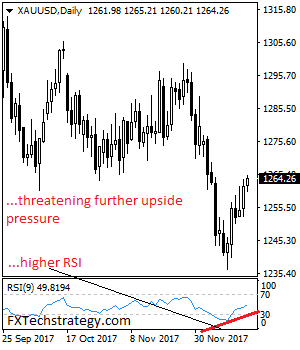
Gold: Recovers Higher, Eyes 1,270.00 Zone
GOLD: The commodity faces further recovery higher as it eyes a move towards the 1,270.36 resistance zone. On the downside, support comes in at the 1,250.00 level where a break will turn attention to the 1,240.00 level. Further down, a cut through here will open the door for a move lower towards the 1,230.00 level. Below here if seen could trigger further downside pressure towards the 1,220.00 level. Conversely, resistance resides at the 1,270.00 level where a break will aim at the 1,280.00 level. A turn above there will expose the 1,290.00 level. Further out, resistance stands at the 1,300.00 level. Its daily RSI is bullish and pointing higher suggesting further strength. All in all, GOLD looks to strengthen further on correction.