Sample Category Title
USD/JPY Mid-Day Outlook
Daily Pivots: (S1) 152.12; (P) 152.61; (R1) 153.42; More...
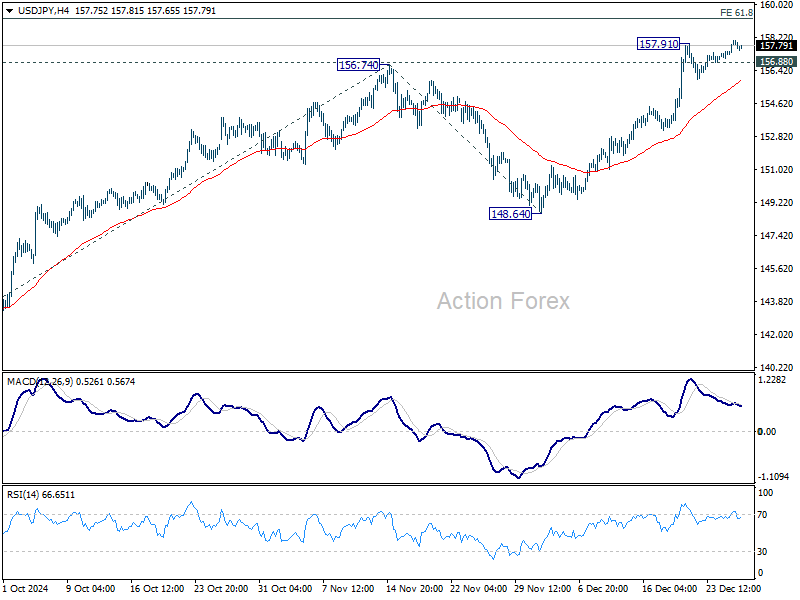
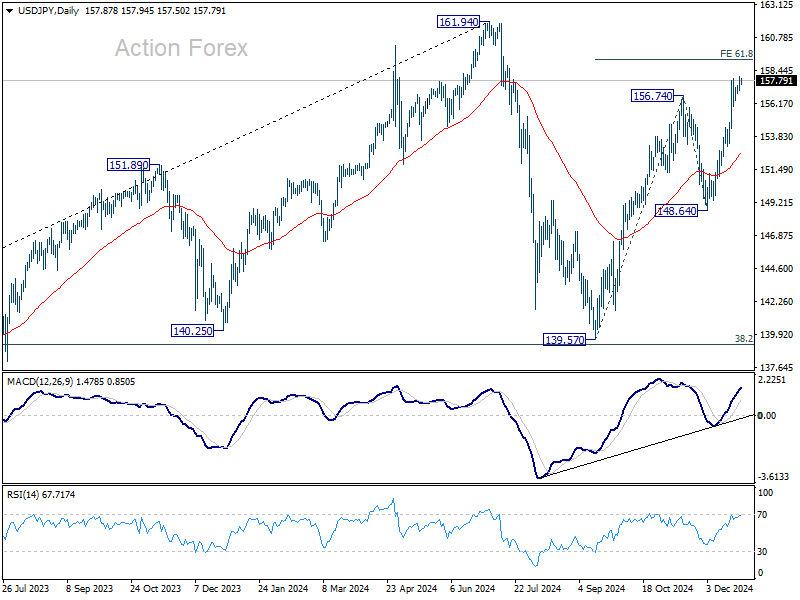
Range trading continues in USD/JPYO and intraday bias stays neutral. Another rise is expected with 151.44 support intact. Sustained trading above of 61.8% retracement of 161.94 to 139.57 at 153.39 will pave the way to retest 161.94 high. However, considering bearish divergence condition in 4H MACD, firm break of 151.44 will indicate short term topping, and turn bias back to the downside for 55 D EMA (now at 149.07).
In the bigger picture, price actions from 161.94 are seen as a corrective pattern to rise from 102.58 (2021 low). The range of medium term consolidation should be set between 38.2% retracement of 102.58 to 161.94 at 139.26 and 161.94. Nevertheless, sustained break of 139.26 would open up deeper medium term decline to 61.8% retracement at 125.25.
USD/CHF Mid-Day Outlook
Daily Pivots: (S1) 0.8648; (P) 0.8679; (R1) 0.8730; More…
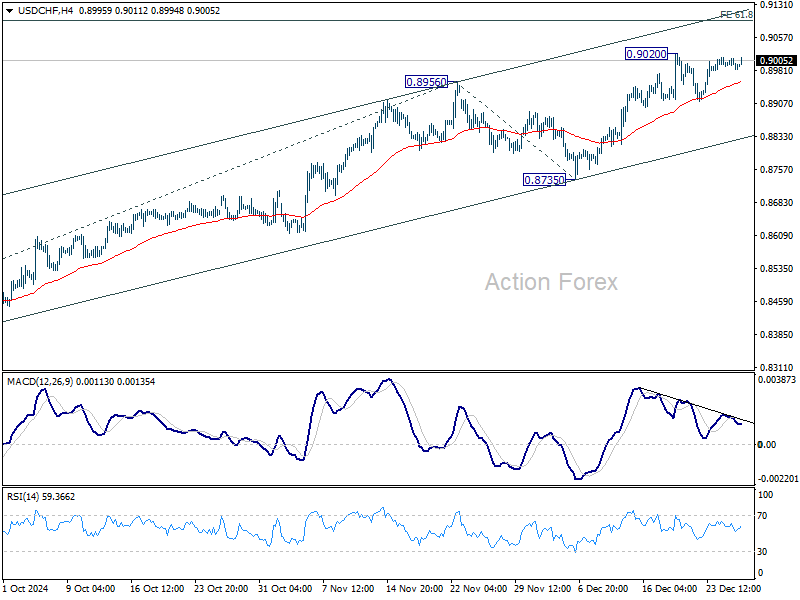
Break of 0.8631 support suggests short term topping at 0.8710, on bearish divergence condition in 4H MACD, after hitting 38.2% retracement of 0.9223 to 0.8374 at 0.8698. Intraday bias is back on the downside for 55 D EMA (now at 0.8613). On the upside, firm break of 0.8710 will resume the rebound from 0.8374.
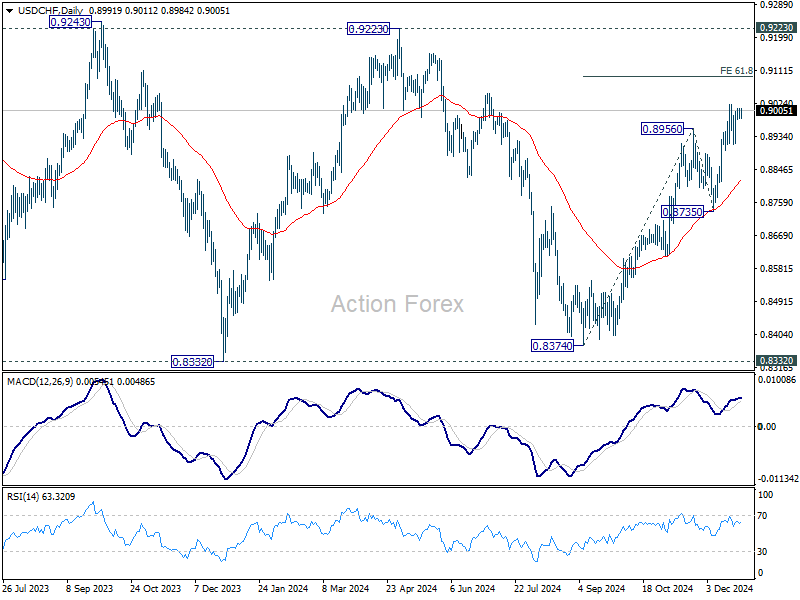
In the bigger picture, price actions from 0.8332 (2023 low) are currently seen as a medium term corrective pattern, with fall from 0.9223 as the second leg. Strong support could be seen from 0.8332 to bring rebound. Yet, overall outlook will continue to stay bearish as long as 0.9243 resistance holds. Firm break of 0.8332, however, will resume larger down trend from 1.0146 (2022 high).
GBP/USD Mid-Day Outlook
Daily Pivots: (S1) 1.2875; (P) 1.2927; (R1) 1.2970; More...
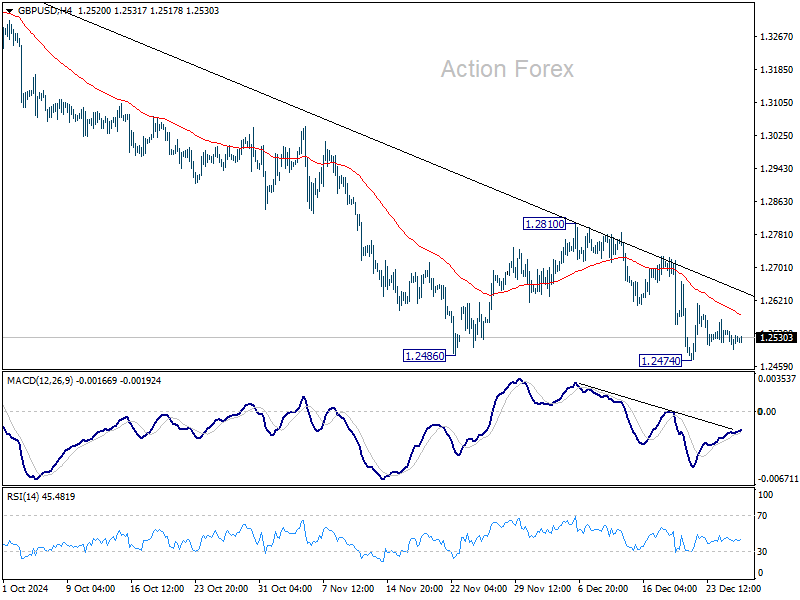
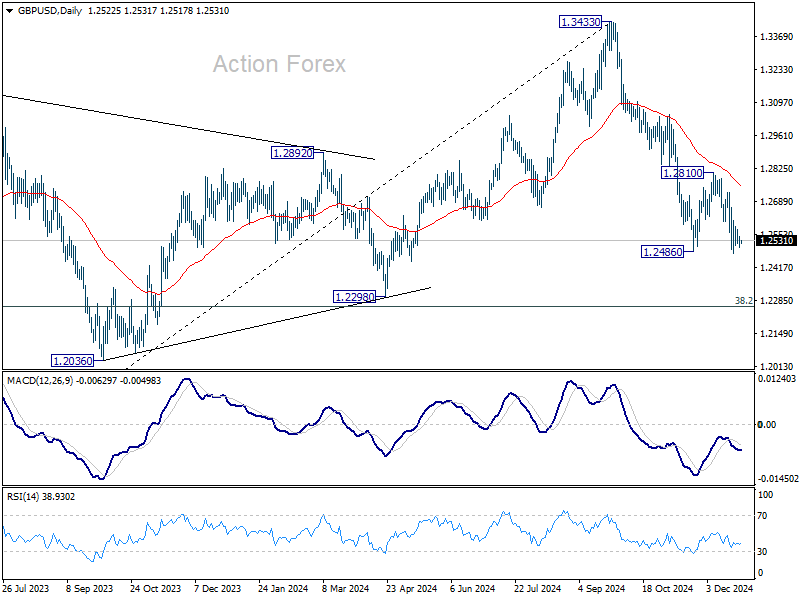
Range trading continues in GBP/USD and intraday bias stays neutral. Further decline is expected as long as 1.3042 resistance holds. Below 1.2842 will resume the fall from 1.3433 to 61.8% retracement of 1.2298 to 1.3433 at 1.2732. However, considering bullish convergence condition in 4H MACD, firm break of 1.3042 will indicate short term bottoming, and turn bias back to the upside.
In the bigger picture, considering mildly bearish divergence condition in D MACD, a medium term top is likely in place at 1.3433 already. Price actions from there are seen as correction to whole up trend from 1.0351 (2022 low). Deeper decline would be seen to 38.2% retracement of 1.0351 to 1.3433 at 1.2256, which is close to 1.2298 structural support. Strong support should be seen there to bring rebound.
EUR/USD Mid-Day Outlook
Daily Pivots: (S1) 1.0809; (P) 1.0857; (R1) 1.0883; More...
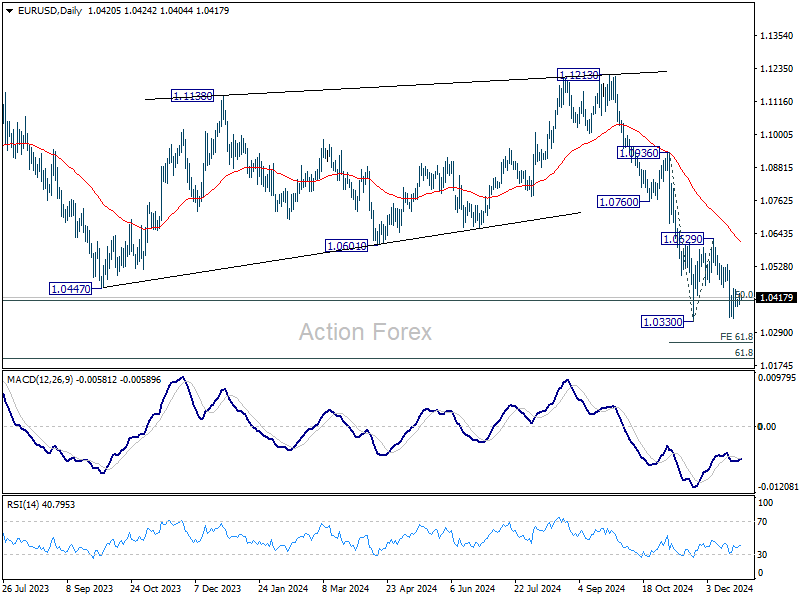
Intraday bias in EUR/USD is back on the upside as rebound from 1.0760 short term bottom resumed. Further rise would be seen to 55 D EMA (now at 1.0940). Strong resistance should be seen there to limit upside. On the downside, below 1.0831 minor support will bring retest of 1.0760 first, and then 61.8% retracement of 1.0447 to 1.1213 at 1.0740.
In the bigger picture, price actions from 1.1274 (2023 high) are seen as a consolidation pattern to up trend from 0.9534 (2022 low), with fall from 1.1213 as the third leg. Downside should be contained by 50% retracement of 0.9534 (2022 low) to 1.1274 at 1.0404, to bring up trend resumption at a later stage.
Dollar Struggles as Safe Havens Strengthen Ahead of US Election; RBA Holds Key Focus Tomorrow
Dollar remains the weakest currency in the lead-up to the US presidential election, though its downside appears contained as early selling momentum in Asia has not extended into European session. Safe-haven currencies, led by the Swiss Franc and Yen, are gaining as US and European Treasury yields retreat. Among other currencies, Sterling and Loonie are also lagging behind, although overall market indecisiveness keeps most major pairs within Friday’s trading range.
While the US election remains the primary focus, attention is also turning to RBA’s rate decision in the upcoming Asian session. The central bank is widely expected to hold rates at 4.35%, with virtually no expectation for any surprises. Market participants will be watching closely for any changes in RBA’s language that might hint at future policy easing, particularly any shift from the “not ruling anything in or out ” stance, which could set a clearer tone for policy easing in 2025. The release of new economic projections will also be key in gauging RBA’s outlook.
Technically, a short term top was in place at 101.68 in AUD/JPY, on bearish divergence condition in 4H MACD, ahead of 61.8% retracement of 109.36 to 90.10 at 102.02. Firm break of 99.42 support will argue that corrective rise from 90.10 has completed with three-waves up to 101.68. The third leg of the pattern from 109.36 might have then commenced. Next target will be 90.10/93.58 support zone in the near term.
In Europe, at the time of writing, FTSE is up 0.62%. DAX is down -0.06%. CAC Is up 0.12%. UK 10-year yield is down -0.018 at 4.442. Germany 10-year yield is down -0.006 at 2.404. Earlier in Asia, Japan was on holiday. Hong Kong HSI rose 0.30%. China Shanghai SSE rose 1.17%. Singapore Strait Times rose 0.47%.
Eurozone Sentix investor confidence rises slightly to -12.8, inflation fears resurface
Eurozone Sentix Investor Confidence index showed modest improvement, rising from -13.8 to -12.8 in November, though it fell just short of the anticipated -12.7. Current Situation index also moved up slightly from -23.3 to -21.5, while the Expectations index held steady at -3.8.
Sentix noted that Germany continues to be the "problem child" of the Eurozone, with ongoing economic struggles that have drawn widespread media attention. However, investors remain largely unfazed by these issues, showing limited reaction to the concerns surrounding Germany’s economic policy.
Meanwhile, inflationary concerns have re-emerged, with Sentix highlighting a significant drop in its "Inflation" theme barometer from +11 to -12.25—the lowest reading since July 2023.
This slump underscores a difficult situation for ECB. A struggling economy would typically benefit from more accommodative monetary policy, but inflationary pressures could restrict the ECB's ability to cut rates further.
Eurozone PMI manufacturing finalized at 46 in Oct, intense competition pressures margins
Eurozone manufacturing showed mild signs of stabilization in October, with PMI Manufacturing index finalizing at 46.0, up from September's 45.0. This marks a slight improvement, but activity remains firmly in contraction.
By country, Spain led the group with a PMI Manufacturing of 54.5, a 32-month high, followed by Ireland at 51.5 and Greece at 51.2. In contrast, the Netherlands and Austria reported significant declines, with PMIs at 47.0 and 42.0 respectively. Germany saw a modest rise to 43.0, marking a three-month high but still in contraction territory, while France's index held steady at 44.5, a two-month low.
Cyrus de la Rubia, Chief Economist at Hamburg Commercial Bank, commented that while the manufacturing recession "did not deepen further" in October, challenges persist. Production and new orders both declined at a slower rate, leading to a Q4 GDP Nowcast indicating a -0.1% contraction in industrial output.
The environment remains "deflationary," benefiting purchasing departments with lower input costs but intensifying competitive pressures, particularly with firms passing on price reductions to customers. De la Rubia noted that this "fierce competition," likely amplified by competition from China, is squeezing profit margins across the sector.
RBNZ flags geopolitical risks as key threat to New Zealand’s financial stability
RBNZ highlighted significant geopolitical risks as a major concern for New Zealand’s financial stability in a pre-release of findings from its upcoming Financial Stability Report. Key threats stem from global tensions involving Russia, China, and the Middle East, which RBNZ may incorporate into next year’s solvency stress test.
RBNZ noted that in some scenarios, “global supply chains were disrupted,” triggering renewed inflationary pressures and elevated interest rates. The report mentions a “more extreme scenario” involving a conflict in the Asia-Pacific region with one or more of New Zealand’s key trading partners. This may allude to risks of a major disruption if China attempts to assert territorial claims in the South China Sea or to use force in the Taiwan Strait.
Kerry Watt, RBNZ’s Director of Financial Stability Assessment & Strategy, commented on the increased “concern about geopolitical tension,” emphasizing that “as a small open economy, dependent on international trade and investment, geopolitical risks are clearly relevant to our financial system. Their potential impacts cannot be underestimated."
EUR/USD Mid-Day Outlook
Daily Pivots: (S1) 1.0809; (P) 1.0857; (R1) 1.0883; More...
Intraday bias in EUR/USD is back on the upside as rebound from 1.0760 short term bottom resumed. Further rise would be seen to 55 D EMA (now at 1.0940). Strong resistance should be seen there to limit upside. On the downside, below 1.0831 minor support will bring retest of 1.0760 first, and then 61.8% retracement of 1.0447 to 1.1213 at 1.0740.
In the bigger picture, price actions from 1.1274 (2023 high) are seen as a consolidation pattern to up trend from 0.9534 (2022 low), with fall from 1.1213 as the third leg. Downside should be contained by 50% retracement of 0.9534 (2022 low) to 1.1274 at 1.0404, to bring up trend resumption at a later stage.
Brent Crude Rises as OPEC+ Delays Production Increase
Brent crude oil prices climbed above 74 USD per barrel following OPEC+'s announcement to delay its production increase originally scheduled for December. This decision marks the second postponement by OPEC+ amid persistent global economic challenges and aims to avoid potential market oversupply.
Demand prospects remain subdued with Europe's slow economic recovery and Asia's lacklustre performance, particularly in China despite recent stimulus efforts. Additionally, tensions in the Middle East, particularly Iran's continued threats against Israel, are providing strong support to oil prices, with potential escalations anticipated post-US presidential elections on 5 November.
Concerns that regional oil production facilities might be targeted in these attacks contribute to fears of disrupted supply, further buoying oil prices. Meanwhile, temporary weakness in the US dollar also increases oil prices.
Technical analysis of Brent
Brent crude oil prices have rebounded from a recent low of 70.55 and are upward towards 76.16. The market is consolidating around 73.22, with a potential breakout that could lead to the 76.16 level. Once this target is achieved, a pullback to 73.22 could occur before further gains towards 79.20 are pursued. This bullish scenario is supported by MACD indicators suggesting upward momentum.
Following a correction to 73.22, Brent is poised to ascend to 74.90. A successful breach of this level could pave the way to 76.16. The stochastic oscillator's position above 50, pointing upwards towards 80, corroborates this potential upward movement.
As Bitcoin Retreats from the Top, Ethereum Moves to the Bottom
Market Picture
The crypto market lost 1.7% of its cap in 24 hours to $2.24 trillion. The market is correcting as Trump’s chances of winning national polls diminish ahead of the election. For now, it looks like a de-risking ahead of an important event where both major candidates have roughly equal chances of winning.
The price of bitcoin has fallen back below $68.5K and was bottomed out at levels $1K lower on Sunday. The pullback has not yet broken the overall bullish pattern that has been forming since September. We will be able to talk about the bears’ clear superiority when the price breaks below $65K, which would be a failure below the local lows from the end of last month and the 50-day moving average.
The situation is gloomier for Ethereum, which has been losing for the fifth day in a row, falling back to $2450—the lowest of the last three weeks. It is below the 50-day moving average and generally near the lower end of its trading range since August.
News Background
Inflows into spot bitcoin ETFs in the US were the highest since mid-March and the fourth highest since the funds’ inception. According to data from SoSoValue, inflows into BTC ETFs totalled $2.22 billion last week, bringing total investment to $24.15 billion.
Bitcoin options traders prepared for a bullish scenario after the US presidential election and the Fed meeting by increasing open interest in November calls with strike prices above $80K. JPMorgan noted that a Trump victory in the election on 5 November may strengthen BTC’s upward momentum.
Swiss company 21Shares has filed a Form S-1 with the US SEC to register an ETF based on XRP.
Tether, the issuer of the USDT stablecoin, reported a net profit of $2.5bn for the third quarter. Since the beginning of the year, the figure has reached $7.7 billion. According to Tether’s statement, the financial results have been confirmed by the auditing firm BDO. The group’s equity reached $14.7 billion, and consolidated assets reached an all-time high of $134.4 billion.
The state of Florida reported $800 million in cryptocurrency-related assets. It is not the first US state to invest in crypto assets. In May, the Wisconsin Investment Board announced the purchase of $163 million worth of spot bitcoin ETF shares.
Eurozone Sentix investor confidence rises slightly to -12.8, inflation fears resurface
Eurozone Sentix Investor Confidence index showed modest improvement, rising from -13.8 to -12.8 in November, though it fell just short of the anticipated -12.7. Current Situation index also moved up slightly from -23.3 to -21.5, while the Expectations index held steady at -3.8.
Sentix noted that Germany continues to be the "problem child" of the Eurozone, with ongoing economic struggles that have drawn widespread media attention. However, investors remain largely unfazed by these issues, showing limited reaction to the concerns surrounding Germany’s economic policy.
Meanwhile, inflationary concerns have re-emerged, with Sentix highlighting a significant drop in its "Inflation" theme barometer from +11 to -12.25—the lowest reading since July 2023.
This slump underscores a difficult situation for ECB. A struggling economy would typically benefit from more accommodative monetary policy, but inflationary pressures could restrict the ECB's ability to cut rates further.
XAU/USD Analysis: Gold Price Chart Displays Bearish Signals
Analysing the XAU/USD chart on October 18, we:
→ Established a long-term upward channel (indicated in blue);
→ Suggested that the target for bulls might be the upper red line, drawn parallel to the red corrective channel.
Since then:
→ The gold price rose to the upper red line and the top of the blue channel,
→ But then experienced a bearish reversal, dropping sharply on October 31 amid economic news.
Today, technical analysis of the XAU/USD chart shows several bearish signals, specifically:
→ Gold has moved into the lower half of the blue channel, crossing below its midpoint—indicating supply pressure;
→ The $2757 level has once again acted as resistance (marked with arrows);
→ A bearish "Head and Shoulders" pattern (SHS) is forming on the chart.
A central question for November will likely be whether bulls can keep the gold price within the ascending channel. The channel’s lower boundary may serve as a support level.
However, it’s possible that, with new developments in geopolitics and macroeconomics, the XAU/USD chart will continue to display price action within a more defined downward channel.
Start trading commodity CFDs with tight spreads. Open your trading account now or learn more about trading commodity CFDs with FXOpen.
This article represents the opinion of the Companies operating under the FXOpen brand only. It is not to be construed as an offer, solicitation, or recommendation with respect to products and services provided by the Companies operating under the FXOpen brand, nor is it to be considered financial advice.
Eurozone PMI manufacturing finalized at 46 in Oct, intense competition pressures margins
Eurozone manufacturing showed mild signs of stabilization in October, with PMI Manufacturing index finalizing at 46.0, up from September's 45.0. This marks a slight improvement, but activity remains firmly in contraction.
By country, Spain led the group with a PMI Manufacturing of 54.5, a 32-month high, followed by Ireland at 51.5 and Greece at 51.2. In contrast, the Netherlands and Austria reported significant declines, with PMIs at 47.0 and 42.0 respectively. Germany saw a modest rise to 43.0, marking a three-month high but still in contraction territory, while France's index held steady at 44.5, a two-month low.
Cyrus de la Rubia, Chief Economist at Hamburg Commercial Bank, commented that while the manufacturing recession "did not deepen further" in October, challenges persist. Production and new orders both declined at a slower rate, leading to a Q4 GDP nowcast indicating a -0.1% contraction in industrial output.
The environment remains "deflationary," benefiting purchasing departments with lower input costs but intensifying competitive pressures, particularly with firms passing on price reductions to customers. De la Rubia noted that this "fierce competition," likely amplified by competition from China, is squeezing profit margins across the sector.