Sample Category Title
USD/CAD Weekly Outlook
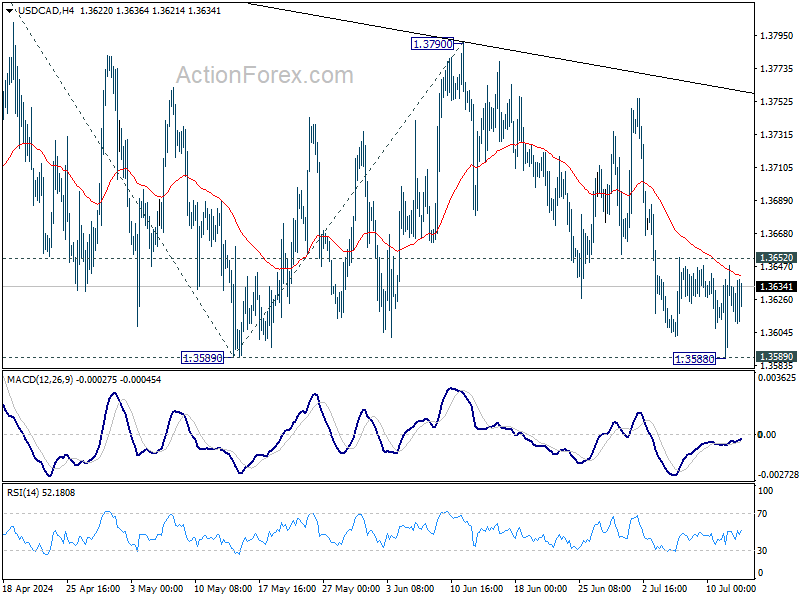
USD/CAD edged lower to 1.3588 last week but recovered after hitting 1.3589 support. Initial bias remains neutral this week first. On the downside, firm break of 1.3589 will extend the corrective pattern from 1.3845 and target 100% projection of 1.3845 to 1.3589 from 1.3790 at 1.3534. Strong support would be seen there to bring rebound. On the upside, above 1.3652 minor resistance will turn bias back to the upside for 1.3790 resistance instead.
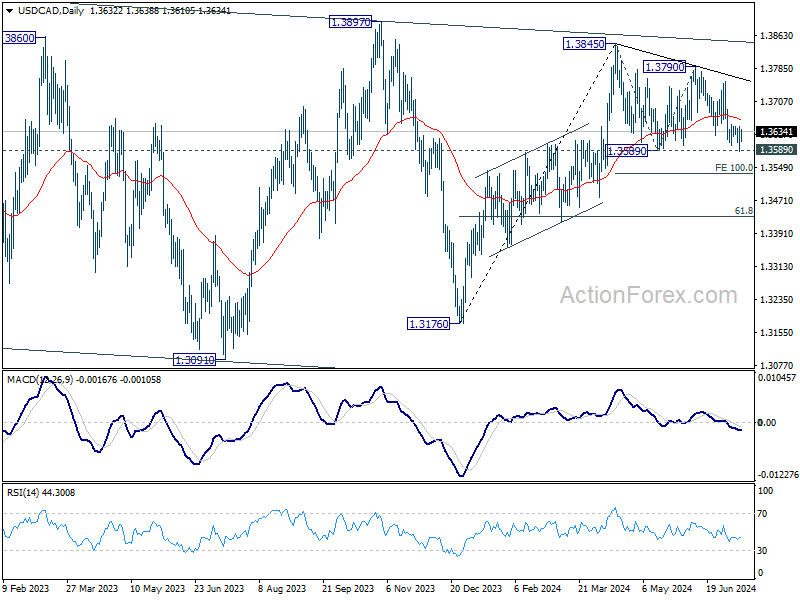
In the bigger picture, price actions from 1.3976 (2022 high) are viewed as a corrective pattern. In case of another fall, strong support should emerge above 1.2947 resistance turned support to bring rebound. Firm break of 1.3976 will confirm up resumption of whole up trend from 1.2005 (2021 low). Next target is 61.8% projection of 1.2401 to 1.3976 from 1.3176 at 1.4149.
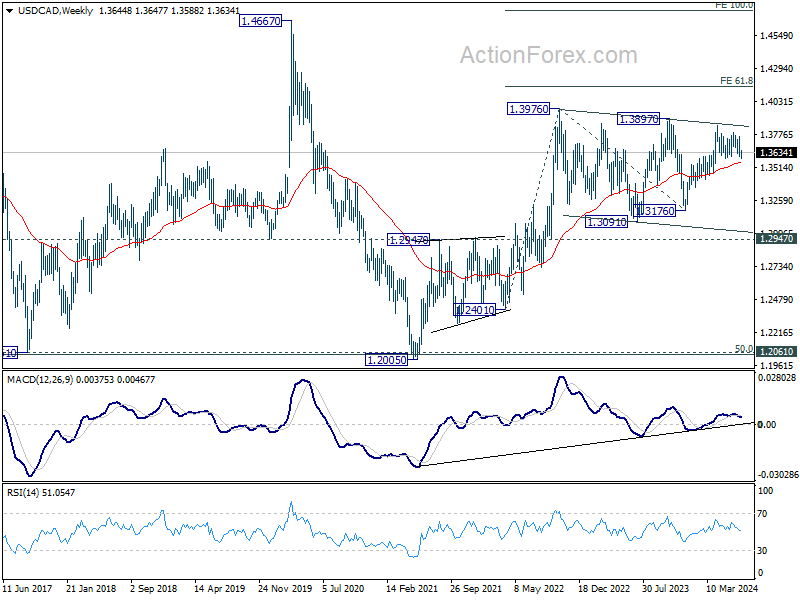
In the longer term picture, price actions from 1.4689 (2016 high) are seen as a consolidation pattern, which might have completed at 1.2005. That is, up trend from 0.9506 (2007 low) is expected to resume at a later stage. This will remain the favored case as long as 1.2947 resistance turned support holds.
GBP/JPY Weekly Outlook
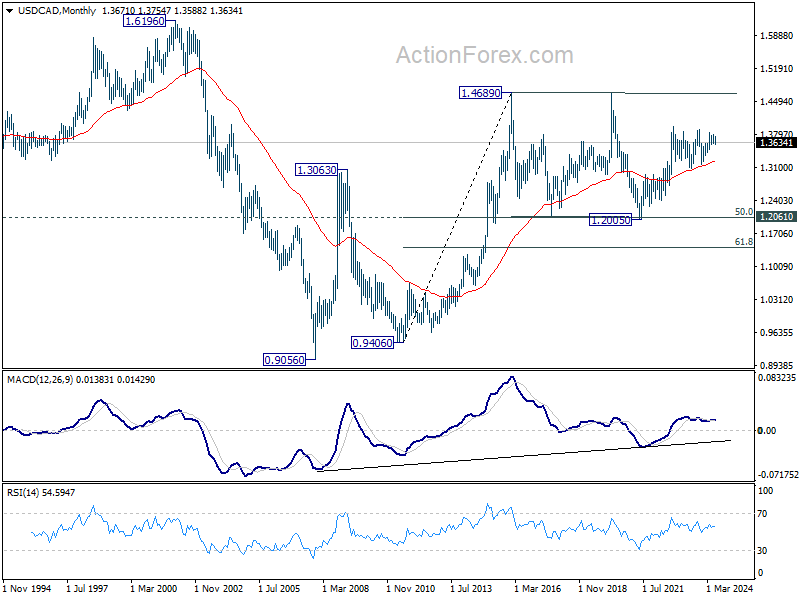
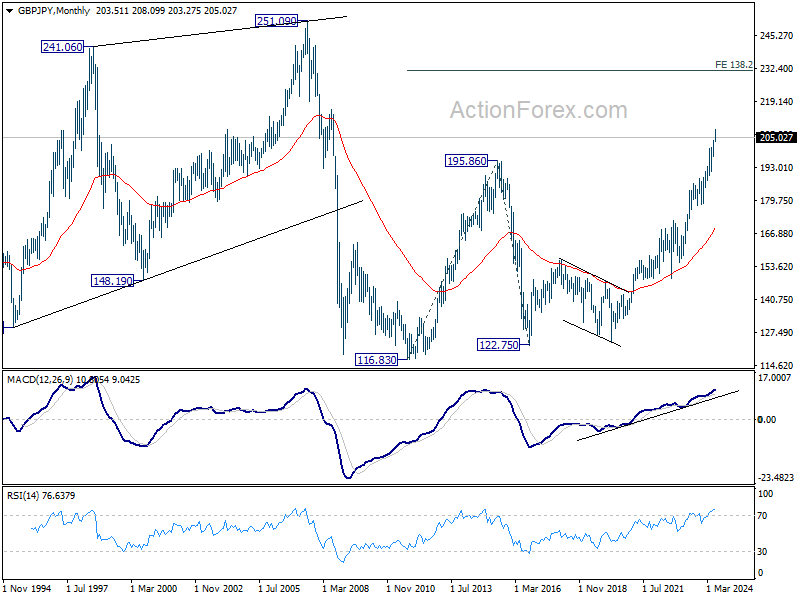
GBP/JPY retreated sharply after edging higher to 208.09 last week. Considering bearish divergence condition in 4H MACD, a short term top should be in place. Deeper pullback could be seen through 203.82 temporary low. But downside should be contained by 38.2% retracement of 191.34 to 208.09 at 201.69 to bring rebound, and set the range of consolidations. However, sustained break of 201.69 will argue that larger correction is already underway.
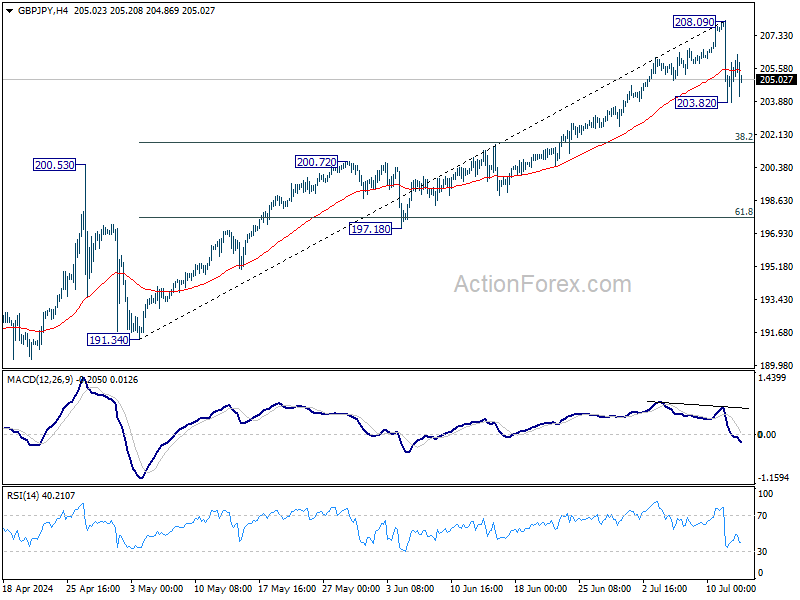
In the bigger picture, as long as 200.72 resistance turned support holds, the long term up trend should still be in progress. Next target is 100% projection of 155.33 to 188.63 from 178.32 at 211.62. However, firm break of 200.72 will suggest that it's already in larger scale correction.
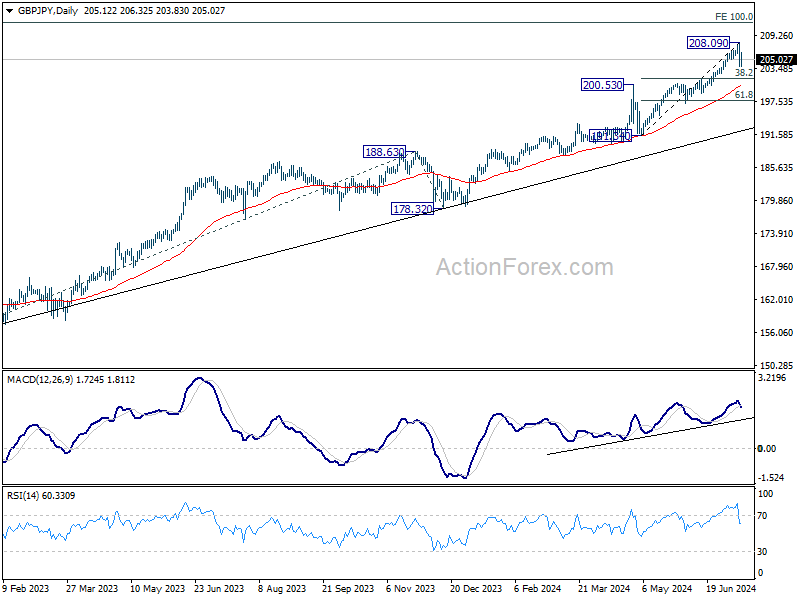
In the longer term picture, rise from 122.75 (2016 low) is seen as the third leg of the pattern from 116.83 (2011 low). Next target is 138.2% projection of 116.83 to 195.86 from 122.75 at 231.96. Outlook will stay bullish as long as 178.32 support holds, or until a clear reversal pattern forms.
EUR/JPY Weekly Outlook
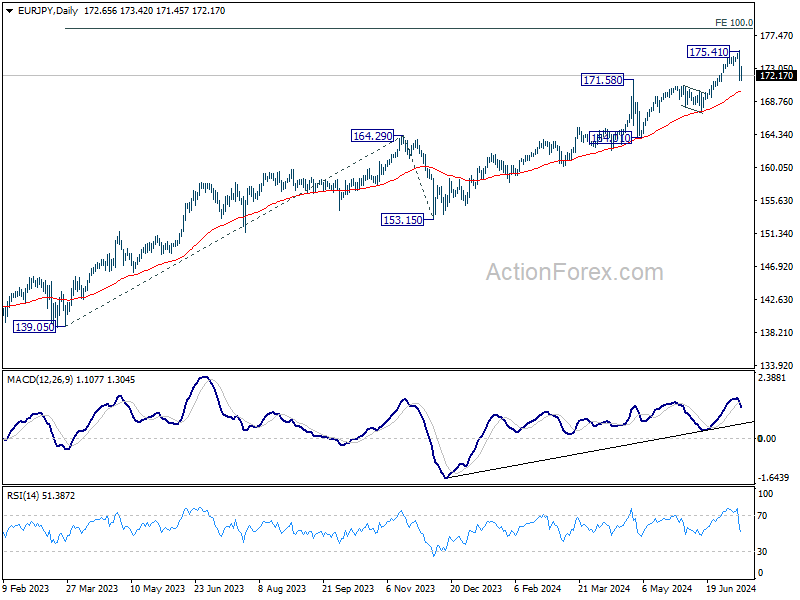
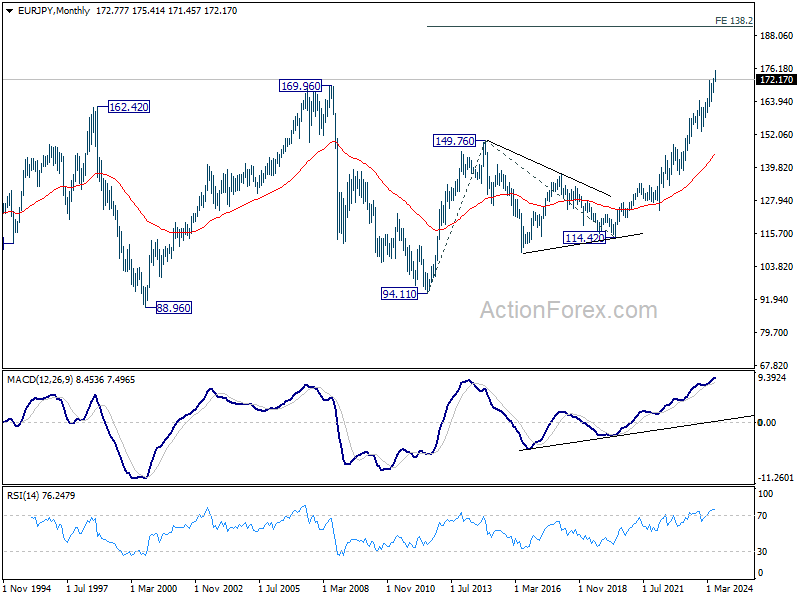
EUR/JPY fell sharply after edging higher to 175.41 last week. Considering bearish divergence condition in 4H MACD, a short term top should be in place. Deeper correction cannot be ruled out. But for now, downside should be contained by 170.87 and bring rebound, to set the range for consolidations. However, firm break of 170.87 will argue that larger correction is already underway and target 167.52 and possibly below.
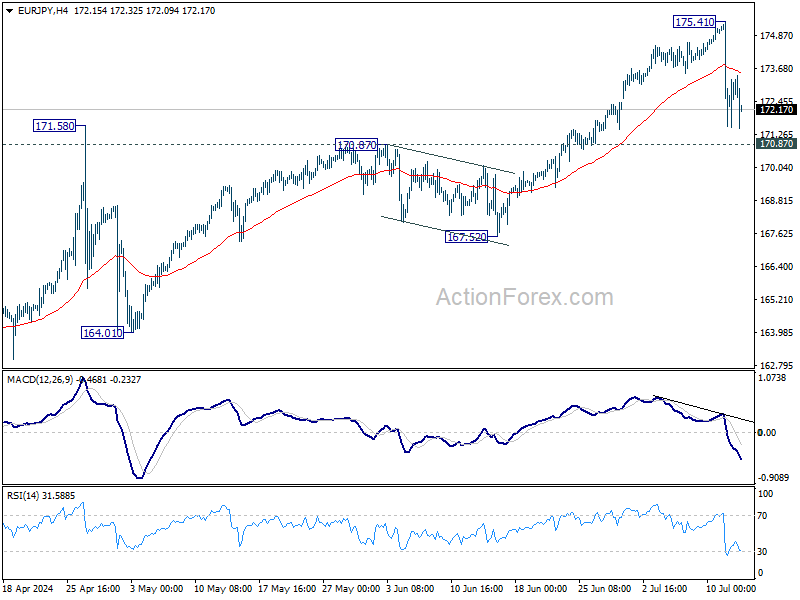
In the bigger picture, as long as 170.87 resistance turned support holds, the long term up trend is still expected to continue. Next target is 100% projection of 139.05 to 164.29 from 153.15 at 178.38. However, firm break of 170.87 will bring deeper fall to 167.52 support. Decisive break there will confirm that larger correction in in progress for 153.15/164.29 support zone.
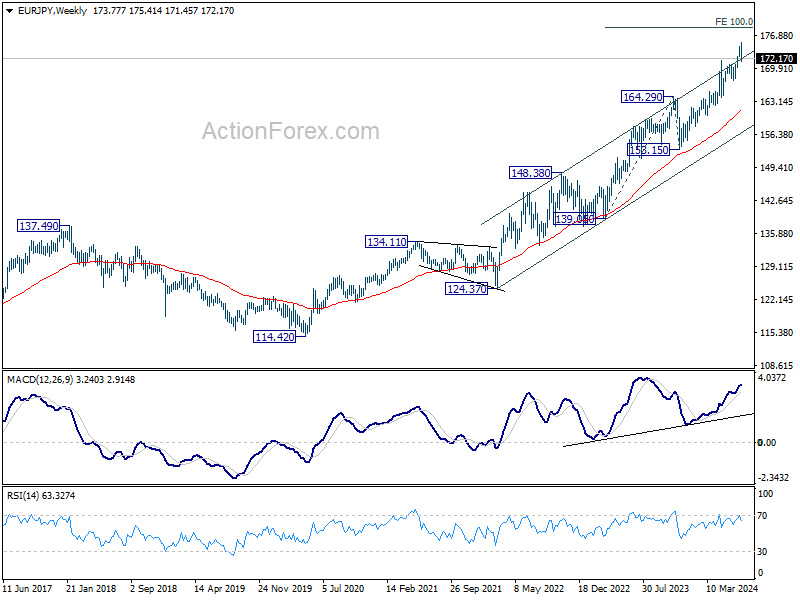
In the long term picture, rise from 114.42 (2020 low) is seen as the third leg of the whole up trend from 94.11 (2012 low). Next target is 138.2% projection of 94.11 to 149.76 from 114.42 at 191.32. This will remain the favored case as long as 167.52 support holds.
EUR/GBP Weekly Outlook
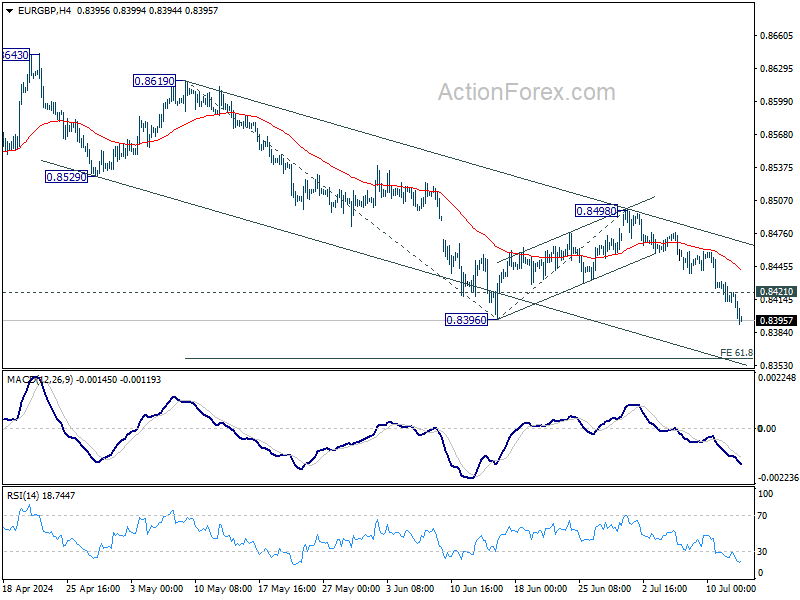
EUR/GBP's late break of 0.8396 support suggests that larger down trend is resuming. Initial bias remains on the downside this week. Next near term target is 61.8% projection of 0.8619 to 0.8396 from 0.8498 at 0.8360. Firm break there could prompt downside acceleration to 100% projection at 0.8275. On the upside, above 0.8421 minor resistance will delay the bearish case and turn intraday bias neutral first.
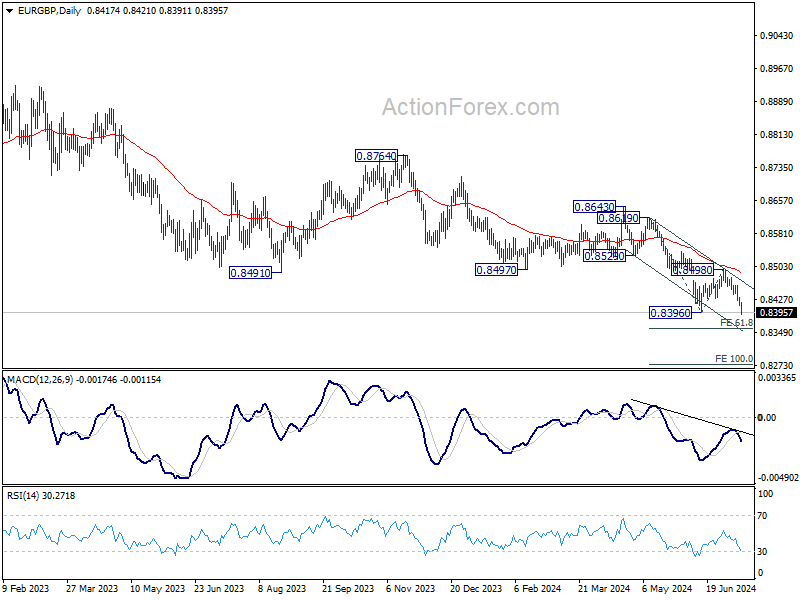
In the bigger picture, down trend from 0.9267 (2022 high) is in progress. Next target is 0.8201 key support (2022 low). For now, outlook will remain bearish as long as 0.8643 resistance holds, even in case of stronger rebound.
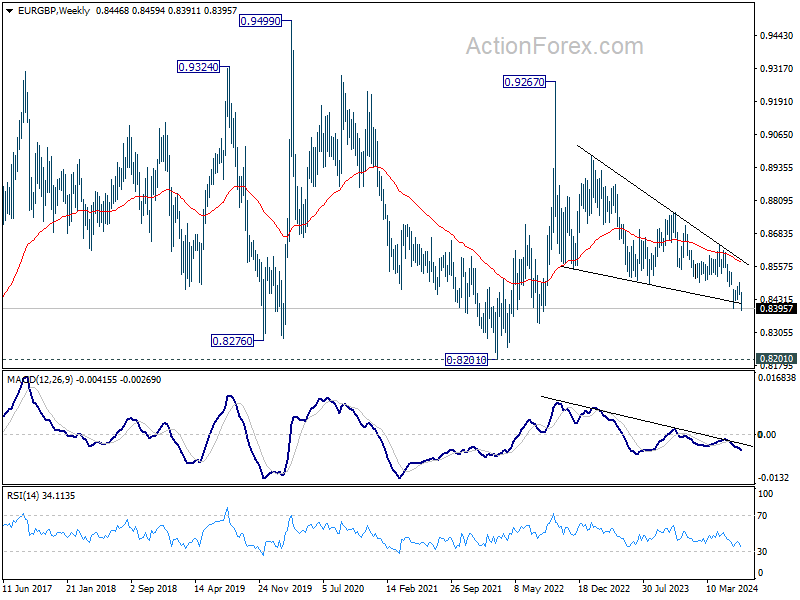
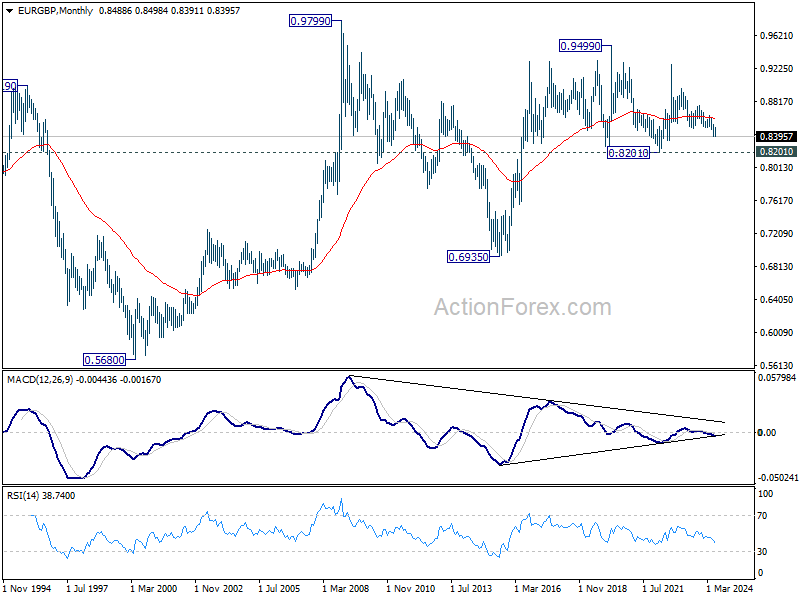
In the long term picture, price action from 0.9499 (2020 high) is seen as part of the long term range pattern from 0.9799 (2008 high). Range trading should continue between 0.8201 and 0.9499, until there is clear signal of imminent breakout.
EUR/AUD Weekly Outlook
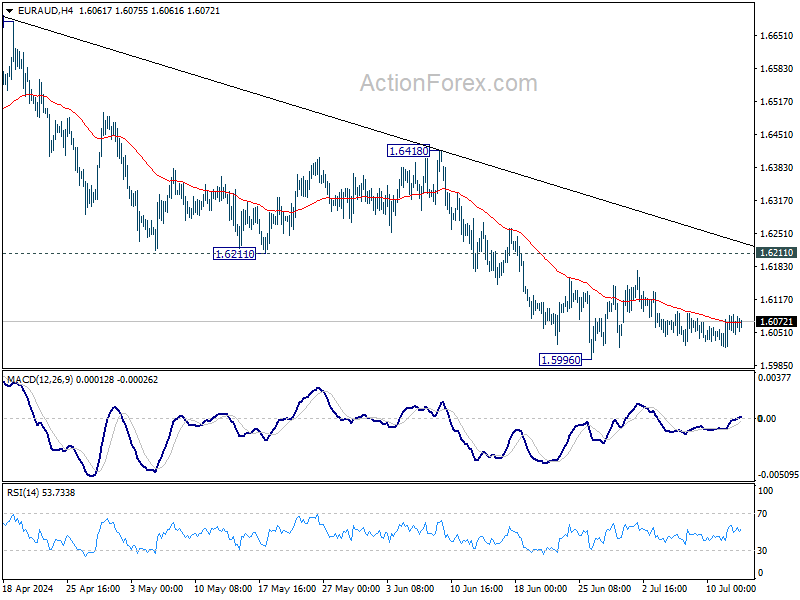
EUR/AUD's consolidation from 1.5996 continued last week and outlook is unchanged. Initial bias stays neutral this week first. While another recovery cannot be ruled out, further decline is expected as long as 1.6211 resistance holds. Break of 1.5996 will resume larger fall to 1.5846 support next.
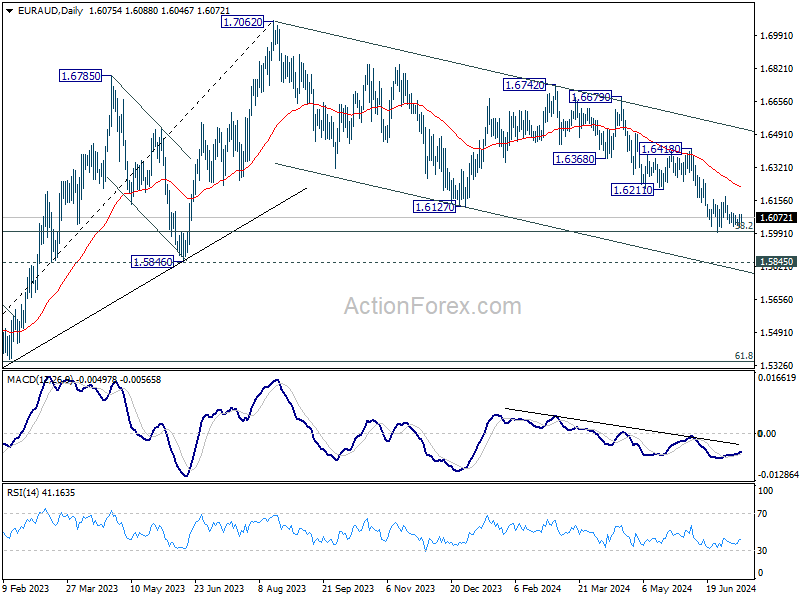
In the bigger picture, fall from 1.7062 medium term top is seen as a correction to the up trend from 1.4281 (2022 low) only. Strong support is still expected between 1.5846 and 38.2% retracement of 1.4281 to 1.7062 at 1.6000 to bring rebound. Break of 1.6148 resistance will argue that the correction has completed.
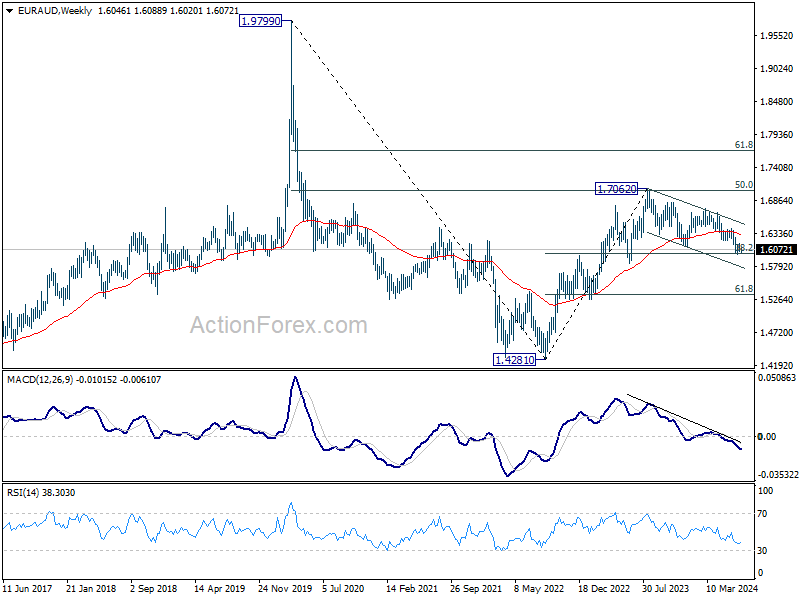
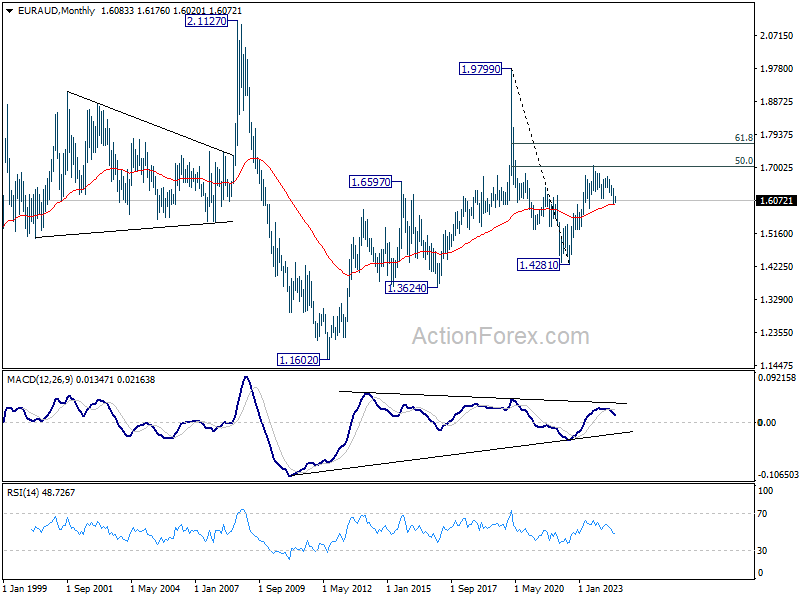
In the longer term picture, price actions from 1.9799 (2020 high) are seen as a long term decline at the same scale as the rise from 1.1602 (2012 low). Rebound from 1.4281 is seen as the second leg. As long as 55 M EMA (now at 1.5970) holds, this second leg could still extend higher. However, sustained trading below 55 M EMA will open up the bearish case for extending the decline through 1.4281 low.
EUR/CHF Weekly Outlook
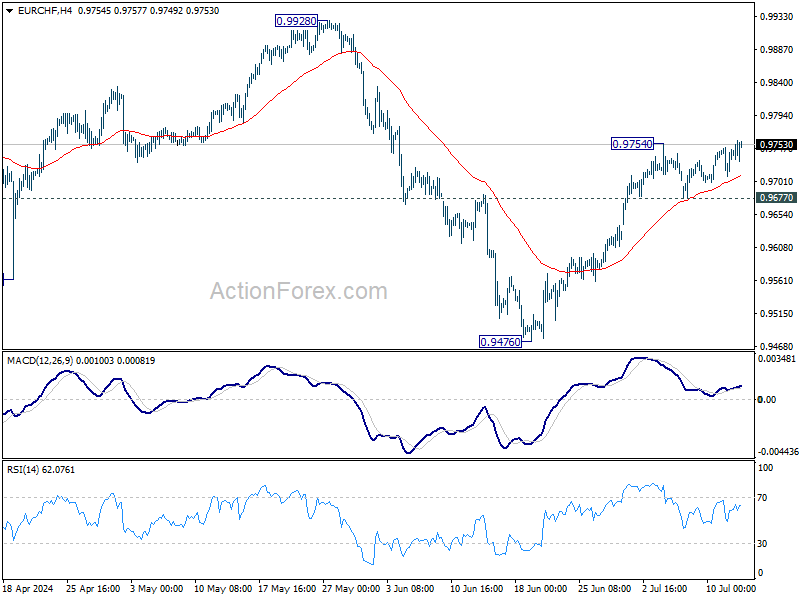
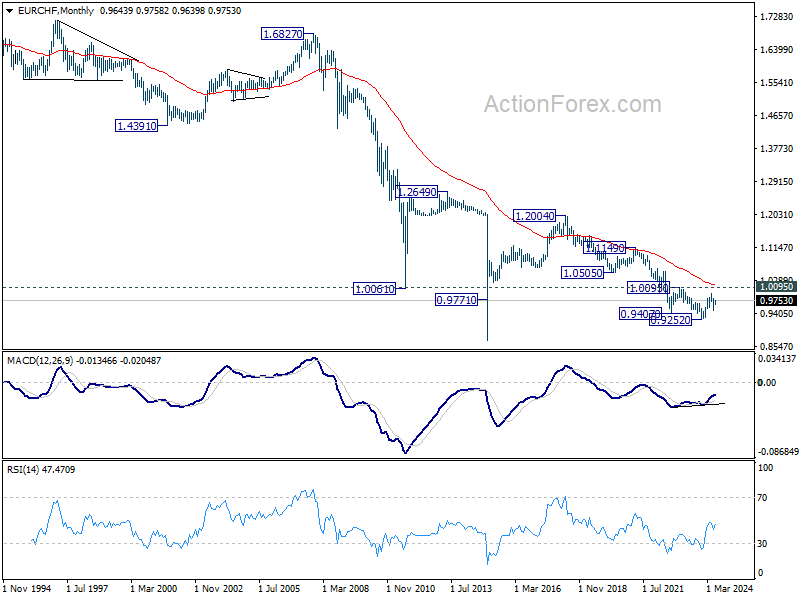
EUR/CHF's late breach of 0.9754 resistance last week suggests that rise from 0.9476 is resuming. Initial bias is back on the upside this week. Further rally would be seen to retest 0.9928 high. On the downside, however, break of 0.9677 will turn bias to the downside for deeper pullback.
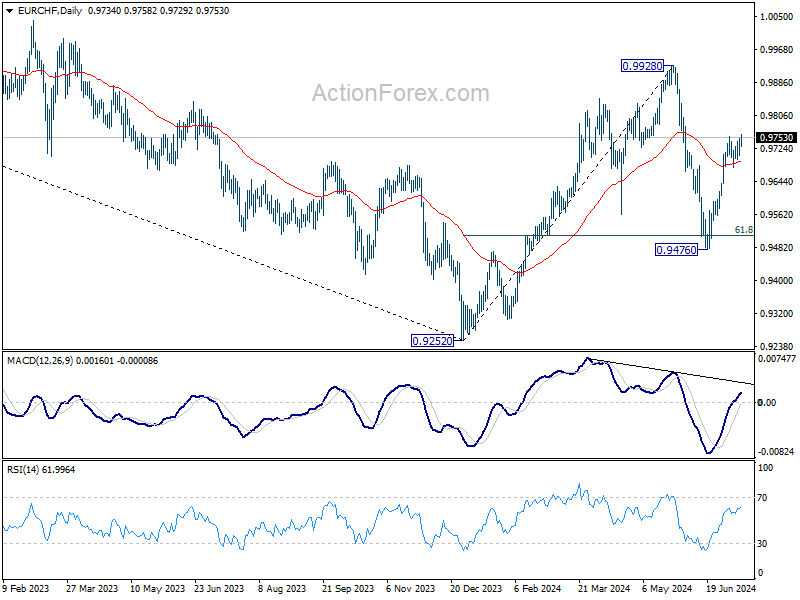
In the bigger picture, rebound from 0.9252 medium term bottom might not be completed yet. But even in case of resumption, strong resistance could emerge from 1.0095 to limit upside. Medium term outlook will be neutral at best as long as 1.0094 structural resistance holds. Meanwhile, break of 0.9476 will bring retest of 0.9252 low.
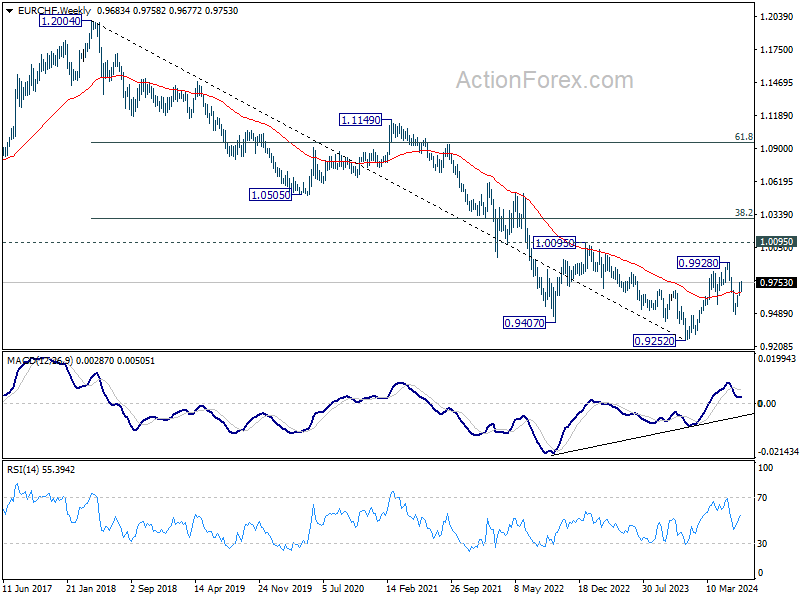
In the long term picture, fall from 1.2004 (2018 high) is part of the multi-decade down trend. Firm break of 1.0095 resistance is needed to be the first sign of long term bottoming. Otherwise, outlook will remain bearish.
The Week Ahead – ECB Spotlight as Fed Rate Speculations Drive Market Shifts
- US inflation data caused a significant selloff in US mega-cap tech stocks and a shift towards riskier areas of the market.
- The ECB interest rate decision is expected to bring no change, but the bank lending survey may shed light on the impact of higher rates on the economy.
- In the UK, inflation data is due on Wednesday, and while headline CPI dipped below 2% in June, it is expected to rise again in the second half of the year.
- In the US, the market will be quiet, with a speech by Fed Chair Powell being the most notable event.
Week in Review: Rate cut bets weigh on tech stocks as US inflation cools
Another week is over and market participants will undoubtedly have plenty of mixed feelings. The highlight of the week came on Thursday when US inflation data data was lower than expected, which has helped boost the confidence of individual FOMC members that inflation is on track to reach the Federal Reserve’s 2% target.
The headline CPI fell by 0.1% month-on-month instead of rising by 0.1% as predicted, while core CPI increased by 0.1% MoM compared to the 0.2% forecast. Additionally, initial jobless claims dropped by 17,000 to 222,000 and continuing claims remained stable. However, the low CPI number is the main focus, causing the 10-year Treasury yield to fall below 4.20% for the first time since late March.
US Interest Rate probabilities have doubled over the past month with market participants now pricing in a 80%+ chance of a rate cut in September and a 60% chance of a cut in November. A stark contrast to two weeks ago and the most recent Fed meeting.
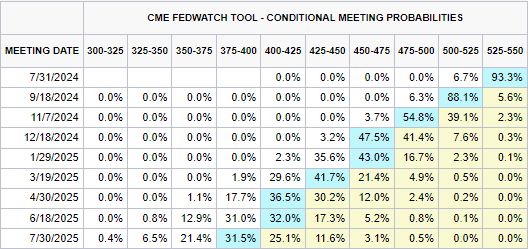
Source: CME Fedwatch Tool
US PPI data released on Friday showed an increase across the board. Market participants hoping for relief were disappointed, as any hopes of a modest US Dollar recovery were dashed by the preliminary Michigan consumer sentiment report. Lower-than-expected consumer sentiment and softer inflation expectations were enough to maintain selling pressure on the US Dollar heading into the weekend.
The most intriguing development following the inflation data release was a significant selloff in US mega-cap tech stocks. The inflation data prompted a notable shift towards riskier areas of the market, with the Russell 2000 emerging as the top performer.
Additionally, another noteworthy development that underscores concerns about the concentration of the S&P 500 in the ‘magnificent 7’ is that the index lost around 0.8% for the day, despite approximately 400 companies ending the day in the green.
The Russell 2000 surged 3.6%, marking its best day in 2024. Homebuilders soared, and banks saw gains ahead of the upcoming earnings season. Given that earnings season is upon us, this could play a crucial role in determining whether the rotation to more smaller stocks will be sustainable or prove to be short-lived.
The Week Ahead – EU, US and ASIA
Europe + UK
The week ahead brings the European Central Bank (ECB) interest rate decision with market participants expecting no change from the ECB. It would seem that the ECB bank Lending Survey may be more important as it sheds light on the impact higher rates are having on the economy.
In the UK we have inflation data due on Wednesday. Headline CPI dipped slightly below 2% in June, but this is likely the lowest point. Expect it to rise again in the second half of the year, settling between 2-2.5%. Services inflation is a bigger concern for the Bank of England and has been more persistent than expected. We anticipate some minor progress in this area as well. Much of the recent unexpected increase is due to price hikes at the start of the financial year, which the Bank of England believes is likely just noise, not a significant trend.
ASIA PACIFIC
In the Asia Pacific region, the most significant data release next week comes from China on Monday. This includes retail sales, industrial production, and GDP growth data, which will capture the attention of market participants. There is still some uncertainty regarding the Chinese economy, and recent data from the world’s second-largest economy has not alleviated these concerns. Weak data could negatively impact commodity-dependent currencies such as the Australian and New Zealand dollars, as well as the South African Rand.
US
In the US, market participants get a reprieve as we have a quiet week on the calendar. Among the most notable events will be a speech by Fed Chair Powell. It will be interesting to hear what the Fed Chair has to say following the CPI and PPI data and whether the PPI print may weigh on any decisions at the Fed upcoming meetings.
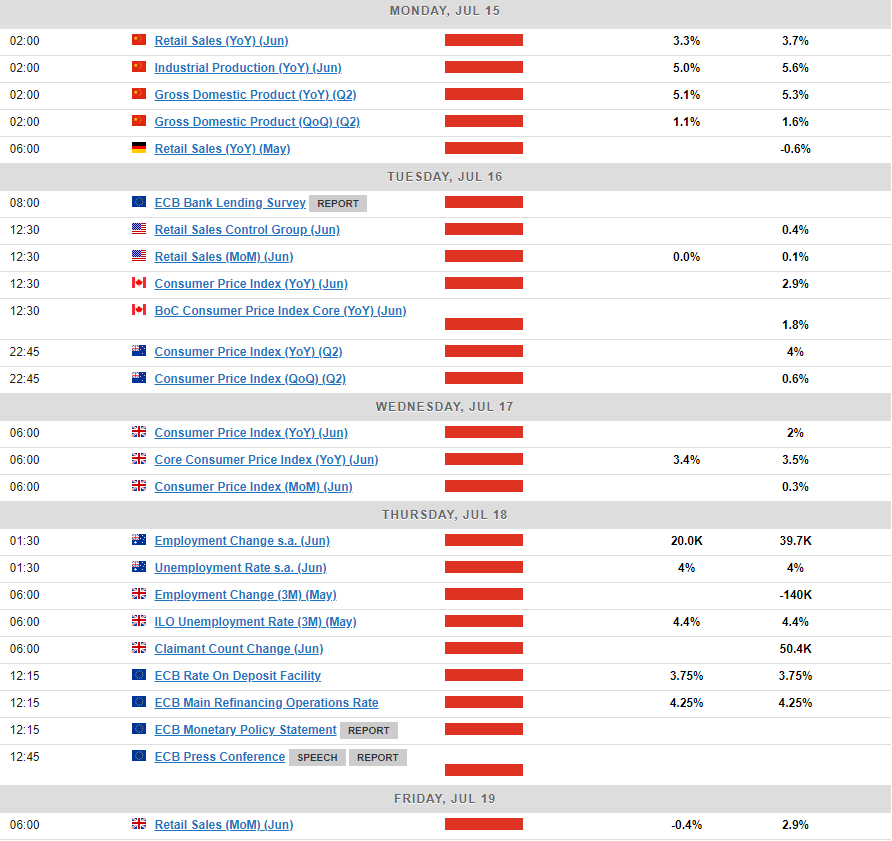
Chart of the Week
The chart I will be focusing on this week is the US Dollar Index (DXY). Following softer inflation data in the US, the DXY has broken through the psychological level of 105.00. The DXY also completed a break of the ascending trendline and both the 100 and 200-day MAs.
Price is resting at the 104.00 support handle heading into next week. I think the big question on the lips of market participants is whether this move will be sustainable. The lack of data next week from the US means the speech by Fed Chair Powell could be key in determining the US Dollar Indexes next move.
Continued weakness in the DXY will likely benefit US Dollar denominated currency pairs as well as commodities like Gold and Silver.
DXY Daily Chart – July 12, 2024
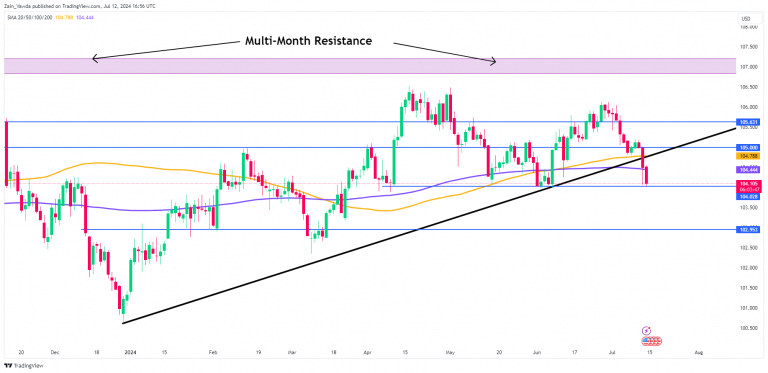
Source:TradingView.Com (click to enlarge)
The Weekly Bottom Line: U.S. – Inflation Cooling
U.S. Highlights
- U.S. inflation eased by more than expected in the month of June, raising the likelihood of a September rate cut.
- Small business confidence continued to edge higher in June, though several forward-looking indicators suggests some softening in the months ahead.
- Eyes will be on Chair Powell’s appearance in DC next week for a reaction to this week’s CPI data.
Canadian Highlights
- Taking the lead from the U.S., Canadian yields took a dive this week as a softer-than-expected U.S. CPI report raised the odds of the Federal Reserve easing its policy rate earlier than previously expected.
- Home sales picked up in June, although benchmark home price growth remained subdued – a welcome sign for consumer inflation.
- CPI will be next week’s headliner. Core inflation likely eased, but not enough to fully support a July rate cut.
U.S. – Inflation Cooling
Federal Reserve Governor Lisa Cook said on Wednesday this week that the “soft landing” was starting to line up in U.S. data, a statement that, while intended to be backward-looking, may have been an unexpected act of prescience. A day later, the CPI report for June was released and as we wrote in our commentary yesterday, the report was exactly what the FOMC was looking for. The pace of inflation eased for both headline and core, as shown in Chart 1.

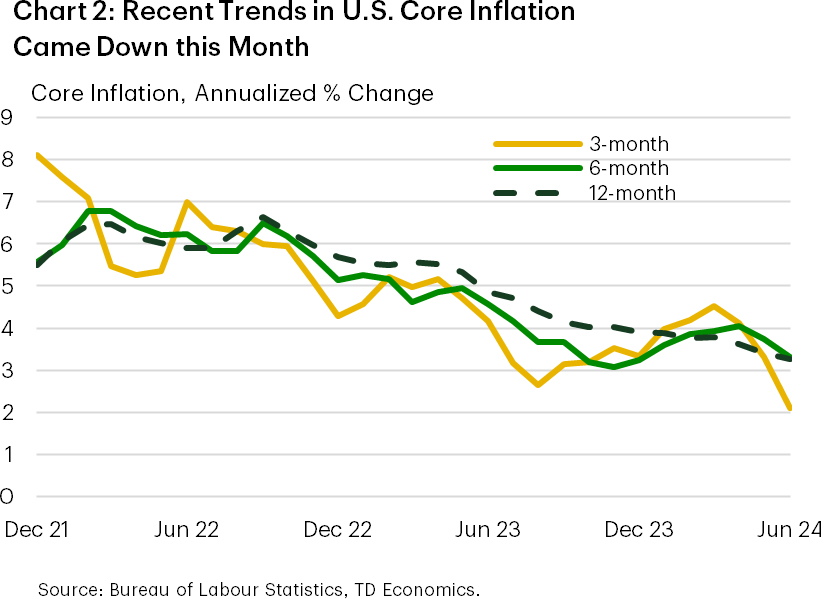
Defying expectations for modest gain of 0.1% from the previous month, headline CPI declined 0.1%. Core prices increased by a ‘soft’ 0.1%, compared to the 0.4% monthly gain averaged in the first 3 months of the year. By almost all measures, this is perhaps the most promising CPI report the FOMC has seen since it stopped raising interest rates just under a year ago. In Chart 2, we can see how how much this release brings down recent trends in CPI. The possibility of a September rate cut was already live, especially as concerns have been mounting over how quickly the labor market has been cooling– now we expect it to be at the forefront of the Fed’s decision-making.
Aside from the CPI report, it was a fairly light week for U.S. data. We did see the release of the NFIB Small Business Optimism Index, which generally painted a still upbeat picture for small businesses. However, there were hints of soft landing throughout the release, including a further easing in the share of firms planning to raise prices and further evidence that the labor market is cooling, with hiring intentions remaining handily below pre-pandemic levels.
We already mentioned Governor Lisa Cook’s speech which signaled, even before the last release of the CPI data, that prices, labor markets, and economic activity were evolving constructively in the eyes of the Fed. Chairman Powell offered a similar observation in his testimony to the Senate Committee on Banking, Housing, and Urban Affairs the day before. The Fed chairman made the point in his testimony that they see risks to the Fed’s dual mandate as more balanced than earlier this year when inflation had turned meaningfully higher. More balanced risks means the Federal Reserve will not delay rate cuts too long for fear of cooling the economy and the labor market too much.
Next week, attention will shift to the June readings of retail sales and housing starts as investors try and gauge to what extent domestic activity has slowed alongside the recent cooling in the labor market. We also look ahead to Chairman Powell’s appearance at the Economic Club of Washington on Monday, which is the first time we will hear from a voting FOMC member following this week’s inflation data. With the trend on inflation lower, and a number of employment metrics showing increasing slack building in the labor market, Powell will likely use next week’s appearance to start priming markets for a September cut.
Canada – Calm Before the Storm
Even with no week-shortening holiday to blame it on, there was a paucity of major Canadian economic data this week. Instead, Canadian markets were left to take their cues from developments elsewhere. In oil markets, prices were flat, as an improved summer demand backdrop faced off with easing supply concerns. Elsewhere, the benchmark 10-year bond yield followed its U.S. counterpart lower, after a soft U.S. CPI inflation print raised the expectation that the Federal Reserve could be getting closer to cutting its policy rate. This same factor also helped propel a gain in the TSX this week. Meanwhile, the Canadian dollar was broadly unchanged during the week and has been range-bound for nearly 2 years.
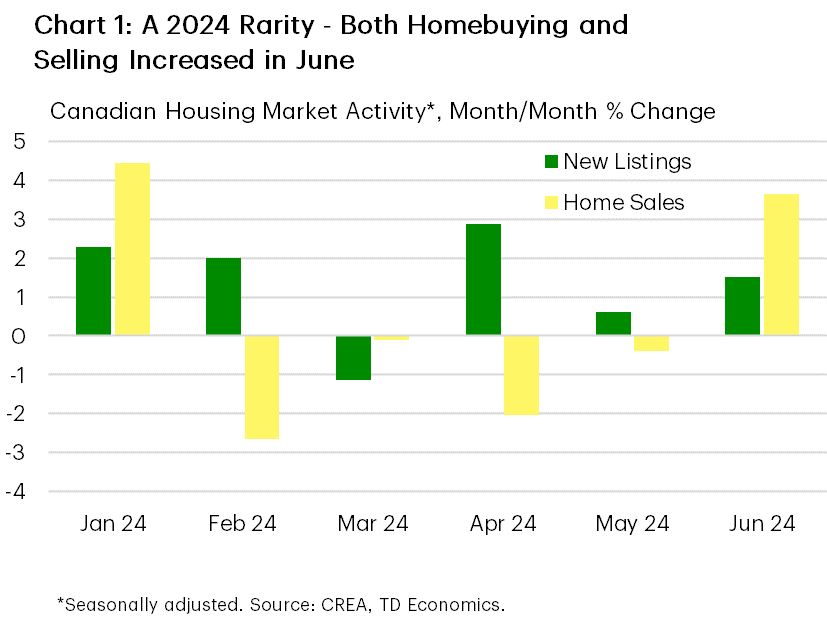
The week did offer a look at how Canadian housing markets performed in June and as it turns out, both buyers and sellers were more active, although sales levels remained low (Chart 1). A drop in interest rates during the month likely played some role in enticing buyers back into the market. Listings also picked up, posting their 5th increase in 6 months and offering buyers more choice. For their part, the Bank of Canada was likely pleased with the report, as overall economic growth was boosted by rising home sales. What’s more, the mild performance in benchmark prices suggests that the underlying trend in home price inflation remains subdued – a meaningful development for the CPI.
The real data fireworks come next week, with the Bank of Canada’s Business Outlook Survey (BoS) and Survey of Consumer Expectations on Monday and the June CPI report on Tuesday. Markets will also receive a pulse-check on the consumer via the retail trade report on Friday. On the latter, Statcan’s preliminary estimate suggests that retail spending dropped 0.6% month-on-month in May, offering some contrast to the gain shown in TD’s internal credit and debit card data. However, these same metrics point to a spending slowdown in June. A key takeaway from the prior BoS was that 2-year inflation expectations continued to decline while firms’ pricing behaviour further normalized in the first quarter. We’ll be looking for a continuation of these trends in the second quarter report. Economic growth indicators are also part of the Survey, but we’ve had plenty of other data showing the Canadian economy’s resilience in Q2, including decent job gains in the first two months of the quarter, an above-trend GDP growth print in April, and a preliminary estimate showing another monthly gain in May.
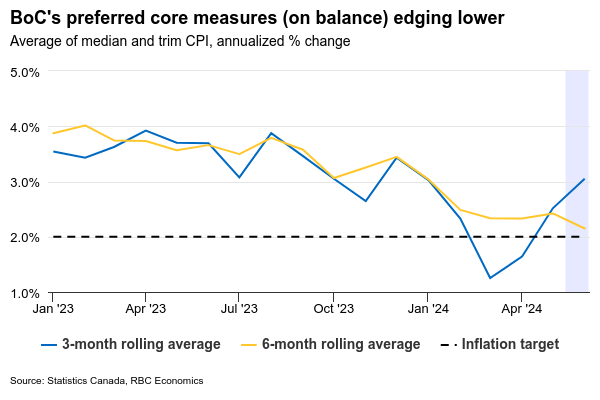
However, the inflation report will be the marquee print of the week. We expect that the average of the Bank of Canada’s preferred core inflation measures dipped to 2.8% year-on-year from 2.9% in May (Chart 2). If it materializes, this result would obviously be an improvement, although probably wouldn’t be enough to tip the scales in favour of a July rate cut. Indeed, the Bank’s next move is likely to come in September, which is when markets have the next rate cut fully priced-in.

Weekly Economic & Financial Commentary: Balanced Risks Drive the FOMC Closer to a September Rate Cut
Summary
United States: Fed’s Challenge: Making Sure Fire Is Out vs. Water Damage
- We learned this week that CPI declined in June and core prices rose at the slowest clip since early 2021. With the inflation target in sight, Fed policymakers are taking stock of deteriorating labor market dynamics and souring consumer sentiment as they weigh the outlook for rates.
- Next week: Retail sales (Tues.), Housing Starts (Wed.), Industrial Production (Wed.)
International: Some Encouraging Signs in Japanese Wage Growth and U.K. Economic Recovery
- This week, some underlying measures of pay growth in Japan bested expectations, potentially reflecting the historically high wage hikes agreed to in this year's spring wage negotiations; we view this as consistent with further Bank of Japan policy normalization this year and into next. In the U.K., monthly GDP figures revealed an ongoing economic recovery.
- Next week: China GDP (Mon.), Canada CPI (Tue.), European Central Bank Policy Rate (Thu.)
Interest Rate Watch: Balanced Risks Drive the FOMC Closer to a September Rate Cut
- Since January, the FOMC's post-meeting statement has signaled that neither further hikes were likely nor were rate cuts near. In Congressional testimony this week, however, Chair Powell's comments suggested that the FOMC is getting closer to exiting its holding pattern and preparing to descend.
Credit Market Insights: Interest Expense Getting to Consumers
- Consumer credit has downshifted thus far in 2024, as mounting personal interest expenses have increased the cost of carrying these debts. Revolving credit, which is primarily composed of credit cards, has driven much of this deceleration.
Topic of the Week: "Elevated Inflation Is Not the Only Risk We Face" – Jerome Powell
- Given the material cooling in the labor market over the past year, further deterioration may look less like a welcome “normalization” and more like unexpected weakening to the Fed. We highlighted several cracks in the labor market earlier this year, and six months later, the widespread signs of negative momentum in these worry spots persist.
June Inflation Report and BOS Survey Set the Stage for BoC’s Next Rate Cut
The Bank of Canada’s quarterly Business Outlook Survey (BOS) and June’s inflation data will be the last major data releases before the BoC’s next interest rate announcement on July 24. We expect a slowdown in inflation after an upside surprise in May and for the BOS to look soft enough to justify a second consecutive 25 basis point interest rate cut from the BoC at that meeting.
Headline consumer price index growth is expected to slow to 2.7% year-over-year after a surprisingly higher 2.9% reading in May. Energy price growth slowed on lower gasoline prices in June and food price increases have also been edging lower. Stripping out volatile food and energy components, inflation should come in at 3%, little changed from the prior month. But, the BoC will focus on growth in the preferred “core” measures, which provide more insights into broader underlying price growth trends. The closely watched three-month average of monthly increases will likely tick higher for both the median and trim CPI measures as a very small monthly increase in March falls out of that calculation, but the six-month average should hold around the 2% inflation target given earlier downside surprises.
The Q2 BOS will also be closely watched for further confirmation that the economic backdrop is continuing to soften in a way that would raise the central bank’s confidence about inflation pressures easing. The BoC’s governing council is particularly focused on indicators of the supply and demand balance in the economy, corporate pricing behaviour, inflation expectations, and wage growth. We expect all to show further improvement in the survey. Business responses’ will be reviewed for whether global shipping disruptions (and a jump higher in container shipping costs) are feeding through to increased costs. However, falling per capita gross domestic product and rising unemployment should mean that expected wage growth and inflation continue to slow. Corporate pricing behaviour has been normalizing with the frequency and size of price adjustments edging slowly back towards pre-pandemic levels.
Week ahead data watch
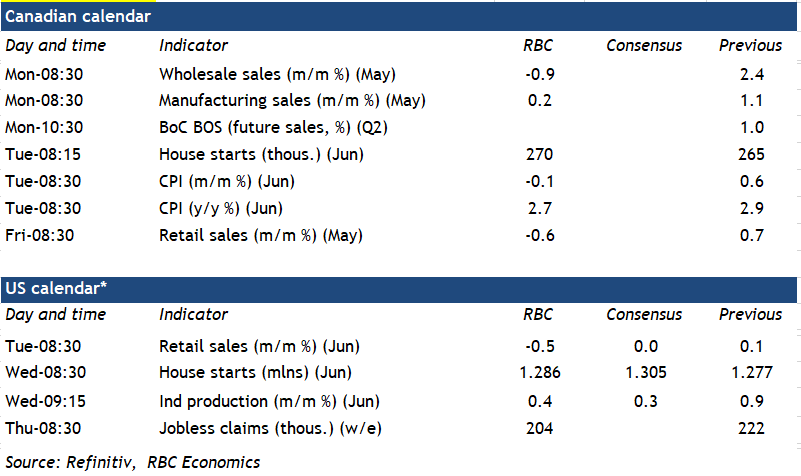
Canadian manufacturing sales likely edged up 0.2% in May, according to Statistics Canada’s flash estimate, down from 1.1% sales growth in April and primarily driven by higher sales in aerospace products and parts industry group as well as the food product subsector.
We expect Canadian core wholesale sales (excluding petroleum, products, and other hydrocarbons and excluding oilseed and grain) to drop by 0.9%, with sales in motor vehicles, parts and accessories seeing the largest decline.
Canadian housing starts likely increased by 270,000 in June, up 2.1% from last month after a 9.7% jump in April.
We look for a 0.6% decline in May Canadian retail sales, in line with StatCan’s advance indicator. Much of the slowdown came from lower auto sales during that month (-3.7% seasonally adjusted), as well as a price-related sales decline at gas stations (-3.2%).
U.S. retail sales likely edged lower 0.5% in June, given auto sales and sales at gas stations were down. Control sales should hold flat during that month.
We expect U.S. industrial production to inch higher by 0.4% in June with higher output in the manufacturing and mining sectors offsetting lower output in the utility sector.