Sample Category Title
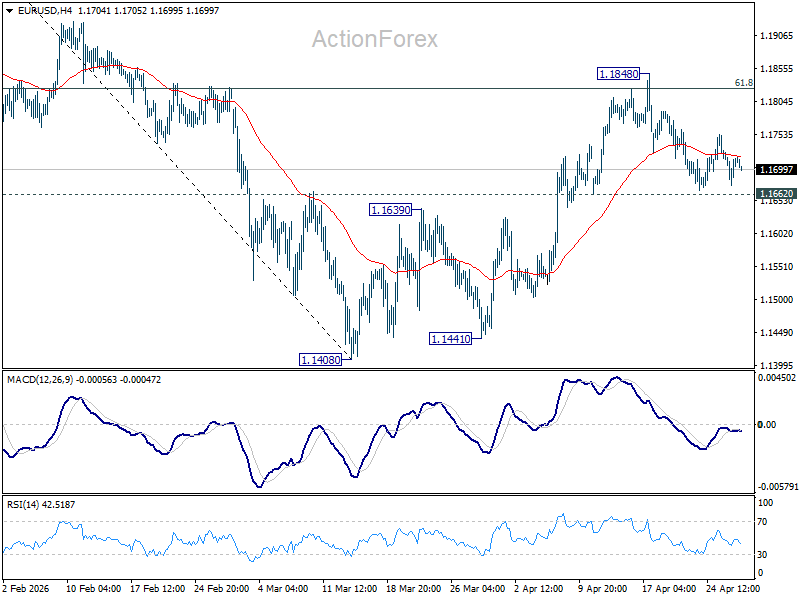
EUR/USD Daily Outlook
Daily Pivots: (S1) 1.1684; (P) 1.1706; (R1) 1.1735; More….
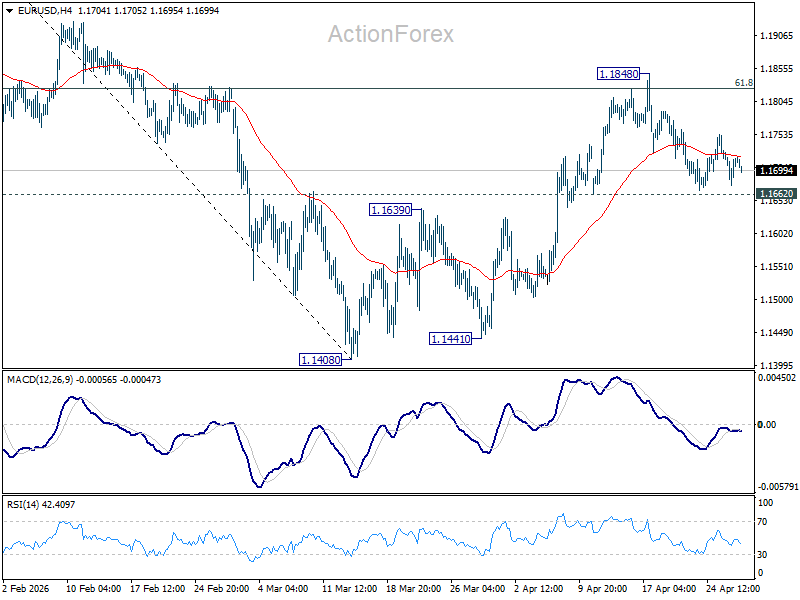
Intraday bias in EUR/USD remains neutral for the moment. Further rally is expected with 1.1662 support intact. On the upside, sustained trading above 61.8% retracement of 1.2081 to 1.1408 at 1.1824 will pave the way to retest 1.2081 high. However, firm break of 1.1662 support will indicate the the rebound from 1.1408 has completed, and bring deeper decline back towards this low instead.
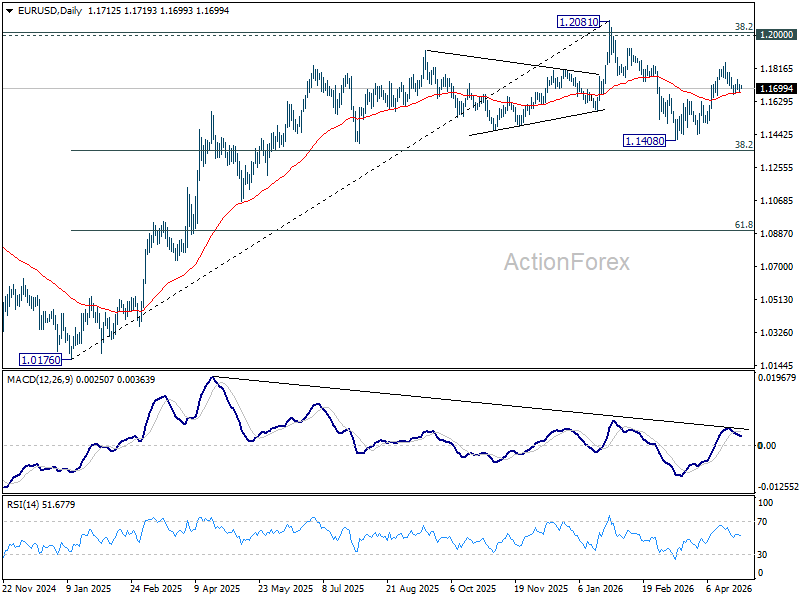
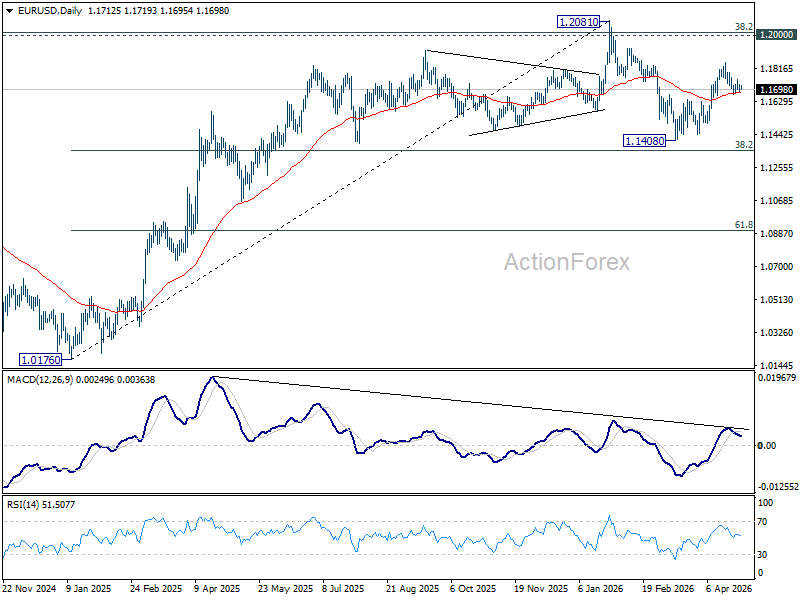
In the bigger picture, the strong support from 38.2% retracement of 1.0176 to 1.2081 at 1.1353 suggests that the pullback from 1.2081 is more likely a corrective move. Strong support was also found in 55 W EMA (now at 1.1530). Focus is back on 1.2 key cluster resistance level. Decisive break there will carry long term bullish implications. Nevertheless, break of 1.1408 support will revive the case of medium term bearish trend reversal.
USD/JPY Daily Outlook
Daily Pivots: (S1) 159.12; (P) 159.45; (R1) 159.95; More...
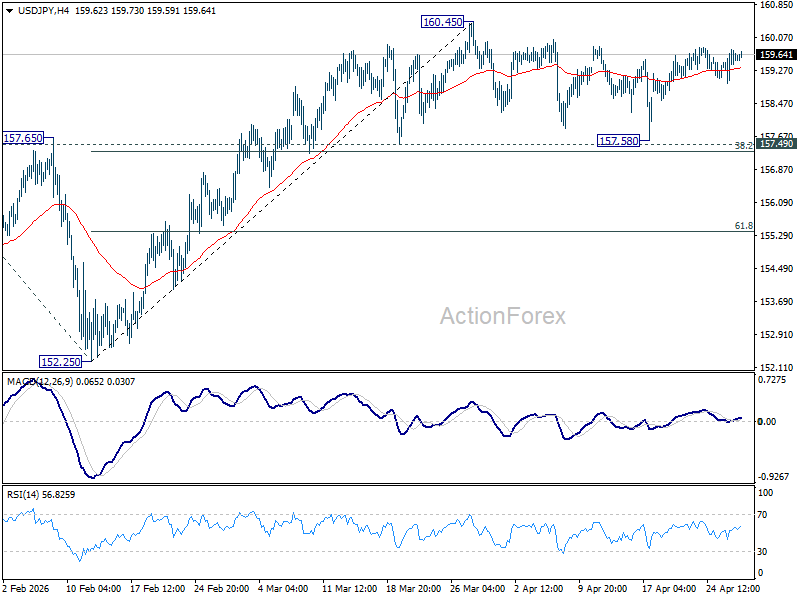
Intraday bias in USD/JPY remains neutral as consolidation continues below 160.45. Further rise is expected with 157.49 cluster support (38.2% retracement of 152.25 to 160.45 at 157.31) intact. On the upside break of 160.45 will target a retest on 161.94 high. However, firm break of 157.31/49 will bring deeper fall back to 61.8% retracement at 155.38 next.
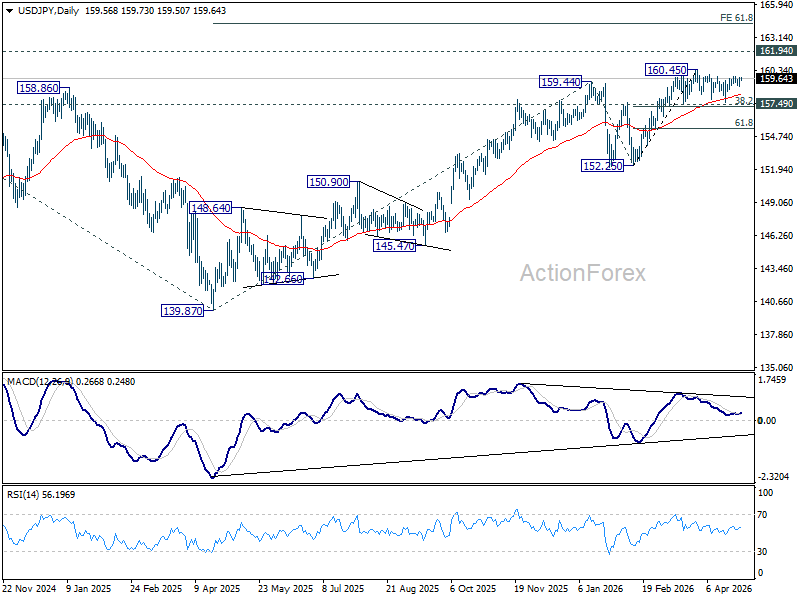
In the bigger picture, outlook is unchanged that corrective pattern from 161.94 (2024 high) should have completed with three waves at 139.87. Larger up trend from 102.58 (2021 low) could be ready to resume through 161.94. This will remain the favored case as long as 55 W EMA (now at 153.81) holds. Firm break of 161.94 will pave the way to 61.8% projection of 102.58 to 161.94 from 139.87 at 176.75.
GBP/USD Daily Outlook
Daily Pivots: (S1) 1.3472; (P) 1.3509; (R1) 1.3556; More...
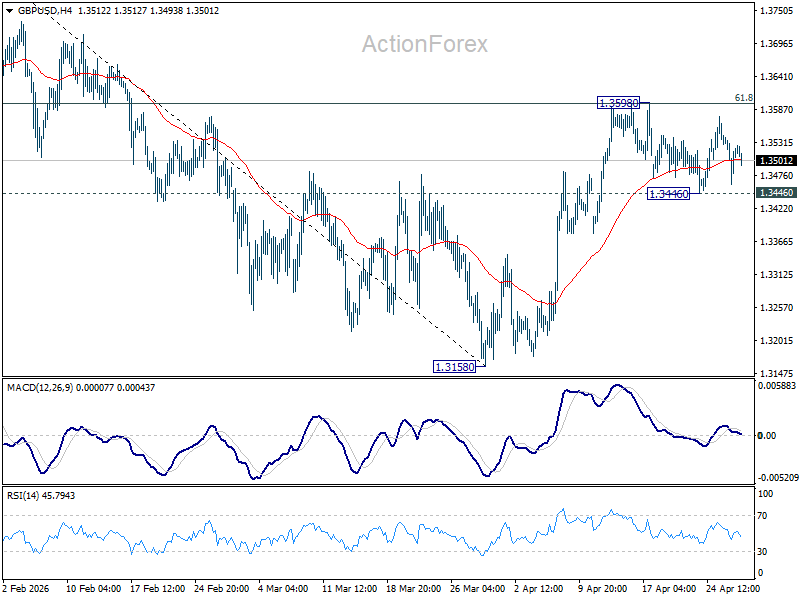
Range trading continues in GBP/USD and intraday bias stays neutral. Further rise is still in favor with 1.3446 support intact. On the upside, firm break of 61.8% retracement of 1.3867 to 1.3158 at 1.3596 will pave the way to retest 1.3867 high. However, break of 1.3446 will turn bias back to the downside for deeper pullback.
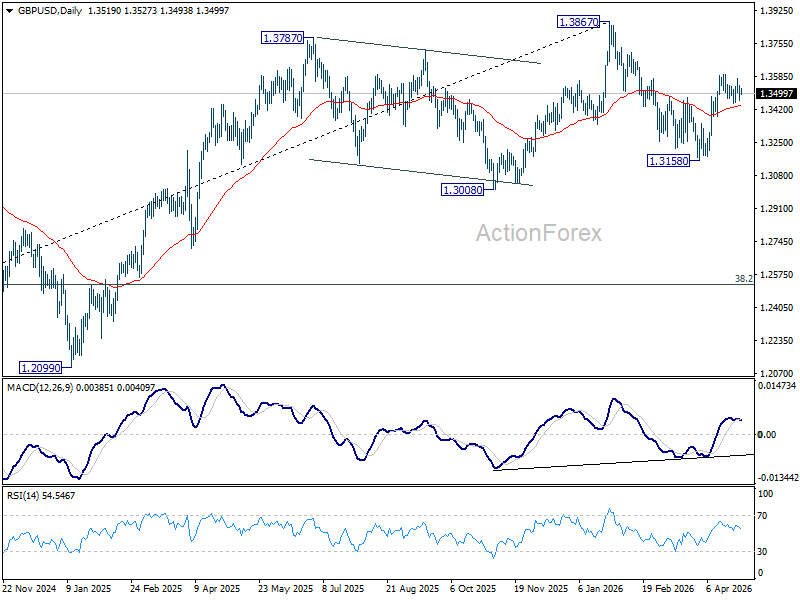
In the bigger picture, current development suggests that price actions from 1.3867 are merely a corrective pattern within the broader up trend from 1.0351 (2022 low). With 1.3008 support intact, medium term bullishness is maintained and break of 1.3867 is back in favor for a later stage, towards 1.4248 key resistance (2021 high).
USD/CHF Daily Outlook
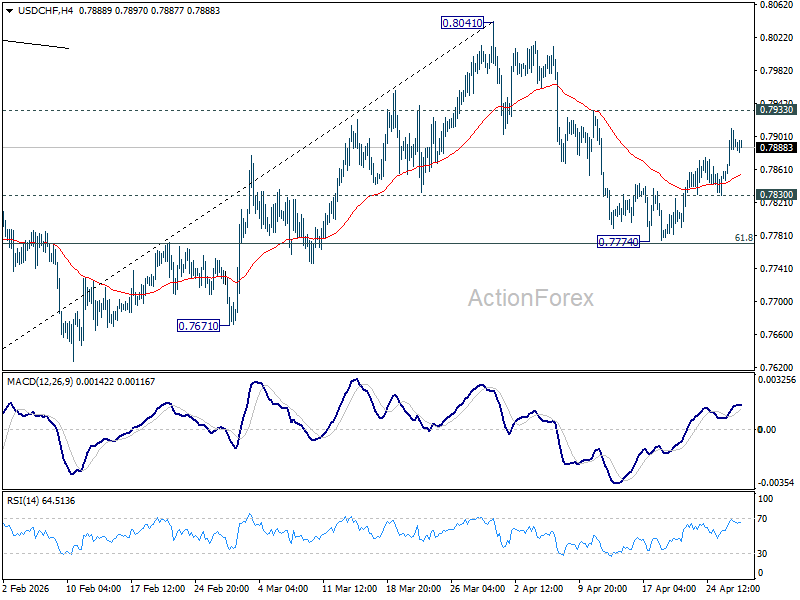
Daily Pivots: (S1) 0.7853; (P) 0.7883; (R1) 0.7923; More….
Intraday bias in USD/CHF stays neutral for the moment. On the downside, below 0.7830 will turn bias to the downside for 0.7774 support. Sustained break of 61.8% retracement of 0.7603 to 0.8041 at 0.7770 will pave the way to retest 0.7603 low. However, decisive break of 0.7933 will argue that fall from 0.8041 has completed as a corrective move. Further rise should then be seen through 0.8041 to resume the whole rebound from 0.7603.
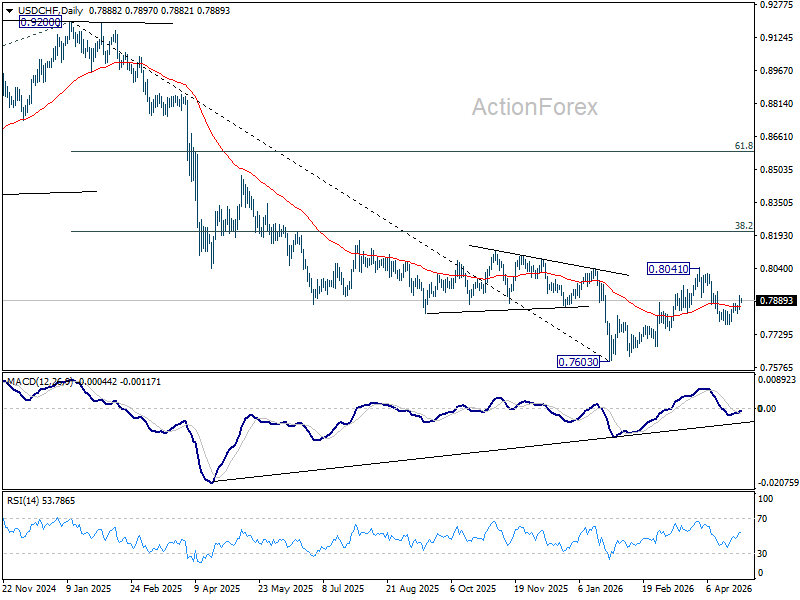
In the bigger picture, rebound from 0.7603 medium term bottom is seen as correcting the fall from 0.9200 only. Rejection by 55 W EMA (now at 0.8053) will affirm this bearish case, and setup down trend resumption to 100% projection of 1.0146 (2022 high) to 0.8332 from 0.9200 at 0.7382 at a later stage. Though, sustained break of 55 W EMA will suggest that it's probably correcting the larger scale down trend from 1.0146 (2022 high).
USD/CAD Daily Outlook
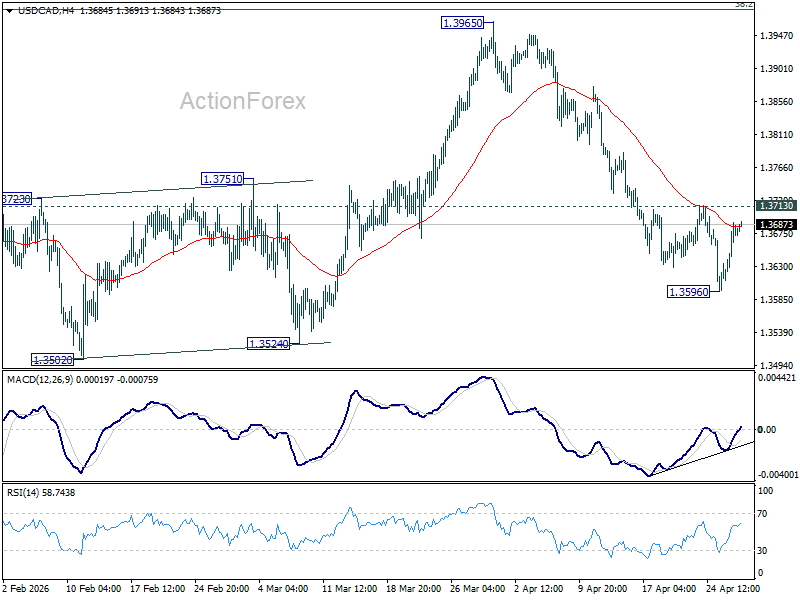
Daily Pivots: (S1) 1.3632; (P) 1.3662; (R1) 1.3712; More...
Intraday bias in USD/CAD is turned neutral first with current recovery. Further decline is expected as long as 1.3713 resistance holds. Below 1.3596 will resume the decline from 1.3965 to retest 1.3480 low. Nevertheless, firm break of 1.3713 will turn bias to the upside for stronger rebound instead.
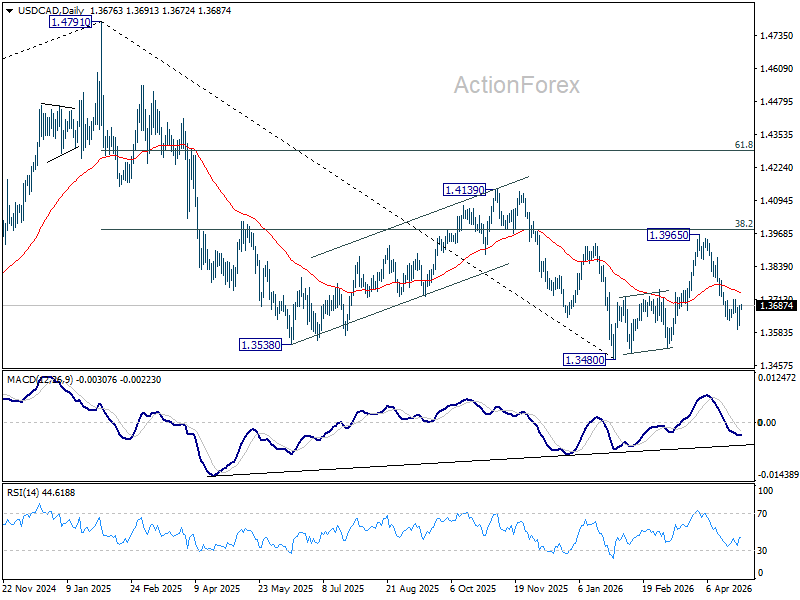
In the bigger picture, price actions from 1.4791 are seen as a corrective pattern to the whole up trend from 1.2005 (2021 low). Deeper fall could be seen, as the pattern extends, to 61.8% retracement of 1.2005 to 1.4791 at 1.3069. However, decisive break of 38.2% retracement of 1.4791 to 1.3480 at 1.3981 will argue that the correction has completed with three waves down to 1.3480 already. Further break of 1.4139 will confirm and bring retest of 1.4791 high.
UAE Exits OPEC, OpenAI Misses Targets
We had two big headlines yesterday — neither Trump-related, hallelujah — and these were:
- The WSJ reporting that OpenAI missed several monthly internal targets for new users and revenue, and
- The UAE is leaving OPEC.
It was hard to choose which one to start with, but here we go — I'll start with the UAE news.
The UAE is leaving OPEC after six decades. They want to follow their own oil strategy, they don't want to be constrained by OPEC production quotas, they have had disputes about this before with Saudi Arabia, and they felt that the current Middle East disruption was the right moment to take the step.
What's important to know is that the UAE accounted for 12% of OPEC's total production and will surely have an impact on the punch power of OPEC globally. OPEC accounted for about 35–40% of global market share; without the UAE, this share would drop to roughly 31–36%. It means that OPEC's output restrictions would have a smaller impact on stabilizing global oil prices, and worse, the UAE's departure could encourage other producers to pursue their national interests independently — meaning maximizing production to maximize revenue in a context where smaller overall production can't provide enough support to oil prices to make the output-restriction strategy worthwhile. In short, higher competition and more supply will likely weigh on medium- to long-term oil prices once the Middle East dust settles and trade through the Strait of Hormuz is restored.
In the short run, however, given the massive disruption to oil flows through the Strait, the split will have little impact. The geopolitical tensions weigh much heavier. The oil market is undersupplied due to the near-complete halt of oil flows to global markets, and the UAE cannot bring barrels to market even if it wanted to. This is why oil prices rose yesterday. Both WTI and Brent crude traded past $105 per barrel, and longer-dated oil futures rose — though they rose less, hinting that the UAE news was indeed diluted by the highly tense geopolitical context.
Higher oil prices did not enthuse equity investors around the world, but the real hit to equity sentiment was the news that OpenAI missed internal targets on revenue and user growth, suggesting that revenue growth may not be enough to meet future — and lofty — computing contracts. In short, OpenAI may miss future payments if it cannot bring in enough money.
A startup missing targets could have been a minor issue for global financial markets, were it not sitting at the centre of a hundreds-of-billions-of-dollars AI ecosystem that includes the world's biggest and most richly valued names. I think of Nvidia — down around 1.60% yesterday — AMD down 3.40%, Oracle down more than 4%, and SoftBank down nearly 10%. Microsoft, on the other hand, rebounded 1% after having announced a day earlier that it is loosening its ties with the company.
The reason OpenAI missed its targets is likely the emergence of Google's Gemini and Anthropic's Claude models, which have come to challenge OpenAI especially in the lucrative coding business — they simply took a share of OpenAI's revenue. And indeed, since last October, Anthropic-related stocks have done notably better than OpenAI-related ones. The circles of course overlap, with some big companies sitting at the intersection of both, like Nvidia and AMD. But Google and Amazon, for example, have been strongly backing Anthropic, while Oracle and Microsoft were among the major names in the OpenAI circle.
So what's next? While the OpenAI news impacted Google and Amazon less than it did companies heavily betting on OpenAI — looking at you, SoftBank — the risk of slowing revenue growth due to intense competition could, and probably will, become a headache for other AI players as well, since scaling is costly and competition is extremely intense. This should have a limited impact on chip and computing demand overall, but companies must navigate revenue potential and risks more carefully — because if OpenAI misses a payment, there will be a domino effect down the line. That is the worst-case scenario for the AI rally and could have global implications.
In any case, futures are in positive territory this morning, suggesting the market has absorbed the OpenAI news and decided to look past it.
The Federal Reserve (Fed) will be in focus today, along with earnings from Google, Microsoft, Meta, and Qualcomm due after the bell. US Big Tech is expected to report around 40% revenue growth for last quarter — slowing, but still strong. Beyond that, 80% of S&P 500 companies have beaten revenue expectations so far.
Across the Atlantic, the picture is more mixed. Barclays fell short of its US rivals in Q1 results, while BP gained around 1% after confirming that Middle East-driven volatility contributed to profit. But appetite for European equities is waning due to rising energy costs and deteriorating growth prospects. Meanwhile, 12-month inflation expectations for the euro area spiked to 4% — a rise that could encourage workers to demand higher wages and companies to pass additional costs on to clients, potentially starting a fresh inflation spiral that could oblige the European Central Bank (ECB) to tighten policy by hiking rates. The ECB is expected to hold when it announces its latest policy decision tomorrow. A benchmark 10-year euro area government yield is nonetheless painting a worrying picture. The EURUSD, meanwhile, remains under pressure despite the hawkish implications for the ECB, as the broadly stronger US dollar is weighing on the pair amid persistent geopolitical tensions and rising oil prices.
FOMC Set to Stay on Hold as Powell Nears End of Tenure
In focus today
Tonight the FOMC is expected to keep its target rate unchanged within the current range of 3.5-3.75%. It is likely the last meeting with Jerome Powell as Fed chair, before Kevin Warsh is expected to replace him. For more details, read our Research US - Fed preview: In a waiting mode, 27 April.
We will receive German and Spain flash inflation numbers today, the most important releases ahead of the euro area print tomorrow. Furthermore, the EU Commission's business confidence indicator is released today where focus is on the selling price expectations. The forward-looking nature of the survey is important for the ECB.
In Sweden, we will receive preliminary GDP data and the NIER survey, which will provide crucial insights into the outcome for the first quarter. We expect 0% q/q growth and 2% y/y growth for the preliminary GDP figures. The quarterly NIER survey will also reveal firms' inflation expectations, which over time has proven to be one of the most reliable inflation indicators.
In the afternoon, the Bank of Canada is widely expected to keep its key policy rate unchanged at 2.25%, thus marking the fourth consecutive hold.
Overnight, China releases PMIs for April with both the private as well as official NBS data coming out. The numbers will give an indication of how the Chinese economy is coping with the war in the Middle East. As seen in the euro zone last week, manufacturing PMIs are expected to hold up at levels above 50 while the service sector could see a hit due to negative effects on transportation and a decline in tourism.
Economic and market news
What happened overnight
In Australia, the Reserve Bank of Australia's (RBA) preferred measure of core inflation, the trimmed mean measure, rose by 0.8% in Q1, slightly below market expectations and the 0.9% increase seen in Q4. RBA is expected to hike rates again next week, but it is not a done deal yet with around 70% probability priced in.
What happened yesterday
In oil markets, prices continued to climb slightly yesterday, with Brent crude rising to USD 111/bbl, returning to pre-ceasefire levels. Expectations for a swift reopening of the Strait of Hormuz have diminished significantly, with investors on Polymarket now assigning roughly a 40% probability of oil flows normalising before the end of May, down sharply from 70% immediately after the ceasefire. Markets are likely to remain sceptical about progress in US-Iran talks and may only react decisively once ships begin to cross the strait again.
Furthermore, the UAE's decision to leave OPEC and OPEC+ from 1 May marks a notable shift in the oil market. While the move allows the UAE to produce at full capacity independently, the news did not affect oil pricing due to the continued closing of the Strait of Hormuz. Reuters reports that the UAE, which accounted for 3% of global crude supply with a production of 3.4 million bbl/day before the Iran war, could ramp up output to its full capacity of 5 million bbl/day once shipping resumes. As OPEC's fourth-largest producer, the UAE's departure reduces the group's control over global oil production from 50% to approximately 45%. While Iraq has confirmed its commitment to OPEC+, the UAE's exit raises questions about the organisation's cohesion and signals a potential regime shift in the oil market. While such a shift could potentially drive a substantial drop in oil prices, this is contingent on the reopening of the Strait of Hormuz.
In the euro area, the ECB's Consumer Expectations Survey for March revealed sharply higher inflation expectations, with median 1Y CPI expectations jumping to 4.0% from 2.5%, and 3Y expectations rising to 3.0% from 2.5%. The monthly increase in 1Y expectations is nearly as large as the surge seen in March 2022, signalling a hawkish shift. Particularly medium-term expectations climbed, which prompted an upwards push on the EUR rates. Meanwhile, the ECB's quarterly bank lending survey showed banks tightening credit standards across all loan categories in Q1, driven by higher perceived risks. Further tightening is expected in Q2, which could help cool the euro area economy ahead of anticipated ECB rate hikes this summer.
In Japan, following the BoJ's decision to keep rates unchanged, Governor Ueda avoided firm guidance on the timing of a rate hike but kept the door open for potential action at the June meeting. Market pricing of hikes remained steady, with 17bp worth of hikes priced in by June and 50bp total rate hikes in 2026. We continue to expect a rate hike at the June meeting.
In the US, the April Conference Board consumer confidence index improved for the third consecutive month, in contrast to the less optimistic University of Michigan survey. In any case, overall confidence remains weak compared to pre-pandemic levels, and inflation expectations stay modestly elevated. ADP also released their weekly private sector jobs growth estimate, which showed that employment grew by 39k per week on average over the four weeks ending April 12, which is roughly consistent with the reference period for the upcoming April NFP. While the correlation to BLS's Jobs Report is far from perfect, ADP's weekly estimates have signalled improving sequential jobs growth into April.
In Hungary, the central bank (MNB) left its benchmark rate unchanged at 6.25% yesterday, in line with both our expectations and market consensus.
Equities: Equities moved lower yesterday, with most regions in the red and the sector rotation tilting more defensive. What is worth noting, however, is that tech led the decline while the VIX actually fell. In other words, this was not primarily a classic negative macro-data sell-off. It was at least as much about renewed concerns around the AI space, triggered by OpenAI warning on revenue developments. That naturally brought one of the key underlying concerns in the AI narrative back to the surface: monetisation. But investors should be careful not to extrapolate too aggressively. What we have heard from OpenAI does not match what we have heard from Anthropic. Put differently, this may be less a story about broad-based AI demand disappointment and more about a meaningful shift in users from ChatGPT towards Claude.
Asian equities are mixed this morning, with Chinese equities stronger in Hong Kong. European and US futures are marginally higher.
FI and FX: EUR/USD continues to trade near 1.17 ahead of tonight's FOMC meeting where no change to the policy rate and no firm forward guidance is expected. The following press conference should be the last one for J. Powell as a Fed Chair. The BoC is to leave its policy rate unchanged at 2.25%, too, while focus will be on the quarterly MPR. The UAE's decision to leave OPEC might be a bearish trigger for oil prices once the SOH reopens, for now however oil remains at elevated levels with the June Brent Crude at USD111.2. In Sweden we will get important data from the NIER survey and the GDP Indicator for Q1. The Norwegian retail sales numbers are likely less of a mover of the NOK than potential surprises from the FOMC.
AUD/USD Daily Report
Daily Pivots: (S1) 0.7157; (P) 0.7176; (R1) 0.7202; More...
AUD/USD dips mildly today but stays in established range below 0.7221. Intraday bias remains neutral and more sideway trading could be seen. Further rise is expected as long as 0.7076 support holds. On the upside, firm break of 0.7221 will extend larger up trend to 61.8% projection of 0.6420 to 0.7187 from 0.6832 at 0.7306. On the downside, break of 0.7076 minor support will turn bias back to the downside for deeper pullback.
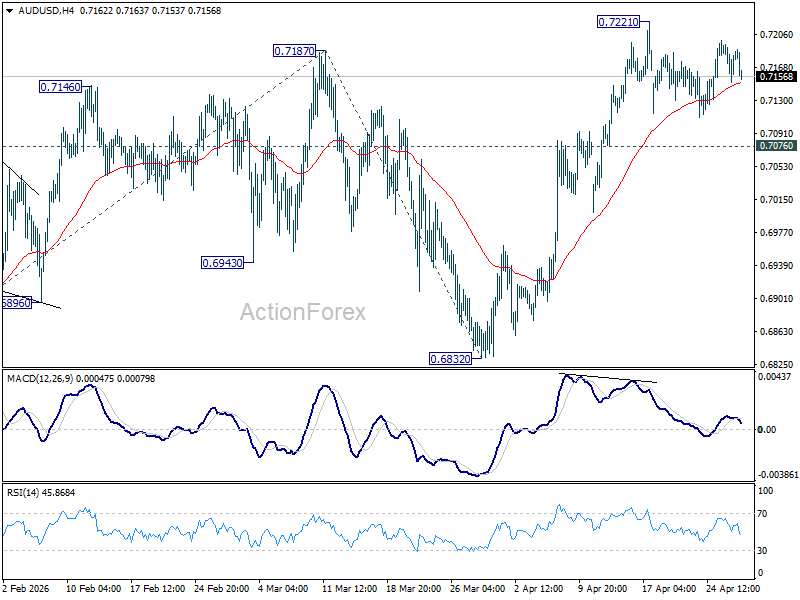
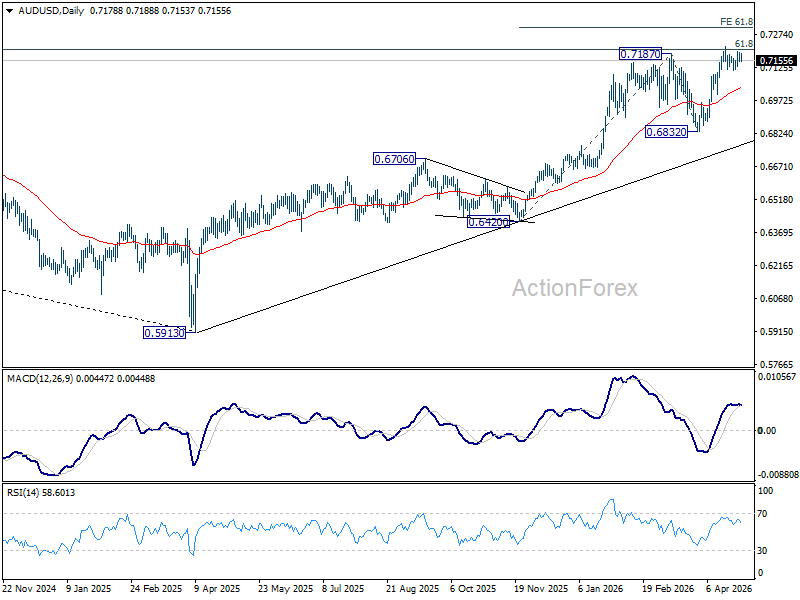
In the bigger picture, rise from 0.5913 (2024 low) is still in progress. Decisive break of 61.8% retracement of 0.8006 to 0.5913 at 0.7206 will solidify the case that it's already reversing the down trend from 0.8006 (2021 high). Further rally should then be seen to retest 0.8006. For now, outlook will remain bullish as long as 0.6832 support holds, in case of pullback.
Waiting Game: Markets Stall Ahead of Fed Powell’s Finale
Despite the renewed surge in oil prices, there has been little shift in overall sentiment. Brent’s move higher would typically trigger a broader risk-off reaction, yet price action across asset classes remains contained. The lack of urgency suggests that traders are unwilling to commit ahead of today’s FOMC decision.
The Federal Reserve is widely expected to leave rates unchanged at 3.50–3.75%, but the real focus is on tone rather than action. This meeting is likely Jerome Powell’s final one as Chair, and expectations are firmly anchored around a “steady as she goes” message rather than any attempt to reshape the policy outlook.
There are also structural reasons why the meeting may deliver little. As an interim gathering without updated economic projections, it offers limited scope for meaningful guidance changes. Any adjustment to the Fed’s outlook is more likely to be deferred to June, when new forecasts are released. This reinforces the view that today’s meeting could turn out to be a non-event.
At the same time, the macro backdrop is becoming more complex. Oil prices have surged as the US–Iran conflict drags on, but the situation remains a stalemate rather than a breakdown. Markets are not yet pricing a return to full-scale conflict, which explains why the move in oil has not translated into broader panic.
This leaves markets in a delicate balance. On one hand, elevated oil prices are feeding into inflation concerns and supporting safe haven demand. On the other, the absence of escalation is preventing a more aggressive repricing of risk. As a result, traders are holding positions light and waiting for clearer signals.
In FX markets, Australian Dollar continues to stand out as the strongest performer for the week so far. The Q1 inflation report reinforced expectations for an RBA rate hike in May, effectively locking in near-term tightening. However, the softer-than-expected details have introduced uncertainty over the path beyond that move.
This nuance matters. While headline inflation surged, underlying pressures were more contained, suggesting that the RBA may not need to accelerate tightening after May. That has led to some pullback in Aussie, even as it retains a relative yield advantage.
Dollar is currently the second strongest currency, supported by the combination of higher oil prices and modest safe haven flows. However, without a clear escalation in geopolitics or a hawkish shift from the Fed, the move lacks strong momentum.
Canadian Dollar is also benefiting from the oil rally, but the domestic policy outlook is far more cautious. The Bank of Canada is widely expected to hold rates steady today, and many economists see little need for further tightening given ongoing weakness in parts of the economy.
Governor Tiff Macklem has already downplayed the significance of recent inflation expectations, viewing them as largely transitory as driven by external shocks. The focus remains on supporting growth, suggesting that policy will remain on hold even as oil prices rise.
At the other end of the spectrum, Swiss Franc is underperforming despite elevated geopolitical risks. Traditionally, CHF would attract inflows during periods of uncertainty, but this time the dominant driver is interest rate differentials rather than risk sentiment.
With oil prices rising, markets are increasingly expecting other central banks—particularly the ECB and BoE—to maintain or even strengthen their tightening bias to counter inflation pressures. By contrast, the Swiss National Bank is expected to stay on hold, with its primary concern still centered on preventing excessive Franc strength that could trigger deflationary forces.
Kiwi and Sterling are also underperforming, while Euro and Yen are trading in the middle of the pack.
Fed–Market Disconnect Takes Center Stage as Powell’s Final FOMC Faces Oil-Driven Inflation Test
The Fed sees inflation as temporary—but markets are not convinced. As oil prices surge again, Powell’s final FOMC faces a critical test between sticking to the script or signaling a policy shift. Read More.
Australia CPI Jumps to 4.6% as Fuel Surge Drives Headline Higher, Core Inflation Steady
Headline inflation is rising again in Australia, but stable core and easing services inflation suggest the shock remains concentrated rather than broad-based. Read More.
RBNZ's Breman: Ready to Act Decisively If Inflation Persists
RBNZ's Breman said if inflation persists, action will follow decisively. With fuel driving prices higher and core inflation still contained, policymakers are staying cautious but ready to tighten. Read More.
AUD/USD Daily Report
Daily Pivots: (S1) 0.7157; (P) 0.7176; (R1) 0.7202; More...
AUD/USD dips mildly today but stays in established range below 0.7221. Intraday bias remains neutral and more sideway trading could be seen. Further rise is expected as long as 0.7076 support holds. On the upside, firm break of 0.7221 will extend larger up trend to 61.8% projection of 0.6420 to 0.7187 from 0.6832 at 0.7306. On the downside, break of 0.7076 minor support will turn bias back to the downside for deeper pullback.
In the bigger picture, rise from 0.5913 (2024 low) is still in progress. Decisive break of 61.8% retracement of 0.8006 to 0.5913 at 0.7206 will solidify the case that it's already reversing the down trend from 0.8006 (2021 high). Further rally should then be seen to retest 0.8006. For now, outlook will remain bullish as long as 0.6832 support holds, in case of pullback.
Fed–Market Disconnect Takes Center Stage as Powell’s Final FOMC Faces Oil-Driven Inflation Test
Today’s FOMC decision is expected to leave rates unchanged at 3.50–3.75%, yet the real story lies in the widening gap between what the Fed is signaling and what markets are pricing. That tension is now being tested by a renewed surge in oil prices, as geopolitical risks refuse to fade.
This meeting carries added weight as it is likely Jerome Powell’s final one as Chair before his term ends on May 15. Rather than setting a new direction, Powell is likely to maintain a neutral, flexible stance, effectively handing policy discretion to incoming Chair Kevin Warsh. That raises the risk that the meeting itself becomes a non-event rather than a turning point.
But the backdrop is shifting. With Brent crude breaking above $110 again, the argument that inflation is purely transitory is becoming harder to sustain. The longer the Iran conflict drags on, the greater the risk that energy-driven price pressures become embedded in the broader inflation outlook.
This is where the disconnect becomes most evident. The Fed’s March projections still point to one rate cut this year, a view supported by most economists. Markets, however, are moving in the opposite direction. Fed funds futures now imply nearly an 80% probability that rates will remain unchanged at current levels through year-end, with the odds of a cut declining further as oil prices push higher.
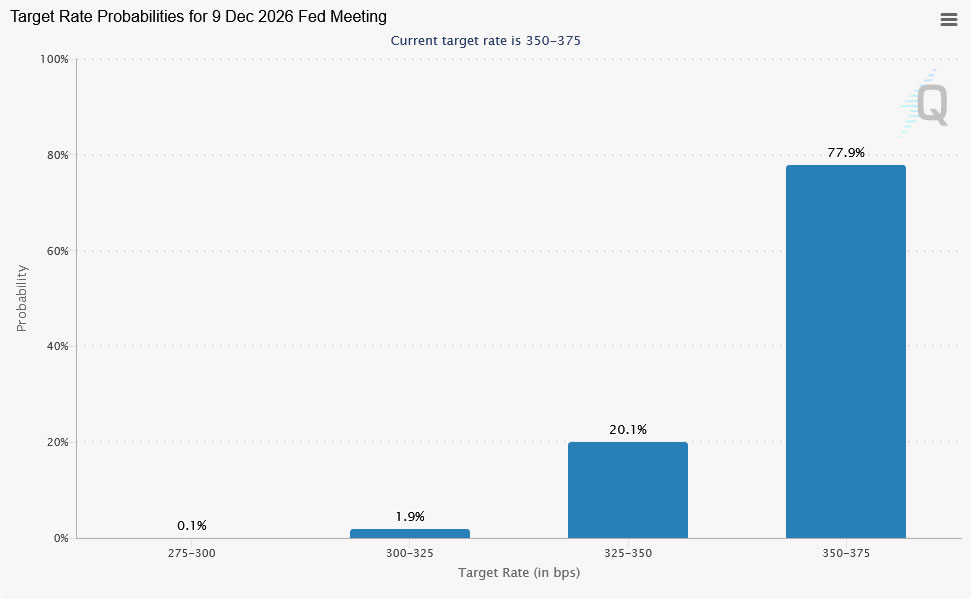
This reflects growing skepticism toward the Fed’s “transitory” narrative. While policymakers expect energy-driven inflation to fade once geopolitical tensions ease, traders are increasingly betting that persistent price pressures will force the Fed to revise its outlook, potentially reducing or eliminating projected cuts.
The key question is whether this meeting marks the start of that shift. Powell may choose to stick to the existing framework, emphasizing that inflation pressures are temporary and data-dependent. Such a stance could be interpreted as dovish, reinforcing expectations that policy easing remains on the table and weighing on the Dollar.
Alternatively, a subtle shift in tone—acknowledging that geopolitical energy shocks may be more persistent—could have outsized market impact. Even a modest adjustment could prompt markets to further price out rate cuts, supporting yields and lifting the Dollar.
For traders, EUR/USD is a key focus. As long as 1.1662 holds, the rebound from 1.1408 remains intact, with a break of 1.1848 resistance opening the way toward 1.2081.However, firm break of 1.1662 will suggest that the rebound from 1.1408 has completed as a corrective move. That would firstly bring retest of 1.1408 low.