

Sample Category Title
RBA May hike locked in
We reaffirm our view that the RBA will raise the cash rate 25bps to 4.35% next week.
We reaffirm our expectation that the RBA Monetary Policy Board (MPB) will raise the cash rate a further 25bps at its May meeting, to 4.35%. Inflation was higher than the MPB was comfortable with prior to the Middle East conflict, spurring it to lift the cash rate in both February and March. The RBA doubled down on its views that the economy was tighter than full employment and needed to be restrained to get inflation back under control.
Those rate hikes were based on data relating to the period before the war. While petrol prices have since reversed much of the 32.8% increase recorded in March, part of this was driven by the cut to excise, due to expire in a few months. Diesel prices – and thus freight costs – remain very elevated. The RBA could look through higher fuel prices if that was all that was happening, but it is not. Pass-through to other (non-fuel) prices is clearly starting, touching everything from building products to takeaway food if the reports we are receiving are any guide. The RBA will be hearing similar stories from firms in its liaison program.
March would have been very early days for much pass-through to be evident in the CPI. For example, many of the price increases for building products we are aware of did not take effect until 1 April. Today’s CPI data nonetheless show scattered signs of pass-through to other prices. There were some promising signs in softer monthly prices of appliances and some other household goods. However, home-building and vehicle repair costs, along with downstream insurance inflation, all picked up in the month and quarter. Services related to AV, computing and telecommunications also increased in the month, which for telecommunications went against the run of recent months’ results.
This is occurring in the context of a starting point where non-tradables and services inflation are already too high. At 0.8%qtr, the RBA’s preferred quarterly trimmed mean measure of inflation is still too high for the RBA to walk past, even though it was a touch lower than our pre-release expectation, consistent with the downside risks we flagged.
Together with the spike in both consumer inflation expectations and business survey measures of costs and prices, the March inflation data will have the RBA’s inflation warning lights flashing bright red. The MPB will see an imperative to address high inflation despite the caution expressed by the minority voters in March.
Some observers point to the demand-destruction higher fuel prices can unleash via the hit to real incomes, which will dampen inflation on its own eventually. This is plausible, but it will take too long to assuage an RBA facing an extended period of above-target inflation.
Indeed, based on its communication so far, especially the March minutes, the MPB puts little weight on that argument. The minutes characterised the supply shock as ‘further exacerbating existing capacity pressures’, and the future demand destruction as just a possibility. This view flows from the RBA’s analysis that the economy is already too tight, as inferred from inflation already being above target. It is also taking signal from the income boost from higher LNG prices, but no disinflationary signal from exchange rate appreciation beyond what is already implied by the RBA’s own actions on rates.
We also consider significant what the RBA has not communicated in recent weeks. When markets began pricing in multiple policy rate hikes by the ECB, Bank of England and Bank of Canada, senior officials at those central banks pushed back. Indeed, BoE Governor Bailey stated in an interview with Reuters that “markets had gotten ahead of themselves”. ECB President Lagarde used a speech on 25 March to highlight that the current shock was likely to be less inflationary than the energy shock in 2022 when Russia invaded Ukraine at a time that other supply chains were still recovering from pandemic disruption. The RBA has not pushed back in the same way. In addition to the higher starting point for inflation here, part of the reason seems to be that Australia is already seeing the pass-through to other prices that other central banks are still at the stage of watching for.
All this adds up to the MPB wanting to tighten policy further. The refreshed forecast in the Statement on Monetary Policy will allow the RBA to set out its views of the inflation impulse from the war, making May a good opportunity to take, and explain, the next step.
The outlook for the cash rate beyond May is necessarily less certain. We hold to our base case that there will be two further rate hikes after May, in June and August. The RBA’s experience last year, when underlying inflation popped back up almost immediately after it cut rates, will have nudged some within the RBA to the idea that the cash rate needs to be higher than its previous peak to really get inflation under control (for the technically-minded, their individual estimates of the neutral rate got revised up). While outwardly the RBA continues to characterise its strategy as being willing to be a bit less activist to hold onto the post-pandemic employment gains, most of the original architects of that strategy have left the building and those inclined to be more activist will have more influence.
There is a chance that the RBA ends up doing less than our base case, if the voices on the MPB that counselled caution in March can sway other members, or if pass-through to non-fuel prices turns out to be less than current information suggests. However, we put less weight on this scenario given the starting point for domestically driven inflation.
WTI Crude Oil Rebound Approaches Crucial Zone, Breakout Or Pullback?
Key Highlights
- WTI Crude Oil started a recovery wave above $96.50 and $98.00.
- A bullish trend line is forming with support at $99.80 on the 4-hour chart of XTI/USD.
- Gold is grinding lower below the $4,650 support zone.
- EUR/USD seems to be struggling to regain traction for a move above 1.1740.
WTI Crude Oil Price Technical Analysis
WTI Crude Oil prices found support near $88.00 against the US Dollar. The price started a steady recovery wave above the $90.00 and $92.50 levels.
Looking at the 4-hour chart of XTI/USD, the price settled above $85, the 100 simple moving average (red, 4-hour), and the 200 simple moving average (green, 4-hour). The price cleared the 50% Fib retracement level of the downward move from the $117.73 swing high to the $81.94 low.
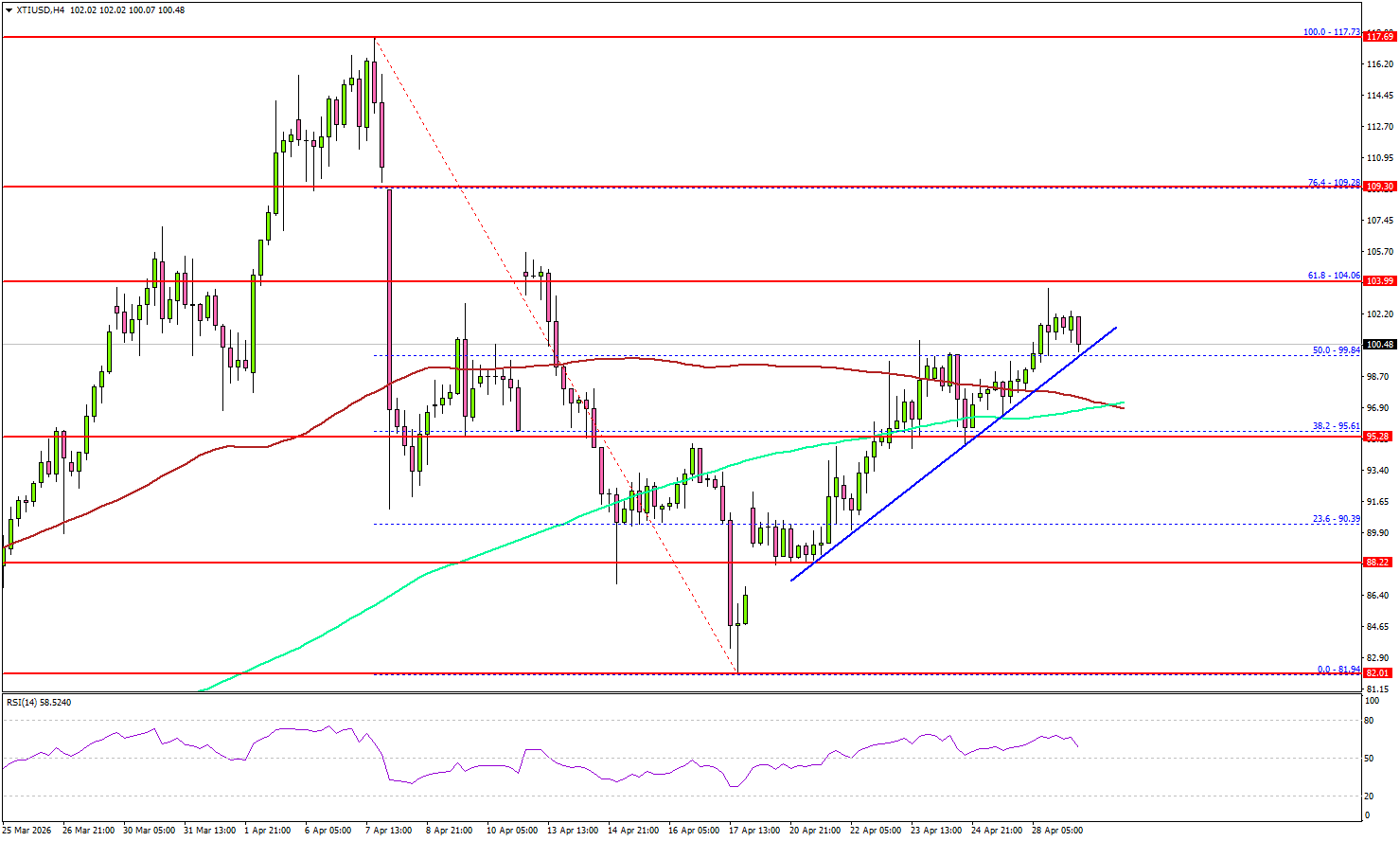
On the upside, immediate resistance is near the $103.50 level. The first key hurdle for the bulls could be $104.00 and the 61.8% Fib retracement level of the downward move from the $117.73 swing high to the $81.94 low.
A close above $104.00 might send Oil prices toward $110.00. Any more gains might call for a test of $115.00 in the near term. On the downside, the first major support sits near the $99.50 zone. The next support could be $96.00, below which the price could dive and test $92.00.
A daily close below $92.00 could open the doors for a larger decline. In the stated case, the bears might aim for a drop toward $85.00.
Looking at Gold, there was a bearish reaction below the $4,680 and $4,650 support levels. The next major bid zone could be $4,500.
Economic Releases to Watch Today
- US Durable Goods Orders for March 2026 – Forecast +0.5% versus -1.3% previous.
- Fed Interest Rate Decision - Forecast 3.75%, versus 3.75% previous.
RBNZ’s Breman: Ready to Act Decisively If Inflation Persists
RBNZ Governor Anna Breman warned at a panel discussion today that New Zealand is being affected by global inflation shocks stemming from the Middle East conflict, noting that it has “disrupted global supply chains, pushing up prices for oil, fertilizers, and other goods facing shortages.” As a small open economy, she said, New Zealand “cannot avoid being buffeted by these global forces,” with impacts likely to vary across sectors, regions, and households.
Despite the pickup in inflation, Breman view the pressure as largely temporary. Annual CPI rose to 3.1% in Q1 2026, above the 1–3% target range, but Breman said that “much of the increase was driven by fuel prices,” while core inflation measures “have remained stable within the target band.”
Nevertheless, she stressed that monetary policy “can and should ensure that a temporary increase in inflation does not turn into enduring inflationary pressures,” with a focus on returning inflation to 2% over the medium term.
Breman added the decision to hold the OCR at 2.25% earlier this month weighed the benefits of acting pre-emptively against “the cost of unnecessarily stifling the economic recovery.” However, she reaffirmed that the RBNZ “remains ready to act decisively and in a timely manner” if signs emerge that short-term inflation is feeding into more persistent pressures, while continuing to monitor developments in the Middle East and incoming data.
Australia CPI Jumps to 4.6% as Fuel Surge Drives Headline Higher, Core Inflation Steady
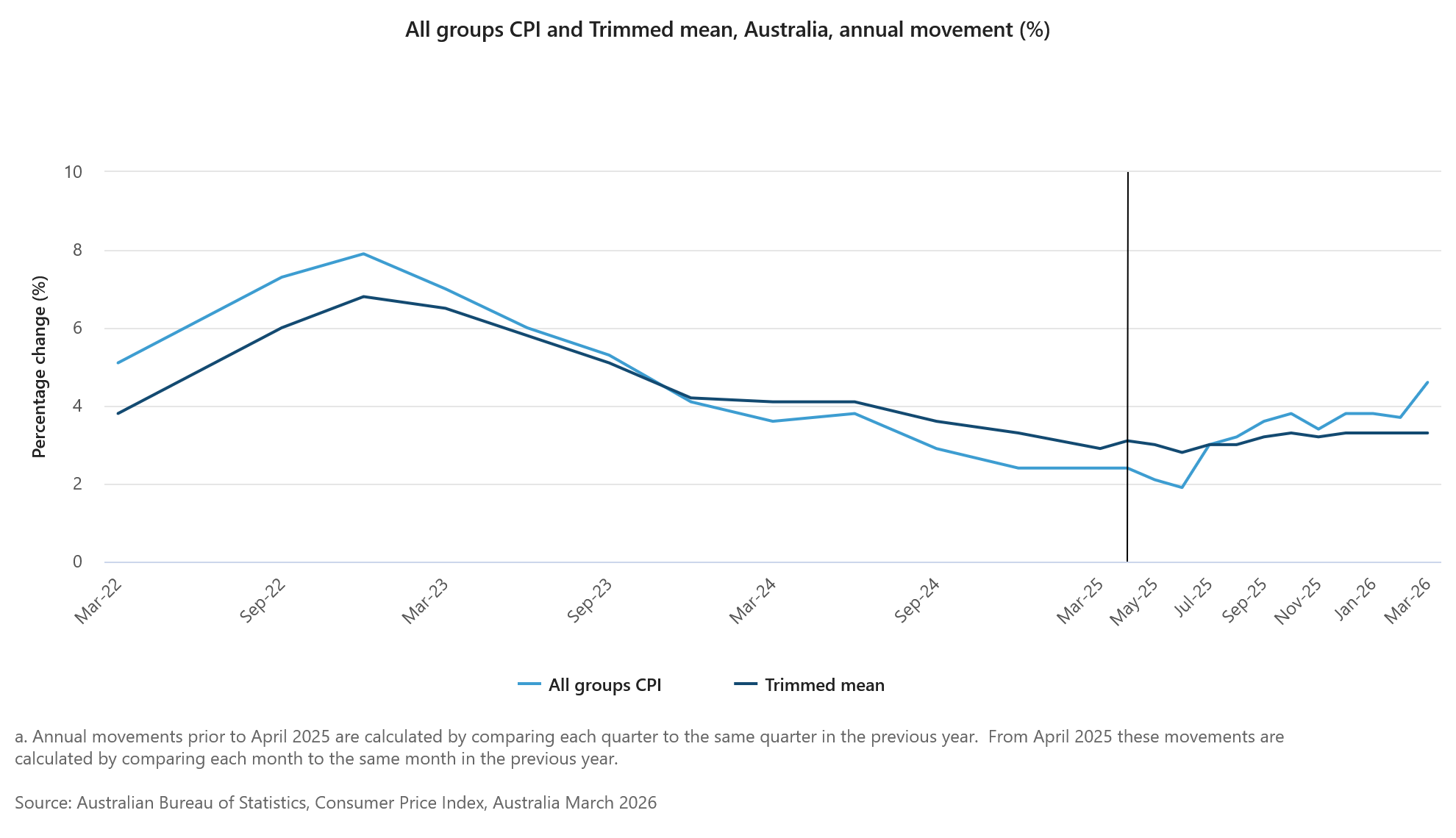
Australia’s inflation accelerated sharply in March, with headline CPI rising from 3.7% yoy to 4.6% yoy, the highest since September 2023, though slightly below expectations of 4.8% yoy. The surge was largely driven by energy costs.
The breakdown shows a clear divergence between goods and services. Goods inflation jumped from 3.5% yoy to 5.5% yoy, led by automotive fuel, which surged 24.2% yoy. By contrast, services inflation eased from 3.9% yoy to 3.6% yoy, pointing to softer underlying domestic price pressures.
On a monthly basis, CPI rose 1.1% mom, with transport costs up 9.2% as automotive fuel prices spiked 32.8%—the largest monthly increase since the series began in 2017.
Core inflation remains contained, with trimmed mean CPI unchanged at 3.3% yoy in both March and the first quarter. This suggests that while headline inflation is being pushed higher by external cost shocks, underlying inflation dynamics have yet to re-accelerate.
| Indicator (Mar) | Previous | Latest |
|---|---|---|
| CPI (YoY) | 3.7% | 4.6% |
| Trimmed Mean CPI (YoY) | 3.3% | 3.3% |
| Goods Inflation (YoY) | 3.5% | 5.5% |
| Services Inflation (YoY) | 3.9% | 3.6% |
| Monthly CPI (MoM) | — | 1.1% |
| Transport (MoM) | — | 9.2% |
| Automotive Fuel (YoY) | — | 24.2% |
| Automotive Fuel (MoM) | — | 32.8% |
AUDCAD Wave Analysis
AUDCAD: ⬆️ Buy
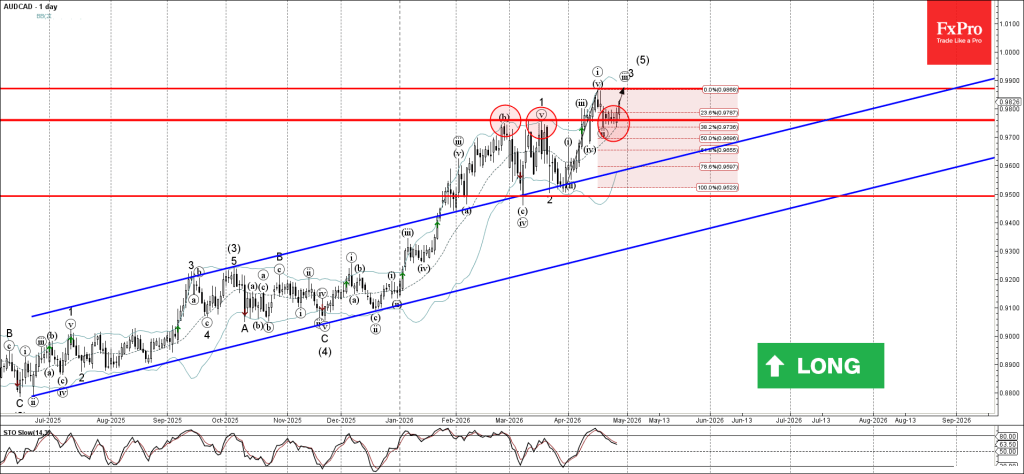
- AUDCAD reversed from support zone
- Likely to rise to resistance level 0.9870
AUDCAD currency pair recently reversed up from the support zone between the key support level 0.9760 (former monthly high from March) and the 38.2% Fibonacci correction of the upward impulse from March.
The upward reversal from the support level 0.9760 started the active short-term impulse wave 3 – which belongs to wave (5) from November.
Given the overriding daily uptrend, AUDCAD currency pair can be expected to rise to the next resistance level 0.9870 (top of the previous impulse wave i).
Brent Wave Analysis
Brent: ⬆️ Buy
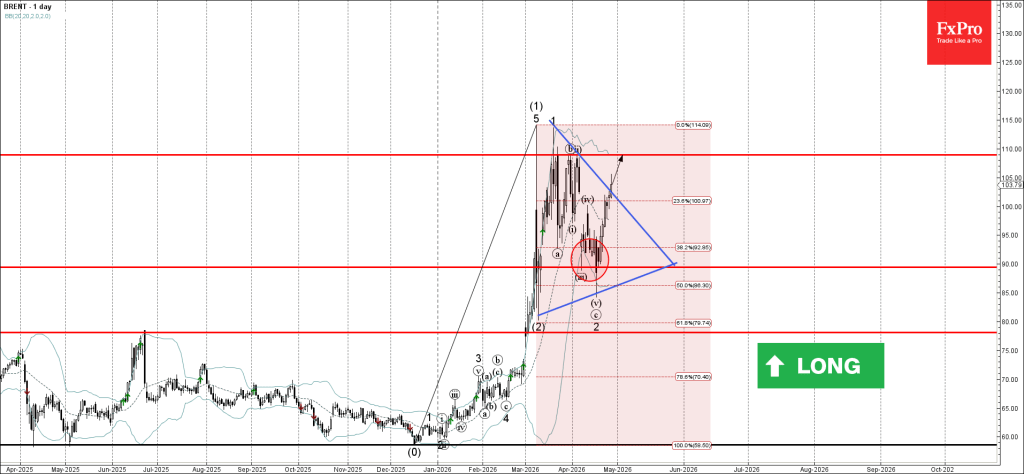
- Brent broke daily Triangle
- Likely to rise to resistance level 108.90
Brent continues to rise inside the sharp minor impulse wave 3, which started earlier when the price reversed up from the key support level 90.00.
The price earlier broke the resistance trendline of the daily Triangle from March – which accelerated the active short-term impulse wave 3.
Given the clear daily uptrend, Brent can be expected to rise to the next resistance level 108.90 (top of the previous waves b and ii).
Eco Data 4/29/26
| GMT | Ccy | Events | Act | Cons | Prev | Rev |
|---|---|---|---|---|---|---|
| 01:30 | AUD | CPI M/M Mar | 1.10% | 1.30% | 0.00% | |
| 01:30 | AUD | CPI Y/Y Mar | 4.60% | 4.80% | 3.70% | |
| 01:30 | AUD | Trimmed Mean CPI M/M Mar | 0.30% | 0.30% | 0.20% | |
| 01:30 | AUD | Trimmed Mean CPI Y/Y Mar | 3.30% | 3.30% | ||
| 01:30 | AUD | CPI Q/Q Q1 | 1.40% | 1.40% | 0.60% | |
| 01:30 | AUD | CPI Y/Y Q1 | 4.60% | 4.10% | 3.60% | |
| 01:30 | AUD | Trimmed Mean CPI Q/Q Q1 | 0.80% | 0.90% | ||
| 01:30 | AUD | Trimmed Mean CPI Y/Y Q1 | 3.30% | 3.50% | 3.40% | |
| 08:00 | CHF | UBS Economic Expectations Apr | -30.3 | -35 | ||
| 08:00 | EUR | Eurozone M3 Money Supply Y/Y Mar | 3.20% | 3.10% | 3.00% | |
| 09:00 | EUR | Eurozone Economic Sentiment Indicator Apr | 93 | 95.5 | 96.6 | 96.2 |
| 09:00 | EUR | Eurozone Industrial Confidence Apr | -7.7 | -8 | -7 | |
| 09:00 | EUR | Eurozone Services Sentiment Apr | 0.9 | 3.8 | 4.9 | 4.1 |
| 09:00 | EUR | Eurozone Consumer Confidence Apr F | -20.6 | -20.6 | -20.6 | |
| 12:00 | EUR | Germany CPI M/M Apr P | 0.60% | 0.70% | 1.10% | |
| 12:00 | EUR | Germany CPI Y/Y Apr P | 2.90% | 3.00% | 2.70% | |
| 12:30 | USD | Goods Trade Balance (USD) Mar P | -87.9B | -86.3B | -83.5B | |
| 12:30 | USD | Wholesale Sales Inventories Mar P | 1.40% | 0.30% | 0.80% | 0.90% |
| 12:30 | USD | Durable Goods Orders Mar | 0.80% | 0.50% | -1.30% | |
| 12:30 | USD | Durable Goods Orders ex Transport Mar | 0.90% | 0.40% | 0.90% | |
| 13:45 | CAD | BoC Interest Rate Decision | 2.25% | 2.25% | 2.25% | |
| 14:30 | CAD | BoC Press Conference | ||||
| 14:30 | USD | Crude Oil Inventories (Apr 24) | -6.2M | 0.3M | 1.9M | |
| 18:00 | USD | Fed Interest Rate Decision | 3.75% | 3.75% | 3.75% | |
| 18:30 | USD | FOMC Press Conference |
| 01:30 | AUD |
| CPI M/M Mar | |
| Actual | 1.10% |
| Consensus | 1.30% |
| Previous | 0.00% |
| 01:30 | AUD |
| CPI Y/Y Mar | |
| Actual | 4.60% |
| Consensus | 4.80% |
| Previous | 3.70% |
| 01:30 | AUD |
| Trimmed Mean CPI M/M Mar | |
| Actual | 0.30% |
| Consensus | 0.30% |
| Previous | 0.20% |
| 01:30 | AUD |
| Trimmed Mean CPI Y/Y Mar | |
| Actual | 3.30% |
| Consensus | |
| Previous | 3.30% |
| 01:30 | AUD |
| CPI Q/Q Q1 | |
| Actual | 1.40% |
| Consensus | 1.40% |
| Previous | 0.60% |
| 01:30 | AUD |
| CPI Y/Y Q1 | |
| Actual | 4.60% |
| Consensus | 4.10% |
| Previous | 3.60% |
| 01:30 | AUD |
| Trimmed Mean CPI Q/Q Q1 | |
| Actual | 0.80% |
| Consensus | |
| Previous | 0.90% |
| 01:30 | AUD |
| Trimmed Mean CPI Y/Y Q1 | |
| Actual | 3.30% |
| Consensus | 3.50% |
| Previous | 3.40% |
| 08:00 | CHF |
| UBS Economic Expectations Apr | |
| Actual | -30.3 |
| Consensus | |
| Previous | -35 |
| 08:00 | EUR |
| Eurozone M3 Money Supply Y/Y Mar | |
| Actual | 3.20% |
| Consensus | 3.10% |
| Previous | 3.00% |
| 09:00 | EUR |
| Eurozone Economic Sentiment Indicator Apr | |
| Actual | 93 |
| Consensus | 95.5 |
| Previous | 96.6 |
| Revised | 96.2 |
| 09:00 | EUR |
| Eurozone Industrial Confidence Apr | |
| Actual | -7.7 |
| Consensus | -8 |
| Previous | -7 |
| 09:00 | EUR |
| Eurozone Services Sentiment Apr | |
| Actual | 0.9 |
| Consensus | 3.8 |
| Previous | 4.9 |
| Revised | 4.1 |
| 09:00 | EUR |
| Eurozone Consumer Confidence Apr F | |
| Actual | -20.6 |
| Consensus | -20.6 |
| Previous | -20.6 |
| 12:00 | EUR |
| Germany CPI M/M Apr P | |
| Actual | 0.60% |
| Consensus | 0.70% |
| Previous | 1.10% |
| 12:00 | EUR |
| Germany CPI Y/Y Apr P | |
| Actual | 2.90% |
| Consensus | 3.00% |
| Previous | 2.70% |
| 12:30 | USD |
| Goods Trade Balance (USD) Mar P | |
| Actual | -87.9B |
| Consensus | -86.3B |
| Previous | -83.5B |
| 12:30 | USD |
| Wholesale Sales Inventories Mar P | |
| Actual | 1.40% |
| Consensus | 0.30% |
| Previous | 0.80% |
| Revised | 0.90% |
| 12:30 | USD |
| Durable Goods Orders Mar | |
| Actual | 0.80% |
| Consensus | 0.50% |
| Previous | -1.30% |
| 12:30 | USD |
| Durable Goods Orders ex Transport Mar | |
| Actual | 0.90% |
| Consensus | 0.40% |
| Previous | 0.90% |
| 13:45 | CAD |
| BoC Interest Rate Decision | |
| Actual | 2.25% |
| Consensus | 2.25% |
| Previous | 2.25% |
| 14:30 | CAD |
| BoC Press Conference | |
| Actual | |
| Consensus | |
| Previous | |
| 14:30 | USD |
| Crude Oil Inventories (Apr 24) | |
| Actual | -6.2M |
| Consensus | 0.3M |
| Previous | 1.9M |
| 18:00 | USD |
| Fed Interest Rate Decision | |
| Actual | 3.75% |
| Consensus | 3.75% |
| Previous | 3.75% |
| 18:30 | USD |
| FOMC Press Conference | |
| Actual | |
| Consensus | |
| Previous | |
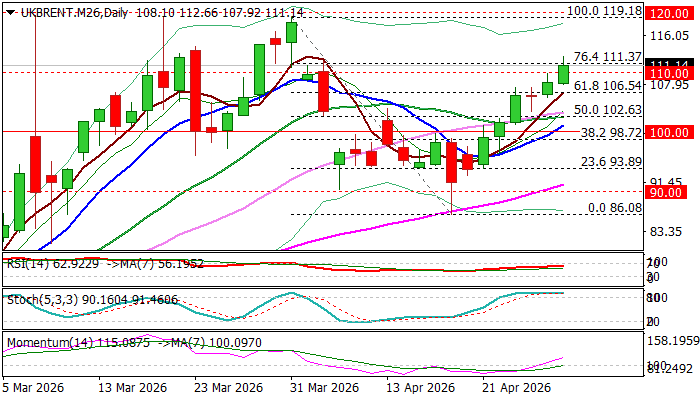
Brent Price Hits One-Month High on Worries Over USA/Iran Peace Talks Stall
Brent oil rose over 4% on Tuesday and hit its highest in almost one month, as growing uncertainty over disappointing signs from Middle East peace talks, with Strait of Hormuz remaining mainly closed and raising fears about stronger negative impact globally, that provides more support to oil prices.
Another shocking news that United Arab Emirates have terminated their membership in OPEC and OPEC+ cartels, partially deflated bulls that could result in consolidation / limited pullback in coming sessions.
Daily studies remain bullish but overbought that may provide some headwinds and keep near term action on hold.
Bulls broke above $110.00 (psychological) and dented $111.37 (Fibo 76.4% of $119.19/$86.08 bear-leg) that brings key barriers at 120 zone (recent peaks) in focus, with limited correction seen as positioning for fresh push higher if geopolitical situation remains unchanged or worsens.
Holding above $110 would provide bulls additional positive impulse, although limited dips below $110 (ideally to be contained above $107.00/$106.50) won’t be harmful for larger bullish picture, but would mark a healthy correction.
Res: 112.66; 114.66; 116.86; 119.18
Sup: 110.00; 107.92; 107.00; 106.54
UAE Quits OPEC! Crude Oil Explodes to $100 – WTI Technical Analysis
- WTI Oil extends its persistent bounce in the absence of any diplomatic advancements, breaking the $100 barrier
- The energy commodity market is seeing its rules change completely, with the UAE quitting OPEC+ as producers prepare for the end of the war
- Exploring an in-depth Technical Analysis of the commodity
It is a pivotal week for global Markets, and after weeks of confusing fundamental catalysts, some regime-changing news is gripping Energy Commodities.
The UAE just announced it will quit the OPEC+ cartel amid a sharp rise in Oil prices, now above $100 per barrel.
The OPEC+ organization aims to regulate Crude production and prices for mutual interests, but with the Middle East conflict completely changing the rules of the game, the regime installed in 1960 is progressively tumbling.
The cartel, now left with 11 members (+ Russia), notably including Venezuela and Iran, has seen large challenges in recent years with production disagreements, internal foul plays, some members not respecting their quotas and limits.
The idea is that the most powerful producing countries had already begun to try to price out smaller producers through overproduction and price declines, a trend seen in 2025, which brought Oil prices to 5-year lows.
And this already led to the exit of Indonesia, Qatar, and others in recent years.
Add to this the largely divided geopolitics of recent years, with decades of peace turning into global instability, and you get the recipe for some Market-breaking news.
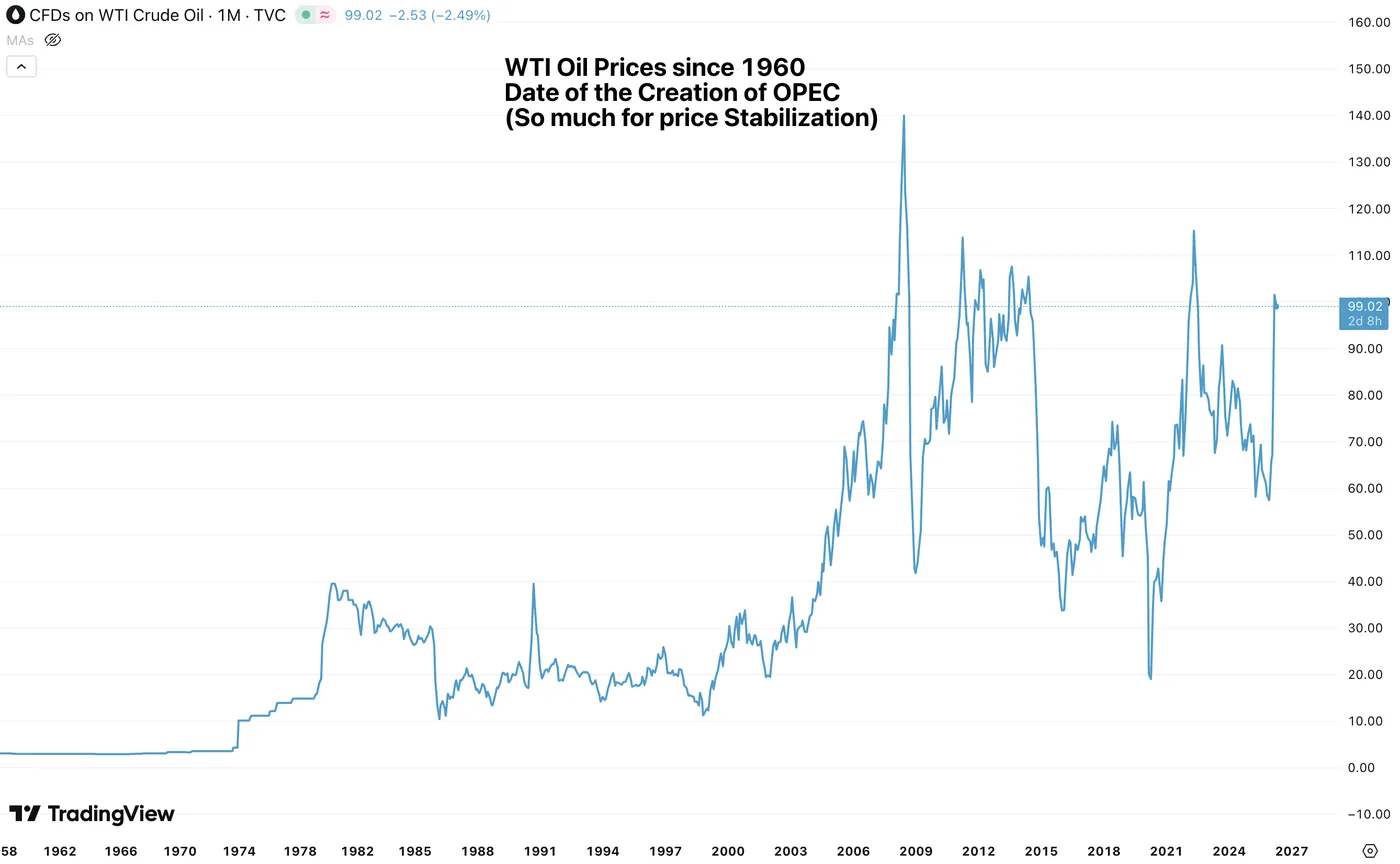
WTI Crude since 1960, the formation of OPEC – Source: TradingView. April 28, 2026
The Iran war is priced to end in recent months, if not weeks, and in the macroeconomic game, there is no place for those who don't prepare.
If and when Iran turns in for a deal, there will be blood in the Market.
While the diplomatic attempts and news are still in a stalemate, with the US maintaining its blockade on the Strait of Hormuz to chokehold Iran's economy, the World is still operating, and Oil producers are progressively preparing for what comes next.
Trump just posted that Iran was pleading for the US to reopen the Strait promptly to move on to the next phase of the negotiations.
And it seems that a large pumping frenzy will reward those who are isolating themselves from quotas and limits – see what's already happening in the US and Canada, and they are largely winning from these Middle East dynamics.
With changing fundamentals, the Market is in a repricing mode and is subject to high volatility.
Let's dive into a multi-timeframe analysis of WTI (US) Oil to determine levels of interest and put the odds in the trader's favor to capitalize on the issue.
US Oil Intraday Timeframe Analysis
WTI 4H Chart and Technical Levels
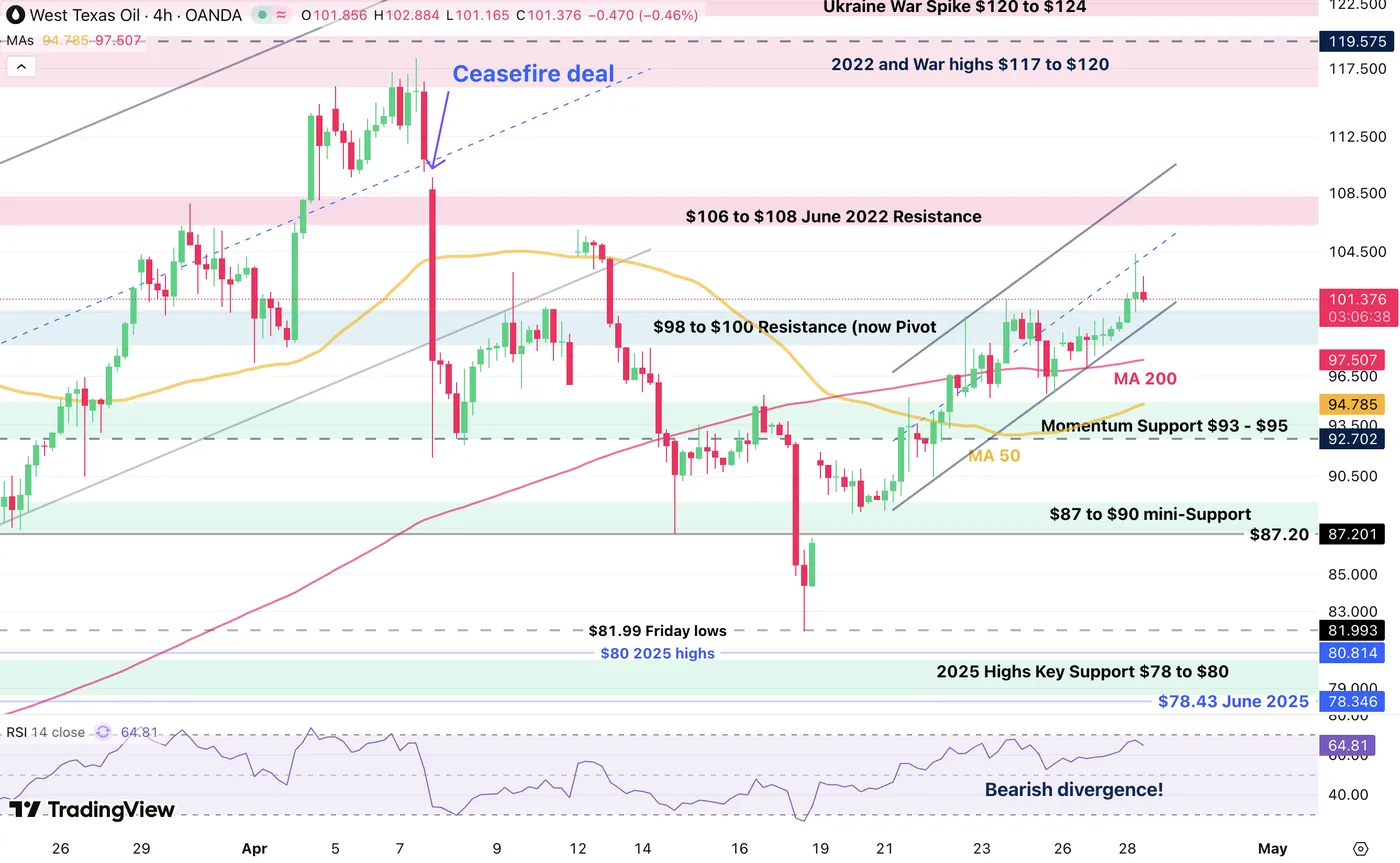
WTI Oil 4H Chart – April 28, 2026. Source: TradingView
WTI rallied frantically since its Friday 17th spike down to $82, now trading 23% higher as supply droughts persist and the geopolitical cloud fails to dissipate.
While conditions allowed for a grind higher, at current levels, there doesn't seem to be much interest for bulls to extend the action higher, particularly after the recent news brought an end to the move-up.
Check out the large bearish divergence which may confirm an end to this ongoing rally.
Explore the trading levels, then take a closer look to the 1H timeframe for a few scenarios.
WTI Technical Levels:
Resistance Levels
- $104 next-mini resistance (morning highs!)
- $106 to $108 June 2022 Resistance
- 2022 and Monday highs $117 to $120 (larger channel top)
- Ukraine War Spike $120 to $124
Support Levels
- $98 to $100 Resistance (now Pivot)
- 4H 50-period MA $97.30
- War Support $93.00 - $95
- $82 Friday 17 lows
- 2025 Highs Key Support $78 to $80
1H Chart and action levels
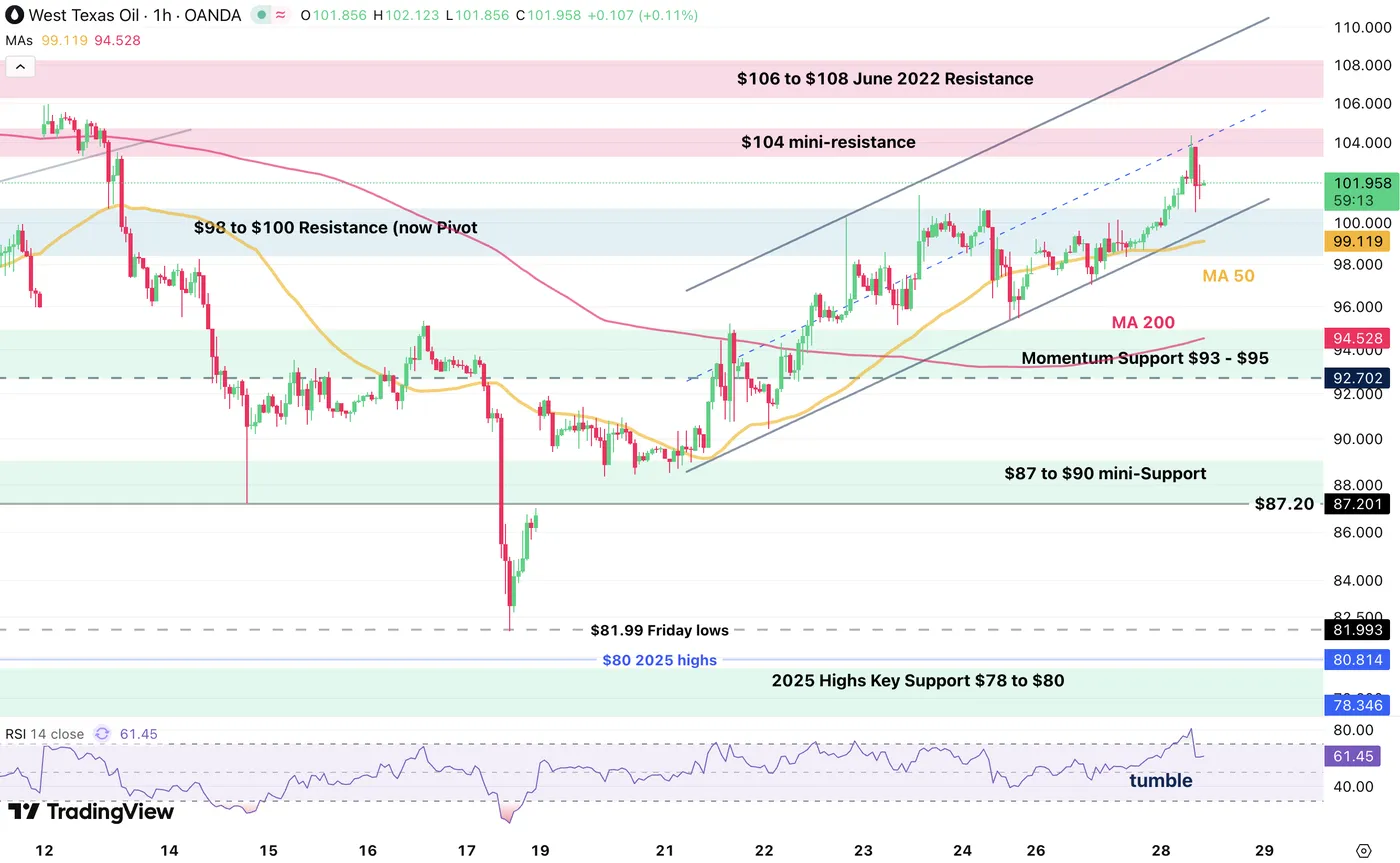
WTI Oil 1H Chart – April 28, 2026. Source: TradingView
Crude has formed an upward channel in recent action, but the most important development to watch is the fact that bulls could not push above its central line, hence maintaining weak momentum.
This hints at higher odds of a downside break, with confirmation below the 50-Hour MA ($99.13).
Breaking the channel should maintain a rangebound price action between ~$93 and $103
Any break and close above/below these areas suggest of renewed volatility and changing dynamics, necessitating further analysis.
Safe Trades and Keep your eyes on the news!
Sunset Market Commentary
Markets
Bank of Japan governor Ueda’s press conference contrasted with the hawkish hold coming out of the split vote and the new monetary policy rate. Three out of nine BoJ-members voted to raise the policy rate by 25 bps to 1%, up from only one in March. CPI ex fresh food forecasts faced upward revisions for FY 2026 and FY 2027, from respectively 1.9% to 2.8% and from 2% to 2.3%. The first projection for FY 2028 stands at 2%. Core CPI (excluding fresh food and energy) is now seen at 2.6% (from 2.2%), 2.6% (from 2.1%) and 2.2%. Upside risks remain. While Ueda suggested that the price acceleration would last longer than the economic slowdown, he failed to provide a clear-cut path for a June rate hike. It's an open secret that the central bank closely communicates with the government, but Ueda stressed independence. PM Takaichi is an open supporter of the Abenomics combo of both stimulative fiscal and monetary policy. A rate hike (towards neutral) is possible if the economy doesn’t have a big slowdown. New GDP forecasts only faced a downward revision for the current fiscal year, from 1% to 0.5%, with projections for the next two years at 0.7% and 0.8%. The market implied probability for a June move by the BoJ remained unchanged at 65%. JPY reversed small initial gains during Ueda’s presser, rebounding back from 159 to 159.80.
The ECB’s March consumer expectation survey grabbed attention. Median expectations for inflation over the next 12 months spiked from 2.5% to 4% (vs 2.8% consensus), the highest level since October 2023 and to be compared with a 5.8% peak in October 2022. Expectations for inflation three years ahead, the ECB’s policy horizon, moved from 2.5% to 3% (vs 2.6% consensus). Since the start of the survey early 2022, expectations on this horizon were only (marginally) higher in that same October 2022 month (3.1%). Inflation expectations for five years ahead ticked from 2.3% to 2.4%, a series high. After last week’s April PMI’s, it’s a second worrying signal for the ECB from a price perspective. The clock ticks against central banks with time being a (price) catalyst. Notice that this month’s developments won’t bode well for the April consumer survey. Core bond yield curve bear flattened as a result with Europe underperforming. Daily changes at the German curve currently vary between +1.5 bps (30-yr) and +6.3 bps (2-yr). At one stage, the front end of the curve gained almost 10 bps as markets embraced the prospect of a hawkish central bank reaction function. In the meantime, Brent crude prices continue to creep higher as the high stakes game-of-chicken between the US and Iran continues. Neither party wants to blink first with Iran taking energy prices hostage and the US trying to squeeze Iran’s economy. Brent crude passed the $110/b mark for the first time since April 7. The unprecedented decision by the UAE to leave OPEC and OPEC+ from May 1st only very briefly halted the uptrend. OPEC’s third biggest producer and member since 1967 is looking to raise production and chase market share, and only adds to the ongoing reshaping of energy markets caused by the US/Israeli war against Iran.
News & Views
EMU banks reported a further net tightening of credit standards for loans or credit lines to firms (net percentage of banks of 10%), the ECB’s Q1 Bank Lending Survey revealed today. The larger than expected tightening was the most pronounced since 2023Q3 and extended a trend that began in mid-2025. Perceived risks to the economic outlook and a lower risk tolerance were the main contributing factors. There was a small, in-line-with-expectations net tightening of credit standards for housing loans. Credit standards for consumer credit meanwhile tightened further and more than anticipated. Banks expect standards in all categories to become more restrictive in Q2. Firms loan demand unexpectedly decreased in Q1. Demand for housing loans was unchanged, missing expectations for growth. Consumer credit demand decreased strongly reflecting weaker spending on durable goods and lower consumer confidence. Banks see further loan demand declines across the board for Q2.
The Hungarian central bank (MNB) left the policy rate unchanged at 6.25% today. Inflation rose to 1.8% from 1.4% in March and is expected to continue to rise this year as high energy prices pass through. The MNB noted that the recently stronger Hungarian forint following the parliamentary elections and the accompanying declining risk premia would moderate the rate of inflation. It nevertheless expects headline CPI to be above the tolerance band from 2026Q3 before returning to target in 2027H2. The MNB advocates a careful and patient approach to monetary policy in light of inflation risks arising from geopolitical tensions and the uncertain financial market environment. Maintaining tight monetary conditions remains warranted in achieving price stability. The Hungarian forint trades little changed around EUR/HUF 365 with the MNB refraining from any rates guidance.