Sample Category Title
USD/JPY Mid-Day Outlook
Daily Pivots: (S1) 152.78; (P) 153.08; (R1) 153.58; More...
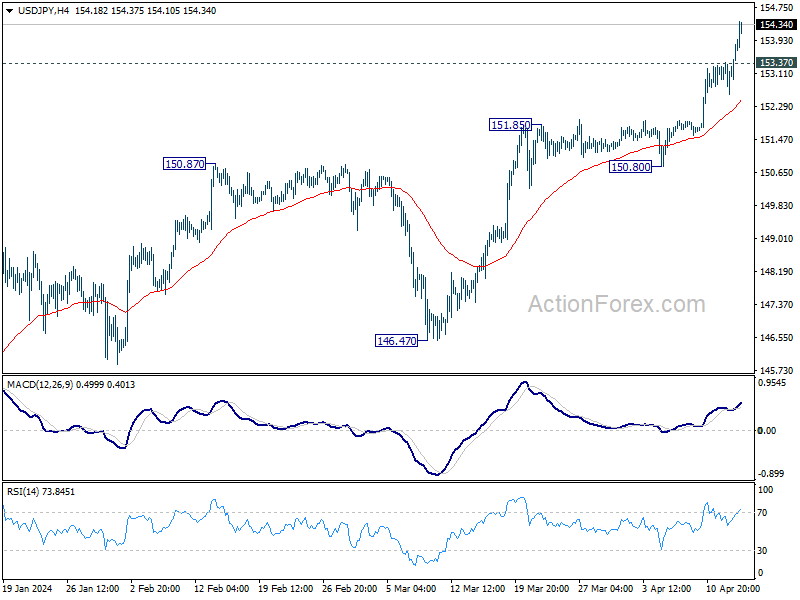
Intraday bias in USD/JPY remains on the upside at this point. Current up trend is in progress for 155.20 fibonacci projection level next. On the downside, below 153.37 minor support will turn intraday bias neutral and bring consolidations again, before staging another rally.
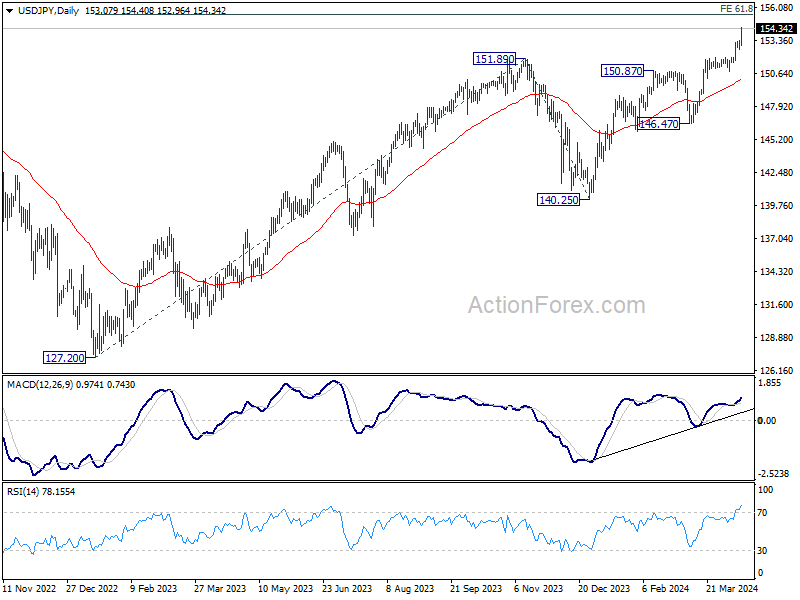
In the bigger picture, current rise from 140.25 is seen as the third leg of the up trend from 127.20 (2023 low). Next target is 61.8% projection of 127.20 to 151.89 from 140.25 at 155.20. Outlook will now remain bullish as long as 146.47 support holds, even in case of deep pullback.
U.S. Retail Sales Rebound in February
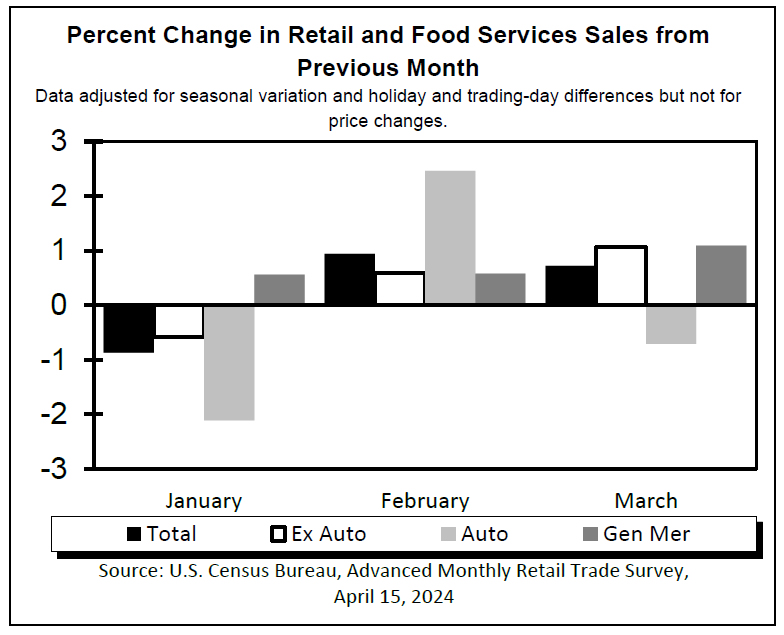
Retail sales rose by 0.7% month-on-month (m/m) in March, adding to February's upwardly revised 0.9 % gain (previously 0.6%). The increase was higher than the consensus forecast calling for a more modest increase of 0.4%
Trade in the auto sector was down -0.7% m/m, reflecting a decline at motor vehicle dealers (-0.9%), which was only partly offset by an increase in sales at automotive parts and accessory stores (1.9%).
Sales at gasoline stations rose a sizeable by 2.1% m/m, largely reflecting an uptick in gas prices. The building materials and equipment category rose a more modest 0.7% m/m.
Sales in the retail sales "control group", which excludes the above volatile components (autos, building materials and gas) and is used to estimate personal consumption expenditures (PCE), rose significantly on the month (1.1%) after rising by 0.3% m/m in February (revised from 0% previously).
- Among the control group, the largest positive contributions came from non-store retailers (2.7% m/m), miscellaneous store retailers (2.1% m/m) and department stores (1.1% m/m).
- The largest declines were at sporting goods stores (-1.8% m/m) and clothing and accessory stores (-1.6% m/m).
Food services & drinking places – the only services category in the retail sales report – rose by 0.4% m/m.
Key Implications
Once again U.S. consumers showed resilience by boosting retail spending in March and closing out the first quarter on an upswing. With sales picking up in the last two months, it was just sufficient to overcome the steep decline (-0.9%) in January. As such retail spending finished out Q1 with a marginal increase of 0.2% q/q (annualized). This is a sizeable step down from a 2.3% gain in Q4 2023. As the labor market continues to rebalance in 2024 and wage gains cool, spending is expected to follow a similar path.
That said, given the recent string of hotter-than-expected CPI inflation readings, Fed policymakers are unlikely to welcome the continued showing of resilient consumer spending evident in today's report. Worth watching is the strength of spending in the control group as this could show up in higher PCE spending. As FOMC members have noted on numerous occasions, the bar to cut rates depends on signs that inflation is moving sustainably toward two percent. While price movements on the goods side of the economy have been relatively tame, continued strong retail spending could upend that. As it stands, our call is currently for a July cut, but continued inflation persistence poses a risk to this view.
GBP/USD Mid-Day Outlook
Daily Pivots: (S1) 1.2396; (P) 1.2481; (R1) 1.2535; More...
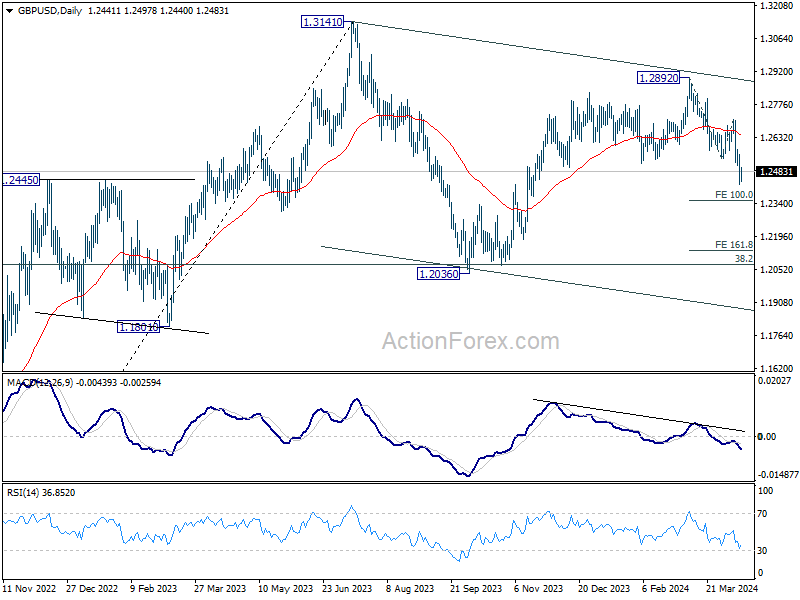
Intraday bias in GBP/USD is turned neutral with 4H MACD crossed above signal line. Some consolidations would be seen first, but recovery should be limited by 1.2577 minor resistance to bring another fall. On the downside, break of 1.2425 will resume the decline from 1.2892 to 100% projection of 1.2892 to 1.2538 from 1.2708 at 1.2354. Firm break there will target 161.8% projection at 1.2207 next.
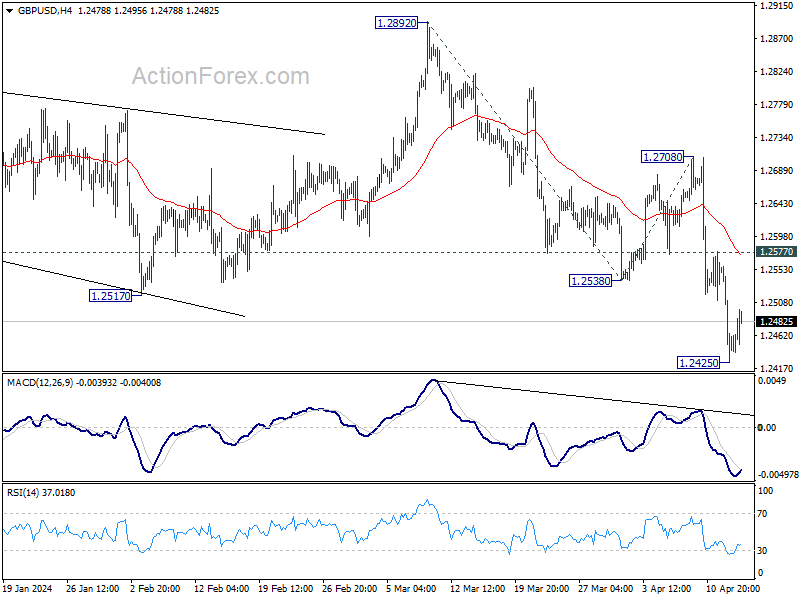
In the bigger picture, price actions from 1.3141 medium term top are seen as a corrective pattern to up trend from 1.0351 (2022 low). Fall from 1.2892 is seen as the third leg. Deeper decline would be seen to 1.2036 support and possibly below. But strong support should emerge from 61.8% retracement of 1.0351 to 1.2452 at 1.1417 to complete the correction.
Strong Retail Sales Spur Brief Dollar Bounce; More Consolidations First?
Dollar bounces slightly in early US trading following unexpectedly strong retail sales data. However, there is no clear follow through buying in the greenback for now. The only exception is USD/JPY which continues to make new 34-year highs. Against others, Dollar might extend its consolidation phase for a while longer, as the impact from rising treasury yields is offset by rebound in risk sentiment.
Despite improvements in Eurozone industrial production, Euro remains under pressure. ECB officials have presented a divided front, reflecting varying degrees of enthusiasm for ongoing monetary policy easing. While there is a general consensus on a prospective rate cut in June, the council is split on the path forward. Doves like ECB member Gediminas Simkus has voiced support for additional easing post-June. However, other members have adopted a more cautious approach, reluctant to commit to further actions beyond the initial rate cut.
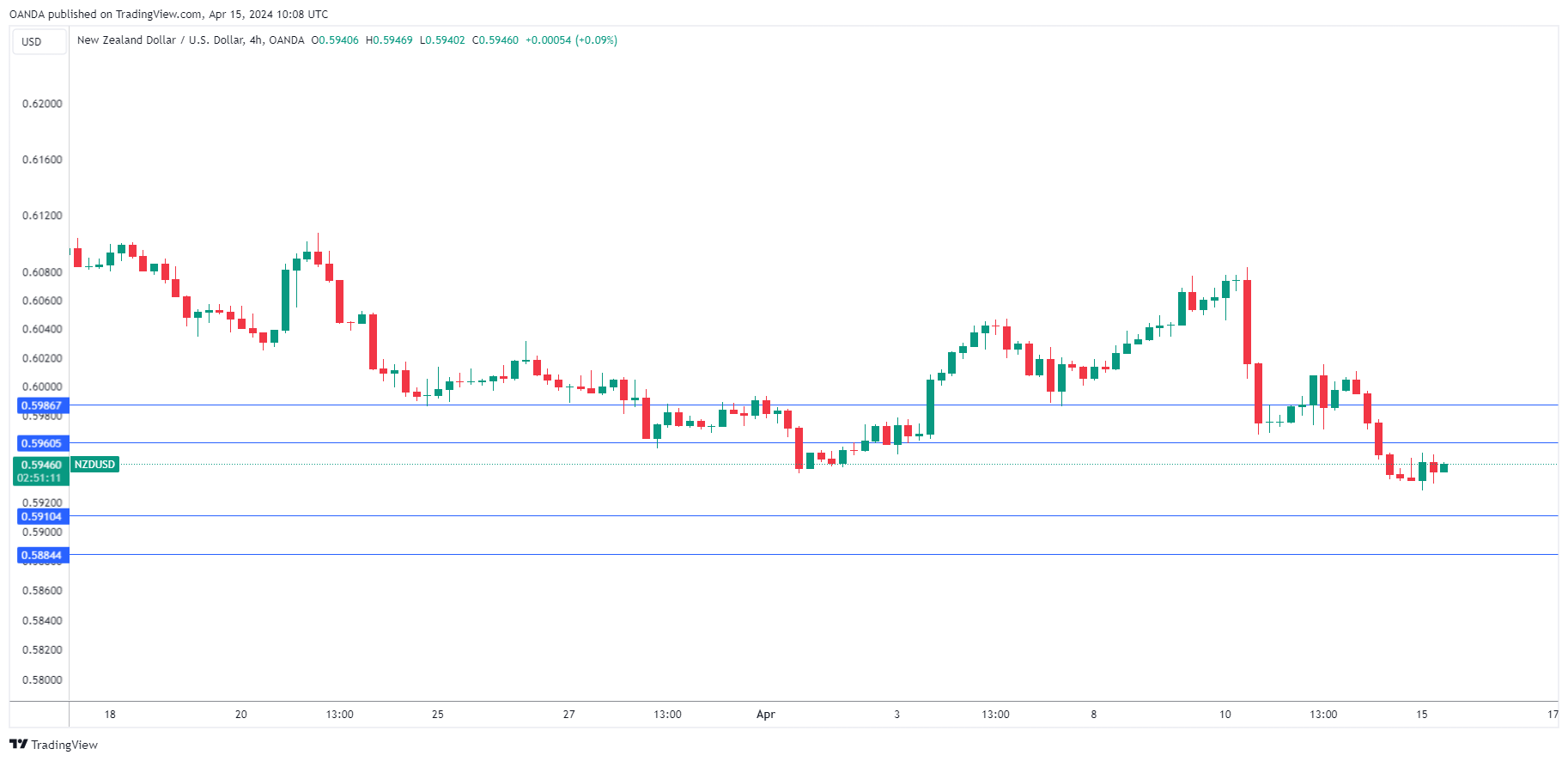
In broader currency market movements, New Zealand Dollar trails Yen as the second weakest currency, adversely affected by disappointing service sector data. Conversely, Canadian Dollar leads as the strongest, with Australian Dollar and Sterling also showing robust performance. US Dollar holds a middle position awaiting range breakout.
In Europe, at the time of writing, FTSE is up 0.04%. DAX is up 1.32%. CAC is up 1.24%. UK 10-year yield is up 0.070 at 4.211. Germany 10-year yield is up 0.0654 at 2.424. Earlier in Asia, Nikkei fell -0.79%. Hong Kong HSI fell -0.72%. China Shanghai SSE rose 1.26%. Singapore Strait Times fell -1.09%. Japan 10-year JGB yield fell -0.0005 to 0.866.
US retail sales rises 0.7% mom in Jun, ex-auto sales up 1.1% mom
US retail sales rose 0.7% mom to 709.6B in June, above expectation of 0.4% mom. Ex-auto sales rose 1.1% mom to USD 575.5B, above expectation of 0.5% mom. Ex-gasoline sales rose 0.6% mom to USD 655.0B. Ex-auto and gasoline sales rose 1.0% mom. to USD 520.9B.
Total sales for the January through March period were up 2.1% from the same period a year ago.
ECB's Lane: Disinflation process necessarily bumpy at current phase
ECB Chief Economist Philip Lane described disinflation process as "necessarily bumpy" at the current phase. In a speech, he pointed out that headline inflation is expected to "fluctuate around current levels in the near term," influenced by base effects in energy sector and recent reversal of service inflation spikes caused by the early timing of Easter.
Meanwhile, Lane noting that while wage pressures are "gradually moderating," they remain above what would be considered normal or steady-state levels. He emphasized that achieving ECB's inflation target involves not just controlling wage growth but also managing profit margins across the economy.
Looking ahead to June Governing Council meeting, Lane indicated that ECB's decisions would be informed by "updated staff projections" and comprehensive data on wage and profit dynamics from the early months of the year. He suggested that if these updated assessments and data provide stronger confidence that inflation is converging to ECB's targets, it could be "appropriate to reduce the current level of monetary policy restriction."
ECB's Kazimir cautions on post-June monetary policy, stresses flexibility
ECB Governing Council member Peter Kazimir highlighted emphasized the importance of maintaining a flexible monetary policy stance beyond an initial rate reduction possibly in June. He underscored that the decision to lower rates in June should be viewed as a recalibration in response to improving economic conditions, rather than a firm commitment to continued easing.
"June is an opportunity to recalibrate our approach in light of improving economic conditions. Let's be clear: We are not pre-committing to a definite path post-June," Kazimir stated.
He elaborated, "Even after the first rate cut, our monetary policy will remain restrictive; it needs to."
Kazimir also addressed the broader implications of easing monetary policy, clarifying that "The notion of easing doesn't imply a commitment to specific future cuts but rather an openness to respond in kind, should the economic data advocate for it."
Moreover, Kazimir cautioned about the vulnerability of the economy to unexpected shocks, emphasizing the necessity for ECB to maintain its agility in policymaking.
ECB's Simkus anticipates three rate cuts this year, possibly four
ECB Governing Council member Gediminas Simkus forecasted three 25bps rate cuts for this year, with a potential for a fourth. "I see a higher than 50% chance there will be more than three cuts this year," he told reporters.
Simkus also highlighted that the ECB might not stop at just one rate cut in June, stating, "I see a higher than zero chance that an interest rate cut may follow also in July. The July decision will be important in setting the trajectory."
Regarding the pace and magnitude of these rate cuts, Simkus emphasized a cautious approach. He remarked that there is "no urgency to cut rates" by more than 25bps at a time, indicating he preference for gradual adjustments rather than larger, more aggressive cuts.
Eurozone industrial production rises 0.8% mom in Feb, EU up 0.7% mom
Eurozone industrial production rose 0.8% mom in February, matched expectations. Production increased by 0.5% for intermediate goods, 1.2% for capital goods, and 1.4% for durable consumer goods. On the other hand, production by -3.0% for energy, and -0.9% for non-durable consumer goods.
EU industrial production rose 0.7% mom. The highest monthly increases were recorded in Ireland (+3.8%), Hungary (+3.5%) and Slovenia (+3.3%). The largest decreases were observed in Croatia (-4.6%), Lithuania (-3.0%) and Belgium (-2.7%).
NZ BNZ services plummets to 47.5, signaling over 2% GDP contraction
New Zealand's service sector saw a significant downturn in March, as evidenced by BusinessNZ Performance of Services Index, which fell sharply from 52.6 to 47.5. This decline places the index back in contraction territory, and well below its long-term average of 53.4.
The components of the PSI painted a concerning picture: activity and sales saw a steep decline from 52.4 to 44.8. While employment showed a slight improvement, rising marginally from 49.4 to 50.1, new orders and business fell significantly from 55.5 to 48.3. Stocks and inventories also dropped from 52.2 to 46.9, and supplier deliveries was stagnant at 48.7.
Business sentiment mirrored these negative trends, with proportion of negative comments rising sharply to 63.0% in March, up from 57.3% in February and 53.0% in January. Respondents frequently cited ongoing recession and persistent inflationary pressures, including rising costs of living, as key factors impacting their operations.
BNZ Senior Economist Doug Steel stated, "Combining today's weak PSI activity with last week's similarly weak PMI activity, yields a composite reading that would be consistent with GDP falling by more than 2% compared to year-earlier levels. That is much weaker than what folk are forecasting."
GBP/USD Mid-Day Outlook
Daily Pivots: (S1) 1.2396; (P) 1.2481; (R1) 1.2535; More...
Intraday bias in GBP/USD is turned neutral with 4H MACD crossed above signal line. Some consolidations would be seen first, but recovery should be limited by 1.2577 minor resistance to bring another fall. On the downside, break of 1.2425 will resume the decline from 1.2892 to 100% projection of 1.2892 to 1.2538 from 1.2708 at 1.2354. Firm break there will target 161.8% projection at 1.2207 next.
In the bigger picture, price actions from 1.3141 medium term top are seen as a corrective pattern to up trend from 1.0351 (2022 low). Fall from 1.2892 is seen as the third leg. Deeper decline would be seen to 1.2036 support and possibly below. But strong support should emerge from 61.8% retracement of 1.0351 to 1.2452 at 1.1417 to complete the correction.
Economic Indicators Update
| GMT | Ccy | Events | Actual | Forecast | Previous | Revised |
|---|---|---|---|---|---|---|
| 22:30 | NZD | Business NZ PSI Mar | 47.5 | 53 | 52.6 | |
| 23:50 | JPY | Machinery Orders M/M Feb | 7.70% | 0.80% | -1.70% | |
| 06:30 | CHF | Producer and Import Prices M/M Mar | 0.10% | 0.20% | 0.10% | |
| 06:30 | CHF | Producer and Import Prices Y/Y Mar | -2.10% | -2.00% | ||
| 09:00 | EUR | Eurozone Industrial Production M/M Feb | 0.80% | 0.80% | -3.20% | |
| 12:30 | CAD | Manufacturing Sales M/M Feb | 0.70% | 0.70% | 0.20% | |
| 12:30 | CAD | Wholesale Sales M/M Feb | 0.00% | 0.80% | 0.10% | |
| 12:30 | USD | Empire State Manufacturing Index Apr | -14.3 | -9 | -20.9 | |
| 12:30 | USD | Retail Sales M/M Mar | 0.70% | 0.40% | 0.60% | |
| 12:30 | USD | Retail Sales ex Autos M/M Mar | 1.10% | 0.50% | 0.30% | |
| 14:00 | USD | Business Inventories Feb | 0.30% | 0.00% | ||
| 14:00 | USD | NAHB Housing Market Index Apr | 52 | 51 |
ECB’s Lane: Disinflation process necessarily bumpy at current phase
ECB Chief Economist Philip Lane described disinflation process as "necessarily bumpy" at the current phase. In a speech, he pointed out that headline inflation is expected to "fluctuate around current levels in the near term," influenced by base effects in energy sector and recent reversal of service inflation spikes caused by the early timing of Easter.
Meanwhile, Lane noting that while wage pressures are "gradually moderating," they remain above what would be considered normal or steady-state levels. He emphasized that achieving ECB's inflation target involves not just controlling wage growth but also managing profit margins across the economy.
Looking ahead to June Governing Council meeting, Lane indicated that ECB's decisions would be informed by "updated staff projections" and comprehensive data on wage and profit dynamics from the early months of the year. He suggested that if these updated assessments and data provide stronger confidence that inflation is converging to ECB's targets, it could be "appropriate to reduce the current level of monetary policy restriction."
US retail sales rises 0.7% mom in Jun, ex-auto sales up 1.1% mom
US retail sales rose 0.7% mom to 709.6B in June, above expectation of 0.4% mom. Ex-auto sales rose 1.1% mom to USD 575.5B, above expectation of 0.5% mom. Ex-gasoline sales rose 0.6% mom to USD 655.0B. Ex-auto and gasoline sales rose 1.0% mom. to USD 520.9B.
Total sales for the January through March period were up 2.1% from the same period a year ago.
ECB’s Kazimir cautions on post-June monetary policy, stresses flexibility
ECB Governing Council member Peter Kazimir highlighted emphasized the importance of maintaining a flexible monetary policy stance beyond an initial rate reduction possibly in June. He underscored that the decision to lower rates in June should be viewed as a recalibration in response to improving economic conditions, rather than a firm commitment to continued easing.
"June is an opportunity to recalibrate our approach in light of improving economic conditions. Let's be clear: We are not pre-committing to a definite path post-June," Kazimir stated.
He elaborated, "Even after the first rate cut, our monetary policy will remain restrictive; it needs to."
Kazimir also addressed the broader implications of easing monetary policy, clarifying that "The notion of easing doesn't imply a commitment to specific future cuts but rather an openness to respond in kind, should the economic data advocate for it."
Moreover, Kazimir cautioned about the vulnerability of the economy to unexpected shocks, emphasizing the necessity for ECB to maintain its agility in policymaking.
Euro Ends Slide as Industrial Production Rebounds
The euro has stabilized on Monday after sustaining sharp losses on Friday. In the European session, EUR/USD is trading at 1.0656, up 0.14%. The US dollar posted strong gains last week against the majors and surged 1.8% against the euro, which fell to a six-month low.
Eurozone industrial production rebounded 0.8% m/m in February following a 3% decline in January and matching market expectations. This could point to a turnaround in industrial production, which has been struggling. On an annualized basis, industrial production fell by 6.4%.
ECB’s Simkus projects three rate cuts
The ECB held the cash rate at 4.5% last week for a fifth straight time. The central bank has maintained a cautious stance of “higher for longer” but signaled at the March meeting that a June cut was on the table. On Monday, ECB Governing Council member Gediminas Simkus projected a higher than 50% chance of three more cuts this year. This is close to market expectations as the markets have priced in 85 basis points in cuts this year.
In the US, inflation has accelerated for two straight months, a reminder that the Fed will not have an easy time getting inflation back down to the 2% target. On Friday, UoM 1-year inflation expectations rose to 3.1% in April, up from 2.9% in March and the highest in four months. The economy remains surprisingly strong and last month’s nonfarm payrolls surged with a gain of 303,000, well above expectations.
The markets have responded to the strong data by paring expectations of a rate cut. A July hike is a 50/50 toss-up and a September cut, which just a week ago was an 89% probability, has dropped to 70%, according to the CME FedWatch tool.
EUR/USD Technical
- EUR/USD tested resistance at 1.0665 earlier. The next resistance line is 1.0708
- 1.0599 and 1.0556 are providing support
US Dollar Exhibits Remarkable Strength Amid Global Tensions
The EUR/USD pair has experienced a notable decline, currently stabilising around 1.0648. Last week, the pair recorded its most significant weekly gain since 2022, fuelled by the anticipation of persistently high interest rates in the US and escalated conflicts in the Middle East.
The US dollar appreciated by 1.6% over the week against a basket of six major currencies, reaching another 34-year high against the Japanese yen and experiencing its most substantial weekly increase against the British pound since July 2023.
Recent US inflation data and the Federal Reserve's cautious stance have tempered expectations for substantial interest rate cuts this year. Initially, six cuts were anticipated at the start of the year, reduced to three in early April, and now just two cuts are forecasted. In contrast, European monetary authorities have hinted at potential rate cuts within the coming months.
Market expectations for the first Fed rate cut have shifted from June to September, reflecting ongoing concerns about inflation and uncertainty about whether the economic environment will support easing monetary policies soon. Additionally, the disputes in the Middle East have bolstered the safe-haven appeal of the US dollar, further supporting its strength.
EUR/USD technical analysis
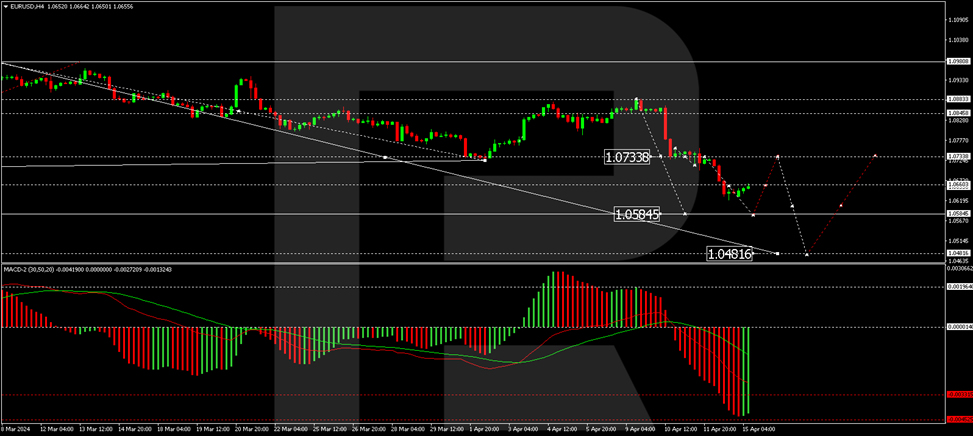
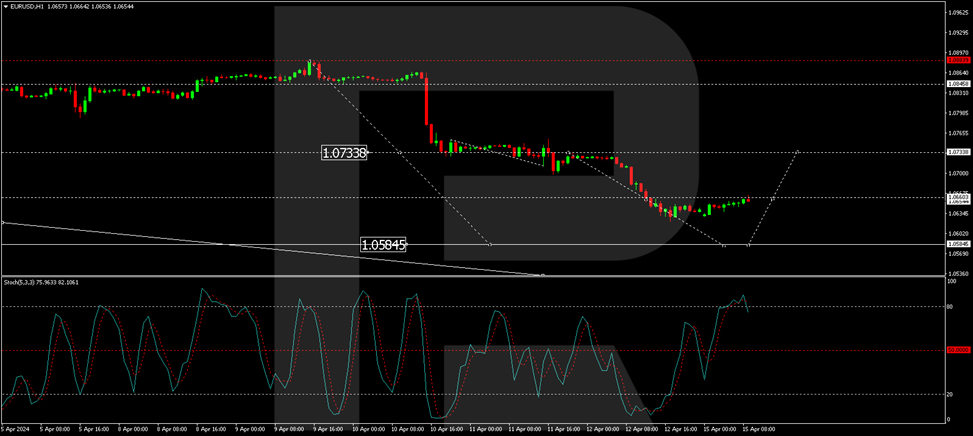
On the H4 chart of EUR/USD, the pair formed a consolidation range around 1.0733 before beginning a downward wave to 1.0622. A new consolidation range is currently forming above this level. An upward exit from this range could lead to a corrective move towards 1.0733. Conversely, a downward exit might signal a continuation of the decline to 1.0585. The MACD indicator, with its signal line below zero and directed downwards, supports this bearish scenario.
The H1 chart shows ongoing development in the downward wave towards 1.0585. After completing a rise to 1.0622, the market is currently correcting to 1.0660. Following this correction, a further decline to 1.0585 is anticipated. This bearish outlook is confirmed by the Stochastic oscillator, currently above 80, with an expected fall to the 20 mark, indicating potential for further declines.
US 500 Reverses Towards 123.6% Fibonacci
- US 500 cash index experiences a minor pullack
- Meets support at 123.6% Fibo extension of its 2022 downtrend
- Oscillators exit overbought zones, but do not weaken dramatically
The US 500 stock index (cash) has been staging an impressive rally since it bottomed out in October 2023, generating consecutive all-time highs. Although the price has been experiencing a setback in the past two weeks, it’s still too early to call for a sustained downside correction.
Should bearish pressures persist, the index could challenge 5,130, which is the 123.6% Fibonacci extension of the 4,817-3,489 downtrend. Slicing through that hurdle, the price may descend towards the 2021 peak of 4,817, which could serve as support in the future. Even lower, the 78.6% Fibo of 4,533 could provide downside protection.
In case the bulls regain the upper hand, the recent record high of 5,281 could come under scrutiny. Further advances could then cease around the 138.2% Fibo of 5,324. A break above that zone could pave the way for the 150.0% Fibo of 5,481, which lies very close to the 4,500 psychological zone.
Overall, the US 500 index has been facing some downside pressures in the near-term as its advance had gotten extremely overstretched. Is this a temporary pullback or the start of a strong downside correction?