

Sample Category Title
Cliff Notes: Labour Market Offers Hope for the Medium Term
Key insights from the week that was.
In Australia, the week began with another sombre update on confidence. The Westpac-MI Consumer Sentiment Index returned to deeply pessimistic levels, down 2.6% to 79.9. The RBA’s decision to raise the cash rate was a key factor, as evinced by the sharp fall in sentiment between those surveyed before the decision (83.0) and after (78.2). Cost-of-living pressures and renewed concerns over interest rates point to weak holiday season spending; 40% of households plan to spend less on gifts this Christmas than last. This result is consistent with the family finances and spending on ‘major household items’ sub-indexes being well below long-run average levels.
The labour market remains a bright-spot amid a gloomy outlook, however. The October labour force survey reported that employment increased by 55,000 (0.4%) in the month and hours worked gained 0.5%. Temporary hiring associated with the 2023 Australian Indigenous Voice referendum may have provided support, but the impact is uncertain.
What remains clear, however, is that Australia’s migration boom continues to expand the labour force, the participation rate returning to its post-WWI record high of 67.0% in October, seeing the unemployment rate rise to 3.7% even as employment grew above trend. In the months ahead, a further softening in hours worked is likely before employment experiences a material slowdown below trend.
In-step with the resilience of the labour market, wage outcomes also remain supportive. Q3’s 1.3% lift in the wage price index was in line with expectations, but the composition offered some surprises. A larger-than-expected contribution from awards and enterprise bargaining – a consequence of the minimum wage and aged care wage decisions as well as CPI indexation – was offset by a softer outcome from individual bargaining, a segment which tends to be more reactive to labour demand/ supply.
This detail suggests upside risks for aggregate wage growth are limited, increasing the probability of the RBA being able to achieve their aim of preserving the gains made on unemployment since the pandemic while bringing inflation under control – a topic discussed by Westpac Chief Economist Luci Ellis this week.
The latest NAB business survey also continued to report welcome progress regarding inflation. Following a sharp moderation in September, momentum in purchase costs, labour costs and final product prices all continued to ease in October, albeit at a slower pace. These results are within the context of a step-down in business conditions from last year (+13 vs. +25) and weakness in business confidence, the current level below the long-run average (–2 vs. +5).
Moving offshore, US consumer prices were flat in October against expectations for a 0.1% gain, leaving annual inflation at 3.2%yr from 3.7%yr in September. Falling oil prices were the primary cause of the deceleration in the month, although core prices also came in below expectations at 0.2%. Within the core basket, goods prices have, at the margin, declined for five consecutive months. Disinflation also looks to be broadening through services ex-shelter, indicating softer consumer demand and business pricing power. As shelter retreats in coming months, the FOMC’s 2.0%yr will come within reach, likely mid-2024.
Retail sales meanwhile were broadly as expected in October, roughly flat for the month and up 2.7%yr. 2023’s pattern has been periods of strength followed by a lull. If we are right in expecting GDP growth to slow below trend, sales growth will remain weak through year-end without another acceleration. Savings, real income growth and uncertainty over the outlook are all headwinds.
Despite these developments, commentary from FOMC members remains cautious. Chicago Fed President Goolsbee highlighted the importance of rents to the next leg down in inflation, while San Francisco Fed President Mary Daly warned against prematurely claiming victory over inflation. To manage risks, it is prudent for the FOMC to support term interest rates around current levels into the new year when, on the current trend, the CPI will be much closer to target.
UK consumer prices were also flat in October. Benefitting from 2022’s high base – established by strong energy and fuel prices before subsidies took effect – annual inflation also jolted lower in October from 6.7% to 4.6%. Outside energy, substantial progress has been made with goods disinflation; however, services inflation remains sticky, contributing 3.0ppts to the CPI, i.e. two thirds of headline inflation, only 0.2ppts less than September. The Bank of England has said they expect services inflation to remain robust for some time. A meaningful turn must materialise before rates can be cut. Enduring strength in wage growth adds to the uncertainty regarding services inflation. Over the year to September, total wages rose 7.9%yr.
Coming back to Asia, China’s October activity data was again mixed. Base effects were favourable for retail sales, the pulse of recent months solid but not strong, 6.9%ytd. Fixed asset investment growth meanwhile continues to be held down by weakness in the property sector, respectively 2.9% and –9.3%ytd. The underlying detail of fixed asset investment ex property remains very positive though, with growth in infrastructure and manufacturing investment holding up. Rumours of significant support for the property sector offer the promise of more balanced investment and improving sentiment amongst households and businesses in 2024 if delivered on by authorities. Our expectation of 5.3% growth in 2023 and 2024 depends on further effective stimulus in the months ahead.
Finally, Japanese GDP fell 0.5%qtr in Q3 driven by weakness in domestic demand. Household consumption declined 0.1%qtr following a 0.9%qtr decline in Q2. Exports increased another 0.5%qtr after a substantial 3.9%qtr increase in Q2, but strength in imports offset much of this gain. These results argue for accommodative fiscal and monetary policy to help mitigate the loss of lost purchasing power experienced by households due to inflation.
BoJ’s Ueda reiterates patience in maintaining ultra-loose policy
BoJ Governor Kazuo Ueda has once again underscored the central bank's commitment to maintaining its ultra-loose monetary policy, emphasizing the need for patience in the face of uncertain inflation dynamics.
Speaking to the parliament, Ueda noted, "Trend inflation is likely to gradually accelerate toward our 2% inflation target through fiscal 2025. But this needs to be accompanied by a positive wage-inflation cycle."
"Uncertainty on whether Japan will see such a positive wage-inflation cycle is high," he added.
Addressing the behavior of 10-year JGB yields, Ueda expressed that he does not foresee a sharp rise above the 1% reference level, even under upward pressure.
Looking ahead, Ueda clarified the bank's position on potentially ending its Yield Curve Control and negative interest rate policies, stating, "We will consider ending YCC, negative rate if we can expect inflation to stably, and sustainably hit the price target."
He added that the order of adjustments to the policy would be contingent on various factors, including economic conditions, price movements, and market developments.
Mester’s perspective from Fed’s crow’s nest: Disinflation progress made, yet more evidence needed
In a CNBC interview overnight, Cleveland Fed President Loretta Mester acknowledged, "We're making progress on inflation, discernible progress. We need to see more of that."
But she also highlighted the necessity of observing more concrete data to confirm that inflation is indeed on a timely path back to the desired level.
In her metaphorical reference to the "crow's nest", a vantage point on a ship used for spotting distant objects, Mester likened Fed's current position.
"We're at the crow's nest. What does the crow's nest let you do? It lets you look out on the horizon and see where the data is coming in, where the economy is evolving."
As for her personal stance on the direction of monetary policy, "I haven't assessed that yet. Where I think we are right now is we're basically in a very good spot for policy."
Fed’s Cook: Soft landing is possible but not assured
Fed Governor Lisa Cook addressed the delicate balance between sustaining economic growth and managing inflation in her conference remarks overnight. Cook acknowledged the possibility of achieving a "soft landing" for the US. economy, highlighting the ongoing disinflationary trends and robust labor market conditions. However, she was quick to note that such an outcome is not guaranteed.
"A 'soft landing' is possible, with continued disinflation and a strong labor market, but it is not assured," Cook stated. She elaborated on the complexities noting, "I see risks as two-sided, requiring us to balance the risk of not tightening enough against the risk of tightening too much."
She also pointed out the current economic resilience, saying, "The economy is still growing and consumers are still spending," which could potentially maintain demand-driven pressures in the market. Such momentum, according to Cook, could keep the economy and labor market tight, consequently slowing the disinflation process.
However, Cook also expressed concern over the potential negative impacts of aggressive policy measures, adding, "But I am also attuned to the risk of an unnecessarily sharp decline in economic activity and employment."
BoE’s Ramsden signals extended period of restrictive monetary policy ahead
BoE's Deputy Governor Dave Ramsden emphasized the need for a prolonged phase of restrictive monetary policy to achieve the central bank's inflation target. Speaking on the future direction of the BoE's approach, Ramsden stated, "Monetary policy is likely to need to be restrictive for an extended period of time."
Ramsden further elaborated on the Monetary Policy Committee's stance, noting, "The MPC have communicated that monetary policy will need to be sufficiently restrictive for sufficiently long to return inflation to the 2% target sustainably in the medium term."
Additionally, Ramsden, who oversees BoE's quantitative tightening program, discussed the uncertainty surrounding the optimal size of the central bank's balance sheet. The ongoing assessment of the necessary reserves supply aims to meet both monetary policy objectives and ensure financial stability.
"We continue to work towards assessing what our future steady state reserves supply looks like, both to meet our monetary policy objectives through quantitative tightening, while ensuring our financial stability objective is also supported," he explained.
AUDUSD Wave Analysis
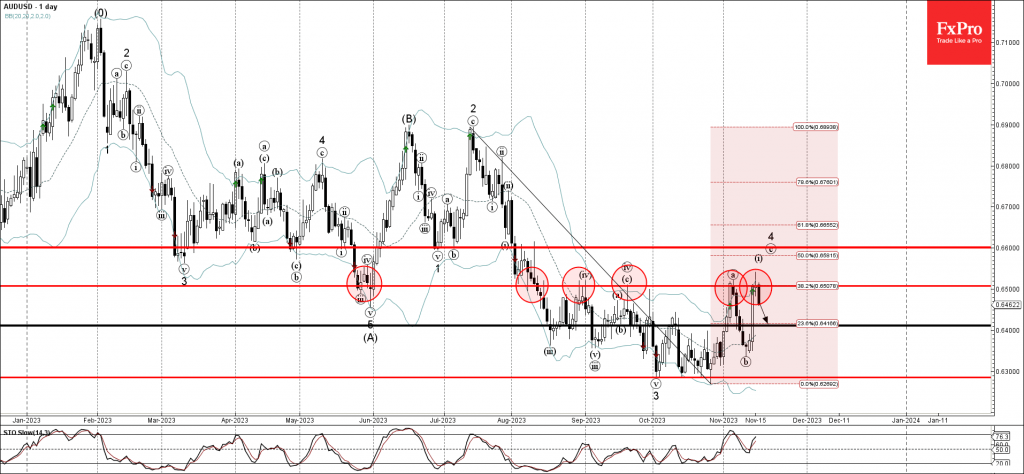
- AUDUSD reversed from resistance level 0.6500
- Likely to fall to support level 0,6400
AUDUSD currency pair recently reversed down from pivotal resistance level 0.6500 (former strong support from May, which has been reversing the price from August) intersecting with the upper daily Bollinger Band.
The downward reversal from the resistance level 0.6500 stopped the previous minor ABC correction 4.
Given the clear daily downtrend and the strong bullish USD sentiment, AUDUSD currency pair can be expected to fall further toward the next support level 0,6400.
NZDUSD Wave Analysis
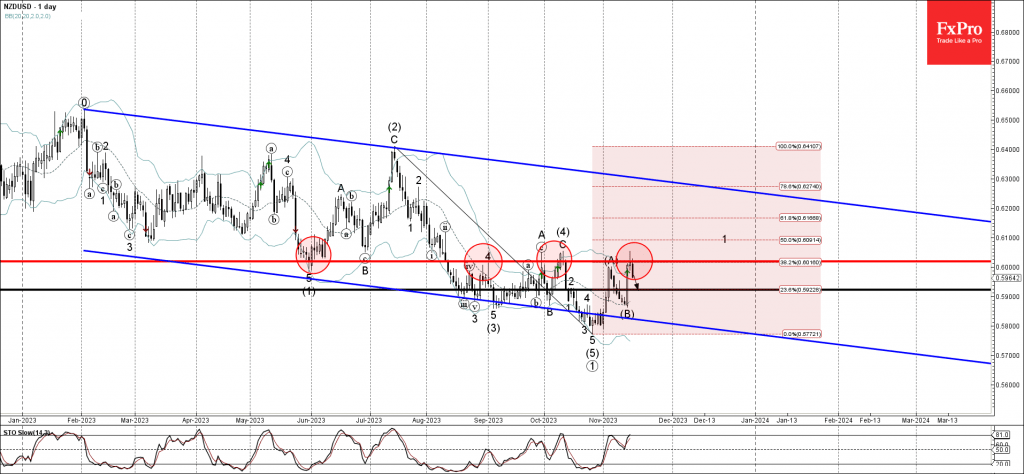
- NZDUSD reversed from resistance level 0.6020
- Likely to fall to support level 0.5925
NZDUSD currency pair recently reversed down from key resistance level 0.6020 (which has been reversing the price from August) coinciding with the upper daily Bollinger Band.
The resistance level 0.6020 was also strengthened by the coinciding 38.2% Fibonacci correction of the downward impulse from July.
Given the clear daily uptrend, NZDUSD currency pair can be expected to fall further toward the next support level 0.5925.
Bitcoin BTCUSD Buying The Dips At The Blue Box Area
In this article we’re going to take a quick look at the Elliott Wave charts of Bitcoin BTCUSD published in members area of the website. As our members know BTCUSD is showing impulsive bullish sequences in the cycle from the 24955.26 low that were calling for a further strength. Recently we got a pull back that has ended at the Blue Box zone,our buying area. In the further text we are going to explain the Elliott Wave Forecast and trading setup.
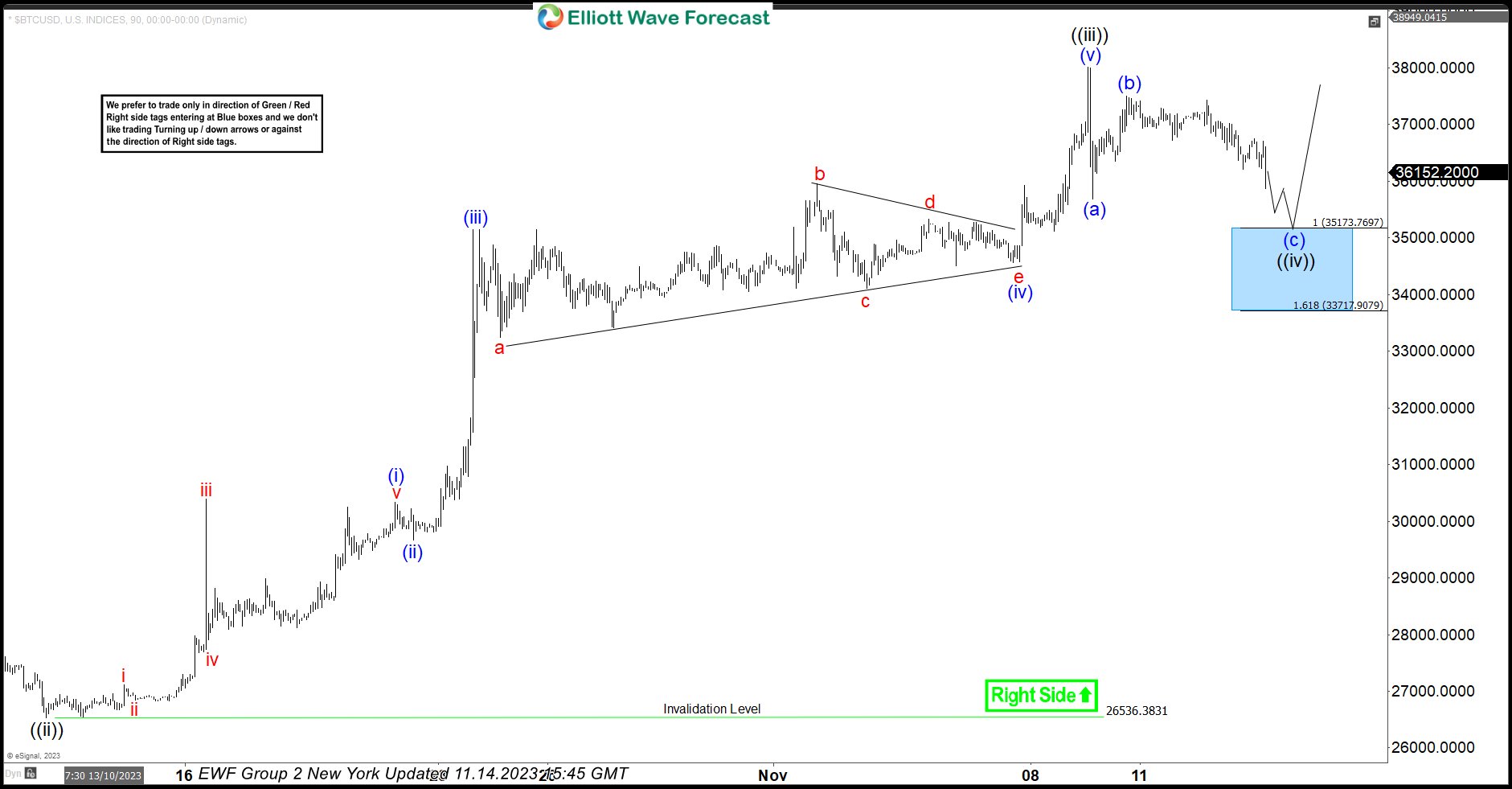
BTCUSD Elliott Wave 1 Hour Chart 11.04.2023
BTCUSD is giving us correction that is unfolding as a Zig Zag pattern. At the moment structure is still incomplete. Bitcoin can see more downside toward 35173.76-33717.907 blue box ( buying zone). We don’t recommend selling Bitcoin and prefer the long side. From the marked zone, BTCUSD should ideally make either rally toward new highs or in 3 waves bounce alternatively. Once bounce reaches 50 Fibs against the (b) blue high 37547, we will make long position risk free ( put SL at BE) and take partial profits.
Official trading strategy on How to trade 3, 7, or 11 swing and equal leg is explained in details in Educational Video, available for members viewing inside the membership area.
Quick reminder on how to trade our charts :
Red bearish stamp+ blue box = Selling Setup
Green bullish stamp+ blue box = Buying Setup
Charts with Black stamps are not tradable. 🚫
Bitcoin ( BTCUSD ) Elliott Wave 1 Hour Chart 4.14.2023
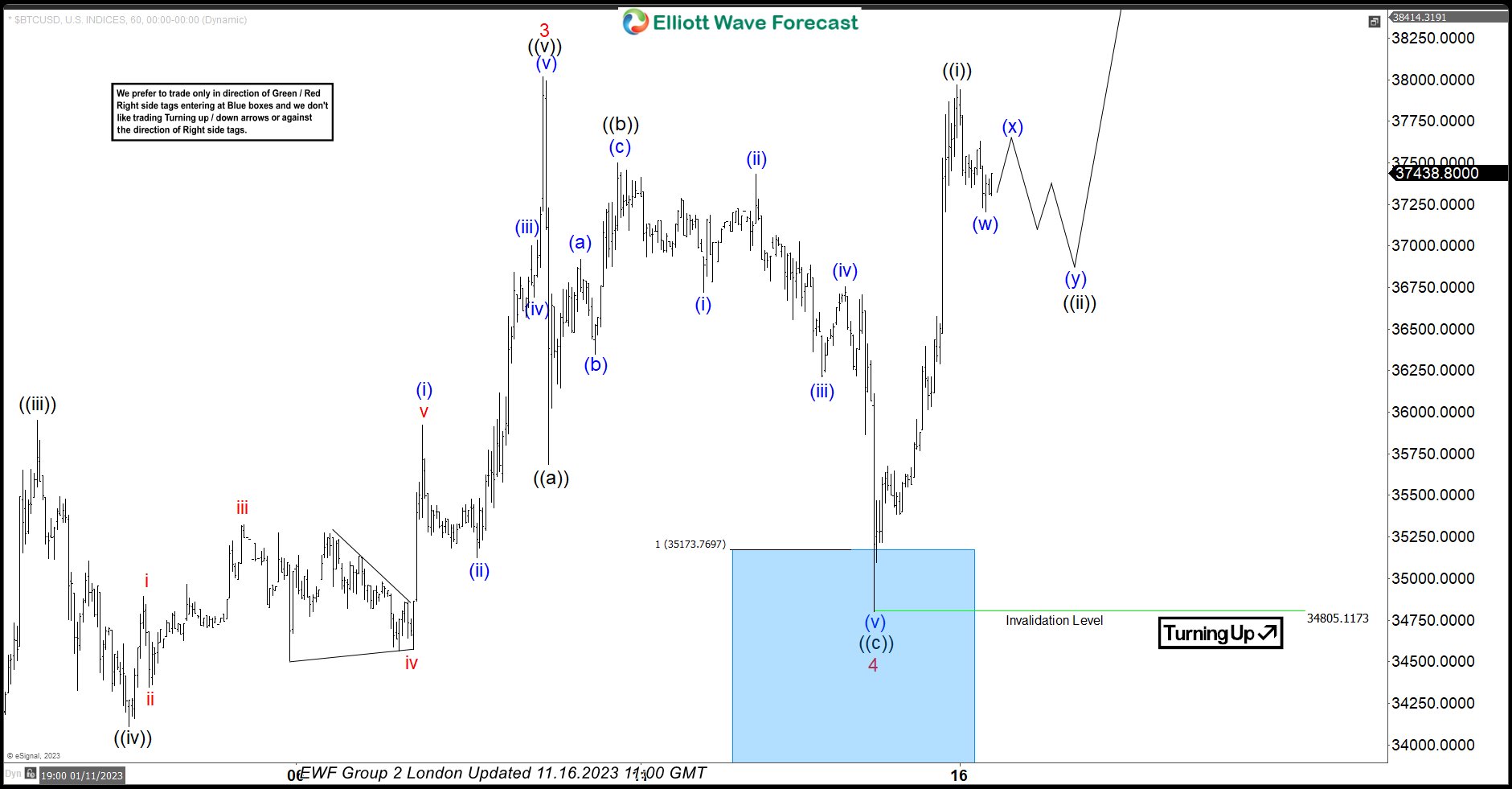
BTCUSD made extension toward our buying zone : 35173.76-33717.907. Bitcoin found buyers at the blue box as expected and we got good reaction from there , 5 waves impulsive rally that retested previous peak. Currently doing short term pull back against the 34805.11 low that can see approximately 36506-35663 area. As far as the pivot at 34805.11 low holds, we can see further rally once short term pull back completes.
Sunset Market Commentary
Markets
US eco data are at it again. Weekly jobless claims picked up slightly more than expected (from 218k to 231k) to the highest level since mid-August. Continuing claims, the number of people who have already filed an initial claim and are still filing for unemployment benefits, rose to 1865k. That’s slightly above the early April top (1861k) and the highest level since November 2021. October import and export prices completed this week’s hattrick of positive inflation surprises following CPI on Tuesday and PPI yesterday. Import prices fell by 0.8% M/M (-2% Y/Y) while export prices were 1.1% lower compared with September (-4.9% Y/Y). Markets anticipated a more gentle decline. The headline Philly Fed Business Outlook improved slightly more than hoped (-5.9 from -9), but underlying details showed deteriorations in new orders (1.3 from 4.4), employment (0.8 from 4), shipments (-17.9 from 10.8) and the general outlook six months from now (-2.1 from 9.2). Prices paid meanwhile confirmed the disinflationary trend (14.8 from 23.1) while prices received remain more sticky (14.8 from 14.6). The US Note future rallied back to this week’s earlier high, but failed for now to really test these tops. US yields obviously show a similar trading pattern, attempting to extend this week’s correction lower. Daily changes vary between -7.8 bps at the frond end and -5.7 bps at the very long end. German Bund yields again shadow US ones lower, but with a marginal outperformance of the very long end (-5.4 bps for 30-yr vs -4 bps for 2yr). The trade weighted dollar equally tries to keep it together just above this week’s sell-off lows (104.33 vs 104) with EUR/USD currently changing hands at 1.0869, up from an open at 1.0848 and compared to this week’s top at 1.0887. European stock markets are mixed, ending a three-day rally with key US gauges marginally weaker at the start of today’s US session. EUR/GBP set a new (intraday) cycle top 0.8766 (highest since May), ignoring central bank talk. Bank of England policy maker Greene suggested that monetary policy needs to be restrictive for longer as the notion that the long run neutral rate might be a bit higher as well as the natural rate of unemployment isn’t something everyone’s grappling with yet. Greene is one of the hawks on the board, unsuccessfully voting for higher rates at the previous meeting. Her comments contrast with analyst talk today that the BoE could pull the trigger on policy rates ahead of the Fed and the ECB.
News & Views
Hungary’s central bank (MNB) vice-governor Virag today said the monetary institution will likely continue to cut interest rates at an unchanged pace of 75 bps despite inflation declining more than hoped-for. He said that it’s realistic for rates to go below 11% by year’s end and below 10% in February. Real interest rates will remain positive in the period ahead, he added, with the central bank (and KBC Economics) expecting inflation to ease to 7-8% by December. The MNB started lowering the base rate end October. Doing so surprised markets who were at the time expecting a 50 bps cut. It underpinned the decision with inflation falling faster than expected. With October CPI two weeks later again dropping more than forecasted (sub 10%), speculation for more aggressive rate cuts to the tune of 100 bps promptly rose. Virag’s comments come after similar ones from Zsolt Kuti, a close advisor to the Hungarian rate-setting committee. He argued against cutting rates too hastily yesterday. Their (scripted?) appearance leaves little traces on the Hungarian forint, which is trading unchanged around a four-month high of EUR/HUF 376.3.
Adam Bodnar, the man widely tipped to be Poland’s next Justice minister, in a Reuters scoop said he’ll let the European Public Prosecutor’s Office (EPPO) know that it wishes to join in the first weeks after a new, pro EU opposition-led government is formed. The EPPO is an independent public prosecution office of the EU which deals with cases affecting the bloc's financial interests. 22 out of the 27 member states have joined but Poland under the outgoing PiS government hasn’t (yet). For Bodnar, joining EPPO is a sign of good faith to “show we are coming back to the rule of law”, a critical condition to unlock billions of EU funds that are currently held back. In other news, Polish core inflation came in bang in line with expectations. Monthly dynamics accelerated from -0.1% to +0.6% in October, bringing the y/y figure to 8%. The (PiS-minded) central bank recently took a hawkish turn after the October elections, with risks of the policy rate (5.75%) being kept stable at least through March 2024.The zloty vastly outperforms regional peers today. EUR/PLN drops to 4.37. This is the strongest PLN level since early 2020.