Sample Category Title
BoE Policymaker Pushes Back Against Market Interest Rate Expectations, Jobless Claims Promising
We're seeing a more muted session in financial markets on Thursday following a couple of days in which investors have been very encouraged by the economic data.
Inflation figures from the US and UK have been very promising, so much so that markets see almost no chance of another rate hike in this cycle from either the Fed or BoE and a high likelihood of a rate cut by the end of the second quarter of next year.
That's despite one BoE policymaker, Megan Greene, pushing back against that, although it is worth noting she does sit at the hawkish end of the committee having recently been in the minority voting for a rate hike. While her concerns over wages and where interest rates will land in the future are perfectly reasonable, it seems markets are more aligned with the dovish end of the MPC.
I expect many policymakers will continue to push back against markets for now until they can be absolutely certain that inflation has been controlled and is on a path back to 2%. A late pivot has likely always been the strategy and I expect it remains the case. Higher for longer remains the mantra but I suspect it won't be too much longer now.
Encouraging claims data but we've had numerous false dawns before
Jobless claims were a welcome addition to recent data that pointed to a slight cooling in the labour market and, perhaps, the US economy. Of course, we're talking about a very small step in the right direction, from the perspective of the Fed, and it will need to be backed by a lot more over the coming months, but it's a start. Claims have been trending higher in recent weeks but we've seen numerous false dawns this year and this could simply be the latest.
Will Oil prices encourage Russia and Saudi Arabia to extend cuts?
Oil prices have been trending lower again in recent days after rebounding on Tuesday, around the October lows in the case of WTI. There are clearly concerns around demand going into next year, particularly around China, which OPEC this week sought to relieve, to no avail.
The recent trend may make it difficult for Saudi Arabia and Russia to allow their unilateral cuts to expire at the end of the year, which is something markets may be gradually pricing in. The lack of a commitment to extend so far may reflect a desire to not but as we've seen so often in the past, the producers will do whatever it takes to support the price. The question may be whether they can get others on board.
Gold eyeing $2,000 after more promising US data
Gold prices are pushing higher once more after running into some resistance around $1,980 on Wednesday. While it hasn't yet moved above yesterday's highs, momentum still looks healthy and gold bulls may have sights set on $2,000 once more. Recent data has been very favorable for gold, it will be interesting to see whether that will be enough to propel it above this big psychological zone.
GBP/USD Edges Lower, Eyes Retail Sales
- UK retail sales expected to rebound in October
- US PPI and retail sales decline
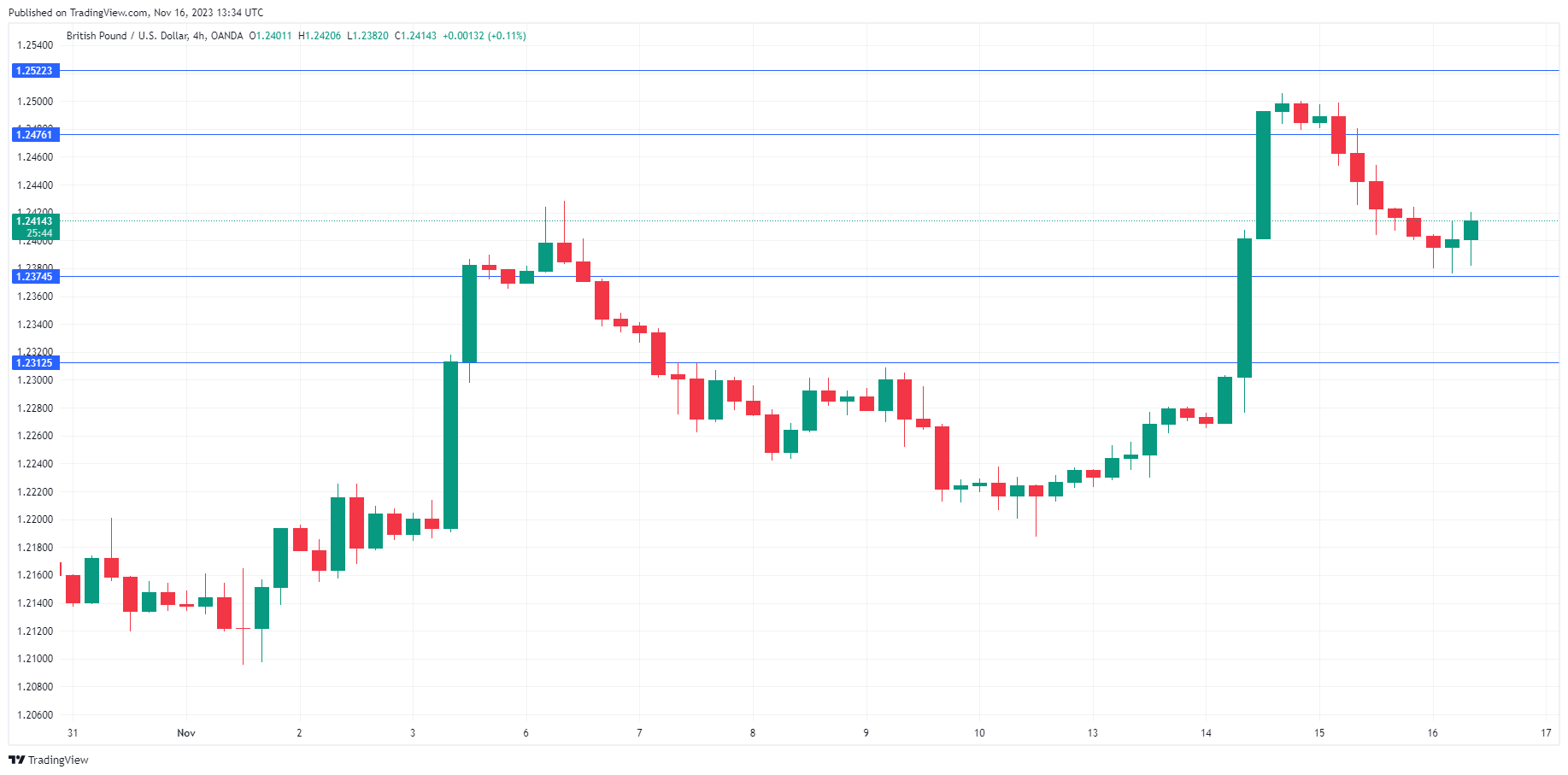
The British pound has extended its losses on Thursday. In the European session, GBP/USD is trading at 1.2401, down 0.11%.
The pound is having a roller-coaster week. GBP/USD surged 1.8% on Tuesday following the soft US inflation print and climbed to a two-month high. However, the pound has since coughed up about half those gains and is trading at the 1.24 line. The UK releases retail sales on Friday, which could result in further volatility.
UK retail sales had a dreadful September, coming in at -0.9% m/m and missing the forecast of 0.2%. The markets are expecting a rebound in October, with a forecast of 0.3%. September was unseasonably hot, which led to fewer purchases of autumn clothing. Consumers remain deeply pessimistic about the economy and are being squeezed by higher heating and fuel costs, elevated borrowing costs and a softer job market.
On the inflation front, there was good news on Wednesday as inflation dropped to 4.6%, down sharply from 6.7% and below the forecast of 4.8%. This was the lowest level since October 2021 and inflation has finally dropped below 5%. However, the BoE has been stressing that the battle against inflation is far from over, and has projected that inflation won’t fall to the 2% target until late 2025.
In the US, producer prices fell 0.5% m/m in October, its largest drop since April 2020 and below expectations. The decline in gasoline prices was a major factor in the soft release. Retail sales for October dipped 0.1%, missing the estimate of 0.3% and snapping a six-month streak of gains. The weak numbers are further evidence that the US economy is cooling down.
GBP/USD Technical
- GBP/USD is putting pressure on support at 1.2374. Below, there is support at 1.2312
- 1.2476 and 1.2522 are the next resistance lines
EUR/USD Mid-Day Outlook
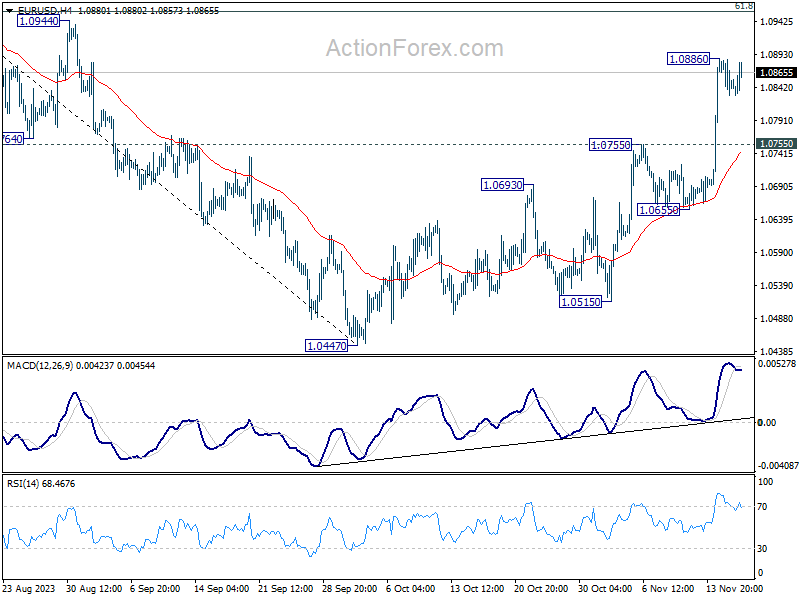
Daily Pivots: (S1) 1.0824; (P) 1.0855; (R1) 1.0878; More...
EUR/USD bounces mildly in early US session but stays below 1.0886. Intraday bias remains neutral and some more consolidations could be seen. But downside of retreat should be contained by 1.0755 resistance turned support to bring another rally. On the upside, above 1.0886 will resume the rebound from 1.0447 to 61.8% retracement of 1.1274 to 1.0447 at 1.0958 next.
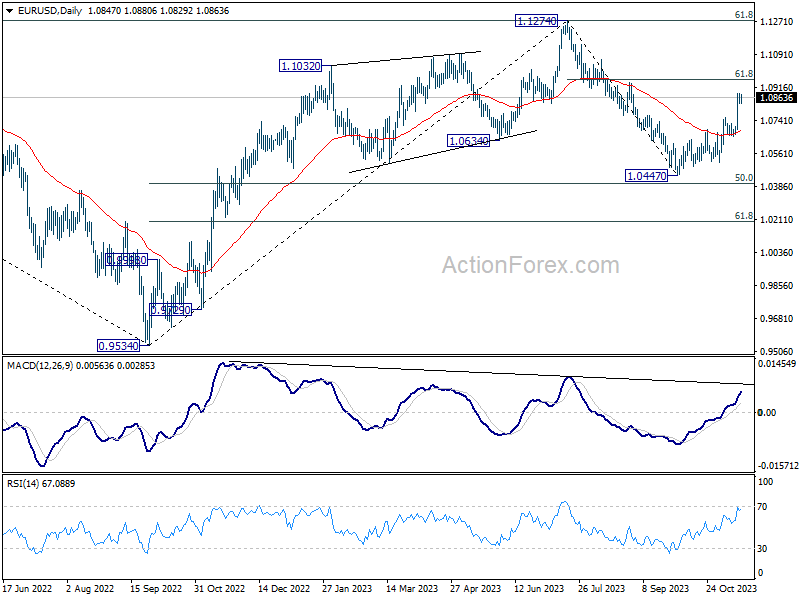
In the bigger picture, price actions from 1.1274 are viewed as a corrective pattern to rise from 0.9534 (2022 low). Rise from 1.0447 is tentatively seen as the second leg. Hence while further rally could be seen, upside should be limited by 1.1274 to bring the third leg of the pattern. However, break of 1.0447 will resume the fall to 61.8% retracement of 0.9543 to 1.1274 at 1.0199.
GBP/USD Mid-Day Outlook
Daily Pivots: (S1) 1.2379; (P) 1.2441; (R1) 1.2477; More...
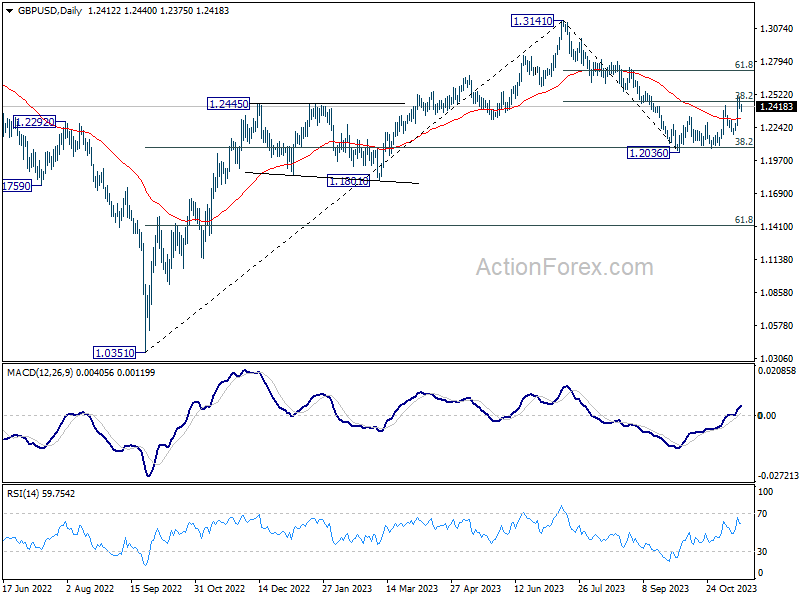
Intraday bias in GBP/USD stays neutral as consolidation from 1.2504 is extending. Downside should be contained by 55 4H EMA (now at 1.2323) to bring another rally. On the upside, break of 1.2504 will resume the whole rebound from 1.2036. Sustained trading above 38.2% retracement of 1.3141 to 1.2036 at 1.2458 will pave the way to 61.8% retracement at 1.2716.
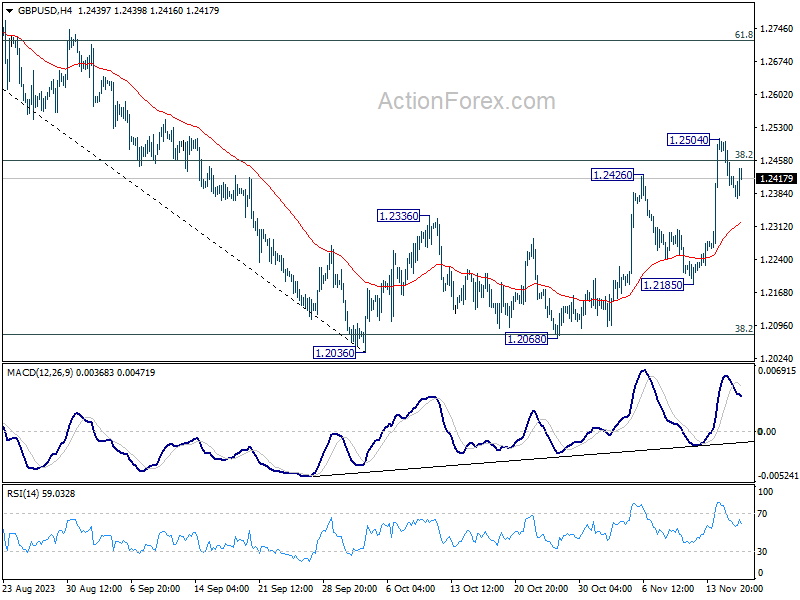
In the bigger picture, price actions from 1.3141 are seen as a corrective pattern to rise from 1.0351 (2022 low). Strong rebound from 38.2% retracement of 1.0351 (2022 low) to 1.3141 at 1.2075 will argue that current rise from 1.2036 is already the second leg. However, while further rally could be seen, upside should be limited by 1.3141 to bring the third leg of the pattern.
USD/CHF Mid-Day Outlook
Daily Pivots: (S1) 0.8837; (P) 0.8933; (R1) 0.8988; More....
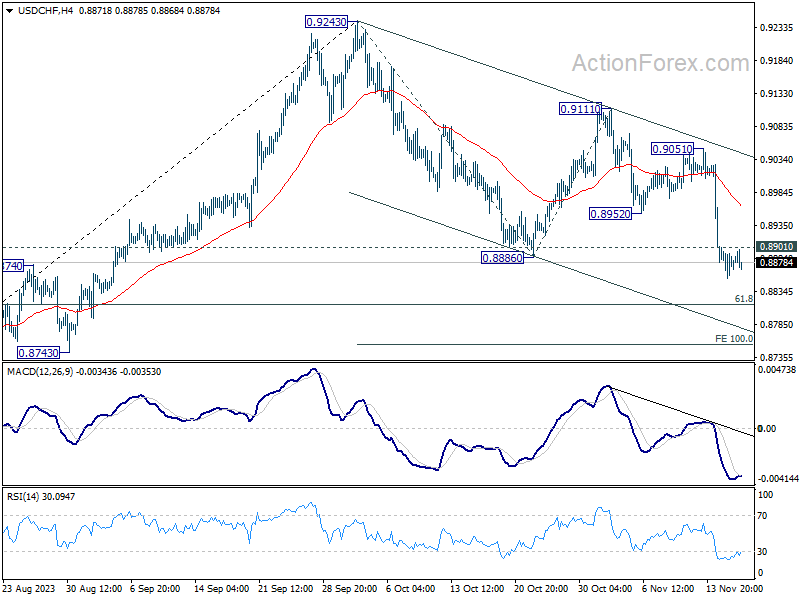
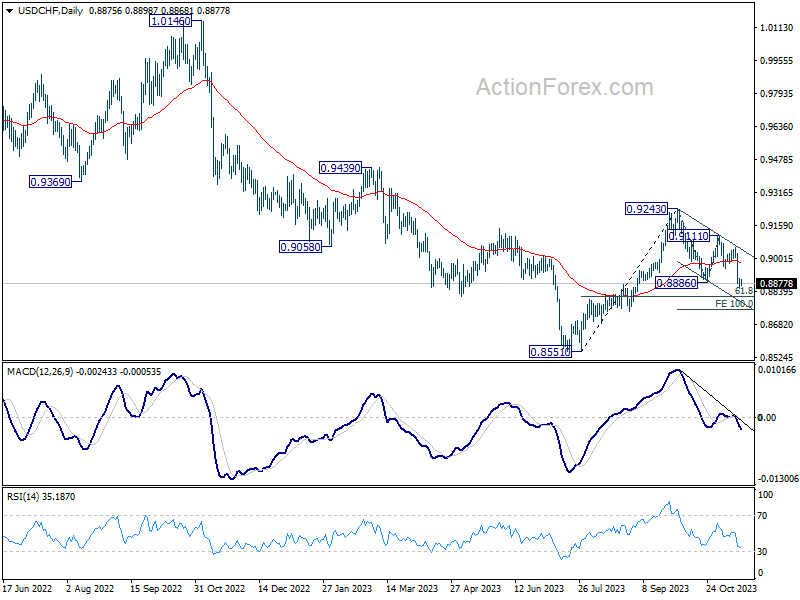
No change in USD/CHF's outlook and intraday bias stays on the downside. Fall from 0.9243 is in progress and should target 100% projection of 0.9243 to 0.8886 from 0.9111 at 0.8754. On the upside, above 0.8901 minor resistance will turn intraday bias neutral and bring consolidations first. But recovery should be limited well below 0.9051 resistance to bring another decline.
In the bigger picture, price actions from 0.8551 are currently seen as a correction to the decline from 1.0146. Fall from 0.9243 is seen as the second leg for now. Deeper fall would be seen to 61.8% retracement of 0.8551 to 0.9243 at 0.8815. Sustained break there will bring retest of 0.8551 low. For now, this will remain the favored case as long as 0.9111 resistance holds.
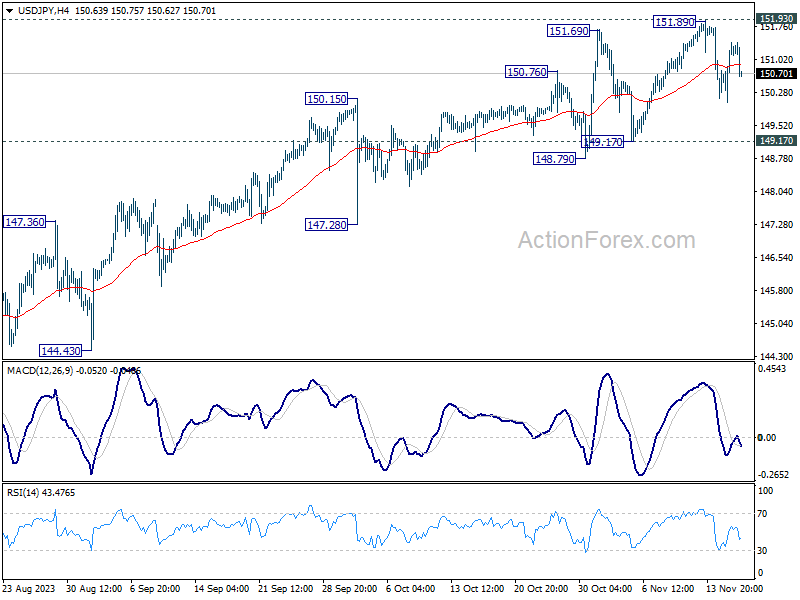
USD/JPY Mid-Day Outlook
Daily Pivots: (S1) 150.49; (P) 150.95; (R1) 151.86; More...
USD/JPY dips notably in early US session but stays well inside established range of 149.17/151.89. Intraday bias stays neutral for the moment. Further rally is in favor as long as 149.17 support holds. On the upside, decisive break of 151.93 resistance will confirm resumption of long term up trend. Next target will be 157.69 projection level. However, firm break of 149.17 will be a sign of bearish reversal and bring deeper fall to 147.28 support first.
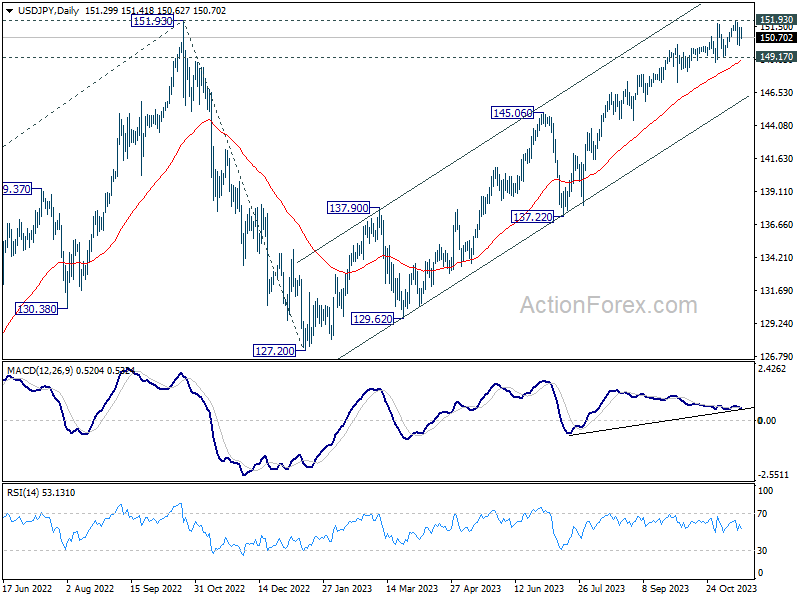
In the bigger picture, immediate focus is now on 151.93 resistance (2022 high). Rejection by 151.93, followed by sustained break of 145.06 resistance turned support will argue that rise from 127.20 has completed, and turn outlook bearish for 137.22 support and below. However, sustained break of 151.93 will confirm resumption of long term up trend. Next target will be 61.8% projection of 102.58 (2021 low) to 151.93 from 127.20 at 157.69.
Dollar Under Renewed Pressure Amid Signs of Cooling Job Market and Easing Price Pressures
Dollar is facing renewed selling pressure in the early US session, as fresh economic data points to a further cooling in the job market. A significant uptick in continuing jobless claims, reaching their highest level in nearly two years, suggests a softening labor environment.
Adding to this, deeper-than-expected decline in import prices, influenced by both fuel and non-fuel components, indicates easing price pressures. Concurrently, Philadelphia Fed manufacturing survey underscores ongoing industry challenges, marking the 16th month of contraction in the last 18 months.
These economic indicators collectively bolster the argument that Fed may have reached the end of its current tightening cycle. This perspective aligns with growing market sentiment that anticipates no more rate hike by Fed. Instead, loosening would probably start in the first half of next year.
Elsewhere in the currency markets, Japanese Yen and Euro emerge as the day's strongest performers, with Swiss Franc also gaining ground. On the other hand, commodity-linked currencies, along with British pound, are facing challenges. Their performance throughout the remainder of the session is likely to hinge on shifts in global risk sentiment.
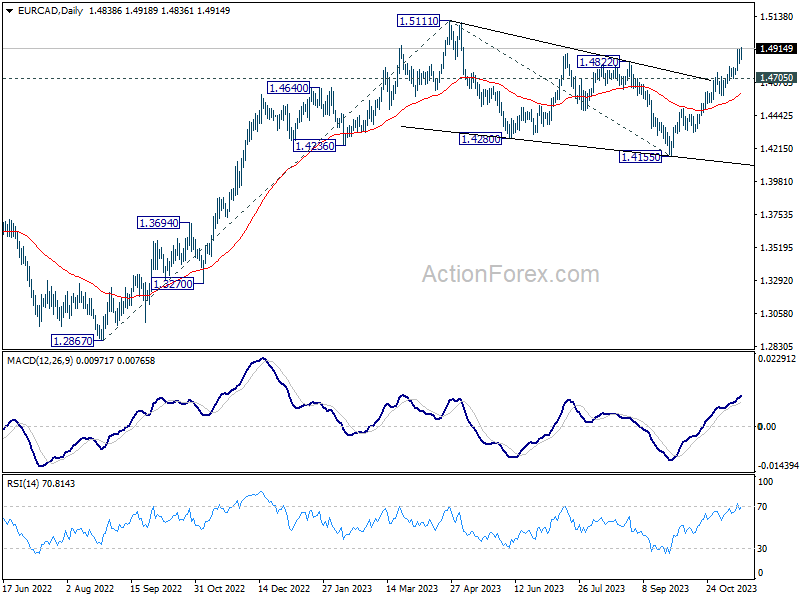
From a technical standpoint, EUR/CAD marches on as rise from 1.4155 is extending. As noted in previous reports, correction from 1.5111 should have completed with three waves down to 1.4155. Retest of 1.5111 high should be seen next. Firm break there will resume larger up trend from 1.2867. This will now remain the favored case as long as 1.4705 support holds.
In Europe, at the time of writing, FTSE is down -0.56%. DAX is up 0.67%. CAC is down -0.15%. Germany 10-year yield is down -0.0405 at 2.604. Earlier in Asia, Nikkei dropped -0.28%. Hong Kong HSI fell -1.36%. China Shanghai SSE fell -0.71%. Singapore Strait Times rose 0.03%. Japan 10-year JGB yield fell -0.0065 to 0.791.
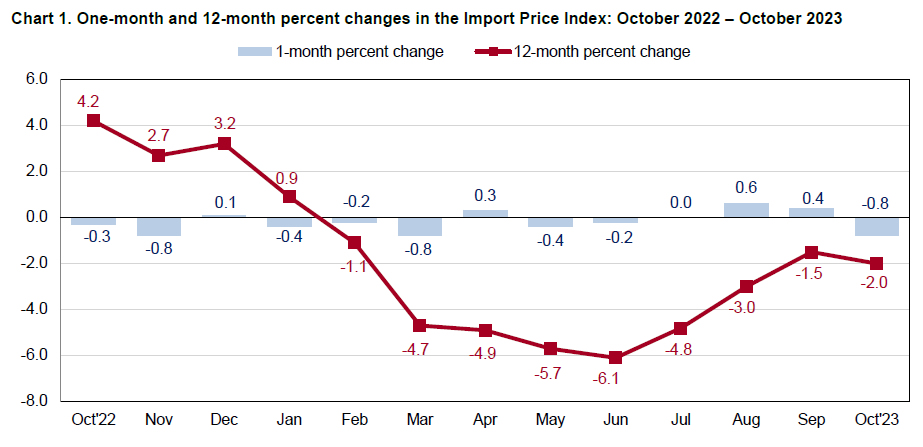
US import price fell -0.8% mom in Oct
US import price index fell -0.8% mom in October, larger decline than expectation of -0.3% mom. That's the first monthly drop since June, and the largest since March.
Prices for import fuel declined -6.3% mom, after advancing 6.3% mom the previous month. The October drop was the first 1-month decrease since May and the largest monthly decline since September 2022.
Nonfuel import prices declined -0.2% mom for the third consecutive month. Prices for nonfuel imports have not recorded a monthly advance since February.
US initial jobless claims rose to 231k, continuing claims highest in nearly two years
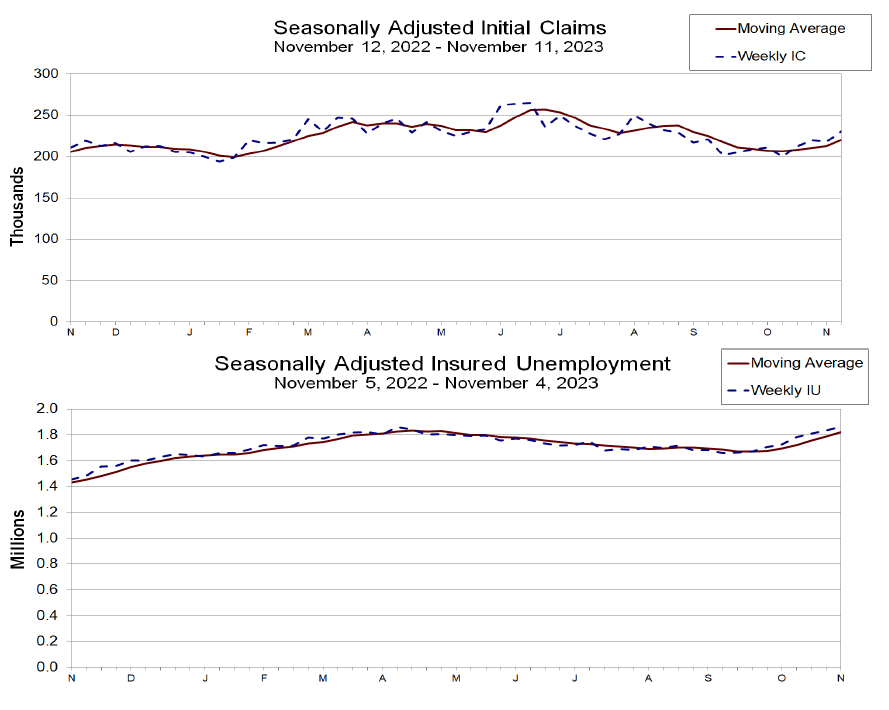
US initial jobless claims rose 13k to 231k in the week ending November 11, above expectation of 222k. Four week moving average of initial claims rose 8k to 220k.
Continuing claims rose 32k to 1865k in the week ending November 4. That's the highest level since November 27, 2021. Four-week moving average of continuing claims rose 34.5k to 1823k.
BoE's Greene: Incredibly high wage growth remains a concern
BoE monetary policymaker Megan Greene expressed cautious optimism in a recent interview with Bloomberg TV, acknowledging the positive signs of declining inflation in the UK.
Greene noted that the recent data, which showed a drop in inflation to 4.6% and a weakening in wage growth, was indeed "good news." However, she voiced concerns about the persistence of inflation, particularly in the services component of CPI. Besides, her apprehension primarily stems from the still elevated wage growth, which she described as "incredibly high."
She emphasized the challenges posed by this situation, stating, "If we have an economy with fairly low productivity growth and really high wage growth, it's going to be hard to hit the (2% inflation) target."
Australia's employment grows 55k, yet signs of cooling emerge
Australia's labor market displayed stronger-than-anticipated performance in October, with employment figures surpassing expectations. The economy added 55k jobs, well above forecasted growth of 22.8k. This increase was driven by both full-time and part-time employment, which rose by 17k and 37.9k respectively.
Despite this robust job growth, unemployment rate edged up slightly from 3.6% to 3.7%, aligning with market expectations. Participation rate also saw an uptick, rising by 0.2% to 67.0%. Additionally, month-over-month hours worked in the economy increased by 0.5%.
Bjorn Jarvis, ABS head of labour statistics, noted that over the past two months, this equates to an average monthly employment growth of approximately 31k people, slightly lower than average growth of 35k people a month since October 2022.
He also highlighted that annual growth rate in hours worked has slowed to 1.7%, down from around 5% mid-year, and lower than annual employment growth of 3.0%. This slowdown may suggest that "the labour market is starting to slow, following a particularly strong period of growth."
Japan's exports increase for second month, despite persistent decline in China shipments
In October, Japan experienced a mixed bag in its trade sector. Exports saw a modest rise of 1.6% yoy to JPY 9167B, marking the second consecutive month of growth, albeit at a slower pace compared to September's 4.3% yoy increase.
One notable aspect was the continued decline in shipments to China, which fell by -4.0% yoy. This marks the eleventh consecutive month of decline, underscoring the strained trade relations and potentially shifting economic alliances in the region.
Conversely, exports to the US surged by 8.4% yoy, buoyed by robust demand for hybrid vehicles and mining and construction machinery. This surge propelled the value of U.S.-bound shipments to record levels. Similarly, exports to Europe experienced a healthy increase of 8.9% yoy, indicating diversified trade relations.
On the import front, Japan witnessed a significant drop of -12.5% yoy to JPY 9810B. The trade balance resulted in a deficit of JPY -663B.
Looking at seasonally adjusted terms, both exports and imports saw month-on-month declines, with exports decreasing by -1.2% mom to JPY 8800B and imports falling by -0.7% mom to JPY 9262B. Consequently, trade deficit widened from September's JPY -420B to JPY -462B.
USD/JPY Mid-Day Outlook
Daily Pivots: (S1) 150.49; (P) 150.95; (R1) 151.86; More...
USD/JPY dips notably in early US session but stays well inside established range of 149.17/151.89. Intraday bias stays neutral for the moment. Further rally is in favor as long as 149.17 support holds. On the upside, decisive break of 151.93 resistance will confirm resumption of long term up trend. Next target will be 157.69 projection level. However, firm break of 149.17 will be a sign of bearish reversal and bring deeper fall to 147.28 support first.
In the bigger picture, immediate focus is now on 151.93 resistance (2022 high). Rejection by 151.93, followed by sustained break of 145.06 resistance turned support will argue that rise from 127.20 has completed, and turn outlook bearish for 137.22 support and below. However, sustained break of 151.93 will confirm resumption of long term up trend. Next target will be 61.8% projection of 102.58 (2021 low) to 151.93 from 127.20 at 157.69.
Economic Indicators Update
| GMT | Ccy | Events | Actual | Forecast | Previous | Revised |
|---|---|---|---|---|---|---|
| 23:50 | JPY | Trade Balance (USD) Oct | -0.46T | -0.71T | -0.43T | |
| 23:50 | JPY | Machinery Orders M/M Sep | 1.40% | 0.90% | -0.50% | |
| 00:00 | AUD | Consumer Inflation Expectations Nov | 4.90% | 4.80% | ||
| 00:30 | AUD | Employment Change Oct | 55.0K | 22.8K | 6.7K | |
| 00:30 | AUD | Unemployment Rate Oct | 3.70% | 3.70% | 3.60% | |
| 04:30 | JPY | Tertiary Industry Index M/M Sep | -1.00% | -0.10% | -0.10% | 0.70% |
| 13:15 | CAD | Housing Starts Y/Y Oct | 275K | 255K | 270K | |
| 13:30 | USD | Initial Jobless Claims (Nov 10) | 231K | 222K | 217K | 218K |
| 13:30 | USD | Import Price Index M/M Oct | -0.80% | -0.30% | 0.10% | 0.40% |
| 13:30 | USD | Philadelphia Fed Manufacturing Survey Nov | -5.9 | -11 | -9 | |
| 14:15 | USD | Industrial Production M/M Oct | -0.40% | 0.30% | ||
| 14:15 | USD | Capacity Utilization Oct | 79.40% | 79.70% | ||
| 15:00 | USD | Natural Gas Storage |
US import price fell -0.8% mom in Oct
US import price index fell -0.8% mom in October, larger decline than expectation of -0.3% mom. That's the first monthly drop since June, and the largest since March.
Prices for import fuel declined -6.3% mom, after advancing 6.3% mom the previous month. The October drop was the first 1-month decrease since May and the largest monthly decline since September 2022.
Nonfuel import prices declined -0.2% mom for the third consecutive month. Prices for nonfuel imports have not recorded a monthly advance since February.
US initial jobless claims rose to 231k, continuing claims highest in nearly two years
US initial jobless claims rose 13k to 231k in the week ending November 11, above expectation of 222k. Four week moving average of initial claims rose 8k to 220k.
Continuing claims rose 32k to 1865k in the week ending November 4. That's the highest level since November 27, 2021. Four-week moving average of continuing claims rose 34.5k to 1823k.
EURAUD Holds in Sideways Channel Around 1.6700
- EURAUD bounces off 20-day SMA
- Momentum indicators confirm the weak momentum
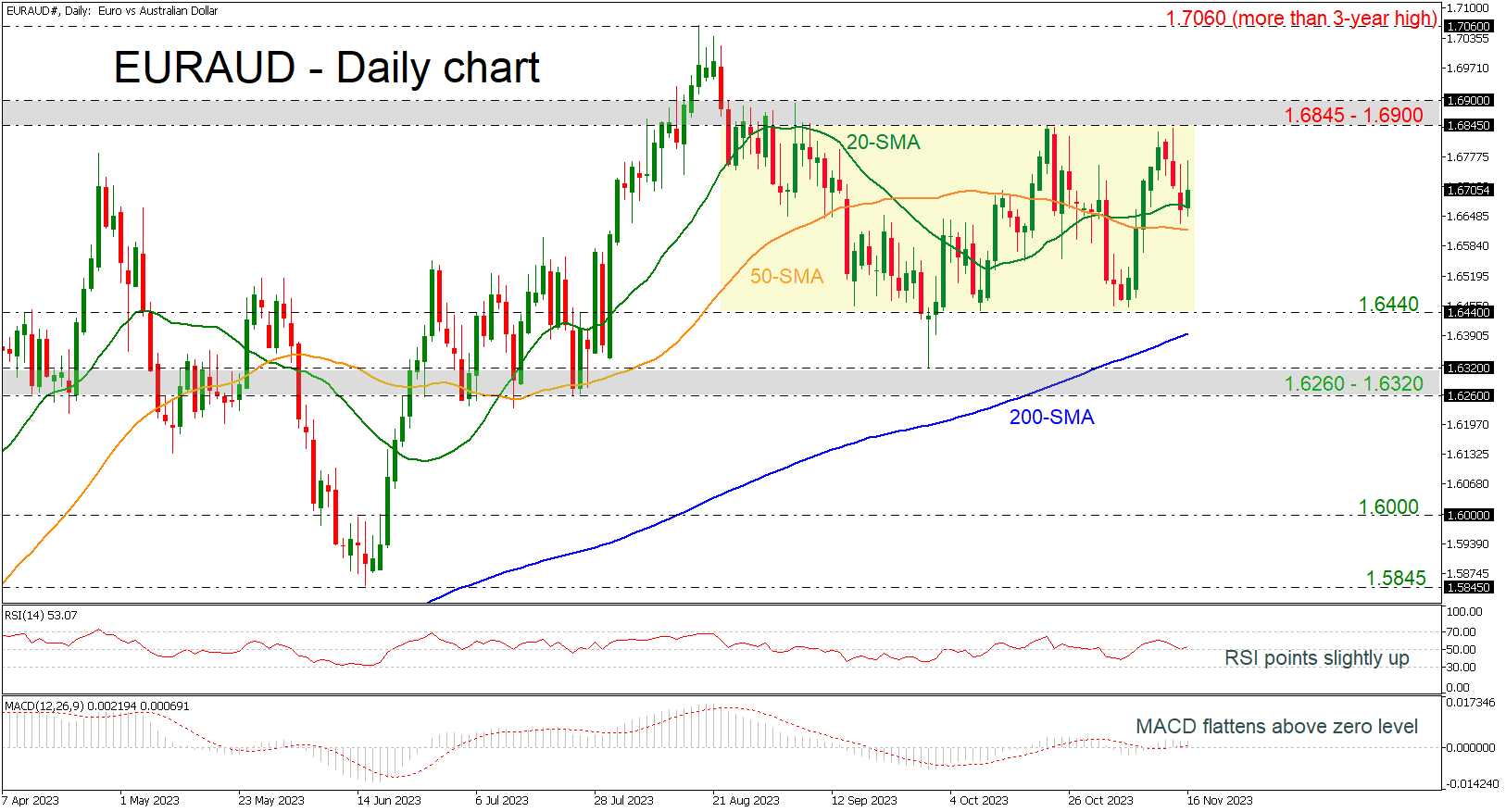
EURAUD has been developing within a trading range of 1.6440 to 1.6845 since August 23 with the short-term simple moving averages (SMAs) acting as mid-levels.
The technical oscillators are confirming the sideways move, as the MACD is flattening near its zero level and the RSI is ticking marginally up around the neutral threshold of 50.
If buyers stay in play, the door will open for the tight zone of 1.6845 – 1.6900. Running higher, the pair will have to face the more-than-three-year high of 1.7060 and if there is a break of it, that would shift the neutral outlook to positive.
Should the bears press the price below lower, the 20- and the 50-day SMAs around 1.6670 and 1.6620 respectively may prevent an aggressive downfall towards the lower boundary of the range at 1.6440. If the latter gives way too, the decline could continue towards the 200-day SMA at 1.6395 before testing the 1.6260 – 1.6320 support area.
In a nutshell, despite the latest existing rebound off the 20-day SMA, there are some obstacles to consider before a real bullish trend reversal takes place. The pair needs to break the trading range to show a clear trend direction.