Sample Category Title
U.S. Inflation Expected to Rise in August on Soaring Gasoline Prices
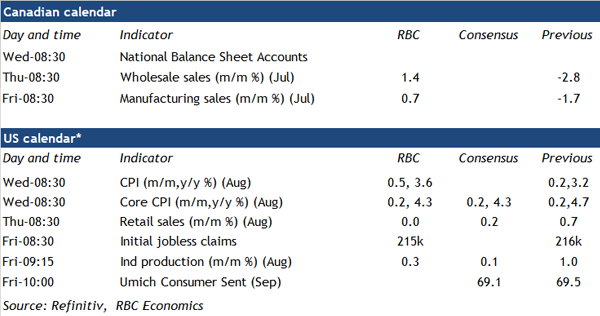
The U.S. Federal Reserve will be on the lookout for signs that broader inflation trends continued to slow down in August—even as energy prices spiked. We expect headline CPI to tick up to 3.6% year-over-year in August, up from 3.2% in July. This increase is almost entirely explained by higher global energy prices. Gasoline prices rose more than 10% month-over-month (on a seasonally adjusted basis) between July in August. And energy prices as a whole likely reported their steepest month-over-month growth since mid-2022.
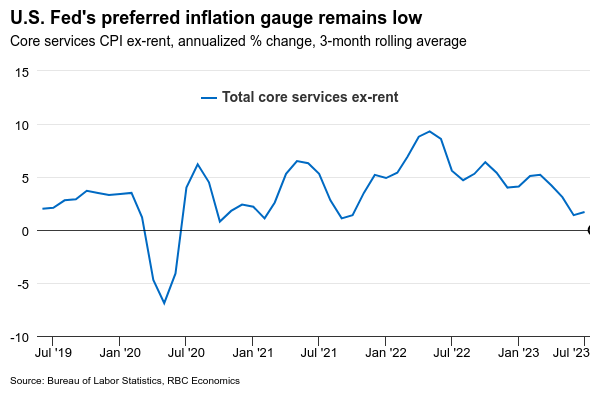
Aside from energy, U.S. price pressures have eased substantially in recent months. Food price growth has moderated sharply and we look for ‘core’ (ex-food & energy) price growth to slow to 4.3% year-over-year in August from 4.7% the month before. That will drop the measure further below a 6.6% peak in September last year. Month-over-month increases in the Fed’s preferred “supercore” measure (CPI services excluding rent) have been running below a 2% annualized rate for the last four months. But inflation pressures won’t stay that low if surging economic growth data and firm labour markets don’t show further signs of softness. But the economic backdrop abroad is slowing, job openings and quit rates continue to decline, and ‘excess’ savings that cushioned households from the blow of higher prices and interest rates are now largely depleted. We continue to look for U.S. economic growth to soften in the coming months—preventing a re-acceleration of broader inflation pressures.
- According to StatCan’s advance estimates for July, “core” wholesale sales rose by 1.4%, higher motor vehicle and parts sales (+5.8%) contributed to this, offsetting lower sales in machinery, equipment and supplies.
- Manufacturing sales ticked up 0.7% in July according to the flash estimate, primarily driven by petroleum and coal product, food, and primary metal subsectors. Industrial prices in the manufacturing sector rose more than that (seasonally adjusted) in July, suggesting that sales declined excluding price impacts.
- U.S. retail sales likely remain unchanged in August, following a 0.7% uptick in the prior month. This expected slowdown in growth is mainly due to a 4.5% decline in unit auto sales in August. Excluding autos, we expect sales edged up by 0.3% although largely due to a price-related increase in sales at gas stations.
- We expect that U.S. industrial production inched up 0.3% in August, decelerating from a 1% increase in July. Most of this growth was drive by the manufacturing sector, where hours worked rose.
- Canadian household net wealth likely rose in Q2 with an increase in house prices and stronger equity markets pushing asset values up more than debt levels. A surge in household disposable incomes in Q2 likely pushed the debt-to-income ratio lower and left the debt servicing ratio little-changed despite further increases in debt payments. Signs that labour markets softened into Q3 mean that positive income boost is unlikely to be repeated in the near-term.
Summary 9/11 – 9/15
Monday, Sep 11, 2023
| GMT | Ccy | Events | Consensus | Previous |
|---|---|---|---|---|
| 23:50 | JPY | Money Supply M2+CD Y/Y Jul | 2.50% | 2.40% |
| 06:00 | JPY | Machine Tool Orders Y/Y Aug P | -19.80% | |
| 08:00 | EUR | Italy Industrial Output M/M Jul | -0.30% | 0.50% |
| GMT | Ccy | Events | |
|---|---|---|---|
| 23:50 | JPY | Money Supply M2+CD Y/Y Jul | |
| Forecast: 2.50% | Previous: 2.40% | ||
| 06:00 | JPY | Machine Tool Orders Y/Y Aug P | |
| Forecast: | Previous: -19.80% | ||
| 08:00 | EUR | Italy Industrial Output M/M Jul | |
| Forecast: -0.30% | Previous: 0.50% | ||
Tuesday, Sep 12, 2023
| GMT | Ccy | Events | Consensus | Previous |
|---|---|---|---|---|
| 00:30 | AUD | Westpac Consumer Confidence Sep | -0.40% | |
| 01:30 | AUD | NAB Business Conditions Aug | 10 | |
| 01:30 | AUD | NAB Business Confidence Aug | 2 | |
| 06:00 | GBP | Claimant Count Change Aug | 29K | |
| 06:00 | GBP | ILO Unemployment Rate (3M) Jul | 4.30% | 4.20% |
| 06:00 | GBP | Average Earnings Excluding Bonus 3M/Y Jul | 7.60% | 7.80% |
| 06:00 | GBP | Average Earnings Including Bonus 3M/Y Jul | 8.20% | 8.20% |
| 09:00 | EUR | Germany ZEW Economic Sentiment Sep | -15 | -12.3 |
| 09:00 | EUR | Germany ZEW Current Situation Sep | -75 | -71.3 |
| 09:00 | EUR | Eurozone ZEW Economic Sentiment Sep | -6.2 | -5.5 |
| 10:00 | USD | NFIB Business Optimism Index Aug | 91.6 | 91.9 |
| 23:50 | JPY | PPI Y/Y Aug | 3.20% | 3.60% |
| 23:50 | JPY | BSI Large Manufacturing Conditions Q3 | 0.2 | -0.4 |
| GMT | Ccy | Events | |
|---|---|---|---|
| 00:30 | AUD | Westpac Consumer Confidence Sep | |
| Forecast: | Previous: -0.40% | ||
| 01:30 | AUD | NAB Business Conditions Aug | |
| Forecast: | Previous: 10 | ||
| 01:30 | AUD | NAB Business Confidence Aug | |
| Forecast: | Previous: 2 | ||
| 06:00 | GBP | Claimant Count Change Aug | |
| Forecast: | Previous: 29K | ||
| 06:00 | GBP | ILO Unemployment Rate (3M) Jul | |
| Forecast: 4.30% | Previous: 4.20% | ||
| 06:00 | GBP | Average Earnings Excluding Bonus 3M/Y Jul | |
| Forecast: 7.60% | Previous: 7.80% | ||
| 06:00 | GBP | Average Earnings Including Bonus 3M/Y Jul | |
| Forecast: 8.20% | Previous: 8.20% | ||
| 09:00 | EUR | Germany ZEW Economic Sentiment Sep | |
| Forecast: -15 | Previous: -12.3 | ||
| 09:00 | EUR | Germany ZEW Current Situation Sep | |
| Forecast: -75 | Previous: -71.3 | ||
| 09:00 | EUR | Eurozone ZEW Economic Sentiment Sep | |
| Forecast: -6.2 | Previous: -5.5 | ||
| 10:00 | USD | NFIB Business Optimism Index Aug | |
| Forecast: 91.6 | Previous: 91.9 | ||
| 23:50 | JPY | PPI Y/Y Aug | |
| Forecast: 3.20% | Previous: 3.60% | ||
| 23:50 | JPY | BSI Large Manufacturing Conditions Q3 | |
| Forecast: 0.2 | Previous: -0.4 | ||
Wednesday, Sep 13, 2023
| GMT | Ccy | Events | Consensus | Previous |
|---|---|---|---|---|
| 06:00 | GBP | GDP M/M Jul | -0.20% | 0.50% |
| 06:00 | GBP | Industrial Production M/M Jul | -0.50% | 1.80% |
| 06:00 | GBP | Industrial Production Y/Y Jul | 0.70% | |
| 06:00 | GBP | Manufacturing Production M/M Jul | -0.90% | 2.40% |
| 06:00 | GBP | Manufacturing Production Y/Y Jul | 3.10% | |
| 06:00 | GBP | Goods Trade Balance (GBP) Jul | -15.9B | -15.5B |
| 09:00 | EUR | Eurozone Industrial Production M/M Jul | -0.70% | 0.50% |
| 11:00 | GBP | NIESR GDP Estimate Aug | 0.30% | |
| 11:00 | USD | MBA Mortgage Applications (Sep 8) | -2.90% | |
| 12:30 | USD | CPI M/M Aug | 0.60% | 0.20% |
| 12:30 | USD | CPI Y/Y Aug | 3.60% | 3.20% |
| 12:30 | USD | CPI Core M/M Aug | 0.20% | 0.20% |
| 12:30 | USD | CPI Core Y/Y Aug | 4.70% | |
| 14:30 | USD | Crude Oil Inventories | -6.3M | |
| 23:50 | JPY | Machinery Orders M/M Jul | -0.70% | 2.70% |
| GMT | Ccy | Events | |
|---|---|---|---|
| 06:00 | GBP | GDP M/M Jul | |
| Forecast: -0.20% | Previous: 0.50% | ||
| 06:00 | GBP | Industrial Production M/M Jul | |
| Forecast: -0.50% | Previous: 1.80% | ||
| 06:00 | GBP | Industrial Production Y/Y Jul | |
| Forecast: | Previous: 0.70% | ||
| 06:00 | GBP | Manufacturing Production M/M Jul | |
| Forecast: -0.90% | Previous: 2.40% | ||
| 06:00 | GBP | Manufacturing Production Y/Y Jul | |
| Forecast: | Previous: 3.10% | ||
| 06:00 | GBP | Goods Trade Balance (GBP) Jul | |
| Forecast: -15.9B | Previous: -15.5B | ||
| 09:00 | EUR | Eurozone Industrial Production M/M Jul | |
| Forecast: -0.70% | Previous: 0.50% | ||
| 11:00 | GBP | NIESR GDP Estimate Aug | |
| Forecast: | Previous: 0.30% | ||
| 11:00 | USD | MBA Mortgage Applications (Sep 8) | |
| Forecast: | Previous: -2.90% | ||
| 12:30 | USD | CPI M/M Aug | |
| Forecast: 0.60% | Previous: 0.20% | ||
| 12:30 | USD | CPI Y/Y Aug | |
| Forecast: 3.60% | Previous: 3.20% | ||
| 12:30 | USD | CPI Core M/M Aug | |
| Forecast: 0.20% | Previous: 0.20% | ||
| 12:30 | USD | CPI Core Y/Y Aug | |
| Forecast: | Previous: 4.70% | ||
| 14:30 | USD | Crude Oil Inventories | |
| Forecast: | Previous: -6.3M | ||
| 23:50 | JPY | Machinery Orders M/M Jul | |
| Forecast: -0.70% | Previous: 2.70% | ||
Thursday, Sep 14, 2023
| GMT | Ccy | Events | Consensus | Previous |
|---|---|---|---|---|
| 01:00 | AUD | Consumer Inflation Expectations Sep | 4.90% | |
| 01:30 | AUD | Employment Change Aug | 24.3K | -14.6K |
| 01:30 | AUD | Unemployment Rate s.a. Aug | 3.70% | 3.70% |
| 04:30 | JPY | Industrial Production M/M Jul F | -2.00% | -2.00% |
| 06:30 | CHF | Producer and Import Prices M/M Aug | 0.10% | -0.10% |
| 06:30 | CHF | Producer and Import Prices Y/Y Aug | -0.60% | |
| 12:15 | EUR | ECB Main Refinancing Rate | 4.25% | 4.25% |
| 12:30 | CAD | Wholesale Sales M/M Jul | -2.00% | -2.80% |
| 12:30 | USD | Retail Sales M/M Aug | 0.20% | 0.70% |
| 12:30 | USD | Retail Sales ex Autos M/M Aug | 0.40% | 1.00% |
| 12:30 | USD | PPI M/M Aug | 0.40% | 0.30% |
| 12:30 | USD | PPI Y/Y Aug | 0.80% | |
| 12:30 | USD | PPI Core M/M Aug | 0.20% | 0.30% |
| 12:30 | USD | PPI Core Y/Y Aug | 2.40% | |
| 12:30 | USD | Initial Jobless Claims (Sep 8) | 229K | 216K |
| 12:45 | EUR | ECB Press Conference | ||
| 14:00 | USD | Business Inventories Jul | 0.10% | 0.00% |
| 14:30 | USD | Natural Gas Storage | 33B | |
| 22:30 | NZD | Business NZ PMI Aug | 46.3 |
| GMT | Ccy | Events | |
|---|---|---|---|
| 01:00 | AUD | Consumer Inflation Expectations Sep | |
| Forecast: | Previous: 4.90% | ||
| 01:30 | AUD | Employment Change Aug | |
| Forecast: 24.3K | Previous: -14.6K | ||
| 01:30 | AUD | Unemployment Rate s.a. Aug | |
| Forecast: 3.70% | Previous: 3.70% | ||
| 04:30 | JPY | Industrial Production M/M Jul F | |
| Forecast: -2.00% | Previous: -2.00% | ||
| 06:30 | CHF | Producer and Import Prices M/M Aug | |
| Forecast: 0.10% | Previous: -0.10% | ||
| 06:30 | CHF | Producer and Import Prices Y/Y Aug | |
| Forecast: | Previous: -0.60% | ||
| 12:15 | EUR | ECB Main Refinancing Rate | |
| Forecast: 4.25% | Previous: 4.25% | ||
| 12:30 | CAD | Wholesale Sales M/M Jul | |
| Forecast: -2.00% | Previous: -2.80% | ||
| 12:30 | USD | Retail Sales M/M Aug | |
| Forecast: 0.20% | Previous: 0.70% | ||
| 12:30 | USD | Retail Sales ex Autos M/M Aug | |
| Forecast: 0.40% | Previous: 1.00% | ||
| 12:30 | USD | PPI M/M Aug | |
| Forecast: 0.40% | Previous: 0.30% | ||
| 12:30 | USD | PPI Y/Y Aug | |
| Forecast: | Previous: 0.80% | ||
| 12:30 | USD | PPI Core M/M Aug | |
| Forecast: 0.20% | Previous: 0.30% | ||
| 12:30 | USD | PPI Core Y/Y Aug | |
| Forecast: | Previous: 2.40% | ||
| 12:30 | USD | Initial Jobless Claims (Sep 8) | |
| Forecast: 229K | Previous: 216K | ||
| 12:45 | EUR | ECB Press Conference | |
| Forecast: | Previous: | ||
| 14:00 | USD | Business Inventories Jul | |
| Forecast: 0.10% | Previous: 0.00% | ||
| 14:30 | USD | Natural Gas Storage | |
| Forecast: | Previous: 33B | ||
| 22:30 | NZD | Business NZ PMI Aug | |
| Forecast: | Previous: 46.3 | ||
Friday, Sep 15, 2023
| GMT | Ccy | Events | Consensus | Previous |
|---|---|---|---|---|
| 02:00 | CNY | Industrial Production Y/Y Aug | 4.00% | 3.70% |
| 02:00 | CNY | Fixed Asset Investment YTD Y/Y Aug | 3.30% | 3.40% |
| 02:00 | CNY | Retail Sales Y/Y Aug | 3.00% | 2.50% |
| 04:30 | JPY | Tertiary Industry Index M/M Jul | 0.20% | -0.40% |
| 08:30 | GBP | Consumer Inflation Expectations | 3.50% | |
| 09:00 | EUR | Eurozone Trade Balance (EUR) Jul | 13.5B | 12.5B |
| 12:30 | CAD | Manufacturing Sales M/M Jul | -1.70% | |
| 12:30 | USD | Empire State Manufacturing Sep | -10 | -19 |
| 12:30 | USD | Import Price Index M/M Aug | 0.40% | |
| 13:15 | USD | Industrial Production M/M Aug | 0.20% | 1.00% |
| 13:15 | USD | Capacity Utilization Aug | 79.30% | 79.30% |
| 14:00 | USD | Michigan Consumer Sentiment Index Sep P | 69.5 | 69.5 |
| GMT | Ccy | Events | |
|---|---|---|---|
| 02:00 | CNY | Industrial Production Y/Y Aug | |
| Forecast: 4.00% | Previous: 3.70% | ||
| 02:00 | CNY | Fixed Asset Investment YTD Y/Y Aug | |
| Forecast: 3.30% | Previous: 3.40% | ||
| 02:00 | CNY | Retail Sales Y/Y Aug | |
| Forecast: 3.00% | Previous: 2.50% | ||
| 04:30 | JPY | Tertiary Industry Index M/M Jul | |
| Forecast: 0.20% | Previous: -0.40% | ||
| 08:30 | GBP | Consumer Inflation Expectations | |
| Forecast: | Previous: 3.50% | ||
| 09:00 | EUR | Eurozone Trade Balance (EUR) Jul | |
| Forecast: 13.5B | Previous: 12.5B | ||
| 12:30 | CAD | Manufacturing Sales M/M Jul | |
| Forecast: | Previous: -1.70% | ||
| 12:30 | USD | Empire State Manufacturing Sep | |
| Forecast: -10 | Previous: -19 | ||
| 12:30 | USD | Import Price Index M/M Aug | |
| Forecast: | Previous: 0.40% | ||
| 13:15 | USD | Industrial Production M/M Aug | |
| Forecast: 0.20% | Previous: 1.00% | ||
| 13:15 | USD | Capacity Utilization Aug | |
| Forecast: 79.30% | Previous: 79.30% | ||
| 14:00 | USD | Michigan Consumer Sentiment Index Sep P | |
| Forecast: 69.5 | Previous: 69.5 | ||
US Inflation Data Could Add Fuel to Dollar’s Resurgence
The US dollar has gone on a tear in recent weeks amid signs that the US economy remains resilient, in contrast to Europe and China that are rapidly losing steam. Whether this rally continues or suffers a setback will depend on the latest CPI report on Wednesday at 12:30 GMT. Overall though, the outlook for the dollar seems quite bright.
American strength
A range of incoming indicators continue to reaffirm the power of the US economy. The labor market is still in great shape and with inflation cooling off, real wage growth has returned to positive territory, which is a blessing for American consumers if it is sustained.
Meanwhile, the housing market has defied the negative pressure exerted by sky-high borrowing costs and has instead enjoyed an impressive recovery. Thanks to a national supply shortage, home prices as measured by the Case-Shiller price index almost hit new record highs in June, a trend that almost certainly persisted over the summer.
Add it all together and it seems US economic growth is reaccelerating. The economy grew by 2.1% year-over-year in the second quarter and the Atlanta Fed GDPNow model points to an annualized growth rate of 5.6% this quarter.
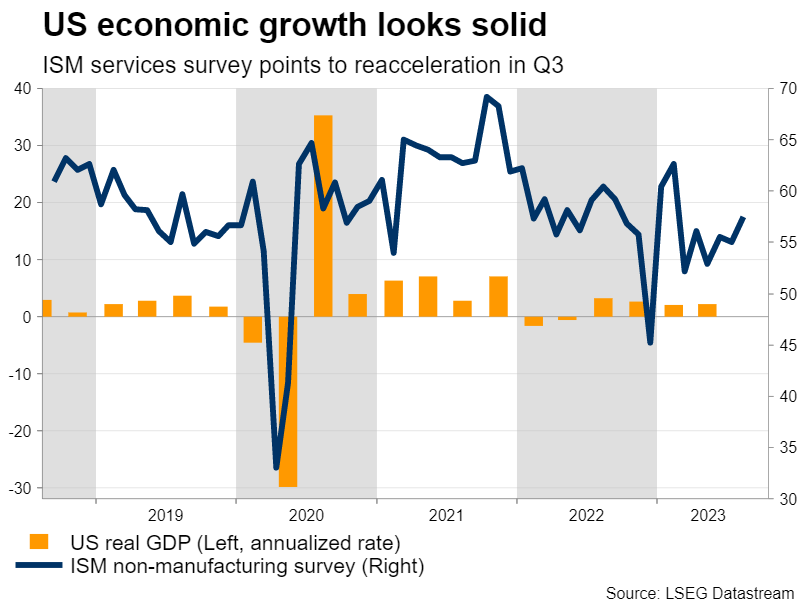
In contrast, both the Eurozone and China are slowing down at an alarming pace. Euro area GDP grew only 0.5% y/y in the second quarter, and business surveys suggest the situation will get worse moving forward, putting the risk of a mild recession on the radar. Likewise, China is dealing with the crises in its manufacturing and property sectors, which have sapped growth.
Inflation report
Turning to the upcoming releases, inflation as measured by the CPI rate is expected to have risen in August, partly because of the spike in energy prices. In monthly terms, the headline CPI rate is anticipated at 0.5%, which would push the yearly rate up to 3.5% from 3.2% in July.
However, the core rate that excludes energy and food items is projected to have risen only by 0.2% on the month. That would translate into a decline in the yearly rate, mostly because of base effects. Since a very hot print from August 2022 will now drop out of the 12-month CPI calculation and will be replaced by a colder print, that will mechanically push the yearly rate down.
Therefore, it's a mixed bag and the market reaction will boil down to any surprises in these numbers. In this sense, the risk of an upside CPI surprise seems greater, as the prices paid components of both the ISM surveys rose sharply during the month.
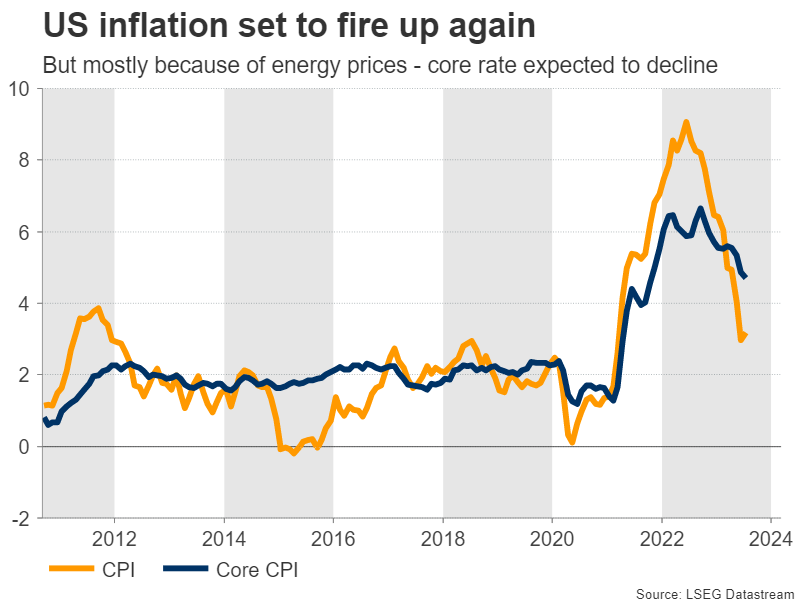
Arguing the same point is the Cleveland Fed's inflation nowcast model, which points to monthly prints of 0.79% and 0.38% for the headline and core CPI rates respectively, far above official forecasts. Admittedly, this is a narrow model, so it's difficult to put much weight on it. Still, it is one of the only real-time inflation trackers available.
Looking at the charts, an upside CPI surprise could push euro/dollar lower towards the crucial region of 1.0630, a violation of which would shift the technical outlook to negative. On the other hand, the most important area to watch in case of a CPI miss is 1.0760, which acted both as support and resistance this year.
Big picture
All told, the US economy and by extension the dollar seem much more attractive than any alternatives at this point. Europe and China are battling a severe slowdown, the Japanese yen has been devastated by rate differentials, and the British pound is trading like a proxy for equity markets, leaving it vulnerable to any shifts in risk appetite.
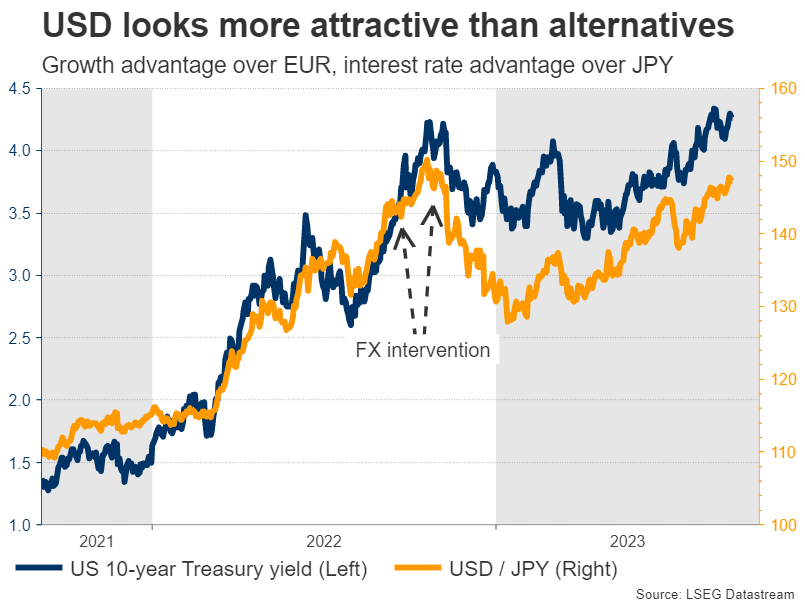
The US dollar stands in antithesis to all this. It offers a combination of solid economic growth, high interest rates, and safe haven qualities thanks to its reserve currency status, making it an 'all weather currency'.
If these elements remain in play while the global economy continues to struggle, that would leave plenty of scope for the dollar to extend its rally.
Week Ahead – ECB Rate Hike Hangs in the Balance; US CPI Could Edge Up Again
The European Central Bank is headed for a crunch rate decision next week amid rising recession risks and the job on inflation not yet done. It’s going to be a big week for the US dollar as well, as the CPI and retail sales reports are due before the Fed’s September meeting. There’s a barrage of UK data that will keep the pound on its toes before the next Bank of England decision, while the market mood will also be swayed by some key economic indicators out of China, as fears about the health of the world’s second largest economy persist.
Recession fears come back to haunt the euro
After an impressive uptrend that stretched almost 10 months, the euro’s fortunes took a turn for the worst this summer. A massive rebound in the US dollar has been one of the thorns on the euro’s side. Another is the deteriorating outlook for the Eurozone economy. Following an aggressive tightening campaign that has taken everyone by surprise, borrowing costs in the euro area now stand at their highest since the single currency’s inception. Add to that the weakening demand in Europe’s key export markets, it’s no wonder that growth is faltering. Germany in particular has been hit hard by the sharp slowdown in China and the ZEW economic sentiment index out on Tuesday could underscore all the gloom.
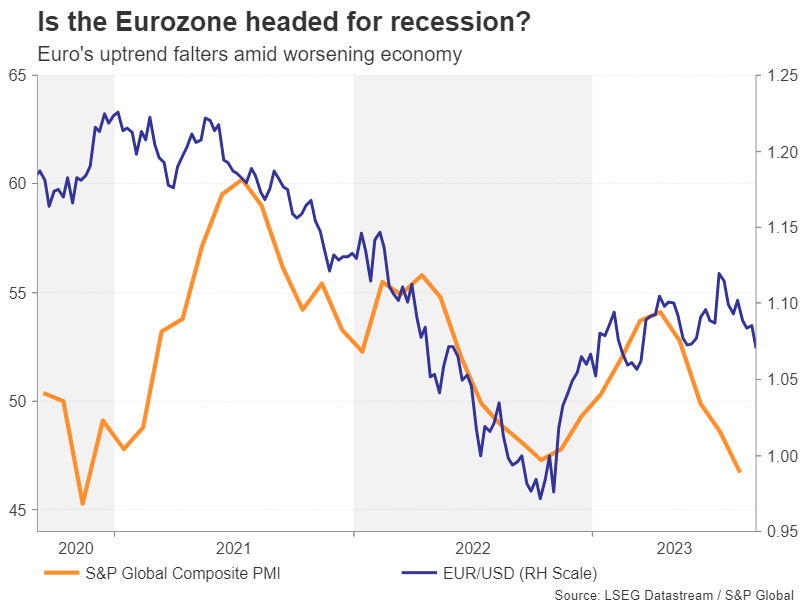
Moreover, the bad news keeps getting worse. Second quarter GDP growth just got revised down to 0.1% from 0.3% q/q, reviving recession angst, while the latest PMI readings show the downturn deepened in August. There could be more negative news from July industrial production figures due on Wednesday.
Will the ECB surprise with a 25-bps hike?
All this could give ECB policymakers enough cause for concern to pause interest rates for the first time since June 2022 when they meet on Thursday. The consensus among economists and in money markets is for the ECB to keep its deposit rate unchanged at 3.75%.
However, investors still see a sizeable probability of about 35% that the ECB will hike by 25 basis points in September. After all, core inflation that strips out food, energy, alcohol and tobacco has barely fallen this year, while CPI that excludes only food and energy remains fairly elevated at 6.2% y/y. Whilst there is very good reason to believe that inflation will moderate further over the coming months, the hawks among the Governing Council may push for one further hike for reassurance before agreeing to a pause.
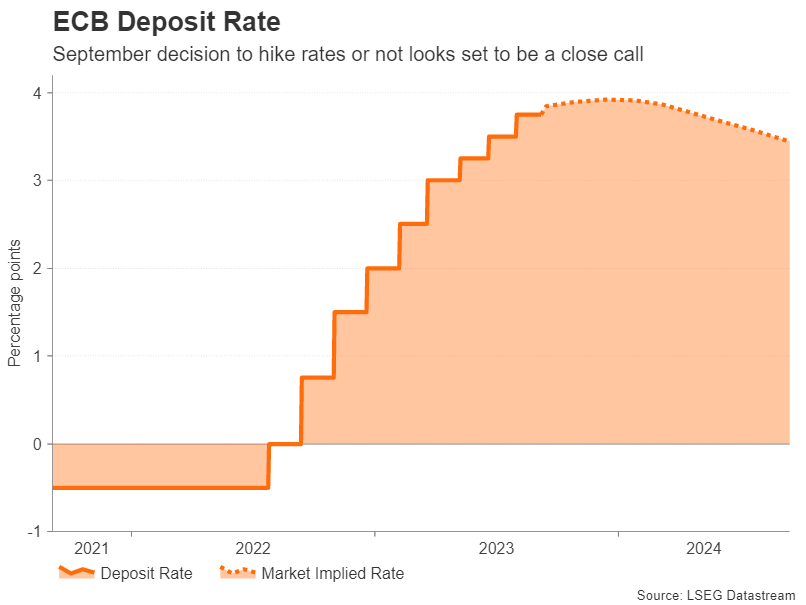
If the ECB decides not to raise rates, a hawkish hold seems almost certain. Hence, there is scope for some limited upside correction in euro/dollar. However, no amount of hawkish rhetoric or even a positive spin on the economy by President Lagarde will be able to save the euro when there are stagflation clouds hanging over it.
US CPI & retail sales could reinforce higher for longer bets
The Fed doesn’t meet until September 19-20 – that’s almost two months since the July FOMC – and after an uneventful Jackson Hole, markets are badly in need for some fresh policy guidance. Before then however, investors will be treated to the August CPI and retail sales prints.
First up is CPI inflation on Wednesday. The consumer price index inched up in July for the first time in more than a year, rising by 3.2% year-on-year. Expectations are for a further uptick in August to 3.6%. Core CPI on the other hand could edge slightly lower from 4.7%. So unless there’s a beat in both of those figures or a shock large miss, the reaction in the bond and equity markets might be muted.
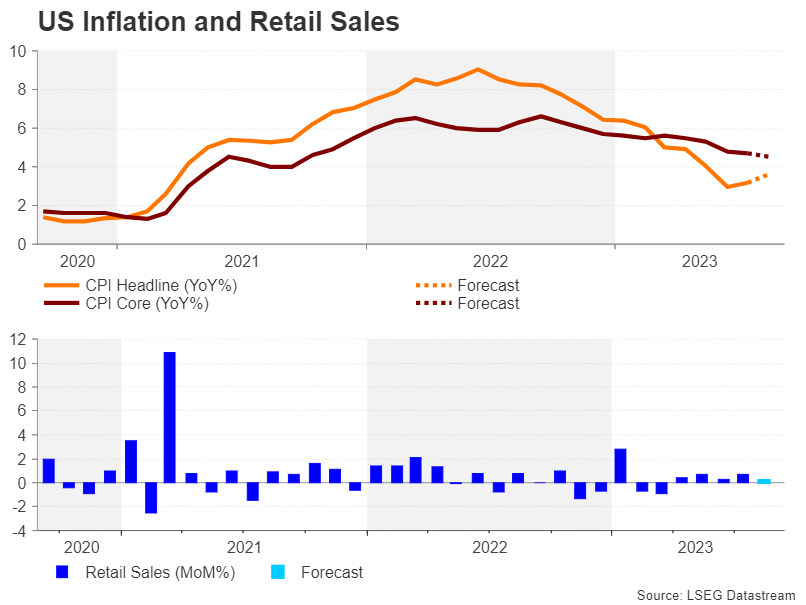
If the CPI report turns out broadly neutral, attention will swiftly turn to Thursday’s producer price index and retail sales numbers. The unexpectedly strong consumer spending in the third quarter is possibly the single biggest factor that could prompt the Fed to press the hike button in September or November. The retail sales readings will therefore be watched carefully.
Following a 0.7% m/m rise in July, retail sales are forecast to have grown at a more moderate pace of 0.2% in August.
Other releases will include the Empire State manufacturing index, industrial output and the University of Michigan’s preliminary consumer sentiment survey, all on Friday.
The odds for a 25-bps rate increase by November were boosted after the upbeat ISM services PMI and they could firm further if the upcoming week’s data is overall solid. The dollar is already trading at six-month highs so if the US economy continues to shine the brightest among its peers, there could be more gains in store.
Will UK jobs and GDP data come to the pound’s aid?
Out of all the major central banks, the Bank of England is widely seen as having the furthest to go in interest rate hikes. That’s been the key driver for sterling this year when, until recently, it topped the FX league for best performers before being toppled by the Swiss franc. The reason why the pound lost its crown is because the ‘further to go’ distance has suddenly shrunk and the BoE may only raise rates a couple more times.
This repricing quickened after Governor Andrew Bailey hinted that policymakers are “much nearer” the end of the tightening cycles. A deepening slump in the UK housing market might explain why Bailey is becoming more jittery about overtightening.
Nevertheless, the British economy has proven to be somewhat more resilient than the Eurozone’s and next week’s data could further support this view. Employment numbers for July are due on Tuesday, which will include a vital update on wage growth. UK pay growth accelerated to an astoundingly high 8.2% y/y in the three months to June. At the very least, high wage growth looks set to prevent the Bank from cutting rates anytime soon even if it decides to go on pause early.
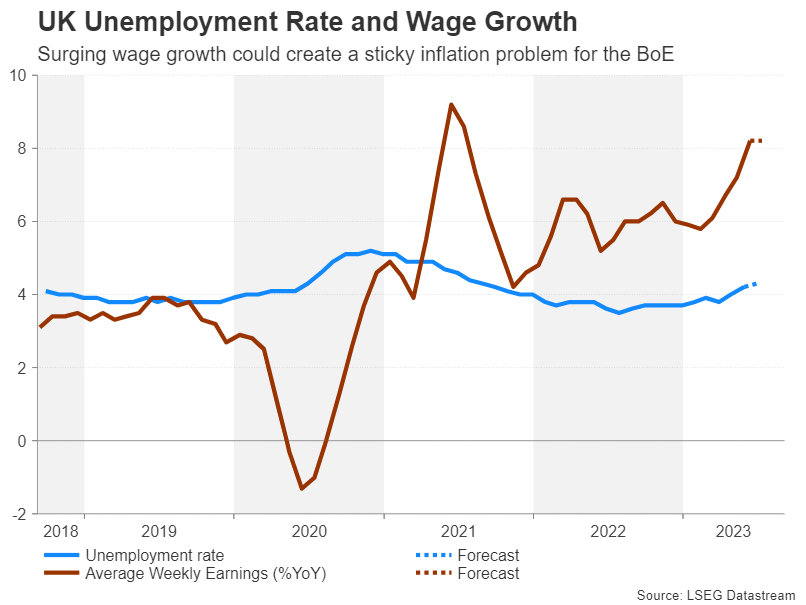
On Wednesday, the focus will be on the July GDP estimate, with industrial production and trade figures also on cue.
Sterling could recoup some of its recent losses should the incoming data ease concerns about stagflation or a recession.
Aussie weighed by Chinese and domestic woes
Down under, another battered currency will be looking for a data boost. The Australian dollar has had a rough ride lately amid a stalling economic recovery in China and the Reserve Bank of Australia not committing to any further rate hikes.
Domestic employment numbers will be important for the aussie on Tuesday after stronger-than-expected GDP growth in the second quarter cast doubt on the RBA’s overcaution on the economy. Any rebound in jobs growth in August could thus provide the aussie a bit of a lift.
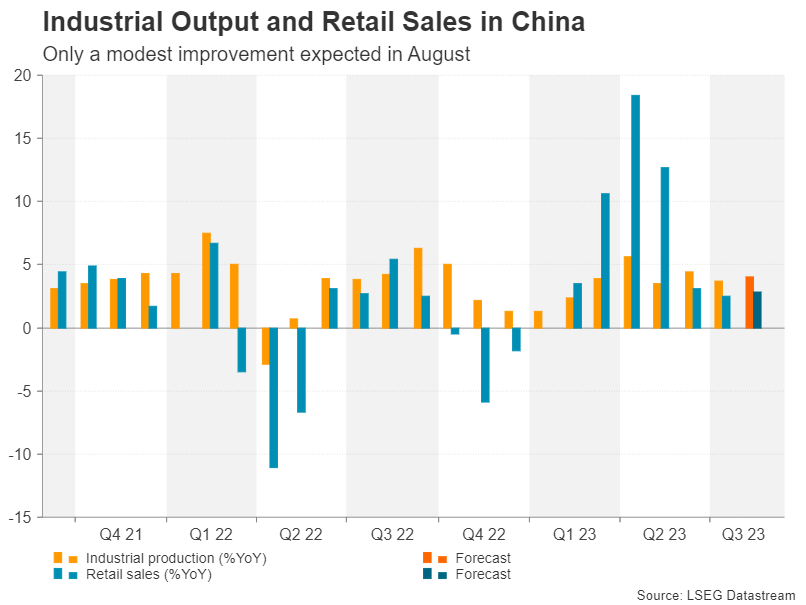
However, traders might pay more attention to China’s monthly releases on industrial output, retail sales and investment due on Friday. Although growth momentum is expected to have remained sluggish in August by China’s standards, the forecasts point to some improvement. Should that turn out to be the case, risk sentiment is likely to be buoyed, helping the aussie to bounce back from 10-month lows.
Weekly Focus – All Eyes on the ECB Next Week
This week, we published our latest economic forecasts for both Nordic and global economies in Nordic Outlook - Divergent fortunes, 5 September. The outlook for the euro area remains weak, and we think the economy is headed for a slight contraction towards the end of the year. In the US, we have lifted our growth forecast for this year (1.9%) due to more upbeat investment outlook, but still look for clearly below-trend growth towards 2024 on weakening consumption (+0.6%). And while Chinese authorities have recently rolled out increasing number of stimulus measures, we expect growth to remain below the official target at 4.8% in 2023 and 4.2% in 2024.
The divergent outlook was reflected in this week's mixed data releases as well. Euro area Sentix index signalled further weakening in investor confidence in early September, while China's Caixin Services PMI confirmed the slowdown in the official NBS measure released earlier. In contrast, US ISM Services index defied weaker signals from PMIs, and rose sharply against expectations (54.5; from 52.7). Notably, the uptick was broad-based across subcomponents, including new orders, employment and prices paid.
The strong reading lifted UST yields, which were further boosted by initial jobless claims falling to the lowest levels since February. The fear of rates staying higher for longer weighed on equity sentiment and EUR/USD. We discussed the recent US labour market data and implications for the Fed in US Labour Market Monitor, 7 September.
Next week, the focus turns to the ECB meeting, where we anticipate a final 25bp hike. Markets remain divided between a hike and a pause, with the implied probability of the former hovering around 35-40%. This week, the Q2 compensation of employees, which is ECB's key measure for wage growth, continued to grow at a pace of 5.6% y/y, close to Q1 rate of 5.4%. The figure was slightly higher than ECB estimated for 2023 back in June (5.3%). This could provide support to the still elevated underlying core inflation, which we expect to fall below 3% only in H2 2024. Read our more detailed ECB Preview, 6 September and further details on data from Euro Area Macro Monitor, 7 September.
In the US, next week brings the final key data release ahead of the September FOMC meeting, including the August CPI. While the recent uptick in oil prices will likely lift the headline measure by 0.5% m/m, cooling wage pressures should translate into further easing in core services inflation, and we forecast another low core CPI print at 0.2% m/m. While both us and the markets remain convinced that the Fed will go on a pause in September, market pricing implies that the November meeting is essentially a coin-flip between a hike and a pause. The next meeting will provide some interest cues in the form of updated rate projections however, and a low CPI print could tilt some of the FOMC participants to revert their June call for one more hike later in the year.
Other data releases include US retail sales, where early card transaction data is pointing towards slowing real spending growth, especially when considering the higher gasoline prices. The Fed will keep an eye out for the preliminary University of Michigan survey as well, and if the declining trend on inflation expectations continued into September.
Week Ahead – US Inflation Key, ECB Ponders Rate Pause, UK Labor Market Data
US
This week is all about the US CPI report and retail sales data. If the US demand for goods didn’t weaken that much and if inflation heated up, rate hike expectations for the November meeting might become the consensus. The inflation report might not be as clear as headline inflation will obviously rise given the surge in gasoline prices, but core might deliver another subdued reading. Moderation with consumer spending will be the theme as Americans deal with higher energy prices, rising debt levels, and as confidence softens.
Investors will also pay close attention to the University of Michigan’s inflation expectations on Friday. The 1-year outlook for prices may drop from the 3.5% August reading. Fed speak will be nonexistent as the blackout period begins for the September 20th policy meeting.
Eurozone
The European Central Bank meets next week and it’s not clear at this stage what decision they will come to. Refinitiv is pricing in around a 65% chance of a hold, which may signal the end of the tightening cycle – not that the ECB would in any way suggest that at this stage – but expectations do differ. There’s every chance the committee will push through one more, at which point the data is expected to improve regardless making a Fed-style exit all the more difficult. Ultimately, it will likely come down to the projections which will be released alongside the decision. ZEW surveys aside, on Tuesday, the rest of the week is made up of tier-three data.
UK
Potentially a big week for the UK ahead of the next monetary policy meeting on 21 September. Andrew Bailey and his colleagues this past week hinted that the decision is in the balance and not the foregone conclusion many expect. Markets are pricing in a more than 70% chance of a hike and more than 50% of another after that by February. If what they said is true, then the labor market report on Tuesday could be hugely significant as further slack could give those on the fence the reassurances they need that past measures, among other things, are working and more may not be needed. Huw Pill also speaks on Monday while Catherine Mann will make an appearance in Canada on Tuesday. GDP on Wednesday could also be interesting, with the rest of the week made up of less influential releases.
Russia
The CBR is expected to leave the key rate unchanged at 12% on Friday. It hiked very aggressively at the last meeting – from 8.5% – so there is scope for another surprise, with inflation having risen again last month to 5.1%. The rouble has also been in steady decline after rebounding following the last announcement, to trade not far from its recent lows against the dollar.
South Africa
A relatively quiet week ahead, with manufacturing figures due on Monday and retail sales on Wednesday.
Turkey
The CBRT is desperately trying to get inflation under control again with successive large interest rate hikes. In response the currency has stopped making new lows but it has drifted lower again over the last couple of weeks since the surprisingly large last hike. It’s sitting not far from the pre-meeting lows now and inflation data this past week won’t have helped, rising to 58.94% annually. More rate hikes are likely on the way. Next week the focus is on unemployment and industrial production figures on Monday.
Switzerland
A very quiet week to come, with PPI inflation the only economic release. We’ve been seeing some deflation in recent months in the PPI data which will be giving the SNB some comfort that price pressures are back under control. Another rate hike is no longer viewed as guaranteed, with markets slightly favoring a hold over the coming meetings but it is tight.
China
The much sought-after consumer and producers’ price inflation data for August will be released this Saturday where market participants will have a better gauge of the current deflationary conditions in China.
After a slight improvement in the two sub-components of August’s NBS Manufacturing PM where new orders and production rose to their highest level since March at 50.2 and 51.9 respectively coupled with an improvement in export growth for August that shrunk to a lesser magnitude of -8.8% y/y from -14.5% y/y in July, there are some signs of optimism that the recent eight months of deflationary pressures may have started to abate.
The August CPI is expected to inch back up to 0.2% y/y from -0.3% y/y in July and the PPI is forecast to shrink at a lesser magnitude of -3% y/y in August versus -4.4% in July. If the PPI turns out as expected, it will be the second consecutive month of improvement from a persistent loop of deflationary pressure in factory gate prices since November 2022.
Other key data to focus on will be new yuan loans and M2 money supply for August which will be released on Monday. It will provide a sense of whether China’s economy is slipping into a liquidity trap despite the current targeted monetary and fiscal stimulus measures enacted by policymakers.
Lastly, the housing price index, industrial production, retail sales, and the unemployment rate for August will be released on Friday with both retail sales and industrial production expected to show slight improvement; 2.8% y/y for retail sales over 2.5% y/y recorded in July, 4% y/y for industrial production versus 3.7% in July.
Market participants will be keeping a close eye on youth unemployment for August after July’s figure was temporarily suspended by the National Bureau of Statistics without any clear timeline for the suspension. The youth joblessness data in China is of key concern after the youth unemployment rate skyrocketed to a record high of 21.3% in June, around four times more than the national unemployment rate of 5.3%.
Lastly, China’s central bank, the PBoC, will announce its decision on a key benchmark interest rate, the 1-year medium-term lending facility rate on Friday and the expectation is no change at 2.50% after a prior cut of 15 basis points.
India
Inflation and balance of trade for August will be the focus for the coming week. Inflation data is released on Tuesday and is expected to dip slightly to 7% y/y from 7.44% in July, the highest since April 2022.
Balance of trade will be released on Friday and the expectation is for the deficit to widen slightly to -$21 billion from -$20.67 billion in July.
Australia
On Monday, the Westpac consumer confidence change for September is expected to improve to 0.6% m/m from a reading of -0.4% m/m in August, following three consecutive interest rate pauses from RBA.
The key employment change data for August will be released on Thursday with 24,300 jobs expected to be created, an improvement on the 14,600 reduction in July. Meanwhile, the unemployment rate is expected to slip to 3.6% from 3.7% in July.
New Zealand
Electronic retail card spending for August is due on Tuesday and is forecast to dip to 1.4% y/y from 2.2% in July. That would represent a declining trend in growth in the past five months.
Next up, food inflation for August will be released on Wednesday; its growth rate is expected to slow to 7.8% y/y from 9.6% in July. That would be the slowest growth in food inflation since June 2022.
Japan
A couple of key data points to note for the coming week. Firstly, the Reuters Tankan Index on manufacturers’ sentiment on Wednesday; after a big jump to +12 in August – its highest level recorded so far this year – sentiment is expected to taper off slightly to +10 for September.
Producers’ price index for August will be released on Wednesday and a slight dip is expected to 3.2% y/y from 3.6% in July.
Lastly, on Thursday, we will have data on machinery orders from July with the consensus expecting a further decline of 10.7% y/y from -5.8% in June.
Singapore
One key data to focus on is the balance of trade for August which will be out on Friday. The trade surplus is being expected to increase slightly to $7 billion from $6.49 billion in July. That would be the fourth consecutive month of expansion in the trade surplus.
Economic Calendar
Saturday, Sept. 9
Economic Data/Events
- China CPI, PPI
- G-20 summit in New Delhi: President Biden, UK PM Sunak and Saudi Crown Prince Mohammed bin Salman plan to attend
Sunday, Sept. 10
Economic Events
- Russia’s Eastern Economic Forum: North Korean leader Kim Jong Un to meet with Russian President Putin
- Russia holds regional elections, including in four occupied regions of Ukraine
Monday, Sept. 11
Economic Data/Events
- China aggregate financing
- Italy industrial production
- Japan M2 money stock
- Mexico industrial production
- South Africa manufacturing production
- Turkey current account, industrial production
- The EU releases an updated economic forecast
- BOE’s Mann speaks at Canadian Association for Business economics conference
- US Deputy Treasury Secretary Adeyemo addresses The Economic Club of New York
- Creditors of China’s Country Garden finish voting on requests to extend more bonds
- Thailand PM Thavisin to unveil economic measures at joint session of parliament
Tuesday, Sept. 12
Economic Data/Events
- Australia consumer confidence
- Germany ZEW survey
- India industrial production, CPI
- Mexico international reserves
- Spain CPI
- UK jobless claims, unemployment
- Apple unveils iPhone 15 line and next-generation smartwatches at “Wonderlust”
- New Zealand’s Treasury releases pre-election economic and fiscal update
Wednesday, Sept. 13
Economic Data/Events
- US August CPI M/M: 0.5%e v 0.2% prior; Y/Y: 3.6%e v 3.2% prior
- Eurozone industrial production
- India trade
- Japan PPI
- New Zealand food prices
- UK industrial production
- European Commission President von der Leyen delivers State of the EU speech at the European Parliament in Strasbourg.
- Tech leaders including Tesla’s Elon Musk and Meta Platforms’ Mark Zuckerberg attend a forum on the future of AI convened by Senator Chuck Schumer
Thursday, Sept. 14
Economic Data/Events
- US retail sales, PPI, business inventories, initial jobless claims
- Australia unemployment
- Eurozone ECB rate decision: Expected to deliver one last rate hike, bringing main refinancing rate to 4.50% and the deposit rate to 4.00%
- India wholesale prices
- Japan machinery orders, industrial production
- United Auto Workers union contract talks reach a pivotal moment that could shut down a major section of the US economy
- German Foreign Minister Baerbock to meet with US Secretary of State Blinken in DC
- Italian PM Meloni to attend Budapest Demographic Summit
Friday, Sept. 15
Economic Data/Events
- US industrial production, University of Michigan consumer sentiment, Empire manufacturing index
- Canada existing home sales
- China property prices, retail sales, industrial production
- France CPI
- Italy trade, CPI
- Japan tertiary index
- New Zealand PMI
- Poland CPI
- Russia rate decision
- Chinese financial institutions set to reduce foreign exchange deposits held in reserve
- Informal meeting of EU finance ministers in Spain
Sovereign Rating Updates
- Germany (Fitch)
- Belgium (S&P)
- Saudi Arabia (S&P)
- Spain (S&P)
- Greece (Moody’s)
- Netherlands (DBRS)
Crypto Sellers Losing Patience
Market Picture
It looks like sellers in cryptocurrencies are losing patience. The crypto market remains tightly pinned at $1.04 trillion in capitalisation. An attempt to break away and cross the $1.05 trillion mark has been met with heavy selling, and it’s well below the $1.1 trillion pivot late last month.
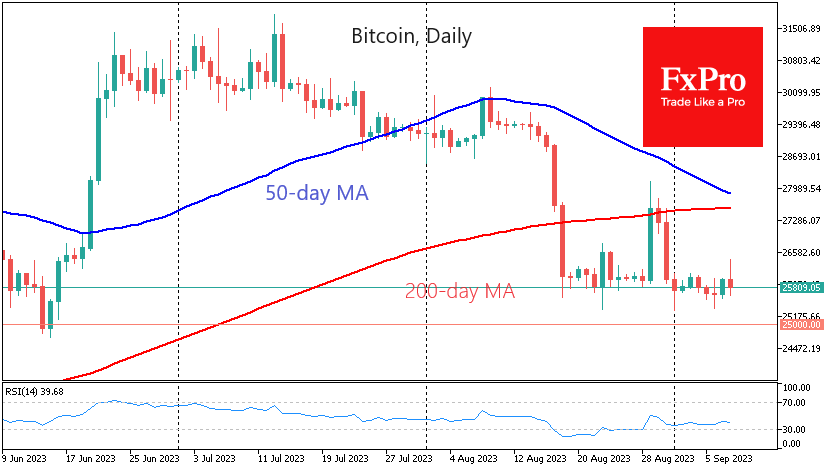
Similarly, Bitcoin is finding it increasingly difficult to keep its balance as it rises above $26.0K. The last such attempt on Friday morning was quickly thwarted, and BTCUSD is again trading near $25.8K.
Bitcoin’s technical picture on daily timeframes remains bearish, as the 50-day is approaching 200-day MA from above. The crossing (probably next week) can potentially trigger an impulsive sell-off, which is very dangerous in such a thin market.
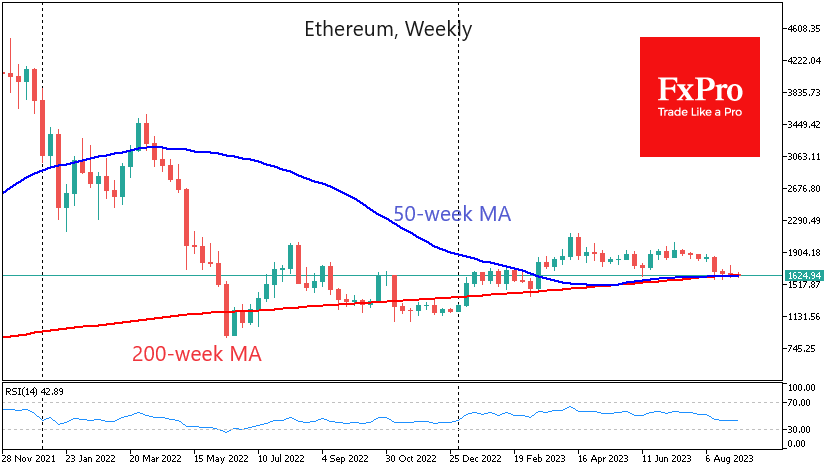
Ethereum is trading near its 50- and 200-week averages and near its lows from March. This is a bearish disposition, especially given the strengthening dollar and pressure on US stock indices in the background.
News background
The Financial Stability Board and the International Monetary Fund recommended regulating digital assets. The initiative aims to bring together standards and different positions to mitigate cryptocurrency risks.
The Chicago Board Options Exchange (CBOE) filed applications with the US Securities and Exchange Commission (SEC) on behalf of Ark Invest and VanEck to launch spot ETFs on Ethereum.
Google has allowed advertising of blockchain-based games using NFT from 15 September if they are unrelated to gambling.
Meanwhile, Arkham Intelligence platform identified Grayscale Foundation wallets that hold more than $16bn worth of bitcoins.
USD/CAD: A Hot Canadian Employment/Wage Report Sends the Loonie Higher
- BOC rate hike odds for the October 25th meeting rise from yesterday’s 23.9% to 28.8%
- Hours worked climbed to the highest level since February
- CAD futures open interest rise to best levels since mid-March
Canada’s economy isn’t quite ready to cool. The latest Canadian employment report showed hiring bounced back in August, doubling expectations. The near 40,000 added jobs exceeded the 17,500 consensus estimate and proved that the prior month’s unexpected shedding of jobs was not the beginning of a new trend. The BOC will pay close attention to the wage growth acceleration of 5.2%, which was expected to soften to 4.7%. There is a lot of data before the October 25th BOC meeting, but it still seems like they’ve reached the terminal rate for this tightening cycle.
Open Interest in Canadian dollar futures
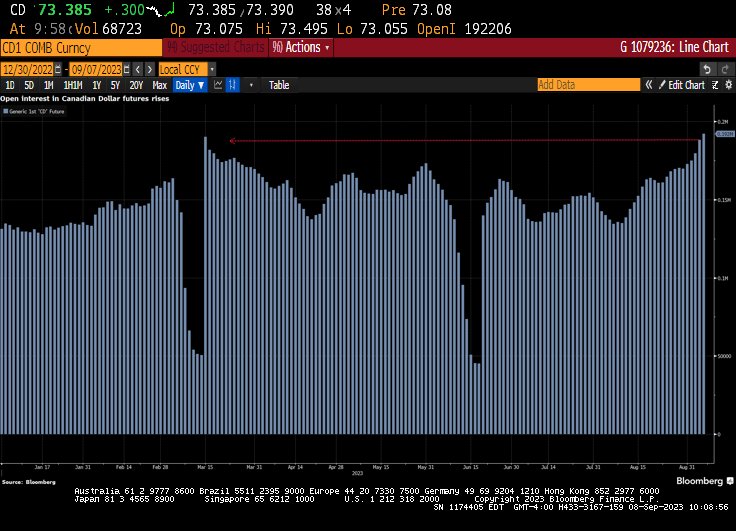
The Canadian dollar is the top performing G10 currency and that could continue given how the futures market is positioned. The last time open interest for Canadian dollar futures were at these levels was the middle of March, which was when USD/CAD started its decline from around the 1.37 level to the 1.3300 area.
Canadian Employment Highlights
Canada’s strong jobs report showed full-time employment rebounded from 1,700 to 32,200, while part-time work created 7,800 jobs, much better-than-the prior month’s decline of 8,100 positions. The unemployment rate held steady at 5.5%, which was better than the expected increase of 5.6%. The majority of the job gains stemmed from the professional and technical services, and construction. The regions that benefited the most were Alberta, British Columbia and Prince Edward Island. Nova Scotia was the only region that lost jobs. While the job gains are a positive sign, when you figure in population growth, this pace won’t cut it for keeping the unemployment rate steady. About 50,000 jobs per month would be needed to support a steady unemployment rate.
USD/CAD 60-minute chart
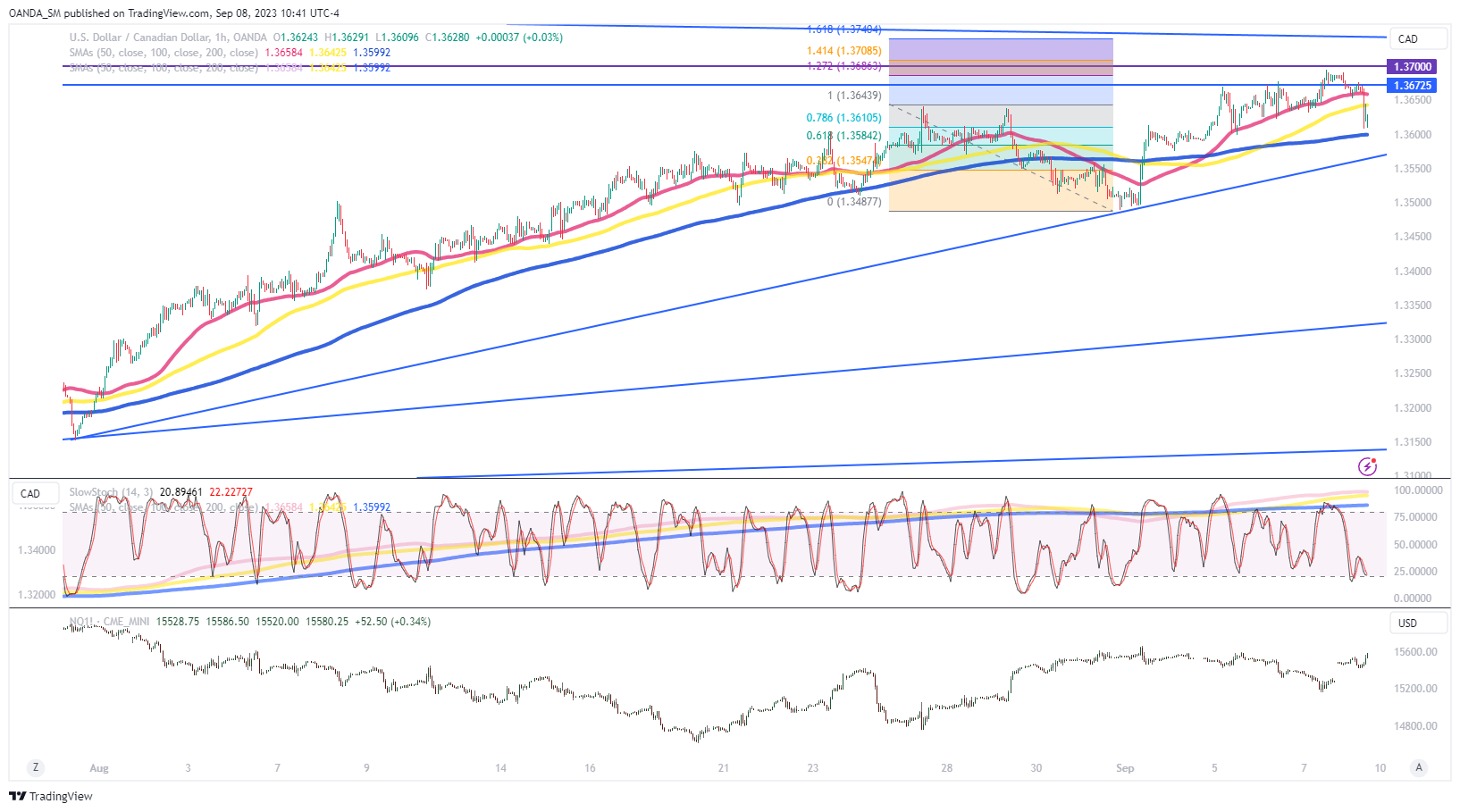
After breaking down below the 1.3650 level, bearish momentum is slowing down ahead of the 1.3600 level. If the start of next week does not include a risk averse start, the Canadian dollar could have a strong move here. Unless the uptrend line (which started in July) is broken substantially to the downside, the prevailing bullish trend may remain in place.
Sunset Market Commentary
Markets
Today’s empty eco calendar left plenty of room to further digest the PBOC’s regime shift in CNY fixings. They turn more tolerant to a weaker currency given the cyclical and structural headwinds the economy is facing. USD/CNY trades at the highest level since end 2007 (7.34). USD/JPY (147.40) is not impressed by Finance Minister Suzuki’s verbal intervention warning. USD/JPY 150, the previous line in the sand for strong action, comes closer step by step. Yesterday evening’s Wall Street risk off spilt to Asia and initially to Europe as well despite a decent start. The EuroStoxx 50 intensively tested the key 4200 support area which is the downside of the sideways trading band in place since May. A break didn’t occur with technical rebound action starting mid-way European dealings. Core bonds made a similar intraday U-turn though it started way faster. The new increase in the oil price ($89.5/b to $90.5/b) comes a good way in helping to explain the move. Changes on the German and the US yield curve are confined to +- 1 bp. The EUR/USD decline takes a breather, but at 1.07 no more than that. The dollar holds the upper hand in the current market environment. EUR/GBP is going nowhere neither at 0.8575. A report on jobs by KPMG and REC was overlooked. It signaled reduced activity across the UK during August with permanent placements falling at a rapid pace which was the sharpest in over three years while temp billings slipped into decline for the first time since July 2020. Nevertheless, competition for specific skills and the strong inflationary environment drove further increases in starting pay. The report adds to the picture scheduled by official data with the unemployment rate gradually picking increasing while wage growth accelerates. The Bank of England will likely take it as a sign to proceed slowly from here with markets expecting a final (or second-to-last) 25 bps rate hike.
News & Views
The Food Price Index of the Food and Agriculture Organization of the United Nations was down 2.1% in August from July, reversing the rebound registered last month and is currently 24% below its peak reached in March 2022. The drop reflected declines in the price indices for dairy products, vegetable oils, meat and cereals, while the sugar price index increased moderately. The Cereal Price Index declined 0.7% M/M to be down 14.1% Y/Y. Wheat prices fell 3.8%. Maize prices fell for the seventh consecutive month, hitting their lowest value since September 2020. By contrast, the Rice Price Index in August rose by 9.8% M/M to reach a 15-year nominal high, reflecting trade disruptions registered in the aftermath of India's July ban on rice exports. Vegetable oil prices declined 3.1% in August. The FAO Dairy Price Index (-4.0% M/M) registered the eighth consecutive monthly decline, to be 22.4% below its corresponding value last year. Meat prices also declined 4% M/M. The FAO Sugar Price Index rose 1.3% from July to be 34% higher compared to August last year. The increase in world sugar prices was mainly due to heightened concerns over the impact of the El Niño weather phenomenon on global production prospects. In India, below-average rains in August were detrimental to sugarcane crop development, while dry weather conditions in Thailand are expected to negatively affect the 2023/24 production. In Brazil, rains hampered field operations in some areas; however, the large crop currently being harvested limited the upward pressure on world sugar prices. The weakening of the Brazilian Real against the USD and lower ethanol prices also contributed to curbing the rise in world sugar prices. Still recent futures prices suggest upside price pressures might continue.
Canadian employment in August still rose at a solid/faster than expected pace. The economy added 39.9k jobs, double expectations, mainly driven by a rise in full time employment (32.2k). The unemployment rate remained unchanged at 5.5% (5.6% expected). Hourly wages for permanent employment unexpectedly accelerated from 5% to 5.2% while an easing to 4.7% was expected. At the same, the labour force continues to expand at a faster pace than employment. This reduces the employment rate from 62% to 61.9% and might slightly/gradually ease the tightness in the labour market. The Bank of Canada this week left its policy rate unchanged at 5% but showed ongoing concerns on persistent underlying inflation. Today’s wage data at least won’t help to ease this concern. The 2-yr CAD government bond yield rose 4 bps after the release. After touching the weakest level against the dollar since March yesterday; the loonie after the data strengthens from 1.3675 to test the 1.361 area.
XAU/USD : Gold Price Regained Traction on Dovish Signals from Fed
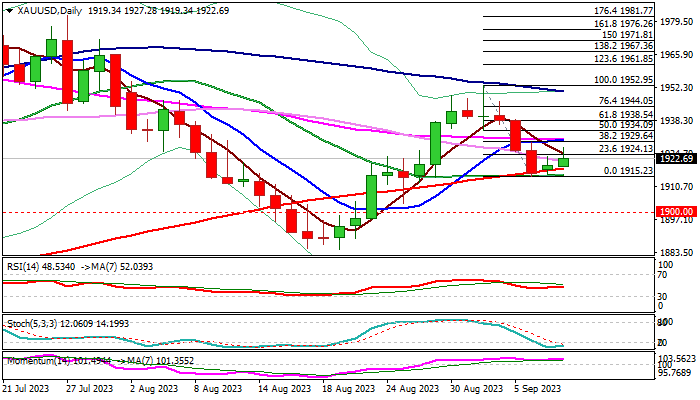
Gold price rose further on Friday, extending recovery from $1915, where the higher base is forming after three-day fall found firm ground, after being contained by 200DMA.
Weaker dollar on end-of-week profit taking contributed to fresh strength, as the metal benefited from rather neutral stance of Fed policymakers.
Fed officials referred to cooling inflation and quite good shape of the economy, while the latest data showed that labor demand is coming down and unemployment is rising, suggesting that the central bank will likely stay on hold in September’s policy meeting.
Technical picture on daily chart remains bullishly aligned as positive momentum is strong, RSI heading north and stochastic is about to emerge from oversold territory, though MA’s are in mixed setup.
Fresh strength cracked initial resistance at $1924 (Fibo 23.6% of $1952/$1915) but needs more work at the upside and sustained break above $1930 zone Fibo 38.2% / converged 10/55DMA’s) to generate reversal signal and open way for stronger advance.
Near-term bias is expected to remain with bulls while the price action stays above 200DMA, while next week’s daily cloud twist is also expected to be magnetic.
Res: 1930; 1938; 1940; 1948.
Sup: 1918; 1915; 1902; 1892.