

Sample Category Title
What To Trade In July
July is right around the corner, and it heralds the start of the year's second half. In this article, I hope to share with you, my dear readers, a few of my trade ideas for July in hopes that it fetches you all some sizable profits and makes your July fun and fruitful. Let’s go!
AUDCAD - W1 Timeframe
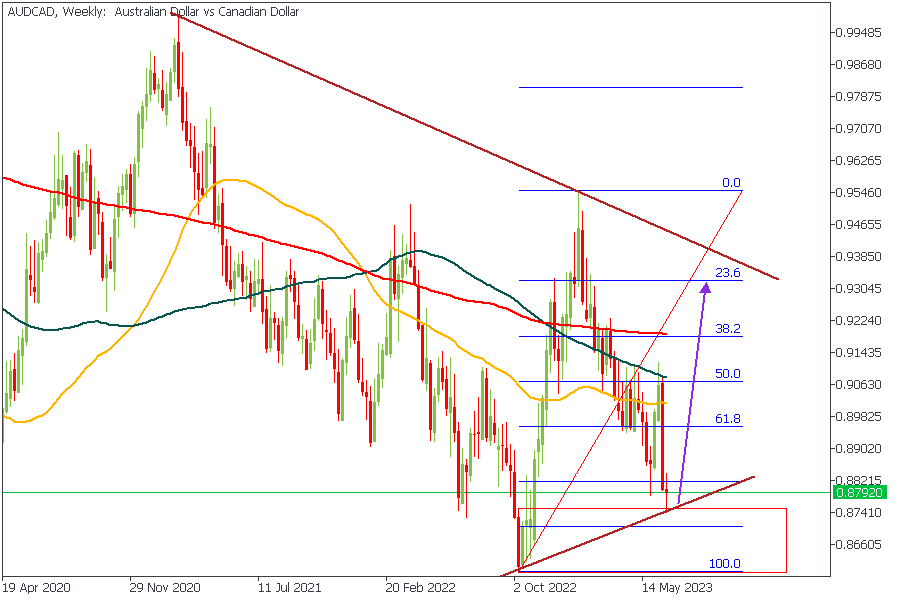
Let’s take a look at AUDCAD first of all. Here we see the wick of the current weekly candle resting on top of a trendline support that cuts across the drop-base-rally demand zone. Also, there is a clear break above the previous structural high, with a retest at 76% of the Fibonacci retracement zone. In line with these criteria, I would expect to see AUDCAD get rejected from the demand zone with a bullish price action extending to the 38% region of the Fibonacci retracement.
Analyst’s Expectations:
- Direction: Bullish
- Target: 0.91267
- Invalidation: 0.86010
USDCAD - W1 Timeframe
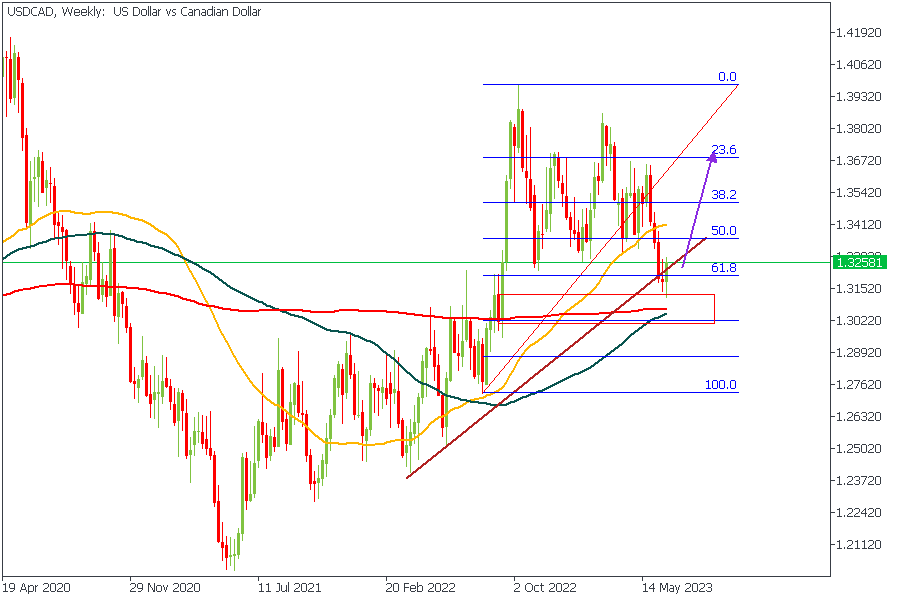
The price action on USDCAD appears pretty obvious. We can see a rally-base-rally demand zone that aligns with the 200 and 100 period moving averages as support and 76% of the Fibonacci retracement. In this scenario, I expect USDCAD to rise to 24% of the Fibonacci retracement since we also have a trendline support as an added confluence in favor of a bullish rebound.
Analyst’s Expectations:
- Direction: Bullish
- Target: 1.35727
- Invalidation: 1.30139
GBPCAD - W1 Timeframe
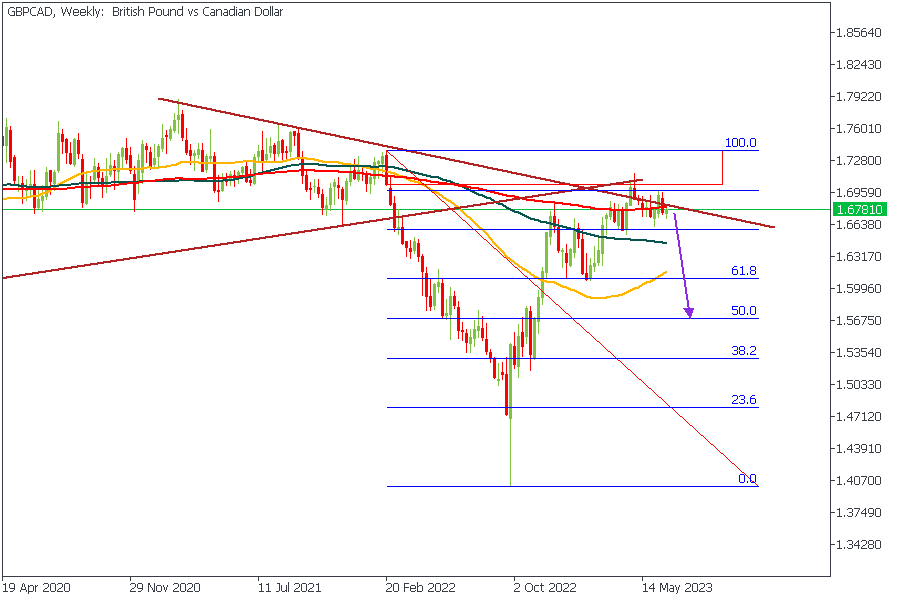
GBPCAD presents another interesting setup. In this case, we even see price trading at an intersection of two resistance trendlines - one of my favorite confluences for trend continuation trades. In addition to these, we also have a rally-base-drop supply zone, a 200-period moving average resistance, and the 88% Fibonacci retracement level as resistance. Did you notice the moving averages? They are also arrayed in a clear bearish order, meaning we have at least five confluences in favor of a bearish outcome on GBPCAD.
Analyst’s Expectations:
- Direction: Bearish
- Target: 1.58063
- Invalidation: 1.70099
CONCLUSION
The trading of CFDs comes at a risk. Thus, to succeed, you have to manage risks properly. To avoid costly mistakes while you look to trade these opportunities, be sure to do your due diligence and manage your risk appropriately.
Is Crypto Season Back Now?
Exciting news from Mastercard: they are launching a Multi-Token Network (MTN) to explore the potential of tokenized bank deposits, stablecoins, and central bank digital currencies (CBDCs). The MTN will begin with testing tokenized bank deposits and will be available in beta mode this summer in the UK. They have invited banks and financial institutions to participate in the initiative. Mastercard aims to bring programmability and flexibility to regulated money by making bank deposits digital assets on the blockchain. This aligns with their blockchain analytics application, Mastercard Crypto Credentials, which ensures compliance with regulations like anti-money laundering. The MTN will enable cross-border transfers of value between banks, allowing for fast and flexible movement. Selected teams will be able to develop use cases powered by tokenized deposits and digital assets in an MTN Innovation Sprint happening in London this summer.
BTCUSD - W1 Timeframe
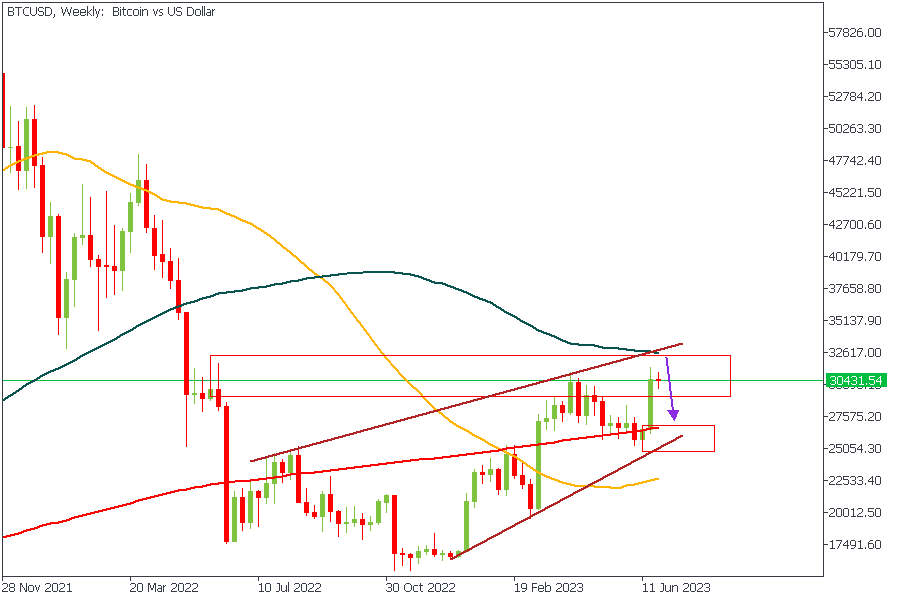
Bitcoin has had an interesting couple of weeks, with a remarkable, bullish recovery. However, BTCUSD is struggling to keep up the bull run due to selling pressure from the supply zone, as highlighted in the chart. The rally-base-drop supply zone is expected to yield some bearish pressure, potentially derailing the bullish intent. Here’s my take; wait to see a clear rejection from this supply zone from the Daily timeframe before proceeding to take a position on the commodity.
Analyst’s Expectations:
- Direction: Bearish
- Target: 27000.00
- Invalidation: 32728.84
XRPUSD - D1 Timeframe
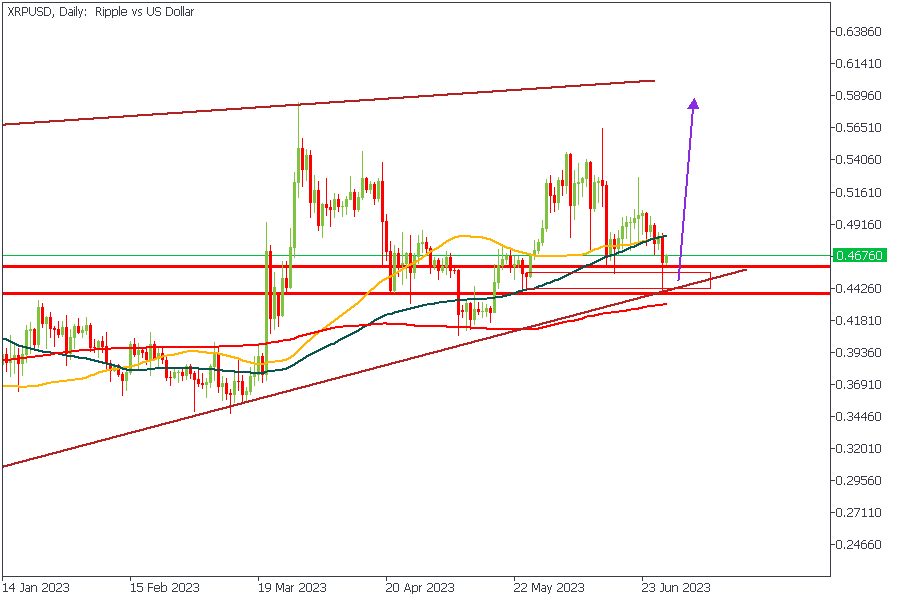
XRPUSD is sitting pretty in a well-cushioned area of demand - the likelihood of breaking this demand zone is minimal. First, we see the trendline support, then the bullish array of the moving averages, followed by the drop-base-rally demand zone, and finally, the 200-day moving average as support. All these confluences serve strictly to bolster the bullish sentiment on XRPUSD.
Analyst’s Expectations:
- Direction: Bullish
- Target: 0.56699
- Invalidation: 0.44237
ETHUSD - D1 Timeframe
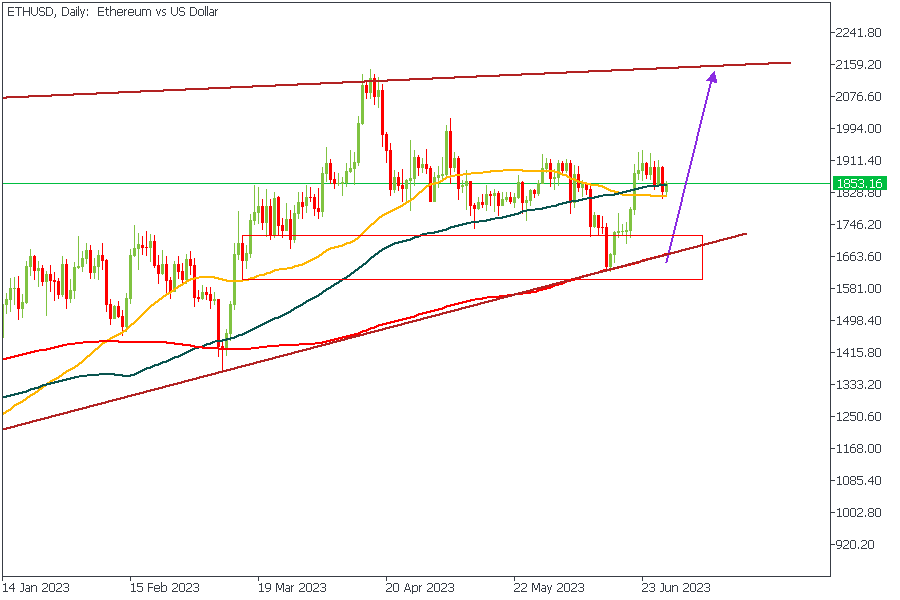
ETHUSD is yet another cryptocurrency pair that is also prepping for a bull run. So far, we’ve seen Ethereum react succinctly to the confluence of the 200-day MA, the demand zone, and the trendline support, leading to a price action that slightly broke above the previous high of the market structure. On this basis, I expect to see a seamless continuation of the same bullish price action from the 100-day moving average as an area of support.
Analyst’s Expectations:
- Direction: Bullish
- Target: 2066.42
- Invalidation: 1690.03
CONCLUSION
The trading of CFDs comes at a risk. Thus, to succeed, you have to manage risks properly. To avoid costly mistakes while you look to trade these opportunities, be sure to do your due diligence and manage your risk appropriately.
USD/JPY Steady Ahead of Key Japanese Inflation Release
- Japan releases Tokyo Core CPI on Friday
- USD/JPY moves closer to symbolic 145 line
- Ueda says no changes to policy unless core inflation rises
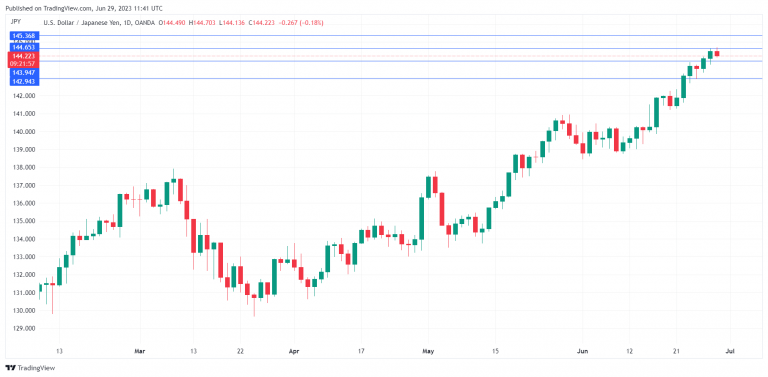
USD/JPY has edged lower on Thursday. In the European session, the yen is trading at 144.19, down 0.20%. The yen dropped as low as 144.70 in the Asian session, as the symbolic 145 line remains under pressure.
Tokyo Core CPI expected to tick higher
Japan releases a key inflation indicator, Tokyo Core CPI, on Friday. The indicator dipped to 3.2% in May but is expected to inch up to 3.3% in June. Tokyo CPI excluding food and energy, currently at 2.4% and known as the “core core index”, will be under the microscope after the National “core core index” rose unexpectedly in June. Earlier this week, BoJ Core CPI, the preferred inflation gauge of the central bank, rose from 2.9% to 3.1%, above the consensus of 3.0%.
If today’s inflation report also shows that inflation is creeping higher, it will put into question the BoJ’s stance that cost-driven inflation is temporary and therefore there is no need to tighten monetary policy.
Governor Ueda reiterated this position at the ECB Bank Forum on Wednesday. Ueda stated that he would continue the BoJ’s ultra-easy monetary policy unless he was “reasonably sure” that inflation accelerated in 2024. He said that the BoJ was not confident that this would occur, noting that even though headline inflation was above 3%, core inflation remained below the Bank’s 2% target.
The BoJ’s ultra-accommodative policy has seen the yen slide to 7-month lows, which has drawn warnings from the Ministry of Finance about intervening in the currency markets. Ueda declined to comment on the possibility of intervention, saying that the BoJ was closely monitoring the exchange rate and that the yen was influenced by many other factors besides BoJ policy.
USD/JPY Technical
- There is resistance line at 144.65 and 145.36
- 143.94 and 142.94 are providing support
XAU/USD: Gold Hits New 14-Week Low on Break of Psychological $1900 Support
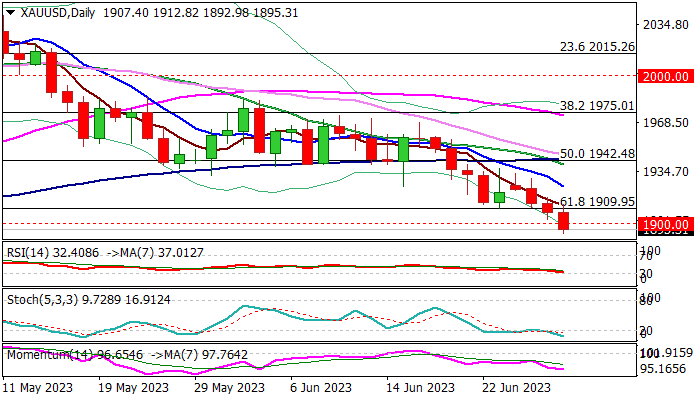
Gold price fell further and hit new multi-week low on Thursday, following break of psychological $1900 support.
The yellow metal price remains firmly in red, weighed by hawkish central banks which signaled further rate hikes to continue fighting stubbornly high inflation and prompted traders into dollar.
In addition, better than expected US Q1 GDP and weekly jobless claims added to signals that the US economy remains robust and will likely avoid recession, reducing need for run into safety and additionally weighing on fading safe-haven demand.
The price probes below $1900 for the first time since mid-March, with close below this level to further weaken near-term structure and open way for deeper drop, exposing targets at $1869/$1856 (Fibo 76.4% of $$1804/$2080 / rising 200DMA).
The metal is also on track for the second straight significant weekly loss, as well as to end month with over 3% down, which contributes to negative signals.
Technical studies on daily chart are predominantly bearish, with oversold conditions being so far ignored, although some price adjustment should be anticipated in coming sessions.
Broken supports at $1900/$1909 should ideally cap, with extended upticks not to exceed falling 10DMA ($1924), to keep larger bears intact.
Res: 1900; 1909; 1924; 1932.
Sup: 1885; 1869; 1856; 1845.
Sunset Market Commentary
Markets
June inflation rates of several EA member states were supposed to be the main dish for today but US weekly jobless claims unexpectedly stole the show. They retreated to 239k vs the stabilization expected at 265k. Unemployment benefits applications were on the rise since mid-May in a sign of the very first cracks in the labor market following the Fed’s aggressive tightening campaign. That’s now again being called into question with today’s data. US bond yields, already advancing before the release, extended gains by several bps. Current changes vary between 7.1 bps in the 30-y) to 15.3 bps for the 2-y with the latter hitting the highest level since the mid-March tremors. Suddenly markets are pricing in a 50% chance for a second rate hike after the one delivered in July. Turning to European price data then, most of them were at or slightly above expectations. Spanish HICP rose 0.6% m/m to 1.6% y/y, beating consensus by 0.2 and 0.1 ppts respectively. German inflation picked up again exactly as expected through a 0.4% monthly rise, bringing the yearly figure to 6.8%, up from 6.3%. Belgian inflation (national calculation) dropped below 5% (4.15%) on a huge energy price effect (-3.48 ppts). Core inflation ex energy decelerated to a still lofty 8.14%, down from 8.7% while services inflation stood at 7.25% (from 8.16%). Tomorrow’s Euro Area headline reading is seen at 5.6% but more importantly, the core gauge may reaccelerate to 5.5%. German yields shoot 5-8.4 bps higher with the belly underperforming the wings. The move is overwhelmingly inspired by the US though. The euro held the upper hand against the dollar but growing yield differentials favoured the dollar eventually. EUR/USD returned earlier gains to trade lower for the day below 1.09. The trade-weighted USD DXY index rises towards 103.34 and USD/JPY is taking another step to 145. Other interesting currency moves come from the SEK, which is trading at an all-time low as we speak (see below). EUR/GBP is trading slightly weaker around 0.8624. European bourses pared gains from their noon intraday highs of 0.6% to about a third. US futures in one streak forfeited all gains after the claims publications, leading to a neutral cash opening.
News & Views
The Swedish Riksbank today raised its policy rate as expected by 25 bps to 3.75%. The bank assessed that inflation is falling but still far too high. Services prices are raising unexpectedly rapidly and a weaker koruna are seen as an indication that inflation is declining more slowly than expected. The RB only marginally changed its forecasts for CPIF inflation this year (5.9%) and in 2024 (2.4%). Even so, the bank now concludes that policy needs to be tightened further, guiding for at least one more rate hike later this year and that the policy rate will remain at a contractionary level for a long period of time. As part of the policy normalization the RB also decided to expand the sales for government bonds from a pace of SEK 3.5 bln per month now to SEK 5 bln taking effect from September. The RB hopes that this will contribute to a stronger koruna and improve capacity to reduce inflation. The Swedish krone was not impressed by today’s action/amended guidance. The Swedish currency immediately after the RB decision touched a new all-time low against the euro at EUR/SEK 11.82. Markets apparently still conclude that the RB remains behind the curve. The RB in its monetary policy report also admits that the interest rates abroad have risen more than in Sweden, depriving the krona from the necessary interest rate support. After a temporary intraday rebound the krone currently (EUR/SEK 11.84) again trades at all-time lows. Separately from the monetary policy actions, the RB also announced that it is examining reducing the FX risk of its SEK 410 bln currency reserves via hedging. The measure is said not to have any monetary policy purpose.
Data from the Bank of England today showed that UK households repaid a £0.1 bln of mortgage debt in May following a record net £1.5 bln net repayment in April. Net borrowing on consumer credit by individuals decreased from £1.5 bln in April to £1.1 bln in May. Households also drained a net £4.6 bln from savings at banks and building societies, the biggest outflow on record. The withdrawal could be an indication that consumer are using savings buffers to cope with the higher cost of living and to repay mortgage debt.
USD/JPY Mid-Day Outlook
Daily Pivots: (S1) 143.94; (P) 144.28; (R1) 144.83; More...
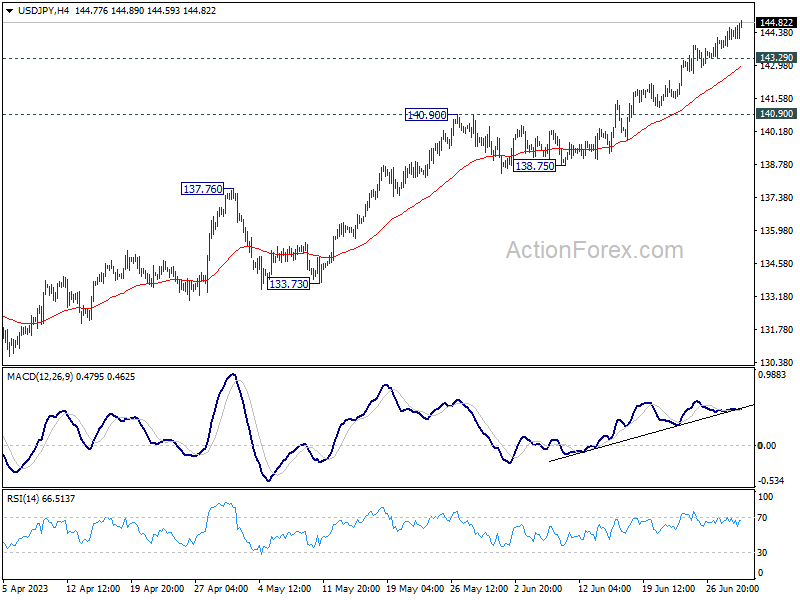
USD/JPY's rally is still in progress and intraday bias stays on the upside at this point. Current rise from 127.20 should target 161.8% projection of 127.20 to 137.90 from 129.62 at 146.93. On the downside, below 143.29 minor support will turn bias again and bring consolidations. But further rally will remain in favor as long as 140.90 resistance turned support holds.
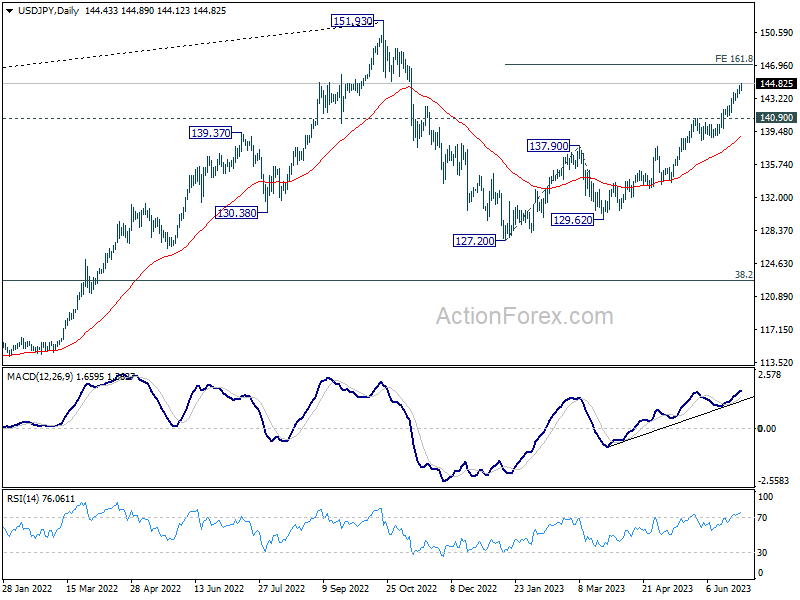
In the bigger picture, rise from 127.20 is currently seen as the second leg of the corrective pattern from 151.93 high. Further rally is expected as long as 137.90 resistance turned support holds, to retest 151.93. But strong resistance could be seen there to limit upside. Break of 137.90 will indicate the the third leg has started back towards 127.20.
GBP/USD Mid-Day Outlook
Daily Pivots: (S1) 1.2577; (P) 1.2665; (R1) 1.2723; More...
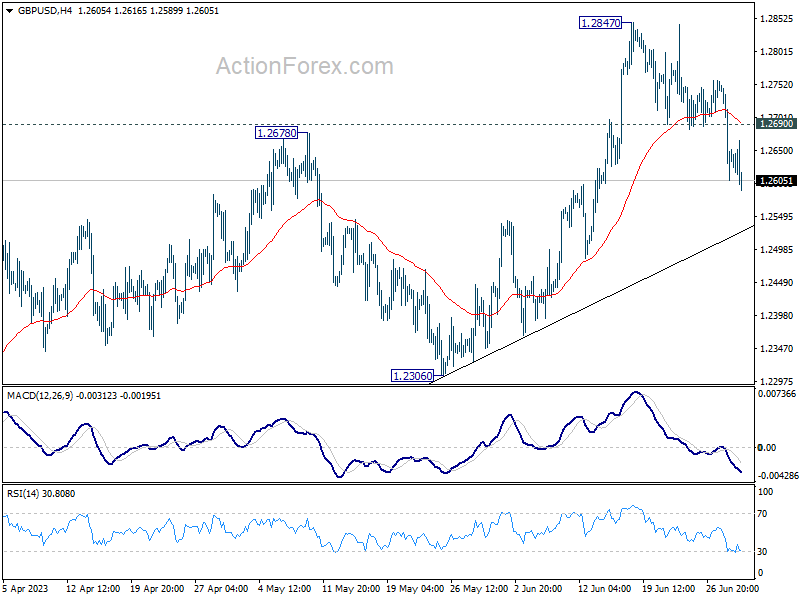
A short term top should be in place at 1.2847 in GBP/USD. Intraday bias is now on the downside for 55 D EMA (now at 1.2531). Considering bearish divergence condition in D MACD, sustained break of the EMA will argue that it's already in correction to larger up trend and target 1.2306 support. On the upside, though, break of 1.2690 minor resistance will bring retest of 1.2847 instead.
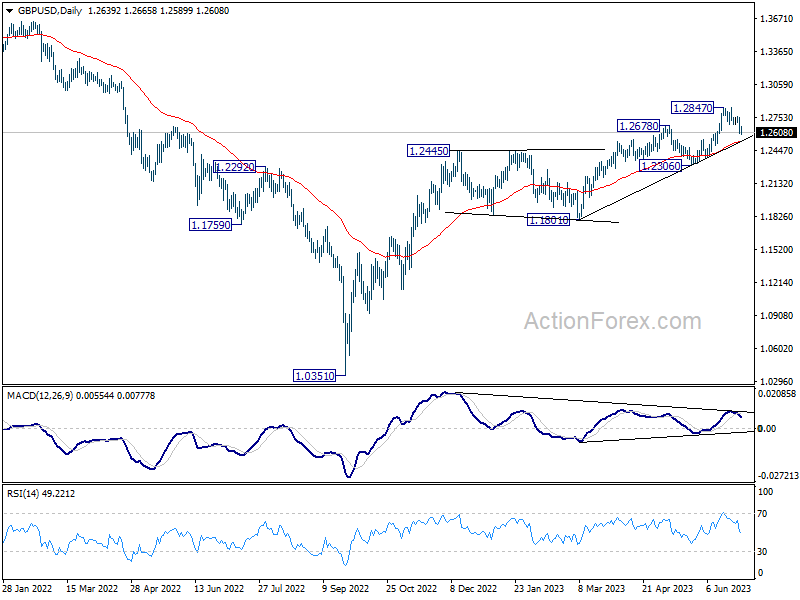
In the bigger picture, the strong support from 55 W EMA (now at 1.2341) is a medium term bullish sign. Outlook will stay bullish as long as 1.2306 support holds. Rise from 1.0351 medium term bottom (2022 low) is expected to extend further to retest 1.4248 key resistance (2021 high).
USD/CHF Mid-Day Outlook
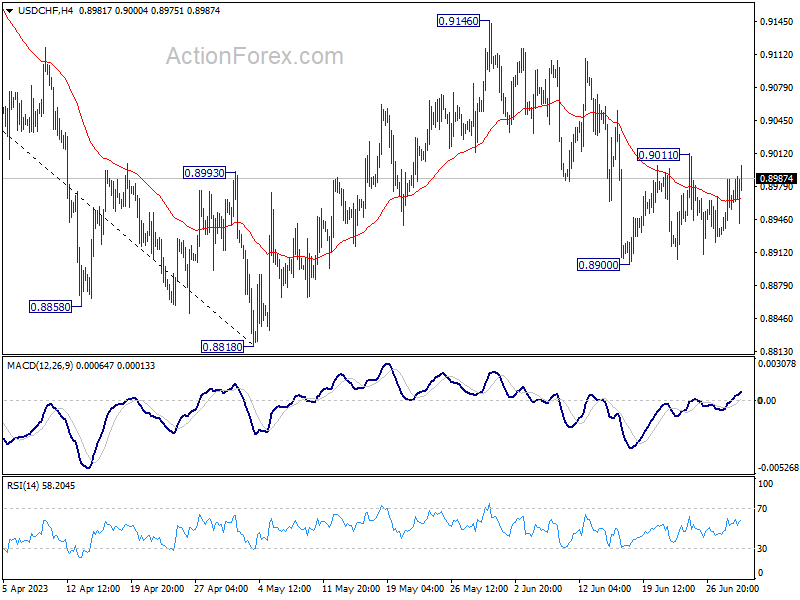
Daily Pivots: (S1) 0.8937; (P) 0.8962; (R1) 0.8995; More...
Range trading continues in USD/CHF and intraday bias stays neutral. On the downside, break of 0.8900 will resume the fall from 0.9146 to 0.8818 low or below. But for now, strong support is still expected from 0.8756 long term support to bring rebound. On the upside, above 0.9011 will bring stronger rise towards 0.9146 resistance.
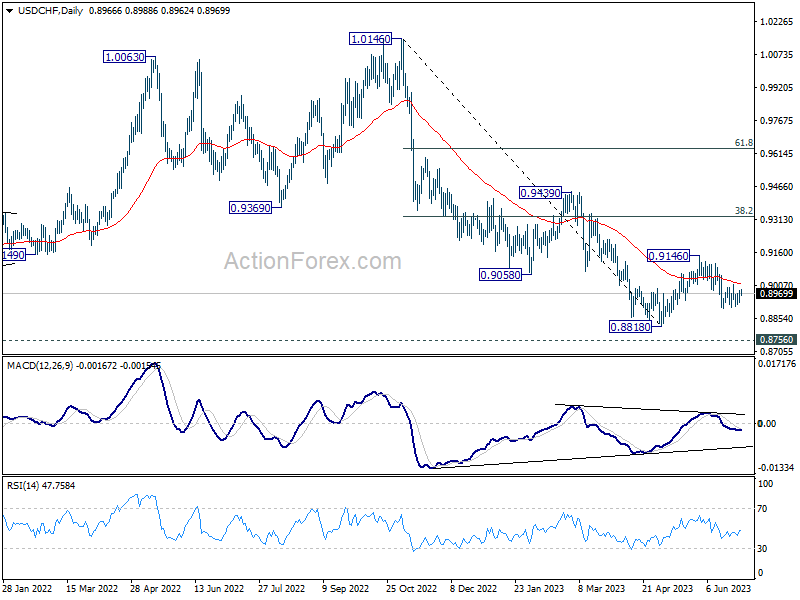
In the bigger picture, fall from 1.1046 (2022 high) is seen as a leg in the long term range pattern from 1.0342 (2016 high), which might have completed at 0.8818 already, just ahead of 0.8756 long term support. Sustained trading above 0.9058 support turned resistance should confirm medium term bottoming.
EUR/USD Mid-Day Outlook
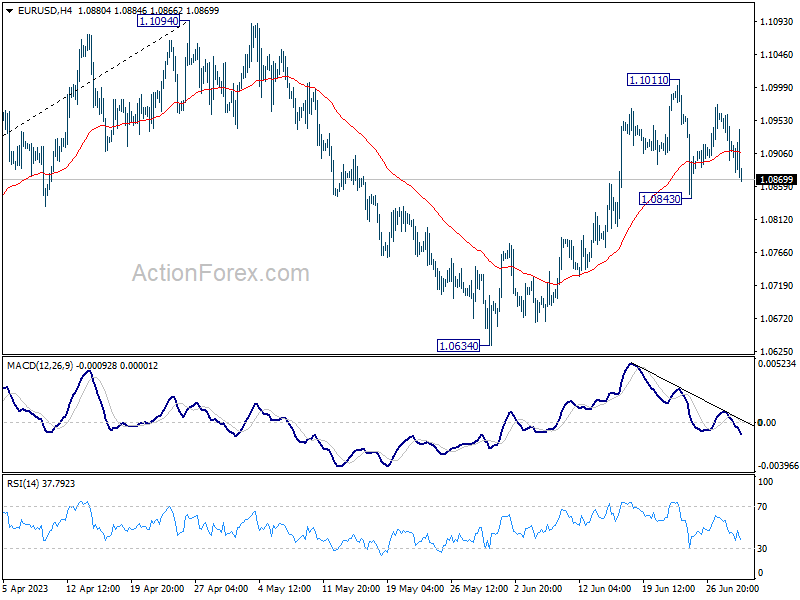
Daily Pivots: (S1) 1.0883; (P) 1.0928; (R1) 1.0957; More...
EUR/USD is extending the sideway pattern from 1.1011 and intraday bias stays neutral. For now, further rally is still mildly in favor. Break of 1.1011 will resume the rise from 1.0634 and target 1.1094 resistance. Decisive break there will resume larger up trend from 0.9534. However, break of 1.0843 will turn bias to the downside for 1.0634 support instead.
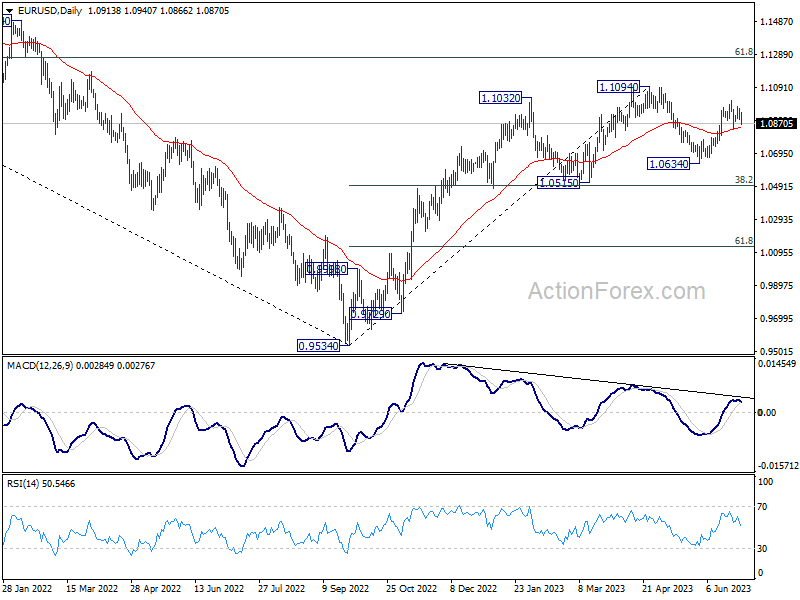
In the bigger picture, as long as 1.0515 support holds, rise from 0.9534 (2022 low) would still extend higher. Sustained break of 61.8% retracement of 1.2348 (2021 high) to 0.9534 at 1.1273 will solidify the case of bullish trend reversal and target 1.2348 resistance next (2021 high).
Currency Markets in Holding Pattern, Gold Breaches 1900
In the currency trading arena, there's been a notable lack of movement today. Gold has caught the market's attention, sliding past the 1900 psychological level. Yet Dollar remains relatively undisturbed, also showing no significant response to the latest jobless claim data and Q1 GDP final figures. Likewise, the release of higher-than-anticipated German CPI data sparked only a fleeting and mild rally in Euro, lacking subsequent follow-through. Despite today's tranquil conditions, market participants are bracing for potential turbulence tomorrow, as data releases including China's PMIs, Eurozone's CPI flash, and US PCE inflation data are slated.
So far this week, US Dollar and Euro are neck-and-neck in the contest for the strongest currency, with Swiss Franc hot on their heels. Australian and New Zealand Dollars are battling it out to avoid the week's weakest currency title, though Canadian Dollar may still swoop in and claim that unenviable status. Japanese Yen finds itself in the middle of the pack, trading within a consolidation range, under threat potential government intervention. British Pound is showing signs of weakness, but any significant depreciation is yet to materialize.
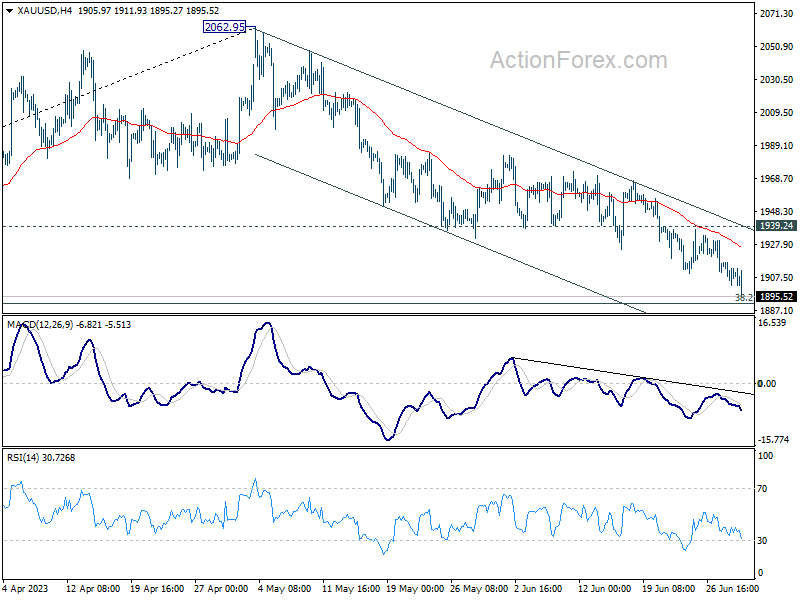
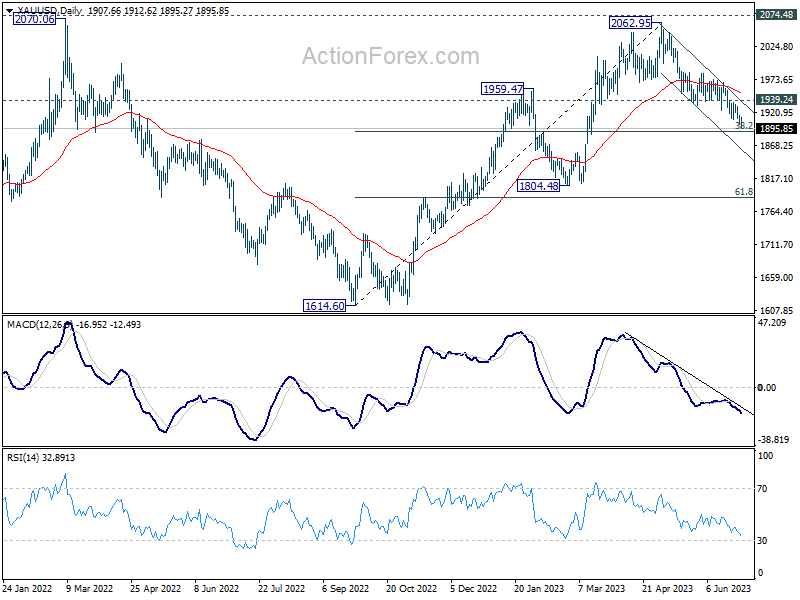
Technically, Gold is now quickly approaching fibonacci support at 38.2% retracement of 1614.60 to 2062.95 at 1891.68. Strong rebound from that level, followed by break of 1939.24 resistance, will be the first sign of bottoming, and keep the decline from 2062.95 as a near term correction only. However, sustained break of 1891.68 would raise the chance of trend reversal. Or, at least that would open up deeper fall to 1804.48, and possibly to 61.8% retracement at 1785.86.
In Europe, at the time of writing, FTSE is down -0.48%. DAX is down -0.03%. CAC is up 0.44%. Germany 10-year yield is up 0.072 at 2.391. Earlier in Asia, Nikkei rose 0.12%. Hong Kong HSI dropped -1.24%. China Shanghai SSE dropped -0.22%. Singapore Strait Times rose 0.06%. Japan 10-year JGB yield dropped -0.0041 to 0.384.
Fed Powell: A long way to go to bring inflation down to 2%
In a speech today, Fed Chair Jerome Powell underscored the ongoing battle with inflation, asserting, "Inflation pressures continue to run high, and the process of getting inflation back down to 2 percent has a long way to go."
He added that "a strong majority of Committee participants expect that it will be appropriate to raise interest rates two or more times by the end of the year," referring to the latest dot plot.
Powell painted a mixed picture of the U.S. economy. He noted that "recent indicators suggest that economic activity has continued to expand at a modest pace." He also pointed to the effects of higher interest rates and slower output growth on business fixed investment.
His comments also highlight the persistent tightness in the labor market. "Over the past three months, payroll job gains have been robust," Powell said, adding that "labor demand still substantially exceeds the supply of available workers." Nevertheless, he also observed "some easing in nominal wage growth, and declining vacancies."
Fed Bostic not seeing urgency to hike again as by others including Powell
Atlanta Fed President Raphael Bostic signaled a more cautious stance on interest rate hikes, contrary to some of his peers' sentiments. he said, "I don't see as much urgency to move as stated by others, including my Chair," expressing his willingness to assess further signs of economic slowdown before advocating for more aggressive action.
Bostic highlighted the fact that Fed has "only been in restrictive territory for 8-10 months". He is waiting for "more signs that a slowdown is happening in the next several months".
Nevertheless, Bostic left room for adaptability based on incoming data. He remarked, "If inflation moves away from target or seems to significantly stall out, then we'll probably have to do more." However, he also noted that, "We're not seeing either of those right now."
US initial jobless claims dropped to 239k, vs exp. 265k
US initial jobless claims dropped -26k to 239k in the week ending June 24, below expectation of 265k. Four-week moving average of initial claims rose 1.5k to 257.5k, highest since November 13, 2021 when it was 260k.
Continuing claims dropped -19k to 1742k in the week ending June 17. Four-week moving average of continuing claims dropped -13k to 1758k.
Eurozone economic sentiment fell to 95.3, EU down to 94.0
Eurozone Economic Sentiment Indicator dropped from 96.4 to 95.3 in June, slightly below expectation of 96.0. Employment Expectations Indicator rose from 104.6 to 105.0. Economic Uncertainty Indicator dropped from 21.6 to 20.4. Industry confidence fell from -5.3 to -7.2. Services confidence fell from 7.1 to 5.7. Retail trade confidence fell from -5.3 to -6.0. Construction confidence fell from -0.3 to -2.0. Consumer confidence improved from -17.4 to -16.1.
EU Economic Sentiment Indicator fell from 95.1 to 94.0. Employment Expectation Indicator rose from 103.9 to 104.3. Economic Uncertainty Indicator dropped from 21.2 to 20.1. Amongst the largest EU economies, the ESI deteriorated in Germany (-1.9), Italy (-1.1), the Netherlands (-1.0) and Spain (-0.9), while it remained virtually unchanged in Poland (-0.1) and improved in France (+0.8).
Japan retail sales rose 1.3% mom, 5.7% yoy, beat expectations
In the latest release from Japan, retail sales rose 1.3% mom, surpassing the anticipated increase of 0.8% mom. This growth also reflects a robust 5.7% yoy rise, again beating expectations of 5.2% year-on-year.
While inflation remaining above 3% mark could have been a contributing factor in boosting retail sales, there is evidence to suggest that return of overseas tourists is also playing a substantial role in stimulating economic activity.
Earlier reports from Japan National Tourism Organization highlighted that number of overseas visitors is nearing 70% of pre-pandemic levels as of May, indicating a resilient recovery of the tourism sector, and with it, potential for further economic growth.
In separate release, Consumer Confidence index nudged up from 36.0 to 36.2. This is the highest reading observed since January 2022, suggesting that households are more optimistic about the economy's trajectory. This could potentially translate into a higher propensity to spend, further bolstering retail sales and overall economic performance in the coming months.
NZ ANZ business confidence rose to -18, subtle signs of easing inflation pressures
New Zealand ANZ Business Confidence Index improved notably from -31.1 to -18.0 in June, marking the highest level since November 2021. Furthermore, the outlook for their own activity rose from -4.5 to 2.7, turning positive for the first time in 14 months.
Digging into the details reveals a more nuanced picture. Despite the improved overall business sentiment, export intentions dipped from 2.0 to -1.8. However, there were more encouraging signs in other areas: investment intentions rose from -6.8 to -2.7, and employment intentions followed suit, moving from -5.7 to -3.5. Meanwhile, pricing intentions have shown a modest decline from 52.4 to 49.3.
On the inflation front, there are tentative signs that pressures might be easing slightly. Cost expectations dropped from 84.1 to 76.0, and inflation expectations decreased from 5.47% to 5.29%. There was also a slight improvement in profit expectations, which rose from -27.4 to -24.1.
Commenting on the results, ANZ noted, "for now, cautious optimism appears to be emerging that the worst could be past – but it's conditional on those inflation indicators continuing to fall."
Australia retail sales rose 0.7% mom, boosted by sales events
Australia retail sales turnover rose 0.7% mom to AUD 35.52B in May, well above expectation of 0.1% mom. Through the year, sales turnover was up 4.2% yoy.
Ben Dorber, ABS head of retail statistics, said: "Retail turnover was supported by a rise in spending on food and eating out, combined with a boost in spending on discretionary goods.
"This latest rise reflected some resilience in spending with consumers taking advantage of larger than usual promotional activity and sales events for May."
EUR/USD Mid-Day Outlook
Daily Pivots: (S1) 1.0883; (P) 1.0928; (R1) 1.0957; More...
EUR/USD is extending the sideway pattern from 1.1011 and intraday bias stays neutral. For now, further rally is still mildly in favor. Break of 1.1011 will resume the rise from 1.0634 and target 1.1094 resistance. Decisive break there will resume larger up trend from 0.9534. However, break of 1.0843 will turn bias to the downside for 1.0634 support instead.
In the bigger picture, as long as 1.0515 support holds, rise from 0.9534 (2022 low) would still extend higher. Sustained break of 61.8% retracement of 1.2348 (2021 high) to 0.9534 at 1.1273 will solidify the case of bullish trend reversal and target 1.2348 resistance next (2021 high).
Economic Indicators Update
| GMT | Ccy | Events | Actual | Forecast | Previous | Revised |
|---|---|---|---|---|---|---|
| 23:50 | JPY | Retail Trade Y/Y May | 5.70% | 5.20% | 5.00% | 5.10% |
| 01:00 | NZD | ANZ Business Confidence Jun | -18 | -31.1 | ||
| 01:30 | AUD | Retail Sales M/M May | 0.70% | 0.10% | 0.00% | |
| 05:00 | JPY | Consumer Confidence Jun | 36.2 | 36.2 | 36 | |
| 08:00 | EUR | ECB Economic Bulletin | ||||
| 08:30 | GBP | Mortgage Approvals May | 51K | 50K | 49K | |
| 08:30 | GBP | M4 Money Supply M/M May | 0.20% | -0.10% | 0.00% | |
| 09:00 | EUR | Eurozone Economic Sentiment Indicator Jun | 95.3 | 96 | 96.5 | |
| 09:00 | EUR | Eurozone Industrial Confidence Jun | -7.2 | -5.5 | -5.2 | |
| 09:00 | EUR | Eurozone Services Sentiment Jun | 5.7 | 5.5 | 7 | |
| 09:00 | EUR | Eurozone Consumer Confidence Jun F | -16.1 | -16.1 | -16.1 | |
| 12:00 | EUR | Germany CPI M/M Jun P | 0.30% | 0.20% | -0.10% | |
| 12:00 | EUR | Germany CPI Y/Y Jun P | 6.40% | 6.30% | 6.10% | |
| 12:30 | USD | Initial Jobless Claims (Jun 23) | 239K | 265K | 264K | 265K |
| 12:30 | USD | GDP Annualized Q1 F | 2.00% | 1.30% | 1.30% | |
| 12:30 | USD | GDP Price Index Q1 F | 4.10% | 4.20% | 4.20% | |
| 14:00 | USD | Pending Home Sales M/M May | -0.30% | 0.00% | ||
| 14:30 | USD | Natural Gas Storage | 83B | 95B |