

Sample Category Title
New Zealand Dollar Slides as Consumer Confidence Stays Weak
- NZD/USD is down 1.3% this week
- New Zealand consumer confidence rises
- Powell to testify before a House Committee on Wednesday
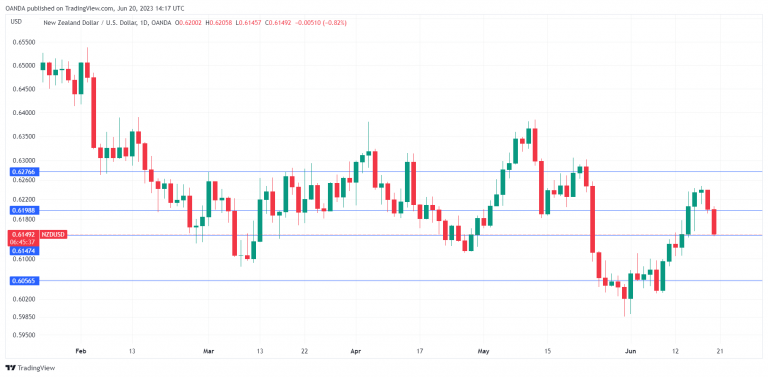
The New Zealand dollar is sharply lower for a second straight day. In the North American session, NZD/USD is trading at 0.6148, down 0.83%.
New Zealand consumer confidence rises
New Zealand Westpac consumer confidence accelerated to 83.1 in May, up from 77.7 in April and above the consensus of 76.2 points. Still, this is a low level as consumers remain pessimistic about economic conditions. The Westpac survey found that even though household incomes were higher due to strong wage growth, household finances were squeezed for two reasons. First, the cost-of-living crisis has hurt households, with inflation climbing 6.7% over the past year. Second, high interest rates have impacted on many households as mortgage rates have shot up.
Weak consumer confidence, which could well translate into a drop in consumer spending, would not be bad news at all for the Reserve Bank of New Zealand, which needs the economy to slow in order to pause interest rate hikes. The benchmark rate currently stands at 5.50% and the RBNZ meets next on July 12th. Last week’s GDP report for the first quarter showed growth contracted by 0.1%, which means that technically New Zealand is in a recession, with two consecutive quarters of negative growth.
In the US, this week’s data calendar is very light. There are no tier-1 releases on Tuesday and the markets are looking ahead to Wednesday, with Jerome Powell testifying before the House Financial Services Committee. Powell will likely be grilled by lawmakers on the Fed’s unconventional interest rate path, as the Fed paused last week after ten straight hikes but has signalled that it plans to renew hiking at next month’s meeting.
NZD/USD Technical
- NZD/USD is putting strong pressure on support at 0.6147. Below, there is support at 0.6056
- 0.6198 and 0.6276 are the next resistance lines
Sunset Market Commentary
Markets
The sense of disappointment following the Chinese 10 bps rate cut found its way through European markets as well. Stocks at some point ceded about 0.6% before paring losses to just 0.1% (EuroStoxx 50). Wall Street opens 0.1-0.5% lower. US yields eked out a few bps at the reopen after a long weekend (Juneteenth) but gains evaporated throughout the European session and in early US dealings even turned into losses of 2.3-4.6 bps. Strong US housing data suggesting the rate-sensitive sector stands its ground pretty well but were unable to prevent declines from happening. Building permits in May rose 5.2% m/m vs 0.6% expected, bringing the amount to 1491k (vs 1425). The series is considered a leading indicator as it marks the first step in the home building process. Shovel-in-the-ground housing starts seared a whopping 21.7% whereas expectations were for a minor 0.1% contraction. The total amount stood at 1631k, the highest in a year. The data follow up on yesterday’s bigger than expected rebound in the NAHB housing market index. German yields gapped lower at the open with lower-than-expected PPI numbers (-1.4% m/m vs -0.7% expected) explaining the move. Losses deepened from there on out into net daily changes ranging between -3.6 bps (2-y) to -11.6 bps (30-y). Rehn from Finland was the latest ECB policymaker to note the underlying inflation’s disappointing decline over the past months. Governing council member Muller later expressed worry over fast rising wages, which may get inflation firmly anchored to 2% over the medium term more complicated. His comments failed to deliver any market response though. Gilts outperform global peers after doing the exact opposite yesterday. Yields tank 12.6-15.7 bps across the curve compared to the 3.1-14 bps gains in a move that deepened the inversion on Monday. The amount of volatility underscores the important week UK assets are facing, kicking off with UK CPI numbers tomorrow.
The Japanese yen outperforms on currency markets today. USD/JPY eases towards 141.51 while EUR/JPY dips back below 155. Especially the latter combination is still trading at strong levels though. On the other side of the spectrum we have the Aussie dollar, trading heavily after what were perceived as dovish meeting minutes. The unexpected rate hike turned out to be the result of “finely balanced” arguments rather than an outright hawkish assessment. The euro and the dollar trade on equal footing. The pair holds a tight balance north of 1.09. The trade-weighted dollar (DXY) ekes out a slight gain to 102.60. Sterling declines in a profit-taking move going into the first checkpoint. EUR/GBP rebounds towards 0.8571, up from 0.8537 at the open.
News & Views
Turkish labour minister Vedat Isikhan said that the minimum wage will rise by 34% to TRY 11 402. It’s the second hike this year, bringing the minimum compensation 107% higher than end 2022. Of course, we need to keep in mind that Turkish inflation is still running at 40% Y/Y (85% peak in October of last year). The head of Turkey’s labour unions confederation hoped that authorities (both fiscal & monetary) will step up efforts to slow inflation down or wage hikes risk becoming meaningless. The Turkish central bank meets a first time on Thursday under new governor Hafize Gaye Erkan who got the job in the wake of a broad reshuffle after Turkey presidential elections earlier this year. The earlier decision by the new economic minister to stop FX interventions to synthetically prop up the currency (EUR/TRY 26 from 22 ahead of decision) is expected to get the backing of a significant rate hike from the current 8.5%. The consensus estimate stands at 20% but it’s actually anyone’s guess with prognosis ranging between 14% and 40%.
The Hungarian central bank (MNB) cut its overnight deposit rate by 100 bps for a second meeting running. It now stands at 16% and will be further reduced towards the base rate of 13% if risks continue to recede. The former was introduced to stem unwarranted selling pressure on the forint while the latter should be sufficient to tame inflation. The MNB sees CPI this year in a 16.5%-18.5% range before dropping steeply to 3.5%-5.5% next year. GDP prognosis are 0%-1.5% and 3.5%-4.5% for respectively this year and next. The forint stomachs this second, anticipated, rate cut again well with EUR/HUF broadly unchanged around 372 and keeping the 370-support area (YTD lows) well in sight. HUF swap yields lose 10 bps (2-yr) to 6 bps (30-yr).
GBP/JPY Mid-Day Outlook
Daily Pivots: (S1) 181.20; (P) 181.68; (R1) 182.13; More...
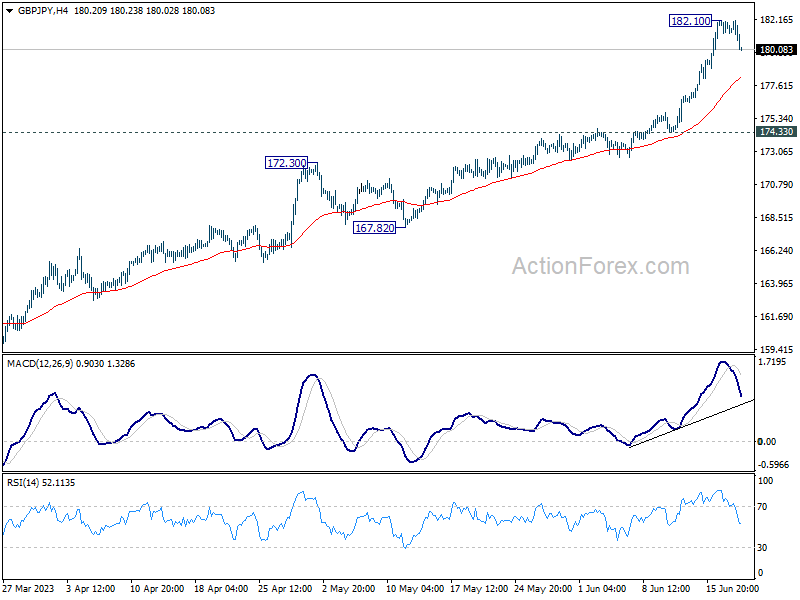
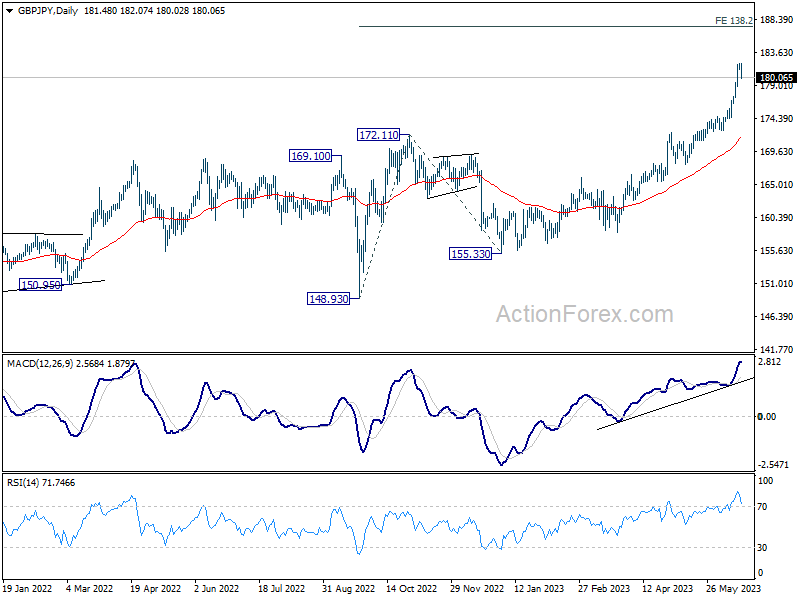
Intraday bias in GBP/JPY is turned neutral as retreat from 182.10 is extending lower. Downside of retreat should be contained above 174.33 to bring another rally. Break of 182.10 will resume larger up trend to 138.2% projection of 148.93 to 172.11 from 155.33 at 187.36.
In the bigger picture, up trend from 123.94 (2020 low) is extending. Next target is 195.86 (2015 high). For now, medium term outlook will remain bullish as long as 172.11 resistance turned support holds, even in case of deep pull back.
EUR/JPY Mid-Day Outlook
Daily Pivots: (S1) 154.68; (P) 155.05; (R1) 155.44; More....
Intraday bias in EUR/JPY is turned neutral as retreat from 155.37 is set to extend lower. But downside should be contained above 151.60 resistance turned support to bring another rally. Break of 155.37 will resume larger up trend to 100% projection of 139.05 to 151.60 from 146.12 at 158.67.

In the bigger picture, rise from 114.42 (2020 low) is in progress. Next target is 100% projection of 124.37 to 148.38 from 138.81 at 162.82. For now, medium term outlook will remain bullish as long as 148.38 resistance turned support holds, even in case of deep pull back.

EUR/USD Mid-Day Outlook
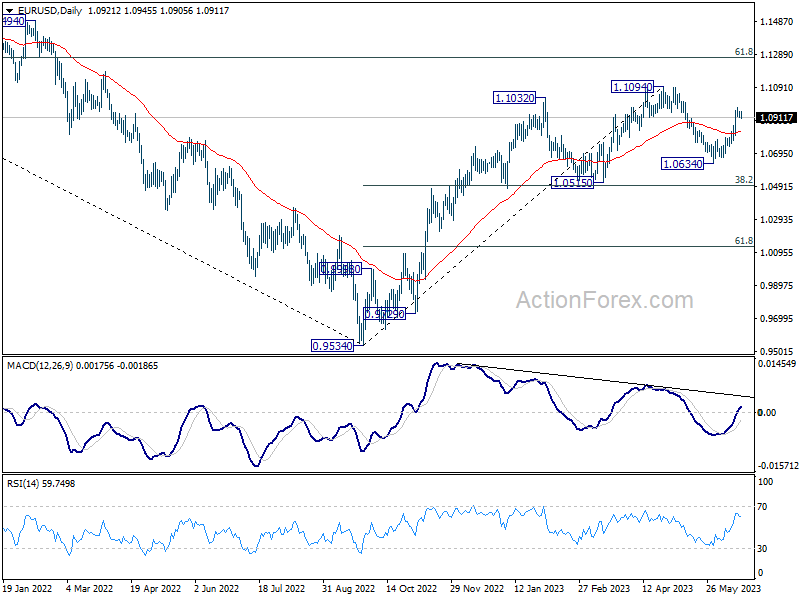
Daily Pivots: (S1) 1.0903; (P) 1.0925; (R1) 1.0942; More...
EUR/USD is staying in consolidation from 1.0969 and intraday bias remains neutral. Further rally is expected as long as 1.0803 support holds. On the upside, above 1.0969 will resume the rise from 1.0634 to retest 1.1094 high. Decisive break there will confirm resumption of whole up trend from 0.9534. However, firm break of 1.0803 will extend the corrective pattern from 1.1094 with another falling leg, targeting 1.0634 and below.
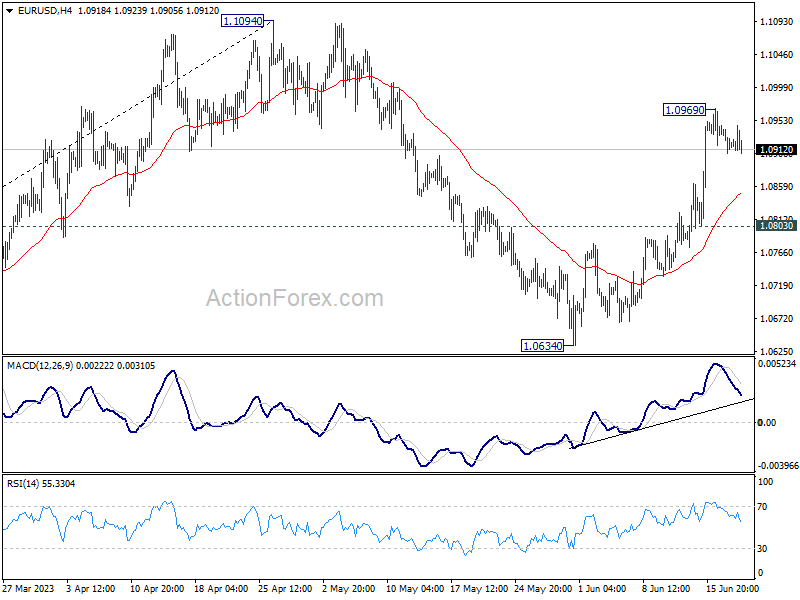
In the bigger picture, as long as 1.0515 support holds, rise from 0.9534 (2022 low) would still extend higher. Sustained break of 61.8% retracement of 1.2348 (2021 high) to 0.9534 at 1.1273 will solidify the case of bullish trend reversal and target 1.2348 resistance next (2021 high).
USD/CHF Mid-Day Outlook
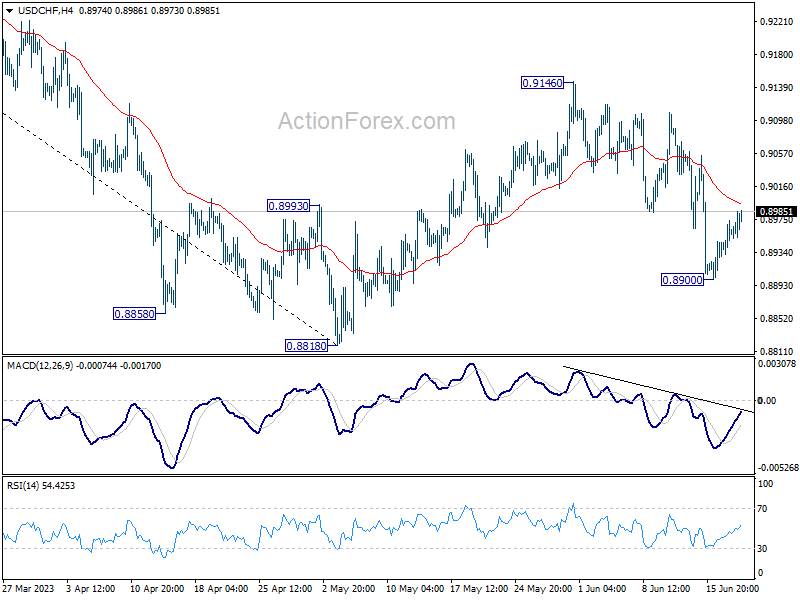
Daily Pivots: (S1) 0.8934; (P) 0.8954; (R1) 0.8978; More...
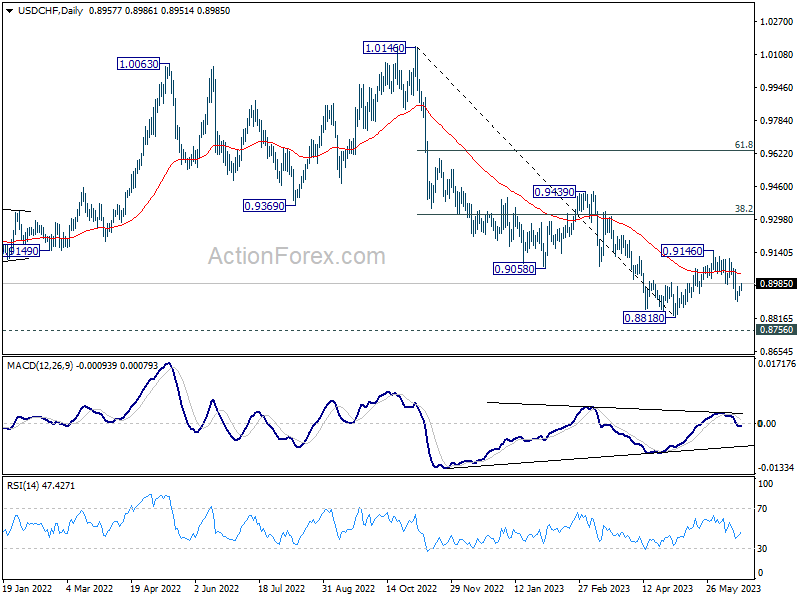
Intraday bias in USD/CHF remains neutral but risk also stays on the downside as long as 0.9146 resistance holds. Below 0.8900 will target 0.8818 and possibly below. But strong support is still expected from 0.8756 to bring reversal.
In the bigger picture, fall from 1.1046 (2022 high) is seen as a leg in the long term range pattern from 1.0342 (2016 high), which might have completed at 0.8818 already, just ahead of 0.8756 long term support. Sustained trading above 0.9058 support turned resistance should confirm medium term bottoming.
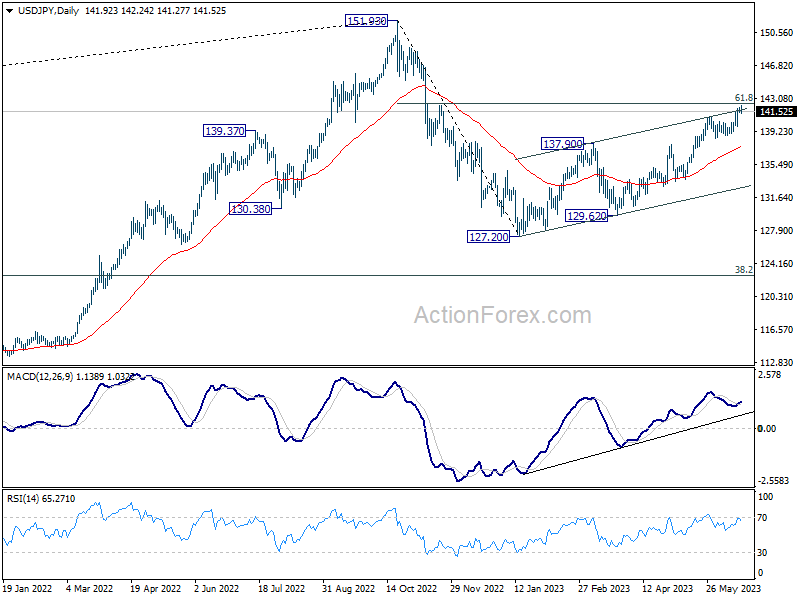
USD/JPY Mid-Day Outlook
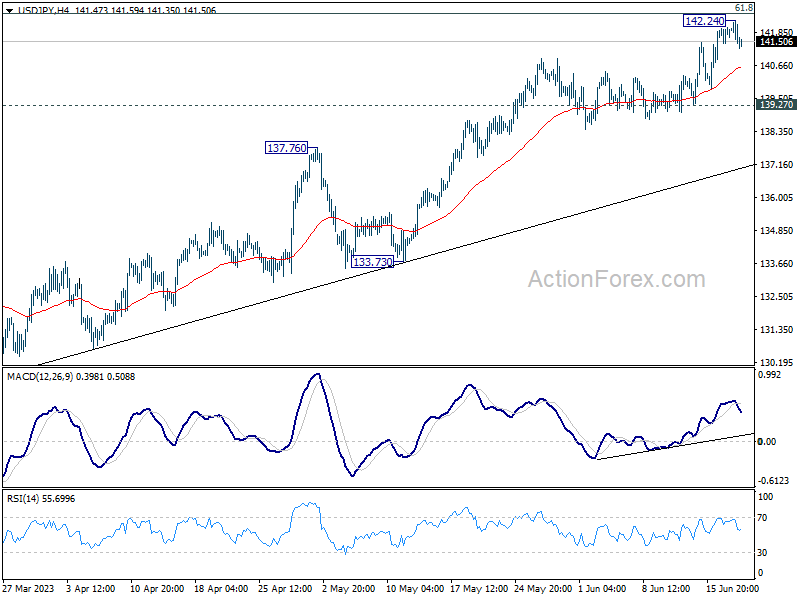
Daily Pivots: (S1) 141.61; (P) 141.83; (R1) 142.23; More...
Intraday bias in USD/JPY is turned neutral with current retreat and some consolidations should be seen. On the upside, sustained trading above 61.8% retracement of 151.93 to 127.20 at 142.48 will pave the way back to retest 151.93 high. However, rejection by 142.48, followed by break of 139.27 will indicate short term topping and turn bias back to the downside.
In the bigger picture, rise from 151.93 are seen as a corrective pattern to up trend from 102.58. The first leg has completed at 127.20. Rebound from there is seen as the second leg, and should be limited below 151.93. Sustained trading below 55 D EMA (now at 137.47) will argue that the third leg has started back to 127.20 and possibly below.
GBP/USD Mid-Day Outlook
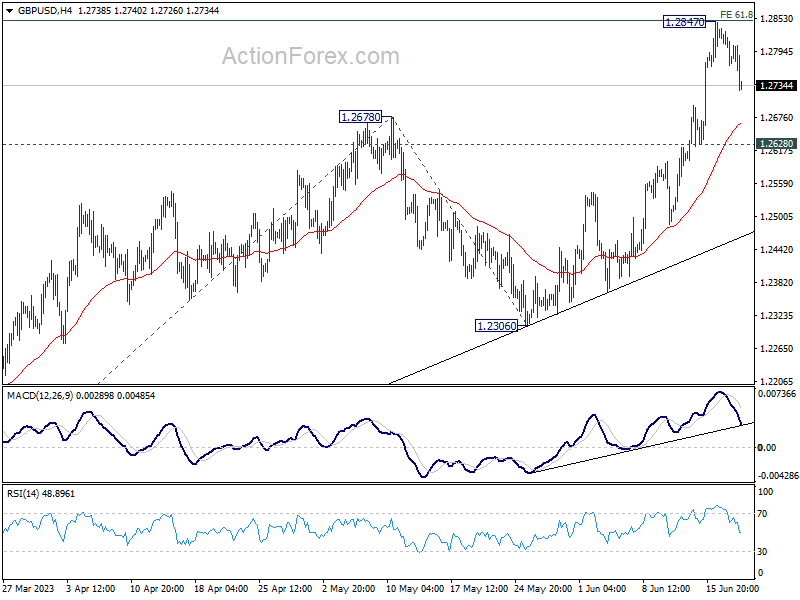
Daily Pivots: (S1) 1.2764; (P) 1.2801; (R1) 1.2830; More...
GBP/USD's retreat from 1.2847 extends lower today but stays well above 1.2628 support. Intraday bias remains neutral first and further rally is expected. On the upside, firm break of 1.2847 will resume larger up trend and target 100% projection of 1.1801 to 1.2678 from 1.2306 at 1.3183 next.
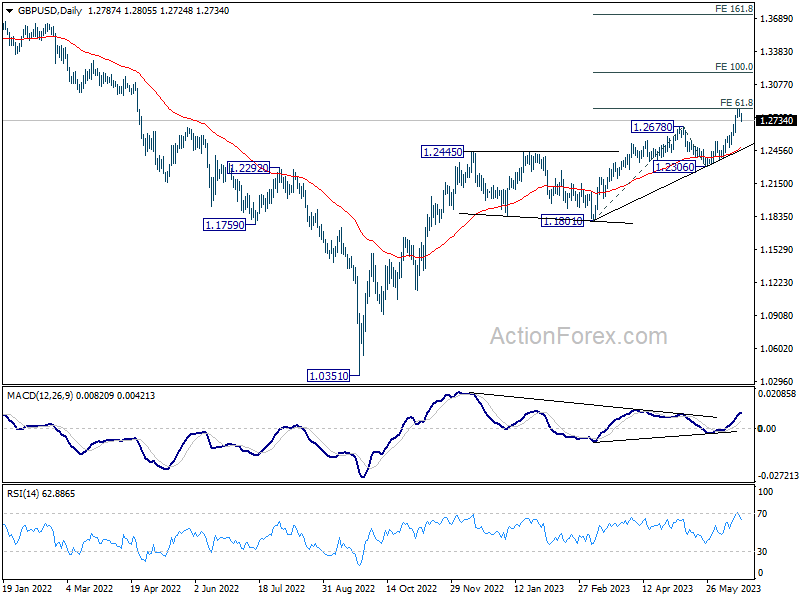
In the bigger picture, the strong support from 55 W EMA (now at 1.2345) is a medium term bullish sign. Outlook will stay bullish as long as 1.2306 support holds. Rise from 1.0351 medium term bottom (2022 low) is expected to extend further to retest 1.4248 key resistance (2021 high).
Dollar and Yen Rebound Gains A Little Momentum in Listless Markets
As US trading session commences, rebounds of Dollar and Yen seem to be gathering a bit more some steam. The broader financial market appears to be rather listless today, with major European indices roughly flat and US futures slightly down. There's also no unified movement in the U.S. and European benchmark treasury yields. Investors appear to be holding their bets ahead of key events tomorrow, namely UK CPI data and Fed Jerome Powell's testimony, then BoE and SNB rate decisions the day after.
For now, Yen, Euro and Dollar are the stronger ones for the day. Australian Dollar is the worst performer after RBA minutes raised some doubts on July rate hike. Aussie is followed by Kiwi and then Sterling, in a mild risk aversion environment. Swiss Franc and Canadian Dollar are mixed.
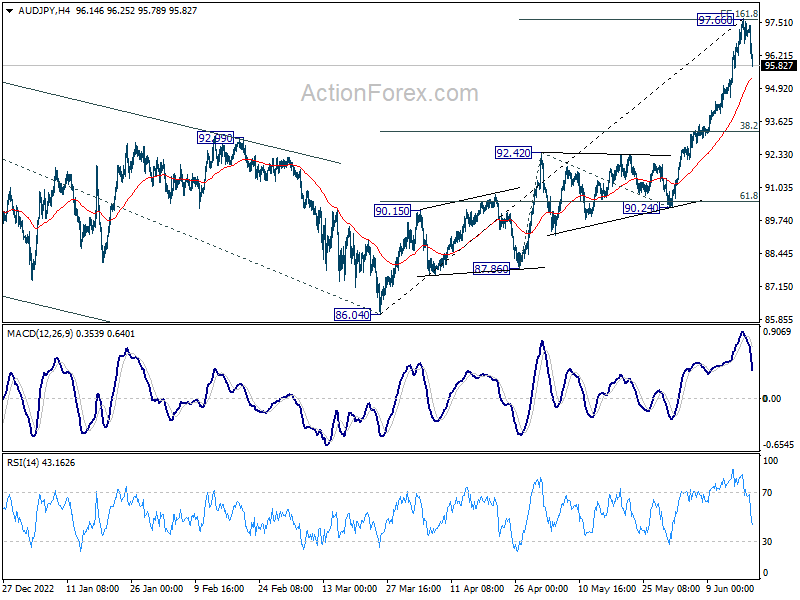
Technically, AUD/JPY should have now turn into a corrective phase with today's pull back. The question is on whether it's correcting the whole rise from 86.04. It's possible that such rally has completed a five-wave sequence after meeting 161.8% projection of 87.86 to 92.42 from 90.24 at 97.61. If that's the case, AUD/JPY could easily dive through 55 4H EMA (now at 95.27) to 38.2% retracement of 86.04 to 97.66 at 93.22. Let's see how AUD/JPY reacts to the EMA and we'll know quickly.
In Europe, at the time of writing, FTSE is up 0.14%. DAX is down -0.16%. CAC is up 0.11%. Germany 10-year yield is down -0.0771 at 2.442. Earlier in Asia, Nikkei rose 0.06%. Hong Kong HSI dropped -1.54%. China Shanghai SSE fell -0.47%. Singapore Strait Times lost -0.65%. Japan 10-year JGB yield declined -0.0052 to 0.390.
ECB Rehn: Inflation excluding energy and food is falling only gradually
ECB Governing Council member Olli Rehn has underscored the significance of core inflation in guiding the bank's monetary-policy decisions. His comments comes at a time when consumer prices in eurozone are reportedly slowing, but not at the desired pace.
Rehn stated, "The rise in consumer prices in the euro area is slowing, but not to the extent desired," further adding, "Inflation excluding energy and food is falling only gradually."
Highlighting the primacy of core inflation – which excludes the volatile sectors of energy and food – in policy considerations, Rehn remarked, "I consider core inflation a very important, essential yardstick in the overall judgment of monetary-policy making."
Rehn emphasized ECB's commitment to bringing inflation back to its target, saying, "We will bring interest rates to levels sufficiently restrictive to achieve a timely return of inflation to the 2% medium-term target and keep them there as long as necessary."
RBA minutes: Finely balanced arguments for hold and hike
Minutes from RBA's June 6 monetary policy meeting reveal an active debate over whether to hold or raise the cash rate by 25bps.
As stated in the minutes, "Members recognised the strength of both sets of arguments, concluding that the arguments were finely balanced." However, they ultimately determined that a rate increase was the stronger course of action at this meeting.
Recent data indicating that inflation risks had begun tilting to the upside were a key influence on the board's decision. As they noted, "Given this shift and the already drawn-out return of inflation to target, the Board judged that a further increase in interest rates was warranted."
Such a move would bolster confidence that inflation would indeed return to the target range "over the period ahead", they reasoned.
At the meeting, RBA raised cash rate target by 25bps to 4.10%.
RBA Bullock: Economy needs to grow at a below trend pace for a while
In a speech, RBA Deputy Governor Michele Bullock noted the economy needs to "grow at a below trend pace for a while" to bring demand and supply into better balance. Only that will give "the greatest chance of securing sustainable full employment into the future."
Bullock explained, "For monetary policy... We think of full employment as the point at which there is a balance between demand and supply in the labour market (and in the markets for goods and services) with inflation at the inflation target."
"In recent months, the balance between labour demand and supply has improved somewhat," she noted. "Nevertheless, the labour market remains tight."
Also, "for the first time in decades, firms' demand for labour exceeds the amount of labour that people are willing and able to
"At the same time, with demand for goods and services high relative to the economy's capacity to supply those things, inflation is well above the 2–3 per cent target range."
PBoC cuts two key lending rates
China's PBoC executed cuts to two of its pivotal lending rates today, marking the first time such adjustments have been made in 10 months since last August.
The Chinese central bank opted to reduce one-year loan prime rate by -10 bps, taking it down from 3.65% to 3.55%. Concurrently, it also implemented a -10 bps cut to five-year loan prime rate, adjusting it from 4.3% to 4.2%.
These measures follow other recent actions aimed at easing monetary policy. Only last Thursday, PBOC made its first cut to one-year medium-term loan facility in 10 months. Furthermore, the bank reduced its seven-day reverse repurchase rate on the preceding Monday.
GBP/USD Mid-Day Outlook
Daily Pivots: (S1) 1.2764; (P) 1.2801; (R1) 1.2830; More...
GBP/USD's retreat from 1.2847 extends lower today but stays well above 1.2628 support. Intraday bias remains neutral first and further rally is expected. On the upside, firm break of 1.2847 will resume larger up trend and target 100% projection of 1.1801 to 1.2678 from 1.2306 at 1.3183 next.
In the bigger picture, the strong support from 55 W EMA (now at 1.2345) is a medium term bullish sign. Outlook will stay bullish as long as 1.2306 support holds. Rise from 1.0351 medium term bottom (2022 low) is expected to extend further to retest 1.4248 key resistance (2021 high).
Economic Indicators Update
| GMT | Ccy | Events | Actual | Forecast | Previous | Revised |
|---|---|---|---|---|---|---|
| 01:30 | AUD | RBA Minutes | ||||
| 04:30 | JPY | Industrial Production M/M Apr F | 0.70% | -0.40% | -0.40% | |
| 06:00 | CHF | Trade Balance (CHF) May | 5.48B | 3.45B | 2.60B | 2.56B |
| 06:00 | EUR | Germany PPI M/M May | -1.40% | -0.70% | 0.30% | |
| 06:00 | EUR | Germany PPI Y/Y May | 1.00% | 1.70% | 4.10% | |
| 08:00 | EUR | Eurozone Current Account (EUR) Apr | 4B | 27.3B | 31.2B | |
| 12:30 | USD | Housing Starts May | 1.63M | 1.40M | 1.40M | 1.34M |
| 12:30 | USD | Building Permits May | 1.49M | 1.43M | 1.42M |
ECB Rehn: Inflation excluding energy and food is falling only gradually
ECB Governing Council member Olli Rehn has underscored the significance of core inflation in guiding the bank's monetary-policy decisions. His comments comes at a time when consumer prices in eurozone are reportedly slowing, but not at the desired pace.
Rehn stated, "The rise in consumer prices in the euro area is slowing, but not to the extent desired," further adding, "Inflation excluding energy and food is falling only gradually."
Highlighting the primacy of core inflation – which excludes the volatile sectors of energy and food – in policy considerations, Rehn remarked, "I consider core inflation a very important, essential yardstick in the overall judgment of monetary-policy making."
Rehn emphasized ECB's commitment to bringing inflation back to its target, saying, "We will bring interest rates to levels sufficiently restrictive to achieve a timely return of inflation to the 2% medium-term target and keep them there as long as necessary."