

Sample Category Title
USD/JPY Daily Outlook
Daily Pivots: (S1) 141.61; (P) 141.83; (R1) 142.23; More...
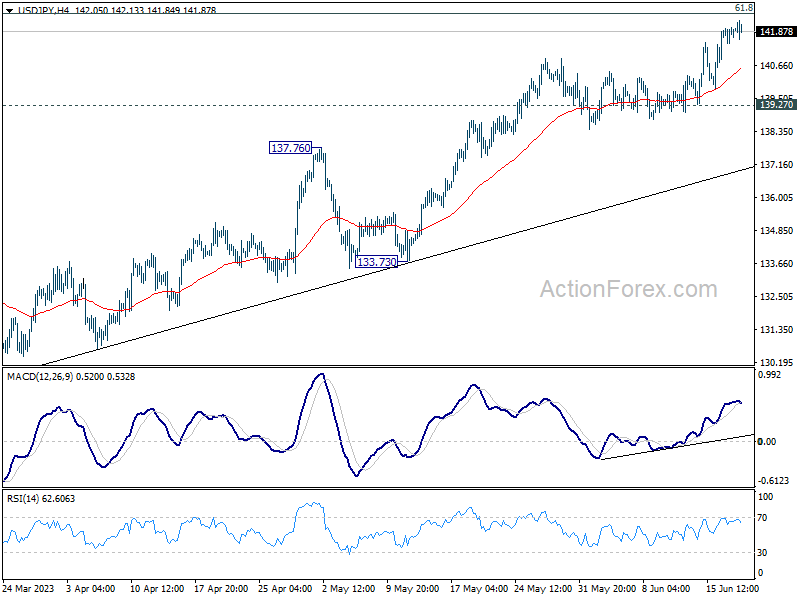
Intraday bias in USD/JPY stays on the upside for 61.8% retracement of 151.93 to 127.20 at 142.48 next. Sustained break there will pave the way back to retest 151.93 high. However, rejection by 142.48, followed by break of 139.27 will indicate short term topping and turn bias back to the downside.
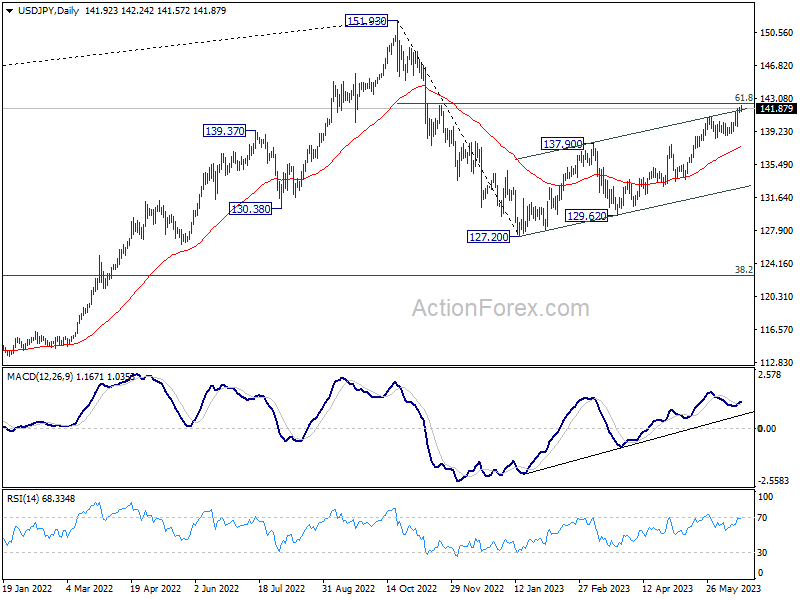
In the bigger picture, rise from 151.93 are seen as a corrective pattern to up trend from 102.58. The first leg has completed at 127.20. Rebound from there is seen as the second leg, and should be limited below 151.93. Sustained trading below 55 D EMA (now at 137.47) will argue that the third leg has started back to 127.20 and possibly below.
USD/CAD Daily Outlook
Daily Pivots: (S1) 1.3183; (P) 1.3206; (R1) 1.3233; More....
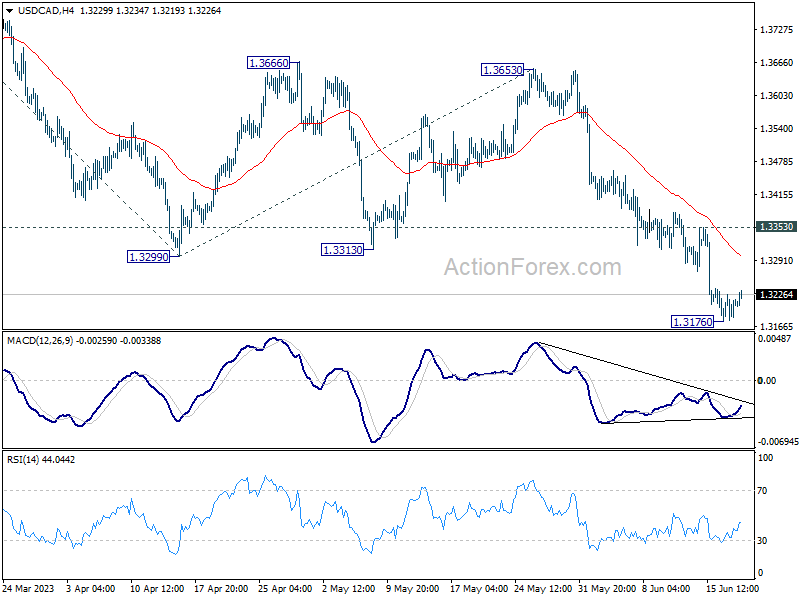
A temporary low is in place at 1.3176 in USD/CAD with current recovery. Some consolidations would be seen but further decline is expected as long as 1.3353 resistance holds. Below 1.3176 will resume the whole decline from 1.3976 to 100% projection of 1.3860 to 1.3299 from 1.3653 at 1.3092 next.
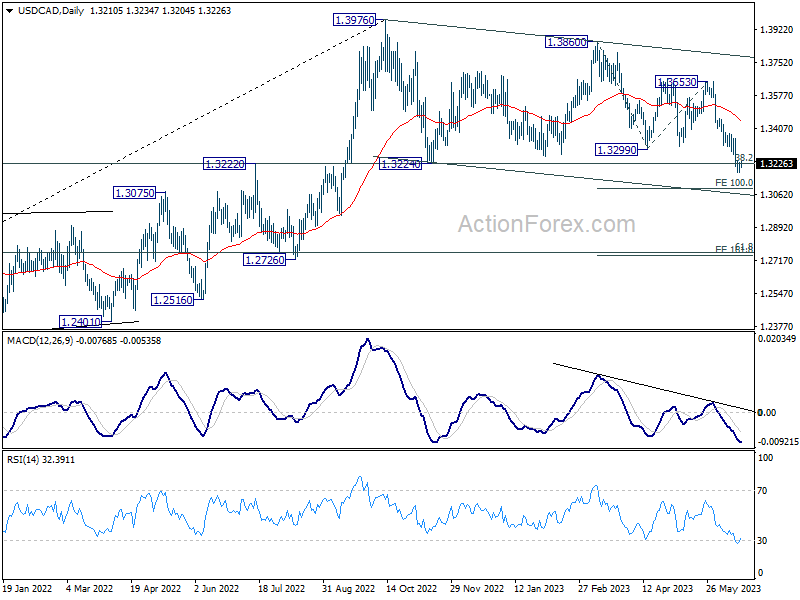
In the bigger picture, price actions from 1.3976 are still viewed as a correction to up trend from 1.2005 (2021 low), but chance of trend reversal is increasing with current decline. But in either case, sustained trading below 38.2% retracement of 1.2005 to 1.3976 at 1.3233 will pave the way to 61.8% retracement at 1.2758. Risk will stay on the downside as long as 1.3653 resistance holds, even in case of strong rebound.
RBA Minutes Less Hawkish Than Expected, For Now
The Board sees increased inflation risks while recognising prospect of weakening economy. And rising unemployment rate.
The Minutes from the Reserve Bank Board’s meeting in June provide a more balanced approach to the outlook for rates than we saw in the Governor’s statement following the decision to raise the cash rate by 25 basis points.
Of some significance is the absence of the sentence, “Some further tightening of monetary policy may be required to ensure that inflation returns to target in a reasonable time frame.”
That sentence was used in both his Statement and in his speech the following day to a bankers’ forum. It seems somewhat strange that the Governor would repeat the sentence on two occasions but the Board chose to exclude it from the Minutes.
The Minutes did conclude that the Governor’s speech the following day “would provide an opportunity to explain the decision in more detail.” So we should reasonably conclude that the “some further tightening” is still on the Board’s radar.
Less surprising is the description of the tightening decision as “finely balanced”. This is a fairly common description of decisions when we are nearing the end of the tightening cycle.
The Board considered two options – raise the cash rate by 25 basis points or hold rates steady.
The key theme from the Governor’s statement that the balance of risks on inflation had shifted to the upside (compared with a month earlier) was confirmed in the Minutes.
These direct risks are set out as: the monthly indicator of headline inflation had shifted to the upside in April; the decline in goods prices inflation had been less than observed in other countries; and services price inflation had not yet shown signs of moderating.
But concerns around wages growth seemed more acute: “the possibility of implicit indexation …to become widespread… [while] some members observed that some firms were indexing their prices.”
In addition the Annual Wage Review decision of the Fair Work Commission was higher than expected … and a range of public sector enterprise agreements were being negotiated and were likely to contain wage rises in excess of 4% for the first year. Concerns were also raised that “a broad range of jobs were to become implicitly indexed to high inflation.”
There is also specific concern around the housing market with the unexpected resumption of growth in house prices implying less of a drag on spending. Further, the stabilisation of housing loan approvals suggested that financial conditions “may not have been as tight as previously judged”.
Despite the rate increase in June the Westpac Melbourne Institute Index of House Price Expectations stabilised in June at a very high level, while auction clearance rates have remained high despite a marked lift in turnover. When the Board meets again on July 4 it is likely to be discussing another month of housing buoyancy.
There is ample recognition of the impact on households of rising rates, highlighting the risk that the economy slows and unemployment rises by more than expected. But the key remains that tight labour markets are inconsistent with the higher unemployment rate required to be consistent with the inflation target.
Conclusion
Westpac expects a follow up rate increase in July. This will be based around the key theme from the Minutes that the risks to achieving the inflation target have increased. It seems unlikely that concerns around indexation; sticky services inflation; and rising house prices will dissipate in one month.
Nevertheless it is curious that the Minutes did not repeat “some further tightening of monetary policy…” while there is clearly concern around household spending.
Since the Board meeting Compensation of Employees was reported to have lifted by a hefty 2.4% in the March quarter; while GDP lifted by a tepid 0.2% - around expectations.
The May Employment Report with an increase of 76,000 jobs will continue to see concerns at the RBA around a tight labour market raising those issues with respect to higher than acceptable wages growth, especially concerns around indexation. This concern around tight labour markets was emphasised by Deputy Governor Bullock today when she referred to employment being above what is consistent with the inflation target – more evidence that upside risks to inflation are sustained.
We still have to see the May Inflation Report – it is a little surprising that the Board gave reasonable emphasis to the April report given it excludes so many components of inflation. We will be watching that report but it seems unlikely to be a “game changer” given the Board’s clear recognition that inflation risks have increased.
Westpac confirms its expectation that the Board will raise the cash rate in both July and August.
USD/JPY Technical: 142.25 Resistance Met with Bullish Exhaustion
- The rally of USD/JPY has reached 142.25/142.50 key medium-term resistance ex-post BoJ monetary policy decision last Friday.
- Latest Commitments of Traders report on JPY futures on net large speculators’ open bearish positioning has reached close to a 3-year extreme.
- The next key related event will be the release of Japan’s nationwide inflation data for May on this Friday, 23 June.
This is a follow-up analysis from our earlier publication dated 15 June 2023, “USD/JPY Technical: Bullish breakout from 4-week range ahead of BOJ”.
The USD/JPY has shaped the expected positive follow-through in price actions reinforced by the latest Bank of Japan (BoJ)’s dovish jawboning last Friday, 16 June to maintain its ultra-dovish monetary policy due to an expectation that inflation in Japan faces a risk of a slowdown in the second half of the current fiscal year.
The last 3 days of up move in the USD/JPY has led it to hit a 142.25/50 key resistance with bullish exhaustion elements at this juncture ahead of the next key related economic data release, the Japan nationwide inflation for May out on this Friday, 23 June.
Fig 1: USD/JPY medium-term trend as of 20 Jun 2023 (Source: TradingView, click to enlarge chart)
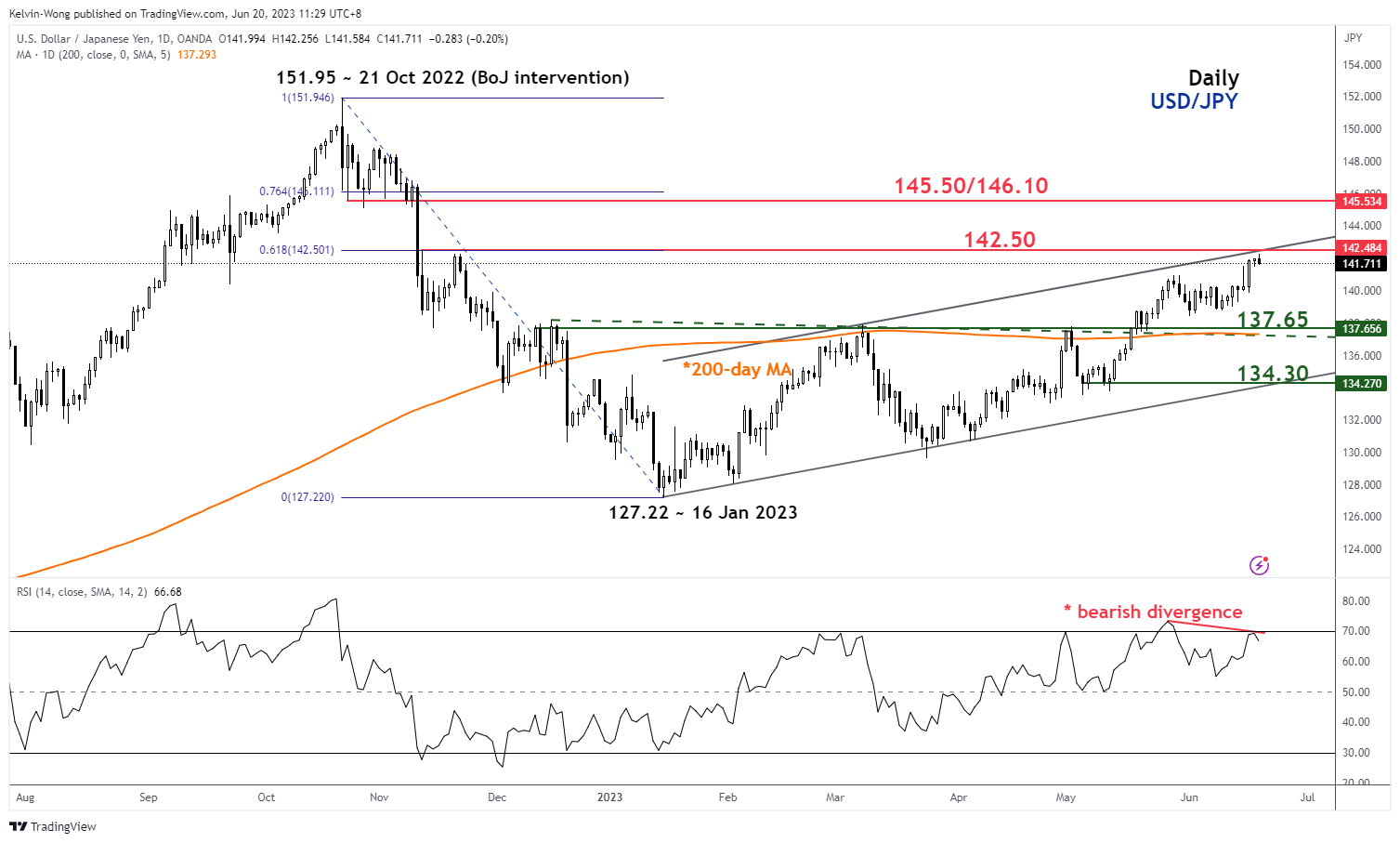
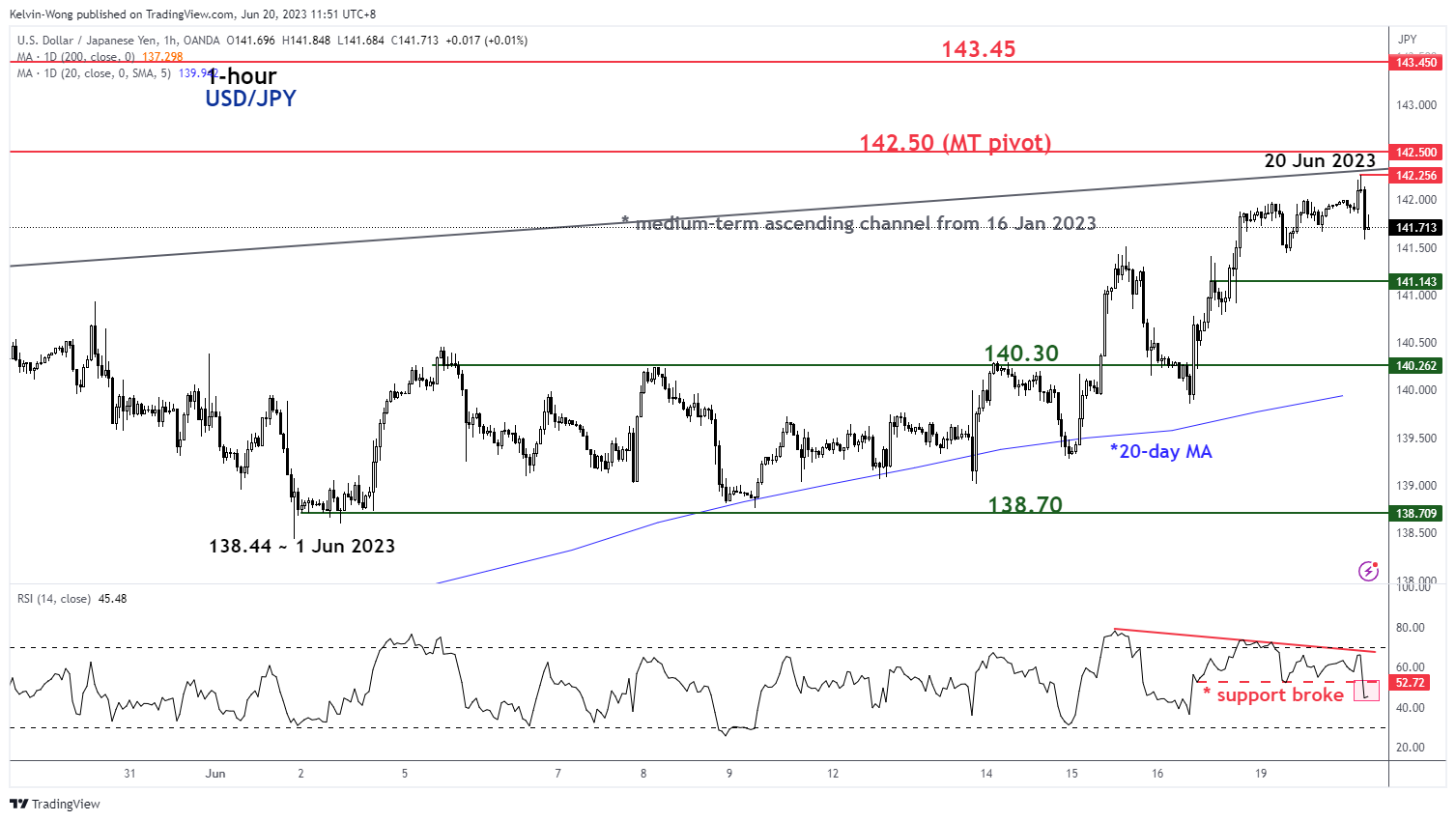
Fig 2: USD/JPY short-term minor trend as of 20 Jun 2023 (Source: TradingView, click to enlarge chart)
JPY futures’ bearish net open positioning of large speculators has reached close to a 3-year extreme
Fig 3: JPY futures net open positioning trend of large speculators as of 12 Jun 2023 (Source: MacroMicro, click to enlarge chart)
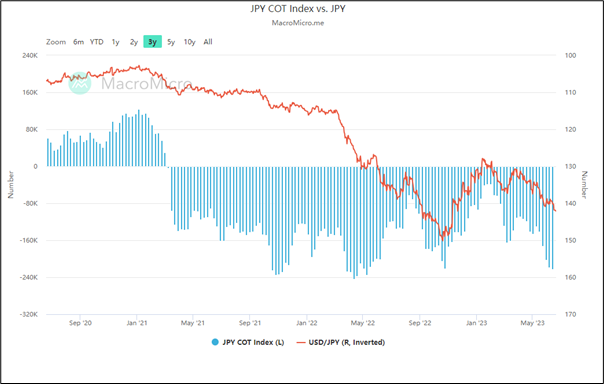
Traders’ sentiment from the Commitments of Traders report can be measured by the difference between the net open positions of large non-commercials (speculators) and the large commercials (hedgers/dealers) in the futures market. A positive number represents net long positions on JPY and a negative number represents net short on JPY.
Based on the latest weekly Commitments of Traders report as of 12 June 2023 compiled by the Commodity Futures Trading Commission (CFTC) on US exchange-listed FX futures market on the JPY futures contract (take note that JPY is quoted as the base currency & USD as the variable currency, i.e. JPY/USD), it has indeed shown that traders’ sentiment is skewed towards a more significant increase bearish positioning on JPY versus three months ago.
The latest weekly reported net open positions on the JPY futures market have indicated a jump of net shorts positions on JPY to -222,157 contracts which is close to a 3-year extreme with -243,729 contracts reported on 11 April 2022.
Interestingly, the current reported -222, 157 contracts on net short JPY futures open positions have surpassed the -220,700 contracts reported on 24 October 2022 and thereafter saw the JPY strengthen by +15% against the USD in the following three months.
That’s a form of contrarian opinion analysis where positioning has reached a relatively extreme level and the risk of a reversal in price actions is likely to be easily triggered if related news or events fail to meet the expectations of an “overconfident and exuberance” mindset of participants due to the overcrowding effect.
142.25/142.50 key medium-term resistance of USD/JPY is defined by a confluence of elements
There are three different elements that allow 142.25/142.50 on the USD/JPY to be classified as potential key resistance (see daily chart). Firstly, it is the prior swing highs area of 11 and 22 November 2022 that led to a significant decline in price actions thereafter.
Secondly, it is the upper boundary of a medium-term ascending channel that price actions have oscillated within it since the 16 January 2023 low of 127.72.
Thirdly, it’s the 61.8% Fibonacci retracement of the prior medium-term decline from the 21 October 2022 high to the 16 January 2023 low. Thus, such confluence of elements on the 142.25/142.50 resistance level may suggest that the USD/JPY medium-term uptrend from 16 January 2023 is at risk of hitting a terminal juncture where a potential corrective decline may occur next.
Upside momentum has started to wane
The daily RSI oscillator has flashed a bearish divergence signal at its overbought region and the shorter-term 1-hour RSI has broken below a corresponding support at the 52% level.
Below the 141.15 minor support exposes the next intermediate support at 140.30 (also the 20-day moving average) in the first step.
However, a clearance above 142.50 key medium-term pivotal resistance invalidates the bearish tone for the next resistance to come in at 143.45.
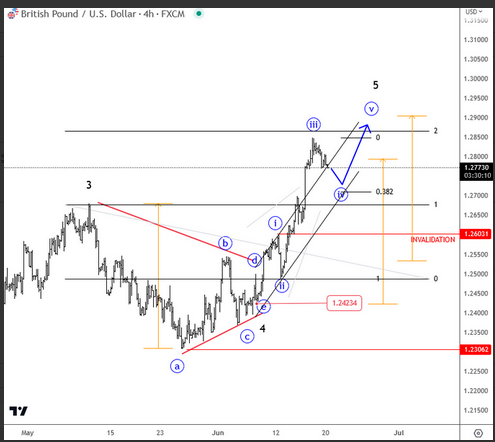
Cable Can be Targeting 1.29 Area With a Fifth Wave
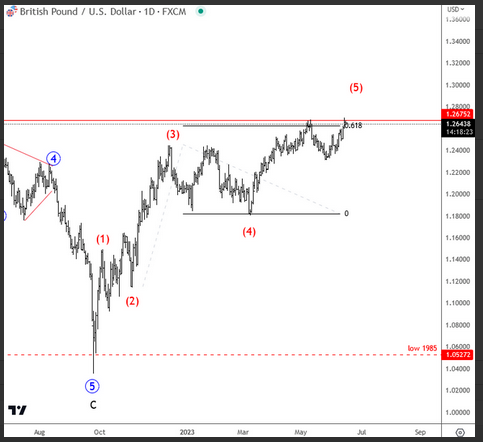
So far this year, pound has made significant progress to the upside and it's still underway. However, there's now a chance that pair is trading in a final wave (5) of a five-wave bullish cycle on a daily chart, which can face a new, higher-degree correction later this year. Looking at the 4-hour chart we see it price breaking higher, out of the bullish fourth wave triangle pattern, so it appears there is a new impulse in play, possibly towards 1.29 area this week, after minor wave four finds support near 1.27-1.2750. A drop below 1.26 will mark end of a bullish run.
Last Week’s USD Setback/Euro Rally Taking a Breather
Markets
Even with no guidance from the US (markets close for Juneteenth) and no important data in Europe, the natural drift in European yields was to extend the recent uptrend. ECB speakers can’t but subscribe ECB’s Lagarde’s commitment to take a next 25 bps step at the July meeting. What happens later is subject to an internal debate. Hawks clearly indicate that the ECB has further to go at the September meeting as core inflation continues its higher for longer path. In this respect, ECB’s de Guindos said that the slowdown in core inflation might be more limited than the decline in the headline measure. More dovish oriented members (e.g. chief economist Lane) stress current data dependent ECB-modus which makes it too early to already guess on the appropriated policy action in September. Even so, German yields in a modest steepening move added between 3.7 bps (2-y) and 5.3 bps (30-y). At 3.16%, the 2-y closed at the highest levels since SVB/CS turbulence in March. The 10-y yield (2.52%) is closing in on the key 2.55% resistance area. Higher yields and a lack of guidance from the US prevented the EuroStoxx 50 to go for a test of the 4412 top (-0.74%). In technical trade, EUR/USD lost modest ground closing at 1.0921. The yen stabilized near recent low levels both against the dollar (USD/JPY 141.98) and the euro (EUR/JPY 155.09). UK bonds again hugely underperformed Bunds going into tomorrow’s UK CPI release annex Thursday’s BoE policy decision. In a sharp further curve inversion UK yields gained between 13.8 bps and 3.2 bps, with the 2-y easily surpassing the 5.0% barrier. EUR/GBP intraday touched a new ST low near 0.8520, but in the end EUR/GBP closed little changed (0.8537).
This morning, most Asian equity markets (except Australia, cf infra) are in a mild risk-off modus. Chinese banks eased the Prime Lending rate for 1-y and 5-y loans by 10 bps to respectively 3.55% and 4.20%. Some markets participants apparently hoped for more generous stimulus. The yuan weakens further (USD/CNY 7.177). The yen also stays in the defensive (USD/JPY 142.1) as US yields join the upside drift in Europe. Later today, the calendar mainly contains building permits and housing starts. Yesterday, NAHB homebuilders sentiment unexpectedly jumped from 50 to 55 (highest in 11 months). Is this a sign that interest rate sensitive parts of the economy stay resilient too? In US yields, the 2-y is again nearing the 4.80% resistance, the last hurdle before the 5.08% March top. The US 10-y (3.80%) meets similar resistance at 3.85%. Last week’s USD setback/euro rally are taking a breather. This process might continue short-term, especially if equities would fall prey to some profit taking after recent rebound. In CE, we also keep an eye a the rate decision of the Hungarian central bank (expected to ease the O/N deposit rate to 16%).
News and views
The Reserve Bank of Australia’s June policy meeting minutes showed the unexpected 25 bps rate hike to 4.10% was the result of “finely balanced” arguments. They considered inflation risks shifted to the upside. Some firms indexed prices to past inflation, making price pressures more persistent, especially against the backdrop of still little spare capacity and very low unemployment. The rate hike was based on inflation taking longer to hit the target and would boost confidence in the process. Arguments in favour for a pause, which was the analyst consensus then, included considerable uncertainty on household spending and the fact that past hikes will sharply slow the economy. Falling commodity prices and international shipping costs meanwhile pose downside inflation risks. All things considered, the case for a hike was stronger nevertheless and the RBA even kept the door open for further hikes if needed. Markets view the minutes as softer than the actual statement though. They were probably caught off guard by the RBA labeling it a finely balanced decision. Australian swap yields tumble between 2.7 and 8.9 bps with the front end of the curve outperforming. Money markets slightly pare their tightening bets, stopping short of pricing in two more 25 bps rate hikes by November. The Australian dollar slips, extending its recent loss streak into a third day. AUD/USD moves from 0.685 at the open to test the 0.68 big figure. RBA’s deputy governor Bullock in an interview later highlighted the central bank’s data dependence. The factors they are looking at are “inflation, particularly services prices, employment, consumption and what households are doing with their savings buffers, and the global economy, including China.” She also said the jobless rate may need to rise toward 4.5% from 3.6% today for inflation to return to target.
RBA Minutes Revealed ‘Fine Balance’ for This Month’s Surprise Hike
Asian stocks were moody, European indices traded lower, and US futures were under pressure on Monday. The rest of the week will likely prove to be challenging both in the US and elsewhere, as central bankers continue pressing economies like lemons, while signs of pain are just before their eyes.
It’s not because the stock markets are driven higher by the AI speculation that the underlying fundamentals are doing well. Average mortgage rates in the US are at the highest levels since the subprime crisis whereas mortgage rates in the UK are again above 6%. The last time we saw these levels was back during Liz Truss mini-budget crisis.
The UK 2-year yield spiked above 5% and has more to rally given the expectation of at least another 125bp hike from the Bank of England (BoE) before the end of this year, the first 25bp being due this Thursday.
What’s funny is that the Reserve Bank of Australia (RBA) minutes released earlier today showed that the RBA rate hike – which was the first hawkish shock in a series of hawkish central bank decisions this month – showed that the decision to hike rates by a surprise 25bp was ‘finely balanced’ and further decisions will depend on inflation outlook and home market. The minutes softened the RBA expectations but will likely undo the pledges of more policy action from the other central banks.
The central bank-induced stress has been well visible in the sovereign bond yields. Besides the sharp rise in UK yields, the US 2-year yield pushes decidedly toward the 5% mark, and the German 2-year yield tops at around 3.20%, the highest levels since the March banking stress. The Stoxx 600 fell more than 1% yesterday and slipped below the 50-DMA. It’s yet too early to call for a peak in equities, both in Europe and across the Atlantic, but there are all the reasons to believe that the rally could not carry on given the morose economic outlook and the aggressive central bank stances.
In China, the People’s Bank of China (PBoC) cut its one- and five-year LPR rates for the first time in ten months in hope to bolster economy, boost inflation and reverse the property crisis. But a targeted fiscal support is most probably needed because slashing rates when investment and consumption weaken due to a confidence crisis may not do much alone. Chinese stocks are under pressure since yesterday as investors were expecting stimulus measures last Friday, and they got nothing instead, as a proof that Xi remains against the Chinese kind of stimulus that we got used to. But that could be the only way to post the kind of Chinese growth numbers that we used to.
European Nat Gas prices are correct, but
The European nat gas prices fell nearly 15% on Monday, after they almost doubled since the start of the month on the back of hot weather and a series of outages. The beginning of this summer reminds us of last summer, when the water levels in European rivers and dams fell alarmingly, causing drought and risk of energy shortage.
Pricewise, we are at about a tenth of last summer’s peak levels, but the extreme weather conditions will likely keep the pressure to the upside, which in return keep inflation worries alive, the European Central Bank (ECB) hawks alert, and the euro bid.
We see the EURUSD’s positive momentum post the ECB meeting gently fade into the 1.10 mark, and we could see some more profit taking before Jerome Powell’s testimony this week, but the medium-term outlook remains positive for the EURUSD.
Improving US-China Relations
Market movers today
It should be another quiet day with mainly US housing data and a couple of Fed speakers on the agenda.
US housing looks like it is recovering as evidenced by the rise in the NAHB housing index yesterday. Today we get building permits and housing starts for May.
Fed's Bullard and Williams will both be speaking. Bullard is among the most hawkish members while Williams is more neutral.
The 60 second overview
Markets: European equity markets were off to a cautious start to the week with most indices in negative territory. US markets were closed due to the Juneteenth holiday. This morning, Asian equity markets are broadly mixed on the back of more monetary policy easing from China. The People's Bank of China cut two more key lending rates for the first time in 10 months to support growth in the world's second largest economy. The Chinese central bank cut the one-year loan prime rate by 10bp from 3.65% to 3.55%, and trimmed the five-year loan prime rate by 10bp from 4.3% to 4.2%. Equity futures point to a red opening in Europe and in the US later.
Blinken visit to China provides progress in US-China relations: It seems the visit by US Secretary of State Anthony Blinken to Beijing went as well as one could have hoped for. A key sign is that Blinken met Xi Jinping at the end of the visit. It was not a guarantee before the trip as it is not always custom due to their difference in ranks. But the fact that it happened suggests some real progress was made towards stabilizing the relations between US and China in Blinken's meetings with China's foreign minister Qin Gang and China's top diplomat Wang Yi. Before the meeting between Xi and Blinken started, Xi stated that "the two sides have also made progress and reached agreement on some specific issues. This is very good". Rare positive words on US-China talks.
New Nordic outlook: This morning, we published our new Nordic Outlook - Too soon to celebrate, 20 June. The news has mostly been good in recent months when it comes to inflation, employment and the near-term growth outlook in most major economies. However, we have yet to see the full effect of the monetary and fiscal tightening that has already happened, and inflation is still not sufficiently under control. We expect prolonged slowdown and moderately higher unemployment, with the risk of a deeper recession still present. This is also true in the Nordic countries, even though the outcome so far has surprised positively in Denmark and Sweden.
Continuing hawkish signals from the ECB: Schnabel's speech yesterday was filled with hawkish signals. She seems to favour one too many hikes than one too few, and she particularly warned against the risk of underestimating underlying inflation given its recent history. Notably Schnabel's hawkish inflation assessment sent yields higher, as she particularly said that they should 'err on the side of doing too much rather than too little' with uncertain inflation outlook. Lane's more cautious assessment did not seem to impact markets. The peak policy rate rose to 3.97%. The July ECB meeting is basically perceived as a 'done deal' by market pricing, yet the battle for September will be key, where markets currently price 18bp.
Equities: Equities saw some pushback on Monday, in thin volumes as US was closed for holidays. Stoxx 600 was down about -1% alike most Nordic markets. It was not a clear cut risk-off session though. An odd mix of banks and tech did relatively well, while it was partly defensives (health care, staples) that sold off, but also real estate and materials. Medical technology stocks were battered, driven by profit warnings from both Getinge and Sartorius. Asian markets are mostly lower too, despite another round of Chinese stimulus measures today. US futures are a notch lower this morning.
FI: Markets sold off through the day with the 10y point up around 5bp in core countries. After a remarkable spread tightening between Italy and Germany of more than 30bp this month, yesterday saw a 4bp reversal. The spread still remains tight at just 160bp. With the low realised volatility, the credit component in rates markets have performed. US was closed yesterday.
FX: EUR/SEK continued its move higher yesterday, trading close to the 14-year high of 11.78 fuelled by risk-off sentiment, periods of low liquidity and mere momentum trading. GBP took a breather from the past months' gains as markets await the May inflation data out Wednesday and Bank of England monetary policy meeting Thursday. EUR/USD declined steady throughout the session, trading firmly below the 1.10 mark.
Credit: Credit markets were relatively calm on Monday despite a small leg lower in equities after soft markets in Asia. With the US market out for a public holiday, there were few signals from one of the key markets thus leading to relatively slow trading. Itrax main widened 0.9bp to close at 76.2bp, while Itrax Xover widened 5.5bp to close at 399.4bp. With the summer break nearing, primary markets were fairly active with both SSA's, Financials and HY corporates coming to the market. Among notable Nordic issuers in the market on Monday were European Energy tapping existing hybrid debt and SBAB which printed EUR500m in green SNP's.
AUD/USD Daily Report
Daily Pivots: (S1) 0.6827; (P) 0.6857; (R1) 0.6880; More...
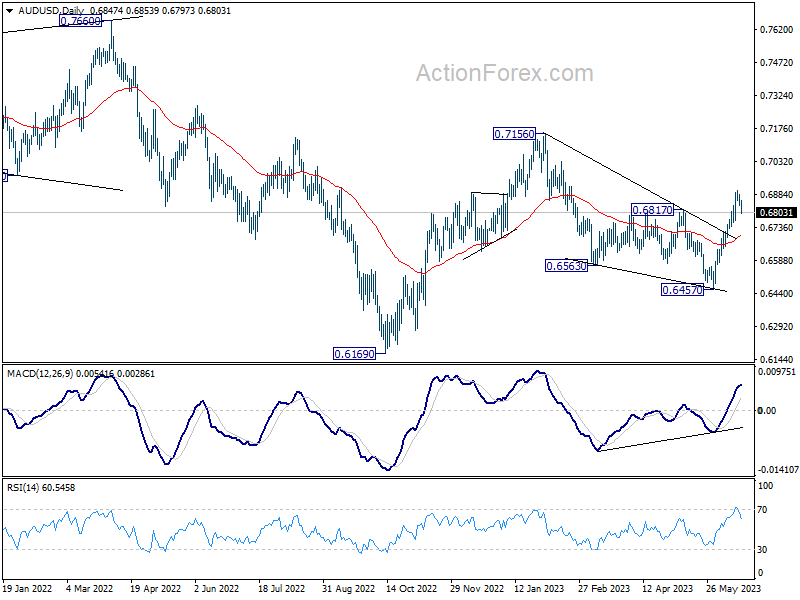
Intraday bias in AUD/USD remains neutral as consolidation from 0.6898 continues. Downside of retreat should be contained by 38.2% retracement of 0.6457 to 0.6898 at 0.6730 to bring another rally. As noted before, whole corrective decline from 0.7156 could have completed with three waves down to 0.6457 already. Above 0.6898 will resume the rise from 0.6457 to retest 0.7156 high next.
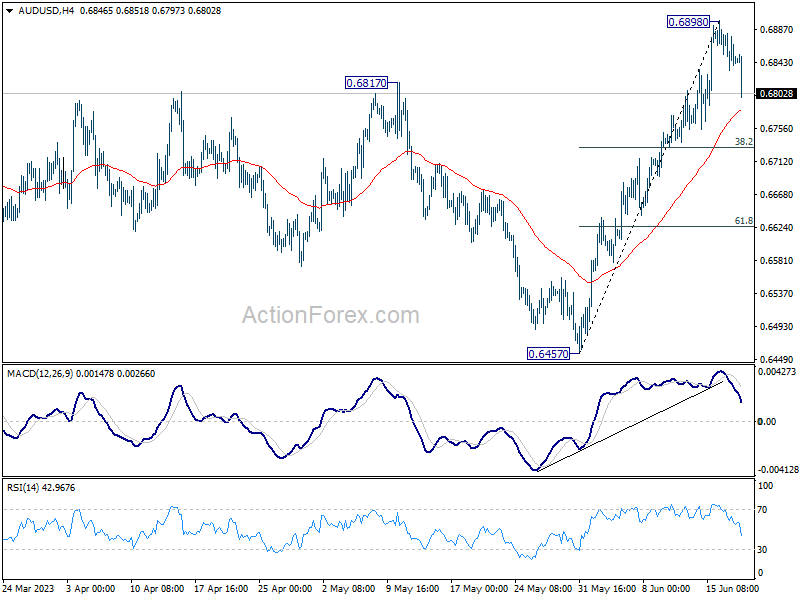
In the bigger picture, fall from 0.7156 could have completed in a three wave corrective structure at 0.6457. The development argues that rise from 0.6169 (2022 low) is still in progress. Firm break of 0.7156 will also add to the case that whole down trend from 0.8006 (2021 high) has finished and turn medium term outlook bullish. For now this will be the favored case as long as 55 D EMA (now at 0.6694) holds, even in case of deep pull back.
Aussie Down as RBA Minutes Raise Doubt Over July Hike
Australian Dollar is trading broadly lower today, reflecting uncertainties that emerged after release of minutes from RBA meeting earlier this month. The minutes revealed that a hold was considered at the meeting. Arguments were finely balanced even though it eventually decided to hike 25bps. These revelations have stirred market doubts about the continuity of monetary tightening in July, suggesting that the RBA might opt for a pause. Weighing down Aussie further is a slight pullback in Asian stocks, despite China's expected rate cut.
Elsewhere in the currency markets, New Zealand Dollar is trailing Aussie as the second weakest so far for the day, with Swiss Franc and Canadian Dollar following. Japanese Yen and Dollar are making mild gains as their corrective recoveries proceed. However, momentum of both currencies remains relatively weak. Euro and Sterling are showing mixed dynamics at the moment.
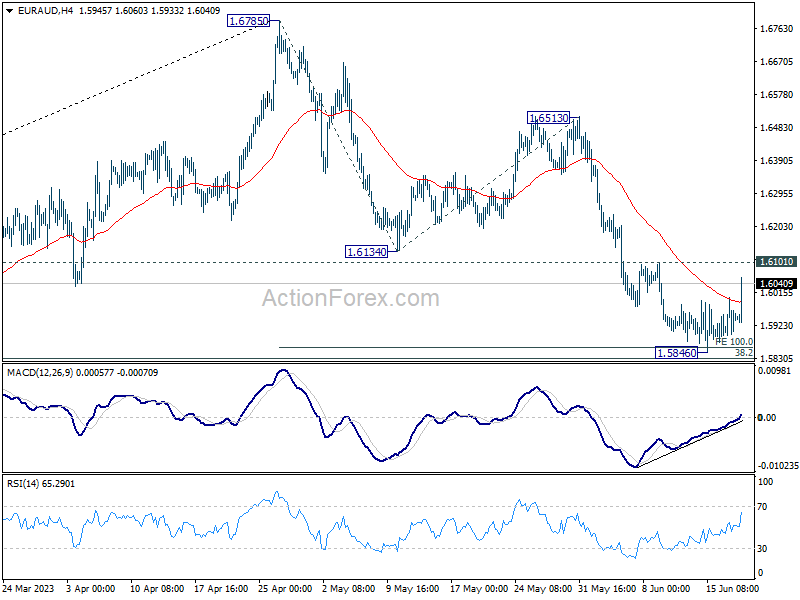
Technically, with the rebound in Asian session, EUR/AUD is now targeting 1.6101 resistance. Decisive break there should add to the case that whole corrective fall from 1.6785 has completed with three waves down to 1.5846, after hitting 100% projection of 1.6785 to 1.6134 from 1.6513 at 1.5862, slightly above 38.2% retracement of 1.4281 to 1.6785 at 1.5828. Stronger rally would be seen back to 1.6513 resistance next. If realized, the development would likely be accompanied by deeper pull back in AUD/USD and stronger rally in EUR/USD.
In Asia, at the time of writing, Nikkei is down -0.31%. Hong Kong HSI is down -1.53%. China Shanghai SSE is down -0.18%. Singapore Strait Times is down -0.46%. Japan 10-year JGB yield is down -0.0038 at 0.391.
RBA minutes: Finely balanced arguments for hold and hike
Minutes from RBA's June 6 monetary policy meeting reveal an active debate over whether to hold or raise the cash rate by 25bps.
As stated in the minutes, "Members recognised the strength of both sets of arguments, concluding that the arguments were finely balanced." However, they ultimately determined that a rate increase was the stronger course of action at this meeting.
Recent data indicating that inflation risks had begun tilting to the upside were a key influence on the board's decision. As they noted, "Given this shift and the already drawn-out return of inflation to target, the Board judged that a further increase in interest rates was warranted."
Such a move would bolster confidence that inflation would indeed return to the target range "over the period ahead", they reasoned.
At the meeting, RBA raised cash rate target by 25bps to 4.10%.
RBA Bullock: Economy needs to grow at a below trend pace for a while
In a speech, RBA Deputy Governor Michele Bullock noted the economy needs to "grow at a below trend pace for a while" to bring demand and supply into better balance. Only that will give "the greatest chance of securing sustainable full employment into the future."
Bullock explained, "For monetary policy... We think of full employment as the point at which there is a balance between demand and supply in the labour market (and in the markets for goods and services) with inflation at the inflation target."
"In recent months, the balance between labour demand and supply has improved somewhat," she noted. "Nevertheless, the labour market remains tight."
Also, "for the first time in decades, firms' demand for labour exceeds the amount of labour that people are willing and able to
"At the same time, with demand for goods and services high relative to the economy's capacity to supply those things, inflation is well above the 2–3 per cent target range."
PBoC cuts two key lending rates
China's PBoC executed cuts to two of its pivotal lending rates today, marking the first time such adjustments have been made in 10 months since last August.
The Chinese central bank opted to reduce one-year loan prime rate by -10 bps, taking it down from 3.65% to 3.55%. Concurrently, it also implemented a -10 bps cut to five-year loan prime rate, adjusting it from 4.3% to 4.2%.
These measures follow other recent actions aimed at easing monetary policy. Only last Thursday, PBOC made its first cut to one-year medium-term loan facility in 10 months. Furthermore, the bank reduced its seven-day reverse repurchase rate on the preceding Monday.
Looking ahead
Swiss trade balance, Germany PPI and Eurozone current account will be released in European session. Later in the day, US will release housing starts and building permits.
AUD/USD Daily Report
Daily Pivots: (S1) 0.6827; (P) 0.6857; (R1) 0.6880; More...
Intraday bias in AUD/USD remains neutral as consolidation from 0.6898 continues. Downside of retreat should be contained by 38.2% retracement of 0.6457 to 0.6898 at 0.6730 to bring another rally. As noted before, whole corrective decline from 0.7156 could have completed with three waves down to 0.6457 already. Above 0.6898 will resume the rise from 0.6457 to retest 0.7156 high next.
In the bigger picture, fall from 0.7156 could have completed in a three wave corrective structure at 0.6457. The development argues that rise from 0.6169 (2022 low) is still in progress. Firm break of 0.7156 will also add to the case that whole down trend from 0.8006 (2021 high) has finished and turn medium term outlook bullish. For now this will be the favored case as long as 55 D EMA (now at 0.6694) holds, even in case of deep pull back.
Economic Indicators Update
| GMT | Ccy | Events | Actual | Forecast | Previous | Revised |
|---|---|---|---|---|---|---|
| 01:30 | AUD | RBA Minutes | ||||
| 04:30 | JPY | Industrial Production M/M Apr F | 0.70% | -0.40% | -0.40% | |
| 06:00 | CHF | Trade Balance (CHF) May | 3.45B | 2.60B | ||
| 06:00 | EUR | Germany PPI M/M May | -0.70% | 0.30% | ||
| 06:00 | EUR | Germany PPI Y/Y May | 1.70% | 4.10% | ||
| 08:00 | EUR | Eurozone Current Account (EUR) Apr | 27.3B | 31.2B | ||
| 12:30 | USD | Housing Starts May | 1.40M | 1.40M | ||
| 12:30 | USD | Building Permits May | 1.43M | 1.42M |