Sample Category Title
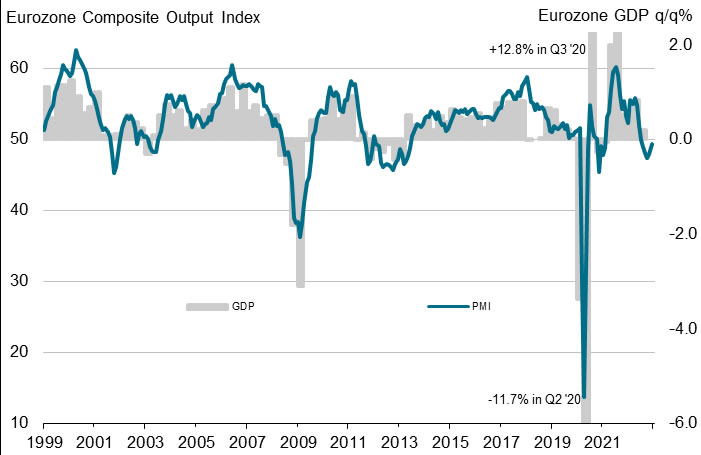
Eurozone PMI composite finalized at 49.3, downturn moderated further
Eurozone PMI Services was finalized at 49.8, in December, up from November's 48.5. PMI Composite was finalized at 49.3, up from prior month's 47.8. Looking at PMI Composite readings of some member states, Spain (49.9), Italy (49.6), France (49.1) and Germany (49.0) were all in contraction.
Joe Hayes, Senior Economist at S&P Global Market Intelligence said:
"The eurozone economy continued to deteriorate in December, but the strength of the downturn moderated for a second successive month, tentatively pointing to a contraction in the economy that may be milder than was initially anticipated....
"Cooling price pressures have helped temper the decline in economic activity levels....
"Nevertheless, there is little evidence across the survey results to suggest the eurozone economy may return to meaningful and stable growth any time soon."
USDCHF Loses Ground after Exciting Rally
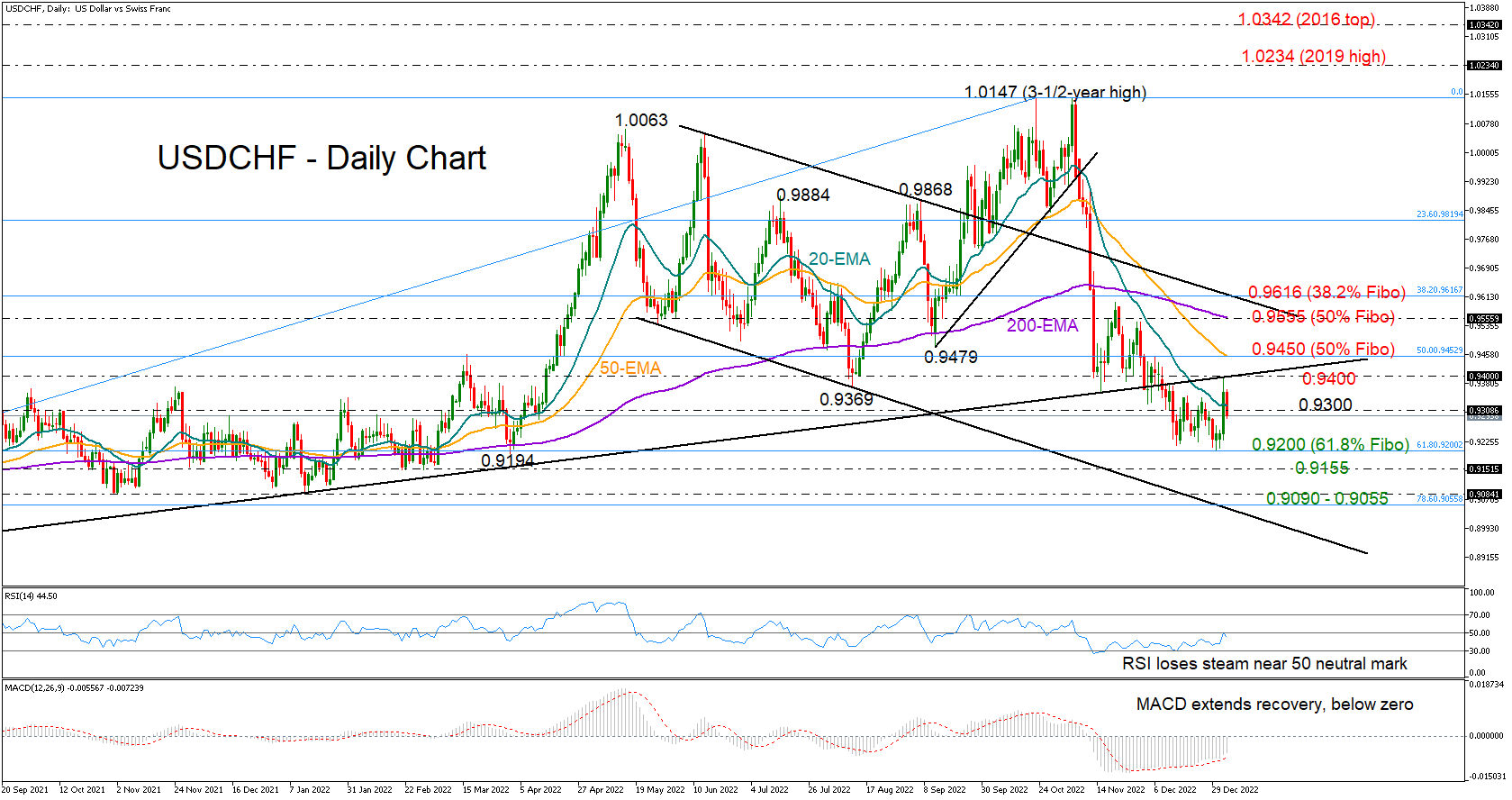
USDCHF experienced its fastest daily rally in a couple of months on Tuesday, advancing by 1.2% to chart an almost one-month high of 0.9397.
Despite the strong bullish momentum, the price could not crawl back above the broken support trendline from the 2021 lows, sliding back to the red zone on Wednesday.
A bullish bias has yet to be confirmed as the RSI keeps hovering below its 50 neutral mark, while the MACD, although above its red signal line, is still dipped in the negative area.
If the decline continues below the 0.9300 psychological mark, the bears will attempt to re-activate the downtrend from November’s highs below the 0.9200 level. This is where the 61.8% Fibonacci retracement of the 2021-2022 uptrend is positioned. Hence, an extension lower could fortify selling pressures likely towards the 0.9155 constraining zone, while a more aggressive decline could retest the 2022 bottom around 0.9090 and the 78.6% Fibo zone of 0.9055.
Alternatively, a bounce back above the key support-turned-resistance trendline and the 0.9400 number could initially take a rest near the 50% Fibonacci barricade of 0.9450 before accelerating towards the 200-day exponential moving average (EMA) at 0.9555. Running higher, the pair will push for a close above the 38.2% Fibonacci number of 0.9616, where the constraining line from June happens to be.
In short, USDCHF has not escaped the bearish area yet despite its latest exciting upturn. For that to happen, the price will need a sustainable recovery above 0.9400 and beyond 0.9450.
NZDUSD Ticks Up From Falling Trend Line
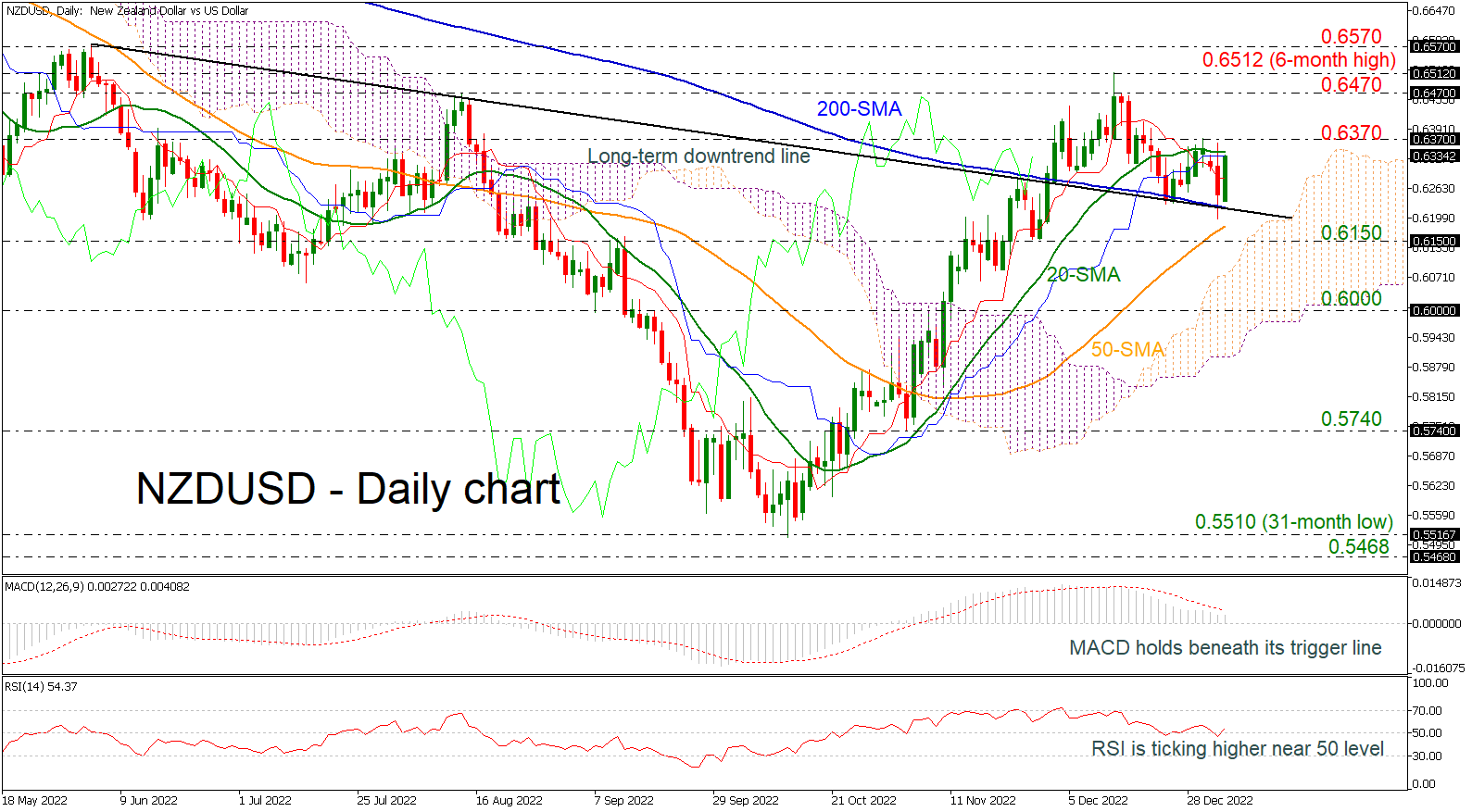
NZDUSD is rising after bouncing off the long-term descending trend line and the 200-day simple moving average (SMA) but is still hovering beneath the 20-day SMA.
The negatively aligned Tenkan-sen line serves as a testament to the negative short-term momentum. The Chikou Span, though, is signaling a potentially oversold market; a near-term reversal should thus not be ruled out. The MACD oscillator is still declining beneath its trigger line in the positive region; however, the RSI is pointing upwards above the neutral threshold of 50.
Immediate support to further declines may take place around the 200-day SMA at 0.6220 ahead of the 50-day SMA at 0.6180, while the 0.6150 barrier could provide additional support in case of steeper losses.
A move to the upside may meet resistance around the 20-day SMA at 0.6340 and the 0.6370 hurdle. More gains could open the way towards the 0.6470 barrier and the six-month peak of 0.6512, while any increases above the latter level would endorse the medium-term bullish outlook.
Overall, NZDUSD is still standing above the downtrend line, suggesting that upside pressures may come next.
AUD/USD: Aussie Surges to Three-Week High on Risk Appetite, Fundamentals
The Australian dollar surged in early Wednesday’s trading, driven by higher stocks and rumors that China is discussing easing of ban on Australia coal imports.
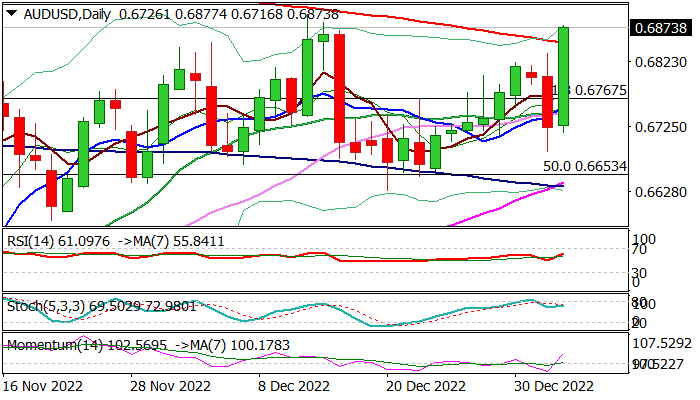
Aussie advanced over 2% in Asia, early Europe and cracked pivotal barrier at 0.6854 (200DMA), eyeing next key levels at 0.6893/0.6908 (Dec 13 former high/Fibo 76.4% of 0.7136/0.6170).
Clear break of these barriers is needed to signal a continuation of larger advance from 0.6170 (Oct 13 low) and expose psychological 0.70 resistance.
Strong rise of positive momentum on daily chart and studies turning into full bullish setup, support fresh advance.
Broken Fibo 61.8% (0.6767) offers solid support and expected to keep the downside protected.
Res: 0.6893; 0.6908; 0.7000; 0.7072.
Sup: 0.6834; 0.6796; 0.6767; 0.6687.
USDJPY Plummets to Fresh 7-Month Low
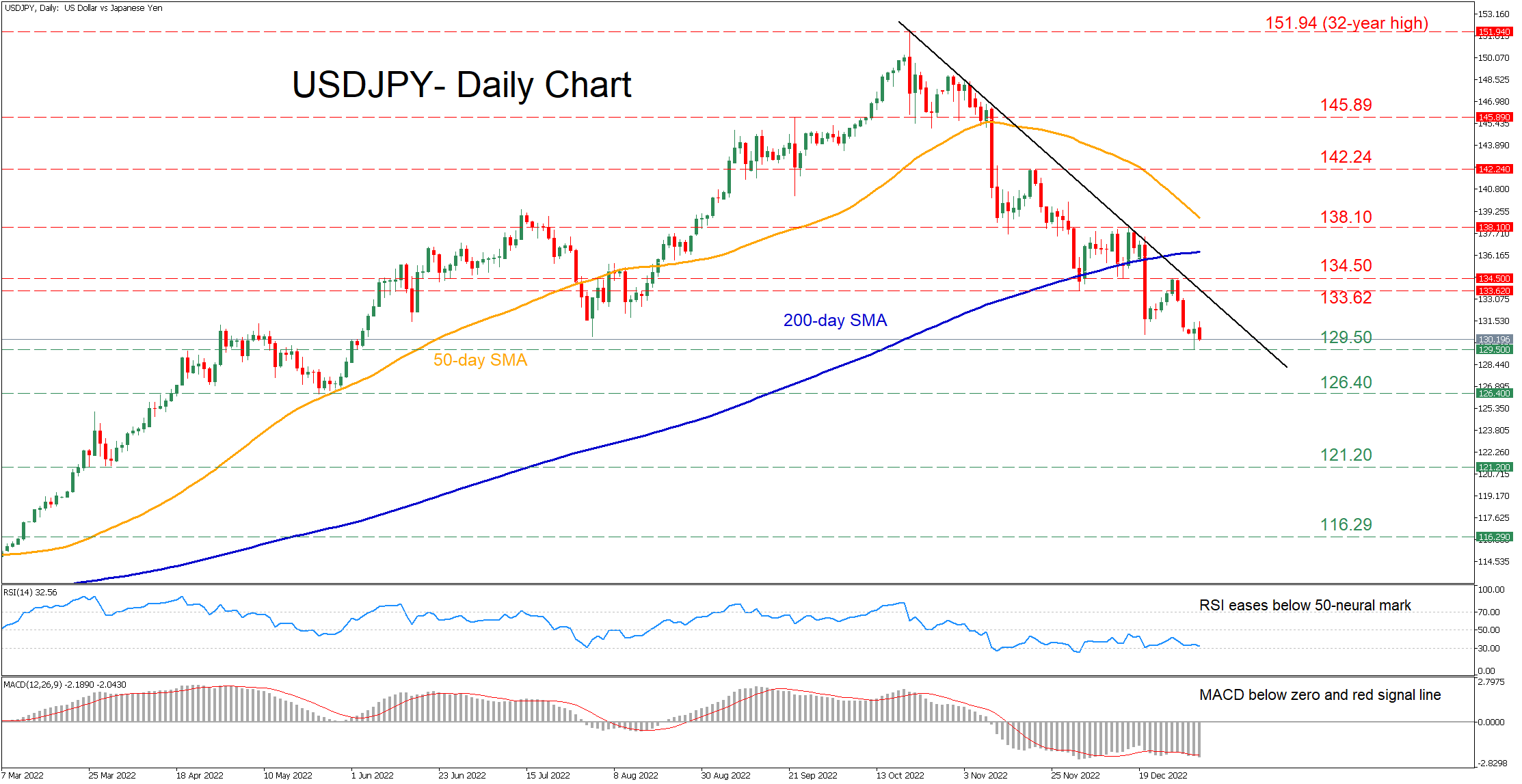
USDJPY had experienced a significant uptrend in the past year, climbing to a 32-year high of 151.94 in mid-October. However, the pair has been experiencing a prolonged downside correction since then, with the price hitting a fresh seven-month low of 129.50 in the previous daily session.
The short-term oscillators currently suggest that bearish forces have gained total control. Specifically, the RSI is declining near its 30-oversold zone, while the MACD histogram is retreating further below both zero and its red signal line.
Should the downfall persist, the price could retest its recent seven-month low of 129.50. Sliding beneath that floor, the pair might descend to form fresh multi-month lows, where the May 2022 low of 126.40 could provide downside protection. A violation of the latter could turn the spotlight to the March 2022 support of 121.20.
Alternatively, should the buying interest intensify, the December support of 133.62 could now act as the initial resistance region. Violating that zone, the bulls may then aim for 134.50 before the 138.10 resistance zone comes under examination. Breaking above the latter, the price could then ascend to challenge 142.24.
In brief, USDJPY appears set to post fresh lows as the technical picture is constantly deteriorating and downside risks are intensifying. What’s more, the descending 50-day simple moving average (SMA) is closing the gap with the 200-day SMA, where a potential death cross could accelerate the decline.
FTSE 100 Tests Major Ceiling
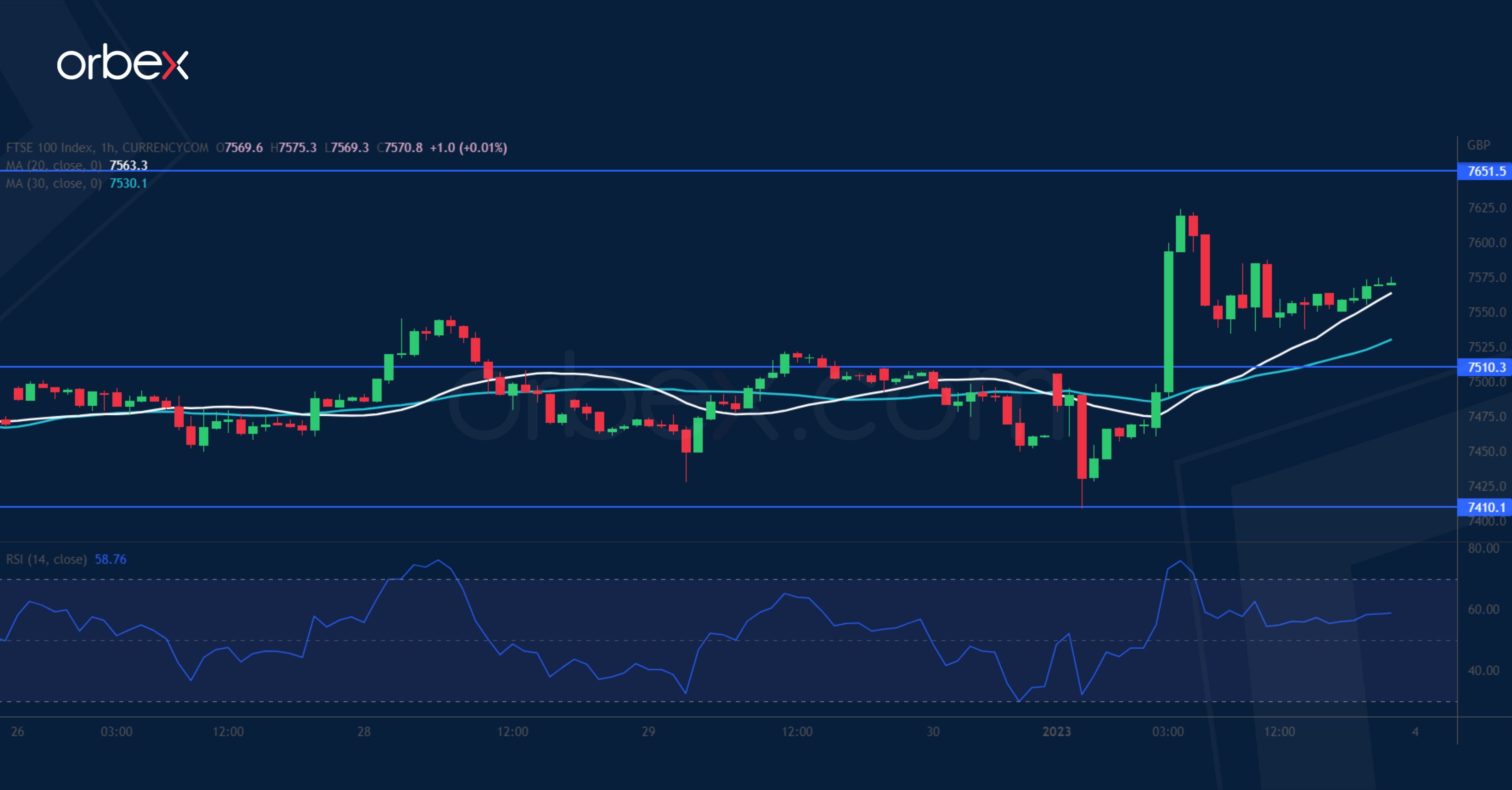
The resources heavy FTSE 100 outperformed thanks to energy stocks. A pop above 7550 may have put the index back on track, sending sellers to cover their bets. 2022’s top around 7650 is the last obstacle and a bullish breakout could trigger a runaway rally with momentum buyers joining the party. Then a new high above 7800 could be in store. After the RSI shows an overbought situation, a limited pullback may attract buyers in the former supply zone near 7510. 7410 is a key level to keep the bounce intact.
USD/CAD Bounces Back
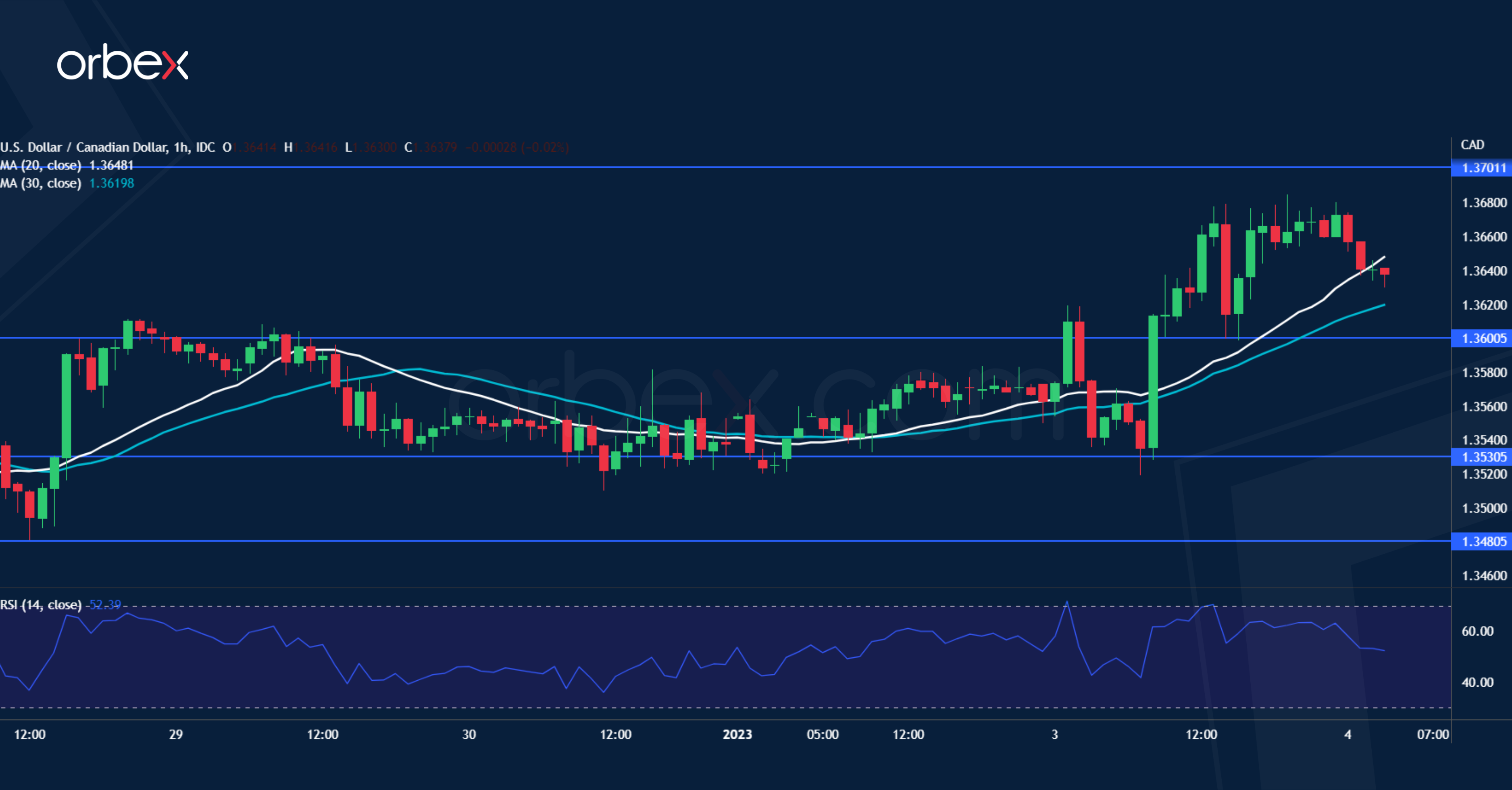
The Canadian dollar softens as risk-sensitive currencies take a backseat amid the greenback’s rally. From the daily chart’s perspective, the medium-term bias remains upward and the bulls have been waiting for an opportunity to stake in. A quick swing between 1.3510 and 1.3610 has narrowed the trading range, paving the way for the next one. A bullish breakout indicates that the path of least resistance is up and 1.3700 is a major obstacle ahead. Its breach would help the bulls regain control. 1.3600 is the closest support.
EUR/USD on Corrective Path
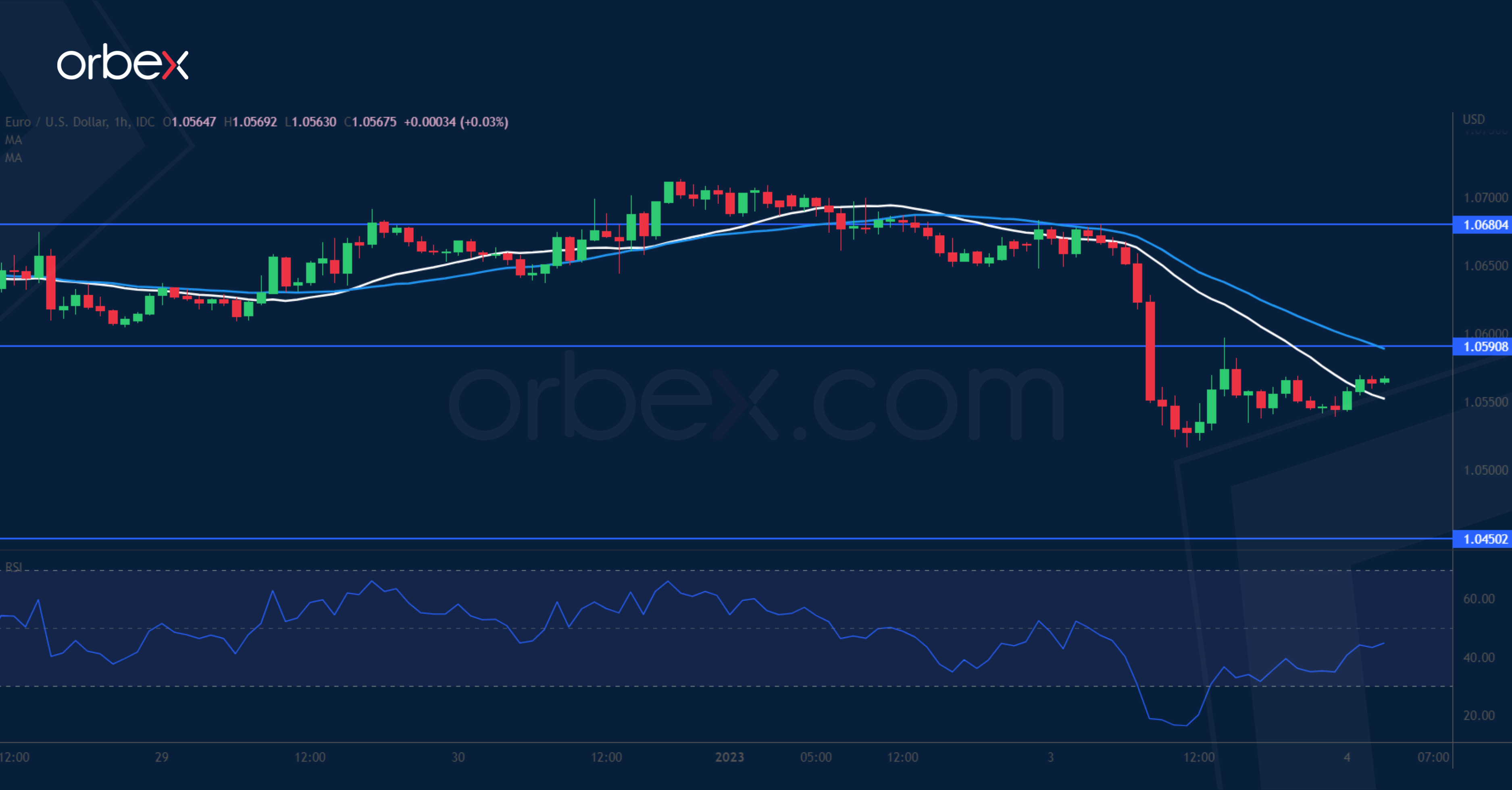
The US dollar jumped as traders made room for the Fed minutes later in the day. The euro’s consolidation at the end of December has failed to achieve a new high. A sharp drop below the demand zone 1.0580-1.0610 confirms exhaustion and is typical of a liquidation after the pair enjoyed a two-month long uninterrupted rally. The daily support at 1.0450 is the level to see if buyers start to come back. Otherwise, the correction could send the price to 1.0300. The support-turned-resistance at 1.0590 is the first hurdle to clear.
FX Market Showed a Mixed Picture
Markets
In line with the start of the new year on Monday in Europe, US investors apparently prepared/hoped for inflationary pressures to gradually ease in the upcoming year. Even with few data to support this view, US yields joined the European bond market rally with US yields declining between 5.6 bps (2-y) and 13.7 bps (10-y). European bonds enjoyed follow-through gains too, supported by a faster-than-excepted slowing in December German inflation. Headline HICP inflation dropped 1.2 % M/M ‘easing’ the Y/Y price rise to 9.6%, down from 11.3% Y/Y in November. However, a big part of the decline was due to government measures to mitigate consumers’ energy bills. At the same time, food prices continue to rise. Next to the inflation data, December German unemployment data pointed the persistent labour market resilience with a decline in the number of unemployed (-15k) lowering the unemployment rate to 5.5%. This suggests a risk of ongoing upside wage pressures. At least for now, investors were happy to embrace the lower-than-expected headline inflation. A decline in oil and European gas prices, supported this narrative. German yields eased another 3.9 bps (2-y) to 8.7 bps (30-y). Contrary to what happened in Europe, the bond rally didn’t help US equities with the Dow closing little changed (-0.03%) and the Nasdaq ceding 0.76%. Europe again outperformed (EuroStoxx50 +0.68%). FX market showed a mixed picture. A combination of USD strength and euro softness pushed EUR/USD off a cliff (close 1.0548 from an open of 1.0667). Sterling declined against the dollar (cable close 1.1968) but gained against the euro (close 0.8813). The yen initially continued its outperformance, but returned gains later the session, closing at 131.02. The test of the key 130.41/58 support area continues.
This morning, Hong Kong, South Korean and Australian shares gain, amongst others, supported by headlines that China might provide additional support for its ailing property sector. Japanese equities decline on a strong yen. The positive risk sentiment arrests further USD gains (DXY 104.5). The yuan (USD/CNY 6.894) and the yen (USD/JPY 130.80) remain well bid. EUR/USD (1.0565) gains modestly.
Later today, French CPI data (expected 0.40% and 7.30% from 7.10%) probably will show slightly different dynamics from the German data. In the US, the manufacturing ISM (expected at 48.5 from 49.0) and the JOLTS job openings will bring new insights on the pace of slowdown in the US economy. Later, the Fed will publish the minutes of ‘hawkish’ December 14 Fed policy meeting. The day-to-day momentum clearly is bond-friendly. At the same time, US markets already discount quite some ‘softness’ (only a 30% chance of a 50 bps early February rate hike vs 25 bps). In this context, data showing economic resilience might slow the bond market rally. On FX markets, the dollar might remain better bid short term. It probably will take really negative US data surprises for EUR/USD to return to the 1.0735 resistance soon.
News Headlines
Chinese officials are mulling to resume some imports of Australian coal after a more than two-year ban, Bloomberg news agency reported. Beijing imposed the restrictions in late 2020 following amongst others Australia’s call for an independent investigation into the origins of the coronavirus which further damaged an already strained relationship. Australian foreign minister Penny Wong traveled to China in December for the first official visit in years in tentative signs of a thaw. By lifting the ban, China seeks to prevent any repeat of the broad power outages in 2021 and to a lesser extent in 2022 while Europe’s Russian oil restrictions could significantly increase demand/competition for coal from other key Chinese suppliers including Indonesia. The Aussie dollar soared on the news, outperforming in the G10 area. AUD/USD is testing the 0.68 big figure, up from 0.6727.
The since the midterms Republican-led US House of Representatives adjourned after Kevin McCarthy failed to secure a simple majority during the election for Speaker. He was shy 15 votes in the first round, making him the first majority party leader in a century to fail. Two subsequent rounds of voting didn’t yield a result either. Because of the ultra-thin Republican majority, the group of people voting against McCarthy have an outsized influence in the ballot. They were left disappointed after the predicted red wave during the midterms did not materialize and press for change in the party. The House cannot function without a Speaker and the process could drag on for days until McCarthy is able to garner enough support or steps aside in the race.
Swiss CPI down to 2.8% yoy, but core rose to 2.0% yoy
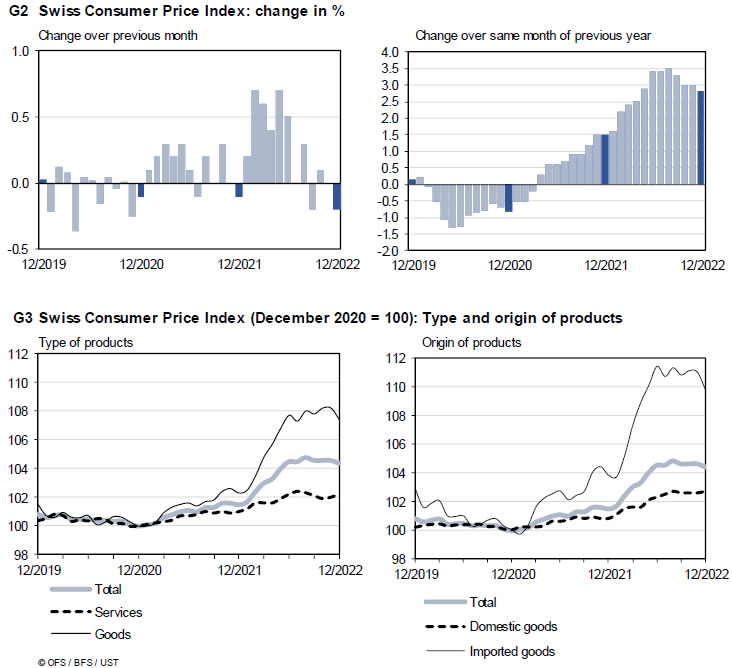
Swiss CPI dropped -0.2% mom in December, due to several factors including falling prices for fuels and heating oil, fruiting vegetables and medicines. On the other hand, rents for holiday flats and the hire of private means of transport increased.
Annually, CPI slowed from 3.0% yoy to 2.8% yoy in December, below expectation of 2.9% yoy. Core inflation (excluding fresh and seasonal products, energy and fuel), accelerated from 1.9% yoy to 2.0% yoy.
Domestic products inflation rose from 1.8% yoy to 1.9% yoy. Imported products inflation slowed notably from 6.3% yoy to 5.8% yoy.