Sample Category Title
Markets Clearly Looking for a New Unequivocal Driver
Markets
Markets clearly are looking for a new unequivocal driver as established trends, especially in interest rate markets, are meeting short term resistance. Maybe the outcome of the US mid-term elections or Thursday’s October CPI release will be able to do so. However, yesterday markets had to rely on their own internal dynamics as there were no data to provide any directional input for trading. US yields reversed most of Friday’s dovish reaction to a payrolls report that we still consider as supporting the case further tightening/demand reduction. US yields gained 5/6 bps points across the curve. Maybe it’s a bit strange to call a it a dovish yield rise. Even so, the move was solely driven by a rise in inflation expectations. The 10-y US real yield (1.67%) maintained Friday’s correction. Whatever the reason, this (temporary) consolidation in the real yields apparently also facilitated a rather mild sentiment on other markets, including equities and the dollar. US equities gained between 1.31% (Dow) and 0.85% (Nasdaq). The dollar showed rather broad-based losses. DXY declined to close just north of the 110 barrier. The decline in USD/JPY was more modest (close 146.63). EUR/USD finished the day north of parity (1.002). The mild global sentiment also often favoured smaller currencies, with remarkably strong performance of CE currencies (EUR/CZK close 24.26 from 24.39 on Friday, EUR/HUF close 400.7 from 402.5 and EUR/PLN close 4.67 from 4.6875). German yields also stayed upwardly oriented gaining between 8.1 bps (2-y) and 3.4 bps (30-y). Especially yields at shorter maturities are only a whisker away from the cycle peak levels, but no clear break occurred yet. Bunds substantially underperformed swaps. For now we don’t draw firm conclusions from yesterday’s trading session, even as underlying optimism remains a bit remarkable post Powell’s hawkish press conference last week.
This morning most Asian markets are trading in positive territory, but often don’t fully capture to WS momentum. China underperforms (CSI 300 -1.27%) as uncertainty on the countries Covid strategy persists. The dollar gains modestly (DXY 110.42, EUR/USD 1.000). US yields also rise marginally this morning. Later today, the calendar is again thin. US NFIB small business confidence (expected to ease from 92.1 to 91.4) is an interesting pointer on the broader health of the US economy but for sure won’t be a game changer. The US Treasury will start a new bond auction cycle with a sale of $40 bln of 3-year notes, the followed by 10 & 30-year auctions later this week. Central bank speakers include ECB’s Wunsch, SNB’s Jordan and BoE’s Pill. We stay cautious to already jump on any broader risk-on repositioning annex sustained USD decline. EUR/USD 1.0094 remains a first ST reference on the technical charts.
News Headlines
Poland is about to sell its first dollar-denominated bonds in six years. The country faces rising borrowing needs ahead of general elections expected in October next year, following amongst others increased military spending. But borrowing in its own currency comes at a significant cost with Polish yields having risen to the highest level in 20 years. At the same time the EU is still withholding some €35bn of post-pandemic aid over a conflict concerning changes in the Polish judiciary. The sale, expected for today, includes a 5-year and a 10-year dollar bond.
Adrian Orr has been appointed for another 5-year term as governor of the Reserve Bank of New Zealand. This provides the opportunity of completing one of the most aggressive tightening cycles in history as the RBNZ tries to get a grip on spiraling inflation (7.2% y/y in Q3). New Zealand was one of the first in October 2021 to start raising policy rates and paved the way for bigger-sized rate hikes. In exactly one year time, the RBNZ’s cumulative tightening amounted to 325 bps (from 0.25% to 3.50%). It is expected to continue the process: according to a quarterly survey published this morning, 2-year inflation expectations have jumped to 3.62% from 3.07%. NZ money markets currently see the terminal rate between 5.25 and 5.50%.
US Midterm Elections Today
Market movers today
Today, the focus is on US midterm elections. Republicans are favoured to win control of both House and Senate, although the Senate race remains a close call. If republicans win the Senate by a slim margin or if Democrats are able to retain the Senate, market reaction should be quite muted, as major changes in fiscal policy would be difficult to pass.
On data front, we get euro area September retail sales and US NFIB small business optimism index from October. Chinese October PPI is due for release overnight.
ECB's Nagel and Wunsch are also in the wires, while the Fed's Barkin is due to discuss inflation overnight.
The 60 second overview
US midterms: Both betting markets and the latest polls suggest that Republicans are the favourites to win control of both Senate and House in the midterm elections today. Senate race will be tighter, however, while betting markets see almost 90% probability of Republicans winning at least the House.. The high inflation has steered both parties away from campaigning for clearly increased spending, and rather the focus has been more on non-economic themes such as abortion rights. As such, we do not expect the election result to be a major market mover in the near term, as the republican congress would most likely be unable to pass dramatic changes to US fiscal policies with Biden still remaining the president. The (modest) risk-scenario for markets would be a clear victory for Republicans also in the Senate, as this could increase the risk of more expansionary (and inflationary) fiscal policies amid the looming recession. Some are already focusing on the upcoming presidential elections, as Trump stated yesterday that he could announce running in 2024 as early as next week.
Risk sentiment: Equity markets rose yesterday as the outlook for a divided US government and hopes of some easing in Chinese Covid-policies supported risk sentiment. We remain sceptical that a turnaround in the strict zero-Covid stance is coming anytime soon, and continue to think EUR/USD will decline back below parity despite the most recent uptick. The Euro Area November Sentix index released yesterday showed a modest rise in investor confidence both in terms of current situation and future expectations, although from a low level. But with recession risks still looming towards the winter, US CPI likely illustrating another month of fast and broad-based rise in prices later this week and Fed still firmly on the tightening mode, we think the optimism might be too early.
Equities: The bear market rally continued on Monday. Investors bought the dip in growth stocks (tech, communication services) despite higher yields. In the Nordics, industrials continued to rally with Sandvik and SKF +4%. However, real estate the big gainer, up 5% and 25% the last month. We prefer to take risk with yield-sensitive sectors rather than earnings-sensitive sectors to leverage in bear market rallies. S&P500 up 1% and futures somewhat lower today.
FI: Core European rates ended 5bp higher on the day, primarily due to a sell-off in the very late part of day (10y Germany touching 2.34%), coinciding with the announcement of the relatively poor cover in the BoE's sales operations. Money markets also sold off, adding 3bp to ECB hikes now pointing to a local high of 3.07%. French governor Villeroy said that ECB would hike rates until core inflation had peaked. Spreads tightened, led by the periphery.
FX: Benign risk sentiment in general supported the SEK, but it is also fair to assume that the news of the Swedish Match M&A now being good to go might have helped push SEK crosses lower.
Credit: Credit markets were broadly positive yesterday with iTraxx Main going 2bp tighter to 107.4bp while Xover tightened by 12.9bp to 521.3bp. In addition, the primary markets seem to be wide open this week with several financial and corporate issuers active with new deals across the Eurobond Market. The largest transaction was from Volkswagen International Finance with a 3-part Green Bond of EUR2.5bn, this was well received with strong book interest and final terms notably below indicated initial price talk.
All Eyes on US Midterm Elections
Investors are tense and undecided into the US midterm elections today.
US President Joe Biden didn’t have an easy mandate. The Covid pandemic, the war in Ukraine, the global energy crisis, the skyrocketing inflation, a pitilessly tighter Federal Reserve (Fed) policy, rising mortgage rates… all these factors will weight on the wrong side of the balance for Democrats at today’s election.
The consensus expectation is a divided government between White House and Congress. Republicans are favoured to take the House and have at least 50/50 seats at Senate.
What does that mean for the US monetary and fiscal policies, the financial markets, and the dollar?
Nothing will change for the Fed
The midterm elections won’t change anything for the Fed policy. The Fed will continue fighting inflation on its end. It will continue tightening its policy, raising the rates - by slower increments but as high as needed to bring inflation back on – at least – a healthy path toward its 2% policy target.
The divergence between a strongly hawkish Fed stance, and reasonably hawkish other central bank stances should continue tilting the balance toward a strong US dollar.
How strong the dollar will be against the majors will depend on how hawkish the central banks of other currencies are, and what shape the US fiscal policy will take.
Fiscal policy will get impacted
The changing landscape in the government will of course have an impact on the way the political decisions are made in the US, and on the way the US debt is managed.
The Fed’s aggressive rate hikes make the huge US debt more expensive by the day. The US debt to GDP ratio stood at a touch below the 125% mark in June this year. And it’s increasing steadily – something Republicans don’t like.
Therefore, the US debt burden could stop the Democrats from putting in place many economic reforms that they would’ve otherwise, if Republicans are sufficiently crowded to block them moving forward. Hence, slowing debt under GOP could slow growth.
Therefore, if Republicans win control of both House and Senate, we should see the US treasuries rally and the dollar soften, whereas if the Democrats hold on to the House and Senate, we shall continue seeing a positive pressure on the dollar.
Every outcome is better for stocks than a Democrat majority
A Republican majority in both chambers should boost equities, more than a Republican majority in both chambers, or a split government.
On the other hand, empirical data shows that the US stock markets performed better with a divided government in the years following a same party controlling the Senate, the House and the Presidency.
That means that even a divided government would be better than a Democrat majority for the US stocks.
Dollar Recovering Slightly in Consolidative Markets, Breakout Awaited
The currency markets are generally quiet, without committed directions. Dollar is recovering broadly, ahead of near term support against European majors. Commodity currencies are softening while Yen is mixed. Some focuses be on US mid-term elections, as well as a Bundesbank symposium. But overall trading activities might remain subdued until US CPI release on Thursday.
Technically, for now, Dollar-Europeans are staying in range. That is, EUR/USD is trading inside 0.9729/1.0092, GBP/USD inside 1.1145/1.1644, USD/CHF 0.9840/1.0146. Any movements inside these ranges are seen as near term volatility only. Concurrent breakouts in these pairs are needed to confirm the next direction of the greenback.
In Asia, at the time of writing, Nikkei is up 1.31%. Hong Kong HSI is down -0.70%. China Shanghai SSE is down -0.69%. Singapore Strait Times is up 0.21%. Japan 10-year JGB yield is down -0.0078% 0.251. Overnight, DOW rose 1.31%. S&P 500 rose 0.96%. NASDAQ rose 0.85%. 10-year yield rose 0.058 to 4.214.
BoJ opinions: Undesirable to make premature changes to monetary policy
In the Summary of Opinions at BoJ's October 27-28 meeting, it's noted that it's wages increase in a "sustainable and stable manner" to achieve the inflation target. Inflation could "deviate upward" form the baseline scenario but it's still "uncertain" whether the rises in prices will be "sustainable". It is "undesirable" to "make premature changes" to monetary policy for the "risk of disrupting the formation of a virtuous cycle between prices and wages."
Nevertheless, on member noted, "it is necessary to examine the impact of high prices on household behavior and wages humbly and without any preconceptions while paying attention to the side effects of monetary easing.
Another member noted, "it is also important to continue to examine how future exit strategies will affect the market and whether market participants will be well prepared for them."
Australia NAB business confidence dropped to 0, conditions dropped to 22
Australia NAB Business Confidence dropped from 5 to 0 in October. Business Conditions dropped slightly from 23 to 22. Trading conditions dropped from 37 to 31. Profitability conditions rose from 21 to 22. Employment conditions dropped from 17 to 14.
NAB Chief Economist Alan Oster said, "Conditions remained strong in October with demand still very elevated and profitability holding up... Despite the strength in conditions, confidence has been falling for several months as headwinds have weighed on the outlook for the global economy and Australia."
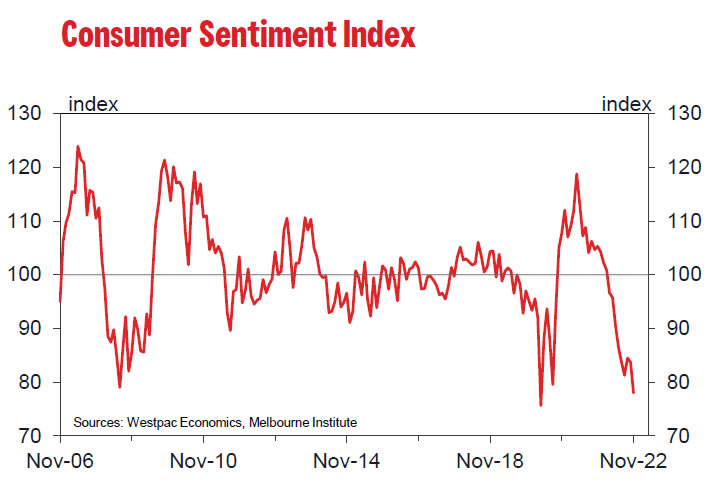
Australia Westpac consumer sentiment dropped to 78, just slightly above pandemic low
Australia Westpac Consumer Sentiment dropped -6.9% to 78.0 in November. The reading was below the low point of the Global Financial Crisis in 2008, and was just slightly higher than pandemic low at 75.6.
Westpac said that inflation and interest rates are weighing heavily on family finances. Nearly 40% of consumers, a record high, look to cut Christmas spending. Confidence in house prices is heading towards 2018.19 lows.
Regarding RBA policy, Westpac expects it to hike by a further 25bps on December 6. Westpac also expects RBA to hike by an additional 0.75% out to May next year.
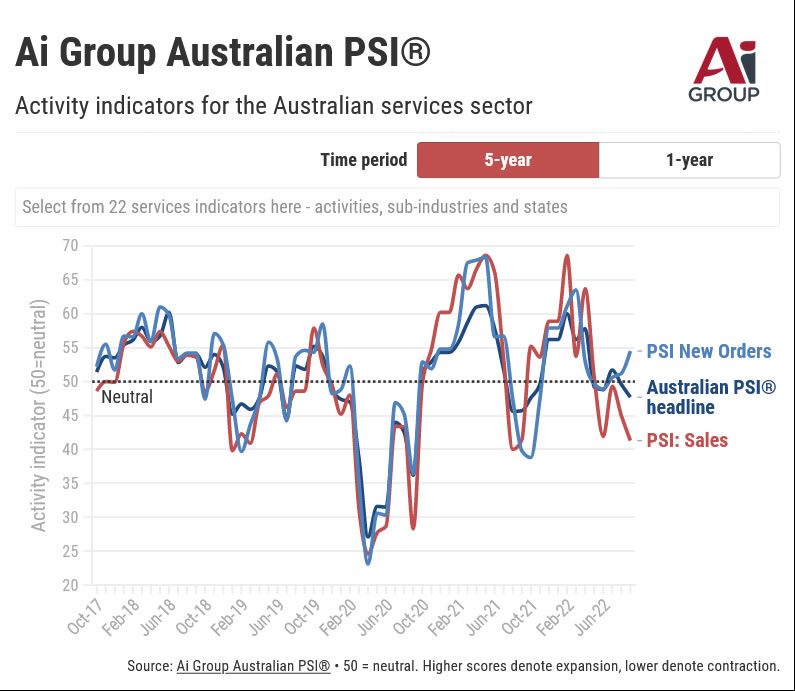
Australia AiG services dropped to 47.7, second month of contraction
Australia AiG Performance of Services Index dropped slightly from 48.0 to 47.7 in October, staying in contraction for a second month. Looking at some details, sales dropped -0.5 to 41.3. Employment rose 1.3 to 53.9. New orders rose 4.3 to 54.5. Input prices rose 4.2 to 77.6. Selling prices rose 3.9 to 62.2. Average wages dropped -1.1 to 64.8.
Innes Willox, Chief Executive of Ai Group, said: "Australia's service sector faces weakening conditions. Chronic labour shortages have dragged on the supply-side of the sector for most of this year. And now the effects of cumulative interest rate rises are weakening demand conditions as well. Conditions particularly deteriorated for retail & hospitality and business & property, which are most exposed to consumer sentiment."
RBNZ 2-yr inflation expectations rose to 3.62%
In RBNZ's Survey of Expectations, businesses expect interest rate to rise 65bps to 4.15% a quarter ahead. In a year's time, they saw interest rates rose further to 4.67%.
Mean one-year ahead GDP growth decreased from prior survey's 1.49% to 1.27%. One year ahead inflation expectations rose from 4.86% in last quarter to 5.08%. Two year ahead inflation expectations rose sharply from 3.07% to 3.62%.
Looking ahead
France trade balance, Italy retail sales and Eurozone retail sales will be released in European session. US will release NFIB business optimism index.
USD/CHF Daily Outlook
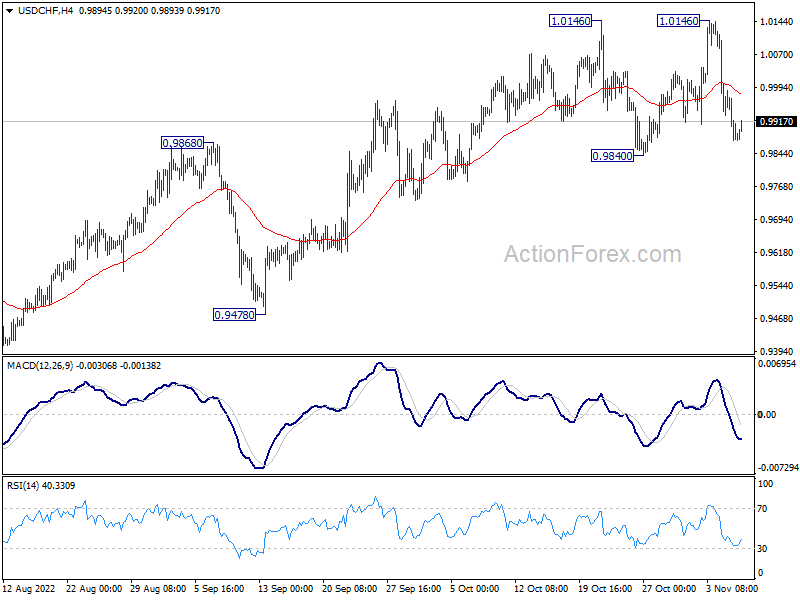
Daily Pivots: (S1) 0.9843; (P) 0.9916; (R1) 0.9957; More...
Intraday bias in USD/CHF remains neutral as range trading continues inside 0.9840/1.0146. Further rally is expected as long as 0.9840 support holds. Break of 1.0146 will resume larger up trend to 1.0283 projection level. However, sustained break of 0.9840 will now complete a double top pattern, and turn bias back to the downside for 0.9478 support instead.
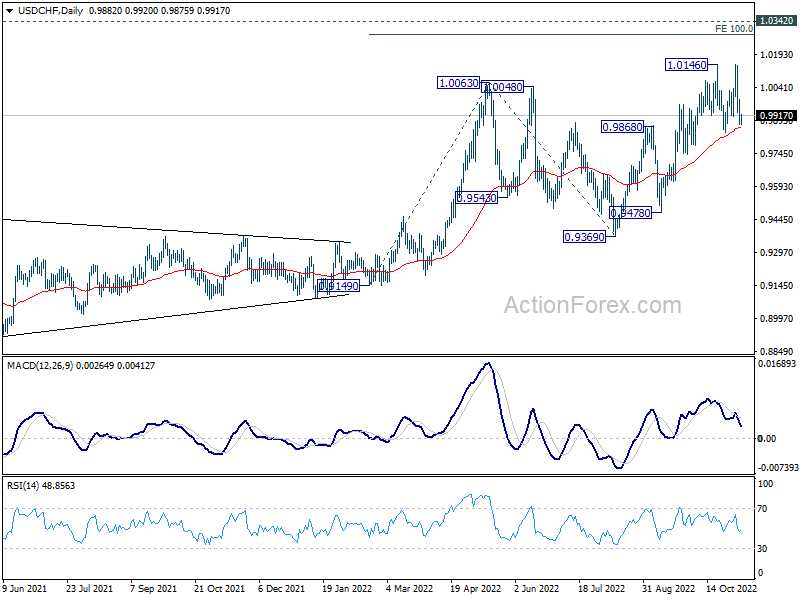
In the bigger picture, up trend from 0.8756 (2021 low) is still in progress. Next target is 100% projection of 0.9149 to 1.0063 from 0.9369 at 1.0283, and then 1.0342 (2016 high). For now, this will remain the favored case as long as 0.9779 support holds, even in case of deep pull back.
Economic Indicators Update
| GMT | Ccy | Events | Actual | Forecast | Previous | Revised |
|---|---|---|---|---|---|---|
| 22:30 | AUD | AiG Performance of Services Index Oct | 47.7 | 48 | ||
| 23:30 | AUD | Westpac Consumer Confidence Nov | -6.90% | -0.90% | ||
| 23:30 | JPY | Labor Cash Earnings Y/Y Sep | 2.10% | 1.60% | 1.70% | |
| 23:30 | JPY | Overall Household Spending Y/Y Sep | 2.30% | 2.70% | 5.10% | |
| 23:50 | JPY | BoJ Summary of Opinions | ||||
| 00:01 | GBP | BRC Like-For-Like Retail Sales Y/Y Oct | 1.20% | 1.50% | 1.80% | |
| 00:30 | AUD | NAB Business Confidence Oct | 0 | 5 | ||
| 00:30 | AUD | NAB Business Conditions Oct | 22 | 25 | 23 | |
| 02:00 | NZD | RBNZ Inflation Expectations Q/Q Q4 | 3.62% | 3.07% | ||
| 05:00 | JPY | Leading Economic Index Sep P | 97.4 | 101.6 | 101.3 | |
| 07:45 | EUR | France Trade Balance (EUR) Sep | -14.0B | -15.3B | ||
| 09:00 | EUR | Italy Retail Sales M/M Sep | -0.10% | -0.40% | ||
| 10:00 | EUR | Eurozone Retail Sales M/M Sep | 0.00% | -0.30% | ||
| 11:00 | USD | NFIB Business Optimism Index Oct | 91.7 | 92.1 |
BoJ opinions: Undesirable to make premature changes to monetary policy
In the Summary of Opinions at BoJ's October 27-28 meeting, it's noted that it's wages increase in a "sustainable and stable manner" to achieve the inflation target. Inflation could "deviate upward" form the baseline scenario but it's still "uncertain" whether the rises in prices will be "sustainable". It is "undesirable" to "make premature changes" to monetary policy for the "risk of disrupting the formation of a virtuous cycle between prices and wages."
Nevertheless, on member noted, "it is necessary to examine the impact of high prices on household behavior and wages humbly and without any preconceptions while paying attention to the side effects of monetary easing.
Another member noted, "it is also important to continue to examine how future exit strategies will affect the market and whether market participants will be well prepared for them."
RBNZ 2-yr inflation expectations rose to 3.62%
In RBNZ's Survey of Expectations, businesses expect interest rate to rise 65bps to 4.15% a quarter ahead. In a year's time, they saw interest rates rose further to 4.67%.
Mean one-year ahead GDP growth decreased from prior survey's 1.49% to 1.27%. One year ahead inflation expectations rose from 4.86% in last quarter to 5.08%. Two year ahead inflation expectations rose sharply from 3.07% to 3.62%.
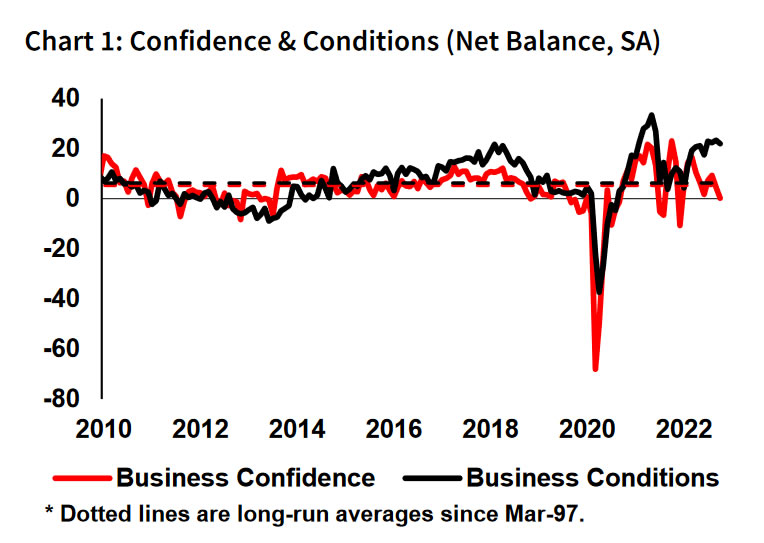
Australia NAB business confidence dropped to 0, conditions dropped to 22
Australia NAB Business Confidence dropped from 5 to 0 in October. Business Conditions dropped slightly from 23 to 22. Trading conditions dropped from 37 to 31. Profitability conditions rose from 21 to 22. Employment conditions dropped from 17 to 14.
NAB Chief Economist Alan Oster said, "Conditions remained strong in October with demand still very elevated and profitability holding up... Despite the strength in conditions, confidence has been falling for several months as headwinds have weighed on the outlook for the global economy and Australia."
Australia Westpac consumer sentiment dropped to 78, just slightly above pandemic low
Australia Westpac Consumer Sentiment dropped -6.9% to 78.0 in November. The reading was below the low point of the Global Financial Crisis in 2008, and was just slightly higher than pandemic low at 75.6.
Westpac said that inflation and interest rates are weighing heavily on family finances. Nearly 40% of consumers, a record high, look to cut Christmas spending. Confidence in house prices is heading towards 2018.19 lows.
Regarding RBA policy, Westpac expects it to hike by a further 25bps on December 6. Westpac also expects RBA to hike by an additional 0.75% out to May next year.
Australia AiG services dropped to 47.7, second month of contraction
Australia AiG Performance of Services Index dropped slightly from 48.0 to 47.7 in October, staying in contraction for a second month. Looking at some details, sales dropped -0.5 to 41.3. Employment rose 1.3 to 53.9. New orders rose 4.3 to 54.5. Input prices rose 4.2 to 77.6. Selling prices rose 3.9 to 62.2. Average wages dropped -1.1 to 64.8.
Innes Willox, Chief Executive of Ai Group, said: "Australia's service sector faces weakening conditions. Chronic labour shortages have dragged on the supply-side of the sector for most of this year. And now the effects of cumulative interest rate rises are weakening demand conditions as well. Conditions particularly deteriorated for retail & hospitality and business & property, which are most exposed to consumer sentiment."
Technical Outlook and Review
USD/JPY:
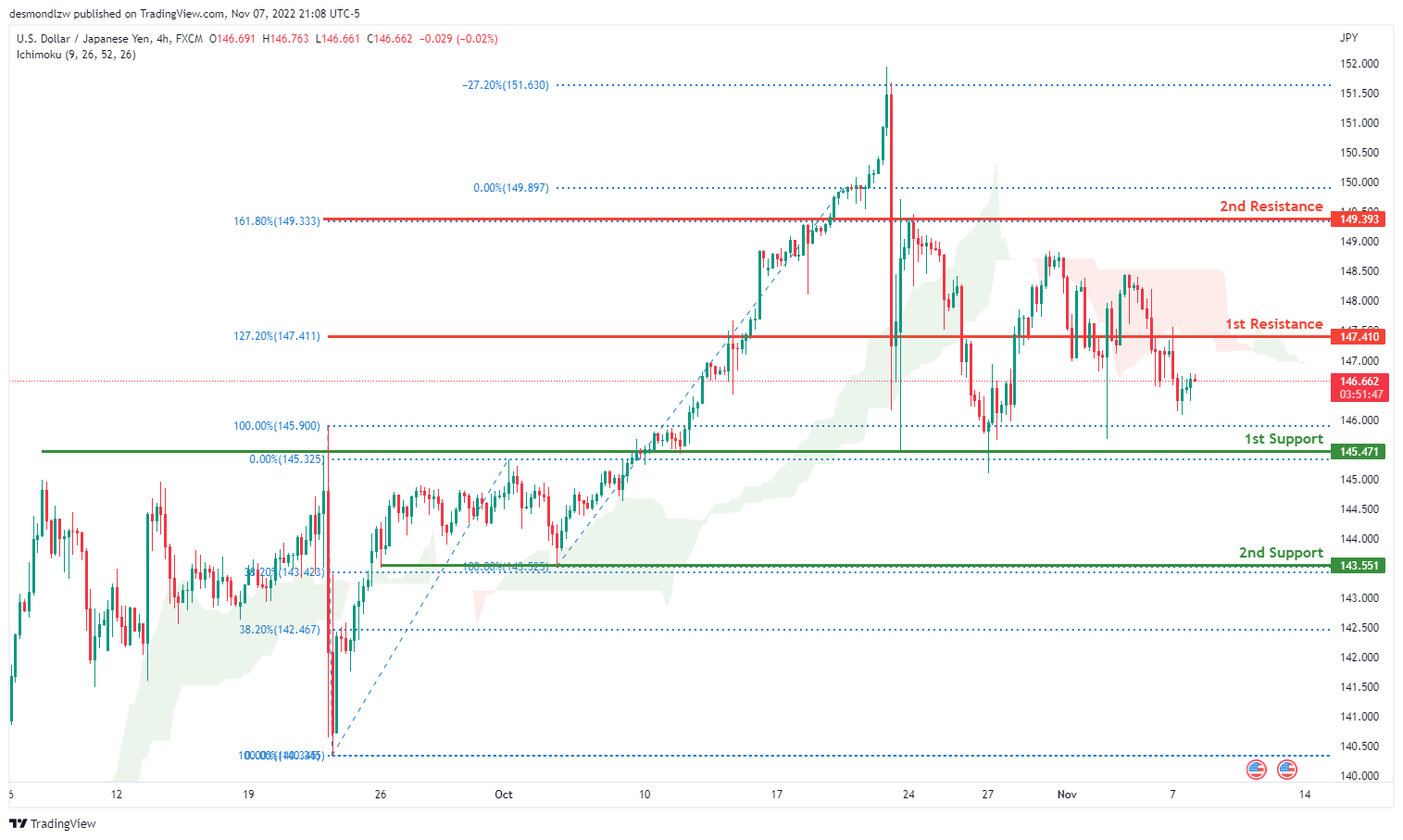
The current general bias for USDJPY on the H4 chart is bearish. To add confluence to this, the price is below the Ichimoku cloud which indicates a bearish market. Overnight, USDJPY continued its bearish momentum with the price currently below the 1st resistance line at 147.410 where the 127.2% Fibonacci extension line is located. Price is currently trading at 146.677 at time of writing. If the bearish momentum continues, expect USDJPY to possibly head towards the 1st support line at 145.471, where the 100% and 0% Fibonacci lines are located. In an alternative scenario, price could break above the 1st resistance and head towards the 2nd resistance at 149.393 where the 161.8% and 0% Fibonacci lines are located.
Areas of consideration:
- H4 time frame, 1st resistance at 147.410
- H4 time frame, 1st resistance at 149.393
- H4 time frame, 1st support at 145.471
DXY:
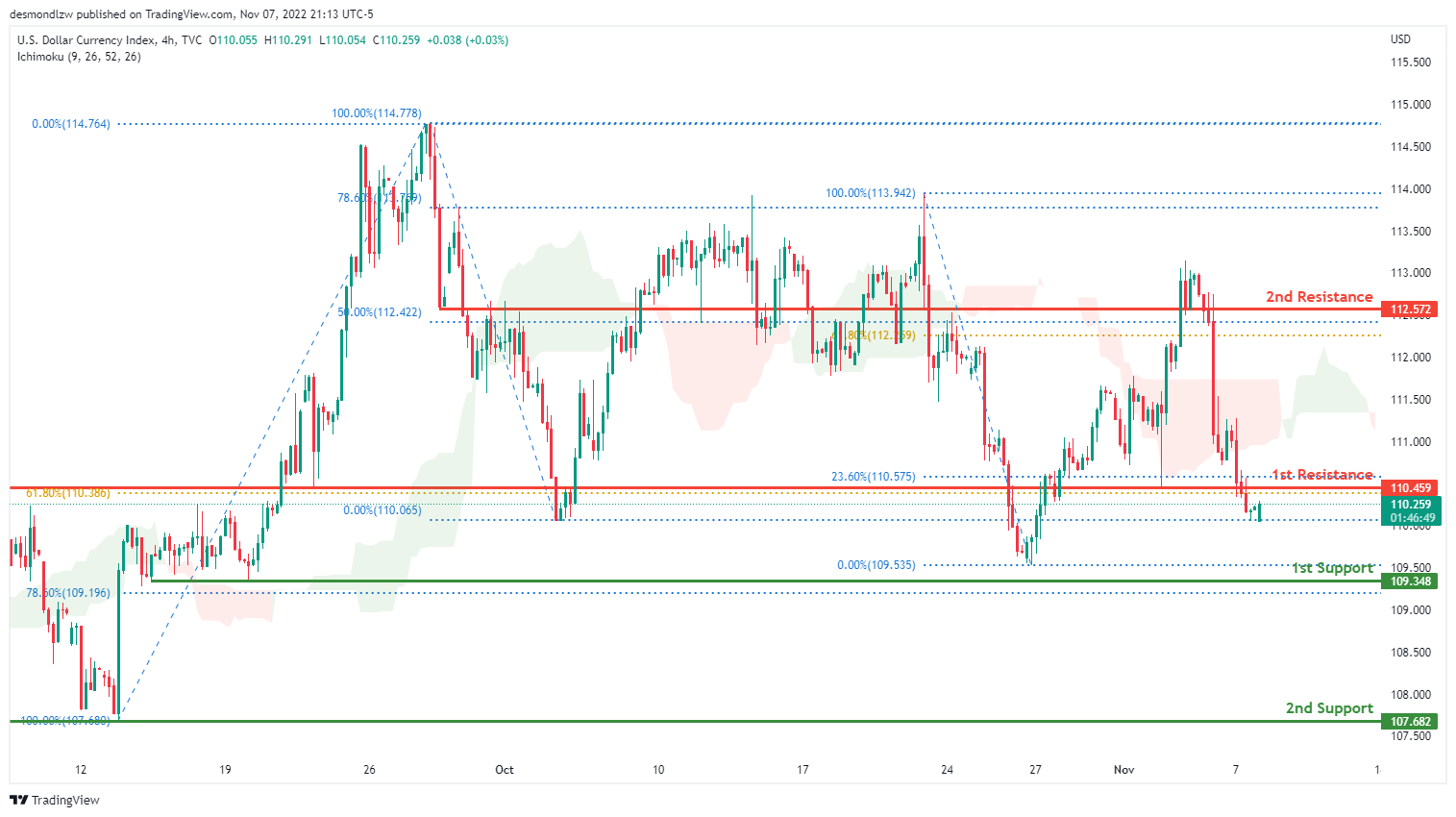
On the H4 chart, the overall bias for DXY is bearish. To add confluence to this, the price is crossing below the Ichimoku cloud which indicates a bearish market. Overnight, price continued its bearish momentum downwards with price closing under the 1st resistance at 110.459 where the 61.8% and 23.6% Fibonacci lines are located. The price is currently trading at 110.258 at the time of writing. If this bearish momentum continues, price could head towards the 1st support line at 109.348 where the 78.6% Fibonacci line and previous low are located. In an alternative scenario, price could head back up to retest the 1st resistance line.
Areas of consideration:
- H4 time frame, 1st resistance at 110.459
- H4 time frame, 1st support at 109.348
EUR/USD:
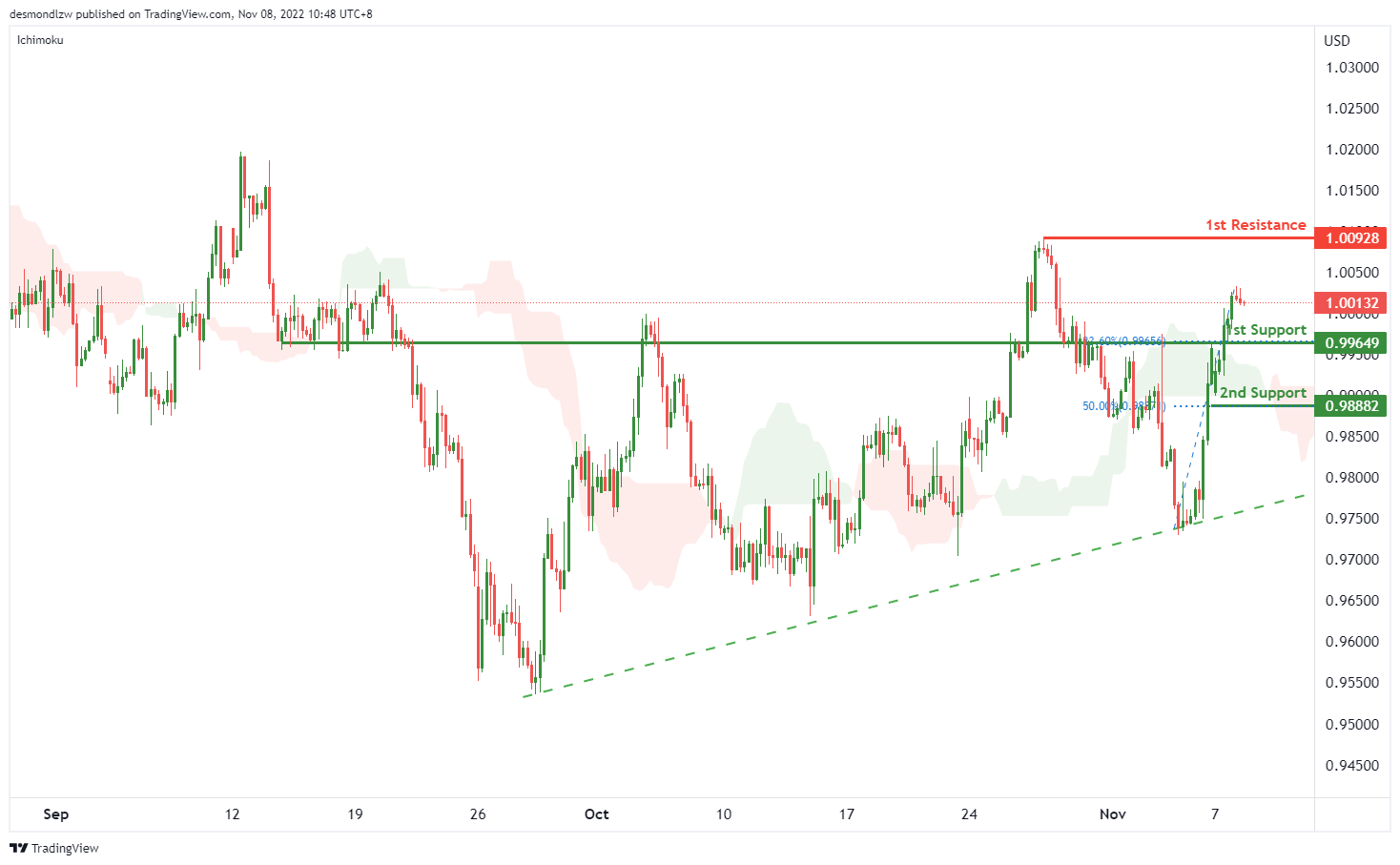
On H4, with the price moving above the ichimoku cloud and ascending trendline, we have a bullish bias that the price may rise from 1st support at 0.99649, which is in line with the 23.6% fibonacci retracement and previous swing lows to the 1st resistance at 1.00928, where the swing high is. Alternatively, the price may drop to the 2nd support at 0.98882, which is in line with the 50% fibonacci retracement .
Areas of consideration :
- H4 1st support at 0.99649
- H4 1st resistance at 1.00928
GBP/USD:
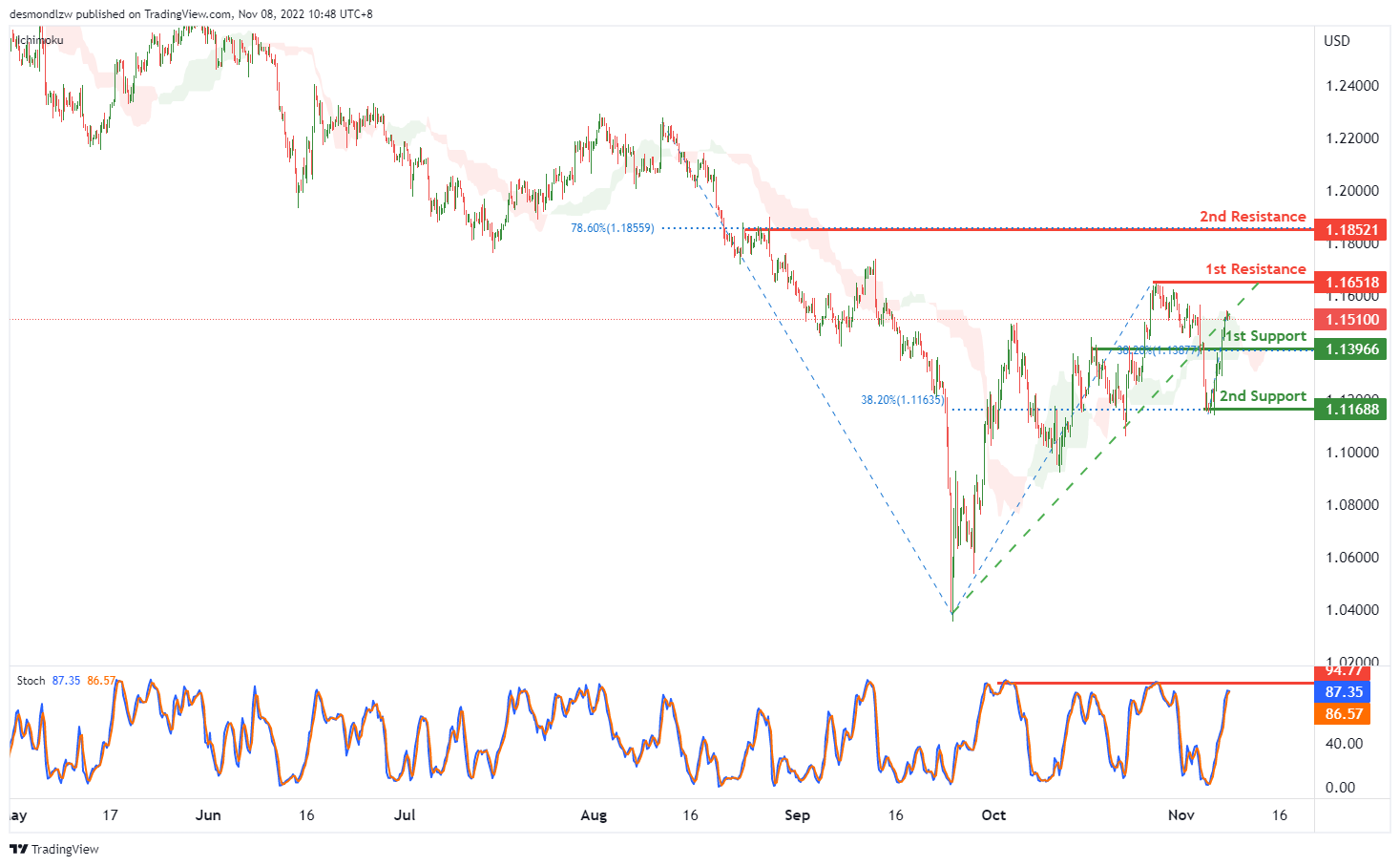
On the H4, price is crossing the ichimoku cloud and rising back to the ascending trendline, we have a bullish bias that the price may rise to test the 1st resistance at 1.16518, which is in line with the previous swing high to the 2nd resistance at 1.18521, where the 78.6% fibonacci retracement is. Alternatively, the price may drop to the 1st support at 1.13966, where the 38.2% fibonacci retracement is, if the 1st support is broken, the 2nd support is at 1.11688, which is in line with the previous swing low and 38.2% fibonacci retracement.
Areas of consideration:
- H4 1st resistance at 1.16518
- H4 2nd resistance at 1.18521
USD/CHF:
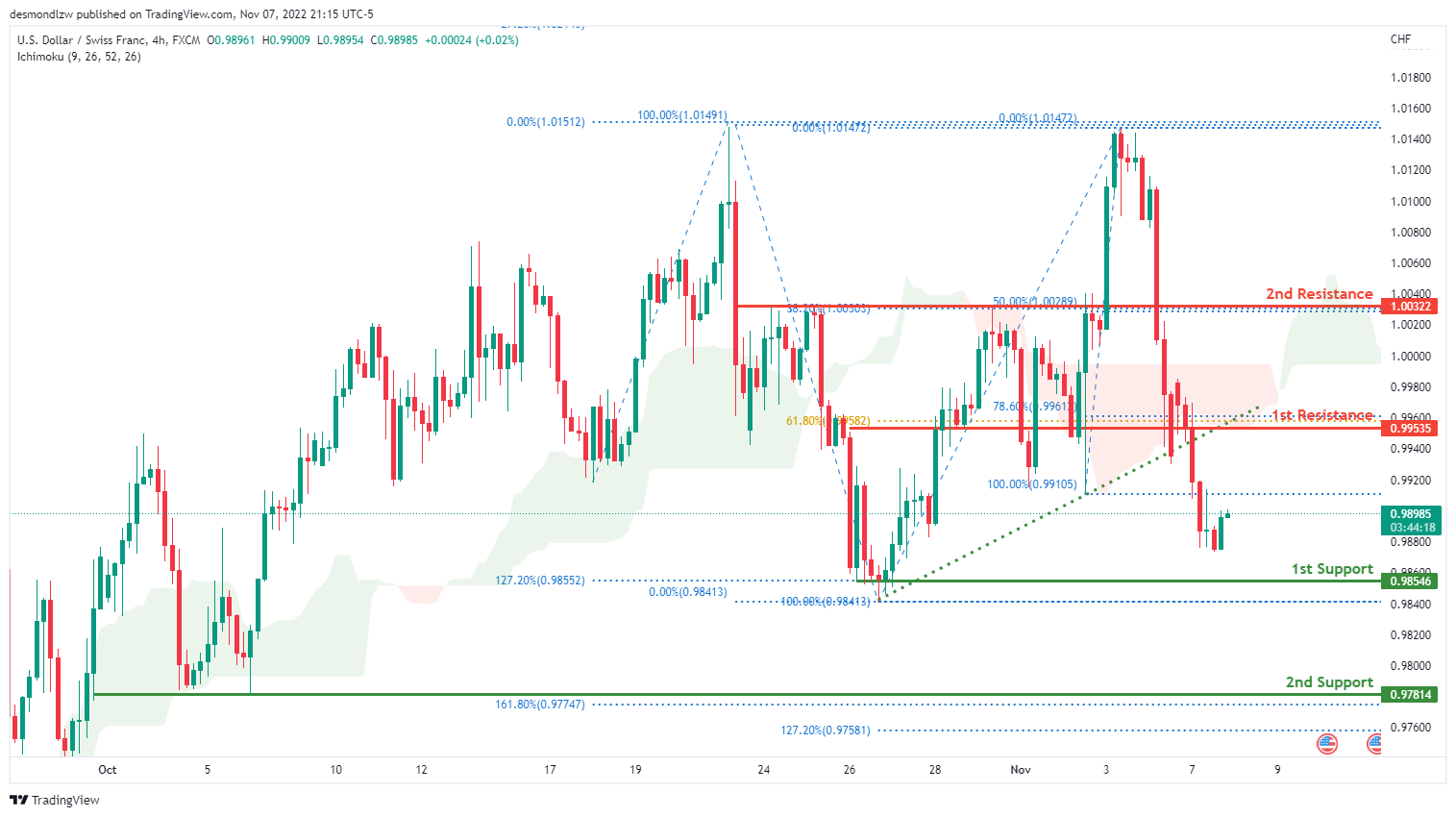
On the H4 chart, the overall bias for USDCHF is bearish. To add confluence to this, the price is below the Ichimoku cloud which indicates a bearish market. Overnight, price continued its bearish momentum downwards with price closing under the 1st resistance line at 0.99535 where the 61.8% and 78.6% Fibonacci lines are located . The price is currently trading at 0.99535 at the time of writing. If this bearish momentum continues, expect price to head towards the 1st support line at 0.98546, where the 127.2% Fibonacci extension line, 100% Fibonacci line and previous swing low are located. In an alternative scenario, price could head back up to retest the 1st resistance line.
Areas of consideration
- H4 1st support at 0.98546
- H4 1st resistance at 0.99535
XAU/USD (GOLD):
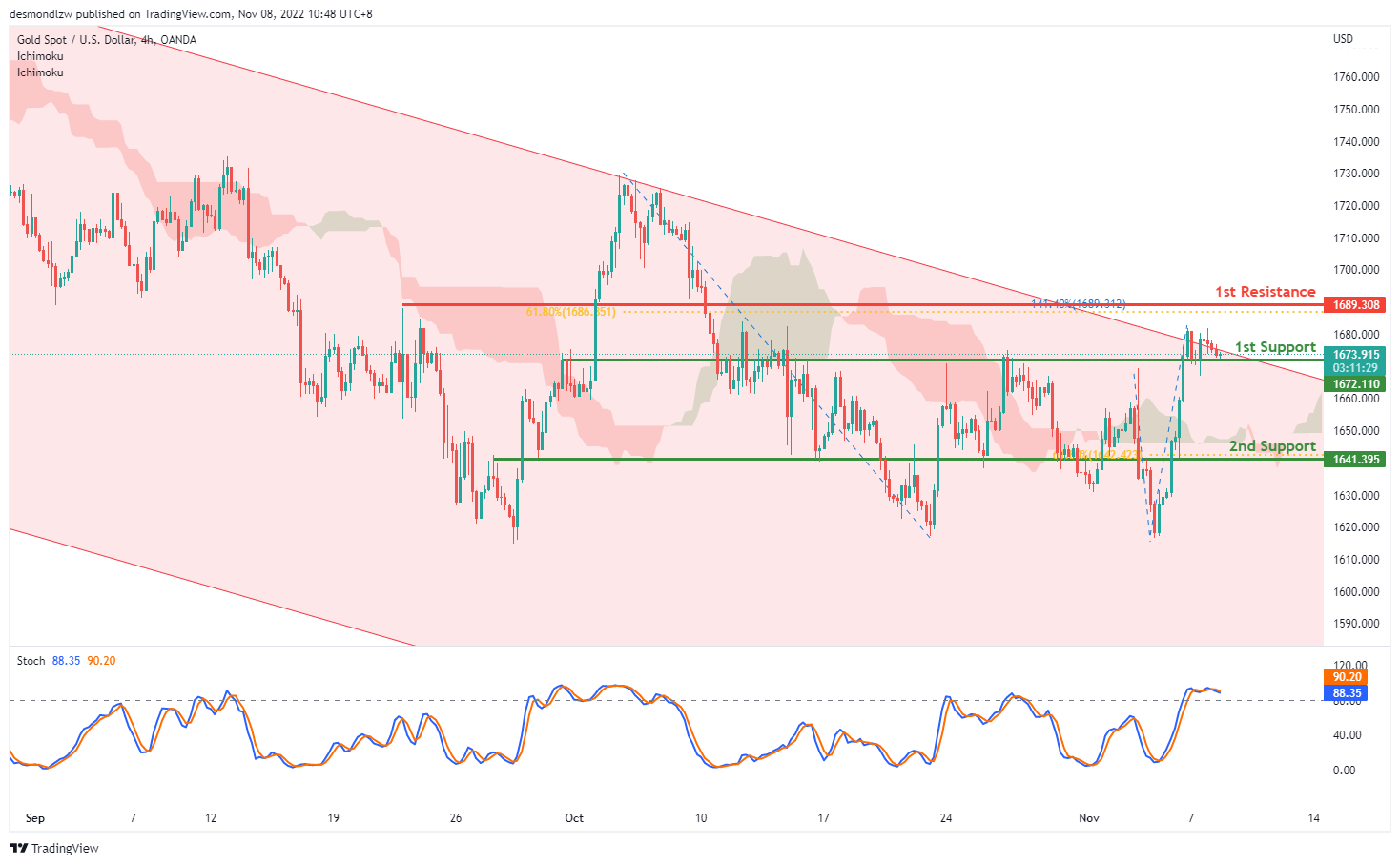
On H4, with the price dropping back to the descending channel and stoch is above 80, showing an overbought signal, we can expect the price to drop from the 1st support at 1672.110, which is in line with the previous swing high to the 2nd support at 1641.395, where the overlap support and 61.8% fibonacci retracement are. Alternatively, the price may rise to the 1st resistance at 1689.308, where the 61.8% fibonacci retracement and 141.4% fibonacci extension sit.
Areas of consideration:
- H4 time frame, 1st support at 1672.110
- H4 time frame, 2nd support at 1641.395
AUD/USD:
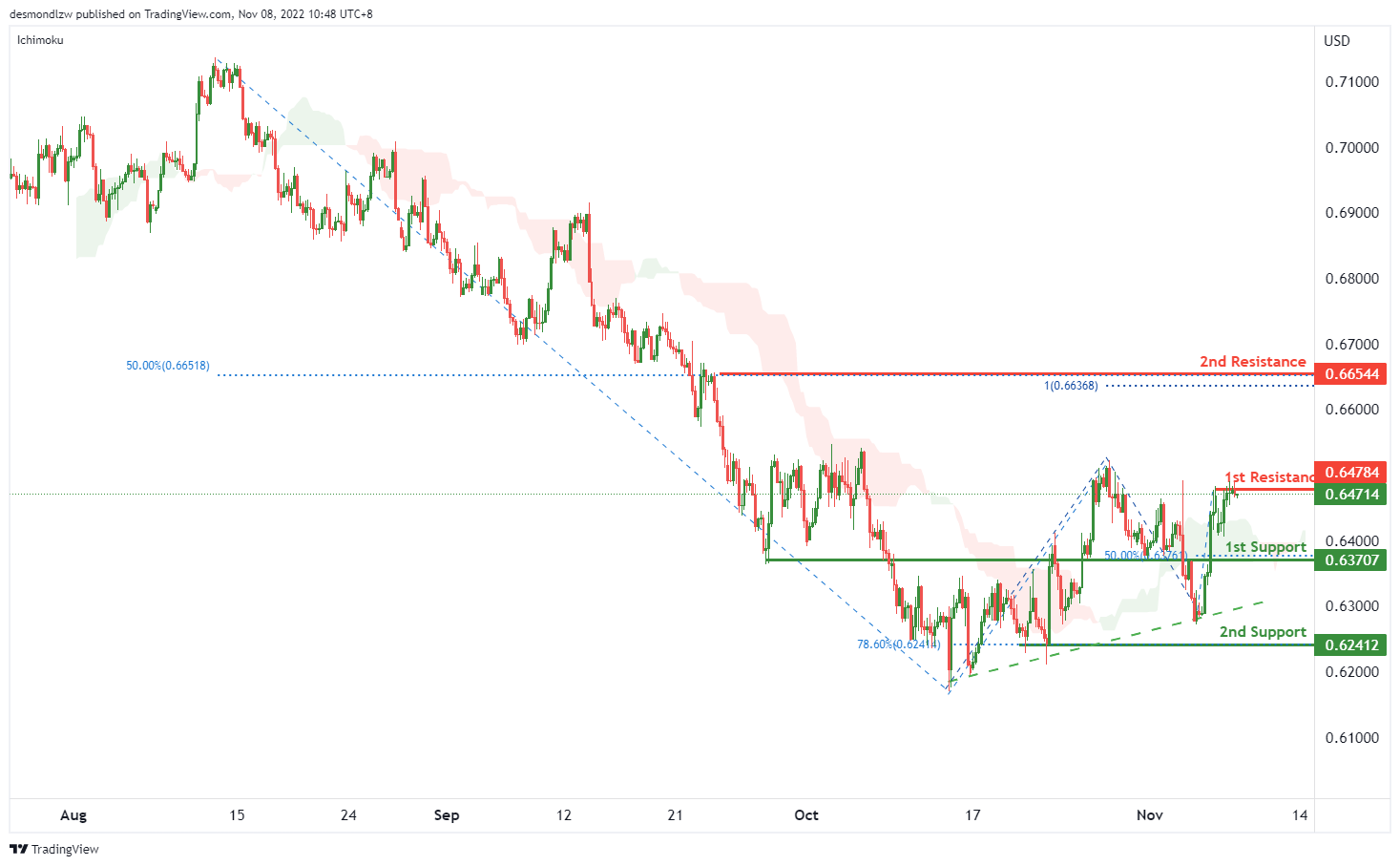
On the H4, with the price crossing the ichimoku cloud and moving above the ascending trendline, we can expect the price to break the 1st resistance at 0.64784, which is in line with the swing high. If the 1st resistance is broken, the 2nd resistance is at 0.66544, where the 100% fibonacci projection and 50% fibonacci retracement are. Alternatively, the price may drop from the 1st resistance to the 1st support at 0.63707, where the 50% fibonacci retracement and previous swing low are. If the 1st support is broken, the 2nd support is at 0.62414, where the 78.6% fibonacci retracement is.
Areas of consideration
- H4, 1st resistance at 0.64784
- H4, 2nd resistance at 0.66544
NZD/USD:
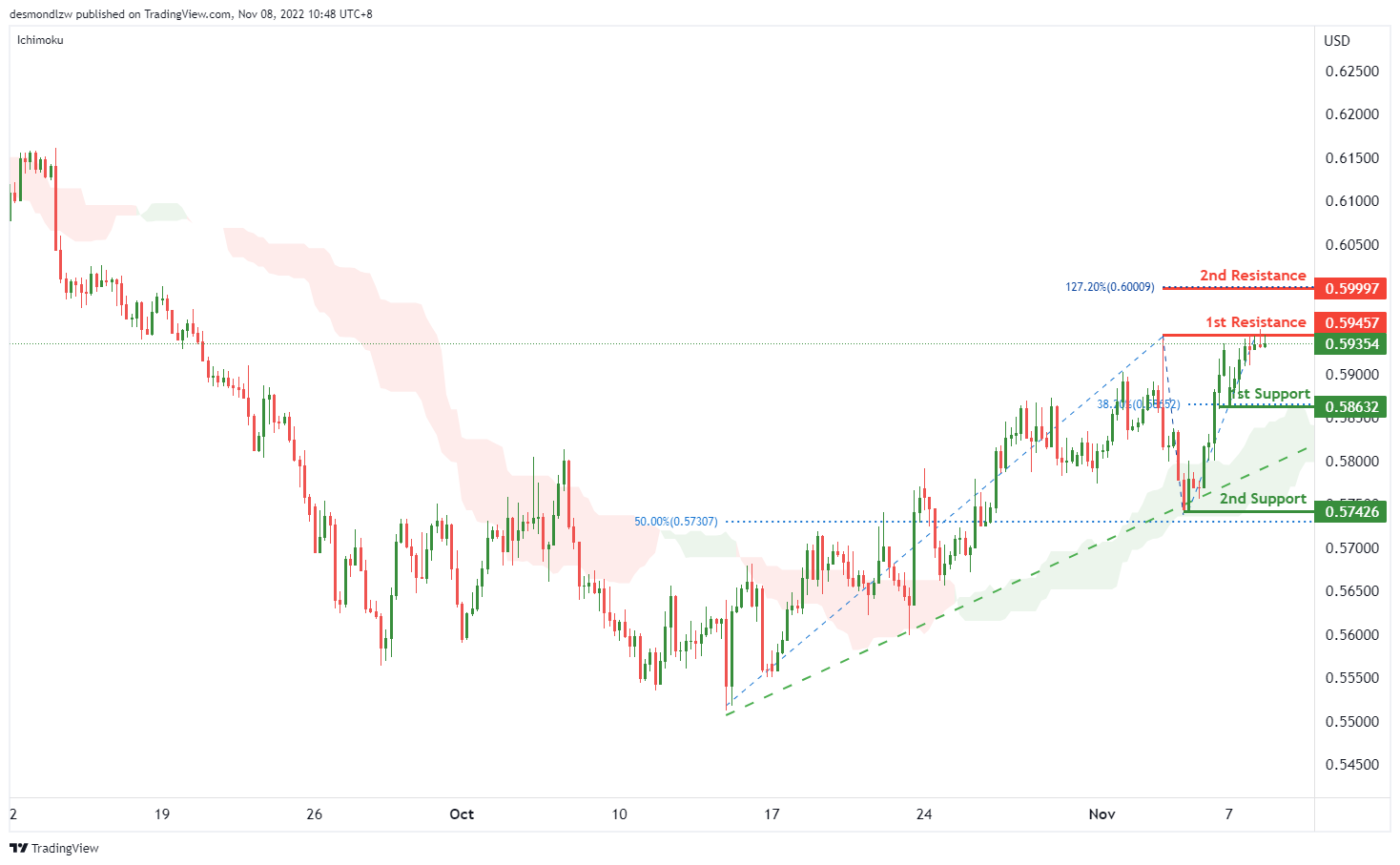
On the H4 chart, as the price is moving above ichimoku cloud and ascending trendline, the price may rise to the 1st resistance at 0.59320, which is in line with the swing highs. If the 1st resistance is broken, the 2nd resistance is at 0.59997, which is in line with the 127.2% fibonacci extension. Alternatively, the price may drop to the 1st support at 0.58632, which is in line with the swing low and 38.2% fibonacci retracement. If the 1st support is broken, the 2nd support is at 0.57426, which is in line with the 50% fibonacci retracement.
Areas of consideration:
- H4 time frame, 1st resistance at 0.59320
- H4 time frame, 2nd resistance at 0.59997
USD/CAD:
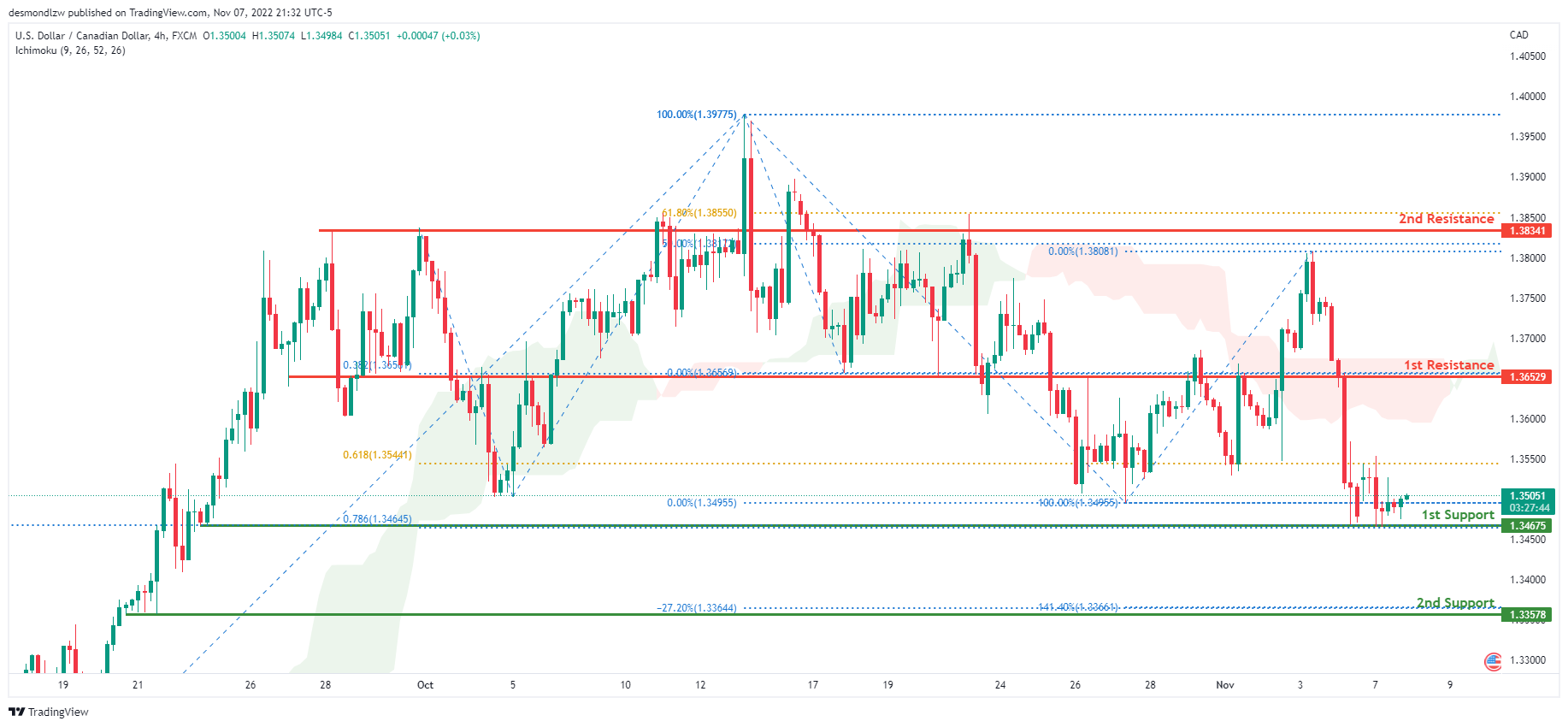
On the H4 chart, the overall bias for USDCAD is bearish. To add confluence to this, the price is below the Ichimoku cloud which indicates a bearish market. Overnight, the price continued to consolidate along the 1st support line. The price is currently trading at 1.35068 at the time of writing. If this bearish momentum continues, expect the price to head back down towards the 1st support line at 1.34675 where the 78.6% Fibonacci projection line and previous low is located. In an alternative scenario, price could head back up towards the 1st resistance line at 1.36529, where the 38.2% Fibonacci projection line is located.
Areas of consideration:
- H4 time frame, 1st resistance at 1.36529
- H4 time frame, 1st support at 1.34675
OIL:
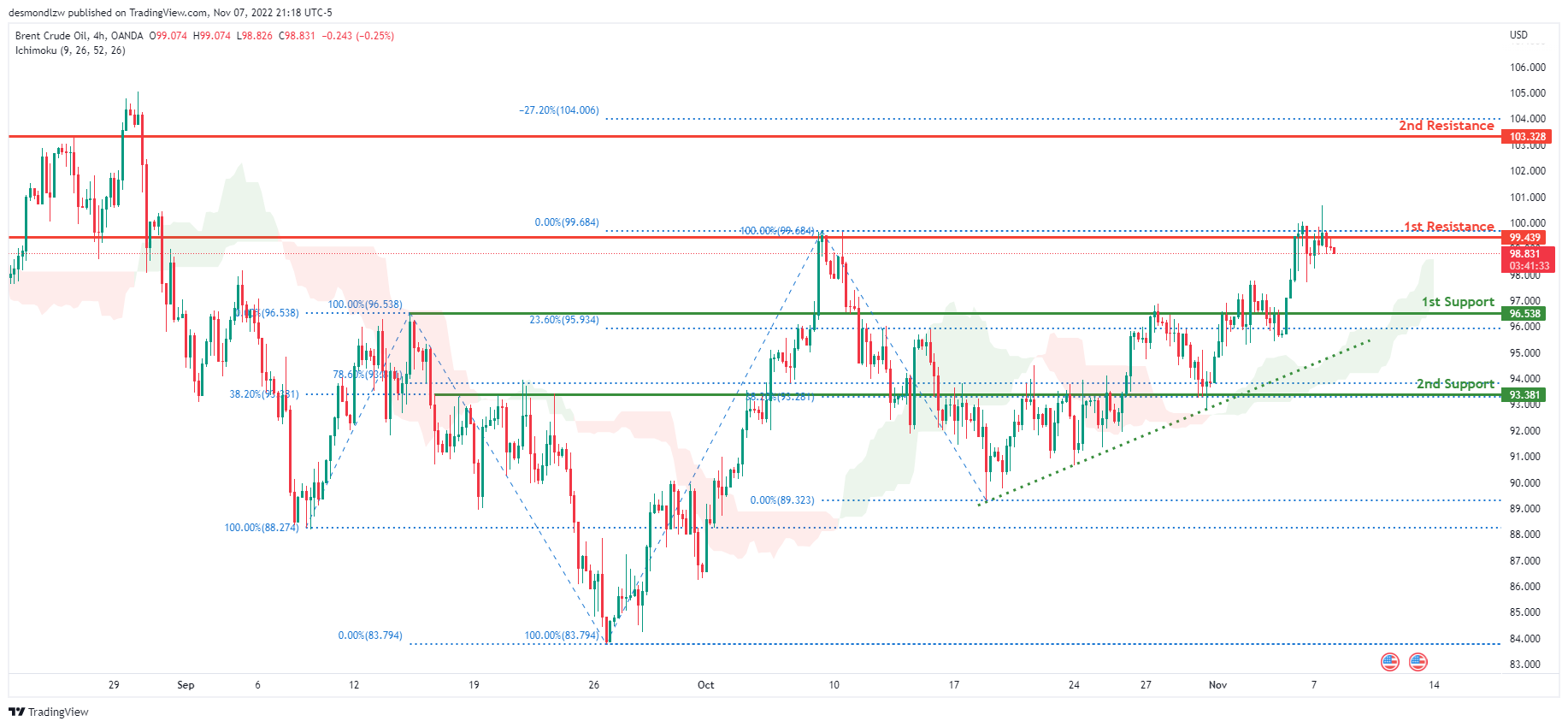
Looking at the H4 chart, the current overall bias for Oil is bullish. To add confluence to this, the price is above the Ichimoku cloud which indicates a bullish market. Overnight, price attempted to break through the 1st resistance line but eventually closed underneath it, continuing the consolidation. The price is currently trading at 98.846 at the time of writing. If this bullish momentum continues, expect price to possibly head back up towards the 1st resistance at 99.439 where previous swing high and 0% Fibonacci line is located. In an alternative scenario, price could head back down to the 1st support level at 96.538 where the 23.6% and 100% Fibonacci lines are located.
Areas of consideration:
- H4 time frame, 1st resistance at 99.439
- H4 time frame, 1st support at 96.538
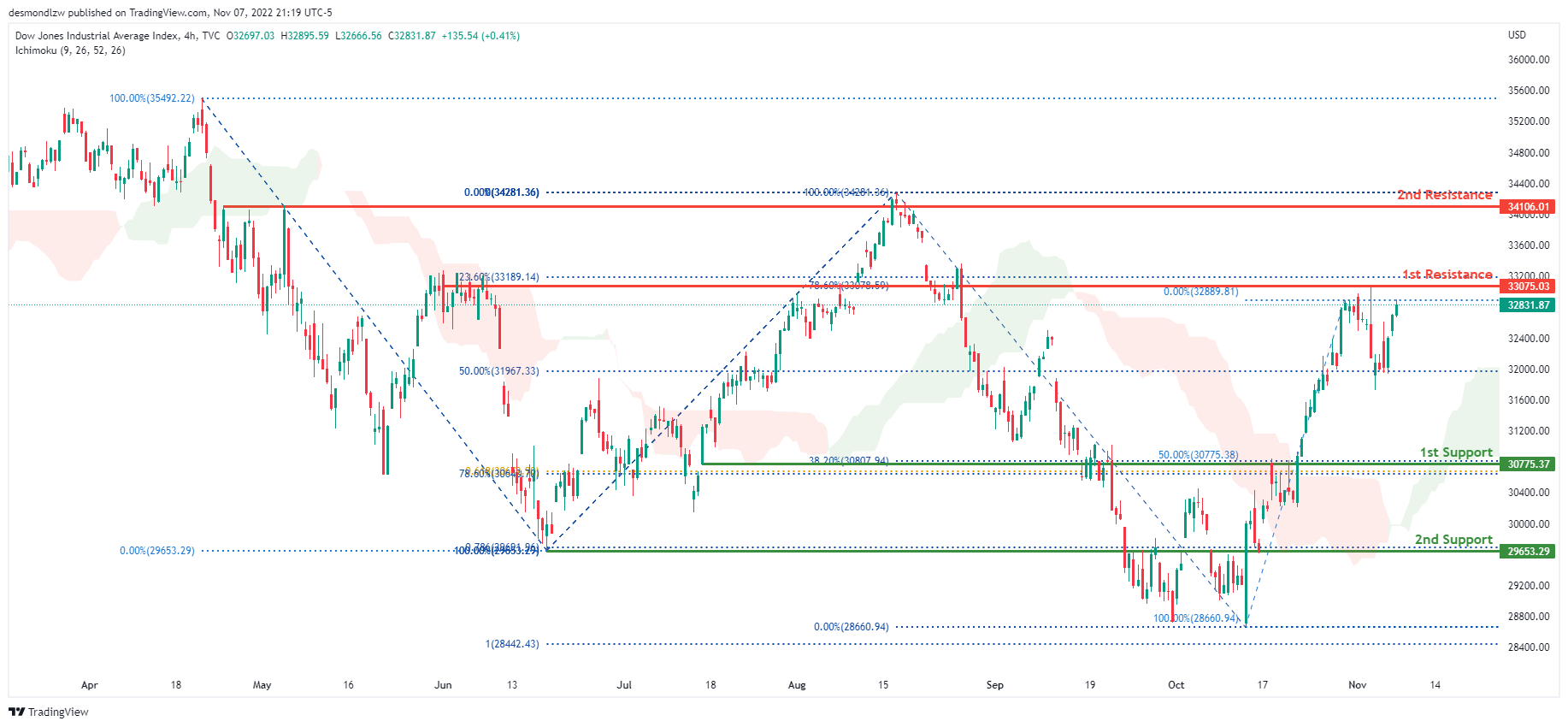
Dow Jones Industrial Average:
On the H4 chart, the overall bias for DJI is bullish. To add confluence to this, the price is above the Ichimoku cloud which indicates a bullish market. Overnight, price continued its bullish momentum upwards. The price is currently trading at 32831.87 at time of writing. If this bullish momentum continues, expect the price to possibly head towards the 1st resistance at 33272.34 where the 23.6% and 78.6% Fibonacci lines are located. In an alternative scenario, price could head towards the 1st support line at 30775.37, where the 38.2% and 50% Fibonacci lines are located.
Areas of consideration:
- H4 time frame, 1st support at 30775.37
- H4 time frame, 1st Resistance at 33272.34
DAX:
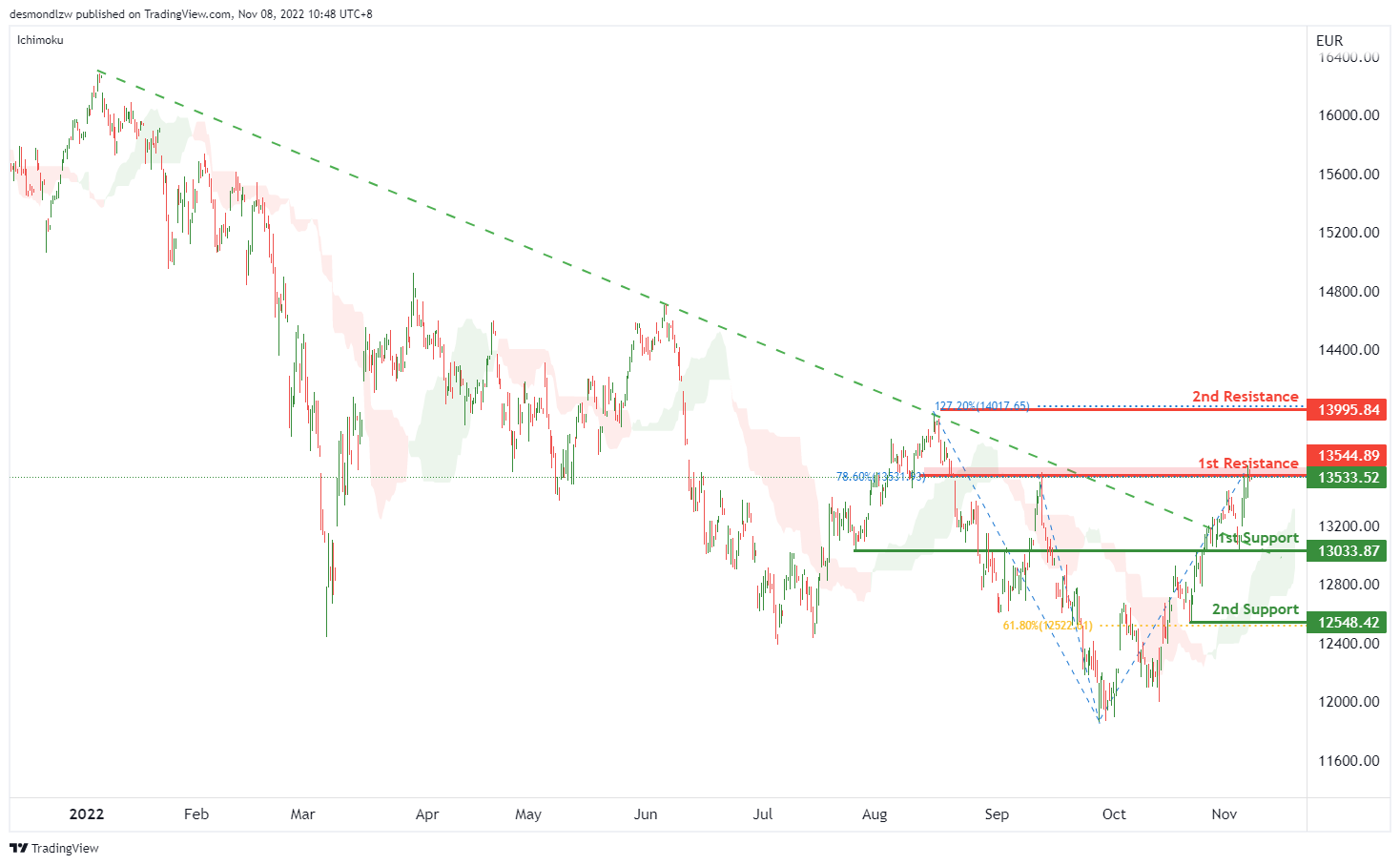
On the H4 chart, the price breaks a descending trendline. Expecting price to possibly continue this bullish momentum and break the 1st resistance at 13544.89, which is in line with the previous swing high and 78.6% fibonacci retracement. If the 1st resistance is broken, the 2nd resistance is at 13995.84, where 127.2% fibonacci extension sits. Alternatively, the price may drop to the 1st support at 13033.87, which is in line with the previous swing low, if the 1st support is broken, the 2nd support is at 12548.42, which is in line with the 61.8% fibonacci retracement.
Areas of consideration:
- H4 time frame, 1st resistance at 13544.89
- H4 time frame, 2nd resistance is at 13995.84
ETHUSD:
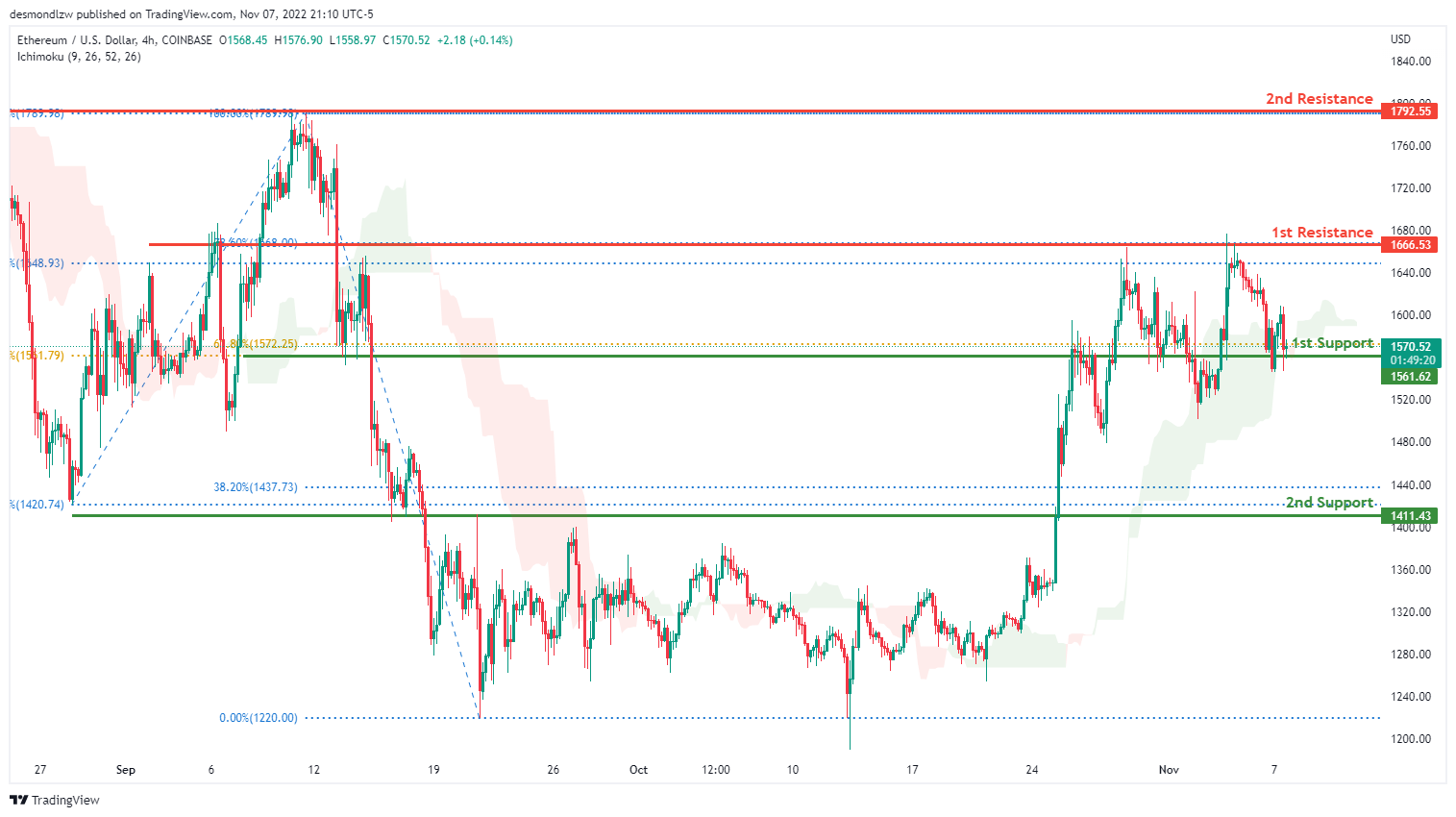
Looking at the H4 chart, the current overall bias for ETHUSD is bullish, with price currently within the green Ichimoku cloud. Overnight, price continued to consolidate along the 1st support line at 1561.62, where 2 of the 61.8% Fibonacci lines are located. The price is currently trading at 1570.63 at the time of writing. If this bullish momentum continues, expect the price to head towards the 1st resistance line at 1666.53, where the 78.6% and 38.2% Fibonacci lines are located. In an alternative scenario, price could break the 1st support line and head towards the 2nd support line at 1411.43, where the 38.2% and 100% Fibonacci lines are located.
Areas of consideration:
- H4 time frame, 1st resistance of 1666.53
- H4 time frame, 1st support at 1561.62
- H4 time frame, 2nd support at 1411.43
BTCUSD:
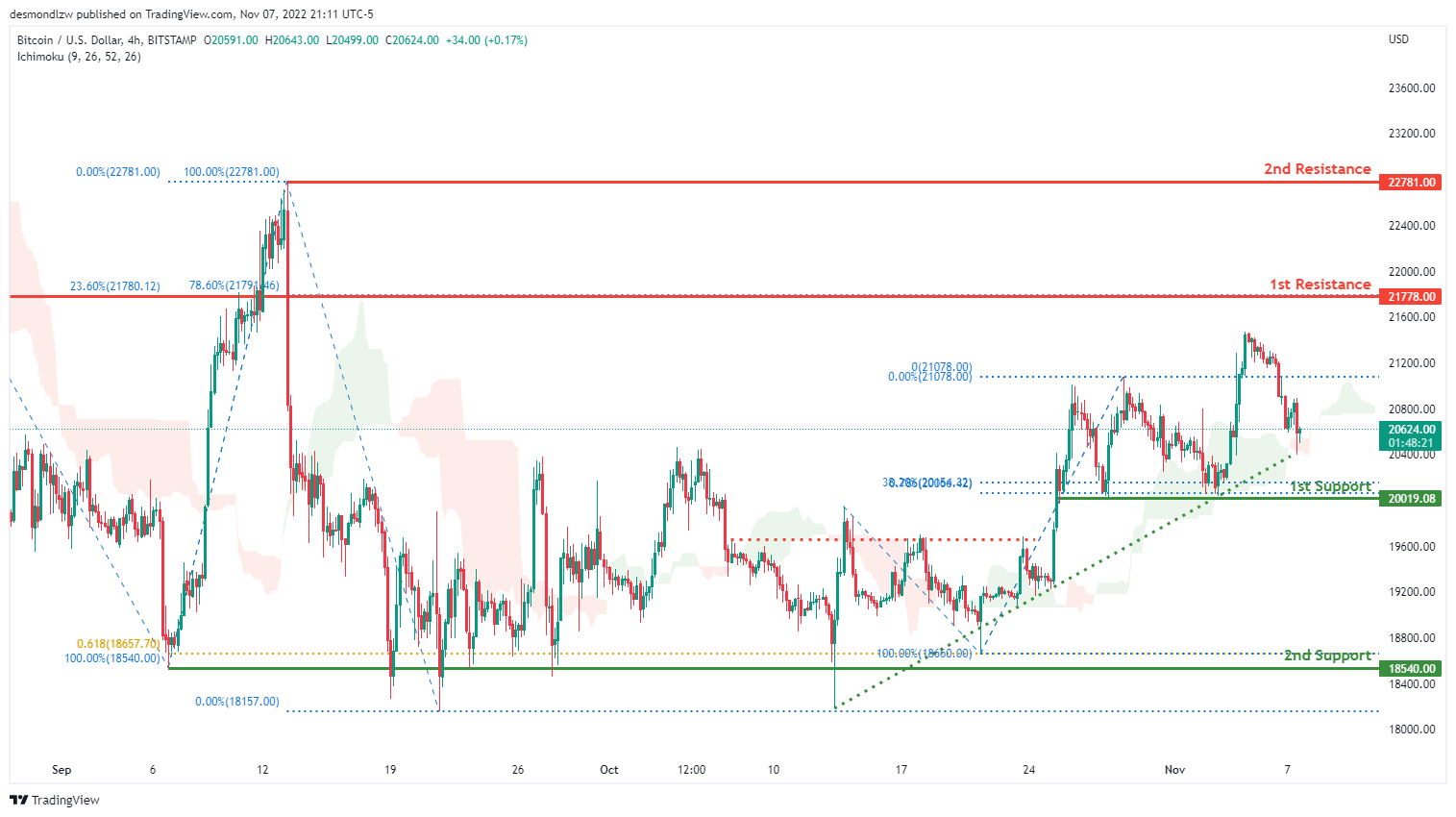
On the H4 chart, the overall bias for BTCUSD is bullish. To add confluence to this, the price is above the Ichimoku cloud which indicates a bullish market. Overnight, price continued its downwards bearish retracement towards the 1st support line. Price is currently trading at 20628.00 at time of writing. If this bullish momentum continues, expect the price to head towards the 1st resistance line at 21788.00 where the 78.6% and 23.6% Fibonacci lines are located. In an alternative scenario, price could continue its bearish retracement and head towards the 1st support line at 20019.08, where the 38.2% Fibonacci line and 78.6% Fibonacci projection line is located.
Areas of consideration:
- H4 time frame, 1st resistance 21778.00
- H4 time frame, 1st support at 20019.08
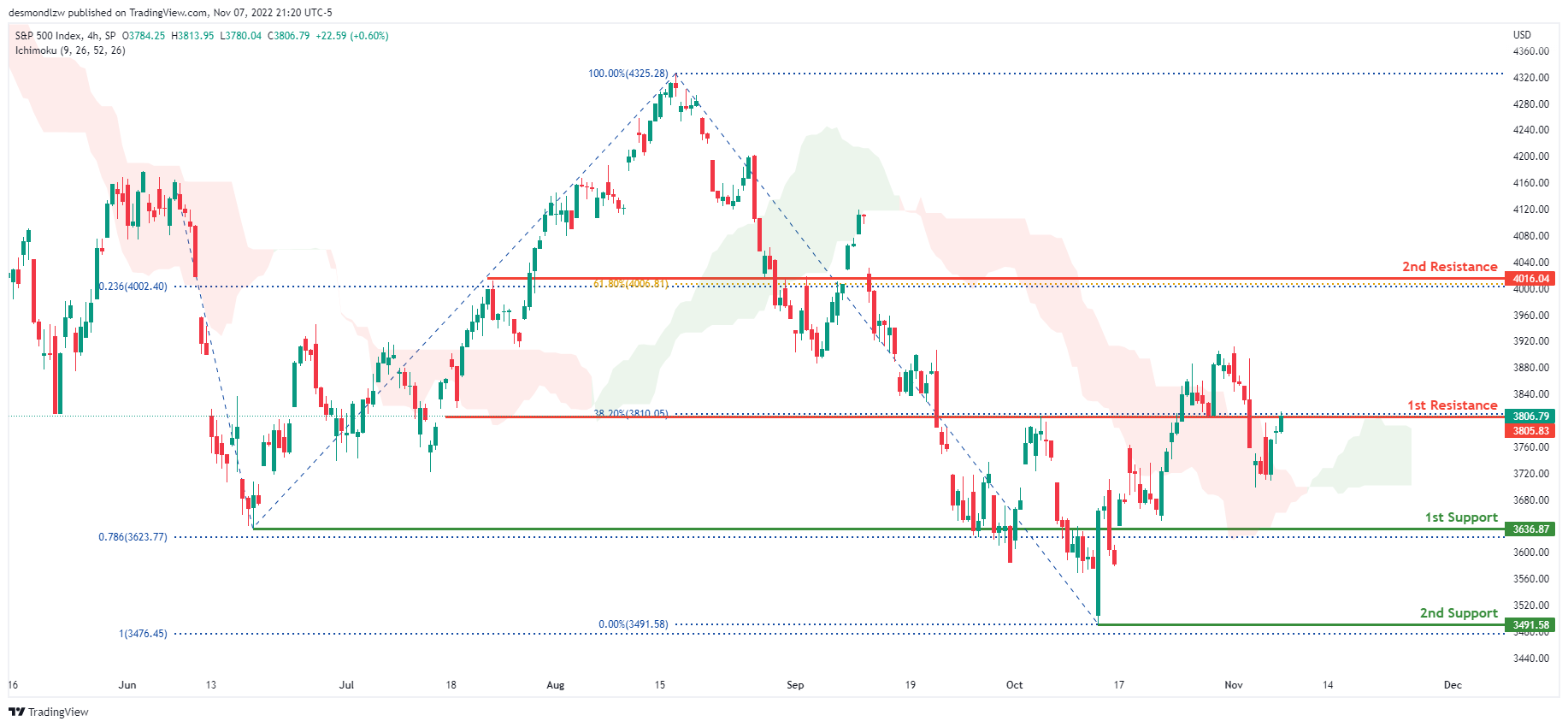
S&P 500:
On the H4 chart, the overall bias for S&P500 is bullish with price currently crossing above the Ichimoku cloud. Overnight, price had bullish momentum with the price closing under the 1st resistance at 3805.83 where the 38.2% Fibonacci line is located. The price is currently trading at 3805.83 at time of writing. If bullish momentum continues, expect price to price could break the 1st resistance line and head towards the 2nd resistance line at 4016.04, where the 23.6% Fibonacci projection line and 61.8% Fibonacci line is located. In an alternative scenario, price could possibly head towards the 1st support at 3636.87 where the previous swing low and 78.6% Fibonacci projection line is located.
Areas of consideration:
- H4 time frame, 1st support at 3636.87
- H4 time frame, 1st resistance at 3805.83
- H4 time frame, 2nd resistance at 4016.04