

Sample Category Title
EUR/JPY Weekly Outlook
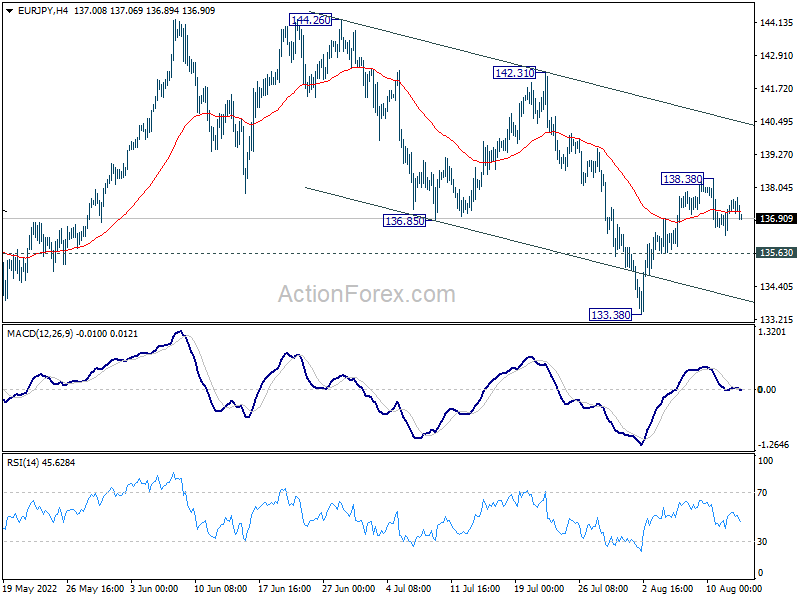
EUR/JPY's rebound from 133.38 extended to 138.38 last week but retreated since then. Initial bias is neutral this week first. On the upside, break of 138.38, and sustained trading above 55 day EMA (now at 138.29) will suggest that whole correction from 144.26 has completed. Further rally would then be seen back to retest 144.26 high. However, break of 135.63 will turn bias back to the downside for 133.38 low instead.
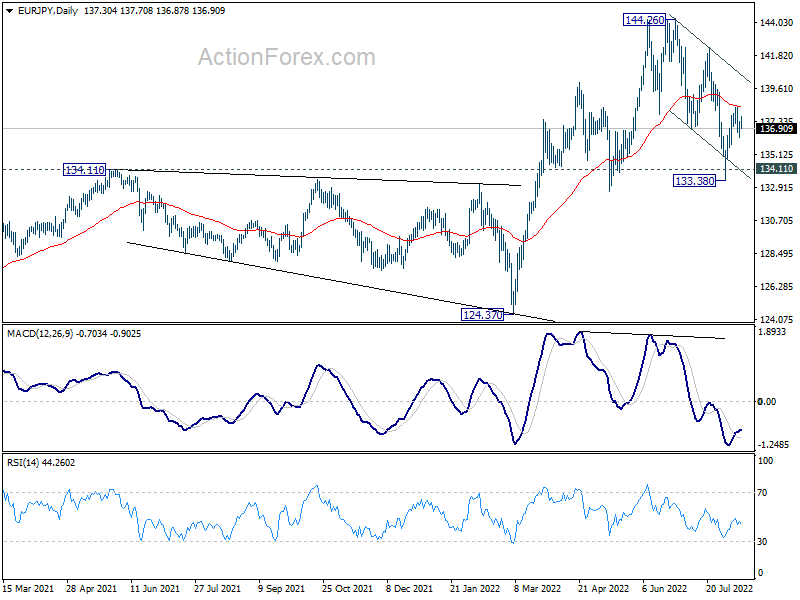
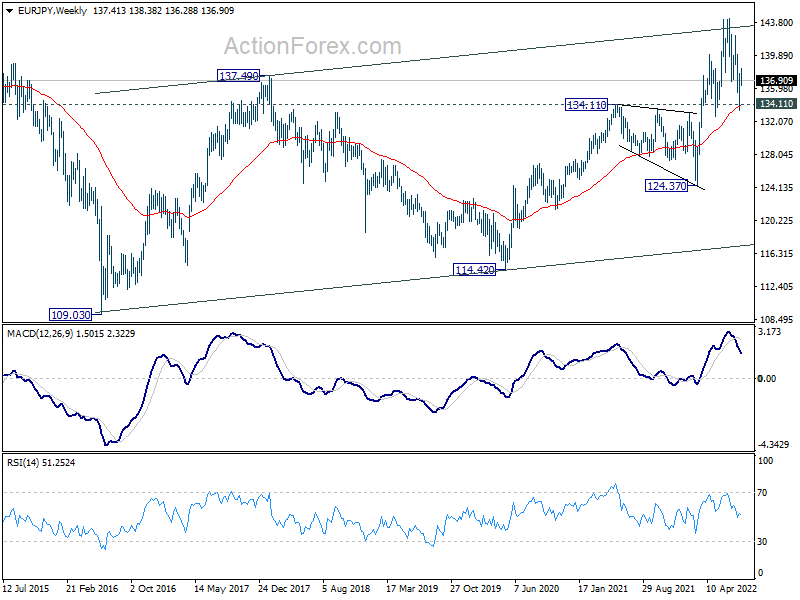
In the bigger picture, up trend from 114.42 (2020 low) is seen as the third leg of the pattern from 109.30 (2016 low). Further rally is in favor as long as 134.11 resistance turned support holds, even in case of deep pull back. Next target is 149.76 (2015 high). However, sustained break of 134.11 will be a sign of medium term bearish reversal and turn focus to 124.37 support for confirmation.
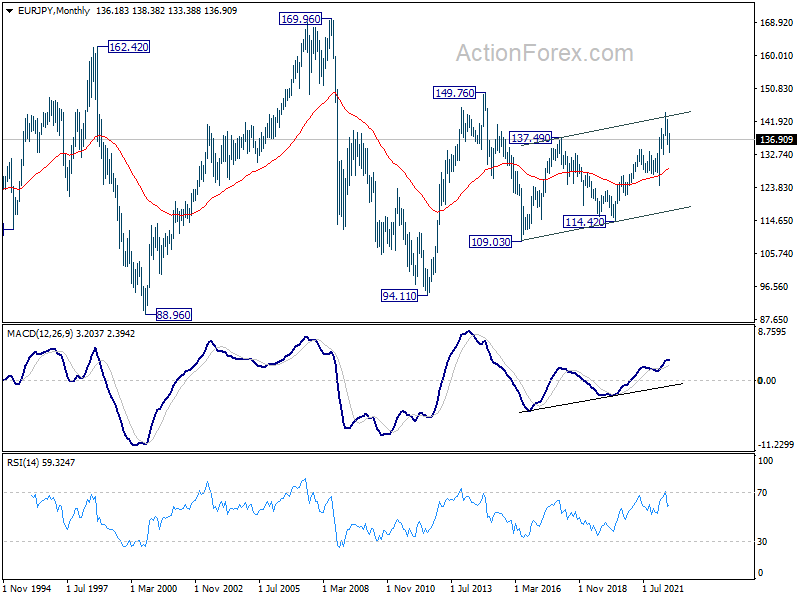
In the long term picture, up trend from 94.11 (2012 low) is seen as in the third leg. Further rally would be seen to 149.76 resistance (2014 high) and above. This will remain the favored case as long as 55 month EMA (now at 128.86) holds.
EUR/GBP Weekly Outlook
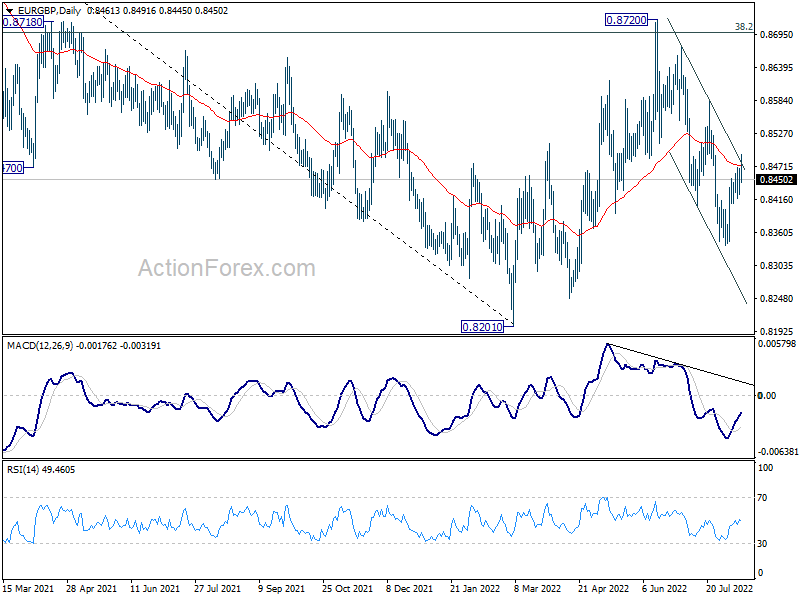
EUR/GBP's rebound from 0.8338 extended higher last week but outlook is unchanged. Fall from 0.8720 is still expected to resume as long as 0.8585 resistance holds. Firm break of 0.8338 support will target a retest on 0.8201 low.
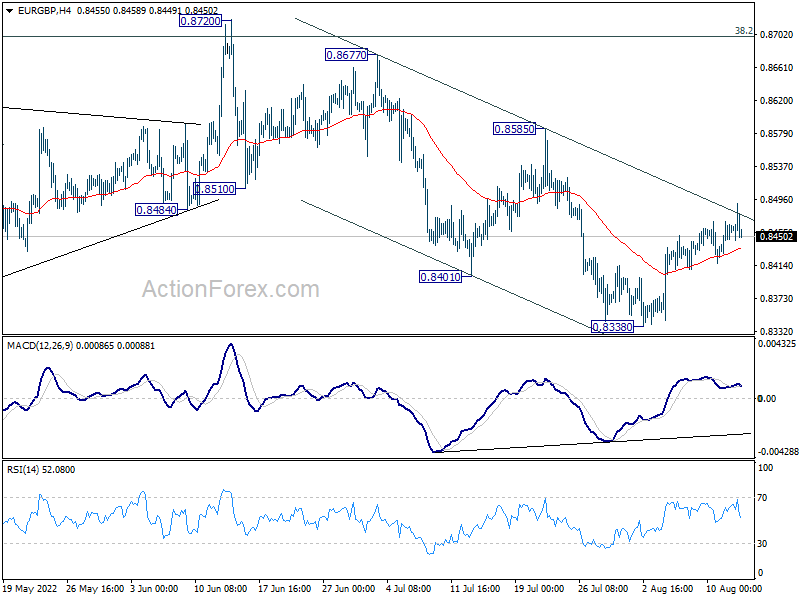
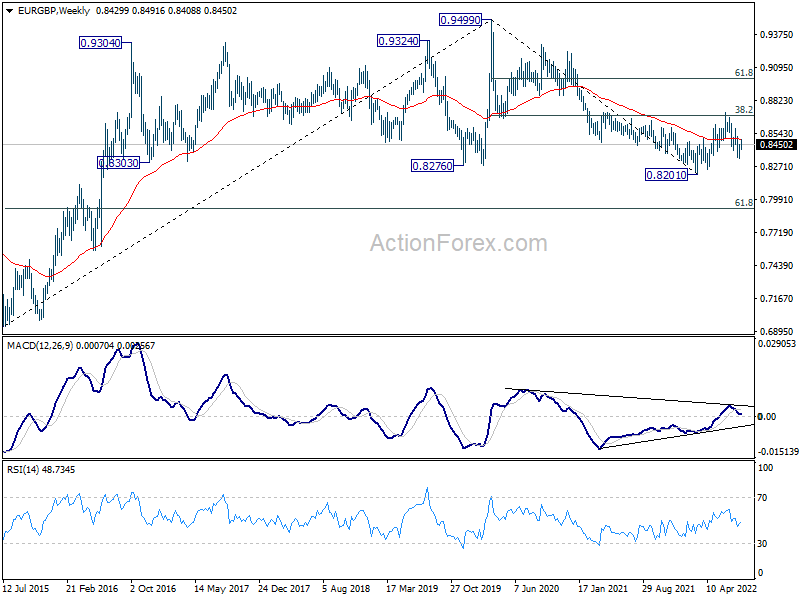
In the bigger picture, current development suggests rejection by 38.2% retracement of 0.9499 to 0.8201 at 0.8697. Medium term bearishness is maintained. Break of 0.8201 will resume larger down trend from 0.9499 (2020 high). Nevertheless, sustained break of 0.8697 will affirm the case that rise from 0.8201 is a medium term up trend itself.
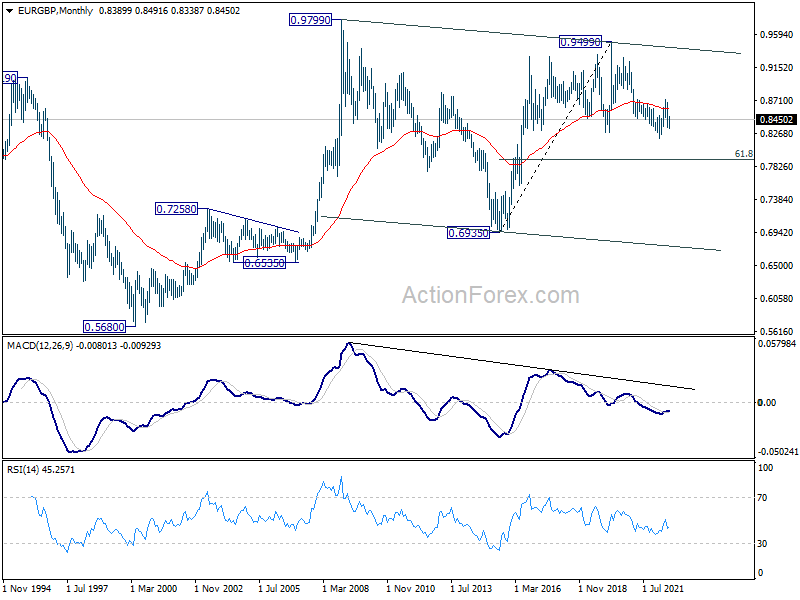
In the long term picture, the lack of medium term downside momentum suggests that fall from 0.9499 (2020 high) is merely a correction to rise from 0.6935 (2015 high). In case of another fall, downside should be contained by 61.8% retracement of 0.6935 to 0.9499 at 0.7917 to bring rebound. Sustained trading above 55 month EMA (now at 0.8591) will indicate that the correction has completed and bring retest of 0.9499.
EUR/AUD Weekly Outlook
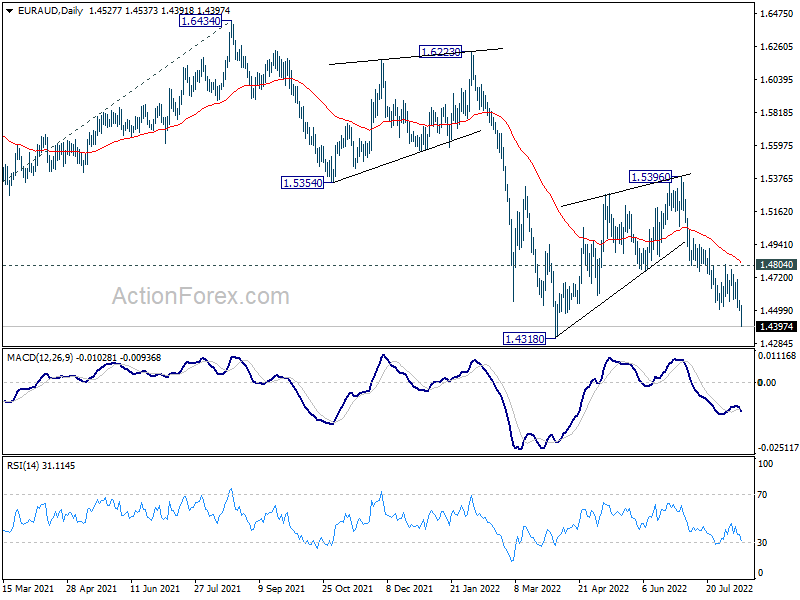
EUR/AUD's fall from 1.5396 resumed last week and hit as low as 1.4391. Initial bias stays on the downside this week for 1.4318 support. Firm break there will resume larger down trend to medium term projection level at 1.3623. On the upside, break of 1.4804 resistance is needed to indicate short term bottoming. Otherwise, risk will stay on the downside in case of recovery.
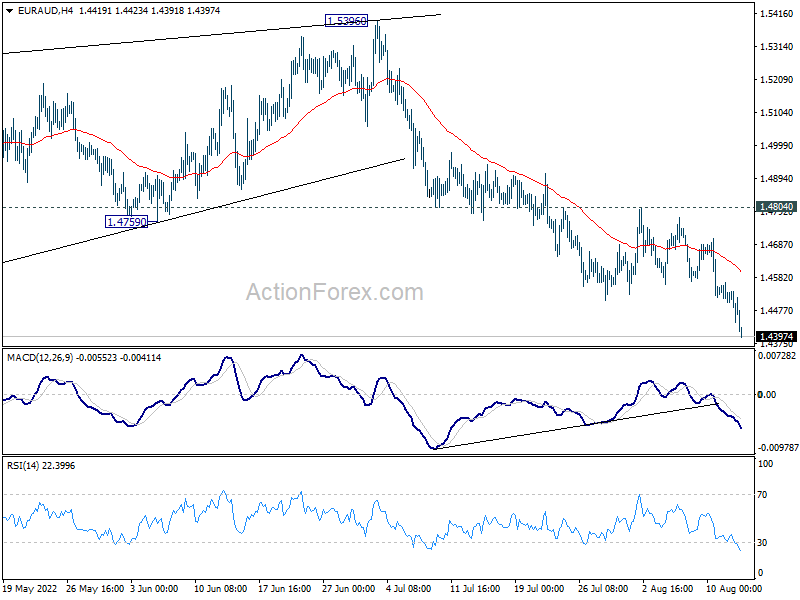
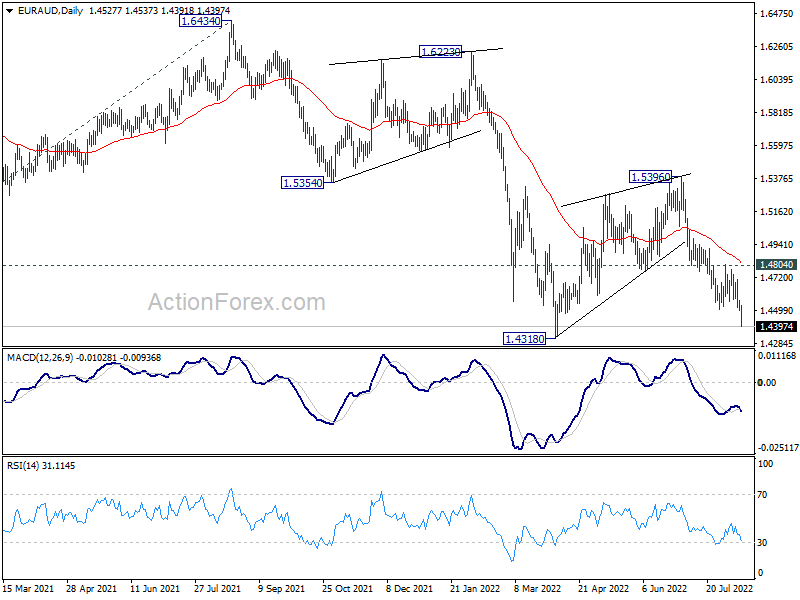
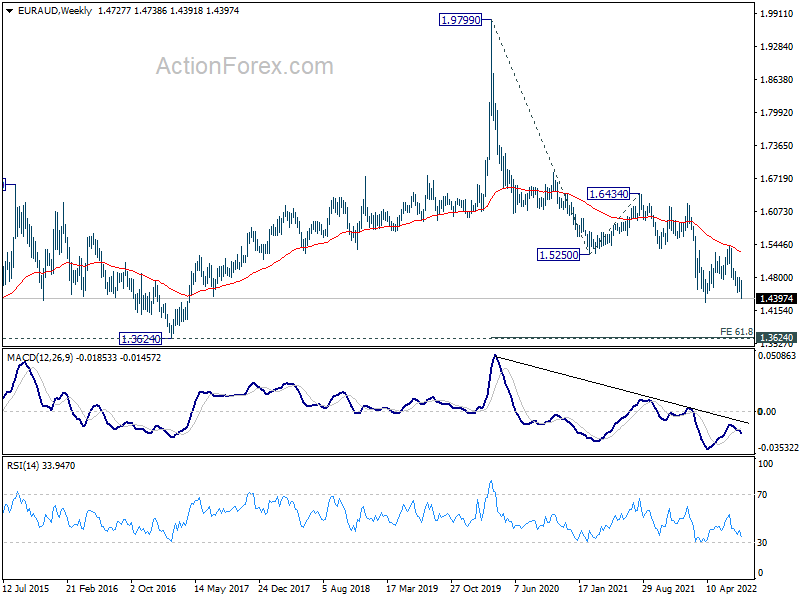
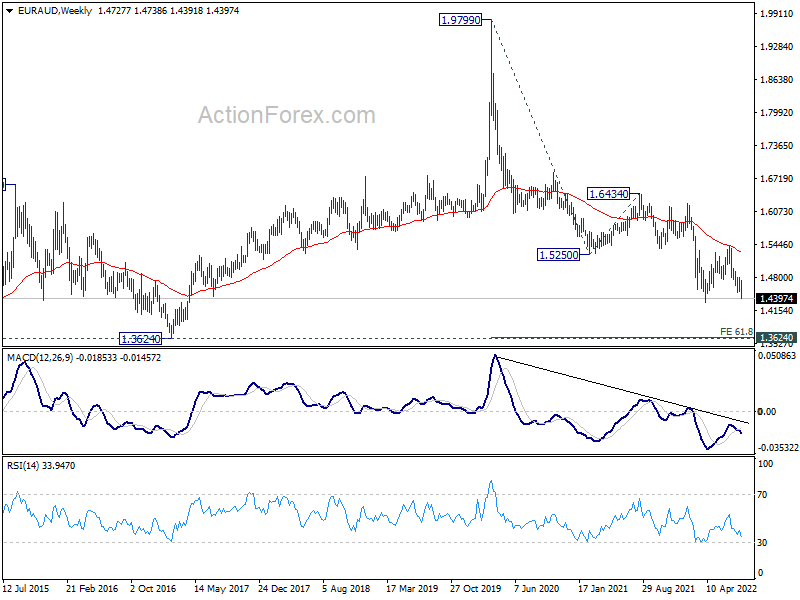
In the bigger picture, down trend from 1.9799 is still in progress. Break of 1.4318 low will target 61.8% projection of 1.9799 to 1.5250 from 1.6434 at 1.3623, which is close to 1.3624 long term support (2017 low). This will remain the favored case now as long as 1.5396 resistance holds.
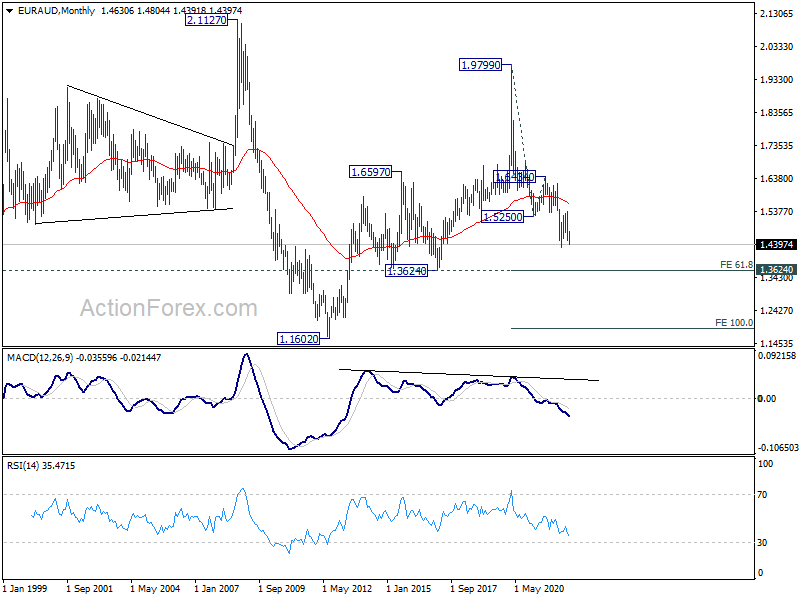
In the longer term picture, fall from 1.9799 (2020 high) is seen as the third leg of the pattern from 2.1127 (2008 high). Deeper fall should be seen to 1.3624 support. Decisive break there would pave the way back to 1.1602 (2012 low). This will remain the favored case as long as 55 month EMA (now at 1.5656) holds.
EUR/CHF Weekly Outlook
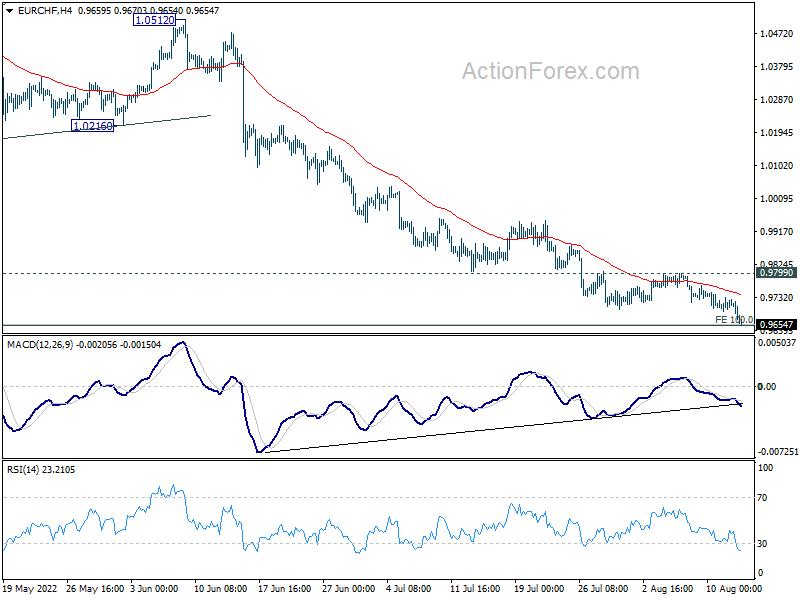
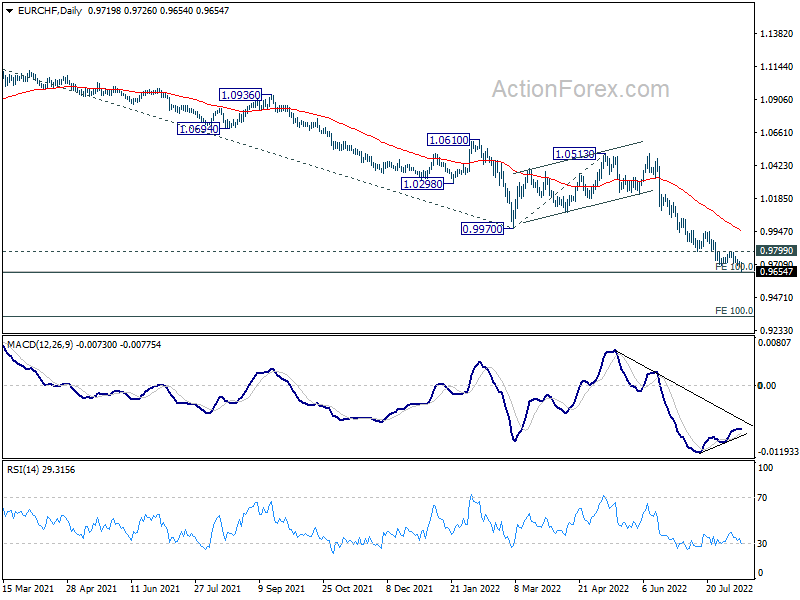
EUR/CHF's down trend resumed last week and hit as low as 0.9654. With 4 hour MACD breaking its trend line, downside momentum might be increasing. Firm break of 0.9650 long term projection level will target 100% projection of 1.1149 to 0.9970 from 1.0513 at 0.9334. Meanwhile, rebound from current level, followed by break of 0.9799 resistance should confirm short term bottoming.
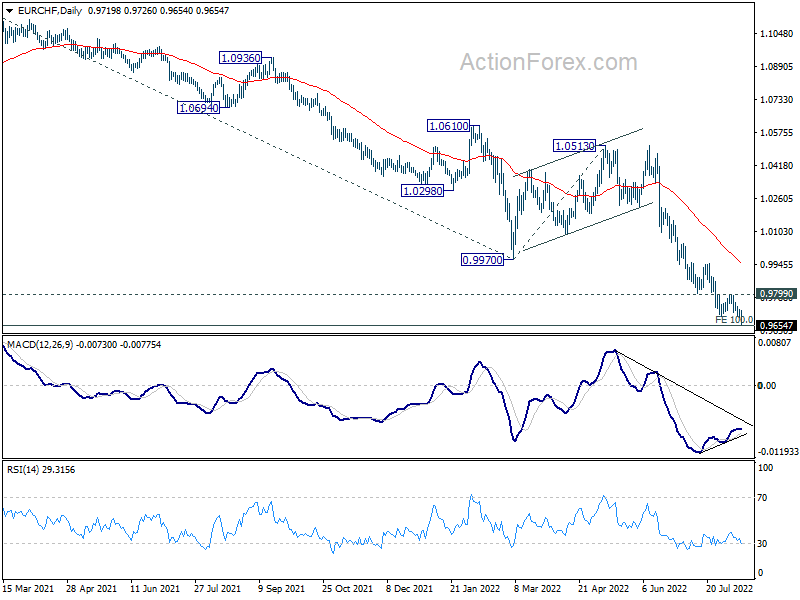
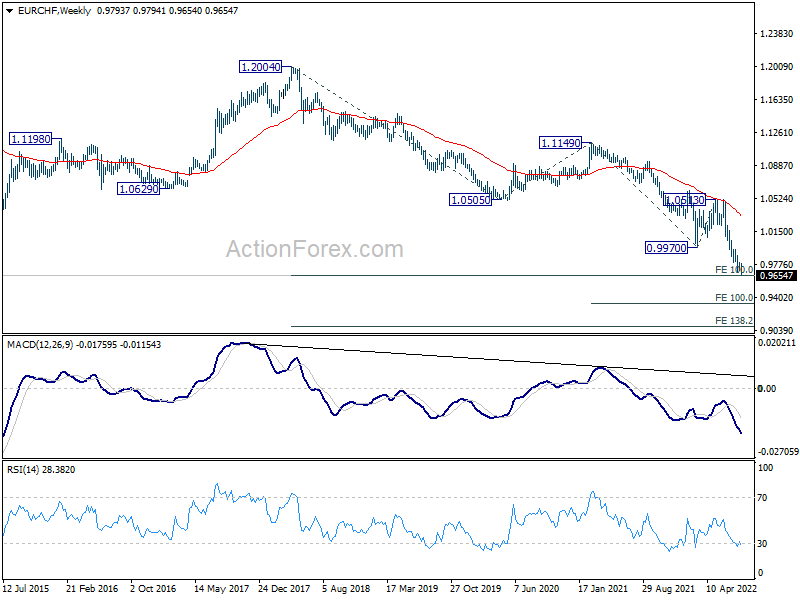
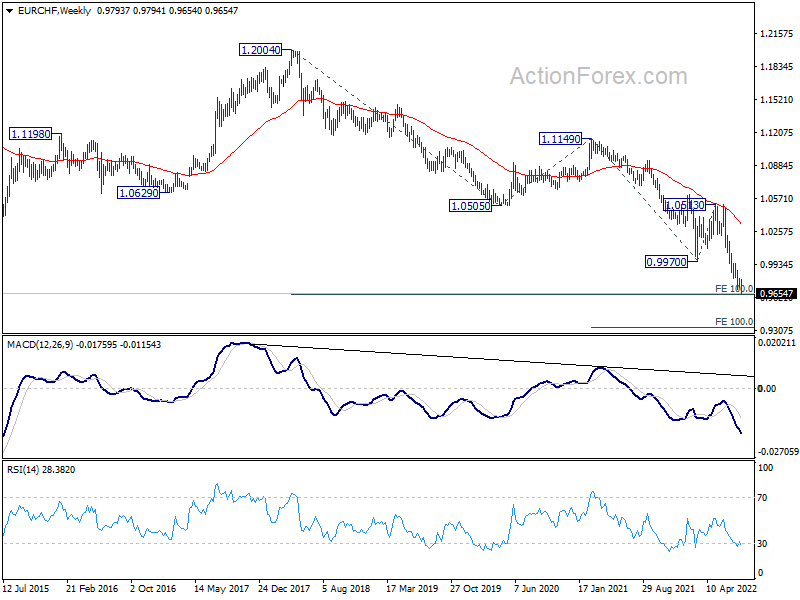
In the bigger picture, long term down trend from 1.2004 (2018 high) is still in progress. Sustained break of 100% projection of 1.2004 to 1.0505 to 1.1149 at 0.9650 will target 138.2% projection at 0.9033 next. On the upside, break of 0.9970 support turned resistance is needed to be the first sign of medium term bottoming. Otherwise, outlook will stay bearish in case of strong rebound.
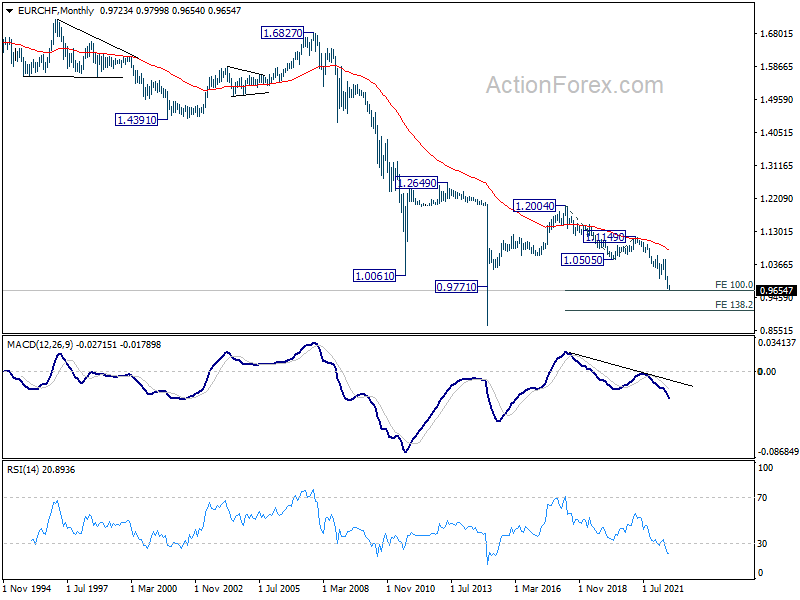
In the long term picture, capped below 55 month EMA, EUR/CHF is seen as extending the multi-decade down trend. There is no prospect of a bullish reversal until firm break of 1.0505 support (2020 low).
Downside Breakouts in Euro and Sterling Crosses to Overshadow Dollar Volatility
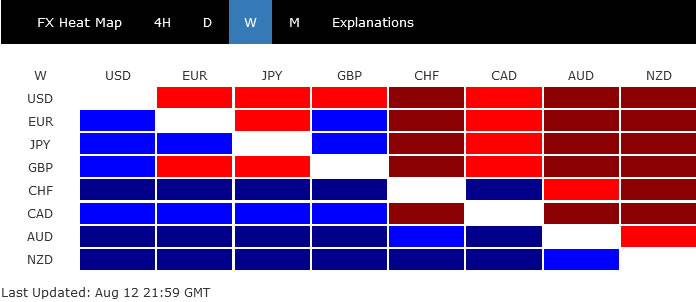
Expectations on the size of next Fed rate hike shifted again last week, with stocks cheering lower than expected consumer inflation reading in the US. Dollar ended as the worst performer but it did have a late come back following rebound in benchmark treasury yields. Indeed, it was the late selloff in Sterling and Euro, the second and third last, that worth more attention.
Meanwhile, return of risk-on sentiment lifted commodity currencies with New Zealand and Australian Dollars being the best performer. Swiss Franc was the third with help from buying against other European majors.
Looking ahead, countering forces could keep Dollar going nowhere in general. The downside breakout in Sterling and Euro in crosses could take a front seat for the near term at least.
Stocks firm, yield resilient, Dollar going nowhere
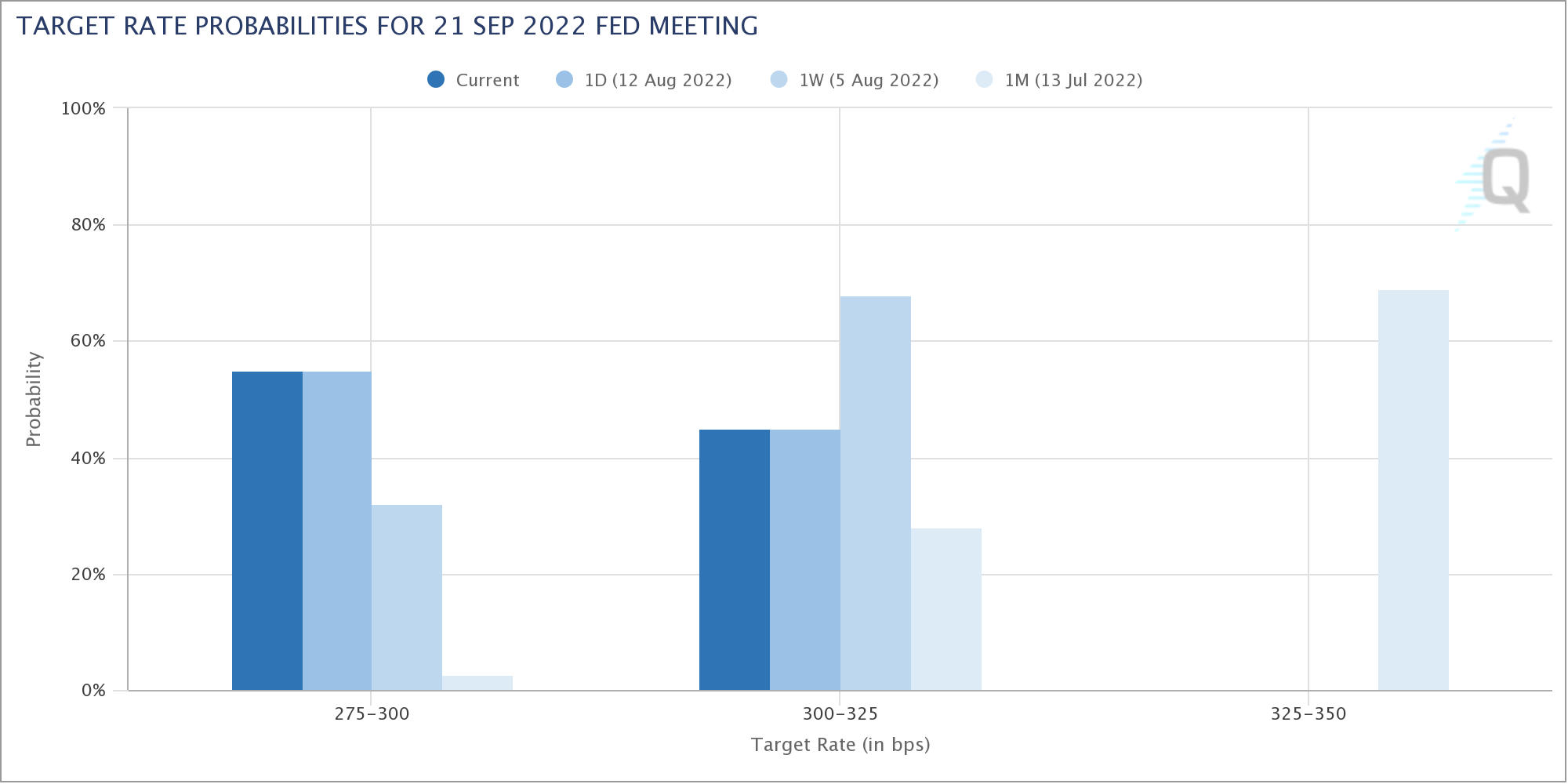
Investors pared back bet on a 75bps rate hike by Fed in September, after lower than expected CPI reading last week, which indicated that inflation might have finally peaked. Fed fund futures are pricing in only 45% chance of 75bps hike, down from 68% a week ago. Instead, there is 55% chance of just a 50bps hike, up from 32% a week ago.
Nevertheless, it should be noted that before September FOMC meeting, there will be one more set of non-farm payroll and CPI data. Thus, it's still too early to conclude anything for that meeting. Sentiment could still flip-flop once more.
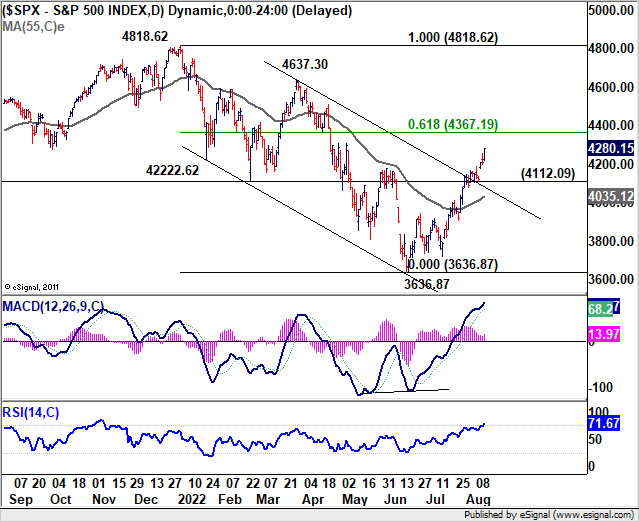
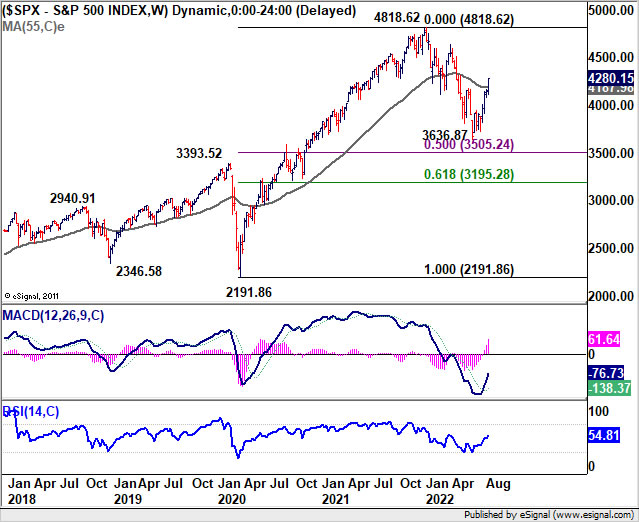
The development gave risk sentiment a lift as major US stock indexes ended the week notably higher. S&P 500's close above 55 week EMA was a bullish sign. That added to the case that correction from 4818.62 has completed completed with three waves down to 3636.87 already. Further rally is now expected as long as 4112.09 support holds. Next target is 61.8% retracement of 4818.62 to 3636.87 at 4367.19. Sustained break there should pave the way to 4637.30/4818.62 resistance zone later in the year. Such development would cap Dollar's rally attempt, in particular against commodity currencies.
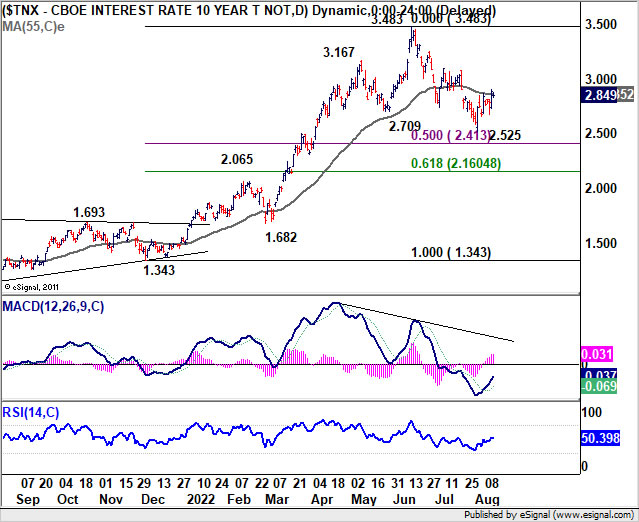
While US 10-year yield dipped initially last week, it managed to rebound quickly to close the week slightly higher at 2.849. There is no change in the view that the first leg of the consolidation pattern from 3.483 has completed at 2.525. TNX is now in the second leg of the consolidation. Sustained trading above 55 day EMA (now at 2.860), will pave the way back to 3.000 handle and above. Such development will give Dollar some support in case, and keep Yen's rebound capped.
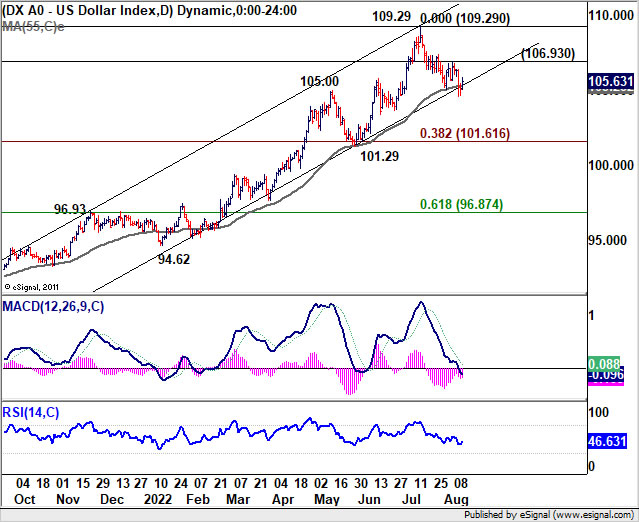
Dollar index extended the correction from 109.29 to 104.63, but quickly recovered. DXY is still holding on to 55 day EMA (now at 105.28) and medium term channel support. Outlook isn't bearish for now, as DXY is still seen as engaging in a near term correction pattern. This is inline with the above views that risk-on sentiment will cap Dollar's rally while resilience in yield will limit downside. That is, Dollar is going nowhere overall.
However, sustained trading below 55 day EMA would mean that DXY is in a medium term corrective pattern that would extend to 101.29 cluster support (38.2% retracement of 89.20 to 109.29 at 101.61).
Downside breakout in some Euro and Sterling crosses
The selloffs in Euro and Sterling were more apparent, in particular against Swiss Franc and Aussie. EUR/CHF's down trend resumed last week and hit as low as 0.9654. It doesn't look like long term projection level 0.9650 will provide enough support for a rebound. And, in any case, outlook will stay bearish as long as 0.9799 resistance holds. Sustained break of 0.9650 will target 100% projection of 1.1149 to 0.9970 from 1.0513 at 0.9334.
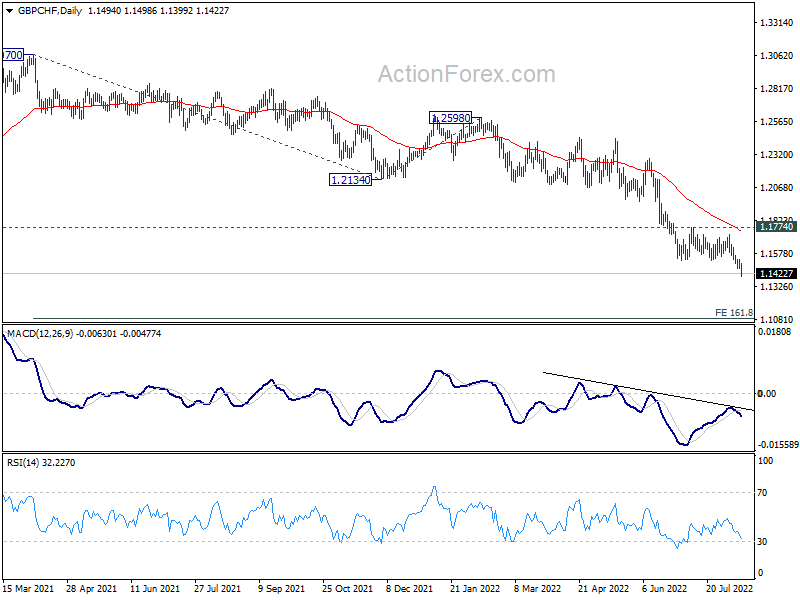
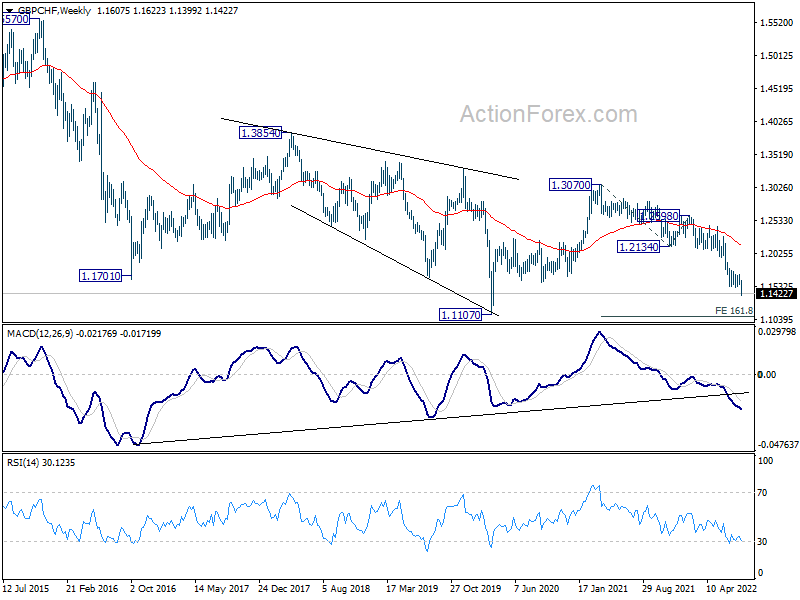
GBP/CHF has also resumed the long term down trend and hit as low as 1.1399. Outlook will stay bearish as long as 1.1774 resistance holds. Next target is 161.8% projection of 1.3070 to 1.2134 from 1.2598 at 1.1084, which is close to 1.1107 (2020 low).
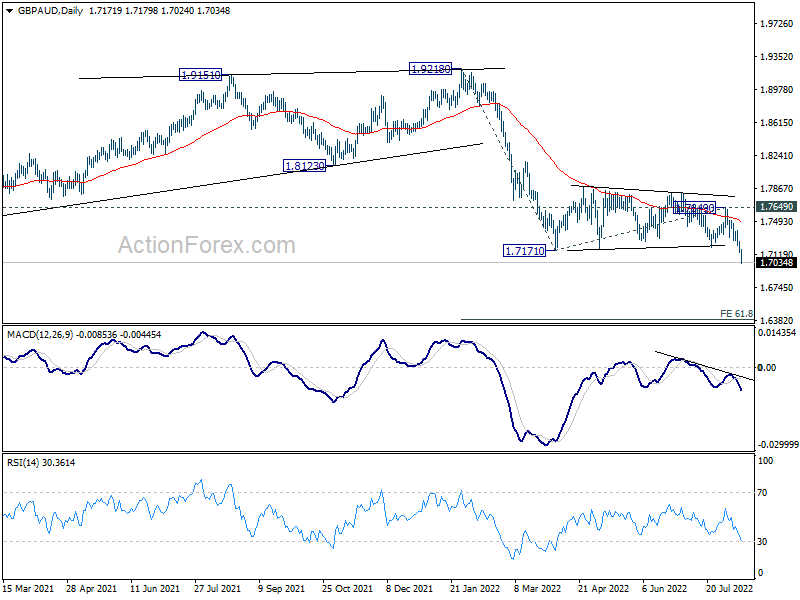
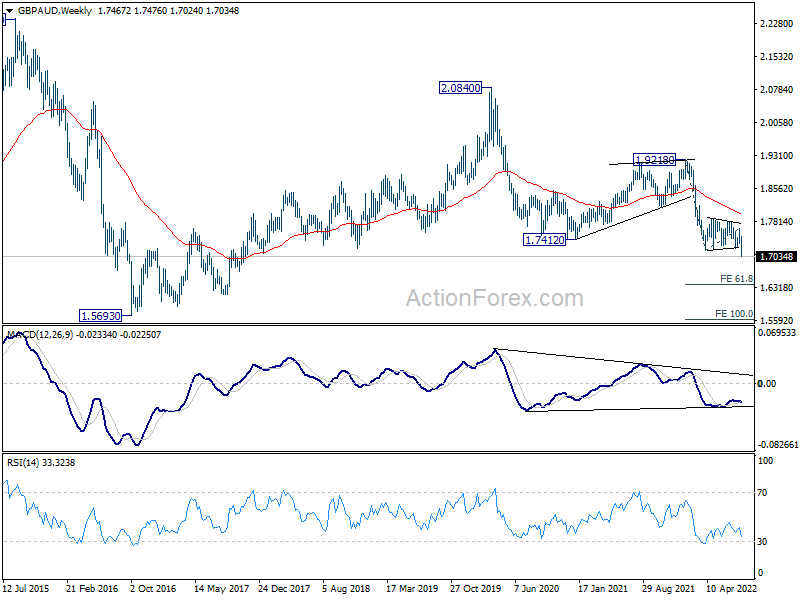
GBP/AUD broke out of near term consolidation pattern last week and hit as low as 1.7024. It's resuming the down trend from 1.9218 (2022 high), as well as that from 2.0840 (2020 high). Near term outlook will stay bearish as long as 1.7649 resistance holds. Next target is 61.8% projection of 1.9218 to 1.7171 from 1.7649 at 1.6384.
EUR/AUD also resumed the near term decline from 1.5396 and hit as low as 1.4391. It's on track to retest 1.4318 low. Firm break there will resume the down trend from 1.6434 (2021 high), and that from 1.9799 (2020 high). Next target will be 61.8% projection of 1.9799 to 1.5250 from 1.6434 at 1.3623, which is close to 1.3624 long term support (2017 low).
USD/JPY Weekly Outlook
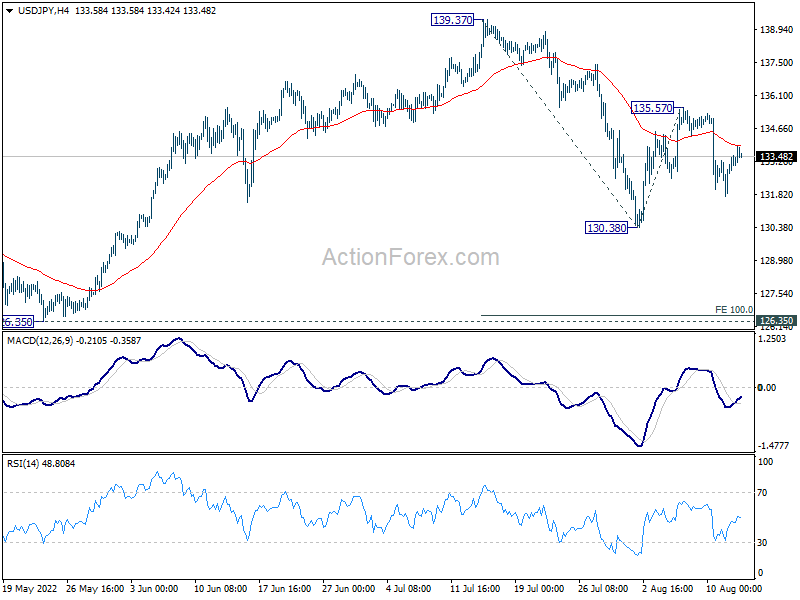
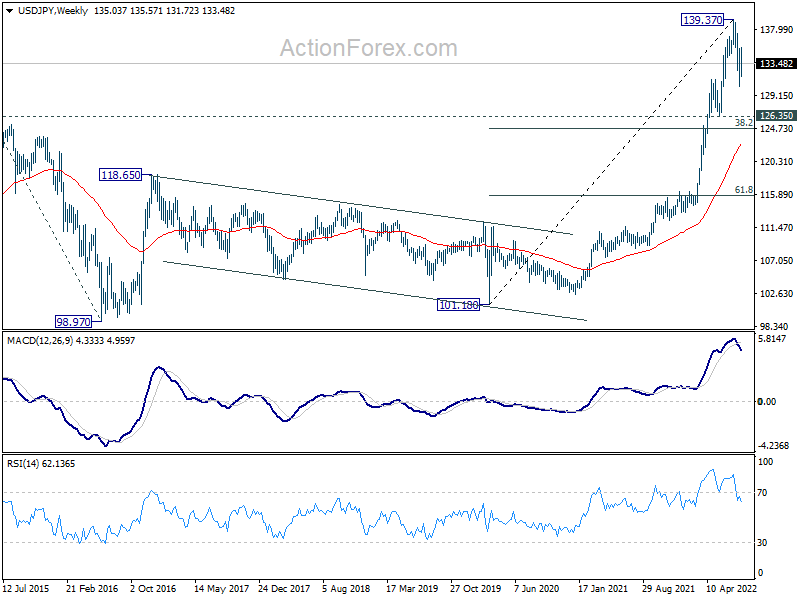
USD/JPY edged higher to 135.57 last week but dropped sharply from there. Yet, downside was contained above 130.38 support. Initial bias stays neutral this week first. Outlook is unchanged that corrective pattern from 139.37 is still unfolding. Range trading between 126.35/139.37 will continue for a while. On the downside, break of 130.38 will target 100% projection of 139.37 to 130.38 from 135.57 at 126.58. On the upside, above 135.57 will resume the rebound form 130.38 to retest 139.37.
In the bigger picture, fall from 139.37 medium term top is seen as correcting whole up trend from 101.18 (2020 low). While deeper decline cannot be ruled out, outlook will stays bullish as long as 55 week EMA (now at 122.70) holds. Long term up trend is expected to resume through 139.37 at a later stage, after the correction finishes.
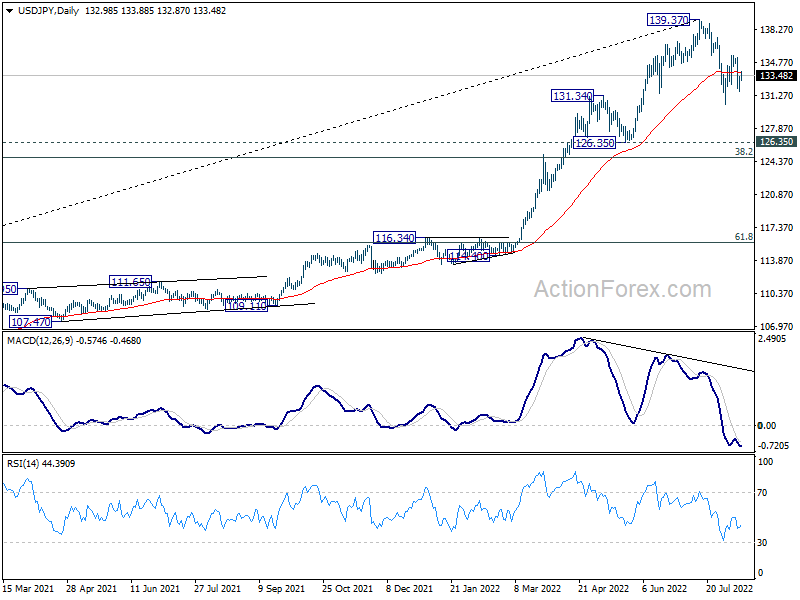
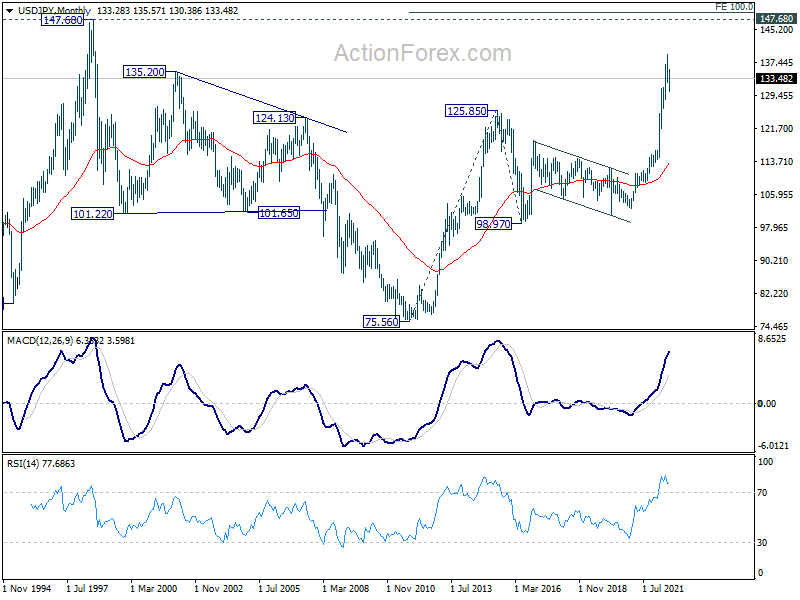
In the long term picture, rise from 101.18 is seen as part of the up trend from 75.56 (2011 low). Further rally is expected to 100% projection of 75.56 (2011 low) to 125.85 (2015 high) from 98.97 at 149.26, which is close to 147.68 (1998 high). This will remain the favored case as long as 55 week EMA (now at 122.70) holds.
Summary 8/15 – 8/19
Monday, Aug 15, 2022
[php_everywhere instance="1"]
Tuesday, Aug 16, 2022
[php_everywhere instance="2"]
Wednesday, Aug 17, 2022
[php_everywhere instance="3"]
Thursday, Aug 18, 2022
[php_everywhere instance="4"]
Friday, Aug 19, 2022
[php_everywhere instance="5"]
Weekly Economic & Financial Commentary: What Shall We Do Now?
Summary
United States: What Shall We Do Now?
- Piecing together the implications of this week's softer-than-expected inflation data with last week's blowout nonfarm payroll report for the Fed's policy path is top of mind for many. The FOMC has made it clear that it needs to see inflation slowing on a sustained basis before pivoting from its current stance.
- Next week: Housing Starts (Mon.), Retail Sales (Tues.), Industrial Production (Tues.)
International: Lower U.S. CPI Fuels International Financial Markets
- The U.S. dollar broadly sold off against foreign currencies, particularly emerging market currencies this week. Currencies across Latin America and EMEA rallied in the immediate aftermath of the July U.S. CPI print and sustained those gains over the second half of the week.
- Next week: Canada CPI (Tues.), German ZEW Survey (Tues.), U.K. CPI (Wed.)
Interest Rate Watch: The Great Flattener
- On Tuesday of this week, the spread between the two-year Treasury yield and the 10-year Treasury yield reached -50 bps, the largest inversion between the two securities since 2000. What is driving this move, and what does it tell us about future economic conditions?
Credit Market Insights: Running a Tight Ship
- The Fed released its Senior Loan Office Opinion Survey for Q2-2022 last week. Surveyed banks pointed to the beginnings of tightening in lending standards and plans to continue to tighten throughout the rest of the year. Demand for credit card loans rose as consumers continue to spend amid blazing inflation.
Topic of the Week: Mind the Gap: New Evidence Suggests Early Emergence of Gender Wage Gap
- Recent data released by the Department of Education suggests the gender wage gaps form almost immediately upon workforce entry. These findings provide color and insight into our continuously evolving understanding of wage disparities among gender.
The Weekly Bottom Line: Inflation Was the Word of the Week
U.S. Highlights
- The U.S. Senate passed a climate, healthcare, and tax bill known as the Inflation Reduction Act of 2022 earlier this week. The legislation is now off to the House of Representatives for a final vote later today where it is expected to pass.
- July CPI came in weaker than expected, with the headline measure flat on the month and core “only” increasing by 0.3% month-over-month.
- While the deceleration in inflation comes as welcome news to policymakers, Fed officials have reiterated that more tightening will be required to achieve price growth stability of 2%.
Canadian Highlights
- A thin Canadian economic data calendar resulted in a lot of eyes looking south of the border in hopes of getting a preview of what is to come next week.
- The main focus next week will be on Canadian CPI, which is expected to show further deceleration on the back of falling energy prices.
- We will also be watching housing sales and price data, which is set to show another drop in overall real estate activity and a further leg down in prices.
U.S. - Inflation Was the Word of the Week
It was a week full of surprises, with inflation being the key theme. Chief among them was the U.S. Senate quickly moving to pass the Inflation Reduction Act of 2022 (IRA). It now heads to the House of Representatives later today for a final vote, where it’s expected to pass. The reconciliation bill is a significantly scaled back version of the far more ambitious Build Back Better Act, though it still incorporates many of the key climate related initiatives that were included in the previous bill.
In terms of broad strokes, the IRA aims to spend roughly $430B on climate and healthcare initiatives over the next decade and is estimated to more than offset those expenditures with $740B of proposed revenue. Over 85% of the appropriated expenditures will be directed towards climate related initiatives and will be dispersed mainly through grants and loans. Of those investments, perhaps most noteworthy is the $80B in new rebates allocated to eligible households for electric vehicles (EVs) and to help decarbonize residential buildings. The additional funding for EVs not only maintains the existing $7,500 rebate but also introduces a new tax credit of up $4,000 for both used and new EVs, with the latter applying only to those vehicles made in North America.
On the healthcare side, the IRA will put a cap of $2,000 on out-of-pocket prescription drug costs for individuals on Medicare. It also aims to bring down the cost of the most expensive drugs by allowing the government to negotiate the price of a subset of those drugs covered by Medicare, though this won’t start until 2026.
All of this will be paid for through a new 15% minimum corporate tax imposed on corporations earning more than $1B, enhancements to the IRS audit and review process, and taxing share buybacks. The fact that the deficit will be reduced over the next decade is what is being used to justify the “inflation reduction” element of the bill. However, the total deficit reduction is only estimated to be $400B (or 1.6% of GDP), and will be spread over the next decade – suggesting the impact to growth and inflation will likely be negligible.
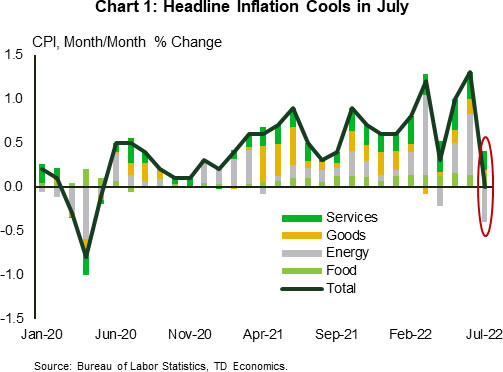
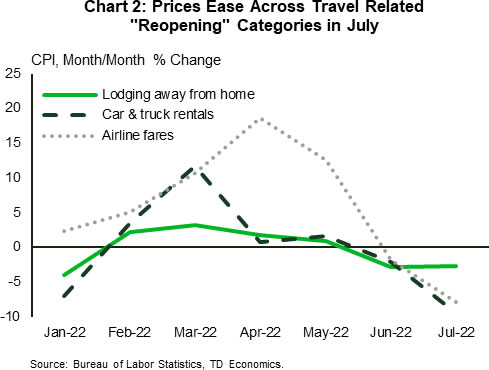
Turing to the other surprise this week, July CPI data (finally!) came in weaker than expected. The headline index was flat on the month, while core prices “only” rose by 0.3% m/m (Chart 1). Indeed, the recent pullback in energy prices subtracted from the headline measure, though accelerating food prices provided a partial offset. Looking to the core measure, there were a few encouraging tidbits. Core services grew by 0.4% m/m – down from the 0.7% m/m reported in June. A lot of the pullback was the result of a softening in travel-related categories, such as airfares, car rentals, and lodging away from home (Chart 2). Other green shoots emerged on the goods side, as prices across most categories decelerated, while used vehicle prices, apparel, and education goods all declined.
This will be welcome news to FOMC officials, but as San Francisco Fed president Mary Daly said on Wednesday “it’s still too early to declare victory”. Daly reiterated her support to dial back on the pace of rate hikes in September but didn’t rule out another 75bps move should the turn in inflation prove to be fleeting.
Canada -Looking South for Signs of Hope
With an empty Canadian economic data calendar, all eyes were on what was moving south of the border. Clearly U.S. CPI was the focus with the upcoming Canada CPI release next week. Given that headline month-on-month (m/m) CPI in the U.S. showed zero price growth in July (Chart 1), sentiment jumped on hopes that central banks may not have to hike rates as much as previously thought. This caused short-term bond yields to drop and equity markets to rally over the week.
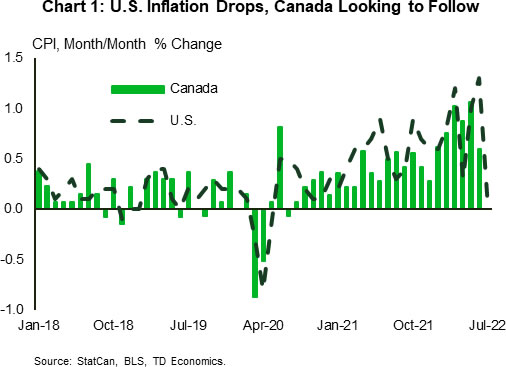
Following the U.S.'s lead, we are looking for Canadian CPI to show a second straight print of decelerating monthly price growth. This monthly trend should translate into a peak in year-on-year (y/y) inflation, with the headline number coming back below 8%. The pullback in gasoline prices will be a primary driver here, with prices having fallen approximately 20% from their peak in early June.
Though a near-term peak in inflation will come as welcomed news, the broadening of inflation to all areas of the economy is likely to keep the annual figures uncomfortably high through the remainder of 2022. We'll be closely watching the evolution of services inflation, which is most reflective of Canadian domestic demand, and has just started to accelerate on the back of rising wages. It is currently growing at 5.2% y/y and is unlikely to show much deceleration given the still ongoing re-opening boom.
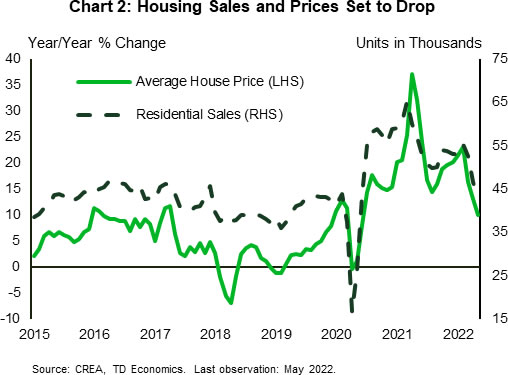
Speaking of interest rates, we will also be getting data on Canadian home sales and prices next week. We are looking for another leg down in sales activity. And with listings holding up reasonably well, this will force the sales-to-listings ratio (currently at 51.7%) even lower. This is putting even more downward pressure on home prices. Based on early readings of transaction data over July, we are expecting the peak-to-trough decline in prices since the first quarter to continue to push towards our forecast of 19%. With the BoC unlikely to pause on rate hikes until later this year, the real estate sector's fall from grace isn't done yet (Chart 2).
Forward Guidance: Canadian Inflation Cooled Off in July
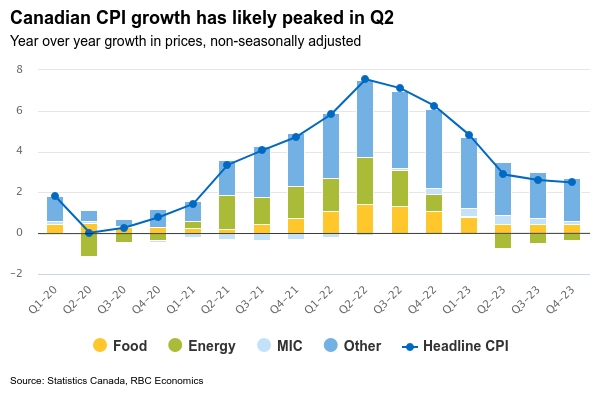
The rapid rise in Canadian inflation likely slowed in July as global commodity prices fell—mirroring a drop in the U.S. inflation earlier this week. By our estimate, headline inflation slowed to 7.7% on a year-over-year basis, down from 8.1% in June. The price of gasoline has declined almost 10% since July, though it remains up more than 30% from a year ago. By contrast, consumer natural gas prices spiked higher last month—particularly in Ontario and British Columbia.
There continue to be signs that global inflation pressures are easing off. Oil prices are down 25% from early June. Global freight shipping costs and times, by air and ocean, have fallen significantly over the past few months. And on the domestic front, though higher interest rates are pushing up mortgage payments, home buying costs (which have contributed substantially to price growth over the last year) have shifted from record monthly increases over the winter to declines in the spring and summer. Our own cardholder data shows consumer spending is still very strong, but has plateaued through July and into August.
Despite the expected dip in next week’s consumer price report, inflation remains much too high and isn’t likely to return sustainably to the Bank of Canada’s target levels without the economy cooling. In June, over 60% of products and services in the CPI were growing at above the Bank of Canada’s 1% to 3% target range. Against that backdrop, the BoC will continue to forcefully raise the overnight rate. We expect a 75 basis point increase in September to build on the 100 basis point hike—the largest since 1998—in July.
Week ahead data watch:
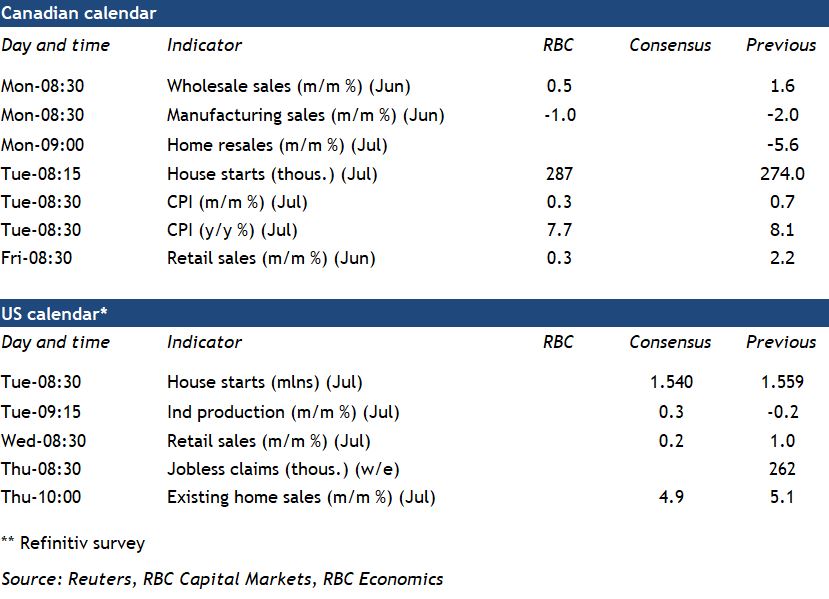
Statistics Canada’s flash estimate predicted a 1% decline in June manufacturing sales. Despite overall price growth, petroleum and coal led the decline followed by weakness in aerospace.
The early estimate of July retail sales was relatively flat at +0.3% month-over-month from June. Our own RBC consumer tracker showed spending plateauing after surging out of pandemic lockdowns.
Canadian home resales will show another decline in July based on early local market reports.
Canadian housing starts likely remained firm in July given the increase in permit issuance to over 300,000 in June.
U.S. economic data will look a little better in July despite a slowing economic growth backdrop. Retail sales likely edged higher even as gasoline station sales dropped due to falling prices. Higher motor vehicle production and a 2% increase in manufacturing hours worked should leave the industrial production report looking firm.
Week Ahead – Rate Hikes Keep Coming
Barring the obvious exception
We may have entered into a typically slower time of year for financial markets but as last week showed, there really is no such thing in 2022 and I expect next week to be no different.
In fact, there are a number of headline events that will grab everyone’s attention, not least the FOMC minutes on Wednesday. While we know the Fed has shifted to data-dependency, the minutes could hold further clues as to the balance on the committee. Of course, a lot of data falls between the July and September meetings – including two inflation and jobs reports – which could make those views less relevant but there’s always scope for a surprise.
There are a number of interest rate decisions next week and unsurprisingly, the bulk will likely involve a large rate hike. The outlier is obviously the CBRT which continues to be driven by unorthodox views on the link between inflation and interest rates, much to the misfortune of all those experiencing nearly 80% inflation as a result.
US
Two reports showed US inflation is slowing and that has tilted the scales for traders in pricing in a slightly less aggressive Fed in September. Wall Street will now look for some guidance hints from the release of the FOMC minutes. The Fed has signalled that guidance wouldn’t be transparent going forward, so we will probably just have mostly reiterations of their data dependence. It might take another cooler-than-expected inflation report before the Fed can admit that they are ready to consider slowing down hikes.
The other important data set for the week is the July retail sales report which should show the consumer is weakening. Traders will also look to see if jobless claims continue to trend higher and if the labour market is showing any signs of becoming less tight.
Fed speak will include appearances during the week from the Fed’s George and Kashkari.
Election season continues with US primary elections in Alaska and Wyoming.
EU
Another quiet week is in store for Europe, with mostly tier two and three data being released. The standout here is the final inflation reading as traders assess interest rate expectations for September. No change is expected but of course, it could surprise.
As will remain the case over the winter, the focus will remain on the energy market and supplies of Russian gas and oil.
UK
The UK is heading for a long period of stagflation, with the BoE forecasting five quarters of contraction from Q4 this year while inflation remains high and interest rates rise. That’s on top of the contraction in the second quarter that was confirmed on Friday. Next week offers labour market, inflation and retail sales data which could provide additional insight into how bad the situation already is.
Russia
PPI inflation is the only release of note next week. The central bank has been aggressively easing in recent months to support the economy and soften the rouble which remains around 20% higher against the dollar since the invasion. The PPI data is unlikely to alter the CBRs course.
South Africa
Another quiet week with retail sales on Wednesday the only notable release.
Turkey
At the risk of sounding repetitive, inflation was almost 80% last month and the CBRT next week is expected to leave the repo rate unchanged at 14% as it continues to cling to its misguided views on inflation and interest rates.
Switzerland
Data highlights next week include PPI on Monday, trade on Thursday and industrial production on Friday. Inflation is running at 3.4% so a 50 basis point hike could be on the cards when the SNB meets next month. Assuming it waits that long, of course. It does love a surprise.
China
On Monday, China releases July retail sales, which are expected to rise to 4.2%, up from 3.1% in June. Investment and industrial production are also expected to accelerate, pointing to a strengthening recovery. Exports have increased but the strict zero-Covid policy has dampened domestic consumption.
The People’s Bank of China sets its one-year medium-term lending facility rate this week. The central bank is expected to maintain the rate at 2.85%, where it has been pegged since January. The MLF could be cut in the next month or two, with the PBOC having previously signalled its intent to do so due to weak household spending and a desire to scale back funding costs for domestic enterprises. But with inflation running close to 3%, alternative targeted measures may be preferred.
India
The highlight next week is WPI inflation on Tuesday. It is expected to drop back slightly to 14.2% which will be welcome following the 50 basis point rate hike from the RBI last week. Further hikes may be warranted in the coming months as the central bank tries to get inflation back below target.
Australia
On Tuesday, the RBA releases the minutes of its August meeting. The markets will be looking for insights into the RBA’s decision at the meeting to raise rates by 0.50%, bringing the cash rate to 1.85%.
Australia publishes employment change on Thursday. The labour market is expected to decelerate in July and post gains of 40,000. This follows the June gain of 88,400, which was higher than expected. The unemployment rate is expected to remain steady at 3.5%.
New Zealand
The Reserve Bank of New Zealand meets on Wednesday. The RBNZ has been at the forefront of aggressive rate hikes by central banks and is expected to raise the cash rate by 50 basis points to 3.00%. This would mark a fourth successive 50bp increase, with further rate increases expected in the coming months. Along with the rate decision, the RBNZ will publish revised growth and inflation forecasts.
Japan
Japan releases its second-quarter GDP on Monday. A strong rebound of 2.6% YoY is expected, after a disappointing -0.5% release in Q1. The modest economic recovery has been driven by post-Covid domestic demand.
A stronger economy is also producing higher inflation, and we’ll get a look at July’s Core CPI on Friday. Core CPI is forecast to rise to 2.5%, up from 2.2% in June. This would push inflation further away from the Bank of Japan’s 2% target, but the central bank is unlikely to reduce stimulus until it is convinced that inflation is not transient.
Singapore
No data or events next week.
Economic Calendar
Sunday, Aug. 14
Economic Data/Events
- India trade
- Saudi Aramco reports Q2 results
Monday, Aug. 15
Economic Data/Events
- US cross-border investment, empire manufacturing
- Canada existing home sales
- China liquidity operations, retail sales, property prices, industrial production, surveyed jobless
- Japan GDP, industrial production
- New Zealand performance services index
- Thailand GDP
- German Chancellor Scholz meets Nordic leaders in Oslo
- South Korea and North Korea celebrate Liberation Day, an annual holiday in both countries to mark their liberation in 1945 from 35 years of Japanese rule.
- Assumption Day is observed in many European countries, including Spain, France and Switzerland. Some financial markets are closed.
Tuesday, Aug. 16
Economic Data/Events
- US housing starts, industrial production
- Australia household spending
- Canada housing starts, CPI
- Germany ZEW survey expectations
- India wholesale prices
- Israel GDP, CPI
- Japan department store sales, tertiary index
- Mexico international reserves
- UK jobless claims, unemployment
- Foreign Secretary Truss and former Chancellor Sunak hold campaign events
- Alaska and Wyoming hold primary elections.
Wednesday, Aug. 17
Economic Data/Events
- US FOMC minutes, business inventories, retail sales
- Australia leading index, wage price index
- Eurozone GDP
- Hungary GDP
- Japan machinery orders, trade
- Singapore non-oil exports, electronic exports
- South Africa retail sales
- UK CPI
- New Zealand PPI
- RBNZ Rate Decision: Expected to raise rates by 50bps to 3.00%
- RBNZ Governor Orr holds a news conference after the release of the central bank’s latest monetary policy statement
- EIA crude oil inventory report
Thursday, Aug. 18
Economic Data/Events
- US existing home sales, initial jobless claims, Conference Board leading index
- Australia unemployment
- China SWIFT global payments
- Eurozone CPI
- New Zealand trade
- Norway GDP
- Norway rate decision: Expected to raise rates by 50bps to 1.75%
- Thailand car sales
- Turkey rate decision: Expected to keep rates steady at 14.00%
- Kansas City Fed President George speaks on the economic outlook
- Minneapolis Fed President Kashkari speaks
Friday, Aug. 19
Economic Data/Events
- New Zealand trade
- Canada retail sales
- Japan CPI
- New Zealand credit card spending
- Thailand forward contracts, foreign reserves
Sovereign Rating Updates
- Iceland (Moody’s)
- Cyprus (Moody’s)