Sample Category Title
Gold Outlook: Precious Traders Await Fed Decision
Turmoil ensues in the global financial scene with rampant inflation, amplified recession fears and wide-reaching geopolitical risks, have investors scramble to reassess the future prospects of the shiny metal. Not only that, but the declaration of monkeypox as a global health emergency from WHO, stirred the waters even more and raised the inevitable question of how governments might respond towards this new threat and what implications will it have on the grander scheme of things. Having said that, in this report we aim to shed light on the current and upcoming events that are of crucial importance for the future development of the precious, as well as a technical analysis of assessing its potential short-to-medium horizon.
Gold’s price has been confined in a sideways price action for the past few sessions, slightly above the $1,700 range, possibly showcasing an absence of conviction on where it might lead to next. Traders brace themselves for tomorrows’ scheduled Fed’s interest rate hike decision and the follow-up speech by Chairman Jerome Powell, awaiting in anticipation on whether the hike will meet the 75-basis point consensus or will there be an upshot surprise of 100 basis points hike. Should the rate match the expectation we might see a rather small yet supporting reaction towards the greenback as the decision is already mostly priced in and could in turn weigh slightly on the precious. However, should the Fed’ opt for an even more aggressive hike and take the market by surprise, then we might see the dollar get a substantial boost and as consequence observe the precious retract, becoming more expensive and thus unattractive for international investors. The aggressive rate hike stance by the Fed, comes after the four-decade high of the consumer price index rate, released in June, exacerbating fears that inflation will take a toll on the consumer front and become entrenched in the economy for longer. On the flip side, should the Fed opt in for the more aggressive monetary policy tightening option in the following months, we might also see the probability of the US economy entering a recession increase to 40%, according to Reuters, thus the chances for a “soft-landing” dwindle drastically in our opinion. Another factor that might impact the shiny metal’s future outlook are the bond yields. Even though gold is considered a safe haven and a hedge against inflation, it could fall out of favor when contrasted with the US treasuries as, the precious bears no-yields. Bond yields however, and the US 10 year in particular, has been declining for the past few sessions which could provide support for gold making it a viable option for investors’ portfolios, thus increasing the demand for bullion.
Finally, we also note the upcoming financial releases for the US, namely the GDP rate figure for Q2 to be released on Thursday the 28th of July alongside with the Initial jobless claims figure for last week and on Friday the 29th of July, the Consumption rate for June and the University of Michigan’s final market sentiment report for July, all being of material importance for the dollar and as a consequence for gold’s price.
Technical Analysis
XAUUSD H4
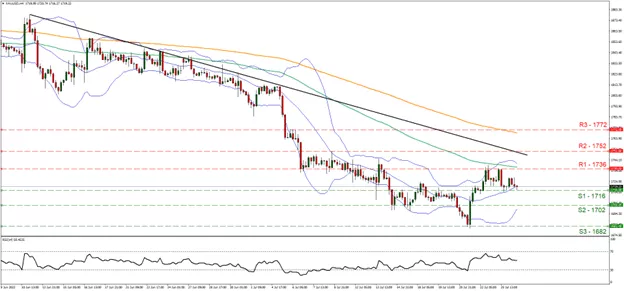
Looking at the XAUUSD 4H chart we can observe the descending trendline initiated on the 13th of June, which highlights the lower peaks and lower troughs of the precious. However, we also observe the stalling and the confinement of the bullion’s price action between the 1716 (S1) support line and the 1736 (R1) resistance line, since the 20th of July, possibly showcasing traders’ indecision towards the shiny metal, ahead of the Fed’s rate decision tomorrow 28th of July. Thus, we hold a sideways price action bias for gold’s for the time being. Supporting our case, is the RSI indicator below the 4H chart, flat lining on the 50 level and the convergence of the price action with the 20 moving average line of the Bollinger bands. Should the bulls take over and for us to change our assessment, we would require a clear break of the 1736 (R1) resistance level, the descending trendline and a possible challenge of the 1752 (R2) resistance line. Given though the pre-mentioned downward trendline and should the bears reign over, we may see the break below the 1716 (S1) support level and the move past the 1702 (S2) support barrier. While in an extreme bearish scenario we may see golds price approaching the 1682 (S3) support hurdle. Please note that higher than usual volatility may be present for gold’s price at the time of the release of the Feds interest rate decision, hence caution is advised should gold traders be active at that time.
US consumer confidence dropped to 95.7, inflation and rate hikes continue posing strong headwinds
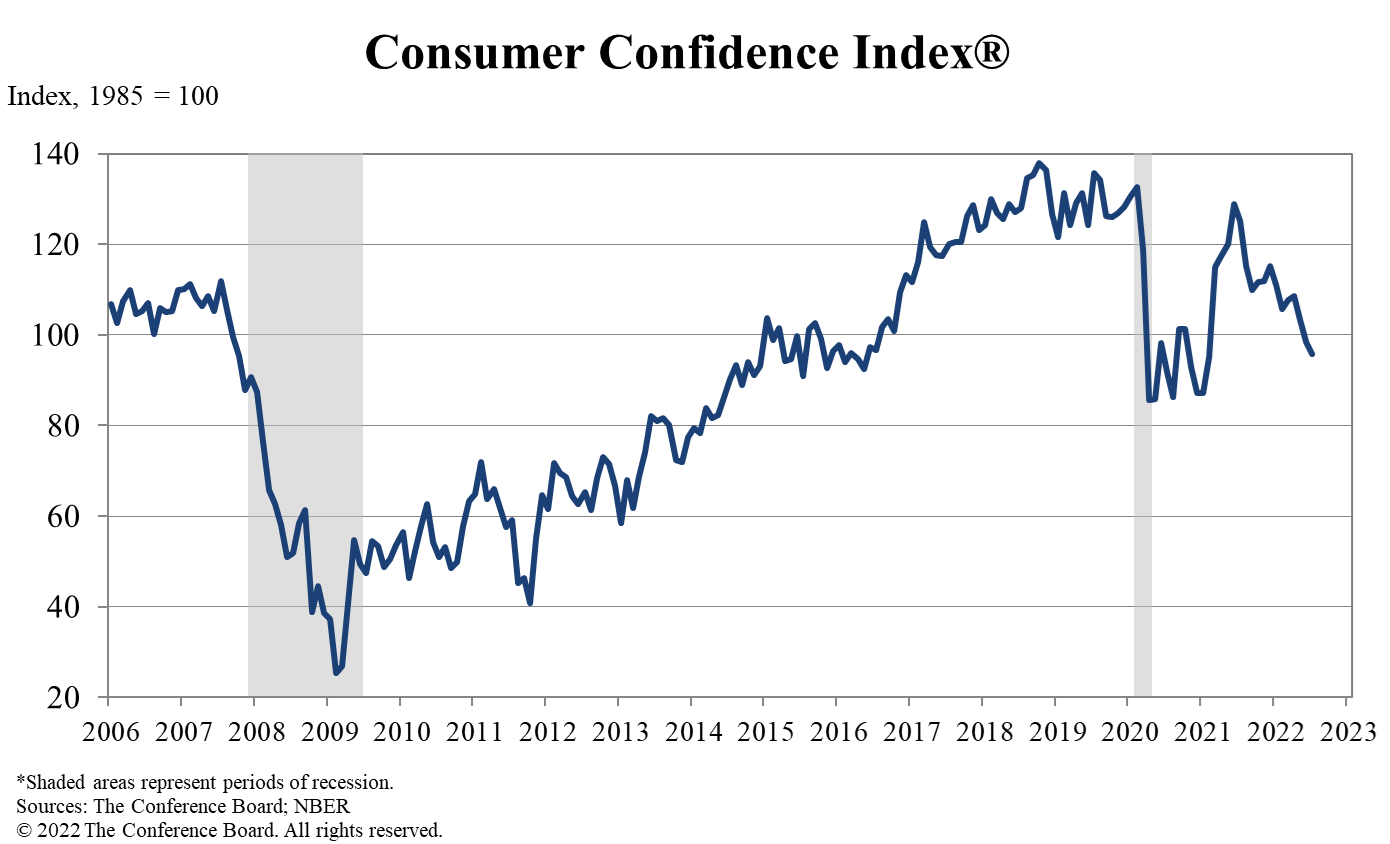
US Conference Board Consumer Confidence dropped from 98.4 to 95.7 in July, below expectation of 96.3. Present Situation Index dropped from 147.2 to 141.3. Expectations Index dropped from 65.8 to 65.3.
"Consumer confidence fell for a third consecutive month in July," said Lynn Franco, Senior Director of Economic Indicators at The Conference Board. "The decrease was driven primarily by a decline in the Present Situation Index—a sign growth has slowed at the start of Q3. The Expectations Index held relatively steady, but remained well below a reading of 80, suggesting recession risks persist. Concerns about inflation—rising gas and food prices, in particular—continued to weigh on consumers."
"As the Fed raises interest rates to rein in inflation, purchasing intentions for cars, homes, and major appliances all pulled back further in July. Looking ahead, inflation and additional rate hikes are likely to continue posing strong headwinds for consumer spending and economic growth over the next six months."
Sunset Market Commentary
Markets
Recession fears continue to haunt European markets. The EMU PMI last week falling below the 50 boom-or-bust level and yesterday’s poor German IFO flagged a sharp deceleration of activity going into H2. Russia reducing gas supply a few days after restarting deliveries via the Nord Stream 1 pipeline only highlights the risk for a big winter supply shock paralyzing key parts of the economy. EMU bond investors increasingly embrace the recession narrative. German yields again tumble between 7.5 bps (2-y and 30-y) and 9 bps (5 & 10-y), the belly of the curve outperforming the wings. After clearing key 1.12%/1.18% support, the German 10-y yield (0.92%) decisively slips below the 1.0% barrier. The 10-y euro swap (1.74%) extends its journey south of 2.0%, with next support near 1.63% (May bottom). Short-term yields show a bit more resilient. Even so, markets ever more question whether the ECB will be able to hike its deposit rate above 1.0% going into the end of the year. Interesting to see whether EMU CPI data later this week will be able to at least partially rebalance the market focus from growth back to inflation, annex the ‘unavoidable’ need further ECB tightening. On intra-EMU bond markets, Italy underperforms (10-y spread vs Germany +5 bps) as markets question the country’s access to next tranches of the EU recovery fund as the country’s reform agenda might stall due the upcoming elections. US yields also stay on a downward trajectory as markets are counting down to tomorrow’s Fed policy decision. Will the Fed also slow the pace of rate hikes beyond tomorrow’s widely expected 75 bps hike? US yields are easing between 4bps (2-y) and 7 bps (5/10-y). European equities are ceding up to 1.0%. The Nasdaq opens with a similar loss. Despite recessionary fears, cyclical commodities including copper, iron ore and oil show tentative signs of bottoming after recent setback. The reference Dutch gas contract jumps to the highest level since March (194.5 EUR/MWh)
Of late, a ST topping pattern in the US dollar and last week’s ‘unexpected’ 50 bps ECB hike temporary gave the euro some reprieve. However, with any upside attempts decisively blocked in the 1.0275 area, EUR/USD today again fell prey to the forces of gravity, trading near 1.0140 compared to opening levels around 1.0220. The move this time was mainly euro weakness rather than USD strength. USD/JPY even declines marginally (136.3). EUR/CHF even dropped to a new multi-year low (0.9770) illustrating the euro underperformance. EUR/GBP also dropped to the 0.845 area, even as cable struggles not to fall below the 1.20 barrier. News Headlines
The Hungarian central bank (MNB) lifted policy rates by 100 bps. The base rate now stands at 10.75%. On Thursday, the central bank will bring the one-week deposit rate to that same level. Underpinning the decision are strong and intensifying price pressures. Inflation hit 11.7% in June, core measures even 13.8% y/y. Rising costs continue to quickly feed through to consumer prices, the MNB says. With prices expected to keep accelerating into the autumn months, risks for second-round effects build unabatedly and must be addressed. The MNB will continue the cycle of interest rate hikes until the outlook for inflation stabilizes around the MNB’s 3% target in a sustainable manner and inflation risks become evenly balanced. The Hungarian forint left intraday lows behind after the policy statement was published but risk-off limits the currency’s upside. EUR/HUF is trading around the 400 barrier.
Europe already reached a political agreement to cut the use of gas by 15% next winter. The Commission proposed to do so only last week. The fast approval comes as the threat of Russia fully cutting off gas supplies is increasingly turning reality after the country announced it will take another turbine offline for maintenance. Supplies from Wednesday on will reduced from 40% of capacity to just 20%. Gas consumption cuts are voluntarily though can become mandatory under request of at least 5 countries or if the Commission deems there’s a high risk of a shortage. Both scenarios need majority backing from member states.
Euro Slides on Nordstrom Squeeze
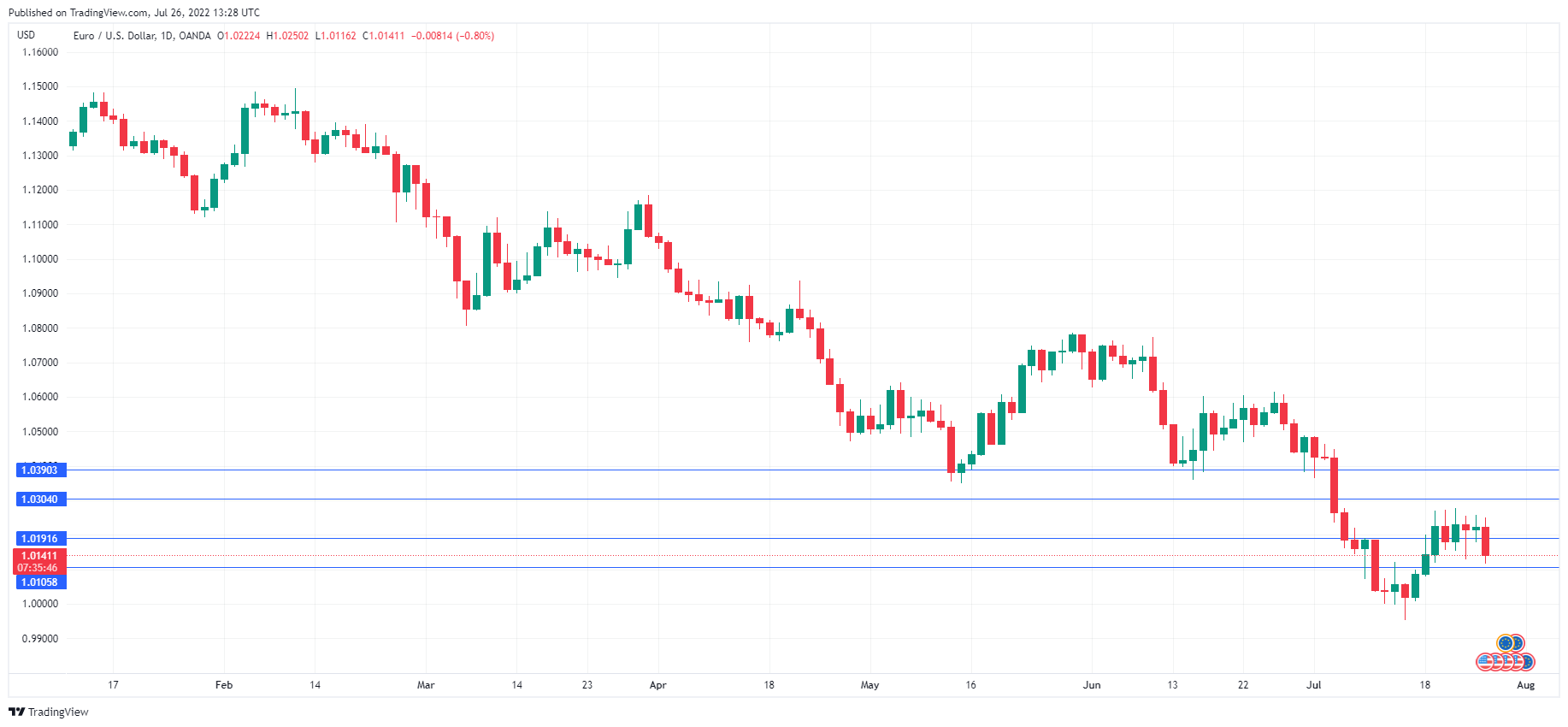
The euro has taken a nasty tumble today. In the North American session, EUR/USD is trading at 1.0144, down 0.76%.
Nord Stream 1 cut to 20% capacity
The energy crisis surrounding Nord Stream 1, a key channel for Russian gas exports to Europe continues to simmer. Perhaps the pipeline should be referred to as ‘Nord Brook 1’, after Gazprom, the Russian energy giant, warned it will cut flows through the pipeline to just 20% of capacity starting Wednesday, claiming “technical issues”. The EU has charged that the move is politically motivated, but Vladimir Putin is holding the better hand of cards and has no compunction about weaponising energy exports to the West.
The EU has scrambled to scale back its energy dependence on Moscow and announced today that member states had agreed on a voluntary reduction of 15% in natural gas imports. The deal was reached at lightning speed, reflecting the tremendous apprehension in Brussels about an energy crisis this winter. Still, the agreement has apparently been watered down, with exemptions for members that are not directly linked to EU gas pipelines and are completely dependent on Russia. The latest squeeze on Nord Stream 1 has unnerved investors and sent the euro sharply lower.
With the war in Ukraine dragging on and a potential energy crisis looming, it’s no surprise that German confidence indicators are under pressure. Ifo Business Sentiment slipped to 88.6 in June, down from 92.2 in May. The soft reading was accompanied by a warning from the Ifo Institute, which warned of a looming recession in Germany, due to soaring energy prices and the possibility of a gas shortage in Europe’s largest economy. On Wednesday, Germany releases GfK Consumer Climate, which is expected to fall to -28.9 in August, down from -27.4 in July. The index has been steadily weakening and has been mired in negative territory since October 2021.
All eyes will be on the Federal Reserve on Wednesday, with a live meeting that will include a supersize rate hike. The markets are expecting a 75bp increase for a second straight meeting, but a massive 100bp hike cannot be ruled out. A 75bp move could be met with a yawn by the US dollar, while a 100bp increase would be a surprise and likely boost the greenback.
EUR/USD Technical
- EUR/USD continues to test support at 1.0191. The next support level is 1.0105
- There is resistance at 1.0304 and 1.0390
EUR/USD Mid-Day Outlook
Daily Pivots: (S1) 1.0180; (P) 1.0219; (R1) 1.0259; More...
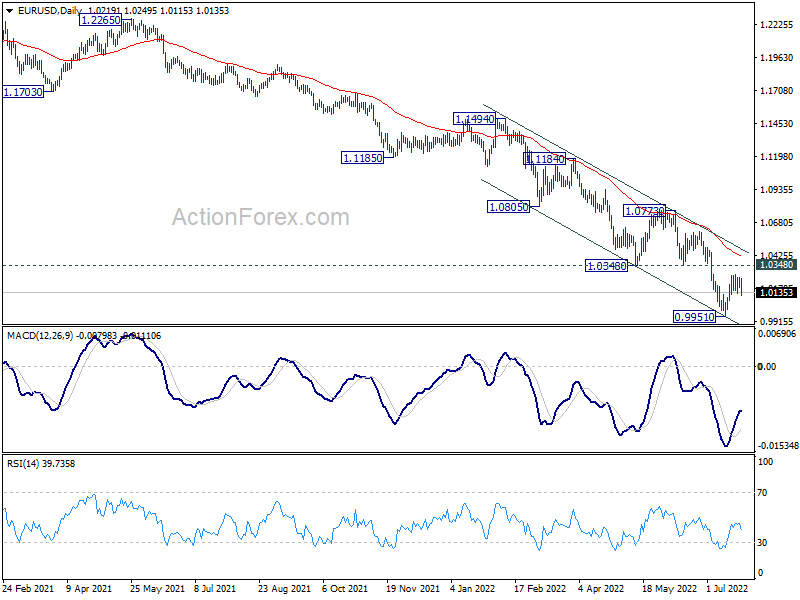
Intraday bias in EUR/USD remains neutral first. on the downside, break of 1.0118 will suggest that rebound from 0.9951 has completed. Bias will be back on the downside for retesting 0.9951 low. On the upside, above 1.0277 will resume the rebound to 1.0348 support turned resistance.
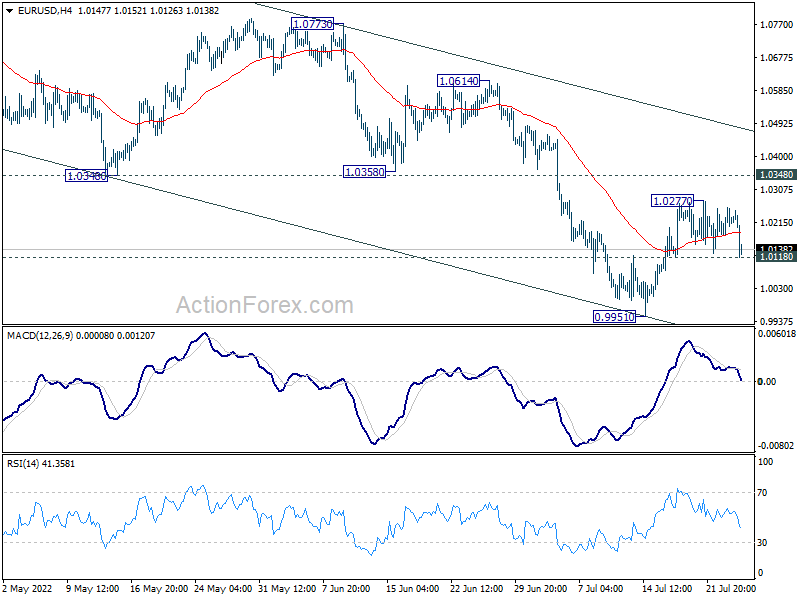
In the bigger picture, down trend from 1.6039 (2008 high) is still in progress. Next target is 100% projection of 1.3993 to 1.0339 from 1.2348 at 0.8694. In any case, outlook will stay bearish as long as 1.0773 resistance holds, in case of strong rebound.
GBP/USD Mid-Day Outlook
Daily Pivots: (S1) 1.1976; (P) 1.2032; (R1) 1.2102; More...
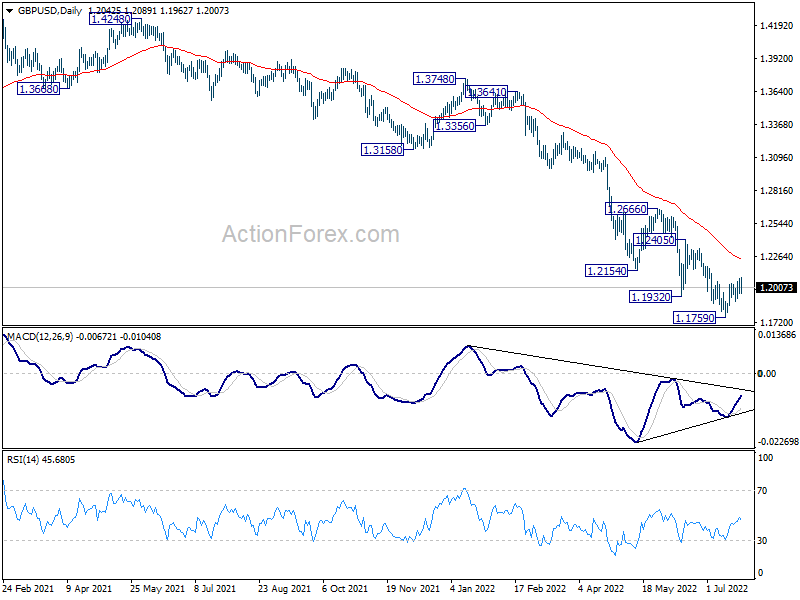
Intraday bias in GBP/USD is turned neutral with current retreat. Further rise is mildly in favor with 1.1888 minor support intact. Above 1.2089 will target 55 day EMA (now at 1.2243). Sustained trading above there will pave the way to 1.2405 resistance and above. On the downside, below 1.1888 minor support will bring retest of 1.1759 low instead.
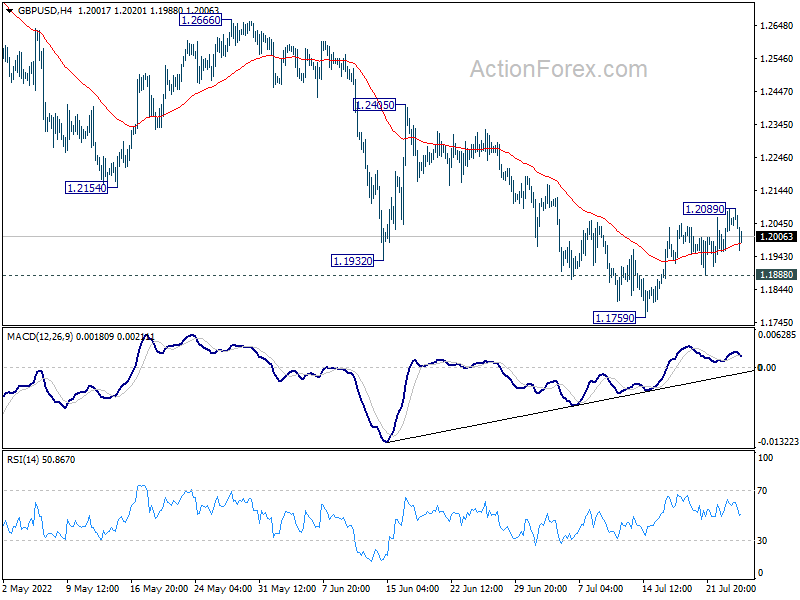
In the bigger picture, fall from 1.4248 (2018 high) could be a leg inside the pattern from 1.1409 (2020 low), or resuming the longer term down trend. Deeper decline is expected as long as 1.2666 resistance holds. Next target is 1.1409 low. However, firm break of 1.2666 will bring stronger rise back to 55 week EMA (now at 1.2986).
USD/CHF Mid-Day Outlook
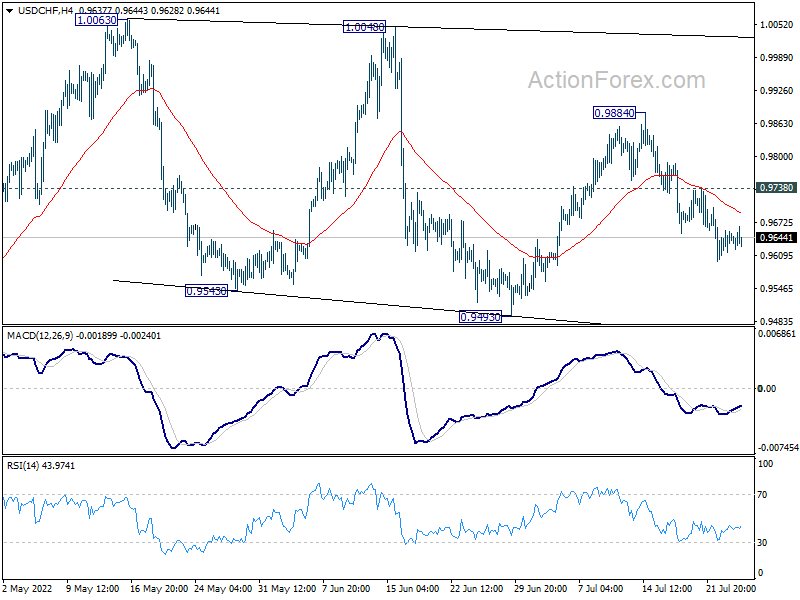
Daily Pivots: (S1) 0.9619; (P) 0.9640; (R1) 0.9667; More...
Further decline is in favor in USD/CHF with 0.9738 minor resistance intact. Fall from 0.9884 is seen as a falling leg of the consolidation from 1.0063. Deeper decline would be seen to 0.9493 support. On the upside, though, above 0.9738 minor resistance will turn bias back to the upside for 0.9884 resistance.
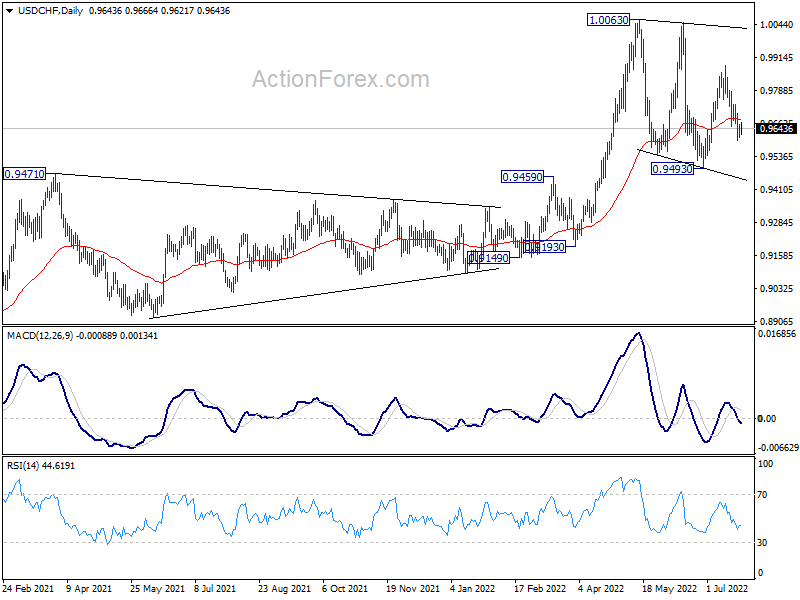
In the bigger picture, medium term up trend from 0.8756 (2021 low) is still in progress. On resumption, next target is 1.0342 (2016 high). Sustained break there will resume long term up trend from 0.7065 (2011 low). This will remain the favored case as long as 0.9471 resistance turned support holds.
USD/JPY Mid-Day Outlook
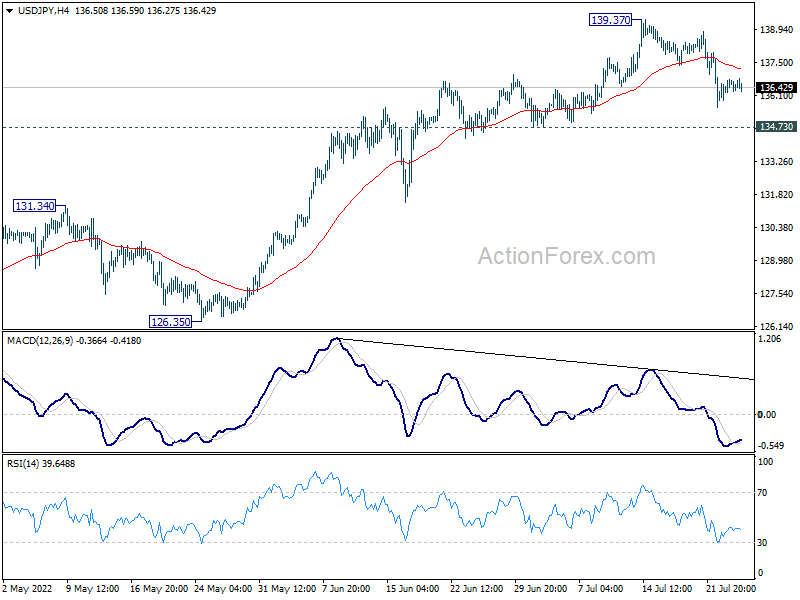
Daily Pivots: (S1) 136.10; (P) 136.45; (R1) 137.00; More...
Intraday bias in USD/JPY remains neutral and outlook is unchanged. On the downside, firm break of 134.73 will confirm short term topping, on bearish divergence condition in 4 hour and daily MACD. Deeper fall would be seen through 55 day EMA to 126.35/131.34 support zone. On the upside, break of 139.37 will resume larger up trend.
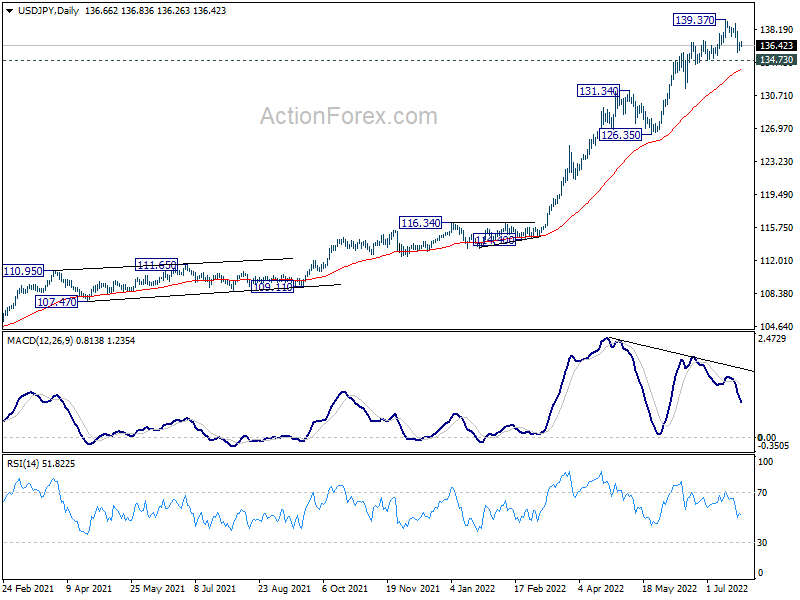
In the bigger picture, current rally is seen as part of the long term up trend from 75.56 (2011 low). Next target is 100% projection of 75.56 (2011 low) to 125.85 (2015 high) from 98.97 at 149.26, which is close to 147.68 (1998 high). This will remain the favored case as long as 126.35 support holds.
EUR/GBP Mid-Day Outlook
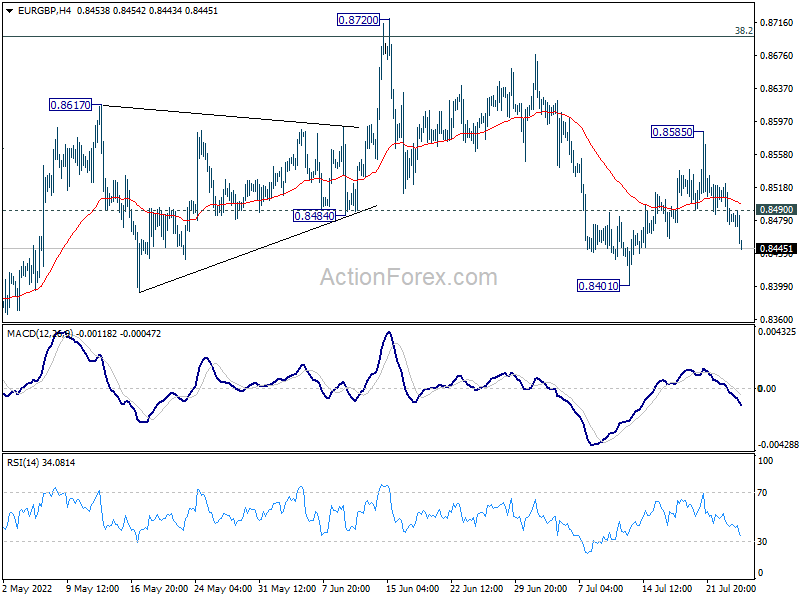
Daily Pivots: (S1) 0.8464; (P) 0.8495; (R1) 0.8514; More...
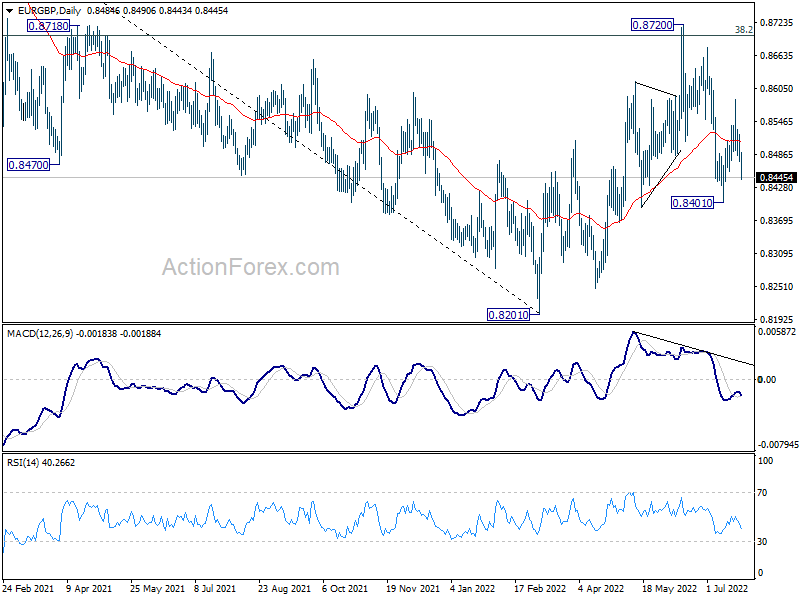
EUR/GBP's break of 0.8456 minor support suggests that rebound from 0.8401 has completed at 0.8585. Intraday bias is back on the downside for 0.8401 support first. Break there will resume larger decline from 0.8720. Deeper fall would then be seen towards 0.8201 low. On the upside, above 0.8490 minor resistance will turn intraday bias neutral first.
In the bigger picture, attention remains on 38.2% retracement of 0.9499 to 0.8201 at 0.8697. Sustained break there will affirm the case that rise from 0.8201 is a medium term up trend itself. Further rally would then be seen to 61.8% retracement at 0.9003. However, rejection by 0.8697 will confirm medium term bearishness for another fall through 0.8201.
EUR/AUD Mid-Day Outlook
Daily Pivots: (S1) 1.4646; (P) 1.4724; (R1) 1.4772; More...
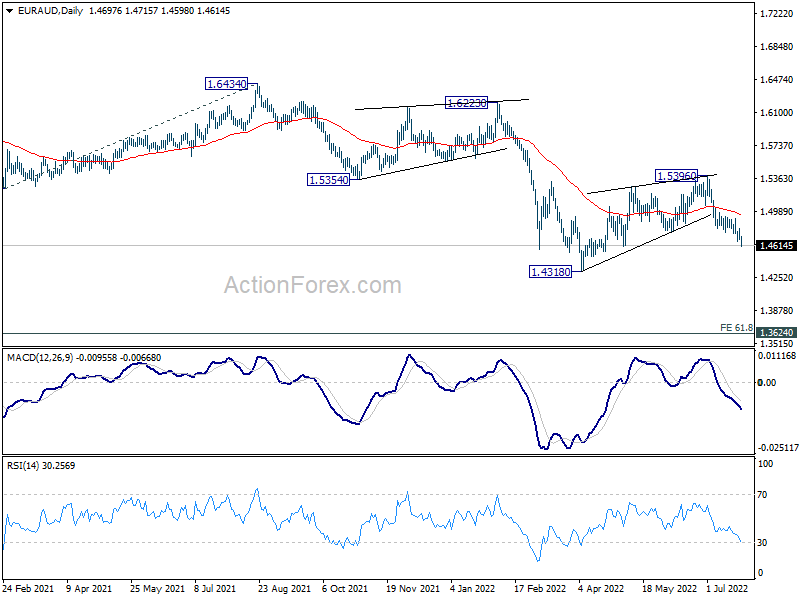
EUR/AUD's decline continues today and hits as low as 1.4598. Intraday bias stays on the downside for retesting 1.4318 low. Decisive break there will resume larger down trend. On the upside, above 1.4803 minor resistance will turn intraday bias neutral, and bring consolidations first, before staging another decline.
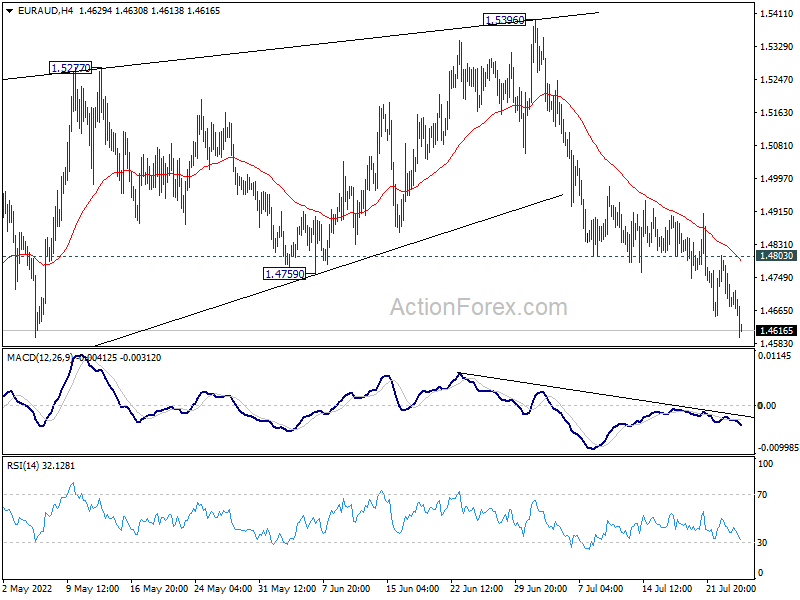
In the bigger picture, rejection by 1.5354 support turned resistance, as well as 55 week EMA (now at 1.5378), maintain medium term bearishness. That is, larger down trend from 1.9799 is not completed yet. Break of 1.4318 low will target 61.8% projection of 1.9799 to 1.5250 from 1.6434 at 1.3623, which is close to 1.3624 long term support (2017 low). This will remain the favored case now as long as 1.5396 resistance holds.