

Sample Category Title
EUR/USD Daily Outlook
Daily Pivots: (S1) 1.1612; (P) 1.1638; (R1) 1.1687; More...
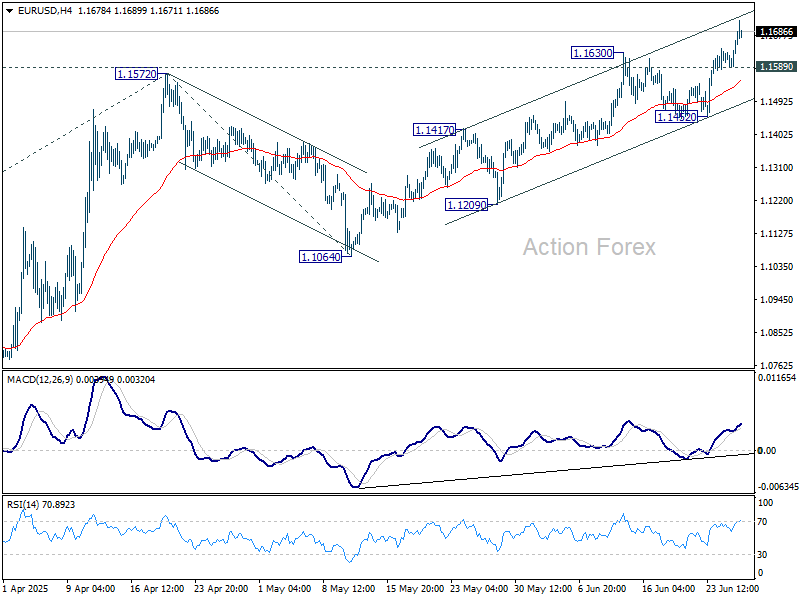
EUR/USD's rally continues today and intraday bias stays on the upside for 61.8% projection of 1.0176 to 1.1572 from 1.1064 at 1.1927. Below 1.1589 minor support will turn intraday bias neutral and bring consolidations. But downside should be contained above 1.1452 support to bring another rally.
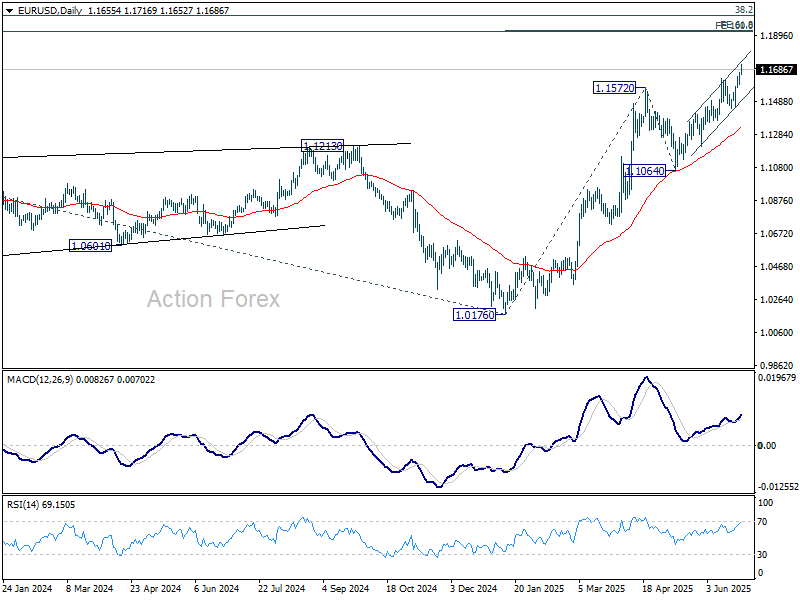
In the bigger picture, rise from 0.9534 long term bottom could be correcting the multi-decade downtrend or the start of a long term up trend. In either case, further rise should be seen to 100% projection of 0.9534 to 1.1274 from 1.0176 at 1.1916. This will now remain the favored case as long as 1.1604 support holds.
Look Out for Comments on a Bigger International Role for Euro
Markets
Trends from Tuesday continued yesterday. The German yield curve further bear steepened after the approval of the German budget, rubberstamping €500 bln additional debt issuance through 2029. German yields changed between -0.8 bps (2-y) and + 2.6 bps (30-y). US Treasuries outperformed even as Fed Chair Powell in the second part of his semi-annual testimony before the Senate held to a cautious wait-and-see approach, pondering the expected inflationary impact of tariffs. Even so, markets feel that softer US labour market data and/or a milder than expected inflationary compared to the Fed’s base-line scenario still might result in faster easing than what is guided in the (median) dot plot. US yields in a bull steepening move eased between -4.4 bps (2-y) and 0.25 bps (30-y). A September 25 bps Fed cut is now (slightly more) than fully discounted. Interest rate differentials this time did matter and further pressured the dollar. EUR/USD jumped beyond the 1.1631 ST top (close 1.166). DXY just didn’t touch the 97.60 YTD low. However, the WSJ overnight elaborationg on previous rumours that Trump is considering to nominate a successor for Fed Chair Powel sooner than is usually the case (in September or October, or maybe even sooner) pushed the dollar beyond these technical barriers. Even as Powell will serve its term until May next year, market expectations on a more growth supportive approach from the new Chair might at least do part of the job with respect to money market positioning, further reducing USD interest rate support. Brent oil closed little changed near $ 68p/b. The Nasdaq (+0.31%) is only a whisker away from its all-time record.
Today’s eco calendar in EMU is thin. In the US, the May trade balance, durable goods orders and jobless claims are scheduled for release. They are not the most important ones, but high/higher than expected jobless claims still might further fuel the debate on frontloading Fed easing. Later the US Treasury will sell $44 bln of 7-y notes with markets keeping an eye at the Senate processing the big beautiful budget bill. In Europe, EU leaders join for a summit in Brussels. The war in Ukraine and sanctions against Russia probably will dominate the headlines. From an eco/market point of point, we look out for potential comments on a bigger international role for the euro. While this wouldn’t yield a big surprise/’new news’, it at least would be perfectly in line with current market momentum as markets are considering alternatives for the US dollar. At 1.168, EUR/USD is testing 76% retracement of the 2021/2022 decline, the final resistance opening up the way for a full retracement to 1.2349 early 2021 top.
News & Views
The Czech National Bank kept its policy rate unchanged at 3.5% yesterday with CNB governor Michl indicating that Czech rates may stay unchanged “for some time”. A relatively tight policy is still needed given pro-inflationary risks around the outlook. Headline inflation will be above the 2% central bank target for the rest of the year and core inflation will remain elevated over the entire forecast horizon. Domestic inflation risks include inertia in services inflation (including imputed rent) and food inflation, a further stronger recovery in lending activity (especially property), additional growth in public sector spending and continued rapid wage growth related to the tight labour market. The longer term impact of increasing barriers to international trade are unclear. Short term, they might weigh on growth (and inflation). The downside risks of a weakening German economy is countered by the planned fiscal stimulus of the new government. The Czech koruna strengthened further after the CNB hinted at the end of the normalization cycle with EUR/CZK testing the YtD low at 24.72. Czech swap rates rose by 2.8 bps to 4.7 bps with the front end underperforming as markets reduced any remaining easing bets.
The Hong Kong Monetary Authority (HKMA) took out HKD 9.42bn from circulation this morning to defend the ceiling of the USD/HKD linked exchange rate system (7.75-7.85). Last month, the HKMA pumped HKD 129.4bn currency into the system when genuine USD-weakness triggered a test of the peg’s floor. The subsequent abundance of liquidity in the HKD market led to a decline in HKD interbank rates, and the widened HKD-USD interest rate differential incentivized carry trade activities that sold HKD for USD, causing the HKD exchange rate to weaken. Other factors like the peaking of stock dividend payout season, the FX conversion of HKD proceeds raised from recent IPO’s or bond issuance by non-local companies for repatriation and the wrapping up of the seasonal half-year-end funding preparation collectively added to the HKD weakening. The HKMA will continue to closely monitor market developments and the external environment to ensure the orderly operation of the Hong Kong dollar markets.
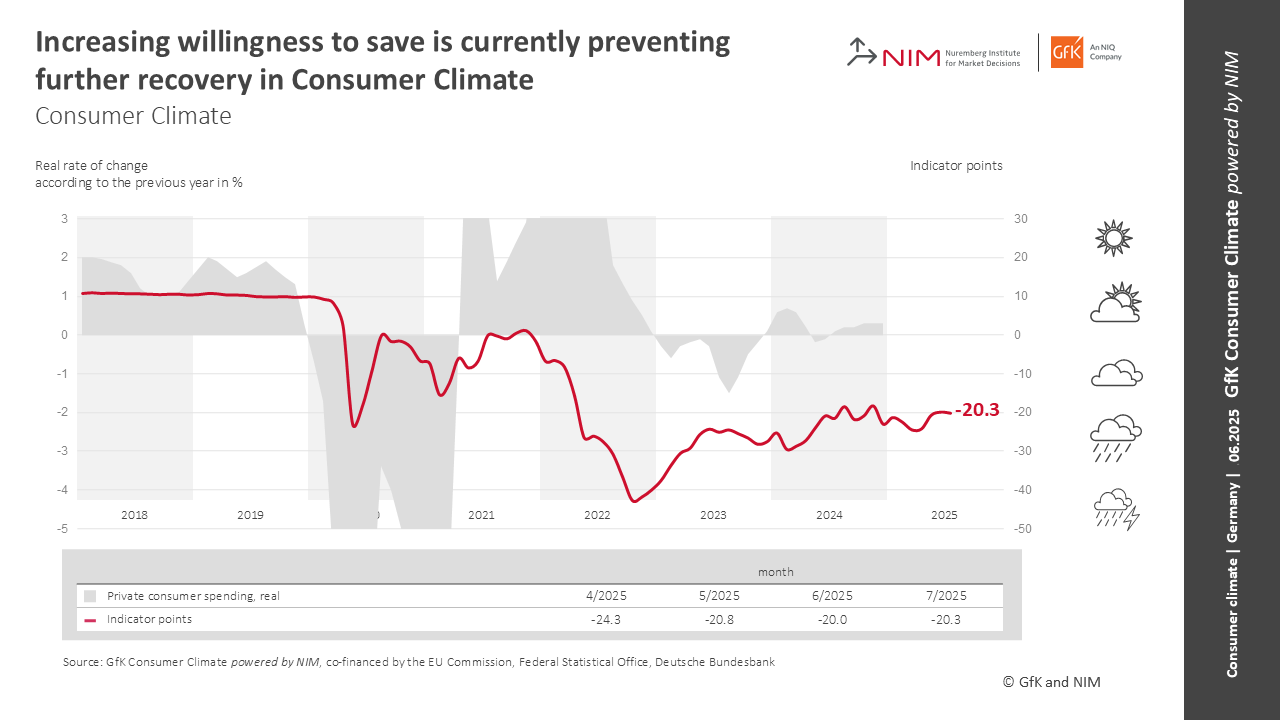
Germany’s Gfk consumer sentiment falls to -20.3, mood sours slightly as precautionary saving picks up
German consumer sentiment slipped slightly in July, with the Gfk index easing from -20.0 to -20.3, missing expectations of a recovery to -19.0.
The drop came despite a strong rebound in the economic expectations component, which surged seven points to 20.1—its highest since the early stages of the Ukraine war. Income expectations also improved for the fourth consecutive month, rising to 12.8.
Yet the consumer climate remains weighed down by caution. The willingness-to-buy index was subdued at -6.2. The notable jump in the savings indicator to 13.9, the highest since April 2024, suggests that households are still holding back on discretionary spending.
GfK’s Rolf Bürkl pointed to rising savings as a key drag, reflecting continued uncertainty and a lack of confidence in making large purchases.
US Preliminary May Trade Balance Data in Focus
In focus today
In the US, the final Q1 GDP data is set for release today. However, preliminary May trade balance data could be more interesting to follow, as it gives the first sense of how imports evolved amid the fluctuating tariff rates.
In Sweden, NIER will unveil a new batch of economic indicators at 09.00 CET. Consumer confidence has been historically low, and we would expect to see an upturn in today's release. Despite the recent uncertainty around both geopolitics and tariffs, companies have reported a more normal economic situation. We will look closer at companies' price plans, particularly in the retail sector, which despite moving somewhat lower in the past readings remain at elevated levels.
In Japan, a range of data will be released overnight, including retail sales and Tokyo inflation figures. Consumers' reluctance to spend is not least related to the high food inflation. It will be interesting to see how retail sales performed in May and how Tokyo prices have developed in June.
A string of Federal Reserve members will be speaking today as well as from ECB, including Schnabel. The market will again be looking for comments on monetary policy as well as comments on easing banking regulation in the US.
Economic and market news
What happened yesterday
In the US, Fed Chair Powell reiterated inflation concerns related to Trump's tariff plans during his Senate testimony, emphasising the need for caution to avoid persistent inflation despite calls for rate cuts this year. Powell's careful stance continues to diverge from President Trump's push for immediate rate reductions. We expect quarterly rate cuts starting from September, closely aligning with market expectations.
In Sweden, the Riksbank's June minutes were "neutral" relative to the decision and MPR. The MPR was more dovish than we expected, reflecting comfort with the inflation forecast despite elevated price plans and core inflation. Geopolitical risks and impacts are debated, with diminished upside risks to the tariff-negotiations compared to the May meeting, supporting the rate cut decision alongside weaker Q1 GDP data. Discussions on further rate cut conditions are minimal, with Thedéen advising against over-interpreting the rate path signal. We anticipate the Riksbank will act if growth remains weak and inflation pressures remain absent.
At the NATO summit, the 32 members have agreed to boost defence spending to 5% of GDP by 2035, as strongly advocated by US President Trump, and reaffirmed their commitment to mutual defence under Article 5 of the Washington Treaty - "that an attack on one is an attack on all". Countries will allocate 3.5% of GDP to core defence and 1.5% to broader defence measures. Despite the consensus, Spain expressed that it could meet its NATO commitments with lower spending, drawing criticism from Trump, who warned of potential trade consequences.
Equities: Equities ended marginally lower yesterday, but beneath the surface the tone was distinctly more constructive. Cyclicals underperformed, while the VIX slipped below 17 - reinforcing the narrative that appetite for US large cap tech and cyclicals has returned. Almost overnight, concerns around trade wars and geopolitics have receded from market consciousness, and macro data no longer seems to be weighing heavily on equity sentiment. In the US yesterday, Dow -0.3%, S&P 500 +0.00%, Nasdaq +0.3%, Russell 2000 -1.2%. Asian equities are trading mixed this morning, while US and European futures are essentially flat
FI and FX: EUR/USD gained ground during yesterday's session edging closer to the 1.17 mark fuelled by rumours of Trump looking to name a replacement for Powell already in the autumn. Following the dovish surprise cut from Norges Bank EUR/NOK has continued on a steady upwards trajectory, breaching the 11.80 mark. In yield space, there has been a modest decline in global bond yields as the ceasefire between Iran and Israel is holding up as well as Powell replacement rumours and the Federal Reserve is proposing to reduce the SLR from 5% to 3.5%-4.5%, which should make US banks able to buy US Treasuries. Hence, 10Y US Treasuries declined a few bp in Asian trade this morning. Oil remained fairly steady during yesterday's session.
GBP/USD Daily Outlook
Daily Pivots: (S1) 1.3613; (P) 1.3642; (R1) 1.3694; More...
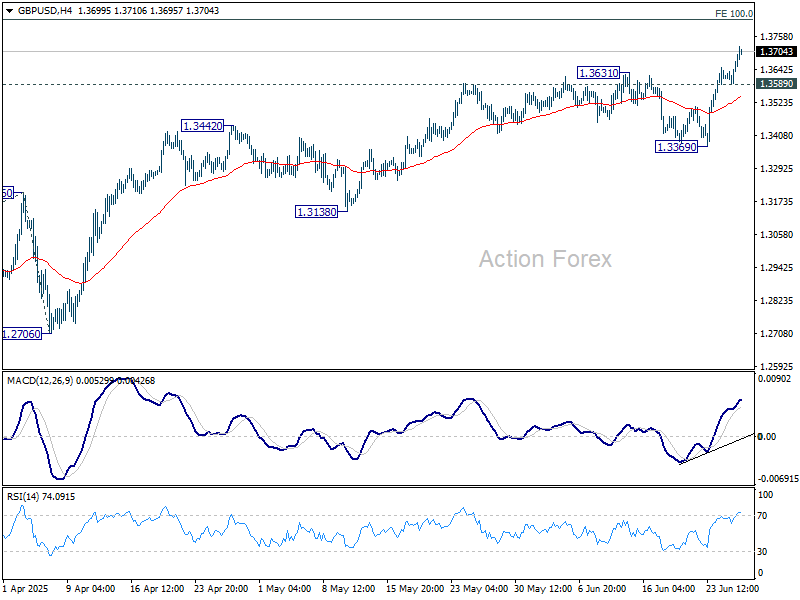
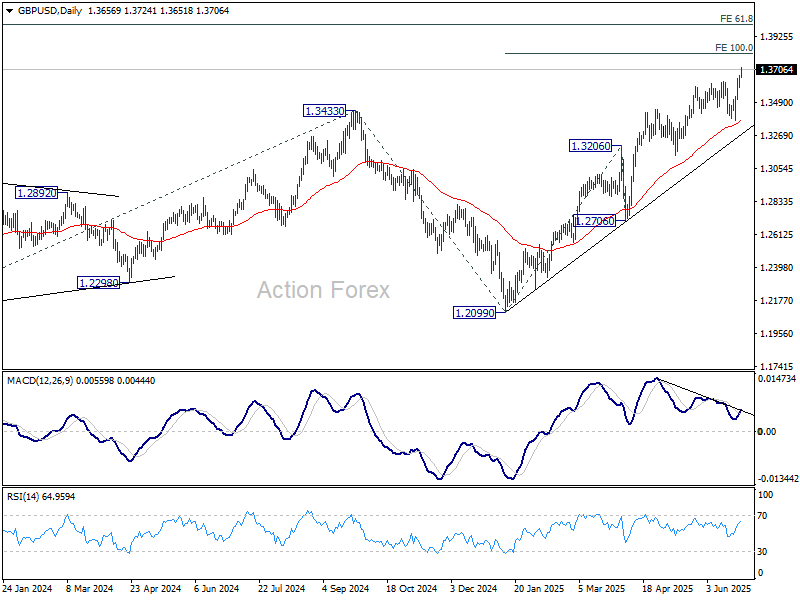
GBP/USD's rally continues today and intraday bias stays on the upside. Current rise from 1.2099 should target 100% projection of 1.2099 to 1.3206 from 1.3138 at 1.3813 next. On the downside, below 1.3589 minor support will turn intraday bias neutral and bring consolidations. But downside should be contained above 1.3369 support to bring another rally.
In the bigger picture, up trend from 1.3051 (2022 low) is in progress. Next medium term target is 61.8% projection of 1.0351 to 1.3433 from 1.2099 at 1.4004. Outlook will now stay bullish as long as 55 W EMA (now at 1.2948) holds, even in case of deep pullback.
Dollar Slides to Multi-Year Lows Against Euro, Pound on NATO Spending Boost
Dollar weakness deepened in Asian session, with the greenback falling to multi-year lows against both Euro and Sterling. For now, downside pressure remains concentrated against European majors. The latest catalyst is a show of fiscal resolve from NATO allies, who agreed to more than double their defense spending target to 5% of GDP by 2035, seen as a long-term fiscal and industrial boost to Europe’s economy and security posture.
The NATO decision breaks down into 3.5% spending on traditional military capabilities and 1.5% on broader resilience like cyber and infrastructure. While symbolic in the short term, the commitment highlights the region’s renewed strategic coherence and investment direction—drawing investor confidence at a time when the US outlook is clouded by trade policy and inflation uncertainty.
Meanwhile, Dollar has now fully reversed its recent safe-haven gains after last week's escalation in the Middle East. With the Israel-Iran ceasefire holding, even amid minor violations, markets are turning back to broader US vulnerabilities, especially fiscal risks, tariffs, and the greenback's trustworthiness as a haven asset.
Monetary policy divergence is also weighing on Dollar. While ECB may be near the end of its cycle, Fed is still expected to resume cuts later this year. Markets are increasingly convinced that a September cut is likely. And after all, Fed’s latest dot plot reflects two cuts this year, with the 2025 median rate at 3.9%,
In the currency markets, Dollar is back as the worst performer of the week, followed by the Loonie and Yen. European currencies are clearly benefiting, with Sterling leading gains, followed by Swiss franc and Euro. Aussie and Kiwi are stuck in the middle.
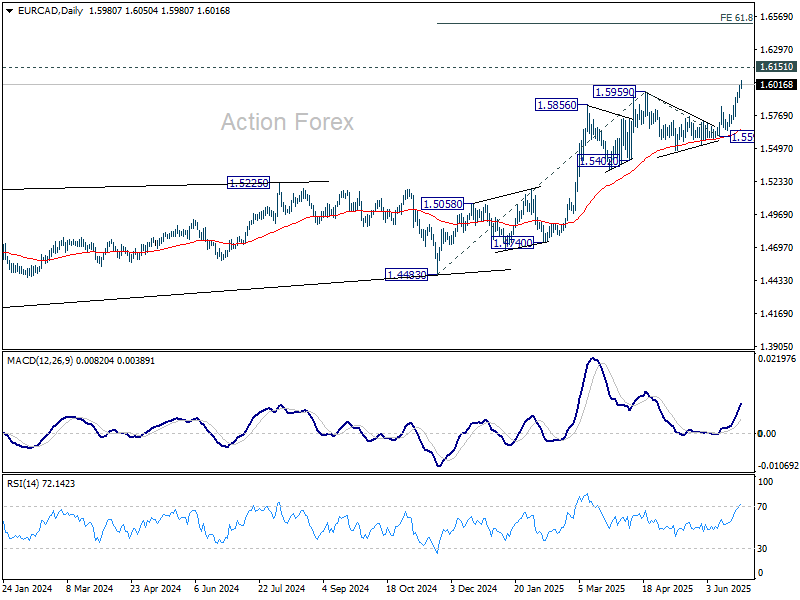
Technically, EUR/CAD's strong break of 1.5959 resistance this week confirms long term up trend resistance. Based on current momentum, there shouldn't be much difficulty in breaking through 1.6151 long term resistance (2018 higher). Next near term target is 61.8% orojection of 1.4483 to 1.5959 from 1.5598 at 1.6510.
In Asia, at the time of writing, Nikkei is up 1.49%. Hong Kong HSI is down -0.65%. China Shanghai SSE is up 0.10%. Singapore Strait Times is up 0.11%. Japan 10-year JGB yield is up 0.014 at 1.418. Overnight, DOW fell -0.25%. S&P 500 fell -0.00%. NASDAQ rose 0.31%. 10-year yield closed flat at 4.293.
Fed's Powell: No modern precedent for Trump's tariff, must proceed carefully
Fed Chair Jerome Powell defended the central bank’s cautious stance on interest rates during day two of his Congressional testimony, citing significant uncertainty around the inflationary impact of tariffs. While Powell acknowledged tariff-driven price hikes could ultimately be transitory, he said Fed must prepare for the possibility that inflation proves more persistent. “As the people who are supposed to keep stable prices, we need to manage that risk,” Powell emphasized.
Powell emphasized that the Fed is operating in largely uncharted territory, warning that the magnitude of potential new tariffs dwarfs those imposed during Trump’s first term, and those earlier measures came when inflation was subdued. “There is not a modern precedent,” he said, cautioning against prematurely adjusting policy without a clearer picture of the economic impact.
“If it comes in quickly and it is over and done, then yes, very likely it is a one-time thing,” he said of tariff inflation. But if the Fed misjudges the situation, “people will pay the cost for a long time.”
GBP/USD Daily Outlook
Daily Pivots: (S1) 1.3613; (P) 1.3642; (R1) 1.3694; More...
GBP/USD's rally continues today and intraday bias stays on the upside. Current rise from 1.2099 should target 100% projection of 1.2099 to 1.3206 from 1.3138 at 1.3813 next. On the downside, below 1.3589 minor support will turn intraday bias neutral and bring consolidations. But downside should be contained above 1.3369 support to bring another rally.
In the bigger picture, up trend from 1.3051 (2022 low) is in progress. Next medium term target is 61.8% projection of 1.0351 to 1.3433 from 1.2099 at 1.4004. Outlook will now stay bullish as long as 55 W EMA (now at 1.2948) holds, even in case of deep pullback.
Bypassing Powell
Trump denied earlier intelligence reports suggesting that the US strikes on Iranian nuclear sites caused only limited damage. On the contrary, he claimed the operation was a historic success and even declared the war over — ‘except that it could maybe restart soon.’ Still, the US and Iran are scheduled to meet for diplomatic talks in Iran this weekend, which appears to be a signal that Trump genuinely wants to de-escalate tensions in the Middle East.
US crude is consolidating near its 100-DMA, just above the critical $65pb level — a major Fibonacci retracement of this year’s decline. This line distinguishes between a continuation of the latest rally and a return to the bearish trend that has been building since the start of the year.
But geopolitics aside, the supply-demand dynamics continue to favour softer oil prices. Global demand prospects are weakening due to trade uncertainties, while supply is ample thanks to faster production restoration from OPEC+. Russia said yesterday it’s open to another output hike at the next OPEC+ meeting due on July 6th. So, if Middle East tensions are truly done and dusted, oil is more likely than not to fall back toward, or even below, the $60pb level.
That’s good news for the Federal Reserve’s (Fed) inflation battle — but unfortunately, it’s not the only risk factor. The real threat to US inflation now is tariffs, and there’s been little progress on that front. Fed Chair Powell keeps insisting the US doesn’t need to rush into rate cuts until there’s more clarity on trade policy. But no one listens — even less so now, as there’s growing concern that Trump could prematurely appoint the next Fed Chair to sideline Powell, who has resisted rate cuts. A new Trump-approved Chair would likely be more willing to cut rates, pleasing Trump, who insists the U.S has no inflation problem. Technically, that’s true — for now. But it could, and that’s the problem.
That said, don’t forget: cutting rates doesn’t guarantee yields will fall. If markets perceive a policy mistake, yields could disconnect from the policy rate — that’s called a loss of credibility. So lower rates — if not justified — aren’t necessarily good news for sovereign bonds. US debt is exploding, and Trump’s spending cuts on social programs don’t come close to offsetting the tax benefits granted to the wealthiest Americans. Debt will rise, and the US must ensure global markets absorb this additional issuance — essentially, to keep funding a policy that makes rich Americans richer. The problem? Investors are backing off. There’s growing appetite for ex-US sovereign bonds, especially in Europe.
In short, Trump has power to do a lot, but he still needs funding. Investors will have the final say.
Dollar pain, equity gain
The US dollar remains heavily unloved. The dollar index continues to slide, despite Powell’s cautiously hawkish tone. But a weaker dollar supports major US equities, as about 40% of S&P 500 revenues come from abroad, including 10–12% from Europe and around 8–10% from Asia. As the dollar weakens (or other currencies strengthen), overseas revenues translate into higher dollar earnings for S&P 500 companies.
Still, a recent Bloomberg Intelligence analysis — factoring in Treasury yields, earnings, and the equity risk premium — warns that S&P 500 earnings would need to rise by as much as 30% over the next year for current valuations to be considered ‘fair.’ Is that possible? It seems stretched for the S&P 493 — but perhaps not for the AI leaders.
Micron just announced stronger-than-expected revenue and gave an upbeat forecast for the current quarter, driven by AI demand. Its high-bandwidth memory chips — essential for running AI tools — are selling like petits pains, as the French say. The company is betting on rising demand for increasingly complex chips to fuel further growth. Micron shares have doubled since their April dip, though they remain below last summer’s highs.
Elsewhere, Nvidia hit a fresh record yesterday. CEO Jensen Huang is now looking beyond both the US and AI — toward robotics — to expand market share. The Middle East and Europe may become the next big markets to help fill the gap left by Trump’s export restrictions to China.
But stepping back to the S&P 500 more broadly, trade risks loom and could hurt sentiment in the short run.
On the geopolitical front, Trump is now furious with Spain, which declined to raise its military budget to 5% of GDP, unlike several other NATO members this week. European stocks fell yesterday, with the Spanish IBEX underperforming. Meanwhile, defense stocks rallied nearly 2% after Babcock announced its first-ever buyback — a move that confirms the boom in European military spending. The company also raised its dividend and boosted medium-term guidance, sending the stock up more than 10%.
The EUR/USD traded past 1.17, and Cable climbed above 1.37. The next natural targets are 1.20 for euro bulls, and 1.40 for Cable. Pullbacks may offer attractive dip-buying opportunities — not because the European economies are particularly strong, but because spending plans are solidly funded… and the dollar is weakening.
RBA Cut Likely in July, But No Shoo-in
July RBA cash rate cut now expected, moved forward from August, but this is no shoo-in.
- We now expect the next RBA rate cut to be in July rather than August, but this is not the shoo-in the market seems to think it is.
- The RBA has sometimes defied market pricing if offshore risks are being over-weighted, but now is the time to bring forward a move it knows it will likely make soon anyway.
- The RBA’s outlook is still shaped by concerns about the tight labour market, slow economy-wide productivity growth and the pricing implications of recovering demand. Thus we expect non-committal, even grudging, language in the post-meeting communication.
- We continue to expect a terminal rate of 2.85% (three further cuts after the upcoming one), but the RBA is unlikely to give any forward guidance in that vein.
The next RBA rate cut is now expected to be in July rather than August, but this is not the shoo-in that markets seem to think it is. Yes, the May monthly CPI indicator came in below even the low number that we expected. That helps bring forward inflation’s return to the 2.5% target midpoint and keep it there, which is what the RBA is trying to achieve. The detail around housing and market services was also a promising sign that core inflation is seeing a sustained moderation. But the June quarterly inflation numbers are still likely to print on the high side, so some caution on the inflation outlook is likely and warranted.
One month’s data ordinarily wouldn’t – and shouldn’t – determine the RBA’s forecast and decision-making. We also note the Governor’s particular caution about the monthly CPI indicator expressed in the May post-meeting media conference. This was an explicit steer that the RBA’s thinking in May was that it did not plan to do back-to-back cuts but would wait for the quarterly CPI ahead of its August meeting. And they still might do that, but it is harder to justify now.
Moving more quickly than the ‘cautious and predictable’ path flagged in May implies that the RBA’s forecasts need to shift. The May SMP showed a forecast for trimmed mean inflation flat as a pancake at 2.6% as far as the forecasts went, never touching the 2.5% midpoint. No model produces a forecast like that. It was more of a message than a true forecast.
That message was that they are still worried about domestic inflation pressures. They think the labour market is still too tight – and productivity growth too weak – to move quickly. Last week’s labour force and today’s job vacancies data would have reinforced this view. Neither is the RBA planning to bring monetary policy to an expansionary stance – this point was also explicitly mentioned in the Minutes.
That 2.6% forecast was the RBA saying it thought it would end up cutting by less than the market was pricing in May, the path on which the RBA’s forecasts were based. Discussion of a 50 basis point cut at the May meeting was just that – discussion. Recall that the Board also discussed keeping the cash rate on hold.
We expect that the inflation evidence will overtake the RBA’s thesis of domestic tightness over time. But we do not think they are going to start singing from an entirely different song sheet just yet. It would be an extraordinary pivot to let go of an analysis of the economy that it has held on to for so long – even in the face of widespread criticism – without any prior communication. And it would be inconsistent with the RBA’s recent pattern of taking a couple of quarters and a bit of counter-arguing before it comes back from a view that is well outside market consensus. (Though with more than a week to go until the next Board meeting still, perhaps an event will be rustled up beforehand.)
Rather, what we are about to see is an RBA that was planning to cut rates soon anyway deciding it may as well get on with it rather than make a contestable argument for further delay.
Note that this is not just about validating market pricing. The RBA is not the Fed: it is less worried about ‘surprising the market’, as we saw in May 2023. If it really did not think it should cut the cash rate soon, it would not be swayed by the market. Indeed, the RBA has form for not cutting rates when markets are pricing a cut, especially if market pricing is keying off assumed negative implications of shocks from offshore that the RBA thinks are overdone. There is an element of that situation currently, a point alluded to in the Deputy Governor’s remarks in late May.
In short, only because the RBA sees itself on a path of cutting rates soon will it decide to validate market pricing and get on with the next cut at its July meeting. But this is not the timing it previously thought it would be on. Given the lingering uncertainties and the RBA’s concerns about a tight labour market, expect its post-meeting language to be non-committal, even a little grudging about the decision to cut.
We still think there are three further cuts after the next one (terminal rate 2.85%), but the timing will depend on the RBA’s post-meeting tone. As flagged when we first added the third and fourth cuts to our call, the risks are that they come sooner than February and May next year.
Gold Slips Lower — Downside Risk Builds Below Key Support
Key Highlights
- Gold started a fresh decline from the $3,450 resistance.
- A key bearish trend line is forming with resistance at $3,360 on the 4-hour chart.
- WTI Crude Oil prices dipped sharply below the $68.00 support.
- The US GDP could contract by 0.2% in Q1 2025.
Gold Price Technical Analysis
Gold prices failed to extend gains above $3,450 and reacted to the downside. There was a steady decline below the $3,400 and $3,380 support levels.
The 4-hour chart of XAU/USD indicates that the price settled below the $3,350 level and the 100 Simple Moving Average (red, 4 hours). The decline was such that the price spiked below the $3,300 level and the 200 Simple Moving Average (green, 4 hours).
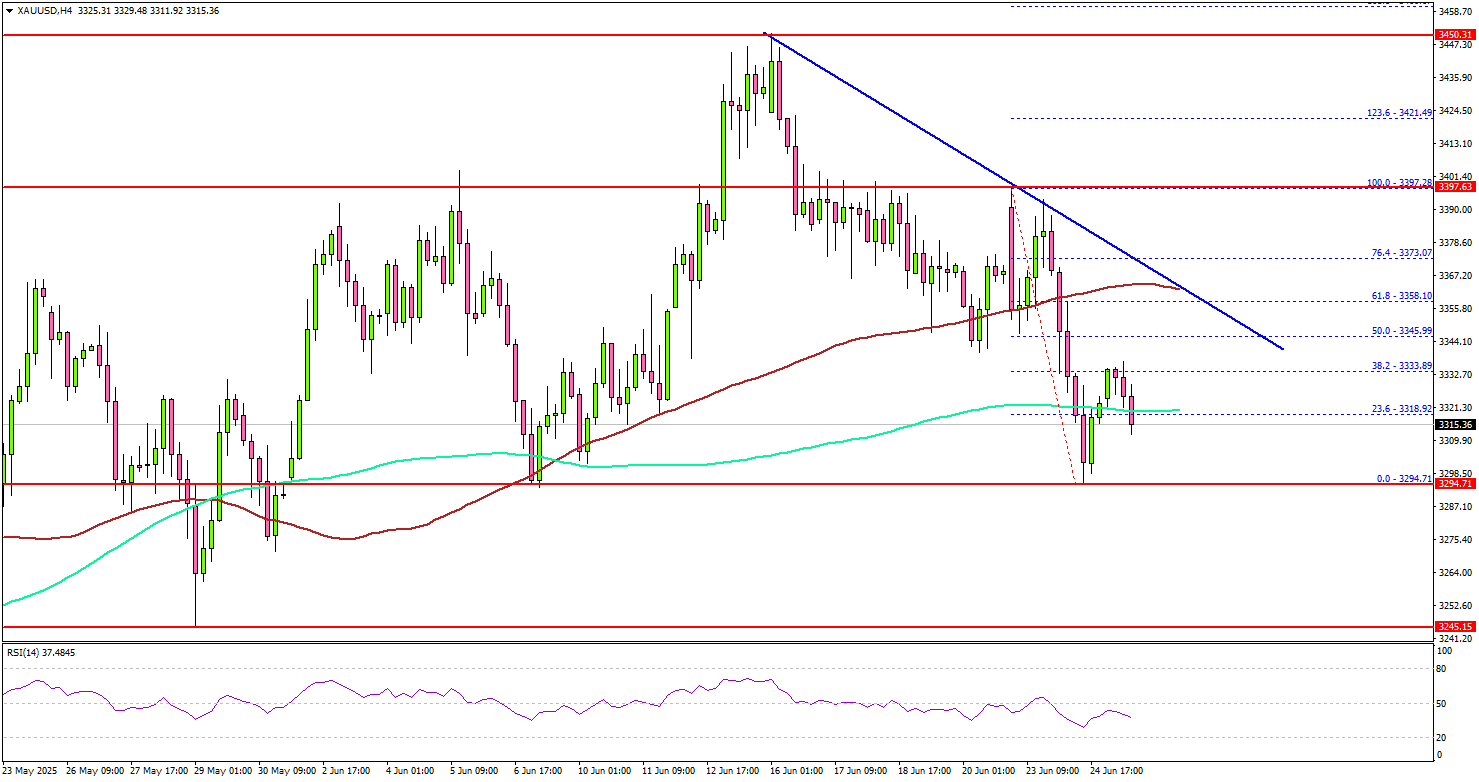
On the downside, initial support is near the $3,295 level. The first key support is $3,275. The next major support is near the $3,450 level. The main support is now $3,230. A downside break below the $3,230 support might call for more downsides. The next major support is near the $3,200 level.
On the upside, immediate resistance is near the $3,335 level. The next major resistance sits near the $3,350 level. The main barrier could be $3,360.
There is also a key bearish trend line forming with resistance at $3,360 on the same chart. A clear move above the $3,360 resistance could open the doors for more upsides. The next major resistance could be $3,400, above which the price could rally toward the milestone level of $3,450.
Looking at WTI Crude Oil, the bears took control and were able to push the price below the $68.00 support zone.
Economic Releases to Watch Today
- US Initial Jobless Claims - Forecast 245K, versus 245K previous.
- US Gross Domestic Product for Q1 2025 – Forecast -0.2% versus previous -0.2%.
- US Durable Goods Orders for May 2025 – Forecast +8.5% versus -6.3% previous.
Fed’s Powell: No modern precedent for Trump’s tariff, must proceed carefully
Fed Chair Jerome Powell defended the central bank’s cautious stance on interest rates during day two of his Congressional testimony, citing significant uncertainty around the inflationary impact of tariffs. While Powell acknowledged tariff-driven price hikes could ultimately be transitory, he said Fed must prepare for the possibility that inflation proves more persistent. “As the people who are supposed to keep stable prices, we need to manage that risk,” Powell emphasized.
Powell emphasized that the Fed is operating in largely uncharted territory, warning that the magnitude of potential new tariffs dwarfs those imposed during Trump’s first term, and those earlier measures came when inflation was subdued. “There is not a modern precedent,” he said, cautioning against prematurely adjusting policy without a clearer picture of the economic impact.
“If it comes in quickly and it is over and done, then yes, very likely it is a one-time thing,” he said of tariff inflation. But if the Fed misjudges the situation, “people will pay the cost for a long time.”