Sample Category Title
USD/CHF Mid-Day Outlook
Daily Pivots: (S1) 0.9860; (P) 0.9892; (R1) 0.9927; More...
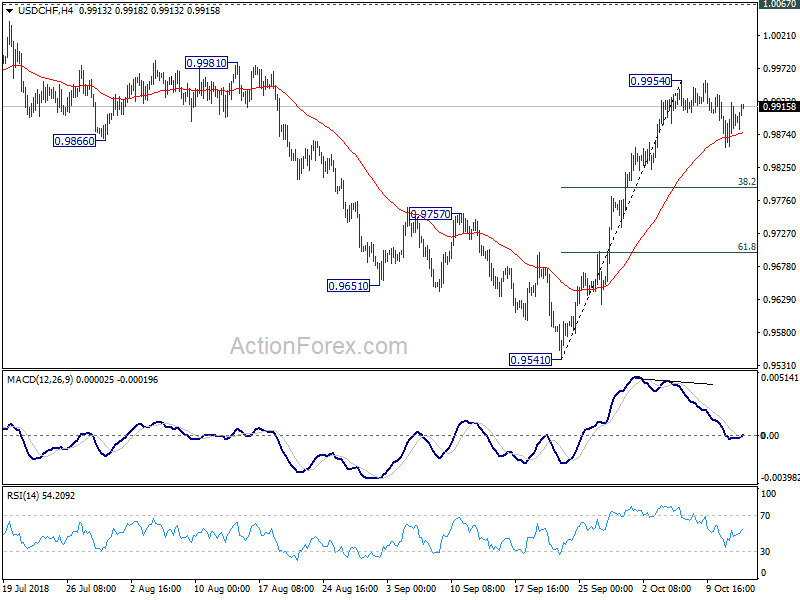
Intraday bias in USD/CHF is turned neutral with today's recovery, after drawing support from 4 hour 55 EMA. Consolidation from 0.9954 could extend with another decline. But in that case, we'd expect strong support from 38.2% retracement of 0.9541 to 0.9954 at 0.9796 to bring rebound, and then rise resumption. On the upside, break of 0.9954 will resume the rally from 0.90541 and target 1.0067 resistance next.
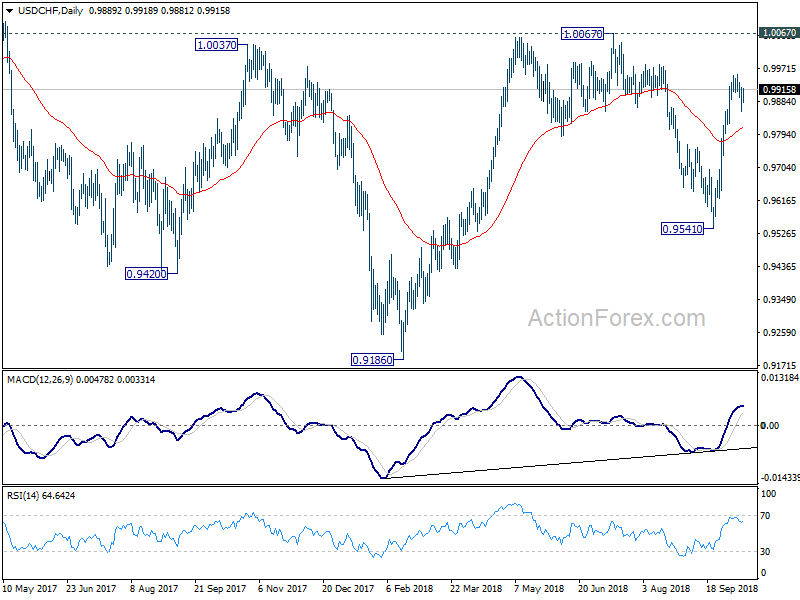
In the bigger picture, the pullback from 1.0067 has completed at 0.9541 already. And rise from 0.9186 is likely resuming. Firm break of 1.0067 will pave the way to retest 1.0342 key resistance. We'd be cautious on strong resistance from there to limit upside to bring another medium term fall to extend long term range trading.
EUR/USD Mid-Day Outlook
Daily Pivots: (S1) 1.1543; (P) 1.1571; (R1) 1.1623; More.....
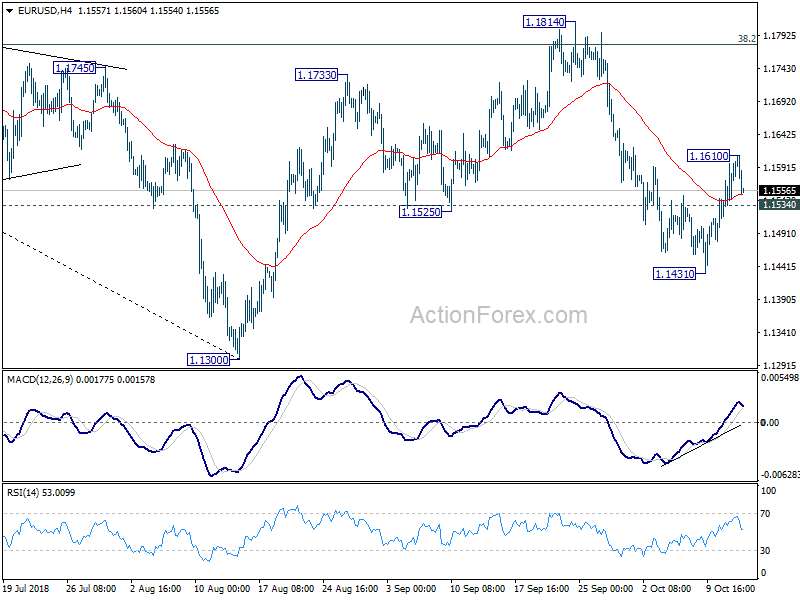
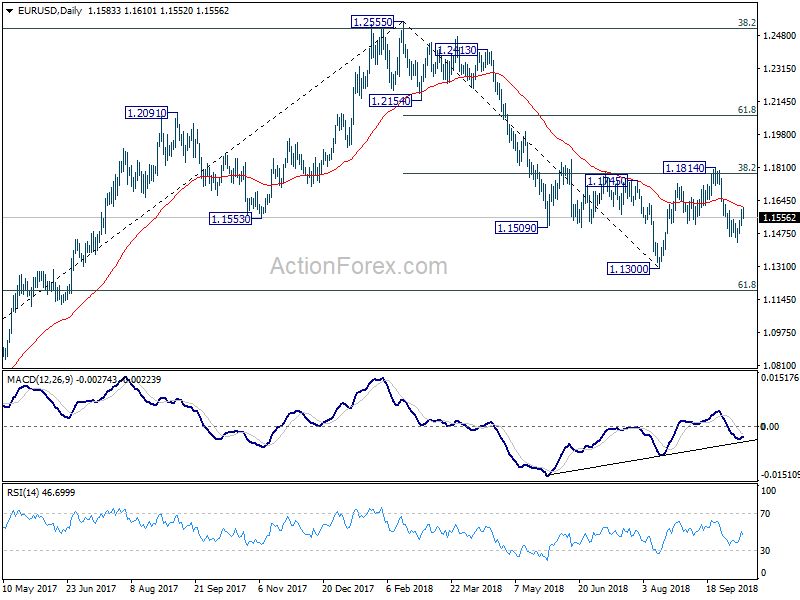
A temporary top should be in place at 1.1610 and intraday bias in EUR/USD is turned neutral first. On the downside, below 1.1534 minor support will indicate completion of rebound from 1.1431. Intraday bias will be turned back to the downside for 1.1431 and then 1.1300 low. On the upside, above 1.1610 will bring another rebound. But still, we'd expect upside to be limited by 1.1779/1814 resistance zone to bring down trend resumption eventually.
In the bigger picture, corrective pattern from 1.1300 could have completed at 1.1814 after hitting 38.2% retracement of 1.2555 to 1.1300 at 1.1779. Decisive break of 1.1300 will resume the down trend from 1.2555 to 61.8% retracement of 1.0339 (2017 low) to 1.2555 at 1.1186 next. Sustained break there will pave the way to retest 1.0339. On the upside, break of 1.1814 will delay the bearish case and extend the correction from 1.1300 with another rise before completion.
Rebound in Global Stocks Lifts Dollar, Treasury Mnuchin also Helps
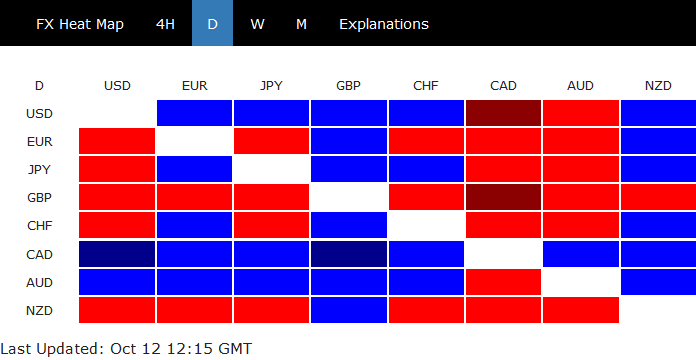
Global equities rebound and are paring back some of this week's steep losses ahead of weekly close. Dollar is also recovering, in particular against Euro and Sterling. US Treasury Secretary Steven Mnuchin comment on Fed also helped give the greenback a mild lift. But for today, Canadian and Australian Dollar are the strongest one so far, while Dollar is the third. On the other hand, Sterling is the weakest one, followed by Euro.
At the time of writing, US futures point to sharply higher open, with triple digit gain in DOW. FTSE is up 0.74%, DAX up 0.74% and CAC up 0.81%. German-Italian spread stays above 300. Italian 10 year yield is down -0.025 at 3.545. German 10 year yield is down -0.008 at 0.512. Earlier today, all major Asian indices closed with gains. Nikkei rose 0.46%, Singapore Strait Times up 0.71%> Hong Kong HSI added 2.21%. China Shanghai SSE gained 0.91% to 2606.91, but still below prior key support at 2638.
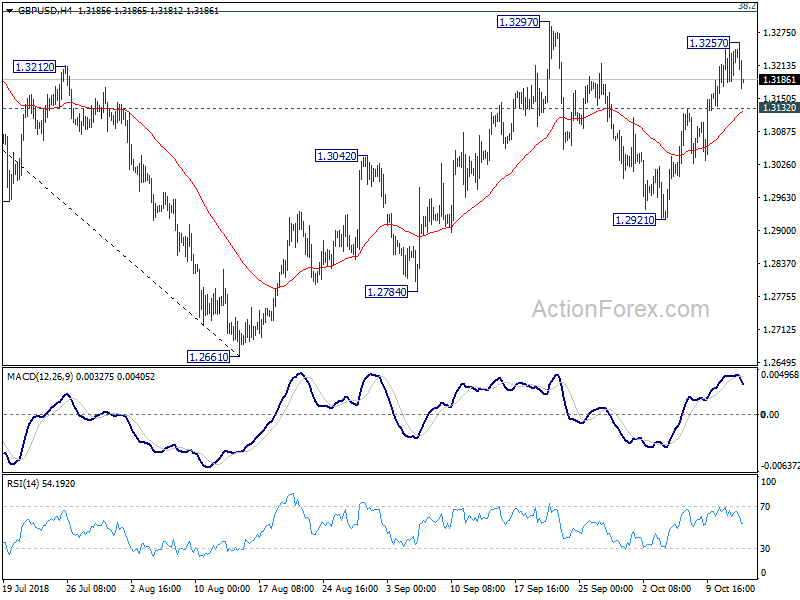
Technically, with Dollar's rebound, focus is now turned to 1.1534 minor support in EUR/USD and 1.3132 minor support in GBP/USD. Break of these two levels will indicate completion of this week's rebound and could trigger more upside in the greenback.
US Mnuchin on Chinese Yuan, trade and Fed
US Treasury Secretary Steve Mnuchin met with China PBoC Governor Yi Gang on the sidelines of the IMF summit in Indonesia. Mnuchin said after the meeting that "I expressed my concern about the weakness in the (yuan) currency and that as part of any trade discussions, currency has to be part of the discussion. And he added that "we had a productive explanation from his standpoint on those issues" regarding Yuan's depreciation against Dollar. It's reported that Yi told people in a closed-door session that China's monetary policy was on an opposite cycle to that of the US.
Mnuchin declined to comment on whether China would be named a currency manipulator in the upcoming Treasury report. But he emphasized that "The currency report is something we report to Congress. It is done pursuant to two separate pieces of legislation. This is not a political document." But on trade, Mnuchin insisted that"It has to be that we can reach an agreement on action items that can rebalance the relationship. We've made it clear that if they have real action items that they want to discuss that we will listen."
On Fed, Mnuchin said "The president likes low interest rates. The president is concerned about the Fed raising interest rates too much and slowing down the economy and those are obviously natural concerns." Meanwhile he called this week's stock market rout as a "natural correction after the markets were up a lot". And according to Mnuchin, it's not related to high interest rates and Fed policy and "there's really no new information in the market on the Fed or on trade for that matter."
ECB Draghi: Cliff-edge Brexit a significant downside risk to financial stability
ECB President Mario Draghi reiterated in an IMF conference that "broad-based growth in the euro area will continue." He added the central bank's policy measures "continue to underpin domestic demand, which remains the mainstay of the ongoing expansion." Global expansion will also continue to benefit Eurozone exports.
On inflation, higher headline inflation reflected rise in energy prices. "While measures of underlying inflation remain generally muted, they have been increasing from earlier lows." And he echoed the monetary policy account that "uncertainty around the inflation outlook is receding." While ECB is on course to stop asset purchases, he emphasized that "significant monetary policy stimulus is still needed to support the further build-up of domestic price pressures and headline inflation developments over the medium term."
On financial stability, he said "recent episodes of heightened financial market volatility have led to only limited contagion across countries and markets." However, "the uncertainty triggered by a cliff-edge Brexit could have the potential to pose a more significant downside risk to financial stability."
UK Hammond on Brexit negotiation: Positive process, challenging substance
Chancellor of the Exchequer Philip Hammond said that there are still big issues to resolve in Brexit negotiation. He said "what has happened over the last week, ten days, is that there has been a measurable change in pace." However, "that shouldn't conceal the fact that we still have some big differences left to resolve. So process is a lot more positive this week – substance still very challenging."
European Commission President Jean-Claude Juncker emphasized that "Those who place all their bets on the scenario of a no-deal are wrong: we will have to find a deal. And I think we will find it," He added that "the Irish issue is obviously extra difficult. It's true we are not where we should be to strike a deal."
China exports to US grew despite trade war, imports shrank for another month
China's trade surplus surprisingly widened in September, as trade surplus with US jumped to record high at USD 34.1B. As trade war started and escalated to another phase, exports to US continued to grow while imports from the US contracted for another month. For the year as a whole, China continued to have faster import growth with EU, than exports.
In USD terms, China's trade surplus widened to USD 31.7B in September, well above expectation of USD 19.4B. Exports rose 14.5% yoy to USD 226.7B. Import rose 14.3% yoy to 195.0B.
For the month of September
- Exports to EU rose 1.2% mom, 11.4% yoy to USD 37.4B. Imports from EU dropped -0.6% mom, rose 9.1% yoy to USD 24.7B. Trade surplus rose 9.9%, 37.7% yoy to USD 12.7B.
- Exports to US rose 5.2% mom, 14.0% yoy to USD 46.7B. Imports from US dropped -5.8% mom, -2.3% yoy to USD 12.6B. Trade surplus rose 9.9% mom, 21.5% yoy to USD 34.1B.
From January to September
- Exports to EU rose 11.4% yoy to USD 301.5B. Imports from EU rose 14.1% to USD 205.2B. Trade surplus rose 6.1% yoy to USD 96.3B.
- Exports to US rose 12.9% yoy to 348.8B. Imports from US rose 8.3% to USD 123.0B. Trade surplus rose 15.5% to USD 225.8B.
Elsewhere
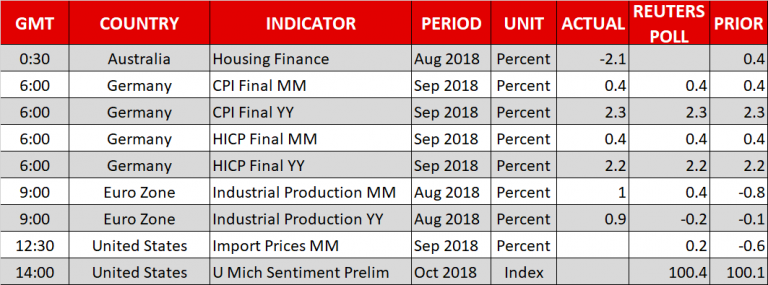
New Zealand BusinessNZ manufacturing PMI dropped 0.3 to 51.7 in September. Australia home loans dropped -2.1% mom in August. Japan M3 rose 2.8% yoy in September. Tertiary industry index rose 0.5% mom in August. German CPI was finalized at 2.3% yoy in September, unrevised. Eurozone industrial production rose 1.0% mom in August, above expectation of 0.4% mom. US import price index rose 0.5% mom in September.
GBP/USD Mid-Day Outlook
Daily Pivots: (S1) 1.3195; (P) 1.3222; (R1) 1.3261; More...
With 4 hour MACD crossed below signal line, a temporary top is formed at 1.3257. Intraday bias in GBP/USD is turned neutral first. Another rise cannot be ruled out yet. But we'd still expect upside to be limited by 1.3316 key fibonacci level to limit upside to bring down trend resumption eventually. On the downside, below 1.3132 minor support will turn bias back to the downside for 1.2921 first. However, sustained break of 1.3316 would pave the way to next fibonacci level at 1.3721.
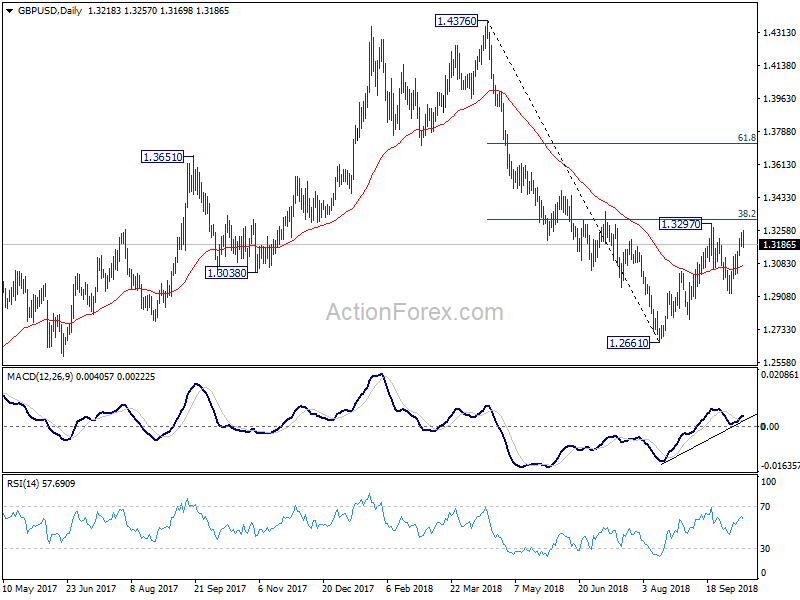
In the bigger picture, whole medium term rebound from 1.1946 (2016 low) should have completed at 1.4376 already, after rejection from 55 month EMA (now at 1.4062). The structure and momentum of the fall from 1.4376 argues that it's resuming long term down trend. And this will be the preferred case as long as 38.2% retracement of 1.4376 to 1.2661 at 1.3316 holds. However, firm break of 1.3316 would bring stronger rebound to 61.8% retracement at 1.3721. And, the eventual depth of the fall from 1.4376, and the chance of hitting 1.1946 low, will depend on the strength of the interim corrective rebound from 1.2661.
Economic Indicators Update
| GMT | Ccy | Events | Actual | Forecast | Previous | Revised |
|---|---|---|---|---|---|---|
| 21:30 | NZD | BusinessNZ Manufacturing PMI Sep | 51.7 | 52 | ||
| 23:50 | JPY | Japan Money Stock M2+CD Y/Y Sep | 2.80% | 2.90% | 2.90% | |
| 0:30 | AUD | Home Loans M/M Aug | -2.10% | -0.90% | 0.40% | 0.00% |
| 2:54 | CNY | Trade Balance (USD) Sep | 31.7B | 19.4B | 27.9B | |
| 2:54 | CNY | Trade Balance (CNY) Sep | 213B | 192.3B | 179.8B | |
| 4:30 | JPY | Tertiary Industry Index M/M Aug | 0.50% | 0.30% | 0.10% | -0.10% |
| 6:00 | EUR | German CPI M/M Sep F | 0.40% | 0.40% | 0.40% | |
| 6:00 | EUR | German CPI Y/Y Sep F | 2.30% | 2.30% | 2.30% | |
| 9:00 | EUR | Eurozone Industrial Production M/M Aug | 1.00% | 0.40% | -0.80% | -0.70% |
| 12:30 | USD | Import Price Index M/M Sep | 0.50% | 0.30% | -0.60% | -0.40% |
| 14:00 | USD | U. of Mich. Sentiment Oct P | 100.9 | 100.1 |
GBP/USD Mid-Day Outlook
Daily Pivots: (S1) 1.3195; (P) 1.3222; (R1) 1.3261; More...
With 4 hour MACD crossed below signal line, a temporary top is formed at 1.3257. Intraday bias in GBP/USD is turned neutral first. Another rise cannot be ruled out yet. But we'd still expect upside to be limited by 1.3316 key fibonacci level to limit upside to bring down trend resumption eventually. On the downside, below 1.3132 minor support will turn bias back to the downside for 1.2921 first. However, sustained break of 1.3316 would pave the way to next fibonacci level at 1.3721.
In the bigger picture, whole medium term rebound from 1.1946 (2016 low) should have completed at 1.4376 already, after rejection from 55 month EMA (now at 1.4062). The structure and momentum of the fall from 1.4376 argues that it's resuming long term down trend. And this will be the preferred case as long as 38.2% retracement of 1.4376 to 1.2661 at 1.3316 holds. However, firm break of 1.3316 would bring stronger rebound to 61.8% retracement at 1.3721. And, the eventual depth of the fall from 1.4376, and the chance of hitting 1.1946 low, will depend on the strength of the interim corrective rebound from 1.2661.
Euro, Pound Erase Gains; Equities Take off as Risk-off Recedes
Here are the latest developments in global markets:
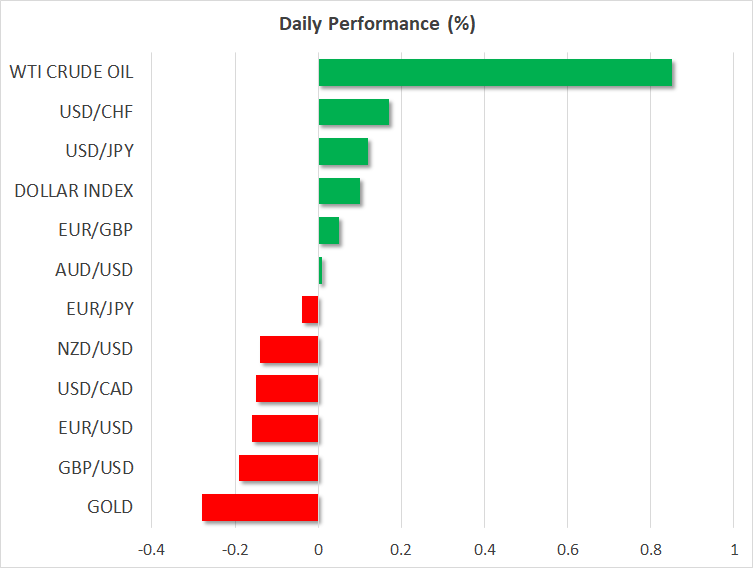
- FOREX: Dollar/yen moved off one-month lows, trading marginally up at 112.32 (+0.13%) as US 10-year Treasury yields slightly rebounded despite US President’s criticism on monetary policy and as risk aversion eased. Trade fears also somewhat calmed down after Chinese exports in September surprised analysts, showing a double-digit growth of 14.5% y/y, the highest since February, while imports appeared weaker than expected. News that the US and the Chinese President could hold a meeting in November and headlines stating that the US Treasury Department will not accuse China of manipulating its currency at its twice-yearly currency report to be issued next week were supporting sentiment. The dollar index was flat at 95.09 as the euro and the pound were giving up gains. Euro/dollar retreated to 1.1577 (-0.16%), shrugging off upbeat EU industrial production figures which returned to positive territory in August, growing about 1.0% in both monthly and yearly terms. Meanwhile speaking at the IMF’s annual meeting in Bali, ECB chief Mario Draghi reiterated that inflation risks are receding, and underlying inflation is expected to pick up steam by the end of the year, adding though that monetary stimulus is still needed. He also mentioned that a cliff-edge Brexit could potentially threaten financial stability. Although markets were positive that Brexit talks could make progress in the coming weeks, pound/dollar shifted back down to 1.3212 (-0.18%) after hitting a fresh 3-week high of 1.3258. Earlier today the British Finance Minister said that Brexit negotiations have improved pace recently, but significant differences remain to be solved. Dollar/loonie fell to 1.3009 (-0.14%). In antipodean currencies, aussie/dollar was steady, while kiwi/dollar was also down by an equivalent percentage even after New Zealand’s finance minister said that he is comfortable with the currency. In emerging markets, the Turkish lira strengthened by 1.06% versus the dollar on speculation that the American pastor detained in Turkey would probably get released soon. The South African rand was the best performer, surging by 1.38% against the greenback
- STOCKS: The calm in the markets helped European stocks to recover significantly on Friday after a strong sell-off on Thursday and before the earnings season kicks off later today, with US banks reporting earnings results for the third quarter before the US bell. At 1140 GMT, the pan-European STOXX 600 and the blue-chip Euro STOXX 50 were trading higher by 0.65% and 0.56% respectively with all sectors being in the green, though both were set to close weaker for the third consecutive week near 2-year lows. The German DAX 30 was up by 0.59%, the French CAC 40 rose by 0.76%, while the Italian FTSE MIB gained 0.66%. UK’s FTSE 100 climbed by 0.71%. In Asia, equities closed in positive territory, with South Korean stocks (+2.0%) outperforming their Japanese and Chinese rivals. In the US, stocks were ready to open strongly equities index futures suggest.
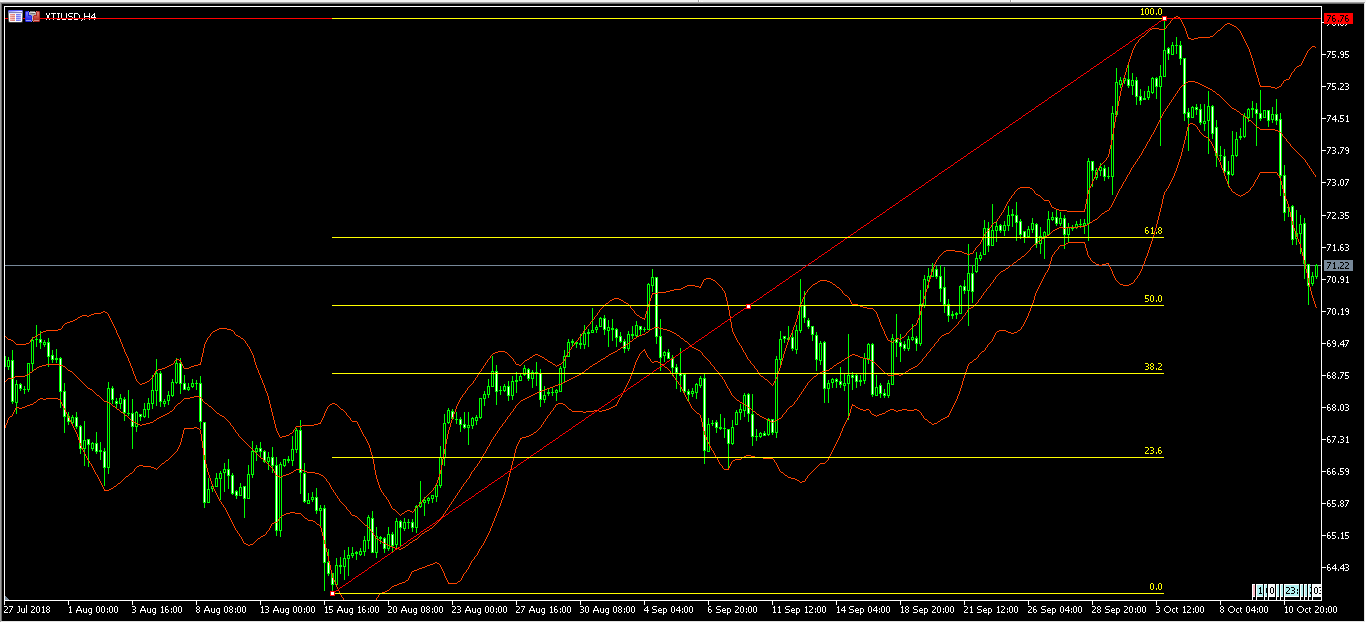
- COMMODITIES: Crude oil prices were in bullish mode on Friday but on track to mark the biggest weekly loss since February following sharp declines in the past two days. The Paris-based energy watchdog EIA cut oil demand growth forecasts for 2018 and 2019 by 0.11 million bpd to 1.28mn and 1.36mn correspondingly. The institute also said that the market is “adequately supplied” for now as the US and Russia have increased production sharply since May. OPEC also boosted production to offset shortages in Iran and Venezuela. Yet it admitted that the world’s spare capacity is already down by 2.0% of global demand. Chinese crude daily imports hit the highest in four months to build up inventories before winter trade data showed. WTI crude was up by 0.85% at $71.57 and Brent was higher by 0.47% at $80.64. In precious metals, gold pulled back from a 2 ½-month high of $1226.25/ounce to trade at $1221 (-0.22%).
Day Ahead: IMF and World meeting in focus; University of Michigan consumer sentiment pending
Friday will be relatively quiet in terms of data releases in the rest of the day, with the US being the only one to give clues on economic trends.
At 1400 GMT, the University of Michigan will deliver preliminary readings on consumer sentiment and inflation expectations for the month of October. Estimates on consumer sentiment are forecasting that the index might inch up to 100.4 compared to 100.1 in the previous month, while the survey related to inflation expectations will attract interest following disappointing but still strong US CPI numbers on Thursday. Earlier at 1230 GMT, US import and export prices for September will also give an indication on inflation. A weaker than expected rise in consumer prices drove the dollar lower against major currencies yesterday, with traders turning somewhat cautious about the Fed’s future rate hikes.
In energy markets, the US Baker Hughes oil rig count is due at 1700 GMT.
In terms of public appearances, Federal Reserve Bank of Chicago President Charles Evans (non-voting FOMC member in 2018) speaks on current economic conditions and monetary policy at 1330 GMT and Federal Reserve Bank of Atlanta President Raphael Bostic (voting member) participates in a discussion at 1545 GMT. Moreover, on the agenda is the Bank of England’s chief economist, Andy Haldane, who will be participating in an event at 1400 GMT.
In Bali, Indonesia, the International Monetary Fund and World Bank will start their annual meeting to discuss work on global financial and economic issues, with many influential central bankers attending the event, among them the ECB Mario Draghi who will be speaking on Saturday as well.
Traders will be watching US-Turkish political developments too, as the American pastor detained in Turkey with terrorism charges returns to court on Friday. Sources stated that a deal is likely on the table and the pastor could be released in the coming days. Note that his detention caused damage to US-Turkish relations, with the countries exchanging sanctions, and the Turkish lira plummeting in the aftermath. Any news proving speculation could boost the lira.
Canadian Dollar Edges Higher, US Consumer Confidence Next
The Canadian dollar has edged higher in the Friday session, following the trend seen on Thursday. Currently, USD/CAD is trading at 1.3011, down 0.18% on the day. On the release front, there are no Canadian events on the schedule. In the U.S, today’s key indicator is UoM Consumer Sentiment, which is expected to remain above the 100-level, with an estimate of 100.4 points.
U.S. consumer inflation reports missed their estimates, and the euro took advantage, posting gains on Thursday. CPI and Core CPI both posted small gains of 0.1%, shy of the estimate of 0.2%. On a year-to-year basis, CPI increased 2.3% in September, down from 2.7% in August. Still, with inflation above the Fed’s 2% inflation target, these readings are unlikely to affect the Fed’s plans to raise interest rates in December, which would mark the fourth rate increase this year. The likelihood of a rate hike remains high, with the CME pegging the odds at 76%.
With the U.S economy continuing to post strong numbers, the Federal Reserve is on track to raise rates in December. This would be the fourth rate hike in 2018, and the markets are expecting three more hikes in 2019. Not surprisingly, this has put pressure on the Bank of Canada to raise rates as well. The Canadian economy is in good shape, but not nearly as strong as its southern neighbor. The Bank of Canada holds its next policy meeting on October 24, and the strength of key Canadian releases will be a major factor as to whether policymakers raise rates.
DAX Punches Higher as Asian Stocks Rebound
The DAX index has rebounded in the Friday session, posting gains. Currently, the index is at 11,617, up 0.68% since the Thursday close. In economic news, German Final CPI gained 0.4%, matching the forecast. Eurozone Industrial Production jumped 1.0%, well above the estimate of 0.4%.
It’s been a brutal week for global equity markets, but there has been some relief on Friday. Asian markets recorded gains, lifting European markets as well. Even with Friday’s gains, the DAX has declined 3.5% this week. Two key factors in the sharp decline are the spike in U.S bond yields and growing fears about the impact of the U.S-China trade war. The DAX touched a low of 12,518 this week, its worst showing since February 2017. If bond yields continue to rise next week, the DAX could face further headwinds next week.
German inflation climbed 2.3% in September on a year-to-year basis, its strongest gain since November 2011. Not surprisingly, much of the increase is a result of higher energy prices, as brent crude remains above $80 a barrel. Eurozone inflation has also been moving higher and is finally closing in on the ECB’s target of just below 2 percent. Stronger inflation has reinforced speculation that the ECB could raise interest rates for the first time in years in the second half of 2019.
The ECB opted to maintain its monetary policy at its September meeting, but not without some handwringing, according to the ECB minutes, released on Thursday. Policymakers debated whether to lower their risk assessment, clearly concerned that global trade tensions could dampen eurozone growth. However, the policymakers decided that the eurozone economy was strong enough to allow the ECB to maintain its ‘slow but steady’ stance of tightening policy. The ECB remains on track to end its massive bond purchase program at the end of the year. Meanwhile, with bond yields pointing higher, investors have reacted negatively and stock markets continue to spin lower. On Thursday, German 10-year bonds fetched 0.55%, marking a 6-month high.
Into US session: Dollar pare losses and global stocks rebound
Entering into US session, Dollar regains a lot of ground as global stock markets rebound today. Also, other than Trump, members of his administration tried to tone down the attack on Fed's rate hikes. Nonetheless, Canadian Dollar and Australian Dollar are the strongest ones, not the greenback. Sterling is trading as the weakest, followed by New Zealand Dollar and then Euro. Overall, the forex markets have turned mixed.
At the time of writing:
- DAX is trading up 0.86%
- CAC up 0.90%,
- FTSE up 0.72%
- German 10 year yield down -0.0024 at 0.518.
- Italian 10 year yield is down -0.016 at 3.555.
- US futures point to high open, with triple digit gains for DOW. But it's still more than an hour to go.
Earlier in Asia:
- Nikkei closed up 0.46%,
- Singapore Strait Times rose 0.71%,
- Hong Kong HSI rose 2.21%
- China Shanghai SSE is gained 0.91% to 2606.91, still below prior key support at 2638.
US Mnuchin on Chinese Yuan, trade and Fed
US Treasury Secretary Steve Mnuchin met with China PBoC Governor Yi Gang on the sidelines of the IMF summit in Indonesia. Mnuchin said after the meeting that "I expressed my concern about the weakness in the (yuan) currency and that as part of any trade discussions, currency has to be part of the discussion. And he added that "we had a productive explanation from his standpoint on those issues" regarding Yuan's depreciation against Dollar. It's reported that Yi told people in a closed-door session that China's monetary policy was on an opposite cycle to that of the US.
Mnuchin declined to comment on whether China would be named a currency manipulator in the upcoming Treasury report. But he emphasized that "The currency report is something we report to Congress. It is done pursuant to two separate pieces of legislation. This is not a political document."
But on trade, Mnuchin insisted that"It has to be that we can reach an agreement on action items that can rebalance the relationship. We've made it clear that if they have real action items that they want to discuss that we will listen."
On Fed, Mnuchin said "The president likes low interest rates. The president is concerned about the Fed raising interest rates too much and slowing down the economy and those are obviously natural concerns." Meanwhile he called this week's stock market rout as a " natural correction after the markets were up a lot". And according to Mnuchin, it's not related to high interest rates and Fed policy and "there's really no new information in the market on the Fed or on trade for that matter."
US 30 Index Bulls Retake Control After Sharp Sell-Off
The US 30 index has plummeted considerably over the last couple of days, recording an almost three-month low of 24916. The sharp sell-off drove the index near the ascending trend line, however, the price turned higher after challenging the 200-day simple moving average (SMA), paring some losses.
The momentum indicators are supportive of the reverse to the upside, with the RSI rising above the oversold zone to move towards the 50 level, while the stochastic oscillator is ready to post a bullish crossover with the blue %K line and the red %D line in the negative threshold.
On the upside, the area between 25481 and 25590, outlined by the 38.2% Fibonacci retracement of the February 6 to October 3 upleg, could provide immediate resistance. A penetration of this area would bring in focus the 23.6% Fibonacci mark near the 26166 resistance.
Should the price head south again, it would be interesting to see whether the rising trend line can stop the bearish movement. If this is not the case, the market could slip until the next barrier of the 61.8% Fibonacci region near 24588. Even lower, the 24480 could act as major support as well, confirming the scenario for more losses.
In the longer timeframe, the index has been following an upward move since February.