

Sample Category Title
AUD/USD Daily Outlook
Daily Pivots: (S1) 0.7266; (P) 0.7285; (R1) 0.7307; More...
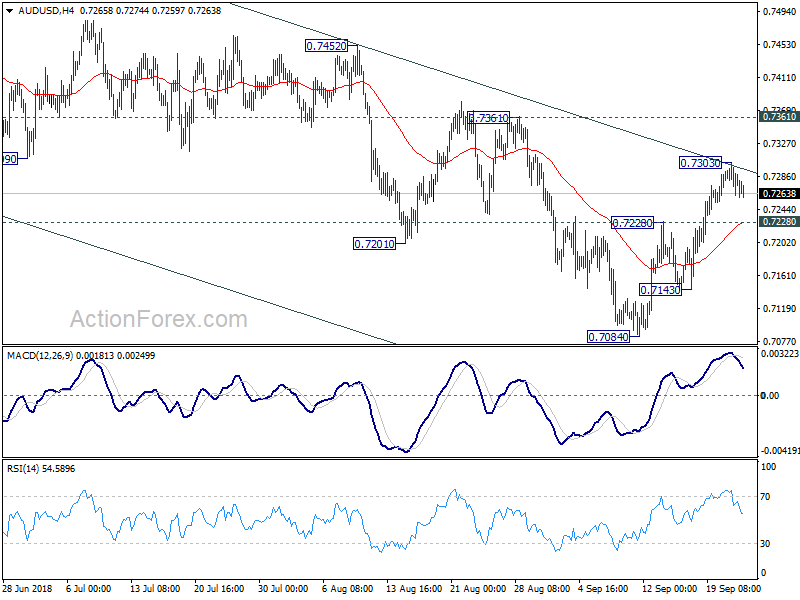
Intraday bias in AUD/USD remains neutral for the moment. On the upside, above 0.7303 will extend the corrective rise from 0.7084. But upside should be limited below 0.7361 resistance to complete the correction and bring down trend resumption. On the downside, below 0.7228 resistance turned support will turn bias back to the downside for 0.7143 first. Break there will likely resume larger fall from 0.8135 through 0.7084 low. However, sustained break of 0.7361 will carry larger bullish implication.
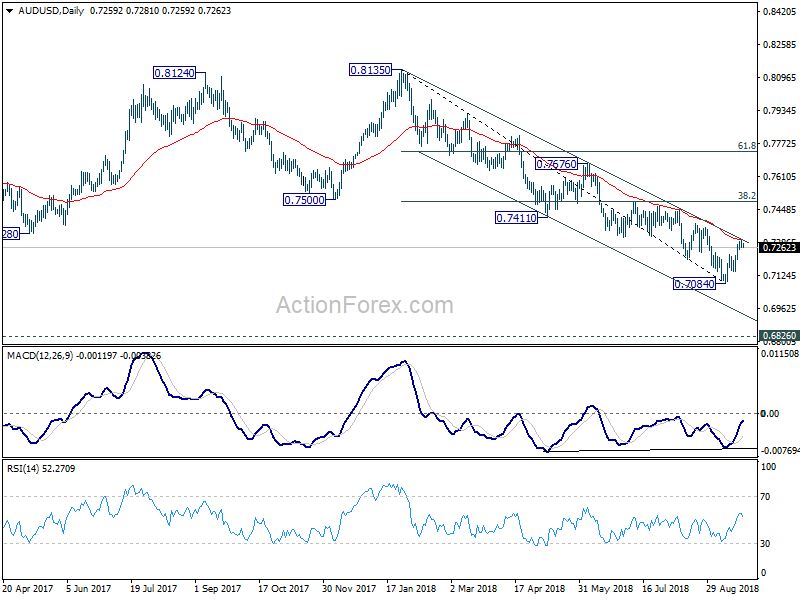
In the bigger picture, rebound from 0.6826 (2016 low) is seen as a corrective move that should be completed at 0.8135. Fall from there would extend to have a test on 0.6826. There is prospect of resuming long term down trend from 1.1079 (2011 high). Current downside momentum as seen in weekly MACD support this bearish case. Firm break of 0.6826 will target 0.6008 key support next (2008 low). On the upside, break of 0.7361 resistance, however, argues that a medium term bottom is possibly in place, and stronger rebound could follow. We'll assess the medium term outlook later if this happens.
USD/CAD Daily Outlook
Daily Pivots: (S1) 1.2887; (P) 1.2915; (R1) 1.2944; More...
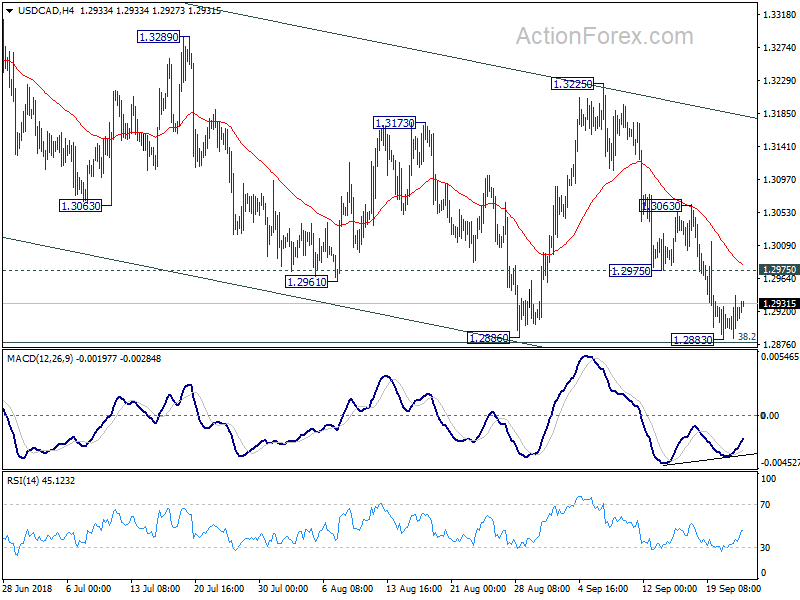
Intraday bias in USD/CAD remains neutral for the moment. At this point, it's held by 38.2% retracement of 1.2061 to 1.3385 at 1.2879. Thus, we're holding on to the bullish view that larger rise from 1.2061 is still in progress. On the upside, above 1.2975 support turned resistance will turn bias back to the upside for 1.3063 first. Break will target 1.3225 key near term resistance. However, sustained break of 1.2879 will dampen our view and target 50% retracement at 1.2723 next.
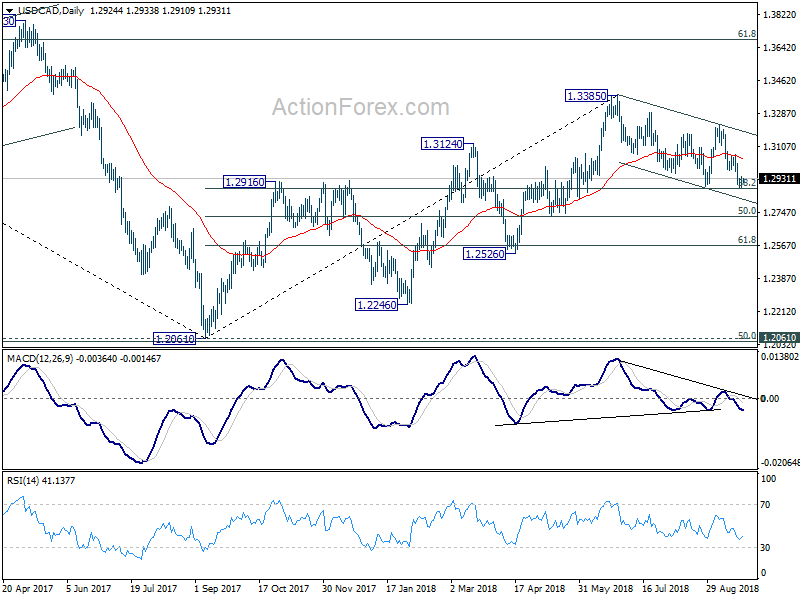
In the bigger picture, focus is back on 38.2% retracement of 1.2061 to 1.3385 at 1.2879 key fibonacci level. As long as it holds, rise from 2017 low at 1.2061 is still in progress. Break of 1.3384 should target 61.8% retracement of 1.4689 (2015 high) to 1.2061 (2017 low) at 1.3685. However, sustained break of 1.2879 will dampen his bullish view and turn focus back to 61.8% retracement at 1.2567, which is close to 1.2526 support.
Dollar Mildly Higher after US-China Trade Talk Cancelled
Asian markets open quietly with Japan and China on holiday. The tone is mixed as new round of US-China tariffs take effects today. At the time of writing, Dollar, Sterling and Yen are firmer ones. Commodity currencies are the weaker ones led by Aussie. A more notable move is indeed seen in WTI crude oil, which breaks 71 handle after OPEC during the weekend. Gold is trading slightly softer and is back below 1200.
The major focus this week is whether FOMC announce would help Dollar stay a sustainable rebound after last week's selloff. The greenback touched a key fibonacci support level of 1.1779 against Euro last week and recovered. But there is no confirmation of reversal yet. Meanwhile, Sterling will continue to be sensitive to any Brexit headlines after last week's EU informal summit ended with negotiation in a impasse.
Technically, it's a little but far but attention will be on 1.1649 minor support in EUR/USD, 0.7228 support in AUD/USD, 0.9651 in resistance in USD/CHF and 1.2975 resistance in USD/CAD.
China-US trade talk cancelled as Trump showed no sincerity and goodwill
Hong Kong's South China Morning Post reported that it's confirmed by unnamed source, China canceled the planned visit by Vice-Premier Liu He to the US on trade. This was on the ground that, as the Foreign Ministry said on Friday, "everything the US does hasn't given any impression of sincerity and goodwill".
Further, Trump said in a rally in Missouri last Friday that "we have far more bullets ... We're going to go US$200 billion and 25 per cent Chinese made goods. And we will come back with more ... If they retaliate, we have a lot more to come back with. And they want to make a deal, and let's see if we can make a deal."
NAFTA talks to continue ... informally, ahead of US imposed deadline
NAFTA talks will continue this week but only in informal way. Both Canadian Foreign Minister Chrystia Freeland and US Trade Representative Robert Lighthizer will be in United Nations General Assembly in New York on Monday and Tuesday. Canadian Prime Minister Justin Trudeau said "certainly the fact that many of our negotiators, many of our teams, will be in New York at the same time (means) it's very likely that conversations continue in a constructive but less formal way." There is no other formal arrangement known at this time.
At the same time, Trudeau didn't sound he would be obliged to the US-imposed deadline of October 1. He reiterated that he would not sign a bad NAFTA deal. And Canadian negotiation team won't be rushed. On the other hand, White House economic adviser Kevin Hassett said on Friday that the US is getting "very, very close" to move forward on a trade deal with Mexico without Canada. Mexican president-elect Andres Manuel Lopez Obrador said on Friday that "in the event that the governments of the United States and Canada do not come to an agreement ... we would have to maintain the bilateral deal with the United States and seek a similar deal with Canada."
WTI oil breaks 71 as OPEC ignores Trump and sticks with its own plan
Oil trades higher today as OPEC decided to ignore request by Trump and stick with it's June agreement on production. The committed said in a statement that it was satisfied "regarding the current oil market outlook, with an overall healthy balance between supply and demand". Also, it urged "countries with spare capacity to work with customers to meet their demand during the remaining month of 2018".
"The markets are adequately supplied. I don't know of any refiner in the world who is looking for oil and is not able to get it," Saudi Energy Minister Khalid al-Falih told reporters as OPEC and non-OPEC energy ministers gathered in Algiers. And, "given the numbers we saw today, that (an output increase in 2019) is highly unlikely unless we have surprises on the supply and demand."
Russian Energy Minister Alexander Novak also said no immediate output increase was necessary. He added "oil demand will be declining in the fourth quarter of this year and the first quarter of next year. So far, we have decided to stick to our June agreements."
The week ahead - FOMC to hike and focus on new projections
FOMC rate decision is the major focus of the week ahead. There is no doubt that Fed will raise federal funds rate by 25bps to 2.00-2.25%. Voting could be a point of interest as some doves have voiced concerns over flattening yield curve. But more importantly, the new economic projections could be most market moving. In particular, Fed's projections on the longer run federal funds rate. It's estimated to be at 2.9% in June projections. And it's the point where policymakers could see interest rate of being restrictive going beyond. This provides the anchor for assessing how far the current rate hike cycle would go. Any uplift in this figure would send Dollar and yields soaring.
RBNZ is another central bank meeting this week. It's expected to stand pat on monetary policy, with a neutral stance. That is, the next move could either be a hike or a cut. Though, it would be interesting to see how Governor Adrian Orr react to stronger than expected Q2 GDP. BoJ will release meeting minutes and summary of opinions too. ECB will release monthly bulletin.
Data flow will be busy too with German Ifo, US durable goods, trade balance and PCE inflation, China PMI manufacturing, Swiss KOF, Eurozone CPI and Canada GDP will catch most attentions. .
Here are some highlights for the week:
- Monday: German Ifo; CBI industrial orders; Canada wholesale sales
- Tuesday: BoJ minutes, CSPI; US house prices, consumer confidence
- Wednesday: New Zealand trade balance, ANZ business confidence; UK mortgage approvals, CBI realized sales; US new home sales; FOMC rate decision
- Thursday: RBNZ rate decision; German Gfk consumer climate; ECB monthly bulletin; US durable goods, trade balance, whole inventories, jobless claims, pending home sales, Q2 GDP final
- Friday: New Zealand building permits; Japan Tokyo CPI, unemployment rate, industrial production, retail sales, housing starts, BoJ summary of opinions; China Caixin PMI manufacturing; UK Gfk consumer confidence, current account, Q2 GDP final; Swiss KOF economic barometer; Eurozone CPI flash; Germany unemployment; Canada GDP, IPPI and RMPI; US personal income and spending, Chicago PMI
USD/CAD Daily Outlook
Daily Pivots: (S1) 1.2887; (P) 1.2915; (R1) 1.2944; More...
Intraday bias in USD/CAD remains neutral for the moment. At this point, it's held by 38.2% retracement of 1.2061 to 1.3385 at 1.2879. Thus, we're holding on to the bullish view that larger rise from 1.2061 is still in progress. On the upside, above 1.2975 support turned resistance will turn bias back to the upside for 1.3063 first. Break will target 1.3225 key near term resistance. However, sustained break of 1.2879 will dampen our view and target 50% retracement at 1.2723 next
In the bigger picture, focus is back on 38.2% retracement of 1.2061 to 1.3385 at 1.2879 key fibonacci level. As long as it holds, rise from 2017 low at 1.2061 is still in progress. Break of 1.3384 should target 61.8% retracement of 1.4689 (2015 high) to 1.2061 (2017 low) at 1.3685. However, sustained break of 1.2879 will dampen his bullish view and turn focus back to 61.8% retracement at 1.2567, which is close to 1.2526 support.
Economic Indicators Update
| GMT | Ccy | Events | Actual | Forecast | Previous | Revised |
|---|---|---|---|---|---|---|
| 08:00 | EUR | German IFO Business Climate Sep | 103.2 | 103.8 | ||
| 08:00 | EUR | German IFO Expectations Sep | 100.5 | 101.2 | ||
| 08:00 | EUR | German IFO Current Assessment Sep | 106 | 106.4 | ||
| 10:00 | GBP | CBI Trends Total Orders Sep | 7 | |||
| 12:30 | CAD | Wholesale Trade Sales M/M Jul | 0.40% | -0.80% |
Market Morning Briefing: Aussie Has Come Off From Crucial Resistance Near 0.73
STOCKS
Major stock indices have risen sharply breaking above the immediate resistances. While the rise sustains, the indices could rally in the near term. Overall stock indices look bullish.
Dow (26743.50, +0.32%) has moved up and tests resistance on the daily candle chart at current levels. A break on the upside could take it to upper resistance near 27000 in the near term. On the longer term charts, the index looks bullish for the medium term towards 27500.
Dax (12430.88, +0.85%) has moved up, breaking above the immediate resistance at 12400. A rise towards 12700 or even 12900 in the longer term looks possible.
Nikkei (23869.93, +0.82%) tested 24000 on the upside and could face some rejection there from the previous high seen in Dec’17. If, the index manages to see fresh highs, a rise towards 24500 or higher would be possible in the longer run. This would also favor Yen weakness in the medium to long term.
Shanghai (2797.48, +2.50%) tested 2800 and while the index sustains the current rise, re-test of levels near 2900 is possible.
Nifty (11143.10, -0.81%) tested 10900 on the downside on Friday dragged by the sharp fall in the realty stocks but recovered to close at higher levels. Some weakness could persist while below 11200.
COMMODITIES
Both Brent (79.73) and WTI (71.53) are trading higher. Brent managed to stay ranged in the 78-80 region. A break on either side would trigger further movement in the rest of the week. A rise on the upside is preferred while the earlier resistance turned support at 78 holds.
WTI has broken above immediate resistance near 70-71 and looks bullish in the near term. While above 71, WTI could target 74 on the upside.
Gold (1200.60) is finding difficulty to sustain above 1200 just now and is stable in the 1220-1190 region. A re-test of 1190-1185 on the downside cannot be negated and we do not see a near term rise above 1220.
Copper (2.8350) has risen towards 2.85 in line with our expectations. Some near term rejection is possible in the 2.85-2.90 region from where a short dip could be seen before the price resumes its upmove. Near term looks bullish.
FOREX
Watch the FOMC policy decision on Wednesday - it could prevent further Dollar weakness. However charts suggest otherwise for the Dollar Index.
Dollar Index (94.26): As mentioned on Friday, the break of the 21 weeks MA on weekly line chart makes the Dollar Index look bearish in the weeks ahead. It could move down to test horizontal support on daily candles near 93.20 by next week. Watch out for the FOMC on 26th Sep – a hawkish view could put a pause to Dollar weakness.
Euro (1.174) has immediate resistance in the 1.180-1.185 zone. Unless the FOMC strengthens the Dollar, the current preference is for Euro to breach 1.185 and tend towards higher resistance near 1.190-1.1925 (daily candles) by next week.
Dollar Yen (112.59) looks bullish towards its July ’18 high of 113.18 in the next 1-2 weeks – as mentioned on Friday, there could be some resistance in the 113.18-113.75 zone after that. If it breached 113.75 as well, the next upside target could well be near 115 in the medium term.
Euro Yen (132.19) came off after testing a high near 113.13 on Friday. The above forecasts on EURUSD and Dollar Yen imply a bullish Euro Yen - there is resistance on daily candles near 133.5-134.0 in the near term, which might get tested in this week. From the weekly line chart, it looks bullish towards 135 in the weeks ahead.
Pound (1.3077) fell on Friday to end the week below the 21 weeks MA at 1.313 on weekly line chart. If it breaks below 1.305, we can again start looking at the downside for Pound. However, while above 1.305, the some chances of bullishness towards 1.34 are still there.
Aussie (0.7269) has come off from crucial resistance near 0.73 on daily candles. While above 0.7200-0.7225, it could rise towards 0.74 in the next 1-2 weeks.
Dollar Rupee (72.22) Ranging between 72.60-80 on the upside and 71.80-60 on the downside could happen this week. Near term bearishness in Indian equities could limit Rupee strength this week.
INTEREST RATES
The Japanese 30 Year yield ( 0.88%) has breached resistance near 0.85% on long term chart. If it sustains this breach in the next few sessions, it could be a bullish indicator for global yields.
The FOMC on Wednesday is set to hike the federal funds rate by 25 bps - this hike has already been factored in by traders. The attention now shifts to the FOMC's indications for future rate hike decisions in Dec '18 and in 2019. Any dovishness or hawkishness on that front would be crucial for whether the 10 year yield stays below its 2018 high of 3.100%-3.125% or breaches it.
US 10 Year yield (3.06%) has come off after testing 3.10% once in the previous week. As mentioned on Friday, the important upside levels to watch out for are: 3.10%, 3.125% and 3.16%. Our current preference is for the yield to not breach 3.16% (800 weeks MA).
The 10 Year German-US spread (-2.60%) is at support on medium term chart near -2.6%. If it doesn't bounce from here in this week, then it could target lower interim support near -2.65% and ultimately move further down to support on long term chart near -2.70% to -2.80%.
Meanwhile, on the medium term chart, it looks like the German 10 year yield (0.46%) could rise towards 0.6% if it crosses above 0.5%. On the long term chart, there is room for a rise till 0.75% in the coming months.
Combining the views from the medium and long term chart of the German-US 10 year spread and the German 10 year yield, a rise to -2.65% to -2.75% and to 0.60%-0.75% on them respectively is possible – which thereby suggests that we should not rule out a possibility of a rise in the US 10 year yield towards 3.25%-3.50% in the remainder of 2018. The breach of 0.85% by the Japanese 30 Year yield further increases this possibility.
However, for now, we still see 3.16% as an important resistance which needs to be breached by the US 10 Year for higher levels to be tested.
EUR/USD Remains Supported Near 1.1700
Key Highlights
- The Euro made a nice upside move and traded above 1.1700 level against the US Dollar.
- There is a key bullish trend line in place with support near 1.1700 on the 4-hours chart of EUR/USD.
- The US Services PMI in Sep 2018 (Prelim) declined from 54.8 to 52.6.
- Today, the Chicago Fed National Activity Index (CFNAI) for August 2018 will be released, which is forecasted to decline from 0.13 to 0.02.
EURUSD Technical Analysis
This past week, the Euro climbed higher from the 1.1620 support against the US Dollar. The EUR/USD pair traded above 1.1700 and 1.1780 before starting a downside correction.
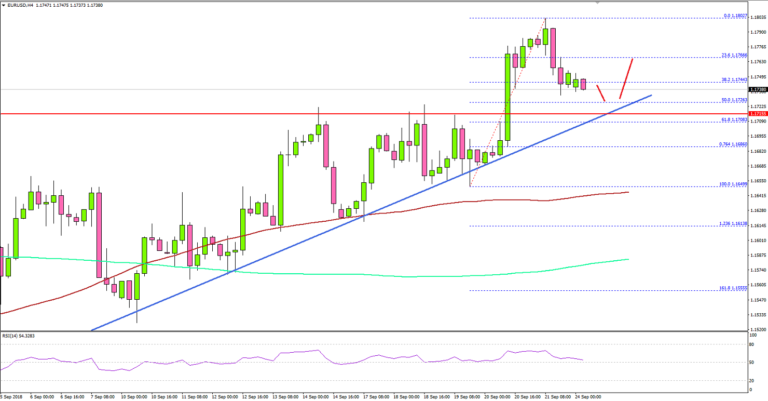
Looking at the 4-hours chart, the pair even spiked above the 1.1800 level and formed a high at 1.1802. Later, the pair started a downside correction and traded below the 1.1750 level and the 23.6% Fib retracement level of the last wave from the 1.1649 low to 1.1802 high.
However, there are many supports on the downside near the 1.1700-10 zone. There is also a key bullish trend line in place with support near 1.1700 on the same chart.
An intermediate support is the 50% Fib retracement level of the last wave from the 1.1649 low to 1.1802 high at 1.1726. Below the trend line, the pair could test the 1.1650 support and the 100 simple moving average (4-hours, red).
On the upside, a daily close above the 1.1800 level could ignite more gains in EUR/USD. The next resistance on the upside is near the 1.1840 level.
Fundamentally, the US Services Purchasing Managers Index (PMI) for Sep 2018 (Prelim) was released by Markit Economics this past Friday. The market was looking for a rise from the last reading of 54.8 to 55.0.
However, the result was disappointing as the Services PMI declined from 54.8 to 52.6, and the US Composite Output Index came in at 53.4 (17-month low), down from 54.7 in August.
Overall, the EUR/USD pair remains supported on dips near the 1.1700 level. Below this, there could be an extended correction to 1.1650. On the upside, a break above 1.1800 may push the pair towards 1.1840.
WTI oil breaks 71 as OPEC ignores Trump and sticks with its own plan
Oil trades higher today as OPEC decided to ignore request by Trump and stick with it's June agreement on production. The committed said in a statement that it was satisfied "regarding the current oil market outlook, with an overall healthy balance between supply and demand". Also, it urged "countries with spare capacity to work with customers to meet their demand during the remaining month of 2018".
"The markets are adequately supplied. I don't know of any refiner in the world who is looking for oil and is not able to get it," Saudi Energy Minister Khalid al-Falih told reporters as OPEC and non-OPEC energy ministers gathered in Algiers. And, "given the numbers we saw today, that (an output increase in 2019) is highly unlikely unless we have surprises on the supply and demand."
Russian Energy Minister Alexander Novak also said no immediate output increase was necessary. He added "oil demand will be declining in the fourth quarter of this year and the first quarter of next year. So far, we have decided to stick to our June agreements."
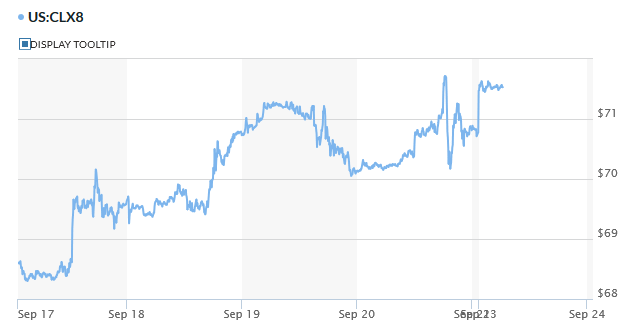
WTI crude oil is currently up 1.09% at 71.55.
GOLD – Risk Remains Lower With 1,187.00 Area Targeted
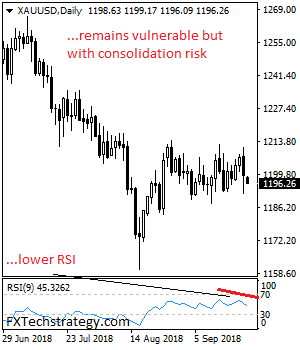
GOLD - The commodity continues to face risk of further downside pressure despite consolidation risk. On the downside, support comes in at the 1,190.00 level where a break will turn attention to the 1,180.00 level. Further down, a cut through here will open the door for a move lower towards the 1,170.00 level. Below here if seen could trigger further downside pressure targeting the 1,160.00 level. Conversely, resistance resides at the 1,210.00 level where a break will aim at the 1,220.00 level. A turn above there will expose the 1,230.00 level. Further out, resistance stands at the 1,240.00 level. All in all, GOLD looks to weaken further towards its key support.
China-US trade talk cancelled as Trump showed no sincerity and goodwill
Hong Kong's South China Morning Post reported that it's confirmed by unnamed source, China canceled the planned visit by Vice-Premier Liu He to the US on trade. This was on the ground that, as the Foreign Ministry said on Friday, "everything the US does hasn't given any impression of sincerity and goodwill".
Further, Trump said in a rally in Missouri last Friday that "we have far more bullets ... We're going to go US$200 billion and 25 per cent Chinese made goods. And we will come back with more ... If they retaliate, we have a lot more to come back with. And they want to make a deal, and let's see if we can make a deal."
Numerous Crosscurrents In Play
US equities
On Friday the Dow and S&P opened and closed again at fresh highs on massive volumes due to options expirations, and while headlines over the weekend suggested that trade talks between both US and China will be shelved until after the US midterm elections, markets will not view this in too much of a negative light. It's not so unexpected, and frankly, the US administration would be just as happy to keep trade wars out of the headlines ahead of the politically charge midterms where the Whitehouse will need to expend much political energy righting their political ship. But more importantly, the markets were viewing the November G-20 summit as a critical focal point where it's expected both Ji and Trump will take to the sidelines with the intentions agreeing on a roadmap to settle this trade dispute. Not to mention, backchannels will most likely be open. But make no mistake, this will be a bumpy ride and don't underestimate the possibility of the US announcing reviews of further China tariffs at some point in time given the Trump administration “modus operandi” of applying non-stop pressure.
Regardless, the astounding closing price action in equities last week, particularly the Shanghai composite and the US Indices suggest the markets are incredibly confident on a US-China trade deal by year-end, more Chinese stimulus to come, and hopefully a stable Yuan.
NAFTA
On the no less political contentious NAFTA 2 trade talks. Canada is expected to join a NAFTA 2.0 agreement. But the Quebec election falls on Oct 1, and with the Provincial Liberals pulling ahead in the polls every so slightly, it's debatable how much of a rush the Federal Liberals will be to ink a deal before month end. Especially given the political fallout from any concessions around the dairy industry, as the bulk of Canada's Milk industry is based in Quebec.
Focus
Traders will continue to monitor Chinese equities, DXY and copper.
Copper is fantastic leading indicators of risk and the economic cycle. Shanghai copper rose smartly on Friday bolstered by China's fiscal efforts to bump up demand.
US Yields
The US 10 yields finished the week above 3.05 % and could be setting the stage for a push higher. Rate differentials are still very much in favour of the USD story. But unlike when US yields rocketed higher in May, the UK and Canadian yields are breaking higher, while Japan is staying the top end of YCCC But more significantly Bunds are trading in the 50 bp region so there's a bit more yield competition for the dollar to contend.
The US dollar
Speaking of which, the USD could trade defensively ahead of this weeks FOMC as USD Bulls erring on the side of caution. With 2 US rates hikes priced into the balance 2018 and in the absence of inflation, it's almost impossible for the Feds to bump up the 2019 curve. So, the markets will end up focusing on shifts in the longball forecast into 2020 which is not the best or brightest of signals for currency traders who tend to view markets in much nearer time horizons. Even if the Feds prod 2020 curve higher, its unclear how much of a USD fillip that shift could deliver given that Chair Jay Powell has contiued to de-emphasise 2020 dots. Unless we get an unexpected shift in the Feds terminal policy range of 2.75-3.00%, not sure the dollar ( X -JPY) goes anywhere but trades within well-worn ranges.
Oil Markets
Last week oil prices were trading buoyantly on reports Saudis are more than happy with a Brent price above $80 or that OPEC, more generally, is not considering raising output. That was until President Trump castigated OPEC ahead of this weekends Algiers meeting.
However, Saudi Arabia and Russia ruled out any expeditious supply increases at the Algeria meeting while decidedly ignoring U.S. President Trump's call to increase supplies and easing price pressures. Not wholly unexpected mind you as the markets have been leaning toward December 3 OPEC summit for more formal decisions
WTI is trading the weekend news very favourably, up over 1 % at the NYMEX open and additionally spirited on by reports of inventories at the Cushing Oklahoma delivery point may have declined further in the week ended September 21.
But bullish sentiment could be tempered somewhat by several reports suggest ing OPEC producers generally agree that oil prices above Brent $80 a barrel would be too high. Which plays into the long-held market axiom that OPEC is looking to stabilise prices within the $70-80 $ sweet spot
Gold Markets
With risk sentiment soaring there has been very little demand for Gold and when you factor in the fact that Gold traditionally trades poorly ahead of anticipated Fed hike, the USD will have up ground to entice buyer back to the market.
G-10
Japanese Yen
The Yen continues to consolidate but with the BoJ continuing to float the idea of shiting policy for no other reason than to support the beleaguered banking sector after years of 0 % interest rates. These trial balloons could contiued to weight on the top side despite USDJPY getting massive support from the favourable interest rate differentials.
The Euro
I still think Italy risk is way underpriced and the Eurozone economic recovery is so uneven that the EURUSD could move lower given the US robust US economic story.
EM Asia
Hard to envision anything other the current account ( ca)deficit currencies remain vulnerable while ca surplus countries will contiued fare well.
The Chinese Yuan
China will move towards current account deficit and with interest rates likely to move lower to stimulate the economy the RMB will either trade weaker or remain stable at the at the CNY weakest levels of the current range.
The Malaysian Ringgit
The song remains the same. Positive updraft from global risk sentiment coupled with rising oil prices. But offset by increasing global yields, especially those in the US which lessens the appeal for local bonds.
The Rupee and Rupiah
As for the regional whipping boys IDR and INR, this a very complicated landscape and surging oil prices will continue to be an outsized problem for both currencies, And despite pledges to fix deficits, there has been no proof in that pudding. Instead, BI and RBI are coming up with creative yet very patchy methods of different interventions like the mandatory conversion for export proceeds in Indonesia, for example, or taking oil demand off the market in India.
Which brings us full circle, to this weeks FOMC, where it's expected both BI and RBI will raise interest rates to match next week Fed hike. So, their ongoing currency struggles will continue to make headlines. However, without addressing the real underlying problems around deficits, hiking interest rates to prop up currency is like putting a band-aid on a broken leg as speculators will continue to target deficit currencies at every opportunity.
Friday Rupee sell-off was directly related to the impact of the RBI raising interest rates which have reportedly caused a massive corporate default for a shadow lender in the housing sector and triggered a significant sell-off in local equity markets.
Ultimately the consumer pays the piper in any rate hike scenario.
NAFTA talks to continue … informally, ahead of US imposed deadline
NAFTA talks will continue this week but only in informal way. Both Canadian Foreign Minister Chrystia Freeland and US Trade Representative Robert Lighthizer will be in United Nations General Assembly in New York on Monday and Tuesday. Canadian Prime Minister Justin Trudeau said "certainly the fact that many of our negotiators, many of our teams, will be in New York at the same time (means) it's very likely that conversations continue in a constructive but less formal way." There is no other formal arrangement known at this time.
At the same time, Trudeau didn't sound he would be obliged to the US-imposed deadline of October 1. He reiterated that he would not sign a bad NAFTA deal. And Canadian negotiation team won't be rushed. On the other hand, White House economic adviser Kevin Hassett said on Friday that the US is getting "very, very close" to move forward on a trade deal with Mexico without Canada. Mexican president-elect Andres Manuel Lopez Obrador said on Friday that "in the event that the governments of the United States and Canada do not come to an agreement ... we would have to maintain the bilateral deal with the United States and seek a similar deal with Canada."